






Abstract
This comprehensive survey reviews the trajectory of research dissemination in the field of two-dimensional correlation spectroscopy (2D-COS) from 1 July 2023 to 10 February 2025. It provides a systematic overview of books, reviews, tutorials, and patent applications, alongside a vast array of innovative theoretical concepts and diverse applications that had emerged during this period. Beyond reporting advancements, this review critically examines instances of improper usage or citations of 2D-COS to promote methodological rigor within the community. The survey highlights significant innovations in probe integration, chemometric data analysis, and technical methodologies. These developments underscore the expanding role of 2D-COS in materials science, environmental monitoring, and complex biological systems. By synthesizing recent literature, this review illustrates dynamic growth, increasing refinement, and multi-disciplinary diversification of 2D-COS across the global scientific landscape.
This is a visual representation of the abstract.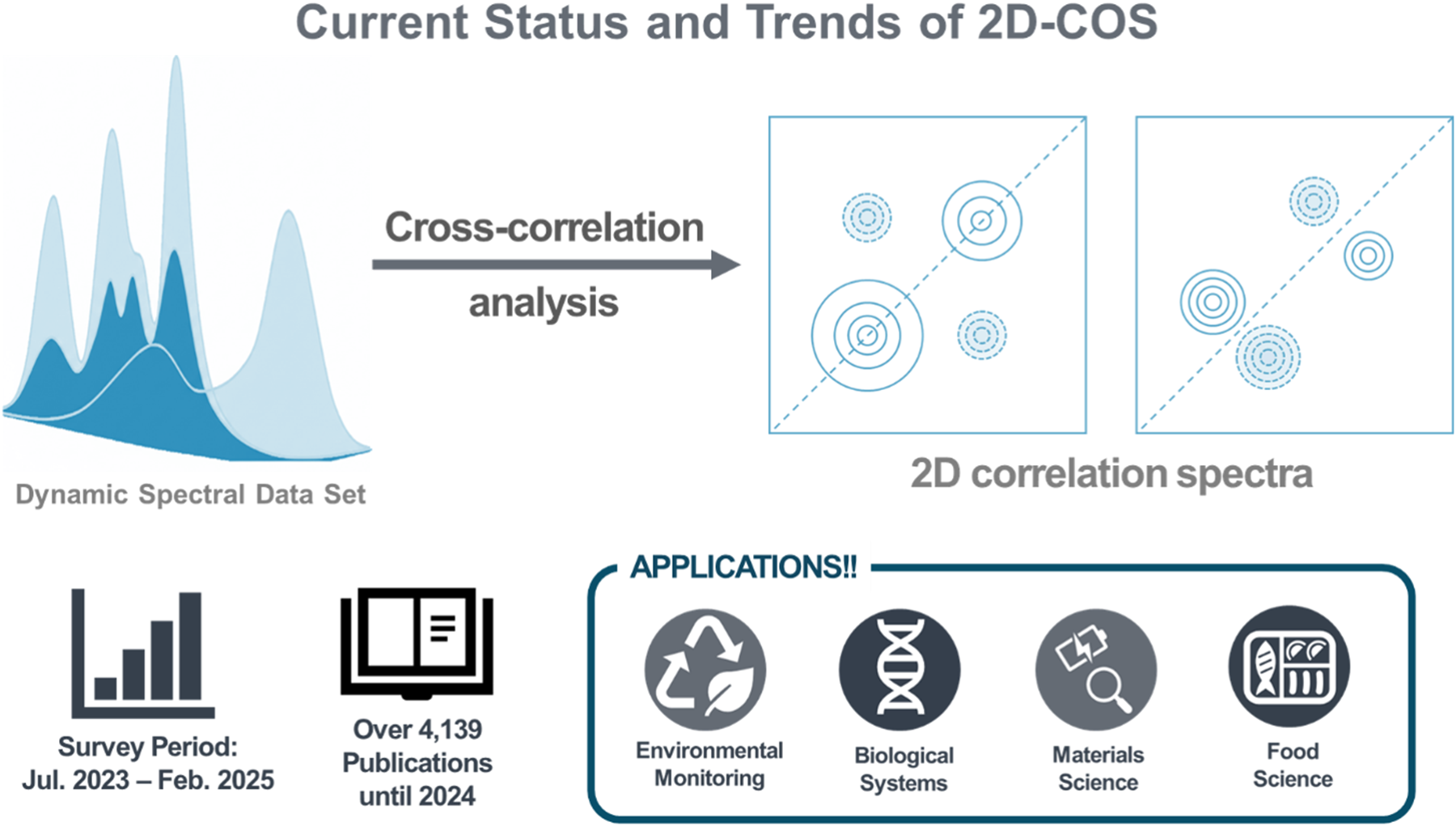
Introduction
This survey on two-dimensional correlation spectroscopy (2D-COS) and its related topics is a part of an ongoing series of comprehensive reviews in the field.1–15 The previous comprehensive survey was reported on 17 August 2023, during the remotely held 2DCOS-XII symposium coordinated from Chuncheon, Korea, and was subsequently summarized in Applied Spectroscopy [2025, Volume 79, Pp. 13–35 and 36–68).14,15
A foundational textbook 16 and two highly cited seminal papers17,18 continue to serve as convenient benchmarks for tracking the dissemination of 2D-COS literature. As of the current review period, the seminal paper 17 fomulating generalized the 2D-COS theory has reached 1,899 citations, while the other seminal publication 18 introducing the discrete Hilbert transform and the 2004 foundational textbook 16 have accumulated 875 and 420 citations, respectively. In addition, two additional classic papers of Noda, the first peer-reviewed article 19 and feature article, 20 are also recognized as fundamental works in the 2D-COS field. These figures underscore the lasting influence of early theoretical frameworks on modern spectroscopic analysis. As the most frequently cited articles within the 2D-COS field, these foundational works were extensively utilized to locate newly published literature during the compilation of the current review. Since the initial inception of 2D-COS in 1986, 21 a total of 4139 related papers have been published through 2024. The survey period for this update extends from 1 July 2023 to 10 February 2025. Following the trend observed in 2023, the annual publication volume continued to exceed 300 papers in 2024, demonstrating that the research output in the field is steadily accelerating.
The sustained prominence of 2D-COS stems from its unique capacity to enhance spectral resolution, resolve intra- and inter-molecular interactions, and establish a precise temporal sequence of events in dynamic systems. These intrinsic strengths were significantly amplified by the 1993 17 generalization of the theory and the subsequent development of computationally efficient algorithms 18 that made the technique accessible to a broader research community. Today, 2D-COS has evolved into an invaluable multidisciplinary tool capable of analyzing diverse samples and systems across a wide range of experimental conditions.
A particularly powerful aspect of 2D-COS is its ability to perform heterocorrelation analysis, where data obtained from different analytical probes, or even different samples, under identical conditions are fused to provide a coherent and synergistic view of complex systems. In 2024, the field maintained its strong momentum with 355 new publications, reflecting a robust annual research output that now consistently exceeds 300 papers.
This survey provides a systematic overview of books, reviews, tutorials, and patent applications, alongside a vast array of innovative theoretical concepts and diverse applications that emerged mainly during 2024. Furthermore, this work critically examines instances of improper usage or citations of 2D-COS to promote methodological rigor within the scientific community.
By highlighting significant innovations in probe integration, chemometric data analysis, and technical methodologies, this review underscores the expanding role of 2D-COS in materials science, environmental monitoring, and complex biological systems. Ultimately, by synthesizing recent literature, this survey illustrates dynamic growth, increasing refinement, and multi-disciplinary diversification of 2D-COS across the global scientific landscape.
Reviews and Tutorials
In recent years, several comprehensive resources have been published to guide researchers through the evolving landscape of 2D-COS. These publications range from high-level summaries of chemometric integrations to fundamental educational materials. Notably, Huo et al. 22 published a review paper on spectroscopy techniques combined with chemometrics and discussed 2D-COS with several other reviews.13,23,24 Morita and Noda 25 reported extensive and detailed tutorial book chapter on 2D-COS in Japanese. Muratova et al. 26 provided an extensive review with 184 citations given on 2D-COS up to 2023. This review covered history, theoretical background, open and commercial software, uneven sampling, heterospectral correlation, and sample–sample correlation. They tabulated a large number of applications with various analytical probes.
New Concepts, Techniques, and Theories
This section discusses the diverse concepts, techniques, and theories emerging in 2D-COS literature from 2024. It highlights significant developments, focusing on unique or unconventional approaches that have advanced the field.
2D-COS Combined with Chemometrics
In 2024, significant advancements were made in the synergy between 2D-COS and chemometric tools, such as principal component analysis (PCA), excitation–emission matrix (EEM) parallel factor analysis (PARAFAC), and partial least squares discriminant analysis (PLS-DA), which have greatly enhanced the discrimination and analysis of complex biological samples. For example, Aït-Kaddour et al. 27 proposed the novel PCA–two-trace two-dimensional correlation spectroscopy (PCA-2T2D-COS) concept, which compares principal component (PC) factors between reference and sample sets. Using this approach, they successfully classified and discriminated beef muscle types from different breeds. Their 2T2D analysis was based on comparing the mean spectra of individual images against the collective mean of each beef class as a reference. The features extracted from these correlations were then utilized for PLS-DA to enhance classification accuracy.
Chen et al. 28 explored a new chemometric integration by applying 2D-COS to fluorescence EEM data. Following a similar conceptual framework established by Shi et al., 29 the microbial bio-oxidation of lead (Pb0) in sludge incineration flue gas was monitored. By tracking the evolution of PARAFAC components across biofilm growth phases, they performed a heterocomponent correlation between component C1 (aromatic proteins/tryptophan) and C2 (humic-like substances). This analysis revealed that extracellular polymeric substances (EPS) play a critical role in the complexation of Pb2+, demonstrating the synergy between EEM-PARAFAC and 2D-COS in resolving complex biotransformation processes. Chen et al. 30 introduced a new concept of comparison of the PCA scores with moving-window 2D-COS (MW2D-COS) to investigate the volatilization process of botanical essential oils in a micro-emulsion-based transdermal drug delivery system. In this study, synchronous spectra were combined with chemometric PCA to segment the volatilization stages, successfully identifying the sequential evaporation of ethanol, water, and menthone.
Molecular Dynamics
Li et al. 31 introduced a novel computational framework by generating 2D-COS from ab initio molecular dynamics (AIMD) simulations under isothermal–isovolumetric conditions. They applied this concept to 2D time-domain terahertz (THz) spectroscopy to compare vanillin polymorphs I and II, utilizing atomic velocities to construct the correlation maps. By analyzing the synchronous spectra, they successfully visualized the complex mode couplings of vibrations, providing deep insights into the polymorphic structural differences. Pejov et al. 32 proposed a new concept based on 2D-COS analysis of temperature-perturbed anharmonic IR spectra of rutile (TiO2) obtained by molecular dynamics simulation. They successfully elucidated the complex mode coupling behavior and vibrational dynamics within the crystal lattice.
Two-Trace Two-Dimensional Correlation Spectroscopy (2T2D-COS)
Since its introduction, 2T2D-COS has become a widely adopted concept,27,33–41 joining the ranks of heterocorrelation spectroscopy, MW2D-COS, and perturbation-correlation MW2D-COS (PCMW2D-COS) in diverse analytical applications. Sun et al. 33 applied 2D visible–near-infrared (Vis-NIR) spectroscopy to monitor the freshness of pork during the aging process. They introduced a new concept of evolving 2T2D-COS, where the average spectrum was used as the reference and individual time dependent spectrum as the sample to obtain a series of 2D-COS images. These images are used for a chemometric deep learning model of dual-branch convolutional neural network (CNN) analysis to predict the total volatile basic nitrogen content. Unlike many other problematic recent applications of 2D-COS images in deep learning models, the perturbation variable and sampling order were explicitly defined in this study. Furthermore, to address the issue of the black box nature of deep learning model, gradient-weighted class activation mapping (Grad-CAM) was utilized to highlight the most effective region of the input images.
New Techniques and Approaches
Dabrowska et al. 42 reported an intriguing new technique using mid-IR dispersion spectroscopy, which measures refractive index spectra instead of absorption. This experimental setup combined a tunable quantum cascade laser (QCL) with a Mach–Zehnder interferometer (MZI) to monitor the reaction process involving the enzymatic cleavage of sucrose by invertase and subsequent mutarotation of glucose and fructose. Zhao and Zhou 43 introduced a novel approach of combining two separate pretreatment variables of the irradiation time and Fe(VI) dosage as a single perturbation. This approach was used to prevent ultrafiltration membrane fouling by the treatment of combined ultraviolet (UV) irradiation and ferrate (Fe(VI)). They observed the degradation of pollutants by active species, Fe(V), Fe(IV),˙OH, and O2˙−, and coagulation induced by the in situ production of Fe(III).
Others
Gupta and Verma 44 provided an intriguing theoretical new concept on multidimensional spectroscopy based on the multiple time delays in autocorrelation analysis of relaxation processes. While this article does not directly relate to the conventional 2D-COS, it may open up a promising possibility for complex cross correlation used in 2D-COS. Neymeyr et al. 45 did not directly address a standard 2D-COS study but introduced a new concept for comparing similarities between vector subspaces, each of which is spanned by two or more vectors, using the 2D canonical (or principal) angle plots. They mentioned Noda’s 1989 paper, 19 stating, “There is also a remarkable similarity between these correlation plots and 2D IR correlation spectrum in time-resolved IR spectroscopy as proposed by Noda, 18 but the underlying mathematical formula and the meaning of the calculated quantities are different”. Ren et al. 46 reported a highly unusual and novel concept of applying 2D-COS beyond spectroscopy to the Biolog EcoPlate carbon source assay. This approach was used to investigate soil carbon mineralization in rubber plantations across different incubation ages, reflecting the metabolic dynamics of soil microorganisms. By applying correlation analysis to the metabolic data, they successfully revealed the sequential utilization of soil components, including carboxylic acids, carbohydrates, amines, polymers, and amino acids.
Su et al. 47 proposed an interesting new concept of using the different sources of humic acid (HA), such as chicken manure, rice straws, and lawn waste, as the perturbation variable for 2D-COS. By integrating 2D-COS with EEM PARAFAC fluorescence data, they performed a heterocomponent correlation analysis of emission loadings. This innovative approach successfully elucidated the adsorption process of compost HAs onto phenanthrene. Zhou et al. 48 presented an intriguing study applying 2D-COS to hydrochemistry, exploring a novel concept by using urbanization as a perturbation. They analyzed three decades of hydrochemical data, specifically the concentrations of various cations and anions in karst underground river water, to monitor environmental shifts. For a detailed comparative analysis, the dataset was divided into two distinct blocks: the period before rapid urbanization and the period during urbanization. Although a minor problem of the switching of the symbols for ϕ and ψ was noted for the synchronous and asynchronous spectra, they focused primarily on the synchronous spectra to identify key correlations in the water chemistry.
Unusual Concept, Technique, and Theory
Al Lafi et al. 49 presented an intriguing study rich in various uncommon applications of 2D correlation techniques, to investigate the phase transition and physical aging of poly(N-vinyl carbazole). This polymer is of particular interest as it exhibits unusual two glass transition temperatures, which they explored in detail to resolve the underlying molecular dynamics. Interestingly, they adopted the terminology “2D correlation mapping” instead of “spectroscopy”, which is appropriate given that the analysis was applied to differential scanning calorimetry (DSC) thermograms obtained under varying annealing temperatures and durations. This analysis revealed that annealing below two glass transition temperature (Tg) values resulted in the distinct angle and butterfly peak cluster patterns indicating the clear presence of peak shift attributable to the relaxation of different stereo-chemical chain segments. Furthermore, the study explored advanced methodologies, including hybrid 2D correlation 50 and multiple-perturbation 2D correlation 51 to evaluate the complex interplay between annealing time and temperature. Xue et al. 52 applied 2D-COS to laser-induced breakdown spectroscopy (LIBS) to analyze sea salt aerosols using high repetition rate low pulse energy laser with varying laser repetition rates. By using the laser repetition rate as a perturbation variable, they identified distinct analyte-specific responses, which were then utilized for the spectral reconstruction of the analytes. They indicated that the spectral components related to the particles and air species were differentiated.
Discussions, Citations, and Mentions
Some publications touch upon or cite 2D-COS without making it the primary focus of the study.
Bratasyuk et al. 53 discussed application of 2D IR correlation spectroscopy in the review of water absorption process in epoxy coatings. Chen et al. 54 discussed the use of 2D-COS for the quality control of various traditional Chinese medicines in this book chapter. Cheng et al. 55 briefly mentioned 2D-COS only as a form of covalence mapping in their review on Coulomb explosion mapping. Fang et al. 56 briefly discussed non-uniform sampling and covariance-based 2D nuclear magnetic resonance (NMR), which is equivalent to the synchronous 2D-COS. He et al. 57 reported an article on a deep learning model of silkworm pupae identification, in which 2D-COS was mentioned. However, they misleadingly described 2D-COS as a tool for simply converting a set of 1D spectra into 2D images.
Hore 58 extensively discussed the applications of 2D-COS in the perspective tutorial on sum frequency generation (SFG) spectroscopy. Li et al. 59 presented the application of fluorescence spectroscopy toward the analysis of dissolved organic matter (DOM) and metal ion binding, covering a number of significant discussions in the perspective review. These include the use of EEM-PARAFRAC component spectra, 2D-COS of synchronous fluorescence spectra, which are slices of EEM and moving window 2D analysis. Middleton 60 discussed in their review of 2D NMR studies of amyloid fibrils the use of covariance processing, introduced by Brüschweiler and Zhang, 61 to the 2D spectra to enhance weak intermolecular cross-peaks between peptide and ligand. This method is conceptually similar to synchronous correlation. Zhang et al. 62 also briefly mentioned covariance 2D NMR, 61 which again is equivalent to synchronous correlation of NMR data, in their perspective article on solid-state NMR studies of polymers. However, the adoption of this type of analysis in NMR field still remains relatively slow.
Tong et al. 63 discussed use of 2D-COS IR in the review on the interfacial interactions between minerals and environmental organic matter. They noted that 2D-COS enables improved spectral resolution, identification of characteristic peaks, and determination of sequence of spectral intensity changes. Yingngam 64 mentioned 2D-COS in the book chapter on the convergence of ethno-biological knowledge of spice seeds and scientific advancement. However, the improper citations for earlier dynamic 2D-COS based on polymer stretching seems somewhat problematic.
Patent Applications and Non-English Articles
Patents and articles published in foreign languages, particularly in Chinese journals in 2024, highlight additional important developments in 2D-COS. Two patent applications related to 2D-COS have been filed in Chinese. Wang et al. 65 filed a Chinese patent applying 2D-COS to Vis-NIR spectroscopy for salted eggs at varying pickling levels. They used only synchronous spectra for wavelength selection and developed a chemometric convolutional neural network model to assess egg quality levels. Zang et al. 66 filed a Chinese patent application on 2D-COS for self-assembly process of supramolecular hydrogel formation for sustained release applications. It consists of carbamazepine nanofiber by adding deuterated water to the solution of carbamazepine and N-fluorenemethoxycarbonyl phenylalanine dipeptide in deuterated DMSO. They identified the order of group changes and intermolecular interactions.
Although 2D-COS research is predominantly published in English, some articles and patents have appeared in Chinese (10) and Japanese (1) sources. Even with the recent advancement in machine translation software, publication of articles in non-English local languages remains a critical factor to be encouraged in reaching out to a greater scientific community.
Wide Range of 2D-COS Applications
In 2024, the scope of 2D-COS expanded significantly, reinforcing its status as a versatile analytical powerhouse across diverse scientific domains. The inherent adaptability of this technique in processing a vast array of data types, ranging from traditional IR and Raman spectra to advanced EEM fluorescence, LIBS, and DSC thermograms, has established it as a preferred methodology for unraveling the complexities of multicomponent systems.
Types of Analytical Probes
Figure 1 illustrates the distribution of various analytical tools reported in the 2024 literature. The 2D-COS technique has been utilized across several spectroscopic modalities, most notably IR, fluorescence, Raman, NIR, and UV–Vis spectroscopy. Among these, IR spectroscopy was the most prevalent, accounting for 67% of the applications, followed by fluorescence (14%), NIR (8%), and Raman (5%) spectroscopy.
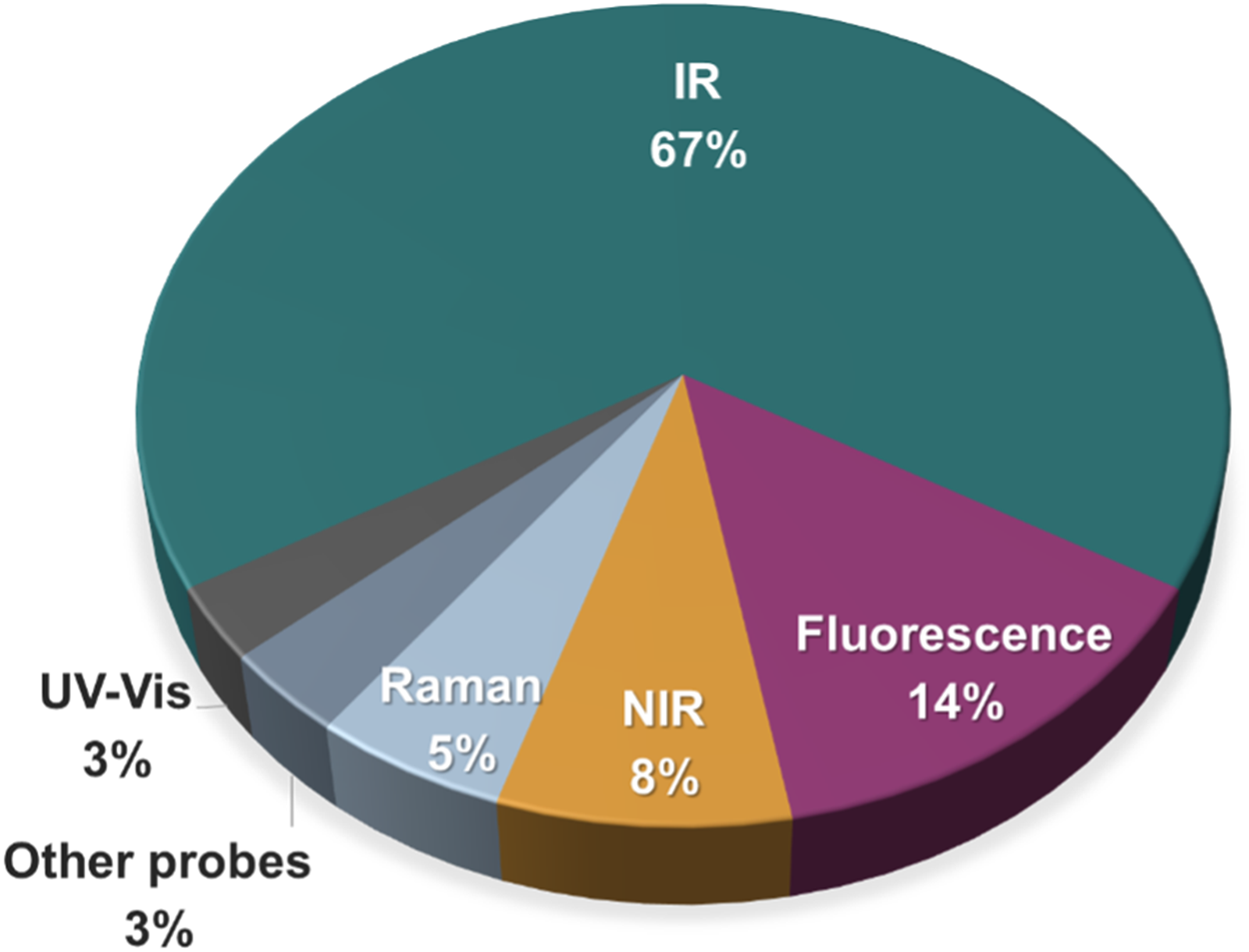
Recent trends of analytical tools in 2D-COS field.
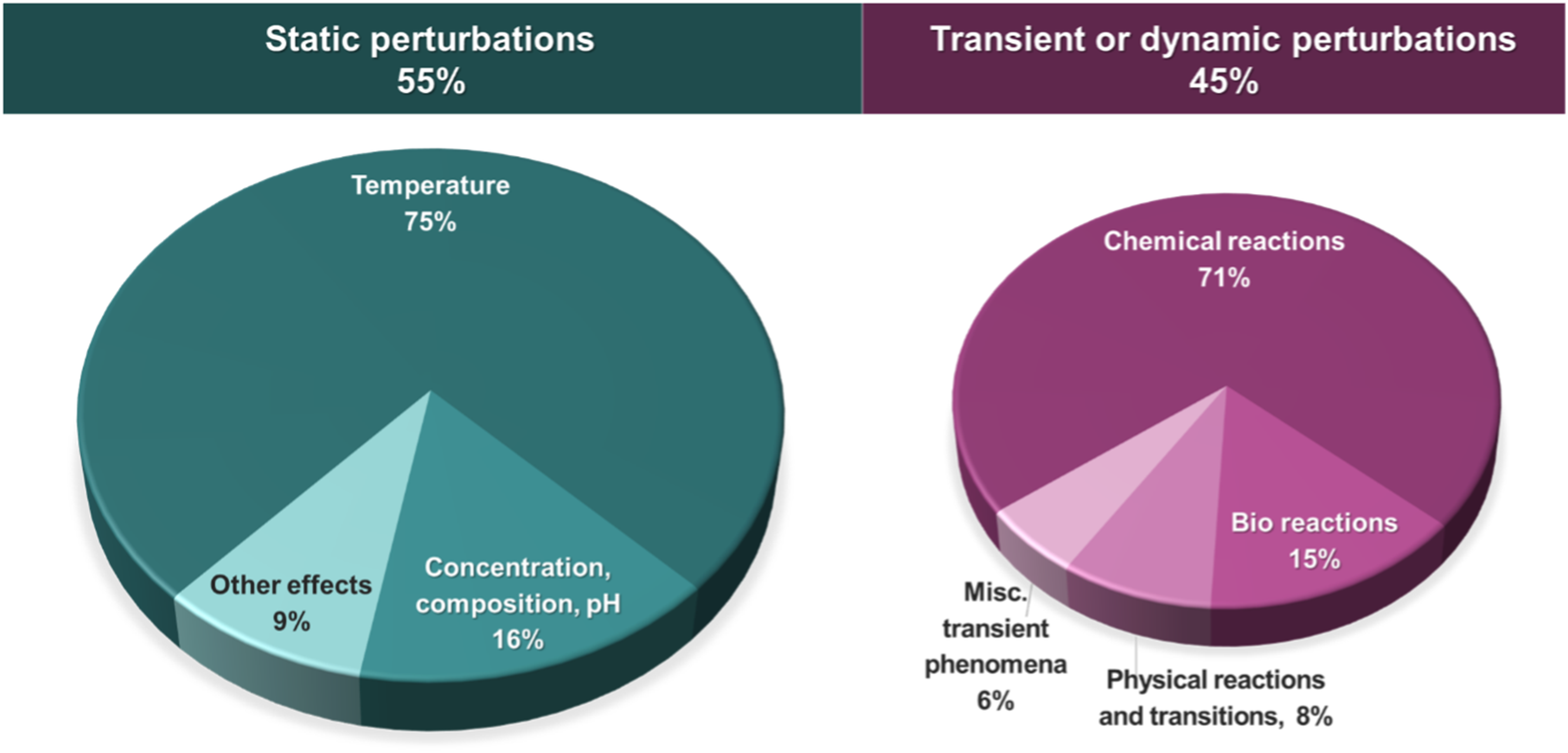
Recent trends of perturbation in 2D-COS field.
Infrared (IR) Spectroscopy
In 2024, IR spectroscopy-based studies remained dominant, focusing primarily on environmental remediation, the elucidation of mechanisms in polymer materials, and the detection of minute structural changes in biomolecules. With 252 reported publications, 2D-COS was utilized across various IR techniques,30,32–35,37,42,47,53,54,63,66–291 including the attenuated total reflectance (ATR) technique,35,53,70,71,86,90,94,108,126,142–144,154,171,174,189,193,198,202,206,213,229,231,236,246,250,252,275,278 thermogravimetric analysis (TGA) coupled IR spectroscopy (TGA-IR),88,95,102,145,157,158,175,230,239 diffuse reflectance infrared Fourier transform spectroscopy (DRIFTS),132,196 synchrotron radiation,216,267 dispersion spectroscopy, 42 and surface-enhanced infrared reflection absorption spectroscopy (SEIRAS) 120 as well as photothermal imaging 204 and dichroism. 37 Furthermore, IR spectroscopy was frequently heterocorrelated with fluorescence spectroscopy,123,165,184,188,190,211,257,273 near-IR (NIR) spectroscopy, 126 mass spectroscopy (MS),88,116,169 and UV–Vis spectroscopy. 190
Fluorescence Spectroscopy
According to 2024 literature, fluorescence spectroscopy, in combination with 2D-COS study, was widely used to analyze changes in the chemical properties of organic matter, interactions with metal ions, and the state of biological samples.
Among the reports involving 2D-COS and fluorescence spectroscopy, 2D synchronous fluorescence correlation analyses59,73,81,92,93,112,113,128,133,138,160,165,172,188,190,211,215,224,238,257,264,273,276,288,292–304 remain the most prevalent approach, appearing in more than 71% of these studies. In contrast to standard fluorescence techniques that record all emissions simultaneously, synchronous fluorescence spectroscopy selectively captures signals that meet a specific wavelength difference. This procedure acts as a specialized filter, transforming a crowded and overlapping spectrum into a much sharper and more precise representation of the sample. Some papers were used in combination with EEM PARAFAC and EEM emissions,28,47,59,122,289,304–311 also were used in this field. Studies utilizing 2D heterospectral correlation analysis have also been reported. These primarily involved the heterocorrelation of fluorescence spectroscopy with IR spectroscopy, 123,165,184,188,190,211,257,273 while a single study explored the correlation between fluorescence and UV–Vis spectroscopy. 297 Heterocomponent analysis28,47,293,304,306,308,311,312 among EEM PARAFAC components was further used to examine the relationship between different spectral features originating from distinct chemical constituents within the same system.
Near-Infrared (NIR) and Raman Spectroscopy
Studies applying 2D-COS to NIR spectroscopy27,33,40,57,65,126,313–336 represented 8% of the total analytical applications in 2024. Vis-NIR spectroscopy27,33,65,314,315,322,325,328,330,332 emerged as the primary technique (10 papers), encompassing both imaging27,40,314,331 and reflectance-based studies.126,322,328,331 The remaining literature showcased a wide array of specialized approaches, with single occurrences of diffuse reflectance, 126 portable spectroscopy, 320 and various imaging modalities such as reflectance 331 and spectral 40 imaging. Furthermore, a NIR/IR heterospectral correlation study was also reported. 126
In 2024, Raman spectroscopy was actively integrated with 2D-COS to detect precise chemical transitions across diverse fields, such as food authentication, disease diagnosis, and nanomaterials analysis. Notably, these Raman spectroscopy-based studies36,39,41,70,263,270,316,337–349 accounted for 5% of the total 2D-COS publications reported this year.
Other Probes
Studies employing UV–Vis spectroscopy accounted for 3% of the analytical probes used in 2D-COS. Notable reports in 2024 included heterospectral correlation analyses between UV–Vis and fluorescence 297 as well as UV–Vis and IR 190 spectroscopy. In addition to the tools referenced above, the 2D-COS was extended to a diverse array of probe types, such as, DSC, 49 hydrochemistry, 48 LIBS, 52 MS,169,340,350 NMR,56,60,350 SFG, 58 soil carbon assay, 46 THz, 31 wide angle X-ray diffraction (WAXD), 351 and X-ray absorption near edge structure (XANES). 352 Significantly, 2D-COS was applied to hydrochemistry and soil carbon assays for the first time, marking a significant expansion of the analytical horizons for this methodology.
Perturbations
As shown in Figure 2, the 355 papers published in 2024 utilizing 2D-COS can be categorized by their perturbation modes: 55% focused on static variables, including temperature, concentration, composition, pH, magnetic, strain, electric field, and others. In contrast, the remaining 45% of the literature employed dynamic perturbations, highlighting a strong research interest in the real-time monitoring of chemical, biological, and physical reactions.
Temperature
Among the various static perturbations, temperature was the most frequently utilized parameter, accounting for 75% of the studies in this category. Within this framework, 2D-COS has become an indispensable tool for elucidating the complex mechanisms of pyrolysis and the dynamic behavior of hydrogen bonding. These studies leverage the exceptional sensitivity of 2D-COS to track the sequential functional group changes during thermal decomposition and to resolve the subtle dissociation or rearrangement of hydrogen-bonded networks.
For example, Chen et al. 88 used 2D IR and 2D IR/MS heterospectral correlation spectroscopy to investigate the co-pyrolysis of Zn/Cd accumulating soil remediation plant Pfaffia glomerata with kaolin or modified kaolin under varying temperature. They demonstrated that the addition of minerals synergistically affected the decomposition of volatile compounds. The same group 89 employed 2D TGA-IR correlation spectroscopy to monitor the combustion of post-harvest soil photo-remediation biomass (Pfaffia glomerata) across a range of temperatures. They revealed the distinct reaction mechanisms and gas evolution patterns emerging under oxy-fuel versus air combustion conditions. Jia et al. 145 utilized 2D TGA-IR correlation spectroscopy to monitor the pyrolysis of ginger with increasing temperature aimed at bioenergy generation. They indicated that devolatilization was the primary phase of the reaction. Kumar et al. 157 examined the co-pyrolysis of lipid-isolated algae Chlorella vulgaris and sewage sludge with increasing temperature using 2D TGA-IR correlation spectroscopy. They showed that copyrolysis synergistically improved hydrocarbon production and inhibited the formation of nitrogenous and oxygenous compounds. They 158 also investigated the pyrolysis of medical wastes under varying temperature utilizing 2D TGA-IR correlation spectroscopy. They revealed the comprehensive perspective on the emission profiles of volatile substance functional groups and their stages of evolution. Lin et al. 175 investigated the co-pyrolysis of textile dyeing sludge with 3D printing waste by applying 2D TGA-IR correlation spectroscopy. They concluded that the temperature-dependent variations of pyrolysis gaseous products were affected by mixing.
Chen et al. 87 prepared biochar under different pyrolysis temperature used for the accelerated carbonation curing of cement mortar. By applying 2D IR correlation spectroscopy they revealed the evolution trends of functional groups within biochar upon pyrolysis observing that a reduction in oxygen-containing functional groups directly hindered its CO2 chemical adsorption capacity. Ding et al. 103 applied 2D IR correlation spectroscopy to investigate the catalytic pyrolysis of polyvinyl chloride (PVC) under different temperatures in the presence of iron oxides. They demonstrated that ferrihydrite with larger specific surface showed better chlorine fixation than hematite. Li et al. 169 employed an innovative combination of temperature-dependent 2D Fourier transform ion cyclotron resonance (FT-ICR) MS and 2D IR correlation spectroscopy. They integrated with IR/MS heterospectral correlation and O/C versus H/C ratio hetero-element correlation spectroscopy, to elucidate the formation dynamics of water-soluble dissolved organic carbon (WSOC) derived from biomass pyrolysis smoke. They determined the sequential evolution of functional groups in response to increasing pyrolysis temperatures. Liu et al. 177 examined the catalytic pyrolysis of marine oily sludge with increasing temperature in the presence of coal gangue, which is a natural solid waste containing various minerals produced during coal mining, affecting the thermal decomposition characteristics.
Liu et al. 178 applied 2D IR correlation spectroscopy to reveal the effect of varying temperatures used for the pyrolysis of municipal sludge-based biochar from pig manure composting on humification and oxytetracycline degradation. They identified the evolutionary sequence of functional groups leading to an increase in aromaticity and humic precursor substances content. Wang et al. 248 studied the adsorption of pollutant 2,4,4’-trichlorobiphenyl onto biochar colloids derived from bamboo chip pyrolysis under different temperatures. They concluded that the photodegradation of the pollutant decreased with increasing pyrolysis temperature due to changes in the degradation pathways. In this study, only synchronous correlation auto-power spectra were used. Wang et al. 238 employed 2D IR and 2D synchronous fluorescence correlation spectroscopy to observe the binding of pharmaceuticals, such as sulfathiazole, acetaminophen, chloramphenicol, and carbamazepine, onto DOM released from biochar made by pyrolysis under different temperatures. They revealed that the higher pyrolysis temperature tended to provide higher binding affinity.
Jin et al. 153 observed the changes in hydrogen bonding interactions within a zwitterionic binder under varying temperature. They demonstrated that this binder chemistry creates electrically charged microenvironment for silicon-based anode, which regulates the solvation environment to enhance the stability of lithium-ion batteries. Li et al. 162 employed 2D IR correlation spectroscopy to monitor the changes in various hydrogen bonding interactions within fiber-reinforced epoxy composites. This system featured carbon fibers surface-modified with hyper-branched polyamide (PA)-amine and graphene oxide (GO), and the analysis revealed their dynamic response to temperature variations. Sun et al. 222 investigated the low-hysteresis polymeric ionogel containing ionic liquids made by the supramolecular self-assembly of quadruple hydrogen bonds under varying temperature. They revealed that the thermal responses of hierarchical nanoaggregates using 2D IR correlation spectroscopy. Tian et al. 324 applied 2D NIR correlation spectroscopy to elucidate the spectral features of aqueous hyaluronic acid solution reflecting five distinct species of water molecules based on their thermal response. By combining these specific spectral signatures with a chemometric deep learning model, they significantly enhanced the accuracy of the concentration calibrations.
Qiao et al. 212 probed the interaction between cellulose membrane and saccharide-based ionic liquids with chlorine anion under temperature changes. From the analysis of PCMW-2D IR correlation spectra, they observed that the inter- and intramolecular HO···H hydrogen bond of cellulose were reduced and replaced by Cl···HO hydrogen bonds. Wei et al. 251 investigated the dissolution and regeneration of cellulose in ionic liquid solvent 1-ethyl-3-methylimidazolium diethyl phosphate under varying temperature. Using 2D IR correlation spectroscopy, they observed the dynamic changes in the hydrogen bonding network during these thermal transitions.
Xu et al. 258 characterized and revealed the diverse states of hydrogen bonding in hydroxypropyl methyl cellulose modified by the in situ polymerization of methyl acrylic acid under varying temperatures. Zhang et al. 353 demonstrated a conductive hydrogel for fabricating triboelectric nanogenerators based on double network of glucan and cross-linked poly(hydroxyethyl acrylate-co-acrylic acid) under varying temperature. They revealed that hydrated lithium ions act as a key component, playing a crucial role in maintaining both ionic conductivity and structural stability under thermal perturbations. Zubir et al. 354 investigated the complex formed by the adsorption of phenol onto kaolin under varying temperature. Using 2D-COS, they observed the dissociation of hydrogen bonds between phenol hydroxyl groups and the kaolin siloxane surface.
Concentration, Composition, and pH
In 2024, chemical perturbations including concentration, composition, and pH were widely employed to investigate molecular dynamics. Researchers monitored various systems, such as salt-ion coordination, pH-dependent protein structures, and nutrient release sequences.
For example, Wang et al. 247 analyzed solutions of lithium bis(trifluoremethane sulfone)imide (LiTFSI) and propylene carbonate with varying lithium salt concentrations using the excess spectra. By proportionally subtracting pure component spectra, they identified several distinct lithium-ion species and their coordination environments within the electrolyte. Li et al. 171 examined the competitive adsorption of Cr(VI) onto lepidocrocite in the presence of L-aspartic acid with varying pH. They indicated that rod-shaped lepidocrocite with more (001) facet exhibited stronger adsorption than plate-like one with more (010) facet. Liu et al. 179 elucidated the secondary structures of soy protein isolate under varying pH. They selected characteristic bands for a chemometric predictive model, especially bidirectional long short-term memory (BILSTM) analysis. Liu et al. 187 examined the nutrient release of activated sewage sludge by thermal treatment with varying pH. Using 2D IR correlation spectroscopy, they monitored the release sequences of nitrogen- and phosphorus-containing organics.
Wang et al. 229 investigated Cr(VI) adsorption onto a mineral schwertmannite across various concentrations and pH levels. Using 2D IR correlation spectroscopy, they revealed that multiple sulfate states within the mineral significantly influence surface properties and competitive adsorption mechanisms for chromium ions. Zhang et al. 355 reported a paper in Chinese on application of 2D-COS to pH-induces dissolved black carbon from pyrolysis. They found that the protonation occurred mainly at the carboxyl and phenol-containing groups. Zhang et al. 332 probed the spectral characteristics of the saltwort species Suaeda salsa in coastal wetland using 2D Vis-NIR correlation spectroscopy. By varying chlorophyll contents as the primary factor, they monitored vegetation dynamics in combination with the chemometric PROSAIL-D model. They used only synchronous spectra to facilitate feature selection and identify key wavelengths most sensitive to chlorophyll fluctuations.
Other Static Effects
In 2024, the field of 2D-COS continued to expand its versatility by incorporating a remarkably wide array of external perturbations. Beyond traditional thermal or chemical changes, recent studies have utilized diverse perturbation variables such as thermal macro-fingerprinting, 119 environmental and geographic factors,190,303,307,319,340 biological and medical indices,34,35,315,322 physical and mechanical stress,37,80,160,183,249,259,348,356 electromagnetic and optical stimuli,43,52,91,120,200,343 and process and material engineering.39,65,293,350 For example, Gao et al. 119 applied three-stage macro-fingerprinting with temperature perturbation to evaluate the traditional Chinese medicine (TCM) Crataegi Fructus (hawthorn) across various thermal processing. By employing only synchronous spectra for discrimination, they identified presence of carcinogenic 5-hydroxymethylfurfural in some cases.
In environmental and geographic studies, factors such as rainfall levels, different landfill types, geographic location, and origin have been increasingly employed as external perturbations. For example, Lin et al. 307 investigated river DOM in urban receiving water from composite non-point source with varying rainfall level. They used 2D fluorescence correlation spectroscopy and EEM PARAFAC component loading spectra to analyze the system. Although they discussed order of changes in the component peaks, it is notable that the actual 2D-COS results were not explicitly presented in this study. Liu et al. 190 used 2D IR/synchronous fluorescence, 2D IR/UV heretospectral correlation spectroscopy to analyze leachates containing perfluoroalkyl substances from different landfills. By comparing fluorescence, IR, and UV data, they elucidated the specific interactions between per- and polyfluoroalkyl substances (PFAS) and various DOM components. Because the analysis relied exclusively on synchronous spectra, the sampling order was not a critical factor in the correlation results. Jensen et al. 340 used sampling locations of spectral images of a mouse brain tissue for correlation to integrate intermodality complementing information. They focused on the synchronous 2D desorption electrospray ionization (DESI) MS/Raman heterospectral correlation spectrum to bridge the high molecular specificity of mass spectrometry with the non-destructive imaging capabilities of Raman spectroscopy. Jiang et al. 319 analyzed Chinese pears using different geographical origins as an external perturbation. They used only synchronous spectra for characteristic wavenumber selection used in the construction of chemometric PLS-DA model.
Biological and medical indices effects, such as infection status, diabetes, biomass coefficients, and beef quality indices are also used as an external perturbation. For example, Karthikeyan et al. 34 applied 2T2D-COS to compare the IR spectra of human saliva samples from control group and those infected by COVID-19 (i.e., SARS-CoV-2 positive). They determined the roles of IgM and IgA in defense mechanism and decrease in lipids and fatty acids due to oxidation by SARS-CoV-2. Furthermore, 2T2D-COS was used as an indicator in monitoring the severity of the disease. Kryska et al. 35 utilized 2T2D-COS to compare the infrared spectra of rat serum from a control group and a Type 2 diabetes model. This approach facilitated the selection of specific lipid markers as key features for chemometric analysis, including random forest and decision tree models. They successfully detected the differences in the phospholipids and lipids fraction. Liu et al. 322 used systematic variations of the above ground biomass coefficient as a perturbation variable to construct synchronous spectral images to be utilized in convolutional neural network, residual network (ResNet) model. They investigated a wheat biomass estimation model constructed from unmanned aerial vehicle remote sensing of the field canopy applying 2D Vis-NIR reflectance correlation spectroscopy. Unlike some other problematic reports involving deep learning models, this work clearly defined the nature of the perturbation, which makes the information represented by 2D correlation spectra meaningful. Dong et al. 315 assessed the quality of beef as functions of the comprehensive amino acid index (CEI) and comprehensive weight index (CWI). They applied 2D-COS to Vis-NIR reflectance hyperspectral imaging data for the feature selection to eliminate collinearity and redundant information, and the result was used to build a chemometric long short-term memory network (LSTM) model.
Physical and mechanical factors including strain, deformation, elongation, depth, and orientation have been utilized as effective external perturbations in 2D-COS studies. For example, Liu et al. 183 investigated self-healable poly(ionic liquid) copolymers with aliphatic groups of different length and flexibility under the strain of the damage–repair cycle process. In this study, heteromode correlation was effectively utilized to highlight the interactions of different groups. They revealed the role of ion–ion, dipole–dipole, and ion–dipole intra- and inter-chain interactions. Wang et al. 249 studied an elastomer with poly(acrylamide) hydrogel anchored on the surface for aqueous lubrication under varying peeling strain. They indicated that weak hydrogen bonds of the hydrogel were preferentially broken to transfer the interfacial loads, resulting in the passivation of interfacial cracking.
Zhang et al. 356 analyzed a shape-memory crosslinked polyurethane with dynamic covalent boron–urethane bonds under tensile strain. They observed breaking of hydrogen bonds during the stretching using 2D IR correlation spectroscopy. Chen et al. 80 investigated a polyurethane system containing ureidopyrimidinone for covalent and supramolecular hydrogen-bond crosslinking nodes. This material, which exhibits exceptional toughness and shape memory or self-healing properties, was subjected to deformation up to 500%. They showed the reversible transition of mechanically responsive hydrogen-bonded arrays from disordered to remotely ordered state using 2D IR correlation spectroscopy. Gaikwad and Urban 117 characterized a self-healable copolymer comprising pentafluorostyrene and n-butyl acrylate under dynamic surface deformation with oscillatory mechanical force. In this study, different dipole–dipole interactions were probed with heteromode correlation of C–F and C–H vibrations. They revealed the role of fluorophilic-σ-lock van der Waals forces affecting inter- and intra-molecular interactions.
Xu et al. 347 examined rigid–flexible interlocking polymers comprising flexible polyurethane and rigid polyimide chains woven together around Cu(I) ion center under uniaxial elongation. They revealed changes in hydrogen-bonds in the hard domains. Li et al. 160 used 2D synchronous fluorescence correlation spectroscopy to analyze sedimentary DOM sampled from different soil depth. They concluded that humic and fulvic acids were found in a shallower layer compared to hydrophilic fractions. Tang et al. 303 examined humus fractions of soil samples along an urbanized river by utilizing 2D synchronous fluorescence, 2D UV, and MW2D fluorescence correlation spectroscopy. In this study, soil depth was used as the perturbation for 2D fluorescence and MW2D correlation analysis, whereas the soil sampling location along the river was used for 2D UV correlation analysis to elucidate compositional differences.
Zhong et al. 348 reported the depth profiling of stratum corneum using confocal Raman microscope. They investigated compositional and structural distributions. Mayerhöfer 37 compared linear dichroism theories based on classic Bouguer–Beer–Lambert approximation and more rigorous electromagnetic wave optics and dispersion theory. In this study, orientation-dependent 2D-COS results estimated from the effect of only the angles between polarization and transition moment were different from those from the consideration of the effect of the orientation with respect to the orientation of the surface of the sample. By comparing theoretical predictions and experimental results based on the oriented fresnoite ceramic sample with Pt wire, they provided evidence supporting the validity of dichroism description based on electromagnetic theory. Furthermore, 2T2D-COS was also employed to determine orientations from a pair of experimental spectra with only very subtle differences.
Electromagnetic and optical stimuli, including magnetic and electric fields, UV irradiation, and laser repetition rates, serve as effective external perturbations in 2D-COS studies. For example, Cheng et al. 91 investigated responses of hydrothermally synthesized polyoxometalates from rare earth and antimonotungustates to magnetic field and thermal perturbations. They suggested the possibility of single-molecule magnetic behavior. They 200 also studied polyoxometalate vandoborates having crown-shaped V12B32 cluster cages with different counter ions and V4+/V5+ ratios in the cluster cage under magnetic perturbation. Even though only synchronous spectra were reported, very different magnetic properties were vividly demonstrated by the 2D-COS analysis. Grempka et al. 120 used 2D SEIRAS correlation spectroscopy to elucidate molecular reorientation of a self-assembled monolayer of helical cysteamine-terminated oligourea foldamer with large dipole moment on gold subsurface under the influence of external electric field. They observed strong piezoelectric responses. Parpal et al. 343 analyzed H2SO4-based reduced graphene oxides electroactive nanofluids under external electric field voltage, which induced significant modification of Raman band.
Process and material engineering factors, including unit operation steps, pickling, dosage, nanoparticle shape, and lignin fractionation, serve as critical external perturbations in 2D-COS studies. For example, Yu et al. 293 used 2D synchronous fluorescence, MW2D fluorescence, 2D UV–Vis correlation spectroscopy to investigate a DOM removal treatment process from acrylic fiber wastewater along the progression of the unit operation steps. They also reported heterocomponent correlation among different fluorescence component regions. Park et al. 39 explored subtle differences in the localized surface plasmon resonance observed for Au nanoparticles with different shapes, i.e., spheres versus rods, and SERS tag probe molecules using 2T2D correlation analysis. They indicated that while conventional difference spectra were unable to detect the difference, slice spectra of asynchronous 2T2D correlation spectra clearly showed the effect of the nanoparticle shapes. Dütsch et al. 350 analyzed the heterospectral correlation between NMR and ion cyclotron resonance MS or tandem MS (MS/MS) for the characterization of fractionated lignin samples. In this study, only synchronous spectra were used for comparison.
Transient and Dynamic Effects
2D-COS was actively applied to systems measured under time-dependent processes including various chemical, biological, and physical reactions and transitions. Among these dynamic processes, chemical reactions such as aging, oxidation, photodegradation, and pyrolysis emerged as the most frequent perturbation, accounting for approximately 71% of the studies in this category. In 2024, the research landscape shifted notably from a simple reaction monitoring toward addressing pressing global issues through the resolution of degradation kinetics and complex environmental interactions.
Chemical reactions, particularly those involving aging and photochemical processes, provide dynamic datasets for 2D-COS to unravel complex kinetic pathways. By using time or light exposure as the external perturbation, researchers can determine the sequential order of chemical transformations that occur during these processes. For example, Ji et al. 144 investigated the interface-induced fibrous aggregates formation during the aging process of hydrogel containing therapeutic antibacterial agent cephradine. They examined molecular mechanism of spontaneous aggregation. Zhang et al. 280 studied the aging process of Liupao tea over many years with changes in constituents, like polysaccharides. They selected characteristic wavelength by 2D-COS for chemometric AI-multimodal fusion with machine learning algorithm. Zhang et al. 334 monitored aging process involving natural light irradiation and high temperature under wet and dry conditions of tire wear nanoparticles. They indicated that chain scission and surface oxidation lead to changes in various functional groups. Schewertmannite is a poorly crystallized iron hydroxyl sulfate mineral typically found in soil contaminated by acid mine drainage. Yao et al. 269 investigated effect of fulvic acid and pH to demonstrate Fe(II)-catalyzed aging transformation process of Cr(III)-bearing schwertmannite. Pivetta et al. 357 examined effect of UV–Vis irradiation time on antineoplastic DNA intercalating drugs for cancer therapy with photosensitizer molecules, like methylene blue or acridine orange. They observed bathochromic and hypochromic shifts by photosensitizers using 2D UV–Vis correlation spectroscopy.
Gu et al. 122 monitored a photochemical transformation process of DOM derived from hydrochar using 2D IR, 2D synchronous fluorescence, MW2D IR correlation spectroscopy. They revealed that different carbonization temperatures affected the photo-responses. Edwards et al. 111 observed photo-oxidation reaction process of converting bio-based furfural to synthesize alkoxibutenolide monomer to replace acrylate-based coating using a continuous flow reactor and in-line IR monitoring. They demonstrated direct conversion of furfural to the reaction intermediate γ-hydroxybutenolide using only synchronous spectra. Song et al. 219 monitored a photo-catalytic oxidation reaction process of isoprene over TiO2 catalyst. They concluded that various oxygen-containing intermediate species were involved leading eventually to the formation of CO2 and H2O.
Song et al. 224 studied a photodegradation process of sediment-derived DOM under UV–Vis irradiation and binding with Cu2+ with varying concentrations. They found that preferential biding sequence and specific functional groups involved in binding were not altered by photodegradation using 2D synchronous fluorescence and 2D IR correlation spectroscopy. Wu et al. 345 tracked a photodegradation process of an emerging explosive 3,3’-diamino-4,4’-azoxyfurazan under solar light. They identified sequence of breakdown and mechanisms of partial degradation using 2D SERS correlation spectroscopy. Zhang et al. 291 investigated a photocatalytic degradation process of oily sludge with BiVO4 catalyst and UV irradiation. They identified primary active species as hole (h+) and hydroxyl (·OH) radical. Zhang et al. 288 studied degradation dynamics involving various substances using 2D synchronous fluorescence correlation spectroscopy. They monitored photo-Fenton thermal degradation process of antibiotic tetracycline hydrochloride in polluted wastewater treatment.
As an analytical tool for external perturbations, 2D-COS has proven vital in characterizing diverse physical phenomena, ranging from sorption and diffusion to crystallization and phase transitions. For example, Ali et al. 69 observed the adsorption process of Ni2+, Zn2+, and phenol under varying contact time for the oil aquifer treatment of oil and gas production wastewater using vadose zone siltstone and conglomerate. They revealed removal mechanism based on electrostatic interaction using 2D IR correlation spectroscopy. Duan et al. 108 investigated the effect of different molecular weights and types of DOM on the adsorption process of sulfadiazine widely used in aquaculture bacterial infection onto colloidal ZnO. They concluded that sequential order of adsorption and bioavailability were affected by DOM. Ma et al. 198 applied 2D-COS to investigate the moisture absorption process in polyvinyl alcohol-poly(N-isopropylmethacrylamide) (PVA-PNIPAM) hydrogel used for moisture-electric generators. They observed a synergistic effect of ionic diffusion and streaming potential.
Mo et al. 201 studied a moisture absorption process into cellulosic hydrogel based on sulfated nano fibrils, PVA and glycerol/water solvent fabricated as a moist-electric generator for energy harvesting. Applying 2D IR correlation spectroscopy, they revealed synergistic effects of asymmetric ion diffusion and redox reaction. Song et al. 220 characterized the water absorption process of polyuria elastomers under moisture perturbation. They revealed water interacted in the sequence of soft domains, loosely packed hard domains, and finally compact hard domains leading to the partial disintegration. Yang et al. 268 tracked a moisture absorption process for a supramolecular hydrogel based on PVA and sodium alginate to fabricate a moisture-electric generator. In this study, high power density and current density were achieved. Cheng et al. 90 monitored an adsorption process of As(III) onto and in situ oxidization to As(V) for immobilization by a novel Fenton reaction catalyst. They revealed both free radical and non-free radical pathways.
Li et al. 173 examined the adsorption process of soil DOM onto minerals, like non-iron baring kaolinite and iron-baring ferrihydrite. They concluded that more efficient adsorption was observed for ferrihydrite, where interactions of carboxylic groups were dominated by ligand exchange, hydrogen-bonding and electrostatic interactions. Liu et al. 181 analyzed accumulation of pharmaceuticals and personal care products, like tetracycline, sulfamethoxazole, and triclocarban, by adsorption process onto sewer sediment. They revealed the role of EPS secretion, which expose hydrophobic functional groups, in promoting the adsorption. Wang et al. 244 probed the adsorptive recovery process of toxic dye Congo Red using a metal-organic framework adsorbent based on copper with three dimensional caged structure. They indicated that energy distribution in Congo Red adsorption was dominated by electrostatic interactions.
Wang et al. 231 analyzed the adsorption process of phosphate onto micro-sized and nano-sized goethite. They indicated that adsorption was face-dependent due to charge distribution and multisite surface complexation. Xia et al. 254 investigated the adsorption process of DOM onto iron oxide minerals in aquifer. They revealed that low pH promoted the oxidation and condensation reaction breakdown of DMO to produce smaller oxygen- and carbon-containing molecules. Yuan et al. 275 probed an adsorptive binding process of Cd(II), Sr(II), and Ni(II) by glomalin-related soil protein in mangrove sediments. They revealed coordination of –OH and –COOH groups with metals using 2D IR correlation spectroscopy. Zhao et al. 358 analyzed synergistic co-adsorption process of Cd(II) and phosphate onto goethite. They revealed presence of two species of phosphate for deprotonated and protonated bidentate–bidentate complexes at pH 5.
Jiang et al. 148 studied the isothermal and non-isothermal crystallization processes of blends of linear and branched polylactic acid (PLA). They exhibited dipole interactions facilitating the adsorption of linear PLA to the branched PLA nucleating agent. Li et al. 300 analyzed the bio-induced magnesium phosphate crystallization process by anaerobic ammonia oxidation for wastewater nitrogen and phosphorus removal. They identified the role of EPS interacting with magnesium phosphate by applying 2D synchronous fluorescence correlation spectroscopy. Ma et al. 152 characterized the isothermal crystallization process of nanocomposite film comprising poly(lactic acid) and carbon dots made from weathered coal surface modified with dodecyl amine or octadecyl amine. They indicated that the crystallinity and toughness was improved by the addition of carbon dots, especially modified with octadecyl amine, by promoting the formation of α-crystal.
Nie et al. 203 explored a non-isothermal crystallization process of poly(vinylidene fluoride) and blend with cetyltrimethyl ammonium bromide by annealing. From the results of 2D IR correlation spectroscopy, they concluded that the apparent band shift was caused by the development of different crystal modifications instead of the effect of ion–dipole interaction. Shi 351 investigated melting by heating and isothermal crystallization process of poly(dimethylsiloxane) elastomer using 2D WAXD correlation spectroscopy. They found that the complex phase transition process involves the formation of long- and short-range order of polymer chains.
Based on recent studies, including investigations into tissue lipidomics, food science, and environmental biotechnology, key examples of bio-reactions and biological processes analyzed via 2D-COS are highlighted. For example, Chang et al. 95 reported in Chinese on monitoring an aerobic composting process of the hydrophilic fraction of sludge. They examined changes in structural composition and electron transfer capacity. Jiang et al. 146 observed structural changes of DOM to analyze the evolution of DOM and microbial community during the electric field-assisted aerobic composting process of sheep manure with ferrous sulfates and biochar. Jiao et al. 149 investigated an enhanced co-composting process of swine manure and corn straw using oxalic acid and Fenton reagent. By applying 2D-COS, they tracked carbon transformation and humification from organic matter. They revealed the role of oxalic acid in protecting Fe(II) and maintaining ·OH during compositing. Long et al. 192 elucidated the evolution sequence of HA chemical structures to monitor humification in the composting process with a trace amount of MnFe2O4. They revealed addition of MnFe2O4 promoted the polyphenol-Maillard oxidation reaction and subsequent polymerization, as well as the growth of laccase/peroxidase producing bacteria. Lu et al. 194 investigated a co-composting process of bagasse lignocellulose biomass and cow manure using compound microorganisms. They demonstrated inoculation of composite microorganisms accelerated the decomposition of compost and intensified the oxidation of humic acid, resulting in more complex and enriched functional groups.
Shen et al. 216 studied an electric field aerobic co-composting process of chicken manure and kitchen waste. Their findings indicated that, compared with conventional compositing, higher compost maturity was obtained due to lower acidity and less ammonia generation. Yang et al. 267 monitored a hyper-thermophilic composting process of DOM from municipal solid waste. They elucidated humification mechanism and associated functional group dynamics using 2D synchrotron IR correlation spectroscopy. Zhang et al. 287 analyzed a co-composting process of pig manure and phenol-rich wine grape pomace in the presence of Fe2O3 and biochar. They revealed that Fe2O3 boosted microbial network symbiosis and promoted the HA production more so than biochar. In a related study, they 283 also observed that the co-composting process of pig manure and wine grape pomace with biochar and Fe2O3 served to passivate heavy metals such as Cu and Zn. While biochar enhanced the carboxylic and phenolic groups in HA, Fe2O3 amplified the resilience of metal-resistant bacteria.
Chen et al. 75 investigated the hydrolysis of food waste for methane production, specifically focusing on the effect of pH on the pretreatment process using microbial-based compound enzyme. They demonstrated that reaction order of food waste components was affected by pH. Pan et al. 208 revealed structural changes in the protein to investigate anaerobic fermentation process of waste activated sludge for water treatment using lysozyme assisted with sodium pyrophosphate, which broke the bonds of lysozyme captured by EPS.
Samples and Application Fields
Figure 3 illustrates the diverse distribution of application fields for 2D-COS in 2024. The technique has been implemented across a broad spectrum of samples and systems, ranging from biomaterials and proteins to environmental and industrial solutions. Notably, the sectors of environment, forensics, and agriculture represent the largest share, comprising 37% of the total 2D-COS literature. This is followed by polymer science (20.2%) and food science (8%). Interestingly, the focus within the polymer field has increasingly shifted toward and integrated with environmental, reaction systems, and industrial chemical applications.
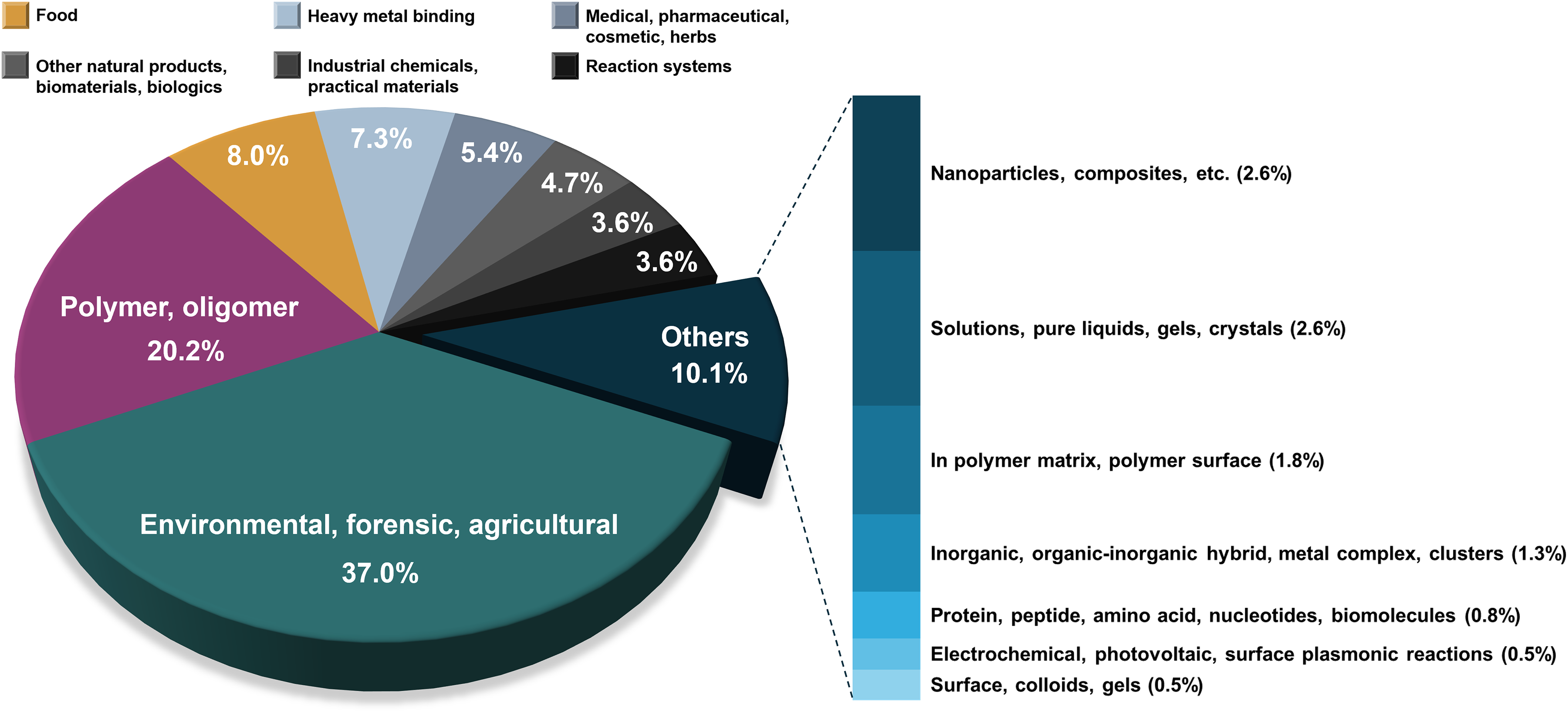
Recent trends of samples in 2D-COS field.
Environmental, Forensic, and Agricultural
Current trends demonstrate a substantial growth in 2D-COS publications within the environmental and forensic sciences. This research scope is particularly evident in the investigation of microplastic aging and the chemical dynamics inherent in wastewater and sludge treatment processes. Furthermore, the technique has been extensively implemented for the molecular characterization of diverse emerging contaminants, including DOM, heavy metals, and antibiotic residues. Such widespread adoption underscores the versatility of 2D-COS in deciphering the complex interactions within heterogeneous samples.
For example, Ding et al. 102 proved volatiles release during the combustion and pyrolysis of textile dye sludge under varying temperature. They elucidated the interaction between the sludge combustion products and microplastic polyethylene (PE) and polypropylene (PP) contaminants affected the initial release of plastic volatiles. Hu and Jiang 298 determined the sequence of DOM responses to analyze the pyrolysis of DOM from soil with microplastics and petroleum contaminants under both varying temperature and time. Liu et al. 186 investigated a biochar produced from the wastewater of pig manure composting in the presence of polyvinylchloride microplastics and antibiotic tetracycline. They found that the different pyrolysis temperature regulated the formation sequence of functional groups, which in turn affected the humification. Jiang et al. 147 investigated the adsorption process of Cd(II) onto various microplastics, like PLA, PA, and PP. They indicated that one-dimensional (1D) spectra before and after the adsorption were very similar. In contrast, 2D spectra revealed specific chemical interactions. Wang et al. 240 characterized the adsorption process of various microplastics, such as PP, PE, PS, and PVC, onto DOM fulvic acid. They concluded that different adsorption mechanisms were observed for different microplastics.
Gao et al. 118 monitored the aging process of high-density polyethylene (HDPE) gauze under mechanical abrasion and UV irradiation, leading to the generation of microplastics. He et al. 130 investigated the aging process of the melt-blown layers of medical surgical masks made of PP and poly(ethylene terephthalate) (PET) leading to the generation of microplastics. They demonstrated that the melt-blown layer showed less aging compared to the resin due to dense microchannel structure exhibiting high hydrophobicity. Huang et al. 141 examined the effect of aging processes of PA microplastics by chemical aging and UV irradiation on Cr(VI) adsorption. They demonstrated that these aging treatments lead to a significant increase in oxygen-containing functional groups. Zhang et al. 282 investigated the interaction and adsorption of nonylphenol onto PP or PA microplastics which had underwent aging processes in soil or photochemical condition. They revealed sequence of changes in the functional groups under aging process using 2D IR correlation spectroscopy. They 359 also examined aging process of PE and PLA microplastics using UV irradiation and H2O2. They demonstrated that aging mechanisms, involving the breakage of C–H and C–C bonds and reactions with oxygen, were very similar for both polymers, and adsorption of Cd(II) and Cr(VI) were increased.
Chen et al. 86 analyzed a photoaging process of poly(butylene adipate-co-terephthalate) (PBAT) microplastics. They demonstrated that while the presence of NO3− promotes the process, presence of Br– or Cl– inhibits. By utilizing 2D-COS, they determined the sequential order of changes in the functional groups, which suggested that the degradation follows Norrish I and Norrish II type reaction mechanisms. Duan et al. 110 investigated effect of rainwater exposure on the photodegradation process of plastics, such as PVC, PP, PE, and PS, under different sunlight irradiation duration. They concluded that rainwater induced strong oxidation and change in the functional group evolution. Photo-oxidation reaction process of a submicron PS particle under UV irradiation was noted. Nwachukwu et al. 204 identified reaction pathways to investigate photothermal heterodyne imaging (PHI) provided the high spatial resolution down to 150 nm. Wang et al. 237 monitored photo-aging process in soil for microplastic PE and PBAT. They examined sequences of functional groups changes, such as preferential breaking of carbon chain structure of PE and oxygen-containing groups of PBAT, using 2D IR correlation spectroscopy.
Cheng et al. 94 investigated the interaction of PVC microplastics with varying dosages and waste activated sludge in anaerobic digestion. They revealed that presence of microplastics affected the interfacial energy of sludge and reduced microbial activities. Shao et al. 218 analyzed the coagulation of microplastic PE complexed with HA using different aluminum coagulants with varying dosages. This study identified that the HA adsorption enhanced the hydrophilicity and electrostatic repulsion of PE, thereby inhibiting removal efficiency. By applying 2D IR correlation spectroscopy, they concluded that the coagulants preferentially interact with –COOH and –OH functional groups of HA by electrostatic attraction, rather than directly with the PE surface.
Pan et al. 207 investigated the effect of DOM with different molecular weights on the photo-aging process of microplastic polystyrene under UV irradiation. They concluded that the fulvic acids with more quinone and phenolic moieties having higher redox capacity showed higher photo-aging effect. Du et al. 104 proved the interactions between algal organic matter (AOM) and varying concentrations of PE or PLA microplastics before and after aging. Through 2D-COS analysis, they determined that sequential order of functional group changes of AOM was significantly affected by both aging and types of microplastics. Chu et al. 96 studied the effect of PS microplastics on adsorption of Cu with varying concentrations on pipe scale formed in drinking water distribution systems. They demonstrated that the adsorption was found to be driven by both complexation and electrostatic interaction affected by microplastics. Du et al. 107 monitored the transformation process of PE and PBAT microplastics by sulfidation reaction. They revealed that PE underwent the oxidation, while reduction and ester hydrolysis were the main causes of chain scission for PBAT.
Liu et al. 176 analyzed the interaction between aged PS microplastics and polyaluminum–titanium chloride coagulant with varying concentrations. They identified that different pH affected the priority of interactions. Wang et al. 233 investigated the DOM generation from various microplastics by the UV aging process. They noted that the production of reactive intermediate species further promoted the generation of reactive radical species. Zeng et al. 279 monitored the aggregation process of PS nanoplastics and goethite nanoparticles under the influence of HA, bovine serum albumin (BSA), DNA, and electrolytes, and elucidated their interactions during the process. Huang et al. 137 probed the aging of biodegradable polylactic acid microplastics in flooded paddy soil after 180 days with different levels of returned straw content. They confirmed the acceleration of the degradation of PLA in the presence of straw.
Ai et al. 67 studied the effect of temperature on biopolymers during the sludge thermal drying process. They revealed that there was no effect under 120 °C, whereas biopolymers broke up to small molecules between 120 and 150 °C exposing hydrophobic groups to promote efficient water evaporation. However, at temperature exceeding 150 °C, water was entrapped by the Maillard reaction product. Qian et al. 211 characterized the effect of Cu(II) on the reaction between algal organic matter and chlorine with varying concentrations producing disinfection byproducts using 2D IR, 2D synchronous fluorescence, MW2D fluorescence, MW2D IR, and 2D fluorescence/IR heterospectral correlation spectroscopy. They indicated that fulvic-like and aliphatic compounds went through preferential reaction for extracellular organic matter, while tryptophan-like and aromatic compounds reacted more for intracellular organic matter.
Kang et al. 155 examined the adsorption fractionation of dissolved black carbon (DBC) with different concentrations onto ferrihydrite. They revealed that the photoactivity toward and photo-conversion of antibiotics by DBC were affected. Hu et al. 134 examined the changes in EPS, which acts as a barrier layer for bacterial consortia providing anaerobic ammonium oxidation, to different levels of antiviral drug pollutant chloroquine phosphate. Zhang et al. 284 studied the photo-transformation process of antibiotics resistant bacteria in karst water and sewage-irrigated farmland soil with calcium carbonate rocks. They revealed the effect of the acid mine drainage formed from pyrite (FeS2), which accelerated the inactivation of bacteria by light.
Zuo et al. 360 analyzed a photodegradation process of biochar-derived DOM during the different incubation period on light. They revealed that carboxyl groups were most sensitive. Chen et al. 76 monitored the biomass gasification using oxy-fuel atmosphere with varying oxygen concentrations to control the devolatilization and tar formation. They explored the response mechanisms of biochar functional groups using 2D IR correlation spectroscopy. Fu et al. 116 probed the gas evolution characteristics and sequence for mild gasification of biomass under varying temperature to balance the production and consumption of energy to optimize the quality of gas and char using 2D IR and 2D IR/MS heterospectral correlation spectroscopy.
Wang et al. 228 investigated the catalytic pyrolysis process of biomass using biochar-based catalysts. They determined reaction mechanisms of coke formation, which leads to catalyst deactivation. Du et al. 105 applied 2D-COS and PCMW2D-COS to IR spectra to investigate the pyrolysis reaction process of cellulose in the presence of NaCl and MgCl2. They demonstrated that the O(2)H ··O(6) hydrogen bond is destructed by the salt. Furthermore, they revealed that NaCl catalyzed ring-opening reaction, and MgCl2 promoted intramolecular dehydration reaction. This paper was published in Chinese. Huang et al. 138 examined the effect of adsorptive fractionation of dissolved black carbon on ferrihydrite on the binding behavior Cu(II) with varying concentrations. They identified that the binding heterogeneities were implied among the components. Furthermore, they determined that the fractionation process led to a significant decrease in the overall binding affinity for Cu(II).
Mu et al. 301 investigated the degradation reaction process of DOM in black odorous water using a rotational step-scheme Au/g–C3N4/BiVO4 heterojunction photo-catalysis with peroxymonosulfate. To facilitate a detailed analysis of the reaction kinetics, they segmented the datasets into several discrete time blocks. Their 2D synchronous fluorescence analysis revealed that fulvic-like substances played a pivotal role in the overall DOM degradation process. Deng et al. 100 probed the electrochemical pretreatment process for recalcitrant DOM with low biodegradability from old landfill leachate. They elucidated the transformation mechanisms and identified a preferential removal of phenols and aromatic substances over amino groups.
Zhang et al. 295 investigated the oxidative stability of soil DOM from abandoned mining areas with varying amount of oxidant. In this study, 2D synchronous fluorescence correlation maps were displayed with 1/nth power transformation to show finer details. They revealed that protein-like materials were preferentially removed by oxidation before humic-like substances. Sun et al. 224 probed the photodegradation process of sediment-derived DOM under UV–Vis irradiation and binding with Cu2+ with varying concentrations. By employing 2D IR and 2D synchronous fluorescence correlation spectroscopy, they demonstrated that the preferential biding sequence and specific functional groups involved in binding were not altered by photodegradation.
Yuan et al. 361 investigated the application of 2D-COS to UV–Vis spectra to examine the complexation of DOM derived from corn straw pyrolysis biochar and pollutant antibiotic sulfadiazine with varying concentrations under different ionic conditions. They demonstrated that the tyrosine-like and humic-like substances were more susceptible to sulfadiazine. Fan et al. 112 analyzed the temperature-dependent interaction and binding of antibiotic norfloxacin with DOM derived from biogas slurry. They observed the conformational reversibility between protein-like and humic-like structures. Chen et al. 73 probed the interaction between antibiotic ciprofloxacin residue in soil with varying concentrations and DOM derived from biochar based on rice straw, pig manure, and cockroach shell. They indicated that the different DOM components interacted with antibiotics differently. Liu et al. 309 analyzed the emission spectra of EEM at excitation wavelength of 275 nm. They examined the quenching behavior of chicken manure-derived DOM when interacting with eight veterinary antibiotics commonly found in farmland surface runoff with varying concentrations. They revealed a preferential binding of tryptophan over humic-like components during the interaction process.
Shen et al. 302 probed the interactions of DOM with antibiotics, like oxytetracycline and sulfamethazine using 2D synchronous fluorescence correlation spectroscopy. Their study, published in Chinese, demonstrated how these antibiotics induce fluorescence quenching. Yan et al. 265 revealed the hydrogen bonding evolution of sodium alginate plasticized with glycerol during the water evaporation process leading to the formation of stable and strong plastics. Yan et al. 264 investigated the binding interaction between DOM derived by the UV irradiation of microplastics and antibiotics with varying concentrations. They revealed that more oxygen-containing components were preferentially binding. Yao et al. 271 observed transformation of As(V) to As(III) to examine the interaction of DOM with Fe and Mn from algal bloom of lake eutrophication and arsenic with varying concentrations. Jiao et al. 150 studied the adsorptive binding interaction of DOM in farmland mollisol and herbicide glyphosate with varying concentrations. They identified a process of multilayer heterogeneous adsorption, which involved specific functional groups responses and significant conformational changes.
Pan et al. 310 explored the effect of ice on the adsorption of lake DOM onto microplastics with different concentrations. By integrating 2D fluorescence spectroscopy with PARAFAC components, they examined the structural modifications of DOM during its complexation with microplastics, particularly humic-like substances. Zhang et al. 294 examined the binding with and transport hindrance by DOM and DBC of a pollutant 2,4,6-trichlorophenol with varying concentrations. By analyzing the 2D synchronous fluorescence correlation spectra, they determined the interaction mechanism from the binding sequence of lipid and small molecules followed by lignin and tannin compounds. Li et al. 172 examined the adsorption of EPS corona onto microplastic PS with varying concentrations. They identified that the N and O moieties in polysaccharides and proteins of EPS were the primary interaction sites involved in the binding process with PS facilitated by hydrogen bonding. Li et al. 165 deciphered the binding interaction between E. coli EPS and antibiotic tetracycline with varying concentrations. By integrating 2D IR and 2D synchronous fluorescence correlation spectroscopy, including MW2D analysis and fluorescence/IR heterocorrelation spectroscopy, they revealed the complex interactions of various components.
Lyu et al. 197 analyzed the degradation processes of PLA face masks under various conditions and agent exposures, such as UV, landfill leachates, seawater, and enzyme. They identified the pathways of chemical group changes occurring within the polymer matrix. Chen et al. 74 investigated the hydrolysis and anaerobic digestion process of food waste with microbial consortium-based compound enzyme. They monitored the dynamics of starch, protein, and lipid functional groups using 2D IR correlation spectroscopy. Luo et al. 195 examined the interaction between fulvic acid and PS microplastics with varying concentrations. They noted that the photo-aging of microplastics changed the sequence of structural changes of fulvic acid. Wu et al. 253 probed the binding interaction of algal EPS with varying concentrations and GO in water via π−π stacking and electrostatic interactions. They identified the conformational alteration of GO bound to stratified EPS. Cao et al. 305 investigated the persulfate oxidation process to decrease aromaticity of groundwater DOM using EEM PARAFAC components and 2D fluorescence correlation spectroscopy. They observed the changes in fulvic substances and microbial-derived humic-like substances.
Chen et al. 78 examined the interaction between 4-hydroxyphenylpyruvate dioxygenase inhibitor herbicides with varying concentrations and maize root exudates as binding sites. They revealed that various functional groups participated in the interaction. Liu et al. 182 investigated the anaerobic treatment of landfill leachate using urease under the influence of different concentrations of Mn2+, which promoted the activity of the enzyme by hydrogen bonding and hydrophobic interactions. Wang et al. 234 evaluated low-density polyethylene (LDPE) films used in food preparation and storage undergoing different aging processes, including microwave irradiation, heating, and UV irradiation. Using 2D IR correlation spectroscopy, they monitored the changes in the surface functionality of the remaining plastic film after the removal of microplastics and DOM. Du et al. 106 observed the formation of microbial corona by the selective adsorption of EPS with varying concentrations on TiO2 nanoparticles with different crystalline phase and exposed facets. They demonstrated that anatase with (101) and (001) facets preferred proteins with lower molecular weight and higher hydrogen bonding, whereas rutile with (110) facets preferred those with higher hydrophobicity. Xia et al. 255 examined microbial activities under increasing salinity using 2D IR correlation spectroscopy. They demonstrated that the supplementation of osmoprotectant glycine betaine promoted the secretion of EPS to increase the salinity tolerance.
Deng et al. 99 investigated the removal of Mn2+ and other contaminants from manganese slag leakage using biochar synergistic bacterial strains. They founded that the oxidation reaction process of Mn was promoted by the C=C and COOH groups of biochar. Ndung'u et al. 342 utilized 2D Raman correlation spectroscopy to detect residue of pesticide chlorothalonil of varying spiking concentrations in vegetable matrices. They used only synchronous spectra for the identification of most pertinent fingerprint marker spectral regions to be used for building a chemometric PCA-SVM calibration model. Huang et al. 139 monitored the microplastics formation by aging processes of biodegradable plastics in air, sea water, and soil. They compared the blend of PLA and PBAT, starch and PE blend, and pure PE. They also identified the sequence of functional group changes using 2D IR correlation spectroscopy. Wang et al. 239 applied 2D TGA IR correlation spectroscopy to investigate the combustion of plastics, like PET, PBAT, PE and PP, under varying temperature. They monitored the sequential changes on volatile organic compounds (VOCs). Furthermore, they implemented an interesting heterosample correlation analysis, comparing the formation of gaseous VOCs with the degradation of solid residues. This approach elucidated the intricate evolutionary relationship between the condensed-phase decomposition and the resulting gas-phase emissions.
Duan et al. 109 monitored the heterogeneous reaction process of the atmospheric pollution gas NO2 on the surface of α-Fe2O3 with or without SO2 gas, UV irradiation, and the presence of sodium dodecyl sulfate (SDS). They indicated that the UV irradiation promoted the formation of nitrate. Furthermore, they concluded that the formation sequence of nitrate and nitrite species was altered by SDS which acted as both catalyst and photoresist. Wang et al. 241 investigated the adsorption of water-soluble polymers, like polyethylene glycol (PEG) and polyvinyl pyrrolidone, with varying concentrations onto minerals, like kaolin and montmorillonite. They identified that Al–O and Si–O are the important binding sites with oxygen and nitrogen containing functional groups of polymers.
Shen et al. 217 examined 2D synchrotron-based IR correlation spectra to clarify the long-term behavior of the free-thaw aging process of pyrolysis biochar. They demonstrated that this aging process significantly altered surface functional groups, which in turn facilitated the dissipation of the flame retardant tetrabromobisphenol A. Lin et al. 308 investigated the spatial–temporal impact of industrial effluent on riverine DOM by integrating EEM-PARAFAC and MW2D correlation spectroscopy. Using seasonal sampling as the temporal perturbation, they unraveled DOM dynamics through MW2D fluorescence and 2D heterocomponent correlation spectroscopy among different PARAFAC components. The analysis was conducted using the Python version of the 2D Shige software, providing a robust framework for tracking the evolution of effluent-derived components.
Li et al. 170 investigated the aggregate stability and organic carbon sequestering of saline soil samples with or without straws under varying salinity. Liu et al. 184 investigated the hydrothermal carbonization of sewage sludge across a range of temperatures using 2D fluorescence and 2D IR spectroscopy. By employing fluorescence-IR heterospectral correlation, they unraveled a series of complex reactions, including condensation and cross-linking processes, providing a molecular-level map of how sludge transforms into hydrochar. Liu et al. 185 examined the hydrothermal carbonization process of sewage sludge assisted by ionic liquid. They revealed that the removal order of functional groups in the resulting hydrochar was influenced by the residence time and liquid-phase circulation. Chang et al. 95 published a paper in Chinses on monitoring the aerobic composting process of the hydrophilic fraction of sludge. They identified the changes in structural composition and electron transfer capacity.
Yan et al. 266 investigated the anaerobic digestion process of water activated sludge with or without multi-enzyme pretreatment. They demonstrated that in the absence of pretreatment, the hydrolysis of structural carbohydrates was the primary step. In contrast, the introduction of multi-enzyme pretreatment made the protein disintegration as the critical step. Yu et al. 272 elucidated the effect of various sludge dewatering agents on the hydrothermal treatment process of PLA microplastics. By applying 2D-COS to IR spectra, they determined the distinct molecular dynamics across the treatments. Guo et al. 123 examined the effect on dewatering by the interaction between sludge protein and tannic acid with varying concentrations using 2D IR, fluorescence/IR heterospectral correlation, and MW2D IR correlation spectroscopy. Zhu et al. 362 examined the soil organic carbon and HA affecting the stability of soil aggregates under different chemical and manure fertilization management schemes with varying rates of fertilizers. By analyzing 2D-COS, they examined the responses of HA to organic fertilizer.
Liu et al. 191 investigated the microwave co-pyrolysis of textile dyeing sludge with varying level of biomass furfural residue. They unraveled the synergistic improvement that led to product valorization. Feng et al. 312 studied the natural attenuation process of toluene with DOM adsorbed onto clay or sandy soil by bacterial biodegradation. To analyze the dynamic biodegradation process, they implemented heterocomponent correlation analysis and MW2D fluorescence spectroscopy, specifically monitoring the changes in emission (Em) intensity of the PARAFAC components as a function of time. Zhou et al. 311 monitored the dynamic changes of DOM components during the treatment process of crab farming park wastewater in an aeration pond. They integrated multiple advanced analytical techniques including 2D fluorescence EEM, 2D UV–Vis, MW2D fluorescence, and PARAFAC heterocomponent analysis.
Chen et al. 83 investigated the municipal wastewater treatment by bacterial anammox system assisted with microalgae biofilm barrier to remove nitrate and phosphate. They revealed that the microalgae growth modulation process affected the compositions, especially the secondary protein structures, of the system EPS to affect the performance. Ding et al. 101 monitored the disinfection transformation process of EPS in wastewater using UV irradiation and peracetic acid treatment. They revealed distinct functional group responses, such as the reduction of aromaticity and increase in saturation and oxidation.
Hu et al. 136 probed the O3/H2O2 Fenton oxidation treatment process of wastewater from the solvent amine desulfurization in natural gas purification plant. They revealed that this advanced oxidation process induced significant transformations in the DOM. Zeirani Nav et al. 202 studied the treatment of wastewater from anaerobic digestate and landfill leachate by deammonification followed by coagulation/flocculation process using different concentrations of various Al-based coagulants. They revealed that different coagulants targeted the same functional groups of DOM in the wastewater, even though they had distinct compositions. Nguyen et al. 304 evaluated a wastewater treatment process using 2D synchronous correlation spectroscopy and EEM-PARAFAC fluorescence to evaluate the effects of varying chlorine and ozone concentrations. They targeted model compounds, such as BSA and HA, alongside actual effluent organic matter (EfOM) samples. The analysis demonstrated that protein-like and fulvic-like substances showed susceptibility toward chlorine and ozone but with different reaction sequences. Additionally, they conducted a heterocomponent analysis among the EEM-PARAFAC components to further distinguish the interaction dynamics of these organic fractions. Chen et al. 296 investigated the treatment of water with emerging and conventional contaminants using the advanced coagulation process driven by ferrate (Fe(VI)) and sulfite (S(IV)) activated Fe(VI). They determined that the sulfite activation changed the reaction order due to different oxidation capacity.
Polymers and Oligomers
In 2024, temperature-dependent 2D-COS was extensively used to investigate hydrogen bonding and crosslinking in polymers and elastomers. Studies elucidated self-healing mechanisms, thermal stability, and shape reconfiguration in various polyurethane and hydrogel systems. Researchers also monitored crystallization, degradation, and swelling processes to determine molecular interaction sequences and structural transformations.
For example, Ma et al. 199 investigated the miscible blends of poly(styrene-alt-N-(ethyl-4-hydroxyphenyl)maleimide) with poly(4-vinyl pyridine) or poly(vinyl pyrrolidone) under varying temperature using 2D IR correlation spectroscopy. They revealed the role of intermolecular hydrogen bonding interaction. Sun et al. 363 studied the self-healing poly(urea-urethane) elastomer prepared by condensation of glycidyl azido polymer with isophorone diisocyanate and 2-aminophenyl disulfide. They revealed the hybrid dynamic lock physical crosslinks by multilevel hydrogen bonding and disulfide bonds under varying temperature. Wang et al. 242 investigated the high-performance elastomer made of poly(urethane-imide-urea) copolymer under varying temperature. They identified the involvement of a number of hydrogen bonds in the system. Yao et al. 270 examined the self-healing photoluminescence polyurethane for optical devices under varying temperature using 2D IR and 2D Raman correlation spectroscopy. They indicated that the incorporation of hydrogen bonds and disulfide bonds into the hard domain improved the polymer’s properties. Zeng et al. 278 investigated the thermal stability of polyester–polycarbonate synthesized from CO2 and biologically sourced isosorbide. By applying 2D-COS to temperature-dependent IR spectra, they observed the dissociation of hydrogen bonding involving C=O groups.
Li et al. 168 employed 2D IR correlation spectroscopy to analyze an oral wound treatment hydrogel with strong tissue adhesion and a low lower critical solution temperature (LCST) for easy removal by heating. This hydrogel, synthesized from N-isopropylacrylamide with cationic and hydrophobic comonomers, was examined to reveal the changes in hydrogen bonding as a function of temperature. Chen et al. 85 examined the moisture-responsive stiffness changes in a composite material comprising semicrystalline polyvinylamine and polyethyleneimine. Using 2D-COS to analyze temperature-dependent IR spectra, they observed the changes in the intermolecular hydrogen bonding association within the primary amine network. Fang et al. 115 characterized the thermal post-curing of 3D printing photopolymer under varying temperature. They revealed the presence of hierarchical hydrogen-bonding interactions. Han et al. 339 revealed the interaction mechanism of constituents for self-assembled triblock copolymer hydrogels made with different polymer concentrations using 2D Raman correlation spectroscopy.
Ionita et al. 142 probed the interaction between polyimide and varying concentrations of CoCl2 used as the dopant. They indicated the presence of residual amic acid in the polyimide using 2D IR correlation spectroscopy. Wong et al. 252 studied an elastomer with enhanced thermal conductivity, poly(thiotic acid-N,N’-methylene bis acrylamide), with ordered hydrogen-bonding interactions. They determined the sequence of hydrogen bonding changes under varying temperature. Xie et al. 256 investigated the recyclable thermosetting poly(dimethylsiloxane) elastomer containing secondary ureidobenzimidazole adduct as a dynamic crosslinking moiety under varying temperature. Xu et al. 260 examined the supramolecular elastomer reinforced by flexible organic imide cages acting as nodes under varying temperature. They revealed dual mechanism of the dissociation of weaker hydrogen bonding followed by that of C=N bonds. Pannico et al. 209 monitored the thermo-oxidative degradation process of flexible epoxy resin. By tracking the evolution of reactive network structure, they determined the ranking of the stability of various functional groups. They utilized slice spectra for the pertinent band identification. Rana et al. 213 investigated the reaction mechanism underlying the crosslinking reaction process of poly(3,4-ethylenedioxythiophene) and polystyrenesulfonate using divinyl sulfone to prepare insoluble porous hydrogel.
Zhang et al. 281 utilized PCMW2D IR correlation analysis to investigate the artificial tendrils made of liquid crystal elastomer showed biomimetic locomotion under the influence of temperature changes. They suggested that an increase in temperature weakens the metal-ligand interactions and leads to the temporary dissociation of the dynamic crosslinking network, thus allowing molecular reorientation and shape reconfiguration for the artificial tendrils. Zhou et al. 364 observed the melt crystallization by cooling of PBAT in the presence of a self-assembly nucleating agent octamethylenedicarboxylic dibenzoylhydrazide. They demonstrated that highly synchronized changes in hydrogen-bonded N–H in the nucleating agent and C=O in the polymer indicated the intermolecular interaction.
Jilili et al. 151 analyzed the thermal degradation and crystallization process of PLA nanocomposite film with modified hectrorite. They concluded that amorphous region was primarily targeted, and hectrorite diminished the degradation of crystalline region. Reitenbach et al. 214 investigated the swelling and deswelling processes of PNIPAM containing NaClO4 or Mg(ClO4)2, which was exposed to D2O and then acetone. Using 2D-COS, they probed the formation of D2O–amide interaction and subsequent perturbation by the introduction of acetone. Li et al. 164 examined the evolution of DOM in mangrove ecosystem produced by the degradation process of fresh and aged PP films under different tidal conditions. They revealed that the production of humic-like compounds affected the local bacterial communities.
Food
In 2024, 2D-COS was widely applied to food analysis for adulteration detection, freshness monitoring, and structural characterization. Researchers utilized synchronous spectra and deep learning to identify beef adulterants and starch retrogradation. For example, Wang et al. 325 utilized 2D Vis-NIR correlation spectroscopy to identify the adulteration of minced beef or mutton with varying compositions of chicken, duck, or pork meat. In this study, 2D-COS images were used for chemometric deep learning ResNet model to identify characteristic peak patterns of adulterants. Unlike some other questionable reports using deep learning models without identifying the perturbation, this work clearly indicated that adulterant compositions were used as the perturbation variable to make the use of both synchronous and asynchronous spectra legitimate. Chen and Wang 314 detected and calibrated polycyclic aromatic hydrocarbons (PAH) in thermally processed lamb with varying roasting time. They analyzed Vis-NIR hyperspectral imaging combined with chemometric competitive adaptive reweighted sampling (CARS) model. Al Lafi et al. 68 utilized 2D IR correlation spectroscopy to characterize milk powder samples adulterated with various concentrations of sucrose, lactose, or starch identifying the characteristic spectral regions necessary for effective adulteration analysis.
Zhang et al. 330 monitored the pork meat during a storage process with 2D Vis-NIR correlation spectroscopy. To predict the total volatile basic nitrogen content, they selected characteristic wavelength from synchronous spectrum for chemometric partial least squares regression (PLSR) model. Zhang et al. 333 probed the Fusarium dry rot infection process of potato during storage using 2D NIR reflectance imaging correlation analysis. To analyze the spectral data, they used only synchronous spectra for feature selection, which were subsequently integrated with chemometric least squares support vector machine (LS-SVM) and PLSR models. Bui et al. 337 performed a 2T2D correlation analysis using transmission Raman spectroscopy with temperature as perturbation. They discriminated the premium aromatic long-grain Vietnamese rice ST25 from non-ST25 rice based on the feature difference in 2T2D spectra to select wavenumber for chemometric incremental association Markov blanket.
Zhai et al. 329 investigated the rice undergoing different periods of storage duration using 2D NIR correlation spectroscopy. In this study, only synchronous spectra were utilized for the characteristic wavelength selection, which then was used in conjunction with chemometric techniques, like K-nearest neighbor analysis, linear discriminant analysis, and least squares support vector machine. Guo et al. 316 assessed the freshness of salmon during the cold storage process by integrating NIR and Raman spectral features. They implemented a data fusion approach, combining these distinct spectral datasets to enhance the predictive performance of a chemometric LS-SVM model.
Heavy Metal Binding
In 2024, 2D-COS research explored heavy metal binding with organic matter, identifying complexation sequences for ions like Cu(II) and Cd(II). Studies highlighted the critical roles of phenolic and carboxyl groups. For example, Chen et al. 81 applied 2D IR and 2D synchronous fluorescence correlation spectroscopy to study the binding interaction between Cd(II) with varying titration concentrations and biomass-burning smoke water-soluble organic matter from fir wood, alfalfa, rice straw, etc. They revealed the binding sequence of different chemical groups. Chen et al. 84 investigated the interaction between DOM released from Eucalyptus leaves and heavy metals with varying concentrations using 2D IR and 2D UV–Vis correlation spectroscopy. They found that Cu(II), Pb(II), and Zn(II) enhanced UV absorption, while Mn(II) did not, indicating different functional groups are active in binding. Cui et al. 306 characterized the binding of Cd(II) and Cu(II) with varying concentrations by EEM PARAFAC components for individual ligands of HA. They also used heterocomponent correlation spectroscopy to determine the precise binding sequence and speed of these ligands under the external perturbation of varying metal concentrations. Wang et al. 245 investigated the binding of Cd(II), Zn(II), and Pb(II) onto DOM derived from biochar with or without modification with KMNO4 which underwent the process of freeze–thaw cycles. They demonstrated that the oxidation of lignocellulose and changes in C–O stretching vibrations of different groups were observed during the earlier freeze–thaw cycles, which resulted in the heavy metal stabilization in soil.
Ouyang et al. 205 examined the chelation binding of cadmium with varying concentrations by neonicotinoid insecticides, which affected the accumulation in rice during different growth stages. They identified distinct binding sites among the various neonicotinoids. Cheng et al. 92 published in Chinese to investigation of the binding interactions of Cu(II) or Cd(II) with varying concentrations with DOM derived from biomass burning smoke from alfalfa, pinewood, or corn straw. They indicated that binding order of different components was affected by the biomass types. Fan et al. 113 investigated the binding of Cu(II) and Pb(II) with varying concentrations by macrophyte-derived DOM from Potamogeton crispus before and after the microbial combined photodegradation. Cheng et al. 93 investigated the binding interaction between Cu(II) with varying concentrations and biomass burning smoke derived DOM from alfalfa, pinewood, and corn straw. They revealed the binding sequence and capacity of different components and chemical groups. Yuan et al. 276 probed the complexation binding of DOM and antibiotic erythromycin with varying concentrations in a soil infiltration system. They demonstrated that the sequential binding order of components and functional groups were revealed, indicating the improvement of complexation by the soil infiltration treatment.
He et al. 131 characterized the passivation by biding with lignin biochar DOM of soil cadmium with varying concentrations. They explored the long-term effect of flooding and evaporation affecting the dynamics. Wang et al. 232 examined the interaction and complexation between landfill leachate DOM and Cr(III) with varying concentrations using 2D IR and MW2D IR correlation spectroscopy. By comparing these interactions with those of natural DOM, they identified a distinct level of binding site heterogeneity. Additionally, they highlighted the significant role of nitrogen-containing groups in the complexation process. Yu et al. 273 utilized 2D IR, 2D synchronous fluorescence and heterospectral correlation spectroscopy to investigate the binding of Cu(II) with varying concentrations by biochar-derived DOM. They demonstrated that the display of finer features was enabled by the 1/9th power transformation of spectra. Furthermore, they revealed that the oxidation of DOM resulted in more stable complexes. Constantino et al. 97 probed the interaction of aquatic humic substances from Amazon rivers with Cu(II), Fe(II), and Al(III) with varying concentrations. They noted the important roles of COO– and CO in phenolic groups.
Fan et al. 365 published a paper in Chinese reporting the complexation of Cu2+ with varying concentrations and DOM from compost of mushroom residue or rice straw. They revealed the strong affinity of protein-like components over fulvic-like or humic-like acids. Yao et al. 292 employed 2D synchronous fluorescence correlation spectroscopy to investigate the adsorption, complexation, and redox reactions of Cu2+ with varying concentrations and DOM samples from various agricultural soils. They revealed the strong chelating affinity of humic-like substances over fulvic-like substances. Hu et al. 133 probed the temperature-dependent binding characteristics between DOM and Cu2+ in a study published in Chinese. They determined that the changes in amide and phenolic functional groups affected the binding affinity, sites, and order. He et al. 128 utilized 2D synchronous fluorescence, 2D IR, and MW2D fluorescence correlation spectroscopy to monitor the binding interactions of biochar-derived DOM and heavy metals with varying concentrations. They concluded that Cu and Zn seem to interact with humic acids, while Pb and Ni interact with protein-like substances.
Ren et al. 215 evaluated the binding interaction between sediment DOM from different zones of lake before and after biodegradation and different concentrations of lead and tetracycline. By applying 2D-COS to concentration-dependent IR and synchronous fluorescence spectra, they determined that dominant binding material was the fulvic-like substances. Zhang et al. 289 probed the interaction between selenium and DOM with varying SeO2 concentrations. The 2D fluorescence was generated from EEM excitation slices with a fixed emission to maximize spectral information. They demonstrated that the biding mechanism of Se was similar to that of Cu. Li et al. 366 investigated the binary interactions between tungustate (WO42–) with varying concentrations and molecular-weight-fractionated DOM from soil and sediment. They revealed the involvement of various oxygen-containing functional groups. Fang et al. 114 studied the adsorption of Pb with varying concentrations on various DOM with different amino acids. They revealed that the amino acid types affected the enhanced accumulation of Pb in algae Chlorella pyrenoidosa.
Medical, Pharmaceutical, Cosmetic, and Herbs
In 2024, 2D-COS analyzed drug stability, serum changes, and hydrogel assemblies to advance medical diagnostics and pharmaceutical crystallization control. Ceylan et al. 41 explored the effect of opioid administration on serum in comparison to the control subjects. They highlighted the changes in lipids and amides using 2T2D Raman correlation spectroscopy. Gross et al. 121 suggested the possible detachment of radical NO2 and ethylene groups to investigate the thermal stability of Chagas disease treatment drug nifurtimox during the isothermal degradation process. Filep et al. 297 monitored the degradation processes of DOM indifferent soil environment. They observed the distinct DOM variation dynamics between grass land or arable land soils and forest soils due to nitrogen supply difference. They applied 2D fluorescence/UV–Vis heterospectral correlation spectroscopy and revealed that high molecular weight fulvic-like components were important carbon sources for soil microorganisms. Li et al. 167 examined the peptide-based hydrogel co-assembly process of carbamazepine used for epileptic disorder treatment to suppress the crystallization. They determined that the elongation of gel fiber was affected by the π−π stacking interaction to obstruct the nucleation-growth process.
Other Natural Products, Biomaterials, Biologics, and Proteins
2D-COS provides a robust framework for analyzing both chemical interactions in enzymatic systems and physical structural transitions in natural products, thereby enabling the systematic optimization of biomaterial and protein properties. For example, Chen et al. 77 applied 2D IR and MW2D correlation spectroscopy to examine the phase-change plywood composite with low thermal conductivity and energy storage made of paraffin wax and urea-formaldehyde adhesive. They revealed the mechanism of thermally induced phase transition involving various functional groups. Zhang et al. 290 investigated production of biochar and DOM from the secondary medicinal residues of snow lotus under different temperatures with modifies, like Na2CO3, K2CO3, and NaOH. They confirmed that the modifiers enhanced the yield of biochar. Paladini et al. 206 probed the evolution of hydrogen bonding during the hydration process of cellulose nano-sponges made with 2,2,6,6-tetramethylpiperidine-1-oxyl (TEMPO) oxidized cellulose nanofibril scaffold and branched polyethyleneimine cross linker. By utilizing 2D IR and PCMW2D IR correlation spectroscopy, they tracked the dynamic responses of water molecules embedded I the micro- and nano-cavities establishing localized water pockets and hydration-guided phase transitions.
Wang et al. 236 investigated the absorption, diffusion, and fixation during the penetration process of reactive dye into the quaternary ammonium salt modified cotton. They demonstrated that, in addition to electrostatic attraction, the formation of hydrogen bonds between water and cationic cotton fabrics promoted the swelling to contribute the penetration. Zhang et al. 367 investigated the treatment of holocellulose using urea and choline chloride with varying concentrations to remove hemicellulose components to obtain high purity dissolving pulp. They determined the changes in hydrogen bonding and crystallinity. Tu et al. 227 monitored the flax dew degumming process using microbial community and hydrolytic enzymes to produce flax fibers. By applying 2D-COS, they identified the removal sequence of non-cellulosic gummy substances.
Hashimoto et al. 126 characterized the nitrogen content from protein and nitrate in both dry and wet leaves using a combination of 2D diffused reflectance NIR and 2D IR spectroscopy. They utilized a chemometric PLS regression model for quantitative determination. To ensure accurate band identification, they used 2D IR/NIR heterospectral correlation spectroscopy and leaf-casein (model protein) heterosample correlation, providing a molecular-level basis for the spectral assignments. Mahdiyanti et al. 323 investigated the thermal behavior of microcrystalline cellulose under changing temperature using 2D NIR and 2D NIR/DSC heterocorrelation spectroscopy. While their use of second derivative NIR spectra is technically allowable, they noted that it introduces additional complexity and potential artifacts to the interpretation of 2D-COS maps. For the computational analysis, they employed the Python-based software 2Dpy, an open-source tool developed by Shigeaki Morita (available at github.com/shigemorita/2Dpy.git). Liang et al. 321 analyzed pulp fibers made by different chemo-mechanical pulping exposed to different equilibrium moisture levels. They identified the distributions of hydrogen-containing groups and utilized the feature wavelengths extracted via 2D-COS to enhance a chemometric PLSR model. Wang et al. 250 published a paper in Chinese on the study of the thermal processing of tobacco with increasing temperature. They revealed the transition temperatures for physical and chemical changes.
Hassanuddin et al. 127 investigated the interaction with mushroom tyrosinase and its inhibition mechanism by analyzing the complex formed with methyl 4-pyridyl ketone thiosemicarbazone under varying temperatures. Wang et al. 327 employed 2D NIR correlation spectroscopy in combination with chemometric CNN model to discriminate starch samples from different sources. In this approach, only the synchronous correlation auto-power spectra were used for wavelength selection, enabling identification of the most responsive spectral regions for effective model training. An et al. 70 investigated the time-dependent retrogression process of wheat starch using 2D IR and Raman correlation spectroscopy. By integrating these results with chemometric PLS model, they proposed that retrogression arises from the formation of helical starch structure mediated by hydrogen bonding.
Solutions, Pure Liquids, and Gels
2D-COS was also applied to analyze the ion association, phase transitions, and hydrogen-bonded clusters to elucidate molecular dynamics in complex solutions and ionogels. Jesionek et al. 143 examined the phase transition of ordinary crystal to disordered plastic crystal phase transition of 3-amino-1-adamantanol exhibiting additional multiple order–disorder transitions during an isothermal annealing process. They revealed the changes in the intramolecular dynamics related to CH, NH, and OH units occurring at different rates. Jiang et al. 341 characterized the ion association behavior of aqueous Na2SO4 solutions with different concentrations. They used excess spectra where the deviation from the ideal mixture spectra. To refine their system, they implemented a comparison of blocked datasets with different upper limits of the concentrations. Additionally, they displayed 2D waterfall plots of intensity over Raman shift and concentration.
Kalhor et al. 154 probed the solution mixtures of ZnCl2 and methanol with varying concentrations. They found that with increasing ZnCl2, methanol trimer is replaced by monomer, dimer, and complex with ZnCl2. Furthermore, they observed the competition between O–H··Cl hydrogen bonding and Zn→O coordination bond.
Peng et al. 210 determined the inter- and intramolecular interactions of lithium ion battery additive vinylene carbonate within various solvents systems at different volume fractions. They found that C=O vibration was Fermi resonant with the overtone of ring breathing vibration. Xu et al. 347 analyzed aqueous solutions of tetrahydrofuran (THF) with varying concentrations using 2D Raman correlation spectroscopy. They indicated that the different cluster structures of THF and hydrogen bonding states were observed in different mole fraction ranges accompanied by the changes in the bond lengths and angles. Xu et al. 347 examined the water-induced phase separation process of binary ionogel comprising amphiphilic polymer networks and hydrophobic ionic liquid. They found that the hydrogen bonding structure changes lead to the moisture-induced stiffening. Xu et al. 346 probed the hydrogen bonding structure evolution of the solution of N-methylpyrrolidone (NMP) and water with varying concentrations using 2D Raman correlation spectroscopy. They demonstrated that NMP is inserted into the tetrahedral structure of water at concentration below 20%. In contrast, at higher concentrations, NMP self-associated through dipole–dipole interaction and also formed clusters with water.
Nanoparticles and Composites
In 2024, 2D-COS tracked dehydration, diffusion, and hydrogen-bonding sequences in nanogels, aerogels, and photonic crystals to optimize responsive composite materials. For example, Zhang et al. 285 examined the colloidal photonic crystals self-assembled from thermosensitive N-isopropylacrylamide-based nanogels copolymerized with N-acrylol-L-phenylalanine and derivative of fluorescent naphthalimide under heating. They revealed the comprehensive microdynamic sequence of the dehydration process involving the changes in hydrogen bonding. Gnacek et al. 338 analyzed the conjugate of neuroleptic and antipsychotic drug chlorpromazine with gold nanoparticles prepared by ligand exchange with trisodium citrate dehydrate. They determined the time-dependent structural evolution of the drug after the adsorptive deposition using 2D SERS correlation spectroscopy.
Zhong et al. 368 tracked the water diffusion process in an asymmetric self-powered cellulose-based aerogel, which was fabricated by the directional freeze drying of quaternized cellulose nanofibril, sodium carboxymethylcellulose (CMC), and single-walled carbon nanotube for moisture-electricity generation and humidity sensing. They revealed the development of different states of water molecules using 2D IR correlation spectroscopy. Kou et al. 156 investigated a cold storage time-temperature indicator based on the composite of Na2CO3-treated poly(methacrylate-acrylic acid) and TiO2 with moisture responsive structural color. They identified the ordering process of hydrogen bonding during the cold storage duration. Hu et al. 135 probed the drying process of wet bilayer photonic crystal film comprising polystyrene microsphere and polyacrylate for reversible encryption-verification applications. They revealed the different evolution states of inter-chain hydrogen bonds driving the shape transformation of micro–nano structures.
Reaction Systems
2D-COS monitored catalytic oxidation, UV curing, and polymerization processes to identify reaction intermediates, unique pathways, and surface interaction dynamics. Brebu et al. 71 investigated the UV curing reaction process of chitosan-gelatin xerogel coating on cold plasma activated PLA film for the surface modification to promote chondrogenic cell growth. They monitored changes in the chemical environment of various functional groups.
Zhang et al. 369 employed 2D IR, PCMW2D IR and PCMW2D Raman correlation spectroscopy to analyze the initiator-free polymerization induced by the solvent evaporation under increasing temperature of protic ionic liquid adhesives based on the neutralization of 2-acrlamide-2-methyl propane sulfonic acid and hydroxylamine. They monitored the changes in the hydrogen bonding interactions. Hebisch et al. 132 probed a catalytic isomerization reaction process of skeletal 1-butene over ferrierite with carbonaceous deposits. They observed synergy of solid acidity by the structural confinement and carbonaceous deposits in zeolite. Lee et al. 159 studied precursor solutions of varying concentrations in DMSO/water to prepare a hydrogel/sponge hybrid material based on cyano-p-aramid nanofibers.
Tarach et al. 225 probed the catalytic oxidation reaction process of methane by Fe sites in mordenite zeolite catalysts with different aluminum atom framework contents. By monitoring the reaction process, they identified a unique reaction pathway that diverges significantly from mechanisms observed in other catalytic systems. They 226 also examined the PP cracking reaction process using hierarchical ZSM-5 zeolite catalysts with different mesoporosities. They utilized different pore directed quaternary ammonium cations and NaOH treatment via a desilication process. Their analysis featured waterfall plots of IR spectra versus time, which clearly illustrated the dynamic evolution of the cracking rection and the formation of specific hydrocarbon products.
Lv et al. 196 investigated the selective catalytic reduction processes of NOx with NH3 using vanadia-based catalyst V2O5/TiO2 promoted with WO3 and MoO3. They found that WO3 and MoO3 significantly enhance catalytic activity by modulating the surface acid sites. Specifically, they observed that NOx adsorbed on Lewis acid sites of V2O5/TiO2 framework to form the NH3,ads–L1 intermediate, which is a key step in the reduction process. Liang et al. 174 analyzed the activation process of heterogeneous peroxydisulfate to produce highly reactive species by proton-coupled electron-transfer using ball-milled phosphorylated zero-valent iron. Held et al. 370 investigated the catalytic oxidation process of propane with N2O or O2 as an oxidant using hydrothermally synthesized mesoporous catalyst using 2D UV–Vis correlation analysis. They displayed waterfall plot of spectral intensity versus reaction time. Liu et al. 180 examined the urea electrolysis reaction process using a modified CoFe layered hydroxide catalyst for lattice oxygen oxidation. They demonstrated that low voltage was required to achieve high current. Furthermore, they confirmed that byproduct NCO− production was suppressed ensuring that CO2 and N2 were efficiently separated during the urea electrolysis process.
Industrial Chemicals and Practical Materials
The application of 2D-COS to industrial chemicals and practical materials saw a marked increase in 2024 compared to previous years. Researchers utilized the technique to analyze diverse systems, including Na-ion battery cathodes, self-healing optical coatings, and flame-retardant resins. Fang et al. 352 applied 2D XANES correlation spectroscopy to investigate a prototype cathode made of NaNi1/3Fe1/3Mn1/3O2 for extending the depth-of-charge layer for a Na-ion battery. They demonstrated that the progressive removal of Na+ ion changed the redox state of charge, confirming the oxidation of Fe.
Hao et al. 125 probed a transparent self-healing and self-clearing coting for the glass surface of optical display devices comprising inorganic rigid cage-like structure and flexible organic chain segments under varying temperature. They observed that the use of ethanol solvent not only facilitated self-healing but also enabled controlled restructuring of surface micro-texture. Li et al. 163 analyzed a bio-based flame retardant derived from vanillin and tyramine incorporated into epoxy resin under varying temperature. They investigated evolution of internal hydrogen bonding, demonstrating how these interactions contribute to the thermal stability and flame-retardant properties of the resin. Lu et al. 193 investigated an energy generator driven by the atmospheric moisture sorption process, where enhanced proton dissociation occurred through charge transfer and ion occupation. Different states of water and their associated hydrogen bonding interactions were detected during this process.
Sun et al. 223 analyzed a thermal insulating form made of phosphate-containing polyurethane composite with natural lignin and expanded graphite flakes under varying temperature. They identified the thermally induced dissociation of hydrogen bonding and cleavage of carbamate to enable the reprocessing. Wang et al. 243 employed 2D-COS and PCMW2D-COS to analyze IR spectra for the investigation of phase change multicore-sheath energy storage fibers. These fibers, containing dodecanol, were fabricated by coaxial electrospinning with in situ UV irradiation polymerization. They revealed the dynamic variations of the supramolecular interactions occurring under varying temperature. Yuan et al. 277 determined the solvent response mechanisms during the air drying process of photonic colorimetric indicator for ethanol concentration sensing. By employing 2D-COS, they monitored the different types of bound water molecules with weak and strong hydrogen bonding interactions with C=O and C–O–C functional groups.
Zhou et al. 349 applied 2D-COS to the temperature response Raman spectra of poly-alpha-olefin based synthetic lubricant oil adulterated with mineral oil. To identify the presence of adulteration, they utilized only synchronous spectra were used in conjunction with chemometric PCA. Zhang et al. 286 investigated an adhesive based on zwitterionic poly(ionic liquid) derivatives with robust dipole–dipole interactions showing stability across diverse polar and nonpolar organic solvents was developed. Utilizing 2D IR and PCMW2D correlation spectroscopy, they demonstrated that the various interactions, such as internal dipole–dipole and electrostatic self-crosslinking, were reveled under varying temperature. Zhang et al. 371 performed the forensic discrimination and identification of shoe sole rubber samples. While their article was published in Chinese, an English abstract was provided for broader accessibility. However, the study presents a significant ambiguity, as the specific perturbation used for the construction of the 2D correlation spectra remains unclear from the available abstract.
Other Application Fields
2D-COS has also been extended to applications across a diverse range of sample types. These include polymer matrices and surface,198,201,220,222,249,268,274,368,372 where it probes structural transitions, as well as biomolecules166,179,299 to study protein folding and DNA interactions. Additionally, it has been utilized to analyze surface and gels,222,249 inorganic and organic-inorganic complexes,32,36,37,91,200 and the dynamic processes involved in electrochemical reactions.343,344
For example, Yu et al. 274 applied 2D-COS to study the diffusion process of acetate anion in an ionogel network. In this study, dynamic changes in the hydrogen bonding interaction between polymer and solvent were observed. Zhao et al. 372 tracked the dynamic changes in stretch-activated hydrogen-bonding networks during the diffusion of water into poly(methyl acrylate-co-methacrylic acid) stimulus-response hydrogel.
Ju et al. 299 probed the aggregation process of collagen crosslinked with flexible dibenzaldehyde terminated PEG. They observed that the essential triple helical structure of collagen was preserved throughout the crosslinking process. Li et al. 166 examined the phase transition and aggregate formation process of short peptide-based assembly of diphenylalanine. They observed changes in amide bands and hydration layers. Wang et al. 344 investigated the electrochemical synthesis of high-valence Ni–MO catalysts using voltage modulation for electrodeposition of nickel by employing 2D Raman correlation spectroscopy. They featured waterfall plot of Raman and voltage. Through this analysis, they revealed the role of interfacial water regulation. Liu et al. 36 probed the manganese oxide catalyst birnessite with varying Ca doping levels for water photocatalytic oxidation. By employing 2D Raman and 2T2D correlation analysis, they demonstrated that the incorporation of Ca contributes to the high frequency region due to the increase in the number of localized electrons of the Fermi energy level and conduction band.
Problematic Usages or Citations, Artifacts, and Other Issues
This section discusses several problematic issues identified in the 2D-COS literature published in 2024, including improper citations, conceptual misunderstandings, and incorrect descriptions of the theoretical background. These concerns, which range from the use of improper nomenclature such as 2D-PCIS or 2DCS to the misspelling of Noda’s rule, are summarized in Table I along with recommendations for their proper application. The table also highlights potential artifacts that can arise when product sign metrics are incorrectly applied to low correlation intensity regions.
Summary of problematic usage or citation, misunderstandings, and misleading interpretations related to 2D-COS introduced in the last year (1 July 2023–10 February 2025).
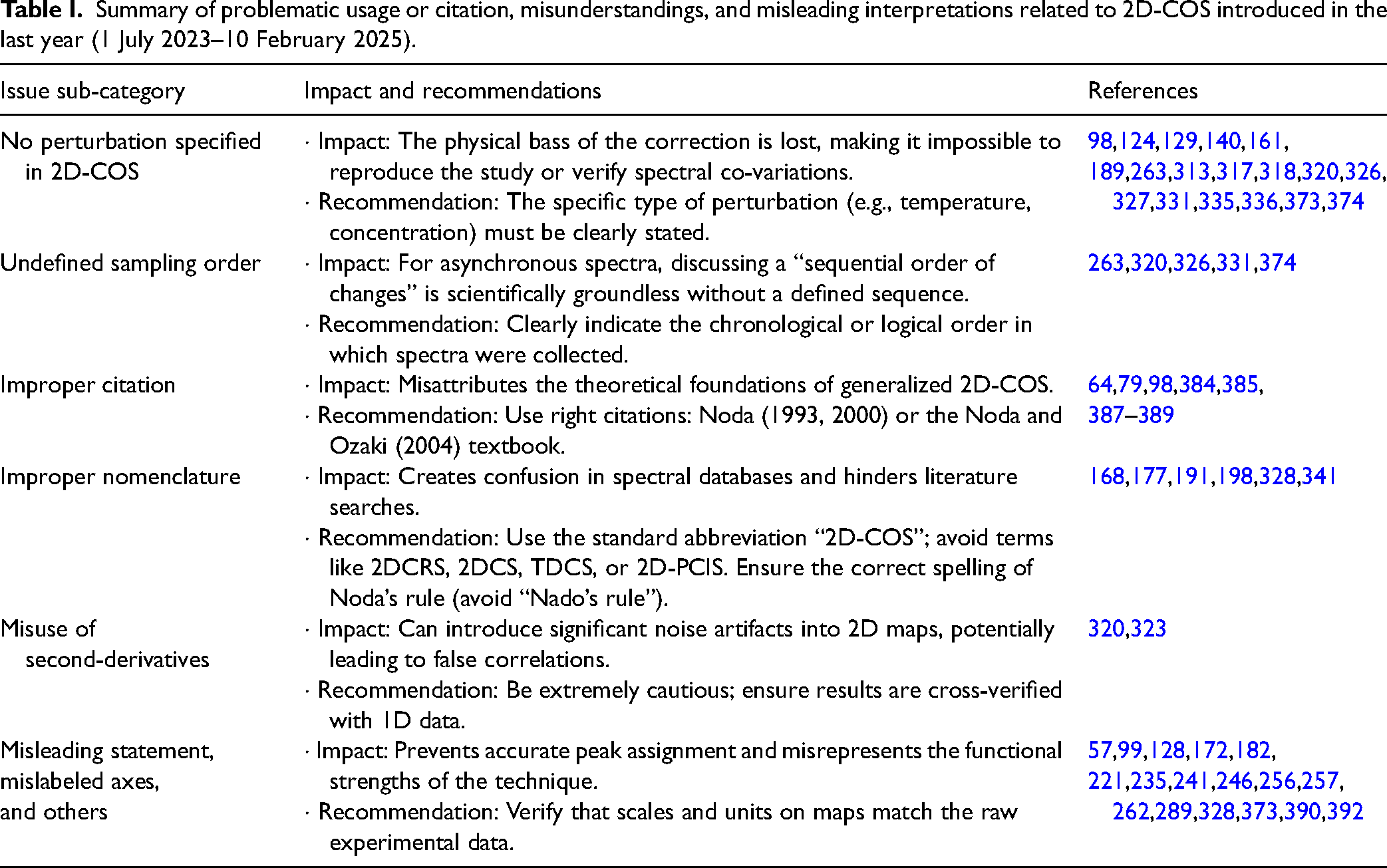
No Perturbation Specified in 2D-COS
Despite the fundamental requirement of the technique, a significant number of studies40,98,124,129,140,161,189,263,313,317,318,320,326,327,331,335,336,373,374 published in 2024 still fail to explicitly define the external perturbation applied during 2D-COS analysis. This oversight is particularly problematic because the physical interpretation of both synchronous and asynchronous maps is entirely dependent on the nature of the stimulus. Without a clearly stated perturbation, the established rules for determining sequential changes become essentially groundless, as the logical order of spectral variations cannot be verified. Furthermore, such an omission hinders the reproducibility of the experiments and obscures the causal relationship between the perturbation and the resulting molecular response. Spectral dataset without explicit specification of the perturbation variable in 2D-COS is analogous to a spectrum consisting of a set of spectral intensities without knowing the specific wavenumber used for each intensity measurement. No significant information is expected from the analysis of such jumbled data.
For example, Chen et al. 313 attempted to determine the geographic origin of Boletus bainiugan mushroom without specifying a defined external perturbation. In this study, 2D-COS spectra were generated from a set of spectral data from each geographic origin, most likely sampled in a random order. Comparison of such 2D-COS spectra have no physical or scientifically justified basis to be reliable. They used only synchronous spectra with ResNet model. Han et al. 124 assessed the discrimination of the geographic origins of medicinal plant Gentiana rigescens Franch by implementing a chemometric ResNet model based on 2D-COS. However, this study serves as another example of problematic reporting from the same group, as it fails to specify the perturbation used to generate 2D-COS images.
He et al. 318 evaluated the classification of Lanxan tsaoko fruits by origin and shape using NIR spectroscopy combined with image recognition. They implemented a chemometric ResNet model using 2D-COS images as input. However, this paper is another example where 2D-COS maps were created from a set of spectra without designating the nature of perturbation, rendering the scientific value of resulting 2D spectra dubious. In a subsequent study by the same group, 2D NIR correlation spectroscopy used to determine the geographic origin of medicinal plant Lanxangia tsao-ko. 317 This paper similarly exhibits the lack of the specification of perturbation in sampling, making the information content for the 2D spectra suspect. The authors seem to show the lack of fundamental understanding of 2D-COS, which characterizes the pattern of spectral signal fluctuations within the sampled dataset. It does not prove any characteristic 2D-COS maps representing specific geographic origin unless the spectral response patterns are truly distinct for different geographic origin under well-defined perturbation protocol.
He et al. 129 characterized different parts and geographic origins of medicinal plants Gentiana rigescens Franch. Another example of the report without specifying the perturbation used for the study, suggesting that the 2D-COS maps were generated from the random variability of samples for each set. Furthermore, the equation used for defining the synchronous correlation was incorrect, indicating the significant lack of the fundamental understanding of 2D-COS. Huang et al. 140 probed the transportation and detection of taste components in whiteleg shrimp using E-tongue system. In the study, they utilized only synchronous spectrum and auto-power spectrum for the feature selection of taste components. However, as observed in other recent literature, the lack of systematic perturbation by simply using random sampling is troubling. Li et al. 161 claimed the authentication of medicinal porcini mushroom species. But this work is fundamentally problematic as no perturbation was specified. The synchronous 2D-COS images used were most likely generated from random sampling of specimen from individual spices, which carries little scientific information other than simple sample variability.
Li et al. 373 investigated the interaction between DOM of different molecular weights from surface water and environmental hormone nonylphenol. However, this article is highly questionable and contains a multitude of significant issues. The source of specific fluorescence spectra, such as synchronous spectra or PARAFAC component spectra, was not specified. Furthermore, while the authors attempted to determine a binding order, they did not specify specific perturbation, such as concentration or time evolution. They also exhibit numerous confused nomenclatures uses, such as synchronization diagram, self-crossing peak, combination order, and cross front. Axes were also mislabeled with the unit of wavenumber (cm−1) instead of wavelength (nm).
Liang et al. 320 attempted to predict the protein content of corn using 2D NIR correlation spectra collected from a portable spectrometer and a chemometric ResNet model. However, this article is also troublesome in many ways. The nature of perturbation was not specified, and all spectra were pooled in some cases without any specific sampling order. Furthermore, the use of second derivative spectra in 2D-COS generates superfluous cross peak artifacts from side lobes. 2D-COS should not be applied as a black box to blindly convert a set of spectra to images without physical meaning. Liu et al. 189 introduced a rapid identification technique for discriminating cigarette types from smoke aerosols using 2D-COS images and deep learning GhostNet model. However, this article is another example of misuse of 2D-COS without specifying any perturbation employed for the generation of 2D-COS results for each cigarette type.
Wang et al. 326 attempted to trace the geographical origin of wine samples by combining 2D NIR correlation images and chemometric deep learning CNN classification model. However, their methodology represents a misguided application of 2D-COS, as it lacks a specified perturbation and a defined sampling order for generating the 2D spectra. Blindly converting a set of randomly collected spectra from a group of samples into some 2D correlation spectral images for further classification analysis without any consideration of the underlying cause of the spectral intensity variations seems to have little scientific basis or justification.
Yan et al. 263 employed 2D Raman correlation spectroscopy to facilitate the discrimination and classification of Chinese handmade paper. However, this study showed a highly problematic issue. First of all, no specification of the type of perturbation was provided, such that the sampling order was not known. That makes the use of Hilbert transform, which is influenced by the sampling order, meaningless. Pretentious claim of the use of tensor product operation was simply the application of two rounds of Hilbert transformation to expand the dimensionality of the datasets to increase the frequency points without any physical ground for justification. The so-called 3D data was then fed into a black box chemometric machine learning tool. Any successful discrimination at this point seems simply fortuitous.
Zhang et al. 331 identified wheat flour identification using 2D NIR correlation spectroscopy combining with chemometric deep learning model. Unfortunately, this article is already in trouble such that no perturbation or sampling order was specified. Furthermore, the reported asynchronous spectra were not antisymmetric, suggesting the probable computational error, even though the antisymmetric nature of such spectra was discussed.
Zheng et al.335,336,374 published a series of studies in 2024 focusing on the classification and quality assessment of bolete mushrooms using 2D-COS integrated with deep learning. However, these works exhibit fundamental methodological flaws regarding the application of two-dimensional correlation principles. Among the problematic articles 374 published this group, several fail to specify the type of perturbation employed, while the authors erroneously stated that 2D-COS is used primarily to “amplify the small differences in the FT-IR spectra”. This assertion ignores the real strength of 2D-COS. Furthermore, there was a statement like “the order of chemical group changes,” which made no sense if the sampling order is not even specified. Collectively, these works demonstrated a significant lack of understanding of the fundamental 2D-COS concept.
Zhou et al. 40 probed the classification of Chinese hickory nuts with storage aging by utilizing 2D NIR correlation spectroscopy images as inputs for DarkNet model. This paper almost looks like another article without specifying the perturbation to obtain 2D-COS results. However, after careful read, this paper seems to be different from other problematic deep learning model papers where a set of randomly sampled spectra without knowing the perturbation are converted to meaningless 2D-COS images. Their approach is essentially a form of 2T2D analysis, similar to the article published by Aït-Kaddour et al., 27 where individual spectrum within an aging class is compared to the average spectrum of the class. Systematic covariation of spectral intensities within the aging class was used for the selection of characteristic wavelength. The use of the second derivative spectra, often known to produce artifacts from spurious cross peaks, also seems acceptable for obtaining “denser spectral information” purely for classification purpose.
Improper Nomenclature in 2D-COS
The unfortunate use of misleading and nonstandard nomenclature, such as 2D-PCIS (perturbation correlation infrared spectroscopy), continues to persist, particularly within the pyrolysis research community. For example, Liu et al.177,191 utilized the term “2D-PCIS” instead of the widely established 2D-COS. This inconsistency remains despite previous recommendations by Park et al., 13 who explicitly advocated for the uniform adoption of the acronym “2D-COS” to represent two-dimensional correlation spectroscopy. Similarly, Li et al. 168 employed the nonstandard nomenclature 2DCS instead of the conventional 2D-COS, which is somewhat troubling as it further fragments the literature and complicates the retrieval of relevant studies. Chen et al. 80 used a misspelling of Nado’s rule instead of Noda’s rule. Jiang et al. 341 implemented the nonstandard nomenclature 2DCRS instead of the widely accepted 2D-COS Raman.
Improper Citation in 2D-COS
Some papers375–383 contained inappropriate or careless citations of classic papers17,19,20 and a book, 16 reflecting most likely a lack of proper understanding of the original works. Alasadi and Baiz 384 investigated polymer–water–ion interaction using ultrafast 2D IR spectroscopy, however, their citation of Noda’s foundational 1990 paper 20 on dynamic 2D-COS appears to be contextually misplaced. These two fields are not related, and the centerline slope method discussed in this article certainly was not used in the 2D-COS paper based on dynamic polymer deformation. Chen et al. 79 used improper citation, attributing the multiplicative scatter correction (MSC) pretreatment of NIR spectra to the generalized 2D-COS paper. 17 Deng et al. 98 evaluated the classification of the geographical origins of traditional Chinese medicinal herb Gastrodia elata f. glauca. They implemented a chemometric ResNet model for the images of synchronous spectra. However, similar to other publications from the same group, the work is problematic such that no specification is provided for the perturbation to generate 2D-COS result, suggesting that randomly collected samples from each geography were used. Furthermore, the work contains improper citations of 2D-COS literature. Specifically, the group referenced studies based on polymer stretching instead of the generalized correlation theory, which indicates a fundamental lack of basic understanding of 2D-COS theory.
Liu and Ren 385 utilized UV–Vis reflectance spectroscopy to detect the salt content in ancient murals. While the application itself is useful, the “normalized difference index” introduced as a function of two independent wavelengths was merely a 2D representation of a 1D spectrum. Consequently, citing the seminal 2D-COS paper 3 by Noda to justify the use of this metric was inappropriate, as the index does not involve the fundamental principles of correlation, perturbation-induced variance, or signal phase relationships inherent to 2D-COS. In a similar reflectance study of mural plasters by the same group, they 386 discussed a “two-band spectral index,” which is likewise a 2D representation of a 1D spectrum. Since this technique is definitely not 2D-COS, the citation of the 2D-COS review paper 3 as a reference is entirely inappropriate, as it misrepresents a simple algebraic combination of variables as a dynamic correlation analysis.
Wang et al. 387 published a review paper on femtosecond electron and X-ray diffraction for ultrafast chemical dynamics study. However, they featured a significant citation error. The 1989 paper 19 by Noda on 2D-COS, which is based on polymer stretching, was improperly cited as an example of multi-dimensional ultrafast spectroscopy. Yang et al. 388 reported the study on the interaction between various DOM and pharmaceutical and personal care products. However, they improperly cited the 1990 paper by Noda, 20 which is dynamic 2D-COS based on polymer stretching, as a tool to study DOM complexation. Yang et al. 389 published an article on ultrafast optical pump–probe spectroscopy. However, they featured a significant citation error. Specifically, the classic paper on generalized 2D-COS 17 not related to ultrafast spectroscopy was improperly cited to refer to an irrelevant topic.
Other Problematic Issues in 2D-COS
A significant number of publications in 2024 continue to exhibit technical inaccuracies and ambiguous terminology that hinder a clear understanding of the reported results. These inconsistencies frequently include mislabeled figures and axes, misleading conceptual statements, and a fundamental lack of clarity regarding the theoretical operation of 2D-COS. Such errors often stem from an incorrect description of the theoretical background and the use of improper nomenclature, both of which can lead to the misinterpretation of spectral data and potential artifacts.
Mislabeled Figure and Axis, and Misleading Statement
Deng et al. 99 noted minor problem of mislabeling the IR axes with wavelength (cm−1) instead of wavenumber. He et al., 128 Wang et al. 241 Zhang et al. 289 also displayed minor problem of mislabeled axes with wavelength instead of wavenumber (cm−1). In a more significant instance of technical inaccuracy, Li et al. 172 mislabeled fluorescence axes as wavelength but used units of cm−1 instead of nm. Furthermore, Liu et al. 182 presented problematic mislabeling of IR axes with wavelength (nm) and the use of incorrect abbreviation “FIRT” instead of the standard FTIR. In the papers written by Wang et al. 246 and Xie et al., 256 minor problem also was found the mislabeling of IR axes with wavelength (nm−1) instead of wavenumber (cm−1).
Xue et al. 346 investigated the binding interaction between DOM from various sources and polycyclic aromatic hydrocarbon acenaphthene with varying concentrations under photodegradation irradiation. While the study provides insights into the environmental fate of these pollutants, it contains a few technical inaccuracies. Specifically, the axes of 2D correlation spectra were labeled with wavelength instead of wavenumber. Furthermore, 2D IR correlation spectra were described as 2D fluorescence correlation spectra in the text. Zhang et al. 390 used somewhat problematic that IR axes were mislabeled as wavelength (nm) instead of wavenumber (cm−1) to monitor oxygenation process of Fe(II) complexed with catechol for humification product of antibiotic norfloxacin
Others
Stephen et al. 221 investigated the effect of zinc with varying concentrations on the muscle tissues of Atlantic cod filets fish Gambusia affinis L. Although PCA-coupled 2D-COS reported by Jung at 2002 391 was claimed to be used to reconstruct less noisy spectra, no adequate details such as the rank of PCA model were provided. Direct 2D-COS analysis of PCA eigenvectors as suggested is also highly problematic, since such analysis based on mere mathematical manipulation has no sound physical foundation. Tu et al. 392 reported the dynamic migration of DOM fractions within an urbanized river. While the authors introduced what they termed a “MW2D map” to visualize four water quality metrics over a period of monthly measurements, their methodology encountered a significant nomenclature issue. The provided plot was identified as a conventional waterfall plot (or contour plot of raw intensities) rather than a true MW2D correlation map, as it lacked the fundamental correlative analysis required for that specific spectroscopic technique. Wang et al. 235 studied photodegradation process of recalcitrant polymer films fused into rock or sediment under UV irradiation. They also investigated effect of organo-mineral interaction. However, potentially highly problematic issue of this article is that IR spectra were reported in the transmission mode, which did not scale with the concentration of the functional groups. 2D-COS analysis of transmission instead of absorbance spectra will generate erroneous results.
Xia et al. 328 utilized 2D Vis-NIR reflectance correlation spectroscopy in an attempt to construct soil spectral library with varying concentrations of soil organic matter. However, this article has several issues, including the use of nomenclature TDCS, instead of 2D-COS recommended by the Society for Applied Spectroscopy. More critically, they used a logarithmic first-order differential transformation to increase the sensitivity and resolution of spectra. While intended to enhance sensitivity and resolution, such nonlinear transformations distort the fundamental correlation analysis results by altering the relative intensity relationships. Fortunately, the potential harm might be minimum since only synchronous spectra were used in this article just for feature identification rather than investigating complex sequential dynamics through asynchronous spectra. Xing et al. 257 investigated the evolution of various components in landfill sludge as a function of landfill age using 2D IR and 2D synchronous fluorescence correlation spectroscopy. Although 2D IR/fluorescence heterospectral correlation analysis was claimed on some figures, they were all 2D fluorescence spectra. It probably is only a minor problem since the conclusion of the work was well supported even without the aid of heterospectral correlation.
Inappropriate use, improper citations, conceptual misunderstandings, and misleading interpretations of 2D-COS are summarized in Table I along with recommendations for its proper and scientifically rigorous application. This summary specifically addresses critical issues such as the omission of specified perturbations and the use of improper nomenclature which can obscure the physical meaning of spectral correlations.
Conclusion
This comprehensive survey presents one year of progress in the field of 2D-COS, including reviews, proceedings, new concepts and theories, and emerging trends. During this period, foundational tutorial chapters and review papers are useful for beginners, as well as focused reviews on specific fields such as Raman spectroscopy and the characterization of polymers and proteins, were published. Numerous new concepts and theories were introduced, including PARAFAC heterocomponent analysis, MW2D fluorescence correlation, smart error sums, and segmented data analysis. These developments indicate that the field remains highly dynamic and continues to evolve through the integration of advanced chemometric tools.
We also critically evaluated problematic usages, citation issues, and artifacts that continue to appear in the literature. A major concern identified is the frequent failure to specify experimental perturbations, which renders the physical basis of the correlation undefined and any sequential interpretation mathematically invalid. Furthermore, treating 2D-COS as a “black box” for deep learning models without defining sampling orders or verifying axis labels can cause significant confusion and undermine the scientific meaning of the technique. Proper understanding, accurate citation, and the rigorous application of 2D-COS anchored in the physical response of the system are essential to support its continued development and wider adoption as a reliable analytical tool.
Footnotes
Acknowledgements
This study was supported by the National Research Foundation of Korea (NRF) grants funded by the Korea government (No. RS-2023-00271205), by the Korea Basic Science Institute (National Research Facilities and Equipment Center) grant funded by the Ministry of Education (No. RS-2020-NF000330).
