






Abstract

Dear Editor,
I read with great interest the recently published article by Izquierdo-Martínez et al. 1 highlighting the positive interference of lithium heparin on protein measurement in cerebrospinal fluid (CSF). This article also discusses preanalytical conditions that may impact the quality of laboratory results. I would like to comment on some of the points discussed and provide additional information on the analytical impact of lithium heparin on protein measurement and on frequently co-ordered laboratory tests or analyses.
The authors emphasise that the device used to collect CSF must not contain any additives and must be sterile. Three issues, not mentioned in the article, can also be highlighted concerning the use of such lithium heparin tubes. The first is that it is a vacuum tube and, if used as such, would cause suction. This is contraindicated in practice, as slight negative pressure can increase the risk of cerebral herniation. 2 In addition, anticoagulation of the sample may result in a loss of information regarding the interpretation of the appearance of the CSF. Indeed, the formation of a clot in the first vial collected indicates the passage of fibrinogen and coagulation factor in the sample and therefore a traumatic puncture. 3 In the presence of heparin, this clot may not form. Without this information, it may be more difficult to distinguish between a traumatic puncture and intracranial haemorrhage, or between an increase in proteins in the CSF and contamination by blood proteins. Finally, the authors did not specifically mention that the recommendations for the measurement of specialised proteins recommend the use of polypropylene tubes, 4 whereas the tube tested is made of polyethylene terephthalate.
Protein measurement in CSF is carried out in laboratories using three main methods: biuret, pyrogallol red and turbidimetry. The authors presented results with a positive bias using the biuret method. They cited results with a negative bias using the pyrogallol red technique. 5 However, it should be noted that the methodology used in the article cited is not the same and that the heparin concentrations are not equivalent.
After reading this article, we questioned the impact on protein measurements carried out in our laboratory using turbidimetry (Roche c503, Meylan, France). As CSF is a precious sample, we also questioned the impact of the analyses that are often co-prescribed: glucose (hexokinase) and lactate (lactate oxidase). We applied the same protocol as the authors
1
to 10 CSF samples from patients. We observed no effect on glucose and lactate levels in CSF. The variations observed in the recovered values were less than 5% (Figure 1). As observed by Izquierdo-Martínez et al,
1
we found a positive bias in samples stored in lithium heparin tubes. The average bias was 112.92 mg/dL therefore weaker than in the biuret technique but not acceptable. Percentage of glucose and lactate recovery in CSF loaded with lithium heparin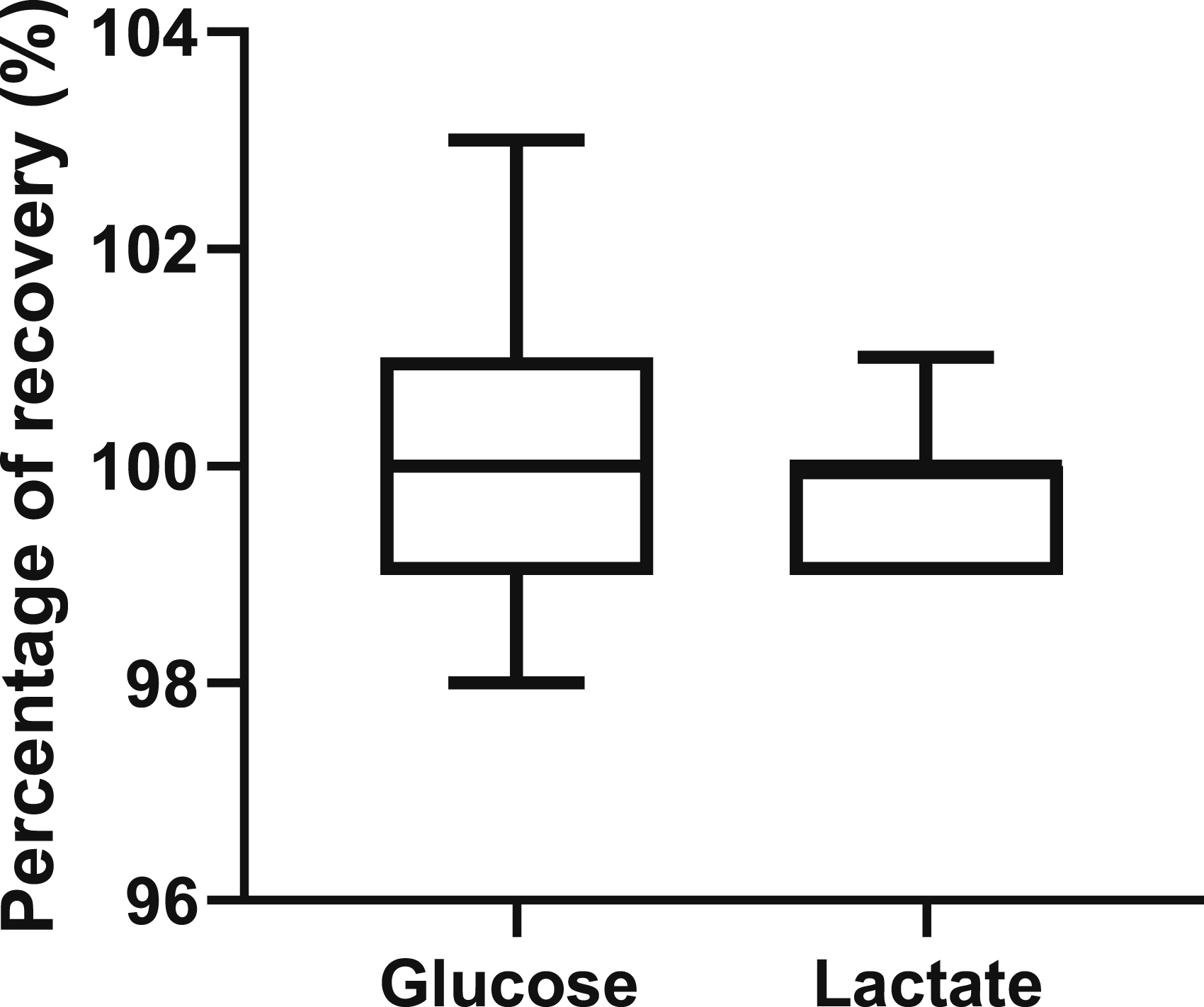
We therefore confirm that total protein levels in CSF should not be measured if the sample has been exposed to a heparinised tube. However, given the precious nature of CSF, glucose and lactate levels may be measured if such a sample is received by the laboratory.
