







Abstract

An epic achievement
Fifty years is a substantive milestone, perhaps because it tallies approximately with the duration of our own productive lives as adults. But even in other fields, the number 50 often serves as a marker and carries significance. For example, a score of 50 runs in Test cricket is customarily marked by raising one’s bat towards the pavilion, and the game is paused momentarily to acknowledge the milestone. We don’t have the luxury of pausing; in fact, the Journal is busier than ever (as you will see) but for the Australian & New Zealand Journal of Psychiatry (ANZJP) to have been in existence for 50 years is certainly a very significant achievement, and one worth taking a little time to celebrate.
The occasion has afforded me the opportunity to pore over the numerous articles that have been published in the Journal over the last 50 years. A narrative spanning five decades necessarily takes on epic proportions, and in this brief editorial, I can only provide a synopsis of some of the changes and trends that have occurred within the pages of this Journal. Essentially, this is largely a quantitative digest, for those that like to put a number on things. The numbers are quite impressive and tell a story, but for a more qualitative summary, the Journal will throughout this year be featuring Retrospectives – see ANZJP This Month: Fifty-Fifty (Malhi, this issue), and Retrospective on Melancholia (Parker, this issue). Later in the year, there will also be another editorial that adopts a more personal perspective on the achievements of the ANZJP and its contributions to the science and practice of psychiatry.
A child of the swinging sixties
Upon reviewing the very first issue of the ANZJP, published in March of 1967, I was pleasantly surprised to see that John Cade (Mr Lithium) had published an article on the metabolism of melancholia (Cade, 1967b), and followed this up in the very next issue (Cade, 1967a) with an account of the historical origins of lithium, noting its position in psychiatry at the time. Amusingly, some years later in 1973 (Cade, 1973), he also wrote a somewhat risqué article on masturbational madness, which interestingly lists acute, chronic, simple, senile, adolescent manias and mania of exaltation along with mania a potu, delusional mania, hysteromania, puerperal mania and nymphomania! In other words, many-a-mania. It is no wonder that lithium was popular when first discovered.
Sexual matters seem to have featured rather strongly in the early years of the Journal, with almost a quarter (6 out of 25) of the articles in four consecutive issues; in fact, 4 out of the first 5 issues published articles on topics such as parent–child incest, erotic professional indiscretions, lesbianism in the Maori, transexualism and transvestism. This too was a revelation to me, and not at all what I had expected to be featured in a medical journal per se. Equally intriguing, if not more so, these early years also featured articles on topics that still seem remarkably contemporary, such as cultural factors in psychiatry (Yap, 1968), the interplay of psychiatry with legal matters (Whitaker, 1968) and the differentiation of dementia from other forms of cognitive changes(Ter and McDonald, 1968). But the Journal has changed. It has grown and become even more diverse, and perhaps this is a key reason for its continued success.
Fifty years of data, and data on 50 years
The ‘facts’ pertaining to the ANZJP over the past 50 years are shown in two graphs captured in the one figure (Figure 1). They represent the Inputs and Outputs, respectively. The figure also shows the different covers that have adorned the Journal over the past 50 years. This year, to mark the occasion, the Journal will be featuring images from its past and will be carrying a special logo. It is interesting to note that, in terms of colour, the ANZJP has been predominantly blue (my favourite), and, even though latterly white has been introduced and featured increasingly, it only further accentuates the blue lettering of the ANZJP – at least that is my perception. Whatever your views on the covers of the Journal, its distinctiveness stems from its rich and varied content. This is the product of many minds.
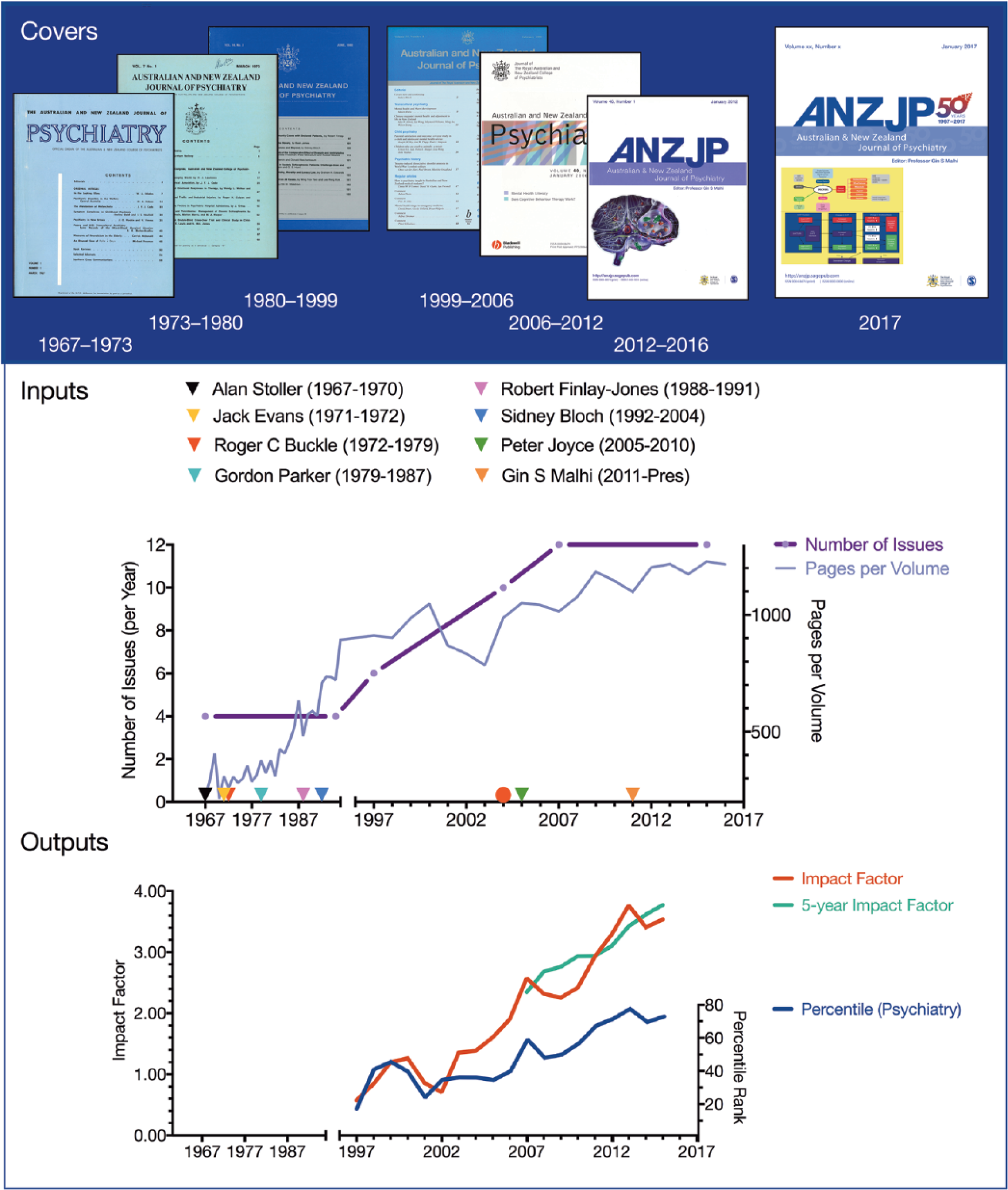
ANZJP: 50 years in numbers.
Since its inception in 1967 under the wise supervision of its Founding Editor, Alan Stoller, a total of eight editors have governed input to the Journal (see Figure 1). The first five editors steered the Journal through its first quarter century: Alan Stoller, Jack Evans, Roger C Buckle, Gordon Parker and Robert Finlay-Jones were editors for 4, 2, 6, 9 and 4 years, respectively. The sixth editor (Sidney Bloch) served for an impressive 13 years on his own. Since 2005, the duration of the editorial role has become standardised and runs for 5-year terms. My immediate predecessor (Peter Joyce) served one term and I am now into my second. Each editor has brought his own unique vision and made subtle changes to the direction and content of the Journal, and also, importantly, introduced new ideas and implemented new initiatives, ensuring that the ANZJP has continually adapted and evolved.
In the early years, there were only 4 issues per year, and therefore considerably fewer pages to fill (on average 300–400 pages per year as compared to more recent years averaging nearly 1200 pages). But publishing was more laborious then. Communication was slower and papers had to be mailed in the post. Looking back, perhaps some would describe this pace of publishing as more considered. Certainly, the writing has more flare and it is evident that, though there are fewer words on the page, they have been chosen carefully to convey precise meaning. In addition to the impact that different editors (and their teams) have had on the Journal, many other factors have also played a significant role. For example, switching publishers often led to the introduction of new styling and formatting and sometimes a new focus for the ANZJP as it accessed ever-broader audiences. Naturally, the profile of the Journal has also been affected by innovations such as the Internet, which has allowed not only online access, but also online submission (marked in red in 2004 in Figure 1), and online processing and publishing.
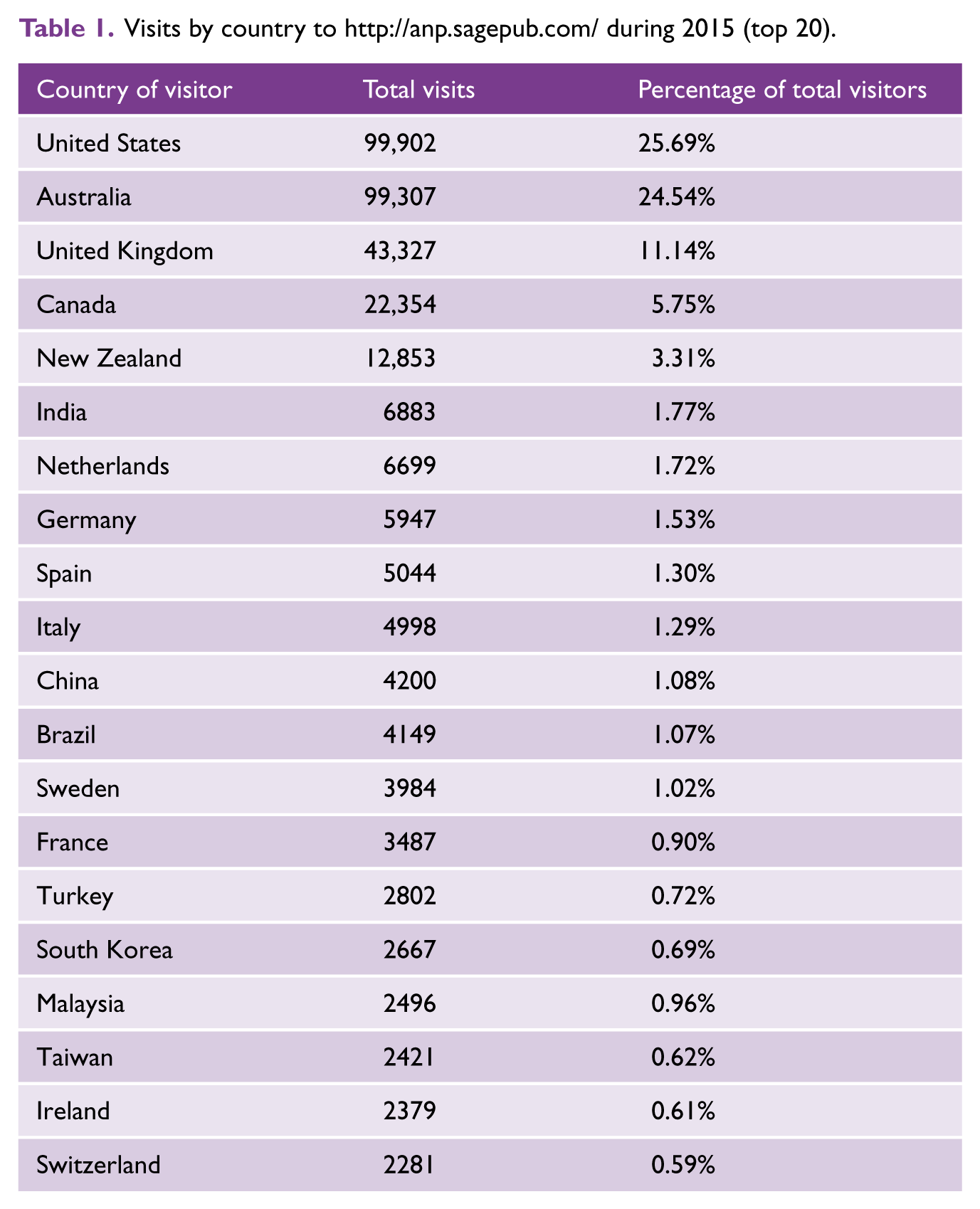
Whatever mechanisms, processes and influences it has been subjected to, even a cursory examination of the Outputs in Figure 1 reveals a single undeniable truth: namely, the ANZJP has positively thrived. It now has more issues than ever before (published monthly) and fills more pages than ever before (more than 1000 annually). It has a robust Impact Factor (both 2 year and 5 year) but, more importantly, it is now receiving more submissions than ever and probably has speedier throughput and online publication than at any time in the past. The impact of articles in the ANZJP has also increased, with many papers attracting citations not just within the first few years, but for many years thereafter. Publications in the Journal are, not surprisingly, largely from Australian and New Zealand researchers, but most online ‘visitors’ (actually visits, see Table 1) to the Journal are from the United States, and a significant number originate from the United Kingdom. Visitors from other European countries, Canada and Asia also feature strongly – reflecting the broadening appeal and international reach of the Journal.
Visits by country to http://anp.sagepub.com/ during 2015 (top 20).
Making an impact
The Impact Factor and ranking of the Journal are of variable importance to its readers. But for authors, and especially researchers and academics, these, along with citations, are critical ‘measures’ of their productivity. Such statistics necessarily have many limitations, but nevertheless, it is interesting to note that over its lifetime the ANZJP has served its contributors well, and continues to do so (see Table 2). Data in Table 2 show citations to the top 50 papers published over the past 50 years in ANZJP, presented in blocks of 5 years. In other words, in each 5-year period the five most highly cited papers are listed in rank order. Papers that have received more than 200 citations since publication (the top 13) have been highlighted in yellow. Note that, for ease of display, only the first author has been cited for each of these articles although, naturally, many additional authors and indeed teams of people have contributed. Nevertheless, it is interesting to note that Alison Yung has the most highly cited paper (545 citations) and features twice as the lead author in the top 13 articles and is a co-author on several others. Also noteworthy is the fact that a number of the current ANZJP Associate Editors, namely, Tony Jorm, Scott Henderson, Philip Boyce and Cherrie Galletly also feature prominently in this list. The fact that nine of the highest cited papers are from two blocks of 5 years (1997–2006) reflects the increasing success of the Journal and the role the Internet has played in making articles more readily accessible, and the expansion in journalsgenerally that has created greater opportunity for citation. This trend is likely to continue as articles published in the last decade (2007–2016) gain momentum.
Most cited articles from the Australian & New Zealand Journal of Psychiatry (ANZJP). The top 13 most cited articles with 200 or more citations are shaded.
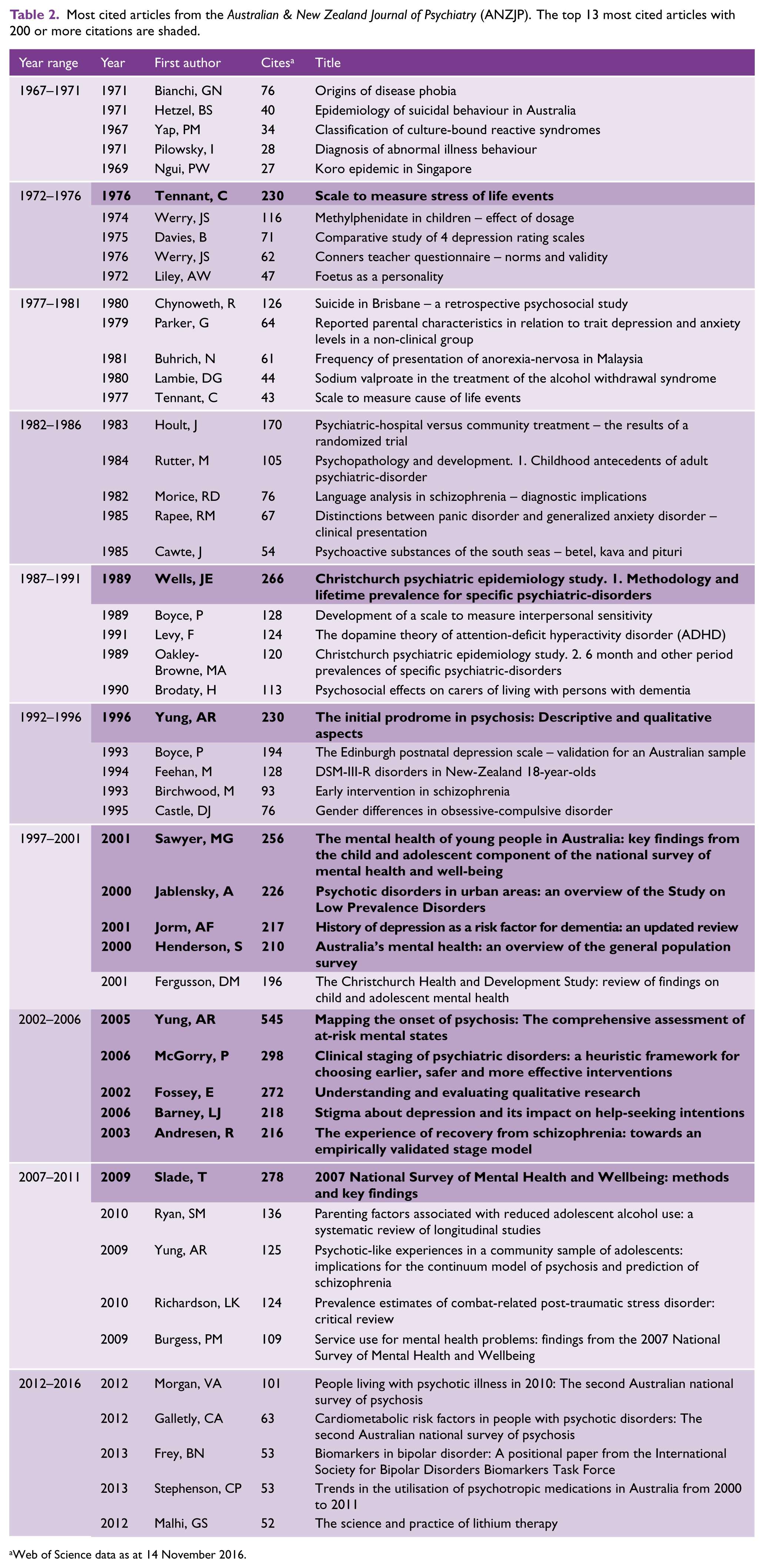
Web of Science data as at 14 November 2016.
Raising the standard in a post-truth era
The journey thus far for the ANZJP has been anything but predictable, with a multitude of factors impacting its course over the past half a century. However, the Journal has survived and thrived: today it reaches a worldwide community of researchers and clinicians and features research that furthers understanding and provides education that informs practice. Political events over the past year certainly suggest no reduction in global unpredictability as we embark on the next 50 years. In these uncertain times, in this golden anniversary year, as all are called upon to defend the worth of scientific knowledge, perhaps we should respond in epic Hollywood style: from the lands that brought you Crocodile Dundee, Lord of The Rings and Mad Max comes a journal so fearless, so magical and so on edge that it too will have numerous sequels and take you on a journey that brings you closer to the truth.
The story continues …
*All persons accessing this journal must be at least 18 years of age or accompanied by a responsible adult.
Footnotes
Declaration of Conflicting Interests
The author(s) declared no potential conflicts of interest with respect to the research, authorship and/or publication of this article.
Funding
The author(s) received no financial support for the research, authorship and/or publication of this article.