







Abstract
This study draws on a survey of 800 upper primary school students concerning their knowledge of certain ‘new media’ applications. The findings concur with other studies in suggesting that students’ relationship with technology is more complex and nuanced than is conveyed by a simple branding of ‘digital native’. Some differential experiences between classes and genders are identified, along with an important minority of students who have much more out-of-school experience with new media than others. The role of the school and teacher in inducting students to new media is presented as central, with important implications for curriculum leadership and teacher professional development.
Keywords
Introduction
The world inhabited by school students is increasingly digital, multimedia and online. They are active users of what can be called ‘new media’, a broad term referring to media that are ‘flexibly’ available on any digital device and that fosters creative participation and community formation (New Media, 2013). Amongst these are YouTube, 1 Facebook, blogs, Twitter, podcasts, online worlds and gaming. With online environments such as Facebook claiming to have 900 million active users (Facebook, 2013), Twitter with 500 million active users (Twitter, 2013), over 11 million subscribers to World of Warcraft (Bainbridge, 2010, p. 1) and The Sims shipping over 16 million copies (The Sims, 2013), it is clear that ‘new media’ occupy an important position in the daily life of the population at large. Certainly, its ubiquitous presence makes it easy to agree with Prensky (2001, p. 1) that the members of the current generation live their lives ‘surrounded by and using computers, videogames, digital music players, video cams, cell phones, and all the other toys and tools of the digital age’.
The relationship between new media and school education is increasingly being explored (e.g. Apperley & Beavis, 2011; Barab, Pettyjohn, Gresalfi, Volk, & Solomou, 2012; Beavis, 2010; Cope & Kalantzis, 2009; Gee, 2007; Lankshear & Knobel, 2006; New London Group, 1996; Thomas, Barab, & Tuzun, 2009). Despite this growing interest, Knobel & Lankshear (2006) have expressed concern that the kinds of digital-age expressive communication required by emerging knowledge economies, and favoured by school-age students, are generally inadequately addressed in classrooms. Portrayals of the knowledge and background school students have of new media are patchy at best. Jenkins (2006) suggested that over half of all American teens, and 57% of those who use the Internet, are media creators, having published some form of multimedia such as blogs, webpages or videos. Several Australian studies point to much less penetration by new media in the lives of young people. In relation to Australian first-year university students, Kennedy, Krause, Judd, Churchward, and Gray (2006) found that 21% of respondents maintained a blog and 24% used social-networking technologies. Smith, Skrbis, and Western (2012) reported on the Internet use by 6444 lower secondary students, finding that it is considerably more nuanced and varied and probably not as high as popular culture might lead us to believe. There is, however, as Rutherford, Bittman, Brown, and Unsworth (2011) observed in their study of young children’s engagement with new media, a notable gap in what is known about Australian students’ use of new media more generally. The study reported in this article contributes to the emerging profile of Australian young people’s familiarity with new media, focusing on upper primary school children specifically.
The commitment of some Australian Education Departments (Australian Labor Party, Australian Capital Territory Branch, 2004; Office of the Minister for Education and Training, Victoria, 2004) to provide authoring software such as Kahootz 3 (Maggs, 2008) to all primary and secondary schools in their jurisdiction created an ideal opportunity for research and development in multimodal authoring (see Chandler, O’Brien, & Unsworth, 2010) and – somewhat coincidentally – students’ awareness and experience with certain new media more generally. In this article, data gathered from 800 upper primary students from years five and six in 17 schools are reported, shedding light on this issue.
With the creation of multimodal texts now featuring in the Australian Curriculum (2013), and the K-12 New Horizon Report (Johnson, Adams & Cummins, 2012) identifying the growth of digital media literacy as a challenge for schools over the medium term, the data presented in this article are timely and have practical significance for teachers, schools and curriculum developers. The results draw attention to the importance of the school and teacher in the introduction of students to new media, and the need for a proactive approach to curriculum design, implementation and professional development.
The study
As it was work with Kahootz 3 (Chandler et al., 2010) that provoked the present investigation, it is important to provide an overview of this software and how it functions. Kahootz 3 is, in several respects, a curious and hybrid piece of software, described by its principal designer as a ‘3D construction toolkit’ (Maggs, 2008). The user is presented with a series of initially blank scenes in the same way as many movie-creation software packages show a sequence of frames to the user. Each scene is a virtual 3D space, which the user populates with various objects from an extensive library. In that sense, it is not unlike the construction of a ‘world’ in environments such as Second Life, The Sims or Minecraft. Like these, the user can move around a virtual space, interacting with other objects. Unlike those environments, Kahootz 3 is a single-user environment, so there are no interactive participants in the space, and the user is not represented through an avatar. Kahootz 3 also provides some limited programmatic capabilities (not unlike computer programming in 3D environments such as Alice) that can be used to develop game-play-styles of interaction; the user can then, for instance, click on certain objects and move to another scene, or cause an effect such as another object bursting into flames. In the parent study in which this investigation is situated (see Chandler et al., 2010), students used these resources to create a movie in the genre of a narrative – a ‘3D multimodal narrative’.
The focus question for the present investigation was this: prior to commencing a unit of work on multimodal authoring, what experience do students have of software that is similar to Kahootz 3? In particular, what is their prior awareness of 3D animation software, movie-making software, 3D game-creation software or 3D worlds?
Participants
Data collection commenced in 2010 and was completed in 2011. In 2010, 377 students from five schools (19 classes) in both years 5 and 6 (including both single year level and composite classes) participated in the study. In 2011, 423 students from 14 schools (26 classes) participated, with two schools participating in both years (but no student participating twice). The schools were varied in relation to geographic location and socioeconomic status, but were mainly government schools. The majority of respondents were Victorian: 12 schools with 83% of total respondents, with smaller numbers from Tasmania (2 schools, 11% of respondents), New South Wales (2 schools, 5% of respondents) and Queensland (1 school, 1% of respondents).
Questionnaire
A questionnaire containing four items, presented in Appendix 2, was used to gather data about the software types similar to Kahootz 3 with which students had prior experience. Respondents identified the new media software familiar to them and the settings in which they learned about those tools. There are two important limitations of the questionnaire. Firstly, it did not allow for the depth or extent of knowledge to be indicated (cf. a Likert-style item for each software product). Secondly, it captured knowledge of only certain types of computer-based new media, so that their use of other devices and technologies (such as gaming consoles, iPads, smartphones, facebook, twitter or skype) is unreported. Because of these limitations the results described are therefore a rough indication of familiarity with an inexact definition of ‘new media’.
Data collection
The questionnaire was available online and was completed in the first third of the school year, prior to any class commencing the program of multimodal authoring. All teachers allocated class time for the completion of the questionnaire, leading to a high return rate of 83%.
Data analysis
For items 1, 2, 3 and 4, the data are nominal and Pearson’s chi-squared test for independence (McDonald, 2009, pp. 52–57) was widely used, as implemented in R (R Development Core Team, 2013). For instance, the relationship between ‘prior experience with an item of software’ as one variable and either school, gender or year level as a second was explored. The sign test (Owen, 1962) was used to test the significance of data falling into binary categories, such as software types as either well or poorly known. Other case-study data drawn from the parent study (Chandler et al., 2010) have also been referred to in this analysis.
Results and discussion
The new media software that was identified as being known by the students is presented first. The circumstances in which these packages are learned are then described. This is followed by a more detailed analysis that differentiates between ‘in school’ and ‘out of school’ and from which some gender and year level differences can be discerned.
New media software known by students
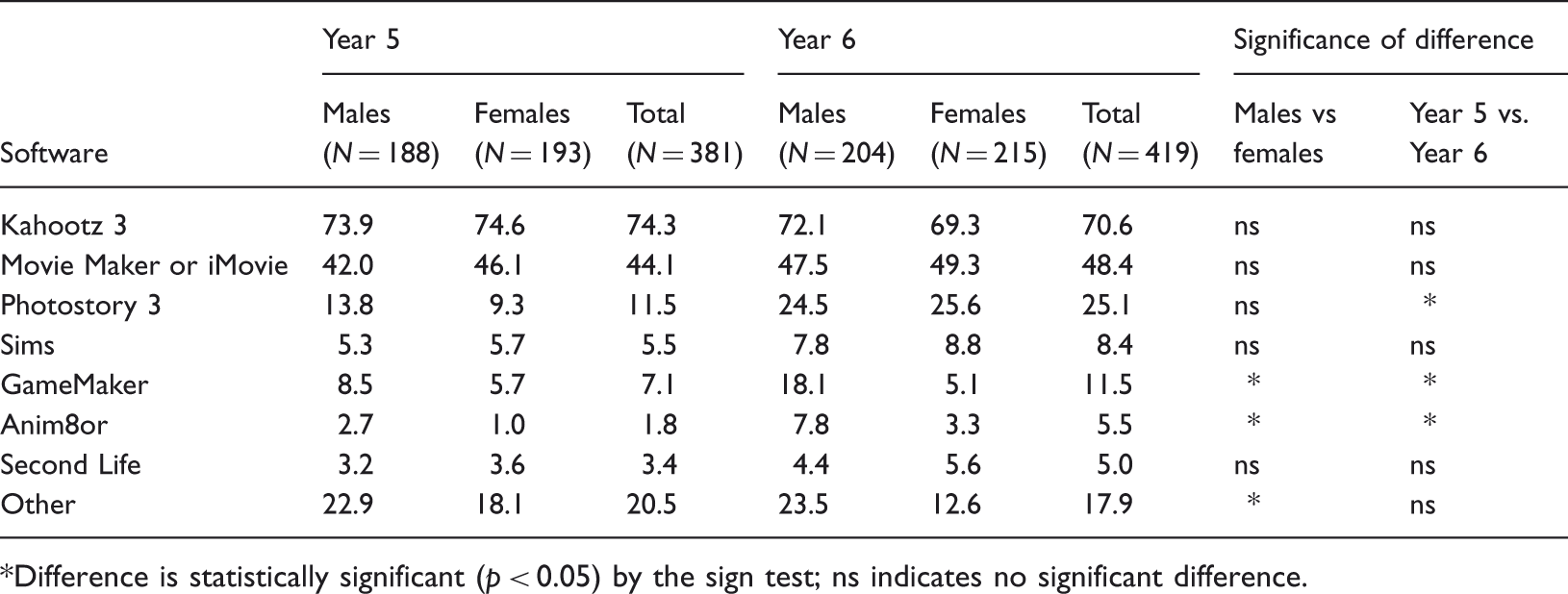
Percentage of respondents who have known or had experience with specific software.
Difference is statistically significant (p < 0.05) by the sign test; ns indicates no significant difference.
It can be seen that items of new media are not generally well known by students. Though classes had not begun the prescribed unit of work in multimodal authoring, they were nevertheless relatively familiar with Kahootz 3 (indeed, ‘Kahootz 3 ready’ schools were specifically recruited for 2011). Aside from this, no product is known by more than 50% of students. In terms of products not specifically listed in the questionnaire items, if environments such as Minecraft or Club Penguin were widely known by students, they would be expected to be nominated as ‘Other’ and rate on this scale somewhere. Of course, students might not have considered such environments to be closely related to their forthcoming work in Kahootz 3, but for less than five of 381 students to identify an item suggests that it is really ‘not on their radar’.
The category ‘Other’ is an aggregation of software types known by less than five students. Individual school percentages of this category range from about 5% in two of the schools to over 30% in three others. Whilst it can be said that the general level of knowledge of new media is not very high, and there are few new media software products that stand out as being widely known, there is considerable variation in the new media known both within and between schools. We now move to consider the circumstances in which these packages are learned, before revisiting this data with a more detailed series of analyses.
Where new media are learned
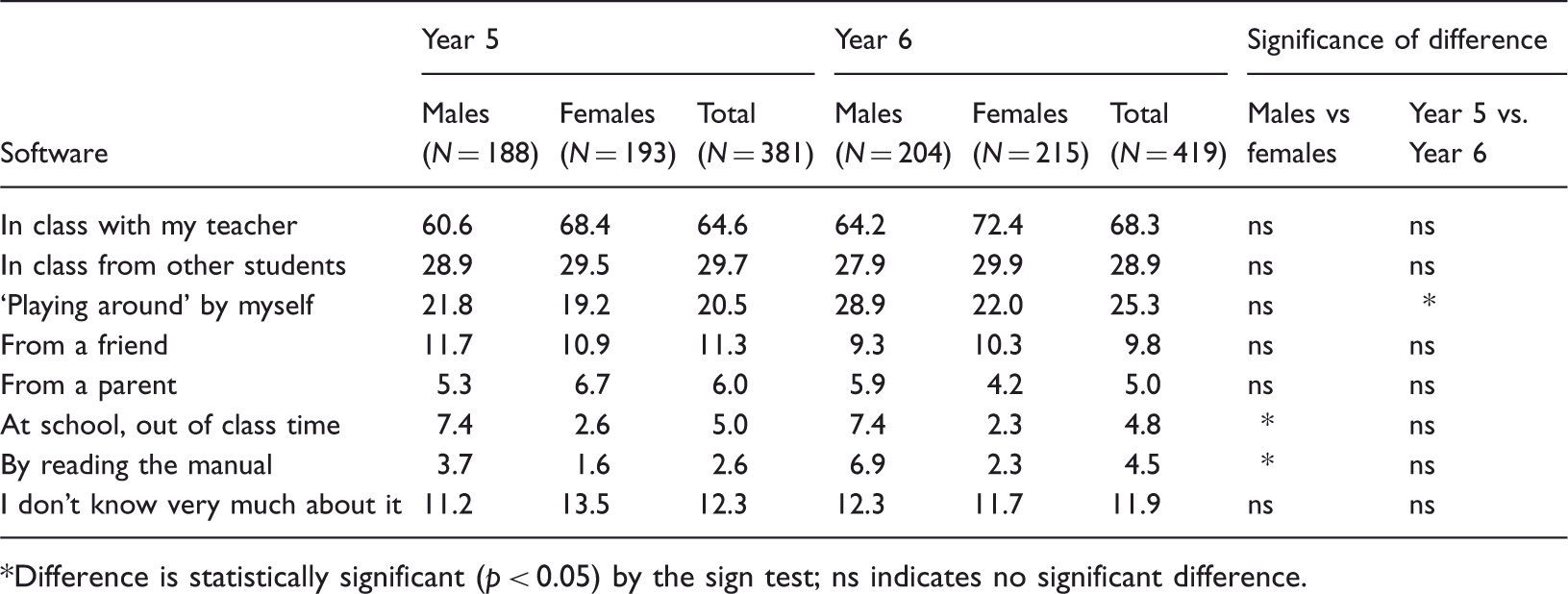
The circumstances in which students have learned about the software products: percentage of respondents.
Difference is statistically significant (p < 0.05) by the sign test; ns indicates no significant difference.
Even allowing for some effects on the data because of the association between this questionnaire and forthcoming units of work, it can be seen that learning about new media was prominently an ‘in class’ activity for the students surveyed. However, up to a third of students reported learning about new media in ways that are consistent with out-of-school engagement.
We now proceed to identify software products that are taught as part of classroom programmes compared with those that may be learned outside their schooling.
Software taught by schools
Schools in which certain software is known by a majority of students.
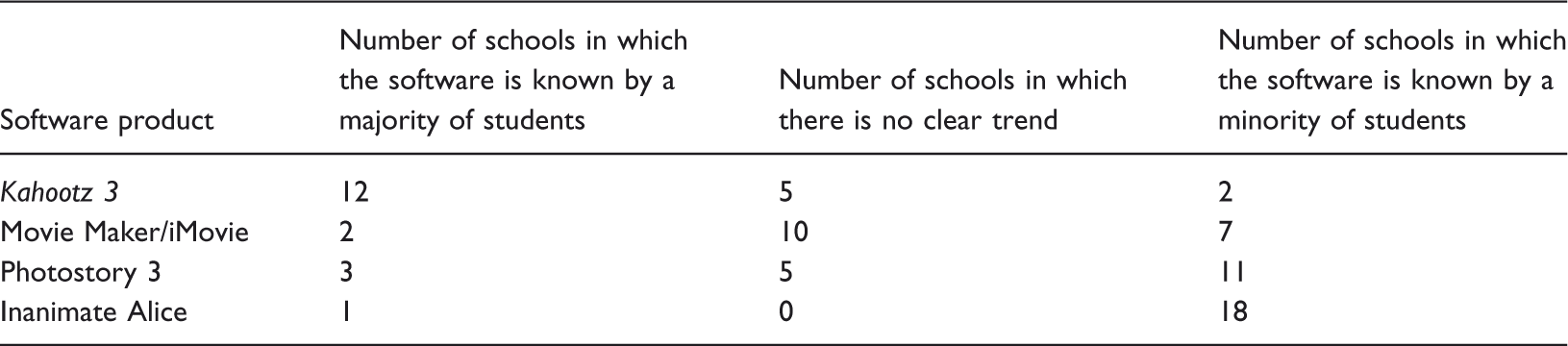
Further analysis identifies that there are six schools in which more than one software product was identified by a majority of students, and a further six schools in which no software was known by a majority of students. Therefore, it appears that there are some schools where new media was an established part of the curriculum and others where it was not. Applying the same type of analysis to classes where there is ‘no clear trend’ in the school overall reveals some classes where a software package was known by a majority of students. This suggests differences between classes in exposure to new media. It is notable that there are three particular schools where no differences between classes, year levels or genders for any of the ‘majority’ software types were found. This would indicate consistency of intention and clarity of curriculum co-ordination at those schools; elsewhere, new media seems to have been picked up formally by some teachers (or informally by groups of students) and not by others.
In the ‘minority cases’ – ‘Other’, Anim8or, GameMaker, The Sims and Second Life – an important result emerged when the numbers were aggregated. An average of 32% had prior experience with at least one type, ranging from about 10% to 60% across schools. This emphasizes the point made earlier about the variability of the knowledge of ‘Other’ software, showing that, outside of class time, a sizeable proportion of students had access to some new media software. Use of new media is alive and well outside the classroom, but considerably more so in some communities than others.
The final area of analysis identifies subgroups of students who had particular familiarity with certain software products compared with other groups, with important implications for deliberate curriculum planning and decision-making.
Knowledge of new media among different subgroups
This discussion emerges from an investigation of differences in the data on the new media software known by students by comparing groupings of gender or year level. Table 1 (above) shows that there were six instances where a significant difference existed, in addition to some complementary within-school differences. These differences occurred with software that was known only by a minority of students.
Knowledge of software categorized as ‘Other’ was more commonly reported by males than by females (Table 1). Males reported more frequently than females that they learned about software at school, out of the classroom or by reading the manual (Table 2). Taking heed of the total numbers in each of these categories, perhaps the main message for teachers is not to be surprised if the small numbers of students who have broad knowledge of software, who spend substantial time at school with new media, or who persist with learning from manuals, are often males.
Game development is an activity which seems to be favoured by males. GameMaker was identified only at six schools, but was known by up to 15% of students at those schools. In each of those schools, males were more likely to have had experience with this software type than females, and year six students more so than year five students. The other game-creation tool considered, Anim8or, was only known at one school, but it was almost universally male students who know of it. These results are consistent with other findings (Kennedy et al., 2006; Kvavik, 2005) which suggest that gaming is more popular amongst males than females.
Whereas the game-creation software seems to be favoured by males, it appears that females were more attracted to Second Life and The Sims. Certainly, The Sims is known to be a draw-card for females with over 60% of players being female (The Sims, 2013). Within this dataset the results are less than conclusive. Knowledge of Second Life and The Sims ranged from around 6% for most schools to nearly 20% for two schools. Although there were no significant gender differences overall, there was one school in which both Second Life and The Sims were known by significantly more female than male students, and Animator by significantly more male than female students. Interestingly, this is one of the schools identified as having consistency of intention and clarity of co-ordination; one could conjecture that there is something distinctive about exposure to new media at that school.
In relation to Movie Maker/iMovie, there were four schools in which there were gender differences. At three of these schools, among the year six students females were more like to have prior experience than males. At the fourth school, year 6 males were more likely to report prior experience than year 6 females. As Movie Maker/iMovie was known only by a minority of students overall at these schools, these differences cannot be ascribed to differential instruction; rather, it seems more reasonable to postulate that certain new media become ‘fads’ amongst different age/gender groupings, in much the same way that school-yard games such as ‘down ball’ and ‘elastics’ have appealed to different age/gender groups at different times.
Similar reasoning might explain some other cases. Consider Photostory 3: two schools where it was known by a majority overall stand in contrast: a statistically significant result in favour of females in one, and males in the other. Also with Kahootz 3: in one class at a particular school, prior experience was more common among males, but in the two other classes, more common among females. ‘Fads’ among certain groups of students seem to be the best explanation for the many of the year level and gender differences that are observed, as variations seem to be highly specific to the school, year level or class.
One particular school stood out as an interesting case. At this school, two teachers participated in the study, one known to be highly committed to new media, and the other not so highly engaged. Nearly every comparison between classes was statistically significant, in favour of the class taught by the teacher more committed to new media. What is then interesting is that males in the class taught by the less media-aware teacher were more likely to identify prior experience with Movie Maker/iMovie than females in the same class. It is tantalizing to suggest that the males in this class had become aware of what was happening in the other class to a greater extent than the females, and accordingly took the initiative to familiarize themselves with the software.
In summary, game creation was a minority activity, but seems to be male dominated. Environments such as Second Life, The Sims and possibly the use of Movie Maker/iMovie were a greater draw-card for female students. ‘Fads’ seem to be a useful way of thinking about differences that are situationally specific, and the particular results from two schools, though very different, emphasize the vital role of the school in providing systematic and consistent exposure to new media.
Summary
In relation to the research question of what experience do upper primary students have of software similar to Kahootz 3, and by implication, of new media more generally, the glib answer is ‘not much’. Of course, defining ‘new media’ in this way does not do justice to the field (see Lister, Dovey, Giddings, Grant, & Kelly, 2003), though this study does provide some valuable insights.
Firstly, assertions (as cited earlier) that teenagers are highly engaged with new media may seriously overstate the engagement of Australian upper primary students. Secondly, it is the classroom, rather than out-of-school experience, where important learning about new media was occurring. Within any class, though, a notable group of students – possibly between one-third and two-thirds – had relevant prior experience. The nature of that experience was, however, far from uniform. Some differences existed between male and female students, but within the data available this speaks more to the diversity of experience than it does to any widespread gendered experience of new media. That being said, there was a tendency for males to be more interested in game development than females, and females possibly more attracted to environments such as The Sims. With that in mind, the value of initiatives such as those of Caitlin Kelleher (Gross & Kelleher, 2010; Kelleher & Pausch, 2007) to introduce female students to programming through environments similar to The Sims must be recognized.
Kahootz 3, Movie Maker, iMovie, Photostory 3 and Inanimate Alice can be identified as the software products that were favoured at the schools surveyed, and these products are concerned with movie construction. Perhaps schools interested in virtual worlds, game play, game creation or simulations were not attracted to a multimodal authoring project with Kahootz 3. It may also be that these other forms have yet to establish any real foot-hold within schools. Moreover, the software packages identified in this study are ‘tried and true’ – ‘safe’ rather than adventurous. Some instances of schools where there is strong curriculum management can be inferred from the data, and other examples where there were notable differences between classes; therefore, the role of schools to provide equitable educational experiences to children is an important one.
Conclusion
New media have arrived in the curriculum of Australian schools. Whether it is because of the philosophy and vision of particular schools or teachers, curriculum implementation imperatives such as the literacy strand of the Australian Curriculum (2013), or a combination of both, implications for teaching, professional development and curriculum management can be identified.
Students at school present a diverse experience of new media. Simply living in a modern world has, in general, not provided students with a high level of prior experience with relevant new media, and yet there is a need to maintain the interest (and extend the knowledge) of a significant minority of students who have some genuine (and possibly extensive) background knowledge. A curriculum which is purposeful about the introduction and use of new media and consistent in its implementation across classes and year levels would seem to be a useful strategy. That is not to suggest that all schools should implement extensive multimodal authoring projects (e.g. Chandler et al., 2010), though with the emphases in the Australian Curriculum, a case for that would be defensible. Rather, the argument here is for experiences aimed at ensuring a more equitable level of simple familiarity with new media more generally.
Another argument for the centrality of the teacher in facilitating student’s engagement with new media arises from the work of Rutherford et al. (2011). They observed that age–appropriate guided interaction by parents is crucial to the language acquisition of young learners accessing both new and old media. In very simple terms, and specifically in the domain of language learning, how the parents are talking with their three-year-old as they use a computer game or watch television matters more than how much ‘screen time’ these children have. By implication, then, it is important for teachers to be engaged with students as they are exposed to new media – to provide a rich discursive environment, and not merely to provide ad-hoc opportunities for use in a classroom. It would be easy, of course, to take a highly pro-digital-native line, asserting that students are already knowledgeable and that all that teachers need to do is to help students apply their knowledge in a suitable context. If this were the case, discussions of Minecraft or The Sims could be relegated to playground chatter or informal conversations. This study provides no evidence to support such a position. Left to their own devices, upper primary students are not gaining a breadth of knowledge of new media, and an active rather than passive role for teachers is called for.
The importance of professional development for teachers so that they can successfully implement the Australian Curriculum is clear, as so much about new media seems to be outside the mainstream of current classroom practice or teacher knowledge. Given the importance of the teacher and the school in introducing new media to students, the provision of systematic professional development needs to be taken very seriously. Unquestionably, school-based curriculum planning and management also needs to be alert and responsive to the impact of new media and the school’s role in inducting students. Comparability between classes and systematic planning across year levels is as important in this area as any other part of the curriculum.
This study has identified differences in exposure to new media between genders, year levels and among schools. A clear implication is the need for a more comprehensive study of Australian students and new media that can more authoritatively identify generalizable trends and differences amongst subgroups. Certainly, it seems that knowledge of new media is more extensive in some communities than others, and the factors that lead to this are worthy of investigation.
The strongest theme emerging from this study is the importance of the role of the school and teacher in introducing upper primary students to new media. Whether that is true of other age groups, or whether it will be true in several years’ time, remains to be seen. Certainly, there is enough evidence in this study to join with others (e.g. Bennett, Maton & Kerwin, 2008; Kennedy et al., 2006; Rutherford et al., 2011; Smith et al., 2012) in suggesting that students’ relationship with technology is more complex and nuanced than is suggested by the simple branding of ‘digital native’. In critiquing the ‘digital natives’ debate, Bennett et al. (2008) have suggested that ‘we may live in a highly technologised world, but it is conceivable that it has become so through evolution, rather than revolution’ (p. 783).
The world of Australian students is one in which the place of new media is increasingly theorized and discussed, a curriculum imperative is in place and students bring experiences that are far from uniform. The K-12 New Horizon Report (Johnson et al., 2012) identifies the growth of digital media literacy as a challenge for schools over the medium term, and so it is schools that need to embrace this challenge and to take a revolutionary stance – to be proactive rather than reactive in relation to new media. Not to do so would be to institutionalize the differential experiences of students and to leave sound learning to chance.
Footnotes
Declaration of conflicting interests
None declared.
Funding
The Australian Research Council Linkage Project ‘Teaching effective 3D authoring in the middle school years: multimedia grammatical design and multimedia authoring pedagogy’ (LP0883563) was funded for 2009–2011. The Chief Investigators were Prof. L. Unsworth (Griffith University) and Dr A. Thomas (University of Tasmania), in partnership with and also funded by the Australian Children’s Television Foundation.