







Abstract
Despite the cultural and linguistic diversity in the Australian population, Australia’s teaching profession remains largely monocultural and monolingual, and the lived experiences of the small number of culturally, linguistically and/or racially diverse (CLRD) teachers working in Australian schools remain under-researched. This article presents the findings of a pilot study, which included a qualitative survey and interviews with teachers who identified as being from CLRD backgrounds. Standpoint theory was used to help arrive at authentic understandings of participants’ experiences, enabling participants’ subjectivities and reflections on their lived experience in relation to the socio-political context of Australian schooling to be embraced. The findings of this study identified a prevalence of feelings of isolation and loneliness among CLRD teachers, and also demonstrated their strategies for resilience. They looked to school leaders as critical players in creating an inclusive school environment, and solidarity and support from colleagues was a key factor that contributed to participants staying in a school community or the profession.
Keywords
Introduction
A strong, diverse and sustainable teaching workforce is of critical social and economic importance to Australia. The 2021 report on the Australian Teacher Workforce Data (Australian Institute of Teaching and School Leadership [AITSL], 2025) shows that the Australian teaching workforce is far more White, middle class and monolingual than the broader population, with only 17% of teachers born overseas and 8.9% of school teachers speaking a language other than English at home. In 2023, approximately 6% of the teacher workforce in Australia were born overseas and held initial teacher education qualifications from overseas. Subsequent policy initiatives have recognised the value of a diverse teaching workforce, including a need to attract more First Nations teachers, and teachers from culturally and linguistically diverse backgrounds to the profession (Department of Education, 2022; Education Ministers Meeting, 2022). This strategy is supported by international research, where there is a strong consensus that a more diverse teaching population has benefits for students and schools (Gist, 2018; Kohli, 2009; Santoro, 2015). Students perceive schools as more inclusive and welcoming environments when they see teachers who have similar backgrounds to themselves (Boser, 2014) and report feeling more supported in their social and emotional development (Bristol & Martin-Fernandez, 2019; Ladson-Billings, 2022). Teachers from culturally diverse backgrounds tend to possess greater multicultural awareness compared to their White counterparts (Cherng & Davis, 2019), are more likely to understand how students’ cultural practices and beliefs shape them as learners (Santoro, 2015) and are often more likely to discuss the topics related to race relations and social justice (Cherng & Halpin, 2016). Teachers of racially minoritised students can act as role models, and students may perceive CLRD teachers as being able to better support them than non-CLRD teachers in navigating cultural stereotypes (Cherng & Halpin, 2016; Fitzpatrick et al., 2014). As insiders to the experiences of racism, CLRD teachers have valuable insights in the fight for educational/social justice (Kohli, 2009).
While current Australian education policies recognise the value of a diverse workforce, they do not consider how the barriers to attracting and retaining teachers from diverse backgrounds in schools might be addressed (Qi et al., 2026). Furthermore, research has found that culturally, linguistically and racially diverse (CLRD) teachers (more commonly referred to as “teachers of Color” in North American literature) often experience hostile work environments and feel less valued than White teachers (Kohli, 2018; Kohli et al., 2022). This can impact on CLRD teachers’ wellbeing and professional growth (Kohli, 2018) and their job satisfaction (Kalantzis & Cope, 2020). Attracting more teachers from diverse backgrounds is likely to be ineffective if schools are not inclusive and welcoming workplaces. Additionally, due to the challenges of securing work, CLRD teachers often find themselves working in the most challenging, under-resourced and “hard-to-staff” schools (Datta Roy & Lavery, 2017; Schweitzer et al., 2021; Yan, 2021), which can impact their capacity and desire to remain in the teaching profession (Simon & Johnson, 2015).
This article presents the findings of a pilot study, which included a qualitative survey and interviews with teachers who identified as being from a CLRD background. The purpose of the pilot research was to illuminate the lived experiences of CLRD teachers working in, and/or seeking work in, Australian schools. The data were analysed thematically, with three clear themes emerging: feelings of isolation or lack of support, the value of strong leadership from school leaders and peers, and how CLRD teachers found solidarity and resilience. Each of these issues will be discussed in turn, along with a discussion of the implications of the findings for policy and practice.
We have chosen to use the term culturally, linguistically and racially diverse (CLRD) throughout our work (see Dwyer et al., 2025) rather than the more commonly used culturally and linguistically diverse (CALD), for two main reasons. First, we conceptualise CLRD teachers not simply as teachers who differ demographically from a dominant norm, but as teachers who may be minoritised through raciolinguistic and embodied processes. These processes operate through accent, vocabulary and other language practices (Cushing, 2023), but also through visible markers such as skin colour, hair, name and cultural or religious dress (Ahmed, 2007). Such markers are not interpreted separately. Rather, they are read together through dominant norms of whiteness, Anglonormativity and classed respectability, shaping how teachers are heard, seen and judged as professional, competent and belonging within educational spaces. Our use of the term is a deliberate move towards a more intersectional view of teachers’ experiences (Crenshaw, 1989). Second, we see including the key term of “race” as a way of recognising that Australia’s reluctance to engage in conversations about race and racism has allowed racism to proliferate (Bargallie et al., 2024). As the Diversity Council of Australia put forward, “while race may not be ‘real’ in the genetic sense, it remains important because people believe it is real and act on it” (Diversity Council of Australia, 2023; n.p. emphasis added).
This article focuses explicitly on the participants’ experiences of isolation in the workplace, along with where and how they experienced support. It should also be noted that the interview and survey data also included many powerful stories of racism and xenophobia, as well as cultural taxation (Hogarth, 2019; Reddick et al., 2019) where CLRD teachers became exhausted from performing cultural labour that their colleagues were not expected to perform. Participants cited incidences of verbal harassment from students, which at times, were dismissed by colleagues and school leaders. These stories were so pervasive in these data that a decision was made to devote a separate article to matters of racism, xenophobia and cultural taxation, allowing for a carefully nuanced and critical discussion. Although some of these issues may be touched upon in this article, the focus here is on experiences of isolation and the critical role played by supportive school leaders and peers.
Positioning and Background
We begin this article with an acknowledgement that the research was conducted on the unceded lands of the country now called Australia. We acknowledge that any conversation of racial justice in Australia must recognise First Nations sovereignty and self-determination. The discussion in this article has relevance for First Nations teacher education. Increasing diversity in the teaching workforce must, of course, include increasing the number of First Nations teachers. We propose that this issue is worthy of exploration separately, as well as in the context of a larger discussion about cultural diversity in the teaching profession. We acknowledge that there is a risk that First Nations teachers may be treated as “just another culture” within a larger category of “culturally diverse teachers” (Williams, 2014, p. 311). However, the participants in this study self-identified as being from a “culturally, linguistically and/or racially diverse background” and First Nations teachers did elect to participate. The research team felt that it was critical that First Nations voices be included, bringing important contributions to a conversation about racism and racial justice in Australian schools.
The impetus for this article stemmed from the lived expertise of researchers of colour on the research team, in particular the standpoint of the lead author (Jacobs), as a South Asian migrant and former classroom teacher. The lead author and others on the research team share the same standpoint as the participants and, as such, have the capacity to understand things that others who do not have a similar standpoint “typically do not know or are invested in not knowing (or, indeed, are invested in systematically ignoring and denying)” (Wylie, 2003, p. 32). Our experience contributes to the “sharpness and awareness of conditions and interpretation” (Mapedzahama & Kwansah-Aidoo, 2017, p. 6) of the experiences of being a racially minoritised teacher in Australia. The value of insider epistemic perspectives cannot be understated; as insiders, we are alert to the conditions of discrimination and oppression and the ways this affects our daily and professional lives. We have the insight to make connections and identify the “subtle manifestations of power dynamics” (Wylie, 2003, p. 37) that may go unnoticed by others who do not share this standpoint. As a result of this shared standpoint, the researchers acknowledge that our analysis and findings are located in a shared disposition with our participants. We argue that our insider positionality and the resulting non-neutrality (Mapedzahama & Kwansah-Aidoo, 2017) enhance the insights of the findings and subsequent contributions to the field of racial justice in schooling. With this in mind, we adopt standpoint theory as the theoretical frame for this study.
Theoretical Position: Standpoint Theory
Standpoint theory has its origins in the work of Hegel and Marx, who proposed that people from oppressed classes have access to knowledge that was not held by those from privileged groups, and that this knowledge provides valuable insights on understanding the world. Standpoint theory asserts that marginalised groups understand the world from their own perspective while also being very familiar with the views of dominant (i.e. oppressor) group members, whose knowledge systems permeate society. Standpoint theorists clarify that it is not simply a minoritised status that affords a particular group an epistemological privilege. Rather, members of oppressed or minoritised groups can, through a process of intellectual and political struggle against inequalities, develop a standpoint that can penetrate beyond normative understandings (Harding, 2009). In this sense, standpoint theory asserts that minoritised people have a more complete “double-consciousness” and hence can provide a better overall understanding of the world (Luke, 2018).
Standpoint theory was later developed by feminist and Indigenous scholars, as a way to address knowledge discourses that were inherently unequal. Later developments increasingly centred intersectionality (Crenshaw, 1989), expanding the early focus on gender to a broader analysis of ways that multiple systems of power shape people’s experiences of the world. Standpoint theory has, at times, sat uncomfortably beside intersectionality, which theorises that mutually constitutive social categories of differences intersect at the individual level, producing complex identity positions and experiences of oppression, privilege, and inequality (Collins, 2019; Crenshaw, 1989). However, standpoint theory is now increasingly used to analyse systemic racism, institutional power, and the ways in which epistemic authority is unevenly distributed across racialised groups. Indigenous scholars have significantly contributed to these developments in standpoint theory by demonstrating how colonial histories and Indigenous epistemologies shape distinctive standpoints. For example, Moreton-Robinson (2013) develops the concept of the “Indigenous standpoint,” which highlights how Indigenous peoples’ lived experiences of colonial dispossession and racialisation produce critical insights into the operation of settler power structures (Moreton-Robinson, 2013). Martin (2006) similarly discussed Indigenous research methodologies, exploring ways they are grounded in relationality, responsibility, and connections to Country. By foregrounding Indigenous experiences and relationships to land, these more recent understandings of standpoint theory can help illuminate the racialised foundations of settler states and challenge Western epistemological frameworks.
While Indigenous research methodologies are not used in this article, we name these approaches to note that both traditional and newer understanding of standpoint theory seeks to de-centre “truth” as monolithic, disrupting the notion that it resides within people with normative, powerful, mainstream experiences, epitomised by those who are White, male, slim, able-bodied, heterosexual and affluent (Haraway, 1988; Harding, 1991). Rather, knowledge is socially situated, and the participants in this study are situated in ways that make it possible for them to be aware of race relations in schools and experiences of racism in a way that racial majority perspectives may not. Haraway (1988) argues that no individual (or group) can have access to all ways of seeing and knowing in the world. Rather, our understandings and interpretations of the world are, in part, reflective of our intersectional positionalities within various groups.
While standpoint theory addresses issues from the perspective of marginalised groups, they are not the only beneficiary of its application. By drawing attention to the experiences of the oppressed, standpoint theory can address issues of justice, equity and inclusion (Braun, 2016). Furthermore, standpoint theory argues that we can achieve more truthful understandings by embracing subjectivities and actively reflecting on our socio-political environments (Au, 2012).
We have adopted standpoint as a guiding theory, drawing attention to the knowledges perpetuated in schooling and their relationship to inequities and social stratification (Edwards, 2012). Building on Black feminist scholarship, particularly the work of Crenshaw (1989), this research centres the perspective that standpoints are formed through the interaction of race, gender, class and other social positions rather than through the axis of any singular facet of identity. With this renewed understanding of standpoint theory, when we engage in research with participants from racially marginalised people, we must consider the racially marginalised standpoints, which can expose structures of inequality that remain invisible from dominant perspectives (Harding, 2004). In the context of this article, all participants in the study are from racially minoritised backgrounds, telling stories of their lived expertise in schools that were shaped by being part of this marginalised group. Participants discuss their experiences of cultural identity, discrimination and isolation as influenced by their gender, geographical location, area of curriculum expertise, class, age and other intersectional factors. In each case, standpoint theory and intersectionality are useful lenses as they both uncover and validate subjected, marginalised and often silenced forms of knowledge (Mann, 2018; Willett & Etowa, 2023).
Method
This article is based on the pilot study of a larger research project that investigates schools as inclusive workplaces for teachers from culturally, linguistically and racially diverse (CLRD) backgrounds. Initial literature review and policy analysis have shaped the development of this pilot study, which included a qualitative survey and interviews with teachers from CLRD backgrounds about stories of their lived experience of teaching in Australian schools. This article reports on the themes from the pilot data, including both survey responses and interviews.
Recruitment
Survey recruitment was undertaken by sharing the survey link on social media and through professional networks and organisations. People were invited to share the online recruitment advertisements, leading to an increase in organic reach on social media. Survey participants were given the option to volunteer to be contacted to participate in an interview. Contacts within the researchers’ professional networks were also invited to participate in an interview, and may have completed the survey afterwards, or not at all. Snowball sampling was also used to identify additional participants for interviews.
Participants
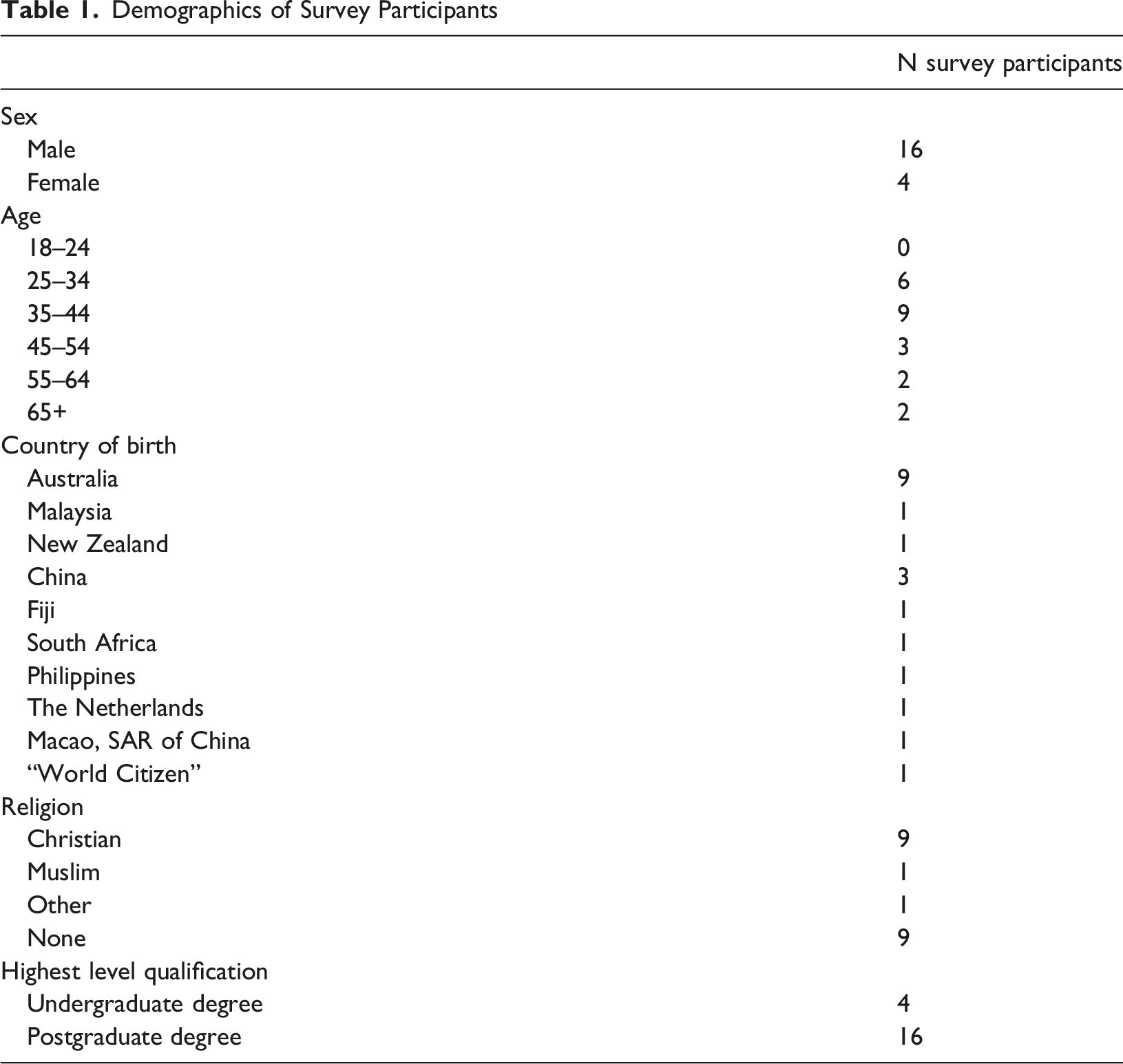
The survey asked participants to recount stories of their experiences of teaching in Australian schools, including how they had been supported and included in their workplaces, their experiences of barriers, exclusion and racism, and how their teacher preparation program and/or professional experience overseas had impacted on their preparedness to teach in Australia.
Demographics of Survey Participants
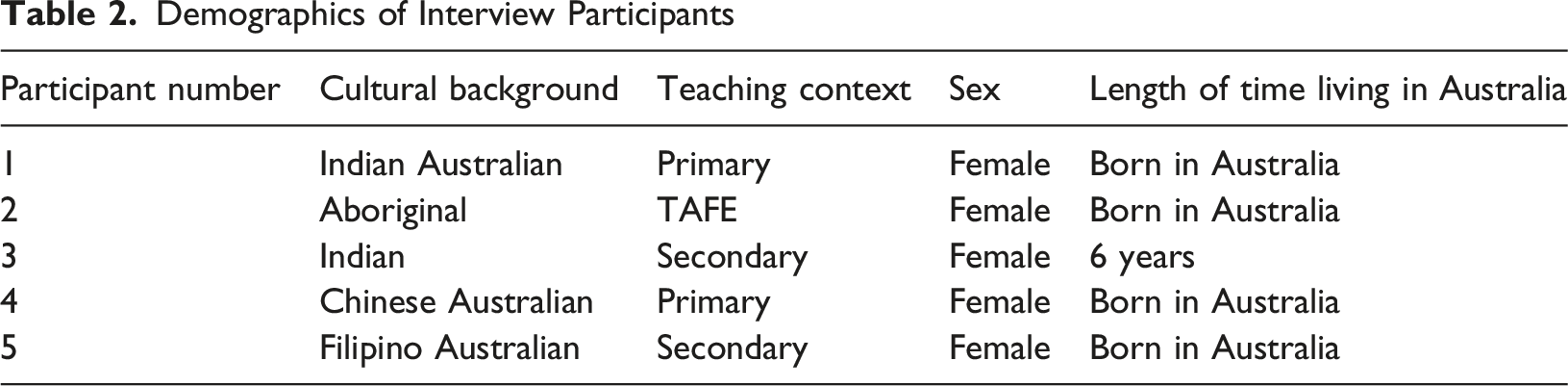
Demographics of Interview Participants
Data Collection
The survey questions were largely qualitative. Participants were invited to respond to each of the questions as a yes/no, with a request to describe an example if they responded yes. The survey questions comprised the following yes/no prompts. • Do you feel you have been supported by your school/s during your teaching career? • Do you think your approach to teaching was compatible or aligned with the Australian schools you have taught at? • Have you experienced overt discrimination from staff, students or the community while teaching in Australia? • Have you experienced “everyday exclusion” in your work in Australian schools? • Have you observed any of your colleagues experiencing discrimination? • Have you been asked to take on extra responsibilities or do additional labour because of your identity, for example, race, language, gender and cultural background?
The interviews were semi-structured, conducted online and were between 30 and 60 minutes in length. Questions included the following: • What contribution do you feel you have made to your school through your teaching? • What are some of the most challenging factors in seeking/gaining employment as a teacher? • What are some of the most challenging factors related to your teaching? • Do you think your teaching approach was compatible with the schools you have taught at? • What surprised you most when you first started teaching in your current school? • How do you think your school could have better supported you? • What could have made your teaching experience better?
A responsive approach to member checking for the qualitative interviews was adopted, to ensure that participants were comfortable with what they had shared previously as well as to ask if they wanted anything deleted or changed. Participants were sent a copy of their transcript and were invited to add to or modify sections. There was often a follow-up conversation in which more data was added, then reviewed and revised. Reflecting feminist standpoint theory, this process created a collective (Sprague, 2016) and ongoing dialogue, forming a coalition between the researcher and participants which allowed for more active and continual involvement of participants throughout the research process. Finally, in the analysis process, the themes that were chosen for reporting were the ones that increased consciousness about issues of power and oppression, and how it can incite change (Guba & Lincoln, 1994). The result of this standpoint theory analysis has been a study that (a) highlights the validity of experiences of minoritised communities; (b) emphasises acceptance of a holistic view of reality that merges the personal and the political.
Data Analysis
Following interview transcription, the full dataset – including qualitative survey responses and interview transcripts – were coded using iterative descriptive coding (Saldaña, 2020), using open-source software, Taguette, by two members of the research team, to allow biases to be identified and interrogated. Initial analysis centred on identifying and coding participants’ experiences, which were then categorised and organised into themes. In the data gathering and analysis processes, the researchers kept in mind the principles of standpoint theory, which seeks to move beyond mere descriptions of marginalisation (Cohen et al., 2022). Rather, the process of thematic analysis sought to better understand mechanisms of social systems that create and sustain power and perpetuate the status quo (Harding, 2012).
Ethical Considerations
This research was reviewed and approved by the University of the Sunshine Coast as complying with the National Statement on the Ethical Conduct in Human Research (National Health and Medical Research Council, 2023) (approval number: A231851). The survey was completed anonymously, and interview participants were allocated pseudonyms. Identifying features of schools or participants that were not essential to understanding the data were removed to protect the participants’ anonymity. Most importantly, issues of cultural safety were carefully considered during and after the interviews. The member of the research team who conducted the interviews is a woman of colour. An email check-in was sent following the interview, with an invitation to debrief by phone if desired. All participants were provided with suggestions for additional support resources, such as their employee assistance program, Lifeline counselling, the research team and university ethics office.
Findings and Discussion
“Nobody talks to me in school”: Feelings of Isolation or Lack of Support
In qualitative responses to the survey, several participants highlighted the feelings of isolation they experienced while working in their school. These feelings sometimes stemmed from feeling excluded in social spaces in the school, or feeling left out of networking or incidental activities that took place in the school. One survey participant wrote: “At times, my faculty would have lunch together in the staff room. It would have been nice to be told about this, even just to be polite, but it did make me feel very left out.”
It is unclear as to whether these experiences of isolation were linked to race, language, culture or the experience of being a racially minoritised teacher. It is also noted that feelings of isolation or loneliness are felt by many in the teaching profession (Tabancali, 2016; Yilmaz, 2011), regardless of cultural background. However, this study found that feelings of isolation or loneliness were pervasive amongst most participants in the current study. In the semi-structured interviews, some participants also told stories around their strategies for combatting isolation, and some of the ways in which they sought to become more visible and appreciated at school. I had to force my way in. I started coaching the [hockey] team and for the first time ever, the principal made eye contact with me and even had a conversation. But it just got to the point where I was only accepted if I was doing extraordinary things, and that was very tiring (Interview Participant 4).
Tiredness and exhaustion were also a common sub-theme among those who described their efforts to make friends, “fit in” (Interview Participant 2) or feel a sense of visibility in their school. One participant’s comments illustrated the reasons why they felt compelled to make constant efforts to be recognised as part of the school community. She began by telling stories of her efforts to coach numerous sporting teams in order to gain acceptance in the school community. Other teachers said “I couldn’t do what you do” and I think “that’s because you've never been in a situation where you want badly to be part of the system but just face continual rejection” (Interview Participant 3).
As has been acknowledged, many teachers experienced isolation or loneliness, but when analysed through the lens of standpoint theory, we can understand that their experience is situated within specific social and historical contexts in which they are minoritised within a White and Anglo-dominant profession, within a White and Anglo-dominant society. Furthermore, the data coding and analysis revealed that the descriptions of isolation and lack of support were exacerbated by experiences of racism, othering or discrimination. The cumulative effect of these negative experiences appeared to result in decreased feelings of belonging or acceptance within a school or the teaching profession. In the qualitative responses to the survey, some participants alluded to their position as a culturally or linguistically diverse teacher being a factor in their isolation, and mentioned times they felt excluded or singled out for feedback. One survey participant wrote: “I was told to not be so outspoken and honest.” Another participant alluded to tropes about migrants being turned into assumptions about them as a teacher: “It is assumed that I am angry, uneducated or I am not taken seriously.”
Another survey participant went further to discuss the role of school leadership in assisting to dissipate the isolation and provide a contact point through which they could seek greater support: “I am still quite new to teaching, so it would have been appreciated if my head teacher checked up on me to make sure I was fitting in well and provide support. I have since left my role.”
Numerous participants identified their school leaders and supervisors as people who have a key role in creating a culture that is welcoming at a school. As mentioned previously, in efforts to feel a sense of belonging, many participants took it upon themselves to take on extra responsibilities that would make them more visible in the school community. While there may have been positive outcomes, it also resulted in tiredness owing to the weight of the additional labour. The next section elaborates on this, and similar experiences, that were revealed in the study.
“The school community and leadership team play a crucial role”: The Responsibilities of School Leaders in Creating an Inclusive Culture
In the interviews, participants were asked about places in which they sought support in the workplace, and all reflected on the role of school leadership teams. This was also reflected in the survey data in which most respondents wrote about Principals, Deputy Principals, school leadership staff and people in positions of authority in educational departments as key players that could help staff feel integrated, safe and supported. From their standpoint, participants said that school leaders had a large role to play in reducing discrimination, and they were in an ideal position to model inclusive practice with staff. As one survey participant expressed: “I reckon that the school community and leadership team play a crucial role in helping the reduction of discrimination against teachers from diverse backgrounds.” Some respondents looked to the leadership team to model valuing the gift of their language or diverse cultural expertise in the school. “I believe the school leadership team should see the value of the languages and ensure that other staff, students, and the community see its importance too.”
In the survey responses, many participants suggested feelings of frustration and further isolation when they did not feel supported by school leadership. In contrast, many interview participants went into detail describing the difference that effective, proactive and responsive school leadership could make, particularly with regard to their sense of belonging in the school. Some of them went so far as to cite this as a reason they stayed at that particular school. The role of school leadership in creating positive cultures and improving staff wellbeing has been well-theorised (Cann, 2019; Cann et al., 2021; Kachchhap & Horo, 2021). More research is required, particularly in Australia, with regard to the role of school leaders in addressing racism, discrimination and prejudice in their school contexts. However, our study suggests that from the standpoint of the participants, school leaders that adopted a believing disposition when informed about instances of discrimination or racism, and those who were seen to take action on matters of racism or even proactively enquire about participants’ wellbeing, contributed to a heightened sense of satisfaction with the school. One participant also remarked that when given autonomy to develop new and culturally appropriate curriculum and teaching materials, they worked harder beyond their expected role. …they’ve allowed me to explore things in my own, you know, given me the autonomy to just – I set up a whole new course for them…and they were completely on board with me doing it in a very different manner (Interview Participant 3).
Having their identity recognised and appreciated was also a critical factor in some participants’ positive views of school leaders: “I have a supportive boss. She loves the flavour that I bring to our team as well” (Interview Participant 2).
Other interview participants spoke more broadly about educational leadership with regard to racial diversity and had an interest in seeing more proactive initiatives from educational leaders outside of the school. Some mentioned that they would like to see more formal training in cultural diversity, inclusion and belonging, and that they must be both mandatory and crafted by people who experience discrimination. When considering the online training modules available to teachers, Interview Participant 1 said “Those [courses] might be there, but nobody does them,” while Interview Participant 4 said “They’re all, you know, ‘be nice to each other’, and bathed in White quietness. None of those courses are created by us.”
Some participants identified a particular need with regard to managing the expectations of new teachers from various cultural backgrounds, so they would know more about what to expect in Australian schools. One survey participant advocated for structured training available to new teachers from overseas to assist with the transition for the teacher: [There] should be some form of centralised training for teachers who come from overseas, so that we have a better understanding of the education system, curriculum, students, and expectations of the work as a teacher here (survey participant).
“That one person at school who will show up for you”: Stories of Solidarity and Resilience
While many participants saw the school leadership team’s role as being crucial, they also said that having supportive colleagues in the school was either a key factor that helped them to stay in the profession or contributed to their sense of belonging. When describing the work environment at their school, Interview Participant 1 said: “It wasn’t good, but I had a good staffroom. They created a haven for me.” Interview Participant 6 concurred: “Having that one person at school who will show up for you is important.”
Along with the importance of camaraderie and solidarity from colleagues, the enduring resilience of CLRD teachers emerged as a key factor that helped participants to continue in their roles. Supportive colleagues helped them to continue doing work that they felt made a difference to their communities and students rather than leaving the school or the profession. While Australian research on the reasons CLRD teachers leave the profession is limited, in studies from outside Australia, teachers of colour have been found to leave the profession at a higher rate than their White counterparts (Achinstein et al., 2010; Elfers et al., 2022; Grooms et al., 2021). This study also found that participants occupied a standpoint of being needed by students from diverse cultural backgrounds, which contributed to their resilience to remain, despite negative experiences.
Despite feeling compelled to stay in the profession for the students, some participants cited previous negative experiences in society that primed them to persevere throughout the challenges. See, this is the fortitude and resilience you have to have. By the time I started teaching, I’d experienced so much outright racism, I was already by then beyond tears. I don't think any of my school friends or colleagues could understand that anguish. I’d always been deprived of agency, deprived of identity, and because I was Chinese… So when you start teaching, you know what you’re going to get (Interview Participant 6).
Moving Forward: The Need to Address Isolation and Create Spaces for Conversations About Race and Racism
These stories elucidate the burdensome impacts of isolation on CLRD teachers, as well as the ameliorating effects of supportive colleagues and school leaders. Teaching is an isolated and isolating profession. In the 1970s, Lortie likened school classrooms to “egg-crates,” where teachers spend their days primarily with their students, and are left to solve problems on their own (Lortie, 1975, p. 14). The value of professional networks and communities for reducing feelings of professional isolation has been well established, but the experiences of participants in this study would suggest that schools also need to address cultural isolation and inclusion explicitly.
It is critical to recognise that the most robust, sustainable solution to issues of cultural isolation among the teaching workforce would be for the teaching workforce, including school leaders, to be more culturally diverse. Systemic inequalities and intergenerational educational trauma (Stanton et al., 2019) make this a long-term project, at best. Further, as our findings and other research suggest, the racial harm experienced by teachers of colour (Kohli et al., 2021) limits the possibilities for a diverse, thriving teaching workforce. Following Kohli and colleagues (2021), we propose that spaces for conversations about race and racism are necessary, and different strategies will be required for different groups of stakeholders.
First, Kohli and colleagues (2021) argue that the leadership potential of teachers of colour is often overlooked and that a “racial affinity critical professional development space” (p. 89) can foster this leadership potential. The program they describe is an annual three-day professional development program, exclusively for racial-justice oriented teachers of colour, focussing on theory, models of practice and leadership skills. As well as empowering the professional identity development of CLRD teachers, such programs may also provide supportive networks that protect against cultural harm and isolation in individual workplaces.
Second, similar racial affinity spaces (also called race-based caucuses, see Varghese et al., 2019) that support the intercultural competence of White teachers have the potential to lead to more inclusive workplace environments. As Sleeter (2019) suggests, “Cross racial dialogue about racism, which involves White people, however, is rare and difficult to develop and sustain” (p. x). Again, this utilises Kohli and colleagues’ (2021) proposal for critical professional development, by providing White teachers with opportunities to engage with critical texts, building their capacity for dialogic communication, and increasing their racial literacy. Kitts (2024) puts forward that facilitated study groups have the potential to challenge dominant discourses and provide agency for teachers as they engage in dialogue.
Third, we argue that school leaders have significant potential to make change, driving workplace inclusion initiatives and modelling inclusive practices (Miller, 2018). By naming and calling out racism, and facilitating conversations about racism between teachers, students and families, school leaders can drive racial equity for teachers and students in their school communities (Grace, 2024). Further, school leaders have the potential to influence others, to establish inclusive cultures, and to secure buy-in for inclusion initiatives (Miller, 2020). However, they also need support and professional development for this to be achieved. Understanding the ways systemic racism is evident in policy and creating an environment that actively works against this requires specialised knowledge and skills (Diem & Welton, 2020). Miller (2020) proposes that school leaders often struggle to manage conflicts related to racism, and, like teachers, they need to develop a critical race consciousness, and be confident to engage in challenging and uncomfortable interactions.
Conclusion
This article has provided insights into some of the issues that CLRD teachers encounter in the teaching profession in Australia, illuminating their lived experiences highlighted in survey and interview data. Standpoint theory has assisted the researchers to enter a discussion on schools as socio-political environments (Au, 2012) in which knowledge is socially situated. The participants in this study have told stories that shed light on race relations in Australian schools and experiences of racism, often in ways that reflected their intersectional positionalities. For example, as well as being CLRD, the participants are First Nations teachers, teachers in regionally isolated areas or teachers that faced language or accent discrimination. We acknowledge the limitations of the study as within a limited time, we were not able to survey more teachers from a wider variety of schooling contexts and locations. However, the use of standpoint theory assisted the researchers to use the data that we gathered to uncover CLRD teachers’ knowledge of the teaching workforce in Australia and validate those experiences throughout the research process.
At a time when the risk of teachers leaving the profession is particularly high, the participants’ almost universal stories of loneliness and isolation are particularly concerning. The significance of support from colleagues and staff members, especially those in leadership positions, represented a dramatic turning point in the data which is worthy of further exploration in future studies. The findings of this pilot study suggest this may be a key factor contributing to both participants’ sense of belonging, as well as their desire to stay in the profession or stay at their school. This is important to note as other studies have established that CLRD teachers have been found to leave the profession at a higher rate than their colleagues who are not from racially minoritised backgrounds (Elfers et al., 2022; Kohli et al., 2021).
With these stories in mind, it becomes clear that change is critically important, to ensure the wellbeing of teachers, educational success of students and the security of the teaching workforce. CLRD teachers, students and families should not have to take sole responsibility for these changes, and, as this paper has demonstrated, there is strong evidence from the research literature of effective practices to increase workplace inclusion. This is challenging work, but it must be prioritised.
Footnotes

Funding
The authors received no financial support for the research, authorship, and/or publication of this article.
Declaration of Conflicting Interests
The authors declared no potential conflicts of interest with respect to the research, authorship, and/or publication of this article.