






Abstract
Background
The viscosity of blood analog fluid (BAF) influences the hemodynamics during testing of medical devices and implants in cardiovascular systems mimicking physiologic flow conditions. BAF, typically composed of water, glycerin, and Xanthan gum, is used to simulate blood's non-Newtonian shear-thinning behavior. Additionally, BAF may include microsphere particles for flow visualization in Laser Doppler Velocimetry (LDV) experiments, though their impact on viscosity remained an under-investigated area. Hypothesis: Addition of particles in the form of polymer microspheres in a BAF solution influences the rheological properties of the fluid.
Methods
Three different test fluids comprising of 16 ml BAF solution with the varying concentrations of polymer microspheres were created: 1% (weight/volume; w/v) and 2% w/v represent test samples, whereas 0% w/v (no microsphere) represents a control sample. The viscosities of BAF for with and without polymer microspheres were measured using a concentric cylinder viscometer. Recorded viscosity data was then optimized by fitting the Carreau model.
Results
Seeding of polymer microspheres in BAF results in significant changes in shear-thinning properties, such as zero- and infinite-viscosity (
Conclusion
Polymer microspheres in BAF significantly alters its shear-thinning properties and must be considered for better hemodynamic evaluations in medical device testing.
Introduction
The viscosity of blood analog fluid (BAF) influences the hemodynamics during testing of medical devices and implants in cardiovascular systems mimicking physiologic flow conditions. Rheological properties of real blood is influenced by multiple factors such as blood composition (e.g., hematocrit level), temperature, shear rate, vessel diameter, cell aggregation (Fähraeus-Lindqvist effect), shape, deformation, orientation, and plasma viscosity. 1 Cho and Kensey 2 investigated the effect of non-Newtonian viscosity of blood on a steady flow in a large arterial vessel. Employing various constitute models, the study investigated the non-Newtonian viscosity of blood and revealed a significant pressure drop across arterial vessels at Reynolds numbers (Re) less than or equal to 100, because of shear thinning viscous property of blood. The study concluded that the non-Newtonian viscosity effect must be considered at smaller Re. For improved determination of the shear-dependent blood viscosity, it is necessary to conduct multiple measurements of viscosity at different shear rates. This may be achieved by adjusting either the rotation speed or the driving pressure in viscometers. 3
Blood Analog Fluid (BAF). Conducting in vitro experiments with blood presents various challenges including flow visualization, coagulation complexities, storage, and procedural handling concerns. To overcome these challenges, blood analog fluid (BAF) typically comprised of water, glycerin and Xanthan gum is often used to test the hemodynamic performance of blood-contacting medical devices and to assess novel diagnostic indices within a simulated cardiovascular flow system. Brookshier and Tarbell 4 pioneered the development of this BAF combination (glycerin and Xanthan gum) that mimics the non-Newtonian shear-thinning behavior of blood in the shear rate range of 1–1000 s−1. The study 4 measured wall shear rates in vitro, in both straight and curved arterial geometries using anemometry with BAF and real blood, revealing no statistical difference between them. Anastasiou et al. 5 further refined BAF compositions, comparing the viscosities of five distinct BAF combinations with the real blood viscosity. The study's 5 findings identified an optimal mixture of 79.1% (v/v) distilled water, 20.1% (v/v) glycerol, and 0.021% (weight/volume; w/v) Xanthan gum, which closely mimics the non-Newtonian shear-thinning behavior of blood. D'Souza et al. 6 conducted an in vitro experiment using similar mixture combination to assess pressure-flow relationship within serial coronary stenoses. In this study, 6 BAF consisting of 80% water, 20% glycerin, and 0.02% Xanthan gum by weight was employed to closely mimic the non-Newtonian behavior of blood. Similarly, Banerjee et al. 7 performed an experimental study using BAF to evaluate the pressure drop coefficient, including the pressure recovery downstream of stenoses in coronary artery. The BAF was prepared by mixing 65% water, 35% glycerin, and 0.02% Xanthan gum. All of these studies demonstrate that BAF composition enables a close approximation of the shear-thinning behavior of real blood. 8
BAF with microsphere particles. The BAF composition often includes microsphere particles to facilitate flow visualization during Laser Doppler Velocimetry (LDV) experiments. Such LDV-based flow visualization studies are needed to characterize the flow field within the cardiovascular system involving medical devices such as blood pumps, valves, and grafts. This allows evaluation of adverse flow regions that pose hemolytic and thrombotic risks. Additionally, flow visualization is also used to validate computational results. The influence of microsphere particles on BAF viscosity has not been reported before. However, it is known that the presence of such particles in a suspension leads to an increase in viscosity because of the increased drag force imparted by particles, resulting in added resistance to flow. Thus, it is hypothesized that the addition of particles in the form of polymer microspheres in a BAF solution will influence the rheological properties of the fluid. Therefore, this research aims to evaluate the effect of polymer microspheres on BAF viscosity. Such an assessment is expected to facilitate and improve in vitro flow visualization using LDV 9 under relevant physiologic conditions observed in vivo. The outcomes of this research are expected to enhance the clinical relevance of in vitro hemodynamic evaluations of medical devices and diagnostic indices.
Methods
Formulation of BAF
The formulation of the BAF is designed to mimic the non-Newtonian viscosity of real blood replicating its shear-thinning rheological properties. In the current composition of BAF, glycerin is known to influence the viscosity at infinite shear rates, whereas Xanthan gum modulates the non-Newtonian behavior near low shear rates. 7 An optimal ratio of glycerin, water, and Xanthan gum must be achieved in order to create a BAF that closely mimics the rheological characteristics of real blood.5,6
Incorporation of Microspheres in BAF. Microspheres induced in BAF have an important role, particularly in generating the scattering signal required for LDV measurements. The microspheres serve as a source for light scattering, facilitating the generation of the reflected signal necessary for velocity measurements. Therefore, these microspheres allow improved calibration and validation of LDV measurements. The selection of the type and size of the microspheres is expected to influence the precision of LDV measurements. In the current study, solid polymer microspheres with a diameter of 8
Different compositions of BAF, such as BAF-80:20, BAF-75:25 and BAF-70:30 (example, BAF-80:20 comprises of 80% (v/v) distilled water, 20% (v/v) glycerol and 0.027% (w/v) Xanthan gum) were created for the current study. The Xanthan gum concentration of 0.027% (w/v) remains consistent for BAF-75:25, and BAF-70:30 compositions as well. Furthermore, these compositions of the BAFs were seeded with variable concentrations of polymer microsphere (1% and 2%) to test its effects on the viscosity of the BAFs.
Experimental setup
Three different test fluids comprising of 16 ml BAF solution with the varying concentrations of polymer microspheres were created: 1% (weight/volume; w/v) and 2% w/v represent test samples, whereas 0% w/v (no microsphere) represents a control sample. To ensure thorough mixing of Xanthan gum and microspheres within the BAFs, a mechanical stirrer was used. For example, the BAF-80:20 composition-comprising of 80% (v/v) distilled water, 20% (v/v) glycerol and 0.027% (w/v) Xanthan gum was initially stirred for approximately 12 h to achieve the homogenous solution. Subsequently, microsphere particles at concentration of 1% (w/v) and 2% (w/v) were seeded to this solution, followed by an additional stirring of about 8 h to ensure uniform distribution throughout the sample. Three experiments (n = 3) were performed for each test fluid. A gap period of ∼4 h between the repeat experiments of the same fluid composition, which allowed the system to be 1) cleaned from any residual microsphere between the spindle and the casing of the Brookfield viscometer, and 2) recalibrated. Each experiment was carried out using an identical approach. For each test fluid, the recorded viscosities from the three measurements were averaged. Repetition of three experiments and a subsequent averaging provides robust and reliable viscosity data for comparisons with variable microsphere seeding compositions.
To measure the viscosity of BAF, with and without polymer microspheres, a concentric cylinder viscometer (LVDV-II + PRO, Brookfield Engineering Laboratories Inc., Middleborough, MA) was used. The spindle (YULA-15, Ametek Brookfield, Middleborough, MA) used for this viscometer had an operating speed of 1.2N, where N is the speed in rpm, ranging from 0.05–80 rpm. Consequently, the shear rate (s−1) range for the spindle was 0.06–97.6 s−1, while the viscosity range was 1–2000 cP. The recorded viscosity data was then fit (discussed in section below) for various constants of the Carreau model using the equation
1
below:
Computational analysis
The present study utilized a generalized reduced gradient (GRG) solver; a non-linear solver optimization tool embedded within Microsoft Excel. GRG solver can determine the optimal value of the objective function by changing the variable cells within the appropriate bounds provided by the user, based on prior knowledge of the subject (constants). To employ the GRG solver, the shear rate and viscosity relationship (Carreau model) were defined. Subsequently, the zero- and infinite-shear rate viscosities (μ0, and μ∞) from the experiment, and assumed initial values of
The viscosity measurements obtained at lower shear rates (<0.5 s−1) are known to be uncertain for Brookfield viscometers. Therefore, highly varying and uncertain viscosities for shear rates < 0.5 s−1 are excluded from the Carreau model curve fitting to obtain the Carreau model coefficients:
Results
This research presents the comparison between the viscosities of different BAFs. These include BAF-80:20, BAF-75:25 and BAF-70:30 (example, BAF-80:20 comprises of 80% (v/v) distilled water, 20% (v/v) glycerol and 0.027% (w/v) Xanthan gum) with the viscosity of real blood. 2 Each composition was repeated three times (n = 3). Additionally, the comparison of different viscosities of BAFs having variable concentrations of 0%, 1% and 2% polymer microsphere are evaluated. The Carreau model coefficient for shear rates in the range of 1s−1 to 100s−1 for the BAF without and with polymer microspheres were also compared with real blood. 2
Comparison of BAFs with blood
Differences between the real blood viscosity constants and Carreau model constants of BAFs are discussed in this section. Amongst the three BAFs (Figure 1 and Table 1), for 0% microspheres, BAF-80:20 was found to be better comparable to the real blood for shear rates ranging from 1 s−1 to 100 s−1. The Carreau model coefficient for BAF-80:20 with 0% microspheres were reported as
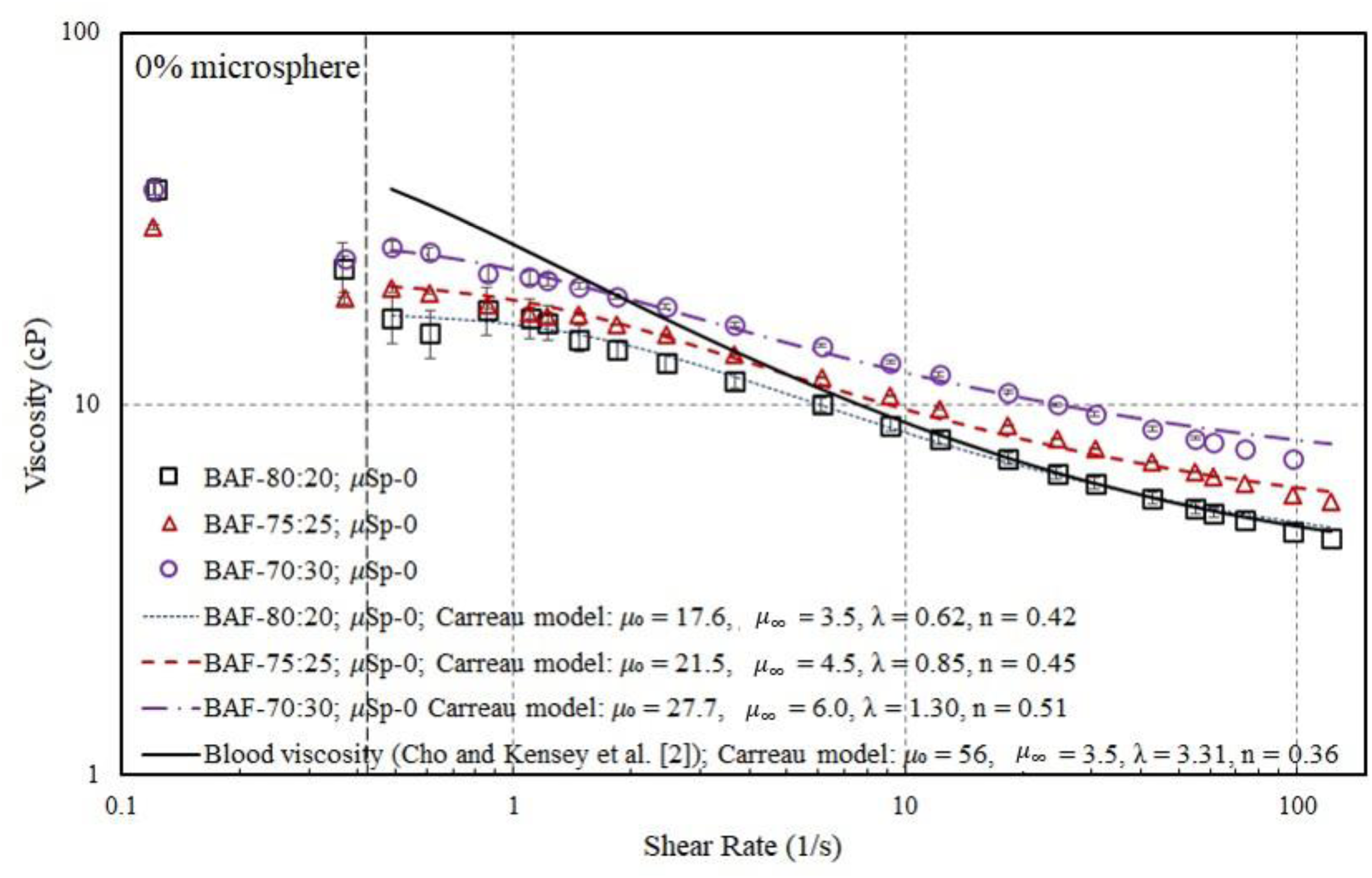
BAF viscosity without polymer microsphere (the percentage of hematocrit of blood is in the range of 33–45%, as reported by Cho and Kensey et al. 2 ).
Comparison of BAF's viscosity with blood. 6

Bold indicates baseline references.
BAF-80:20
Figure 2 compares the viscosity of BAF-80:20 with 0% polymer microspheres (baseline) to BAF-80:20 seeded with 1% (w/v) and 2% (w/v) microspheres. The Carreau model coefficients for BAF-80:20, having 1% microspheres, were determined as

BAF viscosity with a) 0%, b) 1%, and c) 2% (w/v) polymer microsphere in BAF-80:20 composition.
Carreau coefficients comparison between a) 0%, b) 1%, and c) 2% (w/v) polymer microsphere in A) BAF-80:20, B) BAF-75:25, and C) BAF-70:30.

BAF-75:25
Figure 3 compares the viscosity of BAF-75:25 with 0% microspheres (baseline) to BAF-75:25 seeded with 1% (w/v) and 2% (w/v) polymer microspheres. The Carreau model coefficient for BAF-75:25 with 0% microspheres were reported as

BAF viscosity with a) 0%, b) 1%, and c) 2% (w/v) polymer microsphere in BAF-75:25 composition.
BAF-70:30
Figure 4 compares the viscosity of BAF-70:30 with 0% microspheres (baseline) to BAF-70:30 seeded with 1% (w/v) and 2% (w/v) polymer microspheres. The Carreau model coefficient for BAF-70:30 with 0% microspheres were reported as
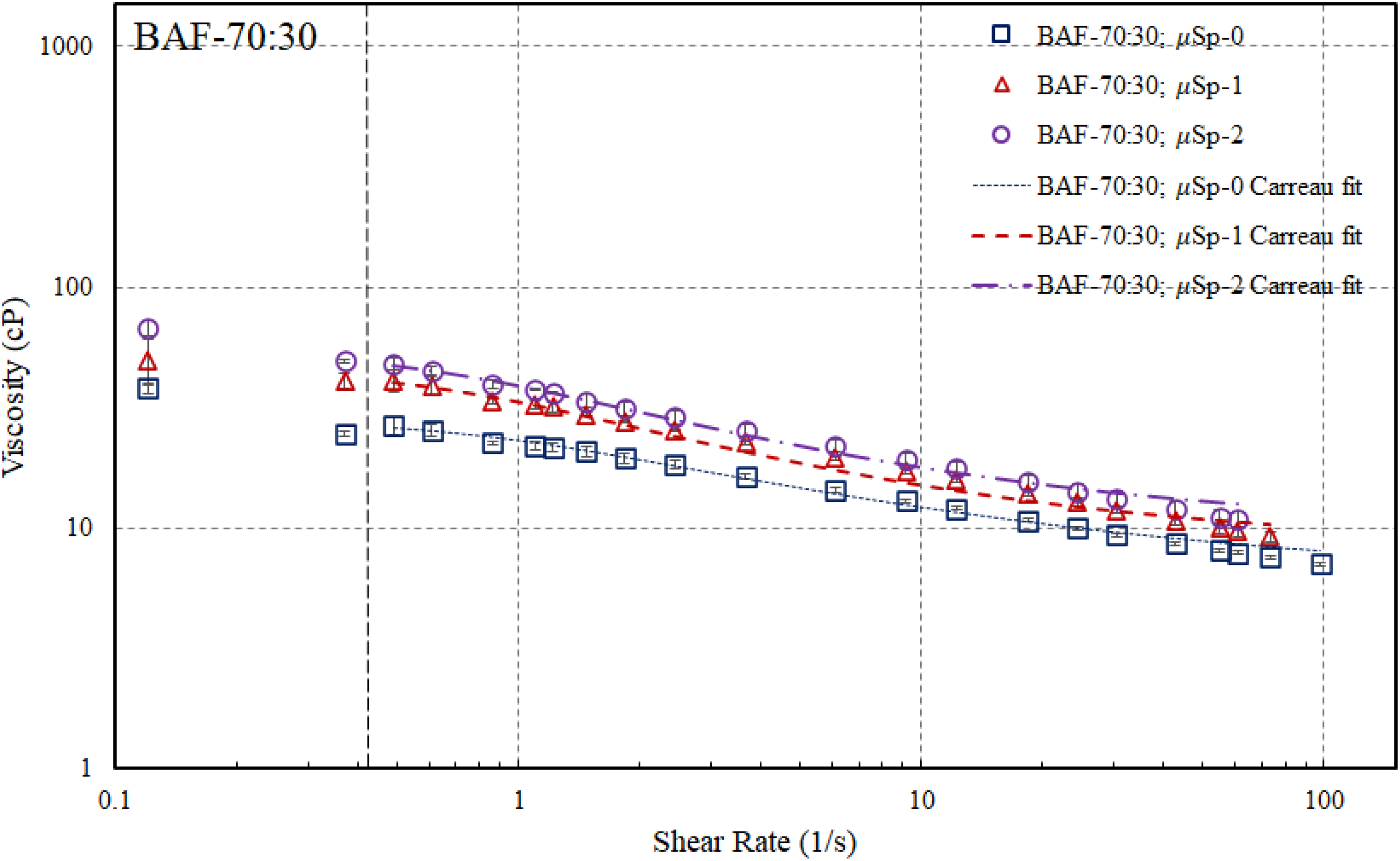
BAF viscosity with a) 0%, b) 1%, and c) 2% (w/v) polymer microsphere in BAF-70:30 composition.
Statistical analysis of BAF-80:20
Figure 5 compares the mean values of viscosities for the three sets of experiments. This includes comparison of for BAF-80:20 with 0% polymer microspheres (baseline) with BAF-80:20 seeded with 1% (w/v) and 2% (w/v) microspheres. Welch 2-sample t-test showed that microsphere seeding had a significant statistical difference for both
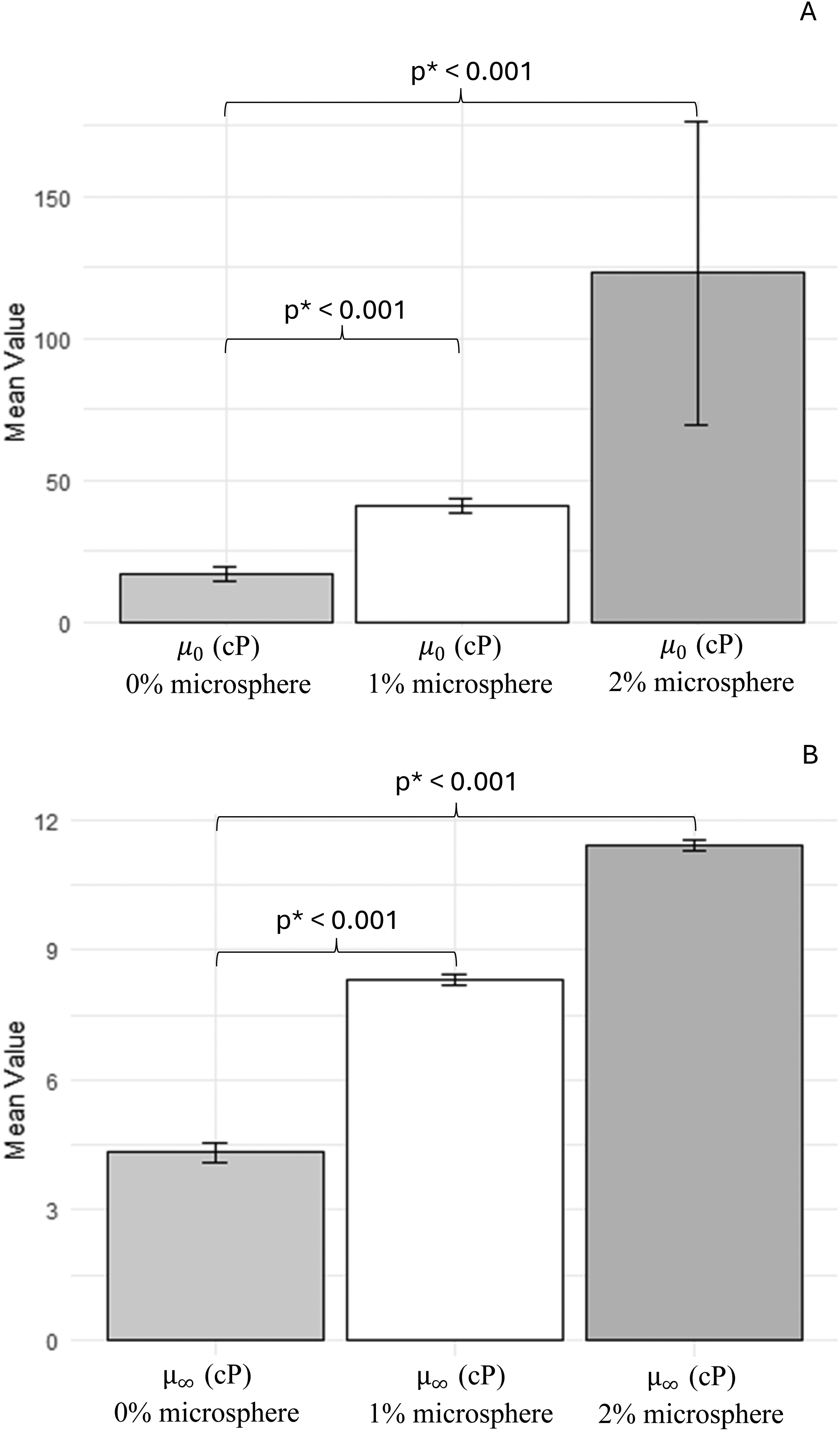
Effect of microspheres on A) μ0 (cP) and B) µ∞ (cP).
It was observed that
Discussion
BAF with or without microspheres plays an important role in many flow visualization experiments, enabling controlled velocity measurements for testing cardiovascular devices. The current study found that BAF containing microsphere particles exhibits significantly higher non-Newtonian viscosity, for both
Comparison of the viscosities among the BAF compositions of BAF-70:30, BAF-75:25, and BAF-80:20 revealed that the viscosity of BAF-80:20 aligns closely with that of real blood for shear rates ranging from 10 s−1 to 100 s−1. The viscosity of the BAF-80:20 in the lower shear rate region (<10 s−1) needs to be further investigated using a falling-needle viscometer. These findings corroborate with those reported by Anastasiou et al., 5 whose study compared the viscosities of four BAF combinations and identified a formulation comprising of 79.1% (v/v) distilled water, 20.9% (v/v) glycerol, and 0.021% (w/v) Xanthan gum as comparable with human blood for shear rates ranging from 1 s−1 to 1000 s−1. These results further affirm the conclusion drawn by Brookshier and Tarbell, 4 who reported that solutions containing Xanthan gum and glycerin offer superior non-Newtonian BAF alternatives for hemodynamic investigations. Additionally, previous in vitro studies in our lab have reported BAF-80:20 6 and BAF-65:35 7 suitable for creating fluid exhibiting the shear thinning non-Newtonian viscous property of blood. Furthermore, the Carreau model constants reported in this study for BAF-80:20 closely resemble those reported in earlier studies on the non-Newtonian viscosity of blood by Cho and Kensey. 2 Specifically, comparison reveals an absolute difference of approximately 38 cP for μ0, 0.05 cP for μ∞, 2.7 for λ, and 0.06 for n between the coefficients obtained by Cho and Kensey 2 for blood and those derived from current measurement for BAF.
The results show that a relatively small % of microsphere seeding significantly increases BAF viscosity (Figure 2, 3 and 4). It is evident that the presence of microsphere has relatively higher influence on μ0 in comparison to μ∞. Overall significant increased values of μ0 caused by microsphere seeding in BAF is expected to influence low-shear region close to the arterial/venous wall, particularly near bends, valves and branches. Similarly, higher values of μ∞ is also expected to elevate wall shear stress. Consequently, the presence of microsphere particles in the BAF leads to added flow resistance, therefore increasing the pressure drop. The appreciable influence of microsphere-seeding in BAF suggests the need for better accounting of its effect for mimicking physiological conditions during LDV measurements. Furthermore, the computational procedure used in cardiovascular physiology needs improved validation by including the effects of microspheres in the BAF.
The spindle for the viscometer used in this study has an operating shear rate range of 1–100 s−1. However, some uncertainties have been reported to exists for μ0 measurement near the lower shear rate region (∼ 1 s−1 and below). For instance, out of 36 measurements (= 3 experiments × 3 types of BAF × 3 types of μSp), only two μ0 measurements showed higher than 100 cP. These are: a) the second μ0 measurement (#2 of n = 3) of BAF-80:20; μSp-2 and b) first μ0 measurement (#1 of n = 3) of BAF-75:25; μSp-2 were 140 cP and 200 cP, respectively.
The addition of microspheres (8 µm in diameter, added at 1% and 2% w/v) to the BAF increases the apparent viscosity across all shear rates (from low to high) due to the increased resistance, caused by drag force resulting from the particle-fluid and particle-particle interactions.10,11 Furthermore, it can be observed that the contribution of microspheres is higher for μ0 than for μ∞, similar to the behavior of Xanthan gum at lower shear rates. However, the microspheres alone cannot fully replicate the effect of Xanthan gum in BAF, as microspheres also contribute appreciably at high shear rates (Figure 5 and Table 2A). We believe that such variations in μ0 and μ∞ are caused by the differences in distribution of microspheres under varying shear and drag force conditions. Comparison of baseline (BAF-80:20, Xanthan gum (0.027% w/v), and 0% (w/v) polymer microsphere with 1% (w/v) and 2% (w/v) microspheres was carried out. Welch-2 sample t-tests (Figure 5 and Table 2A) showed a statistically significant (p < 0.001) increase for both μ0 and
During the cleaning procedure between experiments, microspheres were found to adhere to the inner wall of the stationary viscometer housing (sample chamber) more than the outer wall of the rotating inner spindle. The reason for the separation of microsphere in BAF is not only due to overall drag (Devarakonda et al., 10 Patankar et al. 11 ) but, also caused by the centrifugal force on microspheres exposed to rotating fluid motion within the viscometer. At lower shear rates, the microspheres are more homogeneously dispersed due to the lesser shear rate (weaker rotating flow); thereby, increasing overall particle-fluid and particle-particle interactions, leading to relatively higher μ0. In contrast, at higher shear rates, the microspheres tends to migrate and accumulate at the housing wall caused by centrifugal effects. It may be noted that the density of the microspheres is marginally higher (1.05–1.19 g/cm³) as compared to the BAF (1.05 g/cm3) without microspheres. This accumulation increases the local concentration of particles near the housing wall, resulting in stratification of microspheres in BAF. In other words, fluid surrounding the rotating spindle has lesser number of microspheres and therefore, resulting in lower viscosity in contrast to the near wall region of the housing. This stratification results in a relatively smaller increase in μ∞.
It is evident that microsphere has comparatively more influence on μ0. However, its simultaneous influence on μ∞ can’t be ignored. Hence, the microspheres alone cannot fully replicate the effect of Xanthan gum or glycerin in BAF, as microspheres also contribute appreciably at both lower and high shear rates (Figure 5 and Table 2A). While reducing the amount of Xanthan gum could offset the effects of microspheres at lower shear rates, simultaneous reduction of glycerin may offset the effects of microspheres at higher shear rates. Findings on increased μ0 needs further investigation for viscosities at lower shear rates (<1 s−1) as the present study is limited on obtaining μ0 at lower shear rate range. It is possible that falling needle viscometer can be used for assessing μ0 near lower shear rate region, near 1 s−1 and below.
Additionally, for the 1% microspheres, an absolute increase of 17 cP (61%) in μ0 and 2.50 cP (42%) increase in μ∞ (Figure 4) were observed in comparison to the baseline (0% microsphere) values of BAF-70:30. Furthermore, there was an increase of 95% in the absolute value of μ0 and 67% increase in μ∞ (Figure 4) for 2% microspheres when compared to the 0% microsphere values of BAF-70:30. Interestingly, the microspheres appeared to have reduced influence on the low-shear behavior for BAF-70:30, which can be attributed to the high glycerin content in BAF-70:30. Comparison of the viscosities among the BAF compositions of BAF-70:30, BAF-75:25, and BAF-80:20 revealed that the viscosity of BAF-80:20 aligns closely with that of blood for shear rates ranging from 10 s−1 to 100 s−1, a reliable shear rate range for a Brookfield viscometer. The viscosity of the BAF-80:20 in the lower shear rate region (<10 s−1) needs to be further investigated using a falling-needle viscometer.
The findings of this study emphasize the need for careful selection of microsphere concentrations in BAFs to balance non-Newtonian viscosity and optical clarity for LDV measurements. For future studies, it is recommended optimizing the composition of water, glycerin, and Xanthan gum, alongside the percentage and type of microsphere particles, to achieve a BAF that closely mimics blood's rheological properties across a wide range of shear rates. Additionally, the increased viscosity (10, 11) due to additives highlights the need for recalibrating LDV systems to better capture flow field in lower shear regions, such as near bends and branches of arterial walls. Insight from this study provides a foundation for developing standardized protocols for creating and validating BAF: thereby allowing improved consistency and reliability in cardiovascular flow experiments.
Future study
The current study focuses on assessing the overall effect of microsphere seeding on the viscosity of BAFs, the future research could extend this work by optimizing the proportions of all the above components to improve the performance of BAFs for LDV applications. While we have demonstrated that the introduction of microspheres significantly impacts viscosity, we recognize that investigating additional concentrations (e.g., 0.5% and 1.5%) would enhance the findings and help identify shear rate range where the presence of microspheres becomes pronounced.
Conclusion
Seeding of polymer microspheres in BAF results in significant changes in shear-thinning properties, such as μ0 and μ∞, in relation to viscosity of real blood or BAF without microspheres. It is evident that effect of microsphere seeding in BAF is relatively more pronounced on μ0, influencing low shear region than μ∞ that influences high shear region. Therefore, accounting for the effects of microspheres is essential for better quantification of hemodynamic, such as pressure-flow, evaluation in medical devices and implants during LDV experiments.
Footnotes

Funding
The authors received no financial support for the research, authorship, and/or publication of this article.
Declaration of conflicting interests
The authors declared the following potential conflicts of interest with respect to the research, authorship, and/or publication of this article: The authors declare that the research was conducted in the absence of any commercial or financial relationships that could be construed as a potential conflict of interest.