







Abstract
The growing global prominence of Chinese state-owned enterprises (SOEs) brings new dimensions to our understanding of multi-national corporations (MNCs) and human rights issues. This article constructs a three-level framework that enables the mapping of transnational, national, and intra-organizational human rights pressures, and uses this framework to identify and analyze the human rights that Chinese SOEs report concern with. The analysis provided suggests that while China’s most global SOEs are subject to transnational pressures to respect all human rights, such pressures appear outweighed by those encouraging them to concentrate on only some human rights (i.e., economic, social, and cultural rights) within their national and intra-organizational environment. The article concludes by identifying a number of ways in which our conceptual framework and empirical findings can inform future research.
The policies and practices of multi-national corporations (MNCs) relevant to human rights are increasingly discussed within a number of overlapping literatures (e.g., business and society, business ethics, corporate social responsibility (CSR), and international law (Wettstein, 2012)). By and large, these writings concentrate on normatively prescribing the human rights obligations of MNCs (Arnold, 2010), or on describing the ways in which changes in the global environment have contributed to human rights and CSR concerns becoming increasingly connected (Kobrin, 2009). In particular, the development of the United Nations’ Guiding Principles on Business and Human Rights (Ruggie, 2011), which posits that MNCs have the duty to “respect” human rights and that states have the duty to “protect” human rights and “remedy” human rights concerns (Ruggie, 2008), has been the subject of considerable commentary (McCorquodale, 2009; Whelan, Moon, & Orlitzky, 2009).
Although the broad literature on MNCs and human rights is marked by increasing sophistication, it arguably lacks nuance when it comes to acknowledging that MNCs are commonly subject to competing human rights pressures. Indeed, even those who argue that MNCs operate within fragmented institutional environments, and that MNCs face different CSR pressures (e.g., regarding animal rights, climate change, corruption, sweatshops) at different levels of analysis, tend to emphasize that MNCs operate within an environment that acknowledges and promotes the universality of human rights in a more or less univocal fashion (Aguilera, Rupp, Williams, & Ganapathi, 2007, p. 852; Kostova, Roth, & Dacin, 2008, p. 998).
Two overlapping considerations help explain this emphasis. First, the literature on CSR—and “political” CSR as opposed to political CSR in particular (see Whelan, 2012)—has tended to argue that we now live in a world in which local and national pressures are of decreasing importance and in which transnational pressures from transnational actors who commonly advocate and promote human rights (e.g., international non-government organizations [NGOs] like Amnesty International, inter-governmental organizations like the United Nations) are increasingly important (Scherer & Palazzo, 2011).
Second, there has been a tendency for the MNC and human rights literature to concentrate on the policies and practices of MNCs with Western “home” states. These “home” states—and the citizens thereof—often promote the universality of human rights even though they are not always paragons of virtue with regard thereto, or even signatories to all of the major human rights initiatives. Thus, the U.S. government played a key role in establishing the Universal Declaration of Human Rights (United Nations General Assembly, 1948), but is yet to ratify one of its major “offshoots,” the International Covenant on Economic, Social and Cultural Rights (ICESCR, United Nations General Assembly: 1966a). More specifically, the U.S. government has played a key role in “promoting various voluntary CSR initiatives” (Aguilera et al., 2007, p. 849), multi-stakeholder initiatives (Rasche, 2012), and international accountability standards (IASs; Gilbert, Rasche, & Waddock, 2011) that promote human rights and that U.S. (and other) MNCs commonly participate within (e.g., the Voluntary Principles on Security and Human Rights, focused on the extractive industries; the Global Network Initiative, focused on information and communication technology companies).
The underlying point is that, whereas “the multiplicity of actors currently involved in . . . global [CSR] accountability standards” has been noted more generally (Jamali, 2010, p. 628), the multiplicity of voices that exist with regard to the human rights responsibilities of MNCs remains largely ignored. In addition, and despite the MNC-human rights problematic being intimately related to various nation-states being unable or unwilling to promote human rights domestically, there is a common presumption that national and transnational pressures strongly encourage MNCs to at least profess their concern to “fill” these “governance gaps” (Ruggie, 2008).
This general understanding, however, is rendered increasingly problematic by the re-emergent power of non-Western countries that do not always acknowledge the universality of human rights and that commonly emphasize the importance of state sovereignty (L.-H. Chan, Lee, & Chan, 2008; Waddock, 2008, p. 106). And, it is rendered further problematic by the fact that MNCs are organizational environments that can have internal pressures that may not be consistent with those of their transnational environment (Kostova et al., 2008).
With such concerns in mind, this article identifies and analyzes the competing pressures that Chinese state-owned enterprises (SOEs) are currently subject to as regards human rights responsibilities. Most notably, and on the basis of an empirical analysis of their reported human rights concerns, the article argues that the transnational pressures that encourage Chinese SOEs to acknowledge all human rights, are currently outweighed by those within their national and intra-organizational environment encouraging them to concentrate on only some human rights.
In making this argument, the article is structured as follows. First, the business ethics, CSR, and institutional theory literatures are used to construct a three-level framework for mapping the various human rights pressures that MNCs are subject to. Importantly, it is recognized that because MNCs have headquarters (HQ) in their home states and subsidiaries in host states (Kobrin, 2009, pp. 356-358), the transnational, national, and intra-organizational levels that are distinguished between are more or less always interrelated. Second, the framework is applied to Chinese SOEs affiliated with the central arm of SASAC (the State Asset Supervision and Administration Commission of the State Council), and it is suggested that while Chinese SOEs are subject to similar transnational human rights pressures as all other MNCs, they are also subject to specific and overlapping national and intra-organizational human rights pressures as a result of their being controlled by the Chinese Communist Party (CCP; H. S. Chan, 2009). More substantively, it is argued that whereas the transnational CSR environment is characterized by pressures emphasizing the importance of all human rights—that is, those contained within the International Covenant on Civil and Political Rights (ICCPR, United Nations General Assembly, 1966b) and the ICESCR—the national and intra-organizational network of Chinese SOEs is only characterized by pressures emphasizing the importance of some human rights: those within the ICESCR.
Following this, the article outlines its methods, provides a discussion of its findings with regard to the reported human rights commitments of China’s 10 most global SOEs, and argues that the SOEs appear less influenced by the pressures of the transnational environment than they do their national and intra-organizational environment. The article concludes with a discussion of the wider importance of its findings and makes a number of suggestions as to how these findings can inform future research.
Three Levels of Human Rights Pressures: A Framework
MNCs face various pressures to discharge human rights responsibilities. While the full extent of these duties is the subject of an important normative debate (Smith, 2013; Wettstein, 2012, 2013; Whelan, 2012, 2013), this article is interested in the positive (i.e., descriptive or explanatory) aspects of MNCs and human rights theorizing. In particular, the present section differentiates between three levels of human rights pressure on MNCs: the transnational, national, and intra-organizational levels.
By pressures, the article refers to the ways in which different actors seek to force or encourage MNCs to comply with a given set of behavioral norms, to reconstruct or amend their policies, or to somehow alter their practices (Oliver, 1991; see also Jamali, 2010). Such pressures can be driven (or motivated) by various considerations (e.g., aesthetic, instrumental, moral), and can take various forms (e.g., they can be more coercive or persuasive). Furthermore, different pressures can be complementary (e.g., human and labor rights) or conflicting (e.g., pressures relating to animal rights and the professional interests of abattoir workers), and will often be resisted.
Human rights pressures, more specifically, refer to the fact that MNCs are currently subject to various pressures that encourage them to affect human rights in various ways. Although these pressures can take numerous forms (e.g., laws, moral arguments, pragmatic demands), it is their variable scope that is more important for the present purpose. Specifically, a distinction is made between those pressures that encourage MNCs to respect all of the rights and those that encourage MNCs to respect only some of the rights, listed within the “International Bill of Human Rights”: that is, the Universal Declaration of Human Rights, the ICCPR, and the ICESCR (Morsink, 1999).
These pressures operate in the context of three key developments. First, they are contextualized by the increasingly widespread recognition that MNCs can enable or undermine what amounts to all human rights (Ruggie, 2011). Thus, MNCs (e.g., Coca-Cola) now have policies that prohibit the use of forced labor within their supply chains, and guidelines on how to responsibly “manage” the involuntary resettlement/forced displacement of peoples (e.g., Shell, Statoil). In short, MNCs increasingly recognize responsibilities for human rights concerns that, until recent times, were generally considered the exclusive domain of states (Whelan et al., 2009).
Second, these pressures are contextualized by the manner in which notions of state sovereignty can conflict with pressures encouraging MNCs to promote or respect all human rights. In other words, MNCs, and other organizations, are also subject to pressures that promote the ability of states to set laws within their borders and that enable them to “pick and choose” between the human rights they wish to promote or respect. Furthermore, such inter-governmental organizations as the Organisation for Economic Co-Operation and Development (OECD; 2011) and the United Nations (1945), sometimes promote, in a seemingly contradictory fashion, both all human rights and state sovereignty.
Finally, these pressures are shaped by the fact that MNCs can be directly and indirectly responsible for undermining or disrespecting human rights. MNCs are directly responsible for human rights abuses when their immediate activities (e.g., employment contracts) are the source of concern. In contrast, they are indirectly involved or complicit in “human rights abuses” “where the actual harm is committed by another party, including governments and non-State actors,” that they are (contractually) involved with (Ruggie, 2008, paras. 73-81). Although it might be thought that MNCs are more likely to be subject to human rights pressures that relate to their direct than indirect responsibilities, this is not necessarily the case. For example, many multi-stakeholder initiatives (e.g., the Voluntary Principles on Security and Human Rights, the Global Network Initiative) encourage MNCs to avoid being complicit in (civil and political) human rights abuses, and many MNCs (e.g., Coca-Cola) express their concern to avoid being complicit for a whole variety of (civil and political) human rights (e.g., the right to not be subjected to slavery). Accordingly, the article makes no distinction between direct and indirect human rights responsibilities, and does not suggest whether or not MNCs are more likely to be directly or indirectly responsible for one human right or another. Rather, human rights pressures are simply conceived as encompassing those pressures that relate to the posited direct and indirect responsibilities of MNCs more generally (Ruggie, 2008).
Transnational Human Rights Pressures
Transnational human rights pressures transcend the confines of a given nation-state and other nationally based actors. They tend to derive from inter-governmental organizations, international NGOs, and new governance structures such as multi-stakeholder initiatives or IASs (Aguilera et al., 2007, pp. 850-853; Gilbert et al., 2011; Rasche, 2012). Given the continued absence of a global sovereign, and the difficulties of reaching agreement on matters of international law, transnational human rights pressures rarely take a “hard” or coercive form. Rather, they tend to be of a “softer” status or tend to encourage national actors to impose “harder” pressures upon those other actors they can control (Kobrin, 2009, p. 361).
Prominent examples of international NGOs who encourage MNCs to acknowledge and further human rights include Amnesty International and Human Rights Watch. Prominent examples of transnational initiatives that pressure MNCs to address human rights (and that international NGOs are commonly somehow involved in) include the OECD (2011) Guidelines for Multinational Enterprises, the UN Global Compact (UNGC), and the UN Guiding Principles on Business and Human Rights (Ruggie, 2011). This last initiative has recently been termed the “state of the art in the debate on business and human rights” (Wettstein, 2012, p. 741), and thus provides a good example of how transnational human rights pressures commonly encourage MNCs to acknowledge, and act upon, the importance of all human rights. As the 12th Guiding Principle states,
Because business enterprises can have an impact on virtually the entire spectrum of internationally recognized human rights, their responsibility to respect allies to all such rights . . . An authoritative list of the core internationally recognized human rights is contained in the International Bill of Human Rights . . . , coupled with the principles concerning fundamental rights in the eight ILO [International Labour Organization] core conventions as set out in the Declaration on Fundamental Principles and Rights at Work. (Ruggie, 2011)
Given the present concern with (positive) empirical theorizing, only a number of overlapping points need to be noted with regard to the “Protect, Respect, and Remedy” framework here. First, in advocating that MNCs (and other business enterprises) should “respect” human rights, Ruggie emphasizes that MNCs should “do no harm” (Ruggie, 2008, para. 24). While this posited duty requires MNCs to take positive steps to ensure that they avoid being directly or indirectly responsible for human rights abuses, it is basically a negative duty that does not require MNCs to ensure that all human rights are “protected” or that all human rights concerns are “remedied.”
The duties to protect human rights and remedy human rights concerns, on the contrary, fall to states (Ruggie, 2008). To discharge these two duties, states are required to put measures in place that encourage (or force) MNCs to “respect” human rights, and to establish structures that redress those instances in which “respect” is lacking. Importantly, the state duty to “protect” human rights is arguably most pronounced with regard to SOEs because
In principle, inducing a rights-respecting corporate culture should be easier to achieve in State-owned enterprises (SOEs). Senior management in SOEs is typically appointed by and reports to State entities. Indeed, the State itself may be held responsible under international law for the internationally wrongful acts of its SOEs if they can be considered State organs or are acting on behalf, or under the orders, of the State. (Ruggie, 2008, para. 32)
While we consider the UN Guiding Principles a good illustration of the fact that MNCs are subject to transnational pressures encouraging them to acknowledge (and somehow promote) all human rights, we note that various actors are commonly critical of their underlying “Protect, Respect, and Remedy” framework (see Whelan et al., 2009). MNC and human rights scholars such as Arnold (2010) and human rights NGOs such as Amnesty International, for example, have expressed concern as to what Wettstein (2012) suggests are the relatively modest demands that Ruggie’s framework makes of MNCs and states. Nevertheless, many of these same critics agree that Ruggie’s framework is right to emphasize the importance of all human rights.
National Human Rights Pressures
National human rights pressures are those that are more or less readily associated with a given state or with a given national population. In terms of the latter, it is clearly possible for a given population to place normative and/or material pressure on MNCs to acknowledge and act upon a set of human rights duties (e.g., through consumer boycotts, media advocacy, protests). Furthermore, it is possible for specific elements of a population to place such pressure on MNCs (e.g., nationally based activists and NGOs).
Although the pressures that a national population (or parts thereof) put on MNCs are important, the human rights pressures that states (or governments) can put on MNCs are often more immediate, and less diffuse, due to states being in a position to coerce, or strongly encourage, MNCs, to discharge various human rights duties (Aguilera et al., 2007, p. 848). Among other things, states can encourage or require MNCs to report on their human rights policies and practices as a means by which to encourage a “rights respecting” culture (Ruggie, 2008, para. 30). Furthermore, states can align the awarding of government contracts with the need for strong human rights policies and practices, and they can seek to ensure that their national laws, and the international regimes they participate within more generally, encourage MNCs to respect all human rights (Ruggie, 2011).
Although states can exert pressures on corporations of any nationality, the present interest is in the pressures that states put on “home” MNCs whose “parent” is incorporated within, or has HQ within, their national boundaries. On one hand, then, these national pressures are conceived as sometimes having an “extraterritorial effect” (Ruggie, 2008, para. 14) because MNC’s have subsidiaries located in foreign “host” countries (Zerk, 2006, pp. 51-52). On the other hand, however, these national pressures are defined so as to exclude the pressures that host states put on MNC subsidiaries whose “parent” is located within another “home” country.
In addition to their morally benefitting from the inherent value of doing the “right” thing, states can potentially derive material benefit (e.g., in terms of national competitiveness, risk minimization) by pressuring their home MNCs to respect all human rights (Aguilera et al., 2007, pp. 848-850; Ruggie, 2008, paras. 27, 32, 2011, prin. 2). While states such as the United States (Clinton, 2010) and the United Kingdom (U.K. Foreign & Commonwealth Office, 2011, p. 71) commonly suggest that they follow this general logic, many do not.
The CCP, for instance, can only ever mention the universality and indivisibility of human rights at the risk of self-contradiction, and thus tends to suggest that different societies should emphasize different, or some, human rights, as a result of their differing cultural, economic, and political contexts (Deng, 2008, pp. 271-272). State sovereignty, on the contrary, is an ideal that is broadly aligned with the CCP’s interests. Accordingly, the CCP tends to emphasize it alongside the importance of some more than all human rights, in its various global governance statements and activities (L.-H. Chan et al., 2008), and in the pressures it places on Chinese MNCs (see below).
Intra-Organizational Human Rights Pressures
In addition to being situated within transnational and national environments, “all units in MNCs” (i.e., both MNC HQs and their foreign subsidiaries) can be “viewed as belonging to the same intra-organizational institutional field, which is contained within the boundaries of the firm” (Kostova et al., 2008, p. 998). Such fields are generally easy to recognize: for they are characterized by “formal authority structure[s]” in which “subunits are . . . dependent on the parent company . . . for critical resources” (Kostova et al., 2008, p. 998).
MNCs as a whole, or their separate sub-units, face internal pressures that encourage them to manage their response to external (e.g., national or transnational) pressures. Pressures relating to profitability, reputation, and risk management, for example, often encourage MNCs to “decouple” (Meyer & Rowan, 1977) their actual practices from any accountability standards that external pressures (e.g., from international non-government organizations) have encouraged them to join (Jamali, 2010).
Just as national pressures commonly derive from the moral and material objectives of nation-states, so too do intra-organizational pressures commonly derive from the moral and material objectives, and get shaped by the corporate governance structures (Aguilera & Jackson, 2003) of an MNC’s HQ. As with CSR policies and practices more generally (Whelan, 2012, pp. 716-718), the human rights policies and practices of MNCs tend to be strongly influenced by their owners’ interests and their formal organizational apparatus.
As these points suggest, analyses of the intra-organizational environment of SOEs need to identify the interests (material and/or moral) of the owning nation-state (Aguilera & Jackson, 2010, p. 523; Néron & Norman, 2008, p. 8; Shen & Lin, 2009, p. 444). Furthermore, such analyses need to acknowledge that these intra-organizational pressures can promote either all or some of the human rights listed in the International Bill of Rights, and that these intra-organizational pressures may or may not be consistent with national and transnational pressures.
The interrelated nature of these different pressures is illustrated in Figure 1.
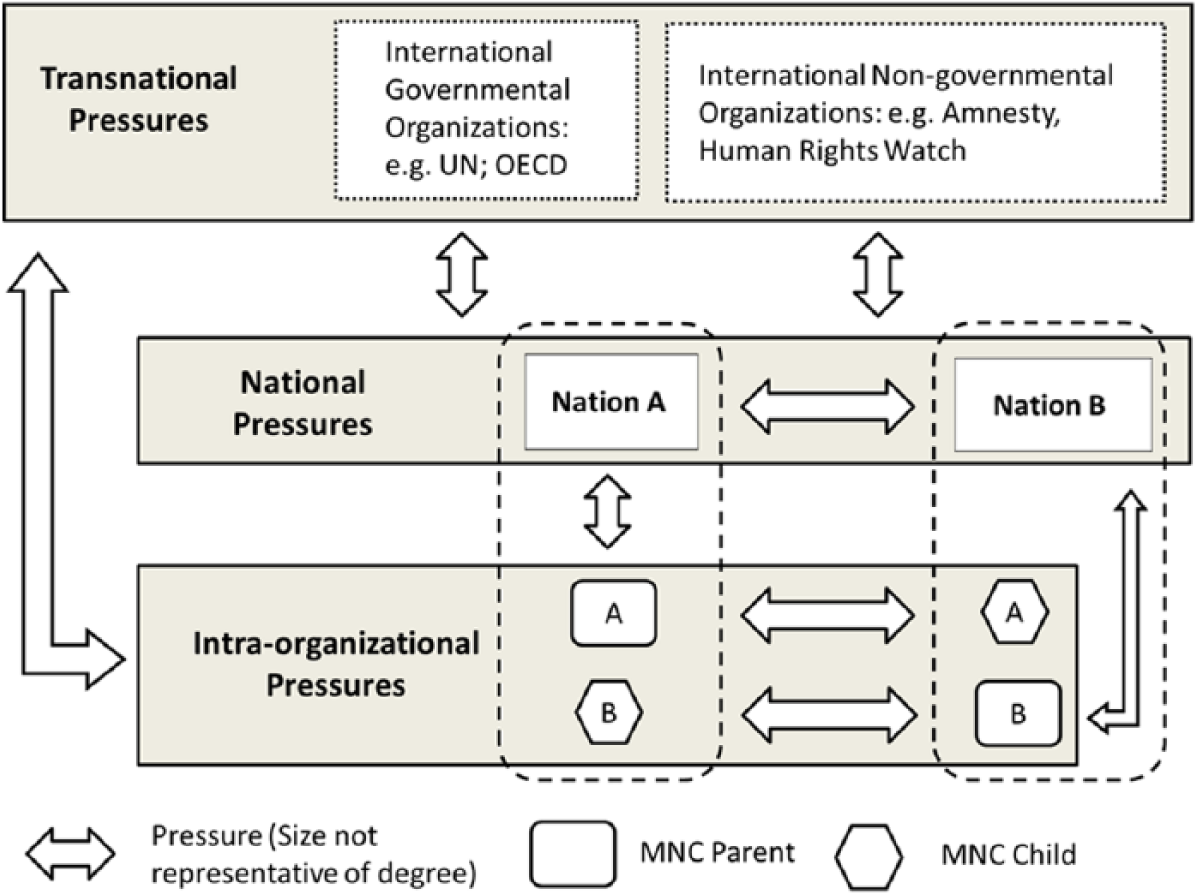
A three-level framework of human rights pressures.
Placing Chinese SOEs Within the Three-Level Framework
Although there is an emerging body of work on China and CSR (Kong, Liu, & Dai, 2012; Moon & Shen, 2010; Noronha, Tou, Cynthia, & Guan, 2013), the relationship between Chinese SOEs and human rights remains largely unexplored. Furthermore, the wider business and society literature is yet to reflect the growing global prominence of Chinese SOEs (Fortune, 2013; United Nations Conference on Trade and Development, 2011). In light of such, the present analysis specifically focuses on those Chinese SOEs placed under the control of SASAC. SASAC (2003) of the People’s Republic of China (PRC) was established to perform the “responsibilities of investor” for China’s leading and most international SOEs (see Naughton, 2011, pp. 317-318). At the time of writing, SASAC is the nominal owner of about 120 of China’s largest SOEs and is the nominal owner of the vast majority of the 95 Chinese MNCs featured on the Fortune Global 500 in 2013. SASAC SOEs are thus a very important part of the global economic landscape.
Transnational Human Rights Pressures
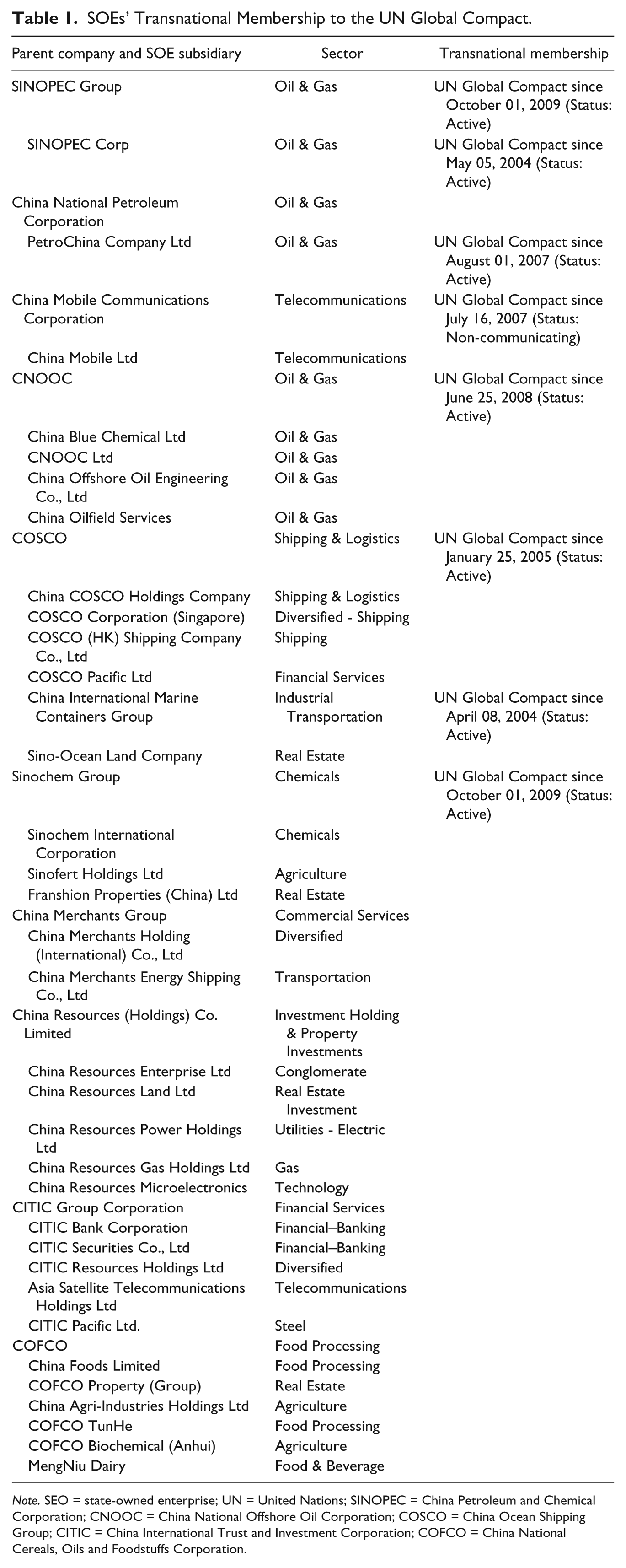
Like other MNCs, SASAC SOEs are embedded within the broader transnational environment, and are ultimately subject to pressures to respect all human rights (Brownell, 2012). More specifically, various SASAC SOEs (e.g., PetroChina, SINOPEC Group, China Mobile Communications Corporation [CMCC]) are members of the UNGC, a transnational CSR initiative that, among other things, encourages MNCs (and other businesses) to respect all human rights (see Table 1). Furthermore, Chinese SOEs are commonly subject to pressure from transnational human rights activists. China National Petroleum Corporation (CNPC), for example, remains subject to considerable pressure from transnational activists concerned to promote all human rights given their controversial (and continuing) activities in Sudan (Patey, 2007, 2009). However, because SASAC SOEs are also commonly not involved in more specific sector-focused human rights multi-stakeholder initiatives (e.g., the Voluntary Principles on Security and Human Rights, which is directed toward the extractives sector; the Global Network Initiative, which is directed toward information and communication technology MNCs), they are arguably subject to less transnational human rights pressures than some of their foreign counterparts (see L.-H. Chan et al., 2008).
SOEs’ Transnational Membership to the UN Global Compact.
Note. SEO = state-owned enterprise; UN = United Nations; SINOPEC = China Petroleum and Chemical Corporation; CNOOC = China National Offshore Oil Corporation; COSCO = China Ocean Shipping Group; CITIC = China International Trust and Investment Corporation; COFCO = China National Cereals, Oils and Foodstuffs Corporation.
National Human Rights Pressures
Whereas SASAC SOEs are subject to transnational pressures that encourage them to acknowledge (and somehow promote) all human rights, they are only subject to pressures that encourage them to acknowledge some human rights at the national level. The Chinese national population, for instance, appears to have “a clear preference for stability and economic growth, even if that means postponing democracy and tolerating for the time being greater restrictions of civil and political rights” (Peerenboom, 2007, p. 156). They also appear to have “a high degree of trust in the ability of the central government to manage the problems the country faces” (Fewsmith, 2008, p. 214).
In addition to the Chinese population arguably having a limited interest in the (national or transnational) promotion of all human rights, the CCP has obvious reasons for being more or less opposed thereto. China’s constitution, for example, legitimizes a monist political system that formally recognizes “the hegemony of the CCP” (Burns, 1999, p. 581), and is thus opposed to the democratic (multi-party) political structures that respect for all human rights entail (Morsink, 1999). It also helps explain why the CCP strongly champions respect for state sovereignty, and is yet to ratify the ICCPR (which is the covenant of the International Bill of Rights most readily associated with democratic political structures). On the contrary, the fact that the CCP’s political legitimacy relates to its furthering a whole host of social and economic rights (Shambaugh, 2008, pp. 168-169) helps explain why it has ratified the ICESCR (Whelan et al., 2009, p. 370).
As with the preceding discussion of Chinese SOEs and transnational human rights pressures, a fuller discussion as to why the Chinese party-state only emphasizes some human rights is beyond the scope of the present article. What does need to be noted, however, is that the CSR guidelines that SASAC released in 2008 reflect the CCP’s more general concern with economic and social rights, and their relative lack of concern with civil and political rights. In particular, it should be emphasized that the guidelines
1. Never state that Chinese SOEs need to respect all human rights (and never actually mention “human rights”); 2. Clearly emphasize economic and social rights when they write of labour rights, sustainable development and “the socialist harmonious society,” for example; 3. Understate or ignore the importance of civil and political rights (e.g., they never mention “freedom of association”); and 4. Link CSR to China’s national interest when they state that the practice of CSR by Chinese SOEs will help “China to spread an image as a responsible nation.” (SASAC, 2008)
As these four points indicate, the Chinese national environment differs from the transnational environment in that it does not pressure Chinese SOEs to acknowledge the importance of all human rights but only those human rights listed in the ICESCR.
Intra-Organizational Human Rights Pressures
In addition to being part of the Chinese national environment, SASAC is part of an intra-organizational environment that is comprised of itself and the SOEs it nominally owns. Further to various other mechanisms controlled by the CCP, such as the nomenklatura system of hierarchically appointing party personnel (Downs, 2008, pp. 123-124; McGregor, 2010, p. 72) and various accounting and financial bodies (Noronha et al., 2013), SASAC strives to ensure that managerial decision-making within China’s most important SOEs is aligned with CCP interests (H. S. Chan, 2009, p. 50; Downs, 2008, p. 125). SASAC thus occupies the top position of the Chinese SOE intra-organizational environment.
SOE HQs occupy the second level. These SOEs are 100% owned by the Chinese party-state (and nominally owned by SASAC). Just as with SASAC, the leading managers of China’s parent SOEs are nearly always leading members of the CCP who have previously been employed in various party-state roles. When it is felt that these leaders somehow undermine CCP interests (or those of powerful opponents within the CCP), they are “dealt with” accordingly. Thus, Jiang Jiemin (the former director of SASAC and full member of the CCP 18th Central Committee, CEO of CNPC and Chairman of PetroChina (China Vitae, 2012) was recently sacked as a result of corruption charges in an effort to eliminate “vested interests in state-owned industries [that] have long been seen as opposed to economic reform . . . ” (British Broadcasting Corporation, 2013).
Finally, the immediate subsidiaries of the SOE HQs lie at the third level of the intra-organizational environment. Although these subsidiaries are commonly listed on foreign stock exchanges, their HQs hold the vast majority of their shares, and they are often managed by the same people that head the parent company. Given that the subsidiaries of Chinese SOE HQs also commonly have their own subsidiaries, we note that we do not include them in our analysis here.
More generally, a key benefit of conceiving the Chinese SOE intra-organizational environment in terms of these three levels is that it highlights that SASAC SOEs are part of a national-intra-organizational hybrid environment that is ultimately controlled by the CCP’s leading body, the Politburo Standing Committee (Shambaugh, 2008; Shirk, 1993). Furthermore, it highlights that this environment is overlaid with “formal authority structure[s]” (Kostova et al., 2008, p. 998) that seek to ensure the influence of CCP interests at every opportunity.
Method
To examine whether or not China’s SASAC SOEs are more influenced by their transnational, national, and/or intra-organizational environments, the authors analyzed human rights related disclosures within documents and websites published by China’s 10 most “internationalized” parent SOEs (as measured by their 2006 outward stock of foreign direct investment; OECD, 2008), and their 34 immediate and listed subsidiaries (OECD, 2008). As depicted in Table 1, 8 of the 44 SOEs analyzed are members of the UNGC—an initiative encouraging corporations to respect all human rights inter alia.
As human rights can be considered a key element of both CSR and sustainable development (e.g., McGoldrick, 1996; UNGC, 2012), the SOE’s CSR/sustainability reports from 2007-2010, and relevant sections of their websites (in both English and Chinese), were reviewed for evidence of explicit and implicit reference to human rights. The use of company reports to analyze CSR actions and intentions is a key source of data for researchers (Chapple & Moon, 2005), and so too are corporate websites, which are increasingly used to detail CSR activities and outputs (Hamann, Sinha, Kapfudzaruwa, & Schild, 2009; Noronha et al., 2013). While corporate reports are not necessarily accurate, and can be subject to bias, public relations spin, and so on (Muthuri & Gilbert, 2011), the risks of inaccuracy are mitigated by the fact that corporate reports are publicly scrutinized, and that it can be in a company’s reputational or branding interests to avoid making false claims, and to uphold basic reporting standards (Chapple & Moon, 2005; Hamann et al., 2009).
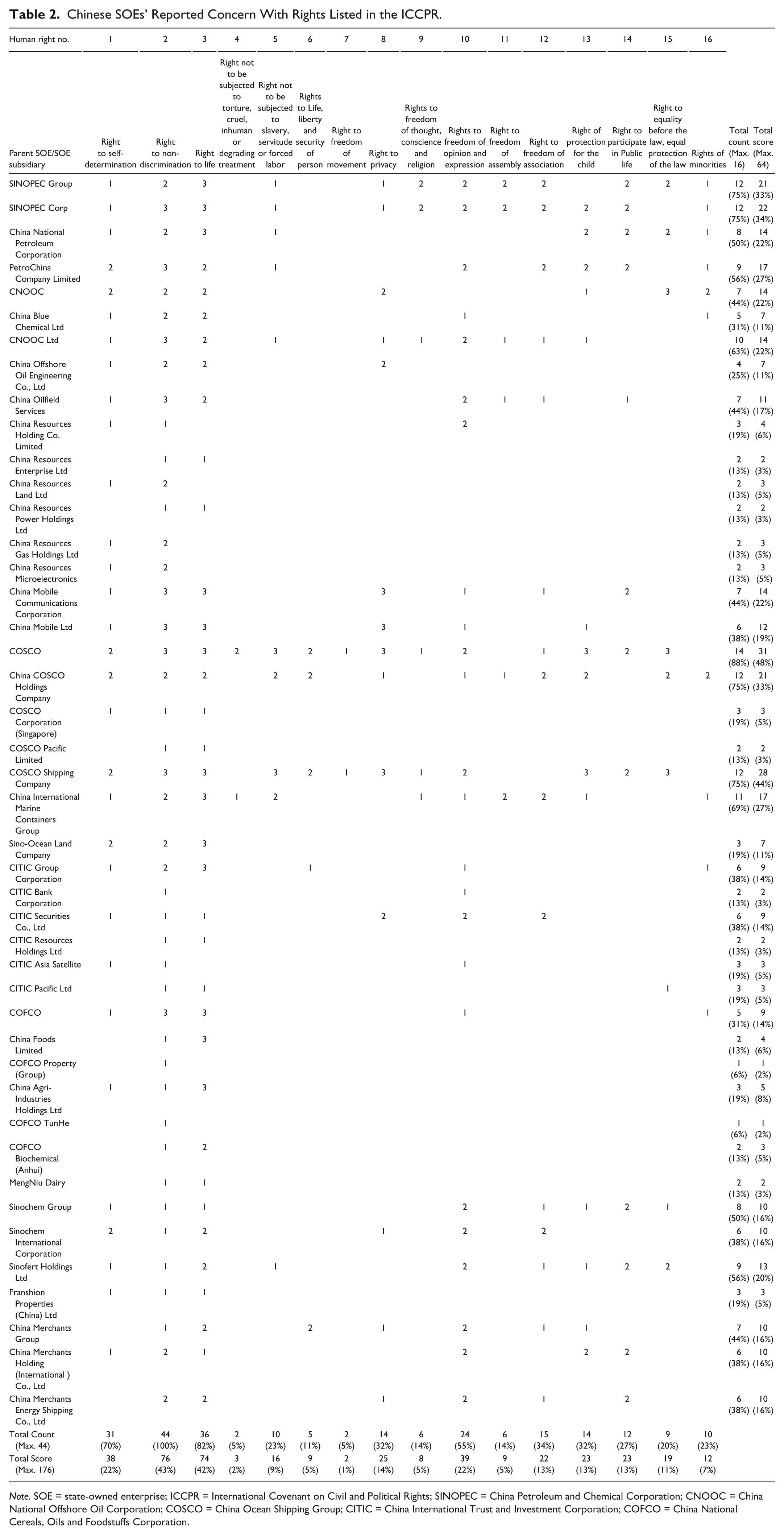
To determine the nature and extent of reported human rights concern, the authors conducted a content analysis of the SOEs’ CSR/sustainability reports and websites with regard to 33 separate human rights derived from the ICCPR and ICESCR (see Tables 2 and 3) and the “Human Rights Translated” guide (Castan Centre for Human Rights and Law, Monash University, 2008). To enable a systematic review of the evidence, the authors developed key indicators (see Table 4 for some examples) under four categories: (a) Policies (e.g., evidence of defined commitments and parameters of engagement with regard to each human rights), (b) Processes (e.g., evidence of management systems, training, and/or stakeholder-engagement processes related to each human rights issue), (c) Monitoring and Accountability (e.g., evidence of impact assessments), and (d) Reporting and Communication (e.g., evidence of reports that are comprehensive and material). Importantly, the same reported concern was sometimes considered relevant to more than one human right (for human rights often overlap).
Chinese SOEs’ Reported Concern With Rights Listed in the ICCPR.
Note. SOE = state-owned enterprise; ICCPR = International Covenant on Civil and Political Rights; SINOPEC = China Petroleum and Chemical Corporation; CNOOC = China National Offshore Oil Corporation; COSCO = China Ocean Shipping Group; CITIC = China International Trust and Investment Corporation; COFCO = China National Cereals, Oils and Foodstuffs Corporation.
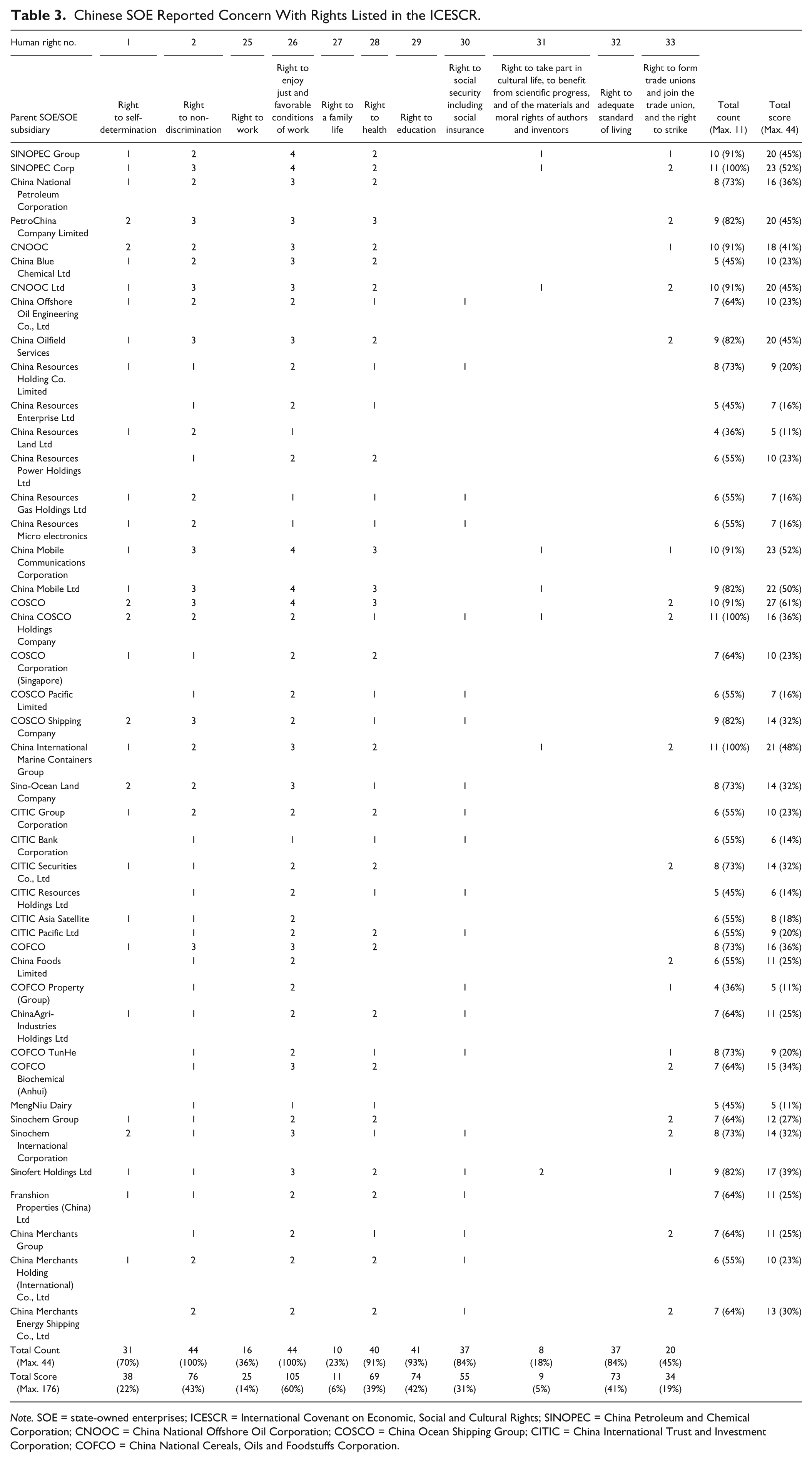
Chinese SOE Reported Concern With Rights Listed in the ICESCR.
Note. SOE = state-owned enterprises; ICESCR = International Covenant on Economic, Social and Cultural Rights; SINOPEC = China Petroleum and Chemical Corporation; CNOOC = China National Offshore Oil Corporation; COSCO = China Ocean Shipping Group; CITIC = China International Trust and Investment Corporation; COFCO = China National Cereals, Oils and Foodstuffs Corporation.
Examples of Human Rights Issues and Related Indicators.
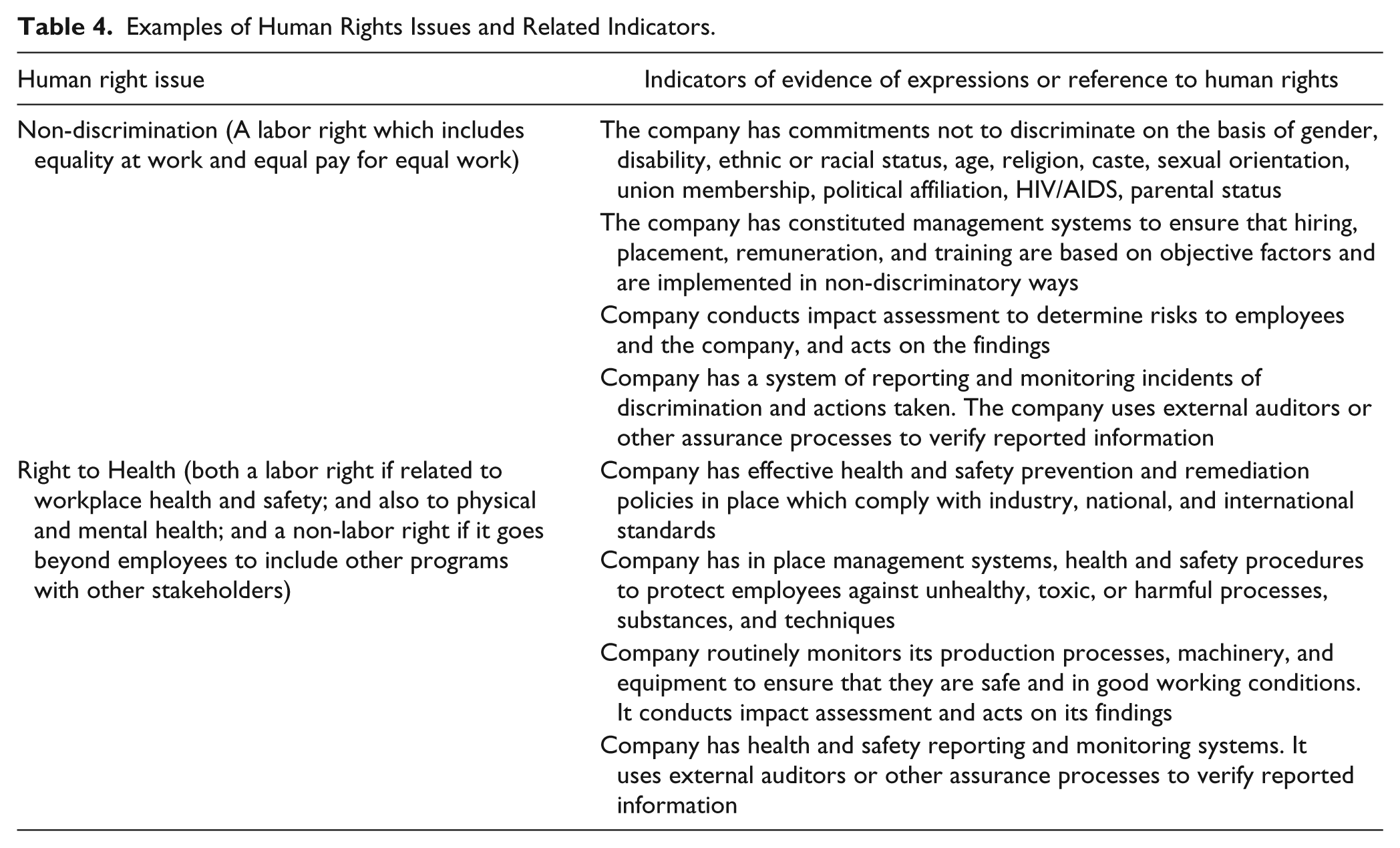
The reported concerns were rated in terms of whether or not they provided convincing evidence with regard to each of the four categories. Thus, a score of 1 was awarded for evidence of policies; 2 for policies and processes; 3 for policies, processes, and monitoring and accountability; and 4 for policies, processes, monitoring and accountability, and reporting and communication. Hence, the score range of 0 to 4 depicts the extent of disclosure on each of the human rights. The rating procedure was completed independently by each of the authors and a research assistant, and any discrepancies discussed and reconciled. The companies were then ranked based on their total human rights score (see Table 5).
Ranking of Chinese SOEs on Reported Concern With Human Rights.
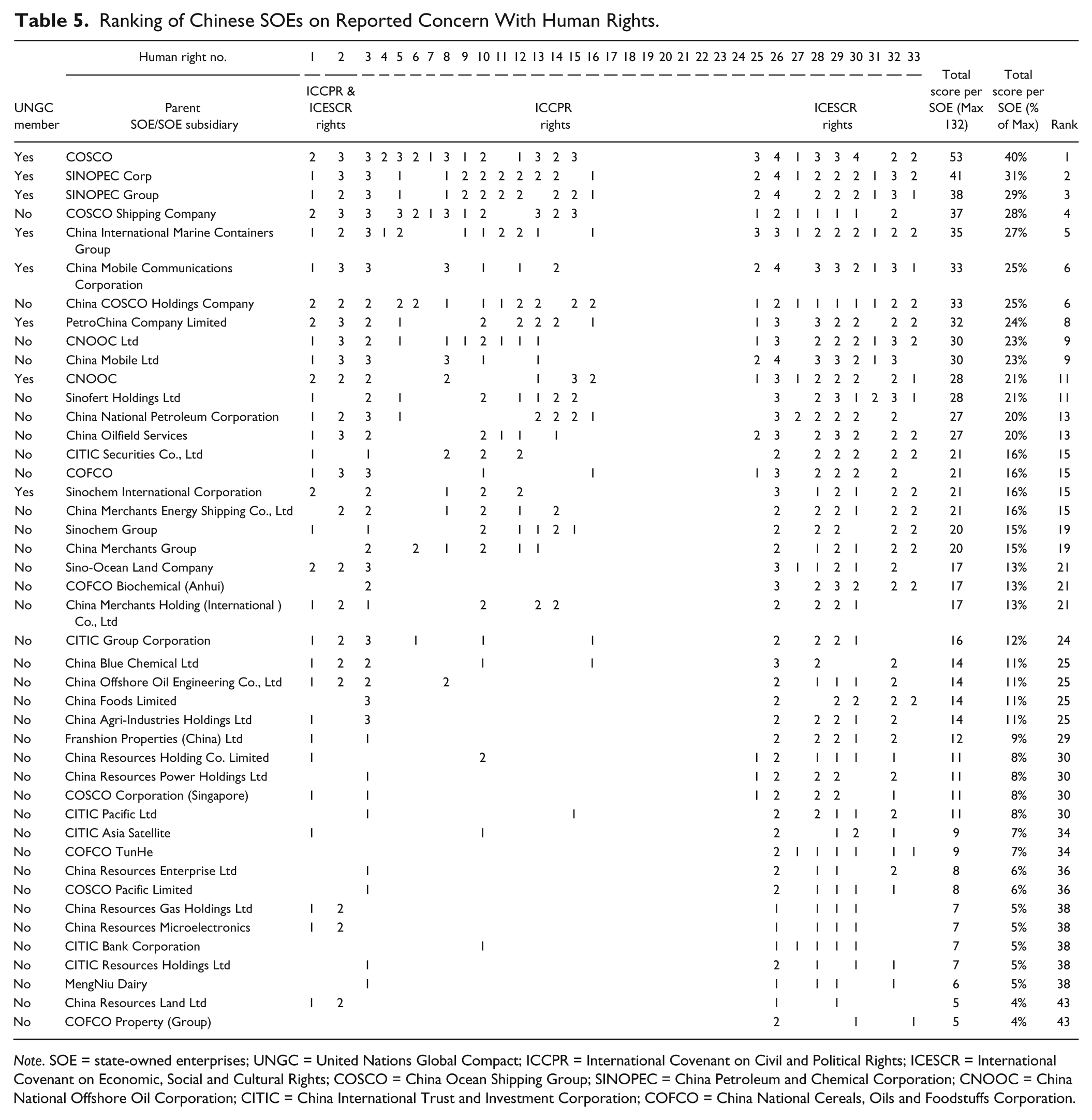
Note. SOE = state-owned enterprises; UNGC = United Nations Global Compact; ICCPR = International Covenant on Civil and Political Rights; ICESCR = International Covenant on Economic, Social and Cultural Rights; COSCO = China Ocean Shipping Group; SINOPEC = China Petroleum and Chemical Corporation; CNOOC = China National Offshore Oil Corporation; CITIC = China International Trust and Investment Corporation; COFCO = China National Cereals, Oils and Foodstuffs Corporation.
Research Findings
The research findings are organized in terms of Chinese SOE’s reported concern with civil and political rights, and their reported concern with economic, social, and cultural rights. Following this, the drivers and motives that Chinese SOEs report upon, and that contextualize their reported human rights concerns, are identified.
Civil and Political Rights
The Civil and Political Rights listed in the ICCPR refer to such things as equality before the law, freedom from servitude, and the right to freedom of conscience and public participation. They tend to be more “negative” than the economic, social, and cultural rights listed in the ICESCR as they “only” require the absence of coercion or restraint. Although primarily directed toward states, all civil and political rights can be affected by businesses in a more or less direct fashion. For example, although it is unlikely that companies can directly affect the right to recognition as a person before the law, businesses can be complicit in abuses of this right by third parties (e.g., if they indirectly benefit from, or support, property acquisition laws that treat the property of women as the property of their husbands).
As to what the SOEs reported, the information disclosed on civil and political rights tended to be broad and lacking in detail. Furthermore, and as is evidenced by their not being included in Table 2, none of the SOEs referred to eight civil and political rights, namely, the right of detained persons to humane treatment; the right of aliens to due process when facing expulsion; the right to a fair trial; the right to be free from retroactive criminal law; the right to recognition as a person before the law; the rights of protection of the family and the right to marry; the rights to freedom from war propaganda, and freedom from incitement to racial, religious, or national hatred; and the right to not be subject to imprisonment for inability to fulfill a contract.
The group of civil and political rights that generated the next lowest scores was generally reported upon in an overlapping and vague fashion. They included the right not to be subjected to torture, cruel, inhuman, or degrading treatment; the right not to be subjected to slavery, servitude, or forced labor; the rights to life, liberty, and security of person; the right to freedom of movement; the rights to freedom of thought, conscience, and religion; the right to freedom of assembly; the right to equality before the law, equal protection of the law; and the rights of minorities. Of the 44 SOEs, no more than 10 reported on any one of these eight rights, and the reports that were made with regard thereto tended to be broad statements of intention or commitment.
In terms of religious freedom, for example, the SOEs referred to such things as employment practices that were religiously non-discriminatory more than they did to the actual capacity to practice religion (e.g., through providing space for worship). Thus, the likes of SINOPEC Group state that their “Chinese employees fully respect the religious belief and habits of foreign counterparts” (SINOPEC Group, 2012) and China National Offshore Oil Corporation Limited (CNOOC) that it respects “differences and diversity in gender, age, disease, race and religion. [And that it . . . ] ensure[s] no system and practices have discrimination tendencies” (2007 Sustainability Report, p. 48). Moreover, only a handful of companies (e.g., COSCO Group, COSCO Shipping Company) went beyond statements of intention or commitment regarding the eight human rights listed above, and reported upon the existence of policies, processes, and/or systems, in which specific roles and responsibilities were detailed (e.g., the role and responsibilities of security guards in armed conflicts).
Around a third of the SOEs paid attention to each of the right to privacy, the right to freedom of association, the rights of protection for the child, and the right to participate in public life. Most of these rights, however, were reported on at a low level (as represented by the predominance of 1s and 2s in these table columns). Furthermore, the reported concern with these rights focused on employees, trade-union-related structures, and processes facilitating freedom of association and collective bargaining (these points are further discussed in the following section).
The remaining civil and political rights were each reported on by more than 50% of the SOEs. This last group includes the right to self-determination, the right to non-discrimination, the right to life, and the right to freedom of opinion and expression. At the most general level, the first of these rights—the right to self-determination (which, like the right to non-discrimination, is also contained in the ICESCR)—refers to the right “of peoples to determine their political status and . . . place in the international community” (Castan Centre for Human Rights and Law, Monash University, 2008, p. 3). The authors found evidence of policies and processes of stakeholder and community consultation over various issues (e.g., local resources and land usage) to constitute a general concern with self-determination. However, the authors also found no evidence of SOEs consulting with traditional peoples (or minority populations) in ways that would enable some sort of national independence (or sovereignty).
Reported concern with the right to non-discrimination was generally quite low. Nevertheless, some of the SOEs went into relative detail. In particular, COSCO (China Ocean Shipping) Group (2010 Sustainability Report) noted,
Among 130 members of top management of second-tier companies, 9 are females . . . ; six are aged below 40 . . . ; two are non-party members . . . ; one is of minority nationality . . . [and that] COSCO Group has 4,188 foreign employees, of which, 1,665 are females, accounting for 40.9%. (p. 152)
By way of contrast, many of the SOEs performed better in terms of their reported concern with the right to life (e.g., their various occupational health and safety and product safety standards) and the right to freedom of opinion and expression. Given various reported incidences in the popular media on violations regarding these rights in China more generally (Noronha et al., 2013, p. 29), however, these scores are likely to be over-stated.
To conclude this first section of analysis, the findings reveal that not one of the SOEs scored the maximum of 4 for any of the civil and political rights, and that the right to life and the right to non-discrimination received the highest average scores of ~1.7 each. More generally, most SOEs only had evidence of policies and/or processes in place for the majority of civil and political rights that they reported concern with, and there was negligible evidence of monitoring and accountability (and none for reporting and communication).
Economic, Social, and Cultural Rights
In contrast to civil and political rights, economic, social, and cultural rights tend to be more “positive”: for they require the possession of specific goods (and not just negative freedom from constraint, and/or the restraint of potential infringers). The economic, social, and cultural right to enjoy just and favorable conditions of work was the most reported upon of the ICESCR rights, and the most reported upon right overall. It received a total score of 105 points, which amounts to 60% of the 176 points possible (see Table 3). This right relates to a broad range of provisions, such as remuneration, working hours, workplace violence and harassment, paid holiday (including maternity/paternity leave), period rest at work, and type of work (e.g., part- or full-time). The analysis revealed that all 44 SOEs expressed their commitment to provide employees with just and favorable working environments, and that SOEs made policy statements related to employees’ entitlement to a “living wage” (which, in turn, was commonly linked to the paying of a minimum wage). Although companies mentioned leave days, very few disclosed their vacation structures and/or systems in detail. COSCO Group provided one exception by detailing its vacation structure in its 2010 Sustainability Report (p. 263), and by noting the number of days employees were entitled to take under various categories, for example, maternity leave (90 days), marriage leave (3 days), paternity leave (15 days), and funeral leave (3 days).
The right to non-discrimination (discussed above) was also reported on by all 44 SOEs. In contrast to the right to enjoy just and favorable conditions at work, which received 105 (60%) of the total points possible, it received a total of 76 (43% of 176). In all, 93% of the SOEs reported on the right to education, 91% on the right to health, 84% on the right to social security and the right to an adequate standard of living, and 70% on the right to self-determination (which we have discussed above once again). The initiatives reported on in these regards were both inward facing (i.e., related to employees) and outward facing (i.e., related to the general public). To provide some further specifics, we note that reported concerns with the right to health tended to focus on physical health and working conditions. Nevertheless, China Oilfield Services Limited (COSL; 2010) also reported on the mental health of its workers when it stated,
In addition to physical health, COSL also cares about staff’s psychological health. It provides staff with psychological health tutorials with the help from members of the Association of Psychological Health, State Professional Psychological Consultants.
Although less often reported on, it was not uncommon for SOEs to refer to the more general right to work, and the right to form trade unions. In all, 45% of SOEs, for instance, claimed that workers had the right to join trade unions, and emphasized that employees had avenues for consultations through such structures as “Labour Union Committees” and “Employee Representative Congresses.” Nevertheless, the SOEs did not disclose information related specifically to the right to strike. This lacuna, however, is not altogether surprising: for SOEs are widely reported to have discouraged strikes and to have intimidated workers previously (Downs, 2008). Furthermore, any mention of the right to form trade unions needs to be qualified by the fact that independent trade unions remain illegal in China.
Although the relatively low reporting of the right to take part in cultural life is perhaps not surprising, the relatively low levels of reporting on the right to a family life are somewhat out of sync with the emphasis on just work conditions. Nevertheless, a number of companies did report that they had maternity leave policies pegged just over the government’s 14 weeks maternity leave allowance. Furthermore, the likes of CNPC, CIMC, and CNOOC Group provided maternity insurance, and COSCO Group reported that they had implemented appropriate working environments for pregnant and lactating female employees (COSCO, 2010, p. 290).
To conclude the analysis of economic, social, and cultural rights, it is noted that a number of SOEs reported the highest possible level of concern (i.e., 4 points) for the right to enjoy just and favorable conditions of work and that this right received an average score of ~2.4 (the highest of all the human rights). Furthermore, and whereas the average score reported for all of the ICCPR rights that were actually reported on was ~0.6 (i.e., excluding the eight ICCPR rights that were not once referred to), the overall average for all of the ICESCR rights was double at ~1.2.
Why Chinese SOEs Report on Human Rights: Motives and Drivers
Just as states and private corporations can potentially be motivated to encourage or engage in CSR activities for a variety of reasons (Aguilera et al., 2007), so too can SOEs. This section thus addresses whether or not the reported human rights concerns of the SOEs can be linked to transnational, national, and/or intra-organizational drivers.
Transnational human rights pressures
As Table 5 summarizes, only seven of the SOEs managed to achieve more than 25% of the total points possible for their reported concern with all of the human rights (i.e., 33 or more of the 132 possible). Of these seven, four were active UNGC members, and one (i.e., CMCC), a non-communicating UNGC member. The highest score of 53 (40%) was achieved by the parent SOE COSCO, a UNGC member. Notably, and while three UNGC members scored less than 25% of the total score possible (PetroChina Company Limited: 24%, CNOOC: 21%, and Sinochem International Corporation: 16%), all of the UNGC SOEs were placed in the top half of the table. Furthermore, all of the SOEs with scores totaling 23% or more (i.e., the top 10 performers) were involved in shipping (part of the COSCO Group), petroleum (part of the Sinopec, CNPC, or CNOOC groups), or telecommunications (part of the China Mobile Group).
It was interesting that talk of human rights was occasionally framed in the language of the “Protect, Respect, and Remedy” framework, even though Ruggie’s framework was rarely referred to explicitly. COSCO Group, for example, wrote,
Recognition and respect for human rights are essential to the rule of law and social justice and equity, and are fundamental to basic social systems such as the judicial system. States have the responsibility and obligation to respect, protect and practice human rights. Organizations are obligated to respect human rights, including respect for human rights within their sphere of influence. (COSCO Group 2010 Sustainability Report, p. 93; emphasis added)
In a similar fashion, some companies that are not UNGC members refer to the 10 UNGC principles in their sustainability reports and give guidance on where various UNGC principles are reported upon (e.g., China Mobile Ltd 2009 Sustainability Report). Furthermore, many of the SOEs appeared mindful of the need to comply with international regulations more generally. For example,
In 2008, COSCO Group has received “International Ship and Port Safety Rules” (ISPS) checks for 774 times, passing rate reached 100%. Since COSCO Group ships docked at various countries with different customs and conditions, crews are required to strictly follow ISPS rules, conscientiously study and grasp the non-invasive security check operation. It was required not to miss any clues, and to avoid being accused of violations of human rights. (2008 Sustainable Development Report, p. 143, emphasis added)
Most SOEs also professed concern to discharge duties associated with various “soft” international instruments that have been (officially or unofficially) sanctioned by the CCP (e.g., the International Labor Organization Convention on child labor and minimum age requirements, various International Standard Organization initiatives). Both COSCO (2010, p. 254) and CMCC (2009, p. 16) for example, noted their implementation of ISO standards 17799 and 27001 relating to privacy. Overall, although the Chinese SOEs reported concern with trans- and inter-national pressures more generally, very few of the SOEs acknowledge the importance of conforming to the transnational pressure to respect all human rights in particular.
National human rights pressures
In contrast to transnational human rights pressures, the Chinese national government appears to have been a much more important and explicit driver of the SOEs’ reported concern with human rights. At the World Economic Forum in Davos 2008, for example, Wang Jianzhou, the CEO of CMCC, acknowledged the SOE’s role in helping China’s Public Service Bureau access private information on their customers whenever they needed it (“China CEO Confesses,” 2008). More generally, the SOEs suggested that their reported concern with human rights was motived by the concern to comply with national laws and regulations of the PRC, and international conventions endorsed by the Chinese government. For example, PetroChina (2008) reports,
We strictly adhere to the Labor Law of the People’s Republic of China, Labor Contract Law of the People’s Republic of China and other relevant regulations of jurisdictions in which our shares are listed and we rigorously fulfill international conventions endorsed by the Chinese government. (2008 CSR Report, p. 35, emphasis in original)
In addition to these considerations, almost all of the SOEs reported that it was their duty to support government policy on “implementing scientific outlook on development” and “building a harmonious society,” and expressed their concern to create CSR policies with “Chinese characteristics.” China Mobile Ltd., for example, stated,
The concepts of “scientific development” and “social harmony” are explicit expectations of societal development. Scientific development emphasizes putting people first, and promotes a holistic, comprehensive, balanced and sustainable approach to development; social harmony is socialism with Chinese characteristics . . . (China Mobile Limited, 2007 CSR Report, p. 25)
Intra-organizational human rights pressures
Whereas the motivational importance of the Chinese government was clearly evident throughout the SOE reports, the importance of SASAC was not so explicitly evident. Nevertheless, many companies indicated responsiveness to SASAC initiatives. For example, SINOPEC Group (2010 Sustainable Development Report, pp. 54, 63, 65) noted its concern to ensure that it complied with SASAC policies regarding external donations, made a point of its corporate website being ranked 3rd in the SASAC annual analysis, and noted that “62 teams and 62 employees of Sinopec were awarded the honorary titles of “Red Flag Team” and “Exemplary Employee” by SASAC.” In addition to being consistent with Chinese governmental policy more generally, the manner in which the SOEs refer to the need to implement the “scientific outlook on development,” to “build a harmonious society,” and to create CSR policies with “Chinese characteristics,” is consistent with the previously discussed SASAC guidelines. It should also be noted that just as the SASAC guidelines fail to mention human rights at all, so too did many of the SOE reports. For example, the second highest ranked SOE overall, Sinopec Corp., fail to explicitly mention “human rights” once in the body of their 2010 Sustainable Development Report (but it does mention it 3 times in a table related to reporting). Nevertheless, SASAC’s reference to a “human-oriented” policy may imply some considerations of human rights (see also Brownell, 2012).
In addition to parent and subsidiary SOEs reporting on human rights in a fashion resembling the SASAC guidelines, a number of the SOE subsidiaries reported on human rights concerns in a similar fashion to their parents. China Mobile Ltd., for example, refers to the 10 UNGC principles in its sustainability reports (2009) despite not being a member of the UNGC itself. This is likely related to the fact that their parent, CMCC, is a member of the UNGC. Similarly, the fact that COSCO Shipping Company and China COSCO Holdings Company both ranked in the top 7 companies despite their not being members of the UNGC, is likely related to the fact that their parent SOE, COSCO, was the highest ranked SOE overall. This does not mean that SOE subsidiaries only performed relatively strongly when their parents did likewise. Indeed, only four of the eight parent SOEs (i.e., CMCC, China Resources (Holdings) Co, COFCO, and COSCO) managed to perform better than all of their subsidiaries.
Discussion
The preceding analysis reveals three points of particular importance. First, the extent to which the Chinese SOEs reported concern with the economic, social, and cultural rights listed in the ICESCR surpassed their reported concern with the civil and political rights listed in the ICCPR. Indeed, the average score the SOEs received for their reported concern for all the ICESCR rights was ~1.2, double the ~0.6 average received for their reported concern with those ICCPR rights actually referred to. Furthermore, and whereas eight of the ICCPR rights were not referred to at all, all of the ICESCR rights were referred to by at least a few of the SOEs to some minimal extent. It should also be emphasized that while none of the SOEs received a maximum score of 4 for any of the ICCPR rights, a number of SOEs received a score of 4 for the right to enjoy just and favorable conditions of work. This ICESCR right also received an average score of ~2.4, the highest of all the rights by some considerable margin—with the rights to non-discrimination (an ICCPR and ICESCR right), life (ICCPR), and education (ICESCR) being collectively placed second with average scores of ~1.7. In short, the SASAC SOEs reported concern with some rather than all human rights. This is consistent with pressures emanating from their national and intra-organizational environments (which emphasize the importance of ICESCR rights), and less consistent with those at the transnational level (which emphasize all of the ICCPR and ICESCR rights).
Second, the analysis shows that while the importance of transnational pressures was somewhat muted overall, those SOEs within the UNGC all placed in the top half of performers (see Table 5). Accordingly, it seems that those SOEs that are more directly exposed to transnational pressures to acknowledge the importance of all human rights are more likely to report concerns that tend in this direction. Furthermore, some of the SOE subsidiaries that did not themselves have direct connections to the transnational pressure to respect all human rights (e.g., COSCO Shipping Company), but that had intra-organizational connections to a parent SOE that did (e.g., COSCO Group), also performed relatively well. Third, the analysis also highlights that, in absolute terms, the SOEs only reported a low concern with human rights generally. Indeed, only “the right to enjoy just and favorable conditions of work” received an average of more than half the maximum score possible.
Together, these three points suggest that the idea that MNCs are commonly subject to national and intra-organizational pressures that contribute to their resisting transnational pressures with regard to CSR issues more generally (Aguilera et al., 2007; Kostova et al., 2008) also holds with regard to human rights issues in particular situations. The findings also shed light on Ruggie’s (2008) suggestion that states should find it easier to “induce a rights-respecting corporate culture . . . in State-owned enterprises” (para. 32). In particular, they suggest that states can pick and choose between the rights that a SOE’s culture respects. More generally, and contra those who suggest that “globalization” is contributing to a significant decrease in state capacities (critically, see Whelan, 2012, pp. 713-715), the findings suggest that at least certain states, and notably China, remain potent actors.
The findings also point toward the ways in which national pressures can contribute to the emergence of novel or idiosyncratic CSR ideals and terminology. For example, the manner in which many of the SOEs wrote of their concern to promote the “scientific outlook on development,” to “build a harmonious society,” and to create CSR policies and practices with “Chinese characteristics,” is clearly linked to national level CCP ideologies (see Shambaugh, 2008, Chapter 6). Furthermore, the manner in which SASAC (2008) links CSR performance to China’s global reputation “as a responsible nation” (SASAC, 2008) suggests that these developments link to national understandings of foreign affairs (Gond, Kang, & Moon, 2011, p. 656; Knudsen, Moon, & Slager, 2015).
More broadly, the findings suggest that if the Chinese party-state can induce a reported concern with specific human rights among its SOEs, then perhaps it can do so with other business as well. There is a line of thought within international relations scholarship, for example, which suggests that those states that control the biggest markets (among other things) also control the rules of the inter- or transnational business environment (Drezner, 2007). Accordingly, the CCP may be able to wield greater influence over CSR policies and practices within their own national environment, and within the transnational environment more generally, if the Chinese economy continues to grow.
Although these findings are theoretically and practically important for all of the reasons just mentioned, they are also constrained by a number of limitations. In the first instance, the findings are limited by their being focused on the reported human rights concerns of Chinese SOEs. Thus, and although the concentration on reported human rights concerns is valid, it cannot be denied that actual policies and practices can be de-coupled (Meyer & Rowan, 1977) from those that are reported upon. To quickly illustrate the importance of this constraint, we note that our analysis of CNOOC Ltd. does not account for public media reports that the SOE has dispossessed Burmese peoples of land and undermined their right to self-determination (The Shwe Gas Bulletin, 2008, 2009). Similarly, in analyzing China Mobile Ltd.’s reported concern with the right to self-determination, no account has been made of public media reports that the SOE deliberately cut off telecommunications to the Sichuan province where many Tibetan nationals are located (“Police on Guard,” 2009).
In addition to the preceding constraint, it is noted that the present findings are limited by the deliberate focus on one specific business form (i.e., the SOE), and on one home country (i.e., China). Among other things then, the lack of an international comparative perspective—where the reported human rights concerns of SOEs from different home states are analyzed—means that the capacity to generalize the findings is limited. The fact that no effort has been made to account for specific industrial considerations also limits the extent to which the findings can be generalized. And finally, the limited discussion of the broader context within which the CCP came to power, and within which Chinese SOEs have emerged, means that such important considerations as the changing nature of SOE–employee relations upon the reported human rights concerns of Chinese SOEs have been excluded from the present analysis (Hassard, Sheehan, & Yuxin, 2008).
Conclusion
This article has argued that the tendency to overlook the potential for MNCs to be subject to conflicting human rights pressures is rendered increasingly problematic by the growing global prominence of Chinese SOEs. More specifically, a framework that differentiates between human rights pressures at three levels of analysis (i.e., at the transnational, national, and intra-organizational levels, respectively) has been constructed and used to analyze the reported human rights concerns of Chinese SOEs. The article’s main finding is that, in predominantly reporting a concern with only some human rights (i.e., those contained within the ICESCR), Chinese SOEs appear more influenced by pressures at the national and intra-organizational level, and less influenced by transnational pressures that encourage them to report their concern with all human rights (i.e., those contained within the ICCPR and ICESCR).
The findings and analysis suggest a number of streams of future research. First, they highlight the need for more detailed and targeted analyses of Chinese SOEs with regard to human rights. Among other things, such work might look into how the different strategic considerations, and different industrial settings, of the various SOEs affect their differing reported concern with human rights. Furthermore, the findings and analysis suggest the need to empirically investigate the extent to which the human rights concerns that the SOEs report upon are evident in actual policies and practices.
The article also points toward the need for research that investigates the ways in which Chinese SOEs might help or hinder the development of those multi-stakeholder networks and/or IASs they do (or do not) participate within (Gilbert et al., 2011). How, for example, does the participation of PetroChina in the UNGC affect the legitimacy of the UNGC given that its parent, and non-UNGC member, CNPC, continues to be accused of supporting a Sudanese government accused of genocide (Investors Against Genocide, 2013)? And how does the non-participation of Chinese SOEs in the Extractive Industries Transparency Initiative (L.-H. Chan et al., 2008, pp. 13-14) diminish (or contribute to) it? Furthermore, and given the article’s focus on SOEs social disclosure, it would be interesting to see how the Global Reporting Initiative has affected Chinese SOEs, and vice versa.
The findings also point toward the need for comparative scholarship. Specifically, the framework and methods detailed here provide a basis from which to begin establishing how different national and intra-organizational pressures affect the extent to which different businesses report concern with (or are actually concerned with) human rights. Clearly, such work is important to those who wish to build upon, add to, or more fully implement Ruggie’s (2011) Guiding Principles on Business and Human Rights.
Finally, the article suggests two broad and overlapping lines of research that are deserving of considerable attention. First, there is a need to develop the fledgling literature on CSR and China (Moon & Shen, 2010; Noronha et al., 2013). This could be done, for example, through more fully exploring the political-economic and normative considerations that inform the various CCP ideologies that the Chinese SOEs and SASAC are linking to CSR. Furthermore, it would be very interesting for future work to look into whether or not the growing might of China and Chinese SOEs is having any impact on human rights pressures at the transnational level and within other countries. This last line of research would likely prove of considerable interest throughout the social sciences.
Footnotes
Acknowledgements
The authors gratefully acknowledge the constructive comments made on earlier versions of this article by the editorial team and two anonymous reviewers. They thankfully acknowledge research assistance from Angela Shen and Biswaraj Ghosh. Glen Whelan thankfully acknowledges support received from the RBB project while being a visiting associate professor at Copenhagen Business School in 2013.
The article was accepted during the editorship of Duane Windsor.
Declaration of Conflicting Interests
The authors declared no potential conflicts of interest with respect to the research, authorship, and/or publication of this article.
Funding
The authors disclosed receipt of the following financial support for the research, authorship, and/or publication of this article: The authors thankfully acknowledge financial support received from University of Nottingham New Researchers Fund.