







Abstract
There has recently been a growth in research that examines how corporations respond to allegations of unethical actions. Although scholars have gained much insight about the range of responses available to and used by organizations, there has been almost no study of why firms choose one response over another. In this article, the authors present a framework of likely organizational response choices to allegations of wrongdoing; we propose that response choices are based on the degree of reputational risk from stakeholder withdrawal of support and on perceived threats to the firm’s primary or secondary identity.
During the last several decades, there has been extensive publicity about corporate wrongdoing as well-known firms have been discovered engaging in unethical practices (Treviño & Nelson, 2007). Parallel to increased media coverage, the amount of scholarly work directed at understanding how wrongdoing begins and is perpetuated within firms has also grown (Ashforth & Anand, 2003; McKendall & Wagner, 1997; Treviño, Weaver, & Reynolds, 2006).
Although the body of literature about why corporations engage in unethical behavior has swelled, scarce attention has been given to what prompts a firm to choose a particular response when faced with credible allegations of wrongdoing. The limited research that has explored responses has largely been confined to identifying different types of responses, such as refusals, excuses, justifications, and concessions (Bradford & Garrett, 1995). However, the antecedents that trigger a response choice have rarely been studied, so we do not know why some firms choose a particular response over others or what conditions might prompt different responses. In this article, the authors propose that the interrelationship of two factors—organizational reputation and organizational identity—help shape which response a firm will choose when accused of wrongdoing.
Organizational reputation is an assessment by external stakeholders about “a company’s past actions and future prospects that describes how key resource providers interpret a company’s initiatives and assess its ability to delivery valued outcomes” (Fombrun, 1996, p. 293). An organization’s reputation can be damaged by allegations of unethical behavior, which can cause severe resource constraints (Sims, 2009). A compromised reputation can also affect the morale of employees, reduce productivity, increase turnover, and create anxiety among stakeholders (Sims, 2009; Turban & Cable, 2003). The organization’s response to the allegations is important because the nature of the organizational response is likely to shape the attitudes of its key stakeholders. Several recent cases of questionable behavior involving high-profile firms suggest that managers of these organizations used a variety of tactics to protect their firm’s reputation with varying degrees of success: Johnson & Johnson and the illegal marketing of a drug (Ingram & Kransy, 2013), Mattel and lead contamination in toys (Kavilanz, 2009), and Procter and Gamble (P&G) and environmental destruction (Horn & Zimmerman, 2014).
Interestingly, not all threats to organizational reputation result in public relations catastrophe. Organizations periodically receive consumer complaints or other negative reactions about the firm, but they do not respond to every one of these possible reputation-damaging cues. Firms are more likely to respond to those negative cues that implicate the organization’s identity (Bundy, Shropshire, & Buchholtz, 2013; Fombrun & Rindova, 2002; Waldron, Navis, & Fisher, 2013).
Organizational identity is often described as a firm’s central, distinctive, and enduring characteristics (Albert & Whetten, 1985). Some posit that organizational identity is a cognitive image held by organizational members, and the purpose of this image is to offer guidance to executives when they develop the vision, mission, and overall strategy of the organization (Dutton, Dukerich, & Harquail, 1994; Gioia, 1998). Others, however, conceptualize the organization as a social actor and describe identity as a self-presentation encapsulating what the organization wants outsiders to believe. When an organization’s self-presentation is congruent with its reputation, accordance exists in the organization and trust develops among outside stakeholders (Whetten & Mackey, 2002). As wrongdoing comes to light, however, both insiders and outsiders may question the organization’s values, employees, actions, strategies, and policies (Waldron et al., 2013).
Consistent with previous research, this article focuses on unethical activities that have actually occurred in organizations and have been discovered by external parties (such as media or regulatory bodies). Following Sims (1992), the authors define unethical behavior as actions that are bad or wrong in a particualr setting. (To avoid excessive repetition, we use the terms wrongdoing and misconduct to mean the same thing as unethical behavior.)
In this article, the authors propose that an organization’s response to allegations of unethical behavior is part of a strategic self-management process as firms attempt to protect their identities and rebuild their reputations following an allegation of wrongdoing. Understanding the role that reputation and identity play in a firm’s response to accusations of unethical behavior will add to the examination of two important intersection points in the business–society relationship as it helps us understand how a business attempts to shape societal perceptions during difficult events.
Our work also adds to the steadily growing body of literature on organization–stakeholder interaction, especially after ethical violations (Pfarrer, Decelles, Smith, & Taylor, 2008; Waldron et al., 2013). Within this stream of research, scholars have proposed various stages of organizational reintegration following a major breach of stakeholder trust (Pfarrer et al., 2008) and offered normative models of organizational reintegration (Gillespie, Dietz, & Lockey, 2014). Our framework uses a descriptive approach to extend this research by examining the specific responses used by organizations following allegations of unethical behavior and proposing how a complex interaction of their identities and reputations influences the responses.
We also believe that exploring the organizational responses to wrongdoing helps provide an additional indication of a firm’s ethical culture—the conditions within an organization that influence its members to behave ethically or unethically (Treviño, Butterfield, & McCabe, 1998). When a firm has engaged in unethical behavior, it has breached the expectations and trust of the societies it serves. Just as a firm makes choices to engage in unethical actions, it makes proactive choices about how to react after the wrongdoing becomes known. Those choices will not undo what has happened, but they can give us additional information about a firm’s ethical culture and other priorities. The authors delve more into these contributions and possibilities for future research in the later sections of the article.
Finally, it is important to clarify at the outset that this article is descriptive in nature; that is, our theory is largely focused on predicting organizational responses to allegations of corruption. We do not theorize the best response strategies that firms should develop given certain allegations; we are interested in exploring the current gap in the literature about why firms choose different types of responses.
This article is divided into three sections. First, the authors offer brief literature reviews of organizational responses to corruption, organizational reputation, and organizational identity. Next, we propose a typology that uses reputation and identity to predict organizational response strategies to charges of unethical behavior. We close the article by offering recommendations for future research.
Literature Review
Organizational Responses After Allegations of Unethical Behavior
The study of possible organizational responses to allegations of wrongdoing has its roots in sociological inquiries at the individual level. In one of the first studies of such responses, Scott and Lyman (1968) offered a theoretical framework of “accounts”—statements made by a social actor to explain unanticipated or untoward behavior. They described two types of accounts—excuses and justification—that people use when accused of having done something wrong. Excuses refer to the use of language that either mitigates or relieves the person from the responsibility for the act. Justifications are accounts that accept responsibility for an action but do not concede that the action caused a net injury. Several different types of justifications have been studied at both individual and group levels (see Ashforth & Anand, 2003, for an extensive review). In 1980, Schonbach proposed two additional types of accounts: concessions and refusals. Concessions verify the action and its aftermath; refusals admit neither guilt nor harm.
Incorporating the earlier work of several researchers (Schonbach, 1990; Scott & Lyman, 1968; Semin & Manstead, 1983; Tedeschi & Reiss, 1981), a detailed typology of accounts was constructed by Szwajkowski (1992) using a two-by-two matrix with the dimensions: (a) whether or not the actor admits that the action has caused net harm, and (b) whether or not the actor accepts responsibility. The matrix lists examples of four types of responses: concessions (accepts responsibility; admits net harm), justifications (accepts responsibility; does not admit net harm), excuses (does not accept responsibility; admits net harm), and refusals (does not accept responsibility or admit net harm).
This initial work at the individual level branched out into studies at group and organizational levels as a handful of researchers studied how organizations might respond to allegations of wrongdoing. More recently, scholars grouped various responses to allegations of wrongdoing into five categories: denials, reframing, deflection, buying time, and acceptance (Anand, Ellstrand, Rajagopalan, & Joshi, 2009). When choosing denial, a firm is wagering that its prior credibility or financial and political clout can suppress the allegations of wrongdoing, or it may be that the allegation is genuinely unfounded. Reframing consists of recasting facts or events so that stakeholders will perceive the questioned action as positive or neutral rather than an ethical breach; four types of reframing were described: scapegoating, normalization, counterattack, and a focus on higher principles. Deflection responses divert attention from the allegation to other factors that depict the organization in a more positive light. Refocusing attention and taking pre-emptive action are two forms of deflection. A fourth category of responses is “buying time.” Under this category, a firm can take various measures such as stonewalling (remaining silent), launching an internal investigation, and consulting experts. The final category of responses is acceptance; the firm may accept the wrongdoing and take remedial actions to rebuild its reputation among the stakeholders.
A different kind of technique that can be used in allegation situations comes from research on stakeholder management and anticipatory impression management. Unlike responses used to counter events that threaten a firm’s reputation or identity, anticipatory responses are used by organizations to proactively project images that prevent or mitigate damage should controversy occur (Elsbach, Sutton, & Principe, 1998).
Research in stakeholder management (Harrison & St. John, 1996) and corporate political strategy (Mahon & McGowan, 1998) suggests at least two different ways a firm is likely to manage its stakeholders: buffering and bridging. Buffering keeps stakeholders at a distance while giving the impression that the interests of these external constituents are held close to heart. For instance, a firm may have departments containing legal, customer service, and ethics officers to satisfy the need to look vigilant and prepared to address any concerns stakeholders may have.
A different way of managing stakeholders is “bridging.” Here, the firm co-ops stakeholders by forming strategic partnerships with them and involving them in critical processes, which ultimately lowers the barriers around the organization. For instance, having customers on design teams or involving activist groups on sensitive issues or cooperative training programs are a few ways that suggest a firm’s willingness to partner with its stakeholders (Harrison & St. John, 1996).
The authors used Szwajkowski’s (1992) typology as a starting point to create a typology of possible organizational responses to allegations of wrongdoing. In each quadrant, we retained selected examples provided by Szwajkowski; we eliminated many that seemed to be individual responses rather than organization-level responses, such as “I didn’t do it of my own violation.” In addition, we also organized Anand et al.’s (2009) work on the five types of responses described above into what we argue are relevant quadrants for organizational responses. Finally, we incorporated techniques described in the stakeholder management literature (see Figure 1).
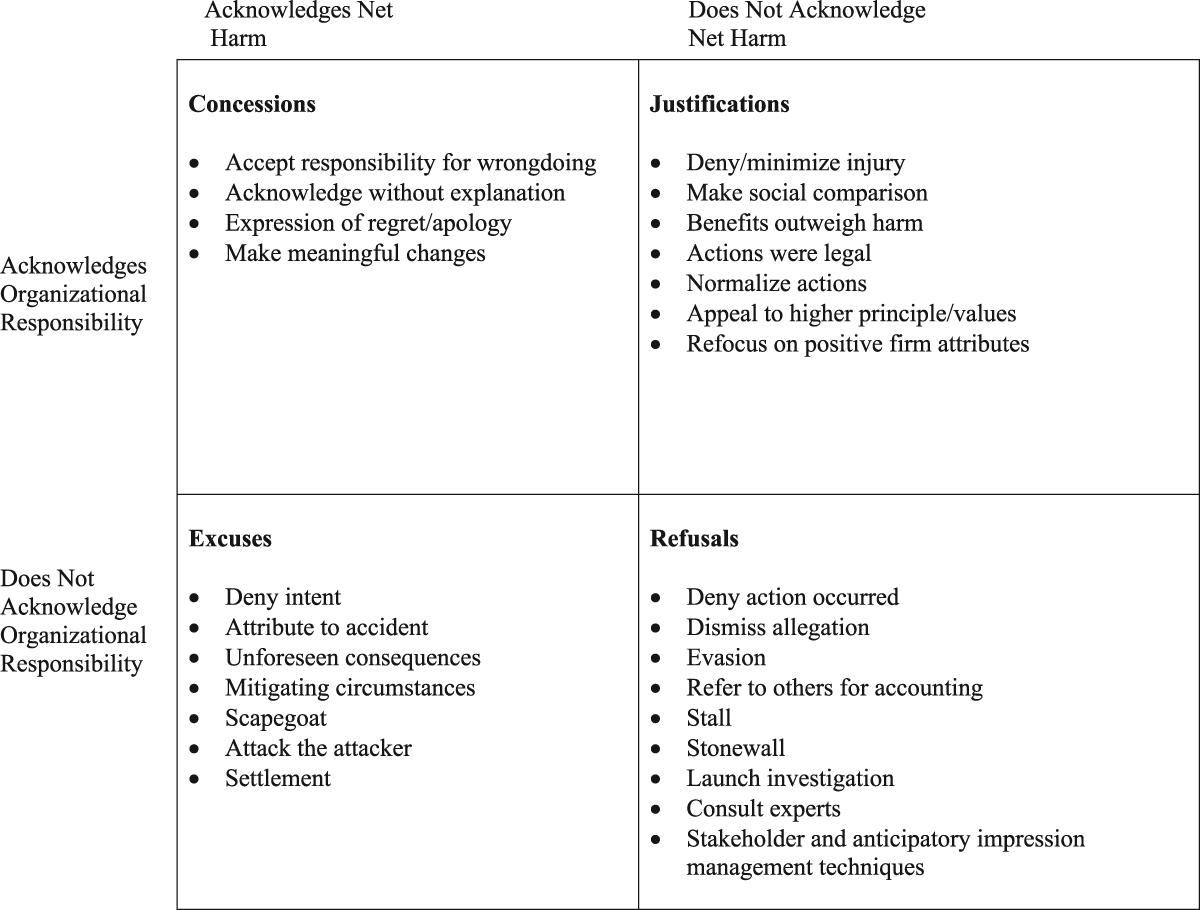
Typology of responses.
“Organizational Reputation” and “Organizational Identity” sub-sections of this article describe previous research conducted on organizational reputation and identity and then offer our theoretical arguments.
Organizational Reputation
Reputation is an assessment made about a firm by outsiders on the basis of limited information (Fombrun, 1996); it encompasses both knowledge about a firm’s characteristics and stakeholders’ emotions toward the firm (Elsbach & Kramer, 1996; Fombrun, 1996). Researchers propose that that a reputation is formed through information exchange and social influence in an organizational field; a reputation encompasses the cumulative, collective knowledge and regard that exists about an organization in the minds of external stakeholders (Rindova, Williamson, Petkova, & Sever, 2005). In essence, reputation reflects the stakeholders’ opinions and feelings about a firm. For instance, a firm may be perceived as a tough competitor (Milgrom & Roberts, 1982), a good place to work (Gatewood, Gowan, & Lautenschlager, 1993), or a producer of quality products (Shapiro, 1983). Reputation also provides information about expected future behavior (Alchian & Demsetz, 1972; Weigelt & Camerer, 1988).
A firm cares about its reputation because it is an intangible asset that provides sustainable competitive advantage and affects firm performance (Barney, 1991; Mishina, Block, & Mannor, 2012). A good reputation allows a firm to impart confidence in its customers, suppliers, investors, and other stakeholders. This confidence, in turn, helps the firm charge a premium for its products and services, attract better candidates as future employees, and create a feeling of safety for its investors (Eccles, Newquist, & Schatz, 2007). The literature on corporate social responsibility (CSR) suggests that organizational performance improves (measured using market value added) when stakeholders view the organization behaving in responsible ways (Hillman & Keim, 2001; Waddock & Graves, 1997).
Because a reputation is built on perceptions, it can be influenced or shaped by a variety of factors (Mahon & Mitnick, 2010). A threat to an organization’s reputation exists when an action that is perceived to violate social/moral norms comes to light; the level or degree of the threat is generally dependent on the perceived amount of damage that an organization’s reputation can suffer if it does not act. Threats to the reputation can change stakeholders’ belief structures and lead to an increase in negative attitudes, the stigmatization of a firm, the eventual devaluing of the firm, and changed stakeholder behavior toward the organization (Coombs, 2007).
However, reputational threats are not all perceived the same (Reuber & Fischer, 2009). Researchers propose that a threat will more likely result in higher reputational damage when:
The organization is held responsible, either at the onset or during continuation of the discreditable action (Coombs & Holladay, 1996; Reuber & Fischer, 2009).
The alleging party is credible, and the coverage of the event is frequent and negative (Mahon & Mitnick, 2010; Reuber & Fischer, 2009). A well-respected news organization, for instance, has the potential to make an organizational threat more visible and valid than a self-proclaimed and extreme watchdog group.
The stakeholders affected by the allegations are powerful, legitimate, and have an urgent claim; stakeholder desires are not always the same, and some stakeholders can more dramatically damage a firm’s reputation by withdrawing support from an organization (Mahon & Wartick, 2003; Mitchell, Agle, & Wood, 1997; Scott & Lane, 2000). In addition, powerful stakeholders might influence other stakeholders, creating a cascading effect of negative evaluations (Mahon & Wartick, 2003).
The type of wrongdoing is interesting, easily understood, affects many people, or is clearly deviant; we believe this type of corruption will be more easily visible and damaging than allegations that are complex, deal with unfamiliar subject matter, or affect a limited amount of people (Felstiner, Abel, & Sarat, 1980-1981).
The company has a prior history of disreputable actions. A company with a prior positive reputation will suffer less and recover faster (Coombs, 2007); conversely, a company that has engaged in prior disreputable actions will be more negatively affected by a new organizational threat (Mahon & McGowan, 1998; Mahon & Wartick, 2003).
Organizational Identity
Organizational identity focuses on questions such as “who are we?” and “what is our purpose?”; the answers to such questions probe organizational values and goals and provide organizational members with a sense of stability. The research on organizational identity originally focused on understanding an organization’s central, distinctive, and enduring characteristics (Albert & Whetten, 1985). The central character reflects the most essential features of the organization; the distinctive character points to features that distinguish the organization from others with which it may be compared, and the enduring aspect refers to the features that exhibit continuity over time (Albert & Whetten, 1985). 1
Although the question of who are we as an organization has always been central in evaluating organizational identity, Whetten and Mackey (2002) recently argued that the “ambiguity inherent in the phenomenological referent for the subject ‘we’ has led to the emergence of two fundamentally different conceptions of organizational identity: identity in organizations versus identity of organizations” (p. 394, emphasis added). The scholarly work evaluating shared perceptions of organizational members about the central, enduring, and distinctive traits of the firm falls under the “identity in organizations” perspective and is consistent with the original definition proposed by Albert and Whetten (1985).
Whetten and Mackey (2002) proposed an alternate view of conceptualizing organizational identity as “identity of organizations.” They argue that organizations should be viewed as social actors that collectively engage in social intercourse and social action. Organizational identity, from this perspective, is situated between self (the traditional definition of identity) and others (the environment). The organization is viewed as a collectivity situated within its social context (e.g., among its competitors, suppliers, and stakeholders, etc.); it has the ability to take on identities from its social context and also the ability to influence its environment by sending identity-related signals (Barraquier, 2013). When viewed from this standpoint, organizational identity constitutes self-definitions that enable a firm to be both similar to and different from other organizations. For example, organizations take on different types of organizational forms (e.g., for-profit vs. non-profit, or global vs. local) that are readily available as recognizable social categories and distinguish themselves by building unique strategies that differentiate them from their competitors. Within this social constructionist perspective, 2 a firm develops an identity that is close to but also different from the existing social benchmarks available in its environments (Gioia & Chittipeddi, 1991; Gioia, Schultz, & Corley, 2000). Organizational identity is therefore shaped by a constant interaction between what members believe the organization is and what they want outsiders to believe about the organization. Organizational members thus simultaneously engage in sensemaking through trying to understand the external and internal environments of the organization and sensegiving through the decimation of information to stakeholders (Gioia & Chittipeddi, 1991).
Extending the organization-as-a-social-actor perspective, Whetten (2006) further maintained that the organization’s self-definition, much like an individual’s self-definition, can be visualized in terms of personal, relational, and social attributes. At the innermost level, a firm’s identity includes organization-specific practices, competencies, and values (Whetten, 2006). An organization’s relational identity includes the firm’s established ties and partnerships with other organizations and institutions (Whetten, 2006). Finally, the firm’s social level of identity includes the firm’s industry and competitive/strategic groups composed of similar firms. This identity level not only helps define a firm but also aids in highlighting what the firm “is not.” When an organization identifies itself as belonging to a particular category or competitor group, stakeholders will anticipate that the firm assumes the common characteristics of that category. In addition, the firm is also expected to distance itself from the characteristics of organizations that fall into another category (King & Whetten, 2008).
Organizations, like individuals, can assume multiple identities; this is known as identity plurality. When a firm has multiple identities, there may be an identity hierarchy that establishes some identities as more important than others (Pratt & Foreman, 2000). An academic institution, for example, can have many individualistic or relational identities such as being a research institution, a teaching institution (or both), an institution serving global or local academic needs, an institution offering a liberal arts education, and so on. However, one identity that dominates for any university is that the organization exists to provide education and various degrees to its students.
Therefore, we refer to a core or primary identity as one that is essential to the firm’s very existence in that particular organizational form. Using the hierarchical order of firm identities (social, relational, personal), Whetten (2006) argued that higher level organizational attributes, including adopted social forms and organizing logics, can be considered structural analogues of “inherent” individual attributes, such as gender and ethnicity, on the grounds that the perceived switching costs associated with the replacement of these core identifying features are so high that the prospect of doing so, is practically speaking, unthinkable. (p. 226)
Therefore, it seems likely that a firm will use different response strategies to allegations of unethical behavior when the allegation is against a primary rather than a secondary identity.
Theoretical Model
Although researchers have examined the variety of responses available to firms accused of wrongdoing, there has been almost no study of factors that might lead a firm to choose a particular response to allegations of corporate misconduct. We use two factors—the threat to a firm’s reputation and its concurrent impact on the organization’s identity to predict which type of response an organization will choose when faced with allegations of unethical behavior. These different response choices are depicted in Figure 2.
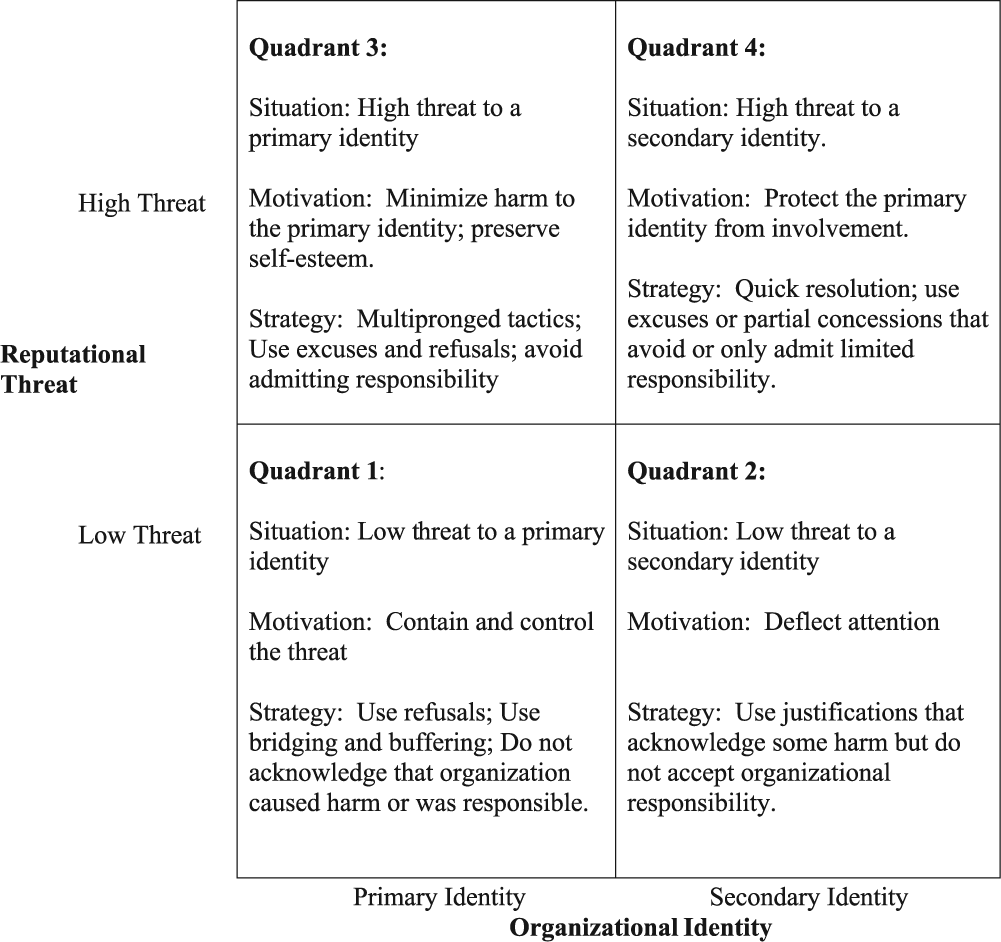
Reputation, identity, and responses to allegations of corruption.
On the vertical axis, we have used the level of reputational threat that an allegation presents to the given organization. As presented previously, we consider the reputational threat to be higher as more of the following factors are present: (a) The organization is held responsible, (b) the allegations are made by powerful parties, (c) the allegation is interesting and easily understood, (d) the stakeholders affected are powerful, and (e) the firm’s history is deficient.
On the other axis, we have used the type of organizational identity that is under attack due to the allegations; we believe the responses to allegations of corruption will differ depending on whether the primary versus secondary identity is targeted by the allegations. Primary identities are guarded more fiercely than secondary identities because of their relevance to the very existence of the organization. Thus, attacks on primary identities are likely to invoke stronger and more visible responses than when the disparaging claims fall on the secondary identities.
It is important to underscore that by using the “identity of organizations” perspective, we believe that the identity of the firm is not just the perceptions of insiders but how the identity is situated in the broader context of the firm’s environment. The social-actor conceptualization of organizational identity (Whetten & Mackey, 2002) views firms as social entities who self-manage identity and reputation; such firms conduct internal assessments of identity challenges and are also actively involved in repairing, containing, or preventing damage to their reputation. Thus, organizational identity is part of a self-management process during which managers use information from relevant environments to define themselves and the firm and, in turn, project organizational images to outsiders with the purpose of presenting the organization as a distinctive and admirable entity (Whetten & Mackey, 2002). A firm, therefore, takes a proactive role in evaluating both what allegations of unethical behavior mean to members internally and what damage the allegations could do to the firm’s ability to function and attain organizational goals.
Taken together, reputation and identity therefore offer a means to examine the responses chosen by firms after there have been credible accusations of wrongdoing. Such accusations can result in incongruence between how an organization presents itself and how stakeholders perceive it. Accordingly, we propose that an organization will attempt to reduce that discrepancy by choosing responses it believes will preserve its identity and bolster its reputation.
In the following sections, in addition to presenting the theoretical arguments concerning the choice of response strategies, the authors also use examples of several companies accused of wrongdoing to illustrate how these representative firms’ responses fit into each of these quadrants.
Quadrant 1: Low Reputational Threats to a Primary Identity
In this quadrant, we describe organizational responses to allegations of misconduct that pose low reputational threats but can still negatively affect the firm’s primary identity. Reputational threats are typically low when key stakeholders have limited awareness of the firm’s wrongdoing, the allegations are being made by groups who are not respected or influential, the organization is not part of the public consciousness, or the allegations are regarded as marginally important or spurious (Sims, 2009).
Despite low reputational concerns, organizations are likely to respond if they perceive that their primary identity might be threatened by allegations. Randel, Jaussi, and Standifird (2009) theorized that a negative evaluation by external stakeholders will always be perceived as a stronger threat when it concerns the organization’s core identity. Also, when allegations of unethical behavior affect the core identity, managers may fear the possible consequences of stakeholder re-evaluations (however few or weak they are) that question the primary identity attributes of the firm. Thus, although the reputation of a firm may be somewhat shielded, organizations may still take defensive actions to protect their primary identity from possible harm (Fombrun & Rindova, 2002).
In the case of the Gulf oil spill, British Petroleum (BP) was seen as the primary culprit after the Deepwater Horizon drilling rig exploded and set off the largest offshore oil spill in U.S. history. BP owned the well, but out of 126 people aboard the Deepwater rig, 79 worked for Transocean (the world’s largest offshore oil driller), and only six worked for BP; nine out of 11 fatalities were Transocean employees (Barrett, Weise, & Gara, 2011). Transocean also manufactured a critical piece of “fail-safe” equipment, and a 2001 Transocean report indicated that there were up to 260 failure possibilities in the equipment (Levin, 2010).
Clearly, Transocean played a crucial role in the Gulf oil spill, but because the media concentrated on a more prominent public consumer firm with previous safety problems, BP was blamed for the fiasco. The coverage of Transocean’s role/responsibility was much less reported, and the company was unfamiliar to the public; this situation allowed Transocean to keep a low profile and experience a low reputational threat. Investigations indicated that critical equipment failures, pressure warning reports that were ignored, and a number of procedural problems all combined into a sequence of events that caused the explosion. BP accepted a limited share of the blame but said that the explosion was a shared responsibility with its partners (Durando, 2010). Transocean, however, blamed the disaster and subsequent harm on BP and refused to contribute to a US$20 billion victims-compensation fund started by BP; furthermore, in its annual report, the company claimed that that 2010 was the safest year ever in the company’s history. In addition, in May 2010, Transocean filed papers in federal court seeking to use a 169-year-old maritime statue to cap the company’s liability for deaths and injuries at less than 27 million dollars (Barrett et al., 2011).
If we view Transocean’s responses as part of a deliberate self-management process involving identity and reputation, their approach is not surprising because when a firm’s primary identity is under a low reputational threat, the potential for damages is not high. In terms of the self-management approach described by Whetten and Mackey (2002), the firm may try to limit new information from becoming available and thus avoid triggering a possible ongoing investigation. Discouraging further examination is best accomplished by an uncomplicated, low-keyed defensive approach designed to not draw additional attention to the details of the allegations. In terms of the possible responses depicted in Figure 1, an organization in such a situation is likely to use refusal responses to avoid acknowledging that its actions caused net harm or that it was responsible for the situation.
When organizational reassessment does not appear imminent, a quiet and defensive refusal approach to allegations is unlikely to spark stakeholder interest because the firm’s response simply confirms what most stakeholders already accept (the firm is innocent, or we do not know anything about it, or we do not care). More proactive or complex responses, such as excuses or justification, may be interpreted as organizational guilt or intent to accept a degree of blame, which might increase stakeholder attention or prompt further examination. In the Gulf oil spill case, media reports concentrated on the culpability of British Petroleum, a much more publically recognized name and a firm known to have extensive resources. Transocean was intent on not attracting undue attention or appearing to have contributed to the carelessness that led to the disaster; the best way to do it was to try and stay out of the public eye and to simply issue denials or dismissals when attention was directed at the company (Mahon & Wartick, 2003). Transocean was able to use this strategy because, although it is a huge company, it serves an industrial market, is not well known by the general public, and is of less interest to the media.
Transocean’s persistent denials may also have occurred because managers viewed the overall concerns with offshore drilling as a threat to the firm’s primary identity. Transocean’s core identity is safe and premier drilling performance (deepwater.com), whereas BP’s primary identity is as a global energy company that acts as a force for progress through the provision of affordable heat, light, and mobility (bp.com). It can be argued that if it accepted any culpability, Transocean would have acknowledged that it had not fulfilled its primary identity. Citing some of these reasons, Barrett et al. (2011) speculated that Transocean avoided accepting even a sliver of blame for the disaster because to do so might have threatened the company’s contracts.
Another reason to deny and dismiss charges of corruption under a low reputational threat to a primary identity is because such a situation allows the organization to strategically choose which audiences or stakeholders it should attend to (Elsbach & Sutton, 1992; Mahon & Wartick, 2003). Research has found that organizations are typically vigilant in maintaining a good reputation with the media (Deephouse, 2000), with regulators (Pfeffer & Salancik, 1978) and with investors (Certo, 2003), but not all stakeholders are equally important to a firm (Mahon & Mitnick, 2010; Mitchell et al., 1997). Stakeholders scrutinize the firm in different ways, and the firm can choose to placate some while maintaining a distance from the others. This strategy is possible when some stakeholders are genuinely unconcerned (low reputational threat) with the allegations. In Transocean’s case, the media did not focus on Transocean, so the firm responded with minimal interviews or comments beyond a disavowal of responsibility (Barrett et al., 2011). In addition, Transocean chose to shield itself against regulators by invoking a maritime law that prevented the regulators from influencing the firm’s reputation, policies, and performance (Deephouse, 2000). Finally, investor confidence plays a crucial role in determining the firm’s financial viability and future growth prospects and sends critical reputational signals to the firm as well as other stakeholders (Certo, 2003). Transocean managed its investors by issuing lucrative dividends for 2010 and declaring that the year was its safest, thereby dismissing any notion that the disaster had affected the firm’s “safe drilling” identity or compromised it financially. A plaintiff’s lawyer commented that “Transocean’s strategy is to offer zero, nothing—how about zip?” (Barrett et al., 2011, p. 56).
Quadrant 2: Low Reputational Threats to a Secondary Identity
When stakeholder scrutiny of the organization’s reputation is low, and its primary identity is not threatened by allegations of wrongdoing, this is a low-stakes situation. In terms of self-management, there is no need for the firm to respond in a defensive or aggressive way. Firms are likely to perceive low reputational and identity threats on a day-to-day basis; many consumer complaints, legal violations, and public relations issues may prick awareness, but are not severe enough to create a substantial concern about reputation or identity.
In such situations, we believe that organizations will rely on justification responses; they will acknowledge a limited amount of harm, but deny responsibility for the situation. Firms in this situation can also use stakeholder management and anticipatory impression techniques. The more an organization has proactively created positive images and managed its stakeholders, the more it can weather a storm in the face of less-serious allegations of wrongdoing (Elsbach et al., 1998; Sitkin & Bies, 1993).
As an example, Elsbach et al. (1998) studied irregularities in billing of three large hospitals. Billing issues clearly posed a threat to a secondary identity (cost of operations; pricing) for these hospitals because the primary identity was providing good medical care. The irregularities did not become the subject of intense media coverage, they directly affected only some patients, and billing irregularities were perceived as commonplace and correctable; these factors resulted in a reputation threat that the firms believed they could avert by using anticipatory tactics.
The authors identified two anticipatory responses firms used to avert any potential future conflicts: accommodation and legitimization. Accommodation refers to the use of images that induce positive emotions such as feelings of liking and goodwill among stakeholders (Liden & Mitchell, 1998). Toward the issue of irregularities in hospital billing, Elsbach et al. (1998) found that instead of using remedial tactics (such as denying or dismissing), several hospitals “presented accommodating images most often by highlighting favors they performed for patients and by presenting self-characterizations of the hospital as caring and friendly” (p. 76). Prior research indicated that the use of such positive mood enhancing techniques leads people to avoid looking for information that might alter their mood (Isen & Means, 1983). Thus, stakeholders either neglect negative information about the organization or are less vigilant in searching for additional information. This allows the firm to avert any future controversies emanating from what currently seems to be a minor issue. Thus, the firm does not deny the action; rather, it concentrates on stressing the net good that emanates from the firm’s operations.
Legitimization (or normalization) is another form of anticipatory response to accusations of wrongdoing; legitimization occurs when firms use various images to persuade stakeholders that the organization conforms to institutional norms (Elsbach et al., 1998). For instance, managers may use a normalization response by portraying the questionable action as an acceptable or a standard practice. When Microsoft was asked to testify before Congress about censoring internet content in China, the firm admitted that it had done so but maintained that it was just following the rules laid down by the Chinese government (Dann & Haddow, 2008).
In the Elsbach et al. (1998) study discussed above, a patient informant was quoted as saying, “I looked through my bill for things like $5.00 Band-Aids. It all looks legit. I guess with a surgery, you have no idea what stuff they’re really using. If it got itemized, I figured they must have used it” (p. 78). Stakeholders are less likely to be concerned if they believe that the firm follows these norms because it suggests that the organization is rational and its practices have been endorsed by institutional audiences (DiMaggio & Powell, 1983).
Quadrant 3: High Reputational Threats to a Primary Identity
In this quadrant, we consider the likely responses to allegations of corruption that create a high reputational concern and involve the organization’s primary identity. The events described by this quadrant comes closest to what researchers label a “crisis” – a situaion with high stakes, perceived urgency, and possible ambiguity (James & Wooten, 2010); this creates a sense of emergency for the organization that is not present to the same degree in the three other quadrants.
We argue that when a firm’s primary identity is under serious reputational threat, the alignment between the firm’s identity claims, the images it has been trying to project to its stakeholders, and its reputation is likely severely damaged because of a widespread loss of faith by key stakeholders and the subsequent decline in the organization’s moral legitimacy (Scott & Lane, 2000). When more powerful stakeholders negatively appraise the firm, it will be likely to self-manage its identity and reputation by expending a significant amount of effort and resources to minimize or repair the damage done by the allegations (Fombrun & Rindova, 2002; Mahon & Wartick, 2003; Scott & Lane, 2000). Because the motivation is to minimize harm to the dominant identity, avoid the loss of powerful stakeholders, and preserve collective self-definition and self-esteem, it is our belief that many firm members will initially work diligently to avoid accepting any guilt about circumstances that could severely threaten the firm’s primary identity. Concealing information about corruption allows the firm to disassociate its identity claims from reputational threats. The Mollen Commission, which investigated police corruption in New York City, discovered that widespread wrongdoing continued for many years because even the honest police officers were more fearful of a scandal and the accompanying loss of pride and self-esteem than they were of the wrongdoing itself. Police officials were wary of the potential harm to the organization’s reputation and their careers, but they were more fearful of the collapse of the organization’s identity of accountability and integrity (“Corruption in Uniform,” 1994). 3
In some cases, attempts at concealment eventually fail; in others, events are catastrophic and no attempt at concealment is possible. When allegations of misconduct have created a serious public threat to a firm’s primary identity, the firm’s legitimacy, resources, and social support are at stake (Oliver, 1991). Because of the serious potential consequences and the complexity of the situation, a period of buying time will be useful as managers collect and process information.
Firms can buy time in various ways. They can remain silent and not respond to initial inquiries. A firm in the unwelcome glare of publicity can claim that that it is undertaking an extensive investigation into the situation, and it might try to co-opt key stakeholders by inviting them to join the investigations (Zavyalova, Pfarrer, Reger, & Shapiro, 2012).
A firm whose primary identity is seriously endangered by allegations of unethical actions can also try to reframe the situation by counterattacking either the accusers or the purported facts to stave off accepting blame. The authors’ belief is that most organizations in these situations will try a variety of techniques that will allow them to disavow responsibility to delay or weaken the amount of blame the firm may eventually be forced to accept.
In 1999, Merck sponsored a clinical study of 8,000 participants to determine whether the pain reliever Vioxx caused fewer gastrointestinal problems than naproxen; Vioxx was superior, but the study unexpectedly revealed that the patients who received Vioxx were 5 times more likely to experience an adverse cardiovascular event (Presley, 2009). Interviews and internal company documents revealed that at a meeting of Merck executives in May 2000, the attendees decided to take no direct action to investigate the cardiovascular risk of Vioxx. A slide that was presented at the meeting said there was no compelling need for such a study, and the implied message would not be favorable. Merck and Vioxx were both well known; at the time of this decision, doctors had prescribed Vioxx more than 5 million times, and Merck had launched the drug in 47 countries (Berenson, Harris, Meier, & Pollack, 2004; Presley, 2009).
After the study results were published in a medical journal, Merck mounted an aggressive marketing campaign designed to reassure doctors and the public that safety concerns about Vioxx were not warranted. Merck dismissed the cardiovascular event differences by claiming that naproxen protected the heart rather than acknowledging that Vioxx might harm the heart, although there was no scientific evidence for such a claim (Presley, 2009).
Other measures taken by Merck included training sales representatives to reframe doctor’s concerns about Vioxx, consistently releasing positive but incomplete press releases about Vioxx, and intimidating and threatening scientists who were saying negative things about Vioxx. Through all this, the CEO maintained that the firm had a “deep and abiding commitment” to dealing ethically with physicians and other health care providers (Adams, 2004, p. 2).
In May 2001, the New York Times ran an article about Vioxx safety concerns, and a high reputational threat escalated. Because so many used Vioxx, the potential harm that Vioxx could cause heart problems was widespread and easily understood. Merck responded with a press release confirming the safety of Vioxx and sent a voicemail to all sales people instructing them to stay focused and confident about the safety of Vioxx (Adams, 2004; Presley, 2009). Studies continued to show that Vioxx posed cardiovascular risks; Merck dismissed the results by correctly pointing out that the design of the studies did not definitely prove that Vioxx was a danger to the heart. Eventually, Merck sponsored a double-blind controlled study to test whether Vioxx could prevent the reoccurrence of colon polyps; the study was terminated early in 2004 because of the cardiovascular risks that emerged. Merck immediately withdrew Vioxx from the market, and pronounced that they were “stunned” about Vioxx safety risks (Berenson et al., 2004; Presley, 2009; Simons, 2004).
After the withdrawal, Merck maintained that it acted “responsibly and appropriately” in its actions regarding Vioxx because it withdrew Vioxx as soon as it had concrete proof of its dangers (Adams, 2004, p. 2). However, notable scientists publically criticized Merck for ignoring early warning signs and never forthrightly trying to determine whether Vioxx was related to cardiovascular events; even the study that uncovered the danger was not done to study Vioxx’s effect on the heart (Simons, 2004). In 2007, Merck settled 27,000 lawsuits for US$4.85 billion, and in 2011, the Justice Department announced that Merck agreed to pay a fine of US$950 million and plead guilty to one misdemeanor involving improperly marketing the drug for rheumatoid arthritis. Beyond that misdemeanor charge, Merck admitted no guilt, and no one was fired over the decisions made about Vioxx (Wilson, 2011).
The Catholic Church also encountered a high reputational threat to its primary identity because of allegations that child molestation took place in the Catholic Church for decades; furthermore, this abuse was covered up and allowed to continue by high-ranking officials of the Church. The core identity of the Catholic Church is that it is a religious and moral institution with churches and schools dedicated to Catholic worship and religious education. The Church also has a secondary identity of being a social services institution with 600 hospitals and 1,400 social services agencies and charities (Steinfels, 2003).
The allegations of child abuse clearly were leveled against the primary identity of the Church and violated the basic religious foundation of the organization. The scandal received national attention when in 2002, after losing a court fight to the Boston Globe to keep them sealed, the Archdiocese of Boston (headed by Cardinal Law) was forced to release 10,000 pages of internal records. The Globe began an intensive expose on Catholic pedophile priests who had molested children and the Church hierarchy that concealed the problem (France, 2004). After the Globe story ran, a high reputational threat was immediately created. The allegations were heinous; most members of the Catholic Church were affected, and the stakeholders most damaged were children. Pedophilia was easily understood and obviously deviant; the Church was clearly responsible for the continuation of the behavior, and the story spread quickly to other cities and countries. The Church’s reputation was severely compromised because the organization responsible for the deviance had an identity that centered on moral directives. This is known as a deontological reputation, and in the case of the Catholic Church, the Church portrayed itself as a moral leader and stakeholders expected that its actions would be based on moral principles. Transgressions are especially harmful to an organization’s reputation in such situations (Mitnick & Mahon, 2007).
The Church’s first response to molestation claims during a 40-year period ranged from the suppression of information to complete denials. The handling of all complaints used closed-door procedures, and information was not released to the public. When complaints were settled with monetary compensation, a gag order was always included that forbade the victim from disclosing the abuse (France, 2004).
As the wrongdoing became public, various Church officials blamed an intrusive media, anti-Catholic feelings, the psychiatric profession, a lax popular culture, and homosexuality for the Church’s troubles. In fact, one cardinal who was considered a possible papal successor compared the media’s reporting of the scandal with the persecution of the Church by Hitler and Stalin. Despite the deflections, polls showed the general public had lost trust in the Church as Church attendance and donations dropped. Catholic hospitals and social service agencies started to distance themselves from the Church, and some were forced to close or downsize as their funding dried up in light of multimillion-dollar judgments against the Church. In spite of tremendous consequences for both the Church’s reputation and its financial viability (the scandal cost more than US$2.6 billion by the end of 2008), the Church’s top officials took a surprisingly long time to accept responsibility, cooperate with law enforcement, put more stringent procedures in place, and apologize for the harm that had been done (France, 2004; Zoll, 2009).
When an organization’s primary identity is seriously threatened, the organization’s very purpose is called into question. Granted, the Catholic Church is a mammoth organization, but the initial focus was on the Boston diocese. Church officials successfully concealed wrongdoing for decades; when a powerful stakeholder (the Boston Globe) made allegations, the Catholic Church used various responses ranging from denials, muting the allegations by using religious authority, shifting the blame to other causes, and defending their actions. The Church spent an inordinately long time engaging in deflection, denial, reframing, scapegoating, and stonewalling responses. Indeed, leaders were willing to let their peripheral identity as a social services institution be compromised in an attempt to save the primary identity, and the Church did not issue an official papal apology until 6 years after the story broke.
When the core identity is seriously threatened, organizations are likely to avoid any admission of direct or willful responsibility for the net harm. We argue the organization will self-manage by use multiple tactics, especially excuses and refusals, to mitigate the accusations that affect the core identity; this will be done in an attempt to preserve self-esteem and to prevent stakeholder reassessment that will lower trust and support for an organization. In extreme cases, a negative reassessment can result in stakeholders repudiating their affiliation with the organization, separating from the organization, or working diligently to discredit the organization (Scott & Lane, 2000).
Quadrant 4: High Reputational Threats to a Secondary Identity
In Quadrant 4, we consider the likely organizational response to allegations of corruption that create a high reputational threat against a secondary identity. When the charges are against a secondary identity, we believe the firm’s ultimate motivation is to protect collective self-esteem and prevent wholesale reassessment by stakeholders through keeping the primary identity uninvolved in the corruption allegations; the quickest way to do this is to offer an excuse that acknowledges harm but does not accept wide-scale responsibility.
A common technique to deal with a serious threat against a secondary identity to isolate the crisis by scapegoating followed by a fast response. Pinning the blame on a particular unit or a few key people may resolve the situation, satisfy stakeholders, and buffer the rest of the organization so that the problem will remain contained. Other tactics available to a firm in this situation are to pay a quick settlement to speed resolution or to maintain that genuine mistakes were made, and the organization did not realize the seriousness of what might occur. We propose that a firm whose secondary identity is threatened is likely to use swift action and localization of blame or some other excuse strategy to keep the investigation and focus contained, and in such cases, the return to normalization is smoother because the rest of the firm is not directly affected.
Hewlett–Packard (HP) is a Fortune 500 company whose primary identity is designing and producing innovative technology products. In 2005, a scandal broke that had nothing to do with HP products. It had become apparent that someone on HP’s Board of Directors was leaking information about board discussion and decisions to the press. Patricia Dunn, Chair of the Board, became determined to find the culprit. On the advice of HP senior executives, Dunn hired an outside security firm, who subcontracted some of the work to other firms. HP Senior Counsel and Director of Ethics, Kevin Hunsaker, gave the outside investigators the personal, cellular, and office telephone numbers of HP Directors, and he further instructed the investigators to obtain the phone records of the Directors and specific members of the media (Reed, 2008).
Using the directors’ social security numbers, investigators were able to obtain the directors’ phone records without their permission or knowledge; they also obtained the records of nine press members who regularly covered HP (Darlin, 2006). This practice is known as “pretexting”; it involves posing as someone else to access confidential information, such as tricking phone companies into releasing call logs by impersonating a customer (Krazit, 2006; Reed, 2008). The human resource (HR) executives knew that the phone records were being accessed through misrepresentation, and the practice continued during 2005-2006. Dunn was briefed weekly on the investigation (Reed, 2008).
In March 2006, a report that identified the leaker as George Keyworth and described the method used to obtain the evidence was given to Dunn and HP’s new CEO, Mark Hurd. Dunn revealed the results of the report to the entire Board, and Keyworth was asked to resign, but he refused. In May 2006, Director Tom Perkins, who was troubled by HP’s action resigned and refused to give an explanation; his actions prompted the Securities and Exchange Commission (SEC) to initiate an investigation, and the SEC subsequently required HP to publically file a written explanation for Perkins’s resignation.
The media coverage was heavy, the discreditable actions were initiated by top management and went on for 2 years, and a company “spying” on its own board members captured public interest. All this combined to create a high-threat situation, and HP moved quickly; Dunn and Keyworth both resigned from the Board within weeks, and the involved executives resigned or were fired. The new CEO apologized on behalf of HP for the pretexting (Reed, 2008). In October 2006, a number of people were indicted for identity theft and other felony charges, although only one would eventually serve jail time (Hesseldahl, 2012). The state of California simultaneously began a criminal investigation into the matter, and HP cooperated; HP also agreed to pay US$14.5 million to settle a lawsuit by the California Attorney General’s office (Darlin, 2006; Reed, 2008). All said, it was a fast and fairly inexpensive resolution to a major reputational threat.
Another example of a high reputational threat to a secondary identity involves a recent scandal at a large Midwestern university. The core identity of the organization is that of an academic institution focused on education and career preparation while one of the secondary identities is as a provider of a safe, pleasant social and living environment where students begin the process of maturing and living independently.
On December 16, 2006, a student was found dead in her dorm room at Eastern Michigan University. For 10 weeks, members of top management repeatedly maintained that they did not suspect any foul play although the condition of the body clearly indicated otherwise. However, on February 23, 2007, a fellow student was arrested for criminal sexual conduct and murder, and it was revealed that a criminal investigation had been initiated immediately after the body was discovered. The story quickly received national attention; the murdered student’s parents engendered empathy, and critics charged that the university had behaved badly by trying to cover up the murder (Huffstutter, 2007).
The university’s president repeatedly claimed that he did not know anything about the homicide and the cover-up; the vice president (VP) of Student Affairs acknowledged that the released statements could have been clearer, but he declared that suspecting the university of a cover-up was “crazy.” The Board of Regents launched its own investigation, and an official investigation by the Board of Education resulted in a fine of US$350,000 in June 2008 when it was found that the university had failed to warn the campus of ongoing threats (Bailey & Luthi, 2009; Huffstutter, 2007).
In July, the University dismissed the President; the VP of Student Affairs and the Public Safety Director resigned. No one else lost his or her job, although many had been accused of participating in the cover-up. Although they did not admit guilt, the university also settled with the student’s family for US$2.5 million. Shortly after the firings, the president of the university’s professors’ union called for a total commitment to the classroom and claimed that too many ancillary issues had been getting in the way of the core issue of supporting and improving education. The university launched a new campaign named Education First, and a new president was hired in May 2008 (“Eastern Michigan University Set,” 2008; Larcom, 2007).
Although there was a period of initial denial, the organization moved fairly quickly toward resolution. The firing of three top officials was dramatic and well publicized; although many maintain it was scapegoating, it seemed to satisfy constituents. Meanwhile, the new campaign that emphasized the university’s strength as an educator served to change the subject and divert stakeholder attention.
Discussion and Conclusion
Most work on organizational misconduct has concentrated on investigating the antecedents to wrongdoing (McKendall & Wagner, 1997). With unethical behavior as the variable of interest, our work looks at the other side of the equation: Why organizations adopt certain responses after they have been accused of unethical action. Just as there are a variety of factors that cause misconduct, the authors propose that there are a variety of factors that influence organizational response to accusations of misconduct.
A substantial amount of research about unethical behavior in organizations has tended to view organizational wrongdoing as a linear event by first examining antecedents that lead to wrongdoing (McKendall & Wagner, 1997) and then looking at the effect of misconduct on subsequent firm financial performance (Baucus & Baucus, 1997). We believe it would be more instructive to view organizational wrongdoing through an organization–stakeholder interaction model where although antecedent conditions result in wrongdoing, the firm’s responses are based on complex interactions of variables such as reputation and identity, and those response choices have consequences both in and outside the firm. If stakeholder reactions are unfavorable enough, the firm can make changes to the responses it chooses. To examine these links, we view the organization as a social actor that self-manages both its identity and reputation, and we use the constructs of organizational reputation and organizational identity to propose why firms faced with accusations of unethical actions might choose to respond in particular ways. Our theoretical proposals and the resulting typology differentiate between primary and secondary identities and between high and low reputational threats (see Figure 2). Because identity and reputation are highly interrelated concepts, our theory offers a richer view of organizational adoption of one response over the other. This helps in developing a better understanding of response strategies that result from complex interrelationships between several variables. This approach offers a more realistic understanding of responses compared with linear examinations using few variables focusing solely on responses irrespective of antecedents. Finally, rather than just listing possible organizational responses to allegations of wrongdoing, our article uses Szwajkowski’s 1992 individual-actor model and combines it with Anand et al.’s (2009) research to present a typology of organizational responses to wrongdoing based on whether an organization acknowledges its actions caused net harm and whether the organization accepts responsibility for the situation.
An interesting area of future research could be the temporal changes in organizational responses when the chosen response to an allegation of wrongdoing does not produce the desired effect of protecting the firm’s identity and reputation. Currently, we have focused on response strategies that are based on managerial perceptions that the allegations belong to one of the four respective quadrants. In reality, however, allegations are not always static and those that are perceived to be of low reputational concerns may grow in time and eventually force managers to adopt strategies to counter higher threats. Or, allegations that affect a secondary identity may begin to challenge the primary identity of the organization. For instance, in Dutton and Dukerich’s (1991) study of the Port Authority of New York (PA), the issue of homeless people taking shelter in transportation facilities was brought to light by the media. The PA, which is responsible for most of the transportation facilities, initially rejected blame when reputational threats were weak. As media criticisms grew, the PA moved to deflection; instead of taking responsibility for the problem, the PA linked it to “other regional issues such as decreasing housing availability and changes in the skills represented in the region’s labor market” and emphasized “the links between homelessness and other negative issues such as drugs and crime” (Dutton & Dukerich, 1991, p. 525). By recasting the issue as a police-security matter and by claiming that the PA was not in the social service business, the organization maintained its innocence concerning the allegations and reemphasized its identity as a transportation provider. As the homelessness issue at PA facilities spread further from bus terminals to the World Trade Center, the media and other external constituents became more vocal. The PA could no longer deflect the issue; it sought and obtained more extensive outreach services, with daytime as well as nighttime assistance, through a contract with the Volunteers of America, a not-for- profit social service provider that sent volunteers to Port Authority facilities to assist homeless people and encourage them to go to shelters. (Dutton & Dukerich, 1991, p. 532)
This is just one example of how the same organization may alter its response strategy as initially chosen responses fail. Future research could therefore explore the change in organizational response as threats are perceived to move from one quadrant to another.
Further empirical research is also obviously needed to explore the various propositions offered. This can start with in-depth case studies that capture rich details of organizational responses over time. A multivariate empirical approach might involve gathering data from a sample of organizations accused of misconduct, coding their responses in terms of time and type, and investigating whether the identity and reputational situations in our four quadrants predict response. Content analysis has also been found quite effective in identifying constructs of interest and determining the degree of the presence of the original constructs (Popping, 2000). Researchers have used annual reports and media publications to code a variety of constructs of interest and analyzed these quantitatively (Abrahamson & Park, 1994; Arndt & Bigelow, 2000). One possible avenue for quantitative analysis is to examine company annual reports and media interviews for the identity and reputational concerns as well as responses to allegations and use software like NUD*IST to code the different constructs and quantitatively assess the presented relationships.
Another interesting area of future research pertains to unraveling the complexities of managing firms’ CSR and responses to allegations of wrongdoing. Given the amount of stakeholder attention to the CSR (which refers to going beyond legal requirements to further some social good; McWilliams & Siegel, 2001), firms have used CSR as an integral part of their business- and corporate-level differentiation strategies (McWilliams, Siegel, & Wright, 2006). Interestingly, although CSR reflects positive qualities, allegations of wrongdoing paint the very opposite qualities of the firm in question, which opens up the possibility for researchers to explore how managers use their CSR efforts to shape responses to allegations. A related question that could be useful for further research is whether a strong ethical culture can intervene when and how a firm chooses its response to incidents of wrongdoing.
Important questions also remain regarding the impact of industry-wide responses to the unethical activities perpetrated by one firm. Prior research has found that negative events such as organizational wrongdoing, although they are confined to a single firm, tend to cast a long shadow over many other similar companies where stakeholders question other similar companies just because they happen to be part of the same industry as the perpetrator (Haack, Pfarrer, & Scherer, 2014). An interesting area of research under this theme would be to explore the response strategies of companies that come under attack because of their similarity to the firm that is accused of wrongdoing (Jonsson, Greve, & Fujiwara-Greve, 2009).
Several managerial implications can be drawn from the propositions we have presented. To completely understand these implications, it is important to reinforce that our model is based on two critical findings from previous research: First, organizations are usually very protective of their dominant identities because they embody the purpose for the firm’s existence, and second, organizations care about their reputation because it serves as an intangible resource. Obviously, when either of these factors is challenged by allegations of wrongdoing, managers instinctively resort to either rejecting or reinterpreting information that challenges their assumptions (Brown & Starkey, 2000). We believe that managers should pay attention not only to the allegation but also their responses to it because the chosen response might pose a serious damage to the firm in the longer run. Many responses are likely to create an escalation of commitment on the part of the organization if they deny the allegations right away. These defensive responses may cause further reputational and identity threats if the firm does not act in ways that the stakeholders want them to. Note that the Catholic Church ultimately did indeed adopt a “zero-tolerance” policy regarding priests with a history of child abuse; however, this decision was made only after the events had caused much damage (Barth, 2001).
As we researched various cases, we found that fully accepting responsibility for wrongdoing typically occurred only after time had passed and other responses had failed. Of course, not all allegations are correct, and in some cases, refusing to accept blame may be warranted. Or, it may be that such examples exist, but acceptance is used only in minor situations that do not make headlines. In all, forthrightly accepting blame and responsibility for unethical action does not seem to be the way many firms choose to respond, even when the evidence is plentiful or the firm has been found guilty of legal violations. In fact, the SEC is now requiring an admission of guilt in some settlements; the SEC previously allowed all settlements to proceed without an admission because it claimed that most companies would refuse to settle if they had to admit wrongdoing (ElBoghdady, 2013).
The firm’s ethical culture may play a role here. As Treviño and Nelson (2007) pointed out, hundreds of thousands of business transactions occur every day, and the public rarely hears that those actions were unethical, so the proportion of firms that engage in serious wrongdoing is probably small. We may not have found examples of firms using acceptance as a response to wrongdoing because if the norms of the organization permitted or encouraged the unethical behavior in the first place, that same culture may work against choosing acceptance as a viable response.
Management should therefore consider that their responses to allegations of wrongdoing may influence employees’ future outlook and behavior. A component of organizational ethical culture is the behavior of management, and studies have shown that employees model the ethical/unethical actions of the firm’s managers (Kaptein, 2011). If wrongdoing is followed by responses that seek to circumvent responsibility, then repeated messages are sent about the importance of ethics in that firm. For instance, the organizational justice literature suggests that when firms do not follow through on behavioral expectations set by their ethical programs, employees are likely to perceive a sense of procedural injustice (Treviño & Weaver, 2001).
In addition, when organizations fail to punish the guilty parties, outside stakeholders may feel that retributive justice has not been served because they view such punishment as just (Treviño & Weaver, 2001). These failures obviously create a sense of ethical slackness and the moral identity and the reputation of the organization may suffer in the future. Thus, managers may want to develop a habit of introspection because some commonly chosen responses do not resonate well with the public or the courts, and they may further damage the reputation and identity of a firm. For instance, prior research has found that stakeholders are more forbearing when a firm acknowledges rather than denies responsibility (Elsbach, 1994).
The authors were surprised when some of our sample organizations seemed to keep following response patterns that did not serve them well. Future research could consider a normative approach to look at what kinds of responses to allegations of misconduct work best.
Although organizations will act to preserve their identities and reputations, sometimes they will fail. Mahon and Mitnick (2010) proposed six strategies that can be used to effect a change in a damaged or negative reputation. A natural research extension is the study of how much an organization can recover if, despite its chosen response strategies, allegations of wrongdoing have damaged a firm’s identity and reputation.
One of the limitations of this article is that it does not explicitly consider the role of anticipated monetary costs as a factor that influences response choice. How accurately and how soon a firm can project costs (e.g., fines, lawsuits, and lost sales and market shares, etc.) and how such estimates influence response choices need to be explored.
In summary, we propose that viewing organizational misconduct as a complex and connected process of behavior and decisions will give both researchers and managers a richer view of how to prevent, analyze, and respond to corruption within an organization. If we view organizational wrongdoing as an interaction between the organization and stakeholders, it is obvious that the bulk of research has concentrated on only a few links within the model. We hope that our research will begin to fill in and prompt examination of what happens after wrongdoing has occurred and result in a more nuanced and complete understanding of unethical behavior in organizations.
Footnotes
Acknowledgements
The authors thank the Business & Society editors David Wasieleski and Duane Windsor and anonymous reviewers for their excellent feedback that significantly improved this article.
The article was accepted during the editorship of Duane Windsor.
Declaration of Conflicting Interests
The author(s) declared no potential conflicts of interest with respect to the research, authorship, and/or publication of this article.
Funding
The author(s) received no financial support for the research, authorship, and/or publication of this article.