







Abstract
This article presents a theory of how the consumption of Islamic products may promote morally consistent behavior over time. We identify and examine three unique meta-characteristics (MCs) of Islamic ethics: ubudiyah (subservience to God), akhirah (focus on the hereafter or the long-term), and tawado (being modest while doing an ethical act). In four experiments, we show that after consumption of an Islamic banking product, MCs produce moral consistency or repeat ethical behavior, which is one major objective of an ethical system. We also show that the absence of MCs results in moral inconsistency, that is, unethical behavior follows earlier consumption of an Islamic banking product due to the mediating psychological mechanism of moral licensing. Hence, it is not only the enactment of general ethical practices, rather the enactment of ethical practices in the specific context set by the MCs through which Islamic ethical system promotes ethical conduct and prevents unethical conduct. The findings have implications for Islamic ethical system and Islamic banking.
Keywords
The Islamic faith provides guidance in all aspects of life (Rice, 1999) to a worldwide growing population of Muslims (Lipka & Hackett, 2017). Hence the influence of this religion on its adherents’ ethical behavior is an important topic of research. Muslims across the globe are asserting their religious identities (Syed & Buren, 2014; Syed & Metcalfe, 2015), along with increased consumption of Islamic products, such as Islamic banking products (IBPs), following religious teachings (Ali, 2015; Ariff, 2011; Elamer et al., 2020; Ernst & Young, 2016; Minhat & Dzolkarnaini, 2016; Murphy & Smolarski, 2020).
Muslims consume Islamic products for moral reasons. Increased consumption of Islamic products reflects the influence of Islamic ethics on the personal and business decisions of Muslims (Murphy & Smolarski, 2020; Syed & Metcalfe, 2015). The implications of consumption of Islamic products ought to be articulated and evaluated to advance research in Islamic ethics because extant research suggests that consumption of products for moral reasons can result in morally inconsistent behavior (Mazar & Zhong, 2010).
One major objective of an ethical 1 system is the promotion of ethical conduct, to ensure morally consistent behavior over time, while simultaneously controlling morally inconsistent 2 behavior through legal codes, social norms, and reward and punishment systems. Behavioral consistency is important because extant evidence suggests that moral behavior in general (Mullen & Monin, 2016), and consumption of products due to moral reasons in particular (Mazar & Zhong, 2010), can produce subsequent unethical behavior. Morally inconsistent behavior occurs due to moral licensing, which refers to the effect that when people have initially behaved ethically, they may later act unethically (Merritt et al., 2010). Furthermore, the research on moral consistency has identified multiple moderating factors, such as construal level, commitment versus progress, identification, values reflection, and behavioral ambiguity, that can mitigate licensing and promote consistent moral behavior (Mullen & Monin, 2016).
Ethical systems are designed to promote morally consistent behavior, and ethical theories describe how to behave ethically in a consistent manner. The extant research on moral consistency in non-Islamic contexts illustrates how to advance research in ethics: to build models containing mediating and moderating mechanisms that provide deeper and fuller explanations of the phenomenon under study (Baron & Kenny, 1986; Bono & McNamara, 2011; Rosenthal & Rosnow, 2008). In Islamic ethics, Abdelzaher et al. (2019) provide a recent example. We present a theory of how the consumption of Islamic products may result in morally consistent behavior. The theory presents the mediating and moderating mechanisms that explain the conditions which produce moral consistency. We identify three factors, the meta-characteristics (MCs) of Islamic ethics, which result in morally consistent behavior:
(a) ubudiyah (subservience to God, seeking His approval by enacting ethical rules without consideration of the material consequences) (Pavlin, 1998; Slamet, 2016),
(b) akhirah (focus on the hereafter [the long-term] while performing a good deed and avoiding focus on the worldly life or dunya [the short-term]) (Asutay, 2007; Saniotis, 2012), and
(c) tawado (being modest while doing an ethical act and shunning riya, the public display of one’s ethicality) (Sidani & Showail, 2012; Zubair, 2017).
These MCs guide how ethical actions should be performed (e.g., one should give to charity—an ethical deed—in private while observing tawado). We test the theory and study the relationship between consuming an Islamic product (i.e., IBP) and moral consistency, and the effect of MCs on this relationship. Our findings suggest that MCs produce moral consistency. The absence of the MCs results in moral inconsistency, that is, unethical behavior follows earlier ethical action (of consuming IBP) due to the mediating mechanism of moral licensing. Hence, it is the enactment of ethical practices in the context set by the MCs through which Islam promotes ethical conduct and prevents subsequent unethical conduct.
In proposing and evaluating the mediating and moderating mechanisms that promote moral consistency, we advance research (Baron & Kenny, 1986; Bono & McNamara, 2011; Rosenthal & Rosnow, 2008) in Islamic ethics. Our study contributes to the literature on Islamic ethics by (a) investigating an important problem of inconsistent moral behavior due to the consumption of Islamic products, (b) highlighting Islamic banking and explicating the ethical implications of consuming IBP, (c) evaluating the boundary conditions under which the theories may apply, and (d) demonstrating the importance of empirical validation of theories. The results have important implications on the design and implementation of ethical systems for Muslims and Islamic societies and also on the design, selling, and consumption of Islamic products in general and IBP in particular.
The theoretical framework embodying the constructs, and their relationship is presented in Figure 1 and explained later. The article is structured as follows: first, we provide an overview of Islamic ethics and discuss its key objective of moral consistency and the underlying mechanism of moral licensing preventing repeat moral behavior. Second, we introduce the MCs and explain how these MCs produce repeat moral behavior. Third, we introduce the consumption of IBP as moral behavior and explain its importance and use it as a context for the empirical investigation. Finally, we present empirical studies and discuss the implications of the findings.
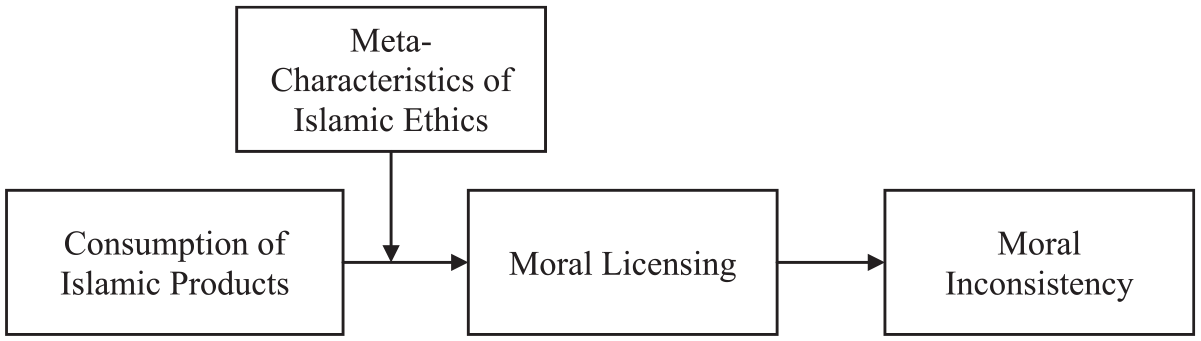
Effects of meta-characteristics of Islamic ethics on the relationship between consumption of Islamic products and moral inconsistency.
Theoretical Background
Islamic Ethics
The study of Islamic ethics may be classified into three approaches: the first approach is normative, which describes the scope and benefits of Islamic ethics (Abeng, 1997; Beekun & Badawi, 2005; Rice, 1999; Sidani & Ariss, 2015). The second is a comparative study of the ethical systems of different religions and the identification of commonalities (Arslan, 2001; Herman & Schaefer, 1997; Parboteeah et al., 2009; Schwartz, 2005). The third and the least developed area is empirical studies on Islamic ethics and its effects (Khan et al., 2015; Murtaza et al., 2016; Yousef, 2000, 2001).
Societies implement ethical systems, including religious ethical systems, to promote morally consistent behavior and to prevent ethical misconduct, over time. Consider the focus of research on the ethical lapses in once-reputed organizations such as Enron, Tyco, WorldCom, and Volkswagen. Researchers have tried to understand the factors responsible for ethical failures with the view to prevent ethical lapses or to promote ethical conduct in the future. The promotion of ethical conduct may be considered as one element of the Maqasid al-Shariah, or the objectives of Islamic law (see Murphy & Smolarski, 2020) and an expression of socially responsible business conduct (Graafland et al., 2007). The conventional mechanisms used to promote ethical conduct include generating clarity and consensus on the ethical principles (Rice, 1999), defining ethical codes of conduct (Adams et al., 2001; Schwartz, 2005), implementing reward systems (Trevino & Youngblood, 1990), enforcing legal and organizational codes (Molander, 1987), developing ethical organizational culture (Kaptein, 2011; Key, 1999), promoting ethical leadership (Hoyt & Price, 2015), and using religious symbols (Desai & Kouchaki, 2017). Yet widespread ethical lapses are observed despite the existence of multiple ethical systems and codes (De Cremer et al., 2010). Hence, there is a need to better understand how to maintain consistency in moral behavior.
Moral Consistency
People are motivated and act to maintain consistency in their behavior (Festinger, 1954; Gawronski & Strack, 2012; Taylor, 1975). When people earlier agree to a small request, they are more likely to accept a bigger request later (Beaman et al., 1983; Burger, 1999). For instance, after having displayed a small traffic sign on the window, people were more likely to put a large traffic sign on the front lawn of their house (Cialdini et al., 1995; Freedman & Fraser, 1966). Similarly, after having performed an ethical or unethical action, people are more likely to follow up and continue acting in similar ways later (Cornelissen et al., 2008; Foss & Dempsey, 1979; Gino et al., 2010; Thomas & Batson, 1981).
If consistency is expected in ethical conduct, then it can be argued that the availability of clear ethical guidelines and enforcement mechanisms should be enough for consistent moral behavior. However, people also act inconsistently and ethical behaviors are followed by unethical actions due to the mediating psychological mechanism of moral licensing, a well-studied phenomenon (Blanken et al., 2015; Mullen & Monin, 2016). According to Merritt and colleagues (2010), “Past good deeds can liberate individuals to engage in [unethical] behaviors” (p. 344). For instance, after having expressed their disagreement with racist comments or after having expressed a preference to vote for the first Black U.S. President Barack Obama, people were more likely to endorse a White person for the job (Effron et al., 2009; Monin & Miller, 2001). Due to strong group identity, group members experienced moral licensing and behaved unethically when the other group members had earlier behaved ethically (Kouchaki, 2011).
The literature on inconsistent moral behavior focuses on the ethical conduct of general nature, such as being fair and honest and helping out others. The lack of studies on moral inconsistency in Islamic ethics necessitated that we first examine the presence of moral inconsistency in the context of consuming Islamic products. This is a key gap because of the globally increasing consumption of Islamic products and lack of understanding about the ethical implications of such behavior. Behavior in one context may not replicate in other contexts (Adler & Gundersen, 2008; Henrich et al., 2010; Ross & Nisbett, 2011). Hence, our first hypothesis tests the presence of moral inconsistency and the mediating mechanism of moral licensing due to consuming Islamic products:
If people are inconsistent in moral behavior, then it makes sense that the social norms, guidelines, and systems governing ethical conduct also address the issue of morally inconsistent behavior. We identify a mechanism to promote consistent ethical behavior, the MCs of Islamic ethics, which sets the context and defines how an ethical action should be performed. The MCs are unique to Islam as they originate from the Quran and Sunnah, 3 the commonly accepted sources of knowledge on Islamic ethics (Rice, 1999).
The Three MCs of Islamic Ethics
Following the inductive approach of Rice (1999), a close reading of the Quran and Sunnah helped us identify the guidance regarding ethical conduct. Not only are ethical actions prescribed (such as being just, fair, and honest), but also how those ethical actions should be performed. Muslims should perform good (ethical) deeds considering:
(a) ubudiyah: as a religious obligation to seek countenance or approval of God, without an expectation of beneficial material consequences (e.g., Quran, 1990, 1:4), 4
(b) akhirah: to focus on the long-term and distant future rather than on the short-term (e.g., Quran, 2:86), and
(c) tawado: to seek the favor of God, not to impress other people (e.g., Quran, 107:6).
Ubudiyah
Muslims are expected to follow the religious teachings as a duty toward God and seek His countenance. Ubudiyah has its roots in the Arabic word “abd,” which means one who is subordinated as a servant, and it also means to worship (Wehr, 1979). Ubudiyah has a deep-rooted meaning of total surrender and doing something out of duty, faith, and belief—the idea that is also connected to spirituality (i.e., taqwa or piety; the conscious realization and effort to stay on the straight path). The literature (Chiabotti et al., 2016; Khan & Naguib, 2014; Pavlin, 1998; Slamet, 2016; Ul-Haq & Khan, 2018) explains the importance of ubudiyah, spirituality, and religiosity.
Islam offers a precisely defined code of conduct encompassing all domains of life, such as the appropriate form of performing mandatory religious rituals, rules of social interaction, commercial dealings, statecraft, taxation, and inheritance laws, among others. One meaning of the word Islam is submission to the will of God that forms the basis of ubudiyah and may be considered the first principle upon which the foundation of Islam rests.
In the Quran, 5:1, God commands, “O y[ou] who believe, fulfill (all) obligations . . . ” It is explained that Muslims should perform good deeds to seek countenance of God (Quran, 30:38-39). On another occasion (Quran, 92:18-20), Muslims are told that they should spend wealth on others, not with the intention to seek any benefit but to seek countenance of God.
In the context of prescribing different rules of behavior, God tells Muslims that, “it is possible that you dislike a thing which is good for you, and that you love a thing which is bad for you. But [God] knows, and you know not” (Quran, 2:216). Hence, Islam prescribes following the established rules, norms, and practices as an expression of ubudiyah, irrespective of the material benefits. The preference for rule-following is also reinforced in other religious practices. Islam spells out the specific procedures for performing different religious rituals such as the prayers, fasting, and pilgrimage. Ethical philosophies based on deontological/Kantian and consequentialist/utilitarian approaches (Wight, 2015) provide alternative ethical frameworks.
The overarching principle of ubudiyah applies to all types of behaviors, including ethical behaviors. In the context of the major objective of the ethical system which is the promotion of moral consistency and prevention of moral inconsistency; we argue that when ethical actions are performed due to their standing as established rules, then ethical actions are likely to be more consistent and repeated over time. Alternatively, when good deeds are performed due to their beneficial consequences then it is quite likely that the consistency of moral behavior is compromised and may result in inconsistent future behavior.
Islamic economics and Islamic finance are based on the concept of ubudiyah (see for example, Al-Sadr, 1982; Chapra, 1992; Maududi, 1975; Usmani, 2002). A person who abides by ubudiyah will make Islamic banking his or her choice because he or she does not want to disobey God and indulge in prohibited deeds. It follows that conformation to Islamic teachings in banking matters will lead to ethical behavior. In other words, the presence of ubudiyah (rule-based orientation to ethical actions) will reduce moral inconsistency, and the absence of ubudiyah (consequences-based orientation to ethical actions) will increase moral inconsistency. Hence, building upon Hypotheses 1(a) and 1(b) we hypothesize as follows:
Akhirah
Quran repeatedly emphasizes the importance of hereafter, the long-term, distant future awaiting Muslims, and warn them of the focus on worldly life, which is short-term and ephemeral in nature. For instance, God declares, “short is the enjoyment of this world: the hereafter is the best for those who do right . . . ” (Quran, 4:77). While comparing the worldly life with life in the hereafter, God says “Nothing is the life of this world but play and amusement. But best is the home in the hereafter, for those who are righteous” (Quran, 6:32). On another occasion God explains what it is like to focus on the short-term worldly life: “Know you (all), that the life of this world is but play and a pastime, adornment and mutual boasting and multiplying (in rivalry) among yourselves, riches and children. Here is a similitude: how rain and the growth which it brings forth, delight (the hearts of) the tillers; soon it withers; you will see it grow yellow; then it becomes dry and crumbles away” (Quran: 57:20). Hence, Islamic teachings inculcate a long-term orientation.
Akhirah constitutes one element of the belief system of Muslims and God repeatedly emphasizes belief in the akhirah as essential to being a true Muslim (e.g., Quran, 2:4, 3:114, 4:59, 5:69). In addition to being one of the main tenets of Islam, akhirah is repeatedly emphasized in Quran as an orientation which should guide all decisions in the life of a Muslim, in contrast with the short-term focus on the worldly life (e.g., Quran, 4:77, 6:32, 7:169, 9:38). Prophet Muhammad is reported to have said: Whoever is focused only on this world, Allah will confound his affairs and make him fear poverty constantly, and he will not get anything of this world except that which has been decreed for him. Whoever is focused on the Hereafter, Allah will settle his affairs for him and make him feel content with his lot, and his provision and worldly gains will undoubtedly come to him. (Saying no. 4105, Ibn Majah, 2007, p. 288)
In other words, Islamic teachings emphasize that while making decisions and taking actions Muslims should consider the akhirah, that is, have long-term orientation instead of the short-term orientation (Asutay, 2007; Saniotis, 2012).
Muhammad Abdul Haleem (2010), a prominent Muslim scholar, explains that according to Islamic teachings life in this world is an inseparable part of a continuum, a unified whole—life, death, life—which gives our life a context and relevance. In this context, the life of the individual is made meaningful and enriched inasmuch as it is full of “good works.” Life in this world leads to the afterlife, a belief which is fundamental in the Qur’an. The afterlife is not treated in the Qur’an in a separate chapter, or as something on its own, for its own sake, but always in relation to life in this world. (Haleem, 2010, p. 84)
According to the Islamic teachings, good deeds are performed in this world because of their relevance to the eternal life in the hereafter, postdeath. The eschatological concept of akhirah serves as an accountability mechanism that orients Muslims to think about the long-term consequences of their daily actions. Similar to the first MC of ubudiyah, the second MC of akhirah is also a general guiding principle to be observed in all walks of life, including ethical conduct. From the perspective of the ethical system and its objective of promoting ethical conduct, we argue that having a long-term orientation may result in consistent ethical behavior or decreased moral inconsistency. In contrast, having short-term orientation may result in increased moral inconsistency. Within the context of Islamic banking, we hypothesize that IBP consumption in the absence of akhirah orientation will result in moral inconsistency.
Tawado
The third MC of Islamic teachings is that Muslims are exhorted to shun public display of good deeds: “O y[ou] who believe! cancel not your charity by reminders of your generosity or by injury, like those who spend their substance to be seen of men, but believe neither in [God] nor in the Last Day” (Quran, 2:264). In explaining the verse, Maududi (1984), an eminent scholar of Islam, notes the desire to display one’s good deeds itself proves that the person concerned does not truly believe in God and the Hereafter. One who does good merely in order to impress people with his righteousness clearly regards those persons as his god. Such a person neither expects a reward from God nor is he concerned that his good deeds will someday be reckoned to his credit . . . (Note 303; p. 204).
The Prophet of Islam has said that a person who gives charity and hides it, such that the left hand does not know what the right hand gives in charity, shall be protected by God on the day of judgment (Saying no. 660, Al-Bukhari, 1997, p. 337). On another occasion, the Prophet equated the desire of showing-off the good deeds with polytheism (denial of the uniqueness of God, a foundational tenant of Islam) (Saying no. 1527, book 16, Al-Asqalani, 2003, p. 551).
The admonition pertaining to showing-off is not limited to the acts such as charity but also extends to the performance of religious duties, such as the prayers: “So woe to the worshippers who are neglectful of their prayers; those who (want but) to be seen but refuse (to supply) (even) neighbourly needs” (Quran, 107:4-7). As Abdullah Yusuf Ali explains these verses: “True worship does not consist in the mere form of prayer . . . Hypocrites make a great show of hollow acts of goodness, devotion, and charity” (Quran: explanatory notes 6283–6285).
The desire for a good reputation cancels the good deeds. Riya is taken extremely seriously and is considered as denial of the most fundamental tenant of Islam, that is, the belief in the singularity of God. Islam educates Muslims to perform good deeds, not with the desire to please others, build a reputation, and be seen as good persons. Indeed, the desire to build a good image and a reputation is so deeply ingrained in human psychology (Bromley, 1993) that it is considered almost impossible to argue that a good deed could be performed for anything else except building a reputation and feeling good about oneself (Andreoni, 1990). Islam helps Muslims to focus on the real purpose of performing good deeds, which is the act of subservience to please God without expecting any benefit immediately and from others.
In comparison with the other two MCs which provide general principles governing all social interactions and decisions, the third MC, tawado, deals directly with the ethical conduct (Sidani & Showail, 2012; Zubair, 2017). Considering that the objective of an ethical system is to ensure repeat moral behavior, it is argued that the reason for specifying observance of tawado while performing good deeds is promotion or consistency of ethical behavior. Or, the reason for the prohibition of riya, that is, avoiding public display of good deeds, is the prevention of moral inconsistency. Within the context of Islamic products, we hypothesize that consumption in the absence of tawado orientation will result in moral inconsistency.
Method
Islamic Banking
Islamic banking and finance industry has experienced compounded annual growth of 5% since 2007; currently, the industry comprises 1,389 institutions with assets worth US$ 2.4 trillion of which Islamic banking accounts for US$ 1.7 trillion assets (Mohamed et al., 2018). International multilateral financial institutions such as the World Bank and International Monetary Fund (IMF) consider Islamic banking and finance as a catalyst for reducing poverty and inclusive prosperity (World Bank & Islamic Development Bank Group, 2017).
We selected Islamic banking to set the context and as an integral part of our empirical studies for the following reasons. First, Islamic banking is clearly in the domain of business and qualifies as a first choice to study business ethics from an Islamic perspective. Islamic banking is considered an ethical approach to doing business and its claim to ethicality should be evaluated. Second, it is unique to Islam. Other forms of religious actions such as prayers and pilgrimages are common to many religions and have already been a focus of research (see Conroy & Emerson, 2004; Longenecker et al., 2004; Parboteeah et al., 2008; Walker et al., 2012). Third, Islamic banking is rapidly emerging as a dominant form of conducting business which necessitates that scholars understand its ethical implications. Finally, Islamic products other than IBP, such as halal food, are marketed as morally appropriate choices only to Muslims living in non-Muslim majority countries. But IBPs are marketed as morally appropriate not only to all Muslims but also to non-Muslims (because usury is prohibited in many religious traditions). The reach of IBP is the widest and the implications of research on IBP are relevant to a very large audience. Thus, the selection of IBP becomes the most suitable choice. In the following, we explain why Islamic banking is considered as an ethical action and how it has grown in recent years.
Islam explicitly prohibits the use of interest-based financing instruments (Ayub, 2009). Quran forbids the use of interest. For instance, the Quran (3:130) says: “O you who believe! devour not usury, double and multiplied; but fear [God]; that you may really prosper.” Those who take interest are described as having been touched by the devil, are considered to have declared war against God and His prophet and are warned to suffer in hell forever (Quran, 2:275-280). Islam declares in no uncertain terms that taking interest is unethical and an extremely repugnant act.
Islam offers a complete code that governs all aspects of social and economic life, such as finance and corporate governance (Albassam & Ntim, 2017; Elghuweel et al., 2017). Islam prohibits Muslims to consume interest-based banking products. Muslims have, therefore, developed alternative banking products. As IBPs are developed considering religious guidelines, the consumption of IBP implies following religious injunctions (Ayub, 2009; Schoon, 2016). Implementation of the religious injunctions is seen as an ethical or moral responsibility; hence, consumption of IBP is also seen as an ethical act.
It might help to view the behavior of Muslim consumers purchasing IBPs as analogous to environmentally conscious individuals purchasing eco-friendly products (consider hybrid vehicles vs. gas guzzlers). Muslims are prohibited from consuming interest-based banking products because the religious reasons specify the adverse consequences of interest for the society in general and the debtors in particular (Ayub, 2009). In a similar vein, pro-environment concerns motivate environmentally conscious consumers to shun the products considered harmful to society and ecology.
Islamic banking has experienced rapid growth. According to Ernst & Young (2016), Islamic banking assets globally registered a growth of 16% from 2010 to 2014, totaling US$ 882 billion and are expected to grow to US$ 1.8 trillion by the year 2020. There are currently more than 38 million Islamic banking customers worldwide, and the number of customers is expected to grow consistently. Muslims consume IBP for ethical reasons: Religious injunctions clearly proscribe the use of interest-based conventional banking products. Hence, the use or purchase of IBP is considered to be an ethical act in observance of religious injunctions.
Like other Muslim majority countries, in Pakistan, the second largest Muslim majority country in the world in terms of population, IBP use is increasing. In 2018, the network of the Islamic banking industry in Pakistan consisted of 21 Islamic banking institutions; five full-fledged Islamic banks and 16 conventional banks had standalone Islamic banking branches (State Bank of Pakistan [SBP], 2018). The increased presence of institutions, products, and market share implies greater marketing, awareness, acceptance, and consumption of IBP. It makes Pakistan a suitable choice among other Muslim majority countries with substantial IBP presence to initiate the assessment of the proposed theory. Therefore, the empirical studies were conducted in Pakistan.
Overview of the Empirical Studies
A preliminary study investigated whether or not the consumption of IBP is considered ethical. Study 1 evaluated Hypotheses 1(a) and 1(b). Studies 2, 3, and 4 assessed Hypotheses 2(a), 2(b), 3(a), 3(b), and 4(a), 4(b) respectively.
Sample Characteristics
All data were collected from randomly selected undergraduate Muslim students 5 at a large, private-sector university in Lahore, Pakistan. The university is not affiliated with any religious institution and offers undergraduate and graduate degrees in multiple academic disciplines, largely following an international curriculum. Most faculty members have PhDs from abroad. Students come from diverse educational and socioeconomic backgrounds and are proficient in the English language. Participants were recruited through open advertisement within the university; participation was voluntary. Participants included students, from freshman to senior year, studying in multiple disciplines. They were compensated through course credit, which is considered a preferred form of compensation without any ethical complications (Slonim et al., 2013). Information on demographics is provided in each study.
In all studies, participants were randomly assigned, which is considered “the great equalizer,” and “researchers can be relatively certain that differences in personalities or backgrounds of their participants are distributed evenly across conditions. Any differences that are observed, then, are likely to be due to the independent variable encountered in the experiment” (Wilson et al., 2010, p. 53). Random assignment ensured that any other potentially influential characteristics such as religiosity, religious intensity, religious salience, religious symbolism, and beliefs about Islamic and conventional banking products did not bias the results and findings are robust to alternative explanations.
Preliminary Study
An initial study tested the preliminary hypothesis that consumption of IBP is seen and interpreted as an ethical action. Forty-three students (Mage = 19.63, SDage = 0.82, female = 23) were randomly selected and surveyed to inquire about their opinion regarding the ethicality of the IBP. Specifically, the participants were asked to respond to the statement, “It is ethical to use Islamic banking products,” on a 7-point scale (from “1” = “strongly disagree,” to “7” = “strongly agree”). Comparison of the overall mean score (M = 5.21, SD = 1.73) versus the neutral value of 4 indicated significant difference, t(42) = 4.60, p < .001. Participants thought that it was ethical to use IBP. The survey responses provided support to the preliminary hypothesis that consumption of IBP is considered an ethical decision.
Study 1
Study 1 assessed the effects of consuming IBP on moral inconsistency and the mediating role of moral licensing to evaluate Hypotheses 1(a) and 1(b).
Method
Participants and design
In Study 1, 67 students (Mage = 20.31, SDage = 1.06, female = 27) participated and were randomly assigned to the two conditions of non-IBP and IBP consumption.
Procedure
Participants were seated separately on individual workstations and read the introduction, which described the study as a decision-making exercise. Participants read that they would participate in decision-making scenarios and there were no right or wrong choices.
In the non-IBP condition, participants read a scenario about running a successful business and expansion requiring additional financing of PKR 100 million. Two firms, Firm A and Firm B, had offered financial products, and each product carried associated probabilities. The product offered by Firm A carried a 30% chance of incurring a cost of PKR 50 million, 20% chance of PKR 30 million, and 50% chance of PKR 10 million. The product offered by Firm B carried a 10% chance of incurring a cost of PKR 80 million, 40% chance of PKR 30 million, and 50% chance of PKR 20 million. Participants were asked to select the firm through which they would arrange additional financing, or in other words, which product they preferred consuming. The order of presentation of the two options was randomized.
After the participants had selected the financing option, they responded to the moral licensing scale. Finally, the ethical decision-making task adapted from Shu et al. (2011) was presented. Participants were asked to imagine that they had missed a mid-term exam during the semester and had the opportunity to take a make-up exam. They further read that some students had received the exam back along with the answer key, and that the instructor did not rewrite make-up exams. Participants were then given two options to choose as their decision: In Option 1, they could ask their classmate about the exam and receive information about the exact questions and answer key (an unethical decision). In Option 2, they had the opportunity to ask about the exam and receive information, but would decide not to do so (an ethical decision). The order of the options was randomized. Afterwards, participants provided demographic information and were debriefed. During the debriefing, participants were interviewed and no participant expressed doubts about the real purpose of the study.
In the IBP consumption condition, participants received identical instructions with one change. Instead of Firms A and B, participants read that two Islamic Banks, Islamic Bank A and Islamic Bank B, provided financial products. The options were same as those in the control condition, and only the titles of financing institutions were changed. Participants were asked to select one Islamic bank from which they would arrange additional financing.
Measures
Mean score on a five-item, 7-point (“1” = “strongly disagree,” to “7” = “strongly agree”) moral licensing scale adapted from Lin et al. (2016) (sample items: “I earn credit for performing a morally laudable behavior,” “Acting good builds up my account of moral credits”) measured the degree of moral licensing. Selection of Option 1, the unethical behavior, in the ethical decision-making task (receiving exact information about exam questions and the answer key) served as a measure of moral inconsistency.
Results
Participants in the IBP condition made more unethical decisions as compared with the participants in the non-IBP condition (76.5% vs. 42.2%), Wald χ2(1) = 7.66, p < .01. The results supported Hypothesis 1(a): consumption of IBP increased moral inconsistency. Comparison of mean scores on moral licensing scale (α = .81) indicated significant effect: t(65) = 2.85, p < .01 (non-IBP: M = 3.95, SD = 1.15; IBP: M = 4.69, SD = 0.97). As compared with the non-IBP condition, participants in the IBP condition rated themselves higher on the moral licensing scale, indicating moral licensing effect. For Hypothesis 1(b), the mediation analysis (Hayes, 2013) revealed a significant indirect effect (b = 0.99; 95% confidence interval [CI] = [.27, 2.41]; see Figure 2) of the consumption of IBP (0 = non-IBP, 1 = IBP) on moral inconsistency (0 = ethical decision, 1 = unethical decision) as mediated by moral licensing. Participants in the IBP condition experienced an increased level of moral licensing and as a result, showed increased moral inconsistency as compared with the participants in the non-IBP condition.
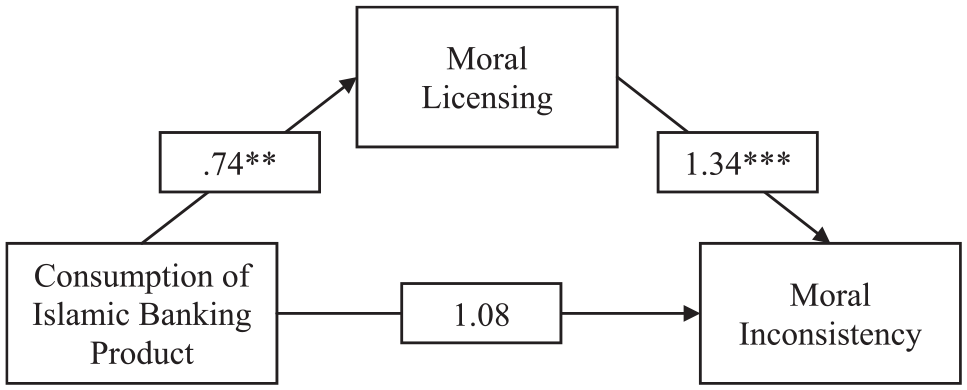
Mediation effect in Study 1.
Discussion
Study 1 supported Hypotheses 1(a) and 1(b): when participants consumed IBP, they experienced an increased level of moral licensing, which resulted in a greater number of unethical decisions or increased moral inconsistency. Participants were approximately twice as likely to take an unethical decision after first having acted ethically by consuming IBP.
Study 2
Study 2 assessed the effects of consuming IBP on moral inconsistency under the condition of ubudiyah orientation, that is, rule-based versus consequence-based ethical decision-making approach, to assess Hypotheses 2(a) and 2(b).
Method
Participants and design
In Study 2, 140 students (Mage = 19.86, SDage = 1.18, female = 59) participated. The study design was 2 (IBP consumption: no vs. yes) × 2 (ubudiyah orientation: no [consequence-based] vs. yes [rule-based]) between subjects, with random assignment.
Procedure
In Study 2, the protocol of Study 1 was followed for the operationalization of non-IBP and IBP conditions. Then two ubudiyah conditions were implemented through the consequence-based and rule-based approach to ethical decision-making. The ubudiyah manipulations were adapted from Cornelissen and colleagues (2013). In the ubudiyah or rule-based condition, participants were asked to think about and write in detail something they did because it was the right thing to do, independent of its consequences. In the non-ubudiyah or consequence-based condition, participants were asked to think about and write in detail something they did that benefited someone at a personal cost. Afterward, basic trolley dilemma pitting rule-based versus consequence-based decisions was presented as a check for manipulations. Then all participants responded to the moral licensing scale. Subsequently, the ethical decision-making task used in Study 1 was presented; finally, demographics were collected and debriefing provided.
Measures
Flipping or not-flipping the switch in the trolley dilemma situation provided a manipulation check for the ubudiyah orientation. The measures of moral licensing and moral inconsistency were the same as used in Study 1.
Results
Manipulation check
The responses of participants to the trolley dilemma were analyzed to determine the efficacy of the manipulations. In the rule-based condition, the percentage of participants who did not consider it appropriate to flip the switch was significantly higher (74.0%), as compared with the participants who considered it appropriate to flip the switch (26.0%), χ2(1) = 16.78, p < .001, indicating manipulation effectiveness. In the consequence-based condition, the percentage of participants who considered it appropriate to flip the switch was significantly higher (76.1%), as compared with the participants who did not consider it appropriate to flip the switch (23.9%), χ2(1) = 18.28, p < .001, indicating effectiveness of the manipulations.
Logistic regression analysis revealed a significant main effect of IBP, Wald χ2(1) = 4.52, p = .03, and a significant interaction effect between IBP consumption and ubudiyah orientation, Wald χ2(1) = 10.10, p < .01. The effect of ubudiyah orientation was not significant. The interaction between IBP consumption and ubudiyah orientation supported Hypothesis 2(a). In the consequence-based condition, the proportion of participants who took unethical decisions went up significantly higher in the IBP condition (75.8%) as compared with participants in non-IBP condition (47.1%), Wald χ2(1) = 5.58, p = .02, indicating an increased level of moral inconsistency. In the rule-based condition, the proportion of participants who took unethical decisions went down significantly in IBP condition (28.2%) as compared with the participants who were in the non-IBP condition (52.9%), Wald χ2(1) = 4.52, p = .03, indicating moral consistency (see Figure 3).
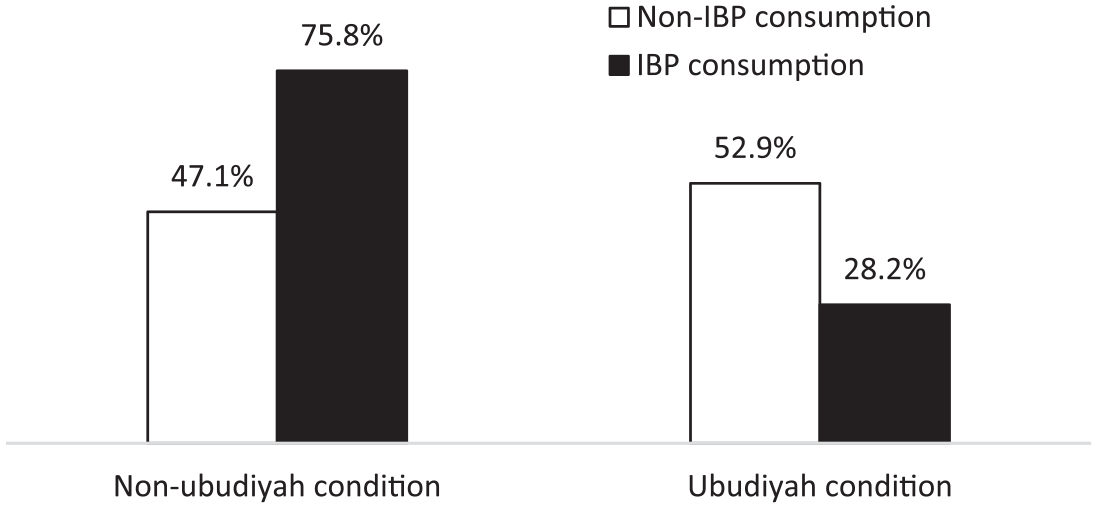
Proportion of unethical decisions or moral inconsistency in Study 2.
The moderated mediation analysis (Hayes, 2013) showed a significant interactive effect (b = 1.31, p < .01) of the IBP consumption and ubudiyah orientation on moral licensing (see Figure 4). The indirect effect of the consumption of IBP (0 = control, 1 = IBP) on the frequency of unethical decision-making (0 = ethical decision, 1 = unethical decision), as mediated by moral licensing (α = .83), was nonsignificant (b = −0.26, 95% CI = [−0.87, 0.37]) in the rule-based condition and significant (b = 0.97, 95% CI = [0.37, 1.91]) in the consequence-based condition.
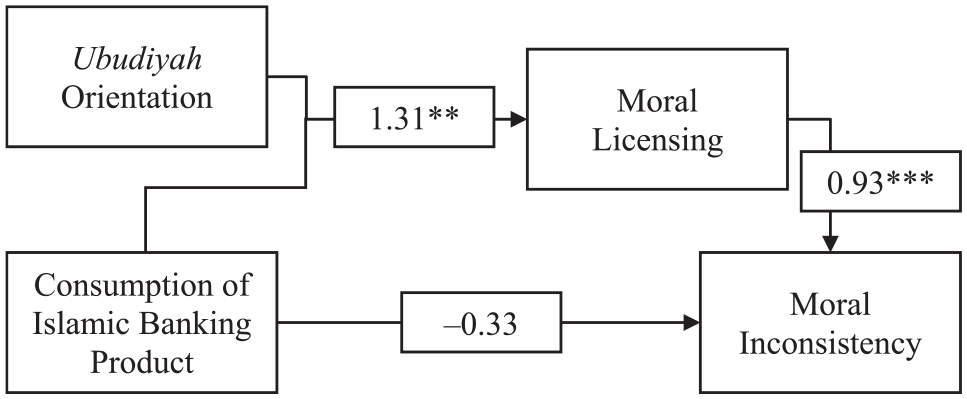
Mediation analysis in Study 2.
Discussion
The results of Study 2 supported Hypotheses 2(a) and 2(b). Participants with a rule-based or ubudiyah orientation demonstrated consistency in their ethical decisions and were 1.6 times more likely to take ethical actions after having consumed IBP. Participants with a consequence-based or non-ubudiyah orientation exhibited moral licensing and were 1.7 times more likely to take an unethical decision after first having consumed IBP (an ethical decision). The interactive influence of IBP consumption and ubudiyah orientation was mediated through moral licensing in the participants with consequence-based (or non-ubudiyah) orientation.
Study 3
Study 3 evaluated the effects of IBP consumption on moral inconsistency under the akhirah conditions of long-term versus short-term thinking to assess Hypotheses 3(a) and 3(b).
Method
Participants and design
In Study 3, 138 students (Mage = 20.16, SDage = 1.24, female = 54) participated. The study design was 2 (IBP consumption: no vs. yes) × 2 (akhirah orientation: no [short-term thinking] vs. yes [long-term thinking]) between subjects, with random assignment.
Procedure
In Study 3 the protocol of Study 1 was followed for the operationalization of non-IBP versus IBP conditions. In the akhirah or long-term thinking condition, participants were told that the need for financing had arisen due to long-term expansion plans and the funds were required 2–5 years later. In the non-akhirah or short-term thinking condition, participants were told that the financing need arose to support ongoing operations and funds were required immediately. Afterwards, participants responded to the moral licensing scale used in Study 1, and to the ethical decision-making task.
The ethical decision-making task was adapted from Zhong and colleagues (2009). Participants read that they were about to graduate, were actively seeking a job, and had been offered job from their preferred organization. The job offer included a double signing bonus as the organization had an erroneous impression about the exceptional record of the participants. Participants were given two choices: (a) accept the offer and say nothing about the record (the unethical decision) or (b) indicate interest but correct the record (the ethical decision).
Measures
As a manipulation check of long-term thinking, participants responded to a 7-point (“1” = “a small extent,” to “7” = “a large extent”) question asking them to indicate to what extent they believed their decision related to events likely to happen in the distant future. For manipulation check of short-term thinking, participants responded to a 7-point (“1” = “a small extent,” to “7” = “a large extent”) question asking them to indicate to what extent they believed their decision related to events likely to happen immediately. The measure of the moral licensing effect was the same as used in Study 1. The choice of the unethical decision served as the measure of moral inconsistency.
Results
Manipulation check
In the long-term thinking condition, comparison of the overall mean score (M = 5.13, SD = 1.15) versus the neutral value of 4 indicated significant difference, t(69) = 8.18, p < .001. Participants tended to believe that their decision related to the events likely to happen in the distant future. In the short-term thinking condition, participants thought that their decision was related to events likely to happen immediately, M = 4.99, SD = 1.02 versus the neutral value of 4; t(67) = 8.01, p < .001.
Logistic regression analysis revealed significant main effect of IBP, Wald χ2(1) = 5.64, p = .02, and significant interaction effect between IBP consumption and akhirah orientation, Wald χ2(1) = 12.43, p < .001. The effect of akhirah orientation was not significant. The interaction between IBP consumption and akhirah orientation provided support to Hypothesis 3(a). Further analysis of the interaction effect showed that in the long-term thinking condition, the proportion of participants who took unethical decisions went down significantly in IBP condition (22.2%) as compared with those participants who were in non-IBP condition (50.0%), Wald χ2(1) = 5.64, p = .02, indicating moral consistency. In short-term thinking condition, the proportion of participants who took unethical decisions went up significantly in IBP condition (74.3%) as compared with the participants who were in the non-IBP condition (42.4%), Wald χ2(1) = 6.82, p < .01, indicating moral inconsistency (see Figure 5).
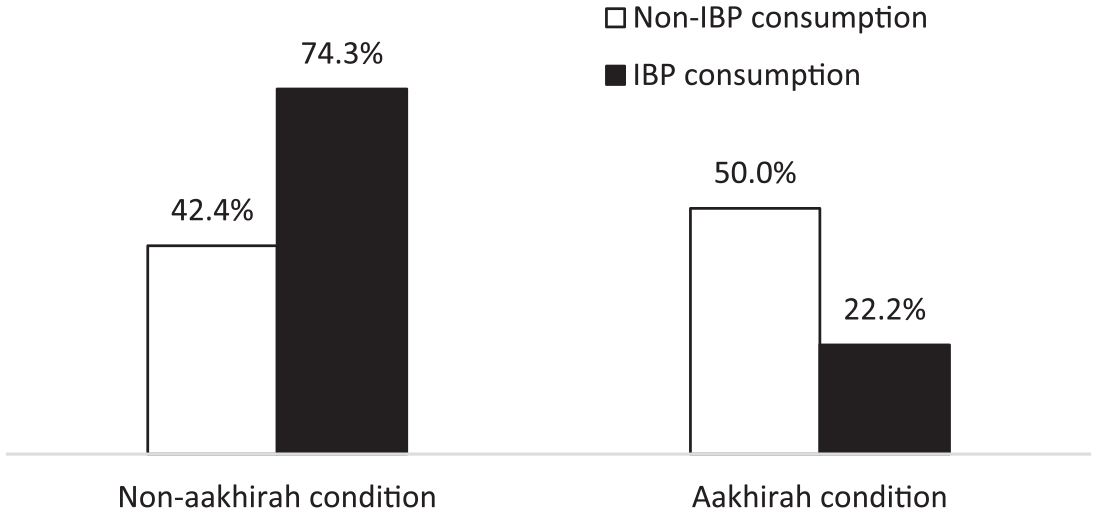
Proportion of unethical decisions or moral inconsistency in Study 3.
The moderated mediation analysis (Hayes, 2013) showed a significant interactive effect (b = 1.16, p < .01) of IBP consumption and akhirah orientation on moral licensing (see Figure 6). The indirect effect of the consumption of IBP (0 = non-IBP, 1 = IBP) on the frequency of unethical decision-making (0 = ethical decision, 1 = unethical decision), as mediated by moral licensing (α = .88), was significant (b = 0.50, 95% CI = [0.11, 1.20]) in the short-term thinking condition, and non-significant (b = 0.02, 95% CI = [−0.20, 0.40]) in the long-term thinking condition, supporting Hypothesis 3(b).
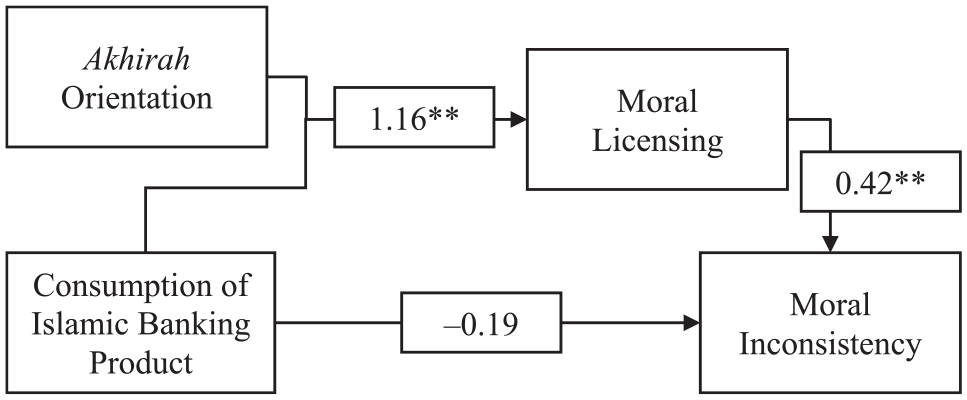
Mediation analysis in Study 3.
Discussion
The results supported Hypotheses 3(a) and 3(b). Participants in the akhirah condition demonstrated consistency in their ethical decisions, and were more than twice as likely to take ethical actions after having consumed IBP. Participants in the short-term thinking or non-akhirah condition took moral license and were approximately 1.75 times more likely to take an unethical decision after first having taken an ethical decision, that is, after having consumed IBP. The interactive influence of IBP consumption and akhirah orientation was mediated through moral licensing only in case when the participants had a short-term thinking approach.
Study 3 provided further evidence of the presence of moral inconsistency after consumption of IBP, and reinforced the findings of Study 2. As the dependent variable, that is, the nature of the unethical decision was different in both studies, the effects appeared persistent under different decision-making situations.
Study 4
Study 4 assessed the effects of consuming an IBP on moral inconsistency under the conditions of tawado orientation or private versus public observability to assess Hypotheses 4(a) and 4(b).
Method
Participants and design
In Study 4, 149 students (Mage = 20.03, SDage = 1.16, female = 60) participated. The study design was 2 (IBP consumption: no vs. yes) × 2 (tawado orientation: no [public observability] vs. yes [private observability]) between subjects, with random assignment.
Procedure
In Study 4 the protocol of Study 2 was followed with two changes: manipulation of the tawado orientation and use of a different measure of unethical decision-making, explained as follows:
In the tawado or private observability condition, participants were told that the financing firms (in non-IBP condition) and the Islamic banks (in IBP condition) required them to keep confidential the financing decision. In the non-tawado or public observability condition, participants were told that the financing firms and the Islamic banks required them to make a public announcement of the financing decision. Afterward, participants responded to a manipulation check, the moral licensing scale, and to the ethical decision-making task.
The ethical decision-making task was adapted from Zhong and colleagues (2009). Specifically, participants read that they were working for a company that had a good year. They were responsible for distributing gift vouchers to important customers and had received some extra vouchers, unknown to anyone else. Participants were given two choices: either to keep the vouchers for personal use (an unethical decision) or to inform the company about the extra vouchers (an ethical decision).
Measures
For manipulation check of private versus public observability conditions, participants responded to a seven-point (“1” = “highly unlikely,” to “7” = “highly likely”) question asking them to indicate how likely was it that they believed people will get to know of their financing decision. The measure of the moral licensing effect was the same as used in Study 2. The choice of unethical decisions served as a measure of moral inconsistency.
Results
Manipulation check
In the private observability condition, comparison of the overall mean score (M = 2.75, SD = 0.88) versus the neutral value of 4 indicated significant difference, t(76) = −12.49, p < .001. Participants thought that it was unlikely that people will get to know their decision. In the public observability condition, participants considered it likely that people will become aware of their decision, M = 5.18, SD = 1.10 versus the neutral value of 4; t(71) = 9.17, p < .001.
Logistic regression analysis revealed significant main effect of IBP consumption, Wald χ2(1) = 5.68, p = .02, and significant interaction effect between IBP consumption and tawado orientation, Wald χ2(1) = 13.09, p < .001. The effect of tawado orientation was not significant. The interaction between IBP consumption and tawado orientation supported Hypothesis 4(a). Under the public observability condition, the proportion of participants who took unethical decisions significantly went up in IBP condition (76.3%) as compared with those participants who were in non-IBP condition (44.1%), Wald χ2(1) = 7.47, p < .01, indicating increased moral inconsistency. Under private observability condition, the proportion of participants who took unethical decisions went down significantly in IBP condition (20.9%) as compared with the participants who were in the non-IBP condition (47.1%), Wald χ2(1) = 5.68, p = .02, indicating moral consistency (see Figure 7).
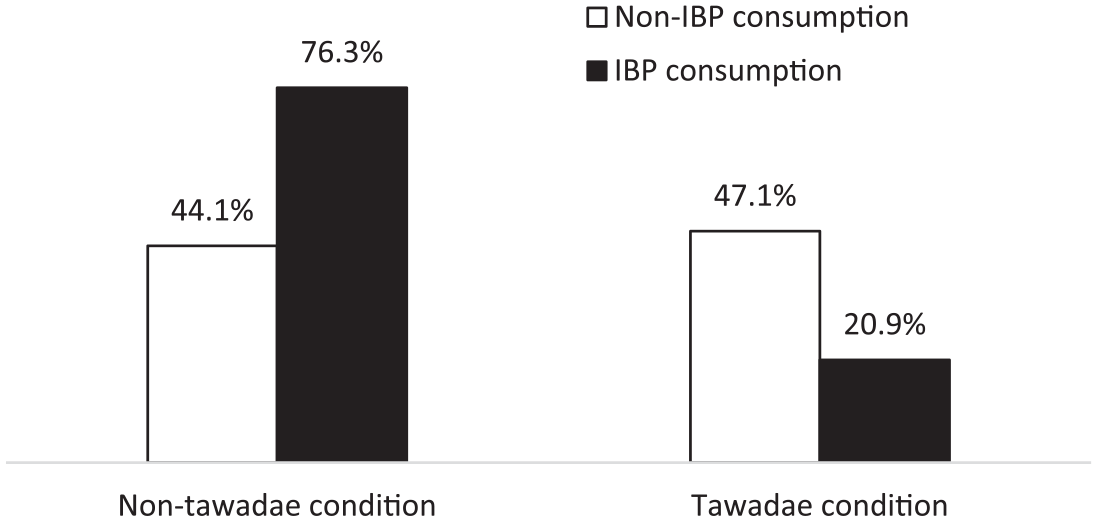
Proportion of unethical decisions or moral inconsistency in Study 4.
The moderated mediation analysis (Hayes, 2013) to asses Hypothesis 4(b) showed significant interactive effect (b = 1.45, p < .001) of the IBP consumption and tawado orientation on moral inconsistency (see Figure 8). The indirect effect of the consumption of IBP (0 = control, 1 = IBP) on the frequency of unethical decision-making (0 = ethical decision, 1 = unethical decision), as mediated by moral licensing (α = .81), was significant (b = 2.12, 95% CI = [1.22, 3.39]) in the public observability condition but nonsignificant (b = −0.29, 95% CI = [−1.07, 0.36]) in the private observability condition.
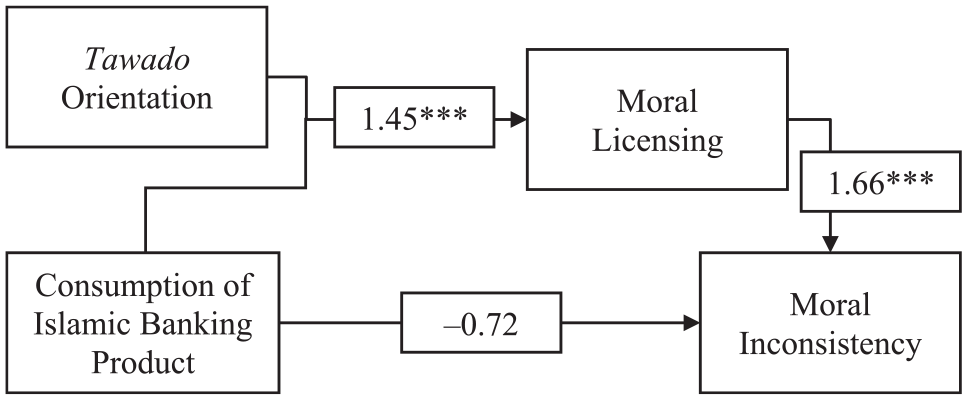
Mediation analysis in Study 4.
Discussion
The results supported Hypotheses 4(a) and 4(b). Participants under private observability or tawado condition demonstrated consistency in their ethical decisions and were approximately 1.75 times more likely to take ethical actions after having consumed IBP. Participants under the public observability or non-tawado condition were approximately 2.25 times more likely to take an unethical decision after first having taken an ethical decision, that is, consumed IBP. The interactive influence of IBP consumption and tawado orientation was mediated through moral licensing under public observability condition only.
General Discussion
An ethical system includes two interrelated elements: what is ethical conduct and how to promote it. Different societies generally agree on ethical norms and expectations and have evolved different systems to promote ethical conduct. How ethical systems promote ethical conduct is an empirical question. Research on Islamic ethics has focused on the identification of the ethical principles, comparison with the ethical systems of other religions and generally accepted norms of ethical conduct. Empirical studies have identified the benefits of the Islamic ethical system. No studies have investigated how the unique features of Islamic ethics promote ethical conduct.
Four studies investigated the role of three MCs of Islamic ethical system—ubudiyah, akhirah, and tawado—in promoting ethical conduct in the context of IBP consumption, which is a form of ethical behavior unique to Islam. We theorized that ethical behavior (i.e., consumption of Islamic products) is subject to moral licensing. We hypothesized that the observed inconsistency after consumption of Islamic products can be reduced through MCs. We tested the theory through the consumption of IBP. The first study demonstrated that the absence of MCs results in less consistent moral behavior. Studies 2–4 found consistent evidence for the moderating influences of MCs. The context of our studies was Islamic banking, which is experiencing rapid growth. We found that the consumption of IBP resulted in morally inconsistent behavior and the presence of MCs made ethical behavior more consistent. The findings have important implications for research and practice.
Theoretical Contribution
The current article makes several contributions to the field of Islamic ethics. First, we identify three MCs of Islamic ethics that define how an ethical action should be performed to improve behavioral consistency. We provide empirical evidence for the effectiveness of the MCs.
Second, we provide evidence on how the ethical acts of religious nature interact with the ethical acts of business nature. More than 80% of people in the world practice religion of one form or another (Hackett et al., 2012). Religion influences most of the behaviors, including business. If religiously informed behaviors are common, then studying their effects on ethical behaviors contributes significantly to develop better ethical theories. The current research provides one example of how to incorporate and study the influence of religious practices on ethical behavior.
Third, the article contributes to the field of Islamic finance. The research in Islamic finance has investigated topics, such as the attractiveness of IBP (Azmat et al., 2016), and the herding behavior (Gavriilidis et al., 2016). The ethical implications of IBP consumption remain unexamined; given the importance of ethics in finance (Ryan et al., 2010), the current article provides initial empirical evidence and suggestions for future research.
IBP consumption is growing (Ernst & Young, 2016). How IBP consumption influences moral behavior becomes increasingly important to study because of the nature of ethical implications involved. Islamic finance, by definition, includes an ethical dimension and is presented as an alternative to conventional finance, which is attributed to causing much financial distress and unethical behavior (Ryan et al., 2010). How the consumption of the products of an industry, which claims to be inherently ethical (Ayub, 2009; Schoon, 2016), further promotes or inhibits ethical behavior becomes an important question to investigate.
Fourth, the article contributes to behavioral ethics by identifying and studying the effect of religious ethical practices. Behavioral ethics research has mostly studied the effects of charity donations, volunteering, honesty, contribution to environmental causes, helping out other people, resource sharing, ethical leader behaviors, previous ethical behaviors, among others (Blanken et al., 2015; Mullen & Monin, 2016). From a religious perspective, the effects of religiosity (Walker et al., 2012), and religious intensity, salience and symbolism (Desai & Kouchaki, 2017; Longenecker et al., 2004; Murphy et al., 2019) have been studied. However, religious practices have not been studied in the context of moral licensing and consistency. In providing empirical evidence of the effect of religiously motivated behavior, current research contributes to the behavioral ethics literature.
Finally, the article contributes to the literature on ethical consumption, which currently focuses on environment-related concerns (Mazar & Zhong, 2010). As the domain of ethically inspired financial decisions, such as investment in green funds and Islamic funds, increases, the ethical implications of such financial decisions will require investigation. The current research findings suggest that such ethically inspired financial decisions may have unintended consequences that should be better understood and thoroughly researched.
Practical Implications
The current research may help Islamic banking industry professionals understand the unanticipated consequences of selling their products. The consumption of IBP may lead either to the negative consequences (unethical behavior) or to the beneficial consequences (ethical behavior), depending upon the orientation of the consumers. The findings may help industry professionals design the promotion and sales strategies of their products.
For instance, if the industry professionals emphasize that an IBP is better than a conventional banking product, in terms of low financial costs and carries other financial benefits, then it may induce the potential consumers to evaluate an IBP with a consequence-based mind-set which may cause moral inconsistency after IBP consumption. Hence, it may be more appropriate to design promotional and sales strategies that focus more on the principle-based reasons for consuming IBPs. Similarly, the design of products and contracts that emphasize confidentiality and conduct of transactions in private may also promote ethical conduct. This will reinforce the major selling point in convincing customers that halal income will help them in obeying the Creator and make akhirah better.
Limitations and Future Directions
First, whereas, the reliability of the findings of experimental research involving students has been questioned (Gordon et al., 1986), the appropriateness of experimental studies is also acknowledged and preferred in studying psychological processes (Colquitt, 2008) and for “controlled theory testing of real-world analogs” (Lonati et al., 2018; p. 20). Behavioral ethics research has overwhelmingly applied an experimental approach (Blanken et al., 2015; Mullen & Monin, 2016). Considering previous research, the research design may be considered as reliable and appropriate. However, further studies of similar nature and field data should be collected to further assess the reliability of the findings. Moreover, data from other Muslim populations and countries should be collected to assess the prevalence of moral inconsistency. Because behavior variation may arise due to the change in situational or cultural context (Adler & Gundersen, 2008; Henrich et al., 2010; Ross & Nisbett, 2011), assessment of the theory in other countries is important.
Second, the current research used only one type of product. Islamic banks offer multiple products (Schoon, 2016). Whether the effects hold for the consumption of different types of products may also be explored. Third, ethical behavior is a product of numerous factors that interact in complex ways (Mullen & Monin, 2016). How other factors, such as personality characteristics and personal values, interact and influence the decision to purchase IBP and the ethical implications of such interactive effects may be studied.
Fourth, ethical intentions also have effects similar to those observed while investigating the actual behavior (Khan & Dhar, 2006). The current research focused only on behavior. Future research may investigate the effects of the intentions to purchase or consume IBP. Finally, it is not known how selling IBP may influence the behavior of industry professionals. Factors that lead to consistent moral behavior in consumers may also motivate similar behavior in the sellers of such products and may be studied.
Conclusion
Islamic ethical system contains unique MCs of ubudiyah, akhirah, and tawado that facilitate moral consistency or repeat moral behavior. Consumption of Islamic banking products is a form of religiously motivated ethical behavior. When consumption is done under the influence of MCs, repeat moral behavior results; the absence of MCs causes moral inconsistency or subsequent unethical conduct. Ethical theories and practices have a limited scope of application. Scholars should study the effects of MCs and important behaviors which may be subject to moral inconsistency. Practitioners should be watchful of potential moral inconsistency and market Islamic banking and other similar products responsibly.
Footnotes
Declaration of Conflicting Interests
The authors declared no potential conflicts of interest with respect to the research, authorship, and/or publication of this article.
Funding
The authors received no financial support for the research, authorship, and/or publication of this article.
