







Abstract
Scaling and member heterogeneity have often been linked to governance failures in cooperatives, yet newly emerging platform cooperatives may hold the potential to overcome this challenge. To assess innovative approaches to cooperative governance, the study proposes that organizational democracy needs to be understood as a multidimensional concept. Using the case study of Honeypot, a platform cooperative of online sex workers, it is found that representative, participative, and deliberative dimensions of organizational democracy are sustained. In contrast, Honeypot is struggling with liberal, social, and autonomous dimensions of organizational democracy. The research contributes to a better understanding of governance innovations in cooperatives by emphasizing that a narrow focus on innovating decision-making processes is insufficient to retain organizational democracy under conditions of global scale and member heterogeneity. In particular, more attention is needed for how cooperatives could innovate their capabilities to generate desirable outcomes and prevent undesirable outcomes for remote and diverse members.
Introduction
As inequality, insecure working conditions, and other socioeconomic problems are on the rise, there is an increasing interest in alternative organizations and specifically also in worker cooperatives (Battilana et al., 2022; Diefenbach, 2020; Mair & Rathert, 2021; Spicer & Kay, 2022). Worker cooperatives differ from conventional firms because they are jointly owned and democratically governed by their workers (International Cooperative Alliance, 1995). This allows labor-suppliers instead of capital-suppliers to make organizational decisions based on the principle of one member, one vote. By serving their interests but also depending on the cooperative’s survival for doing so, worker-members are likely to make decisions that lead to better working conditions (Battilana et al., 2022) and more resilient organizations (Billiet et al., 2021). However, this kind of organizational democracy is not self-evident. Cooperatives are known for running into governance failures when their membership is large and heterogeneous (Höhler & Kühl, 2018; Spear, 2004), since this involves higher collective decision-making costs (Hansmann, 1990) and conflicting institutional logics (Bauwens et al., 2022). Therefore, when worker cooperatives scale and include more diverse members, they can become victims of their own success (Sauser, 2009). To overcome this challenge, innovative approaches to the governance of cooperatives could possibly make a difference (Hansmann, 1990; Mannan, 2018).
The emergence of platform cooperatives has been identified as one such approach (Scholz & Schneider, 2016; Schor, 2020). Based on digital mediation via online platforms, platform cooperatives hold the potential to lower costs of collective decision-making at scale (Bunders, 2024). For example, online communication or voting tools may accelerate decision-making and allow large dispersed groups of members to exercise control on governance processes (Barros & Michaud, 2020). While scaling of cooperatives is traditionally associated with efficiency pressures that threaten organizational democracy and result in mission drift (Cornforth, 1995), there is some evidence that platform cooperatives avoid this tendency by scaling through partnerships with similar organizations (Cossey et al., 2023). For instance, CoopCycle is a platform cooperative of bike couriers organized as a federation with courier collectives across multiple cities and countries (Fortuny-Sicart et al., 2024). The efficiency benefits of scale are thereby obtained through partnership, while social control by and of affiliated organizations prevents mission drift.
At the same time, if workers are no longer in geographical proximity to each other but working from behind their screens anywhere in the world, this could “inhibit the development of shared values and attitudes that are pivotal for implementing successful worker participation” (Mannan & Pek, 2024, p. 235). Hence, successful platform cooperatives are mostly found in sectors with local on-site work (Bunders et al., 2022), while the chances in sectors with global online work are considered ambiguous (Lehdonvirta, 2016). Internationally operating cooperatives may seek mechanisms to control member heterogeneity, for instance by screening new members for shared values (Bhardwaj & Sergeeva, 2023). Platform cooperatives could potentially do so more efficiently, as digital mediation decreases screening costs and increases the pool from which new members with shared values can be selected (Cossey et al., 2023). For example, Stocksy United is a platform cooperative of stock photographers that uses an online application system to screen new members (Christiaens, 2025). However, controlling member heterogeneity is not the same as finding governance mechanisms that work well with a heterogeneous membership and also run the risk of discriminatory exclusion (Soetens & Huybrechts, 2023).
To assess the opportunities and pitfalls of platform cooperatives’ innovative potential in combining organizational democracy with global scale and member heterogeneity, we present a unique case study of Honeypot. As a platform cooperative of online sex workers, Honeypot was founded in 2019 with the intention of becoming an alternative to investor-owned platforms for adult content (Dawson, 2021). Although online sex work is often overlooked in the literature on platform work (West, 2025), recent research documents its rich tradition in everyday forms of resistance and collective organizing, ranging from costs and information sharing between workers to setting up advocacy groups and unions (Hardy & Barbagallo, 2021). While Honeypot is still in the development phase of community volunteerism (Bauwens et al., 2022), they are at once faced with global scale and member heterogeneity as inherent features of the online sex work sector (Mergenthaler & Yasseri, 2022). Therefore, we formulate the following research question: How do platform cooperatives develop organizational democracy despite global scale and member heterogeneity? By answering this question, we make both a theoretical and empirical contribution. First, we define cooperative governance innovations and propose a novel multidimensional framework for understanding its impact on organizational democracy. Second, our findings challenge the dominant focus on procedural innovations (such as participation and representation) by showing the importance of theorizing capabilities related to social equity, autonomy, and liberal safeguards.
In the following section, we review the extant literature on worker cooperatives, which emphasizes their conditional nature instead of being either inevitable or impossible. Drawing on political science literature, we propose that organizational democracy needs to be understood as a multidimensional concept to be able to assess the potential of governance innovations in dealing with adverse conditions. We then continue by describing the case context and our research methods, which include both semi-structured interviews and analysis of Honeypot’s digital communication channels. In the findings, we report on the opportunities of Honeypot’s innovative approach to the governance of cooperatives but also its potential pitfalls. On the one hand, Honeypot manages to sustain representative, participative, and deliberative dimensions of organizational democracy by signaling shared values, using digital technologies, and building democratic institutions. On the other hand, Honeypot is struggling with social, autonomous, and liberal dimensions of organizational democracy because they fail to fulfill the needs of members, depend on external actors for technological affordances, and encounter friction between democratic institutions. To wrap up, the concluding discussion addresses the implications of this research for understanding and implementing innovative approaches to the governance of cooperatives. It emphasizes that a narrow focus on decision-making processes is insufficient for sustaining organizational democracy, and more attention should be paid to strengthening its capabilities to generate desirable outcomes and prevent undesirable outcomes for members.
Conditions and Dimensions of Organizational Democracy
Ideas about the prospects of organizational democracy in worker cooperatives have long been polarized. Already in the 19th century, John Stuart Mill argued that the type of organization which “. . . must be expected in the end to predominate, is not that which can exist between a capitalist as chief, and work-people without a voice in the management, but the association of the labourers themselves on terms of equality, collectively owning the capital with which they carry on their operations, and working under managers elected and removable by themselves” (Mill, 1909, pp. 773–774). In stark contrast, Rosa Luxemburg argued that worker cooperatives facing market pressures are doomed to “either become pure capitalist enterprises or, if the workers’ interests continue to predominate, end by dissolving” (Luxemburg, 1899/2008, p. 81). Others described the tendency of organizational democracy reverting to hierarchical control as the “iron law of oligarchy” (Michels, 1911/1966) or “degeneration thesis” (Cornforth, 1995). Although the idea that worker cooperatives will inevitably become the dominant organizational form might seem naïve in hindsight, arguments about their supposed impossibility were only abandoned after several decades of research (Dow, 2018).
It is now typically understood that organizational democracy is neither inevitable nor impossible, but should be considered conditional (Diefenbach, 2019; Novkovic, 2008; Rothschild & Whitt, 1989). This means that worker cooperatives are expected to be successful given the right set of conditions and prone to governance failure under adverse conditions. While there is little agreement in the literature on which sets of conditions are favorable, size, and member heterogeneity are consistently mentioned as adverse conditions (Höhler & Kühl, 2018; Spear, 2004). Increases in size and member heterogeneity are often also seen as a logical step in the lifecycle of cooperatives, bringing about a tipping point after which their organizational democracy deteriorates (Cook, 2018; Meister, 1984). We discuss both of these conditions in turn.
The larger the organization, both in terms of membership and operational scale, the more difficult it usually is to retain democratic governance. A main reason for that is higher costs of collective decision-making (Hansmann, 1990), as deliberating and voting take up more time when larger or more dispersed groups are involved. Some worker cooperatives therefore put limits on size and avoid internal growth so that direct participation by all members remains feasible (Rothschild & Whitt, 1989). Others follow the traditional approach to cooperative governance, which involves all members forming a general assembly and their elected representatives forming a board of directors (Birchall, 2017). However, this traditional approach often results in poor representation on the board and low participation in the general assembly (Basterretxea et al., 2022; Kokkinidis, 2012; Pek, 2023). Michels (1911/1966) already theorized that board members would specialize in leadership and become more invested in holding onto their position than representing the membership as a whole. Members might also lack motivation to participate in general assemblies, since their vote is unlikely to make a pivotal difference, and it is possible to free-ride on the participation of other members (Wippler, 1986). Moreover, members might not have the right skills to participate effectively in decision-making (Summers & Chillas, 2021).
Likewise, the more heterogeneous its members are, the more difficult it typically is for an organization to retain democratic governance. This is again related to higher costs of collective decision-making (Nilsson, 2001), as aggregating individual preferences into organizational decisions and fostering trust are more complex in heterogeneous groups. Some cooperatives try to control member heterogeneity (Bhardwaj & Sergeeva, 2023), for example by membership criteria and screening, but this may also exclude new members from joining and is probably not always feasible (Soetens & Huybrechts, 2023). Conventional firms can more easily aggregate the preferences of investor-owners, who share an interest in maximizing profit, whereas worker cooperatives need to aggregate the diverse preferences of worker-owners (Dow, 2018; Gupta, 2014). This is especially difficult with heterogeneous members, but it may depend on the type of member heterogeneity (Höhler & Kühl, 2018). Diverging core values are probably more difficult to bridge than demographic divides, although these may overlap in practice. Again, the traditional approach to cooperative governance offers only a partial solution as the board’s decisions may poorly represent the membership as a whole (Ng & Ng, 2009). Moreover, member heterogeneity could also disrupt group cohesion and thereby undermine trust as a crucial basis for collective decision-making (Kanter, 1968; Puusa et al., 2016).
While scaling and including a more diverse group of members involves challenges for organizational democracy, it also reflects success (Cook, 2018; Sauser, 2009). Moreover, degeneration can be resisted, and regeneration of organizational democracy is possible as well (Bretos et al., 2020; Langmead, 2016). Governance innovations are assumed to play a crucial role in this (Hansmann, 1990). We define such governance innovations as new approaches to governance that challenge, alter or replace the dominant form of governance in a given context (Avelino et al., 2019). In other words, governance innovations in cooperatives involve new ways of democratic organizing that diverge from the traditional approach to cooperative governance (i.e., general member assembly and elected board of directors). First, the literature points to governance innovations that are institutional in nature. Some focus on improving representation, such as member councils that control the board (Bijman et al., 2013) or using sortition instead of election to select representatives (Pek, 2021). Others focus on improving direct member participation, for instance, through self-managed teams (Estragó, 2023), consensus decision-making (Leach, 2016), diversity management (Meyers & Vallas, 2016; Sobering, 2016), and education of members (Bretos et al., 2020). Second, and especially relevant for platform cooperatives, the literature discusses governance innovations that involve new technologies, such as voting tools and online discussion forums (Barros & Michaud, 2020; Bunders, 2024; Mannan, 2018).
Instead of arguing in favor of any specific governance innovation, we identify the need for studying organizational democracy as a multidimensional concept that involves more than just representative and participative dimensions. This is crucial because governance innovations that only improve one aspect of organizational democracy may still run into governance failures due to shortcomings in other aspects. A single-dimensional view would not be able to notice or explain why governance failures still occur in such a situation. Drawing on different views of democracy in political science (Coppedge et al., 2011; Ferrin & Kriesi, 2016; Lijphart, 2012), we distinguish six dimensions of organizational democracy (see Table 1). Beyond the representative and participative dimensions discussed so far, there recently is some renewed attention for the importance of deliberative democracy in cooperatives (Ferreras, 2023; Pek, 2023). This is based on the understanding that preference aggregation, either through representative or participative dimensions, is not enough to enable organizational democracy. Instead, discussion and reflection among members are considered prerequisites. Liberal democracy emphasizes the legitimate exercise of power by subjecting it to established rules and procedures so that power can be held accountable and respect civil liberties (Ferrin & Kriesi, 2016). While not usually framed in this way, cooperatives are known for designing institutional arrangements that put checks and balances on power (Diefenbach, 2019; Sacchetti & Tortia, 2015). Social democracy recognizes that democratic procedures can only work if there is some degree of economic equality and substantive outcomes in the interest of members (Ferrin & Kriesi, 2016). This reflects the central aim of any cooperative, which is to fulfill the membership’s “common economic, social and cultural needs and aspirations” (International Cooperative Alliance, 1995). Finally, just as sovereignty matters to national democracies, organizational democracy requires a certain degree of autonomy to prevent external interference in collective decision-making (Bretos & Marcuello, 2017).
Dimensions of Organizational Democracy.
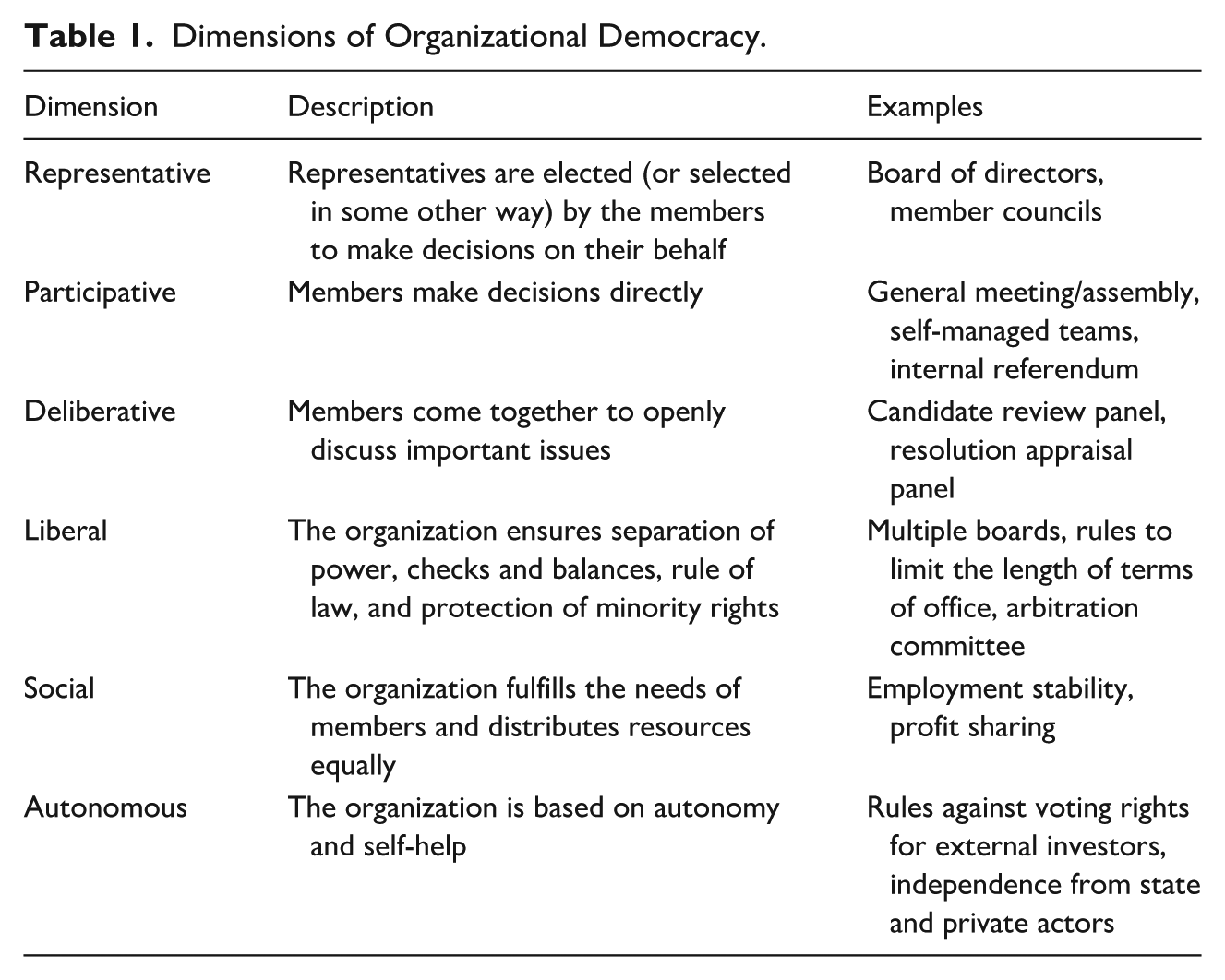
As organizational democracy is a multidimensional concept, there can be tensions between the different dimensions. For example, the majority representatives might make decisions that harm minority rights. These tensions are typically settled “by a hierarchical order between the [dimensions] and their respective elements—one [dimension] imposing limits on the other” (Ferrin & Kriesi, 2016, p. 8). Continuing our example, that is to impose limits on representative democracy to the extent that it protects liberal democracy. The different dimensions of organizational democracy thus work together as a whole to provide democratic governance, even if there exist trade-offs between the dimensions, and it will always be difficult to maximize on all dimensions.
Methodology
Since platform cooperatives in sectors with global online work are rare and also understudied (Bunders et al., 2022), we conducted exploratory research using Honeypot as a case study to inductively identify how organizational democracy is being developed despite global scale and member heterogeneity (Eisenhardt & Graebner, 2007). We selected Honeypot as a single case study due to its unique development process, involving a highly diverse group of members located across the world and their continuous commitment to collective decision-making using digital tools. Hence, Honeypot could be considered an extreme or atypical case from which we could learn which factors help or undermine democratic governance facing global scale and member heterogeneity (Flyvbjerg, 2006). The goal is not to achieve generalizable findings, but to generate new insights on organizational democracy under adverse conditions.
Honeypot was originally founded in 2019 by software engineer and indie porn star Delilah D’lune out of frustration with existing platforms for adult content. Some of these incumbents, such as OnlyFans, were originally “never meant for porn” and tend to excessively police online sex workers (Dawson, 2021). Others, like Chaturbate, were originally “meant for porn” but do not provide online sex workers with the technological features they need while asking for much higher commission rates. Some collective action against these practices existed already (Hardy & Barbagallo, 2021), but without going so far as to strive for independence from the existing platforms. Aiming to become a fully functional alternative, Honeypot is being developed by online sex workers for online sex workers. On their Discord server, anyone can get involved and offer their expertise in developing Honeypot. The server is divided into seven channels, each dedicated to a particular aspect of the platform cooperative’s development, including general, community development, product development, technology, design and branding, project management, and administration. Moreover, the server has approximately 240 members from various occupational backgrounds including sex work, computer science, software development, graphic design, UX/UI design, and more. While following a U.S.-based time zone and English for communication, members are located all across the world. Aside from Discord, Honeypot also utilizes decision-making software Loomio to help make collective decisions. On the main channel, fittingly called general assembly, members can propose changes to the organization and design of the platform. Once the proposals are announced, members can vote on whether to pass the decisions. Honeypot’s development was most active in 2020 and 2021, but it still remains under development with a smaller group of involved members and with less public visibility while considering a name change.
Data collection was conducted from March to July 2022 by the second author and consisted of semi-structured interviews with the founder and admins of Honeypot, next to the entirety of posts on their Discord and Loomio servers. As all members join the platform on an ad hoc basis, few members are committed to the development for a longer or continuous period. Those who are granted admin access are assumed to be more committed, and therefore, more knowledgeable about Honeypot. A pre-existing interview in the magazine Dazed was used to familiarize ourselves with the case (Dawson, 2021). Founder Delilah D’lune was then contacted via social media for an interview, after which snowball sampling was used to arrange interviews with five more admin members. It was not possible to interview other members because of their irregular participation in the development of Honeypot, nor was it desirable, as many of these members wanted to stay fully anonymous. In total, six interviews were conducted over Zoom, each lasting on average 60 min. Interview questions focused on (a) the challenges of global scale and member heterogeneity, (b) resources and institutions mobilized during the development, and (c) to what extent Honeypot’s democratic governance is retained. The background of interviewees was varied in terms of gender, occupation (i.e., sex work, software development, graphic design, or a mix), and location (e.g., United States, Australia).
We further examined all written posts and discussions on the seven channels of Honeypot’s Discord server and the General Assembly on Honeypot’s Loomio server. Triangulating our insights from the interviews with another source of data allowed for checking initial findings and shedding light on the perspectives of members other than the founder and admins (Natow, 2020). On Discord, most messages were posted before October 2021 with later discussions shifting to Loomio. Thus, we analyzed seven threads with 15 reaction messages posted on Loomio regarding the formation of community guidelines, division of roles and tasks, and other proposals. Moreover, up to 1,600 messages on Discord were also analyzed.
Considering that the members of Honeypot belong to a vulnerable population or at least engage with sensitive subject matter (Dewey & Zheng, 2013), ethical considerations are of great importance for this study. While informed consent is the cornerstone of any ethical research, additional measures were taken to minimize the risks of harm and maximize the potential benefits. To ensure both safety and autonomy of participants, all interviewees got to choose whether they want a pseudonym or use their real names for this research. We used whichever names the interviewees chose when reporting the findings, but only first names, as to balance privacy protection with the sentiment among participants that there should be no taboo on sex work. In any quotes of the Discord or Loomio messages provided in this research, no usernames or profile pictures are given.
All data were thematically coded in Atlas.ti (Braun & Clarke, 2006). A dictionary of codes was first identified from the interview transcripts to function as a guide for analyzing the messages from Discord and Loomio. For these messages, we then mostly followed a prescriptive approach by applying codes listed in the dictionary (Blumberg et al., 2014). When codes were frequently repeated in the messages on Discord and Loomio, this corroborated the insights gained from the interviews and allowed us to prioritize our main codes. However, we allowed for an open approach as well to leave room for defining new codes from the messages (Blumberg et al., 2014). By comparing and grouping our main codes, we identified six themes to answer our research question (see the Appendix for an overview of themes and main codes). Three themes reflect opportunities of governance innovation: shared values by signaling, technological affordances, and design of democratic institutions. Correspondingly, three themes reflect pitfalls of governance innovation: losing member engagement, technological dependencies, and democratic frictions. In the findings, we grouped opportunities and pitfalls that are most related, and interpret these as mechanisms for how each dimension of organizational democracy was retained or not.
Findings
Signaling Shared Values to Support the Representative, Participative, and Deliberative Dimensions
On the one hand, Honeypot manages to establish shared values despite members’ diverse personal backgrounds, skills, and geographical locations. It does so not by screening prospective members, which is costly and could exclude new members from joining (Soetens & Huybrechts, 2023), but through ideological signaling which attracts members with shared values. After OnlyFans announced a ban on adult content in August 2021, following pressure from payment processors like Mastercard and Visa, many online sex workers and their sympathizers perceived this as discrimination and went on to seek an alternative platform. Depicting OnlyFans as a clear antagonist (see Figure 1), this trigger event allowed Honeypot get members on board via a link to the Discord server and volunteer in developing its platform. Alex, one of the members with a coordinating role in Honeypot, reflects on this signaling: “As far as I know, we come from similar motivations in terms of frustration with how sex workers are treated and how the OnlyFans decision to cut off payment was announced. Ultimately, it did not happen, but it affected a lot of people . . . OnlyFans is the only way to publish their work. And so there was a sort of microcosm, I guess, where we all bonded together and said, you know what? This is bullshit.”
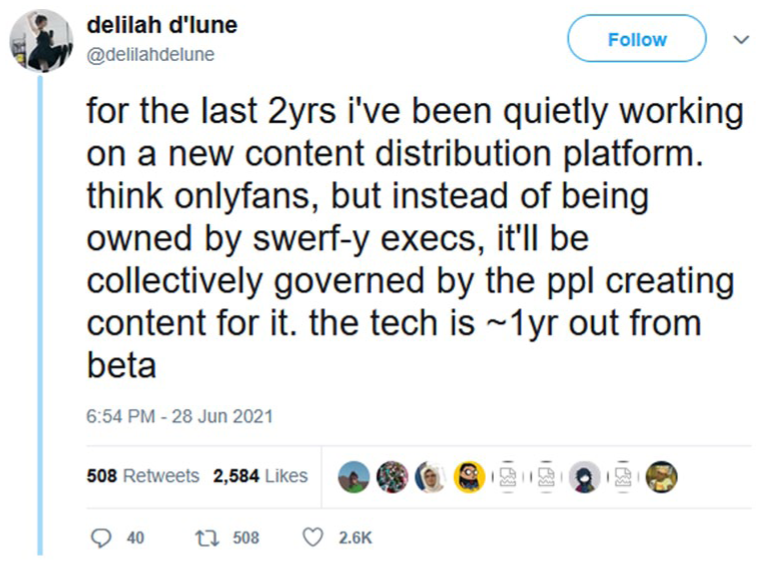
Social media post by Honeypot Founder Delilah.
Sex workers may join to become content creators once Honeypot is live, as this introduction post on Discord illustrates: “Hi, I’m [. . .], I make adult videos, and on the tech side I’m good at data entry. Looking forward to being a part of this collective!.” For members who are not sex workers themselves, they are aware that their contribution will not result in direct benefits. Solidarity with friends who are sex workers plays a role for some of these members, but crucially their motivation arises from the desire for more meaningful work than experienced in the tech sector overall. Founder Delilah illustrates how Honeypot attracts members in this way: “I think for most of the people who are writing code, we have full-time jobs and we do not need additional work. However, our jobs are not necessarily inspiring us to getting a sense of we are doing some good in the world. And so, this is a way for us to get back to just be involved in making a better world, rather than just building machines. For most of the developers, having talked to them, that seems to be the thing. It is ideological.” This is also visible in many of the introductions of new members on Discord, such as: “Hi, I’m a full stack dev with strengths in backend & infrastructure that’s trying to start contributing to meaningful projects! How can I help?”
Members typically view the development of Honeypot as part of larger movements for social justice and LGBTQ rights. For example, on the Discord server a member explains their volunteering as an expression of desiring more egalitarian workplaces: “Yeah I prefer ‘platform contributors’ to ‘staff’ for sure in a collective setting, staff would be the capitalist analogy.” The occupational identity of sex workers is also brought into relation with gender and sexual identities as part of the same struggle for emancipation. Alexis, one of the members who develops the software for Honeypot, describes this in the following way: “So being transgender, I know probably a lot more sex workers than the average person on the street. Lots of people in our community are involved in sex work. I have had friends who were involved in it on and off for years . . . There is also just a lot of trans people and trans women working on [Honeypot]. And I think there is a certain automatic assumed solidarity that we have amongst ourselves.”
Heterogeneity in demographics, skills, occupations, and geographies are apparently less of an issue for establishing trust between members and reaching agreements. Alexis points out that: “Everyone joined for that specific goal like I said before . . . Which did lead to generally people being quite leftist in their politics and their personal ideologies and that sort of thing. I think there’s a certain solidarity from that.” Shared values therefore remain crucial, since ideological homogeneity facilitates the aggregation of individual preferences into organizational decisions and fosters trust (Nilsson, 2001). As a governance innovation, the signaling mechanism thereby indirectly supports the representative, participative, and deliberative dimensions of organizational democracy by opening the doors for new members while also ensuring they are like-minded people who will find it easier to work together and find agreement. Indeed, many decisions of Honeypot are taken with near unanimity, and deliberation mostly takes place in good spirit. For instance, concluding a discussion about future pay levels for software developers compared to online sex workers, one member notes on Discord: “Yeah this is admittedly putting the cart before the horse, but at least we’re all on the same page about this.”
Failing the Social Dimension Due to Losing Member Engagement
On the other hand, it is taking multiple years to develop Honeypot into a fully functional platform where members can make a living by selling adult content. This makes it difficult to sustain the engagement of members over time and undermines the social dimension of organizational democracy. After the momentum gained in 2021, Honeypot was unable to obtain capital investments and experienced a decline in member participation as volunteer energy drained. This is also visible on the Discord server, where most messages were posted in 2021 with much fewer in the years after that: “Things are pretty quiet right now, but a couple of us are still working on the project. Hopefully others will get more involved again once we show progress.” While higher levels of engagement may return once Honeypot becomes operational and is able to realize its plans for below market commission rates so that a larger share of revenue ends up with online sex workers, it is by no means guaranteed. Especially for members in precarious working conditions, it is proving difficult to remain involved despite shared values and feelings of solidarity. Bryce, another member who develops the software for Honeypot, explains: “A lot of people here are new and have irregular income. So we will have to stop for a minute to either look for a job or because they are busy with their jobs or that type of thing. So, there is no obligation.”
During the COVID-19 pandemic, many members also faced challenges in their personal lives. Sickness and exhaustion put further pressure on the time and energy to volunteer. This is reflected in messages posted to Discord when members fail to complete a task in time: “Honestly, I’ve been busy with other life stuff and have not had time this week.” When Honeypot’s founder and informal leader, Delilah, became temporarily unavailable due to personal circumstances, development slowed down as there was no plan to take over her tasks. As Alexis points out, this exemplifies the vulnerability of relying on some very active members and a larger pool of sporadically contributing members: “Delilah is a big driver of stuff that was going on. Her just having to take a break for surgery and recovery meant that a lot of stuff that was in motion and that she was pushing alone, just sort of lost that momentum.”
Technological Affordances to Support the Participative and Deliberative Dimensions
Already during its development, Honeypot employs digital technologies to facilitate asynchronous collaboration and direct participation in decision-making of their geographically dispersed membership. As many members are also (self-)employed elsewhere as software engineers, they are willing to share access to technology infrastructure that would otherwise require high payments to use. For instance, one of the members utilizes access to a hosting service provided by their company to host the website of Honeypot. Consequently, Honeypot manages to cut down costs while developing its platform. In general, a clear preference is given to free, open-source, and easily accessible technologies. For instance, when members of the design committee flagged their difficulties in collaborating, the committee solved this by voting on using a more accessible platform for everyone. Gabrielle, a member of the design committee, explains: “This is the specific reason we use Figma and Discord. They are both free to use and available on any browser. There was discussion early on of using some more robust design packages, but accessibility for lower income folks was a number one priority, myself included.”
Within each committee of Honeypot, members get to decide which platforms are best for collaboration. Figure 2 shows an overview, composed during our analysis and validated by Honeypot founder Delilah, of how different platforms are utilized to support collaboration and collective decision-making. For backend development, the tech committee uses Trello boards to divide tasks and Gitlab for pair coding. Meanwhile, the design committee uses Figma to co-design the branding and visual assets for Honeypot. Each committee may also use Zoom for live collaboration sessions as long as they report their progress on Discord and provide feedback to other committees for further improvements. For example, early design choices were let go to become more accessible for the visually impaired: “If we can use a calculation based on rem to make sure we respect users changing the font size in their browsers for accessibility, that would be great.” When necessary, deliberations on Discord are taken up to a vote on Loomio: “Hey gang. So we need a mission statement currently. Copy is not my strong suit but here’s a Google Doc where we can collectively take a swing at a first draft. It’s set to comment only so we can all suggest edits. Once we decide on an acceptable first draft we can put it to proposal in Loomio.” The final outputs of the development are communicated to Honeypot’s targeted audience via its social media: Twitter, Reddit, Instagram, and YouTube. In turn, followers can provide inputs to Honeypot, such as feedback or their desire to become a member. As a governance innovation, these technological affordances thereby directly support the participative and deliberative dimensions of organizational democracy by providing tools for voting, communicating, and collaborating (Barros & Michaud, 2020; Bunders, 2024).
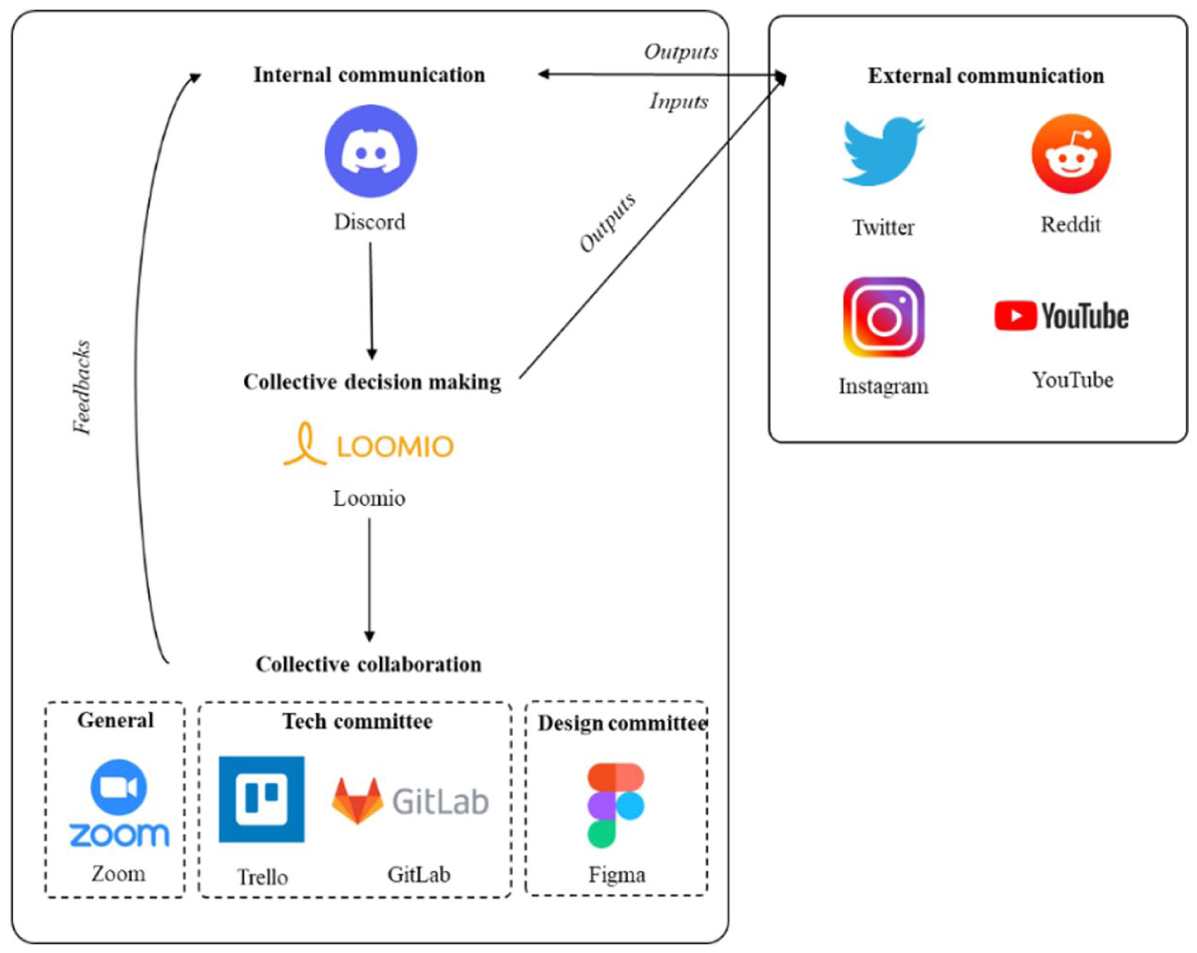
Platforms used for collaboration and collective decision-making in Honeypot.
Failing the Autonomous Dimension Due to Technological Dependencies
At the same time, in developing their platform, Honeypot also becomes dependent on outside actors for providing technological affordances, which undermines the autonomous dimension of organizational democracy. The most important example is access to payment processors for facilitating transactions, such as Mastercard and Visa. Honeypot’s members criticize their dependence on payment processors, illustrated by this message on Discord: “It seems most sites limit their content based on what payment processors allow so they ban swaths of fetish stuff. Is there any way around doing that or would we also end up disallowing large varieties of fetish stuff?.” Yet, using cryptocurrencies is not perceived as a real alternative either, as one discussion on Discord concluded: “To me, the arguments against (value instability, lack of mainstream adoption, environmental devastation, the impact of mining on the cost of useful computing, etc.) still outweigh it.”
After the United States passed the Fight Online Sex Trafficking Act (FOSTA) and the Stop Enabling Sex Trafficking Act (SESTA) in 2018, many payment processors established strict criteria for adult content sites to avoid violation of these laws. One of the criteria requires content to be moderated by human eyes. Even a major platform like OnlyFans responded to this by announcing a ban on adult content, albeit temporarily. In the case of Honeypot, a proposed moderation plan is to have sex workers review each other’s content in return for a larger dividend. However, as Delilah points out, this is also problematic in terms of privacy and risk of income theft: “Because of the review process, we are going to have people who have access to that content before it is published. And that could be a security risk for the individual who has unpublished content, because now someone has access, they can sell it before.” Hence, the power of payment processors leads Honeypot to suboptimal decisions they would otherwise not have considered.
When setting up a newsletter for Honeypot, similar issues with dependence on external actors emerged. Some newsletter services simply refuse any adult content or related material, whereas others still cause problems for Honeypot due to their terms of use. For example, the requirement to list a physical address resulted in one member unwillingly revealing their personal information, as Alexis explains: “We also discovered a couple of days before launch that we were accidentally doxing one of the members of Honeypot, because whoever originally signed up for the account needs their actual personal address to comply with the rules around newsletters.”
Since this issue was later addressed by setting up a post office box, it also demonstrates how Honeypot’s dependence on external actors relates to insufficient knowledge about legal compliance. There is a great fear among members that issues of legal compliance will be weaponized against Honeypot because of the association with sex work, but also because they are forming a cooperative alternative to investor-owned platforms. Alexis illustrates this point vividly: “Especially startups and small businesses work on a very similar ad hoc basis when it comes to that sort of thing. I do think there is a slightly bigger risk with Honeypot on actually being pulled up on some of this stuff, simply because it is a platform for sex workers and it is a collective.”
Design of Democratic Institutions to Support the Representative, Participative, and Deliberative Dimensions
Honeypot has designed several democratic institutions to ensure that members are in control of how the platform is developed. Currently, Honeypot is divided into six committees that function as self-managed teams: social media, tech, design, product development, community, and a committee for intersectional consensus (CIC). The social media committee coordinates the promotion of Honeypot to the public via its social media platforms. The tech committee is responsible for building Honeypot’s platform and website, as well as integrating technical functions and privacy protection methods for sex workers. The design committee oversees the platform’s UX/UI and establishes a brand guideline and visual assets for Honeypot. The product development committee manages the implementation of platform features and legal compliance. The community committee administrates and moderates Honeypot’s communication and collective decision-making platforms, including Discord and Loomio. Operational decisions are made by each committee as a self-managed team, typically on a consensus basis, as Gabrielle explains: “For instance, I am a member of the design committee. If we put every aesthetic design change to an organisation-wide vote, nothing would ever progress. Any large branding or user experience changes do go through the voting process organisation-wide though.” This is a clear example of how governance innovation directly strengthens the participative dimension of organizational democracy.
In each committee, there is an elected bottomliner who, as described on Discord, “has the same powers and responsibilities as other committee members but is also the point of contact between the committee and the collective as a whole.” By 9 pm EST each Thursday, bottomliners are expected to post a summary of the committee’s progress on Honeypot’s Discord server. In practical terms, this is similar to elected representatives forming a board of directors in the traditional approach to cooperative governance (Birchall, 2017). However, this governance innovation to the representative dimension of organizational democracy is semantic in nature as suggested by a member on Loomio: “Instead of ‘director’, what if we used ‘bottomliner’? The implication would be that this position doesn’t hold hierarchical power over other members contributing to a particular platform.”
Members can self-select which committee they want to join, usually based on their skills. One exception is the CIC, which is a special committee that consists of two representatives from each marginalized community who review and evaluate the impact of incoming proposals on sex workers from minority groups, such as LGBTQ+, ethnic, neurodivergent, age 30+, body types, kinks, and non-U.S. citizenship. It was started in response to the precarious position of marginalized groups in online sex work (Mergenthaler & Yasseri, 2022). Representatives are elected by and from self-identifying members of their community. As described on Loomio, these representatives have the decision-making power to “approve, suggest revisions, and otherwise flag a proposal for its negative impact.” While not granted veto power, this governance innovation does strengthen the representative (i.e., minority representation) and to some extent liberal (i.e., minority protection) dimensions of organizational democracy.
Ultimately, the highest decision-making body of Honeypot is its general assembly, consisting of all members who are sex workers and non-sex workers. As stated on Loomio, the general assembly has authority over all committees: “Committees are overseen by the collective as a whole. Any decision a committee makes can be overwritten by a general vote.” To reach a decision, the voting process occurs on Loomio and concludes within 24 hr, requiring a 66% super majority to pass a proposal. When decisions are finalized, the committee bottomliners and the CIC report them directly on Discord. While not an innovative approach to cooperative governance per se, the general assembly does strengthen the participative dimension of organizational democracy. Figure 3 provides a summary of Honeypot’s collective decision-making structure.
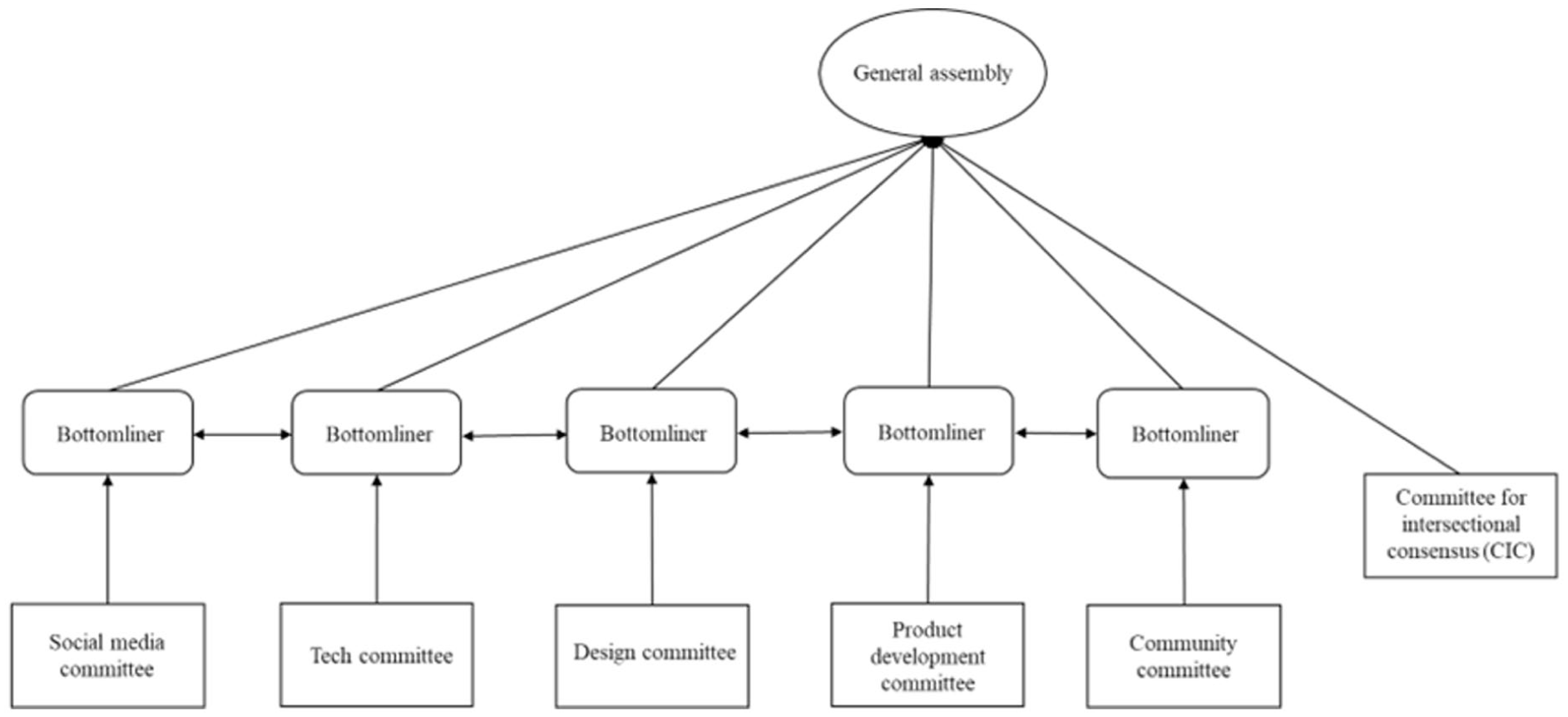
Honeypot’s collective decision-making structure.
Failing the Liberal Dimension Due to Democratic Frictions
Yet, not everything is going well. Due to the lack of formal rules and accountability mechanisms, Honeypot’s participative and deliberative dimensions of organizational democracy also incite friction with its liberal “rule of law” dimension. For instance, members worry that the power to moderate each other’s content may be abused because online sex workers are competing for customers, as this Discord message illustrates: “I would say from a pre-approved list though to prevent them from adding offensive/fetishistic tags to other people’s content.” The design committee already experienced tensions because of one member being very critical without putting in any work themselves. Discussion on Discord shows that some members believe that “do not be an asshole” is enough for rulemaking, while others argue for the need of a code of conduct: “I definitely think it is necessary for a community this size, people have different needs and different definitions of ‘asshole’.” However, as Delilah admits, Honeypot does not have any procedures yet for dealing with opportunistic behavior in a proportionate way: “We do not actually have a policy for suspending someone’s membership at this point, but we probably would want that as well . . . I do not know how to do that ethically just yet.”
Privacy protection is another concern. When Honeypot’s platform goes live, users will be required to complete identity checks to comply with the rules of payment processors and to ensure that all users are adults. Already during development, free exchange of information between members may lead to the (accidental) disclosure of personal information, as in the newsletter example described earlier. Hence, one member posted the following advice on Discord: “Given the tension between security and openness, I would advocate for users to be mindful of what they say and how much identifying information they provide.” Since the current privacy protection method is mainly based on the goodwill of members to not expose sex workers’ personal information, this highlights the vulnerability of Honeypot to privacy risks. Alex reflects on this issue: “The biggest risk for sex workers is being doxed, because you may not have come out to your friends or family that you are a sex worker. So as far as I am concerned, the question boils down to how do you avoid being doxed? Given that we are a cooperative, given that we are in unexplored territory, it is very difficult to secure all of the information.”
Conclusions and Discussion
To assess the opportunities and pitfalls of platform cooperatives as an innovative approach to cooperative governance, this study examines how Honeypot develops organizational democracy despite their global scale and member heterogeneity. Overall, we conclude that governance innovations are primarily used to support collective decision-making processes, while Honeypot is struggling more to innovate capabilities to generate desirable outcomes and prevent undesirable outcomes for members. This challenges the dominant focus on procedural innovations in the cooperative literature (Bijman et al., 2013; Estragó, 2023; Mannan, 2018; Pek, 2021) by showing the importance of also theorizing capabilities related to social equity, autonomy, and liberal safeguards. Below, we first interpret our findings based on the different dimensions of organizational democracy. Next, we discuss limitations of the research. Finally, we reflect on the implications of this study for understanding and implementing governance innovations in cooperatives.
On the one hand, we find that Honeypot manages to sustain representative, participative and deliberative dimensions of organizational democracy by signaling shared values, using digital technologies, and designing democratic institutions. Even though Honeypot’s membership includes diverse personal backgrounds, skills and geographical locations, it does not screen new members for shared values (Bhardwaj & Sergeeva, 2023). Instead, ideological signaling helps to draw in members with shared values, which in turn keeps the costs of collective decision-making low as it is easier to find agreements and trust each other (Nilsson, 2001). We thus find little evidence that working together online inhibits the development of shared values (Mannan & Pek, 2024), but more so for the idea that the internet provides an almost endless pool of potential members who share values (Cossey et al., 2023). We further contribute to understanding some types of member heterogeneity, like demographic or geographical, as less problematic as long as there is sufficient ideological homogeneity (Höhler & Kühl, 2018; Soetens & Huybrechts, 2023). Still, it is unknown whether the signaling mechanism would work equally well to obtain shared values beyond the development phase, when many more members join who are primarily interested in making a living or when more nuanced ideological distinctions become cause for disputes.
The case study of Honeypot further illustrates that technological affordances are crucial in facilitating collaboration and collective decision-making of large dispersed groups of members. In line with some recent literature (Barros & Michaud, 2020; Bunders, 2024), we find that Honeypot manages to lower the costs of collective decision-making and facilitate asynchronous participation by deliberating on Discord, voting on Loomio, and collaborating through a variety of tools. There is no indication for scaling through partnerships in the case of Honeypot so far (Cossey et al., 2023), though it is possible that they will federate into more localized collectives once the platform is fully developed.
Noteworthy is also the design of democratic institutions early on in Honeypot’s development, which include both representative (e.g., elected bottomliners, CIC) and participative institutions (e.g., general assembly, self-managed teams), and to a lesser extent also liberal “minority rights” through the CIC. This shows how some elements are used from the traditional approach to cooperative governance (Birchall, 2017), but altered or expanded with more innovative approaches that can also be found in cooperatives beyond the platform economy (Estragó, 2023; Meyers & Vallas, 2016; Pek, 2023).
On the other hand, we find that Honeypot is struggling with social, autonomous, and liberal dimensions of organizational democracy because they fail to fulfill the needs of members, depend on external actors for technological affordances, and encounter friction between democratic institutions. The slow process of developing Honeypot into a fully functional platform that benefits its members is taking its toll on volunteer energy, which could be explained by insufficient caring activities (Resch & Steyaert, 2020). This undermines the social dimension of organizational democracy, since participation in democratic procedures requires some degree of economic security (Ferrin & Kriesi, 2016). Capital requirements are arguably higher for platform cooperatives operating at a global scale (Bunders et al., 2022). By failing to obtain investments or generate income, Honeypot risks becoming so-called vaporware: an exciting technology that is pre-announced before it becomes available and delayed (indefinitely) to the dismay of its potential users (Choi et al., 2010). Although not successful in the case of Honeypot, scaling could also be a solution here by making more resources available and improving efficiency to fulfill the needs of members, vertically integrate key technologies, and train/hire legal specialists.
The extensive use of digital technologies comes with a price in the case of Honeypot, namely its dependence on external actors and in particular payment processors. This severely restricts the autonomous dimension of organizational democracy, as some decisions are influenced more by the criteria set by external actors than by members’ preferences (Bretos & Marcuello, 2017). With the increasing reliance of organizations on Big Tech’s digital infrastructures, technological dependencies are not a unique issue for platform cooperatives of online sex workers but connect to broader debates about power asymmetry in a digital world (Schor, 2020). At the same time, cooperatives and the online sex industry may experience more restrictions because they operate in alternative or contested markets. In contrast to research highlighting “alegality by design” in blockchain technology (De Filippi et al., 2022), Honeypot’s members show an almost obsession with legality due to the fear that any issue with legal compliance will be weaponized against them. Technological dependencies are probably also less avoidable for platform cooperatives facing global scale and extreme member heterogeneity than for other types of cooperatives.
The lack of formal rules and accountability mechanisms in Honeypot creates friction in its democratic institutions, as checks and balances on power are missing. This threatens the liberal dimension of organizational democracy. Although the CIC is one way in which Honeypot puts limits on collective decision-making to protect the rights of minorities, it still lacks procedures for dealing with opportunistic member behavior in a proportionate way (Diefenbach, 2019; Sacchetti & Tortia, 2015) and fails to protect members’ privacy as an important civil liberty (Ferrin & Kriesi, 2016). Again, while this issue is not unique for platform cooperatives (Bhardwaj & Sergeeva, 2023), monitoring opportunistic behavior is more difficult in large-scale online settings, and privacy is even more crucial in the context of online sex work. By conceptualizing the trade-offs between fostering participation and deliberation while also providing liberal safeguards, our multidimensional approach helps to better understand the complexity of organizational democracy in these settings.
The lessons learned from this research need to be weighed against two limitations. First, while using Honeypot as an extreme or atypical case study provides new insights on organizational democracy under adverse conditions (Flyvbjerg, 2006), it also limits the transferability of these lessons to other contexts. Some of the pitfalls faced by Honeypot are inevitably quite specific to a platform cooperative of online sex workers, such as the difficulties of complying with criteria set by payment processors or the great importance placed on members’ privacy. Other findings may be transferable to platform cooperatives, such as the opportunities and pitfalls of using digital technologies, but these likely play a lesser or at least different role in other cooperatives. It is therefore crucial to examine such governance innovations in different sectors and different types of cooperatives, always taking into account the balance between different dimensions of organizational democracy. Second, the case study of Honeypot is limited by its temporal scope. While Honeypot is still under development, it is known that cooperatives evolve through several stages in a lifecycle (Cook, 2018; Meister, 1984). Things that work well now are no guarantee for the future. For example, as more members join it will likely become harder to collaborate in self-managed teams in the same way, thereby putting the participative dimension of organizational democracy under pressure. Likewise, things that do not work well now, may still be improved in the future. For instance, when their platform finally does become operational it is likely that Honeypot will provide its members with better conditions than the competing investor-owned platforms, thereby reinvigorating the social dimension of organizational democracy.
Ultimately, our study has clear implications for understanding and implementing innovative approaches to the governance of cooperatives. It demonstrates that a narrow focus on improving collective decision-making procedures is insufficient for sustaining organizational democracy. Still, most of the literature on governance innovations in cooperatives focuses on representation and participation (Bijman et al., 2013; Bunders, 2024; Pek, 2021), and to a lesser extent on deliberation (Ferreras, 2023; Pek, 2023). The key insight from this research is that more attention needs to be paid to governance innovations that strengthen the capabilities of cooperatives to generate desirable outcomes and prevent undesirable outcomes for remote and diverse members. This includes innovative approaches to social, autonomous and liberal dimensions of organizational democracy: In what ways can cooperatives fulfill (at least some of the) members’ needs during the development phase and under adverse conditions? How can cooperatives remain autonomous when they increasingly depend on technological affordances that they do not own themselves? Which checks and balances are required in large-scale and heterogeneous cooperatives? These are important directions for future research, but equally so for experimentation in practice.
Footnotes
Appendix A
Acknowledgements
We thank the founding members of Honeypot who were willing to share their experiences about building a platform cooperative of online sex workers, and also the ordinary members for welcoming us on their digital communication channels during the research. Moreover, we are grateful to the guest editors and three anonymous reviewers for their sincere interest in our work and insightful comments that have helped to improve the paper.

Ethical Considerations
The IRB for Non-Experimental Research of Erasmus Research Institute of Management, Erasmus University Rotterdam, waived the need for ethics approval for the collection and analysis of the retrospectively obtained and anonymized data in this study as it was conducted in the supervised context of the second author’s master thesis.
Declaration of Conflicting Interests
The authors declared no potential conflicts of interest with respect to the research, authorship, and/or publication of this article.
Funding
The authors received no financial support for the research, authorship, and/or publication of this article.
Data Availability Statement
The datasets generated and analyzed during the current study are not publicly available since they contain personal data on a small number of research participants.