







Abstract
This article explores how public–private collaboration can drive digital transformation in rural areas to foster social sustainability. Using the strategic approach to social sustainability as an analytical framework and drawing on an in-depth case study of the partnership between Convergenze S.p.A. Società Benefit and the municipal administrations of several small towns in Italy’s Cilento region, the research analyses the roll-out of fiber-to-the-home infrastructure in underserved and unattractive territories. The study identifies three interdependent factors that make collaboration effective (community needs, mutual trust, and proximity) and shows how these elements enable digital investments to translate into social sustainability outcomes. The article demonstrates that public–private collaboration aimed at driving the digital transformation of rural areas can generate significant social sustainability impacts, which, in turn, reinforce the very foundations of the collaboration, thereby supporting new rounds of digital transformation and triggering a self-sustaining virtuous cycle. On this basis, the study proposes a circular model linking public–private collaboration, digital transformation, and social sustainability in rural contexts. It contributes both theoretically and practically to the literature on social sustainability and to the broader discourse on rural digitalization, offering actionable insights for policymakers, local administrators, and entrepreneurs.
Introduction
Social sustainability is a complex and multifaceted concept, both in its theoretical foundations and empirical applications (Åhman, 2013; Popovic et al., 2018), and it has recently emerged as a relevant research domain across various disciplines (Nagendra et al., 2024). While multiple definitions have been proposed, a growing body of literature converges toward a view of social sustainability as a principle of sustainable development aimed at promoting equity through mechanisms such as job creation, access to education, empowerment, and freedom (Dalirazar & Sabzi, 2022; Ipinnaiye & Olaniyan, 2023). From a corporate perspective, social sustainability has been associated with firms’ contribution to local communities through the enhancement of human and societal capital (Dyllick & Hockerts, 2002).
Scholars have recently begun to investigate how digital technologies may contribute to social sustainability (Al-Emran & Griffy-Brown, 2023; Mastrocinque et al., 2022). Much of this research has focused on urban contexts, particularly regarding how digital tools can enhance sustainability in cities and metropolitan areas (Dubey et al., 2019).
At the intersection of these two streams of literature, however, two significant gaps remain. First, while the effects of digitalization on environmental and economic sustainability have been widely explored (Szalkowski & Johansen, 2024), its societal implications in rural contexts, where structural and infrastructural inequalities persist, remain under-researched (Ahvenniemi et al., 2017; Dempsey et al., 2012; Salemink et al., 2017, 2025). Second, existing literature highlights that social sustainability is inherently multi-actor and depends on collaboration among diverse stakeholders, requiring integrated approaches that combine social analysis, community engagement, and policy design to reduce inequality, build resilience, and support sustainable livelihoods (Flyverbom et al., 2019). Yet, there is still limited empirical evidence on how public–private collaboration unfolds in practice in rural areas (Casprini & Palumbo, 2022).
Building on these premises, this study explores the foundations of effective collaboration between firms and public institutions aimed at fostering social sustainability through digital transformation in rural areas. According to the OECD classification, rural areas in developed countries are defined as territories with low population density (<150 inhabitants/km²), located outside urban centers and not included in Functional Urban Areas (Fadic et al., 2019).
Specifically, we aim to address the following research questions: How can digital transformation contribute to achieving social sustainability in rural areas? (RQ1); What are the main elements that sustain public–private collaboration for the digitalization of rural areas? (RQ2).
This study draws on the strategic approach to social sustainability (SASS) developed by Missimer et al. (2016, 2017) within the Framework for Strategic Sustainable Development (Broman and Robert, 2016), and conducts a single-case study analyzing the collaboration between Convergenze S.p.A. Società Benefit (hereafter, Convergenze) and several small municipalities in the rural area of the Cilento region (Southern Italy). The study focuses on how the deployment of fiber-to-the-home (FTTH) infrastructure in underserved, market failure rural areas has enabled early-stage digital transformation and, in turn, contributed to broader social sustainability outcomes. Exploring the processes, enabling conditions, and impacts of this public–private collaboration sheds light on how digitalization can support inclusion, empowerment, and community resilience in rural settings.
This article offers a set of contributions to the literature on social sustainability, digital transformation, and public–private collaboration. First, it engages with research on social sustainability by illustrating how social value creation in rural areas can be interpreted through the SASS. The analysis also contributes to studies on digital transformation by shifting the focus from urban to rural contexts and by examining the social outcomes of FTTH deployment in territories affected by market failure. Finally, the article contributes to the literature on public–private collaboration by identifying three key enabling factors (namely, community needs, mutual trust, and proximity) as central to the generation of social sustainability in rural digitalization processes, and by proposing a circular model that links public–private collaboration, digital transformation, and social sustainability in an iterative and mutually reinforcing way.
Theoretical Framework
Social Sustainability: A Strategic Approach
Social sustainability, as a core pillar of sustainable development, remains a theoretically and empirically complex concept (Dempsey et al., 2012). While much of the sustainable development discourse has focused on balancing economic and environmental priorities, the social dimension is often less clearly defined (Åhman, 2013; Popovic et al., 2018). In recent years, however, its scope has expanded considerably (Morais et al., 2018), with growing calls for more interdisciplinary and critical perspectives that address the philosophical underpinnings of social issues (Dyck & Silvestre, 2018).
In spite of a number of definitions of social sustainability (Weingaertner & Moberg, 2014), a shared or widely accepted definition has yet to emerge. Recent contributions conceptualize social sustainability as a dimension of sustainable development that promotes equity through job creation, education, empowerment, and freedom (Dalirazar & Sabzi, 2022; Ipinnaiye & Olaniyan, 2023). In this sense, social sustainability is also associated with the protection of diversity, human rights, equity, and well-being, while fostering inclusive community conditions (Fine Licht & Folland, 2019), including aspects such as intergenerational access to services, cultural integration, minority empowerment, and political participation.
A recurring theme in many definitions is the centrality of human development, understood as the fulfillment of human needs and potential (Ajmal et al., 2018; Assefa & Frostell, 2007; Boström, 2012; Dyllick & Hockerts, 2002). Key components thus include social justice, cohesion, cultural diversity, and a balance between economic progress and social welfare (Assefa & Frostell, 2007). Understanding social sustainability, however, requires adopting a systemic perspective (Dyllick & Hockerts, 2002) that highlights trust, shared meaning, diversity, learning capacity, and self-organization as essential to meeting individual and collective needs within social systems (Lee et al., 2021).
In an attempt to operationalize the concept, Missimer et al. (2016, 2017) developed the SASS, building on Broman and Roberts’ (2016) work. Drawing on Social Systems Theory (Castellani & Hafferty, 2010; Jackson, 1985) and Complexity Theory (D. Byrne, 2000; Walby, 2007), this framework adopts a systemic and interdisciplinary lens to examine the dynamics and interdependencies that shape social sustainability (Shrivastava et al., 2013).
The SASS identifies five essential aspects (trust, shared meaning, diversity, learning capacity, and self-organization) from which it derives five corresponding social sustainability principles (SSPs) for fostering social sustainability:
SSP1: Promote the right to health by preventing exposure to harmful social conditions and ensuring access to adequate care and support services.
SSP2: Facilitate inclusive participation in social system development by fostering democratic engagement, transparency, and equitable access to decision-making processes.
SSP3: Emphasize learning, skill-building, and personal growth through accessible education and opportunities for lifelong learning and individual empowerment.
SSP4: Address structural inequities by focusing on systemic injustices and unequal access to opportunities and resources.
SSP5: Foster processes of individual meaning-making and the co-creation of shared values, fostering both personal fulfillment and collective purpose to strengthen social cohesion and resilience.
Digital Transformation and Social Sustainability
Digital technologies have become increasingly integral to individuals, organizations, and societies (Dabrowska et al., 2022; Flyverbom et al., 2019). Activities such as information retrieval, maintaining social connections, and urban navigation exemplify the growing reliance on digital tools in everyday life. As a process, digital transformation continues to attract substantial attention from both scholars and practitioners, as the pursuit of sustainable societies remains a shared objective among diverse stakeholders. Investigating how emerging technologies are applied in this context offers opportunities to further develop existing frameworks, methodological approaches, and normative perspectives aimed at addressing societal challenges through solutions that deliver both economic and social value (Bohnsack et al., 2022; Faludi, 2023; Kraus et al., 2021). Achieving such forms of dual value creation often involves collaborative engagement among key actors, including academic institutions, public and private organizations, civil society, and individuals, who must coalesce around common goals. In this context, firms are increasingly expected to develop digital business models that go beyond enhancing operational efficiency and precision, and that explicitly confront pressing societal issues while generating shared value. Value creation in these contexts tends to be multifaceted, emerging through diverse mechanisms and being assessed using different evaluative criteria. The co-creation of value among stakeholders in digital-transformation processes may contribute to mutually beneficial outcomes across stakeholders, reinforcing the societal relevance and sustainability of technological innovation.
Beyond these visible functions, digital transformation is reshaping organizational workflows by automating tasks and enabling novel ways for institutions to rethink and enhance their operations, a process (Zuboff, 1988) referred to as “informating.” Historically, digital technologies were perceived primarily as instruments that organizations adopted for specific purposes. In recent decades, digital technologies have increasingly come to constitute the underlying infrastructure of many organizational processes. Our understanding of people, institutions, and societal dynamics is increasingly mediated through digital means. This infrastructural prominence necessitates a deeper examination of how digital transformations are configured, how they operate, and what implications they entail. A brief overview of the evolution of digital technologies reveals that, as various innovations develop and converge, they form distinctive technological ecosystems, align with societal norms and expectations, and shape patterns of use (Plekhanov et al., 2023).
To pursue broader objectives that extend beyond purely economic goals, digital-transformation initiatives are increasingly expected to be conceived and implemented in a responsible and inclusive manner, ensuring benefits across a broad range of stakeholders involved. The COVID-19 pandemic contributed to a rapid acceleration in the adoption of digital technologies, as organizations sought to adapt to rapidly evolving challenges. However, it will likely take several years before the full societal and organizational impacts of this digital surge can be comprehensively assessed.
Public–Private Collaboration for Digitalization and Social Sustainability
The interplay between public and private actors is vital for steering digital transformation toward social sustainability, as public institutions and private firms bring complementary capacities and responsibilities. Public authorities establish regulatory frameworks, invest in digital infrastructure, and articulate societal goals, shaping the “enabling environment” for digital initiatives, while private organizations contribute innovation capabilities, implementation agility, and resources needed to operationalize technology-driven solutions (Flyverbom et al., 2019). Yet aligning these divergent institutional logics demands inclusive governance arrangements that foster transparent dialogue, joint decision-making forums, and mechanisms for reconciling public accountability with private-sector efficiency, so that digital projects (e.g., e-government platforms, digital health services, and smart-city applications) advance equity rather than exacerbate disparities (Flyverbom et al., 2019).
At the ecosystem level, collaborative processes that bring together policymakers, businesses, civil society actors, and academic institutions play an important role in fostering social innovation by integrating a variety of perspectives and pooling resources. Existing studies suggest that such multi-stakeholder interactions may contribute to both the resilience and inclusiveness of digital initiatives, as they help ensure that technological solutions are aligned with the actual needs of communities (Flyverbom et al., 2019). Nonetheless, challenges remain when incentive structures are not harmonized or when governance mechanisms are inadequate. In the absence of adaptive oversight, digitalization can give rise to issues such as discrimination, breaches of privacy, and unequal access, potentially eroding social cohesion. The effectiveness of public–private partnerships in digital transformation appears to depend, in part, on the presence of mechanisms for critical reflection, inclusive stakeholder consultation, and iterative policy adjustment, which can help ensure that technological change remains responsive to principles of social justice and contributes meaningfully to the construction of equitable and sustainable societies.
Complementary measures, such as subsidized connectivity, digital skills programs, and regulatory safeguards for data privacy, tend to be more effective when coordinated between public authorities and companies to ensure that underserved populations can benefit from digital services (Nosratabadi et al., 2023). Continuous monitoring of social outcomes in digital initiatives, carried out jointly by regulators and companies, allows for timely adjustments and accountability, ensuring that technology-driven projects contribute to inclusive, resilient, and sustainable societies rather than unintentionally reinforcing inequalities.
Research Design
Research Methodology
We investigated our research questions through a qualitative approach, as this method is particularly well suited to explore emerging phenomena and offers the opportunity to examine them with “new ways of seeing” (Bansal et al., 2018, p. 1189). Given the novelty of the topic, we conducted an in-depth exploratory case study (Yin, 2003), employing a narrative approach (Ahl, 2007; Hjorth & Steyaert, 2004; Larty & Hamilton, 2011; Pratt, 2009). Narrative methods are well aligned with studies that address “how” questions and focus on unfolding processes (Larty & Hamilton, 2011).
Building on this orientation, we combined a case study approach with narrative methods to better grasp the dynamics of the phenomenon under investigation. We therefore opted for a single-case study design, as it enabled an in-depth and holistic examination of the specific dynamics through which the phenomenon unfolded (Dyer & Wilkins, 1991; Yin, 2003). In this sense, the approach is not only suitable for engaging with established theoretical frameworks but also for identifying emerging relationships and tracing processes of change at the field level (Hardy & Maguire, 2010). The case study approach has also proven valuable for analyzing collaborative dynamics (Dagnino & Ferrigno, 2015), particularly those involving multiple actors who engage in social construction and negotiation to pursue shared goals and collective interests (Di Vito et al., 2020). Moreover, it has been recognized as a useful method to explore the relationship between digitalization and societal issues (Bokolo et al., 2021) and to help researchers to get a better understanding of how digital transformation is implemented in practice (Piepponen et al., 2022). Finally, adopting a narrative approach has proven particularly suitable for analyzing entrepreneurial dynamics in rural contexts (Gaddefors & Anderson, 2018). It facilitates the analysis of collaborative and evolutionary dynamics (Steyaert, 2004; Toledano & Anderson, 2017) and is particularly appropriate for sensitive or under-documented phenomena (O. Byrne & Shepherd, 2015), offering rich, contextualized insights from the participants’ perspectives.
Considering our research objectives, the study focuses on the case of public–private collaboration between four small municipalities and Convergenze S.p.A., in Cilento, a rural area in the Campania region (South of Italy). The case was selected because it presents at least four key elements: (a) it involves a local cross-sector collaboration (MacManus and Caruson, 2011) that seeks to compensate for the absence of national policies and strategies aimed at ensuring digital transformation; (b) it offers the opportunity to analyze how digital transformation supports the sustainable development of rural areas from multiple perspectives (Varriale et al., 2024); (c) it allows for the examination of digital-transformation processes in rural contexts, thereby addressing the urban dependence that characterized research in this field (Salemink et al., 2025); (d) it features a private actor that serves as a catalyst for the digital transformation of territories affected by depopulation, inadequate infrastructure, limited social services, and geographical isolation, as part of its corporate mission.
Research Context
This case study analyzes the process of public–private collaboration between a rural area of four small municipalities in Cilento, a geographical region in Southern Italy, and Convergenze S.p.A. Società Benefit, as a model to support the digital transformation of these territories. Following the recommendations of the literature (Szalkowski & Johansen, 2024), which suggest analyzing the impact of a single technology to measure its effects in terms of social sustainability, and in line with the narrative approach, which involves a retrospective interpretation based on the identification of key events and a clear definition of the chronological dimension (Toledano & Anderson, 2017), this study focuses on the process of deploying proprietary FTTH infrastructure in these territories. Convergenze is an integrated technology company listed on the Italian Stock Exchange (Euronext Growth Milan), operating nationally in the Telecommunications, Energy, and E-mobility sectors. It was founded in 2005 as a broadband connectivity provider in underserved areas of the Cilento region, with the goal of bridging the digital divide caused by the lack of internet access. As stated in its official documents, Convergenze was established “with the goal of bridging the digital divide by bringing broadband connectivity to underserved areas” (Convergenze website).
Drawing on the vision of its founder and CEO, Rosario Pingaro, the company has long pursued the goal of promoting “digital democracy,” namely, guaranteeing access to connectivity for the communities and individuals who would otherwise be excluded. The initiative initially focused on the Cilento area, which, because of conditions of depopulation, high average age, and low population density, had been largely neglected by major internet service providers. In response to this, Convergenze committed to extending internet connectivity through wireless technology. The founder and CEO of Convergenze had the opportunity during a study period in the United States in the late 1990s to explore the potential of wireless technology, an experience that later informed the company’s strategic orientation.
Building on this insight, Convergenze was established with the explicit objective of addressing the digital divide in the Cilento area. Since 2005, the company has consistently maintained a strong focus on access technologies, progressively expanding from ULL (Unbundled Local Loop) to ADSL (Asymmetric Digital Subscriber Line) and to NGA (Next Generation Access). In line with this strategic trajectory, since 2015, Convergenze has invested in the development of a proprietary infrastructure to support the deployment of FTTH technology.
The main advantages of operating a proprietary FTTH network include technological independence, which enables Convergenze to activate and manage the fiber network according to standards that best meet end customers’ needs, and the high resilience of the backbone, which allows Convergenze to effectively manage data flows and to guarantee a consistently high level of service. Since 2015, infrastructure cabling works have been ongoing, and since 2018, the network has been expanding at an average rate of two new towns per year (Convergenze Impact Report, 2023). Figure 1 illustrates the growth in kilometers of Convergenze’s FTTH network in the Cilento area, developed in territories classified as white (without fiber coverage) or gray areas (with limited fiber coverage).
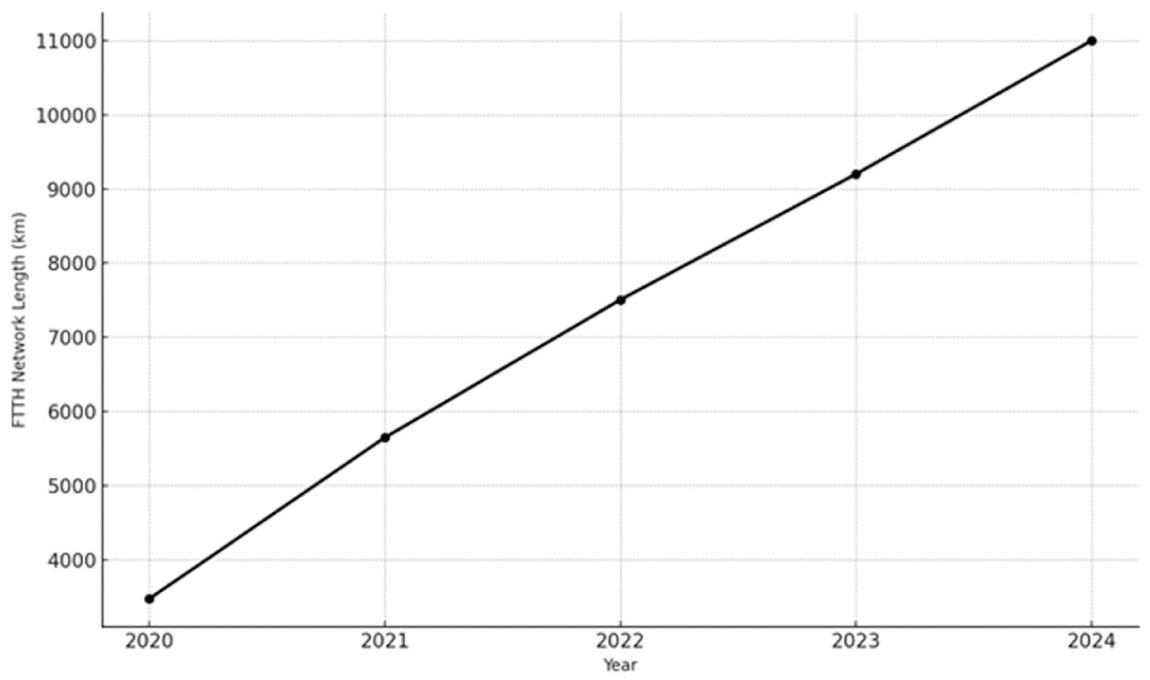
Growth of Convergenze’s FTTH Network in Cilento (2020–2024).
To support this growth, Convergenze has invested between €1.5 and €2 million annually to expand its FTTH infrastructure in these areas (Sustainability Report, 2023). At present, Convergenze is implementing an ambitious 5-year project, with a budget of 22 million euros, to expand its FTTH coverage throughout the country (Admission Document regarding the admission to trading on AIM Italia, p. 88).
Although these areas are so-called “market failure” areas, because they are places where usually national FTTH providers decide not to invest because unprofitable from a business perspective, the CEO of Convergenze emphasizes that the vision behind these investments is driven by the belief that “investing in these territories through the development of advanced technological infrastructure can breathe new life, including economic vitality, into inland areas.”
Today, the company is a multi-utility and can be considered an enlightening example of a business offering innovative services for internal areas using digital technologies. It has been recognized nationally for its managerial vision, capable of synergistically guiding innovation processes with the aim of generating value for the country’s system. In 2023, for the fourth consecutive year, the company was included among the Italian excellences, receiving the Best Managed Companies Award, the award for entrepreneurial excellence of Made in Italy promoted by Deloitte. As a matter of fact, in 2020, Convergenze was the first company in the province of Salerno to be listed on the stock exchange in the infrastructure sector. It is also the first company from the Salerno province to go public after approximately 30 years since the last local listing. Cilento, the geographical area at the center of our study, is located in Southern Italy in the province of Salerno. Since 1991, following the establishment of the Cilento and Vallo di Diano National Park, much of the Cilento territory has become a protected area.
About 181,000 hectares of territory, 80 municipalities, and about 150,000 inhabitants fall within the protected area. The Cilento area has the lowest population density of all Campania (70 inhabitants per square kilometer). This is because of the mountainous nature and emigration. Depopulation and emigration are phenomena that particularly afflict the inland areas, with villages that do not reach 600 inhabitants and significant depopulation trends. Inland areas are areas far from services and characterized by low population density, depopulation dynamics, and high seniority indicators. The municipalities analyzed belong to what is defined as the “Cilento Interno area,” a geographical sub-region predominantly characterized by a fragile and weakly structured economic system, coupled with continuous depopulation and population aging. Table 1 provides demographic information for the five municipalities included in our analysis. The data in Table 1 should be considered within the broader context of the Campania region, which has a population density of 408 inhabitants per km², primarily concentrated in urban areas, and an average age of 43.9 years.
Demographic Overview of Selected Cilento Municipalities (2005–2025).
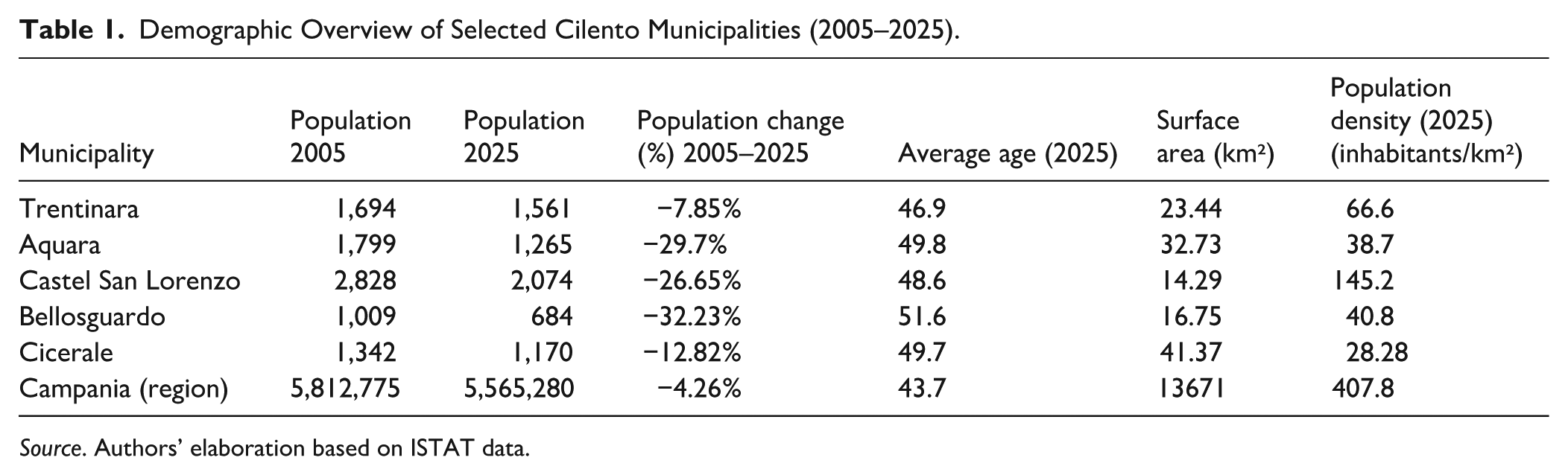
Source. Authors’ elaboration based on ISTAT data.
In this Cilento context, digitalization is increasingly seen as a necessary pathway to enhance the efficiency and effectiveness of local processes and services, ultimately improving the quality of life for citizens and businesses. However, as of 2019, the area still showed a digital divide affecting 53% of the population, with only 31% of residents having access to broadband connections (La strategia d’area del Cilento Interno 2014–2020).
Data Collection
Data were collected through a total of 17 semi-structured interviews conducted between March 2024 and October 2025; the details are provided in Table 2.
Summary of Data Sources.
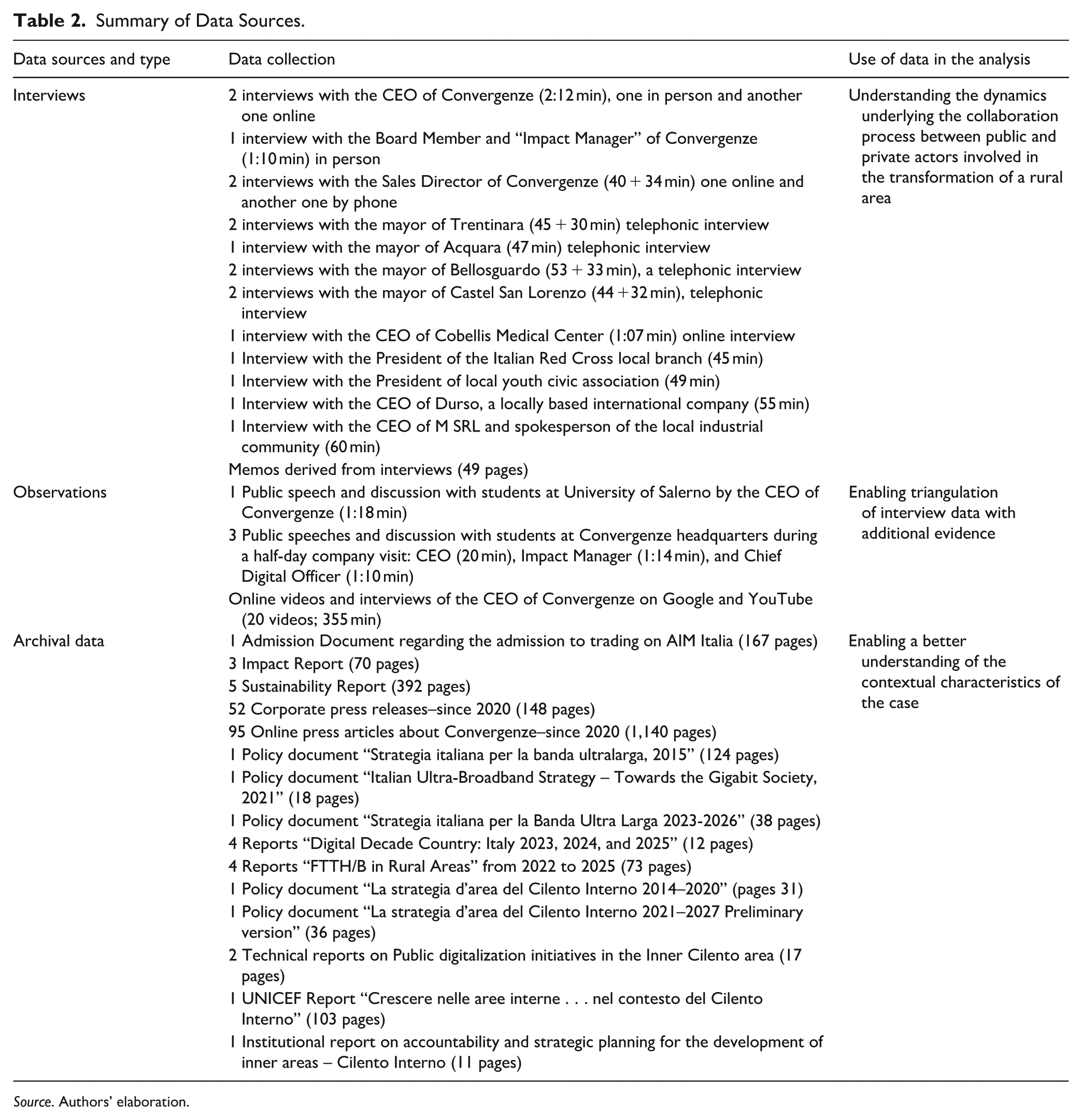
Source. Authors’ elaboration.
Following the initial interview with the CEO, subsequent participants were identified through a snowball sampling strategy (Patton, 1990), beginning within the organization and expanding outward with the active cooperation of Convergenze staff. All interviews were conducted in Italian, either in person, via Microsoft Teams, or by phone. The interviews were conducted by one of the Italian authors, with the support of a colleague who took notes and managed the recordings throughout the process. Additional qualitative insights were obtained through a site visit to Convergenze’s headquarters, where the research team engaged in informal conversations with key personnel, including the Chief Digital Officer and several collaborators. Further data were collected during a seminar hosted by the University of Salerno, as part of a Social Innovation course, where Convergenze representatives were invited speakers. All authors were present during both the site visit and the seminar. In both settings, two researchers acted as moderators, guiding the discussion, while the others recorded observations and field notes.
To ensure data triangulation (Gibbert et al., 2008), primary data were complemented by an extensive review of secondary sources, including the company’s impact and sustainability reports, internal regulations, blog posts, and documentation related to its listing on the stock exchange. A summary of all data sources is presented in Table 2.
Interviews typically lasted between 30 min and 1 hr, with an average duration of 49 min, with a total interviews duration of 832. All interviews were audio-recorded and subsequently transcribed verbatim. The conversations focused on the collaboration between the company and local institutions, with particular attention to community needs and resources, as well as the role of digital technologies in the deployment of FTTH infrastructure.
In terms of the interview protocol (Supplemental Appendix C), the study combined life story interviews with semi-structured interviews (Atkinson, 2002). The first part of each interview employed the life story approach, which, following existing literature (Cucino et al., 2025), is especially valuable in enabling the co-construction of narratives and meanings between interviewer and interviewee (Riessman, 2008). This method enabled an in-depth examination of individual experiences related to public–private collaboration. Participants were invited to recount the story of the events in which they had been directly involved. The second part of the interview followed a semi-structured format and focused more explicitly on a set of predefined themes. Taken together, this combination supported the analysis of sustainable development processes in rural contexts (McMorran et al., 2014), providing both depth and comparability across cases. Regarding the discussion conducted during the seminar and company visit, a predefined script was not used. Questions arose naturally during the dialogue, aiming to obtain a description and interpretation of events directly from the interviewee, in line with the principle of the story interview approach (Riessman, 2008).
Data Analysis
All interviews were transcribed verbatim and translated into English. After familiarizing ourselves with the interviews, observation notes, and archival materials, we developed a case study database to systematically organize and manage the large volume of collected data (Yin, 2018).
We followed the three-stage framework proposed by Larty and Hamilton (2011), combining a structuralist lens with subsequent phases of contextualization and interpretive analysis. A manual content analysis approach was adopted throughout. In the first phase, all interviews were read individually, with attention to the narrative structure – specifically the role of the narrator, characters, sequence of events, and narrative purpose (Czarniawska, 2004).
In the second phase, each interview was re-analyzed using narrative analysis techniques (Hytti et al., 2017; Riessman, 2008). This stage involved contextualizing the stories by acknowledging their embedded nature within specific social and institutional settings (Larty & Hamilton, 2011). The analysis focused on those parts of the material that addressed the public–private collaboration process, paying particular attention to how interviewees described their own roles, as well as to the dynamics and themes that emerged from their accounts.
In the final phase, we triangulated information across all interviews to distill the core elements shaping the relationship between Convergenze and local authorities. Finally, the emerging themes were interpreted in light of the main dimensions of the SASS. This final step enabled us to understand how the collaboration between the company and public institutions supports the digital transition of rural areas and contributes to advancing social sustainability in these contexts (the coding scheme is presented in Supplemental Appendix B). Further details on the data analysis process can be found in Supplemental Appendix A Table A1.
Results
This section is organized around the two research questions guiding the study. First, we show how digital transformation contributes to the five principles of the SASS in the specific context of rural areas. Second, we identify three key factors that enable collaboration between private and public actors aimed at promoting digital transformation in rural areas. The results are presented and discussed in detail in the following sections.
Supporting Digital Transformation to Enhance Social Sustainability in Rural Areas
The capacity to scale FTTH infrastructure in a “market failure” area rests on strong capabilities to establish effective public–private collaboration in the area, driven by a shared goal of eliminating the digital divide in these communities, supporting the digital transformation to enhance social sustainability. In particular, it is possible to identify the role of digitalization in promoting sustainable development.
Promoting the Right to Health
In the context of social sustainability and the realization of the right to health, digital health holds significant potential for rural areas. A key benefit is improved access to healthcare services: telemedicine allows patients in remote locations to consult specialists without undertaking long journeys. In this sense, digital health technologies can help bridge the quality-of-care gap between urban and rural areas. As reported by the mayor of Aquara: “Investing in telemedicine is our aspiration. In the past, we had already equipped some facilities for this purpose; however, we did not have adequate infrastructure technology.”
Despite its potential, several challenges must be addressed to fully realize the benefits of digital health in rural areas. Reliable internet and telecommunications infrastructure are essential prerequisites for the effective functioning of digital health solutions. As highlighted by the mayor of Castel San Lorenzo: “For a community like ours, it is essential to ensure services for the elderly, and fiber technology is fundamental because it enables the realization of the new healthcare organization model being implemented in the Campania region [. . .] without access to the FTTH infrastructure, it would have been impossible to enable telemedicine services for our community.” As highlighted by the mayor of Trentinara, “Access to fiber today has created the conditions to implement telemedicine solutions, which are increasingly necessary for our community. Today, in our territory, there are the conditions to realize the regional strategy for telemedicine.”
In sum, it emerges that digital health has the potential to transform the delivery of healthcare in rural areas, making it more accessible, efficient, and effective. Today, access to an FTTH connection enables even small municipalities to address health challenges, thereby contributing to overall health equity and social sustainability. Ensuring the realization of the right to health in rural areas through digital health not only helps to prevent social conditions that undermine health, but also makes it possible to provide preventive and curative care services, thus promoting a more just and inclusive society.
A concrete example of how digitalization enabled by FTTH connectivity is supporting digital health processes can be found in the local branch of the Italian Red Cross (CRI) Capaccio, an organization active in the area with more than 200 members and 20 employees. As highlighted by the local CRI president, the strengthening of the broadband network made it possible to launch a remote psychological counseling service and to develop an online platform for booking healthcare and assistance services through the organization’s website. Moreover, as the president further emphasized, FTTH in internal areas is opening the door to new digital health solutions currently being tested: “In the long term, FTTH will be a central infrastructure for supporting healthcare and assistance services in Cilento internal areas, such as the pilot projects developed by the Local Health Authority for home dialysis and the creation of local medical centers providing proximity care.”
Another notable example of a facility already implementing digital healthcare through the high-speed FTTH infrastructure is the Cobellis Medical Center, one of the first organizations to adopt Convergenze’s solution. “It has been a shared journey of growth,” highlights the CEO of Cobellis. “Thanks to Convergenze’s technological infrastructure, the clinic now enjoys the network stability required to develop its robotics center and participate in global medical conferences directly from its operating rooms, part of a center of excellence located in the heart of Cilento.” With fiber connectivity, the Cobellis Clinic has also installed a centralized mega-server within the facility, which now serves as the core hub for numerous satellite diagnostic centers spread across Cilento and the Salerno area. This setup enables the full digitalization of medical records and allows both patients and healthcare professionals to access them remotely. The next step the Medical Center is pursuing is home healthcare. As the CEO further explains, “We have been investing in hardware and software for years. Today, we can care for a patient living in a remote inland village of Cilento, monitor their condition, and keep them connected. However, without a stable, fast, and reliable network infrastructure, all of this would be impossible.”
Facilitating Inclusive Participation in Social System Development
Ensuring stable and fast internet access means creating the conditions for democratic participation and access to information, both of which are essential elements of a sustainable society. Bringing internet access to rural communities has been Convergenze’s core mission since its founding. By focusing on understanding the needs of the communities it serves and developing solutions and services tailored to rural areas, Convergenze is progressively closing the digital gap. Between 2018 and 2024, the number of users served by Convergenze’s telecommunications services grew from 32,188 to 56,239 (Convergenze Sustainability Report, 2020, 2024). With adequate connectivity, people living in rural areas can participate in virtual meetings and public consultations, and remain informed about developments affecting their lives and communities. At the same time, the FTTH infrastructure can significantly transform the quality of public services offered to citizens, as highlighted by the mayor of Trentinara: “Previously, municipal offices had an internet connection that did not guarantee stability and quality, creating significant difficulties for the offices. Today, we have greatly improved the administrative efficiency of our municipality, enhancing the quality of services offered to citizens.”
Internet access in rural areas also supports other types of initiatives, such as the project being developed by the municipality of Castel San Lorenzo to strengthen the sense of community among citizens who have emigrated worldwide. As highlighted by the mayor of Castel San Lorenzo, “We are building contacts with fellow townspeople who are scattered around the world. We have developed a series of virtual initiatives to strengthen the bond of our community [. . .] This project is part of a broader vision of participating in a national project of roots tourism.”
At the same time, access to a stable network underpins the project of the municipality of Aquara to create a dedicated space for smart working, enabling residents who work remotely to meet and interact, while also attracting remote workers from outside the area: “Thanks to fiber, today we are also ready to welcome this new type of citizen. We are equipping and dedicating an entire building to make it an ideal space for those working remotely.”
The availability of FTTH internet has also revitalized the community’s long-standing tradition of local associationism. As the President of the Remain Association explained, until only a few years ago even the simplest administrative tasks, such as completing SIAE accreditation for a cultural event, required traveling nearly 70 km: “Back then, with the old connections, we had to get in the car and drive for over an hour just to submit a form,” he recalled, “now, with a single click, we can handle everything from home. It saves us time, energy, and allows us to focus on what really matters.”
In conclusion, guaranteeing reliable internet access in rural areas is essential to ensure that all individuals can actively participate in the formation, governance, and improvement of social systems.
Supporting Learning, Skill-Building, and Personal Growth
Digital technologies have increasingly reshaped learning processes, extending their relevance beyond formal education to encompass lifelong learning trajectories. FTTH connections play a crucial role in enabling learning and skill development in rural areas, helping to overcome geographical limitations. The most evident example emerged during the 2020 lockdown caused by the COVID-19 pandemic, as highlighted by the mayor of Trentinara: “For us, it was crucial to have FTTH network coverage in 2020, because this allowed students residing in Trentinara to study from home, just like their peers living in urban areas.” With high-speed internet access, people living in rural areas can take advantage of online educational resources, courses, and high-quality learning materials, thereby making it easier for individuals to engage in lifelong learning initiatives. Access to professional training and continuous education programs enables people to acquire new competencies and maintain their competitiveness in the labor market.
Overall, the implementation of FTTH connections in rural areas contributes significantly to learning processes, skill development, and personal growth. By expanding access to knowledge and training opportunities, these infrastructures contribute to the creation of more equitable, inclusive, and sustainable communities.
Removing Structural Impartialities
The concept of impartiality between urban and rural areas refers to the need to ensure that all communities, regardless of geographical context, have equal access to the same opportunities and resources. Inequalities can emerge due to disparities in access to essential services, which, as previously highlighted, can be addressed through access to FTTH infrastructure. Therefore, the ability to access such technology lays the foundation for tackling these disparities by promoting services and initiatives aimed at facilitating access to public services and supporting social inclusion in rural as well as urban areas. As highlighted by the mayor of Aquara: “Although there is still much to be done, today we feel we are moving at the same speed as urban areas, this is already a positive fact because we do not feel like second-class citizens.”
However, while technological infrastructure lays the groundwork for promoting inclusion and potentially reducing inequalities between rural and urban areas, it is important to note that technology alone is not sufficient to eliminate impartiality and socioeconomic inequalities. As emphasized by the mayor of Bellosguardo, “This technology creates value for residents in inland areas, but it alone does not make the difference. To retain people, it is necessary to implement actions that support residency. Having technology does not mean overcoming the limitations or the lack of other services that support residency in these areas. Today, however, we must work synergistically, using the power of technology to create new conditions for belonging and residency.”
The removal of structural disparities also plays a key role in enhancing the attractiveness of these areas for business activities. Several companies located in territories now served by Convergenze’s FTTH network had previously considered relocating to more developed urban areas, as the existing infrastructure was insufficient to support their growth. As highlighted by the CEO of Convergenze, “the development of the FTTH infrastructure has helped retain the more digital companies that were in a phase of expansion. A clear example is one of our business clients operating in the digital printing sector, a company that relies heavily on fast internet connectivity. We know they had started scouting for new locations to move their operations, but in this case, Convergenze certainly helped prevent that relocation.”
The Aquara municipality has the main quarter, Durso, a mechanical company with around 50 employees that produces agricultural machinery, operating machines, and industrial vehicles for national and European markets. Although already a client of Convergenze under previous connectivity solutions, the company decided to switch to FTTH broadband, contributing to the costs of laying the network in the area surrounding its facilities, an area not originally included in the municipal plan. As the CEO explained, the decision was primarily driven by the need to ensure efficiency and continuity in production processes: “With FTTH, we were finally able to use cloud-based software instead of local installations, something that wasn’t possible before. This allowed us to reduce costs, avoid fixed licenses, and upgrade only the specific modules we needed, especially for design software.” This example illustrates how, even in rural contexts, the adoption of advanced digital infrastructure can become a concrete lever for operational innovation and economic sustainability among local enterprises.
Enabling Individual Meaning-Making and Co-Creation of Shared Values
Ensuring high-speed internet access is supporting the digital transformation of local businesses, but also enabling individuals to pursue and realize their aspirations and values without technological barriers. As emphasized by the mayor of Castel San Lorenzo: “Today, numerous small productive entities in our territory, especially those in the food and wine sector, are developing online commerce projects, benefiting from a stable connection.” At the same time, this infrastructure nurtures creativity and individual initiative, as illustrated by the project developed by the Pagano brothers in the municipality of Aquara. They have developed a weather station, offering a free service to the community, and are working to design custom agri-tech solutions in collaboration with local wine-producing companies in the Cilento area. The mayor of Aquara proudly notes how the solution developed by local young citizens, following the completion of the village’s fiber-optic cabling, has had a direct impact in supporting local agricultural activities: “This solution helps small-scale farmers manage their operations by providing precise guidance on the best times to carry out necessary treatments, especially for olive trees and vineyards. This makes it possible to perform these treatments more regularly, as opposed to relying on rigid schedules.” The mayor’s words are particularly meaningful, as they point not only to the first steps of very small communities toward what could be considered smart farming models, but also to how digitalization can support local creativity and talent, fostering the development of meaningful relationships within communities committed to generating both social and economic value. This is especially relevant considering that the municipality of Aquara was among the Cilento areas classified as “rural areas with complex development problems,” according to the classification adopted under the LEADER/European Agricultural Fund for Rural Development (EAFRD) program (Campania PSR, 2014–2020).
Access to FTTH technology is also supporting the work of local associations such as Remain, which, thanks to high-speed connectivity, has been able to develop projects that connect the local community with people around the world. The aim is to strengthen local roots while enhancing the possibility of remaining in the area rather than being forced to leave; indeed, “remain” means “to stay” in the Cilento dialect. As highlighted by the president of Remain, “the main need of our community is to open up and overcome the sense of isolation that a territory like ours often experiences. FTTH is enabling us to move at the same speed as urban areas, helping to bridge one of the main infrastructural gaps hindering the development of our region.” In this way, as highlighted by the CEO of Convergenze, through the development of technological infrastructure, “we are closing the digital gap in inland areas, creating the conditions for young people from these territories, who are currently gaining experience elsewhere, to return and start their own businesses, also taking advantage of the incentives promoted by the national government to support the creation of new enterprises in these regions.”
Key Factors Supporting Public–Private Collaboration for Digitalization of Rural Areas
These results rest on strong capabilities to establish effective public–private collaboration in the area, driven by a shared goal of eliminating the digital divide in these communities. Our data analysis reveals three key elements underpinning the public–private collaboration that supported the digital transformation of this rural area: focusing on community needs, building mutual trust, and fostering proximity.
Community Needs
The identification of the specific needs of rural areas emerged as a crucial component of the public–private collaboration supporting the digitalization of these territories. Although Convergenze is steadily expanding its FTTH infrastructure in the white and gray areas of the Cilento region, the selection of each new target area still begins with an assessment of the specific needs of the territory. Priority is given to areas “where Convergenze’s offering can provide significant added value, supporting not only the company’s growth but also the development of available services within the territory itself” (Sustainability Report, 2023).
At the same time, interviews with mayors revealed that these towns often face similar social challenges and that the local communities can be broadly divided into two main macro-categories: the elderly and the working-age population. The latter is frequently characterized by a strong attachment to local roots; remaining in these areas constitutes a conscious life choice. In line with this sense of belonging, in the years following the 2020 lockdown, a strong desire to “return home” has also re-emerged among those who had previously emigrated for work reasons.
As emerged from the interviews, even in these small territories, there is a degree of dynamism among small and very small entrepreneurs, often engaged in agricultural activities. This is the case of Aquara, which was recently awarded the title of “City of Wine” due to having the highest concentration of vineyards in the province of Salerno. The mayor proudly recalls this recognition but also underscores that “it is essential to provide the conditions to support the dynamism of small entrepreneurs who choose to develop their projects here.”
The need to provide adequate network infrastructure to support entrepreneurial projects also emerged as a clear priority for some of Convergenze’s business clients. As highlighted by the CEO of Convergenze, “Before the installation of the FTTH network, some of them were even considering relocating their operations, as they required an internet connection capable of keeping pace with the growth of their business.”
In this area, there are also small and medium-sized enterprises integrated into major industrial supply chains, such as those in the automotive and aerospace sectors. This is the case of the industrial zone of Cicerale, where the local entrepreneurial community, led by the CEO of MGR Group SRL, requested the installation of FTTH infrastructure to support industrial transformation processes. As the CEO of MGR Group SRL explains: “Integrating our manufacturing expertise with digital technologies and creating connected production systems was crucial for us, as the digital industrialization of our production processes was the only way to access specific contracts and develop products that could keep us competitive.”
On the other hand, the elderly population is largely composed of individuals who have spent their entire lives in these towns. The needs of this group differ significantly from those of the working-age population. The elderly particularly require access to adequate care services. As pointed out by the mayor of Bellosguardo: “In small towns like ours, in inland areas, the average age of the population has risen so much; we now have a growing majority of elderly residents in need of care, especially healthcare.” However, as highlighted by the CEO of Cobellis Medical Center, innovating healthcare services and implementing telemedicine, home care, digital health, and remote patient support in these regions requires first and foremost an adequate digital infrastructure: “It is essential to ensure stable, fast, and reliable internet access even in marginal areas; otherwise, it becomes impossible to initiate services such as home care.”
There is also a smaller, yet particularly crucial, segment of the population consisting of children and young people who are still completing their education. As highlighted in the UNICEF report on development processes in the inner areas of Cilento (Carraro et al., 2023), young people view digital technologies as a means to “move beyond” territorial boundaries. However, in previous years, the lack of infrastructure significantly limited opportunities for education and socialization. The UNICEF report, therefore, stresses the importance of ensuring stable internet connectivity and creating spaces in which young people can develop digital skills to reduce the digital divide and promote social inclusion.
Beyond the problems experienced by current residents, these communities also face an additional challenge linked to depopulation, which translates into the loss of traditional knowledge and cultural heritage that embody the roots of the community. As the mayor of Bellosguardo stresses, “A community that loses knowledge about its roots will hardly be able to endure, so a way must be found to preserve and enhance its identity while at the same time developing a new model of community.” However, to counter depopulation, it is essential to ensure services for residents and businesses. While digitalizing public services can ease daily life, adequate infrastructure is needed to support such a transformation. As this case shows, the local public–private collaboration has been crucial in creating the conditions to seize the digitalization opportunities offered by the national government through the PNRR (Italy’s National Recovery and Resilience Plan), to digitalize public services and improve municipal management processes. As highlighted by the mayor of Trentinara, “Applying for funding to implement these services was legally possible, but the FTTH infrastructure was indispensable; it would have been like having access to a car without having the roads to drive it on. That’s why it was essential to build the road first, and we did so locally through public–private collaboration.”
Mutual Trust
Since its founding, Convergenze has always set itself the goal of reducing the digital divide in rural areas. However, it has been Convergenze’s ability to pay attention to the needs of the region from the very beginning, that has allowed it to earn the trust of the territory, both in its relationships with public administrations and with citizens.
Convergenze has served the rural and mountainous areas of the Cilento region, developing internet connectivity services via Wi-Fi UWA and telephone services. This has enabled the company to gain a detailed understanding of the territory and to build a strong reputation, as highlighted by the words of the mayor of Castel San Lorenzo: “We knew the company and we knew that the company knew the territory. When Convergenze expressed interest in investing in areas not served by other providers by laying fiber, it felt like meeting halfway . . . knowing that the company had already proven itself reliable with its telephone services was what convinced us to trust Convergenze to develop this kind of solution.”
As President of the Remain Association, said “the relationship between Convergenze and our community has grown stronger over the years. Convergenze has been active in our area for more than fifteen years, taking us from 56k connections to FTTH, supporting the growth of an entire generation of children and improving the lives of adults and workers in our community.”
The ability to build relationships based on trust has been decisive in increasing collaboration between the public and private sectors over the years. This collaboration has helped bridge social gaps arising from the digital divide in gray areas that the state had largely neglected. As the mayor of Trentinara noted, through public–private collaboration: “We managed to bring fiber to a place like Trentinara before the State intervened, and this is an achievement that must be credited to Convergenze.”
Although the company is now listed on the stock exchange, its local presence and focus on human relationships have played a fundamental role in consolidating trust in the company. Indeed, the unique characteristic of these regions is that they continue to place great value on personal relationships, with the understanding that working together is essential to overcoming the challenges these areas face. As highlighted by the mayor of Trentinara: “The direct relationship, even with Engineer Pingaro, meant that we could meet to discuss how to improve the services offered in our municipality and to make the territory more attractive from an investment perspective.”
The role of interpersonal trust plays a key role both in public–private relationships, particularly in critical sectors that provide services to the community, such as healthcare. In fact, it was precisely the personal trust in the CEO of Convergenze that led the management of Clinica Cobellis to choose Convergenze for their internet services several years ago, despite the presence of other providers in the municipality of Vallo della Lucania. This is evident in the words of the CEO of Cobellis Medical Center: “Because of personal relationships of esteem and trust in the people, from the very beginning we chose to rely on an alternative operator rather than those that might have seemed more prestigious. This choice allowed us, over time, to develop a path of growth together.”
The trust that Convergenze has earned over the years is undoubtedly based on a clear vision regarding the role of collaboration between the public and private sectors, which is crucial for the development of rural areas, as highlighted by the words of the CEO of Convergenze: “The collaboration between the public and private sectors is the key to overcoming the challenges of the future, as neither the private sector nor the public sector alone is capable of being fully efficient anymore.”
Building on the trust-based collaborative process that has supported the digital transformation, Convergenze is currently experimenting in some municipalities with the implementation of an Internet of Things solution applied to the water distribution network. This LoRaWan technology-based solution allows real-time monitoring of water meter statuses to quickly detect and geolocate potential faults. Also, in 2022, Convergenze developed a cybersecurity service offering for business clients and public administrations. Once again, starting from listening to customer needs, the company decided to provide a subscription-based solution that doesn’t require significant upfront investment.
Proximity
In the public–private collaboration, trust is built through physical presence and geographic proximity. Convergenze’s commercial strategy, in fact, is that for each newly targeted territory “a local physical presence is established and local sales personnel are engaged, people who are integrated into the community and aware of the needs of potential customers, so as to ensure that the added value offered is clearly perceived by the local population” (Sustainability Report, 2021, p. 31). This strategic choice is consistent with the company’s broader organizational approach of internalizing operations “whenever possible.” According to the CEO of Convergenze, this integrated management model has played a crucial role over the years in building and reinforcing trust between the company and local communities: “We are a highly integrated company, so even the support is internal and provided by Convergenze employees . . . customer care is a core service for customer satisfaction and cannot be outsourced” (Source: Interview with CEO Rosario Pingaro on Class CNBC – “Presente e futuro di Convergenze SpA SB”).
The integration strategy, as the result of a deep understanding of customers’ needs and characteristics, appears to be a truly decisive element, as highlighted by the CEO of Cobellis Medical Center, who stated that: “One of the most important elements in the relationship with Convergenze is proximity. When there is a problem, you receive an immediate response and solutions that you simply wouldn’t get from large organizations, because in this case, the technician is local and the support service is managed internally. This element is crucial for a healthcare center that cannot afford to lose connectivity.”
This view is echoed in the description provided by the CEO of MGR Group SRL: “I’m aware that our industrial zone is somewhat on the margins compared to other industrial zones, which is why it’s so important for us that Convergenze is really present in the area and always prompt and able to understand our needs.”
Proximity thus emerges as a crucial element in the development and consolidation of public–private collaboration for the digital transformation of rural areas. It is essential to enabling a genuine understanding of the needs of the region and its communities through continuous dialogue. This approach makes it possible to implement tailored solutions and provide timely and effective support, which are necessary to ensure the stability of connectivity and, consequently, of all activities that depend on this infrastructure. In fact, as highlighted by the CEO of Convergenze, one of the competitive advantages of being a small infrastructure operator is precisely the flexibility and ability to manage relationships with network providers directly, “which allows us to quickly resolve particular and specific issues, enabling us to provide an additional layer of support both in pre-sales and post-sales.” The proximity and local presence of Convergenze have continued to intensify even as the company has grown into a national operator, thereby fostering and consolidating the trust needed to sustain regional development. Reflecting this strong attachment to the territory and driven by the intention to reinforce a sense of closeness to the community, Convergenze has opened the Convergenze Academy in Trentinara, where it conducts training activities for young people interested in the cybersecurity and telecommunications sectors.
Through the launch of its Academy, aimed at training a new generation of “Cilentani” capable of supporting the digital transformation of their territory, the relationship of trust between the institution and Convergenze continues to grow stronger, this is also reflected in the endorsement granted to the Academy by the Cilento and Vallo di Diano National Park.
Another example of a digital service developed to support these communities is the “TikTak” platform, developed by Convergenze and made freely available to local administrations and associations to digitalize the ticketing process for the paid food and cultural-related events held throughout the Cilento area. This platform helps streamline the organizational and logistical aspects of these social events, which number over 70 during the summer season.
Discussion
This study engages with the growing debate in both public and academic spheres on social sustainability and the digitalization of rural areas and investigates the role of public–private collaboration as an approach to support the digital transformation of these territories. It contributes to the emerging body of research on the digitalization of rural areas by demonstrating how such processes can enhance social sustainability.
Recent studies (Grybauskas et al., 2022; Szalkowski & Johansen, 2024) have shown that digital transformation can contribute to the advancement of social sustainability. With our study, we extend this line of inquiry by exploring this relationship in the context of rural areas and by examining the role that public–private collaboration plays in enabling this process. Several studies (Bowen and Morris, 2019; Fanjul et al., 2023; Kleemann & Semrau, 2025) have highlighted the urgency of addressing the digital divide between urban and rural areas, as it is a key factor in tackling the economic and social challenges faced by rural territories. Although public–private collaboration has proven to be an effective approach to supporting digital-transformation processes (Brunetti et al., 2020; Casprini & Palumbo, 2022), there is a clear need to dedicate more attention to rural areas as a distinct context of analysis.
In our case, following Szalkowski and Johansen (2024), we chose to examine the impact of a single technology, which, as an infrastructure, provides the necessary foundation for the implementation of digital transformation in rural areas. Through public–private collaboration, fiber-optic connectivity was extended to gray and white areas, which contributed to improved access to healthcare services and supported engagement in lifelong and online learning. At the same time, it strengthened administrative efficiency and encouraged greater community participation in social processes. Equitable access to digital resources has narrowed the gap between urban and rural areas, creating the conditions to address socioeconomic inequalities through targeted action.
Public–private collaboration can take different forms (Stadtler 2015), but represents a fundamental mechanism for addressing social (Di Vito et al., 2020) and environmental (Lin, 2014) challenges and promoting sustainable development. Public–private initiatives are particularly important for optimizing resource utilization and accelerating the adoption of advanced technologies (Casprini & Palumbo, 2022). Moreover, such collaborations foster greater social inclusion by helping to ensure that the benefits of development are equitably distributed and that implemented solutions genuinely meet community needs.
Our findings show that rural settings are characterized by specific “rules of engagement” for public–private collaboration, built around three mutually reinforcing elements: (a) a focus on community needs, (b) the building of mutual trust, and (c) the fostering of proximity. The presence of these elements is essential for effective collaboration and for driving digital-transformation processes in rural areas. Focusing on community needs requires an in-depth analysis of the requirements of communities located far from urban centers, involving an in-depth analysis of various socioeconomic dimensions (Hodge & Monk, 2004; Ruiz Pulpón & del Carmen Cañizares Ruiz, 2020). Trust is a fundamental element in this collaborative process (Nielsen, 2004), and for trust in a collaboration to strengthen, actors must be perceived as trustworthy (Hardin, 1996; Tullberg, 2008). Creating conditions of trustworthiness requires opportunities to demonstrate ability, benevolent motivation, and integrity (Colquitt et al., 2007; Mayer & Gavin, 2005). In addition, geographical proximity is crucial to building mutual trust, as it stimulates the formation and evolution of collaborations among local actors, supporting interactive learning processes and the implementation of innovation practices (Boschma, 2005; Ooms & Piepenbrink, 2021). Our results indicate that these three elements underpinning the success of public–private collaboration in supporting the digitalization of rural areas operate as a virtuous, self-reinforcing cycle (Figure 2). In fact, grounded in trust, geographical proximity, and a strong focus on community needs, the collaboration between Convergenze and the involved municipalities continues to strengthen over time, driving the digital transformation of the rural area and promoting social sustainability outcomes. In turn, these outcomes further reinforce and expand collaboration, generating an iterative and mutually reinforcing virtuous cycle. Overall, this ongoing process of digital transformation aligns well with Convergenze’s vision, which aims to make these territories perceived as in step with the times.
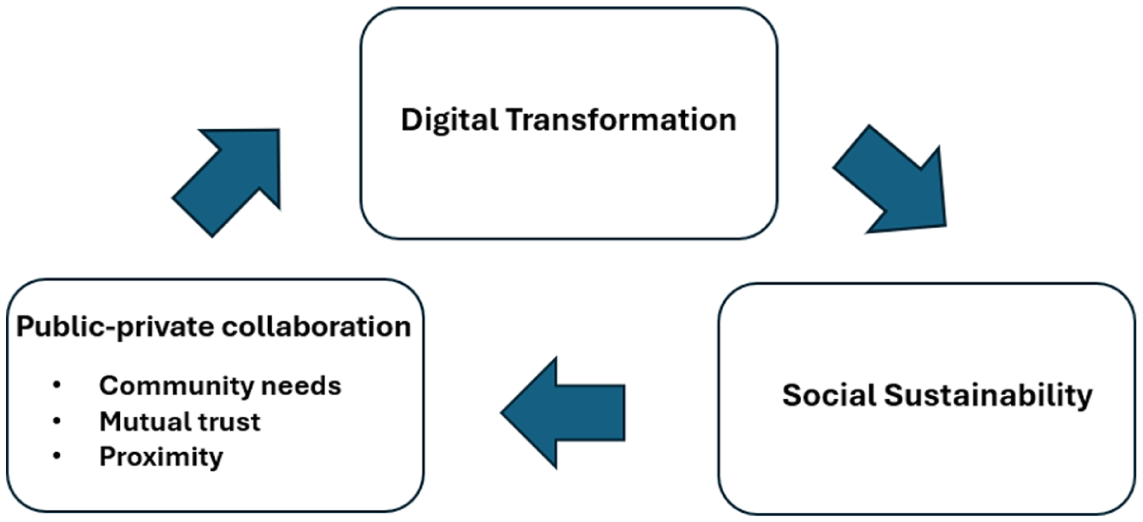
A Circular Model for Social Sustainability in Rural Areas.
Moreover, results of this study show that, similarly to public–private partnerships (Tanveer et al., 2025), local public–private collaborations can also play a significant role in effectively supporting digital innovation. However, the local collaboration between Convergenze and the municipalities aligns, at least in part, with the main models of public–private collaboration (Guzmán & Sierra, 2012). These approaches generally assume that governments at different levels must identify ways to provide efficient services without transferring the economic burden of such interventions onto citizens, relying on processes of devolution, whereby power and responsibility for service provision are transferred from national to local governments (Rees & Gardner, 2003). However, the case examined deviates from the standard public–private collaboration, because its origin is fundamentally different. Rather than being the result of a deliberate national strategy to empower local actors, this local public–private collaboration emerged because the national digitalization plan failed to reach those rural areas. Thus, only the component of local cooperation to deliver efficient services is intentionally present. The second component, “devolution,” did not occur as a planned institutional reform but materialized de facto as municipalities and a local private provider filled the void left by national-level failure.
Overall, the case results challenge the assumption that effective public–private collaboration in digitalization is primarily the result of coordinated top-down governance. Instead, it demonstrates that local partnerships may emerge in spite of, rather than thanks to, national strategies, raising important questions about institutional fragmentation, the importance of identifying the elements of territorial context, and the conditions under which local actors can effectively drive digital transformation. On the other side, the case also illustrates how locally embedded public–private collaboration can play a dual role: first, as a mechanism for anticipating and compensating for delays in national strategies, and second, as a corrective force ensuring that top-down implementation becomes better aligned with local priorities.
Conclusion and Implications
This study contributes to the debate on the social implications of digital technologies by examining how public–private collaboration can drive digital transformation in rural areas and support social sustainability. The findings generate a set of theoretical and practical implications, while also offering insights into context-specific conditions and avenues for future research.
First, the article enriches research on social sustainability by illustrating how social value creation in rural areas can be interpreted through the SASS (Broman & Robert, 2016; Missimer et al., 2016, 2017). Rather than using SASS only as a set of abstract principles, we employ it as an analytical lens to read how concrete practices and outcomes of the collaboration contribute to social sustainability in a rural context. The case shows that the social sustainability conditions outlined by SASS do not materialize automatically once a collaboration is in place but are supported and channeled by three context-specific enabling mechanisms: a sustained focus on community needs, the deliberate construction of mutual trust, and the cultivation of proximity (physical, organizational, and relational). In this way, the study refines the SASS framework by specifying some of the enabling conditions under which its social sustainability principles can be activated in rural areas, and by foregrounding the role of digital transformation and place-based leadership in supporting these processes.
Second, it expands existing work on digital-transformation studies (Bohnsack et al., 2022; Dabrowska et al., 2022; Salemink et al., 2025; Varriale et al., 2024) by shifting the focus from urban settings to rural areas and by examining the social outcomes of FTTH deployment in territories affected by market failure. The findings show that digital infrastructure in itself is not sufficient to generate social sustainability; its transformative potential depends on how it is embedded in local contexts and governance arrangements (Ahvenniemi et al., 2017; Dempsey et al., 2012; Faludi, 2023). In the case analyzed, FTTH deployment becomes a lever for inclusion, empowerment and community resilience when it is combined with long-term public–private collaboration, responsiveness to local needs and mechanisms for involving citizens and municipalities in the design and use of digital services.
Third, the article adds to the literature on public–private collaboration (Brunetti et al., 2020; Casprini & Palumbo, 2022; Stadtler, 2015) by identifying three key enabling factors (namely, community needs, mutual trust and proximity) as central to the generation of social sustainability in rural digitalization processes, and by proposing a circular model that links public–private collaboration, digital transformation and social sustainability in an iterative and mutually reinforcing way.
Practically, the findings suggest that public institutions and firms are encouraged to conceive collaboration not as a one-off project focused solely on infrastructure delivery, but as a long-term process of joint value creation for local communities.
For policymakers and development agencies, the results highlighted how rural digitalization strategies should go beyond closing connectivity gaps and explicitly integrate social sustainability goals, ensuring that investments in infrastructure are accompanied by initiatives that strengthen local capabilities, participation and institutional coordination.
For municipalities, this means investing in stable relationships with private partners, clarifying shared objectives and keeping community needs at the center of decision-making. For firms operating in marginal or underserved territories, the case points to a model of engagement that goes beyond traditional CSR, based on territorial anchoring, continuous dialogue with local actors and visible commitment to the area.
At the same time, the case shows that these enabling factors are closely intertwined with specific contextual conditions. First, the socioeconomic characteristics of the territory, marked by low population density, limited infrastructural development, and a generally weak civic and institutional fabric, suggest that bottom-up dynamics alone may not be sufficient to trigger or sustain transformational processes. In such underdeveloped rural contexts, where social capital is fragmented and formal governance mechanisms may be ineffective or lacking, the activation of collaborative trajectories often requires a strong, legitimized actor capable of initiating and steering the process. The success of the collaboration in the Cilento area is, in fact, linked to the presence of a locally embedded company and a CEO who enjoys strong legitimacy, is able to bridge fragmented institutional arrangements, and articulates a long-term vision for territorial development. These considerations suggest that the successful implementation of public–private collaborations for digital transformation in rural areas may depend as much on the design of participatory processes as on the availability of committed leadership capable of navigating complexity and asymmetry. This indicates that attempts to replicate similar models should pay attention not only to the formal design of partnerships, but also to leadership capacity, social embeddedness, and the relational dynamics among actors. Future research could deepen these insights by comparing different types of anchor organizations and rural territories, and by examining how the circular model operates over time under varying socio-institutional conditions.
Nonetheless, certain limitations open avenues for future research. First, reliance on a single-case study in one rural area limits the generalizability of the findings. Future empirical work should investigate how collaborations between private companies and local governments can effectively promote social sustainability across diverse rural contexts, for example, through comparative or multi-case designs.
Second, this article focuses primarily on FTTH as an example of infrastructural digital innovation; subsequent studies could examine how other digital technologies and service-based digital solutions contribute to social sustainability in rural areas.
Third, future research could analyze public–private collaboration for rural digitalization from an innovation-ecosystem perspective, thereby capturing additional forms of multi-actor connections and governance arrangements.
A further limitation concerns the lack of quantitative data to monitor the impact of digitalization on the digital divide. Neither the municipal alliances, the individual municipalities, nor the company involved had undertaken any systematic assessment of how digital technologies affected local disparities in connectivity or access. Public actors tended to consider such monitoring as primarily within the remit of the private partner, while the private actor perceived it as a responsibility of public institutions. At the same time, national and international research institutes that monitor digitalization processes and the digital divide generally rely on aggregated data, focusing on broad categories such as “rural areas” rather than specific local communities.
This gap highlights the need for local actors, particularly research institutions, to play a more active role within these territories. Establishing operational working groups or local observatories could help generate fine-grained evidence on digital inclusion, foster a more ecosystem-oriented approach to digital transformation, and support evidence-based policymaking at the community level.
Supplemental Material
sj-docx-1-bas-10.1177_00076503261447801 – Supplemental material for Public–Private Collaboration and Digital Transformation for Social Sustainability: A Case Study of a Rural Area
Supplemental material, sj-docx-1-bas-10.1177_00076503261447801 for Public–Private Collaboration and Digital Transformation for Social Sustainability: A Case Study of a Rural Area by Ricky Celenta, Rosangela Feola, Chiara Crudele and Roberto Parente in Business & Society
Supplemental Material
sj-docx-2-bas-10.1177_00076503261447801 – Supplemental material for Public–Private Collaboration and Digital Transformation for Social Sustainability: A Case Study of a Rural Area
Supplemental material, sj-docx-2-bas-10.1177_00076503261447801 for Public–Private Collaboration and Digital Transformation for Social Sustainability: A Case Study of a Rural Area by Ricky Celenta, Rosangela Feola, Chiara Crudele and Roberto Parente in Business & Society
Supplemental Material
sj-docx-3-bas-10.1177_00076503261447801 – Supplemental material for Public–Private Collaboration and Digital Transformation for Social Sustainability: A Case Study of a Rural Area
Supplemental material, sj-docx-3-bas-10.1177_00076503261447801 for Public–Private Collaboration and Digital Transformation for Social Sustainability: A Case Study of a Rural Area by Ricky Celenta, Rosangela Feola, Chiara Crudele and Roberto Parente in Business & Society
Footnotes

Funding
The authors received no financial support for the research, authorship, and/or publication of this article.
Declaration of Conflicting Interests
The authors declared no potential conflicts of interest with respect to the research, authorship, and/or publication of this article.
Supplemental material
Supplemental material for this article is available online.
Author Biographies
References
Supplementary Material
Please find the following supplemental material available below.
For Open Access articles published under a Creative Commons License, all supplemental material carries the same license as the article it is associated with.
For non-Open Access articles published, all supplemental material carries a non-exclusive license, and permission requests for re-use of supplemental material or any part of supplemental material shall be sent directly to the copyright owner as specified in the copyright notice associated with the article.
