






Abstract
The widespread implementation and adoption of digital technologies by organizations has given rise to a massive transformation with the potential to affect many organizations’ internal operations and processes. This transformation affects different levels and steps of output creation in companies, which eventually triggers changes in their organizational structures. This article develops an integrated picture on how digital transformation affects organization design by classifying and analyzing the effect on the process of output creation in firms. Based on this picture, it develops and elaborates on potential opportunities and challenges for companies resulting from digital transformation. Finally, it offers recommendations and decisions rules for dealing with these issues.
Digitization has drastically changed the way firms interact with consumers and the way they do business. In recent years, companies in nearly every sector have implemented initiatives to adopt new digital technologies and to harness their advantages. The process of rapid and widespread adoption and application of digital technologies in commercial settings is commonly referred to as digital transformation—and our focus is specifically on the recent and emerging digital technologies (i.e., artificial intelligence [AI], Internet of things, cloud computing, and big data). 1 This transformation is expected to bring key changes to business operations, processes, and organizational structures aiming to provide competitive products and services to the market. Similarly, the extent of experimentation and adoption of new digital technologies is closely associated with the extent of strategic renewal in a firm. 2 Indeed, the potential impact and scale is so significant that flawed and imperfect transformation can hurt companies in their competition. The benchmark for securing continued success is therefore not to do nothing, but rather to realize digital transformation in a sufficiently wide-ranging and competent manner. Failing to move fast enough can lead to a severe and lasting loss in competitiveness. For example, in retailing, large incumbents experienced significant losses in market share and ultimately long-term competitiveness because they were too slow to adopt and roll out digital and analytical tools in their operations. While most of the established players such as Ikea had somewhat rudimentary online shopping services, Amazon and Alibaba managed to overtake them in sales growth and market share through their extensive use of digital analytics. Similar patterns manifest in numerous other industries as companies are competing to reap the benefits of this transformation as it is fast becoming a, if not the, key driver of competitive advantage.
Although the powerful effect of digital transformation is widely discussed in the media—mainly in the form of narratives about spectacular triumphs and failures of specific businesses—it is still not clear how digital transformation precisely impacts firms’ internal processes to create output and, eventually, their organization design. While there is emerging research on the (often technology-specific) effects of digitization on tasks, employees, companies, and competitive landscapes, 3 we still see a need for an integrated view to generate a unified picture on how digitization affects organization design. In this article, we examine the big picture by breaking down the effect of digital transformation on each step of output creation within companies and then we discuss its aggregate impact. Hence, we take a microstructural approach to organization design. Following Puranam et al., 4 we consider an organization as a “(1) a multi-agent system with (2) identifiable boundaries and (3) system-level goals (purpose) toward which (4) the constituent agent’s efforts are expected to make a contribution.” A microstructural view on organization design is mainly concerned with the process of breaking down the system-wide goals into agent-level goals and necessary contributions (disaggregation) and, once the individual efforts have been completed, the assembly of the individual inputs into a system-wide output (re-aggregation). 5 This is complementary to the approach which treats organizations as a unitary entity. 6
Our conceptual approach has several important benefits. First, it is well known that organization design and management practices play a key role in performance. 7 Second, by analyzing each step toward output creation, our approach lets us recognize the internal diversity in the adoption/application of digital technologies at different levels of aggregation. The microstructural perspective can therefore shed light on the effects of partial and imperfect transformation on the performance of companies. By contrast, organization-wide numbers often used to describe digitization at the firm from an external perspective—such as the number of IT staff or the use of specific technologies and software 8 —may not capture the specific impact of this transformation, For example, an AI system can be used for a wide variety of functions, and “big data analytics” may support consumer engagement, internal staffing processes, or error detection. Therefore, the unitary entity approach to organizations, while being useful to explore topics such as industry structure 9 or internal/external fit, 10 is less suitable for understanding firms’ internal functioning and their improvement. 11 Our approach also complements the traditional strategy literature that attributes firm heterogeneity primarily to location or industry. Finally, studying relevant cases through this perspective could provide lessons for firms that are already in the midst of or still at the beginning of adapting their structure to the increased opportunities offered by digital technologies.
Digital Transformation and Organization Design
What, then, does an organization do, and what is the role of organization design? As mentioned above, an organization consists of multiple agents working toward a common goal and each contributing to achieving this goal. By way of contrast, consider an artisan producing hand-crafted objects. The artisan will plan all steps necessary from start to finish and complete them herself. The disaggregation is essentially determined by the nature of the product, and all is done by one person. Now consider a street musical performance, which is spontaneously joined by pedestrians’ rhythmic clapping, singing, and dancing. There is no explicitly defined goal for this crowd. Yet, they generate a joint performance without any planned division of labor or coordination. An organization lies somewhere in between these two scenarios. There is an explicitly articulated goal the organization pursues (e.g., produce widgets), but a single person is unable to do this economically. The contribution of multiple individuals (agents) is therefore needed to achieve this goal, but agents, unlike machines, act in their own self-interest and typically have some discretion in how to achieve their given sub-goal. The role of organization design then is to divide the overall (organization-wide) goal into smaller components that can conceivably be completed by (groups of) agents, to oversee the successful completion of these components, and to combine them into the organization-wide output. Put simply, organization design is about disaggregating the overall output goal and re-aggregating it again. 12 This approach lets us link individual-level efforts to organization-level output by considering two fundamental processes of disaggregation (for the division of labor) and re-aggregation (for the integration of effort). 13 This is particularly useful in the context of understanding the impact of digital transformation on organizations as we can assess how the necessary steps from disaggregation to re-aggregation are likely to be affected by the increased use of different digital technologies.
To understand our approach in the article, think about a representative firm. To create the expected output, the firm must determine the necessary tasks, and these tasks have to be divided, grouped, and assigned among agents. The efforts of agents on these tasks are then assembled, or aggregated, to make up the final output. Thus, aggregation indicates which (group of) tasks are allocated to which agents, how they are monitored toward completion, and subsequently recombined as the product or service—that is, the final output. Disaggregating output creation to sequential order of task determination, division, and grouping—followed by monitoring, completion, and finally recombination—helps us disentangle the effect of digital transformation within in a firm. At the same time, we generate a big picture pertaining to the general functions of organizations rather than isolated and possibly vanishing elements of organizational structure. 14
Consider the case of a firm with a set of agents (employees) and an expected output to achieve its goals—for example, a manufactured product or a service to be sold to consumers. The firm first considers the set of tasks necessary to create this output. Therefore, the first job in designing the organization to create the desired output is to define and divide the necessary tasks into sub-tasks. This process might take the form of separating a product into the steps in its value chain or documenting the flow of inputs through the production process. This process will have immediate implications for the organizational structure of the firm. Management then has to decide how to group these sub-tasks together based on the existing complementarities and dependencies among them. 15 An example might be the combination of purchasing activities across multiple products into a purchasing department or the design of a production line into “work stations” (e.g., final assembly) that keep the product for a number of production steps to reduce transport times and leverage related skills by workers involved. Put simply, activities that (are expected to) have an independent effect on overall output can be kept separate—for example, the quality of paintwork for a car does not depend on the reliability of the brake system. In contrast, activities that are interdependent should ideally be grouped together. This constitutes activities that are linked either on the output side (e.g., through supermodularities where the marginal value of one activity increases in the extent of the other activity) 16 or on the input side (e.g., the time it takes to assemble and paint a car is reduced if workers can finish aspects of assembly in between layers of paint). These grouped tasks are most likely (and most successfully) conducted under one managerial supervision. After grouping the sub-tasks (e.g., in department work stations, sub-processes), the firm assigns them to individuals (agents) or teams in the company. The allocated tasks represent planned actions that must be executed to create the output. Agents work on the grouped sub-tasks while management monitors their progress toward completion. Finally, when the grouped sub-tasks are completed, they are recombined to create the final output and offer it on the market. We now focus on each step and discuss how digital transformation influences it. 17
Task Determination, Division, and Grouping
Digital transformation can alter the way firms define, divide, and group the sub-tasks required to reach an expected output. For defining and dividing tasks, this effect happens through two mechanisms.
First, digitization dramatically increases the information available to decision makers in organizations. This could inform them about tasks that did not seem necessary before. Systems such as the industrial Internet of things (IIoT) are good examples of this effect. These systems provide a detailed and unified array of data from manufacturing-related dimensions (e.g., inventory turnover, engineering, staff efficiency, and plant performance) linked to administrative activities of companies. IIoT consists of networked sensors and smart devices and applies those technologies directly on the manufacturing floor to collect data and possibly use AI technologies to optimize and predict. Given the availability of detailed data and the enormous predictive power of IIoT in manufacturing, companies can better identify the sub-tasks needed for their output. For instance, IIoT can automatically predict an upcoming failure in the machinery and request a technical service as a required sub-task for the delivery of output. 18 Thanks to this, it is easier now to detect weak links, redundant or costly processes, and missing tasks relevant for output in real time. Hence, IIoT fulfills not only a documenting function (the processes and in particular material movements can be traced with high accuracy), but also generates information relevant for the determining and dividing tasks into chunks and possible contingent modifications such as recalibrations of devices or scheduling a maintenance service if a failure is imminent.
Second, digital transformation itself creates a wave of new critical elements for firm outputs, which leads to demand for new tasks while making some existing ones obsolete. Many new functions and tasks from the digital era are now essential for successful market performance, which reinforces our earlier notion that even firms that do not change fast enough may fall behind and lose competitiveness. Conversely, many traditional elements, tasks, or positions are no longer needed as they are completed more efficiently by digital devices. As an illustrative example, consider Cemex, the global cement production giant. In recent years, Cemex has eliminated most of the administrative and inspective human tasks regarding cement supply and silo management. Instead, it has developed Smart Silo, a digital system that uses sensors in customers’ silos to track consumption. The new system monitors inventory levels in real time. Specialized personnel at Cemex then analyze this information to estimate a demand pattern and provide a seamless supply of material to customers. In this case, digital transformation has eliminated some of the traditional activities yet has triggered demand for new tasks now needed to deliver the output.
Regarding the grouping of tasks, digitization also has a significant impact on organizations in many dimensions. Scholars studying value creation and firm boundaries have investigated the questions of which activities or resources firms need to bundle to create value. 19 This of course happens both at the input level (grouping the tasks) and at the output level (the recombination of completed tasks). Organization scholars argue that task interdependency matters for grouping tasks and managers should bundle the more interdependent tasks together. 20 This approach analyzes organizational structure through drivers such as information processing. Following this logic, digital transformation can influence task groupings by changing the informational interdependencies between tasks. The logic is simple: If more information about specific tasks is generated through digital tools, new interdependencies between tasks may be uncovered or measured more precisely, which may eventually influence the optimal way to group them together. 21 Digital transformation in healthcare offers some relevant examples for this logic; the use of AI in hospitals not only has led to faster patient care, but also enabled hospitals to detect and refine interdependencies. In emergency units, certain situations—such as pneumothorax symptoms—require immediate attention by a radiologist. Upon this check, if the case is not serious, the patient would be sent back to ER personnel and would wait again in a queue to reach another specialized doctor. This standard reciprocal interdependency is no longer necessary thanks to digital technology. The combination of AI and deep learning methods has proven to be very effective in pre-screening patients in ER and detecting cases with a high likelihood of pneumothorax. This eliminates one cycle between the ER personnel, resulting in sequential rather than reciprocal interdependency. 22 A case in the opposite direction is in the growing field of online marketing. Digitization has made some of the (previously independent) tasks in the IT and marketing domains interdependent, such that they would now benefit from being grouped together. Thus, and contrary to the classic functional organization structure, activities in marketing and IT departments may no longer be separated. The use of IT-based consumer data collection systems—such as customer relationship management (CRM) or data management platforms (DMP)—are illustrations of such grouped activities. 23 Similarly, the aforementioned example of Cemex shows how the sales and supply teams are now more dependent than before on the technical and maintenance divisions in charge of Smart Silo sensors.
Finally, by reducing communication costs across geographical and divisional units of the organization, digital transformation drops the costs of grouping activities. Many interdependent activities in the past were inevitably separated because they were geographically distant. Many manufacturing plants are in distant locations (due to such things as costs, regulations, taxes, and availability of raw materials), while other related divisions (such as engineering design or marketing) are typically located at corporate headquarters. Digitization makes it easier to group these interdependent tasks together, which opens up new potential for improving firm efficiency.
Task Assignment
Once the firm defined the sub-tasks required for the expected output and grouped them according to its overarching rationale of combining tasks that are interdependent and separating those that contribute independently to firm success, the firm needs to assign them to appropriate agents. At first glance, this might seem as simple as whoever is qualified to complete a certain task can be assigned to do it. However, there are important nuances in this process and in the way in which digital transformation interacts with, and impacts the organization.
A suitable employee and task match is perceived as the sine qua non of successful performance. The economics literature has extensively studied the selection of agents, mostly through an information lens. 24 This strand of literature emphasizes the role of information constraints (between agents and firm), which can eventually lead to adverse selection and poor performance. 25 By providing extensive cataloged and analyzable data and developing matching mechanisms, digital transformation has significantly reduced these constraints and facilitated both internal and external task assignment. Analyzing such data can sometimes substitute costly ex ante experimentation regarding employee-task assignment and result in a more efficient matching process.
At the external hiring level, both employers and employees increasingly rely on information systems such as digital resume databases 26 or internal “job banks.” A prominent example of these databases, LinkedIn, plays a very active role in talent spotting and reducing search costs. For the labor side, digital forums, online communities, and discussion groups have been increasingly influential in generating (previously unavailable) inside-firm information. Glassdoor, for example, is an online community that covers more than 450,000 companies in over 190 countries. By providing a specialized service, it helps thousands of companies with their recruiting decisions. It also provides high-quality first-hand inside information on companies for individuals on the labor market. Besides these communities, the rise of online labor markets where both employers and freelancers can match in an information-rich environment has created a thick market and improved the efficiency of task assignment. Up to now, these online marketplaces have been largely used for small and low-skill tasks (usually called “gigs”). Thus, the extent of external job assignment was limited by the nature of the jobs. However, there is a growing trend toward covering longer-term and skill-based tasks. Upwork, for instance, is a global leading online labor platform based in California. 27 Unlike most other freelancing platforms, Upwork covers long-term, high-value projects. 28 It facilitates transactions ranging from administrative support and graphic design to more high-skill tasks such as software and web development. Having a cataloged and searchable applicant bank with applicant rating history, Upwork has enabled an efficient and less risky job assignment to external agents—even for high-skill tasks. This platform makes it easier to for firms to assign tasks to a good match, particularly for stand-alone and non-core projects of companies, something that was not easily possible before the digital age.
The facilitating effect of digital transformation does not stop at external hiring. Even within companies, digital transformation significantly improves the efficiency of task assignment to employees. Emerging digital HRM systems such as people analytics help managers to make smarter, more informed, and strategic decisions about their employees without costly experimentation. These analytic tools leverage prior individual-task statistics and provide a detailed overview to managers about the optimal employee-task match—something that was previously possible only after a costly trial-and-error process. This is likely to result in lower rates of drop-outs, team failures, and mobility. Thus, digital transformation and the extensive use of data analytics boost the return companies make on their investments in people. Netflix is a pioneer in the use of data analytics in forming its projects and teams. The story of initiating the House of Cards series by the company is a powerful case in point. Traditionally, networks and studios use repeated trial and error to approve a TV show (and its cast). Based on hundreds of pitches from writers and several pilots presented to professionals and focus groups, networks finalize a cast/TV show project. Yet, in 2011, Netflix committed $100 million for the two initial seasons of House of Cards without even producing or watching a pilot. 29 Based on the data from subscribers’ streaming habits, Netflix made this decision by observing that many people who streamed the British version of House of Cards, also enjoyed streaming David Fincher’s films, or movies starring Kevin Spacey. Hence, the U.S. version of House of Cards was “kind of the perfect storm of material and talent,” as Ted Sarandos, Netflix’s chief content officer, put it. 30 Therefore, they approved this cast for the new series without the traditional stepwise approach, to overwhelming market and critical success.
Finally, and on top of improving the match between task and individual, digital transformation has assisted task assignment by significantly cutting the information acquisition cost for agents. Cheaper information access has an empowering effect, enabling agents to handle problems that were previously not feasible for them. 31 This is due to easy, on-demand access to practical decision rules about handling tasks that traditionally required higher levels of expertise. In addition, access to more information facilitates better training and skill improvement for employees. Eventually, this would make employees more competent to deal with complex problems on the job. For example, a nurse can now handle a wide range of patients’ complaints and diagnose symptoms that previously required a highly skilled physician. Thus, digital transformation provides firms with a larger and cheaper pool of employees for a given task, without a loss in quality.
Task Monitoring and Completion
After assigning the grouped tasks, firms try to monitor agents and make sure the tasks are properly executed and completed. An underlying assumption of many work relationships is that employees act opportunistically (at least to some extent), and when not perfectly monitored, they choose to shirk. 32 Effective monitoring is therefore a crucial step in reaching the desired output, as it reduces employees’ slacking and ideally enforces desirable performance. This eventually leads to more predictable output quality in companies. 33 Again, digital transformation has played an important role in this domain.
At the outset, note that digital transformation may influence the design of work in a way that there is less need for strict monitoring to begin with. As mentioned in the previous section, digitization facilitates a better match between tasks and individuals, which benefits both employees and firms. Since employees receive more personal benefits from working on tasks that suit their abilities, their shirking incentives and probability would drop. In addition, digitization is associated with decentralization and higher employee autonomy, an effective factor of job and organization design that motivates employees. 34 The new work arrangements supported by digitization, such as work-from-home solutions, can also contribute to higher satisfaction, less monitoring concerns, and ultimately to higher productivity. 35
In addition to the positive effects discussed above, digital transformation has also increased firms’ capability to oversee the employees’ activities and analyze their performance. Traditionally, outcome-based contracts were the standard tool to limit employees’ opportunistic behavior, as it was very difficult and costly to monitor their behavior. Today, behavior-based contracts and arrangements are emerging, thanks to the availability of real-time data about projects and agents. Some online labor markets have started to implement virtual monitoring systems, that is, a system that measures, records, and makes agents’ behavior verifiable. 36 The “Work-Diary” system in Upwork is an example. The Work-Diary counts and tracks keystrokes and takes screenshots of the employees’ screens multiple times per hour, enabling verification of work progress and exact billable hours. Applications of AI and other associated technologies, such as smart gadgets and sensors, also provide opportunities for managers to track the actions of their employees. StatusToday, a U.K.-based startup is a company offering such services. Using daily streams of employee metadata, from the key card they use for accessing offices to their click record, folders they open and time spent on files, the startup builds patterns of employee behavior. Their technology can detect and provide an alert when an employee is acting differently than expected. 37 At first glance, this improved monitoring ability enabled by digitization may seem unconditionally beneficial for work outcomes. Nevertheless, there is growing evidence supporting the view that excessive surveillance may actually backfire and generate adverse effects on employees’ motivation, well-being, and eventually performance. The controversy over the use of electronic bracelets by Amazon to track warehouse workers is an example of these concerns. 38 Accordingly, hitting the right balance in the use of digital transformation for employee monitoring and ethical considerations are key issues for organization design in the digital era.
Task Recombination
The final step in the sequence of creating output is the recombination of tasks completed by agents, and digitization can also play a role in this step. Of course, any decision about this step will ultimately have implications for the earlier steps on defining and grouping tasks.
The strategic management literature emphasizes value creation through building unique combinations of activities and resources. 39 In this view, bundling interconnected activities and resources boosts productivity and value. 40 Managers search and struggle to find unique value-creating bundles among activities and assets. 41 Digital transformation may facilitate this search and provide new opportunities for recombining tasks for output. Digitization can also help companies to discover unseen opportunities about activities and assets outside the firm boundaries—which would optimally be recombined with their current activities and would improve the value of the output. A key problem that many managers face on this path is that the value of combinations is largely uncertain ex ante. 42 Digitization may be very effective in mitigating this issue. Combining and analyzing big data and digital experimentation can replace costly trial and error for firms (recall the case of Netflix) and help them make less risky decisions. Also, the effect of digitization in reducing the costs of complementary activities and assets provide a larger option for managers’ combination decisions. The recent strategic decisions by Disney provide an interesting case for the above arguments. As a producer of entertainment content, Disney noticed the potential of digital streaming platforms for its business. Thus, it considered combining traditional activities of content development with digital distribution services. Yet, without committing to a high investment to this new activity, Disney decided first to test the waters. By initiating a small subscription platform named “Disney Life,” the company performed an initial evaluation of the situation. Disney gained valuable insights not only about market potential, but also about the preferences of their digital subscribers. As a result, Disney proposed a huge offer of $52.4 billion to acquire the assets of 21st Century Fox. The deal, facilitated by digital experimentation, is aimed to help the company enrich its traditional business and combine it with digital distribution activities. The heavily advertised rollout of “Disney+” is a case in point that smaller-scale experiments can be scaled up more easily in a digital space than in the physical domain.
Similarly, many other companies have benefited from digitization to combine additional activities with their traditional production. Many sportswear manufacturers such as Nike have combined their products with compatible sports apps and gadgets. Companies producing healthcare devices are also combining their products with apps and smart sensors, capable of measuring consumers’ health status and communicating it to doctors or family members. Pharmaceutical companies such as Pfizer plan to launch mobile devices to provide doctors with clinical data and critical disease symptom information in real time. Thus, it seems that digital transformation has facilitated value creation by enabling novel combinations.
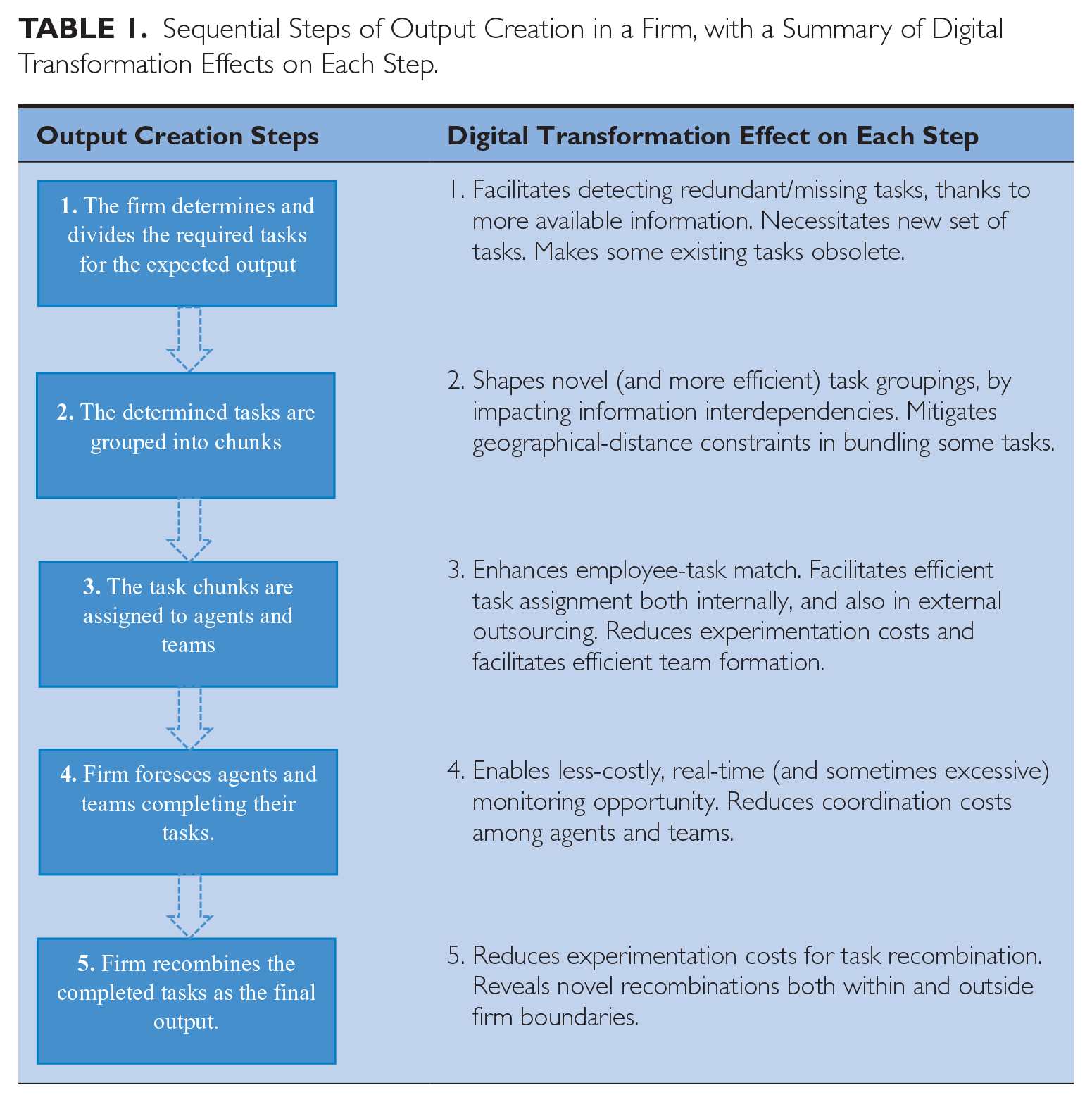
Table 1 summarizes our arguments and provides an overview of the steps of organization design from task division to recombination of the output and how digital transformation can affect them. On average, digitization is expected to improve efficiency and serve companies, their employees, and society. Activities in the future will be defined in terms of more fine-grained and better measured tasks. Enhanced match of agents to tasks may improve retention. Employees are also expected to experience higher job satisfaction. Novel recombined tasks may uncover new services and products to serve the needs of customers in the future market. Nevertheless, this (fairly) optimistic view is based on our theoretical understanding and early anecdotal examples for digital transformation. The discussed impacts on task determination, division, monitoring, and recombination should not be regarded as faultless and absolutely perfect. The majority of these technologies—such as AI and machine learning—rely on sophisticated algorithms to learn from the patterns in existing data inputs and predict future outcomes. 43 In that sense, the impact of digital transformation is prone to biases—for example, from agents strategically providing information that may benefit them. 44 Thus, considerations such as data quality and provision of complementary human skills still seem to be critical to reap the benefits of digitization across organizations.
Sequential Steps of Output Creation in a Firm, with a Summary of Digital Transformation Effects on Each Step.
A Blueprint for Organizing: Some Practical Guidance for Firms
Firms have to manage the inevitable advance of digitization smartly and decisively. Based on our integrated analysis of digital transformation, there are a number of crucial directives firms have to consider when taking the next steps toward digitization.
Consider (New) Interdependencies in Designing Your Digital Organization
Digitization will affect most, if not all, parts of the organization design process of firms. Moreover, changes in one step will affect other steps as well. For example, the ability to match employees and tasks more successfully will allow for changes in the task design, both because the skill profile of an individual matched with one (or multiple) task(s) will end up determining the complementarities attainable in the first steps of organization design. Therefore, department-level digitization initiatives will likely call for further changes in other departments. This implies that firms need to have at least some firm-wide oversight if they cannot implement a wide array of changes in different parts of the organization simultaneously. Otherwise the organization may not fully obtain the benefits of digitization, and may even risk failures due to incomplete transformation.
As a first step in this direction, firms should take stock of the material, information, and financial flows along the process of delivering a product or service. As mentioned before, digital tools can formalize the information flow along a production process, which in turn is likely to affect, create, or further shed light on the interdependencies—for example, by documenting material flows and the ways in which they connect to financial flows. Note that this process requires the organization to observe the processes rather than the functions in the firm as the interdependencies to be uncovered will serve to group tasks depending on their interdependencies and to assign them to agents to complete. A traditional functional approach will likely obscure some of the interdependencies—especially the novel ones—as it takes a possibly historically determined division of tasks as a given.
Choose your digital organization design to be contingent on the tasks at hand
Organizations, in the way we conceptualized them, are centered on outputs and on the necessary steps to achieve them. This has important implications for tasks, their determination, assignment, and completion. Specifically, the optimal task division and allocation may differ by output, such that an employee may take different roles and complete different tasks for different outputs. Hence, the organization design of a firm will become somewhat transient, or contingent on the job at hand. Organization-wide rules—such as optimal team size or control structure—are unlikely to apply universally, so that digitization can support a more fine-grained way of designing an organization.
At the beginning of a major digital transformation, an organization will therefore have to prioritize processes and outputs by their importance and permanence for the organization. If, say, a public office is obliged to engage with requests by citizens for legal documents, the efficient design of this process takes precedence over temporary activities, like organizing a public event for the city’s anniversary. This will be reflected in the extent to which digital structure reflects the organization design of the most persistent processes (as they are most likely to amortize the fixed cost of process digitization), while peripheral or transient processes will either have to remain analog or utilize the digital tools required for the permanent processes.
Choose structure and strategy simultaneously
Our conceptualization of an organization started with the definition of an output the firm wants to deliver, that is, a strategy. However, as the firm’s organization design is increasingly affected by the use of digital technologies in all steps of the design process, its strategic options may also evolve. For example, a firm may be able to offer increased customization of products, achieve faster time-to-market, or develop an increased ability to deliver high-quality products, which may open up options to position the firm’s products in a different strategic group, or even switch to a differentiation strategy. Thus, strategy and structure will end up co-developing. 45
Deciding about structure and strategy in the wake of digital transformation may not be that straightforward for companies due to various (and often counteracting) effects of digitization. For instance, digital transformation can reduce coordination costs, both in external and internal coordination. On the one hand, digitization reduces external coordination and logistics, increasing the payoff that outsourcing provides—such as for external R&D. This mechanism would push companies toward having tighter boundaries and against having (unrelated) diversification strategies. Conversely, reducing internal coordination costs such as monitoring and communication may justify bringing the whole processes under one entity—benefiting from unified digital planning systems. This mechanism would push toward extension of firm boundaries and vertical integration strategies. Successful companies are the ones that can spot which benefits of digitization are stronger.
Redesign your organization, considering your competitive advantage not now, but ten years ahead
At the moment, firms can conjure a competitive advantage from their ability to gather, analyze, and act upon digitized information more efficiently than their competitors. Digital disruption celebrates those firms that disrupted industries and business models through their superior use of data. However, as digitization progresses, these differences among firms are likely to disappear and analytical tasks will increasingly transition to (more or less homogenous) dominant algorithms. Thus, firms have to identify their sources of competitive advantage not in today’s terms—when simply dealing with data efficiently can suffice—but in terms of long-term sources of differentiation.
This is an important pitfall for organizations. The lure of digitally transforming current processes to save on operating costs and/or processing times may convey an advantage in the short term, but may well cement an organization design based on current activities. Furthermore, it may convey a false sense of competitive advantage that is likely to erode as more organizations in the same activity space choose to support their processes digitally. Hence, in addition to the permanent and transient processes currently fulfilled by the organization, organizations should identify new processes and activities as their future source of competitive advantage, and more importantly, focus on their potential for digital support. They should also pay special attention to the potential for imitation or leapfrogging by future competitors. Long-term competitive advantage in the digital age is unlikely to depend on who is able to use digital technologies most efficiently—as technological progress and economy-wide learning is likely to erode most advantages of this nature—but rather on the type and bundle of complementary activities that digital transformation can support.
Finding the right timing of digital transformation is complicated
As discussed earlier, the force of digital transformation punishes players that do not implement at the right time harshly. Some sources of competitive advantage like data are most effective when firms have early and exclusive access to them. Yet, many factors such as within-organization resistance to change can slow down the adoption process and diminish its advantages. Therefore, it is important for organizations to quickly invest in the digital transformation of time-sensitive processes, involve and immerse teams and especially corporate leaders in the transformation, and “make digital everyone’s job.” 46 This approach is crucial to help organizations overcome the inertia and resistance toward full transformation, better realize interdependencies, and eventually achieve the best value-generating structures and practices ahead of their rivals. However, other processes may not need rapid digitization, either because they do not occur frequently (or permanently) enough or because the potential for digitizing this particular process is still premature or expensive. Hence, digital transformation becomes a timing issue as well.
The previous steps of weaving digital transformation into the strategy-conscious design of the organization have left the organization’s decision makers with a list of (current and potential future) tasks and activities that lend themselves more or less readily to digitization. When transforming into a digitally transformed organization, decision makers should keep in mind that management and employee attention is limited and that many digital technologies evolve fairly quickly. Therefore, an activity that does not constitute a source of differentiation for the organization and does not have a ready-made digital tool should not be digitized as soon as the first wave of digitization has taken place, but rather once the tools have matured enough that the digitization process is relatively costless and unaffected by uncertainty around its benefits and costs. Put simply, “late and safe” is preferable to “rushed and uncertain.”
Concluding Remarks and Future Directions
Digital transformation is impacting organization design in many dimensions, but the change already started decades ago. Computerized systems and software introduction goes back to the 1980s, yet share many features of technologies emerging as we speak, especially when it comes to the ways in which they affect the inner workings of a firm. Nevertheless, given the strong force of the current technologies, we expect that the effect of digitization on organization design will accelerate in the near future, since the transformation is starting to reach more applications, domains, and locations. Any advancement in digital applications makes the whole transformation more beneficial for the adopters. Thus, transformation in one part of organizations triggers a chain of transformations in the other parts and amplifies its effect. Organizations are also likely to get better at utilizing digital infrastructure over time. 47 Individuals also will adapt better and reap the benefits of these changes in the near future.
The benefits from digital transformation are not going to be evenly distributed among industry players and can therefore bring significant changes to industry structure. As Heath Terry of Goldman Sachs puts, digital analytic tools such as AI have “the power to reshuffle the competitive stack.” 48 An analysis is by Bloomberg Intelligence finds AI software “likely to be the most disruptive force in technology in the coming decade.” 49 Thus, industry players and firm management should consider smart decisions to reap the benefits of this wave, and they should pick (and time) their battles wisely. Given the enormous reinforcing advantages of digital transformation for companies, managers may need to move faster to avoid losing ground to their competitors for the key activities, while actively choosing to be a follower in others. This is especially the case for smaller companies, which may not have the necessary resources to undergo a complete transformation at once and are therefore prone to “missing the boat” on many digital technologies. Therefore, to catch up or just to survive the competition in the future, small firms may need to select a small set of key processes and activities and move quicker than their larger competitors to reap the benefits of digitization for these strategically important activities. This may help to relieve the financial constraints for these firms. Also, investing in proprietary data and other digital resources seems to be a crucial source of competitive advantage in the future. While algorithms and applications are rapidly copied, securing these proprietary sources seems to be among the few sustainable sources of competitive advantage for firms.
Of course, unlike our simplified model of organization design and digital transformation, many potential interdependencies, complementarities, and benefits of digitization are not (yet) fully determined for some industries and organizations. This is because digital transformation is a multi-faceted and complex phenomenon. Our arguments and selected examples focus on certain aspects of this phenomenon, namely, the increasing data availability and firms’ capability to analyze them. We consider these aspects key drivers of the effect of digital transformation on organization design. Still, there will be second-stage effects and additional aspects to consider. Thus, we emphasize that our theoretical analysis looks at a particular facet of this phenomenon, leaving potential other facets for future research.
As a final note, we acknowledge that our analysis in this article gives a fairly optimistic picture on the internal effect of digital transformation on firms. In discussing this view, we have relied on selected firm-level examples. Yet, analyzing the overall effect without considering the big-picture equilibrium at the market-level would be incomplete. Given cost reduction and entry-facilitating effects of digitization, smaller and laggard competitors may catch up with the current leaders in the not-so-distant future. Competition therefore might become fiercer as firms become more similar in many dimensions and the differentiating stages are increasingly delivered by (and strongly supported by) technology, not humans with limited processing capability. This may imply increasing consumer surplus and welfare. Yet, there may be another side to this story. As digitization changes the organizations, it is placing greater emphasis on intangible assets—such as data. Given the huge synergies and scalability property of intangibles, 50 leading firms may achieve such a large scale that it becomes impossible for others to compete with them. For instance, in the past, talents and human capital were not as easy to detect by hiring firms as today. This distributed some idiosyncratic competitive advantages across firms if they were able to spot (or stumble upon) “unsung talent” not identified by larger incumbents. With the extreme reduction of search cost on human capital, leading companies are increasingly acquiring all the “stars” in the labor market and make competition very difficult for others. Through accessing proprietary data and other intangible assets, digitization may eventually lead to a wave of natural monopolies and high market concentration by industry leaders. 51 Early moves and access to proprietary data has already shown its effect in several industries—such as sports. 52 The advantage of these dynamics is likely to flow toward big firms. These companies may have more resources to be early adopters, monopolize the digital sources of competitive advantage, and eventually become unassailable. This process would give rise to non-traditional monopoly markets. This is of course a trend which would critically lower the internal benefits discussed in this article due to adverse external effects on the markets. At this point, it is too early to comment on the overall effect of digital transformation on markets, as there are currently no comprehensive data sets yet on the utilization or adoption of these technologies at the macro level. 53 This issue therefore remains a promising direction for future work.
Footnotes
Notes
Author Biographies
Tobias Kretschmer is a Professor at the Munich School of Management and Head of the Institute for Strategy, Technology and Organization at Ludwig-Maximilians-Universität München (email:
Pooyan Khashabi is an Assistant Professor at the Munich School of Management at Ludwig-Maximilians-Universität München (email: