






Abstract
While design thinking has gained popularity in product innovation, scholars argue that design thinking can also trigger and sustain organizational innovation. This study investigates the adoption of design thinking in the Design+Innovation unit at PepsiCo. It reveals nine design thinking practices that enable organizational innovation: valorizing personal attitudes and desires, engaging stakeholders in the design discourse, leveraging the design unit as an agent of change, fostering abductive reasoning, empowering decision making through prototypes, crafting proof points, absorbing external viewpoints, searching for co-conspirators, andaligning personal and organizational purposes.
Keywords
Managers and management researchers are increasingly interested in organizational innovation aimed at implementing new organizational forms, procedures, and policies that shape business practices, the workplace environment, and external relations. 1 Given today’s dynamic and fast-paced competitive environment, managers should initiate and guide profound organizational changes that allow firms to exploit their strengths in mature industries, explore opportunities to do things differently, enter new markets, and compete through developing distinct organizational capabilities. 2
The growing literature on organizational innovation offers several insights into how firms can address this challenge, including focusing on issues such as shaping the firm’s mission and goal strategies, structures and systems, resource allocation, and organizational culture. 3 A common thread in this literature is that organizational innovation critically depends on the firm’s ability to learn and adapt. 4 Organizational learning is grounded in the ability to support experimentation, 5 engage in frequent and deep customer contact, 6 and use idea generation tools. 7 Specifically, research suggests that organizational learning depends on exposure to external knowledge through combinative capabilities aimed at internalizing and applying external knowledge and ideas. 8 This research stream focuses on specific organizational mechanisms that support organizational innovation, such as cross-functional teams, participation in decision making, formalization, routinization, connectedness, and socialization tactics. 9
However, while the literature has mainly investigated the firm- and unit-level structural drivers of organizational innovation, more research is needed on the human side of organizational innovation. 10 In particular, numerous studies point out the value of mechanisms or actions that support organizational innovation, but only a few consider the people driving these innovation endeavors. 11 At the same time, the literature depicts organizational innovations in terms of theoretical actions 12 that are difficult to enact in the practical world. These observations clash with the growing recognition that organizational innovation critically depends on people’s flexibility and willingness to engage in experimentation. 13 Aiming to overcome these shortcomings, design thinking seeks to sustain a human-centric and practice-oriented approach to organizational innovation. 14
Although design thinking has been primarily studied in product innovation, it has recently gained popularity in management more broadly. 15 While its definitions vary, design thinking can be conceived as a methodology that enables creative mindsets, broadening the scope of product innovation to encompass functionality and meaning. 16 Design thinking is a pragmatic method to address seemingly intractable and complex problems and consider them in their entirety. Design thinking is often framed as a creative problem-solving methodology, especially in industries where transformation requires new competences and capabilities to develop effective customer experiences. 17
Many firms have started experiencing the benefits of design thinking beyond product innovation. For example, 3M’s creation of an innovation center based on design practices fueled an innovation culture centered on humans and not on technology. 18 SAP’s center of excellence (AppHaus), initially focused on the humanization of product and service solutions, has institutionalized practices that supported the firm’s goal of a human-centered organization. 19 As these examples show, design thinking is evolving and expanding in different domains, and it is introducing experimentation, contact with customers, and idea generation in contexts not considered before. 20
Despite this, very little is known about how this method that originated from design, then grafted into the business domain, can boost innovation beyond products. This creates a very interesting field of inquiry at the crossroads of organizational innovation and design thinking. On one hand, the organizational innovation literature provides relatively limited guidance on the management principles and practices that can help organizations absorb flexibility and experimentation with a human-centered approach. On the other hand, in the design thinking literature, little is known about how the design principles can be extended to foster organizational innovation and learning.
To advance knowledge at the crossroads of these two literature streams, we searched for a case involving both dimensions, namely, a big company that has implemented organizational innovation through design thinking. We identified PepsiCo as a particularly insightful case study, as the company started to conceive, establish, and scale up the role of design thinking to the point that:
Design thinking permeated the entire organization not only as a tool for managing innovation projects, but also as the set of mindsets thanks to which we organize our units; in PepsiCo, design thinking is not just the doing part it is also the thinking, absorbing, and reflecting ones. (Mauro Porcini, PepsiCo Senior Vice President and Chief Design Officer)
Interestingly, our PepsiCo case study reveals the emergence of a distinct set of nine design thinking practices that are key to organizational innovation:
(i) valorizing personal attitudes and desires,
(ii) engaging stakeholders in the design discourse,
(iii) leveraging the design unit as an agent of change,
(iv) fostering abductive reasoning,
(v) empowering decision making through prototypes,
(vi) crafting proof points,
(vii) absorbing external viewpoints,
(viii) searching for co-conspirators, and
(ix) aligning personal and organizational purposes.
We developed this integrative framework through observing the creation of the Design+Innovation unit at PepsiCo.
The Promise of Design Thinking for Organizational Innovation
Organizational innovation is an important complement to product innovation, allowing firms to adapt their business processes, technological capabilities, operations, and distribution channels to facilitate new product/service development while also seizing the related value creation and capture opportunities. 21 Indeed, innovation often requires a degree of flexibility around established routines and ongoing operations, in addition to coordinating multiple organizational actors across different knowledge domains and stages of the innovation process. 22
Prior research provides several insights into the antecedents of organizational innovation. Since the pioneering work on organizational learning, 23 scholars emphasize the importance of organizational mechanisms to enable firms to absorb and implement knowledge and ideas from distant fields. 24 Similar insights emerge from the combinative capabilities perspective, 25 by examining specific organizational mechanisms—such as cross-functional collaboration, participation in decision making, job rotation, formalization, and routinization—and by supporting organizational learning and adaptation. 26
While organizational factors are certainly an important driver of organizational innovation, these perspectives tend to focus less on the human aspect. Some scholars recognize the importance of organizational actors’ cognitive processes, 27 showing that managers have inherently limited knowledge of the environment and thus use cognitive representations from historical experience to direct search processes in new technological environments. Others 28 observe that top managers’ existing knowledge and beliefs shape their approach to scanning and using new knowledge. These studies suggest that people are often bounded by their own rationality, unable to see the relevance of new ideas for their work, hence creating dysfunctional conflict between actors with diverse backgrounds and expertise. 29 In sum, cognitive issues and unproductive social interactions can obstruct organizational innovation and undermine its outcomes.
The importance of a deeper appreciation of the human-centered antecedents of organizational innovation is also highlighted in organizational culture studies in terms of creating a common purpose and connective thread among diverse organizational actors. 30 Indeed, cultural values and norms can provide the basis for coordinated action in innovation processes, defining the desired attitudes, behaviors, and practices. 31 However, studies on the links between organizational culture and innovation also highlight the challenges in creating and sustaining a culture that is conducive to innovation. 32 Cultural values, norms, and beliefs often become an inertial force that limits, rather than enables, people’s ability to manage organizational innovation. As such, innovation requires cultural mechanisms, such as organizational narratives, 33 which provide coherence and flexibility for people to productively integrate new ideas into everyday practices. While these studies attempt to highlight the role that employees play in organizations, recognizing the human dimension as relevant for successful organizational innovations, little is known about how the human aspects can be practically enabled. This shortcoming in the organizational innovation literature opens interesting research opportunities. Given the increasing relevance of leadership 34 and the role of design in boosting innovation, 35 new methodologies that start from a human-centered perspective might allow for bridging this gap. Indeed, considering the design thinking essence of user-centeredness and the focus on humans, 36 be they users or employees, these human-focused approaches can inspire organizational innovation. In this sense, studies have promoted the idea that design thinking can stimulate a human-centered perspective and, in line with system theory, 37 inform the organizational innovation literature.
Linking Design Thinking and Organizational Innovation
Design Thinking: An Overview
Design thinking is primarily recognized as a creative problem-solving method to foster product innovation. 38 However, as some scholars observe, a generally accepted definition is still lacking, “and even the term itself is a subject of controversy among its practitioners and advocates.” 39
The success of the design thinking methodology in innovation management has fueled a proliferation of different definitions, dimensions, and approaches. 40 Some design thinking aspects are rooted in system theory and an internal capacity for innovation, such as scenario building or facilitating opposite views. 41 Nevertheless, design thinking is continuously evolving in line with environmental and societal changes, thus requiring further investigation. Although the design thinking literature is growing, supporters highlight different aspects. 42 Recent studies advocate applying design thinking to the technological environment and boosting digital transformation; others stress its role in supporting the top management team in big corporations or the R&D activities in research departments. 43 However, the debate also refers to the cultural nature of this methodology, and a more individual perspective on the role of biases and capabilities. 44
Notwithstanding this multifaceted view, two studies are key to understanding design thinking. The first study 45 systematically analyzes 104 articles and identifies ten main design thinking attributes: creativity and innovation, user-centeredness and involvement, problem solving, iteration and experimentation, interdisciplinary collaboration, ability to visualize, gestalt view, abductive reasoning, tolerance of ambiguity and failure blending rationality and intuition. The second study 46 provides a framework based on five main themes characterizing design thinking: user focus, problem framing, diversity, experimentation, and visualization. Both these studies highlight the relevance of human-centeredness in considering and designing new solutions (i.e., user-centeredness and involvement, user focus), the need to understand and address the right problem (i.e., problem solving, tolerance of failure, problem framing), the importance of diversified backgrounds and knowledge to envision more valuable futures (i.e., interdisciplinary collaboration, gestalt view, tolerance of ambiguity, diversity), making assumptions, testing thoughts and solutions (e.g., iteration and experimentation, abductive reasoning, experimentation), and finally, the act of thinking materializing in a design result (i.e., blending rationality and intuition, creativity, visualization).
While these themes and practices are prevalent in the design thinking and innovation management literature, evidence suggests that organizations have started to adopt design thinking beyond the product innovation domain. 47 Indeed, the multifaceted nature of design thinking encompassing both the act of reflecting (i.e., thinking) and doing (i.e., designing) is becoming more central in today’s debate, calling for more studies untangling its contribution beyond the product innovation domain.
The Crossroads of Design Thinking and Organizational Innovation
The design thinking methodology—as a means of managing innovation by focusing on users, leveraging creativity, and fostering iteration in interactions with users 48 —is at a crossroads with organizational innovation literature. A comprehensive review 49 indicates that the managerial levers for organizational innovation include the mission and goals, resource allocation, structure, organizational learning, and culture. Nevertheless, little is known at the theoretical level about how to transform these into real actions in organizations. Indeed, the organizational learning and culture lever is clearly intertwined with design thinking rooted in experimentation, tolerance of failure, employee development, and customer contact time and frequency. 50 According to two seminal studies, 51 these determinants overlap with design thinking. Despite these overlaps and insights, two main shortcomings emerge in the organizational innovation literature: the lack of human-centeredness that might hinder organizational learning and transformation, and the absence of a practical method that engages and supports firms in enacting organizational innovation in practice. Design thinking methodology is able to overcome these deficiencies in organizational innovation. 52 Indeed, it might lead to a better understanding of the value of a pervasive design thinking mindset in organizational innovation for practitioners and scholars alike.
Research Methodology
To shed light on how design thinking can foster organizational innovation, we adopt a case study methodology. A single-case study design is commonly suggested as appropriate when the research goal is to build theory starting from “how” questions underpinning complex organizational phenomena. 53 Moreover, this method is particularly promising in studies focused on internal organization issues. 54 Following Eisenhardt and Siggelkow, 55 we opted for a single-case study to unveil a little-known phenomenon that holds the potential to reveal unconventional and surprising answers to our “how” question.
Our sampling strategy started by scrutinizing large corporations that enacted organizational innovation through design thinking. In 2012, PepsiCo (the food and beverage multinational) started transforming intensely. 56 Former CEO Indra Nooyi’s vision was to embrace design to shift from being an ordinary player—focused on competing with its rival Coca-Cola on promotion and brands—to becoming an innovator in the industry. 57 PepsiCo gained global recognition as a pioneer in organizational innovation through design thinking, 58 which led to numerous awards. 59
In 2012, PepsiCo established the Design+Innovation unit with the aim of instilling the design thinking mindset and practices in the entire company. For the story of the Design+Innovation unit from 2012 to 2022, we gathered data from both primary and secondary sources. Given PepsiCo’s fame, the case study benefited from a vast amount of data (e.g., videos, press, website, design awards). We also conducted semi-structured interviews with the Senior Vice President and Chief Design Officer, Mauro Porcini, as he was the first designer hired in 2012 and now leads 300+designers and innovators around the globe. 60
The Design+Innovation Unit at PepsiCo: A Brief Overview of the Case
PepsiCo was founded by Donald M. Kendall, Sr., and Herman W. Lay in 1965 and is headquartered in Purchase, NY. Before the advent of Indra Nooyi in 2006 as CEO and chairperson, PepsiCo tied its fate to traditional marketing skills and capabilities. In the food industry, high brand awareness, enticing packaging with trendy graphics, positioning on the shelves, and building alliances with big retail chains were considered the key activities to manage for success. 61 For years, the discourse on innovation in this industry was limited to changes in packaging and graphics. Before Indra Nooyi and Mauro Porcini, PepsiCo followed similar industry behaviors.
In 2012, Indra Nooyi felt the need to hire Mauro Porcini to scale up the role of design in the company. From that moment, a strategic roadmap was implemented to expand the presence of designers in the organization (widening the range of design capabilities with industrial designers, strategic designers, and brand and experience designers). This growth started with Indra Nooyi and continued under Ramon Laguarta, CEO since 2018, who pushed PepsiCo to double the number of designers and design centers. The design competences of the Design+Innovation unit have been progressively enriched to guarantee the ability to stimulate and contribute to various changes. Today, graphic and packaging design accounts for around 160 people, design for innovation for around 40, and design strategy for around 60, gaining relevance over the years. Moreover, the designers are also curators and promoters of the 15 Design Centers opened by PepsiCo around the world. In the following, we expand on the nine practices that emerged from the analysis of the creation and subsequent development of the Design+Innovation unit through design thinking.
First Practice: Valorizing Personal Attitudes and Desires
Recognizing all the difficulties related to top-down functions in the organizational hierarchy, Porcini started with people, enacting two of the core design thinking practices reported in the literature: empathy with people and placing them in a comfort zone where they can perform at their best. To do so, he used his unique personality, finding the spaces and moments to create natural and informal conversations with employees and internal stakeholders. These one-to-one conversations helped him introduce himself and his design philosophy, discovering the aptitudes of individuals were typically silenced in global corporations. He focused on gaining empathy, not with users but with PepsiCo employees. To help people open up, he felt that the best approach is to start talking about yourself, your desires, and your visions. As Porcini remarked,
If you speak about yourself, sharing what you like, what you dream, your point of view on the world, if you do it in a transparent, authentic, and vulnerable way, people will react by opening up as well, they will speak about their own wishes, visions, perspectives, emotions . . . That’s what I do, all the time. And the context helps too. A lot! During one of my more recent trips to India, for example, as I do during any other business trips, I met one-on-one with every member of my local design team. I didn’t do that just in the office, I took them out, having lunches and dinners together, visiting unexpected places, traveling, and exploring. In those convivial moments, we talked about business, about life, we shared visions and feelings, and we ended up building bonds that are stronger than anything you can ever generate only through a formal meeting, focused merely on business objectives, in a cold corporate meeting room.
Even teams working together daily need continuous empathy and nurturing, beyond formalized techniques and managerial rules. Real engagement and motivation are often crafted in a familiar and intimate space. This concept is well expressed when Porcini describes his way of managing informal meetings outside the firm’s boundaries:
When I organize a strategic meeting in New York, the city where I work and where I live, I often take team members and partners to some of my favorite Italian restaurants. I recommend the best dishes, I let them try meals that they never tried before. Through food I share my culture, I share myself, I share my life, and my vision of life. On the table there isn’t just food, there is my diversity and uniqueness, and through them I try to build a more intimate bridge with the other person’s diversity and uniqueness. Empathy is the keyword.
These quotes reveal the first practice of discovering personal attitudes and desires as valuable and crucial in PepsiCo’s organizational innovation. Indeed, it is not a top-down imposition of practices, but a bottom-up approach to making connections and creating empathy. As experienced by PepsiCo employees, the practice of gaining empathy and discovery is a core value of design thinking that enabled innovativeness in the unit. Indeed, personal connections enable the germination of innovation and the valorization of different personalities as people feel free to share their embryonic ideas.
Second Practice: Engaging Stakeholders in the Design Discourse
The second set of actions relates to the involvement of clients and partners, leveraging the participation practices of design thinking. The Design+Innovation unit involves clients and partners in the design thinking creative processes as soon as possible. The basic assumption is that strong ties with clients and allies can be created by immersing them in the organization design discourse. This encompasses different perspectives and visions of the future that different actors in specific ecosystems shape in their interactions, confrontations, exchanges, and joint ventures
62
. What is the future meaning of food and beverage products? What factors underpin the reason to buy? Sharing these questions with clients and partners fosters the idea that selling products is only a future consequence to be jointly developed. Porcini recalls,
Involving clients at the beginning of the design process doesn’t have anything to do with selling them a product. It’s all about gathering their feedback, insights, and data, to create a better vision, a stronger strategy, and an ideal project. For both of us. And through this process we then reinforce our bond, our partnership, we even build a stronger reputation and appreciation of each other.
This “involving” logic serves not only to share a common direction and together design products with a common business goal but also to create a new “reason why” to involve the PepsiCo customer side (e.g., big hospitality brands) more as consultant or innovation partner than as commercial partner. This seemed to be a turning point in relationship management, completely atypical in a consolidated and mature industry:
[With clients and partners] you discuss how to grow brands, products, experiences, and you do so by bringing to the table a different perspective about the key issues that matter, the one from the outsiders. And from the designers too, in case the client doesn’t have a similar organization in-house. In this kind of interaction, clients often find great value. They see us more and more as partners and consultants, as a strategic team to co-drive innovation in their world.
Porcini’s actions to involve clients and partners in the design discourse show that he sees in the early stages of collaboration a fertile element to kick off the innovation process. However, to do so, people within the organization must be ready to embrace these practices. Creating an open and continuous dialogue with clients and partners about the strategic vision of the future at PepsiCo provides two essential benefits: the strategic vision can be enriched and adjusted, embracing the contributions of external interlocutors; and continuous dialogue creates “memories for the future,” increasing future acceptance of innovations developed at PepsiCo.
Third Practice: Leveraging the Design Unit as an Agent of Change
The third practice is at the cultural level. By shifting the mindset toward experimentation and prototyping, this design thinking practice for organizational innovation aims to disrupt the view of design as a graphics and packaging tool. Porcini stresses the multifaceted soul of design that certainly entails aesthetics, but also an understanding of tacit and hidden human needs.
There are different examples of the wide application of design thinking as a holistic lever in the product and brand portfolio. With SodaStream Professional, for instance, PepsiCo wanted to cover the workplace and public spaces with the introduction of an eco-friendly hydration platform that offers personalized beverages and reduces single-use packaging. Here, the Design+Innovation unit played the role of combining the focus on personalizing the human experience with cultural trends centered on health and sustainability. Moreover, the unit worked on the technological integration side, combining the appliance with a mobile app (SodaStream Connect) that stores personal settings and the drinks or mixes consumed in the past, and that provides tailored suggestions and tips based on preferences.
Regarding competences, PepsiCo sought to build an internal design organization that, while adopting design thinking in projects, also promotes design thinking principles. As Porcini stated,
We have different competencies within the overall design capability. There are two main territories. The first is design thinking applied to branding, where we define the experience with products and brands of today and tomorrow, in a series of divergent and convergent workshops. The second is design thinking applied to innovation, where we imagine the products of the future. In terms of capabilities, we have brand designers, graphic designers, industrial designers, interior designers, digital designers, and then experience designers, connecting all the other design faces together.
The act of applying design holistically was only possible thanks to a careful recruitment policy for designers in different parts of the organization, specifically to lead and organize the PepsiCo Design Centers. Designers are recruited not only for their specialized competences, but also for their behavioral or soft skills. As Porcini stated,
The leaders we recruit for our Design teams should always have a holistic approach to design. They need to understand and manage all design aspects, from product to packaging, through to graphics, digital, experience, strategy, and innovation. And they need to have a series of essential soft skills, like optimism and curiosity, kindness and empathy, humbleness and confidence, and the ability to think big, balanced by the ability to execute . . . These individuals are a fundamental part of our change. We call them “unicorns,” because they are so rare to find.
The holistic application of design thinking has been particularly enabled by this recruitment policy, progressively placing designers with the required capabilities and attitudes at the center of the organization, considering them as agents of change rather than mere aesthetic specialists. This is in line with the design thinking view of encouraging wild ideas and promoting horizontal and non-hierarchical communications among employees 63 . The designer recruitment policy was not aimed at simply securing designers able to bring product innovations. Indeed, most were selected for their design credo and philosophy, and their inclination to see product innovation as a transformative means for organizational innovation.
Fourth Practice: Fostering Abductive Reasoning
A fourth practice emerging from the analysis of the creation and development of the Design+Innovation unit is abductive reasoning: design thinkers observing data that do not fit existing models guessing at a plausible explanation. 64 This inferential logic represents the art of conjecture and the ability to imagine the future by designing what might be, not what is. In introducing this practice, PepsiCo reflected on the role of space as an expansion of the human creative brain. The cornerstone of a design center is usually the provision of spaces and facilities that enable creativity through collaboration, brainstorming, and stand-up dialogue in front of interactive walls or presentations. These things support the quest for plausible explanations of phenomena that are hard to explain with current frameworks.
At PepsiCo, the logic behind the Design Centers is somewhat atypical. Instead of dedicating spaces and facilities to designers or innovation teams, they are open to a variety of internal and external stakeholders. The Design Centers are a tangible manifestation of PepsiCo’s design orientation as an intrinsic aspect of its culture.
To spread our design-driven culture and abductive reasoning and other design thinking principles, we use our facilities a lot, in particular our Design Centers. The physical space is where we connect, co-create, share, celebrate, learn, and build on each other ideas and visions. And it’s where we pitch design to the company’s executives, to other functions, and to customers and influencers of different kinds. Entering one of our design centers, especially the one in New York City, is a natural and organic deep dive into the design world.
As an example, when designing the Design Center in New York, PepsiCo managers decided to exploit the fun and beauty of design, using the Design Center for meetings of a different kind. They wanted to avoid conventional and often boring corporate meeting rooms and environments. PepsiCo sought to recover the value of design to shape the corporate environment and buildings, products and brand image, logos, and packaging. Design that becomes an asset, a culture-crafting tool to communicate the company’s values, and a vehicle to make certain organization practices visible through the spaces, atmosphere, furnishings, and communication interfaces:
Our business partners in PepsiCo often use our design facilities to meet with customers. When that happens, we usually try to leverage the opportunity to plug in a design session. This is an interesting value of a design and creative venue. If you design a facility that is inspiring, creative, innovative, and engaging, you will attract people in many ways. And once they are there, you can open dialogues, build partnerships, and dream projects together.
Design thinking in this format is presented as a means of enabling the engagement of employees and those external stakeholders who wish to take part in company projects. While creative and abductive capabilities are often regarded as characteristics of individual employees, it is now well understood that these capabilities must be nurtured, trained, and nourished. The application of design thinking to spaces, infrastructure, and the work environment can influence employee behaviors. PepsiCo managers and client companies can use the corporate spaces as simple workplaces or as platforms to instill company values and enable new ways of thinking, interacting, and dialoguing.
Fifth Practice: Empowering Decision Making through Prototypes
The visualization capabilities inherent in design thinking activities matter in the prototyping phases, not only to show users a functional and photorealistic release of a future product but also to support decision making. In fact, decision making through visualization is spreading rapidly as a managerial practice, and PepsiCo embraced this trend:
The act of prototyping has the incredible power of aligning people around an idea, of enabling different professional communities and customers to co-create with you, and of building confidence within the organization on the value of the project. Essentially . . . it’s a way of thinking that drives efficiency, increases quality, and builds confidence in the company.
65
Porcini also often uses the following metaphor:
When I say the word “knife,” each person in front of me will visualize in his own mind a unique and different knife, with its own shape, color, finishes, and material. What we will visualize is conditioned by our background and experiences. Some of us will see the knife used by the butcher, others will see a luxurious knife with mother-of-pearl handle. . . who is right? Obviously, nobody and everybody because everyone’s visual mind is affected by past experience. To align everybody around one idea of a knife, we need them all to see what knife we are referring to. We need to “prototype” a knife, we need to draw it, to sketch it, to create it.
Porcini’s words seem to mark a new way of decision making that sees visualization as a primary tool for creating consensus. The managerial disciplines have always based decision making on “knowing” to deliberate through the analysis of “facts and figures.” If this approach made sense in terms of exploiting existing resources, it has shown its limitations in constructing the future where data and facts of the past or present help little in designing and controlling future options. While business communities considered analytical intelligence as a primary decision-making requirement, the visualization of the future through scenarios, mock-ups, and use cases is an essential element to enable dialogue among those with different knowledge and backgrounds. This view is in line with the concept of boundary objects defined in the literature as plastic enough to be adapted to different needs and constraints, but robust enough to maintain the core meaning and message of those who design them. 66 At PepsiCo, this visualization practice helps managers make decisions, bringing prototyping forward into the early innovation stage, and leveraging the boundary object dimension of prototypes in the decision-making process. Even if the early phases in the design process are typically dedicated to exploratory activities in the search for stimuli and insights to nurture “divergent thinking,” rough prototypes allow stimulating sensations, reactions, and metaphors. This fifth practice, more than a device to create convergent thinking, is used to guide shared exploration, where all participants consciously recognize the reframing direction. Several organizational prototypes developed by the Design+Innovation unit can be seen and classified as boundary objects with a speculative nature. And being incomplete fictional props, they suggest possible futures in settings that might not exist yet, leaving room for the imagination of those involved in the process.
Sixth Practice: Crafting Proof Points
The sixth practice emerging from the interviews is what Porcini calls “proof points.” These are intended as the ability of members of the organization to leverage design thinking in crafting specific moments or events—such as the launch of a new product, the redesign of a brand, or the opening of a new market—where something is demonstrated as working and valuable for the whole organization. This view is aligned with the traditional design thinking workshop where prototypes are created, tested, and shared with users to observe the perceived value as early as possible. In industries and companies resistant to design thinking, proof points are a way to create legitimacy, trust, and confidence, not only internally but also externally:
What should we do that really proves the value of design in the short run? We need proof points, we need quick wins, and we need products that generate some form of value. We need to show progress, we need to show the value of those ideas as soon as possible, even if they are not perfect.
In a recent interview at the “Collision from Home” tech conference, Porcini remarked on the need to consider different dimensions to properly demonstrate design effectiveness:
Many people think that design is merely about product styling or packaging form. And while yes, that is one face of the discipline, design is much more than that. There are three main dimensions we consider every time we design to properly prove the design’s effectiveness. First of all, the dimension of people: the human beings, you and I. We observe people and we understand their needs and wants. To do so, we—as designers—study anthropology, ethnography, and human science. And we apply those learnings to our exploration of people’s minds and souls. The second dimension is the one of business. Once you understand what’s relevant to people you need to understand what’s strategically relevant to your business too. Marketing, branding, and macroeconomics are the platforms we use to do so. And that’s indeed what we study at design school. And then finally there is the dimension of technology.
Accordingly, “proof points” complement visualization in decision making. While managers praise design for its power to propose and define new scenarios, the quality of design decisions also lies in the ability to control the results in terms of the product’s technological aspects, use (recalling the user-side and human involvement), and market. This view consists of the embryonic idea of a self-consistent model of design where proposition, materialization, and control aspects cohabit. This idea contrasts with the typical view of the innovation process fragmented over various specialist departments, each handling a slice of the entire process. In some ways, those proposing the idea should ensure its materialization and control the unique aspects to make it succeed. In organizational terms, this practice does not mean depriving other business areas of their task of controlling the technical, economic, and market feasibility aspects, but offering them initial clues on which to pursue to develop specific insights. In other words, proof points in design thinking have an educational role for other corporate areas, as they allow for quickly demonstrating the way to operate.
Seventh Practice: Absorbing External Viewpoints
Leveraging external consensus to gain internal legitimacy in an organization is a practice that Porcini brokered in PepsiCo. This seventh practice is from design thinking where the idea is to show every stakeholder what has been discovered from the early stage of the process and engage them in the learning process. External endorsers are important to support internal operations. Different types of endorsers contributed to PepsiCo’s strategic path, first and foremost designers:
The very first endorsers I found in my journey were the designers and design agencies that I was working with on projects. Renowned firms, operating in design consulting and engineering that have been very successful with other companies. This operation was not only useful from the functional point of view, related to launching new products and improving existing ones, but it was also aimed at providing an internal message: there were external actors, famous and successful in their field who wanted to play with us, who believed in what we were doing.
The media is periodically invited to the different Design Centers around the world to physically touch the efforts and investments behind the company’s visual interfaces and campaigns. This full involvement in product brand life is part of Porcini’s credo, consolidating the idea that the product is not enough today to affirm the brand, and that the method to assess design is biased. Porcini recently argued that the problem with “measuring design by conventional ROI methods, is that its impact isn’t restricted to a single product or campaign.” Moreover,
If Apple had released the iPhone and all their other products, packaging, and experiences were mediocre, it wouldn’t have got the same result. The secret lies in creating a full ecosystem of extraordinary experiences across every touchpoint. Before you can deliver that value, you need a few years to invest in the brand.
67
Indeed, a brand is not only lived by end users, but ecosystem-based competition serves to attract new markets, media, external partners, shareholders, and new retailing systems.
The design awards (Table 1) received since the beginning of the new design course created a “snowball effect.” The more design prizes awarded to PepsiCo, the more the company increases its exposure in the media and its presence in the design discourse, and the more the managers and the organization see the value of the design actions. Astonishingly, by 2022, PepsiCo had received over 1,450 awards.
Number of Design Awards Received by PepsiCo (2014-2022).

Internal consensus—when paradigmatic views are hard to overcome—cannot be reached with only internal mechanisms. Outside legitimacy serves to convince the most skeptical to consider themselves part of the alternative course. This is fundamental in the early and later phases when “leaps of faith” are not enough, and confirmation about the new direction needs to be diffused within the organization.
Eighth Practice: Searching for Co-Conspirators
When I joined PepsiCo, the first thing I did, I sat down with the HR manager, and we started to map the co-conspirators in the organization.
As Porcini emphasizes, the support of people in key positions is fundamental. In the initial phases, when difficulties emerge and people reject the initiatives, engaging some employees to champion the new course and then act as diffusers of the new design course can be a successful strategy. In leveraging the value of the team in design thinking, PepsiCo also introduced this aspect. These co-conspirators played a fundamental role in supporting the new design vision, acting as bridges with others in the organization who were more skeptical and resistant to change. This eighth practice stresses the importance of engaging co-conspirators, as Porcini stated:
In the phase that I call “occasional leap of faith,” you know that not everybody is buying into your vision, but somebody is. So, you need to find that somebody, whom I call a co-conspirator, somebody willing to work with you to build the proof points. I believe that co-conspirators and proof points are a real game changer.
The choice of terminology is not random. Conspirators join leaders because they believe in the proposed change, then act publicly to create trust, increase affiliation, and co-guide the change. Internal consensus cannot be reached with internal mechanisms alone, but need people (i.e., co-conspirators) whose legitimacy serves to convince the most skeptical to feel part of the alternative course.
Ninth Practice: Aligning Personal and Organizational Purposes
The last practice emerging from the case study is aligning the interests of employees with the organizational goals, and vice versa. Whereas big organizations usually set goals at the corporate level to scale down to the units, teams, and individuals, Porcini started from a place where reciprocity and the combination of multiple interests, goals, and contributions are negotiated iteratively. In enacting the design thinking value of human-centeredness, the PepsiCo design unit put every single team member at the center of the debate, thus setting the shared organizational objectives. Deeming the old cascade and top-down approaches to set goals as obsolete, Porcini started from his own view:
There is one question that I always ask myself and I asked my people to consider. The question is how can I make that person succeed? So, this can be applied to your CEO, can be applied to your marketing partner, and can be applied to your own team. If you succeed in doing that, you become indispensable to the person or group of people. Because if you give those people something to make them successful, then obviously they will need you, your skills, and your capability, and then they will invest in you, giving you access to the resources you need. When you ask your question, you need to think about two dimensions: the first one personal: what’s the dream of this person? The second one belongs to the world of business: what are they trying to do or what are they being asked and expected to achieve?
As a complement to the first practice of searching for empathetic ways to make employees comfortable with the new course, the manager’s role consists of understanding how to put people to work under the best conditions, combining personal attitudes and interests with business interests. It is a negotiation that starts with what the leader can do to enable personal and corporate growth.
I didn’t fix business goals just looking at the corporate view of resources and potentialities. I tried to understand what people—at the moment—expect from me, from my work, from my willingness to change. Once I got their expectations and potential contributions, I tried to figure out possible milestones and goals that should have been coherent with the corporation’s interests and the people’s possible contributions that rely on their needs and dreams. This was my job: indulge pushes where there were and avoid frictions where I saw contradictions.
However, iterative negotiation does not happen without the first step, where the leader empathizes with employees, putting themselves at the front line to create the right conditions to indulge individual dreams and aptitudes.
Nine Design Thinking Practices for Organizational Innovation
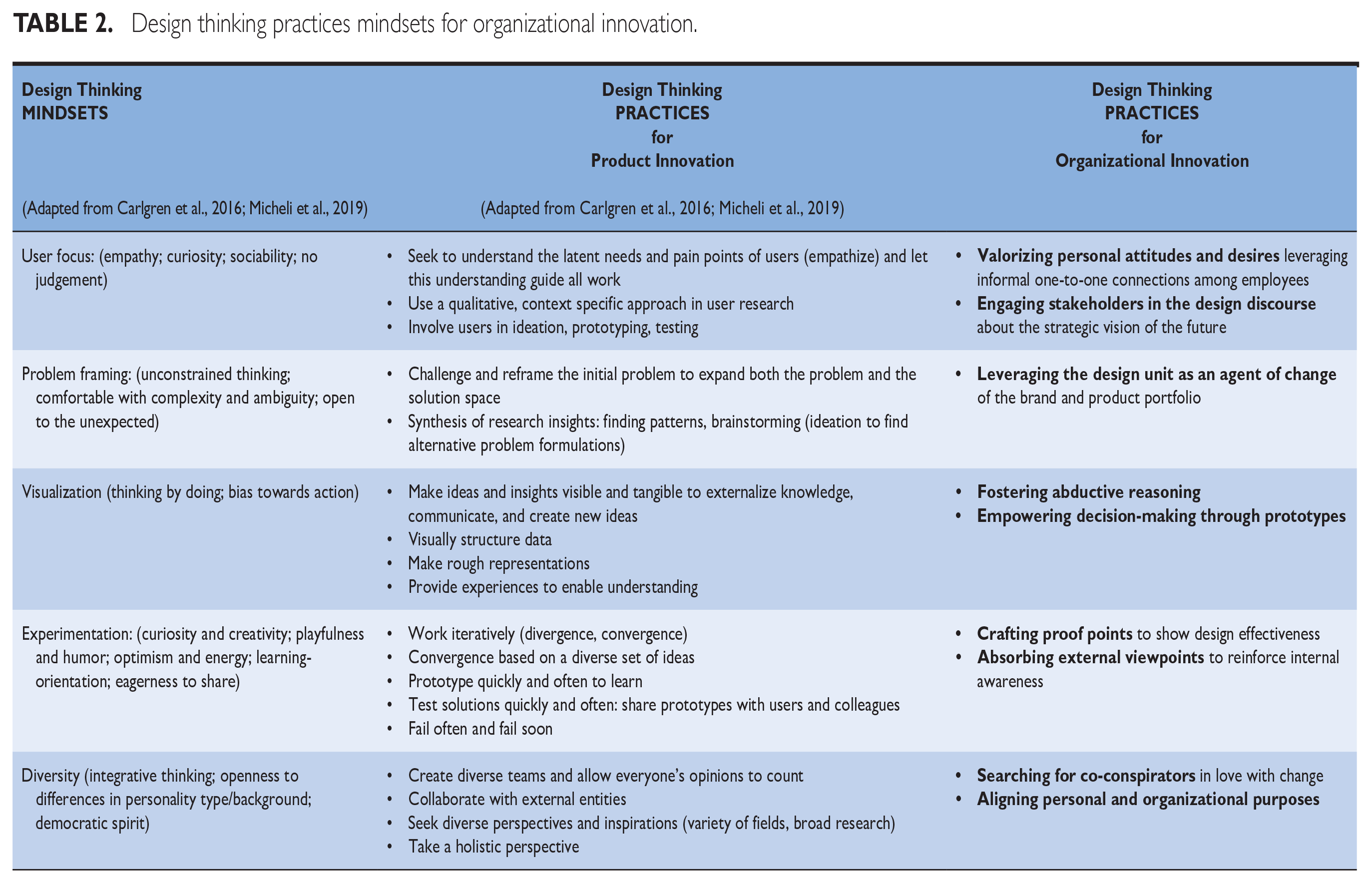
Our qualitative analysis sheds light on the way PepsiCo adopted design thinking to foster organizational innovation. Triangulating the five main mindsets 68 and 18 main practices characterizing design thinking for product innovation, 69 we identify nine design thinking practices that can lead to organizational innovation. Table 2 summarizes the practices emerging from the PepsiCo case.
Design thinking practices mindsets for organizational innovation.
Concluding Remarks
Our findings respond to recent calls for a better understanding of the role of design thinking in broader domains 70 other than product innovation, 71 highlighting that design thinking practices can support organizational innovation. 72 The PepsiCo case enables a better understanding of the role of design thinking in different contexts. 73 First, from an organizational perspective, it shows that in large corporations adopting the design thinking method, the organization shifts toward a more human-centered perspective, bringing design to the core of the organization. Second, by analyzing the different initiatives and decisions, this study unveils nine design thinking practices for organizational innovation that can enrich knowledge around design thinking. 74 Third, the role of design thinking is when the focus is no longer just on end users but on employees, where empathy and the value generated are centered on the organization rather than the product. 75 This is where the advent of industry 4.0 and other initiatives are completely changing the way employees are immersed in the organizational structure. 76 Finally, the findings inform organizational innovation scholars on how design thinking can help solve the lack of humanistic aspects in organizational innovation.
To conclude, this study contributes to the managerial field by enriching our understanding of how design thinking can foster organizational innovation and that this methodology is not a one-size-fits-all but a sophisticated way of untangling wicked problems that require specific practices for specific circumstances. For practitioners, the nine design thinking practices to foster organizational innovation can inform managers in other sectors wishing to adopt design thinking.
Footnotes
Acknowledgements
We would like to thank the PepsiCo Design+Innovation unit for all the exchanges and discussions for our article. We are also grateful to Mauro Porcini, Senior Vice President and Chief Design Officer at PepsiCo, for his passion, valuable time, and willingness in helping us conduct this inspiring case study.
Notes
Author Biographies
Stefano Magistretti is an assistant professor in Agile Innovation as well as Design and Innovation Management at the School of Management of Politecnico di Milano, Italy (email:
Claudio Dell’Era is a professor in Design Thinking for Business at the School of Management of Politecnico di Milano, Italy (email:
Cabirio Cautela is a professor of strategic design at the School of Design and School of Management of Politecnico di Milano, Italy (email:
Josip Kotlar is an associate professor at the School of Management of the Politecnico di Milano, Italy (email: