






Abstract
Summary
Managing innovation ecosystems requires firms to balance collaboration and competition while maintaining strategic differentiation. Inspired by the natural phenomenon of crown shyness—where trees create structured gaps to optimize resource sharing—this article introduces a governance framework for structuring interfirm boundaries and resource allocation. Through an analysis of real-world business ecosystems, five principles emerge: boundary modulation, structural adaptation, competitive insulation, resource partitioning, and dynamic role orchestration. This framework extends existing theories by offering practical strategies for firms navigating co-opetition, digital transformation, and platform economies. It provides business leaders with actionable insights to foster resilient, high-performing innovation ecosystems.
In today’s hyperconnected, volatile markets, firms increasingly operate within innovation ecosystems—interdependent networks that co-create and capture value through collaborative innovation. These ecosystems are shaped by a central paradox: competition and collaboration function as complementary strategies for resilience and growth. From Apple’s App Store to Toyota/BMW joint ventures, firms must coordinate interfirm activity while maintaining distinct positions, as unchecked overlap erodes trust and triggers partner exit. 1 The core challenge thus lies not in ecosystem participation but in governance—specifically, how boundaries are structured to enable innovation without destructive overlap.
This study develops a structural governance framework to manage co-opetition tensions—such as boundary conflicts, trust erosion, and resource competition—in innovation ecosystems. It contributes to ecosystem literature 2 by addressing how ecosystems coevolve with their environment—a gap highlighted in current research.
We define innovation ecosystems as polycentric, co-evolving constellations of interdependent actors—such as firms, research institutions, investors, and public agencies—that jointly create and appropriate value from new technologies under the loose orchestration of one or more focal firms. 3 Building on prior work, 4 we treat platform ecosystems as one subtype alongside modular and business ecosystems. Structurally, ecosystems may take the form of platforms, networks, clusters, or alliances, differing primarily in orchestration intensity—from focal-firm-led to distributed coordination. 5 Our scope includes both platform and non-platform ecosystems characterized by sustained interdependence, shared or compatible architectures, and collective value propositions beyond bilateral exchange. Consistent with this definition, alliance collaborations such as Toyota/BMW qualify as innovation ecosystems, whereas vertically integrated models lacking inter-organizational interdependence do not.
Recent ecosystem research has developed structural governance frameworks explaining how actors align through value architectures, 6 how complementarity and appropriability shape boundaries, 7 and how platforms govern via interface and scope decisions. 8 While these contributions richly theorize coordination under interdependence, a critical gap remains: how to maintain boundaries when actors must both collaborate and compete. Existing frameworks emphasize alignment mechanisms but under-specify separation principles for managing co-opetition tensions, despite comparative reviews calling for more integrated structural governance across ecosystem forms. 9
This gap manifests in a persistent empirical puzzle: why do productive ecosystems unravel when boundaries blur? Amazon’s marketplace conflicts—where orchestrator use of seller data eroded partner trust and triggered antitrust action in the EU, UK, and US 10 —exemplify a broader pattern. Alliance ecosystems show parallel failures when role separations erode in high-stakes R&D. 11 These cases reveal a conceptual gap: prevailing work emphasizes coordination (how to align interdependent actors via complementarities, value architecture, and boundary resources) while under-theorizing separation (how to maintain productive distance across roles, interfaces, and control zones under sustained co-opetition).
We extend ecosystem governance research by introducing boundary calibration as a complement to the well-established focus on coordination. While prior work emphasizes alignment through value architectures, complementarities, and orchestration, 12 we focus on the less-explored challenge of boundary structuring: designing interfirm separations that define who does what, who accesses what (e.g., APIs and data), and who controls what (innovation zones or modules). This boundary-calibration lens clarifies how productive separation enables sustained collaboration, particularly under co-opetition. First, overlapping capabilities between orchestrators and complementors lead to coordination inefficiencies and resource duplication, undermining innovation throughput. 13 Second, blurred access boundaries—especially around data and APIs—create asymmetries that erode trust, prompting complementor disengagement or exit. 14 Third, ambiguous role definitions intensify rivalry, transforming co-opetition into zero-sum conflict and destabilizing the ecosystem. 15 These tensions hinder ecosystem resilience by disrupting alignment, reducing partner incentives, and escalating governance costs.
We introduce crown shyness—an ecological metaphor where mature trees, despite proximity, maintain consistent canopy gaps to reduce mechanical abrasion, optimize light distribution, and enhance collective stability. 16 Rather than competing for every canopy inch, trees self-organize to preserve individual integrity and collective health. This ecological logic provides a powerful lens for innovation ecosystems, where firms must structure “healthy distances” between roles, capabilities, and innovation spaces. We translate crown shyness’s ecological drivers—abrasion avoidance, spatial gap adaptation, and resource optimization—into structural governance principles that guide how firms maintain productive distance while sustaining collaboration.
This metaphor reframes ecosystem governance not as a binary of openness versus control, but as a dynamic design problem of strategic separation. By developing five structural boundary-calibration principles, we provide design levers to manage interfirm tensions while enabling collective adaptation.
Prior ecosystem studies have richly theorized coordination through value architectures and complementarity, but remain largely descriptive about how boundaries evolve and adapt under sustained co-opetition. 17 By addressing this gap through a structural lens of role differentiation and adaptive boundary governance, our framework extends innovation-ecosystem theory beyond structural mapping or actor typologies, advancing the co-evolutionary governance logic called for in recent reviews. 18
Crown Shyness as a Structural Metaphor for Ecosystem Governance
Innovation ecosystems require governance to balance collaboration and competition, a challenge we address through the crown shyness metaphor to enhance collective resilience. 19 These ecological drivers of mechanical-abrasion avoidance and light-diffusion optimization parallel rivalry friction and resource-sharing challenges in innovation ecosystems. Firms in innovation ecosystems likewise maintain role and resource separations, because capability duplication creates inefficiencies 20 and asymmetric access (e.g., use of complementor data) erodes trust. 21
We define innovation-ecosystem structure as three tightly linked layers—roles, interfaces, and control zones—synthesized from established governance constructs. Roles (who does what) align with the literature’s “actors and roles” category. 22 Interfaces (who accesses what and how) map to coordination mechanisms and boundary resources (e.g., APIs/SDKs) that regulate participation. 23 Control zones (who controls what) correspond to orchestrator-defined rules and control rights that set participation scope and exclusivity. 24 In ecosystems such as Apple’s and Microsoft’s, orchestrators define roles, expose interfaces through developer APIs and data policies, and retain control over core apps and OS components. While they allow third-party modules in delineated spaces, frictions can arise when these layers blur, such as when orchestrators compete directly with complementors. This tri-layer framework provides a compact, theory-grounded basis for our governance prescriptions—role clarity, interface modularity, and zone insulation—as boundaries are recalibrated over time.
Roles in innovation ecosystems extend beyond a simple focal-firm/complementor binary. Complementor roles are often plural and heterogeneous—spanning device manufacturers, application developers, service providers, data contributors, and other specialized actors—depending on ecosystem architecture. In some contexts, users or customers also perform complementor-like roles through innovation, content creation, or data provision. Accordingly, terms such as “platform owner” and “complementor” are illustrative rather than restrictive: the governance challenge of role calibration—clarifying who does what and where boundaries lie—remains constant despite role plurality.
This structural logic is implemented through explicit structural mechanisms: IP buffers (protecting proprietary knowledge), modular boundaries (API-based interfaces), and clearly defined roles (distinguishing orchestrators from complementors). This governance logic aligns with layered architectural separation in digital platform ecosystems, 25 where system modularity supports decentralized innovation without collapse.
Building on the crown shyness analogy introduced above, these ecological mechanisms operate structurally: gaps are maintained through spatial self-regulation rather than through direct coordination. Innovation ecosystems benefit from analogous governance mechanisms (such as modular architectures or role zoning) that preserve separation without constant negotiation. At a higher level, trees correspond to ecosystem actors (focal firms and complementors), and resource sharing parallels value co-creation (albeit through deliberate orchestration rather than emergent gaps). 26 This abstraction highlights the framework’s utility by showing how firms can design governance that fosters interdependence without encroachment, supporting stability and long-term viability amid market change while remaining sensitive to context.
Crown shyness is particularly well-suited to ecosystems where governance deliberately structures separation, unlike metaphors such as “keystone species,” which emphasize central actors rather than boundaries. Apple’s ecosystem exemplifies orchestrator-imposed separation through a single curated App Store, strong OS control, and clear distinctions between Apple-controlled and third-party spaces, even as Apple competes with some complementor apps. By contrast, Android features a layered structure: Google governs the core platform, device makers preinstall their own app suites, multiple app stores coexist, and sideloading is allowed. Both ecosystems involve powerful orchestrators and first-party competition; the difference lies in how boundaries are structured and enforced. In Android, crown-shyness separation is therefore more relevant for managing vertical fairness (e.g., data use, neutrality, control rights) than for limiting horizontal rivalry, underscoring the metaphor’s flexibility across platform designs.
Boundaries in crown shyness evolve dynamically, with trees adjusting gaps based on wind, growth, or environmental changes. Similarly, ecosystem boundaries require adaptive governance, to avoid structural rigidity—as illustrated by BlackBerry’s failure to adjust its closed model when app-centric ecosystems emerged—by continuously recalibrating roles and resources as technologies or regulations shift. 27 This positions governance as a dynamic design challenge, balancing interdependence with autonomy over time. Thus, crown shyness is not a static ideal but a structural condition needing continuous adjustment as ecosystems mature, industries evolve, or power dynamics shift. In orchestrator-centric settings (e.g., Apple’s iOS), boundaries may be imposed top-down; in decentralized ecosystems, they emerge through complementor negotiation. This highlights that optimal actor “distances” are context-specific and evolve alongside the ecosystem.
Methodology
This study employs structured metaphor analysis to develop crown shyness as a structural governance model for innovation ecosystems, translating an ecological phenomenon into a strategic tool. 28 Metaphors are established in strategic management—for example, business ecosystems 29 and organizational ecology 30 —but often lack actionable mechanisms. Crown shyness bridges this gap, offering a structured approach to balance competition and collaboration in innovation ecosystems.
Our methodology proceeds in three sequential phases. Phase 1 develops the ecological-to-governance mapping through structured analogy mapping, identifying governance challenges from prior literature and pairing them with crown-shyness mechanism. Phase 2 validates this mapping through internal consistency checks and independent expert review. Phase 3 illustrates and operationalizes the framework through comparative case analysis, using structured extraction and thematic synthesis to derive practitioner-oriented diagnostics. Each phase builds directly on the outputs of the previous one.
This study follows established precedent in strategy and organization research using metaphor analysis. 31 Validation relies on logical coherence between the source (ecology) and target (governance) domains, illustrative fit across organizational contexts, and transparent boundary conditions, rather than quantitative triangulation or inter-coder reliability. Our aim is to develop an actionable structural governance perspective—focused on roles, interfaces, and control zones—rather than to test causal hypotheses, an approach suited to framework development in complex domains where practical applicability outweighs statistical generalization.
The metaphor was selected using three criteria: structural similarity to ecosystem governance challenges, functional applicability for managerial insight, and empirical grounding in ecological research. 32
This framework adopts a structural lens, analyzing how role responsibilities, interface access rights (e.g., APIs/data), and control zones over innovation spaces are allocated across actors—mirroring the three-layer structure emphasized in ecosystem governance research. 33 It shifts focus from firm-level decisions to ecosystem-level boundary design: who participates, under what conditions, and with which separations. In vertically integrated models such as Tesla’s, where interfirm boundaries and role plurality are limited, the framework’s applicability diminishes, defining a clear boundary condition. 34
Phase 1: Structured Analogy Mapping
To translate ecological mechanisms into business governance analogs, we used structured analogy mapping. 35
Step 1: Synthesize Ecological Mechanisms—We synthesized ecological research on crown-shyness mechanisms—mechanical-abrasion avoidance, light optimization, spatial-gap adaptation, and microclimate regulation—drawing on LiDAR-based field analyses that confirm these drivers enhance forest resilience. 36
Step 2: Conduct Targeted Thematic Review—The analysis identified four recurrent challenges: rivalry friction (competitive overlap between orchestrators and complementors), resource misallocation (inefficient access or congestion), boundary drift (unclear role definitions), and trust breakdown (erosion of confidence due to perceived unfairness).
Step 3: Iteratively Pair Ecological Drivers with Governance Problems—We matched each ecological mechanism to its closest governance analog: mechanical abrasion avoidance to rivalry-friction mitigation (e.g., IP buffers), light optimization to resource-allocation efficiency (e.g., modular roles), spatial-gap adaptation to boundary-drift prevention (e.g., adaptive protocols), and microclimate regulation to trust stabilization (e.g., governance charters). These pairings were iteratively refined using illustrative cases (e.g., Apple’s IP buffers, Toyota/BMW’s modular R&D zones).
Step 4: Internal Consistency Checks and Expert Review—We conducted internal consistency checks to ensure that each ecological mechanism aligned with its matched governance challenge across diverse cases.
Phase 2: Analogy Validation
To validate the mapping, we had the complete framework independently reviewed.
Phase 3: Case Selection, Diagnostic Synthesis, and Framework Operationalization
We next examined how the framework manifests empirically and how it can be operationalized for diagnostic use. The four governance challenges identified in Phase 1 represent recurrent failure modes in innovation ecosystems. In Phase 3, we examined how firms respond to these challenges in practice. Cross-case thematic analysis revealed five structural governance principles that specify how boundaries are designed and recalibrated. Four principles map directly to the four challenges—rivalry friction, resource misallocation, boundary drift, and trust breakdown—while a fifth, cross-cutting principle captures the need for ongoing boundary modulation as ecosystem conditions evolve. Together, these principles form design-oriented responses to the observed challenges.
To capture ecosystem variety and test the metaphor’s boundaries, we selected cases across platforms, alliances, and integrated models to ensure structural diversity, then screened for theoretical relevance based on explicit boundary or role-design choices. Representative cases were chosen to maximize contrast rather than generalization, and boundary-condition exemplars were included to avoid retrospective fit. In vertically integrated models, interfirm boundaries are minimal, whereas in overlap-tolerant platforms, separation applies mainly to vertical governance (data use, neutrality, control rights) rather than limiting horizontal rivalry. 37 All cases are treated as illustrative, not causal.
We analyzed five cases—Apple, Amazon, Toyota/BMW, Tesla, and Nvidia—selected through purposeful variation sampling. 38 Apple and Amazon represent platform ecosystems with centralized orchestrators and modular complementors; Toyota/BMW illustrates alliance-based collaborative governance; Tesla provides a contrasting case of vertically integrated innovation. While spanning platforms and alliances, our analytic focus remains on innovation ecosystems as interdependent networks coordinated by focal firms. 39
To exemplify and probe the analogy mappings, we examined these cases using publicly available materials—developer policies and technical documentation (e.g., API guidelines, App Store policies, developer agreements), firm disclosures (annual reports, 10-K filings, earnings-call transcripts), press releases and product announcements, regulatory filings and decisions, and major-news investigations. For each case, we extracted governance mechanisms—role assignments (who does what), interface controls (APIs, data access, sandboxing, neutrality clauses), zone ownership (exclusive vs. open modules), and overlap incidents (orchestrator–complementor encroachment, trust outcomes)—to assess how each case addresses the governance challenges. Extraction followed a structured template applied uniformly across cases to ensure comparability, and attributes were refined iteratively as new governance mechanisms emerged across cases. Representative examples, a source inventory, and boundary-condition documentation are provided in the Table A1.
The structured template served as a systematic data-extraction instrument to ensure comparable information across cases, while subsequent thematic analysis functioned as a synthesis method, identifying recurring governance patterns and failure modes across the extracted case data to derive the five principles presented in the framework. Building on the case analysis, we derived a diagnostic schema linking the five principles to observable red flags, governance tools, and outcomes. We conducted a thematic analysis of governance challenges across cases and synthesized these patterns with ecosystem research 40 to identify mechanisms and performance consequences for each principle.
The Crown Shyness Framework: Five Structural Principles for Innovation Ecosystem Governance
Our case analysis revealed three contrasting governance approaches that exemplify the boundary-calibration challenge. Apple maintains strict role separation and IP buffers, prioritizing stability through strong boundaries. Amazon’s shift from enabler to competitor created role-blurring tensions and trust erosion. Nvidia’s evolution from hardware provider to AI orchestrator demonstrates how dynamic role shifts can sustain ecosystem adaptability. These patterns motivated our framework: ecosystems require governance designs that balance stability, fairness, and renewal.
Drawing on the crown shyness metaphor’s insight into adaptive boundary maintenance, we present five structural principles for governing innovation ecosystems under co-opetition: Boundary Modulation, Structural Adaptation, Competitive Insulation, Resource Partitioning, and Dynamic Role Orchestration. These principles operate across three governance layers—roles (who does what), interfaces (who accesses what), and control zones (who controls what)—and collectively address the core challenge of boundary calibration: maintaining productive distance while sustaining collaborative value creation. The framework translates crown-shyness analogs into actionable boundary constructs, including IP buffers, modular access rules, adaptive charters, and protected innovation zones. Unlike static governance models, it enables ecosystems to recalibrate boundaries as competitive pressures, technologies, and participant configurations evolve.
Although mutually reinforcing, the five principles address distinct governance problems at different ecosystem loci. Boundary Modulation governs horizontal differentiation among peer complementors to limit rivalry, while Competitive Insulation governs vertical fairness between orchestrators and complementors. Structural Adaptation and Dynamic Role Orchestration both address change over time but at different levels: the former recalibrates ecosystem-wide boundaries in response to environmental shifts, while the latter captures firm-level role transitions without reconfiguring the ecosystem. Together, these principles address distinct failure modes within a coherent boundary-calibration system.
Each principle provides a governance mechanism for structuring interfirm boundaries and delineating innovation spaces in which complementors can operate without encroachment. 41 Inspired by crown shyness, the framework favors self-organizing ecosystems—enabled by modular coordination—and resilience through adaptive governance rather than rigid, top-down control. 42 By addressing co-opetition through boundary design, it allows firms to collaborate while preserving strategic autonomy: the ability to pursue distinct innovation trajectories and protect proprietary resources. Ultimately, the framework helps firms manage ecosystem complexity by aligning interdependent actors through deliberate boundary structuring and role differentiation. 43
The five governance principles are analytically distinct yet mutually reinforcing. Rather than operating independently or sequentially, they form an interdependent configuration of boundary-design mechanisms. Competitive Insulation supports role clarity by limiting encroachment, Resource Partitioning enables coordination by reducing congestion over shared assets, and Dynamic Role Orchestration presupposes a baseline of trust stabilization. Boundary Modulation functions as a meta-principle, recalibrating the others as ecosystem conditions evolve. Accordingly, the framework should be understood as a system in which the effectiveness of each principle depends on its alignment with the rest.
Principle 1: Boundary Modulation for Innovation Efficiency
Boundary Modulation addresses horizontal tensions among peer actors by enforcing functional role differentiation. By clarifying boundaries between complementors, this principle reduces destructive overlap and supports sustained co-opetition. 44 Unlike Competitive Insulation, which governs vertical fairness between orchestrators and complementors, Boundary Modulation focuses on peer-level separation—how complementors are differentiated from one another rather than protected from orchestrators. 45
How can firms foster collaborative innovation without triggering destructive competition? Innovation ecosystems depend on balancing interdependence with clear boundaries; unchecked rivalry erodes trust and cannibalizes value. Existing frameworks such as open innovation 46 and co-opetition 47 rarely specify concrete boundary mechanisms. 48
Boundary Modulation relies on explicit role design to prevent peer overlap and redundant competition, reducing coordination costs and rivalry-induced inefficiencies. Governance tools such as role-mapping workshops, strategic zone charters, and capability audits support this separation, particularly in early-stage or fast-scaling ecosystems. On digital platforms, such tools are complemented by peer-level governance rules and boundary resources. 49 Apple’s App Store guidelines, for instance, segment apps into categories, discourage deceptive or near-duplicate offerings (e.g., generic flashlight or calculator clones), and enforce sandboxing rules that limit how apps interfere with one another’s functionality. 50 These mechanisms structure horizontal differentiation among developers and reduce redundant crowding while still allowing rivalry within defined spaces. 51
Since its 2008 launch, Apple has balanced openness and control by integrating third-party apps into iOS while protecting core infrastructure—hardware, the OS, and security. 52 Strict developer guidelines and a standardized review process ensure that apps enhance iPhone utility (e.g., productivity, entertainment, finance) without collapsing into undifferentiated clones. 53 By 2023, the App Store hosted 1.8 million apps and generated substantial annual earnings for developers, 54 demonstrating that strong peer differentiation can coexist with a large and dynamic complementor base. Navigation apps on iOS illustrate this logic: leading offerings differentiate around real-time traffic, place data, or public-transit optimization rather than converging on identical features, expanding user choice while limiting direct cannibalization among complementors.
At the same time, Android’s more open regime allows greater overlap among rival apps and OEM offerings, relying more on minimum quality, safety, and compatibility thresholds than on strong functional separation. 55 Both ecosystems have supported substantial innovation and developer opportunity, albeit with different trade-offs in variety and fragmentation. 56 Apple and Android thus illustrate alternative boundary-modulation regimes rather than a simple hierarchy of “effective” versus “ineffective” approaches. Apple and Android both adjust their ecosystem rules over time, updating guidelines and boundary resources to balance openness with control as market demands shift, reflecting adaptive boundary recalibration in response to environmental change. 57
Comparative evidence from platform, alliance, and open-innovation settings shows that competitive-boundary governance is a necessary condition for sustained coordination. 58 Effective boundary modulation focuses on three key governance strategies:
In data-intensive fields such as AI and fintech, Boundary Modulation limits spillovers and supports innovation, whereas in regulated sectors (e.g., healthcare, finance), legal constraints restrict boundary adjustment. Hyperdynamic digital markets instead require flexible separations that balance agility with protection against uncontrolled overlap. Boundary Modulation thus complements open innovation and co-opetition perspectives by specifying how peer-level boundaries are structurally designed, rather than treating collaboration and competition as primarily relational choices. 62 It contributes a horizontal governance mechanism to ecosystem research by showing how platform boundary resources and category systems differentiate complementors and sustain variety without devolving into destructive rivalry. 63
Principle 2: Structural Adaptation to Environmental Shifts
Why do some innovation ecosystems thrive amid disruption while others collapse? The answer lies in structural adaptation—collective governance shifts that reconfigure roles, boundaries, and coordination mechanisms among interdependent actors in response to environmental change. This principle governs co-opetition by recalibrating ecosystem boundaries to balance collaboration and competition during market shifts. 64 In business ecosystems, this means dynamically adjusting boundaries and coordination mechanisms as technologies, partners, and regulations evolve.
BlackBerry’s decline illustrates the cost of failing to adapt ecosystem structures. In the early 2000s, it dominated the mobile market, holding nearly 50 percent of U.S. smartphone sales by 2010, thanks to its secure messaging and business-focused hardware. 65 However, the launch of Apple’s iPhone (2007) and Google’s Android (2008) shifted the industry toward touchscreen interfaces, app ecosystems, and open developer platforms. 66 BlackBerry maintained a closed model, restricting third-party developers and resisting structural recalibration. As value creation moved from hardware to applications, BlackBerry’s rigidity isolated it from broader digital ecosystems. Developers, enterprises, and consumers migrated to Apple and Google, who structured more open, collaborative ecosystems. By 2013, BlackBerry lost its lead in market share and software capabilities, 67 and by 2016, it exited the smartphone market entirely 68 —a case of competitive separation failure leading to ecosystem obsolescence.
By contrast, Microsoft’s shift to cloud computing shows how Structural Adaptation can build long-term ecosystem resilience. Historically, Microsoft followed a closed, Windows-centric model that limited interoperability. 69 As cloud computing reshaped the industry in the early 2010s—shifting software from licensing to scalable subscriptions—Amazon Web Services (AWS) drew enterprise customers away. Recognizing these constraints, Microsoft restructured its ecosystem governance, repositioning itself as an interoperable cloud enabler rather than a closed platform owner. It added Linux compatibility in 2014 and acquired GitHub in 2018, signaling a decisive move toward cross-platform collaboration and a broader developer ecosystem. 70
This ecosystem-wide boundary recalibration—adjusting data-sharing protocols and partner roles in response to cloud shifts—enabled collective adaptation rather than isolated firm repositioning, distinguishing Structural Adaptation from Dynamic Role Orchestration’s firm-specific role transitions. 71
This flexible, ecosystem-driven approach preserved Microsoft’s enterprise role and redefined it as a cloud leader, rivaling AWS with a 23 percent global market share in Q2 2024. 72 Structural Adaptation broadens current models by demonstrating that ecosystem resilience is an emergent property of shared boundary-recalibration capacity distributed across actors.
These cases underscore the value of structural adaptation in innovation ecosystems. BlackBerry clung to outdated governance, failing to adjust interfirm boundaries. In contrast, Microsoft proactively reshaped its ecosystem to match industry shifts. Firms that defend obsolete structures risk marginalization, while those that recalibrate competitive separations sustain relevance and growth.
Effective Structural Adaptation requires three interrelated governance capabilities:
Taken together, Structural Adaptation contributes to ecosystem theory by foregrounding ecosystem-wide governance recalibration, a layer often underemphasized in the dynamic capabilities literature, which primarily addresses intra-firm resource reconfiguration. 77 In contrast to firm-centric dynamic capabilities, it theorizes ecosystem-level governance plasticity—how inter-organizational boundaries, protocols, and coordination architectures evolve collectively 78 —thereby extending ecosystem theory beyond structural mapping or actor typologies.
Principle 3: Competitive Insulation for Ecosystem Resilience
How can firms safeguard ecosystem stability without stifling innovation? Innovation ecosystems thrive when collaboration is balanced with clear competitive separations. This principle underpins Competitive Insulation, a governance strategy that uses structural safeguards to prevent spillovers. By preserving neutrality, these mechanisms ensure that interdependence fosters mutual value creation rather than triggering cannibalization, trust erosion, or innovation decline.
Competitive Insulation safeguards ecosystem trust and fairness by addressing vertical tensions between orchestrators and complementors. This principle governs co-opetition by ensuring orchestrators collaborate fairly with complementors, preventing trust erosion and long-term disengagement. 79 Boundary Modulation governs horizontal differentiation among peers; Competitive Insulation targets vertical tensions between orchestrators and complementors, especially when focal firms also compete in complementor domains. 80
Competitive insulation fills a key gap in ecosystem dynamics: without deliberate separation, excessive overlap can destabilize networks. Likewise, effective ecosystem governance depends on structural mechanisms that insulate competitive domains, as perceived self-preferencing erodes platform neutrality and discourages complementor participation. 81
Amazon’s platform evolution exemplifies the consequences of blurred boundaries. Launched in 1995 as an online bookstore, Amazon became a dominant e-commerce orchestrator by 2000, enabling third-party sellers with tools like Fulfillment by Amazon (FBA) and access to its vast customer base. 82 This neutrality drove network effects, with third-party sales constituting 60 percent of its marketplace by 2015. 83 However, Amazon shifted from enabler to competitor, launching private-label products—for example, AmazonBasics batteries mimicking Duracell—using proprietary seller data to target high-margin categories. A 2019 Wall Street Journal investigation revealed Amazon used seller data to inform private-label products and favored its offerings in search algorithms, eroding trust and prompting seller exits and regulatory action, including the EU’s 2020 antitrust probe. 84
Competitive Insulation theorizes vertical trust in platform and alliance governance, addressing tensions that arise when orchestrators also compete in partner domains. It operates through mechanisms such as data firewalls, transparency protocols, non-compete clauses, and modular governance structures that prevent dominant actors from exploiting positional advantages. Toyota/BMW’s hydrogen fuel-cell alliance illustrates this logic: clearly defined knowledge-sharing boundaries protect partner autonomy while enabling joint innovation, avoiding the power asymmetries that often destabilize collaborations. 85 This vertical fairness focus contrasts with Boundary Modulation’s horizontal differentiation among complementors.
Absent Competitive Insulation, ecosystems risk value destruction, as illustrated by Google’s erosion of trust in online advertising. Initially a neutral intermediary, Google expanded into proprietary ad tech, data collection, and direct media sales, effectively competing with its partners. This boundary blurring—leveraging ecosystem insights for self-prioritization—triggered regulatory scrutiny, legal action, and advertiser backlash, undermining its role as an impartial platform. 86 As orchestrators are perceived as rivals rather than collaborators, uninsulated competition destabilizes ecosystems and drives participants toward alternative platforms.
By contrast, Toyota and BMW’s hydrogen fuel cell partnership shows how Competitive Insulation enables high-risk innovation without destabilizing rivalry. Unlike over-integrated joint ventures, the alliance maintained clear separation: Toyota led fuel-cell stack development, while BMW focused on vehicle integration. This division enabled shared innovation without encroachment, while preserving brand autonomy and market independence and avoiding role confusion. 87 The collaboration offers a blueprint for managing rivalry in industries where joint innovation is necessary, but full integration is impractical.
Firms can implement competitive insulation through the following strategies:
These cases demonstrate that ecosystem resilience requires more than coordination—it demands deliberate vertical insulation. Where Amazon and Google’s encroachment eroded complementor trust, Toyota/BMW’s bounded collaboration preserved autonomy while enabling innovation. Embedding such mechanisms fosters ecosystems that sustain trust, participation, and differentiation amid ongoing competitive pressures.
Taken together, Competitive Insulation complements platform-strategy and co-opetition research by foregrounding vertical fairness as a structural governance challenge in ecosystems. 92 Existing work explains orchestrator power in digital markets 93 but offers fewer design rules for protecting complementors from self-preferencing and data misuse; by specifying mechanisms such as neutrality clauses, data firewalls, and role-separating alliance architectures, this principle operationalizes how ecosystems can preserve trust and participation when focal firms both orchestrate and compete. 94
Principle 4: Resource Partitioning for Complementary Innovation and Collective Value Creation
How can firms optimize shared resources in innovation ecosystems without triggering destructive rivalry? Ecosystems thrive when shared assets—such as infrastructure, talent, or technology—are leveraged while preserving distinct innovation spaces. Resource Partitioning addresses this challenge by structuring access to collective resources to enable complementary innovation and ecosystem-wide value creation. 95 Without such structuring, ecosystems risk congestion, inefficiency, and competitive deadlock. Microsoft’s AI ecosystem, for example, allocates computational resources separately for OpenAI and enterprise Copilot workloads to prevent capacity clashes, whereas unpartitioned access can trigger tragedy-of-the-commons dynamics that erode ecosystem resilience. 96
Two contrasting cases illustrate this principle. TSMC’s 3 nm capacity congestion demonstrates how unpartitioned resources trigger competitive deadlock, while Microsoft’s AI ecosystem shows how structured allocation enables complementary innovation.
Unpartitioned resources can undermine ecosystem vitality by creating inefficiencies and systemic vulnerability. The semiconductor industry’s reliance on TSMC illustrates this risk. As the world’s leading foundry, TSMC supplies advanced chips to Apple, Nvidia, AMD, and Qualcomm, but by 2021 its 5 nm and 3 nm nodes became critical choke points as pandemic-driven demand outpaced capacity. This congestion reflected not firm-level failure, but ecosystem-wide miscoordination: rivals converged on the same cutting-edge nodes, pursuing overlapping roadmaps without structured partitioning. 97 Apple’s A-series chips, Nvidia’s GPUs, and Qualcomm’s 5G modems—though serving different markets—depended on identical processes, amplifying fragility. The result was cascading disruption, including iPhone production cuts, delays to Nvidia’s RTX 40 series, and Qualcomm’s loss of share to MediaTek. These outcomes show how the absence of resource partitioning magnifies bottlenecks and weakens ecosystem resilience.
Microsoft’s AI ecosystem strategy shows how partitioned resources can drive complementary innovation. Following the 2018 AI boom, Microsoft avoided competing across the full AI stack—instead segmenting its role. It co-developed models with OpenAI (e.g., GPT), scaled Azure as the cloud backbone, and focused on enterprise tools like Copilot, while leaving consumer interfaces (e.g., ChatGPT, Adobe’s creative AI) to partners. This deliberate partitioning, built on Azure’s interoperability and supported by generous cloud credits, reduced friction and enabled differentiation across the ecosystem. 98 A multiyear, $13 billion investment in OpenAI by 2023 99 reinforced role separation, enabling OpenAI’s consumer focus to complement Microsoft’s enterprise orientation.
By structuring access to AI compute and data through tiered allocations and usage agreements, Microsoft avoided the tragedy-of-the-commons overuse that plagued TSMC. 100 This approach—allocating collective resources to distinct complementary niches—differs from Boundary Modulation’s focus on peer role clarity. 101
The result was a resilient ecosystem: Azure grew 30 percent year-over-year in FY24 Q4 on AI-driven demand, 102 OpenAI scaled ChatGPT to 200 million weekly users, and Adobe integrated AI seamlessly via Azure. Unlike TSMC’s congested network, Microsoft avoided resource conflicts by using structural partitions to amplify collective value across the ecosystem. These cases show that Resource Partitioning shapes not only which complementary innovations emerge, but also the scale and stability of ecosystem-wide value creation.
To implement resource partitioning effectively, firms can adopt the following governance structures:
Resource Partitioning is critical in ecosystems with finite assets—such as manufacturing capacity or AI compute—where unmanaged overlap risks collapse. Emerging fields like quantum computing benefit from flexible boundaries, whereas mature ecosystems require clearer partitions. TSMC’s congestion illustrates the costs of ungoverned overlap, while Microsoft’s AI strategy shows how effective partitioning enables complementarity. Firms that strike this balance transform shared resources into engines of resilience and collective innovation. Conceptually, the principle integrates resource orchestration with commons governance to manage access equitably and mitigate tragedy-of-the-commons risks that otherwise stifle innovation. 106
Principle 5: Dynamic Role Orchestration for Ecosystem Renewal
How can firms sustain ecosystem vitality amidst shifting roles, new entrants, and technological disruptions without succumbing to stagnation or overdominance?
Innovation ecosystems thrive when firms dynamically recalibrate their roles—shifting between orchestrator, complementor, or specialist—to foster renewal and adaptability. This principle governs co-opetition by enabling role shifts that balance collaborative innovation and competitive diversity. 107 Dynamic Role Orchestration enables firms to pivot roles over time. Nvidia’s shift from a gaming GPU provider to an AI-platform orchestrator via CUDA illustrates this fluid evolution of roles.
Dynamic Role Orchestration represents a meta-layer of governance focused on firm-specific role transitions—such as a complementor becoming an orchestrator—distinct from Principle 2’s ecosystem-wide boundary recalibrations. These shifts are typically triggered by leadership vision, exogenous market signals (e.g., AI disruption, regulatory change), or competitive realignment. Role transitions are negotiated through strategic review forums involving key ecosystem stakeholders, ensuring alignment with shared innovation goals and mitigating the risk of ecosystem imbalance. 108
Without dynamic role orchestration, ecosystems risk stagnation, dominance by a few players, or collapse as competitive landscapes evolve. Nvidia illustrates how dynamic role orchestration fosters ecosystem renewal. Founded in 1993 as a gaming GPU provider, it pivoted in 2006 with CUDA, transforming its GPUs into a general-purpose computing platform for developers and researchers. 109 As AI demands escalated, Nvidia recalibrated its role: in 2016, it launched DGX systems for AI supercomputing, expanding its ecosystem with cloud and enterprise partners, boosting data center revenue from $830 million in fiscal 2016 to $3.6 billion by fiscal 2023. By Q4 fiscal 2024, Nvidia’s data-center segment had reached $18.4 billion in quarterly revenue—up more than 400 percent year-on-year—driven by H100 GPUs and cloud collaborations such as DGX Cloud on AWS. 110
Unlike IBM, which stagnated by clinging to a hardware-centric role in the PC ecosystem, Nvidia’s modular governance preserved adaptive separation between core and complementary roles. CUDA’s platform openness—with over 4 million developers—enabled complementor innovation while Nvidia maintained orchestrator control, sustaining ecosystem vitality. These role transitions—whether driven by strategic vision (e.g., Nvidia’s CUDA pivot) or market disruption (e.g., AI emergence)—are coordinated with key ecosystem stakeholders to maintain balance and prevent destabilization. 111
Firms can implement dynamic role orchestration through:
Dynamic Role Orchestration is most critical in platform ecosystems (e.g., cloud, AI) and emerging technologies (e.g., blockchain, quantum), where rapid change demands flexibility. In regulated sectors, compliance limits role mobility, while in mature markets, gradual recalibration preserves trust and stability. Role transitions must therefore be timed to ecosystem maturity and regulatory context. Conceptually, this principle complements research on platform leadership and technology-ecosystem governance by emphasizing fluid role recalibration rather than fixed orchestrator templates. 116 It shows how rigidity undermines ecosystem performance and how coordinated role repositioning can restore balance and resilience over time. 117
Together, the five principles form an integrated governance framework for innovation ecosystems. Boundary Modulation and Competitive Insulation manage horizontal and vertical separation, limiting peer rivalry and orchestrator overreach. Structural Adaptation enables system-wide recalibration in response to environmental change, Resource Partitioning organizes shared resources to avoid congestion, and Dynamic Role Orchestration governs firm-level role shifts without destabilizing the ecosystem. This model shifts focus from dyadic coordination to systemic design, showing how resilience and innovation arise not only from collaboration but also from deliberate structural separation, consistent with crown shyness’s logic of adaptive spacing.
Each principle operates at a distinct governance locus (peer-to-peer, orchestrator/complementor, firm-level, or system-wide) and employs different mechanisms to preserve role clarity and adaptive capacity. Table 1 summarizes these distinctions by comparing the principles’ scope, focal tensions, and primary coordination units.
Visual Summary of Crown Shyness Governance Principles.
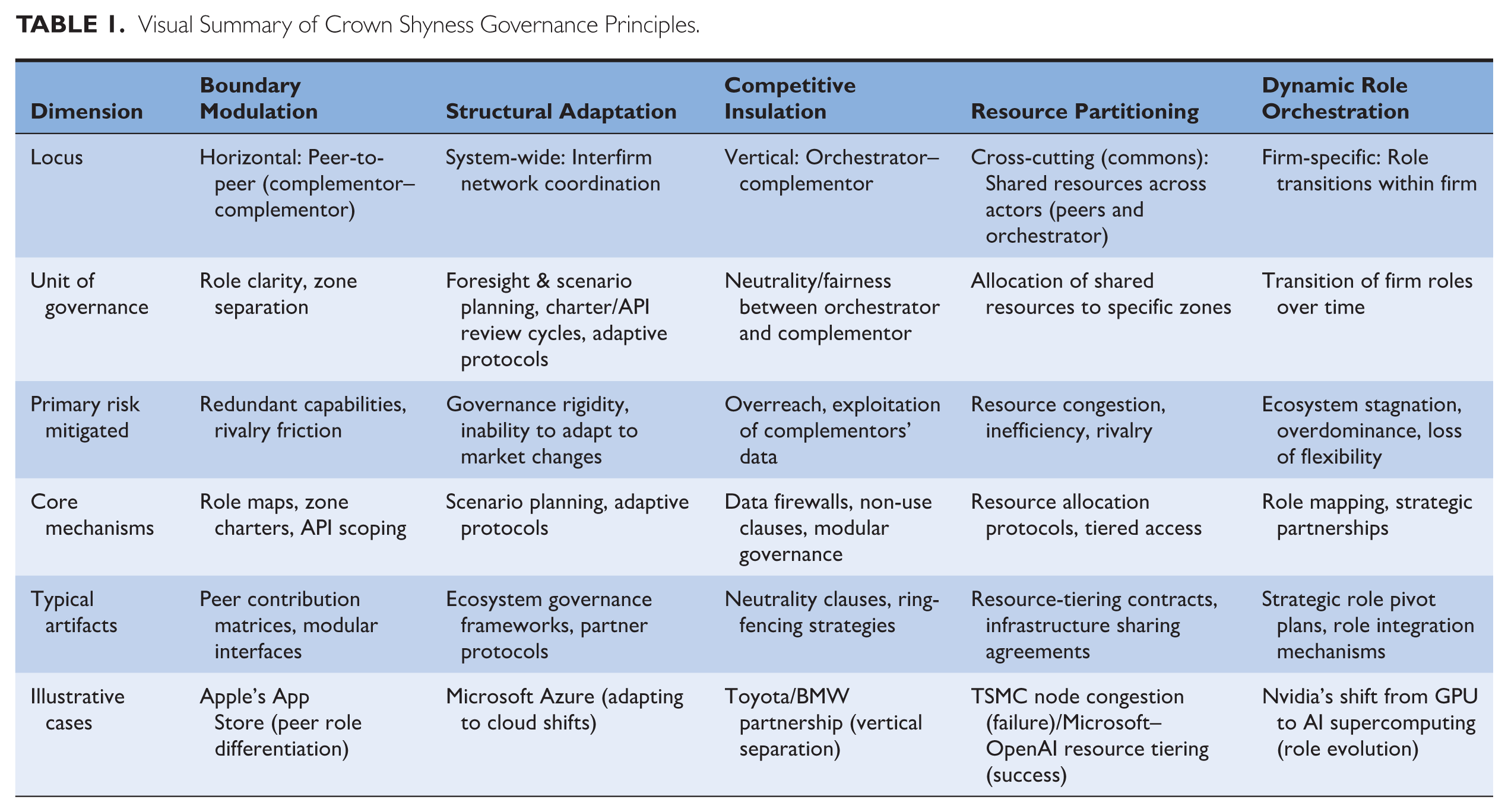
The framework is most applicable to moderate-stability ecosystems in which roles are relatively stable, but boundaries remain open to recalibration. In vertically integrated models with minimal interfirm boundaries (e.g., Tesla), it functions mainly as a diagnostic lens. In overlap-tolerant platforms (e.g., Android), governance permits horizontal rivalry, making crown-shyness separation more relevant for vertical governance—data use, neutrality, and control rights—than for suppressing rivalry itself. Platform ecosystems such as Apple iOS and alliance settings like Toyota/BMW illustrate contexts where semi-stable roles and evolving interfaces make boundary calibration essential.
Managerial Implications and Implementation Guidelines
The five crown shyness principles—Boundary Modulation, Structural Adaptation, Competitive Insulation, Resource Partitioning, and Dynamic Role Orchestration—provide a governance blueprint for innovation ecosystems. Nascent ecosystems typically display low structural complexity and emerging governance norms, whereas mature ecosystems rely on broader coordination, formal protocols, and modular separation. 118 Unlike internal optimization strategies, ecosystem orchestration manages interdependencies to create value without destabilizing the network. As technologies, markets, and entrants evolve, the effective application of these principles requires ongoing strategic flexibility.
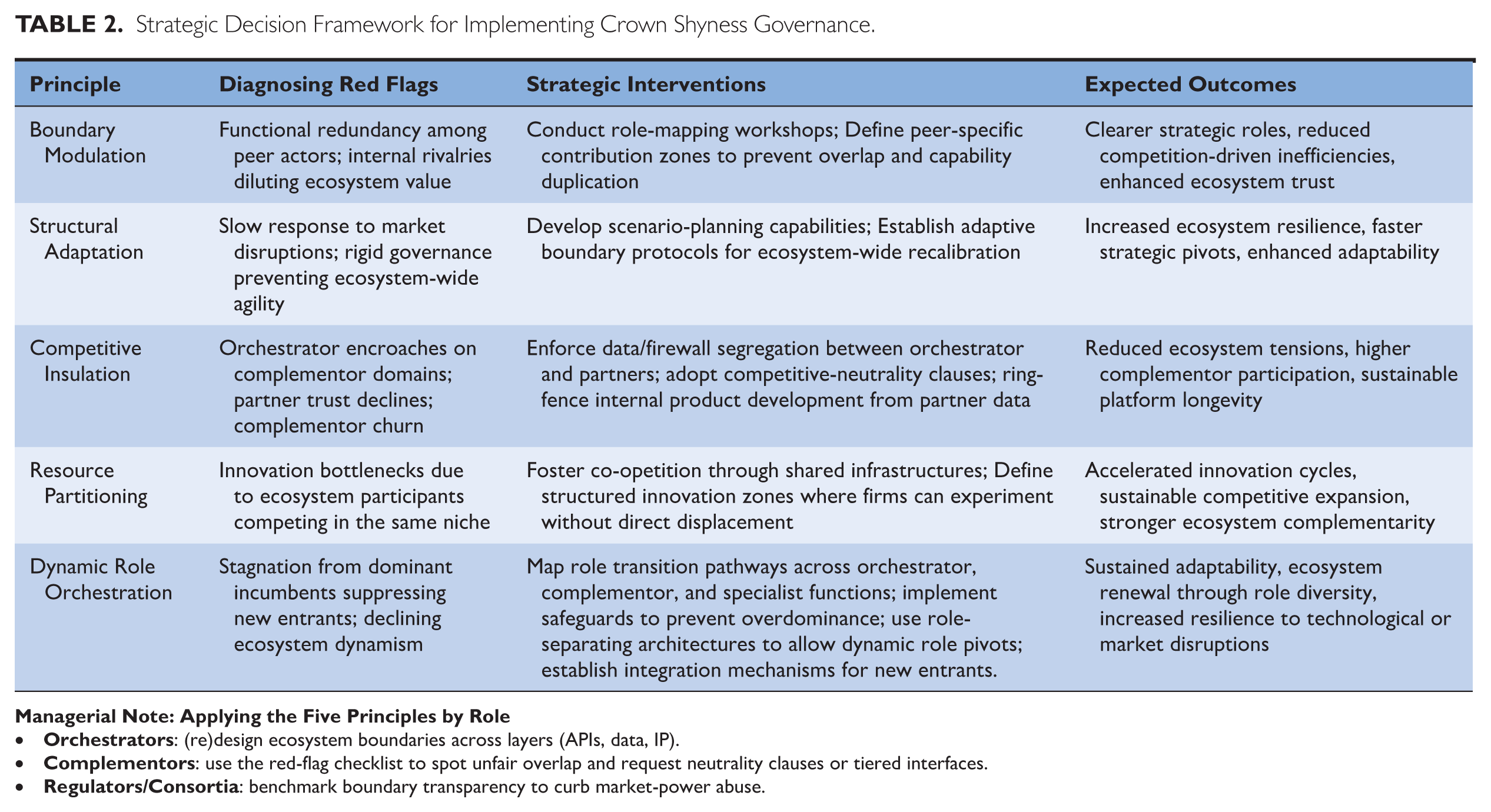
Managers can apply these principles using Table 2 and Figure 1. In nascent ecosystems such as Amazon’s early platform, Boundary Modulation resolves seller overlap through sandboxed role-mapping. In more mature settings, such as Toyota/BMW, Structural Adaptation is enacted through knowledge-zone protocols that recalibrate boundaries and restore partner trust. Competitive Insulation stabilizes confidence in Microsoft Azure, whereas Google’s ad-platform missteps illustrate the costs of overreach.
Strategic Decision Framework for Implementing Crown Shyness Governance.
•
•
•
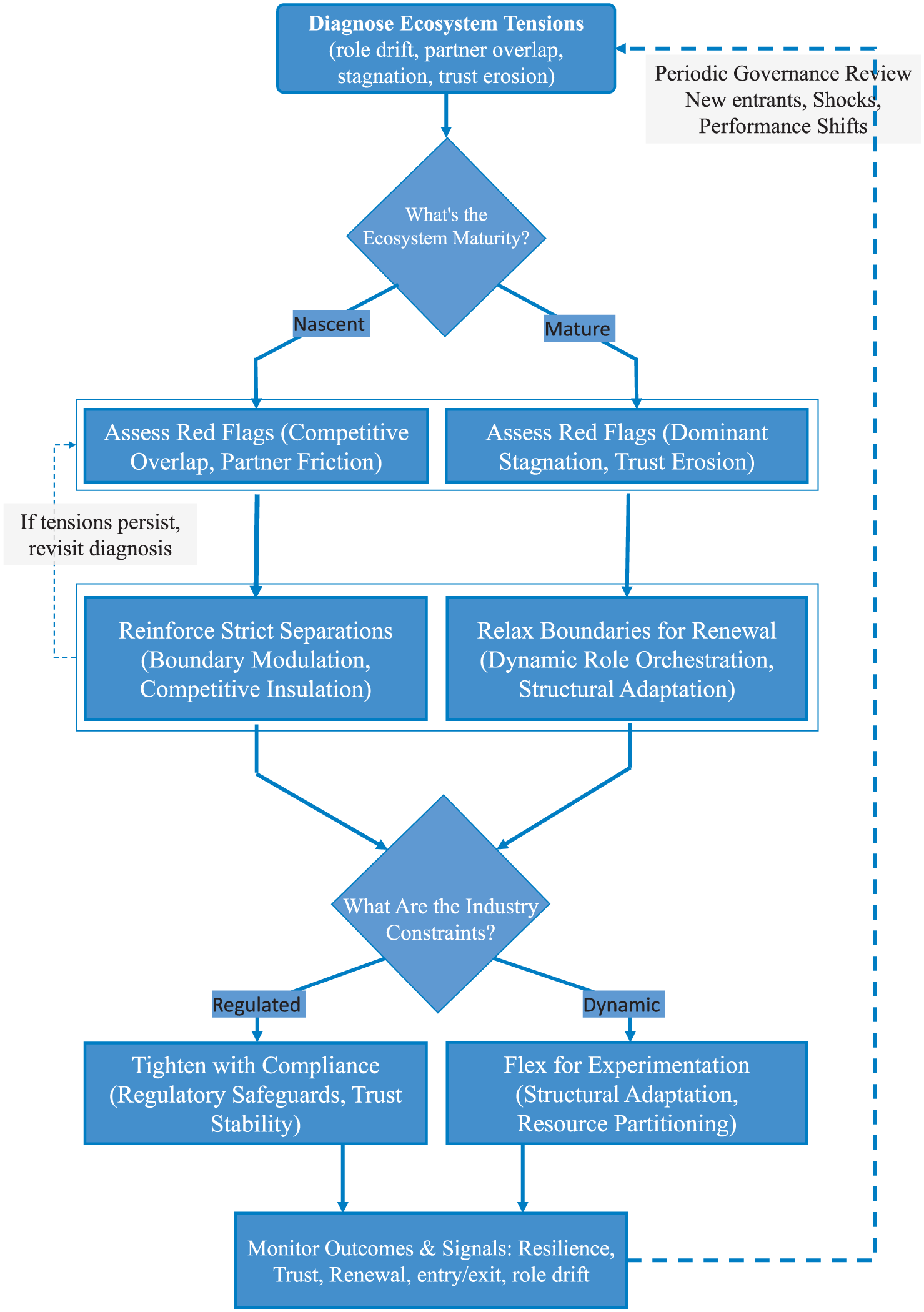
Decision logic flowchart for crown shyness governance.
Interventions should reflect ecosystem maturity and regulatory context, which shape both the red flags that surface and the levers available to re-establish crown shyness. In nascent, lightly regulated ecosystems (e.g., early consumer platforms), peer overlap and role ambiguity are most salient, making Boundary Modulation and Resource Partitioning the primary tools. In mature, heavily regulated contexts (e.g., payments or health technology), red flags more often involve vertical fairness, congestion around critical infrastructures, or rigid role lock-in, rendering Competitive Insulation, Structural Adaptation, and Dynamic Role Orchestration more salient. While orchestrators impose most structural separations, complementors and regulators can contest or recalibrate boundaries—through multihoming, neutrality requests, or rule-making—when red flags persist.
Implementation levers vary by actor role. Orchestrators control APIs, data access, and governance charters, allowing them to impose or relax separations through tools such as neutrality clauses or partner-data ring-fencing. Complementors shape boundaries more indirectly through multihoming, coalition-building, or platform resistance; they may lobby for open APIs, threaten to fork, or contest boundaries via collective bargaining or legal claims. 119 Regulators and consortia, in turn, can audit boundary transparency and benchmark neutrality to curb market-power abuse. Recognizing where boundary-setting power resides ensures that crown-shyness adjustments are not only conceptually sound, but also politically feasible.
The core challenge is dynamically adjusting separations to sustain resilience and innovation, which requires structured yet adaptable decision making. These principles also entail risks. Overly tight Boundary Modulation (such as excessively restrictive App Store controls) or misdesigned Competitive Insulation, including self-preferencing in digital advertising, can fragment ecosystems and trigger partner attrition. Delayed Structural Adaptation (e.g., BlackBerry’s response to app ecosystems) or weak Dynamic Role Orchestration (e.g., IBM’s delayed shift from hardware-centric models) can likewise lead to obsolescence and reduced engagement. 120 Weak Resource Partitioning further amplifies bottlenecks, as TSMC’s concentration on advanced nodes illustrates. 121 Managers can mitigate these risks through governance audits, stakeholder councils, and real-time monitoring, balancing structural stability with adaptive flexibility as ecosystem conditions evolve. 122
Figure 1 shows how managers move from diagnosing co-opetition tensions—using the red flags in Table 2—to selecting and tailoring crown-shyness principles across ecosystem maturity stages. Amazon’s peer redundancy reflects weak Boundary Modulation, while IBM’s strategic drift illustrates delayed Dynamic Role Orchestration. In nascent ecosystems with unstable roles (e.g., the early Apple App Store), stricter tools such as role mapping or IP delineation (Principles 1 and 3) mitigate rivalry and trust erosion. By contrast, mature ecosystems (e.g., Microsoft’s cloud services) benefit from flexible tools such as foresight planning or adaptive role pivoting (Principles 2 and 5). Industry context further shapes these choices: regulated sectors require stronger Competitive Insulation, whereas fast-evolving fields rely more on agile Resource Partitioning. These interventions mirror crown shyness’s adaptive spacing—avoiding overreach while sustaining innovation—with outcomes such as peer efficiency, vertical trust, and structural resilience monitored across principles. 123 Managers should balance stability and flexibility through governance audits and real-time monitoring as conditions evolve.
Ecosystem maturity and regulatory regimes shape how Table 2 should be applied. In young, fast-scaling ecosystems, salient red flags typically include peer redundancy, role confusion, and early resource congestion, calling for tighter Boundary Modulation and clearer Resource Partitioning. By contrast, in large, regulated, or politically salient ecosystems (e.g., cloud, payments, health-tech), red flags more often involve orchestrator overreach, perceived self-preferencing, or structural rigidity, making Competitive Insulation, Structural Adaptation, and Dynamic Role Orchestration the primary tools. Thus, maturity and regulation do not alter the principles themselves, but filter which red flags emerge first and which governance levers managers should prioritize when crown-shyness gaps appear.
Table 2 outlines how managers can combine context (red flags, ecosystem maturity, and regulatory environment) with tailored interventions (governance tools), the underlying mechanisms they activate (e.g., boundary recalibration, role insulation, resource tiering), and the expected outcomes for ecosystem performance.
Effective ecosystem governance requires institutionalizing boundary evolution through red-flag recognition and proactive recalibration. Scenario-planning tools—such as foresight workshops, horizon scanning, and trend analysis—inform structured reviews and role reassessments (e.g., Microsoft’s cloud protocols). 124 Adaptive boundary protocols—such as charter reviews, sandbox updates, and API renegotiations—formalize adjustments, allowing orchestrators and complementors to modulate separations as tensions emerge, thereby maintaining both resilience and collaborative innovation. New entrant integration mechanisms include open APIs (e.g., Nvidia’s CUDA), formal onboarding alliances (e.g., PSD2-compliant financial platforms), and compatibility standards that reduce entry frictions in regulated ecosystems. These mechanisms reinforce boundary flexibility and facilitate dynamic role transitions in maturing ecosystems.
As Figure 1 illustrates, boundary governance should reflect both ecosystem maturity and managerial intent. In nascent ecosystems like fintech, tighter separations—via blockchain protocols for Boundary Modulation or Competitive Insulation—enhance control. Mature ecosystems, such as developer platforms, prioritize adaptability through Dynamic Role Orchestration or Structural Adaptation. Managers track ecosystem strain—trust erosion or partner congestion—and recalibrate boundaries accordingly. Regulated sectors (e.g., healthcare) require stricter safeguards, while dynamic fields (e.g., AI) favor flexible coordination. These shifts mirror crown shyness, where adaptive canopy gaps preserve balance and prevent destructive overlap.
Key Theoretical Implications for Boundary Governance:
Strategic separations are dynamic constructs; ecosystems that periodically revisit role delineations exhibit fewer competitive encroachments.
Longitudinal evidence indicates that governance structures co-evolve with exogenous shocks, embedding adaptive capacity rather than reactive adjustment.
Deliberately maintained “white spaces” (zones without designated owners) are empirically associated with a higher rate of exploratory projects.
Stable ecosystems combine structural fairness (e.g., transparent fee structures) with boundary safeguards, sustaining the trust that underpins long-run collaboration.
Dynamic role recalibration—where no single actor retains dominance indefinitely—correlates with ecosystem longevity and diversity.
Our contribution positions boundary calibration alongside coordination governance as a complementary perspective on innovation ecosystem governance. Whereas much of the existing literature emphasizes coordination governance—how interdependent actors are aligned through complementarities, interfaces, incentives, and orchestration 125 —boundary calibration addresses a related but distinct challenge: how productive separation is maintained so that coordination remains viable over time.
The crown shyness framework is positioned as complementary—rather than substitutive—to perspectives such as dynamic capabilities, platform strategy, and ecosystem orchestration. Dynamic capabilities explain how firms sense, seize, and reconfigure resources in response to change, 126 while platform strategy emphasizes architectural control, boundary resources, and orchestrator scope. 127 We extend these streams by shifting the level of analysis to governance-level boundary calibration: how interfirm separations across roles, interfaces, and control zones are designed and recalibrated so coordination remains viable under co-opetition. This lens makes explicit a form of ecosystem complexity often treated implicitly—how intensified interdependence heightens the risks of overlap, opportunism, and congestion, requiring separation alongside alignment. 128 It also opens a research agenda on how coordination and boundary calibration co-evolve across ecosystem life cycles, regulation, and technological shocks, while offering managers actionable guidance on when to intensify collaboration and when to preserve distance to sustain innovation and trust.
Our analysis shows that the two governance logics are neither substitutes nor competing explanations, but interact in systematic ways. Boundary calibration often serves as a structural precondition for effective coordination: clear role delineation, insulated control zones, and partitioned resources reduce rivalry and protect trust, enabling more intensive collaboration without fear of encroachment. At the same time, coordination places pressure on existing boundaries. As interdependencies deepen, boundaries that were once functional may become misaligned, requiring recalibration to prevent overlap, congestion, or opportunism.
This interplay suggests that ecosystem failures often stem not from insufficient coordination per se, but from dynamic misalignment between coordination and calibration over time—for example, when coordination intensifies without adequate safeguards, or when boundary insulation persists despite changing coordination needs. The five principles—Boundary Modulation, Structural Adaptation, Competitive Insulation, Resource Partitioning, and Dynamic Role Orchestration—thus function as governance mechanisms that sustain and recalibrate this balance as ecosystems evolve.
Conclusion
The crown shyness framework recasts innovation ecosystem governance as a structural challenge of boundary design, not a binary of competition versus collaboration. By emphasizing negotiated separations, it equips firms to preserve trust, prevent destructive overlap, and onboard new entrants without destabilizing the system. This adaptive approach fosters long-term ecosystem resilience, as seen in Nvidia’s shift from gaming GPUs to a $60.9 billion AI platform. 129 In AI-driven markets, such governance enables sustainable differentiation and collective value creation. 130
Ecosystems often fail when their boundaries blur. Prior research richly theorizes interdependence and value architecture, 131 complementarity and role structures, 132 and platform boundary resources, 133 yet under-specifies how to maintain the separations that prevent co-opetition from devolving into destructive rivalry. The crown shyness framework addresses this gap by shifting ecosystem governance from coordination logic (aligning actors for value creation) to calibration logic (maintaining adaptive separations under sustained co-opetition). It synthesizes three governance layers—roles (who does what), interfaces (who accesses what), and control zones (who controls what)—into five adaptive principles that specify what to separate, when to recalibrate, and how to institutionalize boundary governance. This structural perspective extends prior typologies and comparative reviews 134 by providing design levers to sustain trust, fairness, and resilience across both platform-based and alliance-based ecosystems.
This framework advances ecosystem theory by establishing boundary calibration—maintaining adaptive separation under co-opetition—as a core governance challenge alongside coordination. The five principles specify when separation is required (e.g., rivalry, trust erosion, resource congestion), how it should be designed across governance layers (roles, interfaces, control zones), and how it must be recalibrated as ecosystems evolve. In doing so, the framework: theorizes boundaries as adaptive rather than static; demonstrates applicability across platform- and alliance-based ecosystems; and operationalizes calibration through diagnostic tools (Table 2; Figure 1). Beyond innovation-ecosystem research, it also informs co-opetition and platform strategy by clarifying when insulation, not just connection, sustains long-run collaboration and differentiation.
The structural separation challenge we identify extends beyond innovation ecosystems. Open innovation theory emphasizes knowledge flows but under-specifies appropriability safeguards, as seen in Amazon’s third-party data case. 135 Co-opetition research focuses on value co-creation without design rules for role insulation, thereby contributing to overlap failures like Intel/Micron’s 3D XPoint split. 136 Platform strategy clarifies orchestrator power yet under-theorizes complementor protection, as seen in Google’s advertising disputes. 137 Dynamic capabilities explain firm-level renewal but not collective boundary recalibration, as shown by BlackBerry’s ecosystem rigidity. 138 The crown shyness framework thus fills a cross-cutting gap by providing structural governance mechanisms that complement these perspectives.
While the crown shyness framework aligns with core concepts from open innovation and dynamic capabilities, it is not intended to replace these theories. Instead, it complements them by offering a structural governance perspective that focuses on how firms can adapt interfirm boundaries, allocate resources, and manage roles within evolving ecosystems. Open innovation emphasizes knowledge flows and collaboration, 139 while dynamic capabilities focus on firm-level adaptation. 140 The crown shyness framework extends these ideas by providing actionable mechanisms for managing co-opetition at the ecosystem level, supporting both collaborative and competitive behaviors.
Nonetheless, the framework has contextual boundaries. In vertically integrated models like Tesla, where inter-firm boundaries are minimal, our separation logic mainly serves as a diagnostic lens rather than a prescriptive tool. In overlap-tolerant platforms such as Android, governance deliberately permits more horizontal rivalry among complementors and OEM-provided apps, so crown-shyness-style separation is most relevant for vertical governance issues (such as data use, neutrality, and control rights) rather than for suppressing rivalry per se. 141 In software ecosystems, focal firms often provide abundant innovation inputs and shared infrastructure, where modular design and access fairness matter more than strict partitioning. Complementors, though not boundary setters, can still shape governance through contestation, multihoming, or coalitions. 142
While crown shyness offers a valuable metaphor for structural governance in innovation ecosystems, its analogical power has limits. Crown shyness emerges naturally in wild forests to prevent mechanical abrasion and optimize light sharing, whereas innovation-ecosystem boundaries are often orchestrated by powerful focal firms (e.g., Microsoft) and strategically designed to govern access and control. In forests, trees compete over a finite resource—sunlight—whereas digital ecosystems often revolve around deliberately created, abundant, non-rival inputs (such as APIs or SDKs) designed by focal firms for complementors to use in innovation and value creation. 143 These differences underscore that crown shyness is most applicable in moderate-stability ecosystems characterized by crowding, role ambiguity, or governance opacity—contexts in which negotiated structural separation improves adaptability and trust. In platform ecosystems like Android, governance explicitly tolerates overlap among rival complementors and OEM apps to increase variety and consumer value. 144 In such settings, structural separation remains relevant, but primarily for governing vertical fairness—how orchestrators use data, set access terms, and prioritize their own services—rather than for eliminating horizontal rivalry. By contrast, Tesla’s vertically integrated structure minimizes the need for inter-firm boundary design altogether. 145
Footnotes
Appendix A
Notes
Author Biography
Saeed Roshani is an Assistant Professor of Technology and Innovation Management at Amirkabir University of Technology (Tehran Polytechnic) and a Technology Forecasting Consultant specializing in emerging technologies, innovation ecosystems, and strategic foresight (saeedroshani@aut.ac.ir).