






Abstract
How often does your innovation portfolio (your budgeted innovation projects) fail to deliver strategic change because it consists of incremental initiatives or serves partisan objectives? Senior leaders often think the problem lies in weak strategy or weak organizational creativity. But, based on feedback from seventy CEOs and CTOs of large organizations, this article shows that something else is going on. The problem is often the result of how innovation portfolios are assembled. The standardized nature of the most widely used innovation portfolio methods leads to portfolio choices that don’t align with the strategy. This study shows how management can take back strategic control.
Key Recommendations
■ Replace generic metrics with strategic priorities. Allocate innovation resources against strategy-specific change goals, not generic measures such as ROI, market share, or technological novelty.
■ Evaluate portfolios, not projects. Assess innovation initiatives as a portfolio against strategic vulnerabilities and growth ambitions, because strong standalone projects often fail to create strategic change when combined.
■ Use numbers to challenge decisions, not make them. Apply financial and quantitative indicators as due diligence tools that expose weak projects and enforce accountability, not as the primary basis for portfolio selection.
■ Fund the gaps, not the winners. Regularly map projects to strategic goals and shift resources toward critical priorities that lack sufficient innovation investment.
If your innovation portfolio doesn’t seem to support your strategy, you’re not alone. An effective innovation portfolio is supposed to be a collection of budgeted innovation projects that enable your business to make strategic changes. 1 But many senior leadership teams (SLTs) struggle with their portfolios—they don’t keep up with strategic ambitions and are centered on the short term, and on the safe rather than the bold and ambitious. 2 Before you decide that your organization doesn’t understand the strategy or doesn’t have ideas, ask yourself how you allocate innovation resources. A close look at the most widely used innovation project-prioritization methods reveals that they suffer from serious limitations that distort or muddy the strategy.
Standardized
Not so obvious—but just as important—is that both methods pretend that innovation projects can be evaluated in isolation, like standalone activities. On the contrary, innovation projects must be complementary to support strategy. For example, three promising new products that all target the same market will overlap rather than add up to a good innovation portfolio that grows the business. These methods don’t support the need to consider project interdependencies.
Taking back control requires a different process, one that uses strategy-specific prioritization criteria rather than generic and standardized criteria. 6 Strategy-specific means the portfolio criteria are derived from the strategic change needs of the organization.
Engaging with senior leaders through an in-depth intervention study with ten business SLTs, 7 a detailed survey with seventy CEOs and CTOs, 8 and executive workshops in several top business schools confirmed a key insight: Portfolio decision-making processes that don’t actively use strategy-specific criteria don’t reliably deliver business outcomes. So, how can you achieve this? We found that to make the innovation portfolio process more effective, senior leadership teams should regularly do the following:
■
■
■
■
■
The following detailed company spotlight illustrates the leadership challenge of misalignment between strategy and portfolio and the value of driving strategic specificity in the prioritization process. We then validate (with unique data from seventy CEOs and CTOs of large companies) that strategy-specific portfolio choice supports strategic change, leading to higher business growth. 9
Portfolio Selection at Beauty Inc
In 2023, the senior leadership team (SLT) of Beauty Inc., 10 a medium-sized Southeast-Asian cosmetics company that specializes in skincare, set the strategic goal of aggressively growing 30 percent annually over three years by adding products and two new brands. They addressed female consumers aged twenty to sixty through indirect channels (salons) and an online channel, and a few of their own stores. Proud of the science-based efficacy of its skincare products, the SLT thought about developing new ingredients for skincare products that would need regulatory approval, similar to pharmaceutical companies. Figure 1 outlines their business strategy (using Markides’ dynamic strategy framework). 11
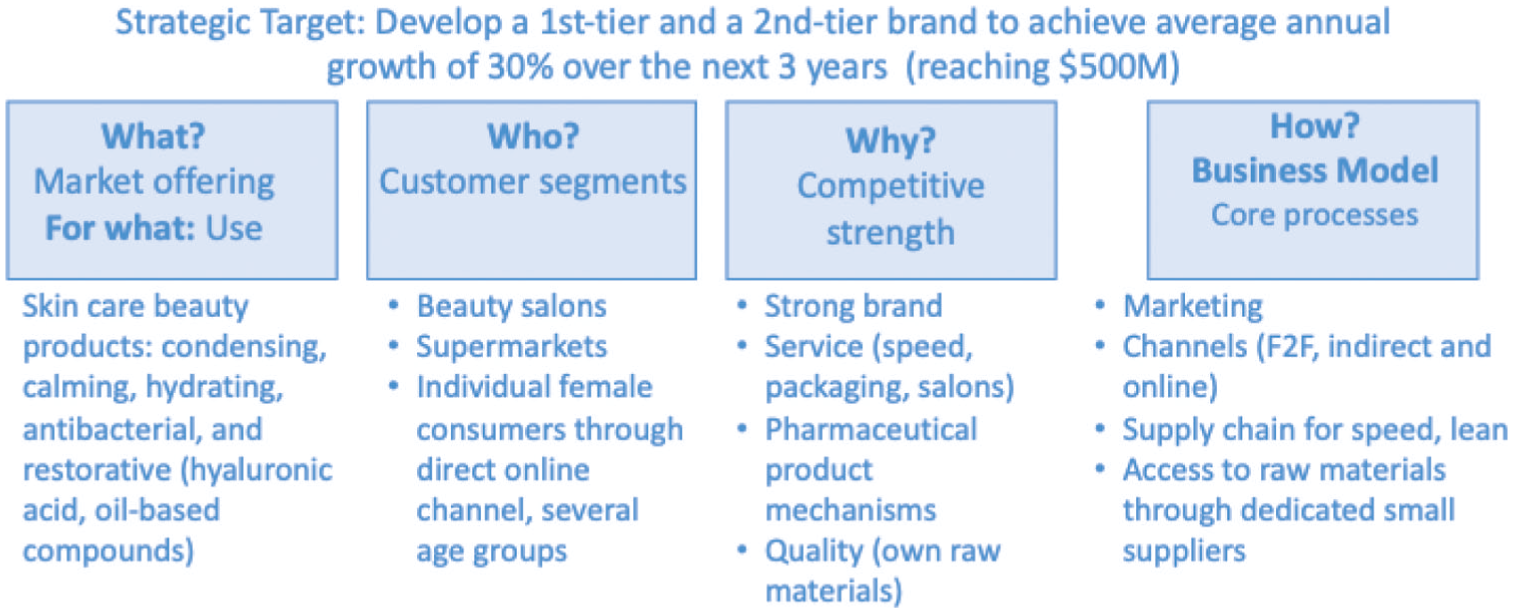
Beauty Inc.’s business strategy.
The SLT invited us to hold a strategy workshop to examine the effectiveness of their innovation portfolio. We first discussed their strategy, and they discovered slight inconsistencies in interpretation among the senior executives present—which is not uncommon—so they re-established a shared consensus on their strategic priorities.
We then asked a key question, “Where are your vulnerabilities with this strategy, and why might you not succeed in achieving your overall 30% growth target?” A lively discussion revealed five concerns: Would R&D succeed in getting substances approved by pharmaceutical regulators? Did they have enough new products? Were they investing enough in brands and channels to establish two new brands? Could their franchised business model, including its online sales channels, support the revenue? And finally, were their operational costs competitive?
These five concerns became, in the first step of the process, the innovation goals in Figure 2. 12 In the second step of the process, we asked the SLT to place the currently funded projects in the table, with each one listed under the respective innovation goal that it best supported (some projects supported more than one goal, and a couple of them none). The projects in the portfolio had been selected using well-known and respected indicators, specifically return and market-share indicators, together with channel and production feasibility measures. This approach resulted in a collection of funded projects depicted in Figure 2.
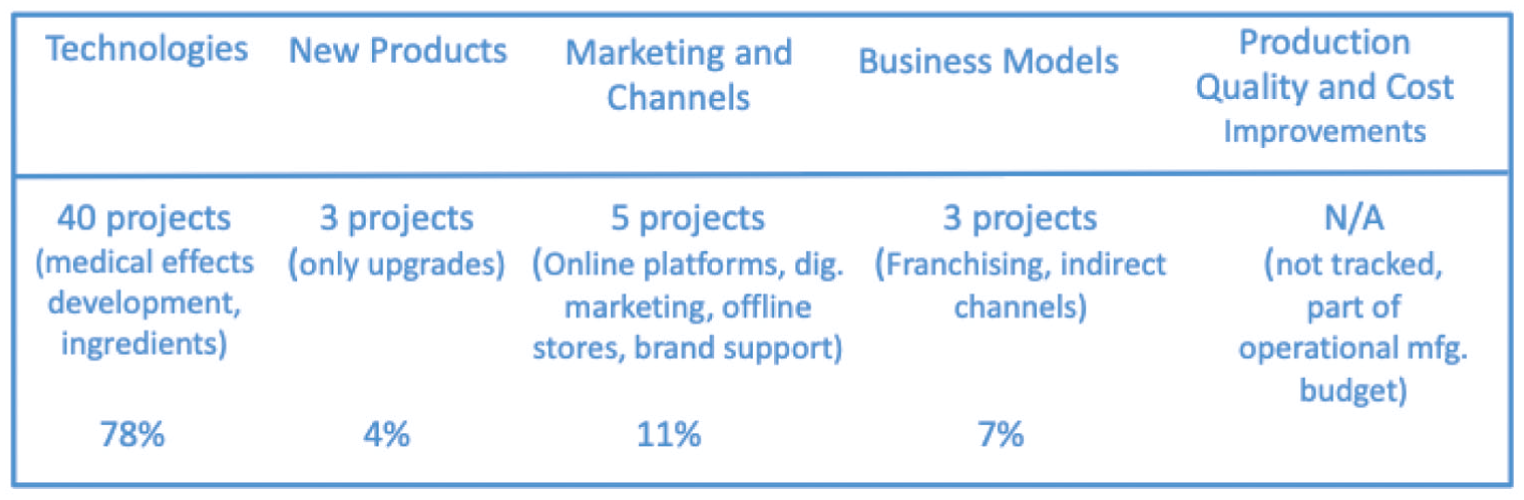
Beauty’s existing innovation portfolio by strategic weaknesses addressed.
This classification exposed a worrying misalignment: The innovation portfolio they had defined based on quantitative indicators was too focused on tech-development projects (with uncertain market outcomes) to achieve the strategic goals of growth from new brands and products. What’s more, it didn’t have enough new products, and it lacked power in projects that would enable marketing to support the existing brands, not to mention building new ones.
This unsettled the SLT. They had never stress-tested the innovation portfolio against their specific strategic concerns and change needs in such an explicit way. How had this happened to a team that clearly knew its strategy and applied a transparent innovation portfolio process?
The answer lay in their prioritization criteria, which placed disproportionate weight on market share indicators, based on an unspoken assumption that market share would come from new technologies. But the resulting slate of “superior-looking projects” (according to those criteria) wasn’t fit to enhance their business.
The realization about the lack of strategy support led to two months of intensive activity, resulting in significant resource reallocation (Figure 3). Tech development was downgraded, reflecting a reduced desire to develop pharmaceutical-like products. Marketing support for (new and existing) brands was radically enhanced, supported by new products to substantiate these brands, alongside an expansion of its online presence by adding online platform partners. And finally, some manufacturing process improvements were reclassified as part of innovation instead of manufacturing. Because these improvements were “strategy-relevant,” 15 percent of the budget was moved from manufacturing to innovation.
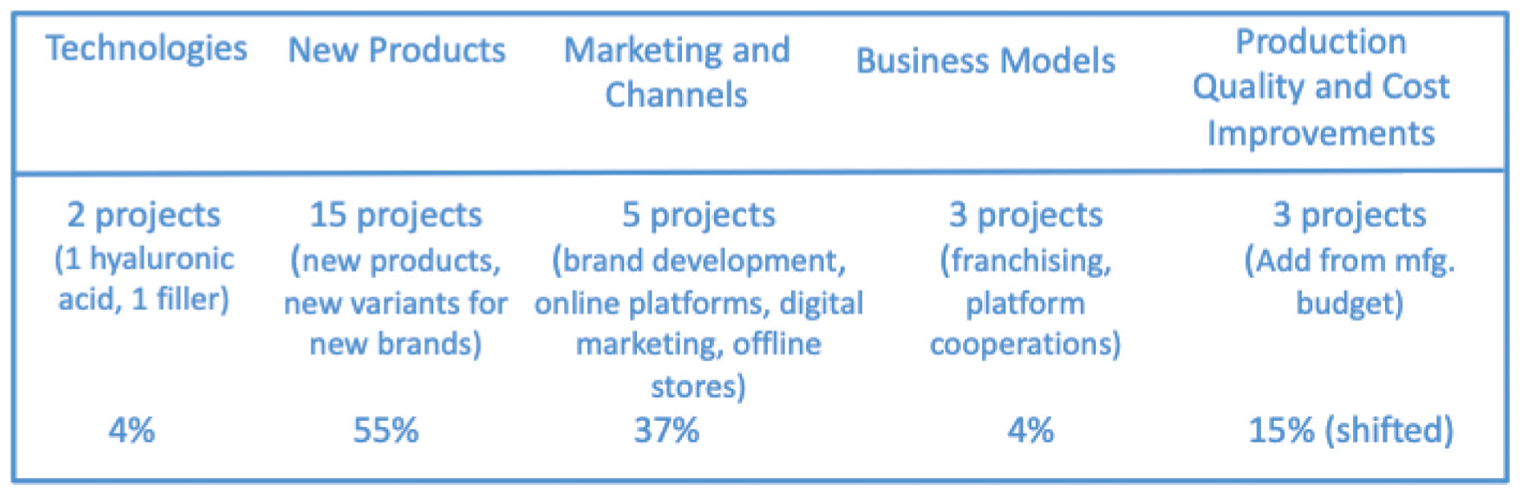
Beauty’s revised innovation portfolio addressing strategic weaknesses (the total budget didn’t change).
The SLT was confident that they could meet the strategic growth target with the adjusted portfolio. It reprioritized innovation resources, but it also reflected a strategic change, as products and brands replaced technology as the key competitiveness driver (although the tech didn’t completely disappear).
The Beauty example illustrates how standardized project-scoring indicators can cause innovation resource allocation to become disconnected from the business strategy, even when importance weights are used. We have seen this disconnect across numerous medium to large companies: Despite clear strategies, innovation portfolios built on generic indicators don’t support specific strategic change needs. The project selection process needs to reflect how this organization wants to support or change this strategy.
Portfolio Effectiveness is Helped by Strategy Specificity: The Study
Was Beauty Inc. (and several other companies we worked with) an outlier, or did the company offer a broader leadership lesson? Is strategy specificity a necessary element when assembling effective innovation portfolios?
A set of detailed interviews with CEOs and CTOs across seventy internationally competing Chinese companies, who each gave us one hour, rigorously analyzed to establish econometric (causal) connections, produced a clear message (Figure 4): Building the innovation portfolio with prioritization criteria that reflect the strategy-specific innovation goals creates business value. The message was more meaningful because of the seniority of the respondents: key decision-makers close to strategic innovation portfolio creation, 13 which was necessary to capture the sensitive and strategic nature of innovation portfolio decisions. 14
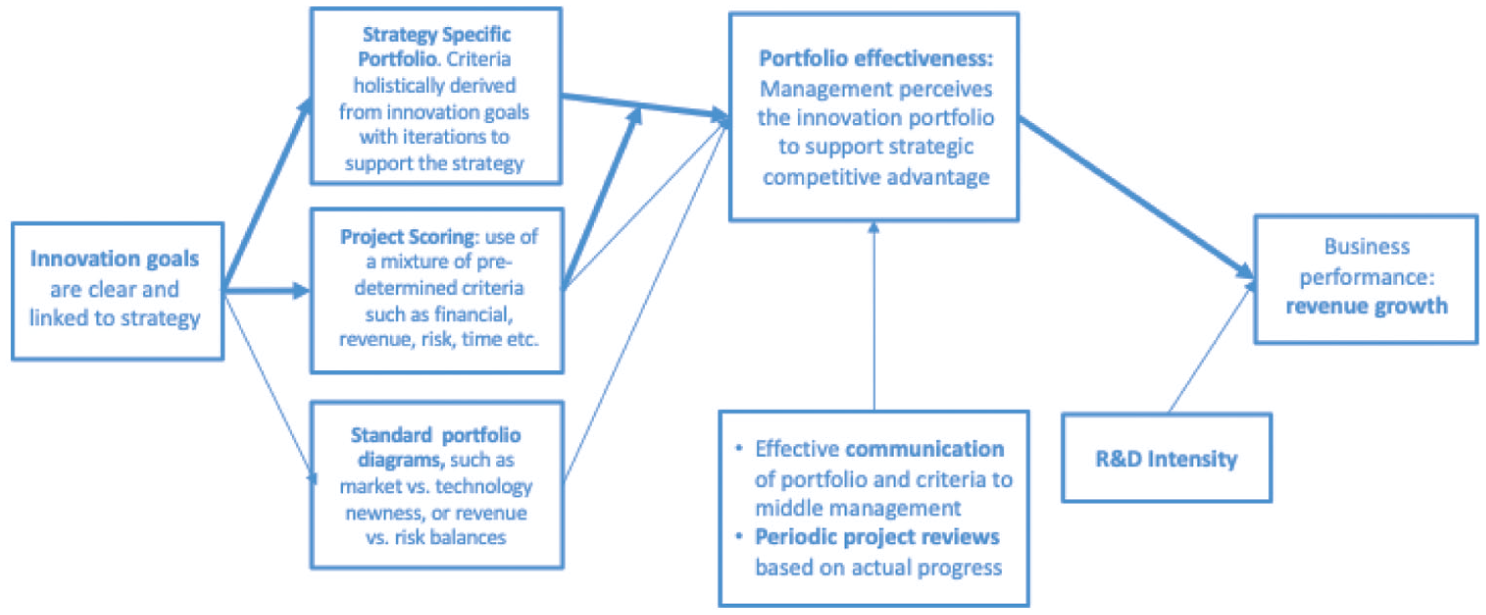
Connections of the portfolio prioritization variables with effectiveness and growth.
The bold arrows in Figure 4 establish the key takeaways for effective innovation portfolio management.
■ First, it should be at the top of leaders’ agendas, as it supports business growth: Across our CEO and CTO respondents, 15 portfolio effectiveness (as assessed by them) was positively associated with revenue growth. As explained earlier, our focus is growth as innovation success (because within the business year, cutting innovation increases profits). And this outcome of our analysis reassures us that we didn’t measure a biased impression by our respondents; in fact, their perception of the quality of the innovation portfolio impacted growth, an objective business measure.
■ Second, effective innovation portfolios are built using strategy-specific portfolio criteria (there is a bold arrow from strategy-specific criteria to portfolio effectiveness). Project-scoring and standardized portfolio diagrams methodologies were, in contrast, not powering portfolio effectiveness. This reflects what we saw at Beauty Inc., as well as the ineffectiveness of the currently dominant approaches discussed earlier.
■ Third, the interviews indicated that strategy-specific criteria are even more productive when informed by project-scoring. In other words, the use of project-scoring, despite its shortcomings as the key driver of project selection, adds discipline to the consideration of strategy-specific criteria. “Discipline” means that projects must be carefully documented and analyzed, and the threat of a project emerging as a clear “loser” (with bad numbers) keeps everyone involved accountable. 16
■ Finally, successful SLTs don’t just need strategy specificity to build an effective portfolio. They also do the groundwork to get there. Articulating clear strategy-driven innovation goals is a key prerequisite for both of the prioritization methods associated with effective portfolios: Clarity is positively associated with the use of project-scoring and strategy-specific portfolio prioritization, but not with standardized portfolio diagrams. 17
Conclusion: How to Build Strategy Specificity into Portfolio Choice
Across our sample of seventy company CEOs and CTOs, with detailed case studies, we found that strategy-specific innovation portfolio methods drive effective innovation portfolio management. Strategy-specific criteria improve the alignment of the innovation portfolio with a company’s strategy, allowing senior leadership teams to design their innovation portfolio to achieve business growth.
We finish by offering some actionable portfolio prioritization guidelines (with additional suggestions), adding more “how to” to the introductory statement. Although we have demonstrated this with only one example (more examples are mentioned in Note 7) we have tested the portfolio guidelines with over one hundred senior managers in workshops in Europe and Hong Kong.
■ Rewire your regular innovation meeting (if you don’t have one, do set it up) with an agenda such as: question the validity and continuing effectiveness of the existing strategy to reach your business goals; check the understanding and support from the key stakeholders; and identify necessary changes (to address threats or opportunities). If additional analysis is required to do this, take the time for this analysis. The SLT discusses and reaffirms agreement on the state of its strategy, including priorities, vulnerabilities, or development opportunities, and where changes are desired. As we saw with Beauty Inc., inconsistencies in interpretations among SLT members arise faster than expected, requiring discussion and possibly reassessment.
■ Focus on the most important strategic change needs, phrased as actionable, strategy-specific innovation goals that are urgent enough to warrant investment. First, consider not just defensive goals (vulnerabilities from the top), but also opportunities (such as a new technology proposal from R&D or a marketing opportunity). A significant opportunity (tested to the point where it can become a large, top-management-sanctioned innovation project) can arise from the bottom up, be incorporated, and even modify the strategy. Second, the SLT can always articulate an aspirational objective, such as “identifying a new market opportunity outside of the currently served segments” as an innovation goal. This is a call to invest in creating such opportunities. It is important to keep in mind that innovation goals do not only have to relate to immediate business needs, they can also be the prompts for longer-term innovation search (“we need to search for new business model for an old or a new segment” or “we need to make key business processes AI-based”) or for pursuing non-quantitative goals such as sustainability gains. The key is a discussion and consensus priority in the SLT.
■ Relate your current innovation portfolio to the strategic change goals. Map out every current project’s fit with the articulated goals and highlight the gaps. They should guide change in the innovation portfolio. Ask, “How much do current projects support the diagnosed strategic innovation goals?” and discuss whether new innovation goals warrant a resource allocation shift (such as reducing resources in some areas to fuel investment in others) or even a partial redesign of the portfolio (adding new projects or visibly adjusting the overall budget). In other words, cut the least important projects and create new ones that cover important neglected goals. In rare cases, you may even decide to increase the total budget if the situation is urgent.
■ Use financial (or quantitative) indicators to supplement the strategic choice, not as ends in themselves to choose projects (which would over time cause a drift of your portfolio from strategy). Use them only as due diligence and to identify really bad (unacceptable money-losing) projects. Used as an accompanying check, quantitative indicators tend to become less biased once the stakes are reduced, and the temptation to manipulate them weakens. And finally, do not fall into the trap of creating “indicators of strategic goal coverage.” Several times, managers asked us whether they could not shorten the time of the strategy workshop by articulating an indicator of “percent of strategic goals covered (in number or in terms of value)” because it would be a “more efficient use of their time.” Creating an SLT consensus about the innovation portfolio is a very good use of senior managers’ time, and the “efficiency” of summary indicators to shorten this consensus discussion is an illusion, risking decision ineffectiveness and longer-term underperformance.
This last guideline is relevant not only for senior managers, but its effect is also evident in professional literature. Strategy-specific innovation prioritization was recommended by innovation academics and professionals fifty years ago, 18 but it got lost in the general search for standard methods that can be easily taught and applied. Busy leaders want to reduce effort with standard criteria, which may also make them feel less vulnerable to criticism and judgment (“I can be more easily criticized if things go wrong because of criteria I have developed than if they go wrong based on established criteria”). Academics and consultants also like standardized criteria because applying them across multiple clients means less work and implies “objectivity.” Also, junior staff may lack the skills needed to make the judgments involved in strategy-specific portfolio design.
The newest incarnation of this belief in the “efficiency” of standardized criteria is the spreading belief that AI can provide “intelligent” rules to make innovation portfolio decisions, as LLMs can now execute complex and case-specific rules. However, we strongly advise SLTs that the innovation portfolio reflects your shared understanding of your strategy—if it is “delegated” to an AI, you will lose distinctiveness and ultimately your ability to make creative strategy changes.
Standardized criteria (or implicit criteria embodied in the opaque decision-weighing matrices of an LLM) sooner or later become a trap, leading to generic, even harmful, decisions without an agreed explanation. This has been widely diagnosed in the last twenty years. We have demonstrated how innovation portfolio prioritization methods can be more effective, based on evidence from multiple sources. Strategy-specific innovation portfolio design allows leaders to scrutinize their strategy in their innovation portfolio design (aligning with or changing the strategy), creating a significant benefit for innovation productivity.
Supplemental Material
sj-docx-1-cmr-10.1177_00081256261464598 – Supplemental material for Innovation Portfolio Management: When Projects Drift From Strategy
Supplemental material, sj-docx-1-cmr-10.1177_00081256261464598 for Innovation Portfolio Management: When Projects Drift From Strategy by Haijian Si, Christoph Loch and Stylianos Kavadias in California Management Review
Footnotes

Supplemental Material
Supplemental material for this article is available online.
Notes
Author Biographies
Supplementary Material
Please find the following supplemental material available below.
For Open Access articles published under a Creative Commons License, all supplemental material carries the same license as the article it is associated with.
For non-Open Access articles published, all supplemental material carries a non-exclusive license, and permission requests for re-use of supplemental material or any part of supplemental material shall be sent directly to the copyright owner as specified in the copyright notice associated with the article.
