







Abstract
Introduction
A growing body of occupational therapy knowledge and practice focuses not on health but on justice, rights, and social transformation for groups and communities, and in doing so brings together aspects of community development and occupational therapy. A tension exists in both fields, however, between the social justice that practitioners espouse, and their real-life practice. This can limit the transformative potential of practice. To address this, practitioners have been encouraged to engage in critical praxis (Farias & Laliberte Rudman, 2019a; Kinsella & Whiteford, 2009; Ledwith, 2016), where theory and practice, action and reflection, are critically synthesized and constantly evolving (Freire, 1972). Despite this, no research to date has explored whether/how occupational therapists or community development practitioners engage in critical praxis, nor ways they may be supported to do so. This study aimed to fill this particular gap by exploring the praxis of Australian occupational therapy-community development practitioners, with the hope findings may provide insights into how to improve practice directed toward social justice.
Background
An expanding field of occupational therapy operates outside the health sphere, with a focus not on health but on social and occupational justice. Such work has been labeled ‘social occupational therapy' (Lopes & Malfitano, 2021), ‘occupation-based social transformative work' (Farias & Laliberte Rudman, 2019a), and ‘critical occupational therapy' (Hammell & Iwama, 2012; Whiteford et al., 2017). Although a comprehensive exploration of social justice is outside this paper's scope, it is defined here as the structuring of society to ensure just and equitable access to resources and conditions for all people, regardless of difference, to live lives they value (Ledwith, 2016; Sen, 1999). Complementary to this is occupational justice, the recognition that all people have a right to fair and equitable opportunities to do the things they need, want, and have to do (Hocking, 2017). As social occupational therapy's focus is on justice, practitioners of this field often do not work within health services, where the focus is rehabilitation or health, rather than justice. Instead, they work across micro, meso, and macro levels of society with groups, communities, and populations whose occupational challenges are seen more accurately as resulting from societal factors (e.g., discourses, practices, systems, and structures) and subsequently, as matters of justice. It is these root causes of injustice that social occupational therapy seeks to transform, to increase possibilities for social and occupational justice (Malfitano & Lopes, 2018). This is often enacted through participatory processes aligned closely with community development (see Galvaan, 2017; Lopes & Malfitano, 2021).
In its broadest sense, community development is a practice that works collectively with communities of people to raise their consciousness of systems that oppress them, and seek possibilities for challenging such systems to advance social justice (Ledwith, 2016). To achieve this, practitioners work in whatever capacity the community needs, to enable collective identification of assets and issues. Together they develop assets and analyze the root causes of issues, deciding on and implementing initiatives needed to address them (Ledwith, 2016; Westoby & Ingamells, 2012). People (micro) and their community (meso) are therefore central to community development practice. Simultaneously, however, community development practice works to effect change at the societal (macro) level. Considering links between the personal and political is essential for transformative outcomes focused on social justice (Ife, 2016; Ledwith, 2016). Such considerations require critical social theories, which assist practitioners to analyze power, inequality, and structural disadvantage (Ife, 2016; Purcell, 2012).
Both social occupational therapy and community development are clear in their aspirations to engage in practice that is transformative compared to ameliorative, liberating compared to pathologizing, working from micro to macro, to disrupt systems and structures of injustice rather than just alleviate symptoms (Farias et al., 2016; Ledwith & Springett, 2010). Yet enacting this vision has been recognized within both disciplines as fraught with tensions (Farias et al., 2016; Ife, 2016; Ledwith, 2016), with practitioners challenged to practice what they espouse (Farias & Laliberte Rudman, 2019a; Purcell, 2012; Quiroga & Reyes, 2019; Shaw, 2017; Townsend & Marval, 2013).
Both practice areas posit that to realize the social transformation they espouse, practitioners need to engage in critical reflexivity and critical dialogue, to question how theories and assumptions promote rather than challenge the status quo, and similarly, to resist ways practice may be co-opted by the very structures and ideologies they aspire to challenge (Farias & Laliberte Rudman, 2019a; Kinsella & Whiteford, 2009; Ledwith, 2016; Quiroga & Reyes, 2019; Townsend & Marval, 2013). Such elements come together in critical praxis (Ledwith, 2016).
Freire (1972) described praxis as the unity of critical reflection and action, theory, and practice, to transform the world, and stipulated such praxis was only authentic when its subsequent actions again became the focus of critical reflection. This integrated cycle of action and critical reflection, where theory is simultaneously generated in action and action from that theory, becomes a ‘way of being', a critical living praxis, that is more than mere theory-practice congruency (Ife, 2016; Ledwith, 2016). Within such praxis, ‘theory' is not merely an abstract concept but is unveiled in concrete situations and everyday life (Freire, 1972). Integral to this unveiling are critical dialogue and reflexivity (Ledwith, 2016). Critical dialogue is not just an exchange of ideas or stories, but a participatory process where individuals communicate as equals in a process of critical inquiry about what is being shared, to unify theory and everyday action (Freire, 1972; Ife, 2016). Critical reflexivity is more than reflection (Farias et al., 2016). It is the process of critically reflecting on our reflections to interrogate unconscious attitudes, assumptions, and positions of power influencing how/why we act in the world the way we do (Kinsella & Whiteford, 2009; Ledwith, 2016), under the premise that acting critically requires seeing critically (Freire, 1972). Such skills assist practitioners to question taken for granted aspects of oppression and understand their structural causes (Freire, 1972). Without critical reflexivity, we risk engaging in thoughtless action, or meaningless activism (Kinsella, 2001). Similarly, failure to act on our reflexivity risks engaging in mere armchair revolution, or actionless thought (Ledwith, 2016). Engaging in praxis, a continual and cyclical process of questioning theoretical assumptions in light of practice and vice versa, is therefore essential to achieving social transformation (Freire, 1972).
Although we acknowledge scholars in community development, occupational therapy, and occupational science have explored utilizing various critical theories to advance transformative agendas, it appears none have investigated the use of praxis as a means to do so. Rather than conceptualizing praxis as something to consider in isolation from other critical theories, it is instead proposed as the vehicle through which critical theories and everyday practice (and life) can be integrated. In this sense, it is purported to be essential for practitioners to enact their vision of advancing social justice (Freire, 1972; Kinsella & Whiteford, 2009; Ledwith, 2016). To our knowledge, neither occupational therapy nor community development has engaged in research exploring practitioners’ use (or lack thereof) of such praxis. We aimed to address this gap by exploring the question: “What are the experiences of engaging in critical praxis among Australian occupational therapy-community development practitioners?”
Australia was chosen for both convenience (two of the authors reside in Australia) and to contribute to the limited body of research on this practice area in Australia. To date, no studies have investigated social occupational therapy within Australia, although we acknowledge the literature on occupational justice, and occupational therapy-community development practice in the Australian context (see Hyett et al., 2018; Whiteford et al., 2018).
Method
It was essential the study's methodology clearly aligned with values and aims of social occupational therapy (Malfitano & Lopes, 2018), community development, and Freirean praxis (Ledwith, 2016): equity, empowerment, trust, dignity, and working with rather than on people. A critical dialogical approach, inspired by Farias et al. (2019), was therefore selected. This approach is critical because it seeks to question taken for granted assumptions, beliefs, discourses, and practices and in doing so spark possibilities for changes in/around practices aimed at social transformation. It does this through dialogue, which for this study's purposes, was understood from Freire's perspective (1972) (discussed above). Such a collaborative process is essential to critical research, which rejects notions of value-free truths and therefore seeks to integrate multiple views and understandings to make sense of phenomena (Kincheloe & McLaren, 2000). A critical awareness of power relations is therefore central to this methodology, which seeks to disrupt traditional views of a researcher as an expert and instead views participants as co-researchers, equally responsible for making sense of experiences (Farias et al., 2019). The methodology also reflected a praxis orientation as, through dialogue, participants and researcher critically reflected on practice, seeking to illuminate possibilities for future actions.
It is important to clarify our positionality in relation to the research. We identify as white, female academics from two countries, one involved with the origins of social occupational therapy. Two of us are involved in occupational therapy education, and one in community development education. All of us have experience in community work. The research underpinning this article was motivated by ongoing discussion and reflection on synergies between community development and occupational therapy, with implications for education and practice in both fields. In particular, we were interested in Paulo Freire's idea of praxis as a channel for social transformation, and a tool for professional action. The study had ethical approval from the institutional Human Research Ethics Committee (project number HEA-19-083).
Recruitment
To explore social occupational therapy practice in Australia (a relatively unknown field), we sought to recruit occupational therapists working in community development outside of health services and with communities who were not defined primarily by health diagnoses or conditions. Participants had to have completed either a bachelor or master's degree in occupational therapy and have at least two years’ experience working in community development outside of health services. We hoped to recruit between five and eight participants, with each participating in two interviews. We predicted the quantity and depth of data produced from this would be sufficient to meet the study's exploratory goals, while also being a pragmatically manageable size within the existing time frames.
As the practice area under investigation is niche, and known to exist on the margins of occupational therapy (Pollard & Sakellariou, 2017), we predicted the potential participant pool would be small and reaching such participants challenging. Convenience sampling (Newing et al., 2011) was used as a starting point. Recruitment documents outlining the study aim, and including a definition of community development, were emailed to all our networks of occupational therapy colleagues, who were encouraged to distribute these further. Two interested participants contacted the first author to participate and were recruited. Snowball sampling (Babbie, 2015) was then used as one participant facilitated recruitment of another, who subsequently facilitated recruitment of another.
Participants
Four participants volunteered and signed consent forms prior to data collection. This sample size was believed to reflect the niche area of practice. Two participants were known to the first author, although she knew little of the specifics of their work. One was a friend with whom the first author had studied, and the second was an acquaintance. This lent itself to the methodological aim of disrupting the traditional views of researcher as expert.
Data Collection
Inspired by Farias et al. (2019), each participant engaged in two separate dialogical interviews with the first author, two-four weeks apart, which were conducted online and recorded. The first interview involved the participant providing an account of a memorable experience in their community development work. The first author then engaged the participant in critical dialogue about the experience, exploring what knowledge, theories and reflections had informed the actions in the experience, and whether such actions had in turn been critically reflected upon, theorized about, and used to inform ongoing practice. Although an interview guide was drafted (see Table 1), this was used loosely as a starting point and, in keeping with the study's methodological assumptions, participants were supported to direct the conversation toward points they wished to explore.
Example Interview Questions.
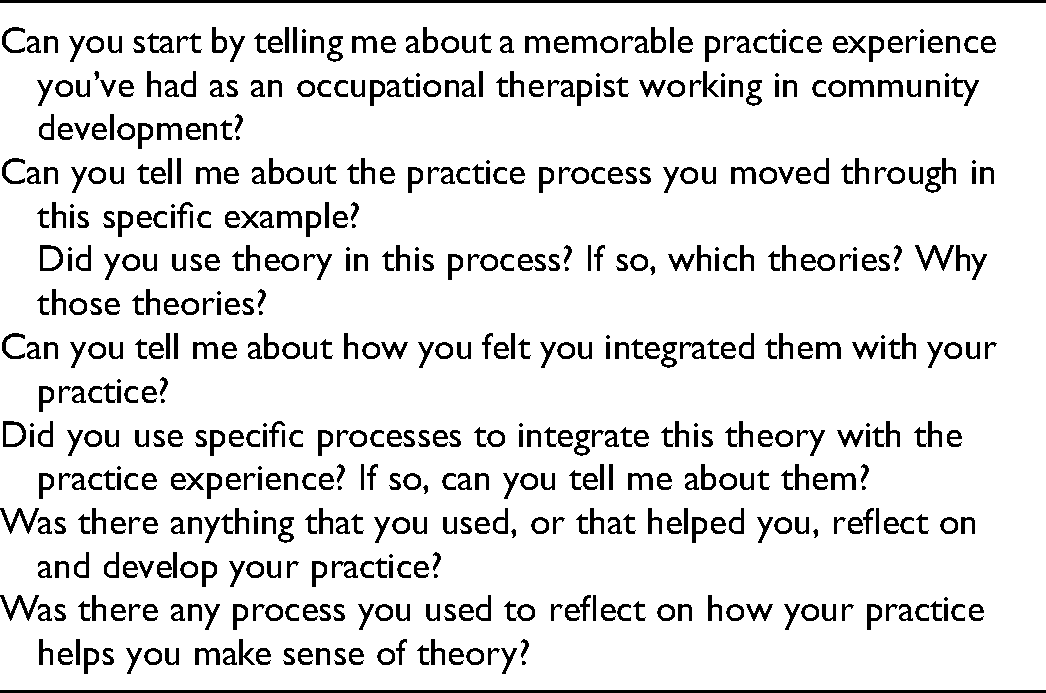
First interviews were transcribed and reviewed by the first author to stimulate a process of critical reflexivity (reflecting upon the reflections and assumptions evident in the first interview), throughout which the first author posed new questions into the original transcript. The participant was invited to respond to these questions in the transcript document (see Figure 1) before returning it to the first author prior to the second interview. This aimed to facilitate critical reflexivity and a deeper exploration of the experience/s shared, by providing greater distance from the original experience described (Ledwith & Springett, 2010). The second dialogical interview was then used to discuss comments and critical reflections generated from the first interview.

Extract from a transcript, with comments from the primary researcher and participant.
Two participants responded to additional questions within their first transcript, sharing this with the first author prior to the second interview. The other two participants reported reading the additional questions but chose to leave these for discussion in the second interview, rather than respond within the document. Transcripts were only shared with the participant they involved. All transcripts were professionally transcribed but checked by the first author for accuracy.
Data Analysis
Acknowledging there is no strict formula for critical qualitative analysis (Kincheloe & McLaren, 2000), Braun and Clarke’s (2006) method of thematic analysis was used as a starting point to facilitate thorough, deep engagement with data by the first author. This was supplemented with discussions between all authors, highlighting critical points of relevance. We used a theoretical approach to generate codes related to praxis, that is, the first author sought examples of praxis (and its component parts) from practice experiences participants shared. An inductive approach was used to generate other codes across the dataset. Data extracts for each code were collated into a separate document and collated into possible themes which were reviewed and refined with the assistance of the other authors. At multiple times throughout analysis and write-up, the first author reflexively returned to the original transcripts to ensure findings accurately and coherently reflected the dataset. This was accompanied by using a research journal where the first author captured her reflexive internal dialogue to challenge ‘unconscious editing' and support comprehensive engagement with data (Berger, 2015). A critical lens was employed throughout by consciously seeking to look behind codes and themes to consider deeper assumptions, discourses, taken for granted aspects, and/or relations of power reflected in the experiences shared.
Findings
The four participants were females with bachelor's degrees in occupational therapy from Australian universities. All had also undertaken studies in either community development, international development, anthropology, public health, or a combination thereof, at either masters or PhD level. To maintain anonymity, their names and detailed descriptions of their work have been omitted. All had experience in community development outside of healthcare services, ranging from two to more than 20 years. Some roles had been predominantly service-delivery, effecting change at the micro. Other roles had created possibilities for social transformation, often by supporting the empowerment of marginalized people, intending to effect change across micro, meso, and macro levels simultaneously. Participants were recruited based on experience working in community development within Australia but three also had community development experience in international settings. Collectively, they had experience working on a variety of projects (e.g., community integration, land management, access to education, and housing) with refugees and asylum seekers, First Australians, and women experiencing homelessness.
To answer the question “What are the experiences of engaging in critical praxis among Australian occupational therapy-community development practitioners?,” all participants made reference to the integration of theory and practice, but this seemed to span isolated instances of theory-practice/action-reflection (i.e., disjointed aspects of praxis), to cyclical integration of theory-practice/action-reflection (i.e., authentic praxis) (see Figure 2). Similarly, ‘thinking about their doing' seemed to range from superficial and operational reflection to more critical, nuanced, and deeper reflection. Findings were grouped into four themes: disjointed aspects of praxis, full cycles of praxis, supporting praxis, and challenges and solutions to praxis.

The praxis process.
Disjointed Praxis
Examples of disjointed praxis demonstrated participants’ abilities to engage in some key aspects of authentic praxis, notably reflection on action and critical thinking. They did not appear, however, to consistently synthesize these, nor use these to inform ongoing practice. Although capable of reflecting on practice, such reflection occasionally seemed more concerned with operational matters, lacking critical depth: We do a debriefing questionnaire that prompts you to look at the stuff you did well, the stuff you want to do differently, the stuff you could do better on, and then you affirm yourself on the things that were fine (Participant A).
At other times, practitioners demonstrated critical reflexivity and integration of critical theoretical perspectives as they unpacked contradictions in practice, yet they felt paralyzed to effect changes in such practice: We had to do [asylum seekers’]…banking payment and we had to cut off the percentage—they were only given 83% of the Centrelink payment, and then if they had defaulted on any kind of payments, we took that off. Eventually I was…the person doing this to the asylum seeker… When you look back on Nazi Germany and you say, how did the guards do that? … Well, I’ll be that guard. Why did I follow what these big organisations are doing? … I hated it and was, like, why am I being made to do this? …You fall into the trap… financially I needed a job but also you rely on the top dogs doing the right thing (Participant A). [Theory is] about being able to do a quick library search to see, okay, what's new since I was at uni[versity], what are the experts in this field saying, what are other people who’ve developed similar programs saying and how are they linking back to research? (Participant B). You can go in on your micro level and say, “Well I helped you buy lunch and I’ve shown you the bus route and then that's my job done,” but up to the bigger level you’re almost keeping people in a system that perpetuates stress and ill-health and segregation. That was the biggest shift in my PhD cognitively—what I’m seeing in the world has implications for shifts in theory and… we need to be …critical of theory and shifting it, if it doesn’t fit with what we’re seeing. That was a very big mental leap for me.
Authentic Praxis
Although fewer in number, other practice examples demonstrated authentic praxis (Freire, 1972). Although seemingly simple, the following demonstrates the practitioner's ability to critically reflect on her practice and position of power, and then adapt her practice, in a cycle of action and reflection, practice and theory. When I was doing training for community groups, there was definitely a difference, that I’m this expert, I’ve had all this other training and …they must defer to me … So, when I do training, I make it as participatory as possible and get their answers to things because otherwise I feel like they take my word as gospel (Participant A). The experience and …reflection are absolutely critical and then, the problem-solving that comes with it. And it never stops … because you think—yeah, I refined this, this really works, but then it doesn’t quite…there's no recipe…It's the process that counts and the mixing and matching of techniques or methods or tools or whatever and try and work out well, what's going to work best here? And how do we build on what we’re finding as we go along? (Participant C). It’s an adaptation of Jess Dart’s work around Most Significant Change. And…we have lots of debates…on Most Significant Change. Because some of it I don’t think is that practical. So we’ve adapted some of those things… we’ve designed different ways by which we work with people to gather stories of significance. The significance might be significant change or significant learning or significant the things that went AWOL. It's about taking those stories and then we put them together and give them back to people to workshop what they think is meaningful in those stories. It’s highly participatory—and it really is empowering (Participant C). We’d been doing a lot of work with different organisations… and… were really frustrated with the way a lot of the work was being done… We wanted to…have a go at doing some of this work the way we really wanted it. The way we thought it should be done. So…I’m in this luxury position, where I am the director…of the organisation and I have a core group of people around me… They’re values-driven, rather than driven by money and power and kudos (Participant C).
Supporting Praxis
Essential is trying to understand how practitioners move from disjointed praxis to a cyclical unity of action and critical reflection, theory, and practice, to achieve authentic praxis (Freire, 1972). Crucial to this is critical thinking (Ife, 2016; Ledwith, 2016), as highlighted by participants: “I think we do need to be critical of the work we do in the community sector and take time to reflect and build in mechanisms that support quality improvement” (Participant B).
Participants’ own critical perspectives were evident in their reflections on positionality and use of reflexivity in their work: You’re constantly looking at… the power relation, historical context, people getting bolshy because they see a white woman who has come from, whatever… but you go away and think, that hurt but did I do something that actually was an unconscious expression of something I didn’t say quite right? (Participant C). I don’t remember having that opportunity [to critique theory] in undergrad [occupational therapy]. I feel a lot of educators see undergrad as teaching students a thing so they can go and do a thing, and sometimes less critically … but art students are critical of absolutely everything. Maybe it's a discipline thing. I’ve done a lot of reading around participatory community development and participatory research processes and trying to be a more critical researcher, kind of unpacked myself who gets to ask what questions and how and what I’m imposing on and what I’m allowing in (Participant D).
Dialogue with others, whether formal or informal, also assisted in generating deeper reflections about action (then used to inform new action) as well as synthesizing theory and practice. Participants identified different people they would engage in dialogue (peers, colleagues, or supervisors); notably, someone with whom they had established and trusting relationships, and who would engage critically: We did…a massive why-why diagram… unpacked the complexity of it and…said, “Where are the opportunities, where can we shift things?” …I was like, “Oh yeah, it’s very complex. There’s a lot of stuff going on here,” … to have that opportunity to reflect and to have that colleague be very open… helped me internally process a lot of that (Participant D). Every time we’ve got… one person…from that community who's respected… that we work with… and daily we sit down… and say, what happened here, what happened there, you tell us what we need to do differently in terms of how we managed a certain context… Often the conversation starts from an operational pragmatic perspective but very quickly, from our perspective anyway, we’re interested to know, well, what’s behind that… where's the power aligned, what are the politics going on here, what does that mean if we’re doing this… (Participant C). There was a lot of reflective work that I did with the team, it almost became habit… we would…have a big discussion around reflecting on what had happened, how does that feel for you as part of the community… With use of my reflective journal I was able to reflect and gain more of an understanding of the value these discussions brought to our work and how they would improve program outcomes … we were able to streamline some tasks, readjust goals, plan ahead through discussion (Participant B). I think [critical reflection] is now implicit and embedded, but that’s supported by a real commitment to working… with the local community in processes where there’s lots of…workshops to…co-design and monitor on a weekly basis what’s happening, where do we go? We embed that… so that that forces reflective practice…. That helps us to continue learning ourselves and reflecting on what we’ve gathered and changing it as we go as well as at the end. It also forces me to do that in a more systematic way, but more importantly—it’s within capacity that people are working to do that (Participant C).
Challenges & Solutions to Praxis
Challenges to embedding and honoring such 'praxis prompts' were identified as heavy workloads, lack of funding, limited resources, organizational and professional culture, and time: How do we genuinely build in that critical reflection on an ongoing basis [when] workloads are so heavy… and we don’t …as a profession acknowledge the critical importance of creating space each week… to critically reflect in a structured way… Seriously getting people to think about their own assumptions, their own values, to look at what that means in terms of how they engage with people and with work? (Participant C) We can advocate for having at the staff meeting… critical storying. Real exercises where we take it in turns to share a story and critically reflect on it, in terms of well, what are we learning out of this? … We need to embed those into agendas… and get it valued in our organisations. I think we need to be doing that and the profession needs to be supporting therapists to do that (Participant C).
Discussion
This study aimed to explore whether/how Australian occupational therapy-community development practitioners engage in critical praxis. All participants appeared capable of engaging in at least some constituent parts of critical praxis, namely critical reflection on theory, but there was less evidence of consistent synthesis of such reflections with ongoing practice. Participants’ reflections on challenges and solutions to praxis provide insights into how to support occupational therapists to be more praxis-oriented.
Enacting Praxis
Cyclical integration of critical perspectives with practice, and reflexivity with action, is required for ongoing, authentic praxis (Freire, 1972; Ledwith, 2016). From this study, writing and dialogue were two methods that supported praxis and have also been highlighted by development scholars as essential to praxis (Ife, 2016; Ledwith, 2016). Both, however, must consciously challenge dominant worldviews by centering marginalized discourses, theories, communities, and individuals—which some participants sought to do through participatory processes in which dialoguing with communities was central. This requires personal commitment to ensure such practices are prioritized, remain critical, and resist becoming merely another recipe or procedure through which practitioners complacently move (Ledwith, 2016; Westoby, 2014).
As participant A alluded to, however, the reality is sometimes even those who are able to maintain critical perspectives and theorize about their practice, and who have a clear vision for their practice, find it impossible to enact that vision within organizational constraints (heavy workloads, lack of funding, and limited resources) (Purcell, 2012; Shaw, 2017). Such constraints are documented in the community development literature both within Australia (see Ingamells, 2010), and internationally (see Ledwith, 2016; Shaw, 2017), and within the literature on social occupational therapy (see Farias & Laliberte Rudman, 2019b). Within such works, these barriers are often interpreted as symptoms of the neoliberal privatization of state-run services, and the funding priorities accompanying such changes. On community development in the Australian context, Lenette and Ingamells (2015) frame this as “a chasm between funded practice versus practice grounded in theory, evidence, and ethics” (p. 92). Such a framing speaks directly to the challenges of engaging in praxis as touched on by participants.
The moral distress of this dilemma may compel occupational therapists to leave their positions rather than remain unwilling cogs in a system perpetuating injustices they seek to change. This was the reality for two participants, who started their own consultancies to practice what they espoused. This suggests their commitment to authentic praxis was not sufficient to influence structures they had worked within, to then practice in the way they envisioned, a finding also reflected in the literature (Purcell, 2012; Shaw, 2017; Westoby, 2014; Westoby & Ingamells, 2012). This suggests authentic or critical praxis is not itself sufficient for achieving transformative practice, as some scholars seem to suggest (Farias et al., 2016; Freire, 1972; Kinsella & Whiteford, 2009; Ledwith, 2016; Purcell, 2012). Further investigation of this dilemma is therefore warranted, with the hope it may illuminate ways to better support practitioners to navigate it.
Models
This study also raises questions regarding the utility of theoretical models in occupational therapy practice aimed at social transformation. Although models are designed to help theorize practice and make sense of complicated, multifactorial situations, we question whether the complexity of the contextualized nature of peoples’ everyday lives (i.e., the site of occupational therapy practice) can be sufficiently captured through a model. Framing situations through models risks simplifying something that should not and cannot be simplified. Moreover, there is a growing critique of the culturally specific nature of dominant occupational therapy models, developed in the Global North and influenced by Western views of health and illness, with a focus predominantly on the individual and insufficient attention given to contextual factors influencing occupational performance and engagement, and therefore occupational justice (Galvaan, 2017; Hammell, 2020). It seems occupational therapy models are therefore not fit for purpose in occupational therapy practice aimed at social transformation, where the focus is on contexts rather than individuals, and justice rather than health. We propose occupational therapy aimed at social transformation should instead be grounded in diverse knowledge bases (Galvaan, 2017) and critical perspectives (Hammell, 2020). These are integrated with practice through critical praxis processes which center the marginalized communities (and their discourses and knowledges) they aim to serve.
Critical Thinking
From the perspective of praxis, critical thinking is employed to synthesize theory and practice, action and reflection, to promote possibilities for practice to become transformative, under the premise that to act critically we need to see critically (Freire, 1972). Although participants highlighted the need to remain critical within their work, they acknowledged occupational therapists are generally not adept at thinking critically, a finding reflected elsewhere in the literature (Hammell, 2020; Kinsella & Whiteford, 2009). Such lack of criticality is believed to be due in part to educational programs where students are taught to unquestioningly accept theory as truth (Hammell, 2020; Kinsella & Whiteford, 2009). Such processes can socialize students to become a docile and submissive professional, one at risk of complicitly maintaining hegemonies that should instead be challenged (Townsend & Marval, 2013; Wilding, 2011), such as taken for granted assumptions of who is responsible for knowledge production, a finding highlighted in this study.
Implications
Supporting practitioners in their commitment to praxis requires a professional occupational therapy culture that recognizes critical praxis as equally essential to everyday practice as the technical skills that generally take priority (Hammell, 2020). It is hoped this would be reflected in the promotion of praxis (and its constituent parts) within occupational therapy education programs, ongoing educational opportunities for practitioners, and by professional registration bodies.
Mentoring, supervision, and/or communities of practice may be useful to support practitioners to remain praxis oriented. These could facilitate the critical reflexivity and dialogue essential for questioning taken for granted thoughts and actions (Wilding, 2011) and synthesizing theory and practice and may be fruitful areas for future research.
Participants highlighted for them, critical perspectives had come from additional studies outside of occupational therapy. If occupational therapists are to be critical practitioners capable of advancing a social justice agenda (World Federation of Occupational Therapists, 2016) then such critical perspectives need to be cultivated within standard occupational therapy education and ongoing professional development. Students and practitioners should be encouraged to question, critique, and build on theory in light of their own realities, questioning their own positionality and taken for granted assumptions about the world and occupational therapy (Hammell, 2020). This would assist them to develop critical thinking and reflexivity, providing preliminary lessons in the cyclical process of praxis (Freire et al., 2014). Furthermore, integrating critical social theory into occupational therapy education and professional development could provide theoretical foundations for interrogating practice and developing critical perspectives required for working in the social field (Irvine-Brown et al., 2020). Such critical perspectives would continue to serve practitioners (and their clients) in multiple practice contexts long after the content they have learnt becomes redundant (Hammell, 2020). Exploring whether/how occupational therapy programs and professional development bodies are already doing this would be a worthwhile area for future research.
Limitations
A limitation of this study was its sample size, believed to be due to the niche area of practice and challenges reaching potential participants. However, we believe the findings display trustworthiness relative to the small sample size, as we followed widely accepted qualitative research strategies to ensure a rigorous approach to data collection and analysis (Nowell et al., 2017). Nevertheless, the findings are exploratory in nature and need further confirmation through future research. Additionally, the study design may have been a limitation because praxis may often be an internal and implicit process, which this study sought to explore through explicit dialogical processes. Observing practitioners in practice may have provided opportunities to make explicit the implicit and facilitate a deeper exploration of praxis.
Conclusion
This study aimed to explore whether and how Australian occupational therapy-community development practitioners are engaging in critical praxis. These initial findings suggest occupational therapy-community development practitioners are capable of engaging in critical praxis but need greater support in both foundational education, and in an ongoing capacity by the profession-at-large, to do so effectively and consistently.
Key Messages
Occupational therapists are capable of engaging in critical praxis to promote more responsive actions aimed at social transformation. Occupational therapists require support to develop, use, and maintain skills in critical praxis in order to be effective in responding to the complexities of their context. More research is needed to understand how to better support occupational therapists navigating tensions of working toward social transformation. Investigating the effectiveness of a community of practice to do this may be worthwhile.
Footnotes
Authors’ Contributions
LIB was responsible for all data collection. She also made a substantial contribution to the design of the work, analysis and interpretation of data, and drafting for publication. VW made a substantial contribution to the design of the work, analysis and interpretation of data, and drafting for publication. AM made a substantial contribution to the design of the work, analysis and interpretation of data, and drafting for publication.
Funding
The author(s) disclosed receipt of the following financial support for the research, authorship, and/or publication of this article: This work was supported by the Office des personnes handicapées du Québec and the Réseau provincial de recherche en adaptation-réadaptation (REPAR) (grant number N/A).
