






Abstract
Background:
Artificial intelligence (AI) use is rapidly emerging in health care and health professions education; there is limited literature to guide its use in occupational therapy (OT) education. Understanding OT students’ current knowledge and usage of AI in their education programs may offer insights for curriculum development.
Purpose:
To explore how OT students in Canada are using AI to support their learning.
Methods:
An exploratory qualitative descriptive design was used. OT students (N = 12) from Master's level programs in Canada participated in semi-structured interviews. Data was analyzed using conventional content analysis.
Findings:
Two main themes emerged: (1) “I use [AI] to get the ball rolling,” which describes how students used AI for course content navigation and administrative tasks to improve efficiency, organization and reduce cognitive load; (2) “It's not good or bad, it's hard to say,” which reflects the tension that students experience recognizing AI's potential, but also hesitancy with concerns about its accuracy, wariness due to their self-perceived knowledge limitations, and potential for academic misconduct.
Conclusion:
OT students are integrating AI into their academic routines with hesitancy and caution, suggesting the need for AI literacy and guidance within OT their professional education.
Introduction
Artificial intelligence (AI) is rapidly expanding in all realms of daily life, including education and healthcare. It is being rapidly integrated into occupational therapy (OT) practice in a variety of ways and has the potential to address many practice challenges. However, there is little published information about the impact of AI in OT education. Exploring OT students’ experiences with AI may provide foundational insights about its use in their learning.
Background
AI is defined as advanced technology that enables the simulation of human intelligence via machines and computer systems (Amisha et al., 2019). It has been described as computers that have the ability to mimic human cognition, action, and human reasoning (Wartman et al., 2018; Sharma et al., 2019). AI has rapidly evolved in recent years, using complex algorithms such as large language models (LLMs) to perform tasks simulating human-like qualities (Krenn et al., 2022) and integrated into our daily lives in many forms, such as personal assistants (i.e., ChatGPT, Siri, Alexa, etc.), automated mass transportation and aviation systems, and computer gaming (Mintz & Brodie, 2019). AI is also being rapidly integrated into health care systems to support medical diagnostic work (e.g., analyzing radiology imaging) (Lecler et al., 2023), clinical administrative tasks (e.g., documentation; appointment booking) (Amisha, 2019), workload management (Karaferis et al., 2025), and patient education (Grünebaum et al., 2026).
These integrations may have important impacts on OT practice given the profession's emphasis on complex clinical reasoning, client-centered, and relational and contextual practice across diverse practice settings. Recently, Jozkowski (2025) argued that AI is no longer a peripheral innovation but an educational and practice imperative for OT students and practitioners, who must be prepared to evaluate, use, and ethically engage with these systems. In clinical practice, AI is increasingly positioned as a collaborative tool capable of augmenting, not replacing, therapists’ clinical reasoning (Jozkowski, 2025). Stover and Jacobs (2024) urge occupational therapists to capitalize on AI use to address a variety of practice challenges from supporting direct client care to managing administrative tasks. Another editorial perspective describes potential “AI team members” that can rapidly synthesize research evidence, detect clinical patterns, and support decision-making in complex cases (Rowe & Ward, 2025). This complex and evolving landscape impacts the training that students need to be practice-ready for environments where AI-driven decision support may be routine.
Currently, in academic settings, AI programs are being used in a variety of ways to support student learning. These include AI-based chatbots that enable the retrieval of knowledge, customization of course material to suit the needs of the student, and supporting assignment completion by generating ideas, providing feedback, and review functions (Ma et al., 2025). AI can be used in simulations to enable health care professionals to practice complex procedures on virtual patients without risking harm to real patients (Dave & Patel, 2023).
Despite its potential benefits, concerns about the use of AI in academia and clinical practice have been identified. These include ethical and privacy issues, potential for bias, plagiarism, and academic misconduct (Boscardin et al., 2024; Castonguay et al., 2024). Castonguay et al. (2024) recognized the ethical, moral, and academic misconduct issues related to AI integration in nursing education but concluded that it was nonetheless important for nurses and nurse educators to learn about AI-enabled innovations given their potential for advancing practice. It is becoming clear that within educational contexts, students must be equipped to critically evaluate the reliability of AI use and recognize its limits within the complexities of OT clinical practice.
Emerging literature suggests that OT students are beginning to use AI to enhance fieldwork readiness, support creative intervention planning, and reduce cognitive load during complex reasoning tasks (Mansour & Wong, 2024). However, little is known about how OT students themselves engage with AI tools, perceive their benefits and limitations, and navigate the ethical and professional expectations associated with their use within their academic programs, including both academic and fieldwork learning.
Given the lack of guidance for AI literacy in OT education (Jozkowski, 2025) and the accelerating integration of AI in OT practice, there is a pressing need for a better understanding of how students understand and experience AI technologies. Therefore, the research question this study will address is: how are OT students in Canada using and experiencing AI in their OT education? We will explore the ways in which OT students use AI, the educational and professional implications of this use, and the broader opportunities and challenges that accompany AI integration into OT curricula.
Methods
Study Design
A descriptive qualitative design was used. According to Jamshed (2014), qualitative research methodology is considered to be suitable when the research is investigating a new field of study. Semi-structured interviews were used for data collection as they can offer more detail about insights into a participant's personal thoughts, feelings, and worldview compared to focus groups (Guest et al., 2017). This study was approved by the University's Research Ethics Board (REB# 47576; approved on December 16, 2024).
Participants
Purposive and snowball sampling was used to recruit participants with the following inclusion criteria: (1) currently enrolled in an accredited Master of OT program in Canada; (2) self-reported exposure and experience with using AI tools or technology to support their OT education, including coursework or fieldwork placements. Participants were excluded if there were English language or communication barriers unless adequate translation or interpretation sources were available.
A recruitment flyer was sent via email to OT university programs across Canada to purposively recruit students from across the country. Snowballing was also used to recruit additional participants. According to Sandelowski (1995), determining an adequate sample size in qualitative research is ultimately a matter of judgment and experience. However, due to AI in OT being a largely understudied area of the literature at the time of recruitment, we aimed for a sample size of 10–15 participants or until saturation was reached. All participants provided informed, written consent prior to participation.
Data Collection
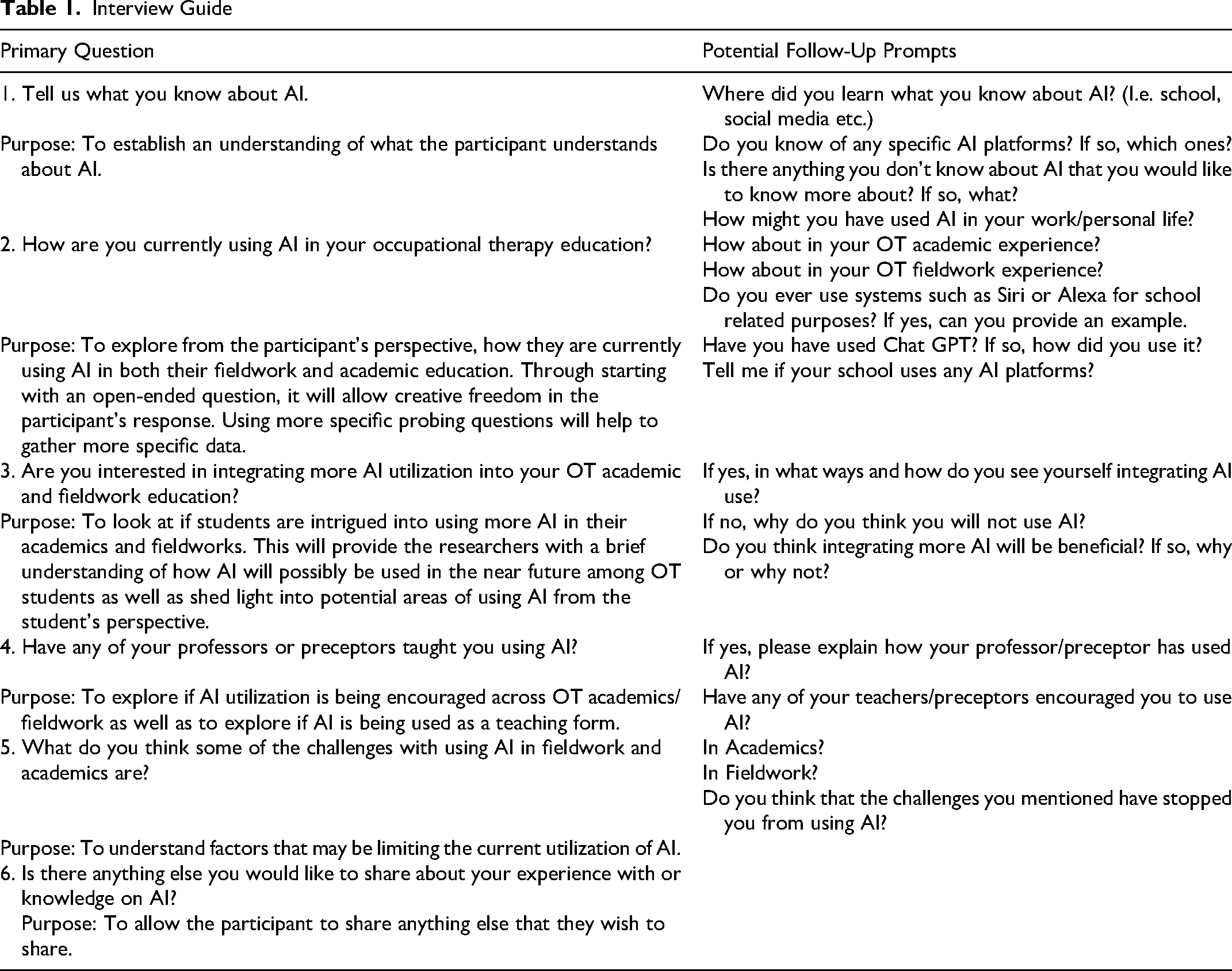
Demographic data was collected, and interviews were conducted via Zoom videoconferencing using a semi-structured interview guide (Table 1). All interviews were recorded and transcribed.
Interview Guide
Analysis
Once data saturation was achieved, conventional content analysis was used to analyze the data (Hsieh & Shannon, 2005). Data saturation occurred when the researchers found that participant responses were redundant, no new information was being collected, and the information obtained addressed the research question (Saunders et al., 2018).
Using Hsieh and Shannon's approach to inductive conventional content analysis, codes and categories are derived directly from the data through close reading of the data (i.e., transcripts), allowing themes to emerge naturally without imposing preconceived theoretical frameworks. The approach is data-driven and especially useful when literature on a topic is limited (Hsieh & Shannon, 2005). The analysis proceeded through the following steps: immersion in the data; open coding; constant comparison; abstraction. Two members (MD and CB) of the research team led the data analysis with regular meetings with the third researcher (AH) to discuss the analytic process and emerging findings. Data analysis began with immersion in the data by reading each transcript multiple times to become familiar with the data. Open coding was then completed, whereby transcripts were reviewed independently by the first two authors, and descriptive codes representing the data were developed and compared. Constant comparison of developing codes was done iteratively throughout this process through regular meetings with the first two researchers and frequent meetings with the third researcher. This included identifying and grouping similar codes and then further refining and defining these codes. Exemplar quotes (i.e., supporting evidence) from the transcripts were extracted as representative of the various codes. Constant comparison continued during the abstraction process, whereby similar codes were organized into developing themes and subthemes, which were then discussed in depth by the research team. The developing themes and subthemes underwent further revisions to confirm themes, their descriptions, exemplars, and their relationships and to ensure comprehensiveness and accuracy of descriptions. Data saturation was achieved after 12 interviews when it was apparent that no new information was identified in the interviews.
Author Positionality
Positionality refers to a researcher's worldview and the stance they adopt within the research process (Holmes, 2020), influencing study design, data collection, analysis, and interpretation of findings. At the time of the study, members of the research team were either OT students (MD, CB) or OT educators (AH), each possessing minimal to moderate experience with AI in their everyday lives and within OT education. The research team shared core professional values, including respect, trust, and a commitment to lifelong learning within the profession. The two researchers responsible for conducting the interviews were OT students; consequently, their perspectives and experiences as student practitioners informed their understanding of participants’ experiences and shaped their interpretation of the data.
Rigor
To ensure trustworthiness and rigor, several measures were undertaken (Colorafi & Evans, 2016; Krefting, 1991; Nowell et al., 2017). We used a transparent approach to data collection and analysis by keeping a log of activities, interpretations, and decisions made. We described our participant demographics and study procedures to enable others to assess the transferability of our findings. A consistent approach to data collection was used to ensure dependability and included having the same two authors complete interviews using a semi-structured interview guide. Credibility in data analysis was enhanced by having two authors (MD and CB) independently code data, which was then triangulated by the third author (AH). Finally, we completed member checking to ensure that findings were reflective of participants’ perspectives. To do this, we sent participants the descriptions of themes and subthemes to ensure findings were representative of their views.
Findings
Twelve OT students (female = 10; male = 2) participated in the study. Participant demographics are shown in Table 2. The majority of participants were from Ontario OT programs (N = 10) and were second-year students aged 20–25 years (N = 10). All (N = 12) participants completed their undergraduate degree within the past 5 years and reported fields of study in health (e.g., kinesiology) or science. The majority of the participants rated their comfort with technology at 4/5 or higher (N = 10). Interviews ranged in duration from 20 to 60 min. The majority of participants (N = 11) reported that ChatGPT was their most used AI platform, and one participant reported using Microsoft Co-Pilot as their primary platform.
Participant Demographics (N = 12)
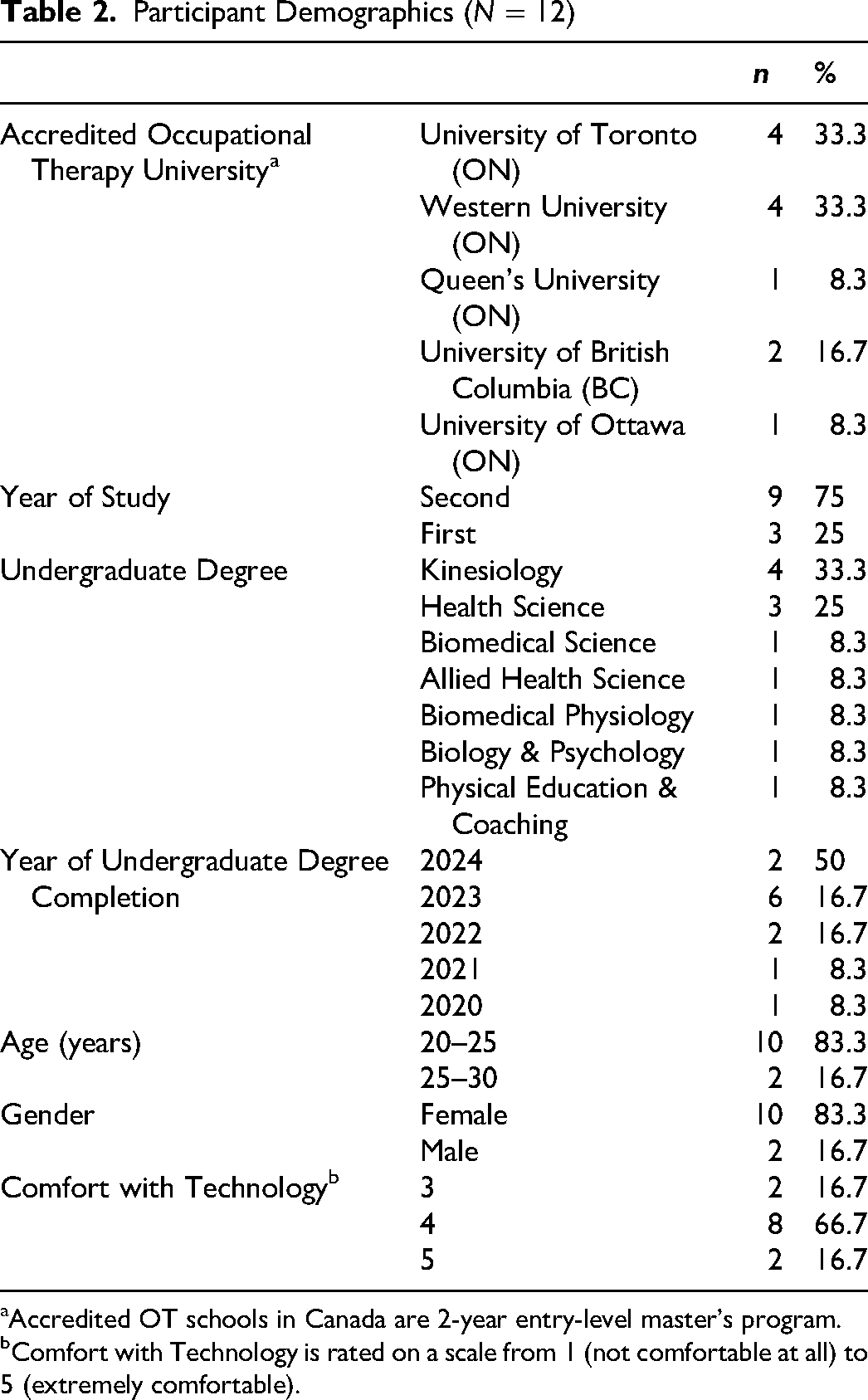
Accredited OT schools in Canada are 2-year entry-level master's program.
Comfort with Technology is rated on a scale from 1 (not comfortable at all) to 5 (extremely comfortable).
Two major themes describe how students use AI in their OT education, “I use it to get the ball rolling” and “It's not good or bad, it's hard to say.” These themes and subthemes are described below and visually depicted in Figure 1. Exemplar quotes from participants are presented to provide evidence of each theme/subtheme.
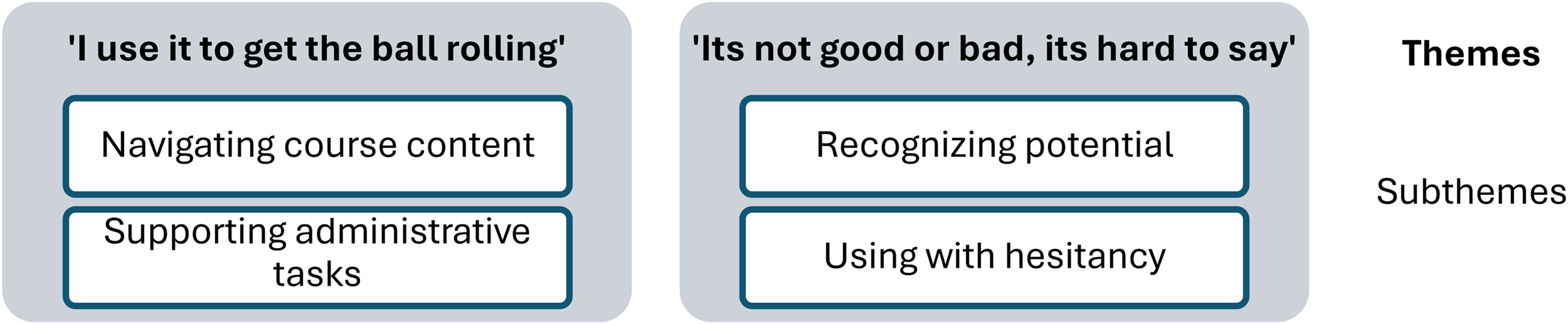
Themes and subthemes representing AI use by OT students.
Theme 1: “I Use It to Get the Ball Rolling”
This theme captures how OT students are currently using AI as an initial step to get started in their learning in fieldwork and academic education. Subthemes include navigating course content and supporting administrative tasks. Participants described turning to AI to jumpstart their thinking and for support with managing their workload. AI was viewed as a tool to help initiate or streamline tasks, with participants highlighting its role in enhancing efficiency and saving time in their academic routines. All participants reported using AI for convenience and efficiency, explaining that it is easy to use, accessible, and helps them save time. As one participant stated, It's similar to Google in a sense, but it kind of summarizes the content in a more user-friendly way, a lot less scrolling required if you want to look something up.
Subtheme 1: Navigating Course Content
Participants described using AI to support their understanding of complex material, customizing studying methods, and exploring concepts more thoroughly. Participants note that it was particularly helpful for brainstorming, simplifying information, or providing different perspectives about complex course content to help them learn that content. Students explained how they were able to “get the ball rolling” with navigating course content by creating study guides and quizzes, clarifying concepts, and acquiring ideas. Participants explained how they use AI to “get the ball rolling” in navigating course content. These are further elaborated on in the examples below.
Creating Study Guides and Quizzes
Participants talked about how they used AI to create study guides and quizzes to help them learn and understand course content better. Creating study guides and quizzes involved students prompting an AI platform to create a quiz based on their course notes (i.e., multiple-choice quiz). They reported that AI-generated quizzes helped them think about course materials differently, thereby improving their understanding. One participant stated: I use it as a study tool. So I'd put in the lecture into ChatGPT and ask it to create a quiz from the material I just put in and it just helps me memorize or understand the steps and processes of certain things.—P012
Clarifying Concepts
Many participants reported using AI to help clarify concepts in both academic and fieldwork education. Clarifying concepts captured the idea of using AI to explain content (i.e., lecture material, readings, and medical jargon) in simpler terms for the user to better understand. For instance, one participant said, I would say I use [AI] if I don’t understand a term or concept. I'll tend to search it up using AI tools to get a more detailed explanation in a different way than the professor said.—P001
Several participants also shared that they used AI to clarify content and concepts for assigned readings by using AI to summarize the readings: If I have a huge article to read, I'll put it in ChatGPT and say ‘what are the main takeaways’ and then that saves time and it highlights the main points for me.—P010
Lastly, participants reported using AI to help understand medical jargon and terminology in both academic and fieldwork settings. One participant explains this as follows: There's so many different conditions and illnesses, injuries that we learn about in OT school that it's almost impossible to know them all or have been exposed to them all even in field work. I find myself looking up that type of thing, like medical conditions. In field work and in my [academic] work as well.—P003
Acquiring Ideas
Participants reported using AI as a tool for generating new ideas to expand their understanding of course content in relation to clinical practice, gathering ideas for assignments, interventions, or session plans. Participants emphasized how AI prompts them to think more deeply about tasks or topics by offering suggestions they hadn’t previously considered or expanding their approach to tasks. They view AI as a valuable source of inspiration, enabling students to approach their academic work with fresh ideas and greater creativity. One participant noted, I would look up ideas for interventions, and it would give me a bunch of ideas, and sometimes there are good ideas that I haven’t thought of.—P005
Subtheme 2: Supporting Administrative Tasks
Participants reported using AI for support with administrative tasks such as reviewing work, organizing schedules, writing emails, and planning their workload. They noted that AI provided a practical tool to reduce their cognitive load and helped them to manage the daily demands of being a graduate student. There were two common examples of how students used AI to support administrative tasks: reviewing and refining work and organizing and planning.
Reviewing and Refining Writing
Participants described using AI to review and refine their writing for academic assignments, documentation, or professional communications (e.g., emails). Participants reported using AI for writing SOAP notes (a methodology for healthcare professionals’ documentation), for using objective language, and for developing analyses. For example, one student shared, [I put] my objective reports into AI and then [I] ask for it to do an analysis, for example, in a typical SOAP note format.—P010
Other participants highlighted using AI for grammar, sentence structuring, word count checks, and reviewing and editing emails. Participants shared that using AI for administrative tasks such as the above helped them to be more efficient with their time.
Organizing and Planning
Participants described using AI as a tool to organize their thoughts, school-related notes, due dates, and workload. They also used AI to schedule deliverables and set timelines for assignments or projects. For example, this participant reported using AI to organize their notes, If I really need to organize my notes and I don’t have time. I’ll totally put it in ChatGPT.—P008
Theme 2: “It's Not Good or Bad, It's Hard to Say”
This second theme captures the mixed feelings and tensions that participants experienced about using AI. While many saw the potential for AI use in OT, they also raised concerns regarding overreliance, the lack of human qualities, and academic integrity. Participants described tensions between its potential and their hesitancy around its use.
Subtheme 1: “It Has a Lot of Potential …”
Participants recognized that AI's potential given their largely positive experiences in using it for course navigation and administrative tasks. They appreciated its ability to generate information very quickly and reduce cognitive load, especially within the context of a highly demanding academic program. They recognized that AI has greater potential for enhancing efficiency in multiple areas beyond their current AI use.
Enhancing Task Efficiency More Broadly
Participants recognized the broader potential for AI to promote efficiency, particularly by streamlining tasks and saving energy by reducing their cognitive burden in both academic and fieldwork contexts. They reported already having used AI as a tool to support efficiency in clinical documentation and studying and described how these tools could more broadly support systemic pressures in healthcare settings by supporting documentation processes. For example, one participant noted that, Documentation is a huge burden on healthcare workers that are already overworked … but it has to be done the right way [and AI can help].—P002
Subtheme 2: “There's Definitely Some Hesitancy”
Participants expressed hesitancy about utilizing AI despite experiencing its benefits and recognizing the broader benefits. Their expressed concerns include overreliance on AI, accuracy limitations, lack of knowledge and guidance, the absence of human qualities, and fears of violating academic integrity guidelines.
Worrying About Over-Reliance
Participants expressed hesitancy about becoming over-reliant on AI and concerns that it could limit critical thinking skills and conflict with the development of professional reasoning and judgement. Many participants emphasized the importance of maintaining their ability to think independently, problem solve, and apply clinical reasoning without relying on AI-generated solutions. One participant brought recognition to the professional competencies of being an OT, suggesting that using AI to do documentation may go against the professional OT competencies. Participants also worry that using AI may discourage engagement in professional reasoning, as AI provides direct answers without having the entire contextual picture and the nuances that influence the process of clinical reasoning. Participants reported that this may also lead to issues with the development of clinical problem-solving skills. As reported by one participant, [AI] shouldn’t overtake my clinical thinking and my ability to write my own SOAP note.—P002
Questioning AI Accuracy
Participants expressed a mix of trust and caution regarding the accuracy of AI-generated responses. Some found AI useful for providing a broad overview of topics, but they recognized its potential limitations in producing accurate or contextually relevant information. One participant reported, [AI is] mostly accurate, but sometimes not fully true.—P010
Other participants reported concerns about misinformation being common in academic contexts and statistics. As a result of the concerns about accuracy, participants reported they would fact-check AI-generated content with what they considered “credible” sources such as peer-reviewed articles online or verifying with their course notes. Similarly, one participant noted that using AI to provide references was quite inaccurate, raising concerns about how students can ensure the integrity of findings produced by AI.
Recognizing Limited Knowledge
Participants expressed caution with AI use due to their own limited knowledge about AI and its use in academics and professional OT contexts. They described how AI, particularly ChatGPT, is a relatively new tool and its role in education is not clearly defined or understood. Multiple participants acknowledged their hesitancy and discomfort surrounding the use of AI, with one participant expressing the following, When I apply something to a problem, I like to follow a certain step-by-step guide … I feel like there's no guidebook on how to use AI.—011
The lack of structured guidance on how to use AI appropriately in academics was a common concern reported amongst participants. Aside from concerns surrounding how to integrate AI into an academic setting, participants also expressed general unfamiliarity with AI in relation to ethical and security implications.
Missing Human Qualities
Participants expressed hesitancy about using AI due to its ability to understand and interpret nuance and complexity in relation to the human experience, emotions, and cultural awareness. While they described AI as useful for factual or medical information, they described concerns about its effectiveness for addressing complex client and societal issues, including intersectionality, systemic oppression, or the lived experiences of marginalized groups. One participant expressed, I do believe that things are so contextual, and things are so unique to individuals. That's why I'm in this program … you really know this person and you have the emotional kind of buy-in that AI won’t ever have.—P008
Several other participants similarly emphasized that AI lacks clinical judgment and emotional intelligence, making it inadequate for holistic and client-centered OT practice.
Fearing Academic Misconduct
Participants described concerns about unclear academic boundaries regarding AI. They wondered when, for example, AI use crossed into plagiarism. One student described the challenge of using it for informing assignments while ensuring their work remains their own: For academics, it's hard if I'm using [AI] to help me with an assignment or understanding ideas to keep it my idea still and not copyright … I don’t want to overuse AI information in my assignments.—P002
Most universities have generated policies about AI use that students perceive as vague and difficult to interpret in relation to their academic work. Participants report that their syllabi often include warnings against the use of AI-generated content and that the fear of academic misconduct often deters participants from using AI. However, participants also expressed concerns about how well they are learning if they are using AI and how this may impact their future as healthcare professional. As one participant said, If you don’t learn by doing your own work, what kind of healthcare professionals are we putting into the field?—P011
Despite these concerns, participants acknowledge that AI still has a place in academic education when used responsibly.
Discussion
This study explored how OT students in Canada are utilizing AI in their academic and fieldwork education. The findings revealed that students are turning to AI for its efficiency and convenience benefits while also being cautious about its use in their studies and expressing concern about its use within the complexities and nuances of OT practice. These insights align with recent literature including an OT editorial (Rowe & Ward, 2025) that concluded that “the integration of generative AI represents both exciting opportunities and significant professional challenges for OT.” Our findings also have implications for curriculum development in AI literacy and applications to academic integrity and reflective practice.
AI Literacy
Given participants' concern about AI use along with their recognition of its positive impact on their learning and its potential for OT practice, providing students with AI literacy training appears to be needed. Many of the concerns about AI expressed by students were related to ethical concerns, unclear boundaries, or a lack of knowledge, indicating a growing need for foundational literacy. This aligns with existing literature suggesting that many healthcare students feel uninformed and unprepared to engage with AI in a responsible and ethical way (Derakhshanian et al., 2024; Kimiafar et al., 2023). Participants in our study raised concerns about issues such as accuracy, lack of human qualities, overreliance, and academic integrity, which echo findings from previous studies exploring the impact of AI tools such as ChatGPT in education (de Castro, 2023).
Discussions regarding structured AI literacy education are becoming more evident within healthcare professional research, with emphasis on the need for a holistic and psychosocial approach (Derakhshanian et al., 2024; Jones & Pratchett, 2024). Experts suggest that AI literacy should go beyond technical training; it should also include critical thinking, ethical awareness, and empowerment with the goal of providing students with new abilities and ways to engage with a digital environment (Jones & Pratchett, 2024; Kimiafar et al., 2023). The AI literacy framework (ALiF) proposes a comprehensive approach to developing AI competencies in educational and healthcare settings (Zary, 2025). The framework comprises five core competency areas: data literacy, technical understanding, critical evaluation, ethical considerations, and practical application. Using a framework such as ALiF may be one tool to support the development of AI literacy curricula and may help to restructure students’ curiosities and hesitancies into informed engagement. For example, components of this framework can ensure OT students understand how LLMs work, fostering digital literacy. Concerns about academic misconduct, biases, and privacy risks can be addressed through ethical and sociocultural awareness. Promoting critical evaluation and practical application can prepare students to analyze AI outputs with a professional lens and encourage them to engage with AI as a collaborative tool rather than a replacement for clinical reasoning. Implementing a structured literacy program like this can support OT students in utilizing AI tools with confidence in a way that is ethical, meaningful, and practical while aligning with professional competencies and values.
Co-Designing Academic Integrity Guidelines
Another key finding from our study is the participants’ concerns about academic misconduct when utilizing AI in their academics. Participants expressed a lack of clarity around what appropriate use of AI looks like in academic tasks as they struggle to balance using AI for their learning while attempting to work within unclear boundaries. Balalle and Pannilage (2025) and others (e.g., Boscardin et al., 2024; Cotton et al., 2024; Kumar et al., 2024) have noted that educational institutions struggle to maintain academic integrity guidance due to rapid advancements in AI technology, posing significant challenges to developing and maintaining up-to-date guidelines. Tripathi and Thakar (2024) call for a collaborative and inclusive approach to establishing clear policies and guidelines within institutions. By involving educators, students, technologists, clinicians, administrators, regulatory body representatives, and ethicists, AI guidelines can be designed and used in a way that promotes integrity and fairness, while meeting the needs of the educational community. Fostering open dialogue and collaboration with students may help to create a culture of trust and transparency, which may facilitate the upholding of integrity (Tripathi & Thakar, 2024). OT programs can take a proactive approach by collaborating with students to codesign policies and guidelines to clarify how, when, and why AI technology can be used in an ethical manner in their academics. Not only will this reinforce academic values, but it will also provide students with the opportunity to develop professional accountability in a real-world context.
Reflective and Intentional AI Use
Participants in this study used AI thoughtfully and critically. It is evident through their responses that they use a reflective, intentional approach to AI, grounded in their awareness of both the benefits and limitations in the context of their professional responsibilities—not just using it as a shortcut. Participants shared some of the ways they utilize AI tools like ChatGPT in organizing their thoughts, reframing questions, and generating new perspectives. Despite concerns that AI may hinder student engagement, emerging literature and participant responses suggest that AI can support deeper learning. These findings reflect the possibility that AI can be embraced in a way that supports evidence-based reasoning and reflective practice in OT education (Rowe & Ward, 2025). AI has the potential to expand student thinking rather than just replace it, presenting it as a tool for query, self-reflection, and integration of knowledge when used ethically and with purpose. Gao et al. (2025) found that AI tools like ChatGPT significantly improved students’ work efficacy, enhanced confidence in their abilities, and expanded their empathy. This aligns with Mansour and Wong (2024), who highlight the educational value of AI, demonstrating its potential to serve as a tool to reduce cognitive burden, support creative thinking in clinical planning, and bridge the gap between theory and practice for students. OT Educators have an opportunity to redesign their assessment methods to emphasize applied critical thinking in ways that are practice authentic and perhaps less susceptible to AI misuse. Together, these findings and those from our study suggest the potential for AI to act as a catalyst for critical thinking and skill acquisition when students use it with intention, reflection, and adequate support. OT programs may benefit from seizing the opportunity to model and justify purposeful use of AI as part of professional identity development.
Limitations
Despite recruitment efforts, the final sample consisted of participants from OT programs in the provinces of Ontario and British Columbia and may not be representative of OT students in all contexts in Canada. A second limitation is the difficulty participants may have had in fully sharing their experiences with AI due to their uncertainties surrounding AI and a general lack of understanding of academic policies around AI use. Participants may have experienced fear of “getting in trouble” for sharing experiences and that their use of AI may not have followed their instructor's or school guidelines. This may have resulted in students censoring what they shared in interviews despite the researcher's reassurances of confidentiality and may have implications for the transferability of findings. Although the sample size was appropriate for this study design and methodology, it represents the experiences of twelve individuals within their specific contexts. Consistent with qualitative research standards, the findings are intended to support analytic or transferability-based generalization, whereby concepts or interpretations may be applicable to other settings when similarities in context, population, or phenomenon exist. Therefore, the researchers emphasized rich description and transparency in analytic procedures to allow readers to assess the relevance and applicability of findings to their own contexts.
Future Directions
Based on the rapidly advancing nature of AI in healthcare education, we recommend future research to explore how structured AI literacy could be co-designed with students and implemented within OT education as well as other health professional programs. In addition, there is a need to examine best practices for the development of academic integrity guidelines and policies alongside students, and how these guidelines will impact the use of AI by students over time.
Conclusion
This study aimed to explore how OT students are experiencing and utilizing AI in their academic and fieldwork education. The findings revealed that students are thoughtfully and critically engaging with AI tools for convenience, efficiency, and generating new perspectives, while also expressing concerns about its limitations and ethical implications. Their perspectives invite both curiosity and caution, indicating a need for clearer guidance, support, and structured education on AI in health professional programs. With rapid advancements in AI tools and technology, there is an opportunity for OT programs to engage in co-design processes to develop and implement AI literacy into curricula, academic integrity guidelines, and demonstrate intentional and reflective AI use.
Key Messages
Student occupational therapists (OT) are actively and cautiously utilizing AI in their academic and fieldwork education for efficiency and generating new perspectives and ideas.
Students are expressing concerns about AI ethics and accuracy given the complexity of OT practice and potential for academic misconduct in their education.
AI literacy programs that address these tensions may benefit OT students to support more confident and ethical AI use in their education and future practice.
Footnotes

Declaration of Conflicting Interests
The authors declared no potential conflicts of interest with respect to the research, authorship, and/or publication of this article.
Funding
The authors received no financial support for the research, authorship, and/or publication of this article.