






Abstract
The Pediatric Early Warning System (PEWS) score may be useful for detection of deterioration in clinical condition. In this retrospective study, the cases were patients transferred to the pediatric intensive care unit (PICU), and controls were those not transferred to the PICU. The maximum PEWS score in both groups were analyzed using Mann–Whitney U test and receiver operating characteristic curve (ROC). The study population included 100 cases and 250 controls. There was no difference in the age of cases and controls (6.3 vs 6.3 years). The length of hospital stay (18.09 ± 32 vs 3.93 ± 2.9 days; P < .001) and the maximum PEWS score (2.95 ± 1.5 vs 1.4 ± 0.8) were significantly higher for the cases (P < .0001). The PEWS score area under the ROC was 0.81 (95% confidence interval = 0.75-0.86). The sensitivity and specificity for a score 2.5 were 62% and 89%, respectively. The use of the modified PEWS score can help identify patients on wards who are at risk for deterioration.
Background
Patients at risk for deterioration in the hospital setting may not be identified easily or in a timely manner by health care professionals. It has been suggested that a structured approach to the bedside evaluation of inpatients can improve the identification of at-risk patients. It has been shown that the majority of in-hospital cardiorespiratory arrests were preceded by significant deterioration in a patient’s physiological parameters.1,2 These changes had been noted but not acted on and therefore resulted in increased mortality secondary to inappropriate or delayed medical management. Interventions based on these changes may lead to reduction of code blue events (CBEs) on medical–surgical wards. 3 An early warning system can help improve communication between the nursing staff and physicians and can help identify a higher risk patient population. 4
Children’s hospitals appear to have a patient population with a higher severity of illness; therefore, it would be desirable to have an effective early warning tool to help identify the progression of illness severity in these patients. 5 Parshuram et al 6 have developed and validated a 7-point bedside Pediatric Early Warning System (PEWS) score, which could quantify the severity of illness and identify critically ill children. Monaghan 7 published his experience with the application of a 3-point PEWS score called Brighton PEWS. In this study, 80% of health care staff reported that PEWS improved their confidence in recognizing children at risk of deterioration. Tucker et al 8 reported in their prospective observational study that the PEWS tool was found to be a reliable and valid scoring system to identify children at risk for clinical deterioration. Many children’s hospitals in the United States have started using PEWS scores to identify at-risk children, with calling out algorithms for decision to transfer to a higher level of care or to activate rapid response teams. The aim of this retrospective study is to validate the modified version of Brighton PEWS tool for the assessment of at-risk children in less acute care areas of the hospital.
Design/Methods
This is a retrospective, case–control study. Cases were all patients who were initially admitted to Miami Children’s Hospital medical–surgical wards during a 30-month period and subsequently transferred to the pediatric intensive care unit (PICU). Patients were transferred to the PICU after a physician’s request, a rapid response team evaluation (RRTE), or a CBE. There were no deaths in non-ICU areas during the study period. Controls were patients admitted to medical–surgical wards but not transferred to the PICU during the same study period. We selected 1 to 3 matching controls for each case. Patients were matched for age, location (medical ward) of admission, month of admission, and admitting diagnosis. The study had no exclusion criteria.
Demographic data, including age, gender, diagnosis, location of admission, month and year of admission, and length of stay were obtained by a retrospective chart review. The data were recorded for the cases during the 48-hour period before transfer to the PICU and for the control patients during the initial 48 hours following hospital admission. The maximum modified PEWS score was calculated for each case and for each control. If the cases were transferred to the PICU within 48 hours of hospital admission, then the data were analyzed from the time of admission to the time of transfer to the PICU. The scores were then used for comparison analysis.
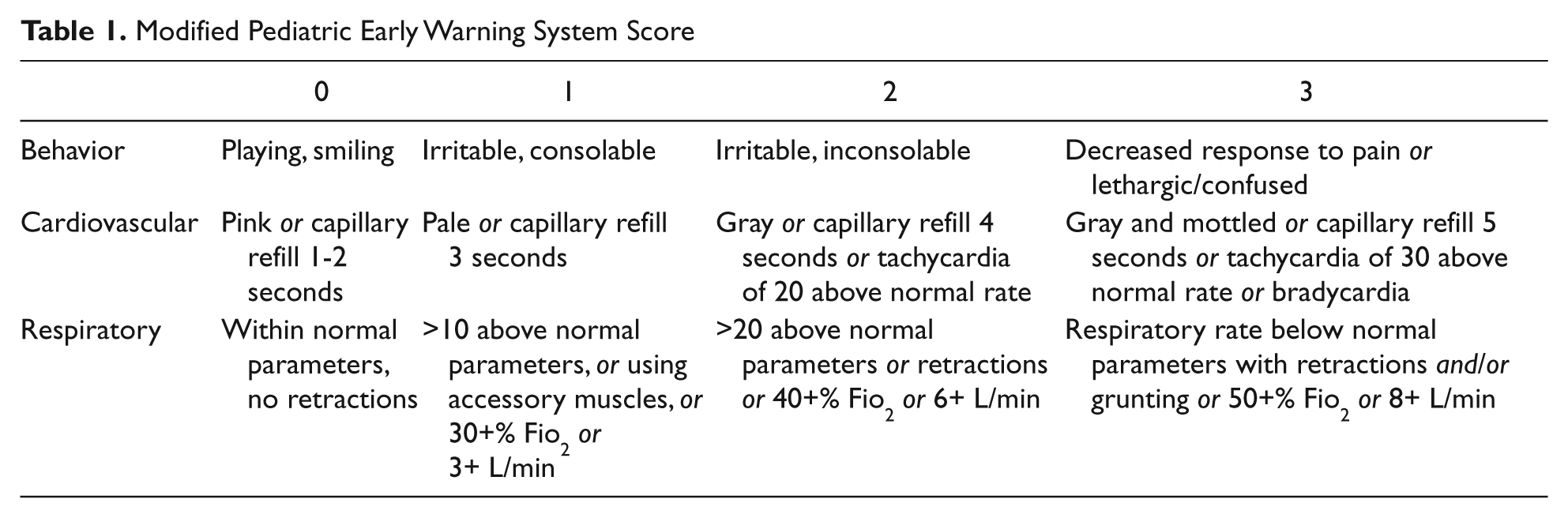
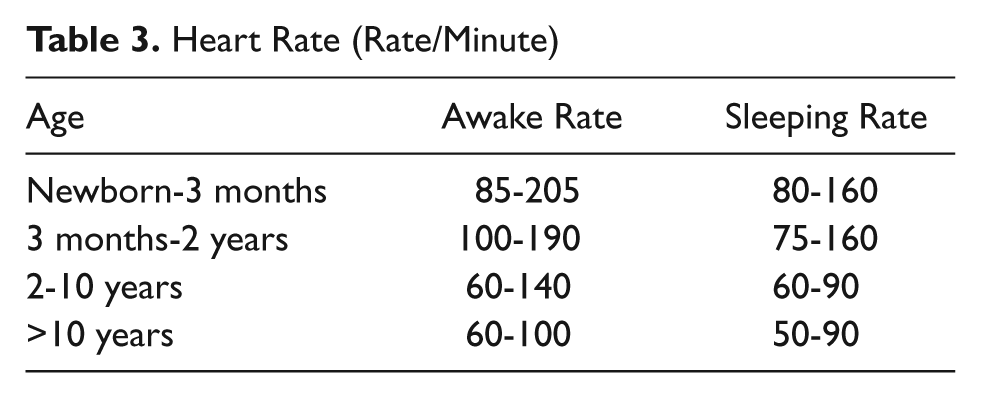
The chart review consisted of obtaining the vital signs and nursing notes recorded electronically by nursing assessments. Our modified PEWS score included behavior, cardiovascular, and respiratory components (Table 1) with maximum potential score of 9. The values for the PEWS score were obtained from the level of consciousness for the behavior component and from vital signs for the cardiovascular and respiratory components (Tables 2 and 3). The PEWS score was collected every 4 hours in both groups. The study was approved by our institutional review board.
Modified Pediatric Early Warning System Score
Respiratory Rate

Heart Rate (Rate/Minute)
The descriptive data are presented as either mean ± standard deviation (mean ± SD) or median with interquartile range (IQR). The age, length of hospital stay, and maximum PEWS score in both groups were compared using Mann–Whitney U test. Categorical data were analyzed using chi-square test. Receiver operating characteristic curves (ROCs) were constructed for maximum PEWS score and transfer to higher level of care. A P value of <.05 was considered significant.
Results
Included in this study were 100 cases and 250 controls admitted during a 30-month period. The cases included 3 transfers to the PICU following a RRTE, 4 following a CBE, 1 following both a RRTE and a CBE, and the rest were by physician request. Of the patients transferred to the PICU, 42% of cases had respiratory diagnoses, 26% had neurological diagnoses, 13% had hematological diagnoses, and 11% had renal diagnoses. In both cases and controls, 56% were males. There was no statistical difference in the age of cases and controls (median [IQR] 2.5 [0.6-14] vs 3 [0.6-12] years). The length of hospital stay was significantly longer (18.09 ±32 vs 3.93 ±2.9 days; P < .001) and the maximum PEWS score was significantly higher (2.95 ± 1.5 vs 1.4 ± 0.8; P < .0001) for cases compared with controls. The PEWS score area under the ROC was 0.81 (95% confidence interval = 0.75-0.86). The sensitivity and specificity of a PEWS score 2.5 for transfer to higher level of care were 62% and 89%, respectively.
Discussion
Our study has shown that in children the PEWS score is significantly higher during the 48 hours prior to critical deterioration compared with children without such deterioration. The modified PEWS score is a simple early warning system that can be easily and serially charted to initiate extra support for children at risk for further deterioration.
The advantages of an early warning system, which includes vital signs and patient evaluations that are routinely performed, include ease of use at the bedside and the potential to improve patient outcomes.9,10 With the implementation of an early warning system, nurses can score routine nursing observations into an actionable index and initiate further evaluation. 10 The score is a preventative measure that assesses acutely ill patients and can identify patients who may need further evaluation or are likely to require resuscitation in the near future.9,11,12 The primary purpose of early warning systems is to prevent delay in interventions or delay in transfer to a critical care unit. 4
Most of the early warning scoring systems use 5 clinical parameters, including systolic blood pressure, heart rate, respiratory rate, temperature, and neurologic status as assessed by the AVPU (alert, voice, pain, unresponsive) score.3,13 There have been several modifications and validations of early warning scores for adults.3,4 Currently, a modified early warning scoring system developed by Morgan et al 13 is used for adult patients.
A PEWS score using 16 items was developed by Duncan et al 12 ; they retrospectively validated its capability to predict a CBE with a sensitivity and specificity of 78% and 95% at a score of 5. 12 This was further refined and validated using 7 items by Parshuram et al. 6 These 7 items include heart rate, systolic blood pressure, capillary refill time, respiratory rate, respiratory effort, transcutaneous oxygen saturation, and oxygen therapy.
Monaghan 7 in 2005 piloted the PEWS in a 24-bed medical unit. The PEWS score was integrated into the daily routine activity of the medical staff. In this study, a nurse calculated the child’s total PEWS score and then depending on the score initiated 1 of 4 actions: informed the nurse in charge, increased the frequency of observations, called for a medical review, and informed the outreach team or called out the full medical team and outreach team. 7 A survey of the nursing staff after implementation found that 80% felt that PEWS improved their confidence in recognizing the child at risk. Several children’s hospitals in the United States adopted the Brighton PEWS score with some modification. A systematic review by Chapman et al, 14 concluded that there is evidence supporting the validity, reliability, and utility of pediatric alert criteria for identifying children at risk for cardiorespiratory compromise.
Akre et al 15 performed a retrospective study using a modified Brighton PEWS score similar to that used in our study. They were able to identify children before a critical event (rapid response callout or cardiorespiratory arrest) with a sensitivity of 85% using a cutoff critical PEWS score of ≥4 or single domain score of 3. Similar to our study, Akre et al 15 also retrospectively reviewed the charts of patients with critical events and assigned a PEWS score. However, they did not compare the scores to that in a control population as was done in our study. In addition, the PEWS score was assigned by a single investigator in our study.
A prospective chart review of clinical observations by Tume 16 showed physiologic deterioration within 24 hours preceding admission to an ICU or high dependency unit and further concluded that 87% of such patients could have identified using a simple early warning scoring. Similarly, another prospective observational study concluded that PEWS score can discriminate between children who require transfer to a higher level of care compared with those did not with an area under curve of 0.89. 8 Edwards et al 17 reported that with Cardiff & Vale PEWS, any single abnormality has a sensitivity of 89% and a specificity of 63.9% in predicting an adverse event defined as respiratory arrest, cardiac arrest, transfer to higher level of care, or death.
Sensitivity and specificity of PEWS score to detect the deterioration may depend not only on the score itself but also on the definition of deterioration used in the study. In our study, we have included all patients who required a RRT call, unplanned transfers, as well as cardiac or respiratory arrest patients under deterioration. Akre et al 15 included only those requiring RRT calls and cardiac arrest and the studies by Tume 16 and Tucker et al 8 included only the children who were transferred to higher level of care as the experimental group. The criteria and threshold for calling a RRT team or transferring to a higher level of care may vary from institution to institution and thus the sensitivity and specificity of the PEWS tool may vary. However, all of these studies have shown a value in detecting clinical deterioration. It is important to study the effect of adopting routine PEWS score measurement with an algorithm to activate help on the rate of unexpected codes, preventable deaths, severity of illness in transferred patients (to assess timely transfer to higher level of care), and utilization of ICU services.
Early warning scores can be used to validate the need to call out an RRT and provide additional interventions. 18 Although there is no specific score that can predict outcome, it appears that a score of 3 or more indicates the need for further evaluation.19,20 An increasing score is associated with a worse outcome given that the score uses abnormalities in routine observations to identify patients at risk for critical illness.19,20
The purpose of an RRT or a medical emergency team (MET) is to (a) evaluate patients, (b) provide them with additional immediate care to stabilize them, and/or (c) coordinate transfer to a higher level of care. RRTs were created to decrease the rate of CBEs in medical facilities. 21 RRTs and METs have been shown to reduce the risk of respiratory and cardiopulmonary arrests outside ofICUs. 22 The identification of at-risk patients can be delayed without specific criteria to call an RRT. Even the best RRT is a reactive system mobilized after a significant change in the patient’s clinical status has already occurred. This may be a significant change in a vital sign or even a subjective feeling on the part of the health care team or family that everything is not right. However, early warning scoring systems can be more proactive in monitoring these at-risk patients.
In our study, we used a modified version of the Brighton PEWS score, which is based on 3 clinical parameters—behavior, the cardiovascular system, and the respiratory system. 7 In this retrospective case–control study, we demonstrated that the modified Brighton PEWS score is significantly higher in children at risk for clinical deterioration.
Limitations with the study include its retrospective nature. The behavioral component of the PEWS score may be subject to varying interpretations.
Conclusions
The use of a modified PEWS score can help identify patients on medical wards who are at risk for deterioration and need further evaluation, treatment, or transfer to a higher level of care. By using the modified PEWS score, clinicians could potentially prevent major adverse events on medical–surgical wards. The modified PEWS score has not been validated in other institutions, and the actual potential reduction of cardiorespiratory arrests or CBEs is not known. Even though the specificity of our maximum modified PEWS score is 89%, our study was unable to completely validate the modified PEWS score given its sensitivity of 62%.
Footnotes
The authors declared no potential conflicts of interest with respect to the research, authorship, and/or publication of this article.
The authors received no financial support for the research, authorship, and/or publication of this article.