






Abstract
Objective. This study discusses the impact of mental health screening in pediatric primary care on the management of mental health concerns. Methods. Youth aged 11 years and their parents completed the Pediatric Symptom Checklist and chart reviews were used to gather information about discussion of mental health concerns and connection with mental health services. The study design was a post-intervention study with a concurrent comparison group of youth aged 12 years who were not offered a screening. The χ2 or Fisher’s exact tests and logistic regression were used to compare groups on outcome variables. Results. Parents who completed a mental health screening for their child were more likely to be referred and attend mental health services, attend a psychiatrist appointment, and discuss their concerns with the primary care provider compared with the comparison group. Conclusions. Screening by parents improves detection of problems and fosters conversations with providers and subsequent connection with services.
Introduction
Estimates suggest that 1 in every 10 children and adolescents suffers from a major mental illness that results in significant impairment. 1 The American Academy of Pediatrics Task Force on Mental Health reported that 21% of children and adolescents in the United States meet diagnostic criteria for a mental health disorder while an additional 16% have impairment in functioning but no specific diagnosis. 2 A nationwide survey of youth in grades 9 to 12 in public and private schools in the United States reported that 29% of students felt sad and hopeless nearly every day for more than 2 weeks that they stopped doing normal activities. Furthermore, 16% reported that they seriously considered suicide, 13% reported creating a suicide plan, and 8% reported trying to commit suicide in the prior year. 3 Unfortunately, a significant gap exists between the high prevalence of mental health concerns and patients receiving appropriate mental health services. National data samples suggest that only 20% of the children who need mental health services actually receive them. 2 This low rate of treatment is often attributed to a number of factors, including low rates of identification, lack of affordability and availability of treatment, and stigma associated with mental illness.4,5 Fortunately, national statistics suggest about 75% of youth have had contact with a physician or health care professional within the past 6 months and almost all children (97%) have a usual place of health care. 6 In addition, there has been a significant increase in the number of psychosocial problems being identified by primary care providers in the past several decades. 7 Therefore, pediatric primary care providers serve a vital role in identifying and diagnosing mental health concerns, as well as helping families get connected with appropriate mental health services.
The American Academy of Pediatrics Task Force on Mental Health (2010) recommended implementation of mental health screening programs in order to improve identification of children with behavioral and emotional health problems in primary care. 8 In addition, the US Preventative Services Task Force (2009) recommends screening adolescents for major depressive disorder. 9 Numerous studies have demonstrated that implementing mental health screening programs in primary care are both feasible and increase the detection rate of potential psychosocial problems.10-16 Moreover, 80% of pediatricians feel they should be responsible for identifying behavioral health difficulties in children, especially for attention-deficit/hyperactivity disorder (ADHD). 17 Fewer agreed that pediatricians should treat or manage behavioral health problems, with 54% believing it is their responsibility to refer children with ADHD and ≥79% for conditions other than ADHD. 17 However, some providers may be hesitant to implement screening because of concerns they may be required to follow-up on mental health issues that they do not feel fully trained to discuss and for which they are unable to access mental health services. 18
In summary, it is recommended that all children and adolescents be screened for mental health concerns in primary care settings in order to assist with the identification, management, and treatment of psychosocial concerns.8,9 Most primary care providers also report satisfaction with the screening process and little resistance from patients and parents. 13 As mental health screening programs become more common in primary care practices, more can be learned about how the screening programs effects the management of mental health concerns, including subsequent referral and/or treatment of mental health problems. Therefore, the present study examines the completion of a voluntary mental health screening by parents and youth as part of a routine well-child care visit compared with youth and parents who were not offered a mental health screening. Specifically, this study examined if youth were more likely to be referred to and attend mental health services, discuss their mental health concerns with their primary care provider, speak to an imbedded social worker providing case management services, and be prescribed psychotropic medication if they completed a screening compared to families who were not offered the screening as part of their routine well-child care visit. It was hypothesized that individuals who complete a mental health screening would be more likely to discuss their concerns with their primary care provider and team social worker, be referred for mental health services, and attend a mental health appointment compared to their nonscreened peers.
Methods
Setting
Strong Pediatric Practice is part of the Division of General Pediatrics at the University of Rochester Medical Center. Strong Pediatric Practice is one of the largest pediatric clinics in Monroe County, New York, serving more than 13,000 children and families. The practice serves primarily low-income families, including primarily Black/African American (65%) families with representation from diverse ethnicities, including Hispanic (15%) and White/Caucasian (15%). The practice focuses on at-risk children living in poverty and children with chronic conditions by offering comprehensive, multidisciplinary care. Multidisciplinary care providers include pediatricians, pediatric residents, nurse practitioners, nurses, technicians, dieticians, social workers, psychologists, and psychiatrists.
Screening Procedure
Prior to a formal mental health screening program, providers broadly assessed for mental health problems as part of their examination during annual appointments. In February 2007, a mental health screening program was initiated as a quality improvement project for children receiving their annual well-child visit. The parent/guardian completed a mental health screening at their child’s annual well-child visit and youth aged 11 years and older completed a self-report measure. The Pediatric Symptom Checklist (PSC), a well-validated screening measure, was completed by parents while youth completed the Pediatric Symptom Checklist–Youth Report (Y-PSC). 19 When the screening program was first implemented, the mental health screeners were only offered to parents of select ages, including ages 8, 11, 14, and 17 years. Youth versions were offered to ages 11, 14, and 17 years. Initially, screeners were not offered to all ages in order to make the screening program feasible given the large practice size. Nursing staff provided the screeners to parents and youth to complete in the examination room while waiting for their medical provider. Providers were encouraged to discuss the screening responses during the appointment with the patient, but formal scoring of the measures was completed after the visit by support staff. All families that completed the screener were provided a follow-up call and/or letter discussing if the results of the screening were negative or positive. For positive screeners, families were first contacted by phone and if they were unavailable, a letter was sent. Contact information was provided for both colocated mental health consultation services within the pediatric practice and community-based mental health services; subsequently families initiated services if interested. Limited colocated services were provided by a faculty psychologist, psychology postdoctoral fellows, and/or a psychiatrist. Additionally, referrals for colocated mental health services could be initiated at any time by the primary care provider, team social worker, or parent/guardian regardless of participation in the screening program. Social workers were available to speak with families during their visits if requested by the family or by the medical provider regardless of their participation in the screening program. Medical providers typically request social workers to speak with patients at the time of the visit if complex or acute mental health services are needed as well as to facilitate referrals for mental health services and to provide general case management services.
To assess the effects of the mental health screening program on the identification and management of mental health concerns, a randomly selected group of medical records were reviewed. Approval from the University of Rochester’s Research Subject Review Board was obtained before conducting the retrospective chart review. A sample of electronic medical records were reviewed for patients aged 11 years who completed the mental health screening during an annual well-child visit in the Strong Pediatric Practice. The study also examined electronic medical records for a randomly selected group of patients aged 12 years who completed an annual well-child visit and did not complete a mental health screening. This comparison group of patients did not complete a mental health screener as the pediatric practice was not routinely offering screening to this age group as it was part of a quality improvement project. It was decided that the group of 12-year-olds would be the best comparison group as their routine well-child visits have the same structure and electronic provider templates as the 11-year-old well-child visits.
Participants
A power analysis was calculated to estimate the sample size needed to achieve power of 0.8 at a significance level of .05. Results of the power analysis suggested a total sample size of 197 participants would be sufficient. During the mental health screening period of February 2007 to February 2009, there were a total of 664 children aged 11 years who attended a well-child visit. Results of the screening program suggested that approximately 272 (41%) of the eligible children aged 11 years completed a mental health screener. Therefore, it was decided that every other child aged 11 years who completed a mental health screener (N = 146) would be included in the study.
The comparison group of children who were not offered a mental health screening at their well-child visit was selected from a group of 12-year-old children. There were a total of 585 children aged 12 years who attended a routine well-child visit from February 2007 to Febrary 2009. From this sample, 154 children completed 2 well-child visits over that 2-year period (at age 11 and age 12). This group of children was excluded from the 12-year-old comparison group to ensure that the groups were independent as they would have been offered the opportunity to complete a mental health screener when they attended their 11-year-old visit. From the total of 431 eligible 12-year-old well-child visits, every third visit was selected to achieve the necessary sample size (N = 146) for the current study.
Outcome Variables
A systematic chart review of patient electronic medical records was conducted to gather demographic data, including age at the annual well-child appointment, gender, ethnicity/race, and mental health diagnoses. Templates in the electronic medical records for well-child visits prompt the providers to elicit mental health concerns. Mental health screening data were collected for the 11-year-olds and included the month and year the screening was completed and total screening score for parent and youth measures. Outcome variables collected from the chart review, within 12 months of the well-child appointment, included (1) if the patient was referred for a counseling appointment in pediatrics (colocated clinic), (2) attendance of a counseling appointment in the colocated clinic, (3) if the patient attended an appointment with a psychiatrist at any location, (4) if psychotropic medications were prescribed by a psychiatrist, (5) if psychotropic medications were prescribed by primary care provider, (6) if the patient was referred for a counseling appointment at a community agency (7) attendance of counseling appointment at a community agency, (8) if the patient discussed mental health concerns with their primary care provider during the well-child appointment, (9) if the patient discussed mental health concerns with their provider at their next outpatient medical visit within 12 months of the initial visit, and (10) if the patient discussed mental health concerns with a social worker in the pediatric clinic at the time of the visit or within 12 months.
A structured chart review was conducted by 3 trained coders. In all, 25 charts were reviewed by more than one coder to establish interrater reliability. Interrater reliability was analyzed using the kappa statistic and was determined to be within the acceptable range (κ = .675) for the variable of referred for mental health services. All other variables were determined to have an exceptionally high interrater reliability (κ = 1.0).
Statistical Analysis
Frequency analyses were computed to describe the demographic profile of pediatric patients who participated in the screening and the outcome of the mental health screening initiative. The same demographic information was examined for the comparison group of patients who were not offered a mental health screener. The χ2 or Fisher’s exact tests were computed to compare the outcome variables (described above) gathered through chart review for the group of 11-year-olds who completed a mental health screening versus the comparison group of 12-year-olds who were not offered a screening. Variables were considered significant at the 2-sided level (P < .05). Additionally, logistic regression was used to determine whether completing a screener predicted various binary outcomes, over and above the covariate of preexisting mental health diagnoses. Specifically, the analyses examined the effects of the completion of a mental health screener on the outcome variables of being referred for colocated or community counseling services, attending colocated or community counseling services, discussing concerns with the primary care provider, and discussing concerns with social work. SPSS version 20 (IBM SPSS, Chicago, IL) was used for all statistical comparisons.
Results
The selected sample included 146 children aged 11 years who attended a well-child visit and completed a mental health screening. A total of 143 (98%) parents completed the PSC and 104 (71%) youth completed the Y-PSC. Positive screening scores were found for 31 (22%) of the parents and 17 (16%) of the youth. These results are consistent with reports that suggest about 20% of children meet criteria for a mental health diagnosis. 2 Of the 146 records reviewed for 11-year-olds, 80 (55%) were female and 66 (45%) were male. The ethnicity of the group was consistent with the general ethnic make-up of the pediatric practice as 95 (65%) identified as Black/African American. Additionally, 36 of the 146 records indicated a previous mental health diagnosis at the time the screening was completed. Diagnoses included primarily disruptive behavior disorders (n = 23, 16%), mood disorders (n = 5, 3%), anxiety disorders (n = 2, 1%), and adjustment disorders (n = 6, 4%). Of the 31 children who had a positive score on their mental health screener, 12 (39%) did not have a previous mental health diagnosis while 19 (61%) had an existing mental health diagnosis.
A randomly selected sample of 146 children aged 12 years who attended a well-child visit but were not offered a mental health screening was used as the comparison group for this study. Of the 146 records that were reviewed, 80 (55%) were female and 66 (45%) were male. Additionally, 31 (21%) of the 146 records indicated a previous mental health diagnosis for the sample of 12-year-olds. Diagnoses included primarily disruptive behavior disorders (n = 24, 16%), pervasive developmental disorders (n = 2, 1%), and adjustment disorders (n = 5, 3%). Chi-square analyses were run for gender, ethnicity, and mental health diagnoses. The group of 12-year-olds did not significantly differ from the group of 11-year-olds in terms of their gender distribution, F(1) = 0, P = 1; ethnicity, F(1) = 0.765, P = .382; or overall rate of mental health diagnoses, F(1) = 0.484, P = .487.
Chi-square analyses were conducted to compare outcome variables gathered from the medical chart review for the group of 11-year-olds who completed a mental health screening with the group of 12-year-olds who were not offered a mental health screening. Separate χ2 analyses were conducted for parents who completed a screener and youth who completed a screening, as these were slightly different groups. Results are listed in Table 1. Significant results of the χ2 analyses suggested that patients whose parent completed a mental health screener (N = 143) were more likely to (1) be referred for colocated counseling services (18% vs 2%, P < .0001), (2) attend colocated counseling services (10% vs 0.5%, P < .0001), (3) attend a psychiatrist appointment (3% vs 0%, P =.029), (4) be referred for community counseling services (24% vs 10%, P = .002), (5) attend community counseling services (10% vs 1%, p =.001), and (6) discuss their concerns with the primary care provider at the concurrent well-child appointment (36% vs 25%, p = .031).
Chi-Square Analyses of Parent-Completed Mental Health Screening Versus No Screening Offered at Well-Child Visit.
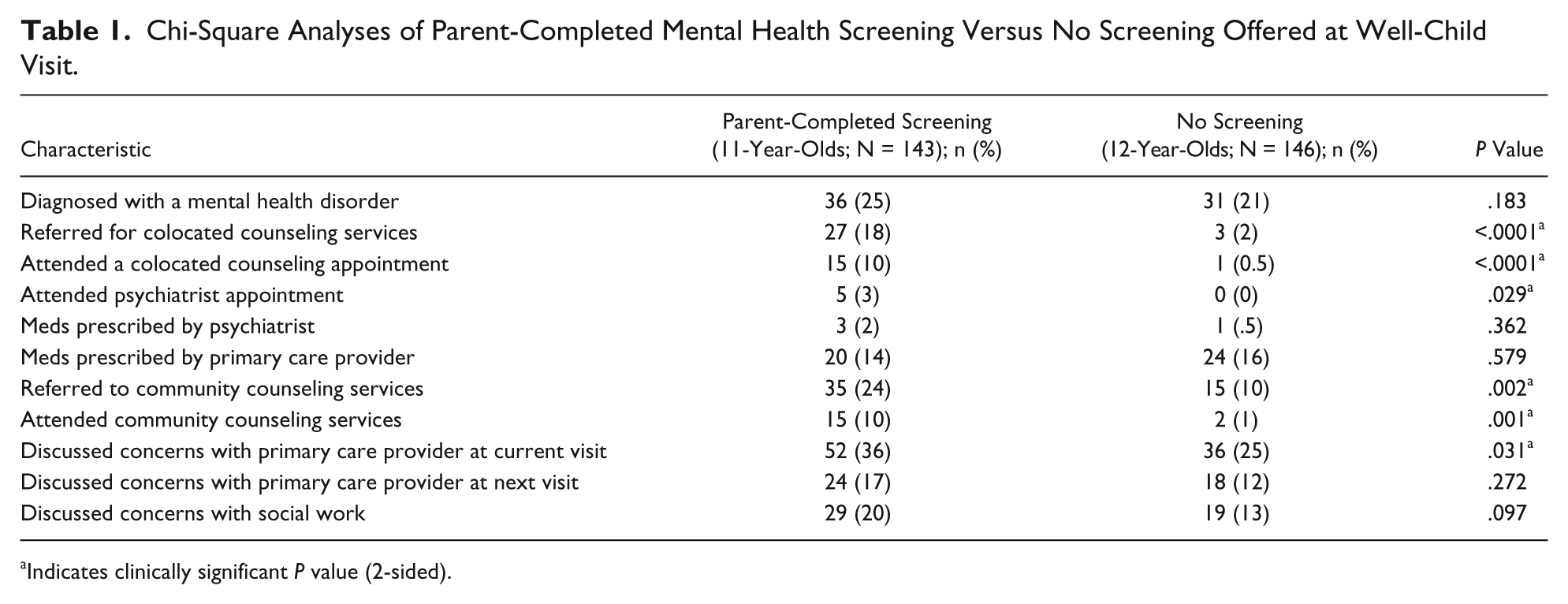
Indicates clinically significant P value (2-sided).
Similar results were also found when examining screenings that were completed only by the youth. The χ2 analyses were also conducted for the group of 11-year-olds in which the youth completed the screening (N = 104) compared with the comparison group of 12-year-olds. Youth who completed a mental health screening were more likely to (1) be referred for colocated counseling services (18% vs 2%, P < .0001), (2) attend colocated counseling services (12% vs 0.5%, P < .0001), (3) attend a psychiatrist appointment (4% vs 0%, P = .018), (4) be referred for community counseling services (23% vs 10%, P = .006), (5) and attend community counseling services (11% vs 1%, P = .002). Results are presented in Table 2. However, one significant finding that differed from parent-completed screenings was when examining the screenings completed by the youth, there was no statistical difference between the groups for discussing concerns with the primary care provider at the visit (33% vs 25%, P = .198).
Chi-Square Analyses of Youth-Completed Mental Health Screening Versus No Screening Offered at Well-Child Visit.
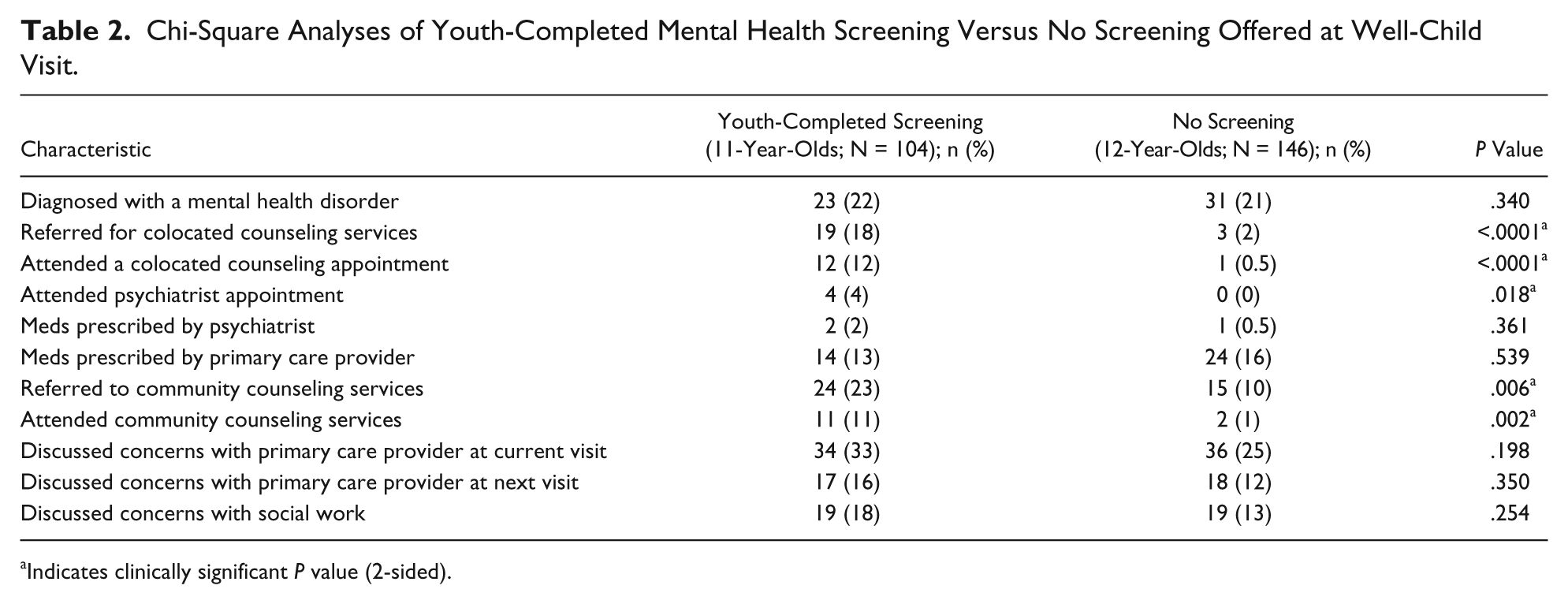
Indicates clinically significant P value (2-sided).
Results of the χ2 analysis suggest that the patients (both parents and youth) who completed the screening did not significantly differ from those who did not complete the screening in terms of having a mental health diagnosis; being prescribed psychotropic medications by their primary care provider; and being prescribed psychotropic medications by a psychiatrist. Results also suggested that patients did not significantly differ in terms of discussing their concerns with a primary care provider at their next medical appointment within 12 months of completing the screening or discussing mental health concerns with a colocated social worker in pediatrics. See Tables 1 and 2 for details.
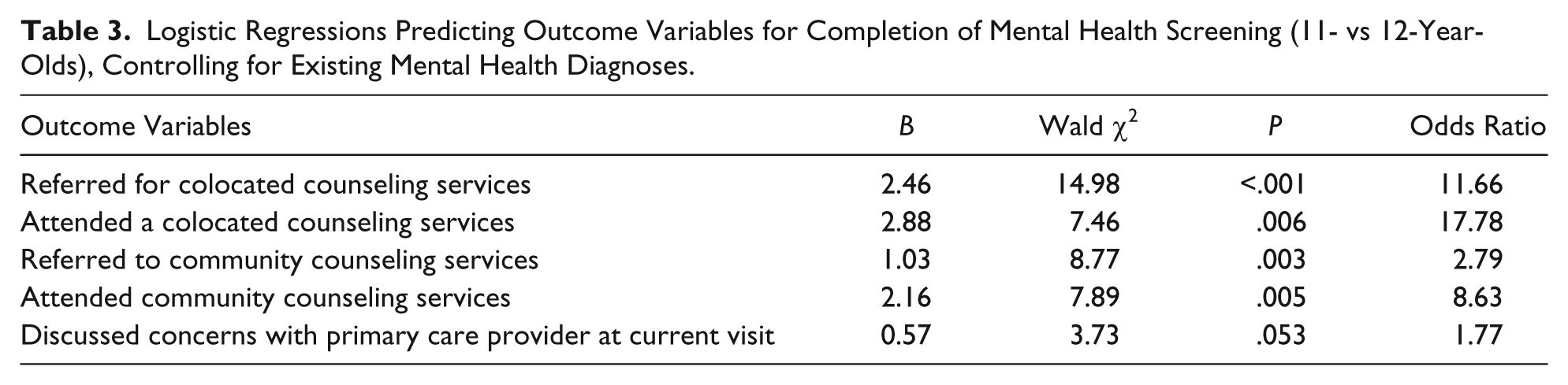
To account for the high rate of existing mental health diagnoses, logistic regression analyses examined the outcome variables in the bivariate analyses that were positively associated with the completion of a mental health screening. Over and above the effect of having a preexisting mental health diagnosis, completion of a mental health screening questionnaire predicted a significantly greater likelihood of being referred for colocated counseling services (B = 2.46, P < .001), attending colocated counseling services (B = 2.88, P = .006), referred for community counseling services (B = 1.03, P = .003), attending community counseling services (B = 2.16, P = .005), and discussing concerns with primary care provider at the current visit (B = 0.57, P = .053). See Table 3 for details.
Logistic Regressions Predicting Outcome Variables for Completion of Mental Health Screening (11- vs 12-Year-Olds), Controlling for Existing Mental Health Diagnoses.
Discussion
Results of this study found that patients who completed a voluntary mental health screening as part of their routine well-child visit were more likely to be referred and attend both colocated and community counseling services compared with individuals who were not offered a mental health screening. These findings were significant above and beyond existing mental health diagnoses, suggesting the screening tool helped to facilitate referral and attendance of mental health services above and beyond existing mental health diagnoses. Patients who completed a mental health screening questionnaire were also more likely to attend an appointment with a psychiatrist, although this finding did not hold true when controlling for existing mental health diagnoses.
Furthermore, patients were more likely to discuss mental health concerns with their primary care provider at the visit if the parent completed a mental health screening questionnaire compared to patients that were not offered a screening. When examining only youth data, youth who completed a screening were not more likely to discuss concerns with the primary care provider. Previous studies have suggested that parental disclosure of mental health problems plays an important role in the identification of mental health concerns and potential treatment.12,20 The current study supports previous findings and highlights the important role that parents play in helping their children discuss mental health concerns with their child’s provider. Therefore, this finding highlights the importance of parents participating in the screening process and indicates that it may not be as effective to rely solely on youth self-report.
Consistent with previous studies, 11 youth who completed a screening measure did not significantly differ from non-screened youth in terms of psychiatric diagnoses or medications being prescribed by a primary care provider or a psychiatrist. For this population, this finding suggests that the screening questionnaire was likely not identifying new diagnoses or resulting in a larger percentage of patients being prescribed medications. This finding should encourage providers to incorporate mental health screenings into their practice as it is unlikely to result in a greater burden to prescribe or identify new patients with mental health needs.
Based on results of this study, the screening questionnaire appears to be a useful tool in facilitating patient referrals to both colocated and community mental health services and encouraging discussion of concerns with the primary care provider at the youth’s annual well-child visit. Overall, patients were more likely to discuss mental health concerns with their primary care provider when prompted by parental completion of a mental health screening.
Results also found that completion of a screening questionnaire was not associated with an increased likelihood of talking to an imbedded social worker. Although previous studies have suggested increased rates of referrals to mental health professionals, the role of social workers in the practice also focuses on case management activities and not solely the provision of mental health treatment. It other words, it is believed that this finding was not significant because patients often talk to social workers regarding a wide range of problems (eg, housing, legal, family problems, mental health concerns, etc) so the completion of mental health screening would not necessarily affect the frequency with which a family discussed a variety of concerns with a social worker. This finding should offer some reassurance to primary care providers that mental health screening will not necessarily increase the need for families to be immediately connected with the services of a social worker.
Furthermore, the groups did not differ in terms of discussing their mental health concerns with their primary care provider at a subsequent visit within 12 months. This finding may be in part explained by other studies that suggest approximately 30% of patients screened do not return for preventive pediatric care.21,22 Therefore, participation in the screening process may have the greatest impact on the concurrent visit and not significantly affect future health appointments. This may also suggest that it is important to continue to screen for mental health concerns at subsequent visits.
Several limitations should be considered when interpreting the findings of this study. First, the medical record review was limited to the pediatric practice so documentation from community mental health providers may not have been accurately recorded in the chart. Therefore, actual rates of attendance of community services may not be exactly reflected in the current study. Second, charts were only reviewed for selected ages and may not generalize to younger or older patients. Collecting additional information on other ages would likely be beneficial in order to generalize the findings. Future studies could also examine optimal ages for screening to be implemented. Third, this study was conducted in a large, primarily low-income, urban, pediatric clinic within a university-based medical center and results may not generalize to other types of practices (eg, suburban, rural, or family medicine practices). It would be helpful to examine data in other clinics, potentially where colocated services are not available, to determine if findings can be generalized. Fourth, no information was available as to why some patients did not complete the mental health screening questionnaire when it was offered as part of their well-child visit. Information on why the questionnaire was not completed by some patients could be beneficial to further examine the implementation and interpretation of mental health screening process.
Overall, this study concludes that completion of mental health screening at well-child visits increased the rate of referral to and attendance of mental health appointments but it did not increase the rates of mental health diagnoses or rates of medication being prescribed by primary care providers. Youth and their parents were more likely to discuss their concerns with their primary care provider when a screener was completed by a parent. Future studies should examine the impact of mental health screening on other age groups to see if the findings generalize to younger and older youth. In addition, long-term outcomes of screening efforts should be evaluated for their potential impact over time.
Footnotes
Acknowledgements
We would like to thank the faculty, staff, and families in the Division of General Pediatrics at University of Rochester Medical Center for their participation in this project.
Declaration of Conflicting Interests
The author(s) declared no potential conflicts of interest with respect to the research, authorship, and/or publication of this article.
Funding
The author(s) disclosed receipt of the following financial support for the research, authorship, and/or publication of this article: The screening program was funded in part by New York State Office of Mental Health, Child and Family Clinic Plus Program and the Aetna Foundation: Regional Community Health Grants Program.