







Abstract
Artificial food colors (AFCs) in foods and beverages may be harmful to children. This study assesses the percentage of grocery store products marketed to children that contain AFCs, by category and company. The research team collected product and food-color information about 810 products in one grocery store in North Carolina in 2014. Overall, 350 products (43.2%) contained AFCs. The most common AFCs were Red 40 (29.8% of products), Blue 1 (24.2%), Yellow 5 (20.5%), and Yellow 6 (19.5%). Produce was the only category that did not have any AFCs. The highest percentage of products with AFCs was found in candies (96.3%), fruit-flavored snacks (94%), and drink mixes/powders (89.7%). Forty-one of the 66 companies marketed products containing AFCs. Given concerns about health effects of AFCs and high proportions of high-AFC categories, clinicians, parents, food companies, and the government can take steps to support children’s healthy eating and development by reducing AFCs in children’s diets.
Keywords
Artificial food colors (AFCs) add color to foods, making them more attractive, especially to children. However, research over the past several decades indicates that AFCs may harm children.1,2 Certain AFCs (or contaminants in the dyes) may be carcinogenic and/or neurotoxic.3,4 Studies also suggest that AFCs are related to attention-related behaviors in children.5,6 The elimination of AFCs from children’s diets may reduce symptoms of attention-related and other behavioral problems. 7
Artificial food colors, as distinguished from color additives derived from natural materials, have been commonly used in foods, drugs, and cosmetics in the United States since the early 1900s. 8 Over the past 100 years, the US government has restricted the use of color additives, usually responding to concerns about toxicity, allergic reactions, or carcinogenicity. Currently, the US Food and Drug Administration (FDA) certifies batches of AFCs on the basis of chemical analyses. Color additives subject to certification, but not natural colorants, must be disclosed by name in the ingredient lists on packaged foods. Common color additives include Red 40, Yellow 5, and Yellow 6, which together account for 90% of all color additives used; others include Blue 1, Blue 2, Citrus Red 2, Green 3, Orange B, and Red 3. 5
Over the past 60 years, per-capita consumption of colors in foods and other products has increased about 5-fold. 9 Due to increases in consumption of AFCs and the rise of attention-deficit hyperactivity disorder (ADHD) in the United States, 10 there is renewed interest in the role of AFCs and their availability in children’s foods. In 2008, Schonwald 11 recommended “food-coloring-free” diets as a “reasonable intervention” for children; in 2010, Millichap and Yee 12 recommended public education about additive-free diets; and in 2012, Arnold et al 5 concluded a review article stating, “Until safety can be better determined, we suggest minimizing children’s exposure to AFCs.”
The current research seeks to understand the feasibility of those recommendations by investigating the prevalence of child-oriented products containing AFCs in the grocery store. The study examines the presence of AFCs by product category and by company. To our knowledge, this is the first study to investigate the proportion of products marketed to children containing AFCs.
Methods
This study was a cross-sectional content analysis of AFCs in packaged foods, vitamin supplements, toothpaste, and other products marketed to children. Information about all of the products marketed to children in one major supermarket in a mid-size city in North Carolina was collected. The median household income of the ZIP code where the store was located was $49 874, which is slightly higher than the state average of $46 693. 13
Sample: Products Marketed to Children
To be considered “marketed to children” and eligible for inclusion in the study, products had to meet at least 1 of the following 5 criteria: (1) displayed 1 or more prominent cartoon characters on the front of the package; (2) displayed a child-oriented licensed character on the front of the package; (3) advertised a child-oriented prize or incentive; (4) included bright and bubbly, child-friendly lettering on the front of the package; and/or (5) was considered a traditional children’s item (eg, fruit-flavored snacks). Those criteria were based on common food-marketing strategies directed to children. 14 Since baby foods are less susceptible to requests by infants and marketing is geared to parents, they were not included in the current sample.
Product Information
General information about the product, which was collected using a paper form in the store, included product name, variety, brand, size, types of marketing techniques, claims on package, and shelf number. Information about the ingredients and nutrient content of the product was then collected from company websites or, if unavailable on the company website, a third-party site (such as a vendor/store site). Product information was entered into an Excel spreadsheet, as were marketing information, all ingredients, presence of individual AFCs, serving size, total calories, grams of total fat, grams of total sugars, milligrams of sodium, and additional notes. Nutrient information was not included in the current analysis.
In-store data were collected from February to June 2014, and online nutrition and ingredient data were collected and entered on a continual basis until September 2014. Four trained data collectors visited the store over the course of the study period to collect the data. A subsample of 5% of products was double-coded, and using Krippendorff’s α test the overall average interrater reliability across relevant variables was 93.6%. Data were analyzed using univariate and bivariate analyses to determine frequencies of the presence of AFCs in products by category and company.
Results
Product Marketing and Categories
Overall, 810 different products in one grocery store were marketed to children. The most frequent marketing strategies were bright/bubbly child-friendly lettering on the front of the package (90.9% of products), followed by traditional kids’ items (89.6%), and cartoon characters on the front of the package (51.2%). Licensed characters on the front of the package were less common (12.0% of products), as were prizes or incentives (6.9%). Ninety-six percent of the products marketed to children employed at least 2 of the 5 assessed strategies, and 85.6% employed at least 3 of the strategies. Nineteen percent of products employed all 5 strategies.
Foods and a small number of non-food items marketed to children represented 20 product categories (Figure 1). Three product categories represented a third of all products marketed to children: cereals (13%), juices/juice drinks (12%), and canned/packaged pasta and soups (9%). Seventeen categories made up the remaining two thirds of products, with non–food items, such as toothpaste, mouthwash, and vitamins, together making up 6% of products marketed to children. Produce, including oranges, pears, and carrots, was the smallest category, with 1% of all products marketed to children.
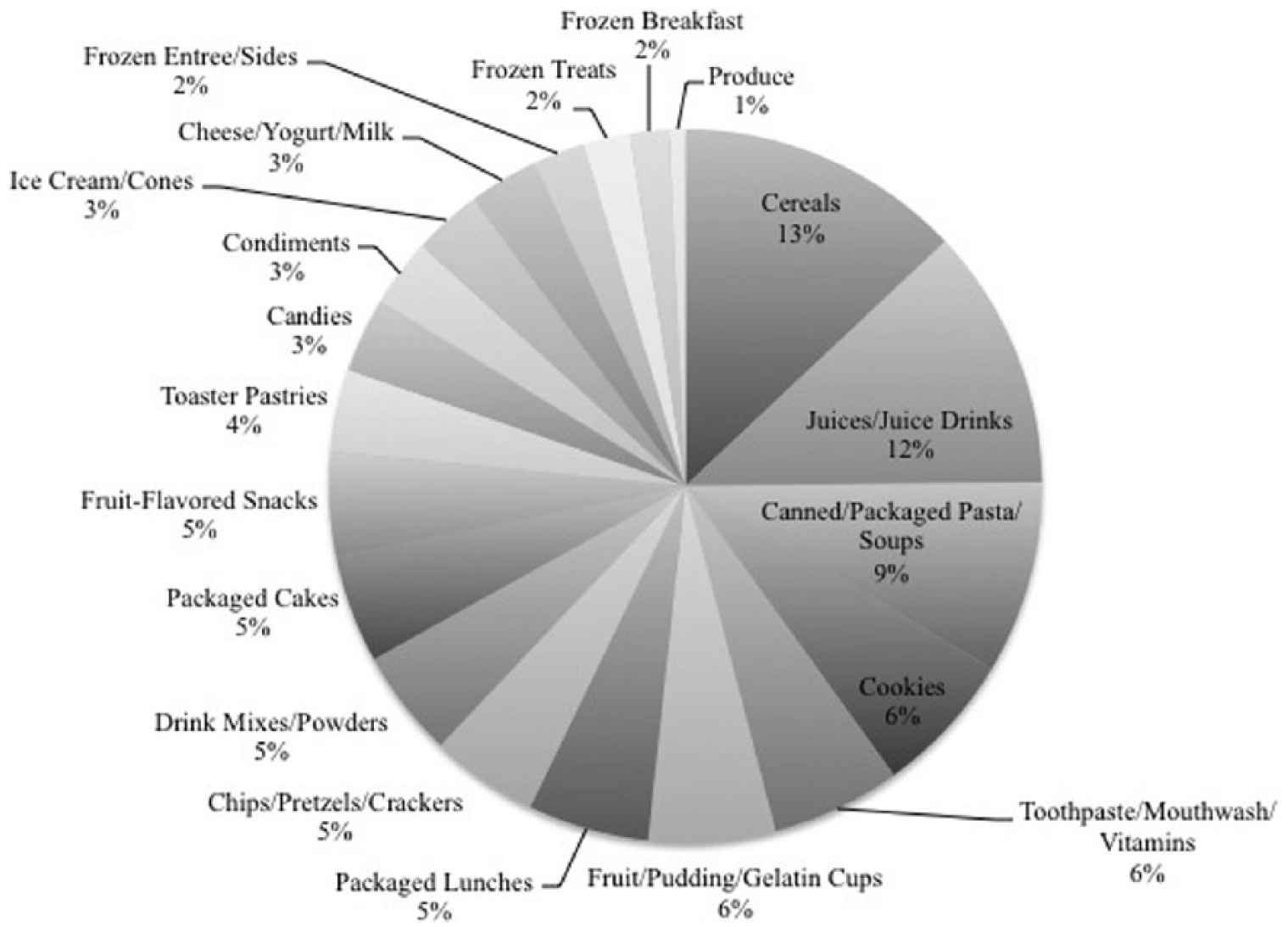
Grocery store products marketed to children (N = 810).
Artificial Food Colors in Children’s Products
Of the 810 products identified in this study, 350 (43.2%) contained AFCs. Table 1 presents the breakdown of products containing any AFCs and each of the 6 individual main AFCs, by product category. The category with the highest proportion of products containing AFCs was candies (96.3% of products), followed by fruit-flavored snacks (94.7%), drink mixes/powders (89.7%), and frozen breakfasts (85.7%). Nineteen of the 20 product categories contained at least 2 products with AFCs. For only 4 categories were AFCs present in less than 20% of products: canned/packaged pastas and soups (19%), ice cream and cones (16%), cheese/yogurt/milk (12%), and produce (0%).
Percentage of Products With Specific AFCs, by Product Category (N = 810).
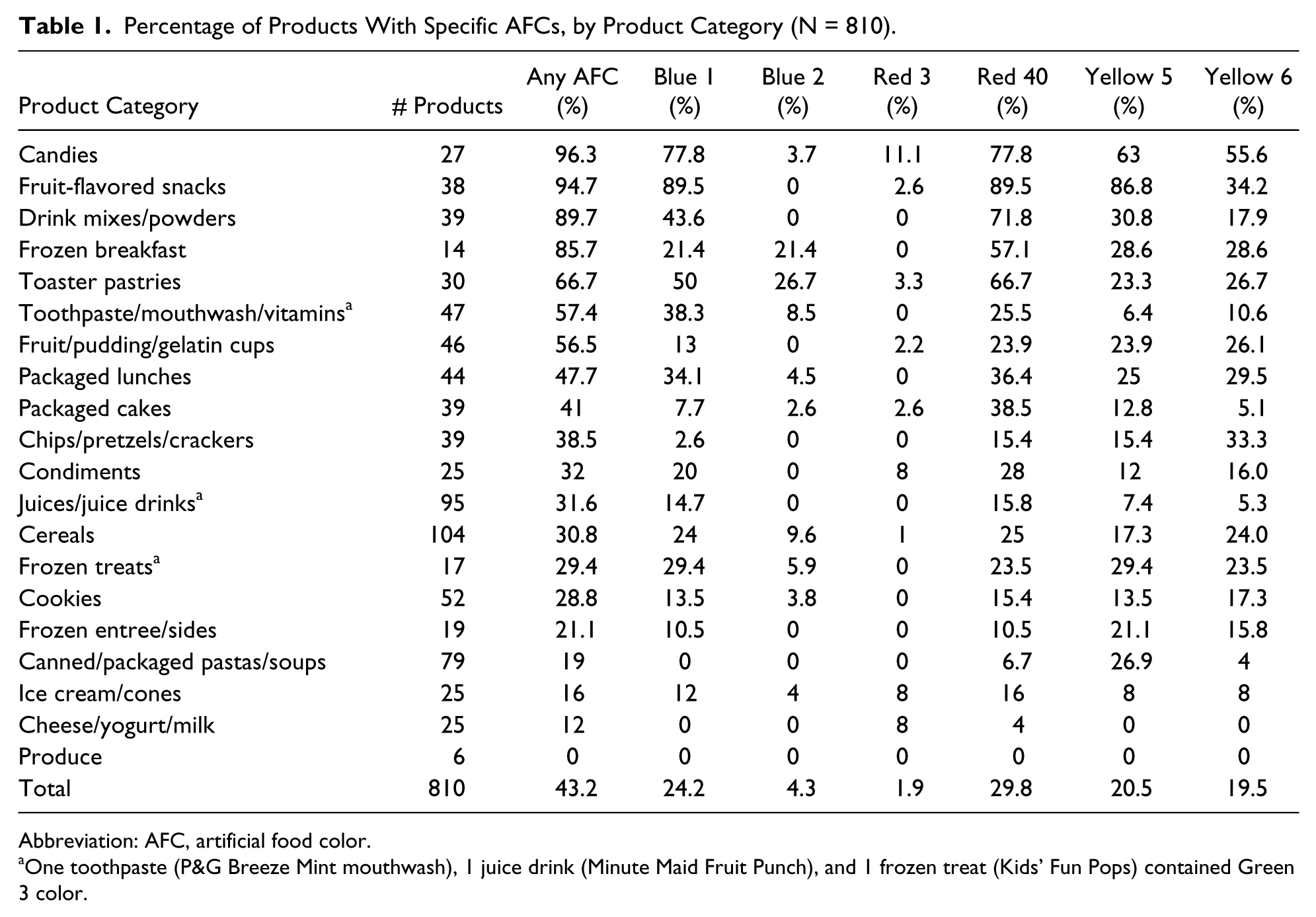
Abbreviation: AFC, artificial food color.
One toothpaste (P&G Breeze Mint mouthwash), 1 juice drink (Minute Maid Fruit Punch), and 1 frozen treat (Kids’ Fun Pops) contained Green 3 color.
Red 40 was the most frequently used AFC, present in 29.8% of the products marketed to children. The percentage of products containing Red 40 ranged from 4% of cheese/yogurt/milk items to 89.5% of fruit-flavored snack items. Other categories with high proportions of products containing Red 40 included candies (77.8%), drink mixes/powders (71.8%), toaster pastries (66.7%). Red 40 was present in products across all 19 of the categories with products containing AFCs.
Blue 1 was present in 24.2% of the products marketed to children, with the percentage of products containing Blue 1 ranging from 7.7% of packaged cakes to 89.5% of fruit-flavored snacks. Blue 1 was not present in canned/packaged pastas and soups, cheese/yogurt/milk, or produce.
Yellow 5 was present in 20.5% of the products marketed to children, with the percentage of products containing Yellow 5 ranging from 6.4% of toothpaste/mouthwash/vitamins to 86.8% of fruit-flavored snacks. Yellow 5 was not present in cheese/yogurt/milk or produce.
Yellow 6 was present in 19.5% of the products marketed to children, with the percentage of products containing AFCs ranging from 5.1% of packaged cakes to 55.6% of candies. Yellow 6 was not present in cheese/yogurt/milk or produce.
Three AFCs were prevalent in fewer than 5% of products. Blue 2 was present in 4.3% of the products marketed to children, with the percentage of products containing AFCs ranging from 2.6% of packaged cakes to 26.7% of toaster pastries. Blue 2 was not present in any products in 10 of the 20 categories. Red 3 was present in 1.9% of the products marketed to children, with the percentage of products containing AFCs ranging from 2.2% of fruit/pudding/gelatin cups to 11.1% of candies. Blue 2 was not present in products in 11 of the 20 categories. Only 3 products (0.3%) marketed to children contained Green 3, and none of the products contained Citrus Red 2 or Orange B, which is only permitted in sausage casings. Products in 4 of the categories (candies, taster pastries, cereals, and ice cream/cones) included all 6 main AFCs.
Companies
A total of 66 companies manufactured the products marketed to children, with the number of products ranging from 1 (14 companies) to 105 (Kraft Foods). Over 65% of the products were manufactured by 10 companies, including Kraft Foods (13% of products), Kellogg (8.5%), General Mills (8.3%), the store brand (7.4%), Mondelēz International (6.3%), ConAgra Foods (5.8%), Campbell Soup (4.8%), McKee Foods (4.8%), PepsiCo, (3.3%), and Unilever (3%).
Table 2 summarizes the number of products and percentage of products containing any AFCs by company. Twenty-five of the parent companies (37.9%) did not market to children any products containing AFCs. The percentage of products containing AFCs for the other 41 companies ranged from 2.6% (Campbell’s) to 100% (15 companies). Twenty-six companies (39.4%) included AFCs in 50% or more of the products they marketed to children.
Percentage of Products Marketed to Children Containing AFCs, by Parent Company (N = 810).
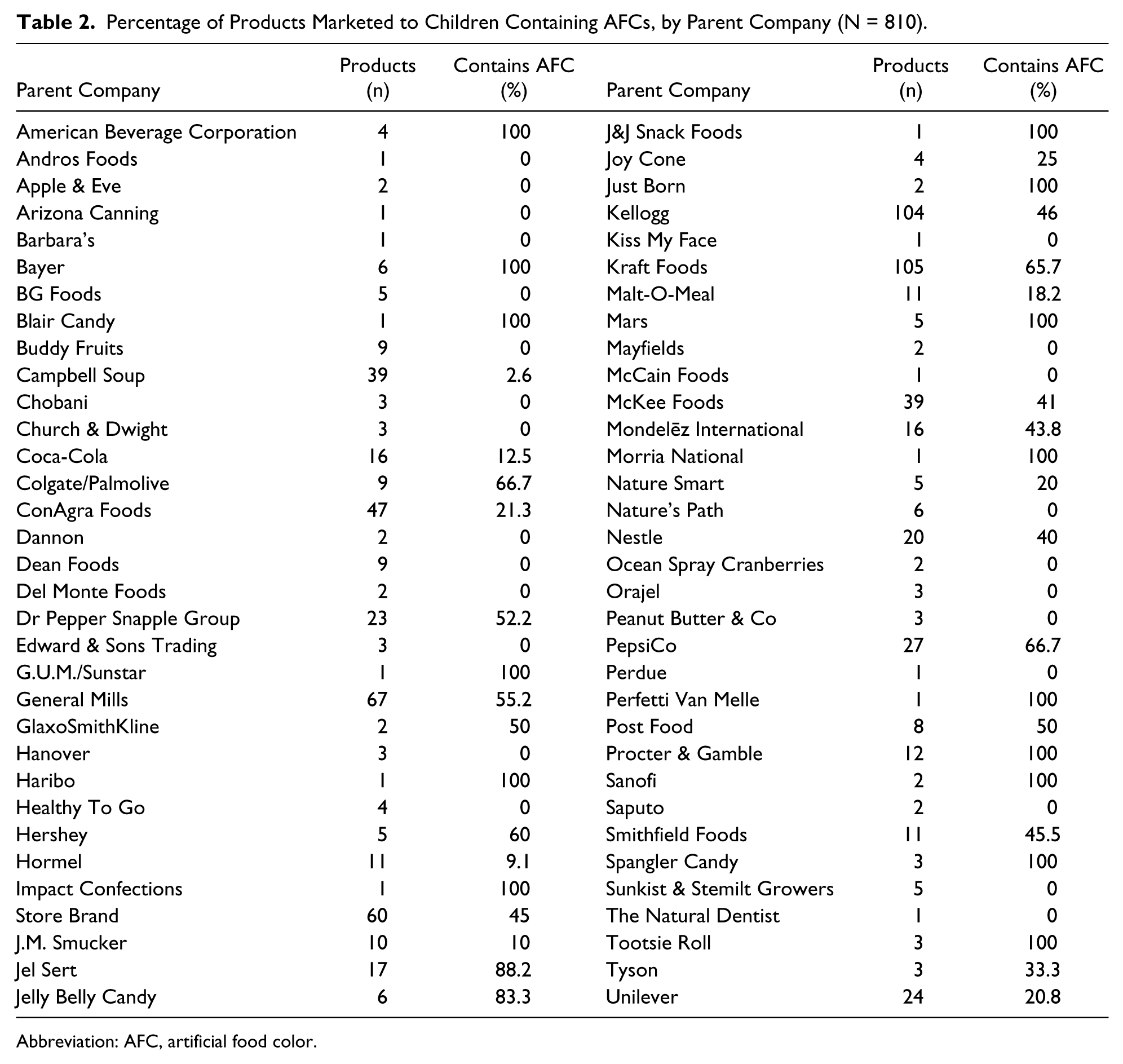
Abbreviation: AFC, artificial food color.
Discussion
Artificial food colors are common in packaged foods marketed to children. We found that at least 1 AFC is present in about 4 in 10 products that attract children from grocery store shelves. AFCs are found throughout the store, with at least 1 product in 19 of 20 categories of products marketed to children.
Though this study may be the first to document the percentage of child-oriented products with AFCs, other research investigated the amounts of AFCs in foods 15 and beverages 9 commonly consumed by children, such as cereals, candies, baked goods, and juices/juice drinks. In those studies, Stevens and colleagues found levels of AFCs in individual foods much higher than the amounts tested in most studies investigating reactions in children.9,15
This study has several limitations. First, the in-store data were collected over a 4-month period that included several color-focused holidays (Valentine’s Day, St Patrick’s Day, and Easter), and the website data were collected over a 6-month period; hence, the full data set may not represent precisely what was available on any given day. Second, the study did not include items that may be popular with children but not marketed directly to them, such as soft drinks. Third, some of the ingredient and/or nutrition information had to be collected from third-party sites and may not have been as accurate as if the information were obtained from the manufacturer’s site or directly from the package label. However, collecting information online was more practical for this study. Fourth, the sample is from only one chain grocery store location and so cannot necessarily be generalizable to other stores from the same chain or other chains in the area or in other parts of the state or country. Finally, this study describes the presence of AFCs but does not provide information on the amount of AFCs in the products nor the amount of AFCs consumed by children. Foods and beverages marketed to children in other settings, such as restaurants, also would be of interest.
As this study suggests, AFCs are commonplace among foods marketed to children. AFCs add eye-popping color to candy, sugary cereals, and other products marketed to kids. However, AFCs lack nutritional value or other health benefit, and they are often used (together with artificial or natural flavorings) in place of healthful ingredients, for example, red and yellow AFCs for carrots and orange juice.
In accordance with recommendations, 12 pediatricians and other clinicians could support families that want to reduce their children’s intake of AFCs by pointing out the ubiquity of AFCs in the grocery store. In general, parents concerned about dyes should be cautious purchasing packaged foods that are attractive to children, and some categories might be avoided altogether, such as candies, fruit-flavored snacks, drink mixes/powders, and frozen breakfasts, all of which had 80% or more products with AFCs. Parents should read ingredient lists even when the pictured food may not appear to have added colors. We did find that over a third of companies that market products to children do not have any products that contain AFCs (Table 2).
Because of adverse publicity about AFCs, some companies and brands, such as General Mills, Pepperidge Farm, Frito-Lay, and Nestle, are removing AFCs from some of their foods. Those companies may either drop added colorings or switch to natural colorings. The natural colorings should be used cautiously as some, such as carmine/cochineal extract, which are extracted from insects, can cause serious allergic reactions, and should be avoided. Also, annatto, from a seed, also causes occasional allergic reactions. Including more fruits and vegetables, such as beet juice, can provide color and nutrients. Food (and vitamin-supplement, toothpaste, and other) manufacturers and restaurants could set standards that include no AFCs in the foods and beverages that they market to children.
At the policy level, the FDA could protect children by revoking the approvals of AFCs. Alternatively, the FDA could require a warning notice on foods containing AFCs, similar to European Union legislation. The European Parliament requires the following warning label on products containing any of the main AFCs: “may have an adverse effect on activity and attention in children.” 16 Those AFCs were the ones used in 2 British studies that appeared to affect children in the general population. 17 The Parliament’s Environment Committee also proposed a ban on AFCs in foods for babies and small children but to date it has not been enacted. 18 It is worth noting that some of the same products that are sold AFC-free in Europe are sold in the United States with AFCs. For example, the topping for a McDonald’s Strawberry Sundae available in the United States contains Red 40, but in the United Kingdom the topping’s color comes solely from strawberries.19,20
In 2011, the FDA convened a Food Advisory Committee to examine the link between AFCs and behavior. At that time, the FDA stated that “exposure to food and food components, including AFCs and preservatives, may be associated with adverse behaviors, not necessarily related to hyperactivity, in certain susceptible children with ADHD and other problem behaviors, and possibly in susceptible children from the general population.” 21 However, the FDA only asked the committee to comment on whether a “causal” relationship had been established between consumption of AFCs and hyperactivity for children “in the general population” (not children with sensitivities). The committee concluded that there was insufficient evidence to establish that finding and recommended further research. The FDA has not taken any action on food dyes since that advisory committee meeting.
Conclusions
Parents who wish to eliminate AFCs from their children’s diets face a challenge, as the current research found that about 4 in 10 packaged items in grocery store products marketed to children contain at least one AFC. Moreover, in some food categories almost all of the products contain AFCs, making it difficult for families to purchase those products without AFCs. Clinicians can educate parents about reading ingredient lists and avoiding certain products or categories, at least until companies implement policies to limit marketing of products containing AFCs. More effective, however, would be for the government to eliminate AFCs from all foods or, at the very least, require a warning notice on packages.
Author Contributions
AB co-designed the study, oversaw data collection and analysis, and drafted portions of the manuscript. MFJ co-designed the study, drafted the discussion section, and edited the manuscript.
Footnotes
Acknowledgements
The authors wish to thank research assistants Melissa Allen, Jennifer Roberts, Kelly Miller, Lauren Flewelling, and Hector Melgar, as well as reviewer Elise Henshaw, and editors Laura MacCleery and Lisa Lefferts.
Declaration of Conflicting Interests
The author(s) declared no potential conflicts of interest with respect to the research, authorship, and/or publication of this article.
Funding
The author(s) received no financial support for the research, authorship, and/or publication of this article.