







Abstract
Speech and language delays are common developmental disorders that can lead to long-term academic and psychosocial impairments. Affected families often benefit from instruction in cultivating a language-rich home environment. This study investigated the feasibility of utilizing text messaging to deliver developmental education to families. Parents of children aged 11 to 36 months with concerning language development were enrolled in a 3-month text messaging program. Pre–program and post–program telephone surveys were completed. All enrolled parents were of low socioeconomic status, and 48% were monolingual Spanish speakers. A total of 27 parents (87%) completed the program and follow-up survey. After program completion, parents reported increased awareness of language-promoting activities and local child development resources (P = .002; P = .005). Parents also reported increased engagement in language-promoting activities (P = .004). The marginal program cost was 37 cents per participant. Findings from this pilot study indicate that text messaging is a feasible, engaging, and inexpensive platform for delivering developmental education to families.
Introduction
Pediatric speech and language delays are common developmental disorders that are associated with chronic impairments in social functioning, emotional health, and scholastic achievement.1-7 These delays affect up to 15% of children.8,9 Higher incidences are observed in children of low socioeconomic status (SES).8,10 In fact, significant disparities in language proficiency between children from low- and high-SES families are seen as early as 18 months of age. 11 Speech therapy is often recommended and is supported by both the US Preventive Services Task Force and a 2010 Cochrane review article.12,13 However, because of insufficient funding, a paucity of certified speech pathologists, and multiple logistical barriers, low-SES families frequently have difficulty accessing these services.14-16 Parent education can enable low-SES families to improve a child’s home linguistic environment 17 ; this familial modification has also been shown to have a positive impact on the language development of children with primary speech and language delay.18,19
Digital health, specifically mobile health (mHealth) programming, is a potential platform for providing developmental education to families of children with speech and language delay outside of the clinic. Within the field of pediatrics, mHealth programs have demonstrated success in improving medication adherence, facilitating timely vaccination, and providing health education.20-25 The uTALK (Texts Advancing Language in Kids) pilot program was designed to use text messaging to provide parents with regular instruction on simple, actionable, language-promoting activities. This study evaluates the feasibility of the uTALK program in delivering developmental education to an urban population of low SES and analyzes the impact of the program on the home linguistic environment.
Methods
Participants
Study participants were recruited from the outpatient pediatric clinic at San Francisco General Hospital between July 2013 and February 2014. Parents were eligible to participate if the primary care provider identified the child as having concerning speech and/or language development. Enrollment was limited to families of children between 11 and 36 months old, given that the study’s developmental interventions targeted this age group. Additional enrollment criteria included parental literacy in either English or Spanish and possession of a mobile telephone with text message capability. Families were not excluded from participation on the basis of medical comorbidities or involvement in other developmental services. Children enrolled continued to receive all recommended care from providers, such as further evaluations for hearing, referral to early intervention, and speech and language services.
Study Design and Procedures
This was a pilot intervention study. Parents meeting the inclusion criteria consented in their preferred language via telephone. On enrollment, participants completed a telephone survey consisting of basic demographic information, self-reported knowledge of language-promoting activities, current engagement in language-promoting activities, and awareness of community resources for early child development. Item response formats for survey questions included the 5-item Likert scale, yes-no questions, and open-ended questions. After survey completion, participants were sent 3 text messages per week for 12 weeks. Three types of text messages were included in the program: messages describing activities that promote child language development; messages providing information on local, low-cost community organizations specializing in early child development; and messages containing survey questions. Samples of text messages are shown in Table 1. Participants were informed that responding to text message survey questions was optional. These questions were designed as a tool to gauge participant engagement in the program; they were not intended to evaluate program effectiveness.
Sample Text Messages.
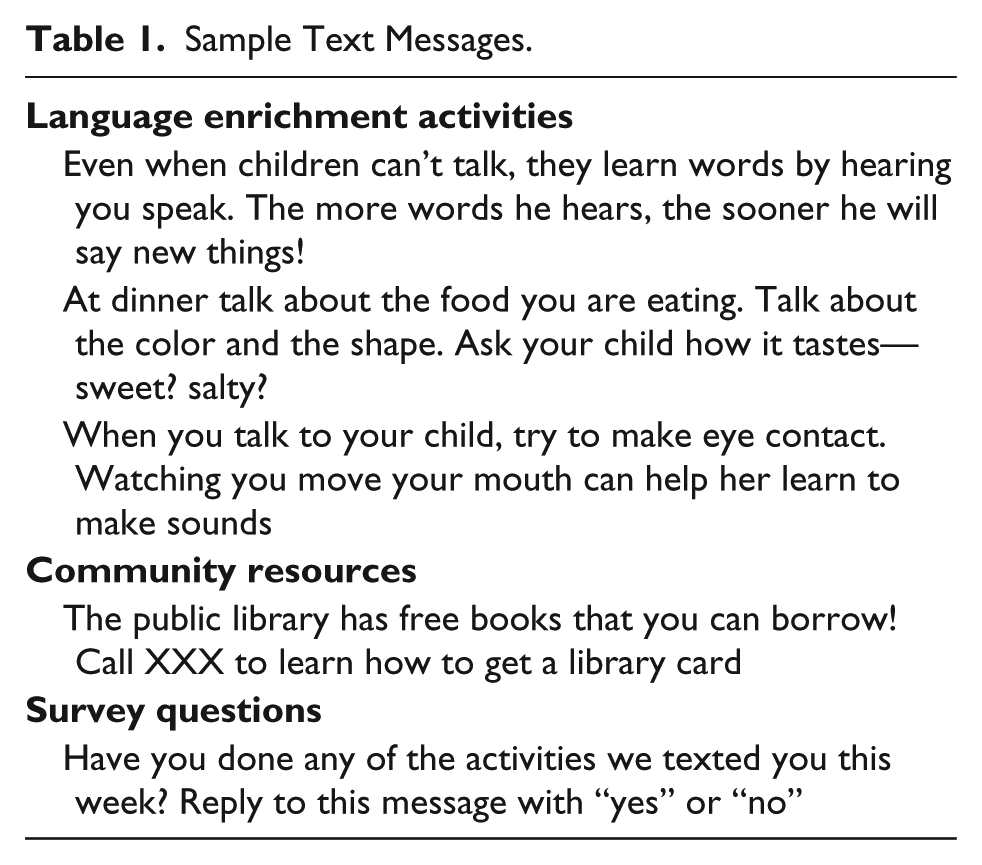
On completion of the uTALK program, parents participated in a follow-up telephone survey assessing the same measures of knowledge and engagement as the baseline survey. The post–program survey also contained questions designed to assess participant opinion of the structure of the text message format and participant opinion of the value of the uTALK program. The study and consent process were approved by the University of California–San Francisco Institutional Review Board.
Text Messaging Platform
The text messaging program was built in Python, using the Django application framework and a Postgresql database. It was hosted on the Amazon’s Web Services platform via Heroku. This framework leveraged the Twilio application programming interface (API) to automatically send SMS messages at a customizable date and time. Text messages were disseminated in a preconfigured order, and were personalized based on language (English or Spanish) of the parent and gender of the child. Text responses from participants were directly transferred to and stored in the database. Participants were able to text “STOP” at any time to remove themselves from the program.
Data Analysis
To assess the feasibility of using text messages to deliver developmental education to the target population, the program completion rate and the response rate to intraprogram text messages were calculated. To evaluate the program’s impact on the home linguistic environment, parental survey responses were compared before and after program participation. For survey questions utilizing the Likert scale, statistical analysis was conducted using a paired t-test. For survey questions involving dichotomous answers, a 2-tailed sign test was used. A McNemar test could not be used because of the small sample size.
To calculate the marginal cost of the text message program, the average cost of the Twilio API per text message was multiplied by the number of text messages sent per participant. Twilio also charges a $1 monthly fee for an account regardless of the number of text messages sent. We distributed the $1 monthly fee evenly across the 31 participants to calculate the program cost per participant. The calculated marginal cost of the program does not include variable text messaging costs charged directly to participants by their mobile provider.
Results
A total of 31 parents were enrolled in the study. Post–program survey data were collected from 27 participants (87%). Two parents elected to stop receiving messages during the program, 1 parent did not remember receiving any messages, and 1 parent could not be contacted after completion of the program. Demographic information is provided in Table 2. All parents either received or were eligible for the Special Supplemental Nutrition Program for Women, Infants, and Children (WIC) at the time of study participation. Nearly half (48%) of parents were monolingual Spanish speakers, with 67% of participants identifying as Hispanic or Latino. The majority of parents had finished high school or some college (81%); only 1 participant had graduated from college. Children ranged in age from 11 to 36 months at the time of enrollment, and 63% of children were older than 24 months.
Participant Characteristics (n = 27).
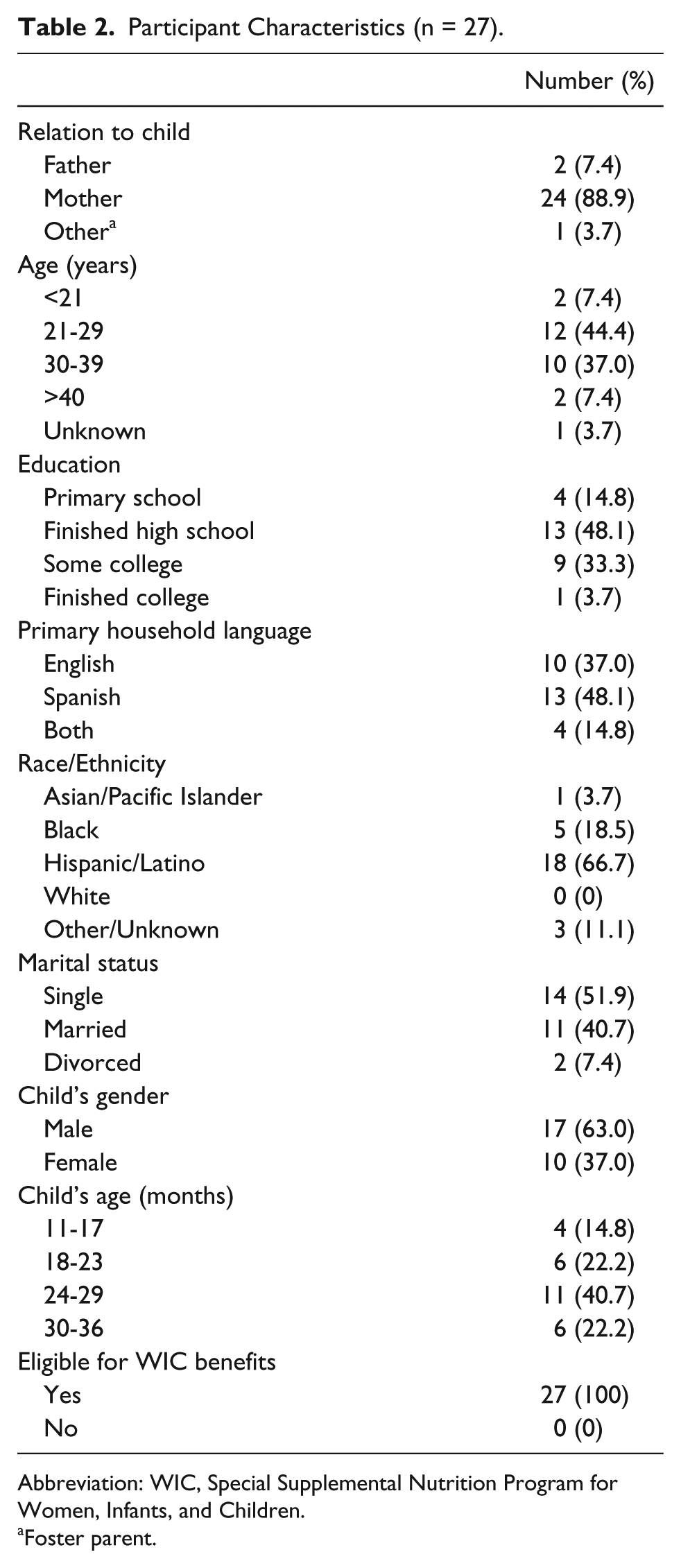
Abbreviation: WIC, Special Supplemental Nutrition Program for Women, Infants, and Children.
Foster parent.
Program Impact
Results of the program’s impact on the language environment are detailed in Table 3. After completing the uTALK program, more parents reported being knowledgeable of pediatric language-promoting activities (56% vs 96%, P = .002) and being aware of community resources for child development (41% vs 82%, P = .005). Parental self-report of engagement in language enrichment activities with their child increased from 89% to 100% (P = .004). After participating in the uTALK program, more parents reported visiting the library (48% vs 70%, P = .03). Parental report of the number of times they read to their child increased (5.2 vs 6.7); however, this was not statistically significant (P = .15).
Sample Questions From the Survey of Participants (n = 27).
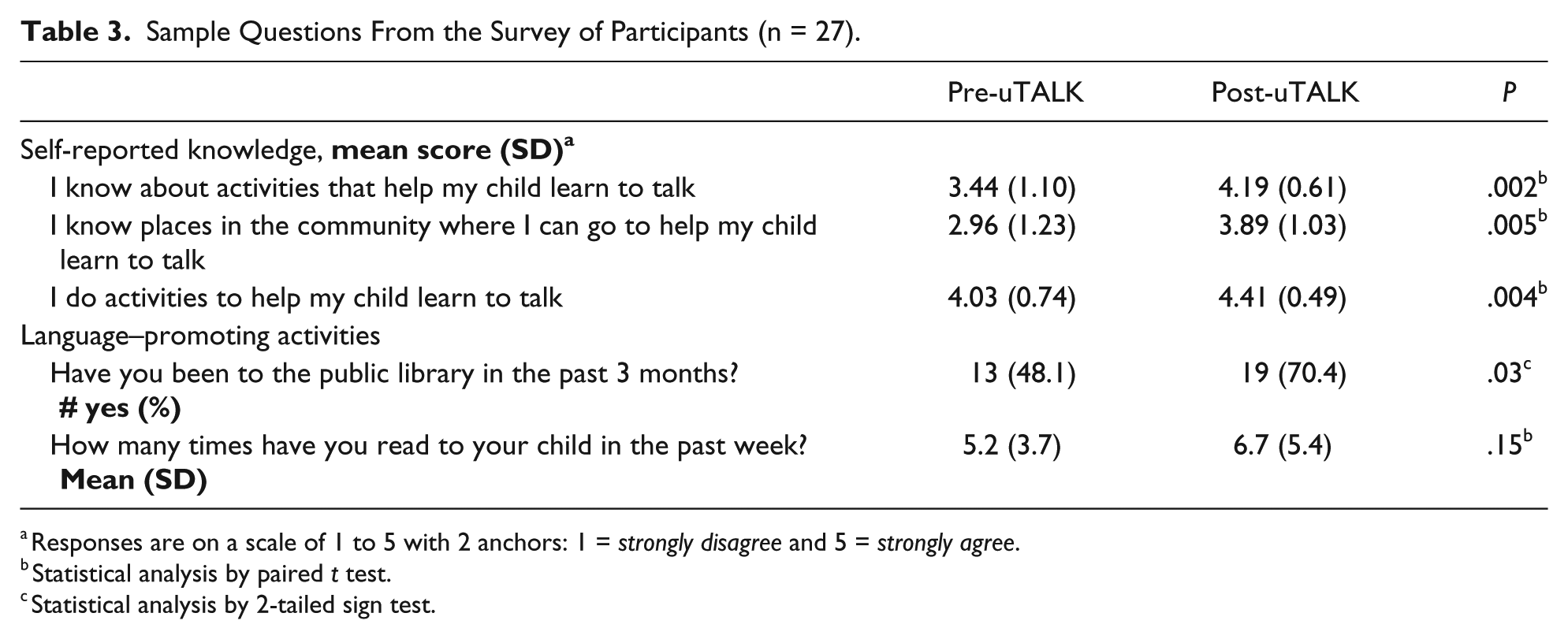
Responses are on a scale of 1 to 5 with 2 anchors: 1 = strongly disagree and 5 = strongly agree.
Statistical analysis by paired t test.
Statistical analysis by 2-tailed sign test.
Program Format and Participant Engagement
Parents were asked several questions regarding the program length and frequency of text messages. Seven parents (26%) felt that the program was “too short,” and 20 parents (74%) felt that it was “just right.” Five parents (19%) reported that the number of texts were “too few,” whereas the remainder reported that the number of texts received was “just right.” Two parents specifically commented that they would like daily messages.
During the program, participants received 4 text messages containing optional survey questions. A total of 15 parents (56%) responded by text message to at least 1 of the optional intraprogram text message survey questions. Although 3 of the 4 questions were designed to be answered with a simple yes or no or a numerical answer, participants often responded with icons or prose.
Value to Parents and Program Cost
In all, 100% of parents reported that they enjoyed the uTALK program and that they would recommend this program to other families; 26 participants (96%) considered the program valuable to their family, and 24 participants (89%) reported that the program helped their child. Parents were also asked to comment about the program. Several comments were specific to the text messaging aspect of the program: “It was easier to get information via text message than on the Internet”; “I was able to save the text messages and look for them later to remember”; and “I liked the text message because you didn’t have to talk to anyone. The information was easy and accessible.”
The Twilio service fee was $0.0075 per text message. When multiplied by the 36 text messages sent per participant during the program, the cost was $0.27 per participant. The $1 monthly fee for a Twilio account was multiplied by 3 months and divided by the 31 enrolled participants, totaling $0.10 per participant. The total marginal cost of the program was calculated to be $0.37 per participant.
Discussion
The objective of this study was to determine whether text messaging is a feasible platform for delivering developmental education to low-income parents of children with speech and language delay. The uTALK program was able to effectively reach the target population of underserved families as evidenced by an 87% program completion rate. Given that almost half of the participants were non–English speaking, this study supports the idea that text messaging is a potential modality for providing education to populations marginalized by language barriers. Furthermore, the participants’ 56% response rate to optional intraprogram text message survey questions suggests that parents were not only receiving the text messages, but that they were also actively reading the messages and engaging with the program. In fact, several participants regularly responded to non–survey messages with “thanks” or a “thumbs-up” icon.
This study’s results also support the hypothesis that a text messaging intervention can enable parents to positively change their child’s linguistic environment. After participating in the 3-month program, parents reported greater knowledge of and participation in language-promoting activities, including visiting the library. Although there was no statistically significant difference in the number of times parents reported reading to their child, this is possibly a result of the study’s small sample size or the variability in parent recall and interpretation of the question.
Based on prior research, improvements in the home linguistic environment, such as those produced through this text messaging program, have direct impacts on the language development of children,18,19,26 Teaching parents how to create enriching environments early in a child’s life is important. Unfortunately, it is often difficult in a clinic setting because of time constraints and language barriers. Furthermore, tips given in the clinic setting are often not translated into actions at home. Comments from participants in uTALK highlighted the effectiveness and convenience of text messages. Text messages can be received on a more frequent basis than primary care visits. Because they are delivered outside of the clinic, the suggestions can be acted on immediately and even saved for future reference. Importantly, the uTALK program was both low–cost and required minimal time for parents and providers.
This study does have several limitations. It is a small study with 31 participants and, thus, definitive conclusions regarding the effectiveness of this program in educating parents cannot yet be made. However, given the high rate of positive responses from parents, as well as a high engagement rate with the text messages, this study provides strong support for further developing text messaging platforms in this context. In addition, this study did not independently assess whether parents participated in suggested activities or whether children improved their language abilities after parent participation in the program. Future research should examine whether participation in the uTALK program affects objective measures of a child’s language development. Given that etiologies of speech and language delay include a heterogeneous group of primary and secondary disturbances, additional research could also clarify which subgroups would most benefit from a text message language intervention.
Conclusions
The uTALK program is a low-cost text message intervention that provides developmental education to parents of children with speech and language delays. The program was able to reach a highly underserved population and was accessible for Spanish speakers. Results of the pilot study suggest that parents both learned and implemented developmental interventions to help their children after participating in this program. Given the positive results of this study, text message programs may be a low-cost, logistically simple method for providing timely developmental education to society’s most vulnerable children. More research is indicated to assess the direct impact of this program on pediatric language development and to identify the pediatric subgroups that would most benefit from this intervention.
Author Contributions
All authors contributed to the concept and design of this project. In addition, KBO collected, analyzed, and interpreted data, and co-drafted the manuscript. CLW helped build the text message platform, collected, analyized, and interpreted data, and co-drafted the manuscript. MJW designed and helped build the text message platform, and critical revised the manuscript. JH and AW both critically revised the manuscript.
Footnotes
Authors’ Note
Kaitlyn B. Olson and Carol L. Wilkinson contributed equally to this project and article.
Declaration of Conflicting Interests
The author(s) declared the following potential conflicts of interest with respect to the research, authorship, and/or publication of this article: Dr Carol Wilkinson, Mr Jackson Wilkinson, and Dr Kaitlyn Olson have a potential conflict of interest. Mr Wilkinson was the founder and Dr Wilkinson was the medical director of Kinsights. Kinsights is a company that facilitates and provides a platform for parenting communities and was recently acquired by Care.com; Mr Wilkinson continues to work at Care.com. After completion of the study, including collection of all data, an updated version of the text messaging program was made available online for free by Kinsights. The text messaging program is located on a separate website (kinsteps.com) and does not require sign-up for Kinsights or Care.com, nor does it require any payment by participants. It is currently offered as a public service at  expense. Dr. Wilkinson and Dr. Olson continue to serve as volunteer consultants to the Kinsteps program.
Funding
The author(s) disclosed receipt of the following financial support for the research, authorship, and/or publication of this article: This study was supported by the American Academy of Pediatrics Resident CATCH (Community Access to Child Health) grant.