







Abstract
Primary care providers (PCPs) have few resources to manage their overweight/obese patients. The purpose of study was to determine if technological resources, such as smartphone apps, may be useful for weight management counseling. PCPs were surveyed about their current use of resources for obesity management and whether smartphone apps would be helpful. Seventy-four PCPs completed the survey. Only 15% currently referred patients to smartphone apps at least sometimes or more often. When asked about features of apps, 66% were not aware of apps with interactive healthy eating games, yet if aware, 45% reported they would refer patients. Providers reported a greater likelihood of being more effective using an app compared with their current ability to manage overweight/obesity, 3.19 versus 2.85, P < .01. The majority of pediatric providers surveyed do not provide technological resources for their overweight/obese patients; yet, they appear interested in using smartphone apps as a resource.
Introduction
Adolescent obesity (body mass index [BMI] ≥ sex-specific 95th percentile on US Centers for Disease Control and Prevention BMI-for-age growth charts) has quadrupled in the past 35 years from 5% in 1980 to 20.5% in 2014.1-3 The literature has shown that primary care providers (PCPs) identify limited resources and time constraints as well as patient adherence among the barriers to effective management of their overweight/obese patients.4-8 PCPs have reported the need for more educational resources and/or training that would assist them with effective weight management counseling.8,9
Given that adolescents’ use of smartphones has increased dramatically over the past decade, smartphones and smartphone applications (apps) may be a useful tool. In a PEW report, 82% American teens were found to own a cell phone or tablet; and of those owners, 71% downloaded an app to one of these devices. 10 Additionally, 94% of teens access online sources daily or many times per day, and 24% of teens go online “almost constantly.” 11 African American adolescents have greater access to smartphones (85%) than do Caucasian and Hispanic adolescents (71%). In addition, smartphone access prevalence has increased among teens of lower socioeconomic status since 61% of adolescents who live in a household that has less than $30 000 income/year have access to a smartphone. 11
Due to the prevalent use of smartphones among adolescents as well as accessible and immediately available apps to help with weight management, mobile apps may be a useful tool for the PCP in weight management. The American Heart Association has recommended investigators to test the efficacy of weight management apps and assess implementation in the primary care setting. 12 Several studies have shown that smartphone apps are helpful resources for adolescent patients with chronic diseases, such as type 2 diabetes mellitus, asthma, and sickle cell disease.13-16 It was shown that adolescents felt mobile health was an acceptable supplementation to weight management counseling in PCP office visits 17 ; however, it is not known how PCPs view smartphone apps as a tool for obesity management or how apps can assist PCPs with counseling their patients. The purpose of this study was to assess PCPs’ current resources used in pediatric weight management and determine to what extent smartphone apps could improve current practice.
Methods
We distributed a survey between August 2016 and October 2016 to pediatric providers in offices that belong to the South Carolina Pediatric Practice Research Network (SCPPRN), a practice-based research network of pediatric providers in Coastal and Central South Carolina. SCPPRN providers regularly manage overweight/obesity in practices and have participated in a prior study of obesity. 18 SCPPRN currently consists of 18 pediatric practices, with a total of 27 separate offices without pediatric provider overlap. Of note, one of the SCPPRN practices is a resident continuity clinic at the local academic institution. All providers in SCPPRN were asked to complete the survey. Practices were given a choice to complete the surveys online or on paper. Providers were emailed the survey and asked to voluntarily complete it. Reminders were sent to providers twice one month apart to encourage completion of survey.
Survey questions were developed and revised by the authors and a team of SCPPRN leadership, and the survey was piloted for clarity by pediatric faculty members at the institution who did not take part in the final survey. Content questions included currently used resources as well as needed resources for weight management. We also asked about current PCP recommendations for weight management apps and preferences about how PCPs and their patients may use weight management apps to supplement provider counseling and management. Last, the surveys measured PCPs’ perceived effectiveness of their current counseling and management of overweight/obesity versus their perceived effectiveness with an app that allowed them to monitor their patients’ progress in reaching their healthy goals.
Since provider comfort could affect whether a provider would refer patients to smartphone apps, the authors asked providers their comfort level with installing and using an app on their own phone and if they had ever used an app themselves to assist with healthy eating, exercise, or managing their weight.
Most questions were designed with choices on a 5-point Likert-type scale ranging from “not at all” to “all the time.” For questions that asked about effectiveness, providers were given a Likert-type scale to choose from with values 1 = not effective at all to 5 = extremely effective. When choosing a cutoff point on the Likert-type scale for questions, we decided to use the cutoff point of 3 = “sometimes,” meaning that providers at least sometimes or more frequently performed the questioned actions. We reasoned that if providers answered sometimes, then they were aware of the resource and had likely used the resource with patients in the past.
Analyses included descriptive statistics, t tests, and Spearman nonparametric correlations for continuous variables, and Fisher’s exact test for dichotomous variables using SAS 9.4 (SAS Institute Inc, Cary, NC).
This study was approved by the Institutional Review Board at the Medical University of South Carolina.
Results
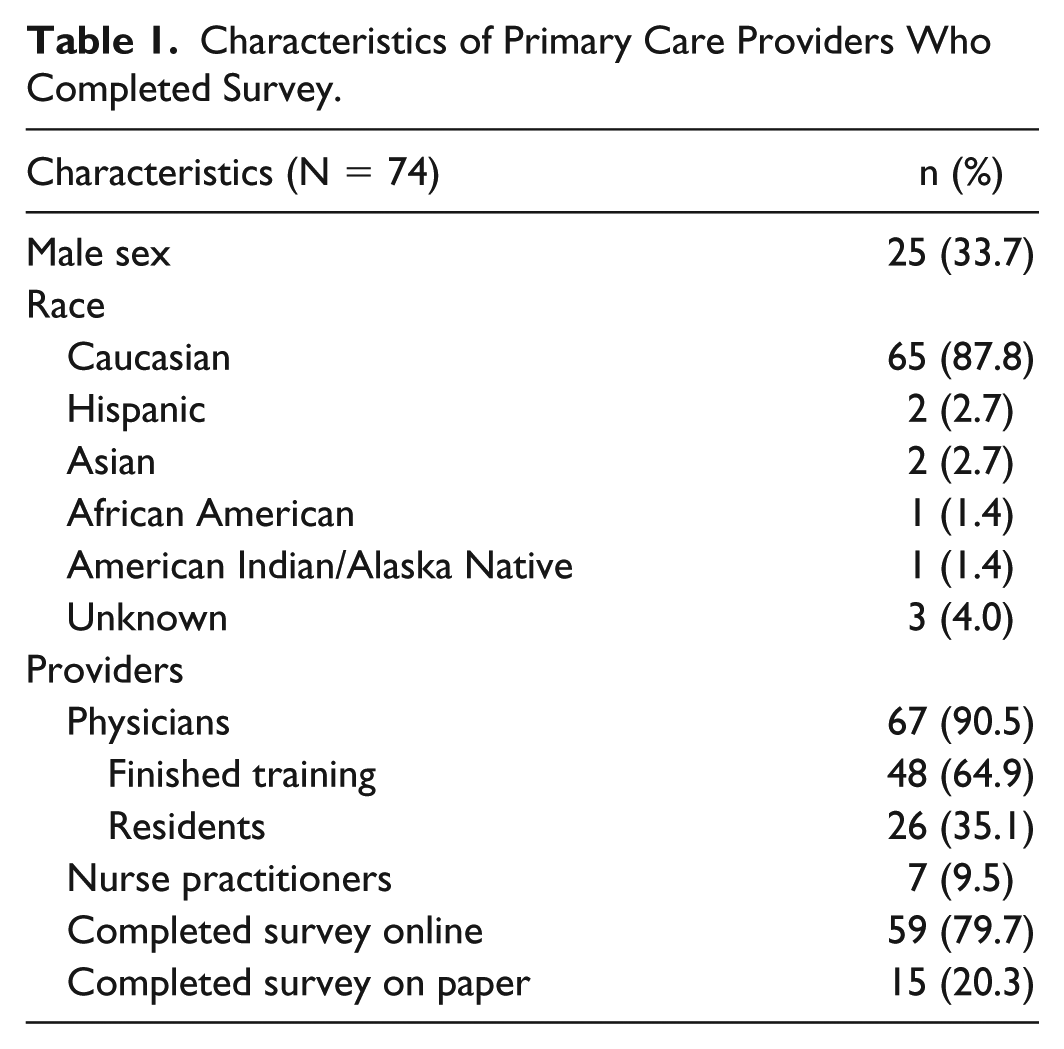
The response rate of completed surveys was 64%. Table 1 displays characteristics for the PCPs who completed the survey including the number who were still residents in training versus those who had completed residency training. The majority of participants were female and Caucasian as well as physicians who already completed their residency training. In addition, 62% of PCPs were aware of mobile health apps and had experience with using one in the past to assist with healthy eating, exercise, or managing their weight. The majority of PCPs (74%) selected “extremely comfortable” and 18.6% selected “very comfortable” when asked their comfort level with installing and using an app on a smartphone. The methods most often used to electronically interact with their patients were as follows: patient portal (81%), office website (35%), email (32%), none (12%), texting (11%), and Facebook (9%).
Characteristics of Primary Care Providers Who Completed Survey.
Current Practice
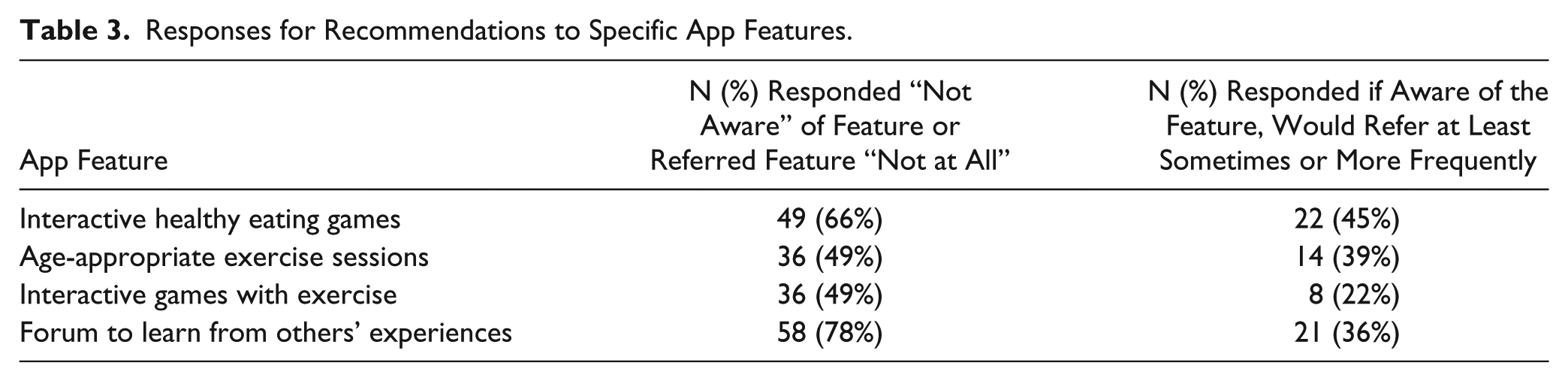
Table 2 displays PCPs’ answers to their current practice of pediatric weight management. PCPs were able to select multiple materials that they use with counseling patients. Three of the most commonly reported topics for take-home resources for overweight/obese patients were the following: healthy diet (73%), limiting juice and sugar sweetened beverages (61%), and physical activity (58%). The top 3 most commonly reported resources used sometimes or more frequently for overweight/obese patients were the following: weight management program (88%), dietician/exercise program (84%), and reading/printed material (61%). Of note, only 15% recommended at least sometimes a weight management smartphone app for patients. Table 2 also shows the distribution of the frequency that PCPs recommended specific app features for weight management with age-appropriate exercise sessions (40%) and interactive games with exercise (36%) being the most frequently recommended features. Over 50% providers did not recommend any of the provided 4 app features at least sometimes. Figure 1 displays how often providers recommended specific app features to their patients including interactive healthy eating games, age-appropriate exercise sessions, interactive games with exercise, or a forum to learn from others’ experiences. Additionally, Table 3 lists what percentage of providers did not ever (combined response of “not at all” or “not aware”) recommend patients to certain app features.
Resources Provided for Weight Management.
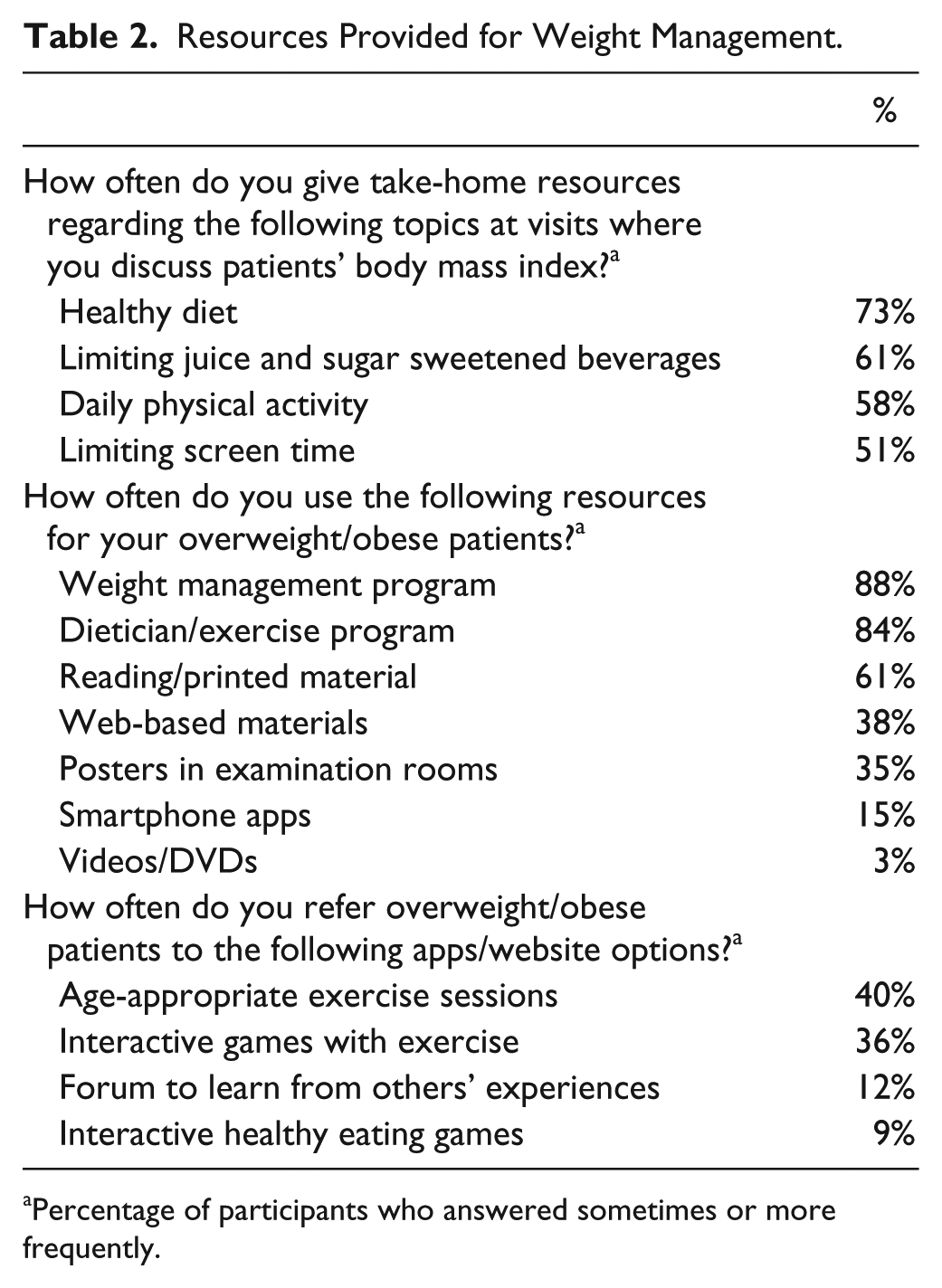
Percentage of participants who answered sometimes or more frequently.
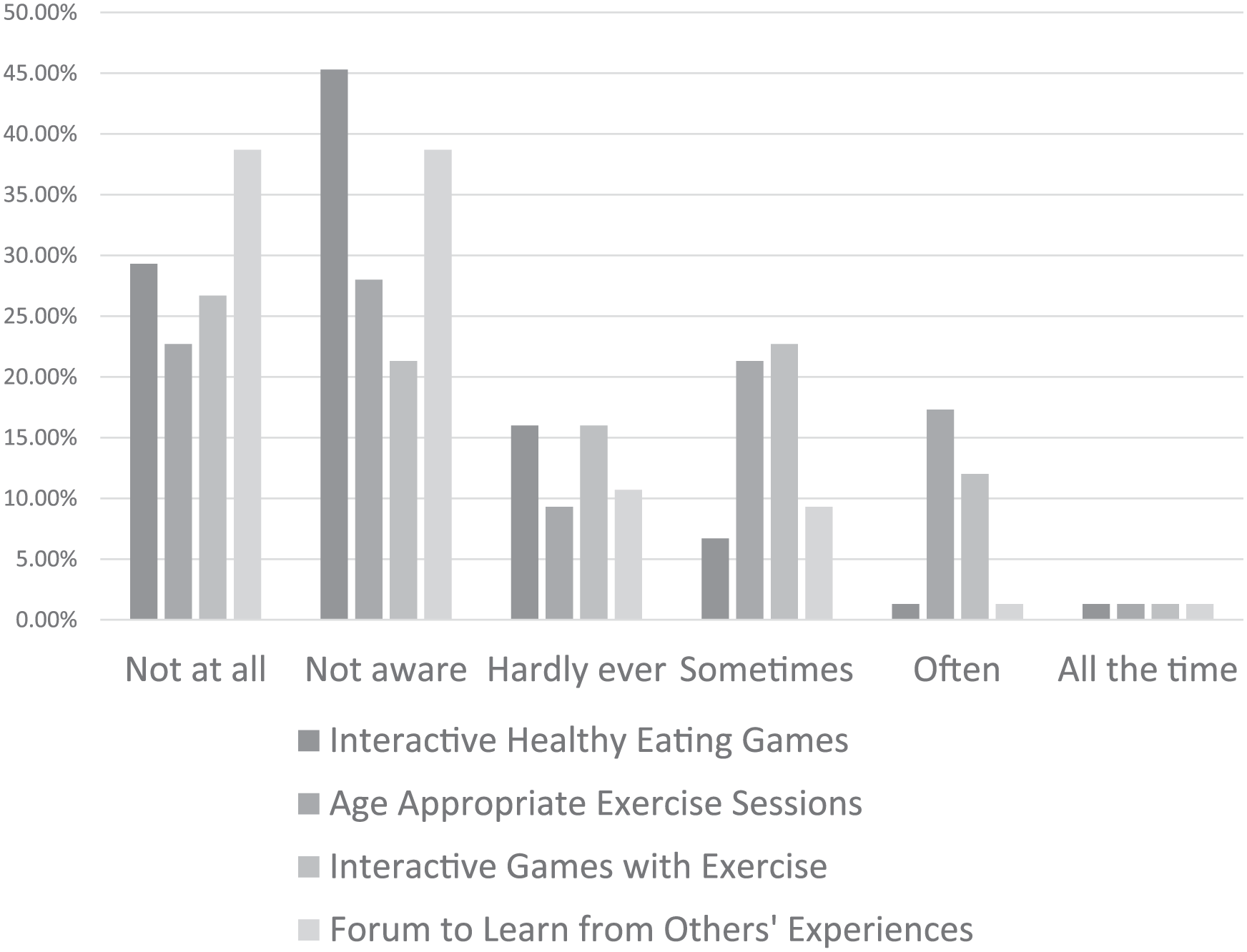
Primary care providers’ rate of recommending specific features of apps.
Responses for Recommendations to Specific App Features.
Future Practice
Alternatively, Table 3 demonstrates how many PCPs think they would recommend the specific app features at least sometimes if they were aware of such app features. Except for the feature, interactive games with exercise, at least half of the PCPs who responded currently “not at all” or “not aware” of app features would actually recommend the app features if they were made aware of them.
Even more providers (75%) reported that they would specifically use an app to check on their overweight/obese patients’ progress in reaching healthy goals. Of those who responded that they would use this app, 95% (53 providers) reported that they would use this app to determine appropriate intervals between follow-up weight visits. We looked for associations between different variables and either outcomes of PCPs being interested in using this app feature or reporting whether the app feature may change their management. Using Spearman nonparametric correlations, there were no statistically significant associations with currently recommending an app for other chronic conditions, using a weight management app for themselves, being finished with residency training, or completing the survey online (vs on paper).
Last, PCPs were also asked how effective they felt their counseling for overweight/obese patients currently is and how effective their counseling would be if there was an app they could use to monitor their patients’ progress with adopting a healthy lifestyle. A t test analysis revealed a mean score of 2.85 for PCPs’ current perceived effectiveness of management and improved to 3.19 with PCPs’ perceived future effectiveness with the described app (P < .01).
Discussion
Given the alarming prevalence of adolescent overweight and obesity, there is a significant need to implement new interventions into the primary care setting, which will hold the interest of adolescents and engage them in developing healthier lifestyles. Given adolescents’ pervasive use of smartphones, apps provide a readily available resource and tool. To the author’s knowledge, this is the first study to delve into PCPs’ preferences for smartphone apps as a resource for obesity management.
An important finding in this study is that most PCPs who completed the survey have access to a pediatric comprehensive weight management program as a local resource or available via telehealth. Yet these practices still desire additional resources, such as smartphone apps, to help their patients with weight management. This could be due to the need of additional resources for weight management regardless of location. Supplemental resources that continue to assist patients at home between office visits could be invaluable in helping adolescent patients stay motivated and feel supported in their efforts. Smartphone apps may be even more helpful in rural areas where providers have fewer community resources to assist with weight management. 9 App use could help with increased time of self-monitoring behaviors, education about healthy eating and exercise, and communication with their medical team. Further study is needed on determining which apps would be helpful and effective.
This study also found that many providers would potentially recommend apps in the future if they were aware of them and received more education about them. The small percentage of providers currently recommending apps does not seem to be due to providers’ discomfort with using apps. However, when given examples of certain available app features, the majority reported not currently referring patients to apps very often. However, PCPs reported they would refer if they were aware of the features (Table 3). Thus, PCPs’ knowledge about mobile health and available features may need to be improved. Ways to disseminate this information could include a website or portal that providers can access, learn about different apps, and share the ones they feel would be most helpful with their patients.
Last, our study found that providers perceived effectiveness in weight management counseling significantly increased if they had a hypothetical app that allowed them to check their patients’ progress in reaching their healthy goals. Since a noted barrier in the literature to obesity management is provider discomfort with counseling or low perceived effectiveness,4,19 a tool that could help providers feel more confident and prepared for managing obesity would be a critical intervention. There are many free and available apps that PCPs can recommend to their patients and even potentially monitor their progress in reaching healthy goals. Further studies should assess ways to incorporate these apps and measure PCPs’ comfort with counseling and managing overweight/obese pediatric patients.
A limitation of this study was that the survey results are from a small sample size from one state. In addition, those that completed the survey may be more inclined to use technology, although we found no correlation with those that completed the survey on paper (possibly PCPs who are less inclined to use technology) and their interest or willingness to use an app to help their patients with weight management. Last, although the survey was piloted with other providers, we realize that misinterpretation of survey questions is always a possibility.
Conclusion
PCPs welcome smartphone apps as a resource to assist with adolescent weight management; however, providers are not aware of many of the features available in apps. In addition, they are interested in using apps that allow them to monitor their patients’ progress in managing their weight between office visits and agree that this app feature could potentially change their current management and significantly increase their perceived effectiveness in weight management counseling. We need future research to identify the utility of apps for the management of obesity. Future studies could also include an assessment of how to best implement these resources into primary care practice and eventually disseminate useful app features to providers for easy referral.
Author Contributions
All authors discussed study design, survey design, and concept of study. CBS and KM analyzed and interpreted results. CBS drafted manuscript and KM and JRR read and modified drafted manuscript.
Footnotes
Declaration of Conflicting Interests
The author(s) declared no potential conflicts of interest with respect to the research, authorship, and/or publication of this article.
Funding
The author(s) received no financial support for the research, authorship, and/or publication of this article.
