






Abstract
Sugar-sweetened beverage (SSB) and fruit juice (FJ) consumption may promote lipid abnormalities in childhood. We examined the association between SSB/FJ intake and lipid levels using electronic health record data for 2816 adolescents. Multivariable logistic regression models treated clinical cutpoints for abnormal lipid levels (triglycerides [TG], high-density lipoprotein (HDL), low-density lipoprotein [LDL], and total cholesterol) as dependent variables. In models not adjusted for adiposity, elevated SSB and FJ consumption was associated with increased odds of having abnormally high TG (SSB: odds ratio [OR] = 1.28 (95% confidence interval [CI] = [1.07-1.52], P = .007); FJ: 1.35 ([1.09-1.69], P = .007)) and abnormally low HDL (SSB: 1.47 ([1.17-1.86], P = .001); FJ: 1.35 ([1.02-1.78], P = .03)). Adjusting for adiposity, a likely mediator of the relationship, attenuated these associations. These findings support the need for identifying unhealthy beverage consumption habits during childhood health care visits as a modifiable behavior associated with cardiometabolic risk.
Introduction
Sugar-sweetened beverage (SSB) consumption in children is associated with the development of obesity as well as cardiometabolic risk factors that may precipitate cardiovascular disease in adulthood.1-5 Despite guidelines recommending avoidance of SSBs and setting overall limits on added sugars, child consumption of sugar from beverages remains high in the United States.6,7 As of 2017, the Centers for Disease Control and Prevention (CDC) reported that US youth consumed an average 143 kCal/day from SSB, representing 7.3% of their daily caloric intake. 8 Sugar-sweetened beverage consumption is more common among lower-income communities of color. There are several known contributors to this disparity, one of which is that companies use strategies such as athlete/celebrity endorsements and social media promotions that target minoritized adolescents and mislead them to believe these beverages are healthy.9-12 In addition, concerns about the safety and palatability of tap water are prevalent in lower-income urban communities of color, making this an unappealing alternative to sugary drinks.13-16 Children in these communities also have a higher risk of developing obesity and other chronic metabolic illnesses.1,17
Sugar-sweetened beverage and fruit juice (FJ) consumption, in addition to being behavioral targets for obesity prevention, may also have important impacts on lipids. Fructose, or in the case of SSBs, high-fructose corn syrup, can increase lipogenesis, and through hepatic and enzymatic pathways, elevated triglycerides (TGs), and hepatic steatosis. Fructose and other sugars contribute to dyslipidemia and insulin resistance through excess calories and modification of lipogenic enzyme pathways. 18 Supporting this idea, several prior observational studies have reported an association between sugary beverage consumption and lipid levels; however, there is ambiguity about whether these associations are present for both FJ and SSBs.2,5,9,17,18
Although long-term cardiovascular outcomes are difficult to predict in childhood, blood lipid levels during this phase of life have been shown to predict cardiovascular risk in middle age 19 and may be modifiable with lifestyle changes, including reduction of SSB and/or FJ consumption. Thus, processes that help to systematically identify children and adolescents who overconsume SSB or FJ are needed as a starting point for intervening on this risk behavior.
The feasibility and validity of using nutrition data captured during routine care have important implications for the use of the electronic health record (EHR) as a data source to study nutritional epidemiology and to identify populations at risk of nutrition-related chronic disease. If screening for nutritional risk behaviors and resulting health consequences can be performed efficiently within a busy academic learning health system, such data could be used by health system leaders to more accurately direct resources for population health interventions. We hypothesized that adolescent patients with high levels of sugary drink consumption documented in our EHR would have higher TGs and decreased high-density lipoprotein cholesterol (HDL-c) compared with those who reported lower levels of sugary drink consumption. We also hypothesized that high SSB consumption would be more strongly associated with these lipid profile findings than high FJ consumption.
Methods
Study Design, Setting, and Data Source
This was a cross-sectional study using EHR data collected as part of routine outpatient clinical care. The study took place within a large academic medical center in North Carolina. In the Spring of 2017, to facilitate systematic data collection on child sugary drink consumption during health care encounters, a 2-item EHR-based screener for SSB and 100% FJ intake was implemented within a large North Carolina health system. 20 In this study, we used resulting data to explore the association of EHR-documented child and adolescent sugary drink consumption with lipid levels. The primary goals of this study were to explore these associations in a real-world, clinic-derived data set, to understand whether any observed associations differed for FJ vs SSB, and to explore to what extent observed associations were mediated by adiposity. We also sought to understand whether EHR-derived data would align with data from previous studies, in which much more detailed dietary information was prospectively collected from participants by trained research team members (eg, as part of clinical trials or cohort studies).
Study Population
We extracted records from the EHR for children and adolescents ages 10 to 17 years with at least 1 documented SSB and FJ consumption screening measure available between May 29, 2018 and January 4, 2021. Sugar-sweetened beverage and FJ-screening measures were obtained at routine primary care pediatric or family medicine visits. We selected this age range based on the population of children in our EHR data set who had available lipid data and lipid-screening guidelines, which indicate universal screening starting at age 9 to 11 years.21,22 Younger children with available lipid data were rare, and we reasoned that they would likely represent a select group of patients in whom lipids were checked due to health concerns or familial hypercholesterolemia.
We further limited the sample of 10- to 17-year old children with SSB/FJ-screening data to those who had complete laboratory results for a serum lipid panel within the 180 days prior to through 360 days after undergoing SSB/FJ screening. We used an asymmetric time window—selecting lipid levels from 180 days prior to SSB/FJ screening vs 360 days after screening—to reduce the risk of reverse-causation in this cross-sectional analysis. We also excluded children with at least 1 diagnosis code for familial hypercholesterolemia at any point during the study period.
Exposure Measure
As noted in the “Introduction” section, measures of child SSB and FJ consumption are captured as discrete data elements in our health system’s EHR (Epic vendor). Data collection is prompted at the point of care, using an automated best practice alert (BPA) for SSB and FJ screening that fires at all in-person visits for children 6 months and older. This screening tool fires for any children who have not had screening completed in the prior 180 days. 20 Medical assistants (not physicians) are prompted to conduct the screening while rooming patients for in-person visits, and the screening questions are optional. Detailed information about development, validation, and implementation of the EHR-based screener has been previously published. 20
For each beverage type (SSB and FJ), BPA screening response options indicating the child’s consumption frequency during the last month include “Never,” “Sometimes but not every day,” “1× per day,” “2× per day,” and “3 or more × per day.” Using these categorical SSB and FJ EHR data obtained during these routine clinical encounters, we created exposure variables to indicate whether a child’s reported consumption exceeded guideline-recommended levels of intake for SSB and FJ. Despite both SSB and FJ being caloric beverages with high total sugar content, because of the high-fructose corn syrup (HFCS) content of many SSBs, it has been hypothesized that SSB may be uniquely damaging to cardiometabolic health compared with FJ; therefore, we created exposure categories that allowed separate assessment of the impact of SSB vs FJ.23,24 We categorized a child’s SSB consumption as either “Exceeding guidelines” (1 or more SSB daily) or “Meeting guidelines” (rare or never consumption of SSB). Similarly, we characterized a child’s FJ consumption as either “Exceeding guidelines” (more than 1 FJ daily) or “Meeting guidelines” (1 or fewer daily servings of FJ). Finally, to reflect cumulative risk of total SSB + FJ consumption, we also characterized a child’s combined consumption as: “Meeting guidelines for both SSB and FJ” (<1 SSB and ≤1 FJ), “Exceeding guidelines for only 1 beverage type” (either high for SSB or FJ), or “Exceeding guidelines for both SSB and FJ.” 25
Outcome Measures
Abnormalities in serum lipid levels, including TGs (mg/dL), HDL, low-density lipoprotein (LDL), and total cholesterol (TC) were the outcome measures of interest, defined based on accepted cutpoints of normal/abnormal for adolescents. 26 For total cholesterol, abnormal was considered as ≥200 mg/dL; for LDL cholesterol, it was considered as ≥130 mg/dL; for HDL-c, it was considered as ≤35 mg/dL, and for TG, it was considered as ≥130 mg/dL. For children with more than 1 set of lipid measures available during the specified window, we selected the measure dated nearest in time to the SSB/FJ-screening date. For all lipid measures, we examined the distribution of data and identified clinically implausible or extreme outliers that could bias results. No measures were identified for exclusion in this process.
Other Measures
Other EHR-derived measures in our analysis included age (at time of SSB/FJ screening, years), sex (men/women), race/ethnicity (non-Hispanic black, Hispanic, other race/ethnicity, or non-Hispanic white), body mass index z-score (BMIz, using CDC criteria and SAS macro, based on height and weight nearest to the date of SSB/FJ screening), time of blood draw for lipid measures (as a proxy for fasting status, dichotomized as before or after 11 am), and clinic type where SSB/FJ screening took place (Pediatrics or Family Medicine clinic). Clinic type was included as a covariate to account for potential systematic differences between how provider types might handle both screening for dyslipidemia and nutritional counseling, based on their training background and professional society guidelines.
We also obtained census tract-level measures of socioeconomic status in a child’s neighborhood from the 2015 to 2019 American Communities Survey (ACS) 5-year estimates. 27 The ACS is a national survey administered by the US Census Bureau that collects population estimates of small geographical area demographic and socioeconomic factors. These measures were income level (proportion of households below 100% of the federal poverty level, quartiles) and education level (proportion of adults with less than high-school education, quartiles) measures based on census tract. If a child’s record did not contain a residential address that mapped to a census tract, then “missing” was treated as a variable category in the model.
Statistical Analysis
For our primary analysis, we constructed multivariable logistic regression models, treating dichotomized beverage consumption level (exceeds vs meets guidelines) as the independent variable and having an abnormal value for each lipid measure (TG, HDL, LDL, TC) as a dependent variable. Models adjusted for child age, sex, race/ethnic group, education and income of neighborhood, fasting status of lipid sample, and clinic type.
Sensitivity Analyses
Because we hypothesized that excess adiposity was on the causal pathway (thus a mediator) between consuming SSB/FJ and development of dyslipidemia, we did not adjust for BMIz in our primary models. To explore whether sugary drink consumption was associated with lipid levels independent of child adiposity, or whether most of the association was mediated by child weight, we repeated our primary models, but included a covariate for child BMIz.
Results
Characteristics of Studied Population
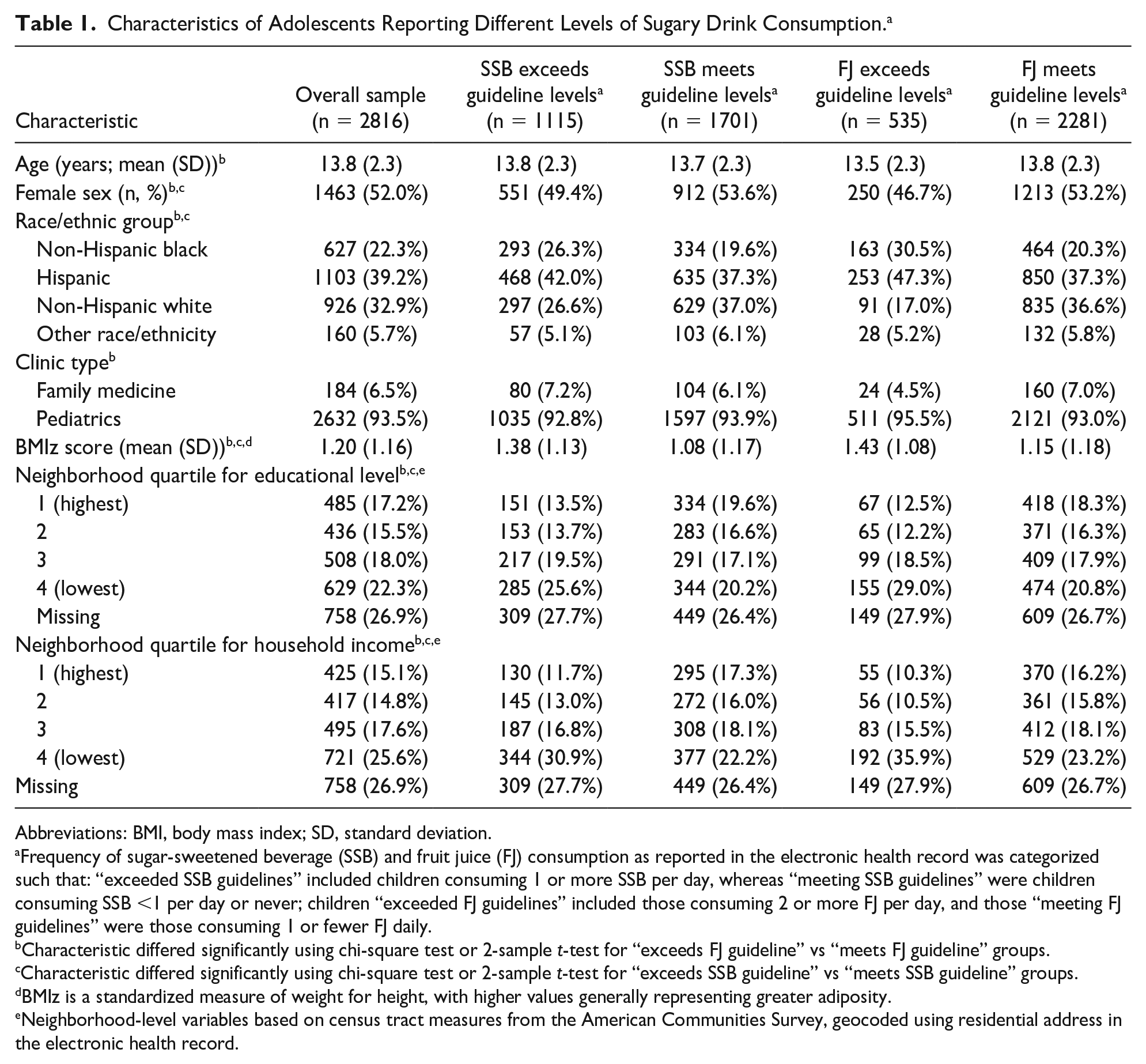
Of n = 15 374 10 to 17 year olds with available SSB and FJ-screening data during the study period (June 2018 to January 2021), 2816 (18%) had available lipid lab results that fell within the specified window relative to the child’s SSB/FJ-screening date. Our final analytic sample included these 2816 patients with EHR-based screening data for both SSB/FJ consumption and in-window lipid measures (Table 1). Of these, 1115 (39.5%) were categorized as exceeding SSB guideline consumption levels and 535 (19%) as exceeding FJ guideline consumption levels. A total of 464 (16.4%) of the sample were characterized as exceeding both SSB and FJ guideline consumption levels. Compared with lower-level consumers, high consumers were less likely to be women (eg, 49.4% of high SSB consumers vs 53.6% of within-guideline SSB consumers), less likely to be non-Hispanic white (26.6% of high SSB consumers; 37% of within-guideline SSB consumers), and had a higher mean BMIz score (1.38 vs 1.08 for high vs within-guideline SSB consumers). In addition, 30.9% of high SSB consumers resided in a neighborhood in the lowest quartile for household income compared with 22.2% of within-guideline consumers.
Characteristics of Adolescents Reporting Different Levels of Sugary Drink Consumption. a
Abbreviations: BMI, body mass index; SD, standard deviation.
Frequency of sugar-sweetened beverage (SSB) and fruit juice (FJ) consumption as reported in the electronic health record was categorized such that: “exceeded SSB guidelines” included children consuming 1 or more SSB per day, whereas “meeting SSB guidelines” were children consuming SSB <1 per day or never; children “exceeded FJ guidelines” included those consuming 2 or more FJ per day, and those “meeting FJ guidelines” were those consuming 1 or fewer FJ daily.
Characteristic differed significantly using chi-square test or 2-sample t-test for “exceeds FJ guideline” vs “meets FJ guideline” groups.
Characteristic differed significantly using chi-square test or 2-sample t-test for “exceeds SSB guideline” vs “meets SSB guideline” groups.
BMIz is a standardized measure of weight for height, with higher values generally representing greater adiposity.
Neighborhood-level variables based on census tract measures from the American Communities Survey, geocoded using residential address in the electronic health record.
Association of Sugary Drink Consumption With Abnormal Lipid Levels
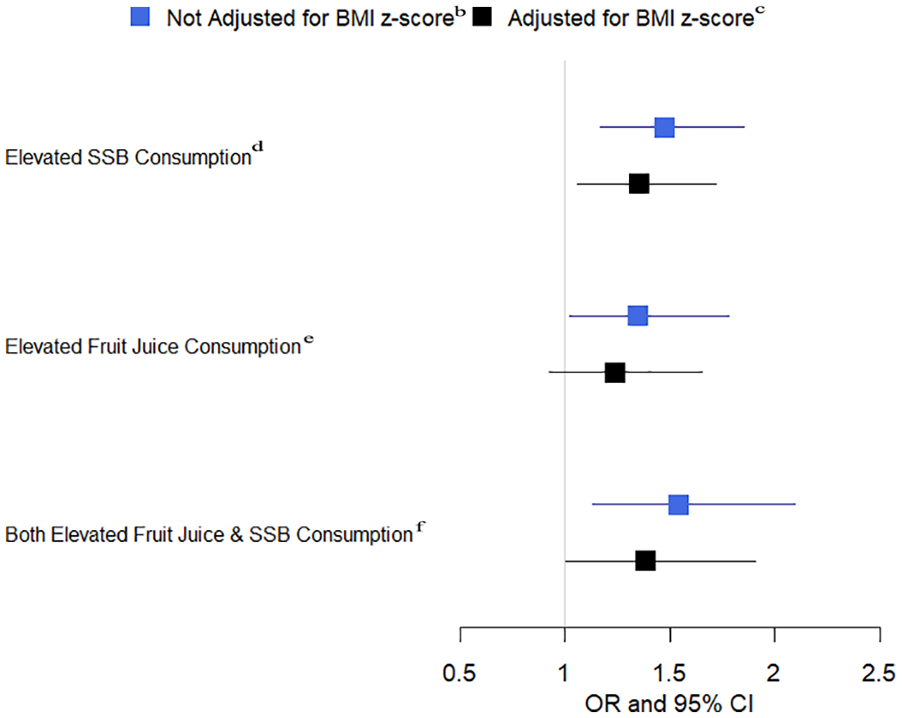
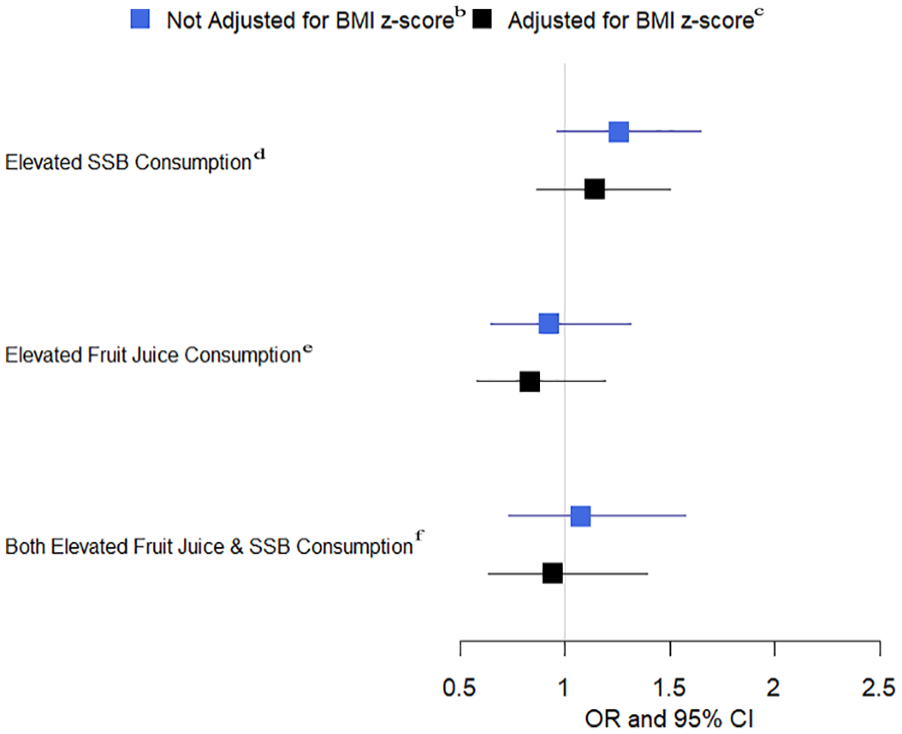
In multivariable models not adjusted for BMIz, SSB consumption above guideline-recommended levels was associated with increased odds of abnormal serum TG levels (odds ratio [OR] = 1.28, 95% confidence interval [CI] = [1.07-1.52]; Figure 1 and Supplemental eTable 1) and increased odds of abnormal HDL levels (OR = 1.35, 95% CI = [1.09-1.69]; Figure 2 and Supplemental eTable 1). There was no significant association between level of SSB consumption and LDL (Figure 3 and Supplemental eTable 1) or total cholesterol (Figure 4 and Supplemental eTable 1). Elevated FJ consumption as an exposure displayed very similar estimates of association with odds of abnormal serum lipids (Figures 1-4 and Supplemental eTable 1). Exceeding guideline-recommended consumption levels for both SSB and FJ was associated with slightly higher odds of abnormal TG and HDL (eg, OR for abnormal HDL 1.54 [1.13-2.10]; Figures 1–4 and Supplemental eTable 1).

Association between sugary drink consumption and elevated triglyceride levels.a
Association between sugary drink consumption and low high-density lipoprotein levels.a
Association between sugary drink consumption and elevated low-density lipoprotein levels.a

Association between sugary drink consumption and elevated total cholesterol levels.a
Results of Models Adjusted for Child BMIz
In multivariable models adjusted for BMIz, the association between SSB consumption or FJ consumption exceeding guideline levels and odds of having abnormal serum TG levels were attenuated and no longer statistically significant (Figure 1 and Supplemental eTable 2). The association of exceeding both SSB and FJ guideline levels with abnormal TG levels was also slightly attenuated (OR = 1.31, 95% CI = [1.02-1.68] mg/dL (−1.9, −0.2)) but remained significant.
Modeling odds of abnormal HDL-c and adjusting for BMIz, the association between SSB consumption and HDL remained significant (OR = 1.35, 95% CI = [1.06-1.72]), but was attenuated for FJ and combined SSB/FJ consumption (Figures 1-4 and Supplemental eTable 2). Similar to our primary models, there was no significant association between SSB or FJ consumption and serum LDL and total cholesterol levels.
Discussion
Sugary drink consumption continues to exceed guideline targets among children in the United States, with important implications for ongoing disparities in childhood obesity and adverse cardiometabolic health outcomes.8-12 In this EHR-based observational study among a diverse sample of children and adolescents, we found SSB and FJ overconsumption to be associated with higher triglycerides and lower HDL levels, associations that were attenuated when adjusted for child BMIz. Although the associations we observed are not inherently novel, they add to a previously conflicting evidence base and build support for the idea that this modifiable behavior is associated with cardiometabolic health. Importantly, our findings leveraged data derived from a novel source for identifying a dietary risk behavior in children—EHRs. This study suggests that clinical data capture on nutritional behaviors such as child sugary drink consumption might be a useful addition for health systems seeking to optimize population health around cardiometabolic disease risk factors.
Our results align well with previously published research on the association between child sugary drink consumption and lipid levels. Across a range of cohort studies and clinical trials, in children ranging from toddler to adolescents, increased sugary drink consumption has been shown to be associated with lower HDL and higher TG levels, with no association with LDL levels.17,28-30 Strengths of these prior studies compared with our analysis include more detailed assessment of beverage consumption as well as assessment of other dietary behaviors that could potentially confound this association,29,30 and the ability to follow children longitudinally. 17 In our analysis, as hypothesized, we found that adjusting for BMIz eliminated the association between sugary drinks and TG, suggesting that increased adiposity may be a primary mediator of this association. In contrast, the persistent BMIz-adjusted association with HDL-c implies that high SSB intake may influence some lipid profile pathways independent of excess weight due to an altered state of lipoprotein metabolism.1,2 Previous studies have produced conflicting results regarding how much of the SSB-lipid association is mediated by obesity. In a cohort of children age 4 to 18 years, Seferidi et al reported high SSB consumption to be associated with high serum TG levels, but this relationship was not attenuated after adjusting for BMIz, suggesting an almost entirely adiposity-independent association of SSB with this lipid particle. 31 Similarly, Eny et al found that, after adjusting for child’s BMIz, the association between SSB, HDL-c, and TG remained intact. 29 In contrast, Ambrosini et al had similar findings to ours, wherein the SSB-TG relationship was attenuated by adjusting for child BMIz. 30 Several factors could account for these disparate findings across studies, including differences in other unmeasured behaviors across populations (eg, physical activity, other dietary behaviors), differences in the range of adiposity within a study sample, or differences in the age of children included in each sample.
A few existing studies have separately explored the association of SSB vs FJ with lipid levels. In many studies that we reviewed, 100% FJ was either included in a broader sugary drink category (as in our primary analysis) or excluded altogether. Our study therefore provides additional insight and suggests that there may be little difference between FJ and SSB for impacting these cardiometabolic health measures. However, this finding adds to a string of inconsistent conclusions around the possible health consequences of FJ vs SSB.18,32 In part, this inconsistency may be due to some respondents misclassifying certain fruit-flavored SSBs as FJ when responding to dietary recall questions. Whether 100% FJ consumption may be net beneficial for child health, 33 or at least unlikely to be harmful, 34 or whether it is in fact associated with adverse outcomes35,36 such as weight gain remains unclear.
A strength of this study was our ability to leverage EHR data on a common dietary risk behavior for adverse child health outcomes. Although pediatric providers (eg, pediatricians, family medicine clinicians) are often aware of the negative of effects of sugary beverages on child health, they do not systematically document screening for this behavior within the EHR. Collecting SSB and FJ consumption at the point-of-care was efficient and resulted in a large, diverse sample representative of the general pediatric population cared for in our pediatric and family medicine clinics. Although the EHR-based screener in our health system is brief (2-items), likely reducing its accuracy compared with measures typical of research studies, 37 we identified very similar associations with high reported sugary drink consumption as have been demonstrated previously in studies using much more detailed beverage and dietary recall instruments. These findings support ongoing work to implement streamlined, clinic-friendly dietary-screening measures into routine clinical practice to efficiently and systematically identify patients at higher risk of diet-related chronic disease.
Limitations
The primary limitation of our study is that, due to its cross-sectional and observational nature, we cannot attribute causality to the associations between beverage consumption and lipid levels. There are likely unmeasured confounders including other dietary behaviors that may contribute to the observed associations, and, based on our use of clinical data, lipid measures were captured with variable timing around the date of SSB screening. If lipid screening preceded the SSB screener by more than a few months, some patients may have been counseled to reduce their SSB consumption based on abnormal lipid levels, and this pattern could have biased our findings toward the null. Importantly, the subset of patients in this analysis may not be broadly representative of a well pediatric population due to the fact that only a small portion of 10 to 17 year olds in our clinical sample had lipid-screening data available. This could indicate selection bias of whether children were screened or not. For example, if adolescents whose lipid levels were tested were systematically less healthy than adolescents without lipid-screening data, the magnitude of associations we observed may differ from what would be found in a random sample of the adolescent population in our system. Another limitation of this study is that we could not assess the fasting status of patients when their lipid levels were drawn (this data element is not captured in the EHR). However, we do not expect the fasting status of patients to systematically differ between high and low SSB consumers; thus, it is not likely a confounding variable. In addition, although we excluded patients who had a diagnosis code of familial hyperlipidemia, there is a possibility that some patients undiagnosed with familial hyperlipidemia were included in our sample. However, we examined all results during our analysis for outliers and only 1 patient was excluded. Finally, we did not include covariates in our models for comorbidities like diabetes, thyroid, kidney or liver disease, and/or medication use. We anticipate these to be rare in a cohort of healthy adolescent patients.
Conclusions
In this cross-sectional study, we observed that higher reported sugary drink consumption in child and adolescent primary care patients was associated with higher TG and lower HDL levels. When adjusting for BMIz, these relationships were attenuated, implying that excess adiposity is an important factor for the potential impacts of these dietary behaviors on cardiometabolic risk profiles. Despite research hypothesizing unique harms of SSBs compared with juice, we observed similar associations of both beverage types with lipid levels. This finding supports clinical guidelines that advise limits on both 100% FJ and SSBs in childhood. 7 Importantly, our results demonstrate the value of embedding screeners for behavioral and social determinants of health in the EHR. 38 These findings also highlight a need for more work on clinic-based efforts to systematically identify children with key nutritional risk behaviors, as they may benefit from preventive lifestyle interventions to reduce their risk of developing chronic cardiometabolic disease in adulthood.
Author Contributions
Study Concept and Design: KHL, FH, AI, AB, JAS, DP; Development of Methodology: KHL, FH; Statistical Analysis: FH; Writing (initial draft): AI, KHL; Writing (review and editing) : AI, KHL, FH, AB, JAS, DP.
Supplemental Material
sj-docx-1-cpj-10.1177_00099228231200405 – Supplemental material for Association Between Child Sugary Drink Consumption and Serum Lipid Levels in Electronic Health Records
Supplemental material, sj-docx-1-cpj-10.1177_00099228231200405 for Association Between Child Sugary Drink Consumption and Serum Lipid Levels in Electronic Health Records by Ankitha Iyer, Fang-Chi Hsu, Alex Bonnecaze, Joseph A. Skelton, Deepak Palakshappa and Kristina H. Lewis in Clinical Pediatrics
Footnotes
Declaration of Conflicting Interests
The author(s) declared no potential conflicts of interest with respect to the research, authorship, and/or publication of this article.
Funding
The author(s) disclosed receipt of the following financial support for the research, authorship, and/or publication of this article: This research was supported through a grant from Healthy Eating Research, a national program of the Robert Wood Johnson Foundation (grant no 74370). Dr. Palakshappa is supported by the National Heart, Lung, and Blood Institute of the National Institutes of Health under Award Number K23HL146902. The funder had no role in the collection, analysis or interpretation of data, writing of the report, or submission for publication.
Ethical Approval
Study activities for this data-only project were reviewed and approved by the Wake Forest University Health Sciences Institutional Review Board.

Supplemental Material
Supplemental material for this article is available online.
References
Supplementary Material
Please find the following supplemental material available below.
For Open Access articles published under a Creative Commons License, all supplemental material carries the same license as the article it is associated with.
For non-Open Access articles published, all supplemental material carries a non-exclusive license, and permission requests for re-use of supplemental material or any part of supplemental material shall be sent directly to the copyright owner as specified in the copyright notice associated with the article.
