







Abstract
Operation First Five (OF5) was established to support families raising children. OF5 is a coalition of local citizens invested in children growing up healthy, safe, and prepared for Kindergarten. OF5 partnered with The Basics Learning Network to provide weekly text messaging regarding child development. Before implementing The Basics messaging, OF5 assessed parents’ knowledge of their children’s development via survey. One hundred thirty-nine participants completed the survey. Most parents reported understanding activities that support child development (eg, reading to their child is important). Only 54% of parents reported reading to their child at least once a day. A disconnect was realized between parents’ knowledge of child development and implementing quality interactions with their children. To address the disconnect, OF5 began rolling out The Basics text messaging program and other community-wide efforts. OF5 plans to re-assess parents’ knowledge of their children’s development in 5 years to identify the impact of The Basics.
Introduction
Operation First Five (OF5) is a local collective impact group established in a rural hub city within the Texas Panhandle to provide support to families raising young children. The mission of this family support collaborative is to prepare young children for school and for life. 1 The OF5 group is comprised of a coalition of individuals and organizations in the community dedicated to supporting families by connecting them to local services and resources that may help their children have a more successful start in life. The official mission of this community-wide organization has been to help children succeed through a comprehensive and collaborative early childhood system that supports families and service providers. 2 The coalition partners’ vision is for all children to grow up healthy, experience nurturing relationships, live in stimulating learning environments, and enter school ready to succeed. 2
The OF5 coalition organized a Mayor’s Summit the community in 2019, which addressed the need for developing strong early learning environments. As part of the Mayor’s Summit, Dr Ron Ferguson was invited to share a program he developed called The Boston Basics. 3 The goal of The Boston Basics is to help bolster social, emotional, and cognitive brain development among children from birth to age 3.
To realize The Boston Basics mission, 5 key principles were identified. 4 First, parents should maximize love and manage stress. When parents are experiencing stress, their children often pick up on the tension and adjust their behavior in response. Infants who feel safe and loved thrive and develop confidence. Second, parents should talk, sing, and point as they interact with their children to teach them about the world around them. Every interaction a parent has with their child is an opportunity for their little one to learn. Third, parents can count, group, and compare objects as opportunities arise throughout the day. These concepts help children make sense of the world around them. Fourth, parents should facilitate their child’s exploration of the world through engaging movement and play. Children develop foundational concepts through play, and opportunities for play-based exploration support the development of skills across cognitive, social-emotional, physical, and linguistic domains. 5 Finally, parents should read and discuss stories with their children. Reading and talking about stories promotes a love of literacy in children and increases their vocabulary knowledge. Children who enjoy literacy have an increased chance of being good readers and excelling in school.
As a follow-up to The Basics Principles, Dr Ferguson developed The Basics Insights, a free text-messaging program for parents of children ages birth to 5. Parents enroll their child for the program under the sponsorship of a local organization. They provide their child’s current age, which allows the parent to receive age-appropriate information regarding their child’s development, along with customized parenting tips based on The Basics Principles. 1
To accomplish the goals of all children within this rural community growing up healthy, safe, and prepared for school, OF5 partnered with The Basics Learning Network with a plan to roll out The Basics Insights text-messaging program within the community. 2 As a preliminary step before beginning The Basics Insights program, the OF5 coalition wanted to assess the current knowledge of child development and resources for parents in the community to document baseline awareness prior to implementing the intervention. Thus, the Potter County Parent Survey (PCPS) was developed to obtain benchmark data prior to implementing The Basics Insights. The goal of the research study presented here was to identify the level of parents’ knowledge of early development and discover their perspectives on learning activities available in the community. In addition, the study aimed to develop awareness of existing community resources that can aid their children in the development of prerequisite readiness skills that may lead to success in school. The research study led to a review of the literature on the following salient topics.
Brain Development
Dr Ferguson developed The Basics using the knowledge that 80% of brain development occurs by age 3.6,7 The rapid development of hearing, language, physical and social-emotional health, along with cognitive skills, within the first 3 years of a child’s life is truly amazing. 2 The early period from conception to age 3 is critical to a child’s development due to the expeditious growth and plasticity of the human brain during this sensitive period. 8 Sheridan and Nelson 9 explain that a sensitive period is “a time during development when the environment can have maximal impact on brain development” (p. 46).
Halfon et al 10 describe that brain development results from a combination of both nature and nurture. Much of the brain’s neurons develop prenatally in a healthy pregnancy; however, synaptic connections are formed as a person learns through exposure and experiences. 10 Researchers widely agree that the first 3 years of life are critical for the establishment of children’s linguistic, cognitive, fine and gross motor skills, and self-help abilities. Furthermore, when these developmental skills are nurtured within an enriching environment, children are put on the path toward long-term achievement and overall well-being. 11
Parents as Their Child’s First Teachers
Considering the critical development that occurs before a child turns 3, parents inevitably play a pivotal role in their child’s early development. Parents are their children’s first teachers and play partners. As such, quality interactions between caregivers and children set the scene to influence all developmental domains. Parents’ consistent responses to their children’s bids for attention and interaction predict children’s later social-emotional, cognitive, linguistic, self-help, and physical development.11-13
Even though some parents intuitively interact with their children in ways that promote their children’s development, not all parents are equipped with this same intuition; however, parents can be taught how to have enriching interactions with their children.14,15 The Basics Principles were created to provide parents with the necessary tools to have quality interactions and promote their child’s development. 3 The Basics Insights can be a resource to help teach parents to interact with their child in an intentional way which promotes their child’s development in all domains.
Home Literacy Environment
One way parents can promote their child’s development is by exposing their children to an abundance of meaningful literacy experiences, such as talking, singing, reading, storytelling, drawing, and writing. 16 A literacy-rich learning environment in the home or child-care facility can positively influence literacy development. Language acquisition and literacy experiences begin at birth; therefore, exposing young children to rich learning environments can enhance language and literacy learning. Furthermore, children’s early literacy experiences, which typically occur in their home environment, predict their later language skills. 17
Children’s early reading development is strongly related to later success in school. 18 In order for parents to share books with children on a regular basis, books must be readily available for the child to explore. Exposing children to a strong early literacy environment positively correlates with their later vocabulary development and ability to decode texts. 19
Importance of Reading Aloud to Students
The fire of literacy is created by the emotional spark between a child, a book, and the person reading. It isn’t achieved by the book alone, nor by the child alone, nor by the adult who is reading aloud. It is the relationship winding between all three bringing them together in easy harmony.
20
A joint position statement from the International Literacy Association (ILA), along with the National Association for the Education of Young Children (NAEYC) reiterates this idea by stating, “It is the talk that surrounds the reading that gives it power, helping children to bridge what is in the story and their own lives.” 21 According to Cullinan and Bagert, 22 reading aloud to children is one of the most important activities parents can do to help their child become a successful reader. Infants and toddlers benefit from listening to the sounds of language. Reading aloud to children of any age can stimulate their imagination, enrich their vocabulary, and help them to develop a deeper understanding of the world. 22 In addition, Willingham 23 explains that a child’s attitude toward reading and learning can be shaped by their experiences with books.
Using knowledge gleaned from the review of the literature, in combination with the broad mission of OF5, the coalition identified the need to investigate the community’s baseline understandings of child development topics to document a starting measurement. Therefore, the purpose of the study was to understand parents’ current knowledge of brain development in the early years identified by OF5 through a community-wide survey approach. The PCPS asked parent participants to respond to questions addressing their current knowledge, capacity, resourcefulness, access, and confidence on topics related to different domains of learning. The PCPS was designed to answer the following research aims:
Describe parents’ knowledge of child development and The Basics.
Describe parents’ application and utilization of concepts of child development and The Basics.
Describe parents’ confidence in their own parenting skills.
Describe parents’ stress in using their parenting skills.
Assess parents’ knowledge of community resources in the area to promote their child’s development.
Methods
Development of the Survey Tool
Researchers met with Dr Ferguson, the original developer of The Boston Basics, Inc. and the Caregiving Beliefs Survey (CBS). Dr Ferguson developed this tool during his time with The Achievement Gap Initiative at Harvard to help achieve equitable outcomes for children from different racial, ethnic, and social class backgrounds. 24 The CBS was developed in 2018 and assessed parents’ knowledge, capacity, resourcefulness, access, and confidence in their child’s development. 25 Ferguson then used the data collected from the CBS to further refine The Basics Principles.
OF5 obtained approval to adapt the CBS to meet the needs of the OF5 coalition and the unique Texas Panhandle community. After adapting the survey tool, Dr Ferguson reviewed and approved the adaptations for local use by OF5. The adaptations to the original CBS included omitting redundant questions and decreasing the Likert scales from 7 response options (ie, strongly agree, moderately agree, slightly agree, neutral, strongly disagree, moderately disagree, and slightly disagree) to 5 response options (ie, strongly agree, agree, neutral, disagree, and strongly disagree). The original CBS focused on children birth to 3 years old, and the OF5 expanded the survey to focus on children birth to 5 years old.
Upon approval from Dr Ferguson, the adapted survey was named the PCPS. The final survey included demographic information, Likert scales, and open-ended questions to assess parent’s knowledge of early development, literacy exposure, and access to local enrichment resources. The PCPS was translated into Spanish by a local Spanish interpreting agency and uploaded into the Qualtrics software. A QR code was created that linked to the survey.
Distribution of the Survey
Initially, a group of approximately 15 parents from local agencies piloted the PCPS and provided feedback on the clarity and accuracy of questions. After the pilot feedback was integrated, the survey went live, and the QR code to access the survey was widely distributed by partners of OF5. The QR code was printed on postcards and distributed at local grocery stores, community events, and community resource agencies. Information about the community survey was also shared on a local morning television shows. The survey was available for approximately 10 months in the local area. A nonprofit social services agency concentrated on distributing the survey to refugee parents and provided interpretation of the survey into the native language of potential participants if needed.
The survey contents and distribution methods were approved by the local institutional review board (IRB).
Results
Two hundred and forty-seven participants initiated the survey, and 139 participants completed all questions on the survey. All participants consented to participate in the study. The number of participant responses varied throughout each section of the survey depending because participants were not forced to provide a response to continue the survey questions. Of the participants, the majority were female and chose to complete the survey in English. Participants ranged in age from 18 to 64 and represented a variety of cultural and educational backgrounds. The demographic data are described in Table 1.
Demographic Data.
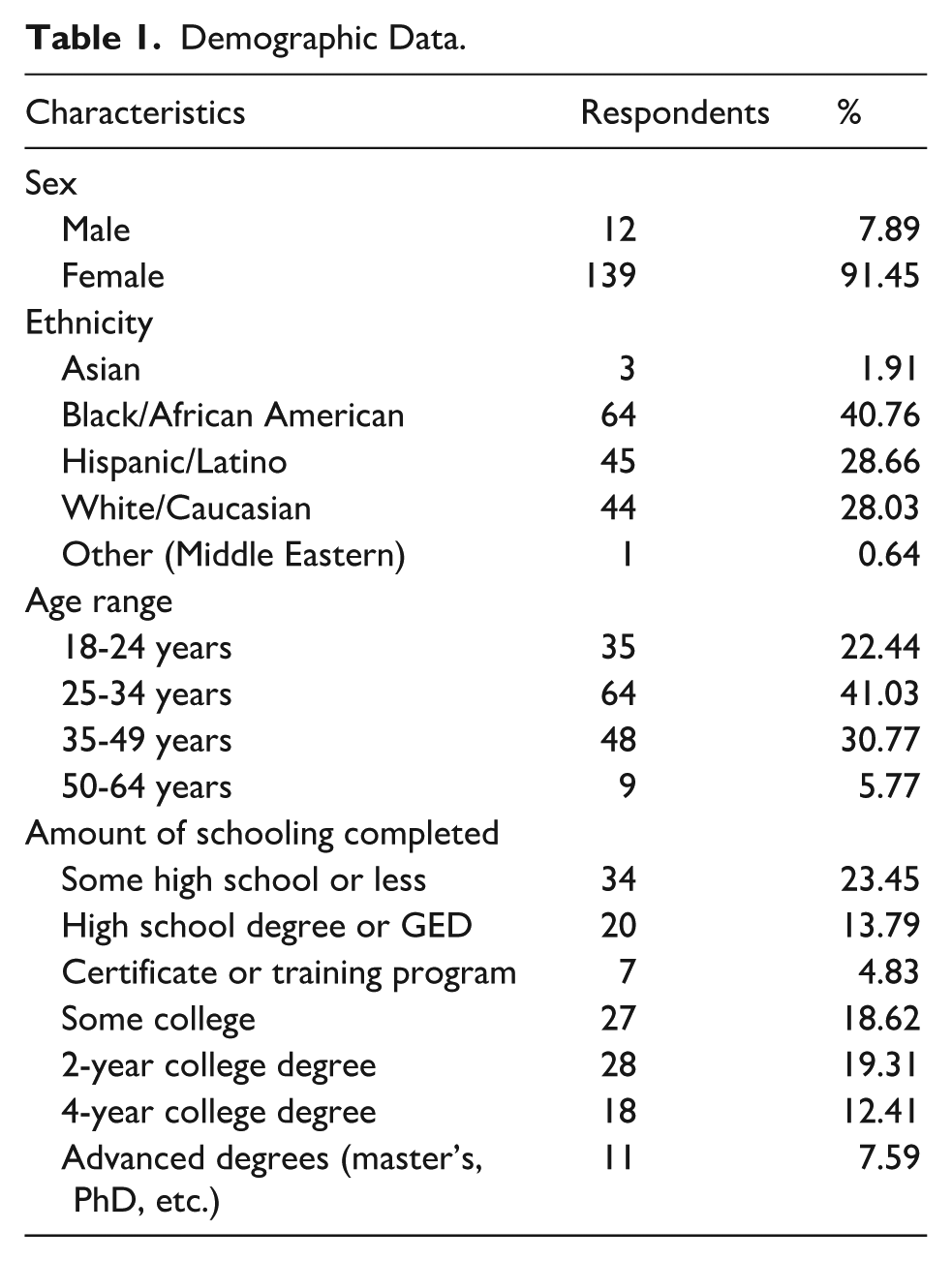
The participants reported the number of children they had in each of the following age ranges; however, this did not necessarily represent the total number of children living in the home. See Table 2 for the ages of children in the home.
Ages of Children in the Home.
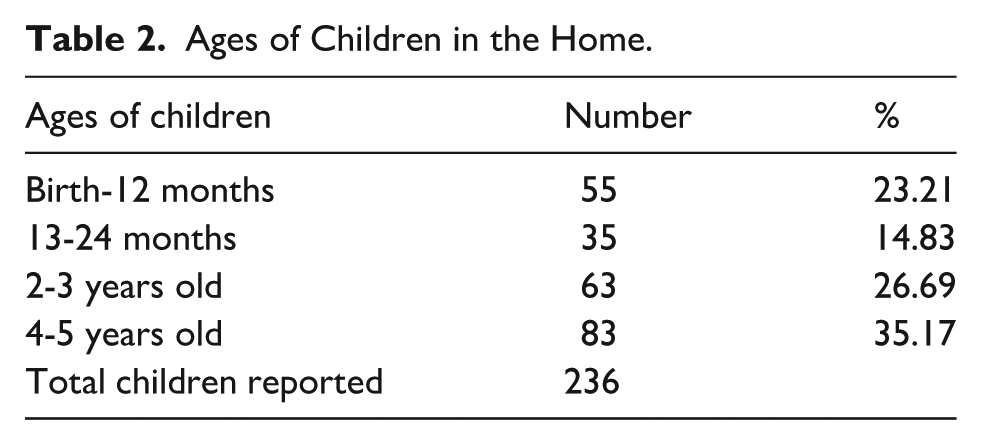
To determine which survey questions answered each research question, the survey questions were coded into 5 categories (ie, knowledge, application and use, confidence, stress, and resources). These categories correspond to research aims 1 to 5.
Aim 1 (Knowledge)
To collect data about parents’ knowledge of child development and their awareness of The Basics, participants answered how they felt about statements regarding their knowledge of child development. In addition, the participants answered questions about their knowledge or awareness of the Basics. Responses choices were “strongly disagree,” “disagree,” “neutral,” “agree,” and “strongly agree.” See the results from parents’ knowledge of child development in Table 3. See the results from parents’ knowledge of The Basics in Table 4.
Parents’ Knowledge of Child Development.
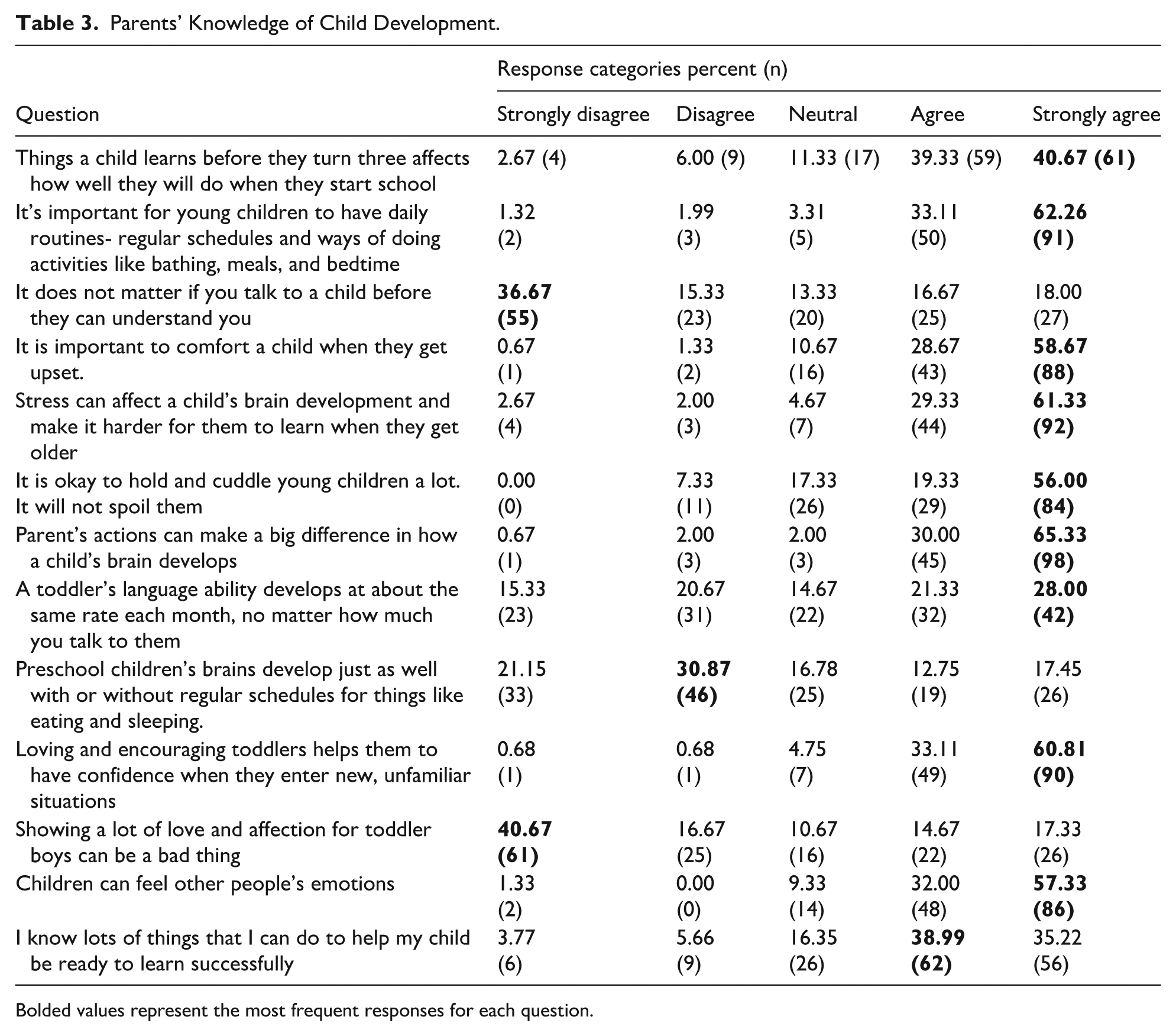
Bolded values represent the most frequent responses for each question.
Parent’s Knowledge of The Basics.
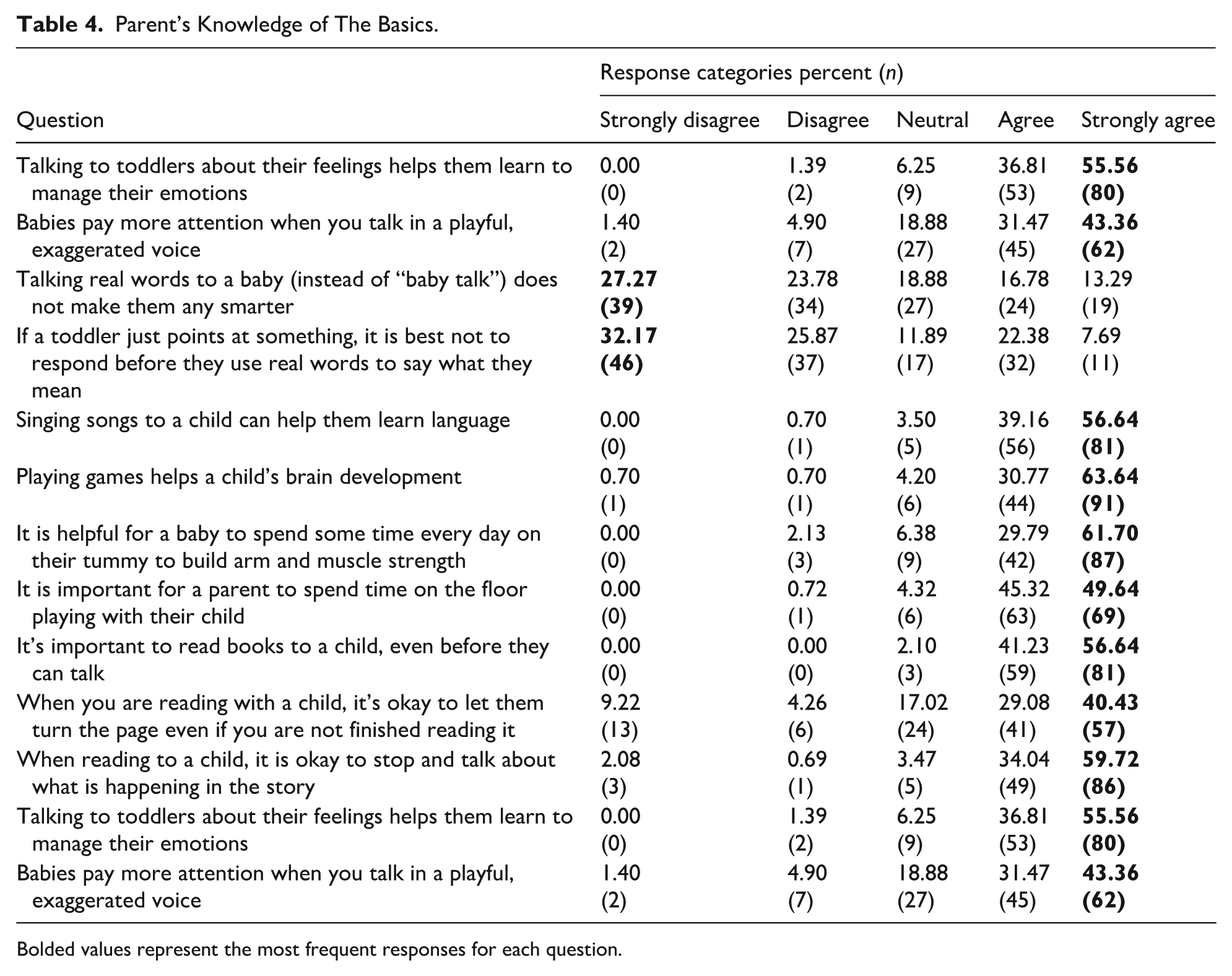
Bolded values represent the most frequent responses for each question.
Aim 2 (Application and Use)
To investigate parents’ application and utilization of concepts of child development and The Basics, parents were asked to report how much and how often they used strategies and tools to promote their child’s development. The first question asked how many books they had in their home. Only 18.06% (26) of parents reported having more than 50 books in their home for their child. Then, 29.17% (42) parents reported having between 20 and 50 books in their home for their child. The majority, 49.92% (69), of parents reported having less than 20 books in their home. Finally, 4.86% (7) of parents reported having zero books in their home.
When asked how strongly they agreed with the statement, “I look for ways to learn new parenting ideas and skills,” 47.71% (75) “strongly agreed” with this statement, 35.22% (56) “agreed” with this statement, 11.32% (18) reported as “neutral” to this statement, 3.77% (6) reported “disagree” with this statement, and 2.52% (4) reported “strongly disagree” with this statement.
Finally, parents answered how often they performed developmental activities with their child. Responses choices were “never,” “once a week,” “a few times a week,” “every day,” and “many times a day.” See the results of parents’ use of The Basics in Table 5.
Parent’s Use of The Basics.
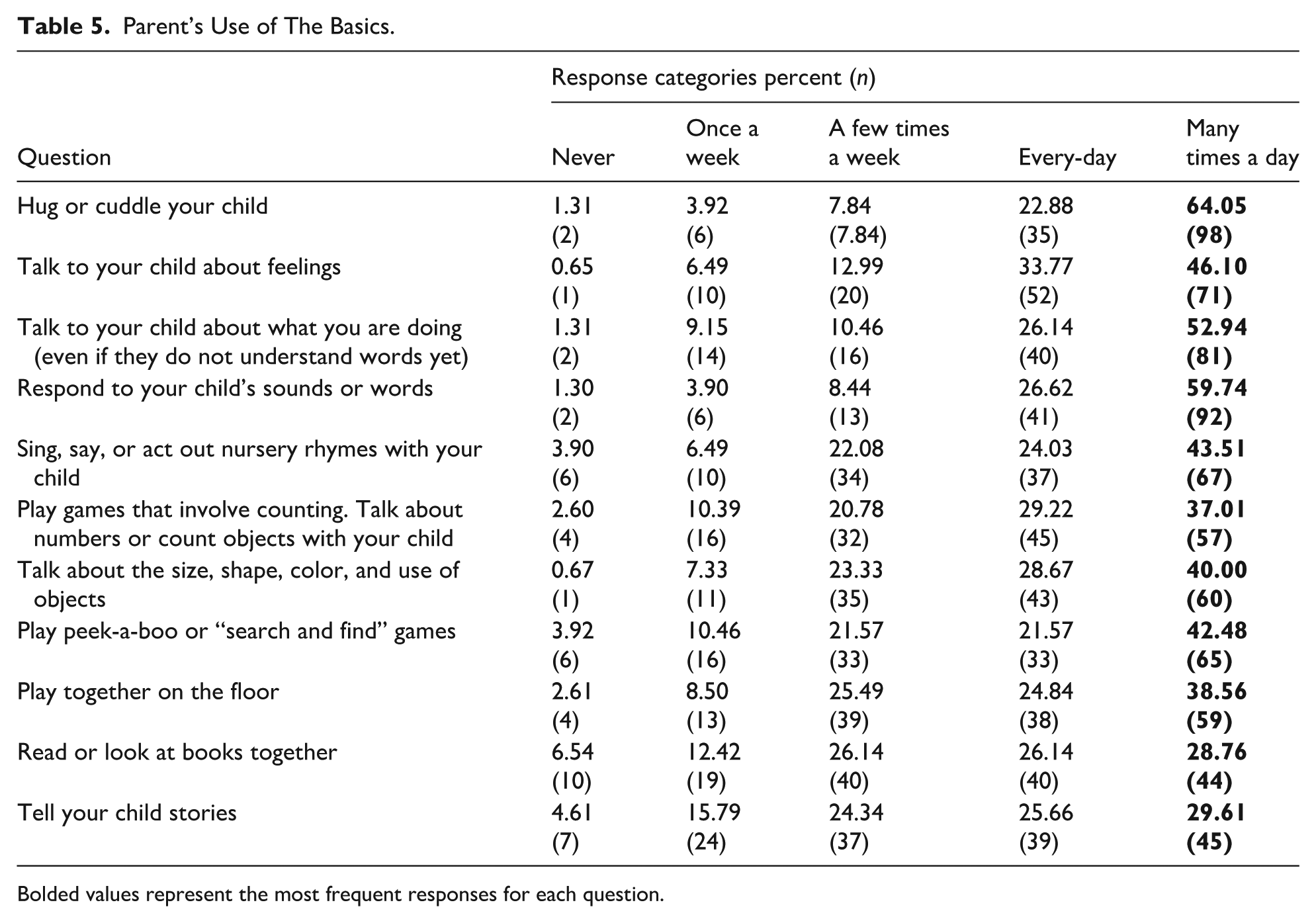
Bolded values represent the most frequent responses for each question.
Aim 3 (Confidence)
To describe parents’ confidence in their own parenting skills, participants were asked to mark the choice that was most true for them. When asked “I feel sure about my skills for helping my child succeed when they start school.,” 40.99% (66) “agreed” with this statement, 34.16% (55) “strongly agreed” with this statement, 19.25% (31) were “neutral” to this statement, 3.11% (5) “strongly disagreed” with this statement, and 2.48% (4) “disagreed” with this statement.
Aim 4 (Parental Stress)
To find out more about the participant’s stress in applying their parenting skills, parents were asked to mark the choice that was most true for them. When asked “The way my child behaves makes me feel stressed.,” 33.75% (54) “disagreed” with this statement, 25.00% (40) “strongly disagreed” with this statement, 19.38% (31) were “neutral” to this statement, 17.50% (28) “agreed” with this statement, and 4.38% (7) “strongly agreed” with this statement. When asked “I feel stressed so much that it gets in the way of being the kind of parent I want to be,” 26.88% (43) “disagreed” with this statement, 23.13% (37) “strongly disagreed” with this statement, 23.13% (37) “agreed” with this statement, and 8.13% (13) “strongly agreed” with this statement.
Aim 5 (Resources)
To assess parents’ knowledge of community resources available in the area to promote their child’s development, parents were asked if they had heard of The Basics. Only 21.68% of parents knew about The Basics. When asked what resources they had knowledge of in the area, parents selected the resources of which they had knowledge. Ranking the resources from most to least knowledge, parents had heard of (1) head start/early head start, (2) public broadcasting system (PBS) kids, (3) public library programs, (4) early childhood intervention, (5) regent health network, (6) parents as teachers, (7) home instruction for parents of preschool youngsters, (8) nurse family partnership, (9) The Five Basics, and (10) subscriptions to text messaging services aimed at child development. Other programs listed by parents were Dolly Parton’s Imagination Library, Hopes of Amarillo, StoryBridge, and the Usborne books newsletter.
Discussion
The overarching goal of this study was to assess parents’ current knowledge, capacity, resourcefulness, access, and confidence on topics related to different domains of learning. To this end, 5 salient categories were developed. The results from each research aim will be discussed in the following paragraphs.
The first research aim was to describe the parents’ knowledge of child development and The Basics. Parents reported that they strongly agreed with most of the developmental knowledge presented (eg, showing affection to their child is important, talking to their child is important even if they do not understand words, responding to their child’s sounds and words is important). Even though many parents reported they had not heard of The Basics by name, they strongly agreed with most of The Basics principles (eg, singing songs to children can help them learn language, spending time on their tummy builds arm and muscle strength, and reading books to children before they can talk). Overall, it appeared as if parents had sufficient knowledge of development to promote their children’s gross development. These results closely align with prior research findings that about 90% of parents do indeed have general knowledge of child development and can identify if their child is developmentally delayed. 26 However, a disconnect appeared between parents’ knowledge and implementation of activities that would promote their children’s development.
The second research aim was to describe parents’ application and utilization of concepts of child development. Most parents reported using principles of The Basics multiple times throughout their day (eg, hugging and cuddling their child, talking to their child about what they are doing, playing games that involve counting). We identified a difference between knowledge of development and utilization of developmental activities. Even though 56% of parents surveyed strongly agreed that it is important to read books to children even before they can talk, almost half (49%) of parents reported having less than 20 books in their home. Furthermore, just over half (54%) of parents reported reading and looking at books with their children at least one time a day. These results closely align with prior research indicating that the number of books in lower socioeconomic status homes can either promote or prevent the amount of quality early literacy interactions. 27 With reportedly limited access to a variety of age-appropriate books and limited daily literacy interactions with their children, these results seem to confirm prior research findings. When the number of books in the home was not a consideration, prior researchers found that parents might not read to their child because of time constraints and/or lack of energy. 28 This survey reiterates results from prior research and indicates a need for The Basics and other programs supporting early literacy in this rural area.
The third research aim was to describe parents’ confidence in their own parenting skills. Most parents agreed or strongly agreed (75%) that they felt sure about their skills to help their children succeed when they started school. Despite their confidence in their own parenting skills, only 79% reported talking to their child about what they were doing at least once a day, and 86% reported that they responded to their child’s sounds or words at least once a day. Furthermore, only 63% of parents reported playing on the floor with their children at least once a day and even less (54%) reported reading to their child at least once a day. If parents are confident in their skills, we were left wondering why they were not consistently interacting with their child in ways that promoted their gross development. As Merga and Ledger 28 found, parents’ interactions with their children might be limited because of time and energy. Combs-Orme et al 8 found parents from different cultural backgrounds had different beliefs and priorities surrounding child rearing practices all together. If this is the case, parent education on child development needs to be modified to be culturally sensitive.
The fourth research aim was to describe parents’ stress in their own parenting skills. Only 35% of parents agreed that their child’s behavior made them feel stressed and that their own stress interfered with their parenting abilities. If the majority of parents are not “stressed” as a parent, then why are they not having quality interactions with their child? This goes back to the disconnect between knowledge and action: parents know how to interact with their child, but they might not always do so.
The final research aim was to assess parents’ knowledge of resources in this area of the Texas Panhandle to promote their child’s development. Only 21% of parents surveyed knew about The Basics. However, parents had knowledge of many local resources that provide direct or indirect services to families and children. In response to these results, OF5 is currently working to increase parents’ awareness of, and access to local resources, specifically The Basics in our rural hub of the Texas Panhandle.
Collectively, these results indicate that parents generally know the importance of specific interactions with their children; however, they might not be doing it consistently. To address this disconnect, OF5 launched multiple initiatives to benefit parents and children in the community. The Basics Insights, a text messaging service, was initiated in this rural hub in the Summer of 2023. Parents can sign their child up for Basics text messages by providing their name and their child’s birthday. Each week the parent receives a text message that tells them about a brain-based fact or developmental milestones that correspond to their child’s age and suggests activities to do with their child that promote development. The activities are related to different Basics Principles each week. The Basics programming is currently free to parents of children in the area due to the Early Childhood Systems Building Preschool Grant Development program. The Basics Amarillo and our local PBS created 6 videos in English and Spanish, explaining The Basics featuring local families in local spaces. These videos will be run on the local PBS station as well as other local news and radio stations.
To address the dearth of books in children’s homes, multiple actions were taken. StoryBridge, a local nonprofit organization with a mission to increase the number of books in children’s homes, and other vested agencies brought the Dolly Parton Imagination Library (DPIL) to this community in the Texas Panhandle. Any parent in the area can sign their child up to receive a developmentally appropriate book each month until their child turns 5 years old. In partnership with StoryBridge, OF5 also funds books for newborns born in Potter County, Texas through the same grant. Funding for the DPIL for the community was provided through the same grant.
Limitations
The results of this study are important in identifying the benchmark level of this community’s parents’ knowledge of early child development, and documenting their knowledge about available resources which may support young children’s development. However, multiple limitations of the study were noted. While analyzing the data, the researchers found that, in hindsight, some of the questions may have been worded in a confusing manner (eg, How many children do you have in each of the following age ranges?). The survey also did not contain a question to collect the total number of children of any ages in the home; therefore, there is no data indicating the total number of children living in the home. Next, although 247 participants began the survey, they did not all complete the survey. With only 139 surveys completed, the sample surveyed may not represent the perspectives of the entire community. In addition, the majority of surveys were completed in English, even though participants had the option to choose to complete the survey in Spanish. Perhaps the limitation of the survey not being offered in a variety of languages deterred some participants from answering the survey.
Clinical Implications and Future Directions
Clearly, OF5 has already used the results of this survey to impact the trajectory of parent-child interactions in the area. The results are being shared with daycares, early educators, school districts, and policy makers to demonstrate the need for rich early literacy experiences for children birth to 5 years old. Since OF5 is composed of local stakeholders, representatives of OF5 are often present at community events involving young children and provide QR codes to for parents to sign up for The Basics Insights. Parents who receive The Basics messages report that they are simple, succinct text messages that act as a reminder to have intentional interactions with their children.
The coalition aims to continue working collaboratively with local stakeholders to inform families about The Basics, the DPIL, StoryBridge, and other local resources. OF5 has a goal of enrolling at least 1000 families in The Basics in 1 year and at least 4000 over the next 3 years. The coalition also aims to disaggregate the data from the PCPS and focus programming in zip codes that reported baseline knowledge in their parenting skills, The Basics, and other local resources. Finally, OF5 plans to re-distribute the PCPS in 5 years to re-assess the community’s knowledge of The Basics and child development to identify continued needs in the community.
Author Contributions
Traci Fredman and Betty Coneway authors contributed to the development of the survey tool and written manuscript. Dr. Fredman assisted with survey distribution and completed data analysis.
Footnotes

Ethical Considerations
This research was approved by the WTAMU IRB #2021.04.12.
Funding
The authors disclosed receipt of the following financial support for the research, authorship, and/or publication of this article: The authors received a small stipend from the Childhood Systems Building Grant for their work on this project.
Declaration of Conflicting Interests
The authors declared no potential conflicts of interest with respect to the research, authorship, and/or publication of this article.