







Abstract
This article examines the effect of electoral misconduct on party systems in new electoral regimes. The authors distinguish between different forms of electoral misconduct and argue that preelection tools—which aim to deter opposition parties and their supporters and create a biased information environment—exert a “psychological” effect on parties and voters, whereas ballot fraud exerts a direct, “mechanical” effect on vote shares. Using original data on electoral misconduct in legislative elections in Latin America and postcommunist countries, the authors find that preelection misconduct has a strong reductive effect on the effective number of parties; however, ballot fraud does not. Further investigation suggests that intimidation of opposition parties and voters is the most important mechanism through which misconduct reduces party numbers. By identifying electoral misconduct as a key omitted variable, this article renders the conventional model of party systems more applicable to the political contexts in new electoral regimes.
Elections are ubiquitous in the regimes that emerged from the third wave and the postcommunist transitions, but they are often of dubious quality. 1 Attempting to hold on to power, incumbents employ a wide range of tools to suppress free political competition, as electoral politics in Peru under Alberto Fujimori illustrates. Prior to the 2000 presidential election, Fujimori used a combination of bribes and intimidation to ensure the cooperation of key players in the judiciary, legislature, and the media. 2 Several widely read tabloids orchestrated smear campaigns to discredit the two leading opposition candidates. 3 Control of the courts also allowed Fujimori to evade accountability for violations of electoral law, including an attempt to rig the software used for vote tabulation. 4
Such measures appear to be quite effective at ensuring electoral victory. According to our data on legislative elections, the ruling party holds on to power 75% of the time in manipulated elections, compared to a 56% rate of victory in free and fair elections (Table 1a). Incumbent parties also enjoy significantly higher margins of victory when elections are manipulated (Table 1b).
Electoral Manipulation and Incumbency Reelection
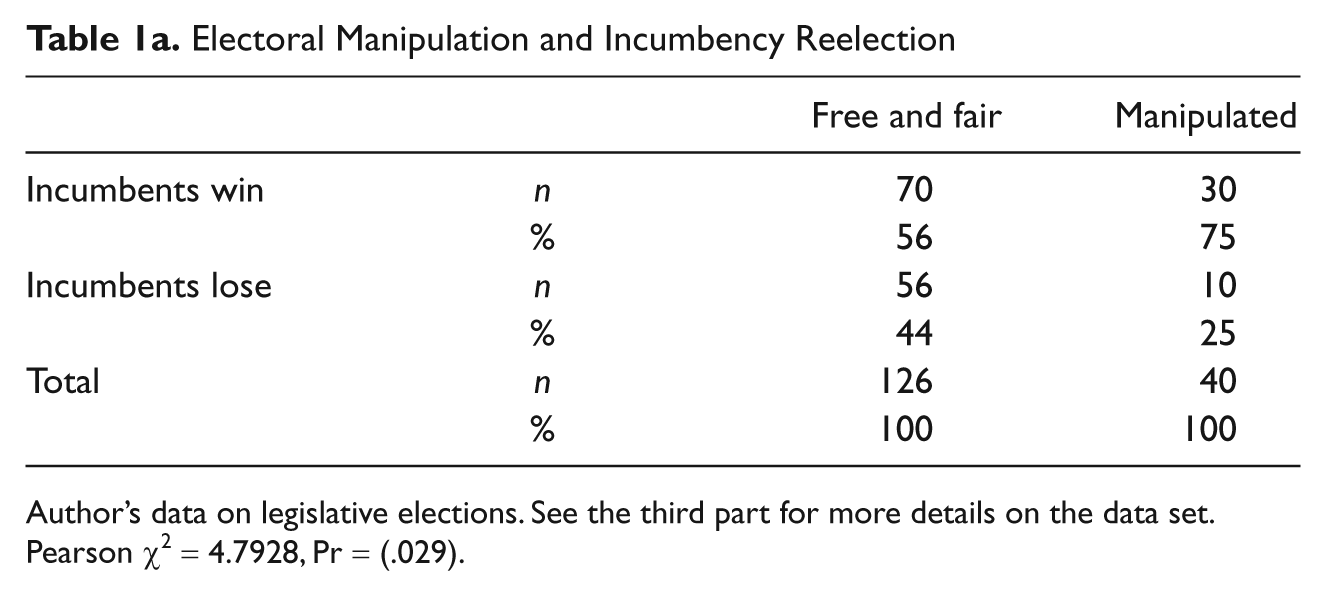
Author’s data on legislative elections. See the third part for more details on the data set. Pearson χ2 = 4.7928, Pr = (.029).
Electoral Manipulation and Margins of Victory
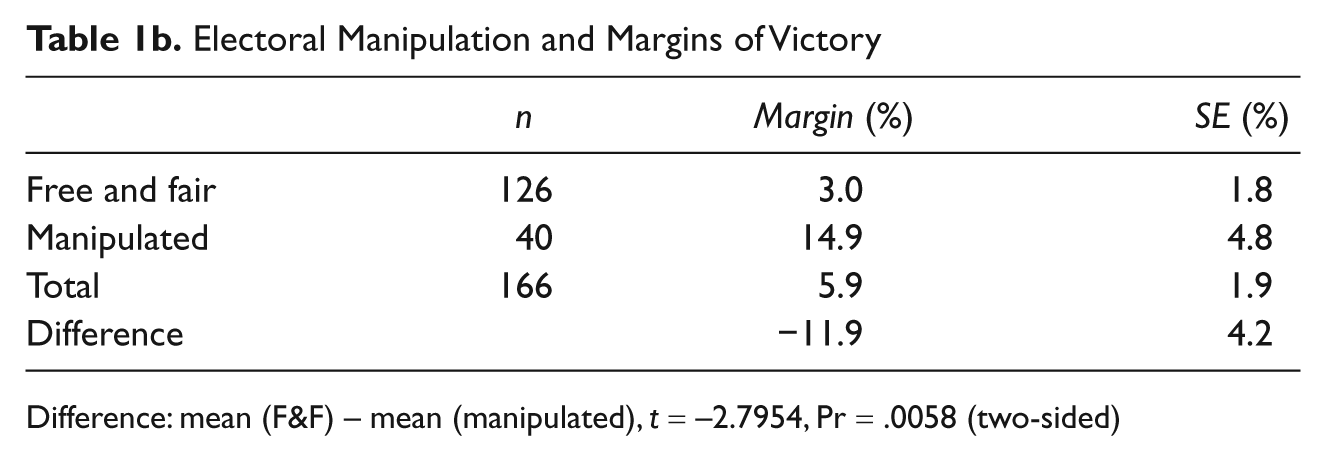
Difference: mean (F&F) – mean (manipulated), t = −2.7954, Pr = .0058 (two-sided)
These patterns, which have been documented and analyzed by others, 5 raise questions about the deeper effects of electoral misconduct, beyond its effect on the incumbent’s odds of winning. Is government-sponsored electoral misconduct associated with fewer political parties? Are some forms of misconduct more effective than others? Through what mechanisms does misconduct influence party politics? The conventional model of party systems, which posits that the number of parties in a country is determined by the interaction of political institutions and social cleavages, 6 does not answer these questions because it assumes a competitive environment in which parties are free to form and campaign and in which election results accurately reflect the votes cast. In fact, these conditions are not met in many countries with new or fragile democratic institutions. By our estimates, 10 of 21 Latin American and Caribbean countries and 13 of 21 postcommunist countries held at least one manipulated election between 1990 and 2004.
Despite the frequency of electoral misconduct, there is little theoretical agreement about its consequences and still less empirical research that investigates its effects. Some studies suggest that governments employ manipulation in close races to increase their vote shares by just enough to ensure an election win. 7 In this scenario, the effect of misconduct on the number and strength of political parties is likely to be shallow. Other studies point to the consequential effects of government-sponsored manipulation on opposition parties’ ability to compete in elections, suggesting that the consequences of misconduct may be deep enough to influence key features of the party system. 8
We provide new insights into this debate by distinguishing between the effects of different forms of government-sponsored electoral misconduct. We argue that tools of misconduct implemented during the preelection period exert “psychological” effects: Opposition parties are discouraged from running, or face restrictions on their ability to campaign, and voters are intimidated or discouraged from supporting the opposition. In contrast, ballot fraud, implemented during the casting, counting, or tabulation of votes, exerts a direct, “mechanical” effect on vote shares. We offer three specific mechanisms—deterrence, information, and rigging—linking these two types of misconduct with a reduction in the number of parties in a system, vis-à-vis the number of parties predicted in a fully competitive context.
We test our theoretical assertions on an original data set of electoral misconduct in 166 legislative elections in Latin American and postcommunist countries between 1990 and 2004. 9 The primary dependent variable of our analysis is the effective number of legislative parties (ENLP), a measure that captures the size of the party system by weighting each party by its share of seats in the legislature. We find that preelection tools of manipulation have a strong reductive effect on ENLP, whereas, perhaps surprisingly, ballot fraud does not. This implies that election day rigging is relatively ineffective at reducing party competition and may be used as a last resort by incumbents in an already weak position. Furthermore, consistent with our argument that misconduct intimidates and deters opposition parties’ entry, we find that preelection misconduct is associated with fewer parties running in the election.
These findings—which provide the first systematic evidence that misconduct influences party systems—have important implications for the quality of political competition in new electoral regimes. Free party competition is the lifeblood of any well-functioning democracy, whereas ruling party dominance is a syndrome of many “hybrid” regimes. 10 A reduction in party system size below its expected level implies a mismatch between voters’ true preferences and the ensuing—biased—electoral outcome, while the deterrence of opposition party entry creates a de facto “representation gap.” Citizens can choose between only a restricted set of parties that do not represent the full spectrum that would otherwise emerge under free and fair conditions.
The article proceeds as follows. The first part outlines competing views about the consequences of electoral misconduct. The second part presents the theory and causal mechanisms explaining how electoral misconduct leads to fewer political parties. The third part describes our original data set and presents our findings. The fourth part concludes and suggests avenues for future research.
Electoral Misconduct: Causes and Consequences
We define government-sponsored electoral misconduct broadly as any action intended to produce a bias favoring the electoral success of the ruling party. 11 It is important to note that this definition is based on actions and their intent, not on their effects. Whether, and to what extent, manipulation actually influences electoral outcomes is an empirical question. Existing research has found that misconduct influences voter turnout, 12 and opposition party behavior. 13 But the institutional consequences of electoral misconduct remain poorly understood. Curious about this relationship, we address an important, yet unanswered, question: Does misconduct reduce the size of party systems?
The existing literature on electoral misconduct does not provide us with clear answers to this question since different theories about the causes of misconduct lead to divergent expectations about its effects. Some studies adopt the perspective that misconduct is a tactic primarily employed to ensure victory in close races. 14 In legislative elections, this could mean that misconduct is limited to certain districts where it is needed most, or, as Birch argues, that misconduct is more likely when electoral rules dictate that “only a small number of votes will need to be shifted in any individual district to alter the outcome of that district.” 15 The implication of this perspective is that misconduct may change the election’s outcome in some districts but is unlikely to have an impact on the size of the party system itself.
Other studies, however, draw insights from politics in authoritarian regimes to highlight a wider set of motives for governments to employ misconduct, even when it is clear that it is not needed to change the outcome of the election. Simpser contends that incumbents have incentives to engage in manipulation even in lopsided races to increase their margin of victory, which helps prevent other parties from running in future elections and discourage voters from supporting the opposition. 16 Research on the survival of Mexico’s hegemonic party regime shows how the creation of an uneven electoral playing field was a key tool—among others, such as patronage and constitutional change—that helped ensure PRI’s electoral dominance for 71 years. 17 These studies suggest that the consequences of misconduct for party systems may be deeper than previously assumed.
However, the large literature on party systems has little to say about the effects of electoral misconduct. The standard model conceptualizes party systems as the joint outcome of institutions and social cleavages and implicitly assumes that elections are free and fair; 18 that parties are free to form, register, and campaign; that voters freely express their preferences; and that votes are accurately counted. As we show, these conditions are often absent in new electoral regimes, yet, surprisingly, researchers have not explored the consequences of violating this core assumption. Empirical research on party systems in new democracies remains primarily focused on the same structural factors (institutions and cleavages) featured in studies on developed democracies. 19 As our analysis suggests, electoral misconduct is an important omitted variable. Failing to control for it may be one reason why research on postcommunist regimes has found that these party systems tend to behave differently than those in established democracies. 20
How Electoral Misconduct Affects Party Systems
To capture fundamental differences in how tools of electoral misconduct affect the electoral process, we break down the concept by the timing of its occurrence. Preelection misconduct includes any actions taken prior to the election that aim to restrict political competition. They include encroaching on parties’ ability to campaign as well as intimidating opposition parties, voters, and the media. These tools exert psychological effects that condition the decisions of party elites and voters. Ballot fraud refers to actions taken on or after election day that distort the balloting, counting, or tabulation processes. It exerts a mechanical effect on the translation of votes to seats. 21 We proceed to outline two psychological mechanisms—deterrence and information—and a mechanical one—rigging—through which misconduct affects the party system.
Preelection Misconduct
Preelection misconduct includes any tool that constrains the ability of opposition parties to register, campaign, and get their message out. The intended targets are opposition party elites and their supporters. Preelection misconduct produces “psychological” effects that alter the choices of these targets. The most extreme forms create entry barriers through stringent registration requirements intended to discourage opposition parties from running. Also common are strategies of intimidation that aim to threaten opposition leaders and supporters. These methods activate a deterrence mechanism; opposition parties are less likely to form or participate in the election, fearing government retaliation, or an abysmal electoral result that can hurt their long-term chances of success. Whether the parties actively boycott the election or simply choose not to run, opposition nonparticipation decreases competition for the ruling party and will, all else equal, lower ENLP.
Preelection tactics of intimidation and repression may also deter voters from casting ballots for the opposition or expressing their support during the campaign. This can influence beliefs about opposition parties’ chances of success, contributing to a perception that the incumbent’s victory is assured and that supporting the opposition would be a waste. As one Russian voter expressed in the run-up to the 2007 parliamentary elections, “There’ll be no real choice, so what’s the point of voting? Everything is decided for us in this country.” 22
Manipulation of the media is another common form of preelection misconduct. Tactics include unbalanced allocation of media coverage in state-controlled outlets, intimidation of journalists, and outright censorship. Such policies result in a constrained information environment in which voters are fed a stream of biased political information. In Fujimori’s Peru, for example, government influence over private television was so strong that stations even rejected paid advertisements from opposition candidates. As candidate Alberto Andrade lamented, “Where is freedom of expression when we can’t even express ourselves by paying?” 23
In addition to media control, incumbents can use their control over the police and local officials to limit the ability of their opponents to disseminate information or to prevent public campaign-related meetings and rallies. Prior to the 2007 parliamentary elections in Armenia, the press secretary for the opposition Heritage Party described the government’s tactics:
[B]ureaucrats and policemen try to create obstacles to our campaign. . . . Policemen approached us in the villages of Ohanavan and Kosh and asked what right we have to meet voters. The head of the Karakert village community . . . tried to resist the placement of the Heritage Party campaign posters. The head of the Lernagog village stated that the whole village has made a decision to vote for the [ruling] Republican Party.
24
Media manipulation and restriction of campaign activity triggers an information mechanism. Because voters possess only limited or biased information, they may be less likely to vote for the opposition. Figure 1 illustrates the psychological effects of the deterrence and information mechanisms. By influencing parties’ choices, these mechanisms decrease the number of parties running, and by influencing voters’ choices, they reduce the vote share for the opposition. All else equal, fewer parties running or less support for opposition parties result in fewer effective legislative parties.
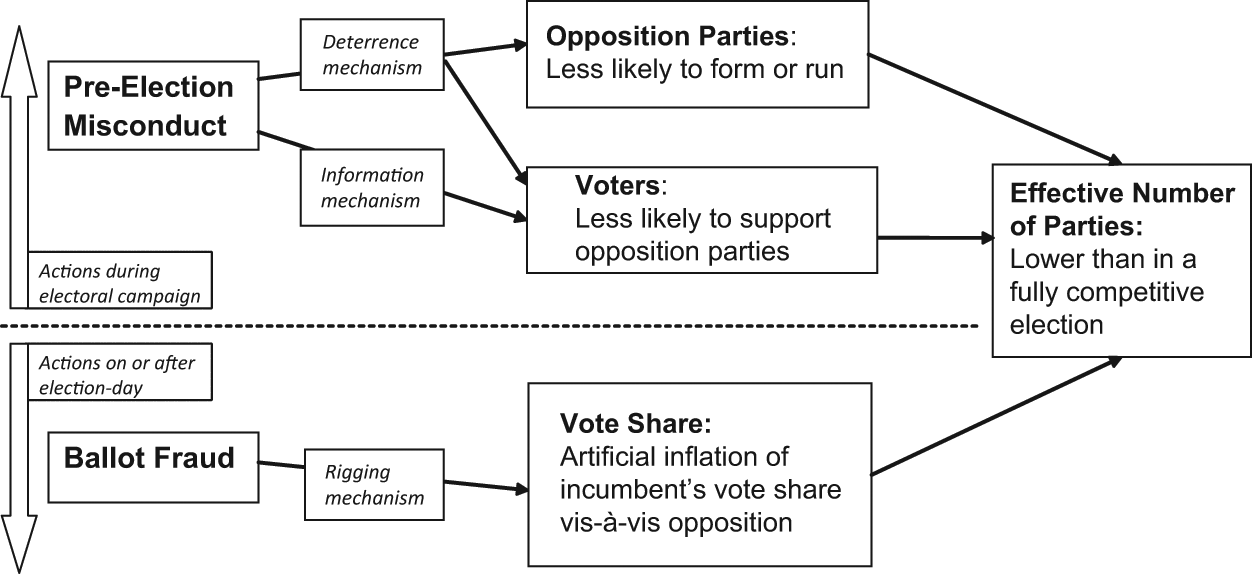
Causal mechanisms linking electoral misconduct to the number of parties
Ballot Fraud
Ballot fraud includes any tool used to distort the voting, ballot counting, or tabulation processes. If effective, it produces a direct, “mechanical” effect on the opposition parties’ vote share via a rigging mechanism. Ballot stuffing and multiple voting are perhaps the most blatant examples of rigging. Another tactic is violation of the secrecy of the vote, which can allow party cadres to monitor voter behavior and punish voters who do not cast ballots for the ruling party. 25 Albania’s 1996 parliamentary election featured many characteristic tactics of ballot fraud: Votes cast for the opposition were altered after the fact to make them invalid, whereas premarked ballots were stuffed into ballot boxes by polling station officials. 26 Tampering with registration lists is another widely used method for reducing opposition parties’ vote shares. In the Dominican Republic’s 1994 election, at least 73,000 names of opposition supporters were mysteriously deleted from registration lists in polling stations on election day, preventing these individuals from casting ballots and contributing to the incumbent’s victory. 27
Summing up, our expectation is that preelection misconduct and ballot fraud will reduce ENLP below that expected in a fully competitive context. If preelection misconduct serves to deter opposition parties, as we claim, it should also be associated with fewer parties running in elections. In what follows, we present our data, analysis, and results.
Empirical Analysis
We test our hypotheses using an original data set of electoral misconduct in 42 Latin American and Caribbean and postcommunist countries, between 1990 and 2004. 28 These two regions represent a good testing ground for our theory, as they exhibit variation across countries and over time in the presence and types of electoral misconduct, electoral systems, social cleavage structures, and the number of parties. In addition, because of the prevalence of election monitoring in these two regions, there exists detailed information on electoral misconduct that is not available for other areas of the developing world.
Our sample covers all countries that held multiparty elections during the period in question. 29 This leads us to include some countries that are not fully democratic. Although party system development may differ across regime types (a possibility that we control for in our analysis), the effect of manipulation should not: Incumbents in every country desire to win elections, and electoral misconduct, if present, is intended to help them achieve that goal. 30
The units of analysis are lower house legislative elections (first round results). 31 Our dependent variable is ENLP. 32 Unlike a simple count of the number of parties in a legislature, ENLP weighs each party by its share of seats. 33 It is important for our purposes that ENLP distinguishes between legislatures that have the same number of parties but different balances of power among them. It therefore captures the degree to which the distribution of power among parties is more equal or skewed. For example, a legislature with three parties that hold 50%, 30%, and 20% of seats, respectively, has an ENLP of 2.63, whereas a legislature with a seat distribution of 70%, 20%, and 10% has an ENLP of 1.85. A final advantage to ENLP is that it is the standard outcome variable used in the party systems literature, making our analysis comparable to others; and the existence of an accepted model of party systems provides us with a clear counterfactual expectation of what ENLP would be in the absence of electoral misconduct.
To code for the presence of electoral misconduct, we use election observation reports from the Organization for Security and Co-operation in Europe, the Organization of American States, National Democratic Institute, and the Carter Center. 34 These organizations are widely considered to be credible, 35 and they issue detailed reports on electoral conduct throughout the entire electoral period. We base our coding on the factual content of the observers’ final reports. 36 It is important to note that these organizations have no interest in falsely reporting manipulation since it is generally politically costly for observers to criticize an election. Thus, overreporting of manipulation is highly unlikely, but underreporting may occur. However, when we investigated this issue, we found no evidence that possible underreporting is a problem. 37
For some elections, reports are not available; in these cases, we relied on news sources from the LexisNexis database and Keesings Record of World Events as well as secondary sources, to ascertain whether misconduct occurred. 38 Only 7 of 166 observations in the sample were coded as experiencing misconduct based on news reports, and in all of these cases more than one independent source confirmed the coding. In short, our coding of misconduct can be considered conservative. If these coding decisions have any effect on our results, it should be in the direction of underestimating the effect of misconduct. 39
Figure 2 provides a list of tools we count as manipulation. If one or more of these tools is present, the election is coded as having experienced misconduct. 40 Although in theory misconduct may be a continuous variable that exhibits higher or lower intensity, the sources we used do not allow us to capture such fine-grained distinctions. Moreover, because we impose no coding criteria as to the effect of misconduct on vote shares or on the outcome of the election, our measures of manipulation are not endogenous to the dependent variable.
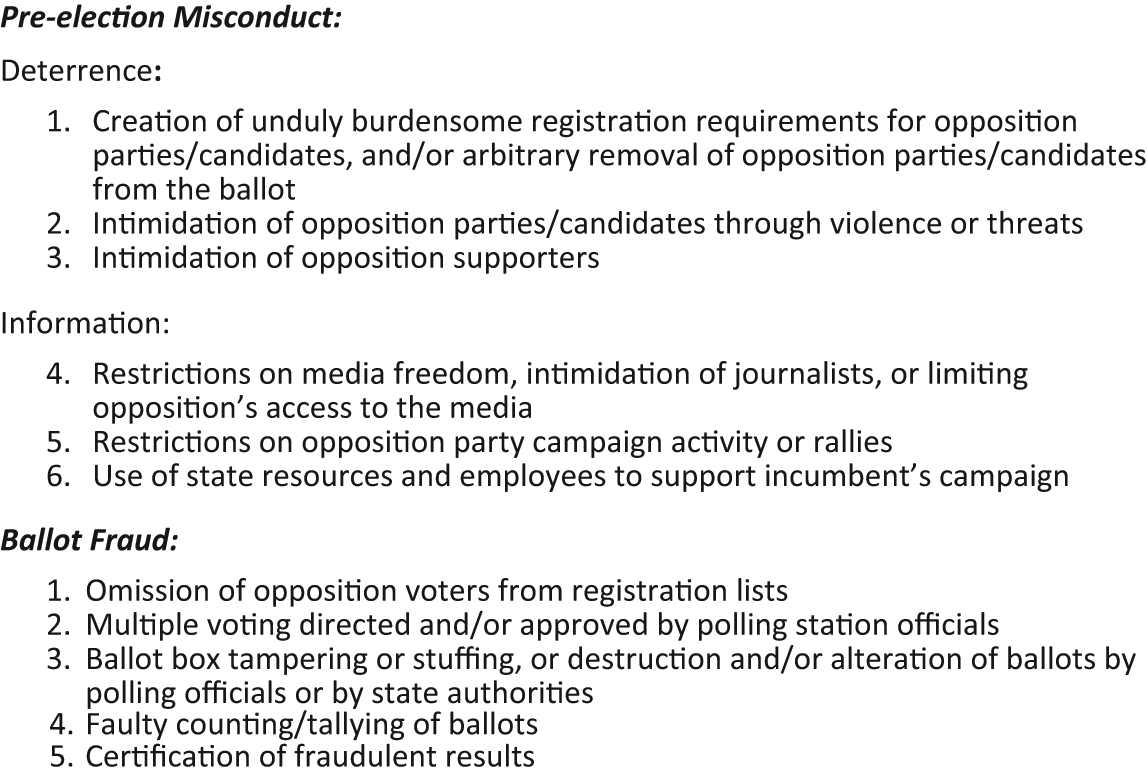
Tools of preelection misconduct and ballot fraud
Two possible issues should be clarified with respect to what we count as manipulation. First, we emphasize that our theory and coding focus on misconduct perpetrated by the government. Although ballot fraud may sometimes be perpetrated by opposition parties, it is normally far less potent than manipulation by the incumbent, which controls the institutions and resources of the state. Moreover, opposition-orchestrated fraud should serve only to strengthen the opposition’s vote share vis-à-vis the ruling party. Thus, excluding it from our analysis should, if anything, bias downward our estimates of the effect of incumbent-sponsored manipulation on the party system. 41
Second, changing electoral rules is an alternative way by which incumbents may try to impose obstacles to the success of opposition parties and hold onto power. 42 However, we do not include this as a tool of misconduct because it is difficult to objectively distinguish between “manipulative” and legitimate reforms. Simply examining the effects of changes to electoral rules is not enough. In Mexico, for example, Diaz-Cayeros and Magaloni show how careful electoral design prolonged the PRI’s dominance by lowering the threshold of success for small parties, which created disincentives for the consolidation of the opposition. 43 However, it would be difficult to code such reforms as manipulation since the short-term effects of these changes actually may have benefited the opposition. 44
To provide a sense of the variation in our data set, Figure 3 depicts the frequency of electoral misconduct over time in our two regions. The vertical axis records the percentage of legislative elections that were manipulated in a given year. Points mark the actual percentage and the dashed lines show smoothed trends over time. As Figure 3 shows, the rate of manipulation in Latin America is generally lower than that in the postcommunist countries and on average exhibits a decreasing trend after 2000. The average rate of manipulation in the postcommunist area remains relatively constant over time, though within this region the former Soviet republics exhibit the highest incidence of manipulation.
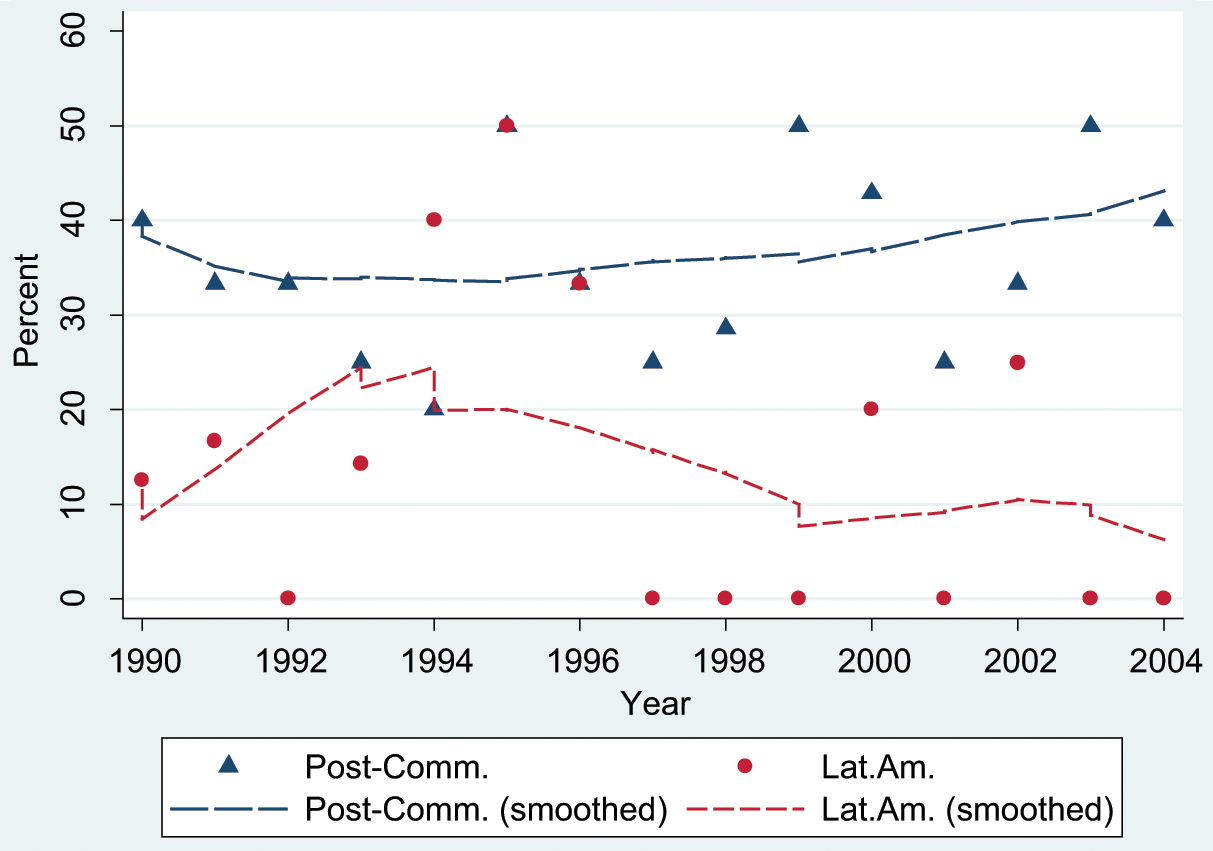
Percentage of elections manipulated over time
One might expect electoral misconduct to be confined to less democratic regimes, but our data show that it frequently occurs in countries coded as democracies. Figure 4a shows the rate of misconduct by Polity score. 45 Although misconduct is far more common in cases at the lower parts of the scale, it also occurs in 13% of regimes scoring 7 or higher. This pattern is similar if we look at Przeworski et al.’s dichotomous coding for regime type. 46 In total, 14% of our elections are nondemocratic according to this coding, accounting for 14 out of 43 cases of manipulation. As Figure 4b shows, 60% of legislative elections in nondemocracies were manipulated by the government. But, perhaps surprisingly, nearly 20% of elections in democracies also experienced misconduct.
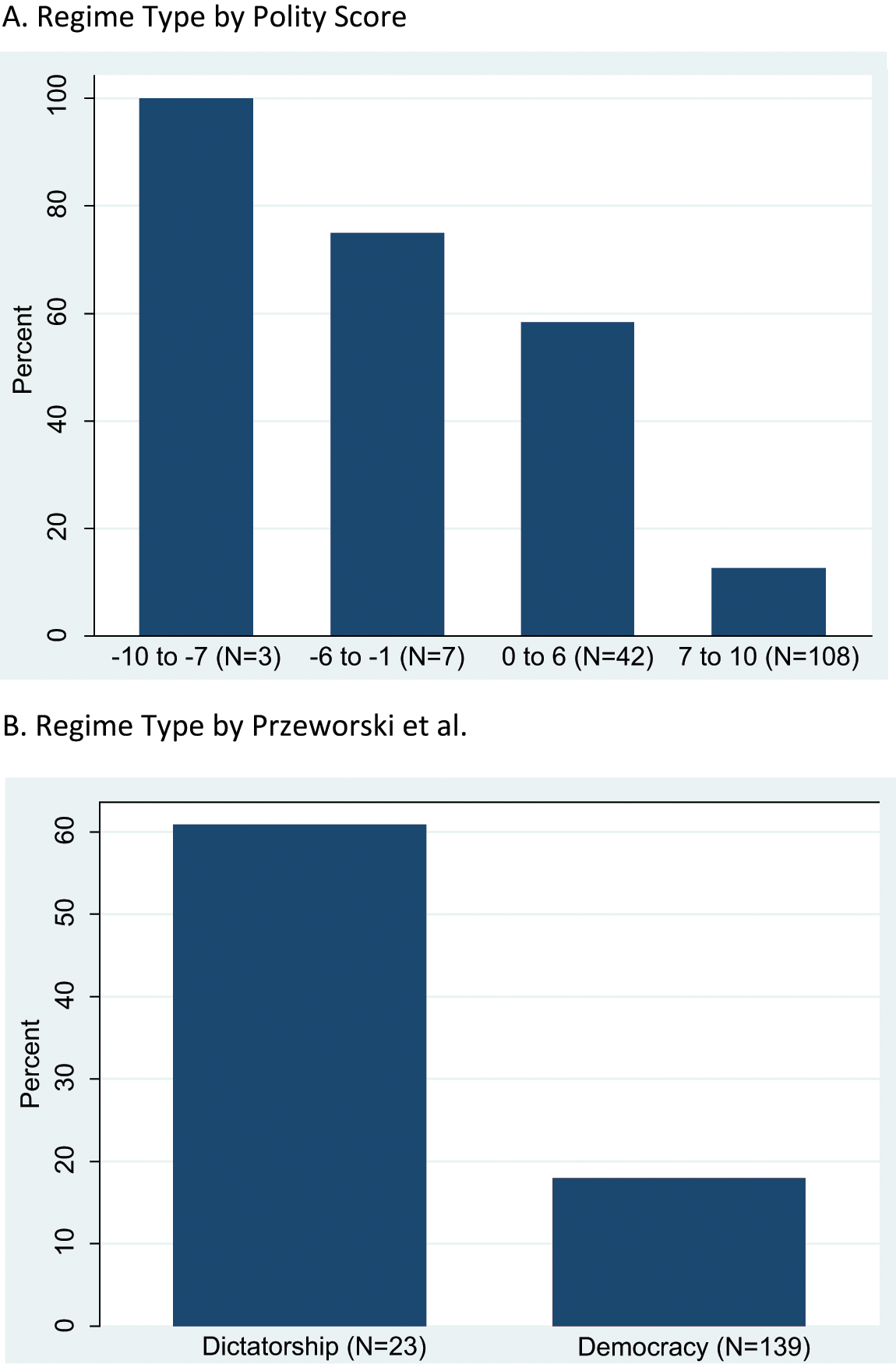
Percentage of elections manipulated, by regime type
Model Specification
To examine whether electoral misconduct has a systematic effect on the party system we estimate a series of ordinary least squares regressions that predict ENLP. We employ robust standard errors, clustered by country, to adjust for spatial correlation among elections taking place in the same country. 47 Our main independent variables of interest capture the timing of electoral misconduct, which is associated with either psychological or mechanical effects: first, a variable for preelection misconduct, and second, a variable for ballot fraud. Both are dummy variables, coded as 1 if one or more of the tools in each category (listed in Figure 2) are employed.
The first set of control variables captures the effect of electoral rules and institutions on the number of parties: First, the logarithmic transformation of district magnitude determines the “capacity” of the party system. 48 We also control for presidential elections since their results affect the candidacies put forth in legislative elections. The effective number of presidential candidates (ENPRES) measures the party system’s fragmentation in presidential elections, 49 whereas the proximity of presidential and legislative elections conditions the coattail effects of the presidential race. 50 We include both variables as well as their interaction term. Finally, we include a variable measuring the threshold of representation in the legislature. Higher thresholds should tend to reduce the number of parties that enter parliament and affect the strategic choices of voters. 51
To capture the effect of social cleavages, we include a variable measuring ethnic fractionalization. 52 We include both ethnic fractionalization and an interaction variable of fractionalization with district magnitude. In accordance with the sociological literature on party systems, we expect fractionalization to be positively associated with the number of parties.
We also include a dummy variable for founding elections that mark a transition to democracy. 53 Because in founding elections the process of strategic coordination among party elites and voters is problematic, we expect them to be contested by higher numbers of parties than subsequent elections. 54 Finally, it is likely that there are additional factors, such as the general level of civil liberties, that influence the number of parties in nondemocracies. We therefore include Przeworski et al.’s measure of regime type (coded as 1 for dictatorship and 0 for democracy) to account for the possibility that it is regime type and not manipulation that reduces the number of parties.
Results
Table 2 displays the results of the empirical analysis. We first run a specification without any variables for electoral misconduct (Model 2.1). Models 2.2 and 2.3 control for the effects of preelection misconduct and ballot fraud. Since preelection misconduct and ballot fraud may occur in the same election, we run a model including both to assess the independent effect of each (2.4).
Effect of Electoral Misconduct on the Party System
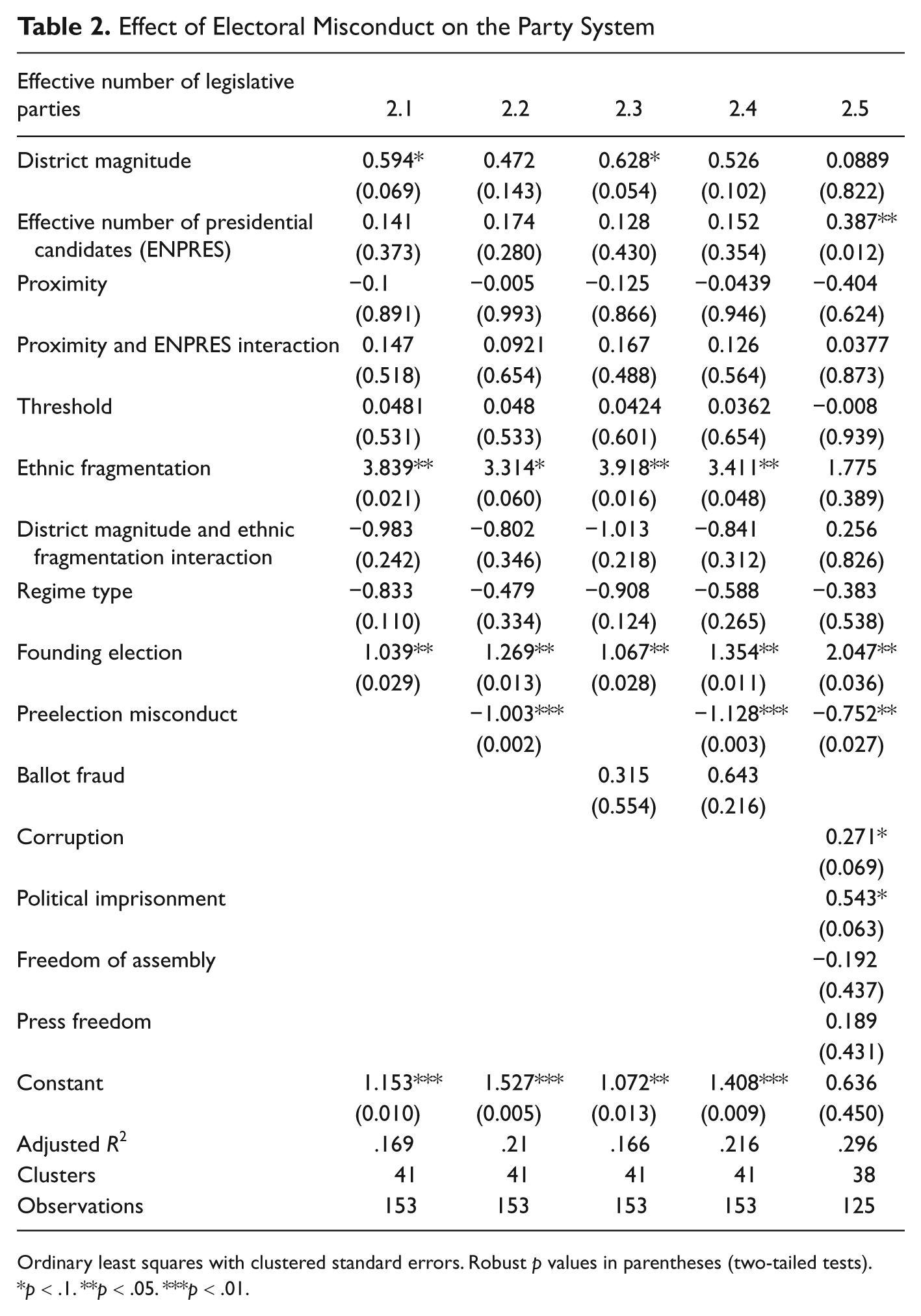
Ordinary least squares with clustered standard errors. Robust p values in parentheses (two-tailed tests).
p < .1. **p < .05. ***p < .01.
The institutional and sociological variables exhibit, for the most part, the expected effects, mirroring results from previous studies. 55 District magnitude and ethnic fragmentation increase the number of parties, whereas their interaction is not significant. 56 Results also support the idea that founding elections are indeed exceptional, having more parties than later elections. Somewhat surprisingly, the number of presidential candidates and the proximity of presidential elections do not have an effect on the number of parties that enter parliament, and neither do thresholds. Democracies and dictatorships do not exhibit significant differences in the number of parties, though the sign for this variable is in the expected direction.
Most important, the results lend support to our main hypothesis, though only preelection misconduct has a substantive and statistically significant negative effect on ENLP, reducing it by about 1. This is a large substantive effect, given that the mean value of ENLP in the sample is 3.7. This result holds even when we control for ballot fraud (Model 2.4), indicating that preelection misconduct has a reductive effect on parties irrespective of whether the incumbent also employs rigging. 57
Ballot fraud, on the other hand, is not significantly associated with fewer parties, either alone or when we control for preelection misconduct. 58 This is a surprising finding that defies our initial expectations. Puzzling as it first appears, there are plausible reasons why preelection tools may be more successful at reducing party competition than ballot fraud. From the incumbent’s perspective, preventing opposition parties from competing or attracting support is likely to be more effective than employing ballot fraud, which alters vote tallies among parties that are already on the ballot. In close elections, distorting vote shares among the parties may be used to ensure the incumbent a narrow victory, but this would not substantially alter the party system itself. Ballot fraud may even lead to an increase in ENLP if the incumbent uses it to siphon votes from major to minor opposition parties.
In sum, these initial results indicate that preelection misconduct has a reductive effect on party systems. We now proceed to examine the robustness of this finding to the inclusion of additional variables that capture aspects of the political environment that may be related to electoral misconduct. Our coding of preelection misconduct accounts only for tools that are implemented by the incumbent during the campaign period with the clear aim of influencing the election. However, many of the countries in which misconduct occurs are also marked by generally high levels of political corruption, clientelism, and broad restrictions on civil liberties that transcend electoral campaigns. It may be these general conditions, rather than electoral misconduct in particular, that are associated with fewer effective political parties.
The last column in Table 2 reports results from a model that tests for this possibility, 59 adding four new control variables. Corruption, taken from the International Country Risk Guide (ICRG) data set, captures the level of corruption in the political sphere, including the prevalence of patronage and bribe taking. 60 To capture the degree to which key civil liberties are respected, we include variables for political imprisonment and freedom of assembly, both from the Cingranelli-Richards (CIRI) data set. 61 The former is coded based on the incarceration of citizens for political beliefs or membership in political, religious, or ethnic groups, whereas the latter measures government-imposed restrictions on free assembly. 62 Finally, we include Freedom House’s measure of press freedom, which codes countries based on legal, political, and economic restrictions on media freedom. All four variables are recoded so that higher scores equate to better conditions (i.e., less corruption and imprisonment, more freedom). 63
Even with the addition of these alternative variables, the negative and significant effect of preelection misconduct on party numbers holds. This finding strengthens our claim that these election-related practices have an effect on party systems above and beyond the effect of general corruption and restrictions on civil liberties. Results also show that lower levels of corruption and imprisonment increase party numbers, as we would expect. The variables for freedom of assembly and press freedom are not significant, which suggests that after controlling for election-related misconduct, general restrictions on the press and assembly do not have an additional reductive effect on party competition.
Testing the Mechanisms of the Argument
To provide a more nuanced understanding of the relationship between preelection misconduct and party systems, we now probe whether the two mechanisms we propose—deterrence and information—are indeed at work. Using information from the election observation reports, we created two additional variables that capture whether the tools of preelection misconduct operate primarily via deterrence or via information suppression. The variables deterrence and information are each coded as 1 if one or more of the tools associated with that mechanism (listed in Figure 2) was employed. These two categories are not mutually exclusive.
Table 3 presents results from models that substitute preelection misconduct with the two new variables for deterrence and information suppression. Both deterrence and information have a reductive effect on the party system, though information appears to be weaker both substantively as well as statistically. Deterrence, however, exerts a strong substantive effect on the party system, reducing ENLP by about 1, even when we control for the presence of corruption or political imprisonment. These findings are consistent with our expectations and unpack the ways through which misconduct affects the party system, namely, through intimidating the opposition and controlling the media.
Effects of Tools of Deterrence and Information on the Party System
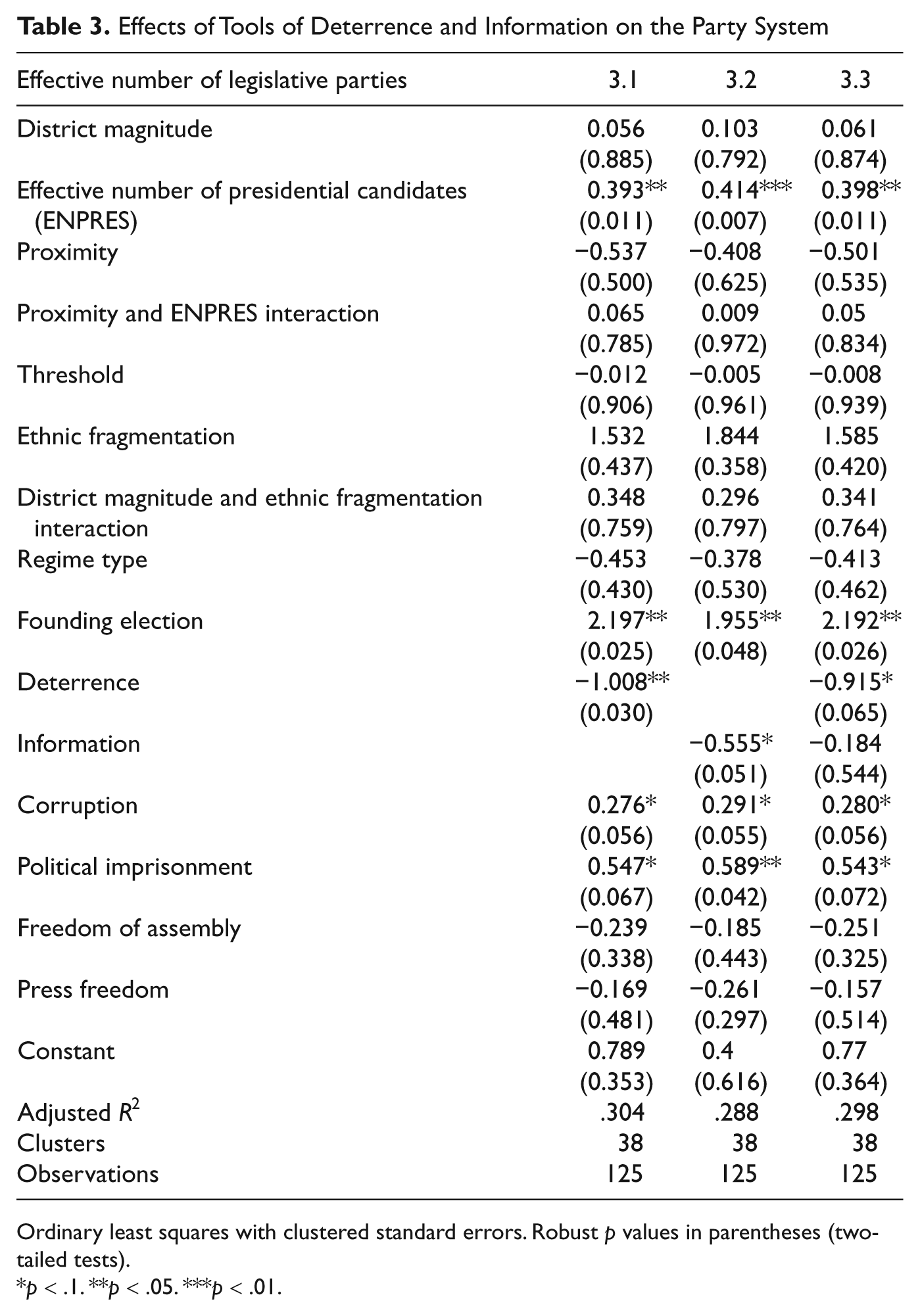
Ordinary least squares with clustered standard errors. Robust p values in parentheses (two-tailed tests).
p < .1. **p < .05. ***p < .01.
As an additional test of the deterrence mechanism, we employ a second dependent variable, the absolute number of parties (ANP), which allows us to examine another observable implication of our theory: that tools of deterrence discourage parties from running in the election. Unlike ENLP, ANP is an unweighted count of parties competing in the election. Ideally, we would like to measure all parties appearing on the ballot; however, most available election results cluster very small parties under an “others” category. We therefore restrict our measure only to parties receiving at least 1% of the vote. This is a small enough threshold to capture most parties that participate in the election and thus forms a relatively accurate estimate of overall party entry. Moreover, it is unlikely that the incumbent’s attempts to manipulate the election target tiny parties, and excluding them from the measure should not bias our estimates. 64
As Models 4.2 and 4.3 reveal, preelection misconduct has a profound effect on party entry; on average, between two and three fewer parties run in manipulated elections. This is a large effect, considering that the mean value of ANP is 9.1. Moreover, as our theory predicts, tools of deterrence are those that are responsible for this effect; preelection misconduct that works via information suppression has no effect on party entry (Models 4.4 and 4.5). 65 The only puzzling result in the analysis is the negative and significant coefficient for the press freedom variable, indicating that elections where the press is free are associated with fewer parties competing. This may reflect the presence of many small but ineffective parties on the ballot in regimes where media freedom is especially low.
The final test we conducted was to check whether misconduct leaves its mark in future elections. We reran all our analyses using the lagged values of our main independent variables. 66 The loss of cases reduces the probability of any significant findings and warrants caution about the interpretation of coefficients, but nonetheless some interesting results emerge. Ballot fraud has no significant effect on ENLP in the next election. Previous instances of preelection misconduct appear not to influence party entry, but they do exert a negative, albeit marginally significant effect (p values around .18) on ENLP. Examining the effect of particular tools, we find that the lag of deterrence has no effect, but the lag of information has a negative and significant one (p values between .06 and .09) on ENLP. This suggests that although intimidation works primarily in the current election, creating a biased information environment may also have a chilling effect on party competition in future elections.
Selection Issues
A potential threat to inference in our analysis stems from the possibility that manipulation is not exogenous to party system characteristics. This could be a problem if incumbents are more likely to employ misconduct in races with fewer effective parties. There is reason to doubt that this is the case since studies have found that incumbents employ misconduct in all sorts of contexts, both competitive and noncompetitive, and thus the decision to manipulate should not be related with the number of parties per se. 67 Nevertheless, we investigate this issue further using a treatment-effects model to reestimate our main equation, Model 2 in Table 2. 68
To instrument for preelection misconduct, we use a dummy variable for countries that submitted applications for EU membership. 69 For our purposes, a valid instrument should be a good predictor of preelection misconduct but should have no direct effect on ENLP. EU applicant status meets both criteria. It captures the government’s commitment to implement democratic reforms required by the EU, of which ensuring clean elections was an important element, but there is no reason to suspect a link between party system size and counties’ decisions to apply for the EU, or even the EU’s subsequent decision to start accession talks.
Results do not indicate that selection is driving our findings. In the treatment-effects model on the sample of postcommunist countries, the coefficient for preelection misconduct becomes stronger (at −1.64, p = .006). 70 The first stage shows that EU application is not a weak instrument (Wald χ2 = 819), and it predicts manipulation in the expected direction (probit estimate at −5.3, at p = .00). It is important that a Wald test of the parameter ρ (rho), which measures the correlation in the error terms of the two equations, is not significant, meaning that we cannot reject that the null hypothesis that ρ = 0.
Robustness Tests
A possible limitation of our analysis is that it includes only two regions of the world. 71 We do this because reliable and detailed election observation reports are not widely available outside Latin America and the postcommunist world. Nevertheless, as a preliminary test to see how well our results travel, we conducted an out of sample test in sub-Saharan Africa. We combine our own data on electoral results in Africa with Lindberg’s data on electoral conduct, which includes a variable for the degree to which an election is deemed free and fair. 72 Although Lindberg’s coding scheme is different from our own, it is designed to capture the same underlying phenomenon. The results are consistent with those reported throughout this article; in Africa, elections that are not free and fair are associated with fewer effective political parties.
The results are robust to several other alternative specifications. First, to ensure that our findings are not sensitive to our coding decisions, we identify 23 elections in which information on electoral misconduct is limited or ambiguous, and rerun our main models (Table 2) allowing for these cases to be coded first as 1 for misconduct, then as 0. Our key result—that preelection misconduct has a negative effect but ballot fraud does not—holds.
We also run the Table 2 regressions on different subsamples. The results hold when we split the sample into Latin America and the postcommunist countries, when we exclude the former Soviet republics from the analysis, when we exclude the six cases of opposition boycott that occur in the data set, 73 and when we split the sample according to whether a country has a presidential or parliamentary system of government. Finally, our results are also unchanged when we control for federalism and when we substitute the ethnic fractionalization measure by Fearon with the Ethnolinguistic fractionalization (ELF) measure.
To investigate whether the effect of regime type is sensitive to the coding scheme, we rerun our analysis using the Polity and Freedom House indexes. 74 Results for electoral misconduct remain substantively the same, whereas the Freedom House variable has a small negative effect on party numbers. We also run the regressions in separate subsamples of democracies and dictatorships, using all three regime type measures. The results reveal that the effect of preelection misconduct is not driven by nondemocracies, no matter how regime type is coded.
We conducted the same series of robustness checks for the models that test the effects of deterrence and information (Table 3) as well as those with ANP as the dependent variable (Table 4) and results remain unchanged. We are thus confident that the effect of preelection misconduct, operating through the mechanisms of deterrence and information, leads to a reduction in the size of party systems.
Effects of Deterrence on Party Entry
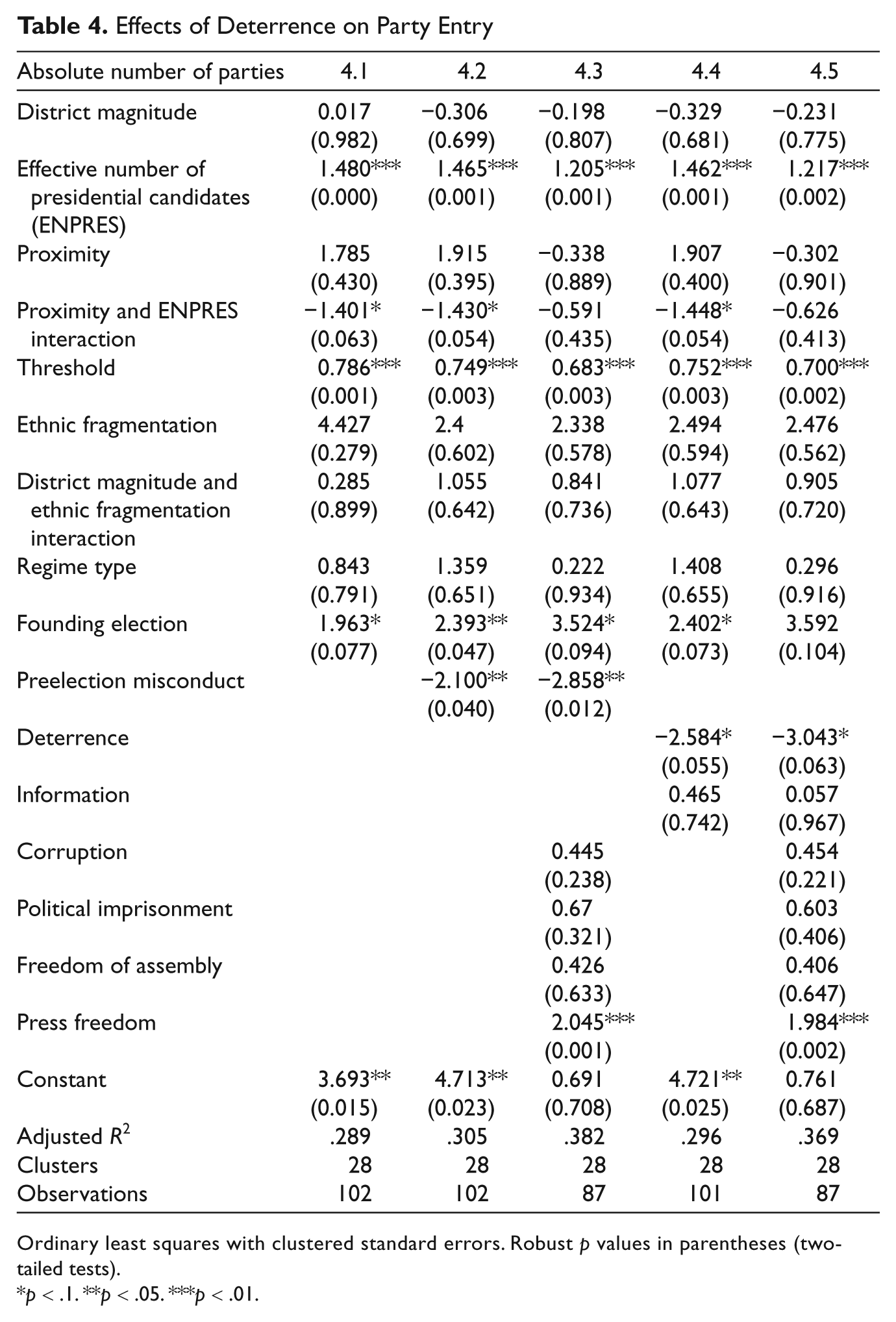
Ordinary least squares with clustered standard errors. Robust p values in parentheses (two-tailed tests).
p < .1. **p < .05. ***p < .01.
Conclusion
This article reveals that electoral misconduct occurs frequently in both democracies and nondemocracies and that it has important consequences for party systems, though some forms of misconduct are more consequential than others. Using new data on the conduct of legislative elections in Latin America and postcommunist countries, we find evidence that tools of preelection misconduct reduce ENLP below the number expected under fully competitive conditions, but ballot fraud does not. Tests of the mechanisms of our argument reveal that preelection misconduct works primarily by deterring opposition parties from competing, by deterring voters from expressing their support for the opposition, and, to a lesser extent, by restricting the information environment.
Our findings carry important substantive and theoretical implications. The fact that misconduct reduces the number of parties suggests the existence of a representation gap in countries that hold flawed elections. In these contests, citizens must choose from a restricted set of parties, and even then their votes may not count. That this representation gap is particularly severe in the presence of preelection misconduct in turn suggests ways to increase the effectiveness of international democracy promotion. The actors involved in promoting democracy should pay close attention to the conduct of electoral campaigns and should devise strategies for responding to government-sponsored intimidation and information repression.
Our findings also highlight an important qualification to the applicability of the standard institutional-sociological model of party systems. The prevalence of electoral misconduct in our data indicates that the model’s implicit assumption of perfect political competition is violated in many countries that hold multiparty elections. This fact, combined with the negative relationship we find between misconduct and the number of parties, calls into question conclusions reached in previous studies that apply this model in regions of the world where electoral manipulation is widespread. Our new data therefore allow for the correction of possible omitted variable biases and will be a useful resource for future empirical research on elections.
Our demonstration of the general relationship between electoral misconduct and party systems opens up many avenues for future research. A natural extension of our analysis would be to examine the effects of manipulation in presidential elections. Future research should also unpack the conditions under which different tools of manipulation are employed. Are some tools more prevalent than others in different institutional contexts? Are close elections more likely to experience ballot fraud? These questions remain to be explored to establish an even more nuanced understanding of how electoral misconduct conditions political competition.
Footnotes
Acknowledgements
Both authors contributed equally to this article. We thank Elias Dinas, Nikolay Marinov, Shayne Martin, Scott Morgenstern, Adam Przeworski, and Alberto Simpser for helpful comments and Shawna Metzger for valuable research assistance.
The authors declared no potential conflicts of interest with respect to the research, authorship, and/or publication of this article.
The authors received no financial support for the research, authorship, and/or publication of this article.