







Abstract
The article examines why some postconflict societies defer the recovery of those who forcibly disappeared as a result of political violence, even after a fully fledged democratic regime is consolidated. The prolonged silences in Cyprus and Spain contradict the experience of other countries such as Bosnia, Guatemala, and South Africa, where truth recovery for disappeared or missing persons was a central element of the transition to peace and democracy. Exhumations of mass graves containing the victims from the two periods of violence in Cyprus (1963–1974) and the Spanish Civil War (1936–1939) was delayed up until the early 2000s. Cyprus and Spain are well suited to explain both prolonged silences in transitional justice and the puzzling decision to become belated truth seekers. The article shows that in negotiated transitions, a subtle elite agreement links the noninstrumental use of the past with the imminent needs for political stability and nascent democratization. As time passes, selective silence becomes an entrenched feature of the political discourse and democratic institutions, acquiring a hegemonic status and prolonging the silencing of violence.
Keywords
Although Federico García Lorca is a famous desaparecido (disappeared) of the Spanish Civil War, he and approximately 30,000 “forgotten” Republican victims are still lying in mass graves. 1 Lorca’s fate epitomizes a central debate in contemporary Spanish society: Should the country “unearth” the truth about the civil war (and search for the bodies of the disappeared), or is it better to continue to “silence” the divisive past? Spain is not the only Mediterranean country dealing with the past. During the two waves of violence in Cyprus, namely, the intercommunal violence (1963–1974) and the subsequent Turkish invasion (1974), approximately 2,000 Greek–Cypriots and Turkish–Cypriots went missing. Disappearances were political acts deployed by both communities to cleanse the island of the presence of the ethnic “Other” in an effort to fulfill official political objectives. Until quite recently, there has been little effort to recover the bodies—or the truth.
Since the 1970s, the phenomenon of enforced disappearances and the ensuing demand by relatives to acknowledge the truth have shaped the development of transitional justice in societies emerging from conflict or authoritarianism. 2 The unprecedented grassroots mobilization in several South American countries of the relatives of desaparecidos seeking the acknowledgment of truth resulted in the first official bodies mandated to establish an authoritative version of human rights abuses in the mid-1980s (Neier, 1999, p. 40). For example, the strenuous efforts of the Madres de Plaza de Mayo in Argentina led to the establishment of CONADEP, a body much like a truth commission with specific emphasis on the desaparecidos; similar coordinated efforts by relatives culminated in truth commissions in Bolivia, Chile, and Guatemala, to name only a few. Since then, truth commissions have become a central tool of transitional justice (Hayner, 2002).
Moreover, the persistent efforts of the relatives’ associations led to landmark legal decisions, gradually constructing an international normative context that reserves a central position for “truth” and enforced disappearances. The most significant recent development is the 2006 International Convention for the Protection of All Persons from Enforced Disappearance (Scovazzi & Citroni, 2007). The convention is the first universal instrument of its kind and represents a breakthrough; it ascribes the inalienable right of the relatives of a missing persons to “know the truth” (Art. 24, Par. 2) 3 regarding the fate of the disappeared and the conditions of their disappearance. Hence, although the right to truth is still emerging in international law and is not explicitly stated in international treaties (Mallinder, 2008, p. 163), the crime of enforced disappearances creates specific rights to truth for victims’ relatives in several treaties.
It is in this revised normative context that such concepts as transitional justice, reconciliation, and truth recovery have become central components of the policy-making agenda. Note, for example, the recent decisions by international organizations, most important the United Nations (UN), to draw from a standard transitional justice toolbox in their peace-building initiatives (UN, 2004). Given this, it is not surprising that a growing number of postconflict countries choose human rights trials and other policies of accountability to comprehensively address the violent past, leading to a “justice cascade” (Lutz & Sikkink, 2001). Even more interesting, these normative pressures encourage societies to overturn prolonged silences, even several decades after transition, a phenomenon called post-transitional justice (Aguilar, 2008; Collins, 2010).
In the midst of this burgeoning change, Cyprus and Spain pose a complex dilemma. Contrary to the experience of other countries with disappeared or missing persons, such as Bosnia, Argentina, and Guatemala, where the mobilization of (civil) society to recover the missing persons was a central element of the transition to democracy, Cyprus and Spain remained (selectively) silent for a remarkably long period after their respective democratic governments were consolidated and are only now unearthing bodies and truths. Of interest, although Latin American societies had limited access to legal and institutional tools, they mobilized earlier and more effectively to address the demand for truth than did Spain and Cyprus, even though the latter were members of influential international organizations. One would expect societies with advanced legal instruments to be more proactive and effective in resolving human rights issues, but this was not the case.
Why do certain societies defer the acknowledgment of human rights problems even when democracy has been fully consolidated? How is this silence constructed, maintained, and perpetuated? How (if at all) do transitional justice settlements persist over time? Finally, what explains the recent efforts of a growing number of countries such as Spain and Cyprus to establish the truth and overturn prolonged silences, even several decades after the transition?
It is argued that an early elite consensus, frequently informed by political learning from past experiences, links the noninstrumental use of the past with the political and security priorities of the nascent regime. Ultimately, this leads to strong institutionalization. As time passes, a “linkage trap” is constructed, whereby selective silence becomes a well-entrenched and hegemonic feature of the political discourse and democratic institutions. Eventually, this hegemonic linkage narrows the variety of alternative policies and sidelines dissenting voices. Paradoxically, this linkage frequently provides the necessary tools for domestic truth seekers to acknowledge past human rights abuses, albeit over the long term.
The article contributes to the growing (post)transitional justice debates by highlighting the importance of domestic political actors in shaping or limiting external normative pressures. The decision of political elites to overturn prolonged silences is often informed by electoral, security, symbolic, and other domestic political considerations rather than driven by normative adaptation to external pressures. This is a gradual and often reversible process, influenced by the structure of domestic politics. The article also notes that the phenomenon of post-transitional justice is enhanced by unprecedented developments in forensic science. Uncontested forensic evidence legitimizes previously excluded voices, thereby encouraging truth-seeking initiatives to mobilize, even belatedly.
The article begins with a critical review of the literature of transitional justice, focusing on the absence of an analytically rigorous presentation of central working concepts. Drawing on the innovative tool of “elite framing,” it then explains the above-mentioned puzzles in Cyprus and Spain and sheds light on the causal mechanism through which silence over past humanitarian issues is constructed and perpetuated. It concludes with insights relevant to the study of (post)transitional justice.
Enforced Disappearances and Truth Recovery in Transitional Justice
Although the concept of truth recovery in transitional settings has gained currency over recent decades, it has been used to refer to a wide range of different—even contradictory—phenomena. It remains contested whether truth recovery constitutes a means to a higher end (i.e., reconciliation) or an end/value in itself. It is equally undetermined if truth refers to a process (i.e., truth telling) or an outcome (i.e., report of a truth commission). Nor have scholars determined whether the scope of truth is individual (micro truth) or social (macro truth).
In essence, the literature fails to address a number of ontological, epistemological, and political problems. To get around this problem, this article adopts a bifurcated view of truth recovery. On one hand, narrow truth recovery is used to refer to a minimalist conception of truth, more precisely, to forensic evidence related to the whereabouts of the disappeared or missing persons. Since the early 1990s forensic exhumations have become a conventional tool of international institutions in addressing the individual (narrow) demand for truth (Stover, Haglund, & Samuels, 2003, pp. 663-664). On the other hand, wider truth recovery indicates the official and unofficial efforts of societies emerging from conflict or authoritarian regimes to democratize the process of dealing with the past (Smyth, 2007) by broadening the accessibility to the public discourse of previously excluded voices. These range from truth commissions to tribunals, traditional justice, community storytelling initiatives, and official apologies. Needless to say, these conceptions of truth are not contradictory and frequently overlap.
Based on the Peace Accord Matrix of the Kroc Institute, Table 1 identifies a number of countries as truth seeking or non–truth seeking, relating this to the type of settlement reached—negotiated or non-negotiated. A careful examination of the table reveals the explanatory strengths and limitations of transitional justice literature. Three main groups of countries emerge from the table.
Type of Transition/Settlement and Truth Recovery for Disappeared or Missing Persons.
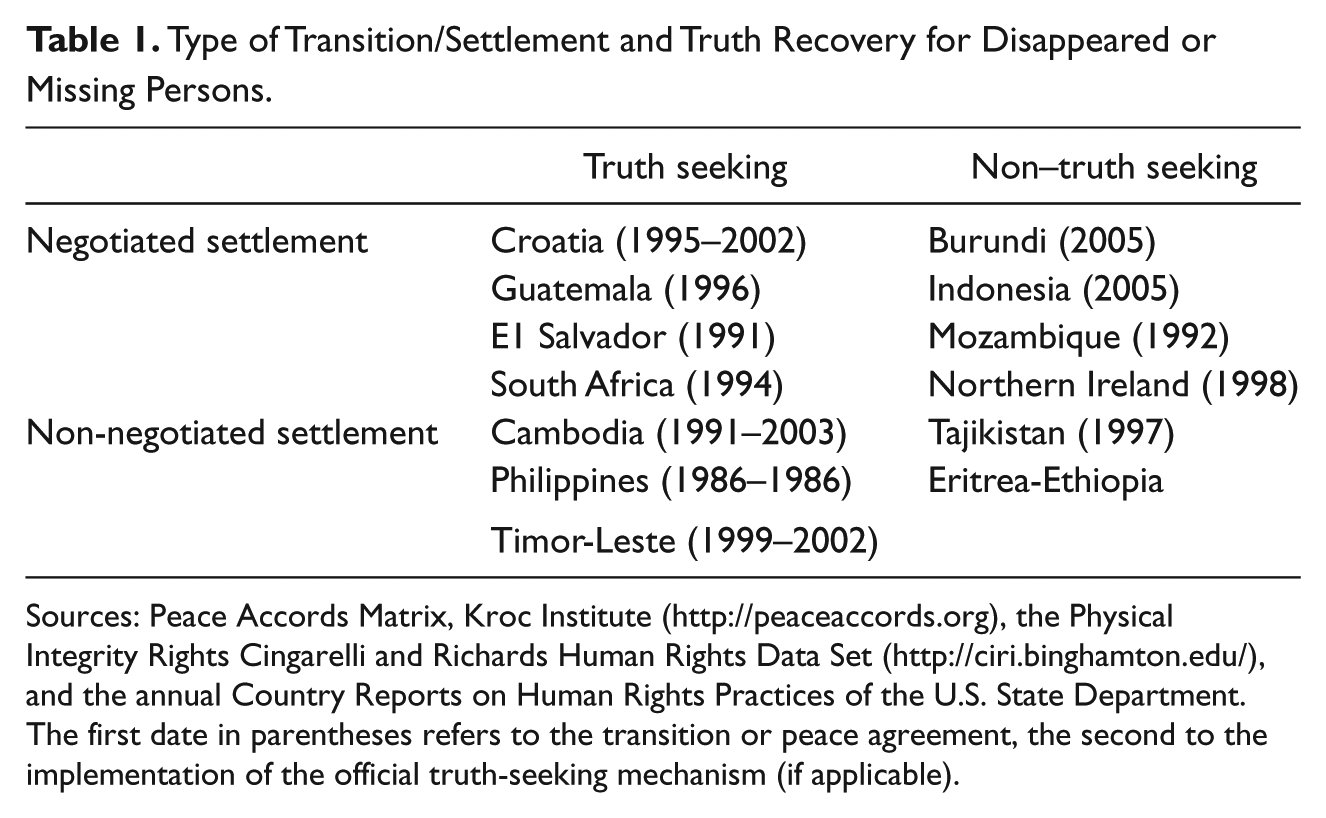
Sources: Peace Accords Matrix, Kroc Institute (http://peaceaccords.org), the Physical Integrity Rights Cingarelli and Richards Human Rights Data Set (http://ciri.binghamton.edu/), and the annual Country Reports on Human Rights Practices of the U.S. State Department. The first date in parentheses refers to the transition or peace agreement, the second to the implementation of the official truth-seeking mechanism (if applicable).
In the first group, shown in the bottom boxes, the absence of a comprehensive peace settlement, as in the case of Eritrea-Ethiopia, can explain the decision to abstain from addressing the past. Elsewhere the total victory (or collapse) of one of the parties in conflict, as in the Philippines, creates conducive conditions for the winning side to decide whether to address the past. Meanwhile, in places such as Cambodia or Timor-Leste where international involvement constitutes a central feature of transition/peace building initiatives, transition is followed by some form of (narrow or wide) official acknowledgment of the problem of disappearances, most significantly through the establishment of retributive models of accountability. The proactive involvement of international institutions includes the contribution of material resources, as well as logistic support to undertake exhumations or establish war crimes tribunals and truth commissions (Sriram, 2004, p. 25; UN, 2004) and reflects an entrenched commitment to the normative principles of transitional justice. A normative thread seems to be linking a growing number of scholars who insist that societies in transition that address human rights violations, such as enforced disappearances, are more likely to strengthen the rule of law, prevent recourse to self-help justice, develop respect for human rights culture, and educate citizenry in democratic practices (Elster, 2004; Méndez, 2001, p. 32; Minow, 2002). The growing use of the tool of human rights trials in most societies where international organizations are engaged in peace building bolsters the argument that the norm of accountability for grave human rights violations has created the “justice cascade” mentioned above (Lutz & Sikkink, 2001; Sikkink & Walling, 2007).
A second group, at the top left of the table, involves cases of negotiated transitions or peace settlements, where the transition is followed by some sort of acknowledgment of the problem of the disappeared. 4 It seems that a significant number of countries have opted to acknowledge human rights abuses despite the fragility of the peace/democratization processes. In fact, certain landmark cases that have shaped contemporary debates on transitional justice, such as Argentina and Chile, could have been included in this box. It is revealing that all societies who experienced a pacted transition and decided to come to terms with their past—with the exception of Croatia—chose the establishment of a truth commission over measures of retributive justice. In essence, this column (partly) reaffirms the view of a growing number of scholars who include truth commissions as novel and superior tools in the transitional justice toolbox (Hayner, 2002). Truth commissions have historically been seen as “second-best” alternatives, located somewhere between the impossibility of retributive justice prohibited by the pacted nature of the transitions and the growing demand for truth in societies with missing persons (Neier, 1999, p. 40). More recently, truth commissions have been transformed; their functions include the ability to restore the dignity of victims, to uproot long-standing myths that bolster violence and cultures of victimhood (Rotberg, 2000), and to break the cycles of violence (Minow, 2002), thereby becoming a central instrument of transitional justice (Brahm, 2007; Hirsch, 2007).
But that is not the whole story. One would expect that in the post-1989 period, when the tools (including binding legal instruments, the centrality of human rights on the international agenda and DNA testing) were available to recover the (narrow or wider) truth about missing persons, more societies in transition would have acknowledged the truth and provided societal closure. But as the third group, shown at the top right of the table, reveals, more than half the countries that experienced a negotiated transition have resisted—for the time being—these external pressures. In fact, as the experiences of Mozambique and Northern Ireland indicate, they have primarily designed policies based on amnesties and silence. A number of realist scholars subscribing to the “logic of consequences” (Snyder & Vinjamuri, 2003) have long argued that because transitions and peace agreements are fragile processes, any effort to comprehensively address the past may upset “spoilers” who perceive truth recovery initiatives to be blatant scapegoating and thus endanger the transition (Snyder & Vinjamuri, 2003). In essence, these scholars insist that scrutinizing the past is not a normative decision but a political one, and, as such, any measure that could contribute to the stability and consolidation of the regime could legitimately be used, even if this requires the adoption of amnesties, impunity, forgetting, and silence (Cobban, 2006; Mallinder, 2008; Mendeloff, 2004).
Spain and Cyprus are outlier cases and would not fit well into the table. Spain would have initially been included in the top right quadrant. During the transition to democracy (1975), Spanish society and political elites decided to establish a “pact of silence” and literally and figuratively bury these complex issues. Still, in a remarkable volte-face, 70 years after the conclusion of the civil war and almost 30 years after the consolidation of democracy, Spain started digging into its past (Aguilar, 2008), moving it to the top left box. For its part, Cyprus is the only case where despite the absence of a political settlement of the conflict, a successful mechanism has been established to address the demand for (narrow) truth recovery of Turkish–Cypriot and Greek–Cypriot missing. It therefore makes sense to use these two societies to comprehensively test the central arguments of transitional justice literature.
With the exception of Northern Ireland, the literature of transitional justice has focused on “success stories” (i.e., where truth recovery is central in the transition) such as South Africa, the former Yugoslavia, and Guatemala (Thoms, James, & Paris, 2008). Little notice has been taken of cases where the truth recovery for missing persons and transitional justice has been absent, such as Cyprus and Spain. Moreover, by focusing explicitly on the period of transition, or immediately following it, the literature has failed to notice that although societies during transition may decide to defer the solution of human rights issues, this does not necessarily mean that a demand to acknowledge this will not emerge in the future.
Furthermore, the transition in Spain and the cessation of hostilities in Cyprus took place well before the above mentioned normative turn in the 1990s. Rather, they occurred at a time when foreign intervention for human rights was minimal, thereby making these two countries instructive examples on how societies can manage humanitarian problems in the absence of the “international factor.” Finally, the time lag permits us to draw safer conclusions, test alternative hypotheses, and examine causal patterns of silence versus nonsilence over human rights abuses, than if we use more recent cases. For all these reasons, Cyprus and Spain are well suited to explain both prolonged silences in transitional justice and the decision to become belated truth seekers.
Political Learning, Negotiated Transitions, and Silences
In societies emerging from conflict, the guidelines for what will be remembered and what will be excluded from public discourse are drawn up during the transitional period. Therefore, the study of transitions provides useful insights into the (non)solution of human rights problems and the long-term effects of transitions. As Figure 1 indicates, elite consensus is significantly facilitated—often dictated—by transitions that result from a pact between the major political forces. In cases of pacted transitions, there is a need to set a least common ideological denominator on which to build the consensus for the new political regime.
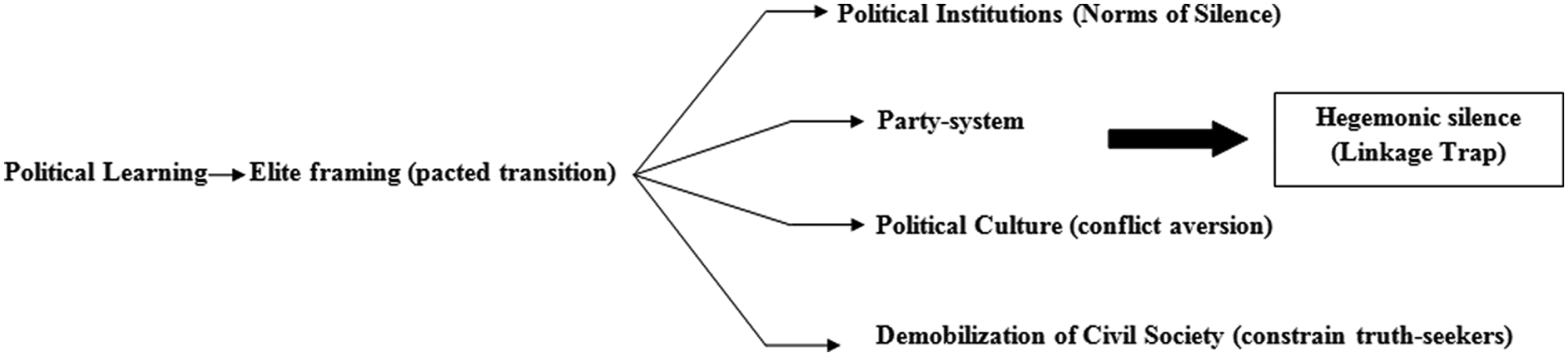
Schematic presentation of the construction and maintenance of (hegemonic) silence.
A decision to silence contentious incidents of the past, such as the Spanish Civil War, or to “selectively remember” the past in a way that accentuates a culture of victimhood, as in Cyprus, is frequently identified as the most appropriate basis for consensus in transitions to democracy. More than politics is at stake here. The burgeoning field of “memory studies” has shown that a common feature of posttraumatic societies is the conscious decision to forget certain painful aspects of the past (Brewer, 2010, p. 147; Connerton, 2008, p. 60). In a notable case study commonly used in transitional justice literature, post–World War II (West) Germany’s transition in the 1950s is characterized by the social amnesia of Germans—forgetting what they did and also what was done to them (Misztal, 2005, p. 1327).
A subtle agreement is frequently reached between parties previously in conflict to “link” the nonuse of the bitter past to the political arena in exchange for a commitment to the new democratic political regime. Since negotiated transitions are perceived to be second-best alternatives for all parties, contentious issues such as truth recovery are often excluded; public debate raises the issue of responsibilities and might easily become a “blame game,” endangering the whole agreement. For example, in Northern Ireland, the IRA remains skeptical of opening a formal truth recovery process on the issue of the disappeared, as this would raise the thorny issue of responsibilities (Guelke, 2007, p. 285). In this way, silence or selective memories become ingrained in political discourse. As noted, eventually, the elite framing becomes institutionalized and hegemonic; this may be the most effective path to peace, stability, and democratic consolidation, but it decreases the prospect and scope of truth recovery.
The process of consensus building described here is often facilitated, even dictated, by the painful experiences of the past which act as political lessons at crucial historical junctures, such as transitions. 5 According to Bermeo (1992), “Crises often force people to re-evaluate the ideas that they have used as guides to action in the past. The changed ideas may relate to tactics, parties, allies, enemies, or institutions” (p. 274). As Bermeo sees it, a lesson can be learned by considering similar experiences of other countries in the international arena (horizontal lesson) or considering a similar preceding period in a society’s history (vertical lesson).
Elite settlements, although providing a conducive environment for promoting democracy and peace, not to mention the ideal environment for resolving urgent problems (economy, reconstruction, institution building), are achieved at the expense of the quality of the emerging democracy. Negotiated transitions tend to concentrate power in the hands of a few political elites and inhibit open democratic procedures; they restrain the development of a vibrant civil society and slow the development of political and civil rights (Encarnación, 2003; Licklider, 1995, p. 685; Linz & Stepan, 1996, p. 56).
The most significant side effect of pacted transitions is the demobilization of civil society. Main sources of truth seeking in postconflict or postauthoritarian regimes are vocal civil society groups associated with the victims; in negotiated transitions, such as Cyprus and Spain, these remained silent. As noted above, in both Cyprus and Spain an early elite consensus to link the noninstrumental use of the past with the need for political stability led to the creation of a hegemonic discourse. Once a frame becomes hegemonic, inconvenient questions that contravene or challenge it are excluded from public debate. As Ian Lustick (1993) says, hegemonic discourses “exclude outcomes, options or questions from public consideration” (p. 121). This does not mean that frames are permanent or immutable: New legal, scientific, economic, or political developments may force elites to slightly revise their proffered frame to sustain its hegemonic role and prevent its crumbling. However, if the intensity and significance of the new developments outshine the ability of frame makers to incorporate them smoothly in the existent frame, then the hegemonic frame loses its explanatory value and collapses.
Method
Elite framing is a useful tool to study the policy outcomes that prevent truth recovery. The framing process has two analytical components. The first stems from the need to identify the source(s) of the problematic situation and attribute responsibility: This could be termed “legitimizing framing” (Benford & Snow, 2000). It presumes that the present situation is unjust, and grievances are the result of the actions of another agent or conditions outside the control of the “in-group” (Gamson, 1992; Klandermans, 1997). The second, “motivational framing,” derives from the need to change the problematic situation; it leads to the creation of a strategy to accomplish change (Benford & Snow, 2000).
Framing “select[s] some aspects of a perceived reality and make[s] them more salient in a communicating text, in such a way as to promote a particular problem, definition, causal interpretation, moral evaluation, and/or treatment recommendations” (Entman, 1993, p. 52). The primary function of frames is to “organize experience and guide action” (Snow, Rochford, & Benford, 1986, p. 464); thus, a core element of the framing process is the degree of instrumentalization in the definition of an issue. The framing process determines “reality” because of its ability to highlight certain aspects of reality while ignoring others (Benford & Snow, 2000). As Entman (1993) aptly notes, “The frame determines whether most people notice and how they understand and remember a problem, as well as how they evaluate and choose to act upon it” (p. 54). Because policy makers and ordinary people deploy these simplified mental images to interpret social events and choose among alternative courses of action (Tetlock, 1998, p. 876), framing is a useful tool for analyzing certain aspects of a conflict, in this case truth recovery for missing persons. 6
In this article, I employ an innovative, multimethod approach to “elite framing” (Benford & Snow, 2000), drawing on an extensive and comprehensive study of parliamentary speeches in two countries over the past three decades. This analysis is coupled with process tracing to identify the causal mechanism by which the specific elite framing adopted during transition prevented the scope of truth recovery in Cyprus and Spain (George & Bennett, 2005, p. 215). In the wide-ranging archival work that preceded the analysis, I read parliamentary debates, seeking to trace the construction of elite discourse(s). I also had limited access to classified documents from the Cyprus House of Representatives and memos prepared for the Ministry of Foreign Affairs of the Republic of Cyprus. Finally, I examined party documents, such as electoral programs and party memoranda. All these helped me to determine the development of the political discourse. The interviews I conducted with politicians shed light on why certain policies were chosen over others at specific junctures; and my interviews with individuals with privileged information allowed me to “triangulate” my hypotheses.
The study of parliamentary debates has several advantages. For one, it allows the analyst to pinpoint a certain framing that is adopted at a very specific time; actors cannot retrospectively change their positions to suit temporal changes in context (Loizides, 2009). For another, it facilitates process tracing, or the construction and maintenance of elite discourse over the long term.
Spain: Disappeared and El pacto de silencio
What becomes apparent from the Spanish parliamentary debates is that the issue of the desaparecidos was not raised until the early 2000s. 7 This prolonged silence poses a methodological problem in the elaboration of the elite framing. To overcome it, I pursue two complementary paths. First, I analyze the debates on other victims’ groups: those mutilated in the civil war, the widows and children of the fallen, and ex-prisoners. I consider the difference between the treatment of their demands and the silence over the issue of desaparecidos and relate this to elite framing. Second, I examine the debates on the Amnesty Law (1977), generally perceived to be the founding tenet of the transition. The two sets of analyses, coupled with my interviews of members of the designated parliamentary commission and my study of electoral programs, overcome this methodological concern.
The debate on the Amnesty Law of 1977 is revelatory of “legitimizing framing.” In it, the civil war is presented as a period of “collective madness” where both sides committed heinous crimes. The attribution of responsibility is strictly avoided: Clearly, there is no “rational” actor to blame for the immense tragedy (Aguilar, 2002). An example of this diagnostic framing appears in the words of the spokesperson of the governing party, Unión de Centro Democrático (UCD); in a 1978 reference to the debated law on pensions for widows and orphans, Bravo de Laguna Bermudez says,
[T]hose widows and orphans that today we talk about . . . are not merely widows or orphans of the communists, of the socialists, or anarchists, but widows and orphans of the tragic Spain. . . . We can give different explanations about what happened between 1936 and 1939, but in any case, it was a national tragedy. (Parliamentary Debates No. 141, November 23, 1978, pp. 5576-5578)
He goes on to proffer strategies to alter the situation (“motivational framing”). In effect, two central framing strategies link the silence on humanitarian issues with the legitimacy of the transition: the establishment of a wide political consensus to bury the divisive past and achieve reconciliation, seen as a precondition for democratic consolidation, and the adoption of an instrumental rationale for redressing victims groups’ (material) needs for closure.
The element of learning from past experiences is evident in the speeches on the Amnesty Law and the Draft Law. The former law is framed as the symbolic closure of a prolonged period of divisions and the beginning of a new democratic era. During its debate, a representative of the Socialist Party insisted, “Today is the date, in which finally, the civil war is buried” (Parliamentary Debates No. 24, October 14, 1977, pp. 965-968). Throughout the parliamentary records, the need to bury the past is seen as the distilled experience of painful lessons, even by the representatives of the “defeated,” most notably communist leader Santiago Carillo (Parliamentary Debates No. 5, July 27, 1977, pp. 73-76). In the interviews I conducted with members of the Designated Parliamentary Committee for drafting the Law on Historical Memory in 2004, almost all still subscribed to this prognostic framing, saying that an agreement to bury the past was mandatory at the time (anonymous interviews, May 6, 2009, and May 18, 2009).
The other tenet of motivational framing highlights the instrumental rationale of accommodating the victims groups’ demands. More specifically, reparations are granted to certain groups not as an acknowledgment of their suffering or their contribution to a noble cause but to comfort the disaffected, including reparations to widows and orphans (Parliamentary Debates No. 141, November 23, 1978, pp. 5575-5576) and military pensions (Royal Decree 6/1978). In part, these are acts of benevolence—not justice. They are perceived as solving problems not covered by the Amnesty Law; therefore, they are treated as solutions that will enable closure (punto final) and accelerate the processes of national reconciliation and democratic consolidation (Aguilar, 2008, p. 420).
Still, desaparecidos are excluded from this framing. Oddly enough, at approximately the same time as the amnesty debates, unofficial exhumations were carried out in Spain. My archival research shows that from 1977 and throughout this first step toward democracy, exhumations took place around the country. In fact, a popular magazine of the time, Interviú, 8 featured detailed coverage of the efforts of the relatives of desaparecidos to exhume the graves and provide their loved ones with a decent burial (Interviú, December 21, 1978, January 3, 1980). Although in other transitional places (Latin America), these grassroots processes have led to strong social movements, in Spain they lost momentum and succumbed to the overriding hegemonic discourse.
Why was the issue of desaparecidos silenced when the demands of other victims groups were accommodated? I have two overlapping responses, the first focusing on the top echelons and the second on the grassroots, both related to the side effects of the specific elite framing.
First, political exhumations (“narrow truth”) or policies of acknowledgment (“wider truth”) for the desaparecidos and the political violence would have raised questions of political responsibility. Asking and answering the question “Who did what to whom?” had the potential to derail democratic consolidation. Therefore, any truth-seeking initiative was out of the question because it contradicted the raison d’être of the proffered framing, namely, to abstain from using the past as a political argument in debates.
A second overlapping explanation considers the meager participation of Spaniards in civic associations, a phenomenon described by Omar Encarnación (2001, p. 63) as “civic anemia.” More than 20 years after the consolidation of democracy, only one in three Spaniards belongs to any voluntary association, levels similar to the postcommunist regimes of Eastern Europe (Encarnación, 2001, p. 63). For one thing, the legacy of the (pacted) transition led to the demobilization of the civil society, thereby hindering truth seeking. For another, an endemic feature of Spanish political culture is the penetration/control of all sorts of civic associations by political parties, primarily through financial means (Encarnación, 2003). To some extent, political parties have determined the agenda of the associations and defined their scope. As the early elite framing became institutionalized and “hegemonic,” it narrowed the conception of national interest at the top and silenced grassroots practices that could contravene it. An indication of the hegemonic status of the discourse is its institutionalization in legislation and legal decisions. Ryan says that in 1979, an individual involved in an unofficial exhumation was reprimanded for carrying out “illegal exhumations” (Ryan, 2009, p. 123). The legal institutionalization of this hegemonic belief is even obvious in the contemporary wave of exhumations. In a recent motion, Judge Baltázar Garzón argued that the systematic nature of the crime constitutes a crime against humanity, and therefore the 1977 Amnesty Law is inapplicable to cases of enforced disappearances (Motion 399/2006). The possibility of overturning the founding tenet of the transition, namely, the Amnesty Law, sparked heated political debate and opened up the prospect of Garzón’s expulsion.
The case of Garzón can be fully understood only within the wider post-transitional justice context in Spain (Aguilar, 2008). More precisely, since the early 2000s, several grassroots organizations of relatives have mobilized to unearth their disappeared ancestors, provide them with a decent burial, clear their reputation, and acknowledge the corresponding (republican or democratic) version of truth about the Spanish Civil War (Ferrándiz, 2009; Gálvez-Biesca, 2006). 9 The mobilization of the generation of the grandchildren of the disappeared exerted bottom-up pressure on the socialist government, leading to the passage of the Law on Historical Memory, which addressed central issues of transitional justice: denouncing Franco’s regime, banning public symbols that commemorate Franco or his allies, mandating local governments to finance exhumations of mass graves, declaring “illegitimate” the summary military trials held during the civil war and Francoist dictatorship, and offering other measures of moral, symbolic, and economic repair to all victims of the war (Law 53/2007).
In other words, more than three decades after the consolidation of democracy in Spain, a specific framing was ingrained in political institutions, the political system and legislation. Simply stated, until recently its hegemonic status prevented truth recovery. It is surprising, however, that the prolonged silence was finally broken. Proof of this is the passage of the Law on Historical Memory and its fuelling of media and public debates.
Cyprus: Selective Memory and Missing Frames
Tracing the elite framing of the problem in the Republic of Cyprus over the past decades reveals a number of downplayed or silenced issues. Take, for example, the official definition of the missing. Until 2003, a missing person was considered to be a “Greek–Cypriot who is still missing since the July 20th 1974, due to the Turkish invasion . . . and the state has no positive information that s/he died” (Law Number 77/1979). Two interesting features of motivational framing are evident in this definition. First, the beginning of the problem of missing persons coincides with the Turkish invasion (July 20, 1974), thereby indicating a conscious decision to causally link the issue of the missing with the invasion. Since 1974, 12 resolutions by the House of Representatives have assigned sole responsibility to Turkey; all were adopted unanimously (Resolutions 37/1975, N.46/1978, N.58/1980, N.113/1992, N.124/1997). Second, the Turkish–Cypriots who went missing as a result of the atrocities of Greek–Cypriot paramilitaries in the 1960s (Patrick, 1976) are excluded, even though they are citizens of the republic.
In other words, selective memory (or selective oblivion) became a founding tenet of the pact that facilitated the transition to peace and democracy in the Republic of Cyprus after the 1974 invasion. References to cases of missing persons, either Greek–Cypriots or Turkish–Cypriots preceding the Turkish invasion, would have seriously delegitimized the predominant discourse that identifies the Turkish invasion as the cause of the problem.
Motivational framing can explain the tactics of political elites in the addressing of the problem of the missing. They used two overlapping framing strategies: one emphasizing national unity and reconciliation by strengthening the institutions of the republic as the only way to overcome the legacy of intracommunal division of the past within the Greek–Cypriot community and restore credibility to the Republic of Cyprus; the other using the symbol of wounds opened by the Turkish invasion to accentuate a “culture of victimhood” and enable the construction of a new common basis of “unity” for the Greek–Cypriot community.
Although the Turkish invasion is used as the focal point of the framing, it was preceded by growing intracommunal violence within the Greek–Cypriot community culminating in a short coup ousting President Makarios. 10 Leftists, frequently treated as traitors, were the targets of violent attacks during the anticolonial struggle of EOKA (Eθνική Oργάνωση Kυπρίων Aγωνιστών—National Organization of Cypriot Fighters); 11 these peaked during the coup (Papadakis, 1993). A number of civil society initiatives representing the relatives of those killed have recently emerged demanding that the state apologize for the human rights violations of leftists (Ireton & Kovras, 2012). The legacy of intracommunal violence was so traumatic that it continues to create political cleavages within the Greek–Cypriot community. Nevertheless, in the overall “Cyprus problem,” even left-wing parties who suffered from nationalist violence have subscribed to the frame prioritizing “national unity.” For example, on the first anniversary of the coup, when the memories of the intracommunal violence were still fresh, the leader of the communist party AKEL officially declared that his party would “keep the flag of patriotic unity high” (Parliamentary Debates July 15, 1975, p. 581). The Cypriot Communist party echoed PCE’s conciliatory tone in Spain, mentioning the need for concessions (“silences”) to pave the way for democracy.
The Turkish invasion led to a revised framing, one focusing on unity and the traumas of the invasion. The missing became the central symbol of ongoing suffering, and political elites invested political capital in this framing. The official name of the designated parliamentary committee on missing persons (established in 1981), the Committee on Refugees-Enclaved-Missing and Adversely Affected Persons, underscores this political strategy. By linking all aspects of victimhood triggered by the Turkish invasion, it was expected to frame the problem in human rights terms, thereby enhancing international sympathy for the Greek–Cypriot negotiating position in the search for a political settlement to reunify the island.
As might be expected, the elite framing, in combination with the (de facto) division of the island in Cyprus facilitated the creation of a “highly censorious environment,” one “marked by taboos, intolerance and vilification of views deviating from the predominant governmental discourse and the official views of history” (Faustman, 2009, p. 34). As in Spain, this culture has fettered the development of a vibrant and vocal civil society (Mavratsas, 2003), which, as noted above, is a source of truth seeking. Even the official organization of the relatives of the missing has interpreted human rights through the lens of national interests. In other countries with disappeared or missing persons, such organizations are the main sources of truth seeking; but in the Greek–Cypriot community, they blocked truth recovery (Kovras & Loizides, 2011). For example, in the mid-1990s, the relatives’ association objected to the government’s intention to exhume common graves in two Greek–Cypriot cemeteries on the grounds that this would lead to a “cover-up” of the problem (Kovras & Loizides, 2011; Sant Cassia, 2005).
Despite the absence of a political settlement, in 2004 a bicommunal agreement was reached to resume the activities of the hitherto ineffective Committee on Missing Persons (CMP). “De-linking” humanitarian issues such as the missing—where the Republic of Cyprus had a moral advantage—was previously considered likely to weaken the overarching Greek–Cypriot political strategy for the reunification of the island. However, lessons learned from past policy failures by chief policy makers, technological advancements that supported a revised policy, and the domestication of new (legal and human rights) norms all contributed to the resumption of the CMP. 12 It has now become one of the most successful bicommunal project on the island (UNFICYP, 2007). By August 2010, 690 bodies had been exhumed and 248 identified (CMP, 2010).
In addition, although the elite framing retained its founding tenets, it became less rigid and began to acknowledge the victimization of Turkish–Cypriots. Paradoxically, a dual framing process has facilitated the exhumations and the demand for (narrow) truth recovery. On one hand, although the wave of exhumations is seen to reaffirm the dominant discourse of Greek-Cypriot victimhood—that is, every exhumation is an evidence of the Turkish aggression—there is strong incentive to encourage the effective working of the CMP. At the same time, the slightly revised framing that encompasses the Turkish–Cypriot missing has led to institutional measures that introduce the (relatives of the) Turkish–Cypriot missing as legitimate political actors. This development has transformed the normative context within which domestic actors interact, leading to the support of the CMP even by actors or politicians who previously had reservations. Despite the remaining political stalemate, the developments on the missing have instilled in the public and political discourse critical reevaluation over responsibilities for the past—an element previously “missing.”
Lessons for (Post)transitional Justice
The study finds that an early elite consensus and its institutionalized discourse is a double-edged sword in negotiated transitions. On one hand, the deep institutionalization of the consensus excludes dissenting voices and prevents early truth recovery. On the other hand, it may be a necessary evil to achieve a minimum level of democratic consolidation and peace. Labeling this a “linkage trap,” I note that in negotiated transitions, a subtle elite agreement links the noninstrumental use of the past with the imminent needs for political stability and nascent democratization. Gradually, this silence is ingrained in the political institutions and the political culture; ultimately, this framing acquires a hegemonic status that is hard to challenge. But in the long term, this silence may be a necessary precondition for democratic consolidation. Alternatively put, there is an inherent paradox in consensual institutions: They are oriented toward reproducing the consensus (hegemonic belief), which silences the victims and civil society at large, but at the same time they cultivate democratic institutions that provide the tools necessary for domestic truth seekers (such as civil society groups) to promote truth recovery and (post)transitional justice, albeit in the long term.
Given this logic of consequences, political parties representing or affiliated with victims’ groups frequently hesitate to deal with the past, even if they assume power in the nascent democratic regime. The cases of PSOE and AKEL, in Spain and Cyprus, respectively, are not exceptional. The consecutive socialist governments (1981–1989 and 1993–2004) in Greece, while representing a significant number of those defeated in the Greek Civil War, have abstained from addressing the past. The same applies to Chile. In the aftermath of the 1989 referendum that ousted Pinochet, the center-left Concertación coalition governed for four terms but made only marginal moves toward official acknowledgment of the past (Sandbu, 2010). Political parties representing the defeated or past victims may prefer to disappoint their electoral constituents rather than trigger instability and endanger overarching objectives (e.g., democratic consolidation, economic development, or reconstruction of state infrastructures).
However, this is just one part of the story since at different post-transition periods, these same parties may decide to break the silence and campaign in the interests of victims groups. For example, during his presidency in Argentina (2003–2007), Néstor Kirchner introduced measures calling for greater scrutiny of the past, most notably by declaring the “full-stop” and “due obedience” laws as null and void, as well as reopening trials for human rights abuses—including disappearances (“A Full Stop Removed,” 2003). Similarly, in Uruguay, despite two referendums that rejected the annulment of the amnesties for human rights abuses during the military from 1973 to 1985, President Vázquez campaigned to abolish the amnesty law, arguing that it violated Uruguay’s obligations under international human rights treaties (“Human Rights in Uruguay,” 2010).
Hence, silence is not an irreversible feature of national politics and collective memories. In fact, there is a growing trend in posttraumatic societies to revise the pacts of silence, even after a considerable delay, which reflects the broader normative turn in international politics. In the period preceding the end of the cold war the overarching priorities of maintaining global order and stability made amnesties and silence over human rights abuses constitutive elements of peace agreements (Newman, Paris, & Richmond, 2009). Since then, though, the global diffusion of human rights norms (Risse & Sikkink, 1999) has increasingly dictated the inclusion of human rights provisions into peace settlements. As Christine Bell’s (2008, p. 243) systematic study of more than 600 peace agreements since 1990 has shown, the emerging normative consensus perceives amnesties as an exception to the norm of accountability. New normative requirements on the content of peace settlements are explained by the proactive role of the most influential international institutions in combination with the emergence of vocal transnational advocacy networks which exert pressure for their implementation. In essence, these external normative pressures have rendered blanket amnesties obsolete, changing the nature and the content of elite bargaining in peace processes and democratic transitions (Lutz & Sikkink, 2001). The growing deployment of normative tools to address the past in peace agreements is also evident by the decision of an increasing number of countries undergoing negotiated transitions to deal with their violent past, a phenomenon reflected in increased number of truth commissions (Hirsch, 2007).
This revised normative framework not only informs the content of pact making but also, as the experience of several South American societies has indicated, legitimizes domestic truth seeking actors to exert bottom-up pressure in a way that overturns enduring amnesty laws and challenges decades-long silences (Collins, 2010). In other words, the agenda of international politics (and law) has considerably changed since the historical examples of Cyprus and Spain. The new norms prevent silence from being institutionalized and bring an end to oblivion and denial in societies with well-entrenched cultures of silence. In the period preceding the normative turn of 1990s, it would have been unimaginable for any Spanish government to pass a law that would address several (post)transitional justice measures or challenge the legitimacy of the Amnesty Law of 1977—perceived as the founding tenet of the post-Francoist Spanish democracy.
The landmark memory law in Spain should not be attributed exclusively to external influences. It also resulted from the sustained efforts of a number of grassroots groups who had been trying since the early 2000s to unearth the bodies of the desaparecidos of the civil war. These efforts were ultimately embraced by influential domestic allies, including political parties, judicial authorities and media, and resulted in officially implemented measures of (post)transitional justice (Ferrándiz, 2009). Similarly in Cyprus, the resumption of the CMP was preceded by the strenuous efforts of bureaucrats within the Ministry of Foreign Affairs who perceived the external influences as an opportunity to implement a policy of (narrow) truth recovery. However, this policy has not led (yet) to the crumbling of the hegemonic silence—only its substantial revision.
The experiences of Cyprus and Spain reveal that the role of domestic actors is crucial in taking advantage of (or resisting) external influences; even when a decision to overturn silence is made, this is not a linear or predetermined process, but gradual progress with many pauses and backward steps. Brazil verifies this; 25 years after the end of the dictatorship, the proposal of the popular President Lula to establish a truth commission on the disappeared triggered a fierce reaction from the military and was subsequently withdrawn (“Don’t Look Back,” 2010). However, in 2012 a truth commission was eventually set up by President Rousseff. This is a central feature of other post-transitional justice societies, such as Chile and El Salvador (Collins, 2010).
External opportunities depend on domestic politics and vice versa. This point echoes Putnam’s (1988, p. 430) “two-level game” theory: international pressure “expands domestic win-sets,” and as such constitutes a necessary condition for a policy shift, but “without domestic resonance” this is insufficient. The decision of political elites to revise a well-entrenched framing is often shaped by electoral, security, symbolic, and other political considerations, rather than explained exclusively by normative adaptation. Drawing on the same theoretical framework, Martin and Sikkink (1993) have highlighted the importance of domestic constituencies in filtering external pressures in several Latin American countries. Although the study acknowledges the power of external normative pressures in bringing about post-transitional justice and the erosion of prolonged silences, it also highlights the pivotal role of domestic politics in utilizing or resisting these normative influences, a point frequently disregarded by the prescriptive orientation of the literature. Most important, the study fits in with a broader trend toward bridging the gap between the international and comparative politics (Caporaso, 1997); it shows how international norms have come to revise the nature of pact making, while highlighting the importance of domestic actors and institutions.
Another issue raised by the comparative analysis of Cyprus and Spain relates to the nature of truth in transitional settings. Even the most celebrated venues for screening the past, such as truth commissions or trials, analyze or incorporate individual “truths” through a kaleidoscopic view of the past that seeks to establish a new mental framework to make sense of complex and confusing past events (Wilson, 2003, p. 370). Frequently, the mandates of truth commissions delimit the scope of enquiry, either by focusing exclusively on the study of specific human rights violations or by considering a very specific period of violence (Chapman & Ball, 2001, p. 4). For example, some transitional states have mandated truth-finding mechanisms to investigate only disappearances, excluding other crimes, such as torture, arbitrary detention or sexual abuses of women, as the cases of Argentina and Uruguay reveal (Chapman & Ball, 2001, p. 4). In this way, truth-seeking initiatives contribute to a narrative construction that privileges certain memories, victims’ groups, or political parties at the expense of others. Trials and truth commissions frequently exclude, obscure, or marginalize other accounts that contravene this overarching framework. Therefore, it is important to highlight that although truth seekers challenge hegemony, they also construct a new one, and this new hegemony may be full of blind spots.
In Cyprus and Spain, the advancement of forensic sciences has made an important contribution to truth discovery. On one hand, forensic evidence establishes hard facts about the past violence that legitimizes previously excluded voices. On the other hand, forensic evidence from exhumations creates more (discursive) space for multiple—but equally legitimate—truths to enter public debates. The ability to unearth the (narrow) truth about the past in a scientifically sound way paved the way for the acknowledgment of the suffering of the Turkish–Cypriot missing. Forensic truth coupled with the global normative context encourages the emergence of multiple versions of truth about the past. This enhances the prospects of (narrow or wider) truth recovery in postconflict settings and suggests the need for overturning prolonged silences.
Conclusion
In negotiated transitions, a subtle elite agreement linking the noninstrumental use of the past with the political and security priorities of the transitional society is often achieved. As time passes, a “linkage trap” is constructed, where selective silence over the past becomes a well-entrenched feature of the political discourse and democratic institutions. As soon as this framing becomes hegemonic, dissenting voices are silenced; it also narrows the conception of national interest and inhibits the solution of human rights issues, even when new windows of opportunity open. At first glance, we conclude that this situation leads to a deadlock. However, as the hypothesis of “linkage paradox” shows, in the long term, the linkage of (i.e., the silence on) human rights issues to the elite pact that serves as the founding tenet of transition becomes the most efficient way to unearth the truth. More precisely, this silence enables the consolidation of strong democratic institutions, which, in turn, provide the institutional tools to (domestic) truth seekers to put forward a comprehensive truth recovery, when such a societal demand emerges.
A policy of reviewing the past cannot be implemented without societal consensus that this is a priority. The fascinating transformation of an inoperative humanitarian body for more than two decades into the most successful bicommunal project in Cyprus and the vocal demand of the generation of the grandchildren of the desaparecidos in Spain to unearth the remains of their grandparents 70 years after the conclusion of the civil war reflect the emergence of a new societal consensus. In both countries, domestic actors challenged the long-standing hegemonic silence, reaffirming the growing phenomenon of post-transitional justice in international politics and reflecting the new normative turn seen round the globe.
Footnotes
Acknowledgements
I am grateful to Neo Loizides, Adrian Guelke, Dimitri A. Sotiropoulos, Kathleen Ireton, Katia Andronikidou, Evan Liaras, and Elizabeth Thompson for their comments on previous drafts of this article. I would also like to thank the Comparative Political Studies editorial team, especially Professor James Caporaso and the two anonymous reviewers, for their insightful feedback.
Declaration of Conflicting Interests
The author declared no potential conflicts of interest with respect to the research, authorship, and/or publication of this article.
Funding
The author received no financial support for the research, authorship, and/or publication of this article.