







Abstract
The article offers a systematic analysis of the comparative trajectory of international democratic change. In particular, it focuses on the resulting convergence or divergence of political systems, borrowing from the literatures on institutional change and policy convergence. To this end, political-institutional data in line with Arend Lijphart’s (1999, 2012) empirical theory of democracy for 24 developed democracies between 1945 and 2010 are analyzed. Heteroscedastic multilevel models allow for directly modeling the development of the variance of types of democracy over time, revealing information about convergence, and adding substantial explanations. The findings indicate that there has been a trend away from extreme types of democracy in single cases, but no unconditional trend of convergence can be observed. However, there are conditional processes of convergence. In particular, economic globalization and the domestic veto structure interactively influence democratic convergence.
Keywords
Arend Lijphart’s career spans nearly half a century and has been dedicated to the study and understanding of democratic regimes and constitutional change. Democracies (1984) set out his first major analysis of patterns of majoritarian and consensus governments. This was later revised and expanded in Patterns of Democracy (1999, updated 2012); while Thinking About Democracy (2008) contains thoughts and reflections regarding his methodology and conclusions. Put simply, Lijphart’s central thesis is that democratic systems can be placed on an axis, which has majoritarianism at one extreme and consensualism at the other. Most democratic systems, Lijphart suggests, can be located on a continuum between these poles. The classic examples of these two poles are Swiss consensus democracy and the extreme majoritarianism found in the United Kingdom (UK), the latter delivered through the framework of the Westminster Model. Although Lijphart’s (1999) analysis at the end of the 21st century showed that both countries were evolving toward more extreme forms of majoritarianism and consensualism, new research (Church & Vatter, 2009; Flinders, 2005, 2010; Steiner, 2002; Vatter, 2008) suggests that their actual trajectory over the last decade has been in the opposite direction meaning that there is a trend of convergence of the two archetypical cases.
However, whether the trajectory traced by the two prototypes UK and Switzerland is just a spurious development or a manifestation of a more general, global trend toward democratic convergence is a matter of contestation. Armingeon (2004, p. 232), for example, investigated the direction of institutional change in 24 politically established democracies in the period 1970-2000. He assumed that democratic change is path-dependent and incremental and concluded that there is only “limited institutional change in the sense of layering and no evidence of convergence.” By contrast a number of scholars, for example, Blondel and Battegazzorre (2002, 2003, p. 23), have suggested that due to globalization, Europeanization, and international competition, there is a general move in advanced political systems in the direction of a hybrid type of democracy: “The long term tendency of Western European parliamentary governments may therefore be in the direction of ‘cooperative majoritarianism.’” Yet, to date, these polarized opinions have talked past each other and there has been little attempt to connect, understand, or weave together their respective positions as part of a broader and coherent analysis of the comparative trajectory of international democratic change. Therefore, the guiding question of this article concerns the extent and direction of democratic change and in particular the description and explanation of possible convergence of political systems, defined as increasing similarity over time (Holzinger, 2006; Knill, 2005; Plümper & Schneider, 2009). Our analysis goes beyond simply synthesizing the broader existing material but instead builds upon fresh empirical research to offer a systematic analysis of democratic convergence in 24 democratically and economically developed countries between 1945 and 2010.
In terms of locating this article within the broader literature on comparative politics, it is distinctive for three main reasons. (a) Although Lijphart’s (1999) original research (covering the period 1945-1996) has been updated for specific countries (Bulsara & Kissane, 2009; Flinders, 2005, 2009; Studlar & Christensen, 2006; Vatter, 2008), and in the meantime, by Lijphart (2012) himself, it has not been replicated through an explicitly longitudinal-comparative analytical lens. (b) Drawing on criticisms of Lijphart’s selection of countries (see, for example, Armingeon, 2002; Schmidt, 2010), we concentrate on 24 advanced democracies that display a comparable degree of democratic consolidation and economic development, yet vary in the extent of economic openness. (c) Finally, the research on which this article is based hints at a broader trend toward what we call democratic change that goes beyond the trajectory traced by the individual cases examined until now. This article, then, explores some of the mechanisms behind the trend by testing selected hypotheses of democratic convergence. This involves not only sophisticated methodological tools—heteroscedastic multilevel modeling—but also, more importantly, seeking to sharpen and develop the analytical precision and leverage of existing research approaches (Armingeon, 2004; Blondel & Battegazzorre, 2002, 2003; Giuliani, 2011a, 2011b).
To balance breadth and depth in the analysis of democratic trajectories, this article is divided into five sections. The opening section briefly summarizes the broad analytical terrain within which this article can be located. The second section then puts down a number of reference points within this terrain by isolating a number of hypotheses that demand empirical analysis if we are to detect the existence, nature, and drivers of any global trend toward democratic convergence. Having set out these hypotheses, the third section then draws upon new data sources to offer an updated Lijphartian analysis of democratic change. The fourth section then drills-down still further by introducing a heteroscedastic multilevel model to refine the analysis vis-à-vis the hypotheses set out in the second section. The fifth and final section reflects upon not only the specific conclusions of this study but also their broader relevance and implications in terms of future research.
Analytical Framework
Arendt Lijphart has become associated, almost synonymous, with “state of the art” constitutional political analysis. Mainwaring (2001, p. 171) suggests that Lijphart’s scholarship constitutes “the single most influential typology of modern democracies”; while Bulsara and Kissane (2009, p. 172) conclude that “it is difficult to discuss contemporary European democracies without reference to Lijphart.” Lijphart’s (in particular 1999; 2012) main argument is that democratic systems can be placed on an axis which has majoritarianism at one extreme and consensualism at the other. In the majoritarian model or Westminster model—Lijphart uses the terms interchangeably—political power is concentrated. It is a power-hoarding model. This form of democracy is, at its foundation, therefore highly elitist, politically muscular, based to some extent on mass-exclusion, and has little emphasis on public participation (the dominant institutional characteristics and stylized poles are set out in Table 1). The consensus model of democracy, by contrast, is based on a rather different value-slope that emphasizes inclusion, multiparty systems, proportional electoral systems, decentralized government, power sharing in coalition cabinets, and a broadly balanced relationship between the executive and legislature. As Schmidt (2010, p. 320) notes, “The consensus democracy ( . . . ) aims to divide power, to create checks, and balance against the majority in the legislature and against the executive state authority.” A Lijphartian analysis of different forms of democracy is derived by a framework involving two dimensions (executives-parties and federal-unitary) each containing five characteristics or variables (see Table 1). It is important to emphasize here that while Lijphart’s two dimensions of democracy are conceptually related regarding their focus on the distribution of power, they are both theoretically and empirically uncorrelated. 1 Change toward either end of the majoritarian–consensualism axis can therefore happen on either of the dimensions independently.
Lijphart’s Framework for Assessing Democratic Forms (Stylized Poles).
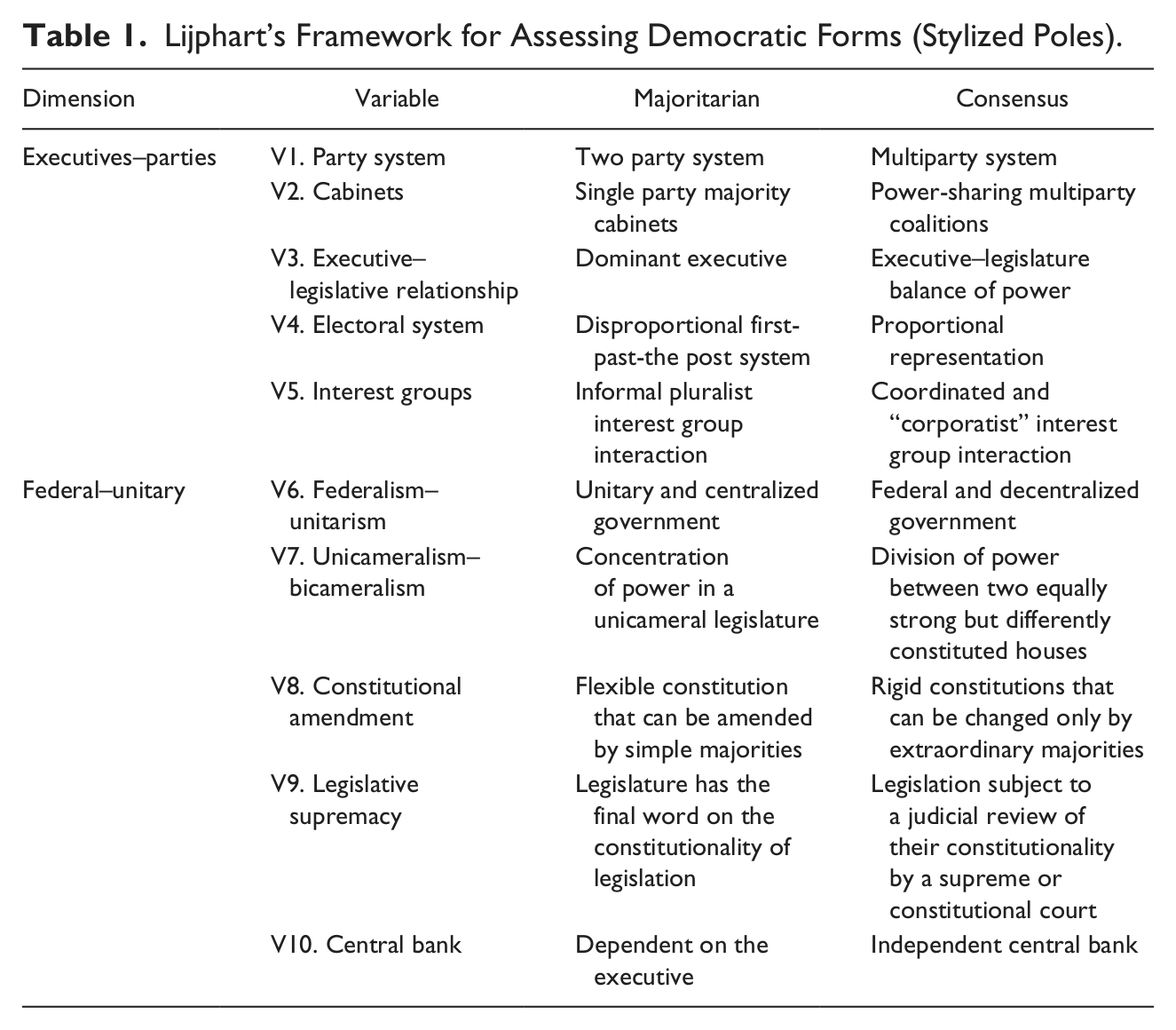
Lijphart’s research found that there were actually very few examples of “extreme” or “pure” majoritarian or consensus democracy. A longitudinal analysis of the second half of the 20th century, however, revealed critical dynamics in relation to the manner in which different countries were evolving either toward or away from Lijphart’s majoritarian and consensual poles. Lijphart (1999, p. 254; see also 2012, p. 250) diagnoses differences between the two dimensions covered:
There are more shifts from left to right or vice versa than from higher to lower locations or vice versa—a pattern that reflects the greater stability of the institutional characteristics of the federal-unitary dimension because these are more often anchored in institutional provisions.
In line with this observation, we solely analyze change and possible convergence on the first, executives-parties dimension in this article. While an analysis of change on the federal-unitary dimension or even interrelations between patterns of change between both dimensions appears worthwhile, we leave it for future research.
Hypotheses on Democratic Convergence
It is necessary to locate our research strategy within the contours of our much broader argument concerning democratic convergence. While emphasizing the role and power of Lijphartian political analysis within the parameters of debates concerning democratic change, we suggest that one potential weakness of Lijphart’s approach is that it pushes scholars toward a binary polarization along an axis on which consensual or majoritarian political constructions exist at each pole—a conceptualization that is arguably too blunt to comprehend the emergence of more subtle adjustments. As Lijphart (1999) phrased it himself, “Obviously, political systems can and do change” (p. 253). The questions we would like to ask here, then, are whether democratic systems change over time, and in particular, whether they become more similar or dissimilar, and how can such potential democratic convergence (or divergence) be explained? Are there mechanisms at work pushing democratic change toward a (dis-)similar type, and is there a general pattern behind the reform trajectories of different democracies which we can observe and explain? To structure our analysis, three explicit hypotheses were adopted (see Table 2).
Three Hypotheses.
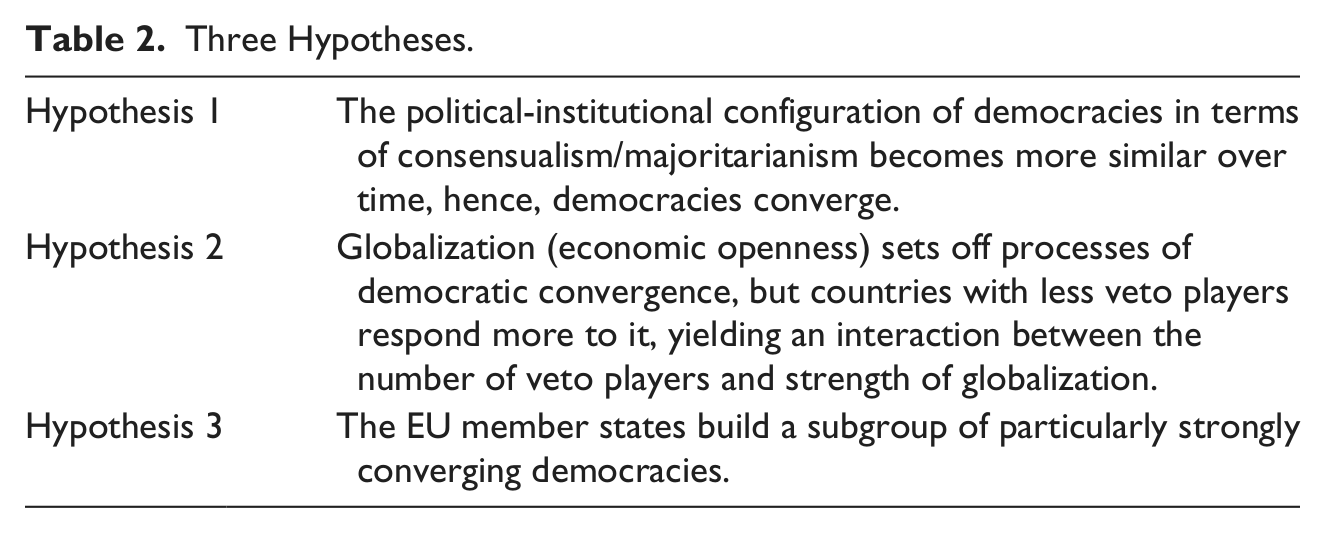
The first hypothesis advanced in this article (Table 2, Hypothesis 1) expects that, in the last decade, and contrary to Lijphart’s (1999) previous findings (see also Armingeon, 2004; Giuliani, 2011a, 2011b), a general—albeit imperfect—trend toward what we term democratic convergence can be observed. The assumed reasons are moves away from the extreme ends of the majoritarianism–consensualism axis, the result being a pattern of convergence oriented toward the middle of the conceptual map (a trajectory suggested but not validated by Blondel & Battegazzorre, 2002, 2003). We further assume that this trend is not restricted to the extreme cases at the margins of Lijphart’s map but also concerns democracies that are closer to the middle of the grid. The empirical implication mainly observed here will be the presence or absence of convergence between types of democracy resulting from such directional moves. The latter will be assessed descriptively. As discussed above, the focus is on the executives-parties dimension of democracy. More specifically, through deliberate electoral reform, the electoral system can be assumed to be a strong leverage point for democratic change, if, as Shugart (2003) shows, it is either extreme on the interparty or on the intraparty dimension and therefore prone to reformist pressures (see also Benoit, 2004; Boix, 1999). Both forms of extremes on the interparty dimension, that is, either a pluralitarian system where a majority government is formed by a party with only a plurality of the vote or a hyperrepresentative system where no majority is won, might entail inherent factors that propel electoral reform, pushing a pluralitarian system toward more consensus and a hyperrepresentative system toward more majoritarianism on that variable (Shugart, 2003). Convergence pressure on extreme electoral design, then, results in convergence pressure on the executives-parties dimension (Taagepera, 2003) and therefore a convergent trajectory of democratic change.
Our second hypothesis seeks to acknowledge that democratic change does not occur in a void, but within the contours of a cultural, political, and institutional miasma. With this in mind, it is worth (very briefly) highlighting some of the contextual factors which, in a sense, dovetail with the theoretical foundations upon which our explanation of convergence/divergence stand. The aim being not to provide an exhaustive account of each and every possible issue but to tease-out a set of what might be termed focal relationships (specifically globalization, domestic veto players and European Union membership) as core pillars in a parsimonious model. 2 In addition, a range of more idiosyncratic explanations will be discussed in the descriptive part of the analysis below.
One of the most widely discussed factors influencing state-level decision making today is the increased globalization of the economy and hence also politics, which—hand in hand with the growing importance of supranational organizations—has a profound impact on several of the indicators of the patterns of democracy. Although research about the impact of globalization and supranational organizations on institutional change has been presented (Anderson, 2002; Armingeon, 2004; Armingeon & Careja, 2008; Polillo & Guillén, 2005), less attention has been paid to how domestic political institutions mediate the relationship between globalization and democratic convergence. In other fields, for example, taxation policy research (Franzese & Hays, 2008; Ganghof, 2007) or welfare state research (e.g., Crepaz, 2001; Ha, 2008), globalization has been thoroughly discussed as a driver of policy convergence.
In taxation policy research (Franzese & Hays, 2008), globalization is discussed as a major source of diffusion, as capital mobility induces competition between states and undermines national tax autonomy. 3 Often, this mechanism is expected to lead to a race to the bottom and hence convergence of tax policies. Similarly, for more globalized countries, we can expect convergence toward a model of democracy that suits—or at the very least is not hostile—to a liberal economic order in which financial flows are increasingly fluid (hence Bauman’s, 2000, emphasis on “liquid modernity” vis-à-vis social, political, and economic change). 4 Furthermore, and of particular interest here, national peculiarities such as corporatism or inclusive political institutions might alter the response to globalization, leading to divergence for domestic reasons (Swank, 2002). Countries’ reactions to globalization are not similar because different political actors or domestic institutions within the constitutional process have to agree on proposals for reforming the rules of the democratic game such as electoral laws. It is in exactly this vein that the veto player theory (Tsebelis, 1995, 2002) argues that the higher the number of veto players, the more difficult it is to change the status quo. 5 Hence, in our context, we could argue that the more numerous the institutional constraints of the central executive and of the parliamentary majority, the more likely democratic change will be blocked or delayed. Federalism, bicameralism, barriers to amend the constitution, or a strong central bank do, inter alia, count as such veto points (Schmidt, 1996, 2010). 6 In other words, we hypothesize that the core elements of Lijphart’s (1999, 2012) federal-unitary dimension interact with globalization and mediate its impact on the degree of democratic convergence in the first, executives-parties dimension (Table 2, Hypothesis 2).
A third explanation relates directly to a particularity of globalization and the growing relevance of supranational organizations. A specific expression of this is the influence of the EU setting new boundaries and generating pressures for convergence (Table 2, Hypothesis 3):
A direct consequence of having to cooperate at the level of the European Union is to have to cooperate at the national level as well: countries cannot present “their” case for a given policy in Brussels unless they are relatively united internally. (Blondel & Battegazzorre, 2003, p. 24)
On the other hand, “majoritarianism is essential for the governments of the EU Member States as it enables these governments to make their case more forcefully since it provides the basis for strong leadership recognized as such beyond the borders of the country concerned” (Blondel & Battegazzorre, 2003, pp. 22-23). Hence, moves away from extreme forms of consensus and majoritarian democracy can be expected to be a particular consequence of membership of the EU and the process of European integration in general. A further argument implying democratic convergence in the EU is that the greater the misfit between European and domestic institutional rules and procedures, the greater the pressure for institutional transformation and adaption (Anderson, 2002; Armingeon & Careja, 2008; Börzel, 1999). 7
Having outlined our three hypotheses regarding democratic convergence and briefly suggested some of the mechanisms responsible for the hypothesized trajectory of change, it is now possible to present the empirical cross-sectional and longitudinal analysis of democratic change in 24 consolidated democracies.
Analyzing Democratic Convergence in Advanced Democracies, 1945-2010
Drawing on Armingeon’s (2002) and Schmidt’s (2010) criticism of Lijphart’s (1999) selection of countries, we concentrate our analysis on economically similar entities, namely, the 24 most developed OECD countries. The systematic comparison of the most advanced and wealthiest democracies not only has the advantage that it capitalizes in some respects on a “most similar systems” research design (Lijphart, 1971; Przeworski & Teune, 1970) and therefore avoids “mixing up most similar and most dissimilar case designs” (Armingeon, 2002, p. 88), it also enables us to ensure that our empirical findings are based on reliable data, which is often not available for less developed countries (Lijphart, 2002, p. 109). While the countries should be relatively homogeneous in terms of democratic consolidation (such as levels of corruption or volatility) and general economic wealth, there is still considerable variation in terms of economic globalization and institutional constraints. 8
The research design further relies on cross-sectional time-series data. For the 24 countries, the political-institutional traits on the executives-parties dimension are observed for three periods, 1945-1970 (t1), 1971-1996 (t2) and 1997-2010 (t3). The data are averaged for these periods, as most of the variables comprising the index change at the time of the country-specific elections (but not yearly), which hampers a more fine-grained isochronal analysis. The periods are also in line with Lijphart’s (1999) original longitudinal analysis, roughly dividing the time frame of the analysis (1945-1996) into pieces of 25 years equivalent to t1 and t2 here. The additional period t3 then comprises the years since Lijphart’s (1999) analysis, yielding a shorter period of roughly 15 years.
The dependent variable, the consensual or majoritarian character of political systems, is measured analogously to Lijphart (1999, 2012), building an index of consensus democracy for the executives-parties dimension. It is composed of the standardized values of the disproportionality of the electoral system (with its sign reversed so that higher values indicate consensus democracy), the effective number of parliamentary parties, single party or minimal winning cabinet type (reversed), and the degree of pluralism (reversed), but excluding cabinet durability because of its highly questionable validity and the strong criticism of Lijphart’s operationalization of the executive–legislative relationship (see Vatter, 2009). 9 The data source is Giuliani (2011a). 10 By focusing on a set of advanced democracies, the data included initially 24 OECD countries (see Figure 1). Of these, Portugal, Greece, and Spain are excluded in the multivariate analyses as data are only available for the periods t2 and t3 after democratization, and Luxembourg and Israel are excluded due to missing information on independent variables. The independent variables for testing our three hypotheses are measured in the following way:
Economic (financial) globalization: “Index for the extent of openness in capital account transactions. The index incorporates a variable indicating the presence of multiple exchange rates, a second variable indicating restrictions on current account transactions and a third variable indicating the requirement of the surrender of export proceeds. The higher the value the more open is the country to cross-border capital transactions” (Armingeon et al., 2010, p. 9; variable kaopen; drawing on Chinn & Ito, 2008).
Institutional constraints: The starting point is the index of institutional constraints of central state government according to Schmidt (1996), where high values indicate powerful constraints and low values are indicative of a large maneuvering room available to central state government. The additive index is composed of six dummy variables (coded “1” for constraints, “0” else): (a) EU membership, (b) degree of centralization of state structure (federalism), (c) difficulty of amending constitutions, (d) strong bicameralism, (e) central bank autonomy, and (f) frequent referenda (Armingeon et al., 2010, p. 7; variable instcons). EU membership has been removed from the index as it constitutes a separate variable in the analysis.
EU membership: Yearly dummy variable (Armingeon et al., 2010).
To capture processes of convergence, a measure t ranging from 0 to 2, with the steps (0, 1, and 2) representing the ordered time periods t1-t3, is used. Hence, t captures a linear time trend.
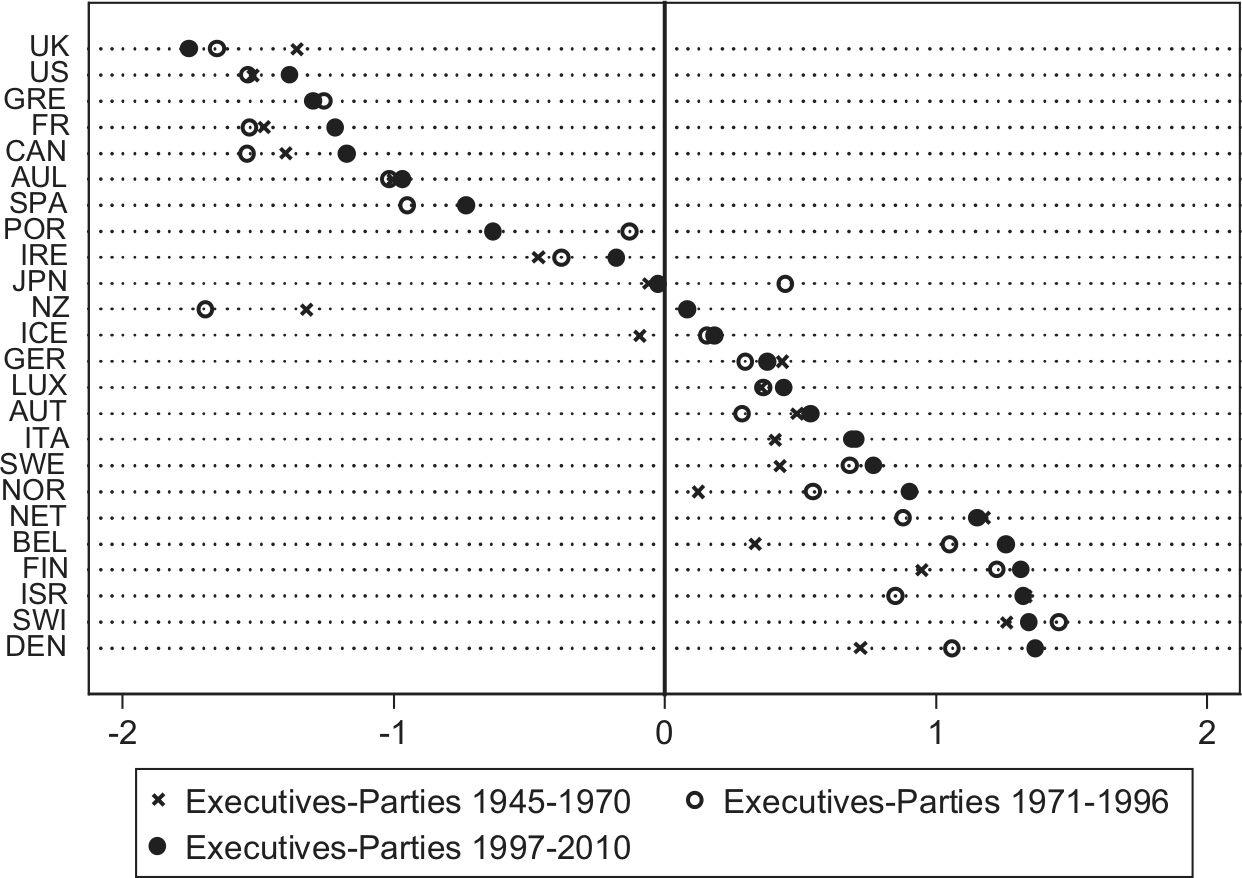
Change on the executives-parties dimension for 24 OECD countries.
All substantial variables are measured as mean values for three time periods (given data availability) t1: 1945-1970, t2: 1971-1996, and t3: 1997-2010. 11
Figure 1 displays change on the executives-parties dimension for 24 OECD countries. The right-hand side of the horizontal axis represents more consensual values on the dimension. The dot plot features three values per country, for the periods 1945-1970 (crosses), 1971-1996 (hollow circles), and 1997-2010 (solid circles). On the vertical axis, the countries are sorted by majoritarianism in the latest period (1997-2010). The visual inspection of the executives-parties dimension at different time intervals, on one hand, demonstrates the variance in institutional structures between countries and the (albeit smaller) variance within countries over time. This initially encourages further investigation. On the other hand, no strong general and unconditional trend of convergence or divergence can be discerned. In line with Armingeon (2004, p. 212), we can assert that institutional change is rather “path-dependent and incremental following a logic of layering of new and old elements.” Or in other words—and to paraphrase Lijphart (2008, p. 178)—“fundamental constitutional changes are difficult to effect and therefore remain rare.” New Zealand is the main exception in the empirical data presented, a result of the idiosyncratic (Benoit, 2004) major electoral reform just between our second and third periods of analysis (i.e., in 1996) and nicely captured in the changing title of Geoffrey Palmer’s analysis of democracy in New Zealand from Unbridled Power (the title of his 1987 book) to Bridled Power (in 2004).
Less prominent but still noteworthy shifts in “patterns of democracy” are also observed in relation to Belgium, Denmark, and Norway (all toward more consensual forms of democratic governance). In Belgium, the transition highlighted in Figure 1 reflects a set of constitutional measures that have been driven by linguistic and regional cleavages and specifically by a growing divide between the mainly Dutch-speaking north and the mainly French-speaking south. A series of constitutional reforms—the most significant being those enacted in 1983 which formally changed Belgium from a unitary to a federal state—have sought to ease tensions through the imposition of ever-more complex power-sharing mechanisms. Denmark and Norway, by contrast, reflect the domestic mediation of external forces—predominantly globalization—upon national politics and therefore resonates strongly with an emerging field of literature on the interplay between “Nordic capitalisms” and globalization (see, in particular, Kristensen & Lilja, 2011). Specifically, these countries have experienced a strong increase in the fragmentation of the party system (Jochem, 2012), for instance, due to the rise of populist parties, which might well be related to processes of globalization.
Generally, the main observation is a slight trend toward more consensus democracy over time, which is more pronounced among the already previously consensual countries and countered by slight developments toward more majoritarianism on the executives-parties dimension in the UK, Portugal, and to some extent also Japan and Switzerland. From this descriptive inspection, we find little evidence in favor of our expectation that countries (unconditionally) move toward the middle of the grid (Hypothesis 1), at least for the executives-parties dimension. No net effect of convergence results from the observations, rather slight divergence. For a pattern of convergence to occur, the crosses (1945-1970) and hollow circles (1976-1996) should be located toward the margin of Figure 1, on average, the opposite is the case (disregarding the exceptional case of New Zealand). Nevertheless, there might be conditional processes of convergence, meaning that there might be factors causing some countries to converge toward some (implicit) institutional configuration. Hence, the next analytical step now tests the initial hypotheses (Table 2) on the determinants of change of democratic types by the means of a quantitative analysis, relying on a heteroscedastic model.
A Heteroscedastic Multilevel Model of Democratic Convergence
The analytical focus of this article is on democratic convergence, drawing on the literature on policy convergence (Heichel, Pape, & Sommerer, 2005; Holzinger, 2006; Holzinger, Jörgens, & Knill, 2007; Knill, 2005; Plümper & Schneider, 2009). The notion of (“sigma”) convergence implies increasing similarity of political systems over time and can be caused by competition, learning, cooperation, and common reactions to shocks (Holzinger, 2006; Knill, 2005; Plümper & Schneider, 2009, p. 991). 12 The two elements of time and similarity have to be accommodated in any analysis of convergence. 13 Classical approaches to the study of convergence are either variance or regression-based (Plümper & Schneider, 2009). Variance-based approaches observe the similarity of the phenomenon of interest at different points in time, but usually stop short of modeling the variance directly, accounting for conditional convergence or convergence clubs. Therefore, Plümper and Schneider (2009) suggest abandoning it in favor of the regression-based approach. It models convergence by stipulating the change in the variable of interest from one point in time to the next as the dependent variable, and the prior level of the same variable as a covariate (Plümper & Schneider, 2009). If convergence occurs, observations with prior values above the target of convergence should have negative change, and those with lower values should have positive change. Hence, the setup is further away from the concept of similarity than a variance-based approach. On the upside, the regression-based approach has the ability to incorporate processes of conditional convergence and convergence clubs directly into the model (using interactions), and to predict equilibriums.
We offer an alternative methodological approach to (sigma) convergence which should enrich the methodological toolbox available to researchers. 14 The approach combines attractive features from the variance and the regression-based approaches. To model similarity directly, the methodological discussion of heteroscedastic models is picked up (Braumoeller, 2006). These are amended for the study of convergence, modeling (conditional) developments of the variance of democratic types over time explicitly. Similar to the regression-based approach, this allows introducing explanatory variables conditioning processes of convergence. At the same time, the direct focus of the variance approach on similarity is held up. Hence, the advantage of the approach is that similarity and processes of convergence can be directly modeled and predicted for different constellations of the covariates. Compared with the classical regression approach, information about the direction of change can be less directly derived (Holzinger et al., 2007). 15
Models of the variance of distributions (or heteroscedastic models) are increasingly advocated (Braumoeller, 2006). King (1989, p. 65) emphasizes that “[f]or some purposes, modeling

The mean of the type of democracy CONS
ij
—consensus democracy on the executives-parties dimension—is modeled using an intercept β0, a country-level variance µj to capture clustering within countries, and a country-time point specific error term ε
ij
. The country-level error term is assumed to be normally distributed (with variance

In the dispersion submodel, the lowest level variance of the type of democracy
Regarding interpretation, the intercept α0 represents the mean log standard deviation at t1, and α1 indicates the change in the variance of the type of democracies compared with the intercept as time passes on (and hence convergence or divergence of types of democracy). The other, interactive coefficients inform about changes in these processes once covariates are considered. A model including the variable T only will be introduced first to test for unconditional convergence, then the other explanations will be introduced.
Table 3 summarizes the results of a series of heteroscedastic multilevel models. The main interest is in the estimates on the coefficients expected to influence the variance of the model. For the location submodel, reported in the upper part of Table 3, only a constant term is estimated, the covariates are introduced in the dispersion submodel in the lower part of Table 3. The number of cases is held constant throughout the models as the variance is vulnerable to the number of cases (Holzinger et al., 2007).
Linear Heteroscedastic Multilevel Models of Consensus Democracy over Time (Executives–Parties Dimension).
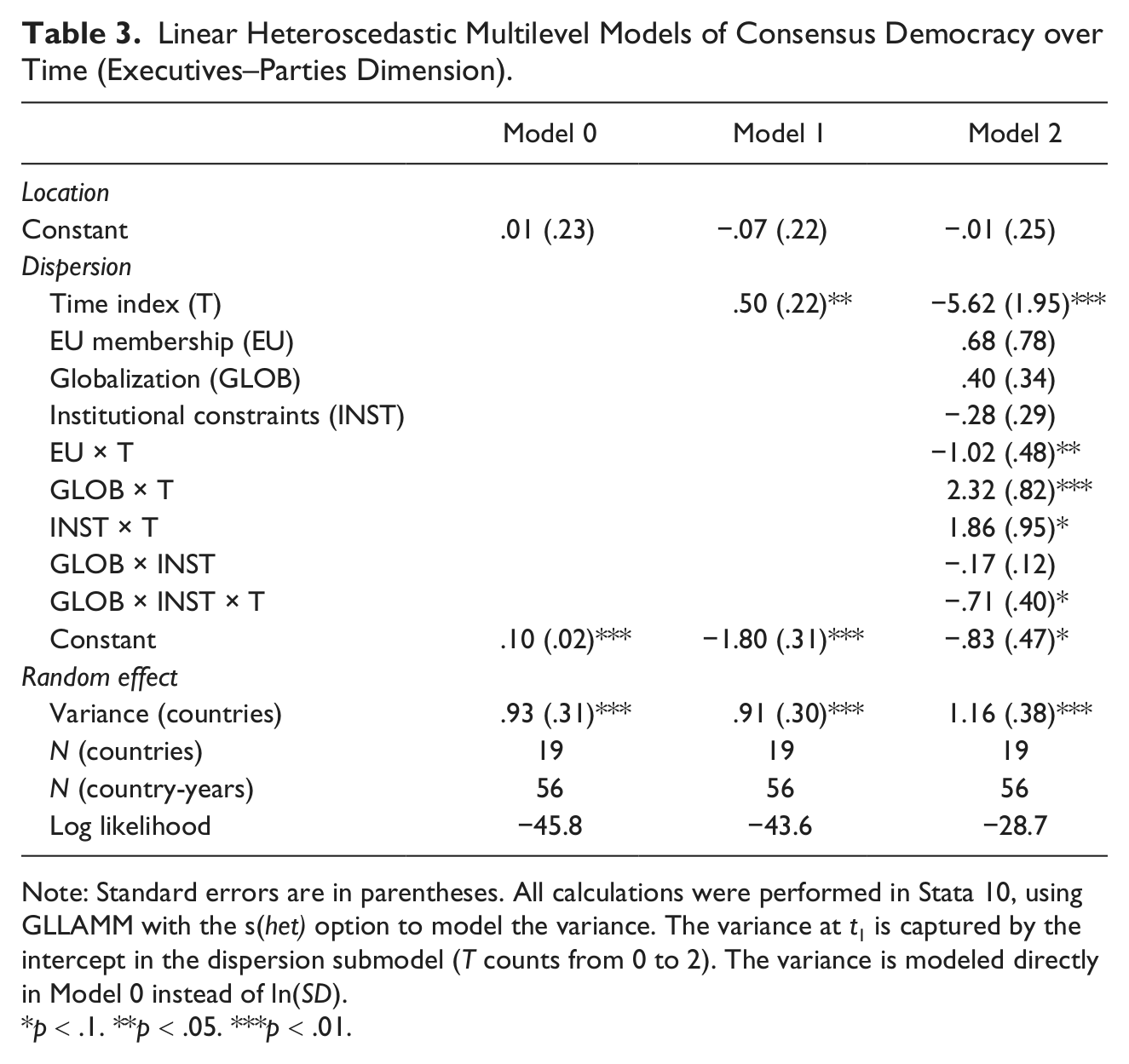
Note: Standard errors are in parentheses. All calculations were performed in Stata 10, using GLLAMM with the s(het) option to model the variance. The variance at t1 is captured by the intercept in the dispersion submodel (T counts from 0 to 2). The variance is modeled directly in Model 0 instead of ln(SD).
p < .1. **p < .05. ***p < .01.
Model 0 is an empty model without any substantial covariates or time variables. The model provides an estimate of the mean of the type of democracy in the location submodel, along with a variance term for differences between countries. The latter is rather large and statistically significant, and compared with the variance at the lowest level (country-time periods), it reveals that about 90% of the variation in the type of democracy is stable over time within countries. Put on its head, this also implies that about 10% of the type of democracy (on the executives-parties dimension) varies over time within countries, a relatively small but interesting enough share, encouraging the explanation of this particular variance. The lowest-level variance indicates the variation that is not stable per country over time and will be modeled in the subsequent specifications. In Model 0, the variance is estimated directly, while in the next models, the log standard deviation scale will be used. The estimate of .10 in Model 0 would translate into a log standard deviation of about −1.15.
Model 1 introduces the linear time trend variable T, counting from t1 (0) over t2 (1) to t3 (2) to test Hypothesis 1 stating that over time, types of democracy converge. Given the coding of the variable, the constant term in the dispersion submodel denotes the variance (presented as the log standard deviation) for t1, while the coefficient on the variable T can be understood as the change in the variance from one period to the next. Model 1 yields a positive and statistically significant effect of time on the variance of democratic types, indicative of divergence rather than convergence. The effect has the magnitude .50 on the log scale, translating (combined with the constant term) into a standard deviation of .17 at t0, .27 at t1, and .45 at t2. Given that the dependent variable, consensus democracy on the executives-parties dimension, by definition has a mean of 0 and a standard deviation of 1 (over the full sample), this effect would be considerable. An additional analysis considering outliers (not reported in Table 3), excluding New Zealand, where by far the largest institutional changes on the executives-parties dimension have occurred, reveals that this finding is sensitive to the exclusion of the outlier. Rather than divergence, a statistically nonsignificant negative effect (−.33, translating into standard deviations of .30 at t0, .21 at t1, and .15 at t2) is observed excluding New Zealand. Still and in sum, and in line with the descriptive analysis, no clear and simple direction of unconditional divergence or convergence can be reported from Model 1, which is at odds with Hypothesis 1.
Model 2 includes operationalizations for all of the substantial explanations laid out in Hypotheses 2 and 3. A two-way interaction is required for a test of Hypothesis 3, which expects convergence among EU member states. As convergence is modeled inspecting the effect of time on the variance of democratic type, the effect of EU membership on convergence is captured by an interaction between time and (the share of the period with) EU membership. In Hypothesis 2, we formulate a three-way interaction. Here, convergence is deemed conditional on globalization (financial openness) and the domestic institutional veto structure. As interactive effects, in particular given a three-way interaction, are not easily interpreted by eyeballing the regression coefficients, meaningful marginal effects of time on the variance of the type of democracy are computed for different levels of EU membership and globalization and the domestic veto structure in Figures 2 and 3, respectively (following Brambor et al., 2006). For each conditioning variable, its empirical range is covered in the Figures, or at least different levels of the variable (the minimum, mean, and maximum for veto players). 17
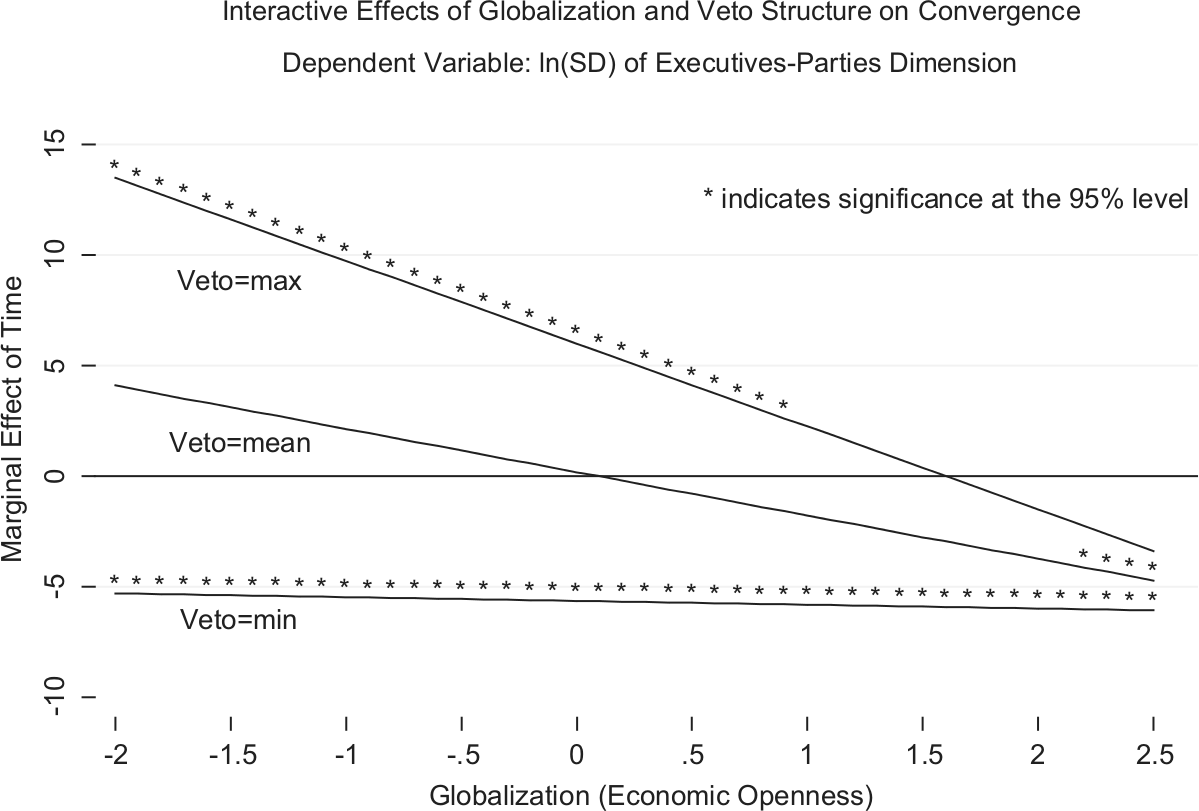
Interactive effects of globalization and veto structure on convergence.
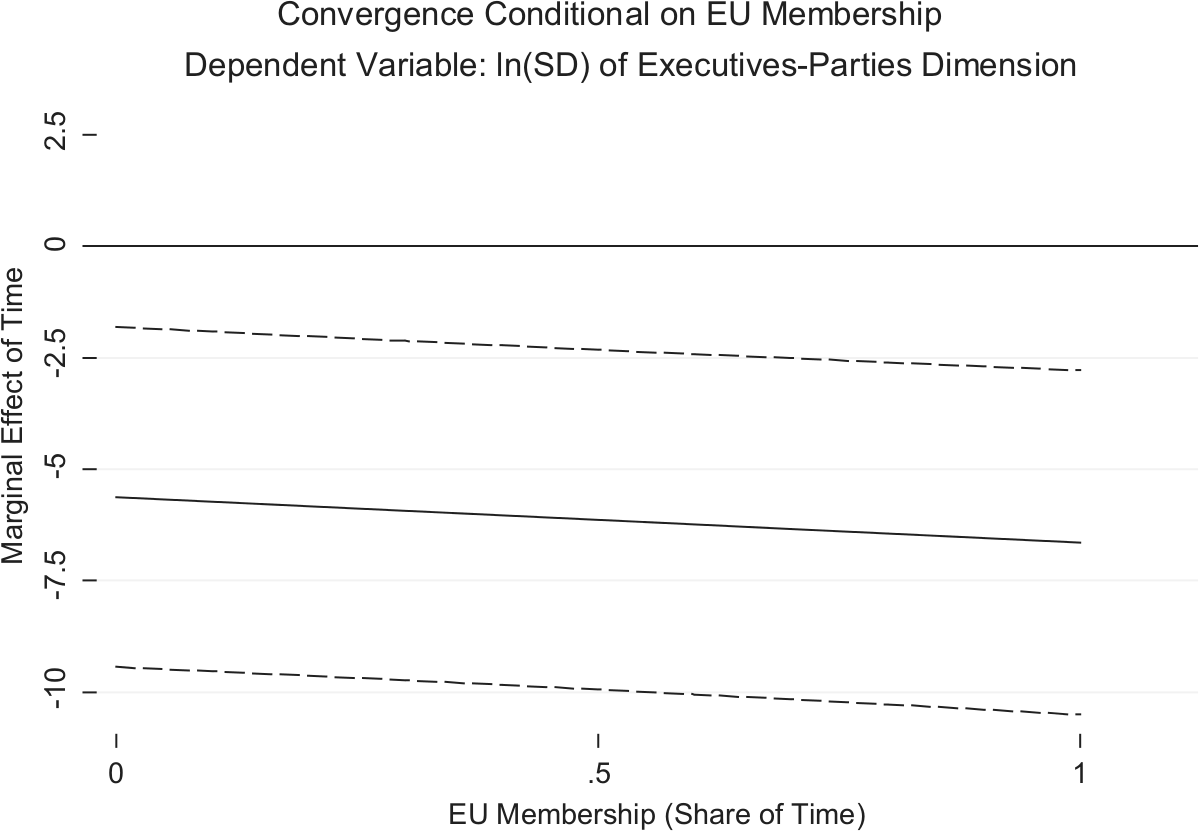
Convergence conditional on EU membership.
Combining the coefficients (from Model 2) on the constitutive terms and on the interactive terms generates meaningful marginal effects, which are displayed along with their standard errors. Figure 2 demonstrates the interactive effect of globalization and the veto structure on democratic convergence. Given a high number of veto players, where the persistence of the status quo has been expected over the whole range of globalization, a surprisingly clear trend toward divergence of types of democracy is observed given low levels of globalization. Despite a large number of veto players, change occurs in these settings, which appears to be of more country-specific nature, speculatively caused by internal rather than external forces. More in line with our hypothesis, for the highest levels of economic openness, the effect of time on the variance loses its statistical significance and eventually dips below zero. For settings with a mean number of veto players, and more in line with Hypothesis 2, globalization only leads to convergence under scenarios of extreme openness. Finally, when the number of veto players is at a minimum, a clear and statistically significant trend toward convergence is observed across the whole range of economic openness, which is reinforced only slightly given higher levels of globalization. Hence, the countries with few veto players are the most vulnerable to external pressures to converge to some model type of democracy, where globalization appears to be but one of the possible explanations. In sum, there are interactive effects of economic globalization and the veto structure, but these are more nuanced than expected in Hypothesis 2.
Notably, when excluding the extreme outlier New Zealand from the analysis (results not reported but available in online Appendix 2; see Endnote 11), the overall pattern of the effects remains stable, but with notable changes in the levels of confidence. The trend toward divergence among less globalized countries with a high number of veto players loses its statistical significance, while the converging trend given a low number of veto players across levels of globalization remains. This result is more in line with the expectation of limited change in settings with a high number of veto players (even though globalization appears to induce convergence in tendency in these situations), and confirms the general trend toward democratic convergence among countries with few veto players, largely independent of globalization.
Finally, Figure 3 shows the effect of EU membership on convergence. Given the presence of the three-way interaction between time, globalization, and the number of veto players, the effect of time when EU membership is zero refers to the situation of intermediate globalization and the minimum of veto players. The effect hence could change once globalization and the veto structure are fixed at other levels. For this situation, however, EU membership appears to slightly attenuate an already existing trend toward convergence, even though the magnitude of the change in the effect is very limited. 18 By controlling for the effects of globalization and the veto structure, this trend is independent of these potentially overlapping economic and domestic constraints. In sum, our expectations about the influence of international organizations, economic pressures, and domestic institutional structures on democratic convergence (Hypotheses 2 and 3) find some but nuanced support in the empirical data analyzed using a heteroscedastic multilevel model.
Conclusion
Political systems can and do change (Lijphart, 1999, p. 253). This article departs from the empirical theory of democracy introduced by Lijphart (1984, 1999, 2012), which maps political systems according to their consensual or majoritarian character on two dimensions. We focus on the first, executives-parties dimension, as change on the federalism-unitarism is generally more constitutionally constrained (Lijphart, 1999, 2012)—with notable exceptions such as the UK (Flinders, 2009). Instead of mere trajectories of change, the focus is on the possible convergence (or divergence) of political systems, defined as increasing similarity (or dissimilarity) over time and mainly used in policy analysis (Holzinger, 2006; Knill, 2005; Plümper & Schneider, 2009). This is a perspective complementary to existing analyses of institutional change, which focus mainly on the direction and extent of travel, allowing descriptive or indirect inferences for convergence or divergence (Armingeon, 2004; Armingeon & Careja, 2008; Blondel & Battegazzorre, 2002, 2003; Flinders, 2009; Giuliani, 2011a, 2011b; Vatter, 2008). The analysis of convergence proposed here directly puts the spotlight on the heterogeneity of political systems and can unearth processes of stability, assimilation, or drift in the variability of countries. What is more, within this framework, and drawing on existing research (e.g., Armingeon, 2004), we introduce several general expectations about and substantial explanations for institutional convergence. The mechanisms discussed include globalization, the domestic veto structure, and EU membership, which are in part interactively expected to influence processes of stability, convergence, or divergence.
Using data measuring majoritarian and consensus democracy on the executives-parties dimension for 24 advanced democracies and the time periods 1945-1970, 1971-1996, and 1997-2010 (Giuliani, 2011a), descriptive analyses as well as the initial specification of the heteroscedastic multilevel model capturing convergence do not provide evidence of unconditional processes of convergence, in line with some prior research (Giuliani, 2011a, 2011b; Lijphart, 1999, 2012). Apart from single cases such as New Zealand or, to some extent, Switzerland, moves away from the extremes of majoritarian and consensus democracy appear not to amount to a global trend in an unconditional fashion.
However, once we introduce our set of conditions expected to facilitate or obstruct convergence, the conclusion changes. There is evidence that globalization and the domestic veto structure interactively influence convergence, even though not in a simple way. After controlling for the impact of economic globalization, EU membership—albeit rather slightly—strengthens a trend toward convergence, at least given certain settings regarding the veto structure and globalization. In this sense, we cannot confirm the conclusion drawn by Armingeon (2004, pp. 212, 233) based on an analysis of institutional change in 24 OECD countries for the period 1970-2000 that “no convergence occurred,” even under conditions of economic and political globalization (but see Cerny, 1997). Rather, conditional convergence emerges in settings where the domestic veto structure is permeable, and globalization generally appears to reinforce processes of convergence or at least reduce divergence. The findings are also at least partly in contrast to Anderson (2002), who comes to the conclusion that “there are no signs of a uniform transformation of the polity in Europe that can be attributed to integration” (p. 817).
Methodologically, the goal of this article has been to provide an alternative tool for analyzing what has been called sigma convergence (Holzinger et al., 2007) or the variance approach (Plümper & Schneider, 2009). To this end, heteroscedastic (multilevel) models have been used (Braumoeller, 2006), modeling the influence of time on the variance of democratic types to capture convergence and introducing interactions to capture its conditional nature. While this has the advantage of directly modeling the similarity of institutional settings, which has been our main focus, future research could extent the model further. For example, the interest can also be in the direction of change or the equilibrium finally reached (Holzinger et al., 2007; Plümper & Schneider, 2009). Regression-based approaches might be better suited for this purpose, possibly integrated into the heteroscedastic model, ideally also using more fine-grained data (see Lijphart, 2012) that facilitate the specification of nonlinear time trends capturing more complex processes of convergence.
One additional caveat of the analysis is that New Zealand proves to be a highly influential case due to the electoral reform and changes in patterns of coalition building observed there. Still, the conclusions remain largely unchanged once the country is excluded. The case also highlights the relevance of further case studies identifying more idiosyncratic factors. Furthermore, the extent of change generally appears limited in absolute terms, as the visual inspection of the data shows. A theoretical and empirical point for further consideration is that not only the number but also the positions of veto players are decisive for their role in mediating the influence of globalization on convergence and that the citizens’ perspective factors in as well (Armingeon, 2004). Finally, the federal-unitary dimension of majoritarian and consensus democracy might be more stable than the executives-parties dimension, but still deserves further theoretical and empirical consideration. In the light of this outlook, this article has attempted to stimulate more research in this field by suggesting a new framework for analyzing (conditional) democratic convergence, thereby adding to the analytical toolbox of students of democracy.
Footnotes
Acknowledgements
We would like to thank first and foremost Marco Giuliani for his generous provision of data, the participants of the Panel “Do Democracies Change?” at the 2011 ECPR General Conference, Reykjavik, in particular Matthijs Bogaards, for their comments and Silja Kohler as well as Rolf Wirz for their competent support in the data collection and bibliographical assistance. All remaining errors are ours.
Declaration of Conflicting Interests
The author(s) declared no potential conflicts of interest with respect to the research, authorship, and/or publication of this article.
Funding
The author(s) received no financial support for the research, authorship, and/or publication of this article.