







Abstract
The dramatic rise of democratic regimes around the world has coincided with an equally significant increase in migration, characterized by an unprecedented movement of people from emerging to established democracies. Through analysis of survey data from six Latin American countries, we offer an empirical evaluation of theoretical mechanisms through which migration can shape the political behaviors of non-migrants in sending nations. We find that individuals who have strong cross-border ties that connect them with relatives living in the United States are more likely to participate in local politics, sympathize with a political party, and persuade others to vote for a party. Those effects are influenced by the positive impact of cross-border ties on civic community involvement, political interest, and political efficacy. Moreover, the evidence suggests that frequent usage of the Internet among non-migrants with strong cross-border ties results in increased political knowledge, which contributes to their greater political interest and efficacy.
Introduction
Over the past 20 years, the world’s migrant population has nearly doubled, with the bulk of that increase made up by the movement of people from emerging to established democracies. Latin America captures well these global trends in migration. While undergoing a region-wide transition toward more democratic systems of government, the region has witnessed unprecedented levels of emigration, mainly to the United States. According to recent estimates, the number of foreign born from Latin American countries living in the United States has gone from fewer than one million in 1960 to 17.5 million in 2010 (Grieco et al., 2012). As a result, Latinos now constitute more than 50% of the U.S. foreign-born population.
Despite these trends, we know relatively little about how migration to more consolidated democracies is affecting democracy in the developing world. Although an abundance of work exists on the rise and import of migration and transnational communities in the fields of economics and sociology, only recently have scholars begun to explore the political impact of migration for those individuals living in emerging democracies who have strong ties with migrant relatives living in established democracies. 1 In a world where international real-time communication has become widely available, we view the role of such connections between migrants and their family members back home as an increasingly important factor in shaping the political behaviors of this latter group.
Indeed, previous qualitative studies have documented the political content of communications between migrants and non-migrants, and how those long-distance communications shape non-migrants’ ideas about how their political system should work by contrasting politics at home and that of the more advanced host democracy (Levitt, 1998, 2001; Levitt & Lamba-Nieves, 2011; Pérez-Armendáriz, 2014). These communications in turn are theorized to increase non-migrants’ awareness of the importance of political participation for effecting change in their community and the quality of their government, thereby increasing the chances that they will involve themselves in politics.
Moreover, the literature documents how the collective efforts of migrant organizations can directly influence political behavior in the form of encouraging support for a particular political party (Nyblade & O’Mahony, 2014; O’Mahony, 2013). A likely by-product of these partisan advocacy efforts, then, will be the emergence of those sending community residents with strong cross-border connections as partisan advocates themselves, encouraging neighbors without such cross-border ties to support the political party most aligned with the interests of citizens living abroad and their non-migrant friends and relatives. Furthermore, the private and community development resources that migrants often provide enhance their influence over the political preferences and behaviors of their relatives back home. Through this combination of economic and what Levitt (1998, 2001) refers to as social remittances then, there is a growing recognition of the role that migration is playing in the local political process of the thousands of sending communities scattered across the emerging democracies of Latin America.
The common thread running through previous research on this issue is a clear but complex connection between migrants, their family members back home, and the political behaviors of this latter group. Our research seeks to push this burgeoning work forward by theorizing and testing empirically several potential causal mechanisms that we view as driving the link between cross-border ties and the political behavior of sending community residents. Taking into account the insights of previous works, we first identify those partisan and non-partisan modes of political engagement that are most likely to be affected by cross-border ties to migrants. We then offer empirical support for previously unexplored mechanisms through which these cross-border ties alter the political behavior of those left behind. By not only examining the direct link between an individual’s migrant connections and his or her political behavior but also several indirect mechanisms through which such ties influence political behavior, we move forward efforts to understand the ways in which migrants may be energizing the political lives of their relatives who stayed behind.
We evaluate these propositions in the Latin American context through a comparative analysis of the political engagement levels of those with strong ties to relatives living in the Unites States and those without such connections across more than 8,500 individuals living in six countries with close proximity and strong migratory connections to the United States. As a result, our study offers one of the few empirical examinations of the political consequences of migration in Latin America that goes beyond a single case. Furthermore, we use a measurement strategy that allows us to assess the impact of the depth of cross-border ties, rather than simply their presence or absence. Through our measure of the depth of the connections one has with relatives living in the United States, we are better able to capture, albeit still indirectly, the extent to which an individual is exposed to the ideas and information that flow between migrants and non-migrants.
From this work, we find substantial evidence that residents of these countries who maintain strong relationships with migrant relatives living in the United States exhibit significantly higher levels of local political engagement than their neighbors who have no such connections. Strong cross-border ties have important direct effects on non-migrants’ proclivity to participate in local political affairs, identify with a political party, and work to persuade others to vote for a political party or candidate. Moreover, we find that these effects are indeed substantive, and not the artificial consequence of household attributes associated with both political engagement and migration.
Our mediation analysis then suggests that stronger cross-border ties also indirectly lead to increased local political activism and partisan advocacy in part through the positive effect that migrant connections have on community involvement, political interest, and political efficacy. Our final set of empirical analyses provides support for our contention that the increased political interest and efficacy we find among citizens with strong cross-border ties come in part from the greater political knowledge they gain as a by-product of their communications with migrant relatives abroad and the prevalence of the use of the Internet in the course of these interactions.
The implications of these findings are that emigration, rather than sapping the civic and political vitality of sending communities across the developing world, instead can result in a more politically active and engaged citizenry. For countries such as Mexico and El Salvador, as well as, perhaps, Cuba following its recent thaw in relations with the United States, the sizable U.S.-based diasporas may be generating positive returns not only through the billions of dollars sent back in economic remittances but also through the ways in which they contribute to a more vibrant democratic political culture.
The Political Relevance of Migrant Connections
Our theoretical point of departure with respect to the ways in which cross-border ties influence political behavior is that for most migrants and their relatives back home, politics most of the time is indeed local. Although there are many instances of diasporas engaging in and influencing national politics, particularly in Latin American countries with highly polarized political histories such as Cuba, we expect most migrants, most of the time, to play a much more important role in encouraging their relatives back home to become involved in the local political arena. This is in no small part due to the fact that what likely matters most for the majority of migrants who maintain strong and persistent connections with their stay-behind relatives is the quality of life of this latter group rather than the overthrow of a regime or the creation of a national political movement. In the discussion that follows, it will become clear that institutions that operate at the local level—including local governments, community associations, and political parties—are instrumental for migrants and the relatives they leave behind to work together toward the improvement of their family’s living conditions.
Migrants who do actively sustain relationships with those left behind, then, should be most concerned about, and most eager to influence, local political processes that affect the quality of life of their relatives, leading to a greater involvement of non-migrants in local political affairs. Indeed, the strength of connections between migrants and their relatives is arguably a reasonable proxy for the degree to which migrants still care about those they left behind and the development prospects of their hometown. A daughter who stops calling her mother, for example, suggests a weakening of the bonds between the two and a diminished sense of presence on the part of the migrant in the lives of those left behind and the community within which they live. In this sense, then, the frequency of communications between migrants and their relatives becomes an important indicator of the depth of attachment a migrant still has to his or her hometown and the well-being of those friends and family members who still reside there.
To guide our analysis of the potential links between cross-border connections and political behavior in the Latin American context, we build on Levitt’s (1998, 2001; Levitt & Lamba-Nieves, 2011) theoretical framework that highlights the import of social remittances in understanding the ways in which migrants influence the attitudes and behaviors of non-migrant relatives. She defines social remittances as the “ideas, behaviors, identities, and social capital that flow from receiving to sending country communities” (Levitt, 1998, p. 927). Central to the concept of social remittances is the notion that migrants serve as agents for the diffusion of norms and practices they observe in the more established democracy of their host country. Her research provides a comprehensive account of how being connected to relatives living abroad, particularly in a more democratic nation, shapes one’s political attitudes and behaviors. From her ethnographic work on the case of the Dominican Republic, and the relationships between its diaspora in the United States and those still residing in the country, Levitt (1998) identifies multiple ways in which social remittances influence the behaviors and attitudes of those left behind.
Levitt argues that social remittances can flow through everyday conversations between migrants and relatives back home that contrast the performance and characteristics of the host and home country political systems. Transmission of social remittances, therefore, occurs “when migrants speak directly to their family members about a different kind of politics and encourage them to pursue change” (Levitt, 1998, p. 936). Previous literature investigating the political content of long-distance conversations between migrants and non-migrants supports Levitt’s argument. In her analysis of 138 semi-structured interviews of return migrants, migrants, and non-migrants in Mexico, Pérez-Armendáriz (2014) finds that conversations between U.S.-based migrants and their relatives back home often have a significant political dimension, whether overtly, such as a discussion of the more positive role that police seem to play in the United States than they do in Mexico, or in more subtle forms, such as mention of the high levels of civic engagement that many in the United States appear to have. More specifically, close to 85% of migrants in her sample reported engaging in long-distance conversations about public and political life in the United States with their relatives back home (Pérez-Armendáriz, 2014). With the contrast between an established and emerging democracy made explicit through such conversations, individuals with migrant connections may then have greater incentive and motivation than those without such connections to work toward change in their communities. As Levitt (1998) argues, social remittances can bring about “demands for a different kind of politics” and possibly alter “the patterns of civic and political participation” within the community (pp. 934-942).
Much of the early empirical work testing these ideas focused its lens on the case of Mexico. Pérez-Armendáriz and Crow (2010) find that “having relatives or friends who have migrated north greatly raises one’s proclivity toward democratic participation” (p. 139), particularly in the form of non-electoral political activities. Similarly, Goodman and Hiskey (2008) offer evidence that individuals in Mexico residing in high-migration towns tend to disengage from national politics but involve themselves more in community-based civic activities than their counterparts living in low-migration contexts. Bravo (2009) also finds that, at the individual level, having family members abroad can lead to a process of political disengagement from the formal political system, at least in the form of voting, but produces increased levels of involvement in local civic life. All of these empirical studies suggest a tendency among citizens with migrant connections to pursue communal strategies to achieve local development goals, often supported by economic remittances. Such strategies, we argue, will often lead those citizens into the local political arena as well.
Greater involvement in local politics among non-migrants with strong cross-border ties should also result from the increasing role that hometown associations (HTAs) are playing in sending community development processes, often in cooperation with community organizations and local authorities. Indeed, several scholars have shown that HTAs throughout Latin America often serve as an avenue for the direct political involvement of migrants in the political affairs of their sending communities (Meseguer & Aparicio, 2012a; Orozco, 2002; Orozco & Lapointe, 2004). Previous qualitative research provides a rich account of the political leverage these migrant-led HTAs can have in local politics back home. For example, as Waldinger, Popkin, and Magana (2008) found in their 10-year study of Salvadoran HTAs, the heightened electoral clout of migrants has led local Salvadoran politicians to reach beyond the borders of their own country in an attempt to capture the support of U.S.-based migrant groups. Similarly, Smith (2006) notes in his study of a Mexican migrant community in New York that
[a]lthough [migrants] live in the U.S., they have remained loyal to their home localities by contributing money to them. At the same time they exercise voice, for example by demanding democratization in Mexico as a condition of their continued economic support. (p. 55)
We view such activities as only increasing the likelihood that those residents of sending communities who maintain extensive contacts with their migrant relatives will become important actors in the political life of their community, serving as one point in a triangle of relationships between migrant organizations, local political officials, and the non-migrant citizenry.
Evidence of such synergies between HTAs, community organizations, and local governments has been found in high-migration communities across Latin America (Burgess, 2012). Bada (2011), for example, finds that in the state of Michoacán, Mexico, “migrants, peasant groups, and other community-based organizations were working [together] to submit development proposals to the state and municipal development planning committees” (p. 20). These partnerships, however, continue to be highly politicized as Meseguer and Aparicio (2012a) find in their study of Mexico’s “3 × 1” program, which provides matching government funds for HTA-funded development projects. These authors identified “an important political ‘partnership’ between hometown associations and local politicians” that often times results in “exchanging public infrastructure for political support” (Meseguer & Aparicio, 2012b, p. 435). Such examples of efforts by government officials to interject politics into the activities of migrant networks highlight yet another mechanism through which those individuals with strong cross-border ties will become involved, either by choice or necessity, in local political affairs.
Recent research also identifies other channels of migrant influence over the political behavior of their relatives back home. O’Mahony (2013) and Nyblade and O’Mahony (2014), for example, find evidence for “political remittance cycles” at both the cross-national and subnational levels in which migrants attempt to influence the voting behavior of their relatives back home by urging them to support a particular political party. Such “politically motivated remittance behavior” may include migrants explicitly directing economic remittance recipients to vote for a particular party or support a particular political cause as the price of receiving economic remittances (O’Mahony, 2013). Kapur’s (2010) analysis of how India’s diaspora has influenced that country’s domestic political processes also highlights direct ways in which migrant connections can heighten the political engagement levels of individuals living in sending communities.
In the Latin American context, there are numerous accounts of migrants’ efforts to shape domestic electoral outcomes, as well as the political party preferences of their non-migrant relatives. A recent example of this type of direct migrant influence on the political preferences of family members back home took place in the context of the 2014 presidential election in El Salvador. In the weeks leading up to the election, a prominent Salvadoran migrant organization in Long Island publicly urged its more than 20,000 members to call their relatives in El Salvador and encourage them to vote for the leading leftist candidate, providing free phone calls to those who wished to call their relatives for this purpose (La Página, 2014).
Adding to this picture of migrant influence on home country politics is research that finds that municipalities in Mexico with high levels of migration are more likely to exhibit higher levels of support for opposition parties than towns where migration is not as common (Pfutze, 2012). Conversely, Morgan, Hartlyn, and Espinal (2011) offer evidence from the Dominican Republic that remittance recipients tend to affiliate themselves with the major political parties of the country. Although operating in different partisan directions, these findings make clear that migrants have the potential to influence home politics by altering the political preferences of their relatives back home. Thus, although individuals with cross-border ties might not vote at significantly higher rates in presidential elections than individuals without such connections (Pérez-Armendáriz & Crow, 2010) or engage in national-level politics (Goodman & Hiskey, 2008), they are likely to show substantially higher levels of engagement with a political party, driven in large part by the role party officials might play at the municipal or provincial level in addressing issues of concern for the migrant’s home community.
Drawing from past literature, then, we have thus far identified two forms of political engagement that are particularly likely to be affected by cross-border ties with migrants: political party attachment and political participation at the local level. Migrants can directly influence their relatives’ political engagement levels through the diffusion of ideas that highlight the importance of involvement in local political affairs and by encouraging them to support a political party or get in contact with local government authorities to implement community projects. Thus, we propose the following hypotheses:
Moreover, we have identified potential indirect mechanisms linking cross-border ties with these two forms of local-level political engagement. We posit that the increased civic participation in sending communities among members of migrant households that results from engagement in community improvement projects will contribute to their relatively high levels of political engagement with sub-national government officials and political parties. From this observation, then, we offer a third hypothesis:
Last, we posit two additional indirect mechanisms through which cross-border ties should lead to increased levels of local political engagement among members of migrant households. Cross-border connections can contribute to higher levels of local political participation and partisan activism through their positive effect on the political interest and efficacy levels of members living in a migrant-sending household. In the next section, we elaborate on the theoretical underpinnings of this proposition.
Additional Factors Linking Cross-Border Ties and Political Engagement
We begin with the fact that for at least a decade, members of migrant households with strong connections to their family member living abroad have increasingly relied on digital-based information and communication technologies (ICTs) to communicate with those migrant relatives (Kim & Ball-Rokeach, 2009). Although certainly members of non-migrant households make use of such technologies as well, we argue that the reliance on these technologies among members of migrant households as a means of maintaining contact with their migrant relatives abroad is likely to be greater than for those in non-migrant households (ceteris paribus).
Even during the early 2000s, when access to the Internet was still limited for many U.S.-based migrants, Benitez (2006) found strong qualitative support for an increased reliance on the Internet among members of the Salvadoran diaspora as a means of maintaining cross-border connections. More recently, Dekker and Engbersen (2012) demonstrate that “online media play a crucial role in maintaining ties and contacts within geographically dispersed networks of family and friends” (p. 9) among a sample of migrants from various countries living in the Netherlands. Quoting a Brazilian migrant, the authors highlight the importance of the Internet in the lives of participants in their study: “My life is very good here, but what I see is that much of my social life is still in Brazil . . . in Brazil I have closer friendships, people whom I talk with more frequently, via Skype, Facebook or email” (pp. 9-10). As such forms of communication continue to become more widely available to both migrants and their non-migrant relatives, we see this becoming an increasingly important element to understanding the political impact of cross-border connections.
We posit that this heightened presence and usage of the Internet in migrant households will also bring a greater awareness of international politics, particularly concerning events in the migrant’s host country. Individuals with relatives abroad should be more likely to be attentive to news related to their relatives’ host country as they increasingly make use of the Internet that both allows stronger connections with their migrant relatives and offers greater coverage of and exposure to international events. This should, in turn, lead to an increased interest in politics and a greater sense of self-confidence in understanding political affairs (i.e., political efficacy; for example, Mossberger, 2009; Mossberger, Tolbert, & McNeal, 2007). The next link in this theoretical chain would then be the fairly well-established one between these factors and an individual’s level of political engagement. Both political interest and efficacy have been found to increase citizens’ political participation (Almond & Verba, 1963; Verba, Schlozman, & Brady, 1995). As previous studies have shown, “several of the associations between Internet access and exposure with political efficacy, knowledge, and participation are detectable” even after holding constant other variables (Kenski & Stroud, 2006, p. 173). As a result, we should find higher levels of political interest and efficacy among individuals with strong connections to their migrant relatives and consequently a higher likelihood of engagement in local politics. We state our last two hypotheses more formally as follows:
Our theory, then, accounts for some of the underlying mechanisms likely driving the link between Internet usage and increased political participation found in other research (e.g., Mossberger et al., 2007). We apply those theoretical insights to the specific case of individuals in migrant-sending households who communicate frequently with their migrant family members living abroad. Indeed, previous literature suggests that ICTs facilitate the influence migrants can have on non-migrants’ political behavior. As Benitez (2012) argues in his more recent study of Salvadoran “e-families” (those migrant families that rely on ICTs to stay connected with one another), “the Internet [is] fundamental for migrants’ social, economic, and political participation in the local and global contexts” (p. 1444). Our last two hypotheses account for some of the mechanisms that might in part explain how frequent ICT-based communications between migrants and non-migrants might be influencing the political behavior of this latter group.
Data and Measurement
We analyze data drawn from face-to-face interviews with citizens in six high-migration countries gathered as part of the 2010 Latin American Public Opinion Project (LAPOP) wave of surveys. 2 The surveys are based on national area probability samples of the voting age population in each of the following countries: Mexico, Guatemala, El Salvador, Honduras, Nicaragua, and Dominican Republic. We based the selection of our cases on two criteria: those with significant migration ties to the United States and those with close geographic proximity to this country.
In establishing these selection criteria, we are intentionally focusing our analytical lens on those countries in which we should find a significant percentage of survey respondents who report strong cross-border connections with migrant relatives living in the United States. By doing this, we seek to maximize variation across our migrant connectivity measure while minimizing the number of respondents who may have connections with migrants living in countries other than the United States. As such, our choice of these six countries is driven by the fact that they all have significant migratory relationships and historical ties to the United States, and offer migrants a viable opportunity for occasional return visits to their communities of origin, thus enhancing the prospects for the transmission of social remittances (Levitt, 1998, 2001).
We exclude, therefore, countries like Colombia and Bolivia from our sample. Although a large number of Colombians currently reside in the United States (2013 estimates are 722,000), 3 this number only represents 29.6% of the Colombian diaspora, with many living in Venezuela and Ecuador. Bolivia also has a sizable migrant population in the United States (2013 estimates are 89,000) but has significantly larger migrant populations in Argentina and Spain. Furthermore, for both Colombia and Bolivia, the logistics and costs of return trips for migrants pose more of an obstacle than they do for migrants from Mexico, Central America, and the Dominican Republic.
Data on the migration profiles of our six countries highlight the dominant role of the United States as a destination country. For Mexico, not surprisingly, 98% of its migrant population resides in the United States. For Guatemala, El Salvador, Honduras, and the Dominican Republic, this percentage ranges between 82% and 90%. As we explain in greater detail below, our concern with focusing on cases where migratory ties with the United States are particularly strong stems from the fact that we want to analyze only cross-border ties between family members and those migrants living in an established democracy.
Nicaragua provides the lone exception here, with only 42% of its migrant population residing in the United States, whereas 46% live in neighboring Costa Rica. Our inclusion of Nicaraguan respondents in this study offers an opportunity to discern the extent to which the country’s somewhat unique migration profile may influence our findings with respect to the political impact of cross-border ties. To this end, in addition to our full sample analysis, we also conduct individual country analyses as well as a parallel set of analyses that exclude Nicaraguan respondents. From all of these different analytical strategies, we find first that Nicaragua indeed is somewhat distinct in terms of the relationship between cross-border connections and political participation and, second, that by excluding Nicaragua from our analysis, support for our propositions becomes even stronger.
Core Independent Variable
A central challenge to our analysis concerns the measurement of the depth of an individual’s cross-border connections, rather than the mere presence or absence of such connections. To this end, we leverage two items in the 2010 AmericasBarometer survey instrument that allow for the construction of an index that captures the frequency with which respondents communicate with their migrant relatives. As noted in our theoretical discussion, we view this “frequency of communication” measure as an effective way to capture the extent to which a migrant continues to be an active part of the lives of those she left behind. Our index uses the following two survey questions:
Do you have close relatives who used to live in this household and are now living abroad?
(1) Yes, in the United States only (2) Yes, in the United States and in other countries (3) Yes, in other countries (not in the United States) (4) No
[Only for those who answered “Yes” to first question] How often do you communicate with them?
(1) Never (2) Rarely (3) Once or twice a month (4) Once or twice a week (5) Every day.
Our measure of cross-border ties reflects whether or not respondents have close relatives living in the United States and, if they do, the frequency of communication between them and their relatives. Levitt’s (1998) theory assumes that migrants influence their relatives’ political behavior in part by sharing with them their experiences of life in a better functioning and more democratic political system. The diffusion of those experiences is posited to encourage those receiving this form of social remittance to try to change the status quo in their own community. Thus, we take advantage of the specificity of the first survey item and focus on those individuals with connections to migrants only living in the United States, excluding those respondents with migrant family members living in “other countries” from the analysis. In other words, we build our index excluding individuals falling in Categories 2 and 3 in Survey Item 1 above. 4
Our exclusive focus on U.S.-based migration connections rests on the general assumption that most U.S. immigrants will experience a better functioning and more democratic political system than their home country political system. We say this while fully recognizing the tremendous difficulties, legal uncertainties, and abuses many immigrants may face in the United States. Despite these challenges, recent survey data suggest that for the most part, the foreign-born, Latino population living in the United States does hold positive views of the country’s political system and its public officials. When asked where they were likely to “encounter racism or discrimination the most,” only 1% of respondents mentioned “dealing with government.” And despite an overwhelming majority (75%) of respondents agreeing that they “worry that police . . . will use excessive force against Latinos,” an even greater percentage (84%) believed that “the local police and other law enforcement officers are there to protect you and your family” (Latino Decisions, 2014, p. 31). Thus, while certainly not living lives that offer uniformly positive examples of the virtues of U.S. democracy, immigrants’ positive experiences with the system do appear to outweigh the negative ones.
Our index, then, results in an ordinal variable that ranges from 0 to 5, where
0 = No relatives living abroad
1 = Relatives living in the U.S. but never communicate with them
2 = Relatives living in the U.S. but communicate with them rarely
3 = Relatives living in the U.S. and communicate with them once or twice a month
4 = Relatives living in the U.S. and communicate with them once or twice a week
5 = Relatives living in the U.S. and communicate with them every day.
The distribution of this index 5 reveals that the overwhelming majority of respondents in the sample (about 77%) have very little involvement with migrants of any sort. For the other five categories, we find a relatively equal distribution of respondents across the three middle categories, and a much smaller percentage of respondents on each end of the index. Notwithstanding these low numbers on the extremes, our intentional selection of six countries with strong migratory relations with the United States provides us with sufficient numbers in each category to carry out a robust statistical analysis of our central propositions. These numbers do limit, however, our ability to fully explore possible interaction effects of cross-border ties on political participation or conduct extensive individual country analyses of these propositions.
Dependent Variables
To evaluate the ideas we put forth in previous sections, we look at five dependent variables designed to tap distinct modes of political engagement. 6 The first dependent variable measures citizens’ political participation at the local level, and relies on a survey item that asks respondents if they had participated in a meeting convened by the local government in the previous 12 months. Our next two dependent variables represent an effort to capture the degree of respondents’ attachment to a political party. These include one item on political party identification and another on self-reported efforts to persuade others to vote for a party or candidate. Finally, we consider two dependent variables that tap participation in national politics: voter turnout in presidential elections 7 and petitions to a ministry or state agency (i.e., central government institutions). 8 By considering different modes of political participation, we are able to test the idea that cross-border ties have differential effects on political participation, with the local political arena providing a much more likely domain for the relatives of migrants to exercise their political voice than the national arena.
Testing the Effects of Cross-Border Connections on Political Engagement
In this section, we test the first two hypotheses outlined above. To effectively test our hypotheses, our models account for several other factors. We first control for the likely effect of economic remittances. Specifically, we argue that strong ties with relatives abroad should lead to greater political engagement through social remittances or the diffusion of ideas and information, independently of the impact that receiving economic support from abroad might have on political engagement at the individual level.
Indeed, standard models of political engagement point to economic security as a central determinant of political activism (Brady, Verba, & Schlozman, 1995; Verba & Nie, 1972). Thus, economic remittances have the potential to increase political engagement by providing economic security to those left behind. Pfutze (2012) also raises the possibility that economic remittances can help weaken clientelistic ties that then translate into lower support for the incumbent and at least the possibility of greater political involvement by remittance recipients. Germano (2013), however, suggests that the opposite effect might be at work. He finds in Michoacán, Mexico, that those receiving economic remittances tend to be more satisfied with incumbent officials’ performance and thus less likely to engage in politics. At this point, then, research on the role economic remittances play in the political behaviors of recipients is mixed and largely limited to the case of Mexico (with some notable exceptions such as Dionne, Inman, & Montinola, 2014). What we do know is that receipt of money from abroad does have the potential to influence one’s political behavior patterns, and thus, we must control for this factor when assessing the independent impact of non-monetary remittances.
In addition to our independent variable of primary interest, the cross-border ties index, and a variable on economic remittances, we also include in the models the standard set of control variables typically used in the empirical literature on political engagement. Specifically, our models control for perceptions of the personal and national economic situation, degree of interpersonal trust, level of education, personal economic status as measured by a household “wealth” variable, 9 and respondents’ sex, age, and place of residence (i.e., urban or rural area). We also include a quadratic term for age to capture possible curvilinear effects of age on participation. As empirical evidence suggests that crime victimization is positively and strongly linked to political engagement in the Latin American context (Bateson, 2012), we also account for a variable on personal experience with crime. Fixed effects for each country are also included in the models to account for likely contextual effects or differences across countries in political engagement patterns (Mexico is left as the reference category). The statistical analyses we present in this section also take into account the “design effect” in the estimation of standard errors or the effects of characteristics of the survey sample design that might bias standard errors (Heeringa, West, & Berglund, 2010; Kish, 1995). 10
Table 1 presents the results of our multivariate analysis that test our first two hypotheses. In this first analysis, we treat our cross-border social ties index as a continuous variable. As can be observed, migrant connections do not appear to be significantly correlated with voting in presidential elections or requesting help from governmental offices at the national level. These findings are consistent with those of Goodman and Hiskey (2008), Bravo (2009), and Pérez-Armendáriz and Crow (2010) in which migration connections had little impact on voting behavior. As we discussed in our theoretical section, these findings should not come as a surprise given the very local orientation of most migration-related activities (e.g., HTA-led community development efforts).
The Effect of Cross-Border Social Ties on Political Engagement.
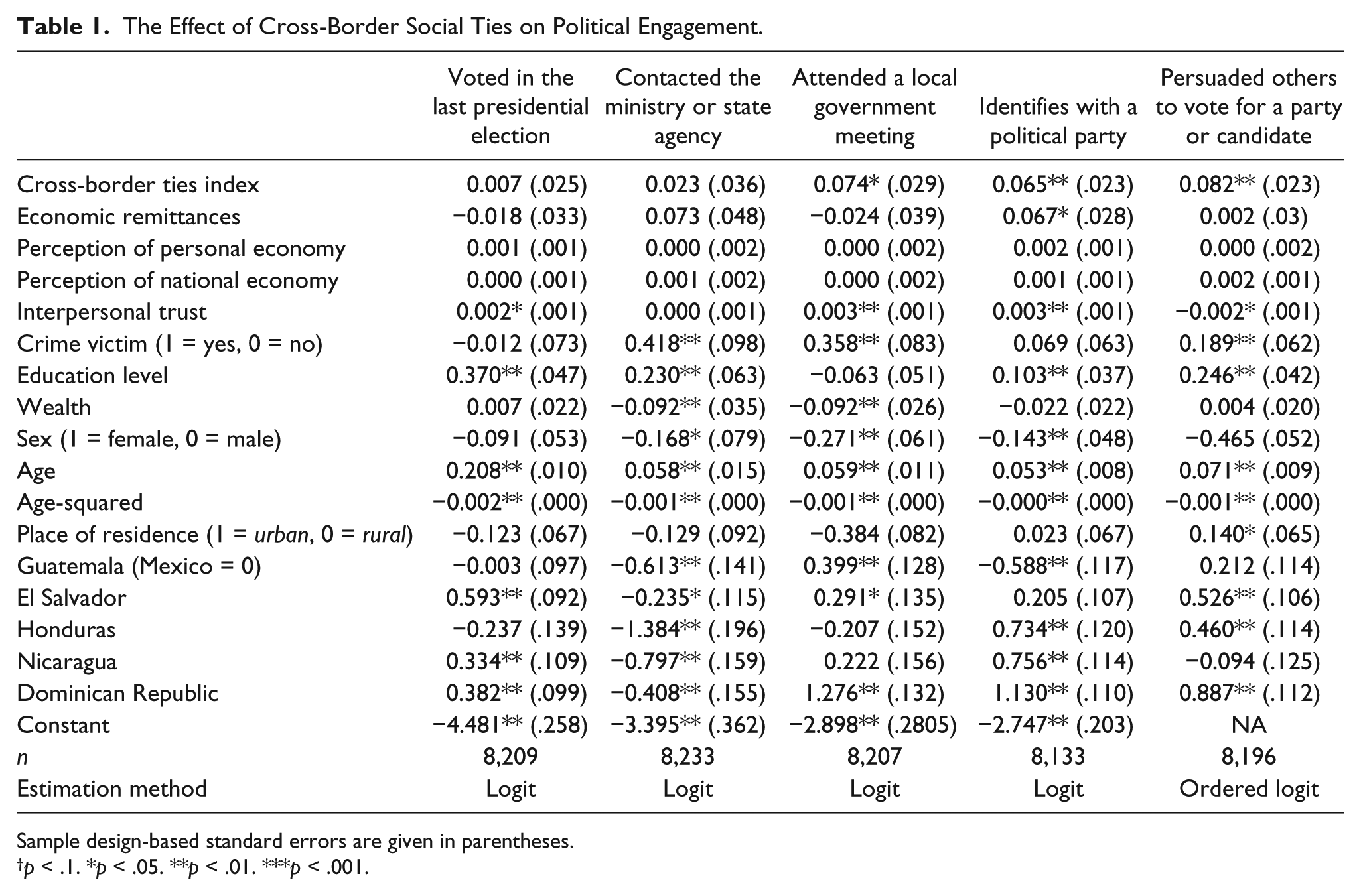
Sample design-based standard errors are given in parentheses.
p < .1. *p < .05. **p < .01. ***p < .001.
As expected, the much stronger piece of support for the impact cross-border connections have on political behavior emerges from the significant and positive effect they have on citizens’ interaction with their local government. We see that those who communicate with relatives abroad on a regular basis are also more likely to identify with a political party and seek to convince others to vote for a particular candidate or political party. When taken together, our null finding with respect to the impact cross-border ties have on involvement in national politics, and the significant positive effect such ties have on one’s involvement with and support for political parties suggests that these latter activities are motivated largely by community-based issues with which local party officials have associated.
Figure 1 illustrates the effect of cross-border ties on citizens’ likelihood of participating in meetings organized by the local government based on the model specification presented in Table 1. The probability of participating in local government meetings moves from about 13.7% for those individuals without any migration connections to 18.4% for those individuals who communicate with their migrant relatives on a daily basis. 11 Similarly, Figure 2 illustrates the results for political party identification presented in Table 1. The predicted probability of identifying with a political party goes from 35.8% to 43.0% as one moves from individuals without cross-border ties to those who have the highest level of involvement or communication with relatives abroad. The results from the model explaining variation in respondents’ self-reported efforts to persuade others to vote for a given political party or candidate are presented in Figure 3. Here we find that that the predicted probability of engaging in these efforts of persuasion increases from an average of 22.9% for those with no migrant connections to 31.4% among respondents who speak with their migrant relatives every day.
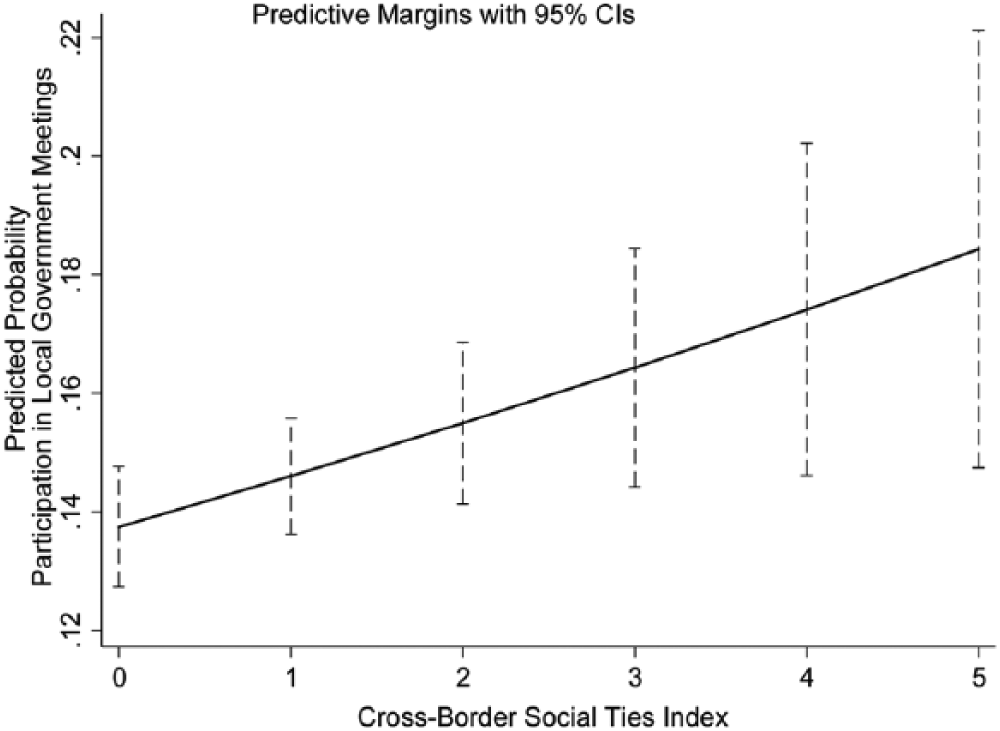
Participation in meetings by the local government.
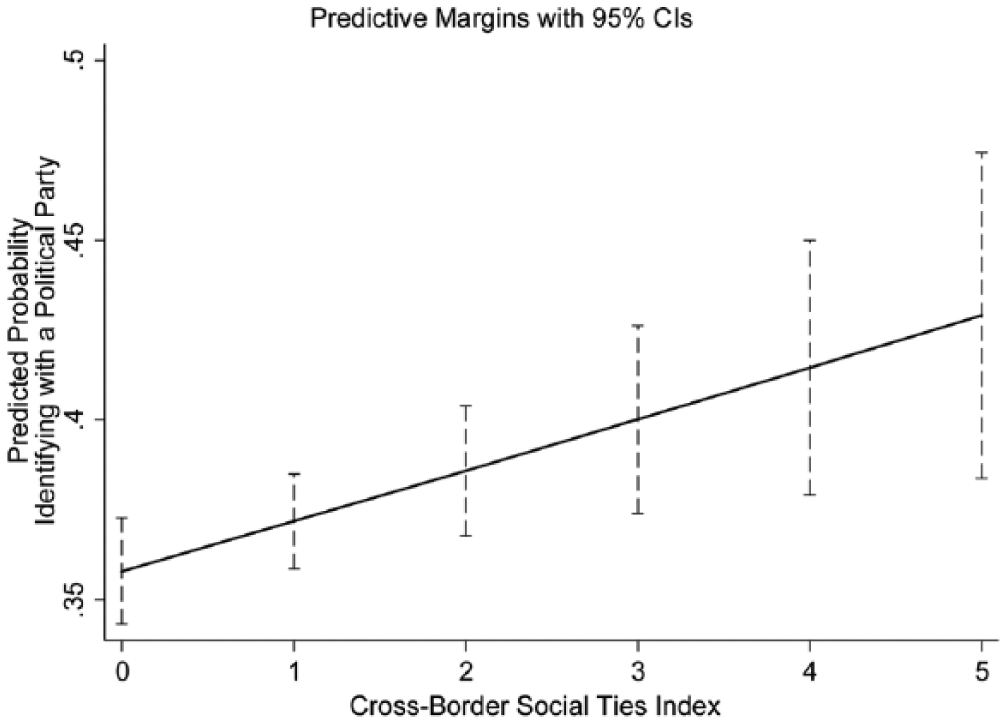
Political party identification.
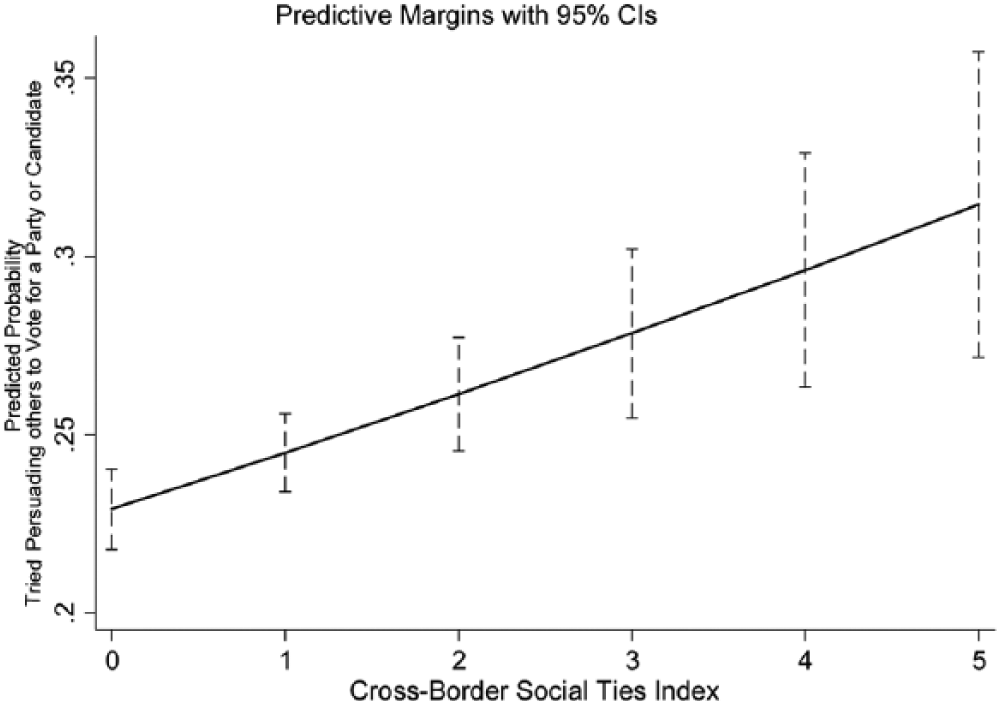
Persuasion of others to vote for a party or candidate.
To assess the robustness of our findings, we next include a measure of respondents’ intentions to migrate. Although citizens who intend to migrate might be more disenchanted with their political system and thus be more likely to participate in politics in an effort to change the status quo, we find that this possibility does not explain the significant effects that cross-border ties have on political engagement. Notably, when we include in our models a control variable for citizens’ intentions to migrate, the results remain similar to those presented in Table 1. 12 From these results, we can be more confident that the effects reported in Table 1 associated with the cross-border social ties index are not the result of a greater probability of planning to migrate among those with strong migrant ties.
Further Robustness Tests
We now turn to the possibility that an endogeneity issue is driving our findings that link cross-border social ties with increased political engagement at the local level. Unobserved variables might simultaneously affect both the probability of having a relative living in the United States and one’s relative level of participation in politics. In other words, individuals who are more likely to migrate to the United States might come from families with a greater probability of participating in politics. Respondents from that household, then, would exhibit higher levels of participation than members of non-migrant households not because of their cross-border ties but rather simply because participation in politics and migration tendencies are both a product of these unobserved traits. We therefore need an empirical strategy to account for at least some of these possibilities.
Our strategy to address the issue relies on the augmented inverse propensity weighted (AIPW) estimator procedure (Glynn & Quinn, 2010; Robins & Rotnitzky, 1995). AIPW estimators use a propensity score model to predict treatment status (e.g., having a relative in the United States or not) and a second model to predict outcomes (i.e., dependent variables). AIPW produces consistent estimates of treatment effects because the probability of treatment is assumed to be independent of the potential outcomes for the dependent variable after conditioning on a series of covariates. An appealing property of the AIPW estimator over other procedures such as propensity score matching is that it yields a consistent average treatment effect (ATE) if either the propensity score model or the outcome regression is misspecified, but the other is properly specified (Glynn & Quinn, 2010). 13 In other words, the AIPW estimator uses “an augmentation term in the outcome model to correct the estimator in case the treatment model is misspecified. If the treatment model is correctly specified, the augmentation term goes to zero in large samples” (StataCorp, 2013, p. 63).
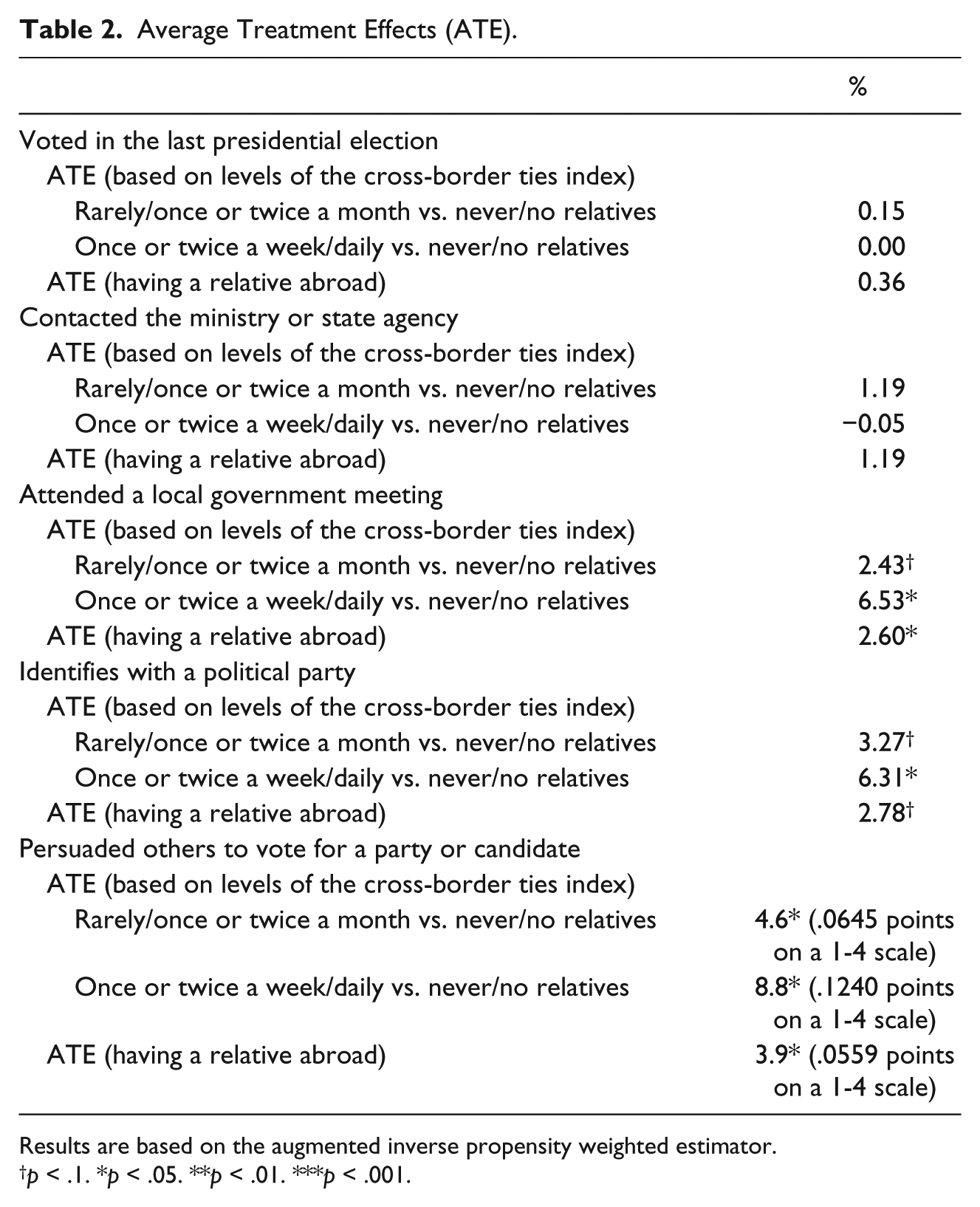
In our case, the outcome model includes all control variables and country fixed effects included in the regression models displayed in Table 1. However, the propensity score model predicts the probability of treatment as a function of household and respondents’ demographic characteristics, including household wealth, place of residency (urban or rural), education level, sex, and age. When we define our treatment variable as a dichotomous measure (i.e., having a relative in the United States or not), our results remain consistent to those reported in the previous section. These findings reinforce our argument that migrants influence the political practices of their relatives back home not because it is a more politically active household to begin with but because of the diffusion of social remittances. Table 2 reports the size of the ATEs for each of the five dependent variables and their statistical significance.
Average Treatment Effects (ATE).
Results are based on the augmented inverse propensity weighted estimator.
p < .1. *p < .05. **p < .01. ***p < .001.
A next step in further establishing the robustness of our findings is to highlight the importance of the degree of cross-border connections in political engagement levels, not just their presence or absence. To do this, we replicate the AIPW analysis described above taking into account different levels of treatment intensity and proceed to compare these results with those we obtain when we use a dichotomous measure of cross-border ties. For this analysis, we estimate ATEs at two levels of treatment on the cross-border social ties index (i.e., having relatives abroad but communicating with them rarely or only once or twice a month and having relatives abroad but communicating with them once or twice a week or daily). We compare each of these two treatment levels with a baseline category (i.e., control group) that includes individuals without relatives abroad or with relatives but who never communicate with them. 14 As we explain in more detail in Note 14, our decision to collapse our categories here is driven purely by the need for a sufficient number of cases in each to carry out the analysis. 15 We find in this approach that, consistent with our theory, the more extensive the level of cross-border ties an individual has with a migrant relative living in the United States, the more likely he or she will be to exhibit higher levels of political engagement at the local level than his or her neighbors who have limited or no such connections.
More specifically, individuals who communicate with their relatives once or twice a week or daily show on average about 6.5% higher probability of participating in local government meetings than those who do not have migrant relatives or those who never communicate with their migrant relatives. Similarly, those individuals in the former group show about a 6.3% higher probability of identifying with a political party. However, communicating with relatives abroad daily or once or twice a week increases the average frequency of persuading others to vote for a party or candidate by a statistically significant 8.8%, equivalent to .12 points on the original scale of this variable (1-4). Notably, as can be seen in Table 2, when we use a measure of cross-border connections that relies only on whether or not an individual has a relative living in the United States, without taking into account the frequency of their communication, the average treatment effect becomes much smaller than when we use our connections measure. This difference in the magnitude of the effect again highlights the importance of capturing the depth of such connections, not just their presence or absence.
Taken together, our results suggest that strong links with migrants living in a more consolidated democracy affect the political engagement levels of citizens in high-migration countries in Latin America. These results challenge the notion that migration will always result in pueblos fantasmas (ghost towns) in which citizens simply sit back and wait for their Western Union checks. Although there certainly may be towns and individuals across Latin America that fit this description, our results suggest that those citizens who maintain a high level of contact with their migrant relatives living in established democracies tend to be more, not less, politically engaged, at the local level.
Uncovering Potential Causal Mechanisms
In this section, we test our last three hypotheses. More specifically, we examine whether the positive effects of cross-border ties on local political engagement are in part explained by the three mediating variables we introduced in the theoretical section: (a) participation in community development activities, (b) heightened feelings of political efficacy, and (c) greater political interest among those who have frequent contacts with migrants living in the United States. To test these propositions, we estimate the path model illustrated in Figure 4, using Bayesian mediation analysis (Wang & Preacher, 2015; Yuan & MacKinnon, 2009) and controlling for the same variables included in previous models. 16 Our main goal here is to evaluate the magnitude and statistical significance of the indirect effect associated with each mediating variable. A Bayesian approach allows us to estimate more accurately the significance of these indirect effects, as it does not assume a normal distribution of parameters (Yuan & MacKinnon, 2009).
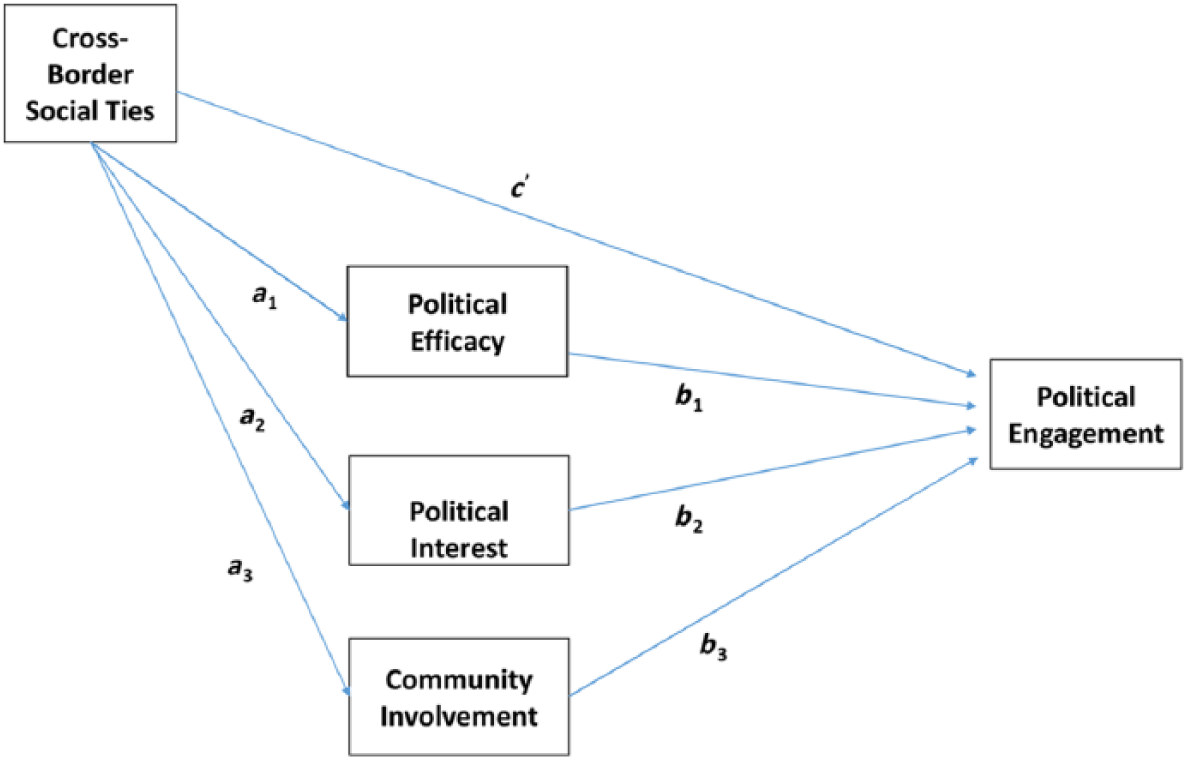
Path model.
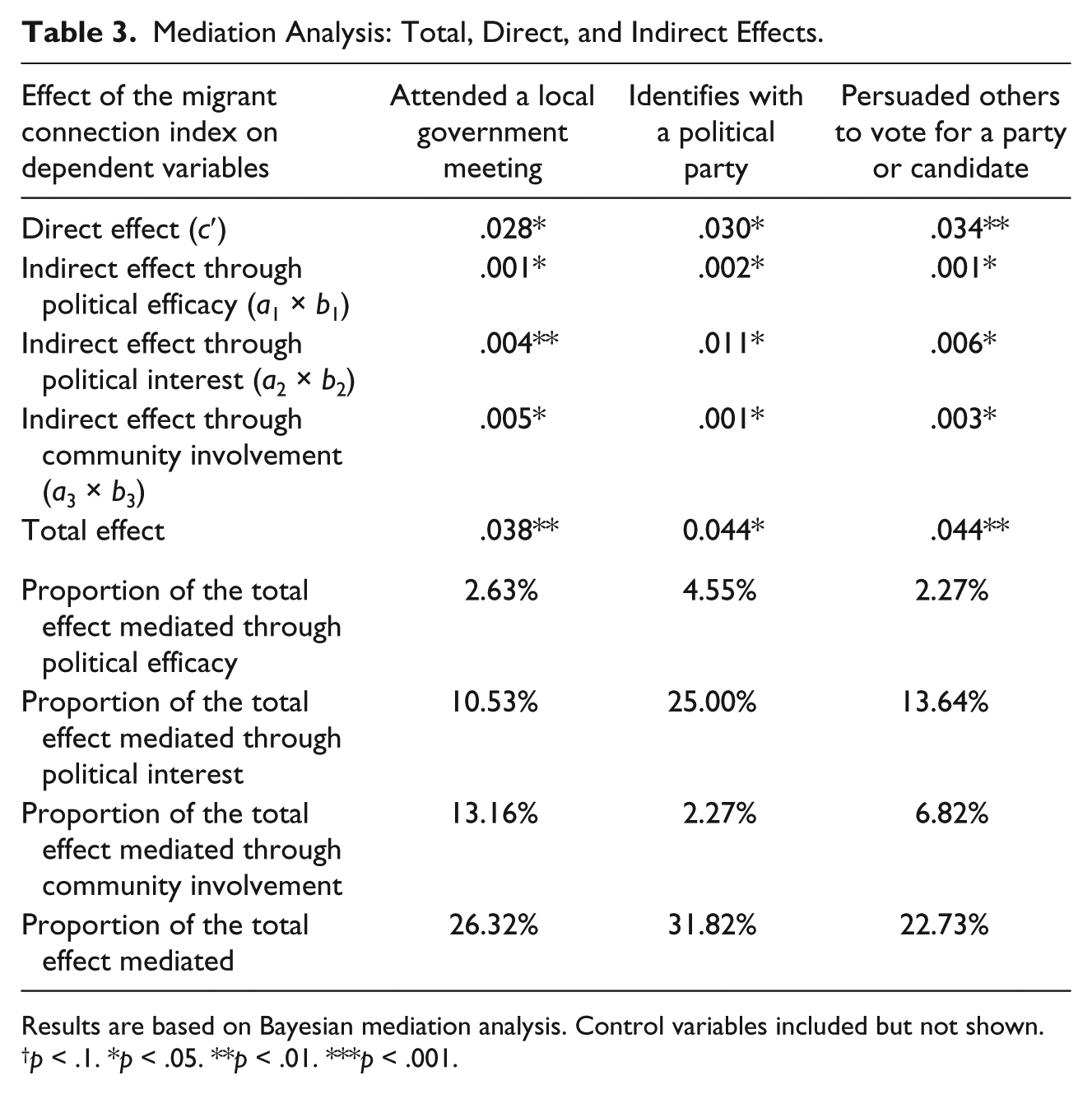
Before we proceed to present our findings, a cautionary note is in order. As our data are non-experimental, we are only able to test whether the association between variables is consistent with the proposed causal model and the theoretical framework that supports it, and not if actual causal relationships exist between variables. With that said, Table 3 presents a summary of our mediation analysis. 17
Mediation Analysis: Total, Direct, and Indirect Effects.
Results are based on Bayesian mediation analysis. Control variables included but not shown.
p < .1. *p < .05. **p < .01. ***p < .001.
From Table 3, we see that the effect of cross-border ties on political engagement is in part a product of the ways in which cross-border connections influence our three mediating variables. We find that 26.3% of the total effect that cross-border ties have on the probability of participating in local government meetings is due to the effect of these three mediating variables. An even more substantial 31.8% of the effect on political party identification is mediated by these factors, whereas 22.7% of the total effect that cross-border ties have on the vote persuasion variable comes from these three mediating variables.
We also find, as expected, that these mediating factors have varying effects on the three forms of political engagement we analyze here. An individual’s level of community civic engagement, for example, exerts a much stronger indirect effect on participation in meetings organized by the local government than it does on our other dependent variables. A similarly intuitive connection exists between cross-border connections, increased interest in politics, political efficacy, and, ultimately, a greater involvement with political parties. Here we, first, find higher levels of political interest among citizens who have frequent communications with their relatives abroad and, second, find that this greater interest in politics is associated with higher levels of involvement with political parties. We find a similar statistically significant, but less substantial, relationship between cross-border connections, feelings of political efficacy, and political party activities.
Finally, further empirical analyses give support to our proposition that increased political interest and political efficacy among those with strong cross-border ties emanate in part from the greater awareness and knowledge of international affairs that we posit to be a by-product of the higher probability of their use of the Internet. Indeed, our regression results show that, once controlling for other factors, individuals with strong links to their relatives abroad are significantly more likely to use the Internet and to know the name of the U.S. president than those who have weak or non-existent cross-border ties. Not surprisingly, we also find a strong effect of Internet usage on the probability of knowing the name of the U.S. president. Based on the regression results, in Figures 5 and 6 we illustrate the substantive effect of cross-border ties on Internet usage and political knowledge. 18
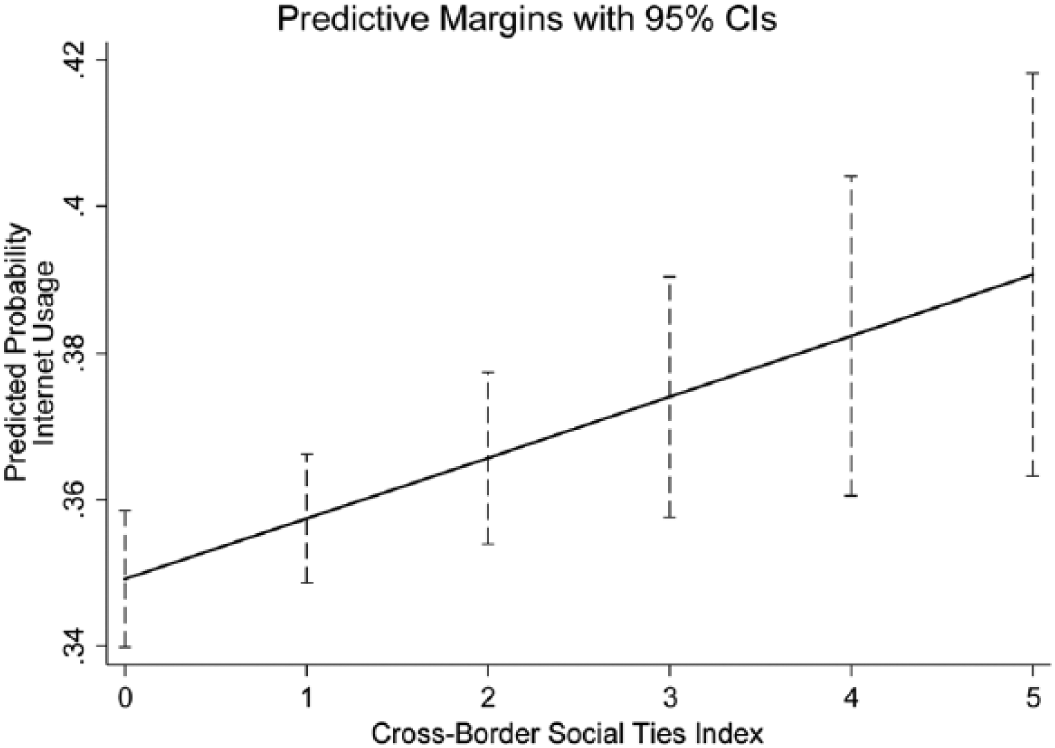
Internet usage.
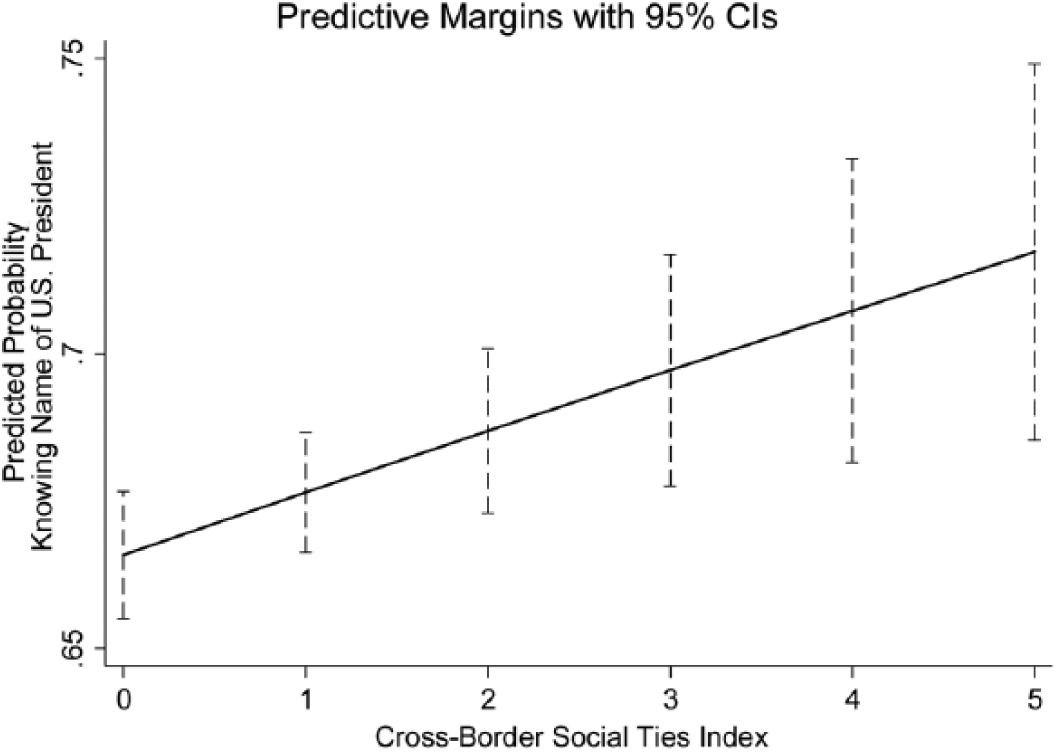
Political Knowledge (knows name of the U.S. president).
In addition, we find that political knowledge of international affairs and Internet usage are strongly correlated with political interest and political efficacy, 19 offering further suggestive evidence that cross-border ties foster political interest and political efficacy by exposing citizens to international political information through the Internet during the course of their interactions with their migrant relatives.
Effects of Case Selection
A final set of analyses allows us to comment on whether the particularities of the Nicaraguan case have any effect on the principal findings of the study. With a larger contingent of emigration to neighboring Costa Rica than to the United States, it is important to establish the ways in which Nicaraguan respondents are influencing our findings. We thus replicated the entire set of previous analyses after excluding Nicaraguan respondents. 20 We find across all models that the effect of cross-border ties on political participation at the local level and party attachment becomes stronger. That is, when our analysis focuses only on countries with virtually exclusive migratory relations with the United States, we find even greater support for our hypotheses. Consistent with our theory, then, these results suggest that personal connections with a relative in the United States are more likely to spur political engagement among non-migrants when the latter reside in countries where the United States is the primary receiving country. Although more research is needed on this question, this dynamic appears to facilitate communities’ collective action to pursue developmental goals with the support and influence of their migrant relatives.
To further explore the effect that the distinct migration profile of Nicaragua has on our results, we carry out a modified version of our analysis for each of the six countries in our sample. This exercise is highly constrained by the extremely low number of respondents that we have for the six cross-border connection categories within each individual country. To deal with this problem, we followed two strategies. First, we added data from LAPOP’s 2008 AmericasBarometer to bolster the number of cases for each country. In addition, because we are working with dependent variables with a relatively low number of respondents in some countries reporting participatory behavior, particularly for our “participation in local government meetings” item, we were forced to construct alternative measures of individuals’ political engagement levels at the local level.
More specifically, as the number of individuals who reported having participated in local government meetings is particularly small in some countries (e.g., 9.5% in the sample for Honduras), we maximize the variance of this variable by creating an index that combines answers to this survey question and the variable on political party identification. Moreover, we create a second index combining the variables on participation in local government meetings and persuasion to vote for a party or candidate. 21 Each index is a count variable reflecting the number of distinct modes of political engagement an individual reported (0-2). We use these two indices as our dependent variables in our individual country analyses. Our theory suggests that strong cross-border ties should be associated with a higher value on each index or higher probability of obtaining a score of 2, namely, participating in local government meetings and reporting attachment to a political party. Consequently, in addition to increasing the variance of our dependent variables, these alternative measures allow us to test even more directly our argument that local political participation should come together with greater political party activism as migrants and their non-migrant relatives are more likely to trade support for a political party in exchange for a party’s assistance with their community development projects.
When we use these two indices as dependent variables and add data from the 2008 LAPOP survey, we find that the ATEs for Nicaragua are not statistically significant, suggesting why our results became stronger when respondents from this country were excluded from the analysis. Conversely, we find that for each of the remaining five countries in our analysis, the ATEs for cross-border connections on the two participation indices remain positive and statistically significant, offering even further support for the posited influence of cross-border connections on local political engagement (see Table 4). 22
ATEs of Having a Relative in the United States by Country.
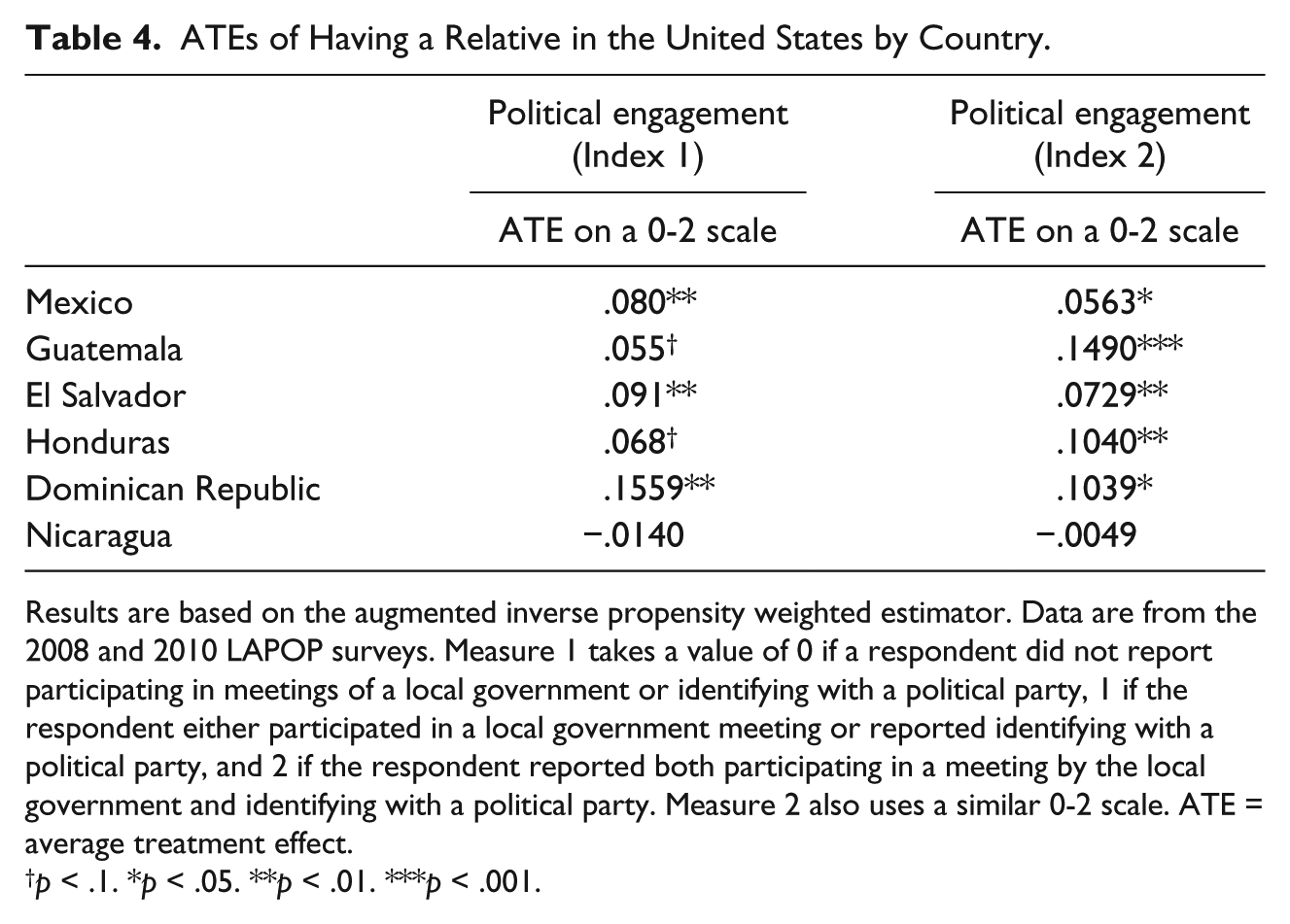
Results are based on the augmented inverse propensity weighted estimator. Data are from the 2008 and 2010 LAPOP surveys. Measure 1 takes a value of 0 if a respondent did not report participating in meetings of a local government or identifying with a political party, 1 if the respondent either participated in a local government meeting or reported identifying with a political party, and 2 if the respondent reported both participating in a meeting by the local government and identifying with a political party. Measure 2 also uses a similar 0-2 scale. ATE = average treatment effect.
p < .1. *p < .05. **p < .01. ***p < .001.
Conclusion
As the movement of people around the world continues to increase, so too does the advance of communication technologies in terms of speed, access, and global coverage. In this article, we examine the implications of these two trends for the democratization process that continues across much of the developing world. With these advances in communication, it is not an overstatement to suggest that there is no other time in human history where the effects of migrants on their relatives who stayed behind are more likely to emerge. The former group has a far greater ability to communicate with the latter on a regular basis, whereas those in the latter group also find themselves in the midst of a prolonged political transition characterized in many areas by flawed democracies and myriad government performance issues. This confluence of events offers a “perfect storm” for the widespread emergence and highly consequential impact of what Levitt identified more than a decade ago as “social remittances.”
Our findings offer the strongest indication yet that migration does in fact have systematic and predictable effects on the way that people with strong ties to migrant relatives engage politically within their communities. We find evidence that those with extensive connections to migrants living in an established democracy are more likely to participate in local politics and become involved with political parties than their neighbors who have no such connections, but exhibit no such differences when it comes to involvement in the national political arena.
At first glance, the greater degree of interaction with local officials coupled with increased political party attachments is encouraging, as any democracy is always in search of a more involved and active citizenry. Upon further reflection, though, these findings also suggest a possible increase in the political divides that run through high-migration sending communities between the “migrant haves” and “migrant have-nots.” That is, those with strong ties to migrants living abroad seem to be transforming these connections into greater prestige and influence within the sending community and greater political activism and representation, whereas those without such connections may be increasingly relegated to a lower rung of their community’s social and political ladder. At this point, we simply do not know enough about the long-term political implications of our findings to say with any degree of confidence whether a “glass half-full” or “glass half-empty” perspective is more warranted. An important next step in understanding migration’s impact on democracy, then, is to delve further into the political dynamics of sending communities across the Americas. And as we mentioned at the outset of this study, such research is important not only for emerging democracies such as those we analyzed here, but perhaps even more importantly for a country like Cuba, where the political implications of cross-border connections, with the stroke of a pen in 2014, became far more critical in understanding its possible democratic future.
What is clear from the results of our research is that migration does not necessarily lead to a politically passive sending community. Although the increased civic community involvement of citizens with strong cross-border ties in particular bolsters participation in local government affairs, their greater party attachment stems in part from their increased political interest and efficacy associated with increased knowledge of international politics. Moreover, we find evidence that, ceteris paribus, the reliance on the Internet of those who maintain strong connections with migrant relatives helps in part to explain their relatively high levels of political knowledge, political interest, and efficacy. Taken together, these different sources of political mobilization contribute even further to higher levels of local political engagement among individuals with strong cross-border ties to migrants and leave us with the more general conclusion that migration has become an important factor in shaping the ongoing democratization processes of the thousands of sending communities around the world.
Footnotes
Declaration of Conflicting Interests
The authors declared no potential conflicts of interest with respect to the research, authorship, and/or publication of this article.
Funding
The authors received no financial support for the research, authorship, and/or publication of this article.
Notes
Author Biographies
References
Supplementary Material
Please find the following supplemental material available below.
For Open Access articles published under a Creative Commons License, all supplemental material carries the same license as the article it is associated with.
For non-Open Access articles published, all supplemental material carries a non-exclusive license, and permission requests for re-use of supplemental material or any part of supplemental material shall be sent directly to the copyright owner as specified in the copyright notice associated with the article.
