







Abstract
This article examines how foreign direct investment (FDI) affects the likelihood of authoritarian leaders’ political survival. We argue that FDI reduces the likelihood of experiencing political challenges from elites. We present two mechanisms for this claim. First, the host governments of authoritarian regimes can use FDI for long-term private good provision, so that FDI helps them to appease elite dissents and to buy off potential elite challengers. Second, FDI mitigates a commitment problem between elites and authoritarian leadership by creating an FDI-related distributional coalition, which in turn makes political defections costly to both parties. Our empirical tests using various two-stage estimators show that FDI significantly decreases the likelihood of elite-driven authoritarian leadership failure and coup attempt.
Foreign direct investment (FDI) has become an essential economic engine for many countries in recent decades, particularly for developing countries. According to the United Nations Conference on Trade and Development (UNCTAD; 2010) data, average FDI net inflows as a percentage of GDP in 2000s was 4.5%, about twice as high as in the 1990s and five times higher than in the 1980s. 1 Given this rapidly growing influence of FDI, scholars and economic policy makers have rigorously examined the economic and political determinants of FDI and its impact on host countries’ economies. In particular, political scientists have sought to answer whether and how the host government’s political and legal practices, in terms of rule of law and property rights, matter in attracting foreign investment. Yet, we know less about the political effects of FDI on the host government in general, in particular and more interestingly about how the potential economic benefits from FDI can be transformed into political incentives for the host government’s leadership, especially in authoritarian regimes.
The lack of understanding of the political effects of FDI is somewhat surprising for the following reason. Recent scholarship in comparative political economy has identified various economic sources (e.g., foreign aid and oil revenues) as important determinants of autocratic stability (e.g., Ahmed, 2012; Bueno de Mesquita & Smith, 2010; Morrison, 2009; A. Smith, 2008). Although FDI contracts in authoritarian regimes are not purely private, and there is significant room for using FDI rents for political purposes, few studies have examined the political effect of FDI on autocratic stability. 2
We argue that authoritarian leaders can use FDI to reduce the likelihood of experiencing political challenges from elites. This article presents two mechanisms for this claim. First, FDI increases the pie that the host country’s authoritarian leadership and elites can share privately. That is, authoritarian leaders can generate more patronage resources to buy the tacit support of potential elite challengers. For example, an authoritarian government can endow elites with privileges to participate in a profit-sharing coalition such as a joint venture. Second, authoritarian leaders can alleviate a commitment problem using economic ties through FDI. By providing elites with tangible and nontangible privileges from FDI contracts, leaders can send a costly signal of their intentions to honor the coalition with elites. In addition, elite defection is costly because regime instability hurts the prospect of long-term economic benefits from FDI. Consequently, FDI can help build a mutually self-enforcing relationship between an authoritarian leader and elites. Thus, we expect that FDI should decrease the likelihood of elite defection, accordingly enhancing regime stability. Using various two-stage methods for authoritarian country-years between 1970 and 2010, we find strong evidence in support of our expectation.
Our research contributes to the FDI literature by examining the regime-stabilizing effects of FDI in authoritarian regimes, as well as to the literature on the determinants of autocratic stability by identifying another important economic source that is beneficial to the authoritarian leadership of the host government. In the following sections, we survey the literature on the political economy of authoritarian stability, and then present theoretical mechanisms through which FDI induces authoritarian stability. Next, we discuss empirical findings along with various robustness checks that support our theoretical expectation. The last section concludes and suggests topics for future research.
Political Economy of Authoritarian Regime Stability
It is a stylized fact that authoritarian leaders are more likely to leave office by irregular means than democratic leaders, and they tend to face more severe posttenure punishment. 3 Elite challenge is a predominant cause of irregular authoritarian leadership failure, compared with other causes such as mass uprisings or foreign imposition (Svolik, 2009). Thus, to secure their political survival, authoritarian leaders are particularly concerned with keeping elite members loyal. We first briefly review existing literature on authoritarian regime stability and summarize the mechanisms through which autocrats can maintain political support from their ruling coalition and in turn enhance regime stability.
The arguments generally center on two mechanisms. First, authoritarian rulers can buy off potential elite dissenters by providing material benefits. 4 Selectorate theory, for example, explains that authoritarian leaders in small winning-coalition systems would want to satisfy their core supporters by providing private goods (Bueno de Mesquita, Smith, Siverson, & Morrow, 2003). However, it is questionable whether material benefits alone can effectively prevent elite defection in the absence of a mechanism that ensures both elites’ commitment to the status quo power distribution and a ruler’s commitment to continuing to share economic spillovers and rents. Accordingly, recent studies started to stress the importance of another mechanism—establishing power-sharing institutions to overcome the commitment problem (e.g., Boix & Svolik, 2013; Gehlbach & Keefer, 2011; Magaloni, 2008). Although their analysis of power-sharing methods may differ, these studies concur that material benefits alone cannot ease concerns about mistrust between an authoritarian leader and elites. 5
On this theoretical foundation, recent scholarship has examined how authoritarian leaders can utilize extra sources of economic income to enhance regime stability, largely focusing on the first mechanism, private good provision: Particularly, foreign aid and resource rents have gained the most scholarly attention in the recent decade. Scholars argue that authoritarian leaders in rent-based economies are less dependent upon public economic productivity, but most likely to use unearned income for private good provision (e.g., T. Dunning, 2004; Kono & Montinola, 2009; Ross, 2001; A. Smith, 2008). Thus, scholars expect that the more unearned income available to an autocratic ruler, the more likely they are to maintain elite support. Several studies found empirical evidence that such unearned income increases autocratic stability. 6 B. Smith (2004), for example, finds that oil wealth increases regime durability because regimes with significant oil revenues are better at funding patronage and repressive apparatuses. Bueno de Mesquita and Smith (2010) find that nondemocratic leaders with access to free resources such as oil and foreign aid are better able to prevent and survive revolutionary threats, because they can provide private goods to elites without suppressing public goods. Similarly, Ahmed (2012) concludes that “unearned foreign income can increase private government consumption in the form of patronage, which a government can use to ensure its political survival” (p. 164).
Others challenge these findings, arguing that the nature of unearned income is not homogeneous across income types and accordingly has different political implications. For instance, Dietrich (2013) argues that aid is distributed not randomly but on the basis of the quality of recipient governments. Her argument implies that the extent to which recipient governments use aid for political purposes is somewhat limited, because poorly governed countries are less likely to receive aid in the first place. Similarly, Escribà-Folch, Meseguer, & Wright (2015) contend that remittances accrue directly to individuals, thereby reducing their availability to governments. Bermeo (2016) more directly contends that foreign aid and its utilization, unlike other income such as oil revenues or remittances, are affected by the preferences of donors. She finds that aid does not have regime-stabilizing effects in the post–Cold War period.
Two points are worth noting. First, recent studies pay close attention to the individual and idiosyncratic characteristics of each type of extra income. Scholars argue that there are considerable differences between foreign aid, remittances, and oil-based income, which lead to distinct theoretical and empirical expectations. In particular, the debate centers on the extent to which authoritarian governments can engage in distributing the income, and how the income is directly related to the preferences of key political actors. In a similar vein, our article also highlights how FDI differs from foreign aid or remittances. FDI is not unearned income; unlike foreign aid, for example, host governments can directly reap economic gains by levying taxes on multinational corporations (MNCs). However, nor is FDI a purely private transaction like trade. Although investment decisions are made by private companies, investment conditions are largely shaped by the policies of host government. MNCs must negotiate the terms of investment with an authoritarian host government: For example, the host government may impose a number of performance requirements on foreign investments, such as joint venture with local industries, technology transfer, and employment and training commitments. That is, an authoritarian host government can directly engage in FDI contract as a key actor to a significant extent, and can manipulate the process of distributing economic benefits by assigning potential beneficiaries. 7
Second, although the literature advances our understanding of the political effects of unearned income on authoritarian stability, the theoretical arguments do not fully incorporate the commitment issue widely discussed in the literature on authoritarian stability and leadership survival. For example, one can still question why autocratic elites maintain their political support once they receive economic gains. Regardless of the sources of economic rents, the distribution of economic benefits is subject to commitment problems. Economic ties around FDI can address this issue. Domestic elites who benefit from FDI income can expect relatively long-term economic gains, as FDI has a longtime horizon in nature. Thus, FDI can create a commitment tie between the government and elite beneficiaries by making an opportunistic and shortsighted exit option more costly.
Political Effects of FDI
In this section, we present more comprehensive explanations for how FDI inflows can enhance authoritarian regime stability. We identify two mechanisms: that is, FDI can improve authoritarian regime stability by providing more resources for private good provision and it helps address a commitment problem between the ruler and elites.
FDI as a Means of Private Goods
We begin with general explanations for how FDI may benefit authoritarian host governments. Host governments can obtain direct income by selling or renting government-owned physical assets, selling stock shares of state-owned enterprises, or selling a monopolized right to develop domestic resources. Furthermore, the host government can obtain additional tax revenues that are paid not by domestic economic actors but by foreign entities: that is, tax revenues generated from FDI can be considered as extra foreign income. Total tax revenues from foreign enterprises in China, for example, accounted for only 2% of national revenue in 1990, but reached 19% in 2001 (Jiang, 2004). Of course, FDI income is not unique to authoritarian regimes, but the distributional consequence of FDI income in authoritarian host countries is distinctive from that in democracies, which is further elaborated in the following discussion.
First of all, FDI may give authoritarian governments more opportunities to create economic profits from existing but undeveloped resources, which in turn can be used to buy off potential political challengers. Foreign investors usually bring advanced technologies along with ample capital, which can help host countries utilize existing economic resources. Economic gains are not automatically followed by existing domestic resources, but the economic potential of natural resources and labor can be realized with the help of technology and capital that FDI often brings with it. Oil industries in authoritarian countries, for example, are usually owned by a national government. While most of oil reserves (about 90%) are controlled by national oil companies (Tordo, 2011), they usually demand advanced technologies from extraction to refinement. For example, Esanov, Raiser, and Buiter (2004) note that
. . . energy resources in Azerbaijan and Kazakhstan were not immediately available for exploitation and had to be developed first. This was done through a policy of opening up to foreign investment, exemplified by contracts with Chevron and Mobil for the Tenting oil field in Kazakhstan (signed in 1993) and with a consortium led by BP for the Razer-Chirag-Guneshli concession areas in Azerbaijan (signed in 1994). (p. 6)
There is another, indirect, path by which FDI can affect regime stability. For example, authoritarian governments with higher revenue can provide more public goods to general citizens, accordingly appeasing political disgruntlement. As Jensen and Rosas (2007) argue, FDI may reduce income inequality, thus increasing general regime support from the public. However, our main concern here is elite-driven regime challenges, because they are known to be most threatening to authoritarian leadership.
What makes FDI in authoritarian regimes unique is that these profits are largely subject to rent seeking by governments. 8 Given the economic opportunities created by FDI, authoritarian institutions are better suited for rent extraction from FDI-induced benefits, because authoritarian governments tend to have a greater discretion than democratic governments both over the FDI-related policies and the distribution of economic rents. In authoritarian regimes, governments are not largely accountable for the (mis)use of economic resources, due to relatively weak domestic constraints on economic policy making. Existing studies echo the political discretion of authoritarian governments over the distribution of economic rents. Jensen and Wantchekon (2004) argue that nondemocratic governments’ discretion over the distribution of resource rents can reduce democratic transition, as the incumbent can utilize those rents to buy off political supporters. Thus, increase in FDI would provide authoritarian governments with more rents that can be used for private good provision.
Second, another mechanism through which authoritarian governments can politically utilize FDI is to require foreign investors to form joint ventures with domestic capital. When it comes to using FDI for political purposes, authoritarian governments may need to consider the distributional consequences of FDI. FDI can create domestic winners and losers; thus, not all members in domestic polity would benefit from FDI (Pandya, 2014; Pinto, 2013). In particular, the literature suggests that domestic capital owners, who usually face direct competition with foreign companies, tend to be the losers. 9 Although authoritarian governments may want to distribute private goods extracted from FDI to political elites, this incentive may be offset by general dissatisfaction among the winning coalition. This also implies that not all members of the winning coalition would welcome their government’s opportunistic strategies to open the domestic market; thus, FDI income may lead to contestant among political elites, between beneficiaries and others. One solution that authoritarian governments can adopt is to require foreign investors to sign joint ventures with companies run by the members of the winning coalition. In this way, a broad range of domestic elites can participate in a profit-sharing coalition, which in turn can produce long-term sustainable economic profits, and thus enhance general satisfaction among the winning-coalition members over the distribution of FDI benefits.
An Egyptian case is indicative of how FDI can play a central role in maintaining regime stability by forming joint ventures. It is well known that the Egyptian military, the most influential elites within the Egyptian government, has had extensive control of the Egyptian economy. FDI has been one of the main channels through which the military establishment has expanded its influence on both national and local economies. In particular, the military has made efforts to form joint ventures with foreign companies in sectors including transport, energy, and environmental projects under the support of the Egyptian government. For instance, a number of joint ventures in maritime industry were established with the world’s largest MNCs. In these projects, the military maintained considerable shares and executive positions through a state-owned holding company (Marshall & Stacher, 2012). In addition, the military not only directly obtained economic gains from joint ventures but also created further economic potential by wielding considerable influence over other industries. For instance, the military
provides much of the hardware and labor for Egypt’s rail construction, which is being expanded in order to link new maritime port terminals with inland rail networks, which in turn will increase the volume of business for the joint venture port operators. (Marshall & Stacher, 2012, p. 3)
Hence, the economic benefits from FDI could spread out broadly to the members of winning coalition, enhancing the general satisfaction of political elites as well as their support for the ruling government. 10
FDI and Commitment Problem
A predominant cause of authoritarian leadership failure, as we saw earlier, is neither popular uprising nor peaceful democratic transition. The biggest threat to authoritarian leadership comes from regime insiders or elites (Svolik, 2009). Elites are afraid of purge or assassination as much as the autocrat is concerned about defection among elites. This incessant tension and mistrust is largely because they cannot credibly commit to honoring their distributional coalition.
11
Distributive strategies alone may not be sufficient enough to secure authoritarian leadership, due to commitment problems (Haber, 2006; Magaloni, 2008). First, simple transfers of short-term economic benefits may not be enough to gain political support from elites, because the authoritarian government may later renege on the promise of private good transfers. That is, elites have a concern that their leader may defect: that is, an authoritarian leader cannot credibly commit to the current power-sharing structure (Boix & Svolik, 2013; Magaloni, 2008). Thus, the authoritarian ruler needs to be able to send a credible signal committing himself to honoring the distributional coalition with elites (Magaloni, 2008). Likewise, it is difficult for authoritarian leaders to distinguish between truly loyal supporters and disguised potential defectors: that is,
Holding on to office is, however, extremely difficult because dictators cannot know who supports them and who does not: virtually all constituents and colleagues in dictatorships—at least those who value their necks—profess loyalty to the dictator, even as they conspire to depose him. (Haber, 2006, p. 694)
Furthermore, economic resources given to elites could provide an opportunity for defection by making potential elite challengers stronger. Thus, elites cannot credibly commit themselves to keeping their loyalty either.
We argue that FDI can help address this time-inconsistency problem to a considerable extent, particularly because it has a longer time horizon than other types of investment, such as foreign portfolio investment (Ahlquist, 2006). This unique aspect of FDI provides an opportunity for both the incumbent leader and elites to credibly commit to their profit-sharing coalition; consequently, FDI helps them build a mutually self-enforcing distributional coalition. 12
First, authoritarian leaders can alleviate elites’ concern over the incumbent’s potential defection ex post, by providing elites with a means of generating sustainable economic profits. The incumbent governments can create economic ties with elites by sharing rent-seeking positions related to FDI projects. Sharing FDI benefits is more than a onetime economic grant. Once involved in a profit-generating coalition, domestic elites expect to enjoy long-term economic benefits due to its longtime horizon. Moreover, allowing elites to obtain sustainable economic gains from FDI projects can serve as a costly signal of the incumbents commitment, because potential elite challengers would be better equipped with economic resources for regime challenge if the incumbent defects. 13 Thus, an authoritarian leader’s signal of creating economic ties with elites becomes more credible.
This mechanism is likely to work primarily because FDI projects are not short-term grants that are externally given and/or independent of elite participation. The aforementioned Egyptian case corroborates this point: “The key factor in ensuring the militarism’s allegiance to Mubarak during the long years of his rule was the enormous autonomy granted to officers in creating and running a lucrative military-industrial-business complex” (Hashim, 2011, p. 109). In addition, regime disruptions or any threats to current FDI projects by elites would significantly undermine the economic resources that are necessary for the autocrat to accumulate his wealth and maintain the satisfaction of supporters. Thus, FDI makes elites’ antileadership challenges a credible threat, in turn alleviating their concern over the ruler’s defection.
Second, FDI can also help address the commitment problem of elites. As elites and international investors form a profit-sharing coalition (e.g., joint ventures), from the perspective of elites, political instability and regime disruption endangers not only current FDI projects but also the prospect of future ones that will bring significant income. That is, dishonoring the current ruling coalition and threatening regime stability becomes more costly as elites’ income and positions are more dependent upon FDI. Foreign investors are likely to make a negative risk assessment for highly destabilized host countries, which in turn would reduce potential FDI inflows, making the opportunity costs of elite defection high. The costliness of elite defection looms large, particularly when considering the longtime horizon of FDI. Thus, elites who are given rights or privileges over FDI rents have a strong incentive to honor the current distributional coalition to ensure stable future economic gains. In sum, the likelihood of elites’ defection is offset by the long-term opportunity costs of the exit option.
Hypotheses
The core implication of our discussion is that FDI can help deter elite challenges and, hence, increase the likelihood of leadership survival in authoritarian regimes. Notice that our theory has no expectation about how FDI affects the probability of public challenges against the authoritarian leadership. Thus, our discussion leads to the following hypothesis:
We believe that the likelihood of elite-driven authoritarian leadership failure is a fairly good indicator of leadership instability due to elite challenges. However, these two theoretical concepts are not equivalent: Regime challenges from elites do not always lead to leadership failure in spite of the increased risk of failure. To evaluate the reliability of our empirical results, we employ another indicator of leadership instability that directly captures regime-destabilizing actions by elites: for example, the number of coup attempts. Thus, we also posit and test an additional hypothesis:
Research Design
Sample
The unit of analysis is authoritarian country-year, and we select authoritarian regime years using the Autocratic Regime Data by Geddes, Wright, and Frantz (2014). A country-year in our study is equivalent to a leader-year, because we include only a single leader who held the leadership position on the first day of each year. The temporal dimension is between 1970 and 2010. The number of authoritarian countries used in regressions is 92, and the number of country-years is 1,969.
Dependent Variable
We use two indicators for our main dependent variable. The first indicator of autocratic instability, LEADERSHIP FAILURE, is created using the information on the type of leadership failure coded by the Archigos database (Goemans, Gleditsch, & Chiozza, 2009). This dichotomous variable is coded as one if a leader was removed (a) by domestic military actors, (b) by other domestic government actors, (c) through assassination by an unsupported individual, or (d) due to a power struggle within the military, short of coup. Leadership survival years are coded as zero. Also coded as zero are regular leadership failures and particular types of irregular authoritarian leadership failure, as they do not fit our theoretical concept of leadership failure by elites: 14 For example, we exclude irregular failures by domestic popular protest, the threat or use of foreign force alone, 15 natural death, illness, and other unknown irregular means or processes.
The other indicator of autocratic instability is a count measure of the number of coup attempts by Powell and Thyne (2011). Coup attempts may be a more direct measure of our theoretical concept of autocratic instability, because coup attempts can indicate how vulnerable an authoritarian leader is to elite-level challenges. 16
Independent Variable
The key independent variable is FDI. Two measures are commonly used in the FDI literature: FDI net inflows and FDI as a percentage of GDP. Although we believe using one measure rather than the other should be guided by our theory, we find potential shortcomings in both measures. First, a country’s wealth or economic development cannot fully explain how much rent an autocrat needs to extract for the provision of patronage goods. In some poor authoritarian countries, the leader and elites accumulate a tremendous amount of private wealth, so we can expect that the level of FDI rents that potentially helps stabilize authoritarian leadership is not necessarily proportional to economic development of those countries. Thus, FDI as a percentage of GDP may not fully capture how much FDI rent is needed to prevent elite challenges. In addition, a country’s wealth can be easily taken into account by including GDP per capita as a control variable. However, the measure of FDI net inflows also has a weakness; that is, the sheer magnitude of FDI inflows may not capture the relative importance of FDI with regard to the size of the host country’s economy. Conversely, cross-country and overtime comparisons are not straightforward when using net inflows.
Given these issues, we use both measures to guard against the possibility of our empirical findings being driven by our choice of measure. The FDI data are drawn from the UNCTAD FDI database (UNCTAD, 2010). The measure of net inflows is logged to normalize the highly skewed distribution. 17
Kerner (2014) demonstrates that FDI stock is a better measure, than FDI flow, to capture MNCs’ commercial activities especially in examining political determinants of FDI. Although we use FDI as an independent variable, our theory suggests that the fluctuations in FDI stock may also serve as a factor that signifies the variation in economic resources available for FDI rents. Thus, we also examine our hypothesis using the logarithm of FDI stock in constant dollars using the UNCTAD FDI stock data that cover the 1980 to 2010 period. 18 The results in the appendix show that our main findings hold using FDI stock. 19
Endogeneity and Instrument
FDI is endogenous to the political conditions of the host government. It might be the case that the causal direction can be reversed: that is, the elite-level political instability of the host country would discourage foreign investors to sign an FDI contract in the first place. Political instability within an authoritarian government is a risk factor for foreign investors who have the long-term prospect of economic returns from their investment. For example, Moon (2015) shows that authoritarian leaders with longtime horizons in office tend to attract more FDI than those with short time horizons, because they tend to provide a better investment climate. Empirically, if FDI is significantly correlated with unobserved factors of autocratic instability, its estimated effects would be biased. To deal with this issue, we employ an instrumental variable approach.
Good instruments should be relevant and valid: They should be strong predictors of the endogenous variable (FDI), theoretically exogenous to the dependent variable, and empirically have little correlation with the unobserved factors that would possibly explain autocratic instability. We created an instrumental variable with such characteristics using the intuition from gravity models of investment. The measure that serves as an instrument is the inverse of weighted distance.
20
We first calculated the “great circle” (capital) distance between the Organisation for Economic Co-Operation and Development (OECD) countries and each country in our sample using the Eugene program (Bennett & Stam, 2000). Then, the inverse of this distance measure (i.e., closeness) is weighted by the size of economy (i.e., GDP) of each OECD country, and the sum of this weighted
Geographical distance has previously been used as an instrument for FDI (e.g., Jensen & Rosas, 2007; Pinto & Zhu, 2016). Jensen and Rosas (2007) noted, “Distance to the border is an ideal instrument, as it is highly correlated with FDI, but there is no theoretical reason to believe that it is associated with unobserved variables omitted from the model” (pp. 474-475). We also find few theoretical links between elite-driven authoritarian leadership failure and geographical distance. In addition, our sample consists of authoritarian country-years, in which we find little reason why OECD countries’ GDP can possibly affect these autocratic countries’ leadership failure driven by elite challenges. Nonetheless, we cannot completely rule out the possibility that our instrument might violate the exclusion restriction via unobserved factors that are not fully controlled in our two-stage models. To guard against this possibility, we also ran our models with country-fixed effects.
The first-stage regression results show that the F statistics of the instrument in the FDI (% of GDP) equation is 47.6, and 54.5 in the FDI net inflows equation. 22 These F statistics are well above the thresholds suggested by Staiger and Stock (1997) and Stock and Yogo (2005), so that our instrument appears to be a predictor of FDI strong enough to satisfy the relevance condition. 23
Two-Stage Estimators
The primary estimation method we use in this article is the two-stage residual inclusion (2SRI) or control function (CF) approach (Alvarez & Glasgow, 1999; Hausman, 1978; Newey, 1987; Rivers & Vuong, 1988; Wooldridge, 2002). The primary advantage of this method is to alleviate the endogeneity problem caused by unobserved confounders (i.e., omitted variables) by accounting for the first-stage residuals in the second stage, in turn technically preventing the potential error correlations between the first and second stages. Wooldridge (2002) and Terza, Basu, and Rathouz (2008) show that 2SRI produces more consistent estimates than the conventional two-stage predictor substitution (2SPS) method, particularly in nonlinear two-stage models. 24
The first-stage estimation method is the same between 2SRI and 2SPS (e.g., two-stage least squares [2SLS]), but in the second stage, 2SRI uses the endogenous variable as it is instead of the predicted values, and includes the first-stage residuals in the second stage. Thus, the estimated effect of FDI is obtained after controlling for the error correlation between the first- and second-stage residuals. Terza et al. (2008) demonstrate in the simulation analysis that their theoretical results favor 2SRI in nonlinear two-stage models. We also replicated our 2SRI models using the conventional 2SLS approach, and the main results remain the same. 25
The following shows the reduced-form equation of the first stage, and the outcome equation of the second stage where the dependent variable is authoritarian leadership failure by elites.


We use ordinary least squares (OLS) as the first-stage estimator, but the 2SRI method is flexible enough for us to employ a more sophisticated estimator in the first-stage equation. For example, we expect that economic conditions and shocks in foreign firms’ countries, in particular OECD countries, affect the potential host countries’ prospect of FDI inflows simultaneously, so that we suspect contemporaneous error correlations across units. Thus, we also employ the PCSE (panel corrected standard errors) approach suggested by Beck and Katz (1995) as the first-stage estimator. We first checked the existence of autocorrelation in errors, and found that only the first-order autocorrelation is significant. We therefore use the Praise–Winston AR(1) process while controlling for the contemporaneous spatial correlations using PCSE. Our main findings hold using PCSE. 26
The second-stage estimator is probit for
Control Variables
We include several control variables without which omitted variable bias is suspected. First, we control for the level of
Summary Statistics.
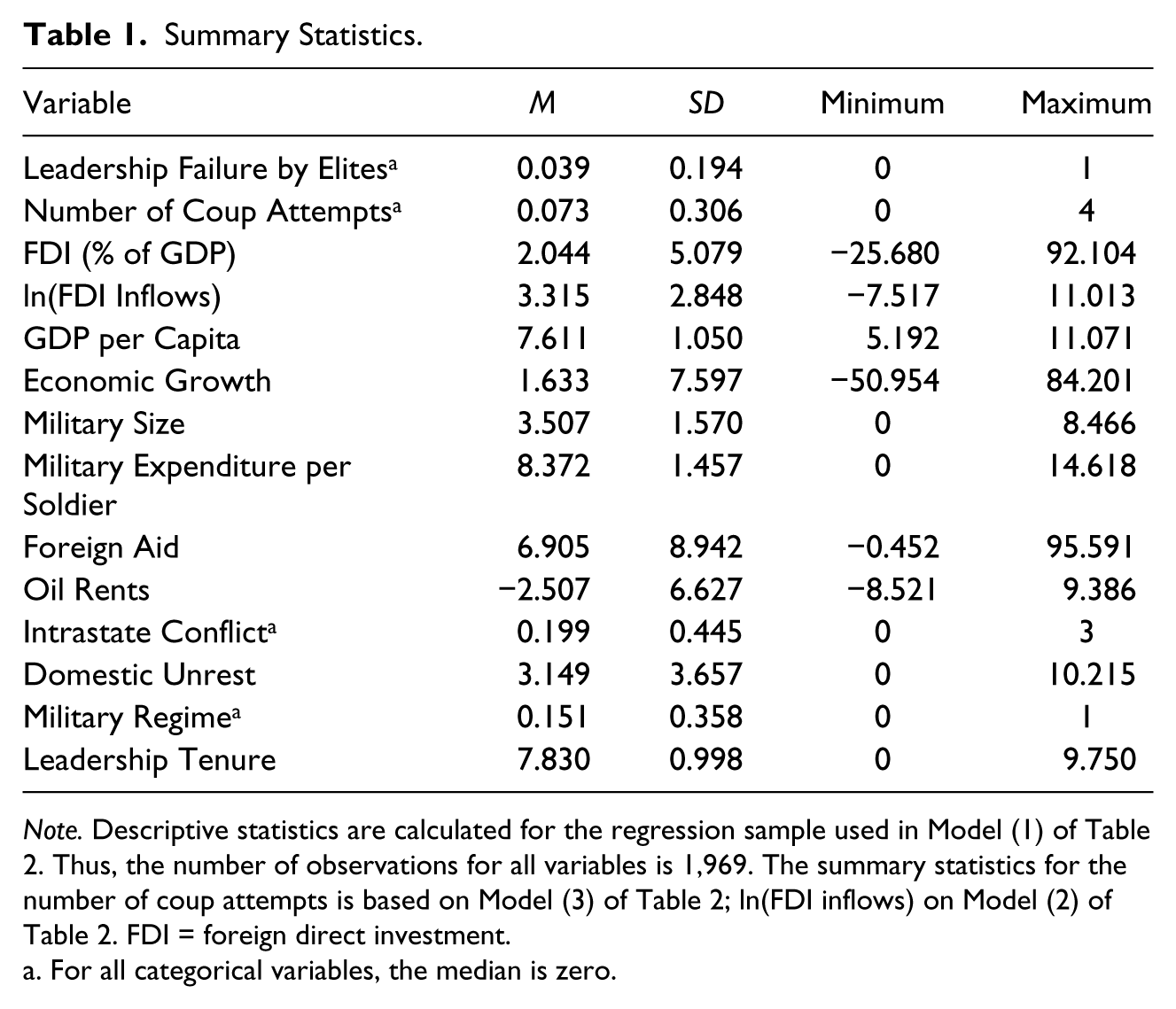
Note. Descriptive statistics are calculated for the regression sample used in Model (1) of Table 2. Thus, the number of observations for all variables is 1,969. The summary statistics for the number of coup attempts is based on Model (3) of Table 2; ln(FDI inflows) on Model (2) of Table 2. FDI = foreign direct investment.
For all categorical variables, the median is zero.
Finally, we also run all models including country-fixed effects. Our instrument might violate the exclusion restriction via unobserved country-specific factors. Technically, we deal with this concern in the 2SRI models by directly controlling for the first-stage residuals in the second stage. However, a more conservative solution might be including country-specific fixed effects in both equations. To avoid the loss of more than half of the observations, we use in-sample country-means for all variables as proxies for country-fixed effects. Our main findings on the impact of FDI on authoritarian instability are largely unaffected using country-specific fixed effects. The results are reported in the appendix (see Table A6).
Results
We first present the main empirical results in Table 2. They support our theoretical expectation that FDI enhances authoritarian regime stability. In all models, two different measures of FDI have negative and significant effects on both elite-driven leadership failure and coup attempt. This finding appears to hold in various auxiliary regressions too. 27
Effect of FDI on Authoritarian Leadership Stability.
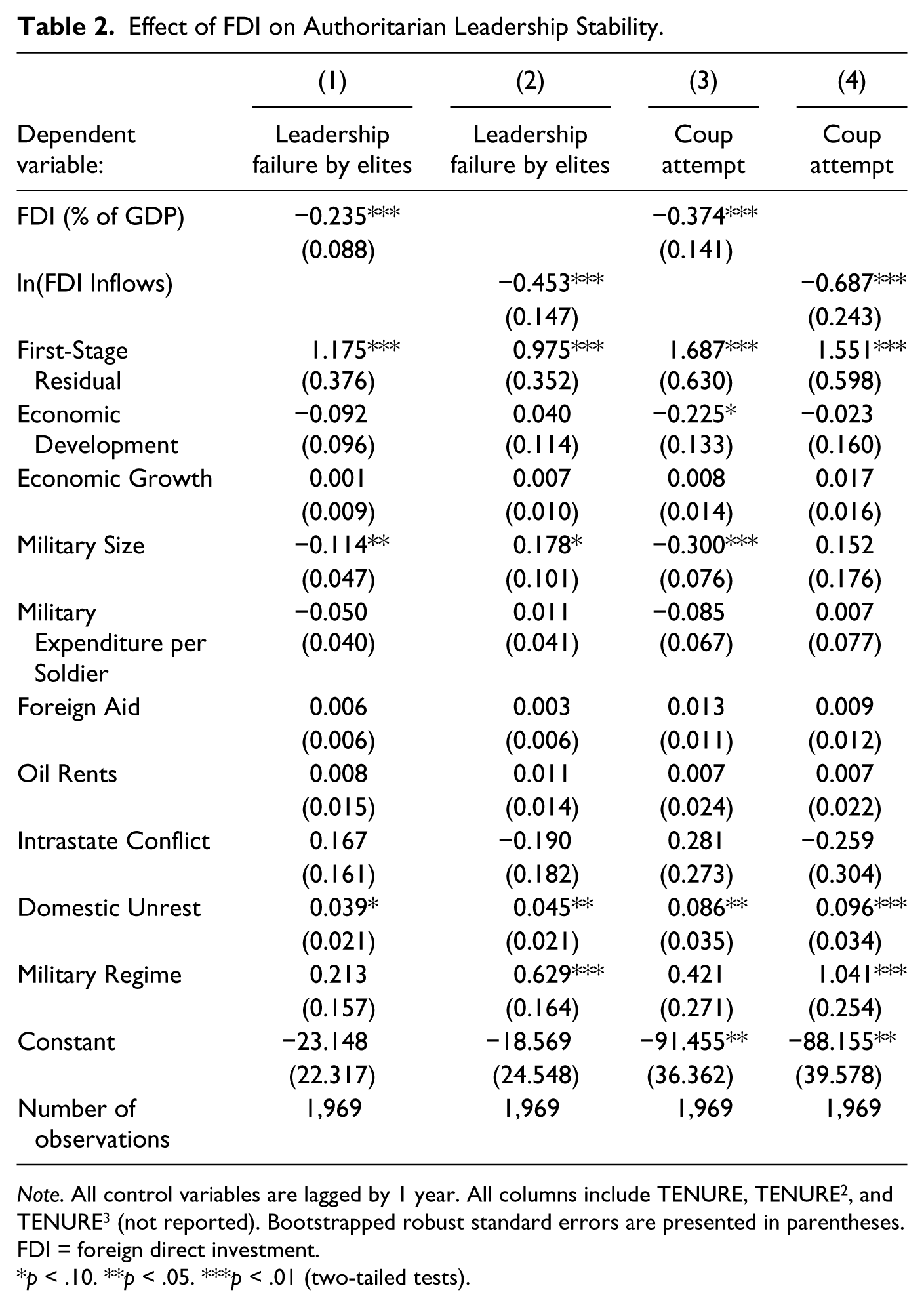
Note. All control variables are lagged by 1 year. All columns include TENURE, TENURE2, and TENURE3 (not reported). Bootstrapped robust standard errors are presented in parentheses. FDI = foreign direct investment.
p < .10. **p < .05. ***p < .01 (two-tailed tests).
In Table 3, we report the substantive effect of FDI on regime stability in each model reported in Table 2. Table 3 presents the marginal effects of FDI using two different formats: (a) the changes in the probability of leadership failure (or changes in the expected incident rate of coup attempts) and (b) the relative percentage changes in the risk of leadership failure (or the relative percentage changes in the expected number of coup attempts). The uncertainties around these predictions are captured by 95% confidence intervals in the parentheses. For example, as FDI as a percentage of GDP increases by one standard deviation (5.1) from the mean (2), the probability of elite-driven leadership failure is expected to decrease by about .02, which is equivalent to 92% decrease in the risk of failure. Given the same change in FDI (as % of GDP), our model predicts that the expected number of coup attempts decreases by about 0.03, which is a 81% decrease compared with the number of coup attempts when FDI (as percentage of GDP) is at its mean. Perhaps a more intuitive prediction can be made using 1% increase instead of the relatively large standard deviation. For example, when FDI as a percentage of GDP increases by 1% from the mean, we expect that the probability of elite-driven leadership failure should decrease by about .01 (about 43%). Similarly, 1% increase in FDI is on average associated with about 0.01 (31%) decrease in the number of coup attempts. The substantive effects of FDI on coup attempts appear to be quite small. But considering that the number of country-years that have experienced at least one coup attempt constitutes about 6.25% of the entire country-years, 28 the substantive effects are not in fact negligible. Furthermore, the size of substantive effects appears to be similar when we used different thresholds such as the 25th, 50th, and 75th percentiles.
Substantive Effects of FDI.
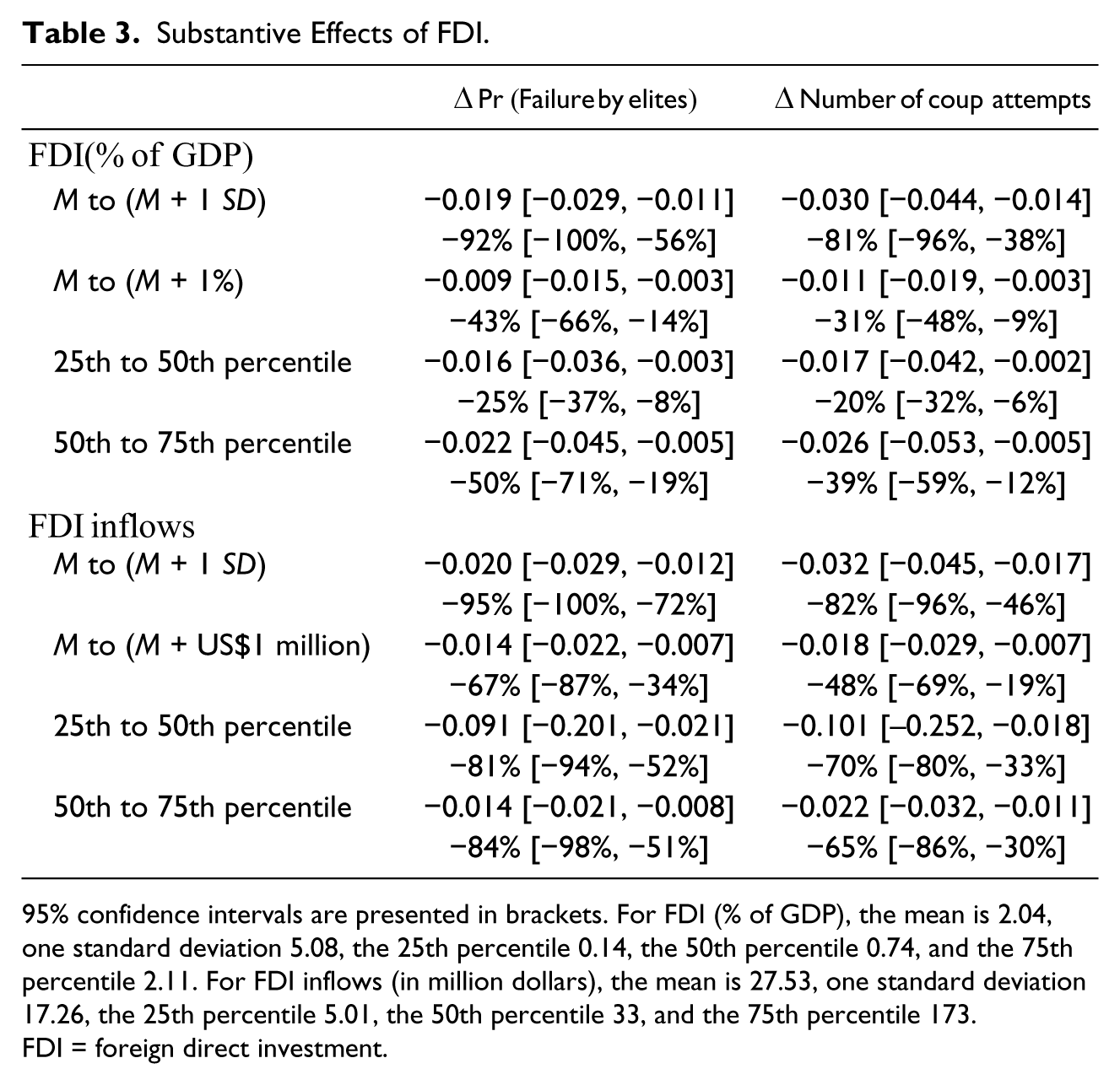
95% confidence intervals are presented in brackets. For FDI (% of GDP), the mean is 2.04, one standard deviation 5.08, the 25th percentile 0.14, the 50th percentile 0.74, and the 75th percentile 2.11. For FDI inflows (in million dollars), the mean is 27.53, one standard deviation 17.26, the 25th percentile 5.01, the 50th percentile 33, and the 75th percentile 173. FDI = foreign direct investment.
When the endogenous variable is net inflows of FDI, the interpretation is more straightforward using the changes in FDI associated with some substantive effects after exponentiating the logged threshold values. For example, as net inflows increase by one standard deviation (about 17.3 million dollars) from the mean (about 27.5 million dollars), the probability of leadership failure by elites is expected to decrease about .02, which is about 95% decrease in the risk of such leadership failure. Using the same changes in net inflows, the model predicts that the number of coup attempts would decrease about 82%. These substantive effects are markedly similar to those using FDI as a percentage of GDP, which indicates that our findings are not significantly driven by a particular measure of FDI.
The results using PCSE as the first-stage estimator, reported in Table A7 in the appendix, show that the negative effects of FDI as a percentage of GDP and net inflows remain significant, but are insignificant for models of coup attempts. These insignificant findings appear to undermine empirical evidence found in the two-stage models of coup attempts with OLS as the first-stage estimator. However, this is not necessarily the case. The estimates of standard errors are obtained using bootstrapping. The standard errors reported in Table 2 are approximated by the asymptotically normal distribution of the coefficient estimates from the bootstrapped samples. When the number of bootstrapped samples is sufficiently large, calculating the 95% confidence intervals using percentiles might be more straightforward without the normality assumption. For example, the formal test of normality for 1,000 bootstrapped coefficient estimates shows that we can reject the null hypothesis that the FDI (percentage of GDP) coefficients are normally distributed. Thus, we present percentile-based confidence intervals in Figure 1. The figure shows that even for models using PCSE and FDI (percentage of GDP), the 95% confidence intervals do not exceed zero, which still provide significant support for our hypotheses.
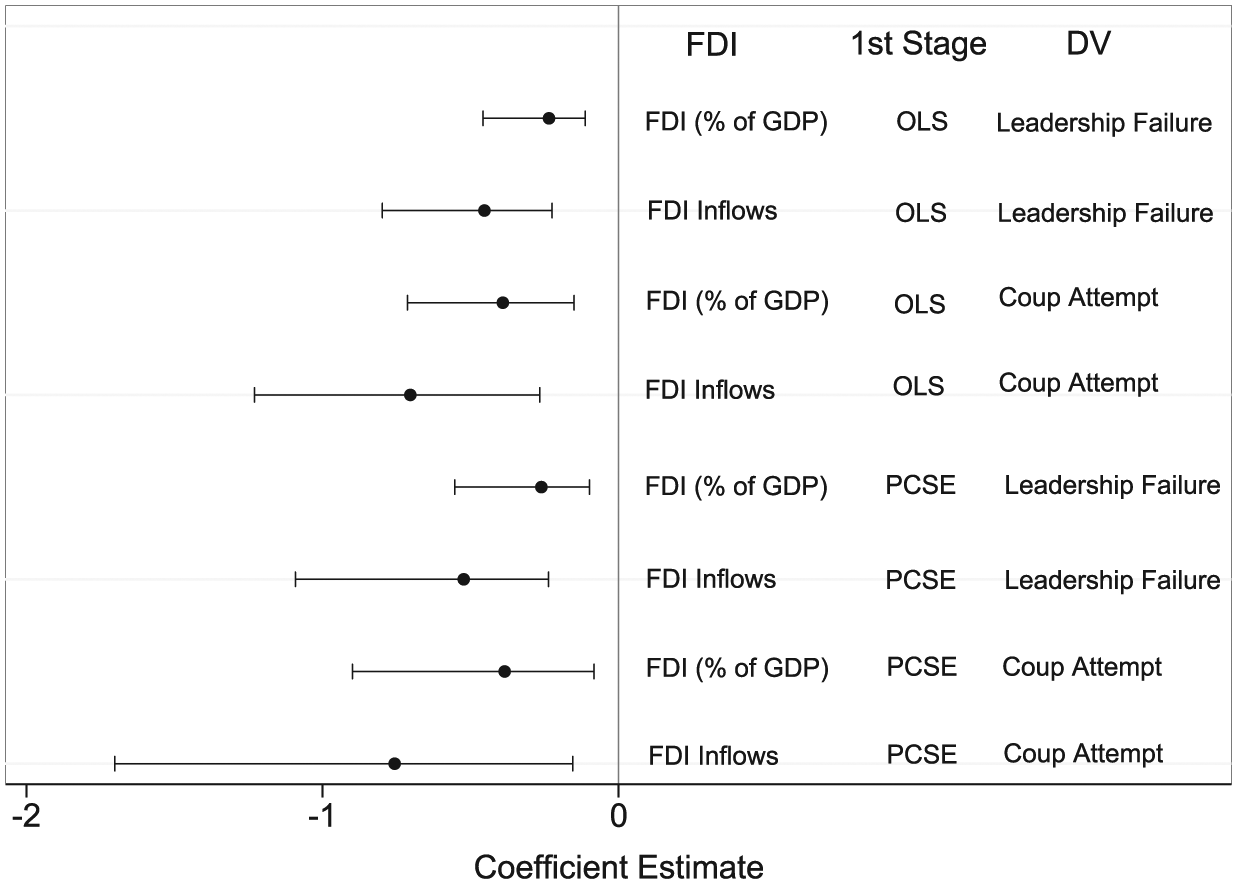
Bootstrapped coefficient estimates of FDI.
Regarding control variables, the level of domestic unrest appears to have positive effects on both leadership failure by elites and coup attempt. When the endogenous variable is FDI as a percentage of GDP, the size of the military has negative and significant effects on both leadership failure and coup attempt. We found too that military regimes are more likely to experience leadership failure and coup, in models using FDI net inflows. However, nontax revenues such as foreign aid and oil rents do not appear to significantly decrease the level of elite-driven autocratic leadership instability.
In sum, we found significant evidence that supports our main theoretical prediction that FDI is beneficial to increasing autocratic leadership stability. This evidence appears to be quite consistent using different indicators of autocratic leadership stability; using different measures of FDI, including country-fixed effects; using different first-stage estimators; and employing the 2SLS. Altogether, these results indicate that FDI can be a source that helps authoritarian leaders prevent at least elite-level challenges.
Conclusion
This article has examined how FDI affects authoritarian host countries’ leadership stability. We presented two mechanisms of FDI’s regime-stabilizing effects. First, we argued that the host governments of authoritarian regimes can use FDI for private good provision, helping them appease elite dissent by providing patronage goods and buying off potential elite challengers. Second, we claimed that FDI mitigates commitment problems between elites and authoritarian leadership by making defections more costly. Empirical findings are largely consistent with our expectation, and the results appear to be robust against various two-stage estimators and across two different indicators of authoritarian instability.
Our theoretical arguments are quite specific with regard to the outcome of interest we try to explain: authoritarian leadership instability caused by elite-level challenges. Yet, we believe that FDI’s effects on the host country’s political environments are not limited to authoritarian regimes, or to elite behavior. Thus, we propose several research topics that can spring out of this article.
We acknowledge that not all authoritarian leaders are equally myopic. Dictators with longtime horizons tend to be more likely to provide public goods, strengthen property rights, and impose optimal tax rates than those with short time horizons (Olson, 1993); thus, they can be better at attracting FDI in the first place (Moon, 2015). In addition, autocrats with longtime horizons may have a greater incentive to design international investment treaties more flexibly to deal with future uncertainties (Blake, 2013). Furthermore, we expect that FDI’s growth-accelerating effect may be greater when autocrats have longtime horizons, because authoritarian leaders with longer time horizons are expected to use FDI income more productively (e.g., increasing public investment and providing welfare goods) than those with shorter time horizons. A similar logic is found in Wright (2008) regarding the relationship between foreign aid effectiveness and authoritarian time horizon. One implication from this conjecture is that the positive impact of FDI on economic growth will reduce as the authoritarian time horizon declines.
Our sample is limited to authoritarian regimes. The political impact of FDI on democratic leaders’ political survival has not been fully explored either. 29 The mechanism through which FDI increases a democratic leader’s prospect of political survival does not seem as obvious as in authoritarian cases. It is not straightforward how FDI increases a democratic government’s public good provision and how democratic audiences respond to the spillovers of FDI. One possibility is that FDI can reduce income inequality, thereby increasing overall regime support (Jensen & Rosas, 2007).
This article provides an insight into the political consequences of FDI in authoritarian countries, which has been largely unexplored in the literature. It also supplements the literature on the relationship between unearned income and authoritarian stability by identifying another influential economic source that has regime-stabilizing effects. Last, our findings, along with those of recent studies, suggest that the political effects of extra income are not uniform but heterogeneous, depending on the characteristics of the source of income.
Footnotes
appendix
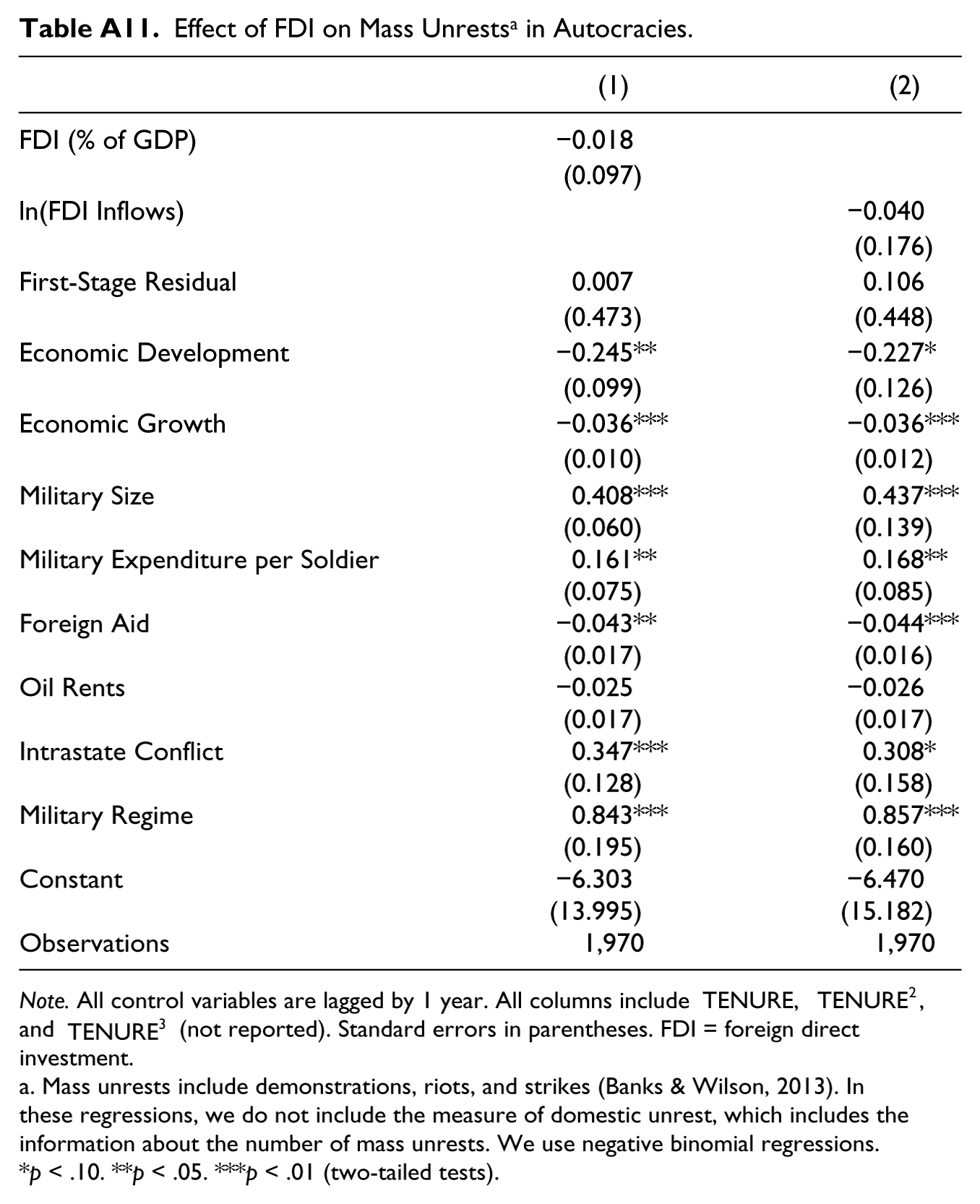
Effect of FDI on Mass Unrests a in Autocracies.
| (1) | (2) | |
|---|---|---|
| FDI (% of GDP) | −0.018 | |
| (0.097) | ||
| ln(FDI Inflows) | −0.040 | |
| (0.176) | ||
| First-Stage Residual | 0.007 | 0.106 |
| (0.473) | (0.448) | |
| Economic Development | −0.245** | −0.227* |
| (0.099) | (0.126) | |
| Economic Growth | −0.036*** | −0.036*** |
| (0.010) | (0.012) | |
| Military Size | 0.408*** | 0.437*** |
| (0.060) | (0.139) | |
| Military Expenditure per Soldier | 0.161** | 0.168** |
| (0.075) | (0.085) | |
| Foreign Aid | −0.043** | −0.044*** |
| (0.017) | (0.016) | |
| Oil Rents | −0.025 | −0.026 |
| (0.017) | (0.017) | |
| Intrastate Conflict | 0.347*** | 0.308* |
| (0.128) | (0.158) | |
| Military Regime | 0.843*** | 0.857*** |
| (0.195) | (0.160) | |
| Constant | −6.303 | −6.470 |
| (13.995) | (15.182) | |
| Observations | 1,970 | 1,970 |
Note. All control variables are lagged by 1 year. All columns include TENURE, TENURE2, and TENURE3 (not reported). Standard errors in parentheses. FDI = foreign direct investment.
Mass unrests include demonstrations, riots, and strikes (Banks & Wilson, 2013). In these regressions, we do not include the measure of domestic unrest, which includes the information about the number of mass unrests. We use negative binomial regressions.
p < .10. **p < .05. ***p < .01 (two-tailed tests).
Acknowledgements
We thank Hoon Lee, Paasha Mahdavi, Clifton Morgan, Pablo Pinto, Toby Rider, Joshua Rovner, Rachel L. Wellhausenand, Joseph Wright, and three reviewers from CPS for their helpful comments.
Authors’ Note
Names are listed alphabetically. All authors contributed equally to the work. An earlier draft of this article was presented at the 2014 Texas Triangle International Relations conference and the 2014 Midwest Political Science Association meetings.
Declaration of Conflicting Interests
The author(s) declared no potential conflicts of interest with respect to the research, authorship, and/or publication of this article.
Funding
The author(s) received no financial support for the research, authorship, and/or publication of this article.
Notes
Author Biographies
References
Supplementary Material
Please find the following supplemental material available below.
For Open Access articles published under a Creative Commons License, all supplemental material carries the same license as the article it is associated with.
For non-Open Access articles published, all supplemental material carries a non-exclusive license, and permission requests for re-use of supplemental material or any part of supplemental material shall be sent directly to the copyright owner as specified in the copyright notice associated with the article.
