







Abstract
Can subnational elections contribute to democratization? In autocracies that hold competitive elections at multiple levels of government, subnational executive offices provide opposition parties with access to resources, increase their visibility among voters, and let them gain experience in government. This allows opposition parties to use subnational executives as “springboards” from which to increase their electoral support in future races, and predicts that their electoral support should follow a diffusion process, that is, a party’s electoral performance in municipality m at time t should be better if that party already governs some of m’s neighbors since t − 1. I evaluate this claim with data from municipal-level elections in Mexico between 1984 and 2000. Consistent with the fact that the Partido Acción Nacional (National Action Party, PAN) followed an explicit strategy of party-building from below but the Partido de la Revolución Democrática (Party of the Democratic Revolution, PRD) did not, the results indicate that diffusion effects contributed to the growth of the former but not the latter.
Keywords
When, and if, political democracy arrives in Mexico, it may well be that it does not come about as the result of a macropolitical transformation, but rather through incremental transformations.
Can subnational elections contribute to the democratization of authoritarian regimes? If so, under what circumstances? The fact that many authoritarian regimes nowadays hold competitive subnational elections 1 raises the question of whether opposition parties can take advantage of them to increase their electoral strength over time. Anecdotal evidence from Serbia, Mexico, and Venezuela suggests that this is sometimes the case, with opposition governors and mayors playing a key role in organizing protests and demonstrations against electoral fraud, improving public service delivery, or shaping the implementation of national redistributive programs (Albertus, 2015; Bunce & Wolchik, 2011; Dobson, 2012; Krnjevic-Miskovic, 2001; Shirk, 2005). Subnational executive offices also provide access to valuable resources (Dobson, 2012; Rakner & van de Walle, 2009), and the fact that opposition executives often use these offices as “springboards” to run for higher level positions means that they have incentives to engage in party-building and campaigning in neighboring districts, enhancing their parties’ electoral prospects in the process (Camp, 2010; Dobson, 2012; Levitsky & Way, 2010).
However, the literature on authoritarian elections has expressed considerable skepticism about the possibility that subnational elections may contribute to democratization. The dominant view on subnational elections in autocracies does not see them as meaningful arenas for electoral contestation but rather as devices for co-opting subnational elites (Blaydes, 2010; Díaz-Cayeros, 2006; Reuter, Buckley, Shubenkova, & Garifullina, 2016). Opposition parties have few resources with which to sustain a permanent party organization and run credible campaigns, and the fact that their leaders lack visibility and government experience further reduces their electoral appeal. Even when an opposition politician is allowed to take office at the subnational level, the ruling party 2 can asphyxiate the new administration financially. Only high-ranking insiders and foreign governments can muster enough resources, visibility, and organizational capital to challenge the regime at the polls; thus, ruling parties are seen as electorally vulnerable only in the presence of a large-scale defection (Brownlee, 2007; Gibson, 2013; Langston, 2006; Levitsky & Way, 2010; Magaloni, 2006; van de Walle, 2006), or if an outside player comes to the opposition’s support (Gibson, 2005, 2013; Levitsky & Way, 2010). Either way, a scenario in which the opposition slowly builds electoral support from the bottom up is unlikely in practice: Either the opposition is so strong that it does not need it, or so weak that the strategy cannot work.
In contrast with this view, in this article, I defend the possibility that opposition victories at the subnational level may act as “chinks in the armor” that slowly erode the edifice of authoritarian rule. Specifically, I posit that in authoritarian regimes that hold elections at multiple levels of government, opposition parties can exploit their victories in subnational executive races as “springboards” from which to increase their electoral support in future races. The logic behind this argument is twofold. On one hand, executive offices allow opposition parties to overcome some of the limitations identified by the literature: They provide access to resources that can be used for hiring party activists, campaigning and monitoring; they send the signal that the ruling party can be defeated at the polls; and they change voters’ beliefs about the experience and quality of opposition leaders. On the other hand, the effect of these factors should be stronger at the local level, 3 and furthermore, opposition executives who intend to “jump” to higher level offices have strong incentives to employ these resources to court voters in neighboring districts, raising their party’s electoral prospects in the process. The implication is that electoral support for opposition parties should follow a diffusion process; that is, the electoral performance of an opposition party—as measured by its probability of winning or its vote share—should be better in municipality m at time t if that party already governs some of m’s neighbors since t − 1.
The possibility that opposition victories in subnational elections may generate a diffusion process has also been raised by Hiskey and Canache (2005), who study how municipal elections contributed to Mexico’s democratization. Nonetheless, my argument differs from theirs in two crucial respects. First, while Hiskey and Canache focus on subnational democratization—understood as the first ruling party defeat in a municipal election—my interest lies in understanding how individual parties can use subnational offices to increase their electoral support over time. Second, and related, I argue that this diffusion process should be understood as a strategy that opposition parties may (not) follow rather than as a general pattern that is equally valid for all opposition parties. 4 The point is that opposition parties can adopt multiple strategies for challenging the ruling party, and one of slowly building support from the bottom up is not always the most convenient or effective. In particular, regime defectors who already enjoy substantial name recognition at the national level, or opposition politicians whose electoral support is overwhelmingly concentrated in a large city, may do better by focusing on national rather than on subnational races.
Empirically, I examine this claim with data on municipal-level elections in Mexico between 1984 and 2000, when the ruling Partido Revolucionario Institucional (Institutional Revolutionary Party, or PRI) finally conceded the presidency after seven decades in power. Mexico constitutes a particularly attractive setting for studying the argument advanced in this article for two reasons. First, the country had two main opposition parties, but while the Partido Acción Nacional (National Action Party, PAN) followed an explicit strategy of building electoral support from the bottom up (Lujambio, 2001), the Partido de la Revolución Democrática (Party of the Democratic Revolution, PRD) focused on defeating the PRI at the national level (Bruhn, 1999, 2012; Hilgers, 2008; Hiskey & Canache, 2005; Martínez González, 2005; Meyenberg & Carrillo, 1999; Reveles Vázquez, 2004; Wuhs, 2008).Thus, comparing the PAN with the PRD can shed light on whether diffusion effects can work for all parties (or none), or only those that adopt an explicit strategy of party-building at the subnational level. And second, while by 2000 both the PAN and the PRD had made substantial inroads across the country, until the mid-1980s the PRI monopolized access to most elected offices (see Table 1 and Figure 1). In other words, practically all of the cross-sectional variation that we see in the data in 2000 was driven by variation within municipalities since the mid-1980s; this suggests employing a fixed-effects approach in which each municipality is compared with itself at different moments in time, alleviating the concern that the results may be driven by the fact that neighboring municipalities tend to be similar to each other.
Mexican States Captured by the Opposition Before the 2000 Presidential Election.
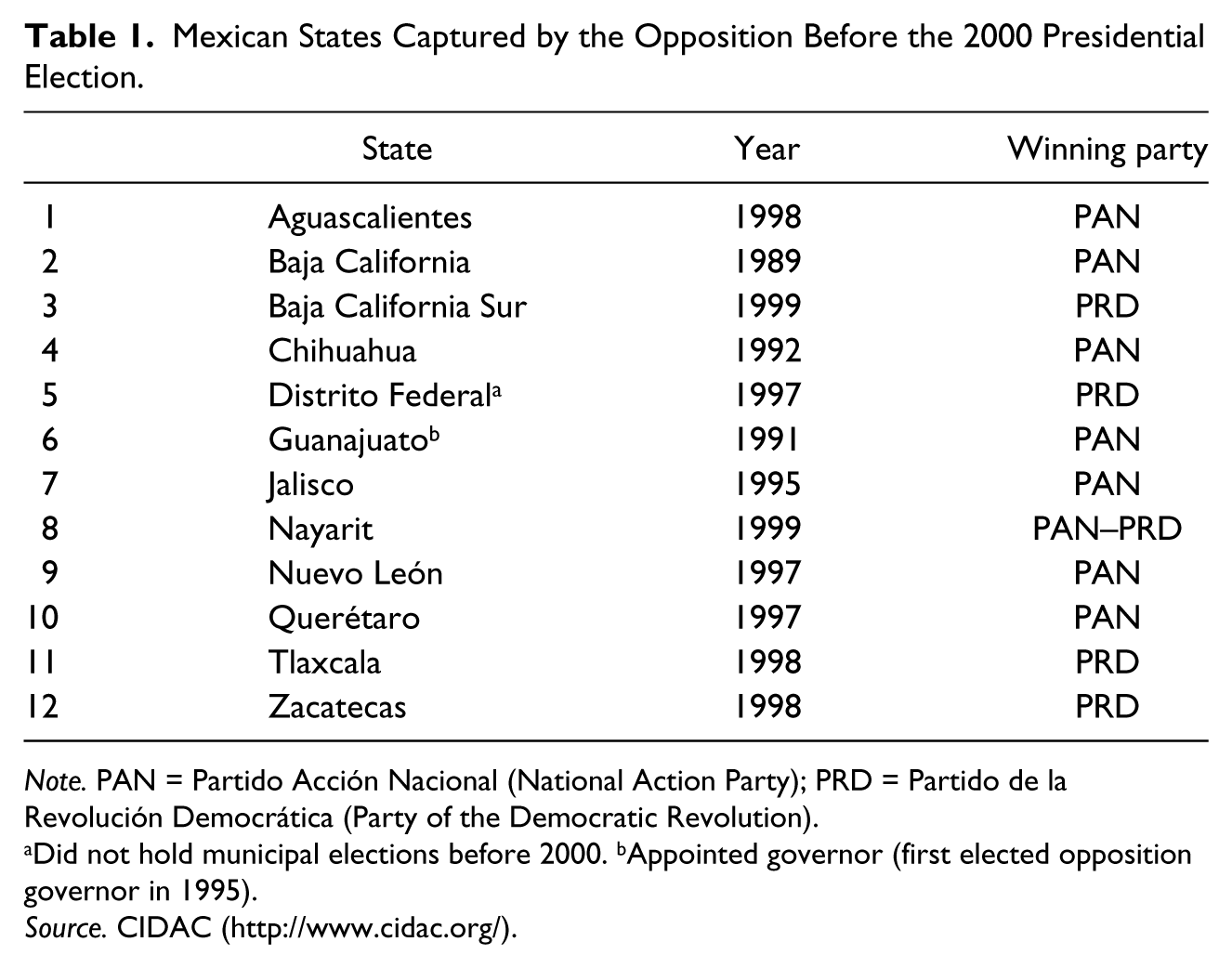
Note. PAN = Partido Acción Nacional (National Action Party); PRD = Partido de la Revolución Democrática (Party of the Democratic Revolution).
Did not hold municipal elections before 2000. bAppointed governor (first elected opposition governor in 1995).
Source. CIDAC (http://www.cidac.org/).
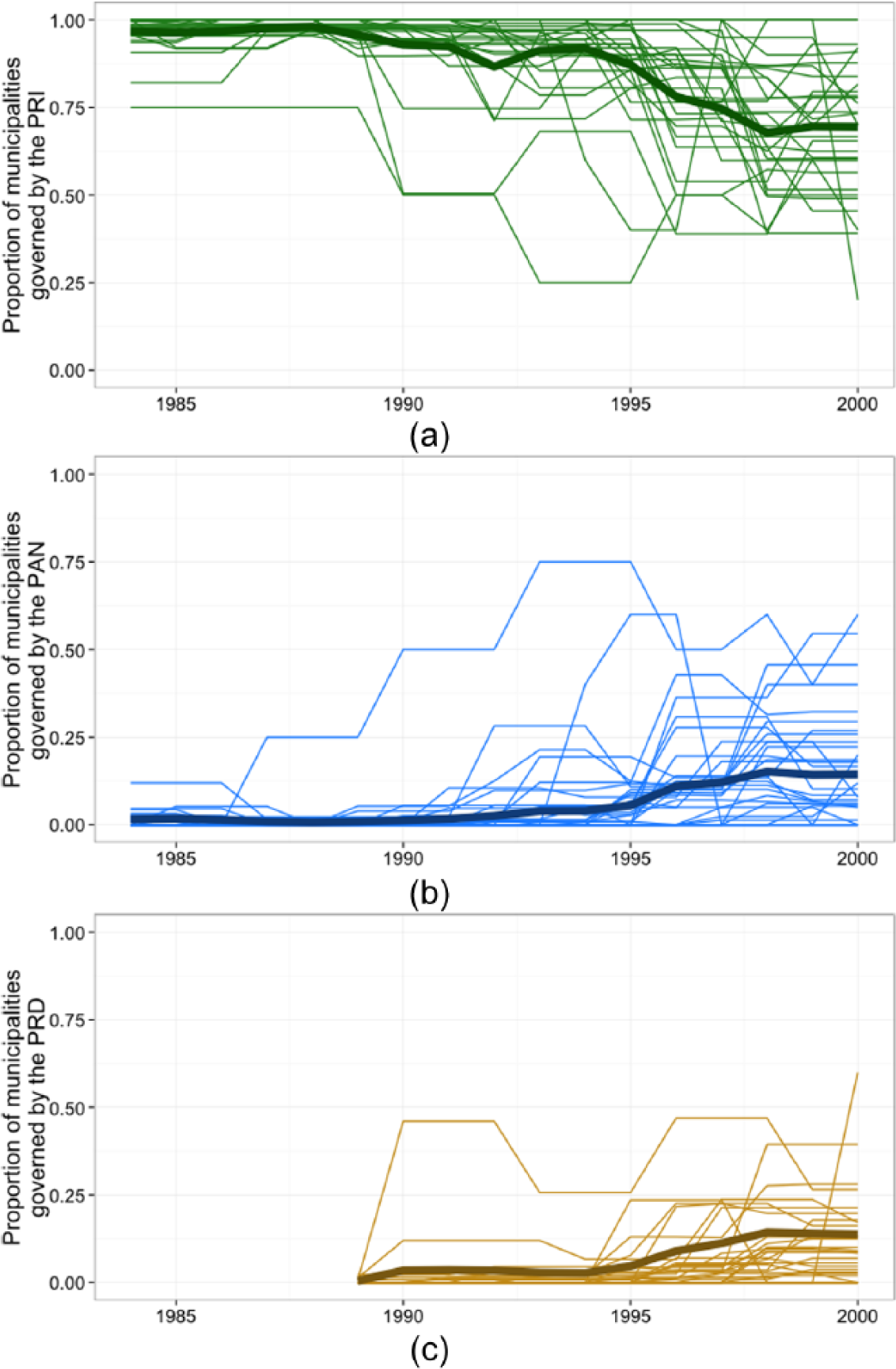
The erosion of the PRI and the ascent of the opposition in Mexico, 1984-2000.
The results indicate that diffusion effects contributed to the PAN’s growth but not to the PRD’s. Specifically, the PAN’s chances of carrying a municipality increased by 7 to 15 percentage points in the presence of a copartisan governor, and by approximately 1.5 to 1.8 percentage points when the number of PAN-governed neighboring municipalities increased by a standard deviation—both substantial effects considering that this party won only 7.4% to 9.0% of elections in the sample. The results are similar for mayoral and congressional elections, indicating that diffusion effects strengthened the PAN at both the local and federal levels. However, the number of copartisan mayors in neighboring municipalities did not increase the PAN’s vote share, possibly because party officials focused on those races in which they could tip the balance in the party’s favor. In the case of the PRD, having a copartisan governor improved the party’s performance in federal elections, but there is no evidence of horizontal diffusion effects; on the contrary, the coefficient of interest is generally negative, though small in magnitude and unreliable. As discussed in more detail below, this is consistent with several stylized facts about this party, notably its low levels of institutionalization (Bruhn, 2012; Eisenstadt, 2004; Hilgers, 2008; Martínez González, 2005; Meyenberg & Carrillo, 1999; Reveles Vázquez, 2004); its emphasis on defeating the PRI at the national level (Hilgers, 2008; Martínez González, 2005); the fact that until the late 1990s, most of its leaders were located mostly in Mexico City and a few other states such as Michoacán (Eisenstadt, 2004; Reveles Vázquez, 2004); its reliance on PRI defectors (Bruhn, 1999, 2012; Hilgers, 2008; Hiskey & Canache, 2005; Meyenberg & Carrillo, 1999; Reveles Vázquez, 2004; Wuhs, 2008); and the systematic “punishment campaign” that the PRI launched against PRD mayors and activists (Bruhn 1997, 2012; Bruhn & Yanner, 1995; Fox & Moguel, 1995; Magaloni, 2006; Reveles Vázquez, 2004).
Theory
Overview
This article studies how subnational elections in competitive authoritarian regimes (CARs) may contribute to the development of opposition parties. CARs are political regimes that combine formal democratic institutions—an executive and a legislature elected in multiparty elections with universal suffrage—with systematic recourse to informal (when not illegal) practices that skew the playing field in the ruling party’s favor, such as government control of the media, electoral fraud, the systematic harassment of opposition leaders and supporters, or the massive use of state resources for partisan gain. 5 Nonetheless, elections in CARs are not a mere façade: The ruling party must work hard to win, and electoral defeats do occur from time to time. 6 The existing literature has studied how defections from the ruling party (Brownlee, 2007; Garrido de Sierra, 2013; Gibson, 2013; Greene, 2007; Langston, 2006; Levitsky & Way, 2010; Magaloni, 2006; Reuter & Gandhi, 2011; Rundlett & Svolik, 2016; van de Walle, 2006), opposition coalitions (Arriola, 2012, 2013; Bunce & Wolchik, 2010, 2011; Donno, 2013; Howard & Roessler, 2006), and the intervention of outside players (Bunce & Wolchik, 2010, 2011; Donno, 2013; Gibson, 2005, 2013; Levitsky & Way, 2010) contribute to make these elections more competitive. However, and despite the fact that opposition parties in CARs vary substantially both in terms of their electoral strength and their degree of institutionalization, we still know little about why some opposition parties are more institutionalized or enjoy more electoral support than others (Morse, 2012).
My main theoretical claim is that opposition parties in CARs may employ subnational executive offices as “springboards for [the] accumulation of victories in [future] races” (Shirk, 2005, p. 109). Specifically, I argue that the resources and visibility provided by these victories allow opposition parties to increase their electoral strength in neighboring areas in future races, and thus, the distribution of electoral support for opposition parties should follow a diffusion pattern: An opposition party’s electoral performance in municipality m at t should be better if that party already controls some of m’s neighbors since t − 1. 7 This extends the work of Fernández-Durán, Poiré, and Rojas-Nandayapa (2004) and Hiskey and Canache (2005), who have suggested the possibility of a diffusion process in federal and municipal elections in Mexico. However, the former focus on contemporaneous effects in federal contests, whereas the latter emphasize subnational democratization (understood as the first electoral defeat of the ruling party) rather than electoral support for individual parties. The rest of the literature has instead focused on the role of insider defections or external actors (Brownlee, 2007; Gibson, 2005, 2013; Langston, 2006; Levitsky & Way, 2010; Magaloni, 2006; van de Walle, 2006), neither of which require or involve a slow process of party-building from below. Some authors have considered the possibility that the opposition may grow from the bottom up but dismissed its feasibility (see Gibson, 2005, 2013, as well as Levitsky & Way, 2010, though these authors acknowledge that Mexico constitutes a partial exception). 8
Before discussing the argument in detail, I need to make two clarifications about its scope. First, I do not offer a full-blown account of why CARs democratize; rather, my point is that opposition parties may take advantage of subnational elections to increase their electoral support over time, thus becoming more serious contenders at the national level. For this reason, I take for granted that the ruling party is willing to recognize opposition victories in subnational elections; when this is not the case, the mechanisms posited in this article cannot work. This is why in Mexico, the PAN’s “municipalization” strategy, though advocated since the party’s founding (Lujambio, 2001), produced few results until the late 1980s (Eisenstadt, 2004, Chapter 2). Nonetheless, ruling parties in CARs are not always in a position to ignore subnational opposition victories, especially if these are too obvious to conceal from outside observers. For example, although Slobodan Milosevic initially refused to recognize opposition victories in the 1996 Serbian municipal elections, he had to back down in the face of strong pressure from street protesters, the Orthodox Church and the international community (Krnjevic-Miskovic, 2001, pp. 98-99). The other side of the coin is that the ruling party’s willingness to recognize opposition victories does not imply that the opposition will take advantage of the opportunity: 12 years after Mexico’s transition to democracy, the (former) opposition had yet to govern 1/10th of the country’s municipalities (Selee, 2012), and at the time of this writing (July 2016), the PRI had never conceded the governorship of five of Mexico’s 32 states. 9
This introduces the second clarification: The diffusion process described in this article should be interpreted as a strategy that opposition parties may choose (not) to follow rather than as a general pattern that occurs more or less automatically. Opposition parties in CARs have multiple ways of challenging the ruling party, and a process of party-building from the bottom up may not be the most attractive of them. In particular, regime defectors or opposition leaders whose base of support is overwhelmingly concentrated in the capital city may find it more appealing to focus on national elections. Nonetheless, some of the mechanisms described below (such as voters’ learning from opposition victories) may operate even without the active involvement of opposition leaders. One of the advantages of studying the Mexican case is that while the PAN followed an explicit strategy of building support from the bottom up, the PRD did not, and thus, the empirical analysis can provide some leverage on which of these two interpretations is more reasonable.
Argument
The argument itself is based on two claims. The first is that opposition parties in CARs can use subnational executive offices to obtain access to resources, gain experience in government, and send the signal that the ruling party can be defeated at the polls. Local governments provide access to resources that can be used for campaigning and hiring party activists (Rakner & van de Walle, 2009). Given the low cost of subnational campaigns in developing countries (Langston & Morgenstern, 2009), even modest resources can make a difference. For example, one of the main advantages of running on Botswana’s BDP ticket is access to a 4 × 4 vehicle for campaigning (Levitsky & Way, 2010, Chapter 6). As governor of the Venezuelan state of Miranda, Henrique Capriles has access to a helicopter with which to campaign in remote areas (Dobson, 2012). Of course, ruling parties often attempt to withdraw resources from opposition governments; nonetheless, subnational governments often receive some transfers from the center, and the fact that subnational executives control some tax base allows opposition leaders to raise their own revenue. This was certainly the case in Mexico, where PAN governors and mayors collected a larger proportion of own revenues than their PRI counterparts (Cleary, 2007; Díaz-Cayeros, 2004; Grindle, 2006; Shirk, 2005).
Controlling an executive office also allows opposition leaders to do something for their constituents, helping dispel fears that they are unsuited to govern (Magaloni, 2006), especially among risk-averse voters (Morgenstern & Zechmeister, 2001). 10 For example, in Venezuela, opposition executives stand out for their capacity to provide better health and education than their chavista counterparts (Dobson, 2012, Chapter 4), and opposition governors played a key role in the implementation of a national land reform program in their states (Albertus, 2015). Similarly, opposition mayors in Mexico pioneered policy innovations that later became widely adopted throughout the country, such as the “Citizen Wednesday” program (Shirk, 2005, p. 181).
The realization that the ruling party can be defeated at the polls can also encourage voters’ willingness to turn out to vote and may dissuade ruling party activists to engage in fraud, especially if they fear retaliation afterward (Bunce & Wolchik, 2010, 2011; Hiskey & Canache, 2005; Magaloni, 2006; Simpser, 2013; Rundlett & Svolik, 2016). Local opposition victories can also allow antiregime voters to coordinate. Even if voters agree on the desirability of getting rid of the ruling party, they may not know which opposition party is better positioned to win (Greene, 2007; Magaloni, 2006; van de Walle, 2006). The effect is especially pronounced at the local level, where lack of polling data means that uncertainty about the electoral strength of different candidates is very high, even for the ruling party (Langston & Morgenstern, 2009). In this context, an opposition victory in local elections can send a reliable signal about the identity of the strongest opposition party in the area.
The second claim is that, to the extent that these factors can make a difference, their effect should be stronger in neighboring districts rather than in far-fetched places. Even in regimes with strong parties, the effectiveness of campaigns for subnational offices depends heavily on local conditions (Langston & Morgenstern, 2009). Practices like clientelism and fraud are very sensitive to local information (Hiskey & Canache, 2005; Magaloni, Díaz-Cayeros, & Estévez, 2006; Medina & Stokes, 2002, 2007; Larreguy, Marshall, & Querubín, 2016), and depend heavily on the opportunities and incentives faced by local officials and activists (Casas, Díaz, & Trinidade, 2016; Rundlett & Svolik, 2016). Successful postelection challenges against electoral fraud require having representatives in hundreds or thousands of polling stations. Voters’ perceptions about the fairness of national elections depend on the amount of competition they have witnessed at the local level (Hiskey & Bowler, 2005). And ambitious politicians who want to “jump” to a higher level position—for example, mayors who intend to run for the governorship—have strong incentives to develop a local reputation and promote party-building in neighboring districts to obtain votes outside their local strongholds (Camp, 2010, Chapter 2). Indeed, using local offices to “jump” to higher level ones is a common practice among opposition politicians in CARs (Levitsky & Way, 2010, Chapter 10; Rakner & van de Walle, 2009). For example, Mikheil Saakashvili’s election as mayor of Tbilisi in 2002 transformed him into the main opposition contender for the presidency of Georgia (Bunce & Wolchik, 2011, p. 157). Many prominent Mexican politicians served as mayors before running for state- or national-level offices (Camp, 2010), notably Ernesto Ruffo—who was mayor of Ensenada before becoming the country’s first opposition governor—and Vicente Fox—governor of Guanajuato before running for the presidency. Venezuelan governors Manuel Rosales and Henrique Capriles also used their office to promote their presidential ambitions, though with less success so far. In sum, while a handful of opposition victories at the subnational level are unlikely to jeopardize the ruling party’s hold on power, their capacity to bring about further opposition victories in local elections should not be underestimated.
Implications
Taken together, these considerations suggest that the electoral support of opposition parties should follow a diffusion pattern whereby electoral victories in subnational executive elections are followed by further victories in neighboring municipalities. 11 In contrast to many diffusion studies, which focus on simultaneous effects (i.e., between t and t), I posit a time lag, as opposition executives can only influence elections occurring after they take office. This process can be either vertical or horizontal. A vertical diffusion process unfolds when the capture of an executive office increases the opposition’s electoral strength in elections for other offices that are decided by the same electorate or a subset of it, for example, if controlling the state governorship improves the opposition’s electoral chances in mayoral elections within the same state. This process may be driven by targeted spending, coattail effects, or the active endorsement of an opposition candidate running for another office. Moreover, this effect should be especially strong because the opposition executive (a) is well-known by the electorate it is attempting to influence and (b) enjoys direct political authority over it. This leads to the following implication 12 :
On the contrary, horizontal diffusion occurs when capturing a subnational office allows the opposition to increase its electoral support in neighboring elections that are decided by a different electorate. The obvious examples are mayors influencing mayoral elections in neighboring municipalities, but governors influencing mayoral elections in states they do not govern or mayors influencing legislative elections in other municipalities also qualify.
As the opposition executive has no political authority over the voters she is attempting to influence, horizontal diffusion is unlikely to be driven by government spending or coattails. Rather, this process may result from two other mechanisms: learning or migration. 13 Learning occurs when players’ beliefs about what is possible, likely, and/or effective are altered as a result of other players’ experiences, for example, when discovering the consequences of new policies (Boehmke & Witmer, 2004; Buera, Monge-Naranjo, & Primiceri, 2011; Gilardi, 2010; Meseguer, 2006; Meseguer & Escribá-Folch, 2011; Shipan & Volden, 2008; Volden, 2006; Weyland, 2007, 2009). As mentioned above, voters may change their behavior after realizing that the ruling party can be defeated at the polls, or they may update their beliefs about the quality of opposition candidates after observing how they perform in office. Migration takes place when players originating in some unit get directly involved in the life of another (Franzese & Hays, 2008). 14 Examples include establishing party committees in neighboring constituencies (Camp, 2010. p. 48; Hiskey & Canache, 2005) or campaigning and mobilizing electoral monitors to neighboring districts (Bunce & Wolchik, 2010, 2011).
Of course, migration and learning are hard to disentangle in practice, and they need not be mutually exclusive, as opposition leaders may campaign in neighboring municipalities by touting their achievements in the ones they already govern. In any case, distinguishing between them requires fine-grained data about campaign visits or the establishment of party committees that are hard to come by. 15 For this reason, in this article, I will not try to adjudicate between these mechanisms; rather, I will focus on whether the electoral support of opposition parties followed a pattern of horizontal diffusion:
Case selection: Mexico 1984-2000
I examine these claims with data on municipal elections in Mexico between 1984 and 2000. During this period, Mexico had a federal system in which competitive elections were held at the national, state and municipal levels. Yet the country was not democratic, as the PRI dominated Mexican politics through a mixture of consent, manipulation, and coercion. Indeed, until the early 1980s, the ruling party controlled almost all elected offices in the country; opposition parties only governed a handful of municipalities, and their legislative representation was limited to a few seats that the PRI had expressly reserved for them. This began to change in 1988, when the defection of Cuauhtémoc Cárdenas—son of a beloved PRI president, and former senator and governor under the ruling party—produced a surprisingly close election: Initial results showed Cárdenas leading, but shortly afterward, the electoral authorities announced a computer crash, and when the counting resumed, the PRI candidate was ahead. 16 Nonetheless, the ruling party lost its supermajority in the Chamber of Deputies, and as Cárdenas would not recognize its victory, the PRI had to negotiate with the PAN to pass constitutional reforms. This initiated a collaboration process in which the PAN supported PRI initiatives in Congress in exchange for more transparent elections and the recognition of opposition victories at the subnational level (Eisenstadt, 2004, 2006). The ruling party conceded its first defeat in a gubernatorial election in 1989, and the number of municipalities governed by the opposition began to increase slowly but steadily over time (see Figure 1). The PRI eventually admitted defeat in the 2000 presidential election; by then, the opposition had already governed 12 of the country’s 32 states (see Table 1).
Several features of Mexico’s political system make it an ideal case for evaluating the argument advanced in this article. The constitution bans consecutive reelection for all elected offices, forcing elected officials to run for another office at the end of their mandate and increasing the importance of party organization for career advancement. The length of elected mandates is uniform across the country: Federal legislators, state legislators, and mayors last 3 years in office, whereas governors, most senators, and the president serve 6-year terms. This introduces a cycle of concurrent and midterm elections at both the federal and state levels, though national and subnational elections are not necessarily concurrent, and thus, results cannot be treated as an artifact of the “pull” of national-level factors. During the 1980s, municipal governments controlled relatively few resources, and the PRI took advantage of this fact to withdraw discretionary funds from opposition governments (Aziz Nassif, 2001; Bruhn, 1997, 1999; Bruhn & Yanner, 1995; Fox & Moguel, 1995; Mizrahi, 1998; Magaloni, 2006; Selee, 2012; Valencia García, 2001). Nonetheless, PAN mayors compensated for this by collecting more revenues on their own (Cleary, 2007; Díaz-Cayeros, 2004; Grindle, 2006), and institutional reforms in the early 1990s increased both the fiscal authority of subnational governments and the amount of resources they received from the center, thus increasing the autonomy of subnational executives (Burki, Perry, & Dillinger, 1999; Courchene & Díaz-Cayeros, 2000; Díaz-Cayeros, 2006; Falleti, 2005; Garman, Haggard, & Willis, 2001; Rodríguez, 1997; Selee, 2012).
Throughout this period, the PRI’s main opposition parties were the PAN on the right and the PRD on the left. For reasons that combine history, geography, and short-term circumstances, these parties adopted very different strategies to challenge the PRI: while the PAN followed an explicit “municipalization” strategy aimed at winning subnational offices and using them as “springboards” for further victories (Lujambio, 2001), the PRD emphasized the goal of ousting the PRI from the presidency as quickly as possible (Bruhn, 1997, 2012; Hilgers, 2008; Martínez González, 2005; Meyenberg & Carrillo, 1999; Reveles Vázquez, 2004). Thus, comparing the PAN and the PRD can shed light on whether the diffusion process described in this article is best understood as a deliberate strategy or as a general pattern that applies to all opposition parties. Specifically, finding that diffusion effects work for both parties would indicate that the process does not depend on a party’s deliberate strategy; while finding that diffusion effects are limited to the PAN would mean that a strategy of building support from the bottom up can succeed, but only for parties that pursue it actively. Finding no evidence of diffusion at all, or detecting diffusion effects only for the PRD, would count as evidence against the argument.
Since its founding in 1939, the PAN advocated a “municipalization” strategy aimed at capturing subnational governments and using them as “springboards” for further electoral victories. Yet during most of its history, the party won few mayoral races (Lujambio, 2001). This began to change during the 1980s, when the ruling party became more willing to tolerate opposition victories and the PAN received an influx of Northern businessmen who emphasized the importance of building ties with voters by solving concrete problems at the local level (Eisenstadt, 2004; Mizrahi, 1994, 1998; Shirk, 1999, 2001, 2005; Valencia García, 2001; Wuhs, 2001, 2008). These new recruits developed local reputations that proved useful when running for higher level offices in future elections. Indeed, a large proportion of panista politicians who achieved national prominence during the 1990s had former experience as mayors or state legislators (Camp, 2010). Many of them also developed an interest in party-building: State party chairs, who presumably had an interest in improving the party’s electoral fortunes across the state, often had electoral experience at the local level, and party members sometimes moved to other states to help develop the party organization there (Camp, 2010, pp. 30-48). The PAN also became willing to collaborate with the PRI, offering legislative support in the national Congress in exchange for more transparent electoral institutions and the recognition of electoral victories in mayoral and electoral contests (Bruhn, 2012; Eisenstadt, 2004, 2006). This was facilitated by the fact that the PAN was a highly disciplined organization (Eisenstadt, 2004, Chapter 6), a consequence of its restrictive affiliation rules (Shirk, 2005). Taken together, these considerations suggest that the PAN was especially well placed for benefitting from horizontal diffusion effects; yet the fact that electoral support for the PAN was geographically concentrated does not necessarily mean that a diffusion process was at work, and in any case, the fact that this party advocated a “municipalization” strategy since its founding but only began to win elections in earnest in the mid-1980s may indicate that it was the PRI’s decision to recognize opposition victories at the subnational level, rather than the municipalization strategy, that mattered.
The PRD was founded in 1989 as the heir of the Frente Democrático Nacional (Democratic National Front, FDN) that supported Cárdenas’s presidential candidacy in 1988 (Bruhn, 1997). From the beginning, the party was a heterogeneous amalgam of former priístas, social movements, and left-wing politicians and intellectuals: “a political Tower of Babel” (Eisenstadt, 2004, p. 202). In this context, Cárdenas unquestioned authority allowed the PRD to held together, though at the cost of hindering the party’s institutionalization (Hilgers, 2008; Martínez González, 2005; Meyenberg & Carrillo, 1999; Reveles Vázquez, 2004). The fact that personalism and reliance on a charismatic leader was common among municipal PRD administrations did not facilitate the party’s institutionalization either (Bruhn, 2012). Moreover, Cárdenas’s insistence on defeating the PRI at the national level and the fact that his base of support was concentrated in relatively few states (notably Mexico City and Michoacán; see Eisenstadt, 2004, p. 58) discouraged a strategy of party-building from the bottom up (Hilgers, 2008; Martínez González, 2005; Reveles Vázquez, 2004). Lax affiliation rules (Bruhn, 2012; Wuhs, 2008) facilitated the entry of recent PRI defectors with little stake in the party’s long-term development (Bruhn, 1997, 1999). Although these defectors brought about important electoral successes—four of the five PRD candidates who won a gubernatorial election before 2000 had recently defected from the PRI 17 —the fact that they had left the ruling party only after failing to receive the nomination meant that their loyalty to the PRD was rather thin (Fox & Moguel, 1995). 18
Certainly, the PRD had some success in winning municipal elections, especially after the mid-1990s (see Figure 1). Yet even then, the party was in a weaker position than the PAN to employ these offices as “springboards” for winning future races. While the PAN regularly leveraged postelection protests into mayoralties, the PRD often had to content itself with lower level positions, such as council seats or second-tier administrative jobs (Eisenstadt, 2004, Chapter 5). Consistent with this, an examination of the political careers of major PRD figures during the 1990s shows that few of them had municipal government experience (Martínez González, 2005, Chapter 4). Moreover, the fact that the PRI perceived the PRD as a more threatening enemy than the PAN (Bruhn, 1997, 1999, 2012; Wuhs, 2008) meant that it was more hostile to it: Hundreds of PRD activists were assassinated (Bruhn, 1997, 2012; Eisenstadt, 2004; Quintero León, López Perdomo, & Leyva Roa, 2004; Reveles Vázquez, 2004), PRD municipalities received fewer funds for social programs (Fox & Moguel, 1995; Magaloni, 2006), and PRI-controlled unions often tried to obstruct the work of PRD mayors, for example, by refusing to collect trash (Bruhn, 1997; Bruhn & Yanner, 1995). The PRD’s raucous style and its willingness to confront with the PRI at every opportunity further alienated voters who were more interested in good government than in protesting (Eisenstadt, 2004, Chapters 5-7). In sum, not only did the PRD not adopt anything akin to the PAN’s “municipalization” strategy, but other factors—its lack of institutionalization, its reliance on defectors, and the PRI’s hostility toward it—suggest that a diffusion process should be less likely in its case.
Last but not least, another reason for focusing on Mexico is the quantity and quality of the data that are available. Data on municipal elections in Mexico cover ≈2,400 municipalities over up to six elections, far more than in other CARs that hold elections at multiple levels of government. Moreover, by focusing on Mexico, I can compare municipalities that faced identical conditions at the beginning—they were all governed by the PRI, in a state and a country that were also governed by the PRI—but diverged slowly over time (see Figure 1). That is, all the cross-sectional variation that can be seen in the data in 2000 (see Figure 2) was driven by variation within municipalities over time. 19 And as the PAN and the PRD had very different regional strongholds (see Figure 2), they usually competed against the PRI rather than against each other.
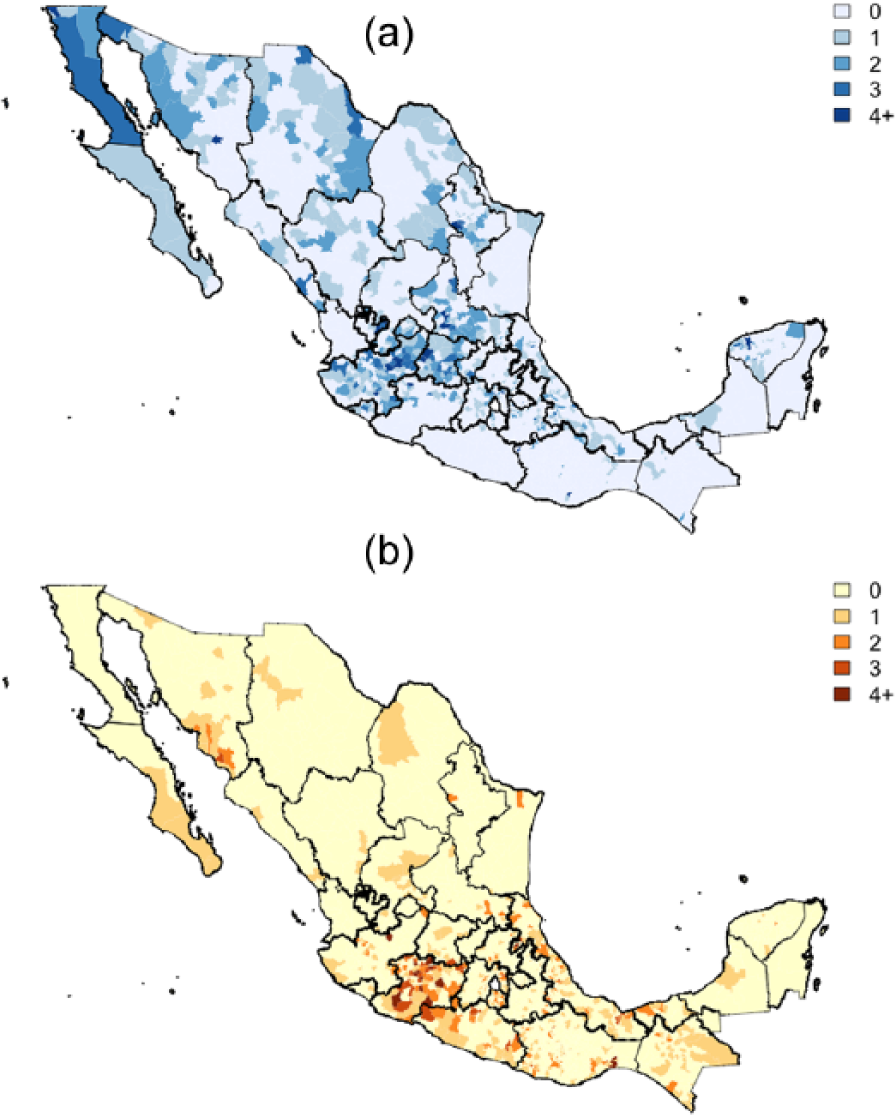
Number of PAN and PRD mayoral victories, 1984-2000.
Before moving to the next section, note that this article does not pretend to offer a full-blown account of the PRI’s demise, which was also driven by worsening economic conditions (Bruhn, 1997; Magaloni, 2006), the impact of economic reforms on the party’s patronage machine (Greene, 2007), growing international pressure to respect electoral outcomes (Cornelius, 1986; Levitsky & Way, 2010), and increasing incentives to defect (Langston, 2006), specially after the 1996 electoral reform (Garrido de Sierra, 2013). Moreover, the diffusion process discussed in this article could only “kick off” because the PRI was willing to tolerate continued opposition victories at the municipal level, which had not been the case before the 1980s (Aziz Nassif, 1994; Cornelius, 1986; Eisenstadt, 2004, Chapter 2; Lujambio, 2001; Shirk, 2001). Rather, my claim is that electoral competition at the subnational level also played a role in strengthening the opposition. During most of its history, the PAN was not an organization for placing candidates in office, and in 1989, the PRD was just the new party of a recent PRI defector (Bruhn, 1997; Eisenstadt, 2004, pp. 162-175; Shirk, 2001). Thus, during the 1980s and early 1990s, both parties found it hard to capitalize on voters’ discontent with economic conditions, as they lacked the resources, pragmatism, and experience needed to convince voters of their ability to replace the PRI (Greene, 2007; Magaloni, 2006). However, by 2000, they had a relatively large presence throughout the country and could mount a serious presidential campaign, which allowed the PAN to exploit the PRI’s weaknesses in the 2000 election in a way that had not been possible in the past (Greene, 2007; Shirk, 2005). The goal of this article is to examine whether, by helping strengthen the opposition, subnational elections also contributed to this process (see Eisenstadt, 2004, for a similar claim).
Data and Method
The unit of observation is the municipal-level election, indexed by municipality m and year t. I examine electoral returns for both mayoral and federal congressional elections, in both cases measured at the municipal level. 20 I employ municipal rather than state-level data both to increase sample size and to have more homogeneous units of analysis. This is especially relevant when studying diffusion effects, because explanatory variables are constructed as neighbor averages: If there are few units, many observations will have similar neighbors, and thus, the underlying variability of the data will be lower. The sample covers the 1984-2000 period: Data for previous elections are not available, and the PRI defeat in the 2000 presidential election meant that subsequent elections no longer took place under authoritarian rule. 21 In the case of the PRD, I begin the analysis in 1989, when the party was first established. 22 Data on congressional elections are only available for 1994, 1997, and 2000. 23 I exclude Mexico City from the sample because it did not hold municipal elections until 2000; municipalities in the state of Oaxaca that employed traditional voting methods (Usos y Costumbres) are also excluded because they held nonpartisan elections (Benton, 2012). 24
The main methodological challenge of the article is to distinguish diffusion effects—that is, genuine interdependence between neighbors—from pure spatial autocorrelation—the tendency of similar units to be located next to each other. To deal with this issue, I exploit the panel structure of the data to look at variation within municipalities over time, rather than cross-sectional differences between them. 25 I do this by fitting models with municipality and year fixed effects. The former ensures that the results will be driven by variation within individual municipalities, ignoring all factors that are time invariant at the municipal level—including geographic location, a history of opposition support before 1984, or the number and nature of its neighbors. To put it differently, every municipality is compared with itself at different moments in time; for example, if some municipality m had a PAN-governed neighbor at t + 3 but not between t and t + 2, the analysis examines whether the PAN did better in m at t + 3 than it had done in the same municipality in the past. Year fixed effects capture time-specific shocks (like national elections) that affect all municipalities at the same time, and accounts for the fact that electoral support for the opposition trended upward over time.
Specifically, I estimate ordinary least squares (OLS) models of the form

where ym,t measures the electoral performance of a given opposition party in municipality m in year t, xm,t is the main explanatory variable,
I employ four measures of the opposition’s electoral performance, ym,t. Winnerm,t is a dummy that takes the value of 1 if the party of interest won the mayoral election in municipality m in year t. In almost all instances, this means that the party in question received the plurality of the vote. 27 Vote sharem,t indicates the vote share of the party of interest in the corresponding mayoral election. Winner (federal)m,t and Vote share (federal)m,t are similarly defined for federal congressional elections. Note that these last two variables are measured at the municipal level, which may not coincide with the level at which seats were actually distributed.
For the vertical diffusion hypothesis, the main explanatory variable is Copartisan governorm,t, a dummy that takes the value of 1 if the party of interest controlled the state governorship at the time of the election. When examining the horizontal diffusion hypothesis, Copartisan neighborsm,t is defined as the proportion of m’s neighboring municipalities that were governed by the party of interest at time t. 28 I code two municipalities as neighbors if their borders have at least one point in common. This implies symmetry, that is, A is a neighbor of B if and only if B is also a neighbor of A, but it does not guarantee that all municipalities will have the same number of neighbors. 29 Copartisan neighbors ranges between 0 (if no neighboring municipality was governed by the party of interest) and 1 (if all of them were). Both Copartisan governor and Copartisan neighbors should have a positive effect on the outcome.
Depending on the specification, I control for Incumbencym,t and Previous votem,t, which indicate the incumbency status and previous vote share of the party of interest in municipality m in election t. Previous winner (federal)m,t and Previous vote (federal)m,t are similarly defined for federal elections. Vote neighborsm,t − 1 is the average vote share received by the party in question in neighboring municipalities in the previous election. Alternationm,t is a dummy indicating whether municipality m was located in a state where the PRI had already conceded the governorship (see Table 1). All specifications include a dummy reporting whether the municipality had been split to create a new one (which may change the identity of its neighbors), 30 a dummy indicating whether municipal and gubernatorial elections were concurrent, 31 and dummies for state electoral cycles. Online Appendix A presents further details on the construction of the sample and variables.
Results
Overview
I begin by presenting an overview of the data. Figure 1 already showed that the proportion of municipalities controlled by the PAN and the PRD increased slowly but steadily over time, from less than 2% in the 1980s to 9% to 11% in 1996 and 14% by 2000. Table 2 quantifies these patterns: Opposition parties won 13% to 15% of the vote on average, and about 7% to 8% of mayoral elections (conditional on winning their average vote share was 49%-51%). The values for federal elections are usually a few percentage points higher because we only have data for 1994-2000, when the opposition was doing better at the polls. The proportion of municipalities with copartisan governors or neighbors is also low: only 5% of elections took place in a state governed by the PAN, and on average, no more than 5% of neighboring municipalities were governed by a PAN or PRD mayor. In the case of the PRD, the Copartisan governor variable always takes the value of zero because this party won its first gubernatorial elections outside Mexico City in 1998, and thus, the first mayoral election under a PRD governor took place in 2001.
Descriptive Statistics.
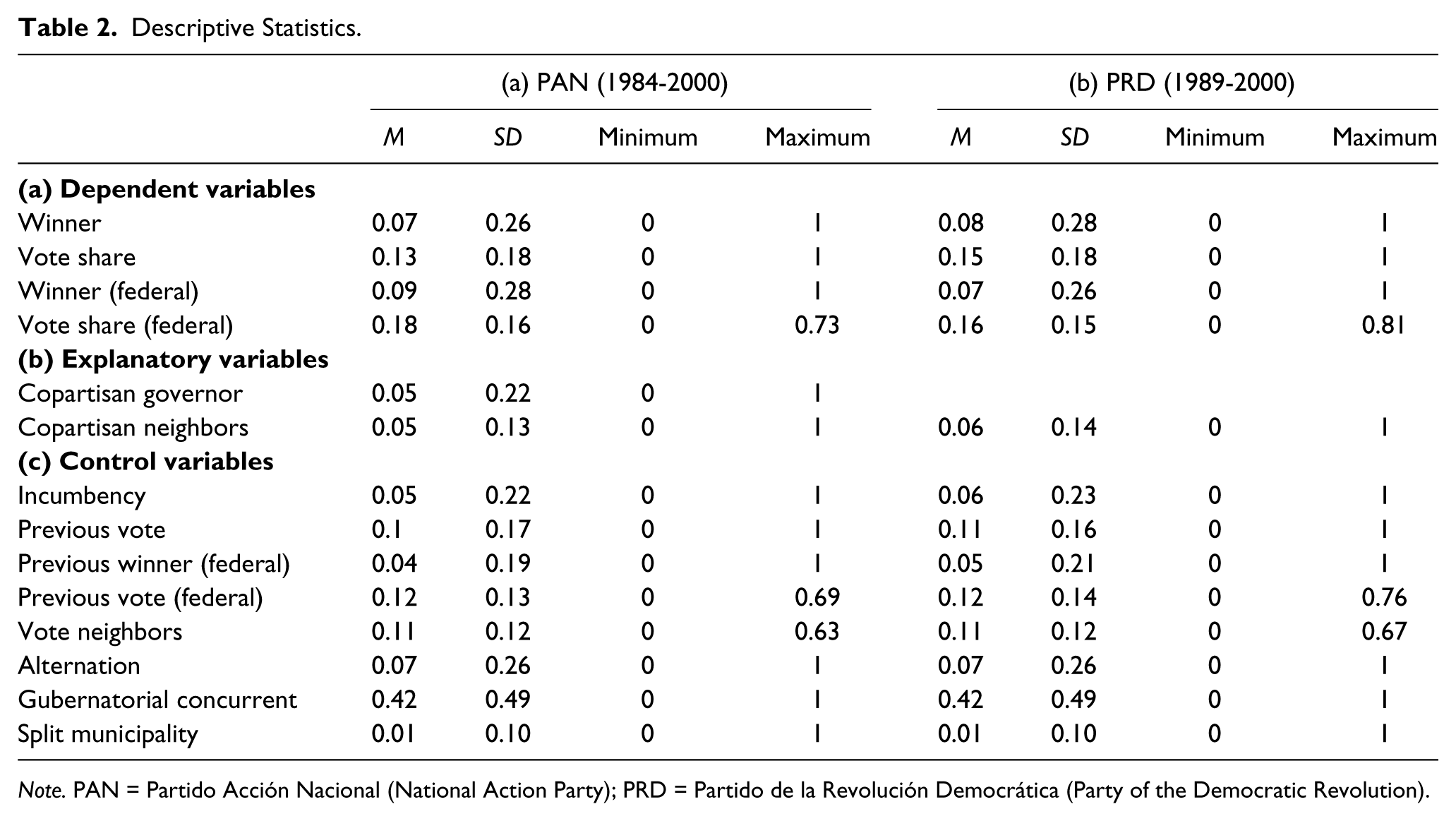
Note. PAN = Partido Acción Nacional (National Action Party); PRD = Partido de la Revolución Democrática (Party of the Democratic Revolution).
However, these numbers obscure large regional differences. Figure 2 shows that the PAN received the bulk of its support in the North and some states in the Center-West, whereas the PRD was especially strong in the South and the South-West. As mentioned above, to the extent that these differences capture time-invariant factors (such as a long history of opposition support), they do not pose a problem for the analysis because the fixed effects will account for them. Moreover, the geographic distribution of opposition support did not remain constant over time. Figure 3 illustrates this point by plotting the evolution of the Moran’s I values for Winner and Winner (federal) between 1984 and 2000. 32 Moran’s I is a widely used measure of spatial autocorrelation that indicates the extent to which observations with similar values of a given variable are located next to each other. It ranges between −1 and 1, with 1 indicating perfect autocorrelation—that is, units with similar values are located contiguously—while −1 means that units with high values are surrounded by units with low values, as in a chessboard (assuming that squares that only share an edge are not treated as neighbors). 33
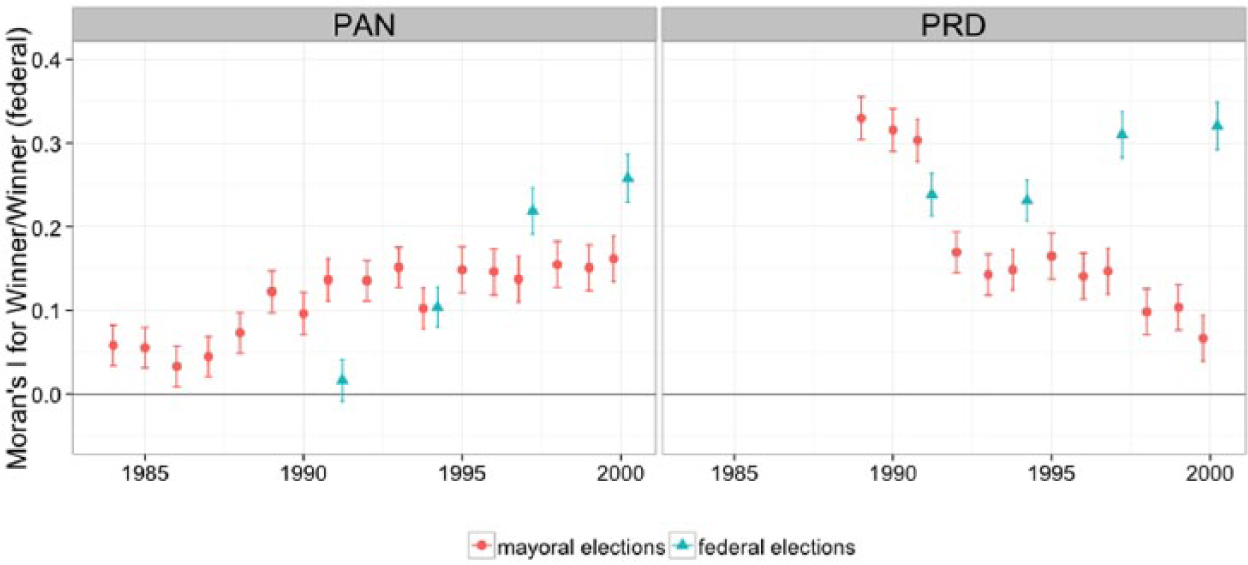
Spatial autocorrelation of opposition-governed municipalities, 1984-2000.
A diffusion process predicts that these Moran’s I values should be close to zero at first—the PRI controlled practically all municipal governments—but increase over time as opposition parties consolidated around their strongholds. 34 The left panel of Figure 3 shows that this was indeed the case for the PAN, whose Moran’s I value for Winner increased from a low of 0.03 in 1986 to a high of 0.16 in 2000. The increase was even larger in federal elections, where it reached a maximum of 0.26 in 2000. The point is not that electoral support for the PAN was spatially autocorrelated but rather that autocorrelation increased steadily over time. The right panel shows that no similar pattern is discernible for the PRD. The large values for 1989-1992 reflect the fact that the FDN did very well in a few states in 1988 but failed to consolidate its support in future elections (Bruhn, 1997). Afterward, there is a slightly negative trend. For federal elections, the Moran’s I values oscillate between 0.23 and 0.32, with no clear trend.
Mayoral Elections
Table 3a presents the results for the models with Winner as the outcome. All models control for Previous vote and include dummies for concurrent gubernatorial elections, split municipalities, the state’s electoral cycle, and municipality and year effects. 35 In line with the vertical diffusion hypothesis, Model 1 shows that capturing a governorship increases the probability that the PAN will win a municipal election by 7 percentage points, doubling the party’s unconditional probability of victory. The next two models examine the horizontal diffusion hypothesis. Model 2 includes an interaction term between Copartisan neighbors and (gubernatorial) Alternation to identify those states where the PRI had already handed over power to the opposition, whereas Model 3 restricts the analysis to states where there had been no alternation in office. States where alternation had taken place arguably featured cleaner elections and a more even playing field than those in which the PRI remained uninterruptedly in power. In both cases, the estimates for Copartisan neighbors are positive and reliable. Substantively, a standard deviation increase in Copartisan neighbors increases the probability that the PAN will capture a municipality by 1.5 percentage points. The unconditional probability that the PAN won a municipal election was just 7.4%, so this represents a 20% increase over this baseline. Furthermore, these estimates indicate the effect of Copartisan neighbors after accounting for other factors that increase the PAN’s electoral performance across the board, such as nationwide partisan tides.
Diffusion Effects in Mayoral Elections in Mexico, 1984-2000.
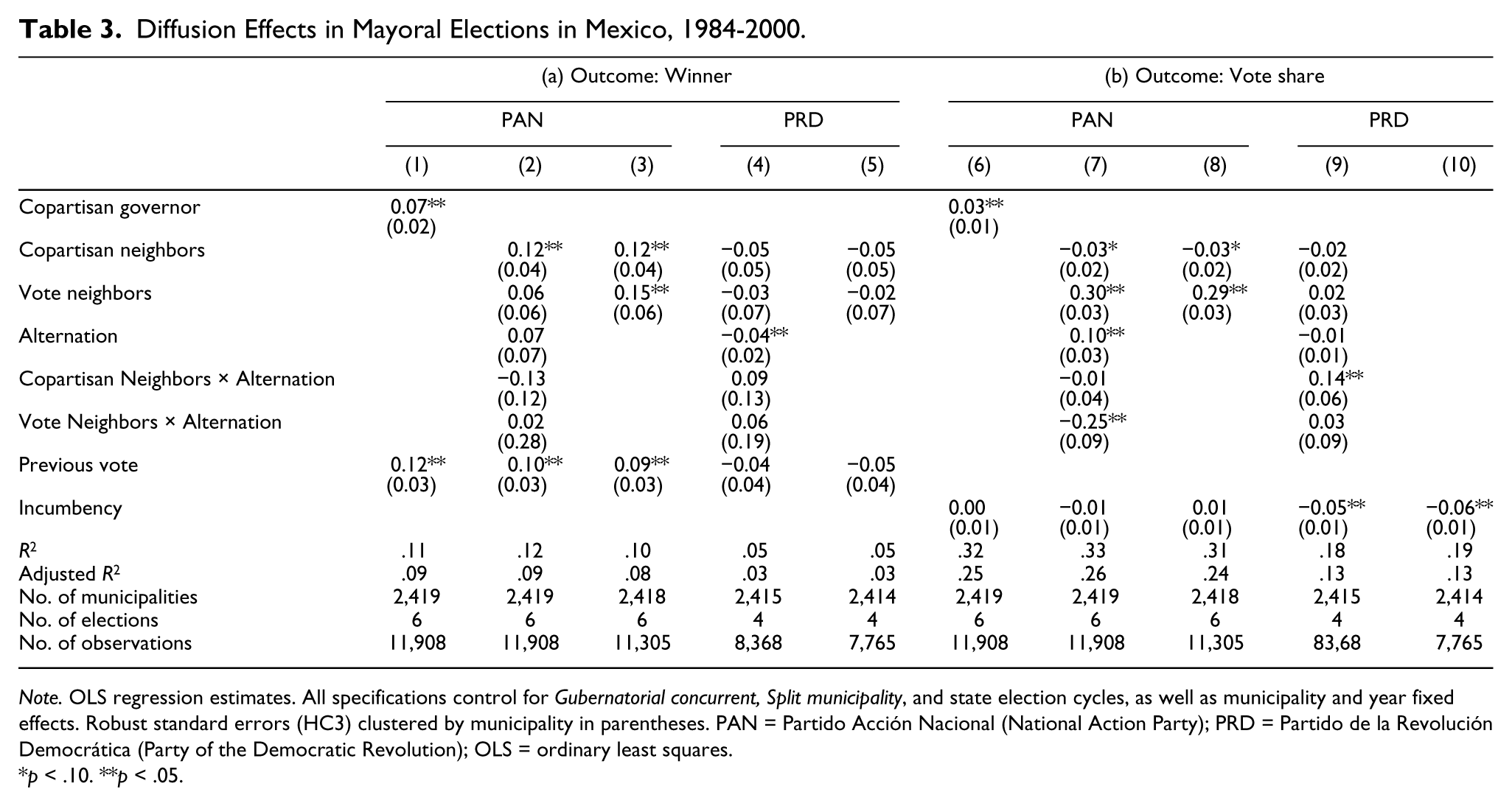
Note. OLS regression estimates. All specifications control for Gubernatorial concurrent, Split municipality, and state election cycles, as well as municipality and year fixed effects. Robust standard errors (HC3) clustered by municipality in parentheses. PAN = Partido Acción Nacional (National Action Party); PRD = Partido de la Revolución Democrática (Party of the Democratic Revolution); OLS = ordinary least squares.
p < .10. **p < .05.
In addition, note that in Model 2, the interaction term between Copartisan neighbors and Alternation is negative and almost identical in magnitude to the estimate for Copartisan neighbors, implying that in states that had experienced alternation in office (which, in practice, means that they were governed by the PAN), 36 the effect of Copartisan neighbors was essentially zero. Taken together, these results indicate that capturing subnational offices did help the PAN win further races, but the effect was stronger when the party lacked better alternatives—in particular, when it did not enjoy the support of the state government. This is consistent with the claim that a “municipalization” strategy is more attractive for opposition parties that are small and weak; as they become stronger and can rely on the support of higher level officials, horizontal diffusion effects should become less consequential. For the same reason, opposition parties that have a realistic shot at winning the national presidency are unlikely to devote much attention to subnational races.
Models 4 and 5 present the results for the PRD. As explained above, the lack of gubernatorial elections in PRD-governed states means that the analysis is restricted to horizontal diffusion effects. In contrast to the PAN, but consistent with Figure 3, the results indicate that diffusion effects did not contribute to the party’s growth. Indeed, the point estimates for Copartisan neighbors are negative, though far from statistically significant at conventional levels. In terms of magnitude, a standard deviation increase in Copartisan neighbors reduces the probability that the PRD will capture a municipality by just 0.7 percentage points (a 8% to 9% decrease over the unconditional probability of winning, which is 8.4%). As discussed above, this may reflect the fact that the PRD’s electoral strategy emphasized the importance of challenging the PRI at the national level rather than growing slowly around regional strongholds. The same applies to the PRD’s tendency to rely on PRI defectors. These defectors were popular politicians who controlled large patronage machines but failed to win the PRI nomination (Garrido de Sierra, 2013; Reveles Vázquez, 2004). One would expect that the ruling party would be less likely to nominate such individuals when it was sure of winning, that is, when the opposition was weak. To the extent that this is the case, however, defections should be concentrated in areas with little opposition support rather than around the PRD’s main strongholds.
Table 3b presents the results for Vote share as the outcome. The specification is the same as before, except that Previous vote is replaced with Incumbency. In line with the previous results, Model 6 indicates that having a copartisan governor increases the PAN’s expected vote share in mayoral elections by 3 percentage points, a reliable but substantively small effect. However, the next two models show that the Copartisan neighbors coefficient is negative, though the magnitude of the effect is extremely small—increasing Copartisan neighbors by 1 standard deviation reduced the PAN’s expected Vote share by less than half of a percentage point—and the estimates are only statistically significant at the 0.10 percent level. Furthermore, note that these estimates represent the effect of Copartisan neighbors above and beyond that of Vote neighbors, which is positive and substantial in magnitude. 37 Nonetheless, the fact that Copartisan neighbors has a different effect on Winner and Vote share is surprising. A potential explanation is that the party’s mayors campaigned strategically in those municipalities where the PAN had a better chance of winning: This would have allowed the party to tip the balance in a few mayoral races without necessarily increasing its average vote share across the board. This is admittedly speculative but consistent with two facts about the PAN’s electoral history before 1997. First, the PAN often organized postelection protests to negotiate concessions from the PRI in “smoke-filled rooms,” eventually receiving some mayoralty in return (Eisenstadt, 2004, Chapter 5). The point is that such concessions often meant annulling the results in a few polling stations in which the PRI had done well, thus giving the PAN a mayoralty with a minimal increase in its vote share. Second, the PAN’s electoral strategy emphasized the importance of sending representatives to all polling stations in a municipality; when resources were scarce, the party preferred to monitor all polling stations in a handful of municipalities rather sending monitors to all municipal races (Eisenstadt, 2004, pp. 181-182). Naturally, one would expect the party to focus on those municipalities where it expected to do better.
The results for the PRD are quite similar. The point estimates for Copartisan neighbors are negative, though unreliable and very small in magnitude: A standard deviation increase in Copartisan neighbors reduces the PRD’s expected vote share by less than a quarter of a percentage point. Moreover, in Model 9, the interaction term between Copartisan neighbors and Alternation is positive and much larger in magnitude than that for Copartisan neighbors. This suggests that the PRD benefitted somewhat from horizontal diffusion effects, though only in PAN-governed states. This is consistent with the claim that the PRI was specially hostile to PRD mayors (Bruhn, 2012; Fox & Moguel, 1995; Magaloni, 2006): To the extent that this hostility was enforced by state governors, the effect should be limited to states governed by the PRI. Nonetheless, the lack of more direct evidence means that this interpretation should remain speculative.
Federal Elections
Table 4 investigates whether diffusion effects also extend to congressional elections. The specifications are identical to those in the previous section, though because of data limitations the analysis only covers the 1994, 1997, and 2000 elections. The results are very similar, especially in the case of the PAN, so I will not comment much on them. In line with expectations, Models 1 to 3 indicate that the PAN was more likely to carry a municipality when it controlled the governorship or some neighboring municipality. The effect for Copartisan governor more than doubles in magnitude—it increases from 7 to 15 percentage points—but the effect of Copartisan neighbors remains almost unchanged; depending on the specification, a standard deviation increase on this variable increases the probability that the party will win a municipality by 1.5 to 1.8 percentage points. In the case of the PRD, the effect of Copartisan governor can now be estimated because congressional elections took place in all states in 2000. Consistent with the vertical diffusion hypothesis, the effect is large and positive: Having a copartisan governor increases the probability of carrying a municipality by 14 percentage points. More surprisingly, Models 5 and 6 indicate that the estimates for Copartisan neighbors are now positive, though neither of them is reliable, and their magnitude is modest. As before, the effect is much stronger in states that had experienced alternation.
Diffusion Effects in Federal Elections in Mexico, 1994-2000.
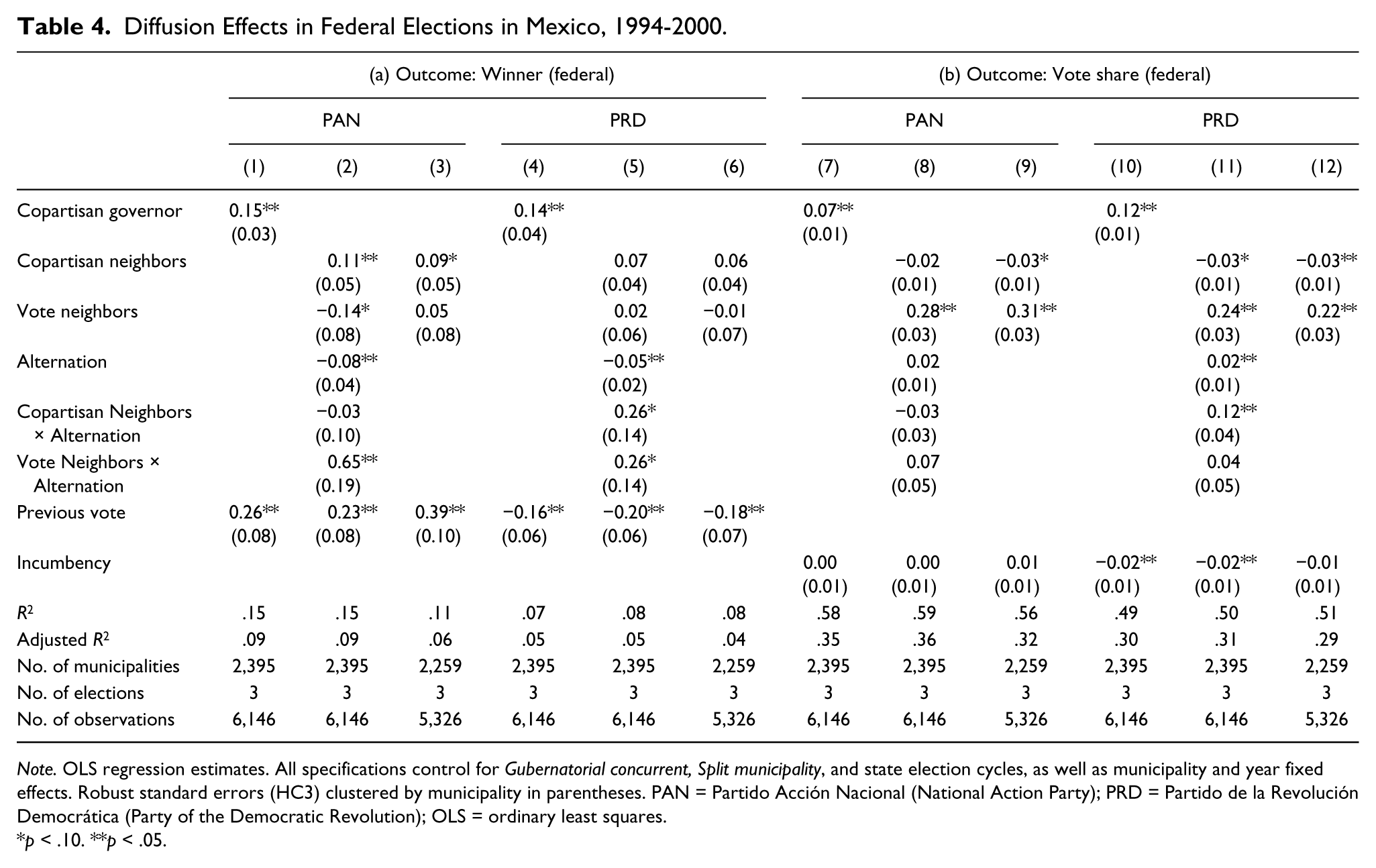
Note. OLS regression estimates. All specifications control for Gubernatorial concurrent, Split municipality, and state election cycles, as well as municipality and year fixed effects. Robust standard errors (HC3) clustered by municipality in parentheses. PAN = Partido Acción Nacional (National Action Party); PRD = Partido de la Revolución Democrática (Party of the Democratic Revolution); OLS = ordinary least squares.
p < .10. **p < .05.
The results in Table 4b show no surprises. The PAN benefits from having a copartisan governor, but the estimates for Copartisan neighbors are negative, though not always reliable and very small in magnitude: A standard deviation increase in the explanatory variable at most reduces the PAN’s vote share by less than half of a percentage point. The case of the PRD is similar: Having a copartisan governor increases the party’s vote share by 12 percentage points, whereas the estimate for Copartisan neighbors is negative but small in magnitude. Again, this effect is restricted to states that did not experience alternation; in those that did, the effect of Copartisan neighbors becomes positive and reliable, though the substantive effect is modest—1.5 percentage points for a standard deviation increase in Copartisan neighbors.
Robustness
Online Appendix B shows that these results are robust to a variety of specification changes: (a) controlling for a municipality’s Poverty level and its Rural status, (b) using alternative neighbor definitions, (c) employing a neighbor dummy that takes the value of 1 when Copartisan neighbors >0, (d) replacing the fixed effects with the lagged dependent variable, (e) including observations where the PAN and PRD formed an alliance, or (f) excluding the state of Oaxaca from the sample.
Discussion and Conclusion
The literature on political parties in autocracies is mostly a literature about ruling parties (Geddes, 2006; Levitsky & Way, 2013; Magaloni, 2008; Morse, 2014; Reuter & Remington, 2009; Smith, 2005; Svolik, 2012). Even when opposition parties are allowed to exist and field candidates, they are perceived as too weak and ineffectual to merit serious attention. In contrast, this article argues that in autocracies that permit electoral competition at multiple levels of government, opposition parties can use subnational executive offices as “springboards” from which to increase their electoral support in future races. However, not all opposition parties will find this strategy attractive; in particular, those that can expect to win a national election, or the ones whose base of support is concentrated in the capital city, may prefer to challenge the regime directly at the center.
I evaluated this argument with municipal-level data from Mexico, a CAR with two main opposition parties that adopted very different electoral strategies vis-à-vis the ruling party. Three findings stand out. First, consistent with the claim that higher level offices such as governorships are highly visible and provide substantial resources, both the PAN and the PRD benefitted from vertical diffusion effects. Even if the PRD did not follow a strategy of party-building from the bottom up, PRD governors still had strong incentives to boost their party’s electoral fortunes in federal elections to increase their standing at the national level (Langston, 2010; Rosas & Langston, 2011).
Second, the PAN was more likely to carry a municipality when it already controlled a neighboring mayoralty, suggesting that the “municipalization” strategy (Lujambio, 2001) did indeed pay up—at least during the late 1980s and 1990s. The effect holds for both mayoral and federal elections but disappears after the party captured the state governorship, supporting the idea that a strategy of growing from the local level is most attractive when there are no alternatives. However, horizontal diffusion does not increase the party’s vote share in municipal election. A possible, though speculative, interpretation of this finding is that PAN mayors did not campaign on behalf of their party in all neighboring municipalities but focused on “winnable” races.
Finally, there is no evidence that the PRD benefitted from a horizontal diffusion process. This is consistent with the idea that building electoral support from the bottom up is a strategy that parties may choose (not) to follow; in particular, it is worth repeating that several aspects of the PRD’s history and structure made it an unlikely candidate to either adopt such a strategy or benefit from it. Formed by a disparate assemblage of social movement leaders, former priístas and left-wing politicians and intellectuals, the PRD has always been a highly factionalized organization. While recognizing Cárdenas as the ultimate arbiter of all internal disputes probably prevented the party from splitting, it also hindered its institutionalization. Moreover, the goal of getting rid of the PRI as quickly as possible, coupled with the fact that many of the party’s founders were based on Mexico City, led the PRD to stress national over subnational elections. Co-opting recent PRI defectors brought important electoral successes, but generated internal tensions and did not contribute to a more institutionalized party (Bruhn, 1997, 1999, 2012; Eisenstadt, 2004; Hilgers, 2008; Martínez González, 2005; Meyenberg & Carrillo, 1999; Reveles Vázquez, 2004; Wuhs, 2008). At the same time, the fact that interaction term between Copartisan neighbors and Alternation is always positive and generally large in magnitude suggests that the PRD could build electoral support from the bottom up when facing a PAN rather than a PRI governor. 38 This speaks to the claim that the PRI was especially hostile against the PRD (Bruhn, 1997, 2012; Bruhn & Yanner, 1995; Fox & Moguel, 1995; Magaloni, 2006; Reveles Vázquez, 2004), and suggests that the ruling party’s “punishment campaign” was successful at preventing voters from switching. Thus, the lack of horizontal diffusion effects for the PRD has two alternative explanations: Either the party did not try to follow a strategy of building support from the bottom up, or the PRI’s behavior prevented such strategy from working. Which of these interpretations is more accurate constitutes an important issue for further research.
Moving beyond Mexico, this article underscores three issues that deserve further attention. The first is why some authoritarian rulers are willing to accept electoral defeats at the subnational level: Why not prevent the opposition from growing when it is still very weak? One potential reason is that authoritarian elites want to appease the international community, as happened in Serbia and to a lesser extent in Mexico (Krnjevic-Miskovic, 2001; Levitsky & Way, 2010, Chapter 4). Alternatively, the ruling party may wish to avoid postelection protests or secure the opposition’s cooperation in the national legislature (Eisenstadt, 2004, 2006). These mechanisms are not mutually exclusive, but they have different implications. If pressure from the international community is decisive, this probably means that foreign actors can help the opposition directly in national elections, and thus, opposition parties will not need to engage in a slow process of party-building from below. When domestic factors are paramount, on the contrary, the fact that a process of democratization “from the bottom up” takes years to develop suggests that offering concessions should be especially attractive for national authoritarian elites, for whom the cost of a few opposition victories in subnational elections is quite low. In turn, this suggests that “endogenous” transition processes should be more common in regimes that have highly institutionalized parties: As such parties rotate individual rulers at regular intervals (Svolik, 2012, Chapter 6), national elites may be less concerned about strengthening the opposition in the long run; at the same time, a disciplined party is crucial for forcing subnational elites to accept electoral defeats without generating massive defections. The PRI’s electoral machine eventually rebelled against what it perceived unjustified concessions to the opposition (Eisenstadt, 2004, Chapter 8), but the party’s iron discipline meant that these concessions could go on from a long time.
A second issue is why some opposition parties adopt a strategy of party-building from the bottom up. Hilgers’s (2008) comparison of the PRD with the Brazilian Workers’ Party (PT), which also had a charismatic leader and was highly heterogeneous at the time of its founding, is illustrative in this regard: The PT’s founders created an institutionalized party because they believed that they could never achieve their ultimate goal of major social transformation without a cohesive and disciplined organization (Hilgers, 2008). In other words, institutionalized opposition parties may require far-sighted founders willing to resist the allure of minor short-term gains for the sake of potentially larger—but highly uncertain—long-term benefits. Yet this simply introduces the question of where these founders come from. According to Levitsky and Way (2013), institutionalized parties tend to arise in the context of social revolutions, where the imperatives of military victory drive the creation of solid and disciplined organizations. Their argument is best suited to incumbent parties, but it may also apply to once-illegal insurgencies that were eventually accepted into the political system, as was the case of the Frente Farabundo Martí para la Liberación Nacional (Farabundo Martí Front for National Liberation, FMLN) in El Salvador (Wood, 2001). In any case, the PAN constitutes an exception to both patterns.
Finally, in this article, I suggested that one of the main driving forces of horizontal diffusion is ambitious politicians who want to “jump” to a higher level office: By trying to court new voters outside their strongholds, these politicians may end up strengthening their party’s reputation (and organization) in neighboring areas. Many of the PAN’s gubernatorial candidates were former mayors (Camp, 2010), and a similar pattern has been found in other CARs (see Levitsky & Way, 2010, for Taiwan, and Rakner and van de Walle’s, 2009, for Africa). Of course, a similar mechanism probably holds in democracies as well, notably among some radical right parties in Western Europe. 39 Yet many of the mechanisms that drive this process remain unclear: Do all ambitious politicians engage in such kind of behavior? Do institutions such as term limits make it more likely? How do politicians decide which new voters to court? And when do ambitious politicians seek to strengthen their party’s organization in neighboring districts rather than simply hiring preexisting brokers?
Footnotes
Acknowledgements
The author thanks Brian Crisp, Guillermo Rosas, Jacob Montgomery, Alberto Simpser, Sunita Parikh, Dawn Brancati, Sebastián Garrido de Sierra, Yonatan Morse, Allyson Benton, the editors, and three anonymous reviewers for their helpful comments. Tobias Pfütze kindly shared his data on municipal elections in Mexico during the 1980s.
Author’s Note
Previous versions of this article were presented at the 3rd Graduate Student Conference in Comparative Politics, Department of Political Science, University of California, Los Angeles (UCLA), April 26, 2014, and the 2014 annual meeting of the American Political Science Association. Code for replicating  as well as all tables included in the text and the Online Appendix B can be found in both the journal’s and the author’s websites. All remaining mistakes are the author’s responsibility.
Declaration of Conflicting Interests
The author(s) declared no potential conflicts of interest with respect to the research, authorship, and/or publication of this article.
Funding
The author(s) received no financial support for the research, authorship, and/or publication of this article.
Notes
Author Biography
References
Supplementary Material
Please find the following supplemental material available below.
For Open Access articles published under a Creative Commons License, all supplemental material carries the same license as the article it is associated with.
For non-Open Access articles published, all supplemental material carries a non-exclusive license, and permission requests for re-use of supplemental material or any part of supplemental material shall be sent directly to the copyright owner as specified in the copyright notice associated with the article.
