







Abstract
In elections around the world, voters are influenced not only by positive offers of gifts and favors but also by the threat of negative sanctions for their individual electoral choices. Preelectoral entitlements such as jobs, assets, and welfare create expectations of future access that brokers can use as powerful negative inducements at the moment of the vote. We argue that in conditions where ballot secrecy makes it difficult to monitor vote choices, brokers are likely to target core supporters with both preelectoral entitlements and election-time threats. We refer to this counterintuitive logic as the “core voters’ curse.” We find evidence for this argument using an original household survey of 1,860 Hungarian citizens in 93 rural communities fielded shortly after the 2014 parliamentary election.
Keywords
In elections around the world, politicians seek to win office by offering voters particularistic benefits. In these cases, politicians can rely on political intermediaries who target voters using a variety of strategies. Do candidates and their intermediaries target loyal partisan supporters or swing voters using clientelistic strategies? This question has been at the center of an extensive literature on clientelistic exchanges and goes back to seminal contributions by Cox and McCubbins (1986) and Dixit and Londregan (1996). We reexamine this question by considering a broader menu of both positive and negative incentives that candidates can use to influence voters. We also analyze interactions between politicians and voters, which involve both the provision of long-term access to policy entitlements and one-shot offers of goods and gifts or money. We argue that especially in conditions of high ballot secrecy, brokers find it attractive to offer their core political supporters privileged access to entitlements, and then mobilize these voters at the time of elections using negative inducements or threats to withdraw access to these long-term income streams. We refer to this counterintuitive finding as the “core voters’ curse.”
Clientelistic exchanges come in a variety of forms. The first objective of our article is to characterize the empirical variety of such nonprogrammatic strategies. We propose a classification that distinguishes between positive and negative inducements. Positive inducements involve promises of new benefits, whereas negative inducements involve threats to worsen voters’ status quo states by taking away an expected future income stream or by worsening the terms of an ongoing economic exchange. This variation is normatively important because negative inducements imply a much more fundamental violation of voters’ autonomy. Drawing on insights from prospect theory, we argue that voters perceive positive inducements and negative inducements differently.
Our second goal is to explain variation in the types of clientelistic strategies. We argue that analyzing election-time clientelistic exchanges as embedded in ongoing relationships between brokers and voters is key to understanding the targeting of positive and negative inducements. Specifically, we argue that in countries where access to entitlements can be politicized, voters who receive entitlements will be mobilized at the time of elections with threats that they will lose those ongoing transfers. In systems where ballot secrecy leads candidates and brokers to focus on incentivizing the turnout of voters with known political preferences, core voters are therefore targeted both with preferential access to entitlements and with threats of economic sanctions during elections. Ultimately, the provision of these contingent entitlements is a double-edged sword because voters who receive them are more vulnerable to election-day threats.
Our empirical evidence comes from a survey of 1,860 Hungarian citizens in 93 rural communities in the immediate aftermath of the April 2014 parliamentary election. We assess the incidence of four clientelistic strategies using list experiments, a survey method that enables respondents to report sensitive information without incriminating themselves that can, thus, reduce bias in the measurement of sensitive political phenomena. We document the existence of both positive and negative forms of clientelism, including threats by mayors to restrict access to workfare programs to voters that make incorrect electoral choices, threats by moneylenders to cut off access to or worsen the terms of credit, offers of administrative favors by employees of the local city hall, and gifts of money or food.
We find that in this context, where most voters believe that their vote choices cannot be monitored, candidates and their agents target voters with strong and predictable party preferences with election-time threats. These results are robust to multiple codings of the strength of party identification, including one based on voters’ ideological positions that are less likely to be influenced by the past receipt of benefits. By contrast, positive inducements around the time of the election are much less targeted based on the strength of party identification. This null effect suggests that by focusing on this subset of transactions, past research may have missed important variation in the targeting of clientelistic exchanges. We also find evidence for our proposed mechanism: Core supporters are more likely to get access to entitlements, particularly in places where they are copartisans of the local mayor.
These findings are important for several reasons. Most significantly, they present a more nuanced view of clientelistic targeting as compared with previous studies. Looking exclusively at one form of clientelistic interaction that often occurs during the immediate election period presents an incomplete picture of the mix of inducements provided by candidates. Second, our findings highlight the importance of negative inducements as a component of clientelistic strategies. Electoral threats, which in some cases reach the level of coercion, violate voters’ rights in a much more fundamental way than positive clientelistic exchanges into which voters freely enter. Furthermore, because most individuals are loss averse, negative inducements may have an outsize effect on voters’ behavior.
Nonprogrammatic Electoral Strategies
The study of electoral clientelism has experienced spectacular growth in recent years. This new literature has significantly advanced our understanding of electoral practices both in countries that have experienced recent democratic transitions and in relatively established democracies. Clientelistic exchanges have been documented in a variety of settings, including Argentina, Bulgaria, Mexico, Guatemala, Brazil, the Philippines, Paraguay, Romania, Benin, and India (Diaz-Cayeros, Estévez, & Magaloni, 2016; Finan & Schechter, 2012; Stokes, Dunning, Nazareno, & Brusco, 2013; Wantchekon, 2003).
We follow much of the literature in defining clientelism as “non-programmatic distribution combined with conditionality” (Stokes et al., 2013). In this, we follow Hicken (2011) and Stokes et al. (2013) in distinguishing clientelism from the programmatic provision of public goods or even pork and club goods by the fact that clientelistic benefits are targeted on specific individuals or small groups and are contingent on those individuals’ political behavior.
Other scholars of clientelism have proposed important conceptual distinctions among forms of clientelism. Kitschelt and Wilkinson (2007) proposed a classification of clientelistic strategies based on the type of brokers deployed by politicians and the type of goods offered to voters. Other studies have documented that a wide range of incentives can be used in particularistic exchanges between politicians and voters, including one-off offers of money or goods (Brusco, Nazareno, & Stokes, 2004), administrative favors (Murillo & Calvo, 2014), jobs (Robinson & Verdier, 2013), land (Baland & Robinson, 2008; Larreguy, 2013), forbearance from prosecution for infractions (Holland, 2016), and even physical harm (Bratton, 2008). Nichter (2008) and Gans-Morse, Mazzuca, and Nichter (2014) propose a typology based on the behavior that is incentivized, including turning out, abstaining, or changing one’s vote.
We contend that one of the most important dimensions differentiating clientelistic incentives is whether they are based on positive inducements or threats. We draw on political theory to view offers and threats as proposals that are differentiated by the impact that they have on the proposal recipient’s baseline condition (Nozick, 1969; Wertheimer, 1987). Nozick (1969) defines the baseline condition as the “normal or natural or expected course of events” (p. 447). In other words, both offers and threats are conditional proposals, but in the case of a threat, the proposal leaves the recipient worse off than expected, regardless of whether or not she accepts the proposal. Wertheimer (1987) further specifies that for a threat to be coercive, the recipient must have no reasonable choice but to accept the proposal.
The distinction between threats and offers depends, thus, on the prior expectations of the target of such strategies. For example, if a voter does not expect to receive welfare benefits, and the benefits are offered to her by a broker in exchange for her vote, then they are being used as a positive inducement. However, if benefits are expected and then the broker threatens to withdraw them, access to the same benefit is used as a threat (Mares & Young, 2016). Such threats are coercive if the voter believes that she could not survive without access to the respective future income stream of benefits. 1 Clientelistic threats also violate a normative view of voters’ baseline conditions: Most people would agree that voters should be able to both access benefits to which they are legally entitled and vote according to their preferences, so threatening to take away those benefits unless the individual changes their voting behavior is worse than this normative baseline.
The distinction between offers and threats is relatively easy to identify when it comes to physical threats, as most would agree that an individual’s baseline condition is free of violence. In the case of economic threats, the voter’s baseline condition is shaped by his or her legal entitlements and his or her prior experiences. This means that the duration of a clientelistic exchange is often a critical determinant of whether an election-time proposal is an offer or a threat. Ongoing access to transfers such as welfare benefits or credit are much more likely to influence a voter’s perceived baseline condition than one-off gifts of food or cash. As a result, election-time proposals that involve the prospect of future losses of such ongoing benefits are likely to be perceived as threats.
We contend that the distinction between positive and negative inducements is important both for normative and empirical reasons. Normatively, negative inducements, particularly those that involve coercion, violate voters’ rights in a much more fundamental way than positive forms of clientelism such as vote buying by removing voters’ autonomy to opt into a clientelistic exchange. Much of Western legal code reflects this view that coercive crimes are more morally unacceptable (Wertheimer, 1987). In other work, we use survey evidence to show that voters perceive negative forms of clientelism as more odious and normatively less desirable as compared with positive forms (Mares & Young, Forthcoming). In addition, theory and evidence from behavioral economics suggest that negative inducements may affect voters’ behavior more severely than positive offers. Theory and experimental evidence from prospect theory has shown that individuals suffer outsize negative shocks to their utility from losses compared with gains (Kahneman & Tversky, 1979). If so, then this loss aversion implies that negative inducements likely have a larger impact on voting behavior than positive inducements of the same size.
Although scholars have recognized that clientelistic transactions are often iterative such that both parties have expectations of future interactions (Hicken, 2011), few studies have made this distinction between positive and negative inducements. To date, most empirical examinations of clientelistic exchanges focus primarily on vote buying, with limited focus on ongoing transfers or coercive threats. In an influential study of clientelism in Argentina, Brusco et al. (2004) study the “proffering to voters of cash or more commonly minor consumption goods by parties in exchange for the recipient’s vote” (p. 67). Drawing on the same survey, Stokes assesses clientelism through offers of “food, building materials, mattresses and clothing” (Stokes, 2005, p. 321). In their study of electoral clientelism in Nicaragua, Gonzalez-Ocantos et al. (2012) examine the offer of gifts or favors by politicians. Similarly, Finan and Schechter (2012) measure clientelism as an offer of “money, food, payment of utility bills, medicines, and/or other goods” during the run-up to the 2006 elections in Paraguay.
Measuring clientelism only as offers of money, goods, or food is problematic for a variety of reasons. First, the menu of positive inducements is much broader and often includes goods and administrative favors provided by the state (Mares & Petrova, 2013; Oliveros, 2016). In recent years, a number of new studies have attempted to assess the magnitude of these administrative favors provided by the state and whether voters respond differently to state-provided clientelism or to offers of goods and food (Murillo & Calvo, 2014). Recent empirical studies that seek to assess the relative incidence of these two forms of positive inducements—vote buying and administrative favors by the state—using survey techniques to measure sensitive behavior have largely found that administrative favors by the state are more prevalent than vote buying (Murillo & Calvo, 2014). As such, an empirical assessment of clientelism on the basis of vote buying alone is likely to result in biased estimates of the magnitude and targeting of nonprogrammatic strategies.
By considering the deployment of both positive and negative inducements, we can examine a number of questions that have been insufficiently addressed in the existing literature on electoral manipulation. First, we seek to understand politicians’ decisions to allocate both positive (vote buying, state favors) and negative inducements (threats by public and private brokers). Are these strategies complements or substitutes? Which voters are targeted with positive inducements, and which with negative threats? The following section formulates our expectations.
Clientelistic Targeting With Multiple Strategies
Our theoretical predictions start with the consideration that the interactions between partisan brokers and voters are not just one-shot events, but an ongoing process that precedes elections. In their seminal paper on political clientelism, Dixit and Londregan (1996) argue that “tactical redistribution is an ongoing process” and Hicken (2011) actually sees the expectation of continued, iterative exchanges as central to the definition of clientelism. We argue that these prior interactions affect the expectations and choices available to politicians, brokers, and voters at the time of elections. To understand the deployment of positive and negative inducements, we need to place the political activities that occur during elections in this more extended temporal perspective.
In countries where clientelistic practices are used, candidates politicize a variety of economic and administrative resources at the local level prior to electoral campaigns. In many contexts, social policies are the most important resource that can be used during this preelectoral phase. Many policies or programs—even those intended to provide universal benefits—can be turned into a source of political dependency. If the local bureaucrats administering the policies are co-opted into partisan networks, they can make benefits conditional on political loyalty. Other benefits may take the form of forbearance, or the selective nonenforcement of the law (Holland, 2016). Many of these policies, including welfare benefits and access to informal credit, are ongoing transfers that voters expect to continue into the future.
These ongoing relationships shape the electoral strategies deployed during the period of the campaign. Shortly before elections, politicians deploy agents to influence voters’ behaviors in the near future. These agents can appeal to voters using two broad types of strategies. Positive proposals involve offers of money, goods, food, or other transfers that increase voters’ utility relative to their baseline conditions. Proposals based on negative inducements, by contrast, involve threats to take away expected future benefits from voters, including access to credit and social policy transfers or threats to worsen the terms of an ongoing economic exchange.
In short, we expect that the targeting of inducements occurs in a two-stage process. In the first stage, which occurs prior to the election period, partisan brokers politicize access to various benefits. In the case of the low-income Hungarian communities where we conducted our fieldwork, the most important entitlements involve access to the workfare program, access to administrative licenses from the state, and access to informal (and illegal) credit. In the case of the workfare program, mayors and their employees have a high degree of discretion over the allocation of benefits (Szombati, 2016; Vidra, 2012). In the case of access to credit, mayors rely on informal moneylenders as their intermediaries (Mares & Young, Forthcoming).
In the second stage, brokers allocate mobilization strategies during the election period conditional on this preelectoral distribution of benefits. The benefits that have been allocated during the preelectoral period affect the mix of positive and negative inducements that can be used during campaigns. Voters who have already received politicized access to entitlements are more likely to be targeted with negative inducements at the time of elections. By contrast, single-shot benefits such as gifts or offers of money are less likely to be directed at voters who have benefited from privileged access to policy entitlements during the preelectoral period. How do politicians target these long-term benefits during the preelectoral period? We follow a large literature on clientelism by examining whether such strategies are targeted toward core supporters, defined as voters who feel close to the ideological position of a political party, or swing voters, who lack ideological attachment to any party. In our empirical analysis, we measure ideological attachment on a 4-point scale ranging from no affiliation to any party to feeling very close to a party. We argue that the differentiation between “core” and “swing” voters takes place prior to the elections and is thus exogenous to our analysis of targeting. Although this is a strong assumption, it has found empirical support in other settings. Previous studies testing this expectation using panel data have reported that closeness to party is uninfluenced by the receipt of policy benefits (Stokes et al., 2013). Our own qualitative interviews from Hungary and Romania also suggest that brokers and politicians do not view preelectoral entitlements as a way to change voters’ ideological positions, but rather a means to reward loyal supporters (Mares & Young, Forthcoming).
We follow recent literature by contending that there are a number of reasons why we should expect that core supporters should be targeted with preelectoral benefits. First, core supporters may be easier to provide with benefits because they are embedded in partisan networks (Murillo & Calvo, 2014). They may also be targeted due to the failure of politicians to perfectly monitor brokers (Stokes et al., 2013). Finally, recent studies have pointed out that the targeting of core versus swing supporters is affected by broader institutional factors, such as the stringency of electoral rules protecting ballot secrecy (Gans-Morse et al., 2014). In institutional environments where ballot secrecy is strongly protected, candidates can only monitor electoral turnout (Nichter, 2008). Gans-Morse et al. (2014) present a model that formalizes intuitions about the conditions in which parties monitor turnout versus vote choice. One important comparative static that emerges in this model is that the less observable vote choices are, the more parties should focus on influencing turnout decisions of known supporters.
Such conditions of high protection of voting secrecy hold in Hungary, the site of our fieldwork. Almost 96% of respondents in our survey expressed the belief that their votes are secret. In comparative perspective, the number is very high. It is comparable in magnitude with aggregate perceptions of ballot secrecy in more established democracies, such as the United States (Gerber et al., 2013). Thus, particularly in this case, we expect that politicized benefits should be targeted on core supporters. In the second stage, electoral campaigns occur in the context of these preelectoral distributions. To the extent that core supporters are favored in the distribution of preelectoral access to ongoing transfers, these voters will be more vulnerable to election-time threats. Swing voters who have not received preferential access to such entitlements should face fewer threats, and may be influenced with positive promises of future transfers or experience no clientelism at all.
The above discussion yields a range of observable implications about the voters who are likely to be targeted by different clientelistic strategies, particularly in a political environment characterized by high protection of voter secrecy.
Voters who are ideologically closer to a political party should be targeted with politicized access to entitlements during the preelection period.
Voters who receive access to entitlements during the preelection period should be targeted with threats of future income losses during the election campaign.
Threats to cut off voters’ access to workfare programs or worsen ongoing economic exchanges are an extremely effective electoral strategy by which candidates and brokers can exploit voters’ loss aversion to mobilize them during elections. Yet, counterintuitively, we predict that such coercive strategies are likely to be directed on core political supporters, because those voters have benefited from privileged access to ongoing transfers during the preelectoral period. By contrast, voters who have received one-off benefits or no benefits at all are not more vulnerable to election-time threats. We refer to this political dynamic as the “core voters’ curse.”
Clientelistic Practices in Hungary
We examine the empirical predictions of our theory in rural Hungary in the context of the 2014 parliamentary election. Hungary has held nominally free elections following the collapse of communism in 1989 and has experienced several alternations between center-right parties and the left-wing Hungarian Socialist Party (Magyar Szocialista Párt or MSZP). Hungary’s electoral system during the first elections of the postcommunist period involved complex general elections that were held in two rounds with turnout requirements and a mix of single-member districts and proportional representation. After winning a two thirds super majority in the 2010 elections, the center-right ruling party, Fidesz, introduced significant changes to the country’s constitution and electoral laws. The new electoral law redrew district boundaries and further legislation limited media access during political campaigns.
In addition, Fidesz enacted a number of changes in social policies that decentralized the distribution of antipoverty benefits, thereby increasing the ability of mayors to politicize access over major entitlements. These reforms caused significant restrictions in eligibility for unemployment benefits, made most social assistance conditional on participation in a workfare program, and gave municipalities the right to make unemployment benefits conditional on a wide range of social behaviors at the discretion of the mayor, including but not limited to school attendance (Szombati, 2016). As Szombati (2016) argues, these measures “rendered hundreds of thousands of families dependent on the goodwill of local mayors and municipalities” (p. 152).
We conducted our survey at the time of the 2014 election, the first after these changes in the electoral laws and social policy. Victor Orbán, Hungary’s incumbent prime minister, won by a landslide majority. Hungarian voters entrusted Fidesz, Orbán’s Christian-conservative political party, with an absolute political majority in the Hungarian parliament. Remarkably, voters largely did not punish Orbán or Fidesz for policies that infringed on the prerogatives of courts or limited press freedom that had created an open conflict between his administration and the European Union.
Although there were no other systematic analyses of clientelism during the 2014 elections, mentions of voter manipulation appeared in the local political press. Consider one such report of electoral irregularities perpetrated by moneylenders published on a popular Hungarian political blog: Then, there is the locally influential, powerful man, the predatory lender. I mean the kind of lender who is not such a petty player. A mid-level manager in a regional organization or even in one run from Budapest. You can also tell that he is not a beginner by the fact that in a small or even a mid-size village or town, everyone knows what he’s up to. So then this lender tells his employees to go campaign in settlements and localities. He will also say that in cases where the client voted correctly their fruitful relationship will be maintained . . . So in case you don’t vote for the right person, you can find yourself and your extended family with greater interest rates for a while and on top of that you can lose the opportunity to participate in the workfare program.
To identify the menu of possible electoral irregularities that were deployed in Hungary, we began by conducting interviews with members of nongovernmental organizations, former politicians and election observers, human rights activists, and voters. This qualitative research provided us with preliminary insights into electoral practices in the Hungarian countryside. The 151 semistructured interviews that we ultimately conducted with a team of local qualitative researchers are documented in Mares and Young (Forthcoming) and we draw on them to contextualize the analysis in this article. Our interviewees described both positive and negative inducements that were implemented by state bureaucrats and independent brokers such as moneylenders. First, respondents reported offers of free food such as sausages, drinks, and other small goods by representatives of parties who were campaigning in their villages. Second, they reported threats from local officials that those supporting the opposition would lose their unemployment benefits. In small and economically depressed localities, unemployment benefits are one of the only viable sources of income for many families. Finally, interviewees reported that politicians relied on moneylenders who threatened to punish indebted voters by worsening the terms of their loans if voters supported the opposition candidate.
The interviews also shed some light on the links between politicians and brokers such as state employees and informal moneylenders. For example, members of our research team observed a Hungarian mayor bypassing formal processes to personally interview potential workfare beneficiaries. In the words of a local administration employee, the mayor “knows who should be offered a workfare job and sometimes does illegal things to employ persons in the workfare program” (Mares & Young, Forthcoming, p. 126). In other cases, residents described how local administration employees were chosen because of their abilities to mobilize votes and their personal loyalties to the mayor. Similarly, our interviews identified cases in which moneylenders and mayors had informal agreements to exchange voter mobilization for the ability to run illegal lending operations. In one locality in Northeastern Hungary, a resident described the relationship as follows: For sure there are three or four [electoral] cycles since the mayor collaborates with the moneylender. It should be known that this man was confronted with the law on many occasions. He was in pre-trial detention and the mayor always paid the bail and brought him out of jail. So he owes a lot to the mayor. The mayor does not hinder the activities of the moneylender in the locality. He can do things as freely as he wants . . . He can lend money, sell drugs, and do anything he wants because the mayor protects him. They mayor lets him do his business. (Mares & Young, Forthcoming, pp. 239-240)
Finally, these interviews identified several strategies that politicians and their brokers use to target and enforce clientelistic exchanges. These strategies include both attempts to monitor voting behavior and to cultivate norms of reciprocity to reduce monitoring costs. If voters perceive that voting according to the will of their patron is the right thing to do, monitoring is less important. In one locality in Heves County, brokers used a list of all known Fidesz supporters to monitor turnout (Mares & Young, Forthcoming, p. 145). In a few localities, residents reported that brokers used the excuse of ballot complexity or voter illiteracy to monitor voters within the polling stations (Mares & Young, Forthcoming, p. 147).
Ultimately, although these strategies of electoral manipulation were sporadically noted in the popular press and in election observer reports, little is known about their prevalence and distribution. Many remain skeptical that clientelism could occur in a country in the European Union. This study begins to fill that evidentiary gap.
Empirical Strategy: Measuring Illicit Behavior
It is difficult to assess electoral practices such as vote buying or intimidation using traditional survey methods. Voters may be reluctant to admit these experiences because of social desirability bias or fear of retaliation or prosecution. One research strategy that has been increasingly used by scholars of clientelism is the list experiment. First developed to elicit unbiased answers about sensitive political attitudes such as racism or antisemitism (Gilens, Sniderman, & Kuklinski, 1998), this strategy has become a powerful tool to study the incidence of electoral fraud (Gingerich, 2010; Gonzalez-Ocantos et al., 2012).
In list experiments, respondents are presented with a list of items and asked how many (as opposed to which) items are true. To capture the incidence of the sensitive behavior, respondents are randomly divided in two groups. Those assigned to the control group are asked about a list of nonsensitive items. By contrast, respondents in the treatment group are presented the same list of nonsensitive items and an additional item that measures the belief or behavior of interest. The difference in the mean number of items chosen by respondents in the treatment and control group represents the incidence of the sensitive behavior in the population.
We designed survey instruments to measure these electoral irregularities in consultation with experts on electoral politics and marginalized ethnic minorities in Hungary. We then pretested both the instruments for the sensitive behavior and the control items that were included in our list in pilot surveys with Hungarian voters. The pretests identified lists of control items that could provide respondents with plausible deniability on the sensitive item. If respondents experience either none or all of the items on the control list, they have to actually reveal their agreement to the sensitive item, resulting in floor and ceiling effects, respectively. In addition, control lists that result in an average response tightly centered at one reduce noise in the measurement of the sensitive item, a key concern with this statistically inefficient strategy (Glynn, 2013). We selected low-prevalence items that were chosen by less than 15% of the respondents and high-prevalence items that were chosen by more than 50% of the respondents but that were strongly negatively correlated (r > –.7). Consider the following example of the control items in a list included in our survey: I am going to read some statements of events that happened or could have happened during the elections. Please recall the elections of 6 April, 2014, and tell me how many of these events happened in your locality. You do not need to tell which ones happened exactly, only how many.
(High prevalence 1) People went to vote at different times of the day.
(Low prevalence) The election commission could not provide a vote to everybody.
(High prevalence 2) Rushing to vote was first thing for people to do in the morning.
Our lists also included randomly assigned treatments to measure four different types of clientelistic strategies. Two of the strategies involve positive inducements, and two involve negative pressure on voters. The following sensitive items were used in the list experiments to measure these phenomena:
(Negative) I was worried that a family member would be dropped from the public works program if I voted wrong.
(Negative) I was worried that I would owe more to my creditor if I voted badly.
(Positive) I was offered a gift, drink, or food in return for my vote.
(Positive) I was expecting a favor from the mayor’s men if I voted well.
The specific phrases that we used in the sensitive items were selected based on qualitative pretesting that validated that respondents understood all four items to measure illicit, individually targeted sanctions or rewards. We designed the sensitive items to broadly capture influence over an individual’s vote, including influencing her vote choice or turnout decision. To this end, language about “voting wrong,” “voting incorrectly,” “voting well,” and “in return for my vote” are all general enough that they could describe any type of voting behavior targeted by a broker. In our qualitative interviews, many respondents use the terms “voting badly” or “voting wrong” to describe going against the wishes of local brokers. In addition, the quantitative pretest of the sensitive items found that the measured prevalence of the sensitive items was largely consistent across multiple wordings of the sensitive items. All four of the list experiments are presented in Online Appendix A, along with pilot results.
It is important to note that these survey items were not designed to describe inducements of equal value, but rather to capture the most relevant forms of clientelism that existed in this context. In general, because the relevant negative inducements involve the loss of access to important entitlements, they tend to represent higher value inducements. In this study of how inducements are targeted, the fact that negative inducements are generally worth more than positive inducements reinforces the idea of the “core voter’s curse.” 2
The list experiments were administered by a Hungarian survey company in May 2014 through face-to-face interviews in 93 villages. Our full sample included more than 1,800 respondents. We selected a stratified sample of communities with fewer than 10,000 people in three Hungarian counties: Baranya, Borsod-Abaúj-Zemplén, and Heves. These counties were selected as likely places for clientelism because they are relatively poor, small, and face competitive pressure in the elections from the right. Ultimately, 35% of our respondents live in Heves, 36% in Borsod-Abaúj-Zemplén, and 29% in Baranya. In each locality, the enumerator chose a central starting location and then randomly selected a direction in which to walk, selecting every nth household along that walk for the survey. Within each household, the enumerator invited the respondent with the birthday closest to the date of the survey to participate.
We randomly assigned the list experiments to respondents by creating two versions of the questionnaire that the enumerators alternated between in each locality. Version A included the treatment versions of the list experiments on lender pressure and welfare pressure (and control for vote buying and mayor favor), whereas Version B included the treatment versions of the list experiments on vote buying and mayor favor (and control for lender pressure and welfare pressure). Table 1 shows summary statistics and balance for the two versions of the survey.
Summary Statistics by Survey Version and Tests of Balance.
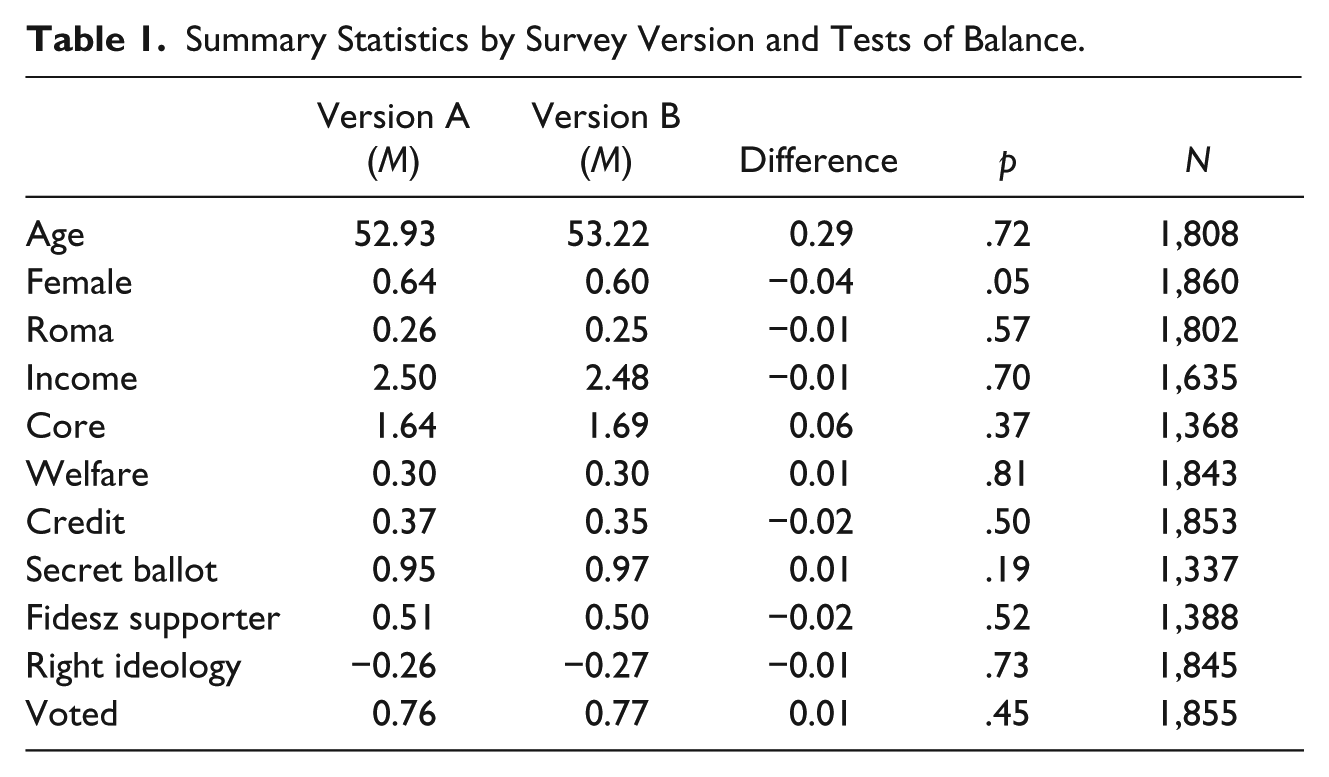
The average age of our respondents is 53 years old, with 64% of our sample made up of women. Thirty percent of our sample receives welfare benefits and 36% is in debt. We measure income with a three-category variable indicating whether the respondent’s monthly household income is less than 50 thousand forints (approximately US$200), 50 to 100 thousand forints, or more than 100 thousand forints. Approximately half of our sample is in the highest income category, with another third in the middle bracket, and 6% in the lowest. There is no evidence that the randomization protocol was incorrectly administered.
We measure the strength of party affiliation on a 4-point scale from 0 to 3, where 0 represents no party affiliation, 1 means that the respondent feels not very close to a party, 2 represents feeling close to a party, and 3 represents feeling very close to a party. Twenty-one percent of respondents feel very close to a party, 25% close, 9% not very close, and 18% unaffiliated. Twenty-six percent did not respond to this question. Approximately 50% of respondents who replied to the question about whether they feel close to any party are supporters of the ruling party Fidesz. In addition, we asked respondents where they stand on a series of three policy issues that are salient in Hungarian politics around the role of the welfare state, and treatment of Roma. We combined these into an index of political beliefs ranging from left to right. Finally, we asked respondents who had voted (76% of the sample) whether they believe that their votes are secret. Importantly for this study, a large proportion of these respondents (96%) believe that their votes are secret.
Two questions in our survey had high levels of nonresponse: political party and household income. Because of this nonresponse, most of our main analyses are done with between 1,200 and 1,350 respondents rather than 1,800. However, in Online Appendix E we show that the results are similar when we reanalyze a data set in which we impute missing observations.
We use a method developed by Blair and Imai (2012) to test the validity of our list experiments. Specifically, we test for evidence that the inclusion of the sensitive item changes the responses to the control items in the list. Intuitively, this test assesses whether responses after the addition of the treatment item are either smaller than the control responses or larger than the control responses by more than one. If either of those conditions is true, then it is likely that the lists have failed to capture the actual prevalence of the sensitive items.
We use the standard suggested by Blair and Imai (2012) of setting a rejection criteria of α = .05 in a two-sided test. Because our measured prevalence of the sensitive items is small, the power of the test to pick up design effects is quite high. We fail to reject the null hypothesis in the tests for design effects for all four list experiments.
The mean responses to the control versions of all four lists are close to 1, which increases the precision of the lists (Glynn, 2013). The means of the control versions of the list vary between 1 and 1.11, with standard deviations of between 0.38 and 0.42. Thus, the ability of the lists to precisely estimate exposure to the sensitive items is high. Furthermore, the risk of floor and ceiling effects is low, as very small percentages of respondents who received the control list experienced either zero or three of the control items: None of the respondents across all four control lists experienced three control items, and 2% to 9% experienced none.
Results: Election-Time Targeting of Clientelism
How Prevalent Is Clientelism?
How pervasive were electoral irregularities during the April 2014 elections in Hungary? We begin by presenting descriptive information on the magnitude of the four forms of clientelism that we measured. Figure 1 displays these results. The points represent the estimated prevalence of the sensitive items based on the difference in the means of the treatment and controls lists; the bars represent 90% and 95% confidence intervals.
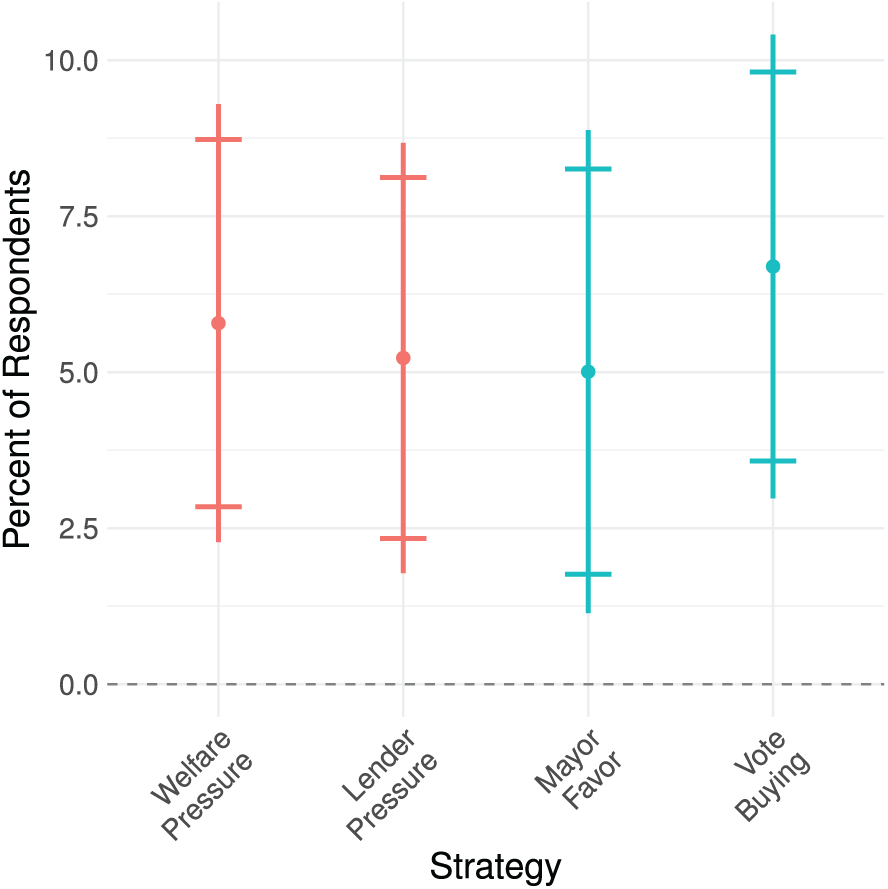
Proportion of sample who experienced positive and negative electoral strategies.
The results displayed in Figure 1 document the existence of all four electoral irregularities during the 2014 Hungarian election. For all four electoral irregularities, the difference between the control and the treatment group is significant, indicating that the likelihood that such strategies did not exist during the 2014 election is less than 5% based on a two-sided test. The relative incidence of these irregularities varies between 5% in the case of mayor favors and 7% in the case of vote buying. These results are comparable with the prevalence of clientelism measured in several other cases, including Venezuela, India, and Russia (Frye, Reuter, & Szakonyi, 2015; Stokes et al., 2013), although lower than others such as Nicaragua or Turkey (Çarkŏglu & Aytaç, 2015; Gonzalez-Ocantos et al., 2012). The prevalence of positive inducements is similar to that of negative inducements.
Who Is Targeted With Inducements During Elections?
Next, we examine whether closeness to party is related to the prevalence of election-time clientelism. Although we cannot identify the causal effect of being a core supporter on the probability of experiencing illicit electoral strategies, this analysis aims to test whether there is a correlation between closeness to party and illicit strategies conditional on other observable characteristics. We use a linear estimator based on interactions of the list treatment variables and individual-level characteristics to estimate the relationship between individual-level covariates and the outcomes measured with our list experiments. 3
Table 2 shows the results of our estimates of the relationship between closeness to party and exposure to positive and negative clientelism. For each positive and negative strategy, we run two specifications: First, we estimate the bivariate relationship between closeness to party and our list experiment outcomes. Second, we add controls including a dummy for being a Roma, age, gender, and household income. All continuous controls as well as our measure of closeness to party are standardized. Table 2 presents the results of this analysis. The results in the top half of the table present the estimated relationship between each independent variable and the sensitive item, whereas the bottom half shows the results on the control items on the list.
Closeness to Party and Exposure to Clientelism During the Election.
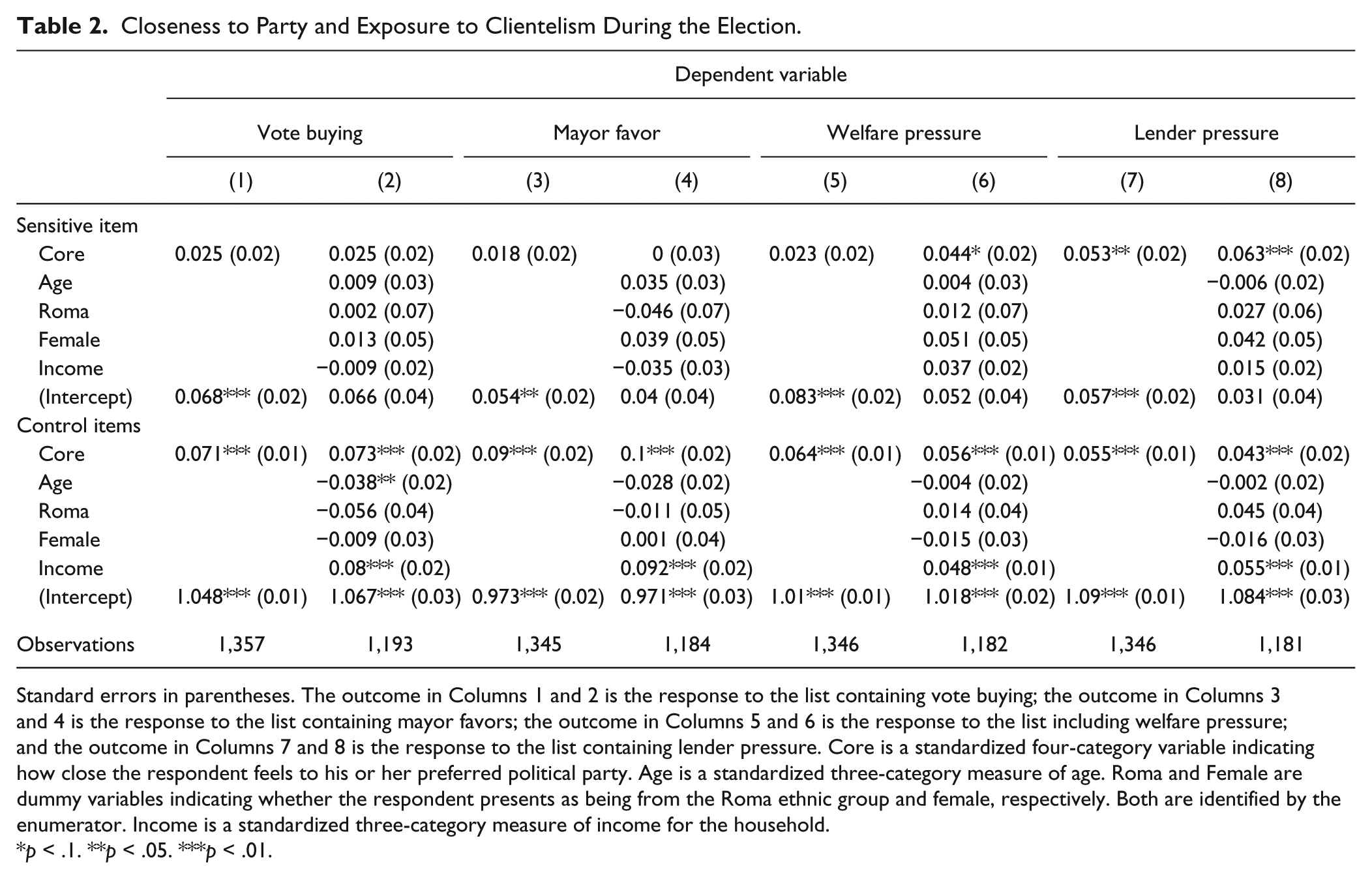
Standard errors in parentheses. The outcome in Columns 1 and 2 is the response to the list containing vote buying; the outcome in Columns 3 and 4 is the response to the list containing mayor favors; the outcome in Columns 5 and 6 is the response to the list including welfare pressure; and the outcome in Columns 7 and 8 is the response to the list containing lender pressure. Core is a standardized four-category variable indicating how close the respondent feels to his or her preferred political party. Age is a standardized three-category measure of age. Roma and Female are dummy variables indicating whether the respondent presents as being from the Roma ethnic group and female, respectively. Both are identified by the enumerator. Income is a standardized three-category measure of income for the household.
p < .1. **p < .05. ***p < .01.
The results in Table 2 show that core supporters are significantly more likely to experience negative electoral strategies, particularly pressure by informal lenders. A one standard deviation increase in closeness to party is associated with a 4.4 percentage point increase in the likelihood of experiencing welfare pressure (Column 6), and a 6.3 percentage point increase in the likelihood of experiencing lender pressure (Column 8). Positive strategies, however, are not significantly related to strength of party affiliation, although there is a positive relationship between closeness to party and exposure to vote-buying offers. In a supplemental analysis presented in Online Appendix B, in which we treat “core” as a categorical rather than continuous variable, we find that the relationship between closeness to party and negative forms of clientelism is primarily driven by a much higher incidence in negative forms of clientelism among the strongest partisans.
None of the controls are consistently distinguishable from zero. Generally, these results suggest that positive inducements to voters are not carefully targeted based on basic observable characteristics of voters other than the strength of their party affiliations. The bottom half of the table shows that there are significant relationships between the control items on the lists and closeness to party. This is likely because people who feel close to a political party are more interested and involved in the campaigns and therefore more likely to be aware of the events around the election campaigns that made up our control lists.
It is important to note that these analyses are based on correlations rather than exogenous variation in the key independent variable. Furthermore, because our dependent variables are measured with list experiments, there is a considerable amount of noise in the data that undercuts statistical power. Nevertheless, the fact that the estimated coefficients in Columns 5 to 8 actually increase with the inclusion of the most plausible omitted variables as controls and are similar to the bivariate relationships increases confidence that the coefficients on closeness to party are not driven by omitted variable bias.
One concern in this analysis is that closeness to party may be driven by the past receipt of clientelistic benefits. Because we propose that closeness to party drives variation in the clientelistic strategies that voters experience, this would introduce bias due to reverse causation. We follow much of the literature on clientelism in viewing closeness to party as a function of sticky, ideology-driven policy preferences. However, we also conduct a robustness check in which we use individual policy preferences regarding welfare and minority rights to predict closeness to party, based on the assumption that these more ideological measures are less likely to be shaped by the past receipt of benefits. When we substitute our survey measure of closeness to party with a predicted measure based only on this left–right ideological variable, the results are largely unchanged. Specifically, the coefficient on predicted closeness to party is very similar in magnitude and remains significant at the 1% level in the analysis of lender pressure. The coefficient in the analysis of welfare pressure is less robust, but still similar in magnitude to that in Columns 5 and 6 of Table 2. This analysis increases our confidence that the results are not driven by endogenous partisanship. However, the potential for reverse causality remains a concern and this argument should be tested in future research that employs measures of partisanship captured from voters before the receipt of benefits, such as parent’s party affiliations or panel data.
Why Are Core Supporters Targeted With Negative Inducements?
So far, we have shown that voters who are ideologically close to a political party are more likely to experience negative forms of clientelism during the 2014 election. In this section, we test whether access to ongoing entitlements, most likely deployed during the preelection period, are targeted on core supporters and associated with higher exposure to negative inducements during the election period.
Entitlements and electoral threats
We begin by testing whether election-time negative inducements are related to the receipt of entitlements. If core supporters are more likely to experience negative forms of clientelism during elections because they are more likely to benefit from politicized entitlements, then we should see two patterns in the data. First, core supporters should be more likely to have access to entitlements. Second, voters who receive entitlements should be more likely to experience election-time negative inducements.
As in the previous specification, we use a linear estimator from the list package developed by Blair and Imai (2012). We estimate the relationship between receiving welfare benefits or credit and experiencing positive and negative forms of clientelism in two separate specifications: first, a specification with no controls using our measures of positive or negative strategies. Second, we present a specification with the measures and controls, including age, a dummy for being a Roma, a dummy for being female, income, and strength of party affiliation.
An important caveat should be kept in mind in interpreting the results presented in this section. Our data come from a survey conducted in the 4 to 5 weeks after the April 2014 Hungarian election, and the questions about welfare and credit were asked in the present tense. Thus, although the ideal test of this implication would look at whether preelection access to welfare and credit are related to election-time inducements, we cannot rule out that these entitlements were in fact granted after the election. We find this unlikely, given that welfare jobs in particular are given out at fixed points during the year, and people access credit fairly infrequently. This suggests that it is unlikely that we would see large shifts in access to both these entitlements during the weeks immediately after the election, which have not been noted in our own qualitative interviews or by journalists and civil society organizations working in these areas.
Table 3 shows that people who are ideologically closer to a political party are more likely to have access to credit and welfare, including the valuable workfare program. A one standard deviation increase in closeness to party is associated with a 7 percentage point increase in the likelihood of having access to credit (Column 2), a 1.2 percentage point increase in the likelihood of receiving welfare (Column 4), and a 1.4 percentage point increase in the likelihood of participating in the workfare program (Column 6). The results on general welfare, however, are not statistically distinguishable from zero in the specifications that include controls. In the specification using a binary measure of any access to entitlements, a one standard deviation increase in closeness to party is associated with an 8.4 percentage point increase in the probability of receiving at least one entitlement (Column 8). Table B5 in Online Appendix B shows that these results are robust to using the version of closeness to party that is predicted from the respondent’s policy preferences, or a binary coding of closeness to party. Taken together, these results suggest that entitlements are strongly related to how ideologically aligned voters are with a political party.
Closeness to Party and Access to Entitlements.
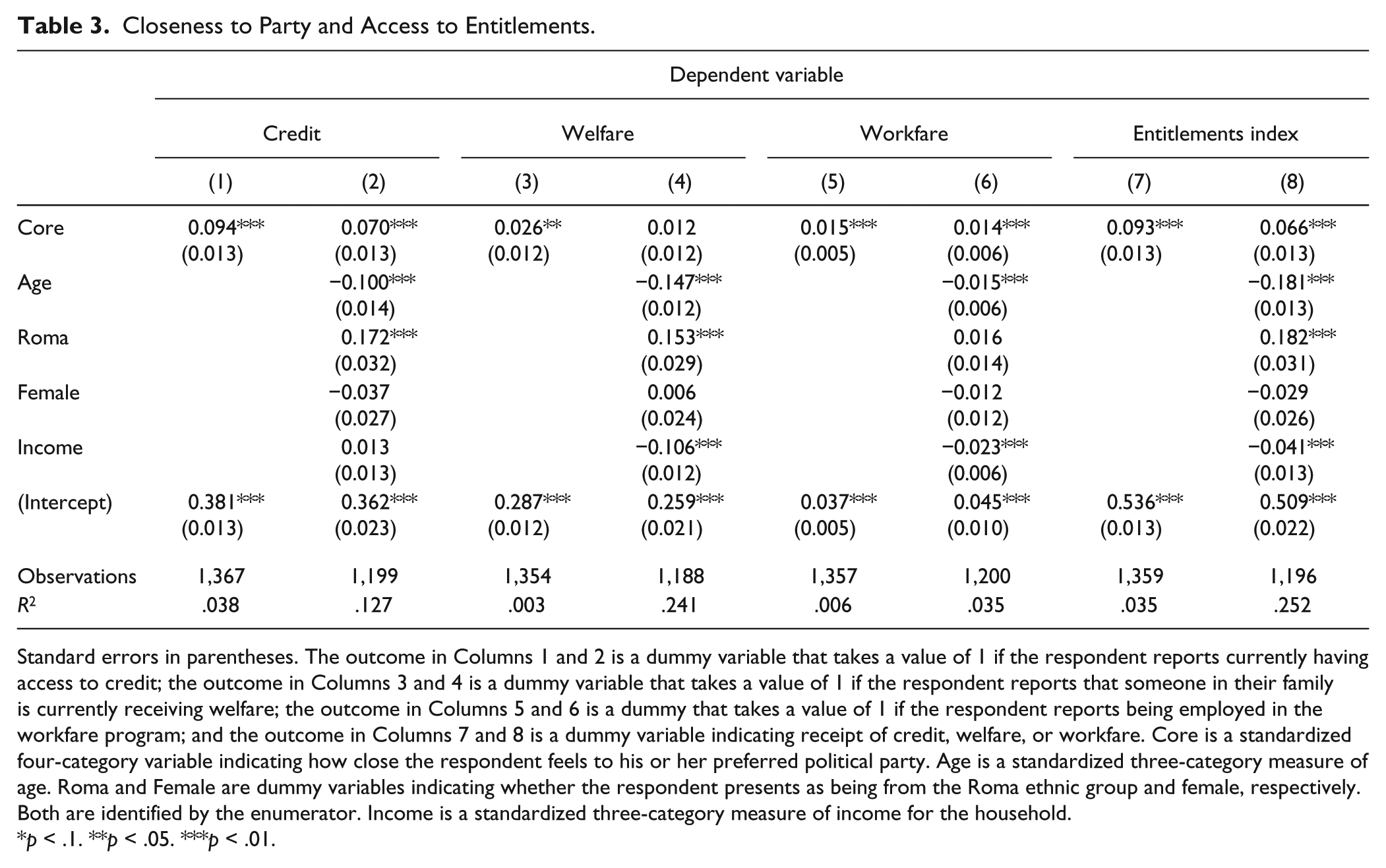
Standard errors in parentheses. The outcome in Columns 1 and 2 is a dummy variable that takes a value of 1 if the respondent reports currently having access to credit; the outcome in Columns 3 and 4 is a dummy variable that takes a value of 1 if the respondent reports that someone in their family is currently receiving welfare; the outcome in Columns 5 and 6 is a dummy that takes a value of 1 if the respondent reports being employed in the workfare program; and the outcome in Columns 7 and 8 is a dummy variable indicating receipt of credit, welfare, or workfare. Core is a standardized four-category variable indicating how close the respondent feels to his or her preferred political party. Age is a standardized three-category measure of age. Roma and Female are dummy variables indicating whether the respondent presents as being from the Roma ethnic group and female, respectively. Both are identified by the enumerator. Income is a standardized three-category measure of income for the household.
p < .1. **p < .05. ***p < .01.
This correlation between closeness to party and the receipt of entitlements could be driven by either core supporters getting access to extra benefits, or swing voters being excluded from benefits. Either of these mechanisms would be consistent with our theoretical expectations. In Online Appendix C.1, we test for suggestive evidence that the proportions of seemingly ineligible voters and seemingly eligible voters who access benefits are increasing with closeness to party. Overall, this analysis suggests that the demand for welfare transfers exceeds supply, and that in general there are more eligible swing voters being excluded from benefits than ineligible core supporters accessing them.
Next, we assess the extent to which receiving such benefits is associated with increases in the likelihood of experiencing election-time clientelistic strategies. If the observed entitlements are distributed before the election, and if receiving these entitlements makes voters more vulnerable to electoral threats, then we should see that people who receive entitlements are more likely to experience negative inducements during the election.
Table 4 generally shows support for our prediction that people who receive access to entitlements would be more likely to experience threats to be cut from those inducements at election time. There is a positive relationship between access to entitlements and all election-time inducements, and this relationship is statistically significant in the specifications with mayor favors and welfare pressure as the outcome variables. Respondents who received some form of entitlements are 12.9 percentage points more likely to experience welfare pressure around the election (Column 6), and 8.5 percentage points more likely to report a vote-buying offer (Column 2). The coefficients in the analyses of mayor favors and lender pressure are also positive, although not statistically significant. Patterns are similar, although not statistically significant, in specifications that test separately for the effect of credit, welfare, and workfare, and also confirm that the receipt of past welfare benefits has a positive relationship with the likelihood of experiencing welfare pressure (β = .08, significant at the 10% level) and receiving credit has a positive (though statistically insignificant) relationship with lender pressure (β = .048). These are presented in Table C6 in the appendices. The positive correlation between the entitlements index and vote buying is surprising. The disaggregated analysis suggests that it is primarily driven by access to credit, which may reflect unmeasured variation in economic deprivation or the fact that voters who receive credit are embedded in the networks of moneylenders acting as brokers. These are not causally identified estimates, so concerns about omitted variable bias should be kept in mind, but they are robust to the inclusion of basic control variables.
Access to Entitlements and Exposure to Clientelism During the Election.
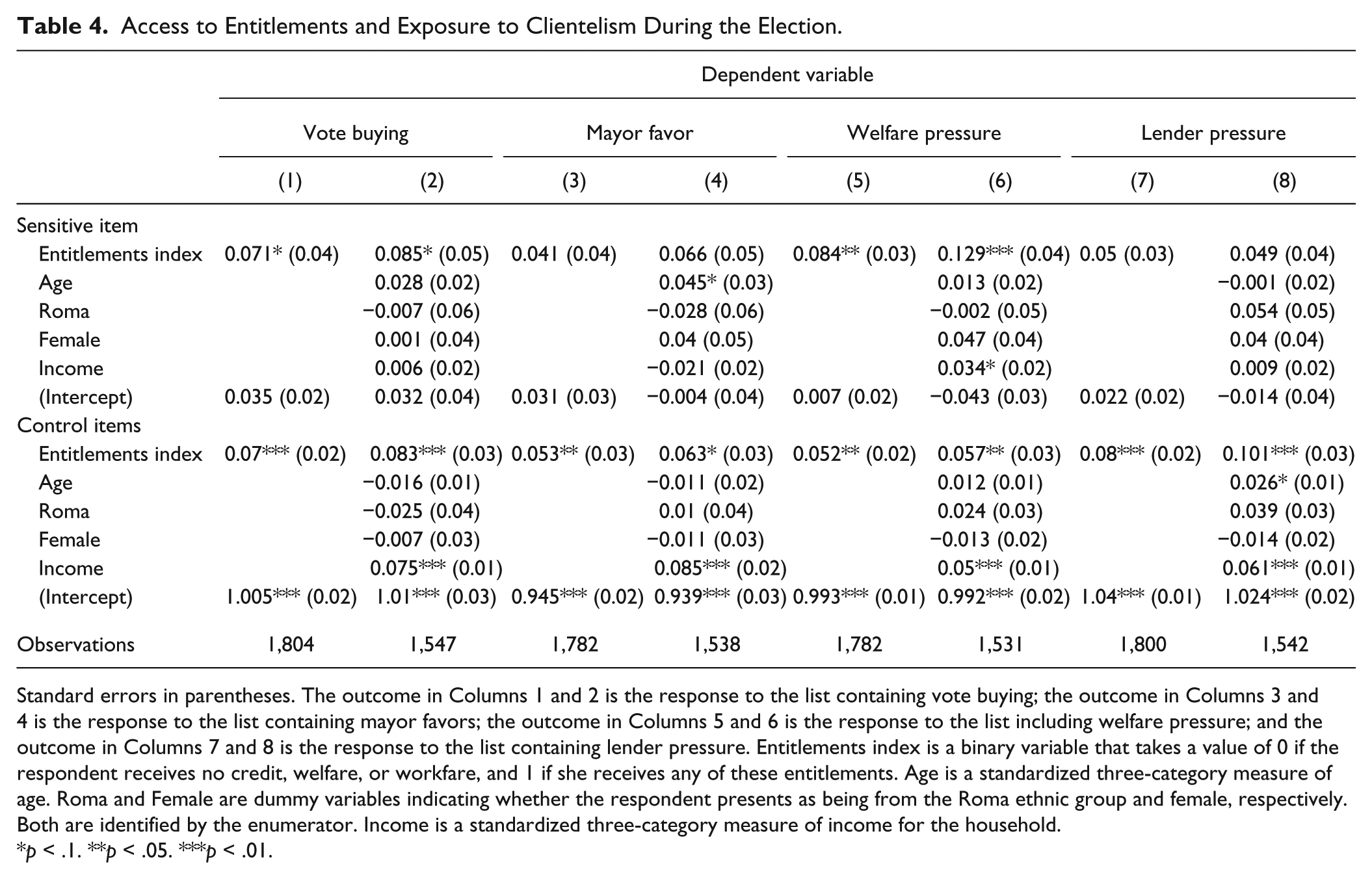
Standard errors in parentheses. The outcome in Columns 1 and 2 is the response to the list containing vote buying; the outcome in Columns 3 and 4 is the response to the list containing mayor favors; the outcome in Columns 5 and 6 is the response to the list including welfare pressure; and the outcome in Columns 7 and 8 is the response to the list containing lender pressure. Entitlements index is a binary variable that takes a value of 0 if the respondent receives no credit, welfare, or workfare, and 1 if she receives any of these entitlements. Age is a standardized three-category measure of age. Roma and Female are dummy variables indicating whether the respondent presents as being from the Roma ethnic group and female, respectively. Both are identified by the enumerator. Income is a standardized three-category measure of income for the household.
p < .1. **p < .05. ***p < .01.
Are parties engaging in turnout or abstention buying?
Finally, we test whether patterns in the data are consistent with turnout buying, or the use of inducements to increase the probability that people who prefer the broker’s party turn out, or abstention buying, meaning the use of inducements to reduce the probability that people who prefer the opponent turn out. One explanation for the observed relationship between being close to a political party and exposure to clientelism is that parties selectively give entitlements to ongoing benefits to voters with whom they are ideologically aligned, and then threaten those voters at the time of the election with the economic sanctions to ensure that they turn out. The less plausible alternative is that parties give entitlements to voters who are strong supporters of their opponents, and then threaten them with economic sanctions to ensure that they do not turn out.
If parties are using election-time negative inducements to buy the turnout of their core supporters, and if mayors are central figures in the distribution of clientelism, we should expect to see that people who are ideologically aligned with their mayors are more likely to experience election-time inducements. However, if mayors are engaging in abstention buying on behalf of their political parties, then we should see people who are not copartisans of the mayor being targeted with inducements. In our data, we have 302 voters who identify with the same party as their mayors at the time of the 2014 election. The vast majority of these (292) identify with Fidesz, whereas 10 feel close to the socialist party MSZP.
This is a difficult test because there is reason to believe that copartisanship should not matter very much in this case. In Hungary, many mayors (the majority in our sample) identify as independents. However, by many accounts, some of these independent mayors are heavily involved in clientelism, despite their lack of formal association with a political party. During the 2014 election, journalists and local experts reported that they primarily mobilized voters on behalf of the ruling party Fidesz. Thus, it is likely that our coding of copartisans miscodes some of the Fidesz voters living under independent mayors.
The results presented in Table 5 are in line with a pattern of turnout buying, and not in line with abstention buying. Voters who are copartisans of their mayors are between 10.5 (Column 6) and 16.3 (Column 8) percentage points more likely to experience welfare pressure and lender pressure during the election, respectively. However, there is a negative relationship between being a copartisan of the mayor and experiencing positive inducements. These results should be interpreted with some caution given that only the results on lender pressure are robustly statistically significant; the coefficients on mayor favors and welfare pressure are significant at the 10% level in the specifications with controls. Results in Online Appendix D show that, consistent with our theory, copartisans of the mayor are also more likely to receive credit and access to the workfare program.
Copartisanship With the Mayor and Election-Time Inducements.
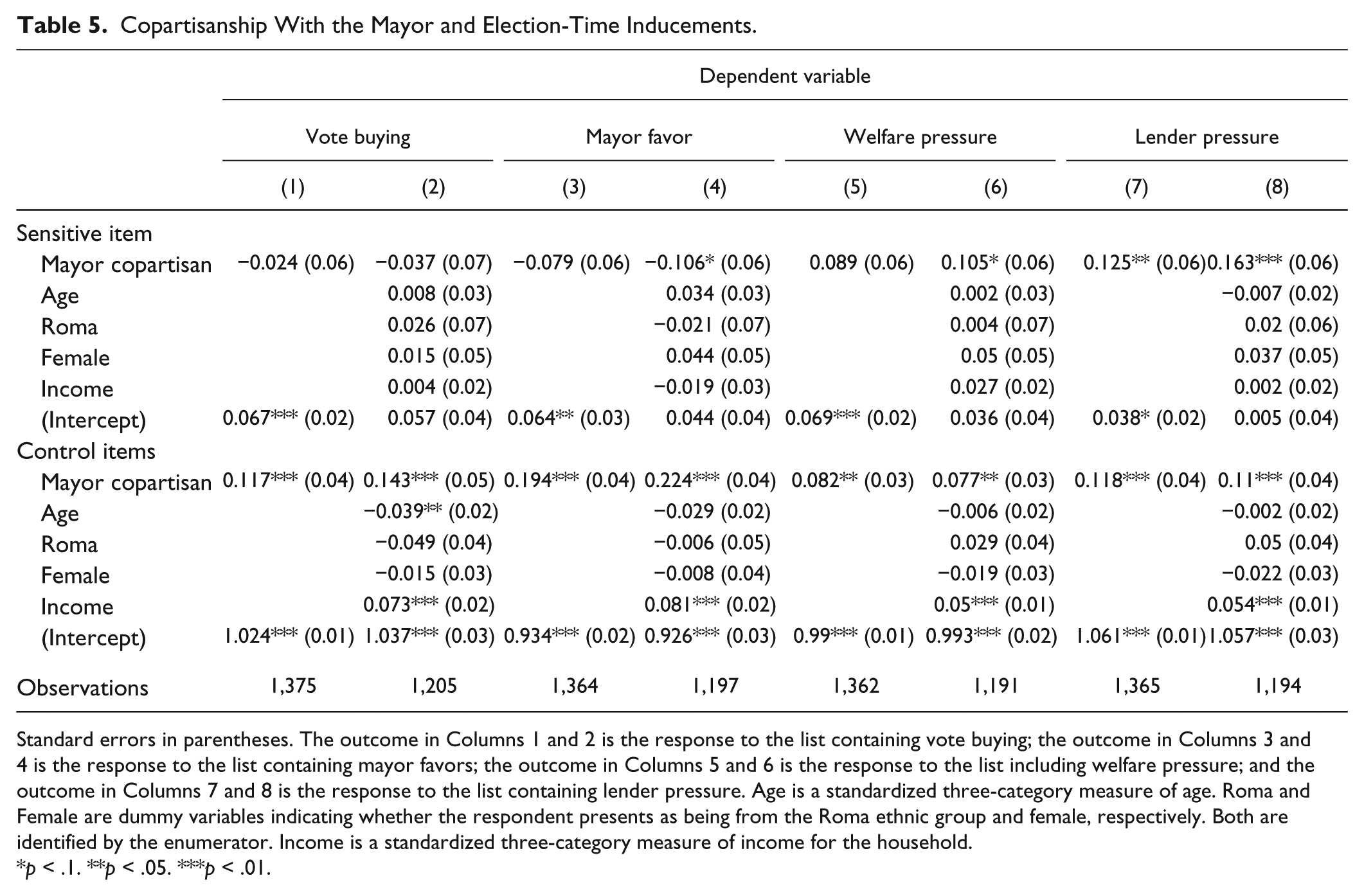
Standard errors in parentheses. The outcome in Columns 1 and 2 is the response to the list containing vote buying; the outcome in Columns 3 and 4 is the response to the list containing mayor favors; the outcome in Columns 5 and 6 is the response to the list including welfare pressure; and the outcome in Columns 7 and 8 is the response to the list containing lender pressure. Age is a standardized three-category measure of age. Roma and Female are dummy variables indicating whether the respondent presents as being from the Roma ethnic group and female, respectively. Both are identified by the enumerator. Income is a standardized three-category measure of income for the household.
p < .1. **p < .05. ***p < .01.
Conclusion
This article has analyzed the incidence of electoral irregularities during the most recent parliamentary election in Hungary. Although the existing literature on electoral clientelism has documented the incidence of clientelistic electoral practices in either premodern political settings or in developing countries, we demonstrate that electoral offers of positive inducements and electoral threats can also be found in parts of an economically advanced European state.
This research contributes theoretically and empirically to the existing literature on clientelism. We disaggregate clientelistic practices by distinguishing between positive and negative economic strategies. In the case of positive inducements, politicians or their agents promise benefits that increase the future income streams of voters. By contrast, negative strategies involve threats of postelectoral punishments for voters’ individual electoral behaviors. We theorized that in a political system where it is difficult to monitor individual vote choice, core supporters are particularly vulnerable to electoral threats because of their higher propensity to receive entitlement benefits during the preelection period.
We test these conjectures using a survey of 1,800 voters in 93 Hungarian rural communities. Our findings support this explanation and document the existence of a “core voter’s curse.” We find that core supporters are much more likely to receive entitlements to long-term, regular transfers from political agents, which enables those agents to threaten core supporters during the election period. These results contribute to a large literature on the conditions under which politicians target core or swing voters with clientelistic strategies, and document the potential for important social policy benefits to make voters vulnerable to threats during elections in new democracies. By contrast, there is little evidence that one-off positive benefits at the time of elections are targeted on any particular subgroups of voters. This nonresult is not trivial, given that much of the literature on clientelism has been focused on this type of vote-buying transaction.
Positive and negative inducements are, thus, both complements and substitutes in this context. Over the longer term, positive inducements based on access to entitlements are complements to negative, threat-based strategies. However, at the time of the election, positive promises of future benefits or one-off handouts seem to be substitutes of negative threats, as they are generally targeted on a different set of voters. This could be reflective of a two-tiered system in which brokers use smaller positive inducements to recruit new clients, whereas more valuable entitlements and subsequent threats are used on those whose votes are quite certain.
Our study documenting clientelistic mobilization also provides insights for understanding Hungary’s gradual illiberal turn. Clientelistic practices in low-income communities provide us with a window into understanding distinct dimensions of democratic backsliding. Other research has shown how gerrymandering, media regulations, and campaign finance restrictions have been used to create an uneven playing field in the election under study (Bánkuti, Halmai, & Scheppele, 2012; Greskovits, 2015).
Second, our study presents a pessimistic forecast for electoral practices in other recent democracies in Latin America and Africa. In general, we would expect our theory to travel to any context where (a) brokers are able to predict individuals’ vote choices, at least to some extent; and (b) access to ongoing benefits can be politicized. The list of benefits that might create expectations of ongoing access encompasses many important resources identified by the qualitative literature on clientelism, including jobs, land, and social policy. Although the extent of targeting on core supporters versus swing voters might change depending on how strong ballot secrecy protections are, the general argument that access to politicized long-term entitlements creates opportunities for negative forms of clientelism during elections remains the same. As a result, our findings suggest that the expansion of social policy in clientelistic political settings may be associated with a transition from vote buying to more coercive forms of clientelism based on threats to exclude voters from benefits on which they depend. To the extent that voters are loss averse, the expansion of politicized social policy may actually increase the potency of clientelistic transactions. In settings where vote choice can be easily predicted based on visible characteristics such as ethnicity, targeting may be even stronger than what we observe in Eastern Europe. These results suggest that scholars and policy makers may need to pay greater attention to the mix of positive and negative inducements that can be deployed during elections to understand and protect the integrity of elections in young democracies.
Supplemental Material
Appendix – Supplemental material for The Core Voter’s Curse: Clientelistic Threats and Promises in Hungarian Elections
Supplemental material, Appendix for The Core Voter’s Curse: Clientelistic Threats and Promises in Hungarian Elections by Isabela Mares and Lauren E. Young in Comparative Political Studies
Footnotes
Declaration of Conflicting Interests
The authors declared no potential conflicts of interest with respect to the research, authorship, and/or publication of this article.
Funding
The authors received no financial support for the research, authorship, and/or publication of this article.
Supplemental Material

Notes
Author Biographies
References
Supplementary Material
Please find the following supplemental material available below.
For Open Access articles published under a Creative Commons License, all supplemental material carries the same license as the article it is associated with.
For non-Open Access articles published, all supplemental material carries a non-exclusive license, and permission requests for re-use of supplemental material or any part of supplemental material shall be sent directly to the copyright owner as specified in the copyright notice associated with the article.
