







Abstract
This article examines the role played by local governments in shaping resistance to reforming fiscally and environmentally disastrous fuel subsidies. Shifting from universal-access social programs, like fuel subsidies, to targeted programs requires vesting authority with local politicians and bureaucrats, whom the state relies on to identify poor households and to deliver benefits. Where local governments are corrupt, citizens find promises to replace fuel subsidies with targeted spending less credible and resistance to reform is higher. Using household survey data from Indonesia, this article finds that corruption in the implementation of targeted transfer programs increases resistance to fuel subsidy reform among the poor citizens who consume the least fuel and who stand to benefit the most from targeted programs. Findings suggest that improving capacity within subnational governments to deliver social programs is important in developing public support for reform.
Countries as diverse as China, Egypt, Indonesia, India, Nigeria, Russia, Thailand, and Venezuela, among others, devote large shares of government resources toward lowering domestic prices on basic household commodities like food and fuel. For poor households that spend large fractions of their income on basic commodities, consumer subsidy programs often provide the main form of social protection, by reducing the price of basic commodities and by reducing households’ exposure to commodity price volatility (Alderman, 2002). Keeping prices low can raise standards of living in the short run, but consumer subsidy programs, particularly those that subsidize the consumption of fossil fuels, are economically disastrous over time. In 2011, government expenditures on fossil fuel subsidies summed to nearly $500 billion globally, and most of the subsidy benefits were captured by richer, urban households (Clements et al., 2013). By comparison, replacing subsidies on fuel consumption with targeted support for the poor would provide greater benefits to the poor without straining budgets (Arze del Granado, Coady, & Gillingham, 2012; Clements et al., 2013).
Some countries have been more successful than others in making this transition. Attempts to raise fuel prices are linked to triggering the widespread antigovernmental protests that contributed to the downfall of the Soeharto regime in Indonesia, to setting off the Saffron Revolution in Myanmar, and to precipitating the 2008 military coup in Mauritania. By contrast, Indonesia raised fuel prices in 2013 and 2014 without major upheaval, and Iran, Jordan, and Morocco all slashed fuel subsidies between 2008 and 2012.
This article explains variations in popular support for reforms based on the varying credibility of the institutions entrusted with implementing reforms. All public require some delegation, and citizens may have different beliefs about which sets of institutions can more credibly and effectively implement policies. Shifting from universal-access social protection programs—like consumer fuel subsidies—to targeted social protection programs requires vesting authority for policy implementation with local politicians and bureaucrats, whom the state relies on to identify poor households and to physically transfer benefits to them. This confers local elite with a great deal of discretion, which they can use to divert public resources for private gain. When local elites have used this discretion to faithfully implement targeted transfer programs in the past, I argue, this can build confidence in reforms that empower them; by contrast, when local elites have used discretionary power for private gain, confidence is undermined.
I focus on the key role played by local elite in shaping popular support for reform of consumer subsidies on automotive fuel (hereafter, “fuel subsidies”) in Indonesia. 1 While it is commonly hypothesized that scaling back fuel subsidies with no form of compensation would be widely rejected, replacing them with targeted programs could, in theory, offer benefits for the poor with less fiscal strain and mitigate social unrest. The central argument of this article is that where local elite have engaged in corruption in past implementation of targeted transfer programs, support for fuel subsidy reform is undermined. While prevalent use of food and fuel subsidies are often attributed to the political influence of urban interests (e.g., Bates, 1981), this argument suggests that, where corruption is prevalent, even rural citizens who, in theory, could benefit from targeted transfers, may oppose subsidy reforms.
I test this argument using household survey and administrative data from 194 randomly selected villages in Indonesia. Indonesia makes an interesting case to examine the effects of local corruption as there is significant variation: In around 40% of villages, I estimate quite low levels of corruption in the implementation of targeted transfer programs, while in others corruption eliminates the benefits of the targeted transfer program within the village altogether. By contrast, countries with universally weak local capabilities may not even contemplate reforms which rely on local officials for implementation.
Using this data, I estimate an important indicator of local corruption: the gap between the official quota that a given village should receive from Indonesia’s largest targeted transfer program and what households receive in practice. To add validity to the measure and credibility to the argument that citizens reason that corruption in past implementation of targeted transfer programs will affect their ability to benefit from future targeted programs, I show that the corruption measure used here strongly predicts whether poor citizens receive targeted transfers during a later fuel subsidy reform. Corruption is associated with, on average, 38% less support for fuel subsidy reform among poor households. The finding is confirmed using matching methods and in a number of robustness checks. I also test whether the argument carries to other contexts by examining public opinion on fuel subsidy reform in Nigeria and find remarkably similar patterns.
The article proceeds as follows. The following section discusses consumer subsidy programs generally and why they can be so difficult to reform. The next sections present the main argument and the Indonesian context. This is followed by a discussion of the data, the empirical strategy, and the main results of the article. The final section concludes, discussing the implications of the findings for the prospects for fuel subsidy reform.
Why Are Fuel Subsidies So Difficult to Repeal?
Consumer subsidies, including those on fuel, often begin as relatively modest attempts to shield households from fluctuations in the price of basic goods and services. In other words, they often begin as price stabilization mechanisms rather than subsidy programs (Bril-Mascarenhas & Post, 2015). As commodity prices rise, however, price stabilization mechanisms can transform into large-scale consumer subsidies, particularly if governments initially design fixed price regimes (in which consumer price stays fixed and the size of the subsidy fluctuates) rather than fixed subsidy regimes (in which consumer price fluctuates to maintain a fixed subsidy size). Indeed, it is the combination of fixed price regimes with rising oil prices which explains much of the increase in the size of fuel subsidies over time: As market prices rise, countries with fixed price regimes become subsidizers (Ross, Hazlett, & Mahdavi, 2017).
Fossil fuel subsidies are typically adopted in countries where their implementation is relatively cheap compared with other means of influencing household consumption. For example, major oil producers are frequent subsidizers of domestic consumption (Cheon, Urpelainen, & Lackner, 2013). In these countries, the public often expects to benefit from their country’s oil wealth, and
the state has a strong incentive to provide goods and services that make it appear that everyone is benefitting—even if some are actually benefitting more—either because they are made available to all citizens or because they have a high degree of visibility. (Jones Luong & Weinthal, 2010, p. 60)
Fuel subsidies are thus an attractive political tool because their benefits are highly visible yet their costs have low visibility, as, in oil exporters, the cost of providing them is born primarily as an off-budget opportunity cost (of not selling fuel at market prices).
Subsidies on fuel are particularly prevalent in countries whose oil wealth is controlled by state-owned oil companies (Cheon, Lackner, & Urpelainen, 2015). States whose oil wealth is managed by state-owned entities may face higher pressures to distribute oil wealth in highly visible ways (Jones Luong & Weinthal, 2010), and the higher capacities of state-owned oil companies compared with their state patrons make it more feasible to do so via subsidizing fuel compared to other forms of distributing wealth (Cheon et al., 2015; Victor, 2009).While these can provide powerful political motivations for adopting fuel subsidies, maintaining them can become prohibitively costly over time, even in oil exporters. For example, fuel subsidies in Nigeria, a net oil exporter, consumed 20% of government expenditures in 2012, due to high commodity prices and low domestic refining capacity, which forces Nigeria to import 85% of domestically consumed fuel products (Siddig, Aguiar, Grethe, Minor, & Walmsley, 2014).
Once enacted, Bril-Mascarenhas and Post (2015) argue that consumer subsidy programs become policy traps—”initially modest policies that grow rapidly and become more entrenched quickly” (p. 99). Even if citizens have poor knowledge of the overall size of subsidies, they argue, attempts to raise prices are highly visible. As commodity prices rise, both the urgency and the difficulty of subsidy reform reaches a crescendo: the cost of providing subsidies increases dramatically for governments, yet the costs that citizens would face in adjusting to higher market prices are also more substantial. Politicians thus seek to avoid blame for repealing subsidies, fearing political backlash. These fears are not unfounded: over the last decade, attempts to raise gasoline prices have triggered protests in at least 19 countries (Ross et al., 2017), and, more broadly, large consumer price shocks can trigger urban riots (Bellemare, 2015; Smith, 2014).
When can consumer fuel subsidies be scaled back? Many advocate initiating reform efforts while the real price of oil is low, as citizens face lower costs of adjustment to subsidy reduction when prices are low (e.g., Benes, Cheon, Urpelainen, & Yang, 2016; Ladislaw & Cuyler, 2015). While some governments have reduced the overall size of subsidies in the current low oil price environment, overturning fixed price regimes has proven particularly challenging (Ross et al., 2017). In many cases, low prices simply temporarily eliminate subsidies in fixed price regimes, which return when commodity prices rise. Thus, it is difficult to assess whether reforms undertaken in low price environments have been successful until market prices rise (and consumer prices are allowed to rise as well).
Beyond just undertaking reforms when prices are low, many suggest that social unrest could be avoided if social programs that target the poor were implemented alongside subsidy reform (e.g., Clements et al., 2013; The World Bank, 2009). 2 Given the prominent role that citizen backlash can play in derailing reform, surprisingly little is known about citizens’ attitudes toward fuel subsidies, their receptiveness to reform, nor how popular support for policy changes can be built over time.
This article’s goal is to explain why some citizens become more amenable to subsidy reform than others, focusing on the attitudes of citizens in Indonesia toward consumer subsidies on automotive fuel. Although the empirical focus is narrow, the argument is relevant to questions about scaling back other types of consumer subsidy programs, moving from universal access to targeted forms of social protection, and compensating the poor for costs of adjustment to economic reforms more broadly. In the following section, I provide an argument for how local institutional context shapes citizens’ attitudes to reform.
An Institutional Explanation for Attitudes
The central government must delegate a range of governing activities, from tax collection to the distribution of social benefits, to local bureaucrats on a daily basis. This delegation can be legally mandated when authority for service delivery is devolved to local governments. It can also occur as a de facto delegation when central governments need the assistance of local officials to find beneficiaries and deliver benefits to them; relying on local actors for this information gives local actors implicit control over program targeting and implementation (Jaspars & Shoham, 1999).
The degree of this delegation varies by policy. Universal-access consumer subsidy programs, like fuel subsidies, require little delegation from central to local governments, as there is no need to discriminate between beneficiaries and nonbeneficiaries. By contrast, delegation is much higher for targeted social protection programs, with local institutions frequently responsible for determining eligibility for targeted programs and for distributing benefits.
When governing authority is delegated—either on a de jure or de facto basis—it opens up the potential for local actors to exploit their position, diverting public resources for private gain. When local elites are “captured,” local authority over service delivery can result in overproviding benefits to local elites at the expense of the poor (Bardhan & Mookherjee, 2005). Local corruption in the implementation of targeted transfer programs can be so costly that it eliminates the benefits of redistributive policies altogether (Olken, 2006). One prominent feature, therefore, of shifting from universal-access subsidy programs to targeted social protection programs is increasing the resources and authority channeled through local officials.
There is considerable evidence that support for public policies is shaped by trust in the government (Hetherington, 2005; Rudolph & Evans, 2005), which is significantly diminished when governments are corrupt (Anderson & Tverdova, 2003; Hakhverdian & Mayne, 2012; Seligson, 2002). In particular, support for policies that involve an intertemporal bargain—or those that impose a cost today for the promise of a future benefit—and the delegation of new resources and responsibilities to public officials depends on trust in the institutions that implement the policies (Jacobs & Matthews, 2017). The uncertainty created by this delegation, Jacobs and Matthews (2017) argue, is such a significant factor in citizens’ attitudes that policy opponents “will frequently seek to undermine support not by denigrating the good in question (e.g., schools, clean air, roads), but by calling into question the credibility of government promises to deliver the promised benefits” (p. 196).
Replacing consumer fuel subsidies with targeted support for the poor involves both an intertemporal bargain and delegation. Citizens have no guarantee that politicians will follow through on promises to increase investments in targeted transfer programs once they have been authorized to reduce support for fuel subsidies. Uncertainty about future policies and political interactions is particularly significant in developing democracies (Lupu & Riedl, 2013). Second, even if politicians do follow through on a promise to increase investments in targeted transfer programs following a fuel price increase, this act requires investing the new resources and authority required to implement the transfer program to local officials. This delegation opens up the possibility that the local officials responsible for delivering the policy will fail to deliver its promised benefits.
However, citizens, even within the same country, can have vastly different beliefs about whether or not local officials will deliver on policy promises. In making these assessments, I argue that citizens rely on past experiences with local policy implementation to form policy attitudes. This logic features prominently in the “policy feedback” literature, which argues that, in addition to social and economic considerations, citizens’ experiences with policy implementation, whether positive or negative, shape their policy preferences (Campbell, 2012). For example, negative experiences with caseworkers responsible for verifying eligibility for social assistance programs or representatives of the criminal justice system reduces citizens’ trust in the government in general in the United States (Soss, 1999; Weaver & Lerman, 2010). Moreover, given their prominent role in the day-to-day lives of citizens and in implementing state policy at the local level, local politicians and bureaucrats are often seen as the key link between state and society (Auerbach, 2016; Weitz-Shapiro, 2008).
I argue that corruption among local public officials diminishes local public support for reforms that delegate more resources and authority to the local level. When local officials have failed to faithfully implement targeted transfer programs in the past, citizens have little reason to believe that they will faithfully implement future targeted transfer programs of the type promised by national politicians as compensation for raising fuel prices. On the other hand, support for reform could be increased over time by building the local capacity to implement targeted transfer program and by reducing local rent-seeking.
However, local corruption may not affect the attitudes of all citizens toward shifting from universal to targeted programs equally. For those citizens who do not expect to be targeted under future programs, corruption among village officials in the implementation of targeted transfer programs may shape their attitudes for other policy areas, but should not necessarily affect whether or not they favor subsidy reform. For these citizens, moving from universal-access consumer subsidy programs to targeted transfer programs means facing higher prices without compensation for loss. Consequently, the views of these citizens are more likely shaped by socioeconomic characteristics and vested interests in subsidies than by considerations about empowering local officials.
Instead, corruption should primarily affect the attitudes of those citizens who could be beneficiaries of future targeted transfer programs, for whom the calculus about how well local officials will implement future programs is directly relevant to the tradeoff between universal and targeted programs. 3 Thus, I test the argument separately on citizens who are eligible and ineligible for targeted transfer programs and expect that corruption primarily drives attitudes among the eligible. Understanding why poorer households (who benefit less from the subsidy) may resist reform is particularly important, as these households form the natural constituency which could be harnessed in favor of reform. I turn to the case of Indonesia to test these ideas.
Subsidies and Targeted Transfer Programs in Indonesia
Administrative—rather than market-based—pricing for fuel has existed in Indonesia since at least the 1960s. At the time, government intervention in the pricing of basic consumer goods was common in Indonesia and elsewhere in Southeast Asia, particularly to stabilize (rather than subsidize) prices (Timmer, 1993). However, the Asian Financial Crisis and the years of recovery that followed dramatically changed the policy environment around fuel subsidies in at least two key ways.
First, the sharp devaluation in Indonesian rupiah caused the costs of fuel subsidies to escalate tenfold, from 0.3% of GDP in 1996 to 2.9% in 1998 (Clements, Jung, & Gupta, 2007, p. 222). Second, the devastating effects of the Asian Financial Crisis on poverty rates in Indonesia (Poppele, Sumarto, & Pritchett, 2000) highlighted to policymakers the need for a social safety net that could target poor households (Haggard & Birdsall, 2000). The government of Indonesia has made several attempts since the Asian Financial Crisis to both reduce the fiscal burden of fuel subsidies and to provide more targeted social safety net programs for the poor—efforts that have been deeply linked to each other. Although reforms have proceeded in fits and starts and have not all been successful, the extent to which policymakers across different political parties and regimes have coalesced around these twin goals is remarkable. Indeed, every regime that has held power since the fall of Soeharto has initiated attempts to reform fuel subsidies.
One of the first significant moves to lessen the fiscal strain of the subsidy program occurred in the immediate aftermath of the Asian Financial Crisis. To survive the crisis, the government sought a loan by the International Monetary Fund (IMF), and elimination of fuel subsidies was a key line item in the set of commitments made by the government in accepting the loan. Consequently, the government implemented a 71% increase in the price of fuel in May 1998, setting off mass demonstrations and social violence across the country and ultimately leading to Soeharto’s resignation later that month. 4 The idea that fuel price hikes could trigger social unrest and topple governments loomed large across subsequent reform efforts.
Meanwhile, concerns about corruption among local officials hampered efforts to introduce targeted social safety net programs to offset fuel price hikes. Local politicians, who were needed both as sources of information about which households to target and as local implementors of programs, could leverage this power in order to establish electoral advantages by using transfers to sway voters or to fund campaigns. The World Bank temporarily suspended disbursements for social safety net loans to avoid charges that they were indirectly supporting incumbents in the upcoming local elections (Haggard & Birdsall, 2000). More generally, Indonesia’s “big bang” decentralization of 1999 raised concerns that empowering local officials would enable widespread rent-seeking by local officials (Hadiz, 2010).
A prominent fuel subsidy reform efforts in 2005 illustrates both how the government tried to lessen fuel subsidies’ fiscal burden and how local corruption complicated these efforts. The reform raised fuel prices yet coupled these increases with targeted cash transfers for the poor to help the poor cope with the economic costs of adjustment to higher fuel prices. Where there was significant local leakage in the cash transfer program, there was also diminished social capital and increased crime (Cameron & Shah, 2014), reflecting both that local politicians were able to divert resources from targeted transfer programs for personal gain and that doing so changed community relations and attitudes. Yet, the reform established the idea that governments could raise fuel prices without losing office, as long as compensatory programs were established as well. This reform type—linking price hikes with targeted transfer programs—became a model for later fuel subsidy reforms in Indonesia and was followed in fuel price hikes in 2008 and 2013 and a failed reform attempt in 2012 (Beaton, Lontoh, & Wai-Poi, 2017).
Despite efforts to replace consumer subsidies with targeted programs for the poor, fuel subsidies remained entrenched. In particular, the administrative pricing mechanism—which has no automatic link to market prices—had not been amended. 5 Thus, rising commodity prices could quickly outpace one-off price adjustments. The fiscal burden of maintaining the subsidies ballooned over time, as Indonesia faced declining oil production (becoming a net-consumer in 2004), rising international oil prices, and increasing domestic consumption. By 2013, when the survey used in this article was fielded, subsidies on fuel and electricity accounted for around 25% of government expenditures, an amount which exceeded total spending on education, health care, and social protection combined (International Institute for Sustainable Development [IISD], 2012, p. 5). Globally, Indonesia ranked behind only Saudi Arabia and Iran in subsidy amount (Davis, 2014).
Since 2014, under the leadership of President Joko Widodo (“Jokowi”), however, reform efforts have ramped up. During his presidential campaign, Jokowi emphasized the significant financial strain imposed by fuel subsidies and the potential to increase spending on targeted, pro-poor programs, as well as on infrastructure and other public investments, if spending on fuel subsidies were reduced (Setiawan, 2014; Suryowati, 2014). Upon assuming office, Jokowi acted on his campaign promises. He issued identification cards to nearly 18 million of Indonesia’s poorest households, intended to give them access to health, education, and welfare programs and eliminated the subsidy on gasoline as a line item in the national budget (Bayu, 2016). Jokowi’s status as the first political “outsider” to hold the presidency—not affiliated with prior regimes or with Indonesia’s oligarchy 6 —may have enhanced his credibility as a reformer and his ability to push through reforms with limited popular backlash. Reform was also eased by low oil prices: reconciling market and retail prices at the time required lowering rather than raising the retail price of gasoline.
Despite this progress, efforts to reform the pricing mechanism have not taken hold, meaning that the government still sets retail prices for gasoline on an ad hoc basis. Indeed, as market prices ticked upward again more recently, the government failed to adjust retail prices, and Indonesia returned to a net-subsidizing position (IISD, 2015). This early backsliding on subsidy reform suggests that as long as the government maintains control of pricing, the temptation to delay price increases to avoid political backlash is strong. Indeed, there is no reason to expect that citizens would not punish the government for price increases as the government maintains agency over prices. Thus, the importance of understanding how the state can build public support for fuel subsidy reform remains highly significant, even as lower oil prices have eased the fiscal burden.
Data and Empirical Strategy
Data Collection
In the following section, I present results from a survey—fielded in March-May 2013—of 1,940 randomly selected households across 194 randomly selected villages in six districts in Indonesia. 7 The districts are spread across Indonesia, including on- and off-Java. Full information on sampling can be found in the Online Appendix. Compared to national averages, the sample is slightly skewed toward rural areas, and contains fewer households in the lower consumption deciles. To correct for sampling imbalances, I use entropy balancing to reweight the survey data to match demographic information from the population (Hainmueller, 2012; Hainmueller & Xu, 2013). 8 Summary statistics for raw and weighted data can be found in the Online Appendix (OA1).
Research Design
Policy attitudes
To measure policy attitudes toward public spending on fuel subsidies, I use two survey questions. In each case, the question prompts the respondent to think about how they would allocate government resources if given the opportunity. The first questions asks the respondent to select three among a list of eight government programs on which she would increase government spending, while the second question asks the respondent to select three among the same eight government programs on which she would decrease government spending. 9 The programs were selected to represent the primary ways that the government in Indonesia intervenes in the economy to promote the welfare of poor citizens, and included cash transfers for the poor, subsidized rice for the poor, health fee waivers for the poor, hiring teachers, improving roads in rural areas, community-driven development funds, reducing the price of automotive fuel, and reducing the price of LPG (cooking fuel). The options enable respondents to choose from a variety of types of public spending: targeted transfer programs, local public goods, and consumer subsidies.
The survey questions are intended to elicit a ranking of respondents’ preferences toward various forms of public spending given a budget constraint. It is worth noting that preferences over spending levels are not necessarily the same as policy preferences. An individual may, for example, have strong preferences in support of education but think that the existing education system is ineffective and unworthy of additional resources. Rather than representing pure policy preferences, then, preferences for more or less public spending on a particular policy domain represent the difference between an individual’s preferred level of spending and status quo spending levels, given beliefs about institutions and policy implementation (Wlezien, 1995).
This type of broad spending question offers several advantages over asking directly about support for fuel subsidy reform in this context. First, a specific fuel subsidy reform package had been proposed, met with widespread protests, and ultimately overturned by parliament during the 6 months prior to survey implementation. In this environment, asking directly about support for fuel subsidy reform risked being confounded with support for the president (who proposed the policy), support for opposition parties (who overturned it), and/or support for the specific reform package being proposed rather than attitudes toward subsidy reform more broadly. 10 Second, the more indirect measure of support reduces concerns about response bias. Given that the Indonesian government has been trying to reform fuel subsidies for many years and communicating the costs of the policy to citizens, citizens may be reluctant to express direct support for the subsidy in a survey. For these reasons, I favor using a more general question that puts public spending on fuel subsidies in context with public spending on other policy areas. I validate the measure by testing the argument on a direct question about fuel subsidy reform implemented by Afrobarometer in Nigeria, where I find both roughly similar overall levels of support for reform as well as support for the argument.
I measure resistance to fuel subsidy reform using a three-category outcome variable, where “1” indicates that the respondent selected to increase spending, “0” that the respondent selected neither to increase nor to decrease spending, and “−1” that the respondent selected to decrease spending on gasoline subsidies. I also show results using binary indicators for whether the respondent selected to increase or decrease spending on gasoline subsidies. I focus on support for gasoline subsidies rather than LPG subsidies as these have been the focal point for reform (as well as the primary source of the fiscal and environmental burden) in Indonesia.
Figure 1 illustrates the level of support for fuel subsidy reform by consumption decile. Overall, a minority of respondents support increasing government spending on gasoline subsidies (28%), and 39% of respondents support decreasing government spending on gasoline subsidies. In fact, except for the richest 20% of households, a greater number select to decrease rather than increase spending on gasoline subsidies within all consumption deciles. The poorest households exhibit the highest levels of support for reform: Over 40% of households in the poorest 20% support decreasing resources devoted to gasoline subsidies. By comparison, there is more overall support for targeted transfer programs, with 53% of all households wanting to increase resources devoted to cash transfers. Taken together, this suggests that gasoline subsidies are only moderately popular as compared to targeted transfer programs, and less so among the poor than the nonpoor. A substantial portion of citizens support scaling back government spending on gasoline subsidies. 11
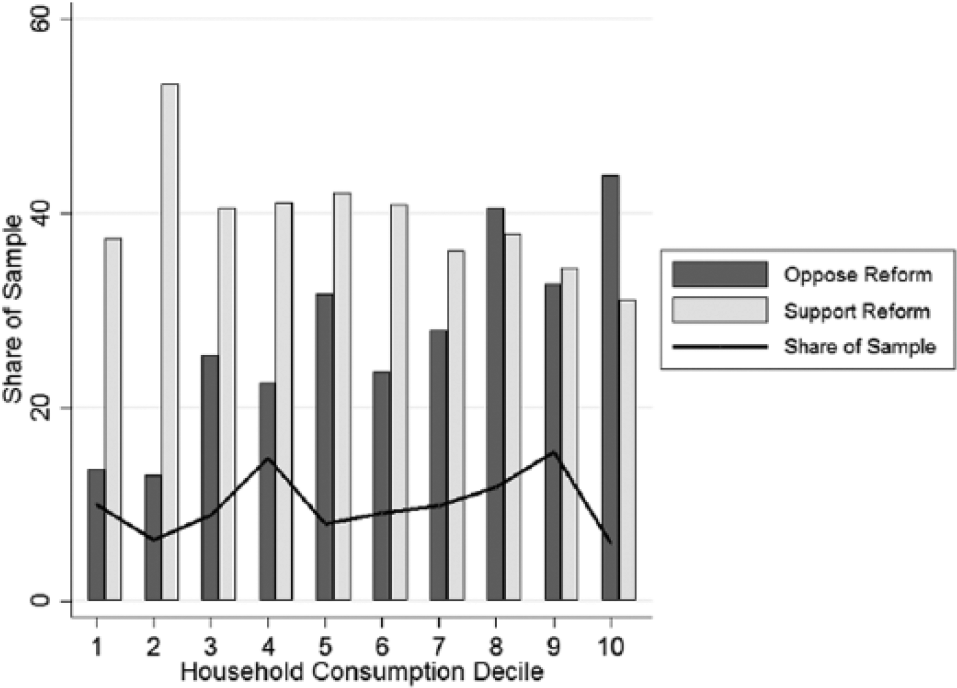
Support for fuel subsidy reform by consumption decile.
Estimating corruption
A large literature explores the relationship between corruption and political attitudes by uncovering partial correlations between perceptions of corruption and attitudes (e.g., Anderson & Tverdova, 2003; Clausen, Kraay, & Nyiri, 2011; Seligson, 2002). It is possible that the same underlying characteristics that cause individuals to report high levels of corruption also cause them to have low confidence in public policies, making it difficult to isolate the effect of corruption. Alternatively, respondents may be reticent to report corruption in survey responses when doing so implies some degree of personal wrongdoing, or simply because such questions can be sensitive, and the resulting bias in corruption estimates can be large (Kraay & Murrell, 2016).
Rather than relying on perceptions of corruption, I estimate corruption among local officials directly using a “gap measurement” method, which estimates corruption by identifying discrepancies between different data sources. 12 Specifically, I look at corruption in the implementation of Indonesia’s largest targeted transfer program, Raskin. The program, in theory, provides 15 kg of rice to 17.5 million low-income households at a copay price that is about one fifth of the market price. Although the program is supported by the central government, the day-to-day logistics for the delivery of subsidized rice to beneficiaries is handled by local governments. Local governments are responsible for picking up the allotment of rice for their entire village—on average 5,550 kg of rice each month to be distributed to 375 households—from a central warehouse (Banerjee, Hanna, Kyle, Olken, & Sumarto, in press-a). At the time of the survey, the average village Raskin quota was thus worth approximately Rp. 27 million—$2,800 13 —monthly, a substantial sum in a context where average per capita income is only around $3,300 annually.
Local officials have substantial leeway in how and whether this sum reaches households, as it is difficult for the central government to monitor whether households receive subsidized rice and the price that they pay. Household purchases reveal that a substantial portion of this quota never reaches households at all (Olken, 2006; The World Bank, 2012a), with households in the survey sample receiving only one third of the intended subsidy (Banerjee, Hanna, Kyle, Olken, & Sumarto, in press-b).
To estimate how much rice goes missing, I use administrative data on the village’s monthly rice quota 14 and compare this to self-reported purchase data from household surveys. For the household purchase data, I utilize data from two different survey waves conducted in the same villages, covering a total of 19 households per village. In each survey wave, households were asked about the prior 3 months of Raskin purchases, including whether they purchased Raskin, the amount they purchased, and the copay price. 15 To arrive at the village-level estimate, I weight the households that are eligible to receive targeted transfer programs and those that are ineligible to do so based on their proportions in the village population. I then compare this figure to the official Raskin quota for the village: the difference between the value of the official quota and the value of the total household rice purchases estimated for the village is the missing Raskin subsidy for the village.
Using this method, I estimate that, on average, villages are missing 23% of their intended subsidy. However, there is substantial heterogeneity: In 41% of villages, less than 10% of the intended subsidy goes missing, while in other villages the entire subsidy is missing (Figure 2). It is important to note that this measure does not include mistargeting—when benefits are redirected from eligible to ineligible households—but only rice that is never reflected in household purchases.
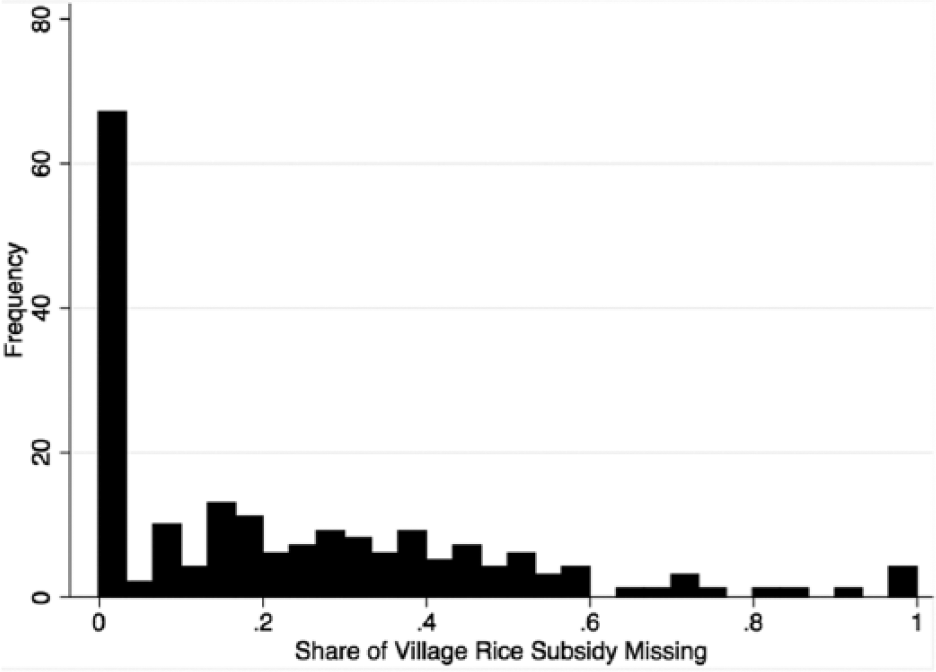
Distribution of missing subsidy.
While this measure does not directly capture all of the ways in which local elites can divert public resources for private gain (e.g., diverting transfers toward political supporters), Raskin is the largest transfer that is regularly channeled through local officials and thus a significant opportunity for local corruption. To add validity to the measure and credibility to the argument that citizens reason that corruption in past implementation of targeted transfer programs will affect their ability to benefit from future targeted programs, I test whether the corruption measure used here predicts whether poor citizens receive targeted transfers in Indonesia’s 2013 fuel subsidy reform. In mid-2013, after the survey was fielded, the government implemented fuel price increase alongside a compensatory targeted cash transfer. In a separate survey conducted in the same 194 villages in December 2013 to January 2014 (Banerjee et al., in press-a), we asked respondents whether they received the cash transfer and whether they gave part of the money that they received to village officials.
I find remarkably similar rates of “missing benefits” within the cash transfer program as in Raskin, with an average of 23% of households reporting having given part of the money to village officials. In one quarter of surveyed villages, at least one surveyed eligible household did not receive the transfer at all. In Table 1, I test whether past corruption in Raskin implementation predicts the share of eligible households within the village that do not receive the cash transfer (column 1) and whether households in the village report giving part of their cash transfer to village officials (column 2). 16 In each case, corruption in the Raskin program is associated with whether households receive benefits from the targeted cash transfer program in the next year.
Does Past Corruption Predict Future Corruption?
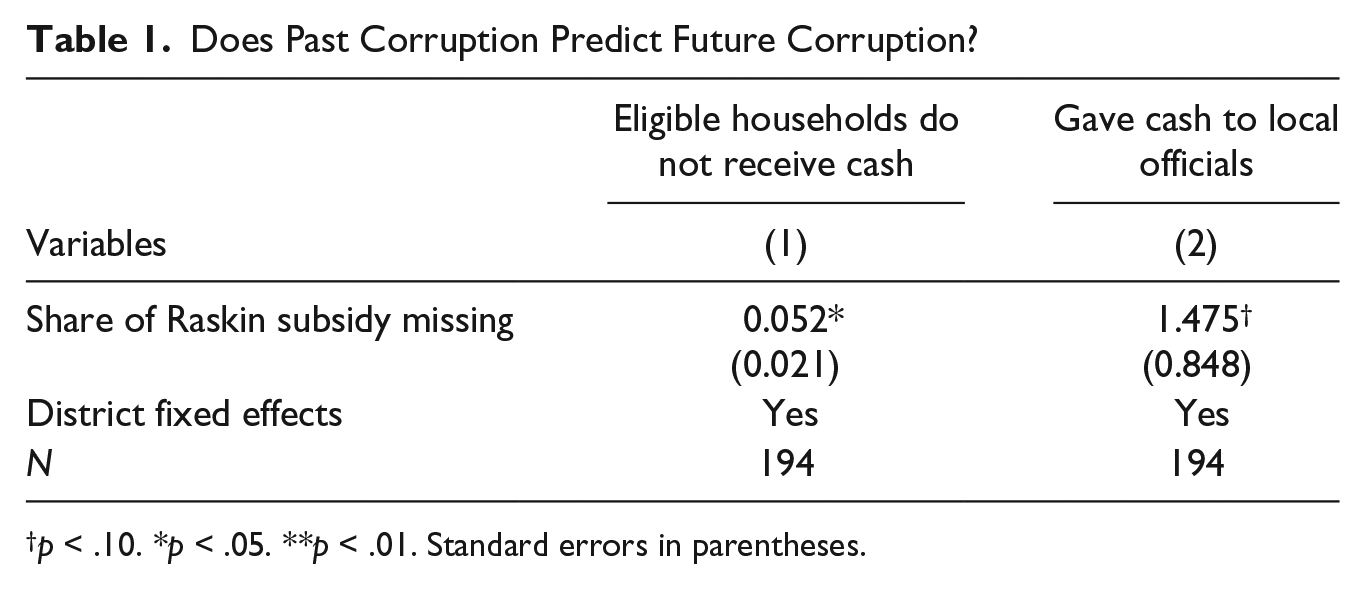
p < .10. *p < .05. **p < .01. Standard errors in parentheses.
Association between past and future corruption across different programs adds validity to the idea that corruption within the Raskin program is more broadly representative of corruption among local officials. It also increases confidence in the argument presented here that households use information on corruption within current programs as an indication of how fuel subsidy reforms will be implemented in their locality.
Controls
The analyses include a series of control variables likely to affect attitudes toward fuel subsidies. Vehicle ownership, transportation spending, agriculture, fuel-intensive job, and urban address individual incentives to maintain subsidies. Vehicle ownership is measured based on whether the household owns a car, truck, motorbike, or motorboat. Transportation spending is measured as the share of the household’s expenditures that were spent on transportation in the past month. Agriculture indicates whether the household owns an agricultural field, as fuel is an important input into agricultural production. Individuals employed in more fuel-intensive sectors of the economy may have higher incentives to maintain subsidies. I code fuel-intensive occupations as those working in agriculture, mining, manufacturing, or transportation. Urban indicates whether households live in an urban or rural area, as urban households are typically thought to be more supportive of fuel subsidies. On the other hand, the per-unit subsidy for rural households is higher because of higher transportation and storage costs in remote areas.
Education indicates the level of education attained by the respondent and ranges from 0 (no schooling) to 10 (postgraduate degree). An individual’s education level may shape the extent to which they understand the costs of fuel subsidies and the potential social benefits of reform. Female indicates whether the respondent is female, as women may have different priorities for public goods and social spending. Finally, richer households are widely seen to benefit more from fuel subsidies, so I include a variable measuring the households’ (logged) per capita monthly consumption. Summary statistics are reported in the Online Appendix (OA2).
Evaluation Strategy
To test the effects of local corruption on support for reform, I first use a simple multivariate analysis, controlling for household and village characteristics:

where ij denotes individual i in village j, X are village controls, Z are individual controls, ω k are district fixed effects, and ε is the error term. The main goal is to estimate β in the equation above, which captures the impact of corruption on attitudes. I estimate an ordered-logit model for the three-category dependent variable and logit models for the binary dependent variables.
The models will only provide valid estimates if the decisions by local officials to engage in corruption are not endogenous to policy attitudes. One concern is simply that corrupt villages are different from noncorrupt villages on a host of dimensions, and it is possible that these differences, rather than corruption itself, drive the correlations between corruption and policy attitudes. Matching improves comparability between “treatment” and “control” villages by preprocessing the data, removing villages from the sample that are dramatically different and thus creating a matched sample from the original data that contains covariates with similar values in both “treatment” and “control” villages. However, matching cannot eliminate bias caused by unobserved variables.
I use coarsened exact matching (CEM) to preprocess the data (Iacus, King, & Porro, 2012). CEM does not require the use of a specific matching algorithm. Instead, CEM requires “coarsening” the values of covariates into discrete categories. After coarsening, exact matching is used to sort the data into strata, and only strata that contain at least one treatment and one control village are retained. This restricts data to common support and ensures that balance between treatment and control is improved for all covariates. 17 Doing so ensures that only inferences that are close to the data are made, which in turn means less model dependence and reduced bias (Ho, Imai, King, & Stuart, 2007).
I include a number of covariates that likely drive decisions to skim from targeted transfer programs to perform the CEM. Urban indicates whether the individual lives in an urban area, and village remoteness is measured as the distance to the subdistrict capital. Less urban and remote areas may be more difficult for the central government to monitor, and citizens in these areas may have less overall knowledge about program benefits, giving local officials within these areas more opportunities to divert resources for private gain. Third, villages with higher levels of ethnic fragmentation and larger populations may have more difficulty engaging in collective action to monitor and punish the activities of corrupt officials. Fourth, villages with more religious institutions—and thus more informal community leaders—may be better positioned to monitor and punish corruption among local officials. Finally, villages in Indonesia vary in whether citizens have the opportunity to directly elect village leaders (and to punish corrupt officials at the polls). In some villages, the village head is directly elected by local citizens, while in others the village head is appointed by the (elected) district mayor.
While dichotomous variables (urban, direct elections) can be matched on their exact values, continuous variables must be coarsened before exact matching. I coarsen population into two categories: whether or not the village has a population of over or under 1,200 households, which is the minimum population required for new village formation. Religious institutions and village remoteness are coarsened into three categories, and ethnic fragmentation is coarsened into two categories. 18 The CEM procedure identifies 25 matched strata for 130 villages. For each village, the proportion of treated to control observations within the strata is used to create a CEM weight, which is used in the postmatching analysis. Because the matching is exact, there is no difference between corrupt and noncorrupt villages on the covariates used for matching. However, balance for continuous covariates is improved as well (OA4).
Results
Main Results
How does corruption affect attitudes toward fuel subsidies? I first discuss the results for the models without matching. The first column in Table 2 presents results for the three-category measure of resistance to fuel subsidy reform, the continuous measure of corruption, and control variables. In this model, the corruption variable is positive and significant for eligible households, indicating that living in a village where local officials skim more from targeted transfer programs indeed increases resistant to fuel subsidy reform. Figure 3 illustrates the magnitude of the effect among eligible households. When corruption levels are near zero, poor citizens are more than two and a half times more likely to support rather than oppose fuel subsidy reform. As the share of missing subsidy nears 100%, the predicted probability that poor citizens support reform declines by 18 percentage points. Meanwhile, the predicted probability that poor citizens oppose reform increases by 14 percentage points. Among control variables, per capita consumption significantly impacts attitudes, as does living in an urban area.
Local Corruption and Resistance to Fuel Subsidy Reform.
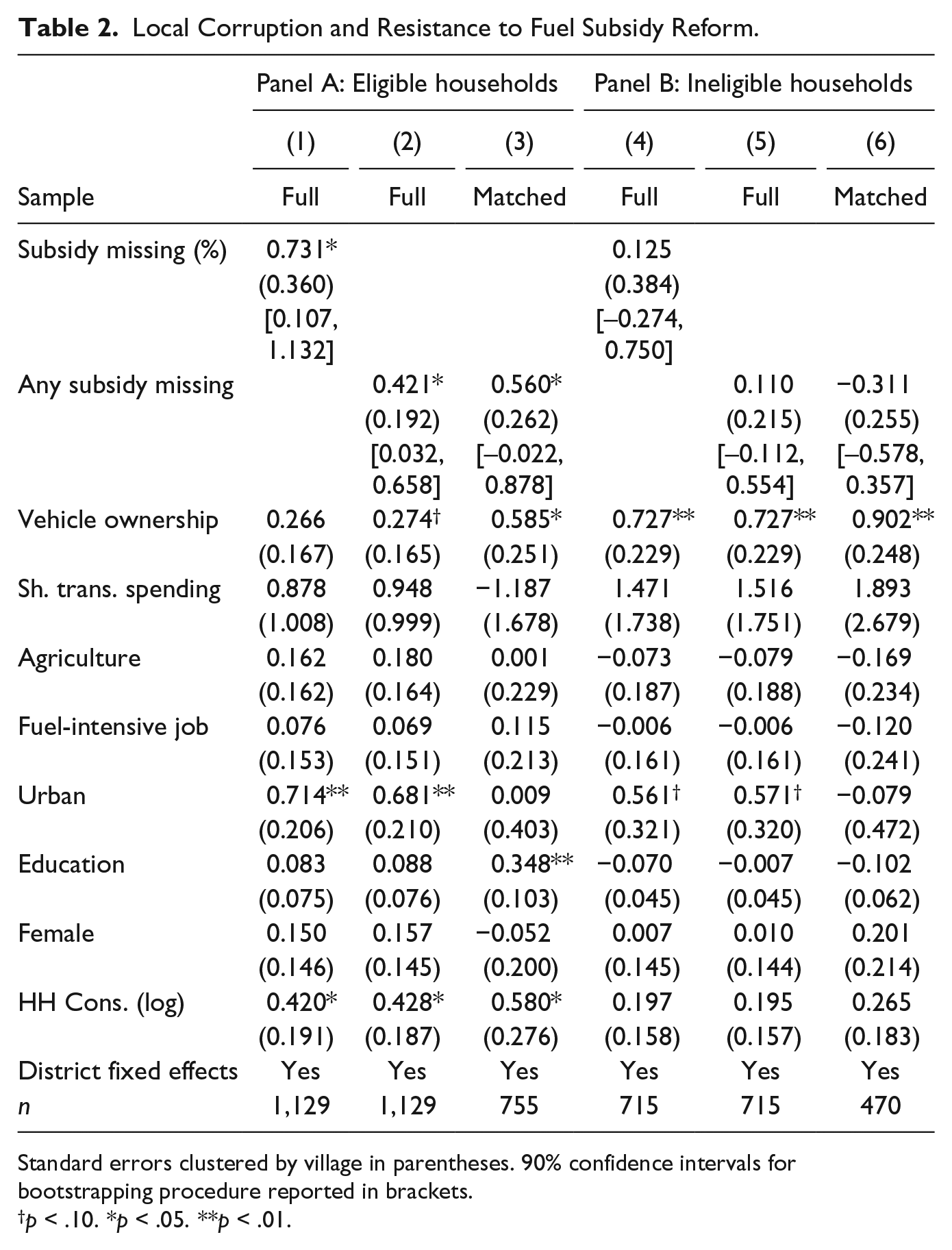
Standard errors clustered by village in parentheses. 90% confidence intervals for bootstrapping procedure reported in brackets.
p < .10. *p < .05. **p < .01.
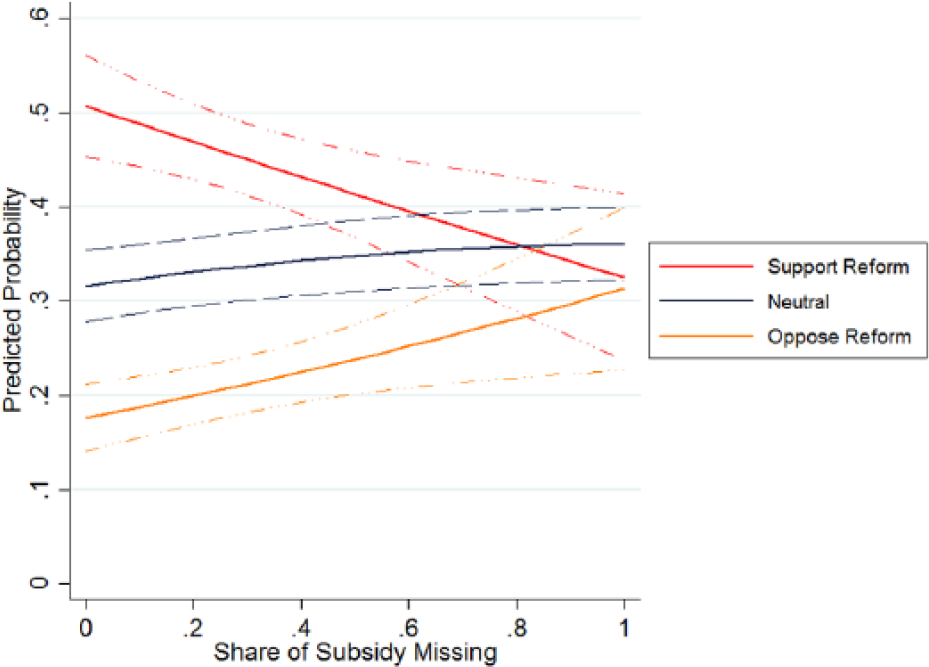
Impact of corruption on predicted probability of resistance to fuel subsidy reform.
Corruption matters on the extensive margin as well: A poor citizen living in a village where officials skim from targeted transfer programs is 6 percentage points more likely to oppose fuel subsidy reform, a 38% increase from the sample mean for eligible households in villages with no corruption (calculated based on column 2). Column 3 includes the same variables as in column 2 but is conducted on the matched sample only. Results are very similar to the first two models: The presence of corruption in the implementation of targeted transfer programs increases resistance to fuel subsidy reform among eligible households. Further, results are consistent using the binary outcome variables indicating whether respondents selected to increase or decrease spending respectively on automotive fuel subsidies (OA5).
Consistent with the argument, corruption does not affect attitudes among households that are ineligible for targeted transfer programs, reported in columns 4 to 6. Point estimates for corruption are near zero and consistently insignificant across the models. Instead, resistance to fuel subsidy reform among these richer households is shaped primarily by vehicle ownership and living in an urban area.
Because corruption is estimated, this could introduce noise into the models. I use a bootstrapping procedure to address this issue: Within each village, I redraw the data set 1,000 times (sampling with replacement) and calculate corruption estimates for each draw of the data, reestimating the model for each draw of the data. I report the 90% confidence intervals for the corruption coefficients using the 5th and 95th percentiles of the stored coefficients and report these in brackets in Table 2. While we can be 90% confident that corruption is linked with more support for fuel subsidies among eligible households in the unmatched sample (whether measured as a share or as an indicator), confidence is slightly lower in the matched sample using the bootstrapping procedure (approximately 85% confidence). 19
I also estimate the models at the village level, as corruption measures are taken at the village level. At the village level, a one standard deviation increase in the share of subsidy that goes missing is associated with a five percentage point decrease in the share of eligible households willing to reduce spending on fuel subsidies. Although not all coefficients on corruption are significant in the village-level models, all are in the same direction as the household models (OA6).
I also conduct a variety of robustness checks. I repeat the matching exercise using a threshold of at least 10% subsidy missing to define “treatment” villages; using a higher threshold should boost confidence that there is a substantive difference between treatment and control villages in corruption levels. I also reperform the CEM algorithm several times, shifting the values of the cutpoints for each variable used for matching. Finally, to reduce concerns about the effect of measurement error of the village population on estimating corruption, I utilize data on village population from the 2011 Pendataan Potensi Desa (PODES) to reestimate corruption. 20 Results are robust to these exercises, and corruption consistently predicts attitudes toward subsidy reform (OA8-10).
Discussion
Although the relationship between local corruption and support for fuel subsidy reform is quite robust empirically, several other pieces of evidence can increase confidence that local corruption indeed motivates citizens’ attitudes toward reform. Specifically, I extend the analysis in two directions. First, I look across policy domains within Indonesia. To show that local corruption indeed informs opinions on public expenditures based on whether expenditures flow through local officials, I examine public support across a wide range of policy areas in Indonesia, with varying degrees of delegation to the local level. Broadly, we should expect to see that local corruption diminishes support for policy areas that empower local officials and increases support for policy areas that provide social benefits without relying on local officials. Second, I show that the argument extends to other contexts using public opinion data from Afrobarometer implemented in Nigeria in 2013. The Nigerian case illustrates that not only does the argument extend to other contexts but also that the relationship is robust to using a more direct measure of resistance to fuel subsidy reform and perceptions of corruption.
If the argument presented here is correct, and corruption entrenches attitudes toward fuel subsidies because they are less vulnerable to local manipulation than targeted social safety net programs, then corruption should also affect attitudes toward other forms of public spending in predictable ways. Namely, corruption should diminish popular support for any form of public spending that vests local governments with greater resources and authority and enhance popular support for public spending on programs that vest resources and authority with alternative government agencies. Thus, I examine the effect of corruption on support for each of the main forms of social spending in Indonesia.
Figure 4 plots the coefficients and standard errors from eight separate ordered-logit models conducted on the matched sample only. The dependent variable in each model is the three-category outcome variable indicating whether the respondent chose to increase, neither to increase nor decrease, or to decrease spending on a given policy area. All models include the same controls reported in Table 2 and district fixed effects (reported in OA7). As predicted by the argument, corruption in the delivery of targeted transfer programs predicts attitudes across a broad range of social spending areas. Corruption is associated with reduced support for targeted transfer programs, including health fee waivers for the poor, subsidized rice for the poor, and cash transfers for the poor. Meanwhile, corruption is correlated with more support for the subsidies on automotive and cooking fuel (though it is not statistically significant for cooking fuel). Corruption has no significant effect on support for hiring teachers, building roads, or community development funds, perhaps because none of these forms of public spending necessarily empower village officials.
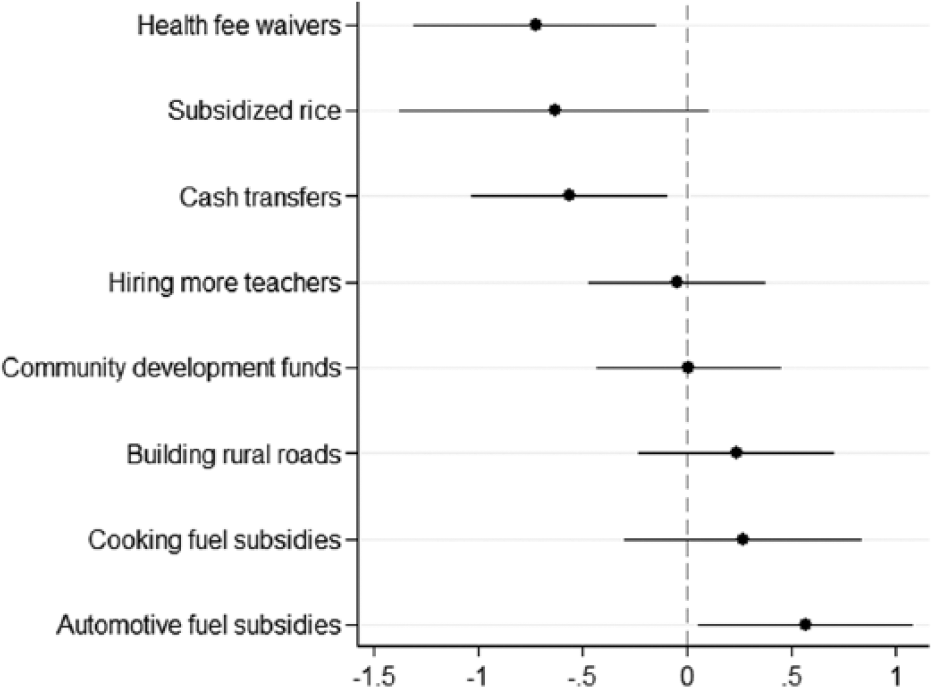
Effect of corruption on support for social spending.
Does corruption explain attitudes toward subsidy reform in other contexts? Until recently, the Nigerian government subsidized the private consumption of automotive fuels to maintain a stable price at the pump. 21 In 2012, subsidies on petroleum products were estimated to account for around 20% of the total public budget (Siddig et al., 2014). When the government attempted to end fuel subsidies in 2012, a nationwide strike brought Nigeria to a standstill. The rallying cry of protestors was, “Remove Corruption, Not Subsidies.” Protest leaders argued that removing one of the few government benefits received by ordinary citizens given that the government had not tackled corruption and other forms of wasteful spending was unfair (Nossiter, 2012).
Afrobarometer (2013) inserted a fuel subsidies module into its questionnaire for Nigeria. The survey asked respondent to select which of the following statements is closest to his or her view. Statement 1 reads, “The government should maintain a fuel subsidy to keep fuel prices low and improve living standards.” While Statement 2 reads, “The fuel subsidy is too expensive, and the government should remove it.” Overall, 37% of respondents agree with Statement 2. This level of overall support for fuel subsidy retrenchment is remarkably similar to Indonesia, where 39% of respondents agreed with fuel subsidy reform.
I measure corruption in local government using a question that asks respondents to identify whether “none,” “some of,” “most of,” or “all of” local government councilors are involved in corruption. For controls, I attempted to follow the Indonesia models as closely as possible. Table 3 reports results: where the dependent variable indicates whether the respondent agreed with Statement 2, neither agreed or disagreed with either statement, or agreed with Statement 1. As in Indonesia, belief that local officials are corrupt is strongly associated with resistance to fuel subsidy reform. This adds confidence both that the argument travels across countries and also that the findings are not driven by how the concepts are operationalized (e.g., perceived vs. estimated corruption).
Support for Fuel Subsidies in Nigeria.
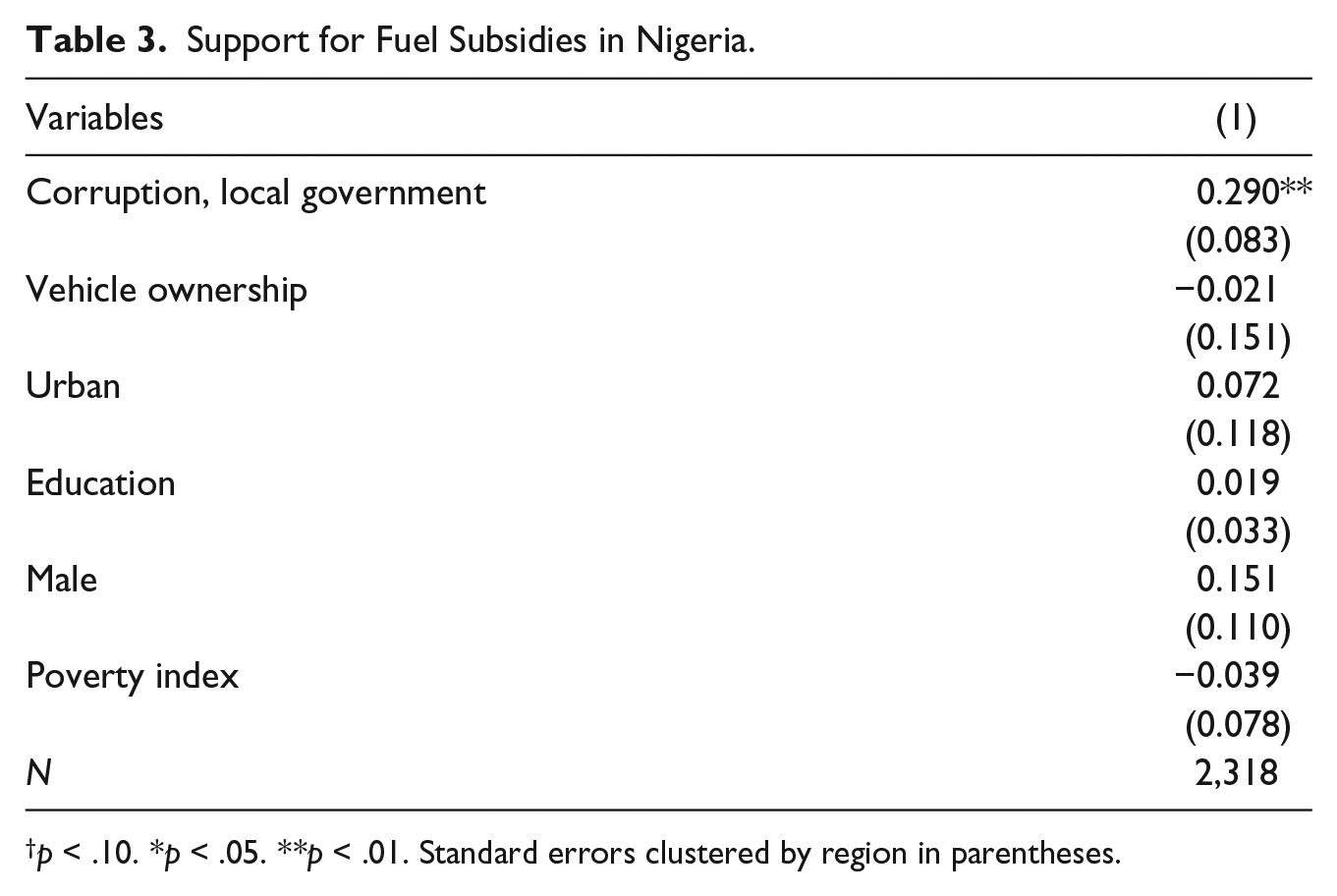
p < .10. *p < .05. **p < .01. Standard errors clustered by region in parentheses.
Conclusions
The size and prevalence of consumer subsidies on fossil fuels has become an area of increasing global concern. Yet scholars have only recently begun to evaluate why countries enact these subsidies and why they are so difficult to repeal. This article joins the emerging literature by investigating the influence of local corruption on attitudes toward subsidy reform. Local corruption influences attitudes toward subsidies because shifting government resources away from social protection programs based on universal access—such as automotive fuel subsidies—to social protection programs based on targeting the poor requires vesting authority for policy implementation with local politicians and bureaucrats. When these local elite use this discretion to divert resources for private gain, citizens are warier of reform efforts that would place more resources in their hands. This article investigates these expectations empirically using household survey data from Indonesia. Findings show that corruption in the implementation of targeted transfer programs—estimated using a “gap” measurement method—is associated with more resistance to reforming consumer automotive fuel subsidies. Results remain consistent when matching is used and to a number of robustness checks.
This finding has important implications for current policy discussions on fuel subsidy reform. Compensating the poor for increases in fuel prices through improved social policy is generally accepted as key for successful reform. However, countries may utilize fuel subsidies as a redistributive tool precisely because they lack the institutional capability to implement alternative forms of social policy (Victor, 2009). Building this capability, including at the local levels, can be an essential component of gaining public support for reform. Absent this capability, even the rural poor, who are thought to benefit little from fuel subsidies, may resist reforms. 22
As this type of capability can only be built over the long-term, it may be more fruitful in the interim to design reform packages that rely on existing patterns of institutional strengths and citizen trust, even if the reforms appear to be less efficient. For example, a more coarsened approach to targeting (e.g., everyone within a village) would rely less on the information provided by local officials and allow for less discretion. Similarly, if there is an institution or agency that has high levels of citizen trust, entrusting it with reform implementation could diminish resistance to reforms. However, just because low trust in local institutions is associated with reduced support for reform does not necessarily mean that citizens would support reforms if compensatory policies were implemented nationally rather than locally, as trust in national governments is frequently lower than trust in local governments, including in Indonesia (Olken, 2009). Exactly how we might expect trust in institutions to shape support for reforms depends on the particular institutions that would be authorized to implement reforms as well as on citizens’ views toward these institutions.
While this article identifies a key source of opposition to reform, it also points to several encouraging trends. First, these findings suggest that much opposition to fuel subsidy reform comes not from a fundamental policy disagreement or an unwillingness to curtail benefits—in fact, 39% of surveyed citizens reported willingness to decrease government spending on automotive fuel subsidies—but from a lack of confidence that public officials will deliver on the programs they promise will replace subsidies. This suggests that citizens’ views could be changed over time, if trust in public institutions can be enhanced. Second, the history of fuel subsidy reforms in Indonesia illustrates how this confidence can be built over time: In 1998, fuel subsidy reforms contributed to the toppling of a regime, while just 16 years later, a major reform effort in 2014 passed with little backlash. No doubt the varying levels of popular support for the regime implementing the reform played significant roles, but Indonesia’s growing administrative capabilities, including in the ability to implement targeted transfer programs, likely also contributed to these divergent outcomes. Many villages in Indonesia at the time of the survey exhibit quite low levels of corruption, and, in these villages, poor citizens do support reform.
In some ways, Indonesia may be a particularly hopeful case for the long-term prospects of reform, given that every regime since the fall of Soeharto has attempted fuel subsidy reform. This suggests that across the political spectrum, there is consensus among political elites on the need for reform. However, these dynamics are by no means unique to Indonesia, nor are the fiscal pressures motivating reform unique to Indonesia’s status as a net importer. Low trust in institutions plays a role in undermining support for reforms in Nigeria, an oil exporter, as shown in the article. Even in Saudi Arabia, fiscal pressure to reform fuel subsidies is high, and energy subsidy reform is a key part of the government’s reform plan to adjust to lower global oil prices and a significantly diminished government budget. The government proposes a compensatory, targeted program for poor and middle-income households to offset the effects of reforms, though both the reform and the targeted program were still delayed as of mid-2017. 23
More broadly, similar dynamics could play out for any type of economic reform which entails transferring resources through institutions in which citizens have varying levels of trust. In evaluating economic reforms with adjustment costs, it is therefore equally important to consider how reforms, including any compensatory social programs, are implemented in practice as to consider the economic winners and losers from reforms. Even citizens who seem to be economic “winners” from reforms may have a vested interest in the status quo if they expect reforms to be implemented imperfectly.
This article also has several broader implications. The results show that local policy implementation can significantly shape patterns of support for national policies. The way that individuals experience social policies varies significantly depending on how local politicians and bureaucrats implement these policies, even in developed countries. This is an important and understudied dimension of attitudes toward redistribution and social policy. The results also draw attention to consumer subsidy programs as significant components of welfare states in developing countries. Future work could usefully examine across a wider range of cases how countries shift over time from welfare states based on broad-based consumer subsidy programs to systems which more narrowly target the poor.
Footnotes
Acknowledgements
I am very grateful to Abhijit Banerjee, Rema Hanna, Benjamin Olken, and Sudarno Sumarto for supporting the inclusion of the survey questions used here. I thank Allison Carnegie, Jeff Colgan, Rema Hanna, Macartan Humphreys, Yotam Margalit, Maria Victoria Murillo, Benjamin Olken, Michael Ross, Sudarno Sumarto, Johannes Urpelainen, and three anonymous reviewers for valuable comments.
Declaration of Conflicting Interests
The author declared no potential conflicts of interest with respect to the research, authorship, and/or publication of this article.
Funding
The author disclosed receipt of the following financial support for the research, authorship, and/or publication of this article: The author acknowledges support from the National Science Foundation Graduate Research Fellowship and from the CGIAR Research Program on Policies, Institutions, and Markets (PIM), which is led by the International Food Policy Research Institute (IFPRI) and funded by CGIAR Fund donors. The article uses data from a project that was financially supported by AusAid through the Poverty Reduction Support Facility. All views expressed are my own and do not reflect the views of any individuals or institutions acknowledged here.
Supplemental Material

Notes
Author Biography
References
Supplementary Material
Please find the following supplemental material available below.
For Open Access articles published under a Creative Commons License, all supplemental material carries the same license as the article it is associated with.
For non-Open Access articles published, all supplemental material carries a non-exclusive license, and permission requests for re-use of supplemental material or any part of supplemental material shall be sent directly to the copyright owner as specified in the copyright notice associated with the article.
