







Abstract
Autocracies often rely on power-sharing to maintain political survival. The literature, however, does not provide an adequate explanation for why autocratic regimes differ in the capability to enforce power-sharing. Drawing on the case of imperial China in the Qing dynasty (1644-1911), this article argues that institutionalized bureaucratic system may be an arguably credible mechanism for facilitating power-sharing. Examining the pattern of bureaucratic turnovers in the Qing period shows that the sanctions and promotions for provincial governors were significantly affected by the level of internal armed conflicts. Favoritism was granted to Manchus, the ruling minority group, for the promotion toward the top level. With the presence of armed conflicts at the province level, however, the rulers were induced to select Han elites from the majority group, as governors. These results are consistent with the logic of power-sharing by virtue of a loyalty-versus-competence trade-off in bureaucratic selections.
Introduction
Autocrat is not just one person. Rulers need to maintain a viable political coalition and share power with supporters. Autocratic regimes, however, differ enormously in their capabilities to enforce power-sharing. To explain the variance on power-sharing institutions, the majority of the literature hinge on a theory about commitment. That is, the efficacy of autocratic rulers to build the power-sharing coalition is limited by their willingness to honor the promised offices, rents, and policy concessions. Institutions that are purported to pose constraints on executive powers, through legislature, party, or the military branch, are deemed to be necessary for facilitating power-sharing (Boix & Svolik, 2013; Gandhi & Przeworski, 2007; Magaloni, 2008).
The commitment problems, however, stem from two sides, not one. While the ruler faces a moral hazard problem of attempting to purge the elites, elites have a parallel moral hazard problem of withdrawal from the support. The cooptation of outsiders introduces heterogeneity within the ruling coalition and may give rise to further instability. Following this logic, the conventional wisdom affords a loyalty-versus-competence trade-off, suggesting that the political selection in autocracies often end up with amassing the mediocre due to this commitment problem (Egorov & Sonin, 2011; Zakharov, 2016).
This article presents a revisionist view on autocratic power-sharing. Different from the conventional wisdom, we switch the focus to the role of institutionalized bureaucratic system. Different from the logic of loyalty-competence trade-off, we argue that both loyalty-based and performance-based selections may contribute to the political resilience of regime. We draw on late imperial China in the Qing dynasty as a case in point. An essential feature of the Chinese bureaucratic system was its high degree of institutionalization (Pomeranz, 2009; Xu, 2011). Lacking the constitutional authority (unlike the congress) and coercive means (unlike the military) to challenge the ruler, bureaucrats were unlikely to pose a direct threat to the ruler. This ensured a credible power-sharing incentive on the ruler’s side and induced elites to defend the established social and political order. The scholarly literature widely recognize the instrumental value of China’s bureaucratic system for enhancing state capability and maintaining social stability (Brandt, Ma, & Rawski, 2014; Rosenthal & Wong, 2011).
The selection of bureaucrats, however, was interfered with the issue of ethnicity in the Qing dynasty. The Qing rulers belonged to the group of Manchus, a minority ethnic group who resided to the northern border of China in the preceding Ming dynasty. The Manchu military started acquiring Chinese regions from the mid-17th century, and eventually became the ruler in 1644. Manchus were different from Hans, the majority ethnic group in China, in language, history, and social and economic norms. The Manchus’ conquests of Chinese provinces were brutal and confronted by military insurgency led by Han elites decades after the establishment of the Qing dynasty. For the Qing rulers, the ethnic identity served as a cue for the a priori perception about political loyalty of bureaucrats. To ensure the Manchu dominance in the political center, the ruler adopted a political patronage system to disproportionately promote Manchu bureaucrats toward the top level (Elliott, 2001; Rawski, 1996).
The patronage, however, had a limit because eventually, the dominance of political power should reflect the dominance of economic power. Manchus were significantly smaller than Hans in population size and the economic influences. As a result, the ruling Manchu group could not maintain social stability with alright exclusion of Hans. A relatively open system of bureaucratic selection was essential for inducing the cooperation from Hans. The Han elites were able to get through competitive exams and acquired administrative capabilities at various different levels of local jurisdiction. As a result, Han bureaucrats were comparatively more skillful in handling complex local situations and more effective in reducing rebellions.
Meanwhile, Hans may be considered less loyal. When detecting the true type of agent is costly, selection depends on a comparison between the value of local stability delivered by competent agents and faithful implementation of the rulers’ preferred policies by co-ethnic agents. The two types of agents co-existed and served for different purposes to strengthen the political order. We argue that the Qing rulers adopted a fine-tuned system combining both performance and patronage-based components to enforce political power-sharing.
This article substantiates the argument through empirical investigations on the interplay between political turnovers of provincial governors and internal military conflicts at the province level. We consider the selections of governors as the ruler’s revealed preference with regard to bureaucratic power-sharing. Internal conflicts provided a tangible performance measure for incumbent governors; moreover, the existing conflicts shaped the rulers’ value of appointing capable governors. Following this reasoning, the analysis focuses on the following empirical questions: How did internal conflicts affect political turnovers and the selection of provincial governors? Were Manchu and Han officials treated discriminatively in terms of the chances of promotion and sanction? And how did ethnic favoritism, if there was anything, interact with the threat by mass rebellions?
Relying on originally collected historical data, the analysis comes down to four findings on bureaucratic selection. (a) The career mobility of bureaucrats was performance-based. Internal conflicts at the province level significantly increased the probability of sanction and reduced the probability of promotion for incumbent governors. (b) The system seems to be dictated by ethnic favoritism. The statistical correlation regulating internal conflicts and political turnovers was significant for Han governors, but insignificant for Manchus in most occasions. Moreover, the Manchu governors received a higher chance of promotion than Hans did. (c) The patterns of bureaucratic appointment corroborate with a mechanism of ethnic power-sharing. An appointment of provincial governor was more likely to be Han with preexisting conflicts. Meanwhile, the rulers did trade-off ethnic favoritism against the demand for competence and performance: the presence of a Han governor in the previous year significantly reduced the probability that a new appointment be drawn from Hans. (d) Consistent with the premise that Han bureaucrats were more skillful at delivering stability at the subnational level, we find that newly appointed Han governors were more effective at reducing internal conflicts than the Manchu counterparts were, while incumbent Han governors did not make a difference.
With empirical focus on the single case of China, this article probably does not amount to a general account for bureaucratic selection in autocracies. However, the findings here shed new lights on how bureaucracy may be instrumental for processing political conflicts. Examining the Qing history led us to the belief that an institutionalized system of selection was a key reason of political resilience of an ethnically divided society ruled by the minority. Absent that, autocratic rulers stand on the edge of razor. Some autocracies then rely on personal patronage and military repression to maintain power (Acemoglu, Verdier, & Robinson, 2004; Bratton & de Walle, 1994; Roessler, 2011).
The exclusiveness in the power base, however, undermines regime stability in two regards. First, the dependence on the military as the sole guardian of social order gives rise to a high possibility of military intervention when the balance of coercive power shifts (Boix & Svolik, 2013). Second, when the majority is excluded from political offices and does not have substantial influences on policies, societal conflicts tend to be transformed along the ethnic line, as elites from the majority groups do not have strong will to defend the status-quo. The Alawi regime in Syria, Iraq under the Sunnis, Rwanda and Burundi under the Tutsi rule are arguably examples (Baram, 1997; Haklai, 2000; Uvin, 1999). Political regimes as such are inherently unstable and hardly sustainable. By contrast, the power-sharing implemented through the bureaucratic system in Qing may explain the puzzle found by Fearon, Kasara and Laitin (2007) that ethnic minority rules are not necessarily correlated with more civil conflicts in large-N studies.
This article also enriches the understanding of political selection in the contemporary China. The political-economic researches on China quarrel over whether performance and promotion incentives matter. A strand of literature attributes strong economic performance in China in recent decades to an effective system of personnel management (Bo, 2002; Li & Zhou, 2005; Xu, 2011; Yao & Zhang, 2015). Many others contend that patronage and factional conflicts preceded performance as driving bureaucratic selection (Jia, Kudamatsu, & Seim, 2015; Shih, Adolph, & Liu, 2012). The two views need not contradict with each other, however, from a power-sharing perspective. The ruler may select bureaucrats with different attributes of loyalty and competence for different purposes. In fact, a recent paper by Lü, Landry, and Duan (2018) shows that performance and political connections matter differently for promotion at different levels. Our finding that Manchu governors were granted favoritism in promotion to the top is logically consistent with theirs.
Bureaucracy as a Power-Sharing Mechanism
A large strand of political-economic literature presumes the loyalty-competence trade-off as a key problem undermining bureaucratic capability in autocracies. Egorov and Sonin (2011) propose a game-theoretic model in which the ruler relies on the agent to deal with potential challengers. As a result, competent agents are more likely to collude with the challenger and pose a stronger threat to the ruler. Zakharov (2016) maintains that more competent agents have better outside options and have a more severe moral hazard problem in contributing to the common defense.
This article presents a refined account on the mechanism of bureaucratic selection in which loyalty and competence need not impede with each other. According to the conventional wisdom, the dominance of loyalists is a symptom of malfunctioned bureaucracy. In our interpretation, the dominance of loyalists at certain positions may actually be a key strength of some autocratic regimes. The point of departure in our explanation is to realize that the design of bureaucracy is not just for efficiency. Instead, bureaucracy may serve as a power-sharing facilitating mechanism. This very purpose reckons a combination of meritocracy and patronage in bureaucratic selections. The loyalty-competence trade-off à la Egorov and Sonin (2011) can be alleviated through using civilian bureaucrats whose power are confined to certain local jurisdictions. Subnational bureaucrats were incapable of overthrowing the ruler due to the fragmentation in bureaucratic power and the lack of authority over commanding the military. For bureaucrats at the very top level, however, loyalty superseded competence as a main consideration. The rulers were more likely to grant powerful positions to agents with strong homophily in family lineage and social networks. This was how the centralized bureaucratic system of the Chinese style dealt with the commitment problem of agents.
The ruler’s commitment problem arises when the promised reward is burdensome, and ex post, the ruler finds it rational to renege on the promise (Myerson, 2015). The bureaucratic system provides several remedies for it. First, the policies and performance of bureaucrats were subject to systemic supervision through the Ministry of Personnel. Institutionalized performance evaluation reduced political uncertainty by increasing the audience cost of the ruler to remove high-ranking bureaucrats. Second, power vacuum due to the removal of competent bureaucrats undermines social stability. In turn, the dependence of the ruler on the bureaucratic system to maintain local stability constrains the ruler’s discretion.
Loyalty Problem in the Qing Period
We follow a sizable literature in admitting ethnicity as a tangible dimension for shaping patronage politics. Political leaders often allocate budget and resources to benefit their coethnics (De Luca, Hodler, Raschky, & Valsecchi, 2018; Gibson & Hoffman, 2013; Gisselquist, Leiderer, & Nino-Zarazua, 2016; Remmer, 2007). Ample evidences on ethnic favoritism are documented with regard to infrastructure investment, public health, and education system (Burgess, Jedwab, Miguel, Morjaria, & Padró i Miquel, 2015; Franck & Rainer, 2012; Kramon & Posner, 2016). In turn, politicians strategically resort to ethnic identity construction to mobilize electoral supports and consolidate personal control over power base (Fearon & Laitin, 2000; McCauley, 2014; Wantchekon, 2003). Ethnic favoritism is also ubiquitous in bureaucratic politics. For example, Iyer and Mani (2012) find that caste affinity with Chief Ministers in India helps bureaucrats get assignments to more important positions. Arriola and Johnson (2014) find that executive power-sharing among ethnic groups repress women’s cabinet appointments.
For the Qing rulers, power-sharing with the majority Han elites was an inevitable choice as a minority group. To coopt the Han elites, the Qing rulers followed the model of the previous Ming dynasty to establish the Imperial Exam for bureaucratic recruitment and organize the cabinet into six ministers. Throughout the Qing dynasty, about 70% of provincial governors and about 56% of Grand Secretariats, the civilian officials with the highest rank in the central administration, were Hans. 1 The inclusion of Han officials contrasts some other minority-ruling regimes in the Chinese history such as the Yuan dynasty (Twitchett & Fairbank, 1994, pp. 454-464).
Extensive power-sharing with the majority group, however, engendered the risk of power dilution, which the Qing rulers were clearly aware of. Manchus were promoted to ensure the rulers’ control over the bureaucratic system, at least at the top level. Manchu candidates were able to get promotion through fast lanes (Guy, 2010). They also had other tracks than the imperial exam for pursuing political careers, such as enrolling in the military, serving as high-ranking officials’ security guards, or using hereditary entitlements (Zhao, 1977, Vol. 108). The ethnicity-based patronage resulted in over-representation of Manchus among top bureaucrats relative to their population size.
The cost of appointing Han bureaucrats stemmed from their lack of policy congruence with the rulers. Through the lens of political agency models, a congruent agent sticks with the ruler’s ideal preference, while a noncongruent type deviates where possible (Fearon, 1999). Compliance is not guaranteed due to information asymmetry and supervision cost. As a result, governors might defy emperors’ orders to combating a particular enemy, conceal local information, and divert fiscal revenues for local purpose. For example, although Han bureaucrats were effective defenders against peasant rebellions in the 19th century, on several critical occasions, they strategically delayed in response to the rulers’ orders and pursued policies in favor of regional interests (Xie, 2006, p. 53).
Competence and Internal Conflicts
The recruitment of elites from the majority Han group enhanced the political resilience of the Qing regime through two mechanisms. First, power-sharing mitigated the hostility between Manchu and Han groups. Second, the cooptation of majority elites enhanced state capacity. Open access to bureaucratic selections induced merit-based competition and helped “create an atmosphere of warmth and trust at the top so that officials could depend on that vertical relationship rather than horizontal connections to assure a predictable political future” (Wakeman, 1985, p. 1009).
The desired competence for bureaucrats should be multifaceted. Rulers relied on agents to collect revenue, deliver public goods, elicit information, and propagate their ideologies. The empirical analysis in this article focuses on the universe of provincial governors (Xun’fu), the highest civilian bureaucrats in a province. Like their predecessors, the Qing rulers embraced the philosophy of economic laissez-faire and placed social stability as a central task. Hence, the challenge of subnational governance lied in “how to pacify local and regional populations who were highly militarized and divided in countless ways” (Peterson, 2016, p. 9).
As civilian officials, provincial governors did not own coercive instruments directly. The military sector consisted of two parts: Eight Banners troop (Ba Qi Jun) dominated by Manchus, and Auxiliary Millitary Units (Green Flag, or Lü Ying) populated by Han Bannermen. Neither force was controlled by governors. The capacity of provincial governors concentrated on famine relief, grievance resolution, infrastructure investment, and the oversight over lower level bureaucrats (Mayers, 1966). After the Taiping Rebellion in the 1850s, provinces were granted a higher degree of fiscal autonomy, and governors’ powers expanded to military affairs. Henceforth, the capability of Han governors might also depend on their skills for managing military affairs.
The comparative advantage of Han governors in maintaining stability was evident even in the eyes of the Qing rulers. It was reported that the Regent Dorgon in the early Qing period believed that Han governors “would be more adept at dealing with provincial China than their Manchu counterparts, whose knowledge of Chinese people and government was often superficial” (Guy, 2017, p. 49). Most Han bureaucrats had a record of local work experience, being rotated among different local jurisdictions. They often took a leading role in fund-raising for infrastructure building (such as road, dam, and irrigation) and got acquaintance with local elites (Will, 1990). It is important to keep in mind that, due to underdeveloped fiscal capability, the state intervention was unable to penetrate down below the county level (Sng, 2014). As a result, the gentry class played a substitutive role in maintaining social order at the local level (Hao, Liu, & Zhou, 2018). Hence, cultural proximity and common social values shared by Han governors and the gentry class rendered a Han advantage in maintaining stability.
Hypotheses
We derive three hypotheses to orient the empirical investigations. We first examine to what extent governors were held accountable by the rulers with regard to unappeased military conflicts under their watch. In a pure performance-based system of bureaucratic evaluation, the turnovers of governors should be responsive to their performance. Internal conflicts in a governor’s jurisdiction should then increase the probability of sanction (being either demoted, or removed from office). Moreover, the linkage between conflicts and bureaucratic turnovers should apply to both Han and Manchu governors in this system. In comparison, under pure patronage, all governors should be taken care of by their patrons. So, internal conflicts did not matter for sanction.
The logic of power-sharing implies a hybrid model with loyalty and competence being strategically evaluated. Political power was conceded at a price. In sharing power with Han elites, the rulers expected high performance. By contrast, Manchus were recruited not for the sake of competence but for the purpose to strike a balance of power between Manchus and Hans. As a result, Manchu governors need not be evaluated according to performance. This reasoning leads us to the following hypothesis.
Furthermore, the logic of political survival implies a higher chance of promotion for Manchu governors than for the Han counterparts. For the business in the political central, ideological and policy congruence with the rulers was more important than the competence to maintain local stability. Based on the discussions on the ethnic identities of Manchu and Han bureaucrats, we hypothesize that the playing field was more in favor of Manchu governors. At the same time, similar logic as in Hypothesis 1 may apply to the interaction of conflicts and promotion. To the extent that evaluation is performance-based, conflicts tend to reduce the chance of promotion more severely for Hans. However, we should expect conflicts to have a more moderate impact on promotions, because loyalty, rather than competence, was a more fundamental consideration for bureaucrats at the top level.
The third hypothesis focuses on the interaction between bureaucratic appointments and regional conflicts. Holding the disutility of appointing Han governors constant, the benefit of power-sharing with Hans increased along with conflicts. The urgent need to restore local stability brought forth a rationale for power-sharing. A caveat here, though, is whether loyalty could become a more important concern as the Hans might revolt in warring times. Historical evidence suggests that it was not the case. In the early and mid-Qing periods, provincial governors did not have sufficient resources to wage a rebellion. Even in the late Qing period, the expansion of governors’ power did not amount to an attempt of rebellion until the very end of the Qing dynasty in 1911. In any case, if the rulers were ever worried about rebellions by Han governors, the probability of appointing Hans should be lowered. This rules against the hypothesis and hence does not matter for a positive empirical finding in support of Hypothesis 3.
Data
To carry out the empirical study, we assemble historical data on bureaucratic selections and armed conflicts throughout the Qing dynasty, 1644-1910. The main dependent variables we adopt for testing Hypotheses 1 to 3 concern bureaucratic sanctions, promotions, and appointments of governors in the 18 provinces of “China proper.” 2 Thanks to historical works on the Qing bureaucracy (Qian, 1980), we are able to code the turnovers of governors in each year. The data map the socioeconomic information and conflicts in each province-year to the governor who presided over the province at the end of the year, and registered turnovers in the governor’s rank, position, and jurisdictions in the year afterward. In the tradition of Chinese bureaucracy, each position is given an administrative rank (Hucker, 1985). The assignments of these ranks are clarified enough to allow the coding for sanction and promotion.
We consider two cases of turnover as a bureaucratic sanction. (a) Demotion is registered if the governor was moved to a lower ranking position. (b) Removal is registered if a governor was deprived of his position and sometimes investigated and imprisoned afterward. A change in office is considered as promotion for each of the following two scenarios: (a) if the governor was transferred to an office of higher rank, or (b) if he stayed in office and was granted a higher rank. On average, incumbent governors had a chance of 6.7% for sanction and 6.6% for promotion in 1 year. Not surprisingly, governors were most common to remain in the same jurisdiction. In addition, with a probability of 14%, governors might be transferred to different positions of equal rank. This included lateral rotations among provinces and the transfers to equal-ranking positions within the central government. There are also a relatively small number of attrition due to retirement, death from diseases, medical leave, or death on duty.
The ethnicity of the governor is a central variable of interest in the study on bureaucratic power-sharing. A governor’s ethnicity can take one of the four types: Manchu, Han Chinese, Han bannerman, or Mongol. We consider a governor as Han if he was identified as Han Chinese or Han bannerman in the original documentation by Qian (1980). Mongols consisted of a relatively small fraction of the whole sample (2.5% of all governors). Historically, Mongols and Manchus had a higher degree of cultural proximity between them than with Hans. To make the analysis simple, we bundle the group Mongols together with the Manchus or Hans as the default group for analyzing bureaucratic sanctions and promotions. 3
The main explanatory variable indicating social stability is internal conflict, which is coded according to the total number of armed conflicts between Qing’s military forces and domestic rivals occurring with each province-year. We rely on two resources, Chronology of Warfare in Dynastic China (Chinese Military History Team, 2003) and Chronicle Historical of Natural Disasters and Warfares in Dynastic China (Chen, 2007), to obtain the information on armed conflicts. Armed conflicts can be further divided into two categories: local riots, in which violence was confined within a province, and mass rebellions, in which violence spread cross several provinces. For conflicts of the second category, one event of conflict is separately counted for each province. The end of a conflict is registered when it was reported that the rebellious group was defeated or withdrew from the province. Overall, internal armed conflicts occurred with a probability of .12, that is, there were 12 incidences of armed conflicts for every 100 province-years. Figure 1 illustrates “China proper” being covered for analysis, with provinces being distinguished by the average level of conflicts and the proportion of Han governors throughout the Qing dynasty.
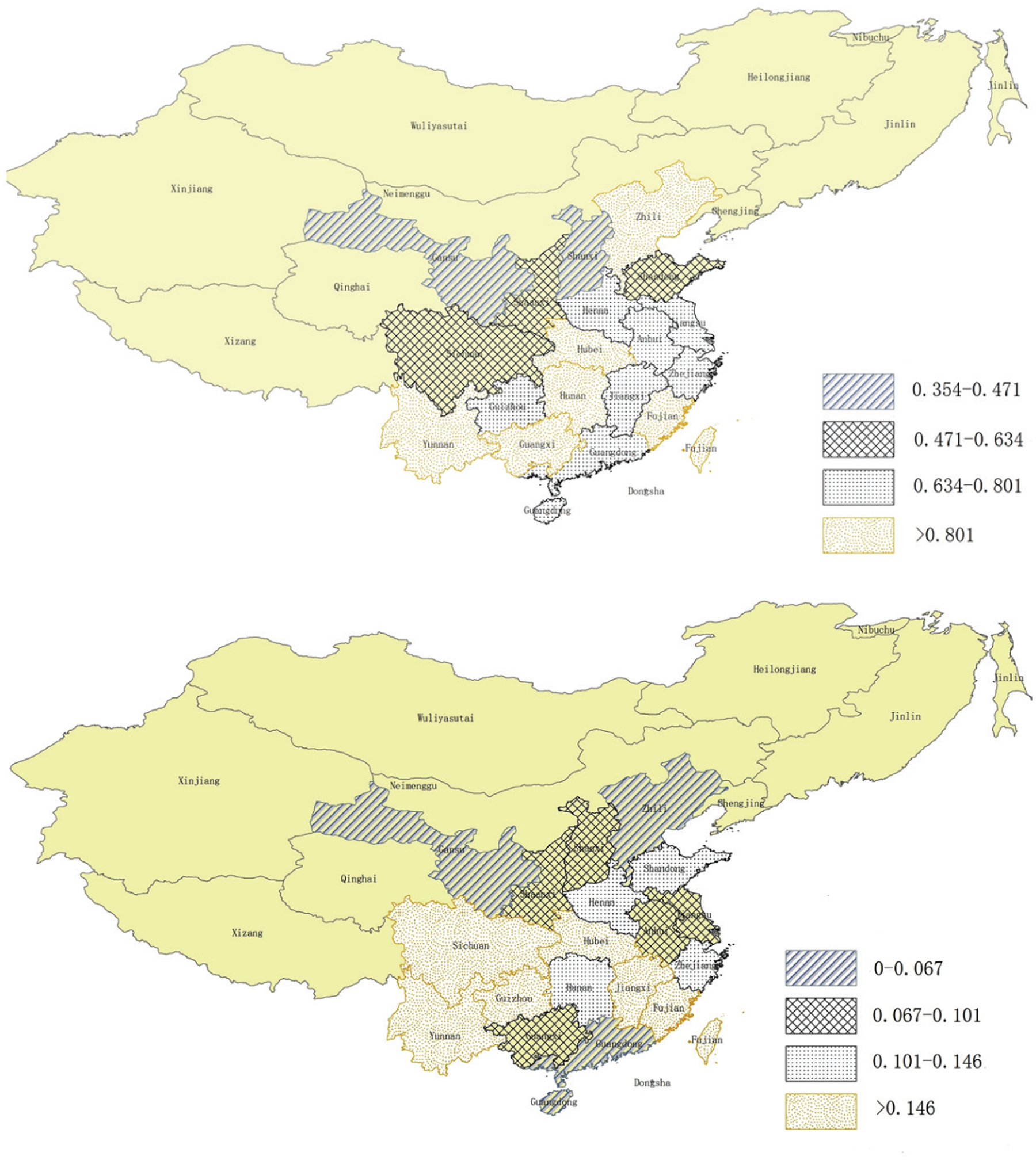
Regions being covered.
We intend to account for multi-dimensional features of governors’ competence. To that end, we collect biographic information of governors to construct a set of measures of their career backgrounds. Jinshi is a dummy variable indicating whether a governor had obtained the highest degree of performance in Chinese Imperial Examination. #Positions registers the number of offices the governor had served before he was appointed to the current position. #Provinces documents the number of provinces the governor had worked before moving to the current province. Military is a dummy variable to capture a governor’s previous work experience associated with military affairs. The sources of governors’ biographic information include Biographic Dictionary of Qing bureaucrats (Zhu, 2010) and Qian (1980).
We also include several socioeconomic variables correlated with the demand for bureaucratic competence, including the logarithm of population, the logarithm of land tax quota in silver (tales), and the logarithm of tribute grain quota at the province-year level. The relevant information are obtained from Liang (1981) and Yan et al. (1955). Missing values are interpolated. Population size and tax quota reflect the difficulty of governance. Hence, controlling for these variable may alleviate the bias in estimation due to unobservable terms correlated with bureaucratic competence.
Aggregate Patterns
Before jumping into the formal econometric tests, we explore the aggregate patterns of bureaucratic selections to illustrate the intuition about Hypotheses 1 and 3. Hypothesis 1 maintains that sanction was more likely for Han governors with the occurrence of internal conflicts. Following Hypothesis 1, we expect the average ratio of sanction for provincial governors to be positively correlated with the level of conflicts. By a similar token, Hypothesis 2 implies that the trend of promotion was inversely correlated with conflicts. In Figure 2, we plot the temporal trends of the two ratios, together with the level of conflicts. It is straightforward to tell that both patterns are consistent with the hypotheses.
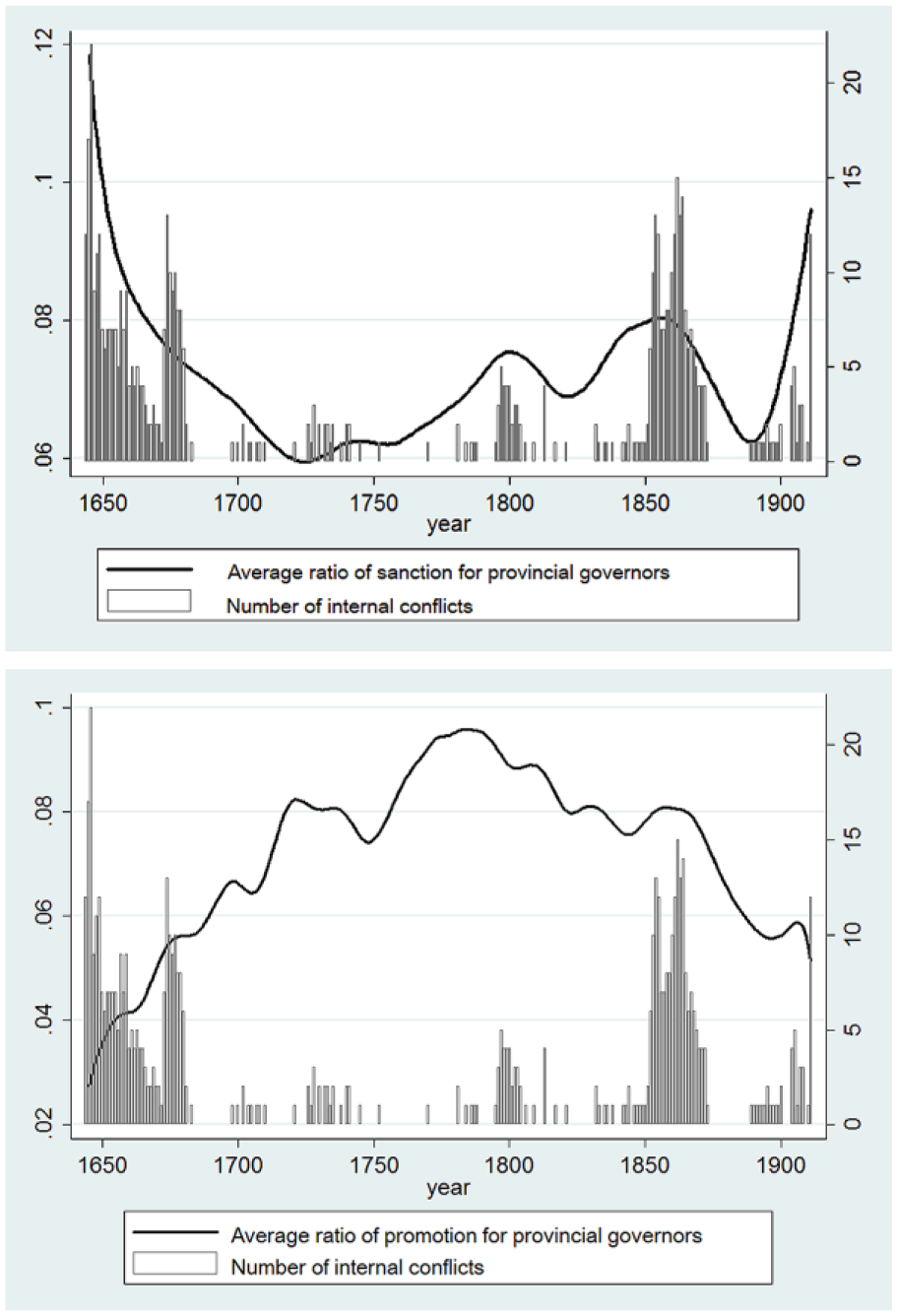
Bureaucratic sanctions and internal conflicts.
Hypothesis 3 predicts that internal conflicts compelled the rulers to appoint more Hans as governor. In the left panel of Figure 3, we report that the average ratio of Han governors was U-curved with respect to time. For reference, we plot the ratio for Han governor-generals and obtain a similar pattern. In the first decade of the Qing dynasty, the provinces were almost exclusively governed by Hans, with many “twice-serving ministers” defected from the Ming dynasty. The ratio of Han governors started to decline after the ascendance of Emperor Kangxi. A number of Han governors were purged by regent Oboi, who expanded the patronage for Manchus (Wakeman, 1977, pp. 87-88). In the 18th century, the proportion of Han governors continued to follow a downward trend, only to pick up an increasing trend in the 19th century. Hans’ proportion in governors and governor-generals were synchronized with internal conflicts.
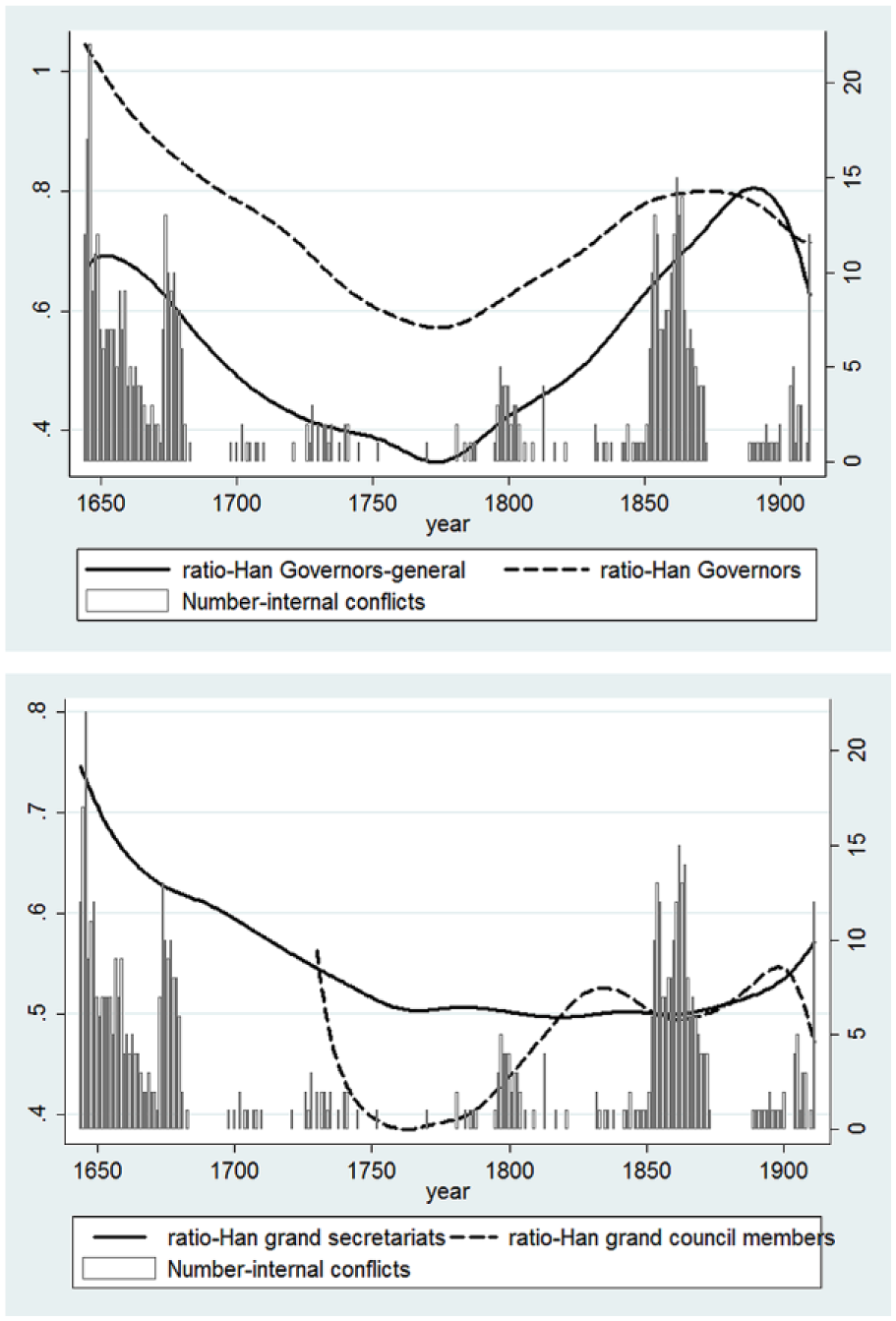
The changes in the ratios of Han officials and internal conflicts nationwide.
The right panel of Figure 3 plots the proportions of Hans as grand secretariats and grand council members, two most powerful positions in the central government. Both demonstrate a U-shaped trend over time, consistent with the movement of conflicts. It is evidence that the two trends of the top-ranking bureaucrats were flatter than that of Han governors. These patterns are consistent with Hypothesis 2, which predicts that bureaucratic selection would increasingly value coethnicity and loyalty for appointments toward the top level. The time variation in the Hans’ proportion at different positions spells out a grand strategy of ethnic power-sharing.
The strategic consideration in power-sharing is also evident by scrutinizing the pattern of appointments. Most mass rebellions were followed by an increase in the fraction of Han governors. In particular, mass warfares during the Taiping Rebellion in the 1850s preceded the rise of Han governors in the late Qing period. Figure 4 shows that there were 1,546 appointments of governors altogether in the Qing history. Among them, 152 appointments occurred with the incidence of internal conflicts in the previous year and 1,413 took place under relatively peaceful environments. Two observations follow from the analysis. (a) The chance of appointing Hans in a conflicting environment was
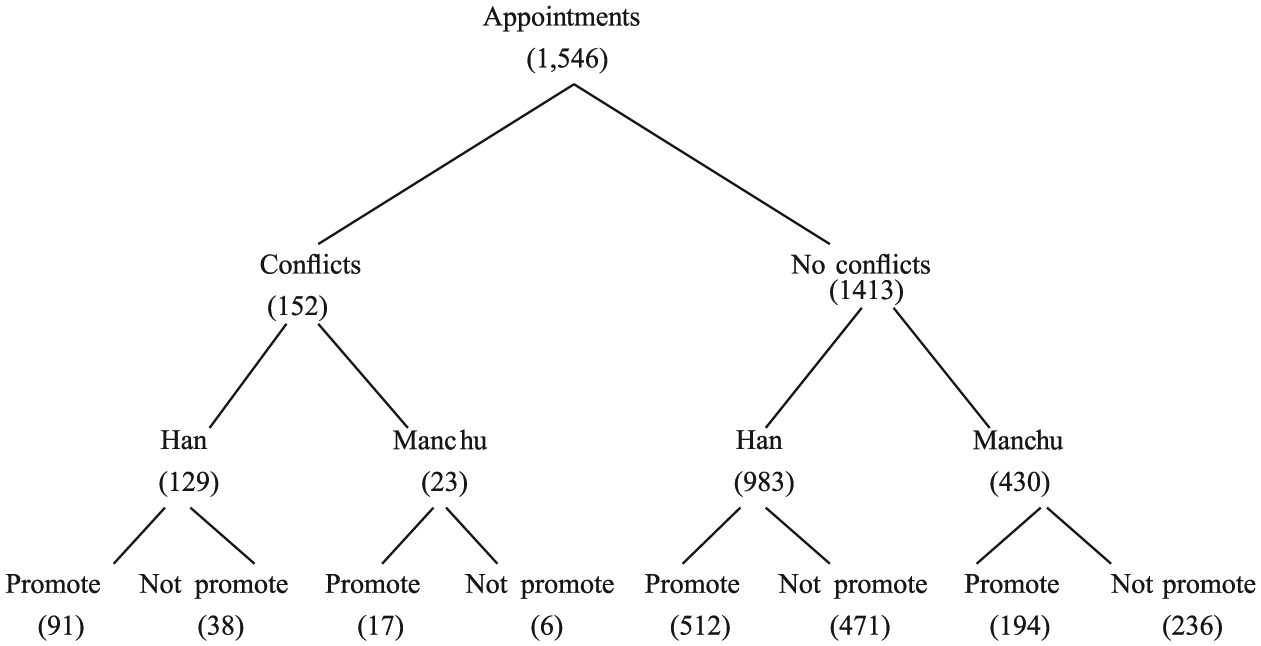
Distribution of personnel appointments.
Sanctions
We test Hypothesis 1 by estimating the impacts of internal armed conflicts on the probability of bureaucratic sanction. The estimations use the following linear probability models:

When the prior distribution of latent probability is not too dispersed, linear probability models obtain higher estimation efficiency than nonlinear models do (Angrist & Pischke, 2008).
4
In Equation 1, the dependent variable
The favoritism toward Manchu bureaucrats is additionally tested by including the interaction between
Table 1 reports the estimates for Equation 1. In column 1, only
Sanction and Internal Conflicts.
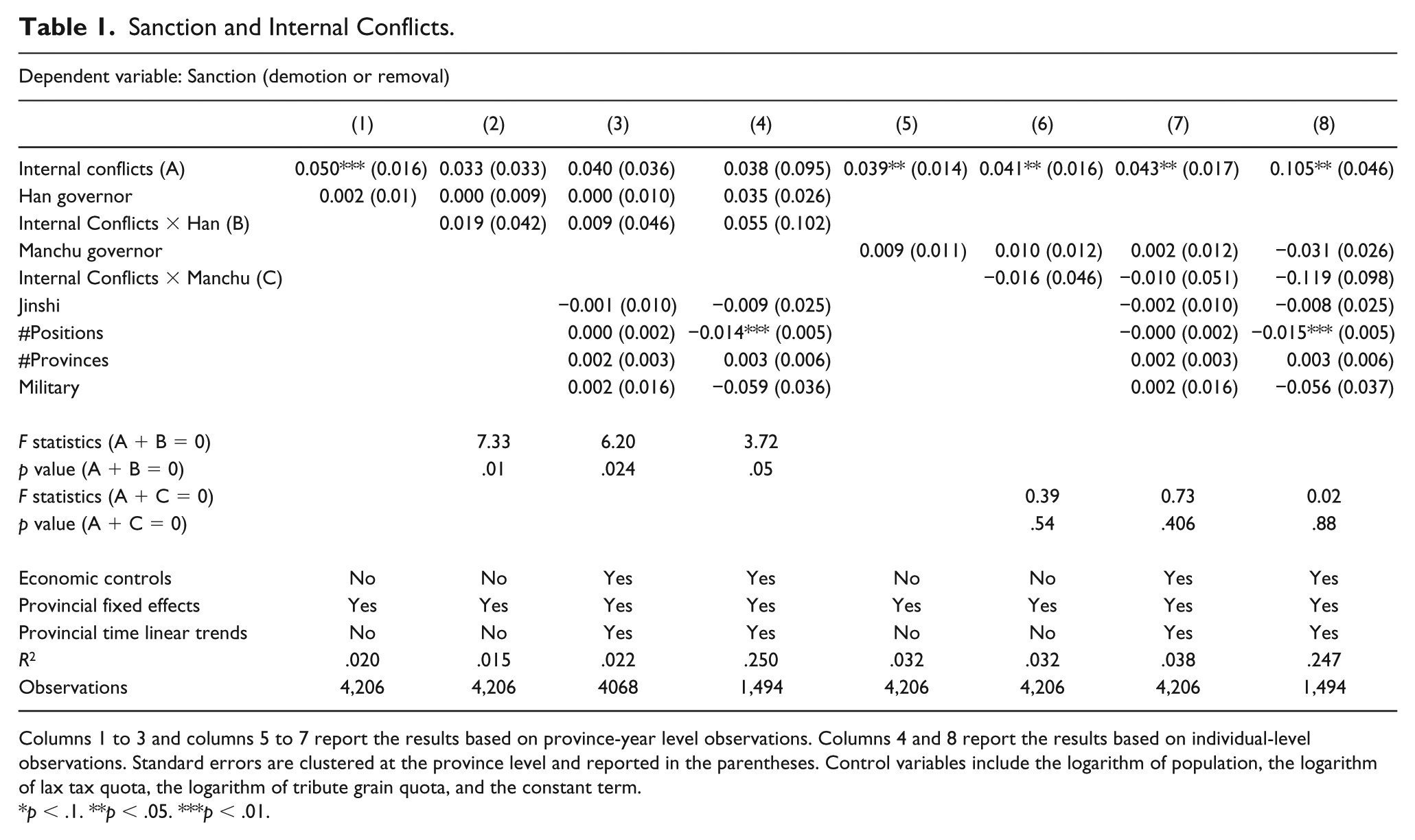
Columns 1 to 3 and columns 5 to 7 report the results based on province-year level observations. Columns 4 and 8 report the results based on individual-level observations. Standard errors are clustered at the province level and reported in the parentheses. Control variables include the logarithm of population, the logarithm of lax tax quota, the logarithm of tribute grain quota, and the constant term.
p < .1. **p < .05. ***p < .01.
In column 4, we implement a robust check by applying the analysis at the individual level. It is possible that conflicts occurred right before the governor was appointed, and thus the sanctioned governor was a scapegoat. To deal with this problem, we estimate the probability of sanction upon the end of a governor’s term and adopt term-average conflicts as a measure of conflicts. The estimation reports a larger sum of coefficients for the impact of conflicts on Han governors:
Columns 5 to 8 in Table 1 provide a mirror of the results of columns 1 to 4 by replacing the dummy variable
Promotions
Equation 2 describes the econometric model for estimating the probability of promotion. The dependent variable

Hypothesis 2 suggests an ethnic favoritism toward Manchus in terms of promotion. This is manifested by a negative coefficient for
Promotion and Internal Conflicts.
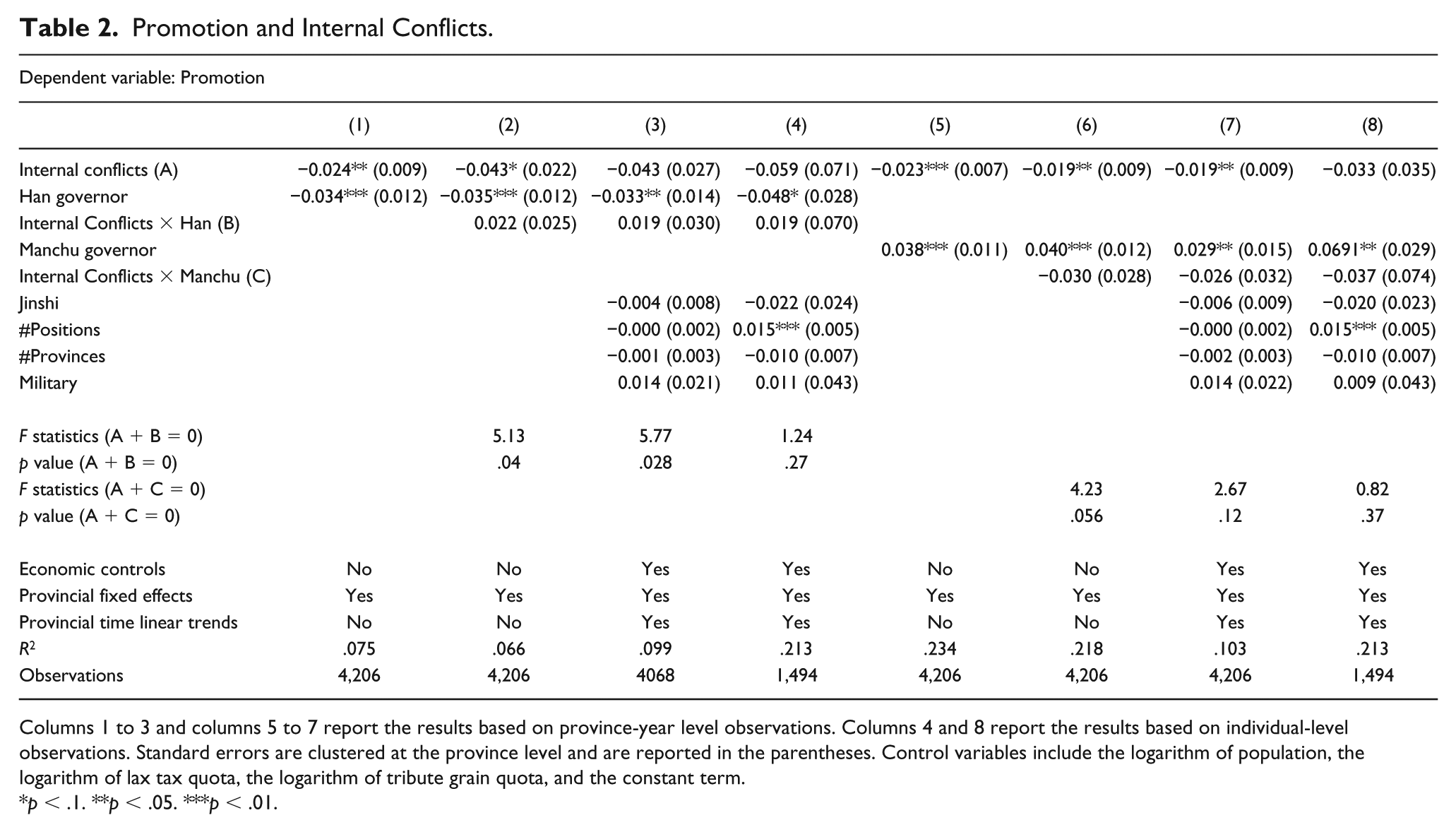
Columns 1 to 3 and columns 5 to 7 report the results based on province-year level observations. Columns 4 and 8 report the results based on individual-level observations. Standard errors are clustered at the province level and are reported in the parentheses. Control variables include the logarithm of population, the logarithm of lax tax quota, the logarithm of tribute grain quota, and the constant term.
p < .1. **p < .05. ***p < .01.
Columns 5 to 8, the Manchu mirrors of columns 1 to 4, document similar results. The impacts of internal conflicts on promotion were not robust for Manchu governors, and moderately negative for Hans. These results are consistent with the logic of bureaucratic power-sharing. For autocratic rulers, the instrumental value of power-sharing lies in the enhancement of local stability at the subnational level. Loyalty superseded performance and competence for the appointments at higher levels. So internal conflicts might have a moderate impact on promotions to the top level.
Appointments
We now examine the data on internal conflicts and new appointments to test Hypothesis 3. The probability of observing a Han governor in province


In Equation 3, the impact of rising conflicts on the tendency of appointing Han governors is captured by
Table 3 reports the estimates for Equation 3. Column 1 presents three coefficients:
Appointments and Internal Conflicts.

Standard errors are clustered at the province level and are reported in the parentheses. Control variables include the logarithm of population, the logarithm of lax tax quota, the logarithm of tribute grain quota, and the constant term.
p < .1. **p < .05. ***p < .01.
Columns 3 and 4 estimate the model similarly, but replace the dummy
How Did Han Governors Perform?
While the empirical results lend support to the argument that the propensity of selecting Hans amid conflicts was stimulated by the demand for competence to maintain peace, other factors may have a confounding effect. One related channel is that the Han faction might be able to wield more personnel powers in times of crisis. Another possibility is that the ruling court sold important powerful offices to Han bureaucrats to deal with war finance problems. 7 In this section, we study the effects of Han governors on lowering conflicts to clarify on the causal mechanisms driving the pattern of selections.

In Equation 4, conflicts in province
Column 1 of Table 4 reports the estimates based on the full sample. It shows that the coefficient
Ability to Neutralize Conflicts: Hans Versus Manchus.
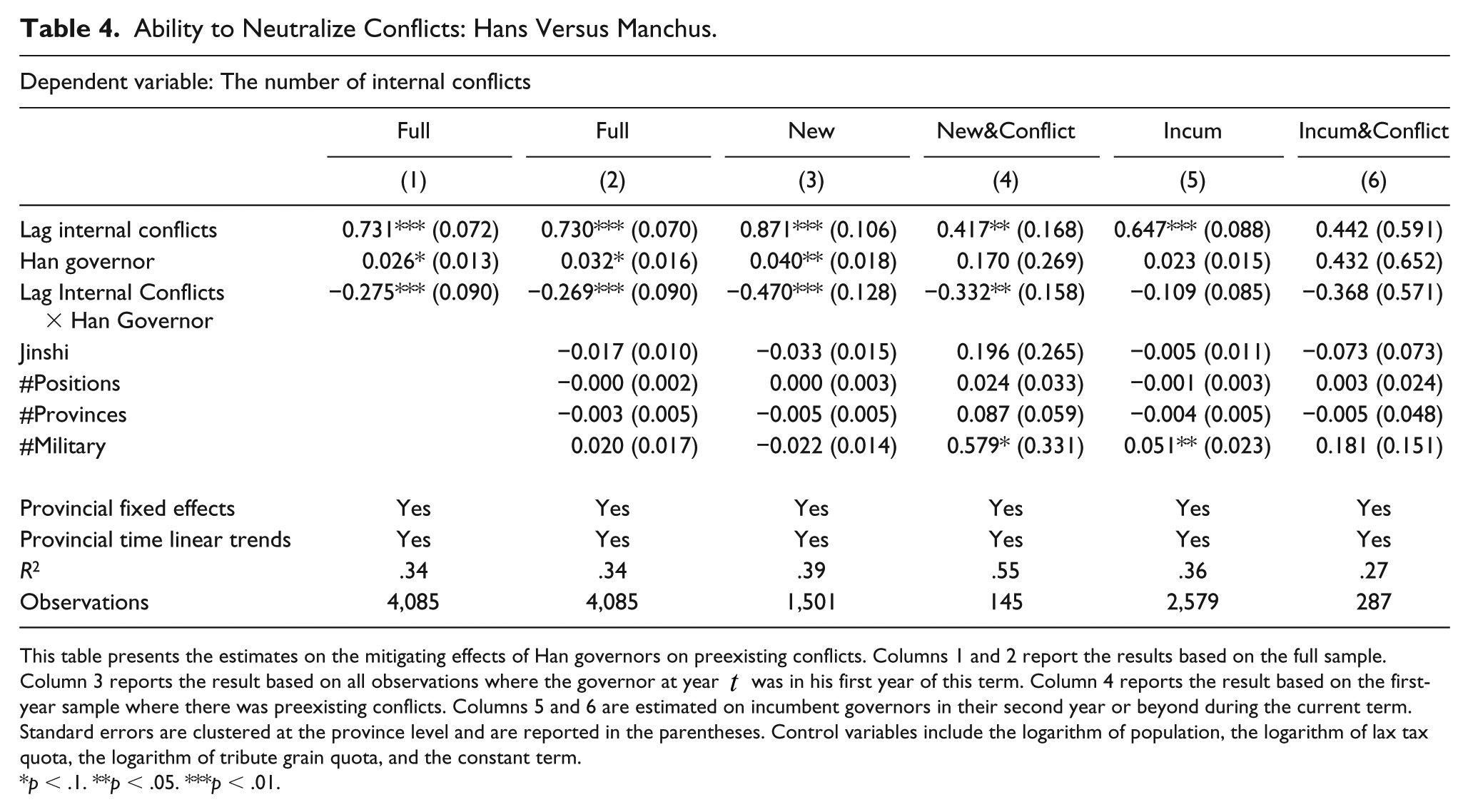
This table presents the estimates on the mitigating effects of Han governors on preexisting conflicts. Columns 1 and 2 report the results based on the full sample. Column 3 reports the result based on all observations where the governor at year
p < .1. **p < .05. ***p < .01.
To clarify on underlying mechanisms, we estimate Equation 4 on the subsample of newly appointed governors only. In column 3, the coefficient of the Han dummy remains positive, and the interaction term
In columns 5 and 6, we estimate the effects for incumbents governors, those in their second year or beyond of the current term. The effects of incumbent Han governors are insignificant for conflict appeasement. Veteran governors might be responsible for rebellions under their watch. Thus, they might not be as good as new appointees. The estimates highlight that the instrumental value of enhancing stability may be a main motivation to share power with the Hans.
Robustness and Alternative Mechanisms
We supplement the main empirical analyses with a set of tests for alternative mechanisms and robustness. The results are relegated to the appendix. First, in Online Appendix Table A2, we separate local conflicts that were confined within one province and mass rebellions that spread across provincial borders. We find that mass rebellions significantly increased the probability of sanction and lowered the probability of promotion for Han governors, but local conflicts did not matter. Both types of conflicts gave rise to a greater propensity of appointing Hans as governor.
In Online Appendix Table A3, we report a robustness check on the coding for ethnicity. We first categorize all Han Bannermen as Manchus and reestimate Equations 1 and 2. We then consider Han Chinese and Han Bannermen as two different groups. We find that the baseline results as reported in Tables 1 and 2 are preserved using the narrower definition for the Han ethnicity. When the dummies for Han Chinese and Han Bannermen are simultaneously included, the effects of conflicts identified in the baseline estimations are found for Han Chinese, but not for Han Bannermen who were considered more loyal to the Qing rulers.
In Online Appendix Table A4, we address ethnic heterogeneity within the Manchu group. It is possible that the Qing rulers considered some Manchu subgroups as rivals, and thus more reluctantly promoted them. We assign an identifier for each subgroup under the Eight Banners system and separately reestimate Equations 1 and 2. We do not find effects of internal conflicts on sanction and promotion for each subgroup except for two cases. In any case, if the Qing ruler would consider a subgroup of Manchus as a threat against their own interests, the Manchu and Han difference should be blurred. This possibility rules against our hypotheses and hence is less of a concern for empirical investigation.
We address the possibility that there may be contemporaneous correlation across units and that the error term follows an autoregressive process. To deal with this issue, we adopt panel-corrected standard errors developed by Beck and Katz (1995) and reestimate Equations 1 and 2. We try to account for the possibility that the estimated impacts of conflicts on sanction and promotion just capture the bad luck of governors. To this end, we adopt the lagged measure of conflicts for estimating the probability of sanction and promotion. The results obtained from using panel-corrected standard errors and lagged conflicts resemble the baseline estimates. We report them in Online Appendix Table A5.
Finally, we attempt to explore the difference over policy implementation between Han and Manchu governors in Online Appendix Table A6. In the imperial China, the state relied heavily on local elites as tax farmers to raise revenue and the gentry class to provide famine reliefs (Bernhardt, 1992; Will, 1990). In turn, tax exemption and famine relief might reflect the preference for governors. Using the prefecture level data on extreme weather conditions and the administrative data on tax exemption and famine relief, we find that Han governors on average were less likely to solicit subsidies for famine relief when the province was hit by extreme weather conditions. They did, however, apply tax exemption at a higher frequency than Manchus did in normal times as well as during natural disasters. The discrepancy in governors’ policy inclinations is suggestive of stronger tendency of regional favoritism by Han governors. An explanation is that some Han governors build local connections through local political networks, so they did a better job of containing the risk of famine in the first place. As a result, they needed less of subsidy from the central government to provide famine relief (Hao & Liu, 2017). Regional favoritism was nevertheless costly for the rulers to the extent it reduced the total revenue available to the central government.
Conclusion
Autocratic rulers face a dilemma of how to secure a broad-based ruling coalition without jeopardizing the risk of diluting power. This article argues that the Qing rulers grappled with this problem through institutionalized bureaucratic selections. The Han bureaucrats from the majority group were entrusted to play a more instrumental role of maintaining peace at the subnational level, and they were increasingly appointed in the face of emerging mass rebellions. The Manchu bureaucrats were promoted to strike a balance of political powers at the top level. This hybrid model with loyalty and competence warranted the commitment to the long-term power-sharing for over several centuries.
This article speaks to the literatures on institutional engineering in ethnically divided societies by examining the case of imperial China. Our findings are consistent with the recent studies on power-sharing in Africa, which suggest that (a) executive power-sharing enhances the horizon of political survival and (b) the allocation of executive powers should reflect contesting powers of ethnic groups for peace to be sustainable (Arriola, 2009; Francois, Rainer, & Trebbi, 2015). Our article sheds lights on a puzzle which the previous literatures do not fully address: Why some ethnically divided societies are capable of committing to ethnic power-sharing coalition, while some other are not? The experience of China suggests that bureaucratic competence may make a difference. Without an institutionalized bureaucratic system, social stability and rent-production are not sustainable, and rulers would not have a committed incentive for power-sharing when the threat of rebellion ebbs. For power-sharing to be viable, competence should be entrenched at the root of political selection even if loyalty may nevertheless dictate power allocation at the top.
Supplemental Material
Qing_CPS_Aug2018_appendix – Supplemental material for All the Emperor’s Men? Conflicts and Power-Sharing in Imperial China
Supplemental material, Qing_CPS_Aug2018_appendix for All the Emperor’s Men? Conflicts and Power-Sharing in Imperial China by Tianyang Xi in Comparative Political Studies
Supplemental Material
replication_data – Supplemental material for All the Emperor’s Men? Conflicts and Power-Sharing in Imperial China
Supplemental material, replication_data for All the Emperor’s Men? Conflicts and Power-Sharing in Imperial China by Tianyang Xi in Comparative Political Studies
Footnotes
Acknowledgements
The author is grateful to the comments from Robert Bates, Carles Boix, Chen Qiang, Jon Eguia, Georgy Egorov, Daniel Esser, John Ferejohn, Price Fishback, Sanford Gordon, Hao Yu, James Hollyer, Peter Katzenstein, James Kung, Pierre Landry, Li Nan, Ma Chicheng, Ma Debin, Michael Munger, Emerson Niou, Peng Kaixiang, Adam Przeworski, Victor Shih, David Stasavage, Sun Guangzhen, Yao Yang, Zhang Xiaobo, and Zhou Li-An. The author also thanks Feng Yingjie, Huang Beichen, Liu Tong, and Wei Jinlin for excellent research assistance.
Declaration of Conflicting Interests
The authors declared no potential conflicts of interest with respect to the research, authorship, and/or publication of this article.
Funding
The authors received no financial support for the research, authorship, and/or publication of this article.

Notes
Author Biography
References
Supplementary Material
Please find the following supplemental material available below.
For Open Access articles published under a Creative Commons License, all supplemental material carries the same license as the article it is associated with.
For non-Open Access articles published, all supplemental material carries a non-exclusive license, and permission requests for re-use of supplemental material or any part of supplemental material shall be sent directly to the copyright owner as specified in the copyright notice associated with the article.
