







Abstract
The shifts from state-led development to neoliberalism in Latin America have prompted debates on the quality of democracy. Although most discussions focus on responsiveness, we examine how economic policy regimes influence accountability. How do policy regimes affect citizens’ ability to hold executives to accounts? This ability, we argue, strengthens where policy regimes are more statist and weakens where policy regimes are more market oriented. Time-series analyses of policy orientations, economic conditions, and presidential approval in 17 countries support this proposition, whereas complementary analyses at the individual-level are consistent with claims that policy regimes influence accountability via a responsibility mechanism. Findings from this study imply that by embracing heterodox policy regimes, recent Latin American executives have improved accountability compared with the era in which the “Washington Consensus” held sway.
The Latin American debt crisis precipitated one of history’s quickest, boldest, and geographically broadest waves of economic reform. Political and social disruptions in its wake quickly prompted scholars to reassess two core elements of democratic theory—representation and accountability—in contexts of economic flux (Borón, 1996; Domínguez, 1998; Kelly, 2003; O’Donnell, 1994; Stokes, 2001; Weyland, 2004). Although the rise of the Latin American Left fueled an impressive follow-on research agenda on the link between economic policy regimes and representation (inter alia, Baker, 2009; Baker & Greene, 2011; Levitsky & Roberts, 2011), and the Great Recession stoked renewed interest in the political economy of financial crises in the region (e.g., Steinberg, 2017; Steinberg, Koesel, & Thompson, 2015), the implications of policy change for economic accountability received less attention.
The effects of policy regimes on accountability warrant fresh examination on the following grounds. First, we lack consensus. Early work struggled to reconcile retrospective voting theory with the short-run discretion publics accorded to leaders after “Washington Consensus” stabilization and structural adjustment packages (Buendía, 1996; Echegaray & Elordi, 2001; Gervasoni, 1999; Weyland, 1996). Now the short run has become the long run. Typical political business-cycle spending to appease reforms’ losers has morphed into an array of policy regimes marrying neoliberal principles to state interventions meant to soften their negative externalities (Avelino, Brown, & Hunter, 2005; Kurtz & Brooks, 2008). Statist and neoliberal dogmatisms have given way to the pragmatism of mixed regimes in the “post-Washington Consensus” era (Birdsall & Fukuyama, 2011). But how do policy regimes influence how citizens hold presidents to accounts? The jury is out.
A second reason to revisit the policy-democracy link is its conspicuous absence in recent works on accountability in Latin America. Studies of the backlash to neoliberalism dealt primarily with protests that interrupted Latin American presidencies (e.g., Arce & Bellinger, 2007; Kurtz, 2004; Pérez-Liñán, 2007). The few studies that analyze the less dramatic, but continual, linkage between the economy and presidential approval place little weight on the role of distinct policy regimes (Arce, 2003; M. E. Arce & Carrión, 2010; Kelly, 2003). Tests of conditional accountability largely probe factors orthogonal to the structure of the national economy (e.g., Campello & Zucco, 2016; Carlin, Love, & Martínez-Gallardo, 2015a, 2015b; De Ferrari, 2015; Gélineau, 2007; Johnson & Schwindt-Bayer, 2009; Rosas & Manzetti, 2015; Samuels, 2004; Zechmeister & Zizumbo-Colunga, 2013). Given the political salience of economic policy reforms, we know surprisingly little about their implications for the public’s ability to reward presidents for economic gains and punish them for losses. These implications go to the heart of democratic quality.
This study unpacks the mass politics consequences of political-economic systems. Do changes in how economies work matter for how democracy works? Our starting point is simple: Economic policy regimes determine the state’s role in the economy and, in turn, condition public perceptions of incumbent responsibility for economic outcomes. Interventionist regimes put the levers of policy control firmly in the state’s hands, thereby clarifying where the buck stops and that economic outcomes—good or bad—depend on incumbent decisions. Neoliberal regimes, however, seem to imply a reduction in elected officials’ day-to-day control of policy. By shifting the burden of economic management from the state to the private sector, incumbents under neoliberalism can eschew responsibility for outcomes. Asymmetry results. Incumbents who govern under freer markets risk less punishment for poor performance but reap fewer rewards for good times. Likewise, in more statist policy regimes small ticks up or down in economic performance translate into wide swings in incumbent popularity. Yet, the model of economic management, be it “hands on” statism or “hands off” neoliberalism, is an explicit policy decision. Neoliberalism, thus, damages accountability by feeding the perception that incumbents who oversee liberal economies can wash their hands of economic outcomes.
Next, we discuss how economic policy regimes shape policy responsibility which, in turn, contributes to how citizens evaluate policymakers. Then, we introduce Latin America as our context of interest and show how statist and neoliberal policy orientations vary over time and across the region. Examining their influence on responsibility attributions, we find that voters tend to assign responsibility for economic problems to the government under statist policy regimes but systematically blame the private sector under neoliberal models. We then show the implications of policy regimes for presidential approval: statist policy orientations sharpen ties between the economy and popularity; neoliberal models weaken them. The conclusion discusses our study’s implications for democracy in Latin America and, more generally, for the limits of economic accountability.
Economic Responsibility and Accountability Under Distinct Policy Regimes
By accountability we mean “the electorate’s capacity to reward or sanction incumbent politicians” (Samuels, 2004, p. 425). If elections and mass mobilization are potent but are rare opportunities to hold executives accountable (Manin, Przeworski, & Stokes, 1999), then public evaluations between elections approximate a continual accountability mechanism (Johnson & Schwindt-Bayer, 2009; Kelly, 2003). Grounded in psychological theories of responsibility attribution in the context of ideal-typical statist and neoliberal regimes, we claim that policy strategies shape the prospects for economic accountability.
The canonical retrospective economic voting hypothesis hinges on voters assigning incumbents responsibility for economic conditions. Yet, voters’ ability to do so, and thus exact accountability, varies according to factors—institutional, economic, political, and social—that alter the “clarity of responsibility” (Powell & Whitten 1993; see Anderson, 2007). To this list of factors, we submit economic policy regimes. Apropos of this are studies showing how ties to global markets and international lending institutions shrink politicians’ room to maneuver, shift blame away from incumbents and, in turn, reduce the weight of economic performance on government evaluations (Alcañiz & Hellwig, 2011; Campello & Zucco, 2016; Hellwig, 2014). Thus, the notion that policy orientations matter for economic accountability, while unexamined, is not far-fetched. But what are the underlying mechanisms?
Economic policy regimes, we posit, shape economic accountability by altering two primary forms of responsibility attributions prominent in social psychology—causal and role—that voters employ when assessing incumbents (Arceneaux, 2006). Causal responsibility is attributed to those whose action is viewed as a proximate cause of an outcome (Hewstone, 1989). As Arceneaux (2006) notes, “[i]n the context of a voting model, causal responsibility attribution is a retrospective evaluation of government performance” (p. 736). Role responsibility attributions refer to the range of obligations one ought to fulfill. Roles concern “the normative context within which the actor is judged,” and, therefore, “it’s not necessarily what you did [or didn’t do], but what you did [or didn’t do] given who you are” (Hamilton, 1978, p. 321; italics in the original). Here, the public expects presidents to fulfill their social roles as stewards of the economy.
Do policy regimes alter causal and role responsibility attributions? We expect so. In pure statist models, the state plays the economic protagonist, promoting production (via credit, subsidies, etc.) and picking sectoral winners (via tariffs, commodity boards, etc.). Economic management is “job one”; role responsibility for the economy is high. And, because economic outcomes (employment, wages, prices, etc.) flow clearly from government policies, causal responsibility is also high. Orthodox neoliberalism, in contrast, rejects state economic intervention as anathema. By arguing that markets rather than the state govern the economy, architects of neoliberal policy regimes seek to circumscribe their economic roles and, in turn, shed responsibility for economic outcomes. Through multiple channels, such as eliminating trade barriers, weakening neo-corporatist structures, removing wage and price controls, and floating currencies, market fundamentalism removes the government’s fingerprints from economic outcomes and frustrates causal responsibility attributions, leaving voters unsure about the effects of policymaker decisions. In the process, incumbents may deflect responsibility onto market actors empowered by a “Washington Consensus”-type policy environment. The causal attributions framework thus suggests the public will hold presidents more accountable for economic conditions under statist policy regimes than under neoliberal ones.
From one perspective, attributing less economic responsibility and exacting less accountability under neoliberalism than under statism is a rational response. Why should voters attribute responsibility to presidents for outcomes beyond their purview and delinked from their actions? But several tensions make us less sanguine about the normative implications of lowered accountability under neoliberalism. Namely, eschewing role responsibility and avoiding (or shifting) causal responsibility for economic outcomes strains credulity for executive policymakers. Whether they extoll statism, neoliberalism, or something in between, the buck still stops with them—especially in Latin America given presidential dominance in policymaking (Morgenstern & Nacif, 2002). And while presidents may feign innocence or blame other actors, the fact remains that their policy choice—be it action or inaction—is, strictly speaking, causal. Perhaps at one time this was a strategic hedge against hard times. But refraining from economic intervention is a policy decision per se. Moreover, accountability suffers if orthodox reformers escape blame for economic downturns or get no credit for economic booms. So if our thesis is right, neoliberalism shrinks role responsibility but also confounds the public’s understanding of causal responsibility—to the detriment of economic accountability and democratic quality. In contrast, under statism accountability thrives.
More commonly, of course, policy choices lie between statist and neoliberal extremes. Heterodoxy need not imply policy incoherence. Just as post-war Europe’s bargain of “embedded liberalism” coherently blended domestic interventionism with a liberal approach abroad (Ruggie, 1982), Latin America’s “embedded neoliberal” regimes promote free trade and capital flows and deploy supply-side interventions (Kurtz & Brooks, 2008). These run the gamut from labor-market policies such as training programs and public employment, to industrial policies that encourage exporters to invest in technology, diversify, and reach new market segments, to an array of public resource commitments (Kurtz & Brooks, 2008). So while heterodox policy regimes require a more economically active state than orthodox ones, their economic outcomes are more at the mercy of market forces than under statism. Thus, in mixed regimes, we expect citizens to assign executives a judicious degree of responsibility for the economy—less than under statism but more than under neoliberal orthodoxy.
In sum, economic policy regimes should influence accountability by obscuring or clarifying responsibility for the economy. Whereas liberalization should decrease the role and causal responsibility the public assigns incumbents for economic output, state intervention should increase it. The extent to which the public holds leaders to accounts for the economy should therefore fall with neoliberalism and rise with statism. Between these poles, heterodox regimes ought to induce moderate degrees of economic accountability. Evidence consistent with these expectations would underscore the consequences of political-economic models and the quality of democracy. Below, we assess these claims empirically.
Policy Regimes in Latin America: Description and Measurement
Moving from theoretical abstraction to empirical observation, we measure policy regimes in Latin America since the 1980s and test whether they condition economic responsibility attributions and accountability in line with expectations. Within three decades, policymakers across the region crafted—to varying degrees and at varying rates—three distinct economic policy regimes: ISI statism, orthodox neoliberalism, and heterodoxy. This heterogeneity, not to mention lingering doubts as to policy regimes’ effects on accountability, makes the region a useful testing ground.
The genesis of economic policy change in Latin America was the 1980s debt crisis spurred by the exhaustion of statist import-substitution development models. Executives in the region accepted short-term stabilization packages from the International Monetary Fund, World Bank, and Inter-American Development Bank. After these failed, they implemented neoliberal structural reforms unilaterally or via the mechanism of loan conditionality. By reducing the state’s role in markets, neoliberal orthodoxy made interventionist policies such as price and capital controls, credit subsidies, and comprehensive social insurance programs undesirable or infeasible.
Yet, structural reform was uneven across policy sectors and countries, and statist policies were not swapped 1:1 for neoliberal ones. After meeting the short-run goal of stabilization, the arcs of structural reforms diverged across policy sectors and countries. Liberalization in trade, foreign investment, and privatization was aggressive but timid in taxation and labor. As Lora (2012, p. 3) notes, “these changes involve far-reaching reforms, but they also suggest that not all the reform potential was exploited.” Indeed, since the masses rejected the market’s vagaries but cheered its consumptive benefits (Baker, 2009), many leaders embraced heterodox strategies. Such models combine economic openness and state production promotion, welfare protections, investments in human capital formation, countercyclical spending, and supply-side interventions (Avelino et al., 2005; Kaplan, 2013; Kurtz & Brooks, 2008).
We measure these policy regimes through a pair of indices tapping the degree to which the economy accords with market fundamentals and state’s ability to offset negative market externalities. To start, we rely on Lora’s (2012) indices of structural reform in five areas: trade, financial markets, tax reform, private sector ownership, and labor markets. The trade index gauges the removal of tariffs and other trade barriers. The financial liberalization index combines metrics of bank reserve ratios, interest rates, taxes on financial transactions, and bank supervision. The tax index looks at national tax policy legislation. The privatization index taps levels of private investment in infrastructure projects in the transport, telecommunications, energy, and water sectors, and reflects the accumulated value of the privatizations, net of nationalizations, as a percentage of GDP. Finally, the labor market index gauges flexibility in hiring and firing, social security contributions, and minimum wage levels.
Nearly all Latin American countries made neoliberal reforms in the 1990s, especially in trade and finance, and to lesser degrees in taxes and privatization. Labor market reforms were fewer, more limited, and often a hodgepodge of pro-market and statist policies—a reality Lora’s labor market index obscures. We address this by developing an unambiguously statist measure of reforms to worker welfare based on protections from joblessness, sickness, and old age. Specifically, the worker welfare index combines Lora’s index of social security contributions and other taxes and payroll contributions with his measure of the minimum wage. 1 To incorporate the state’s willingness to offset negative market externalities through a broad range of fiscal interventions, following Kurtz and Brooks (2008), we include data on final government consumption as a share of GDP from the World Bank’s World Development Indicators. The measure includes all government expenditures (including payrolls) save military expenditures classified as capital formation. These six indicators tap distinct orientations of economic policy regimes. We expect trade, finance, taxation, and privatization to mark neoliberal orientations, and worker welfare and government consumption to reflect statist orientations.
With annual measures available from the mid-1980s to 2009 for most of Latin America, we use dynamic factor modeling (DFM) to generate summary indexes that tap orientations to Neoliberalism and Statism across policy regimes (Tripodis & Zirogiannis, 2015). Two features of our data suggest the use of DFM in place of standard factor-analytic methods. First, it accounts for how the indicators vary within and between countries over time. Second, it is appropriate for relatively short time dimensions (T < 50). Because country-specific estimates would preclude cross-national comparison, we assume the estimated factor loadings do not differ across countries. 2
Figure 1 displays our estimates of policy orientation over time for 18 Latin American and Caribbean countries. Long-dashed lines represent Neoliberalism, produced from the Lora indices for trade, finance, taxes, and privatization; high values connote orthodox neoliberal policies. Short-dashed lines reflect Statism, combining worker welfare and government consumption; high values signal the state plays a strong economic role. Together, the policy trends tell a compelling story of the political economy of Latin America. Neoliberalism shows a region-wide pro-market shift with respect to taxes, trade, finance, and regulation. However, as captured by Statism, trends in government spending and worker protections, areas in which Latin American policymakers retained or increased influence were not uniform (e.g., Kurtz & Brooks, 2008).
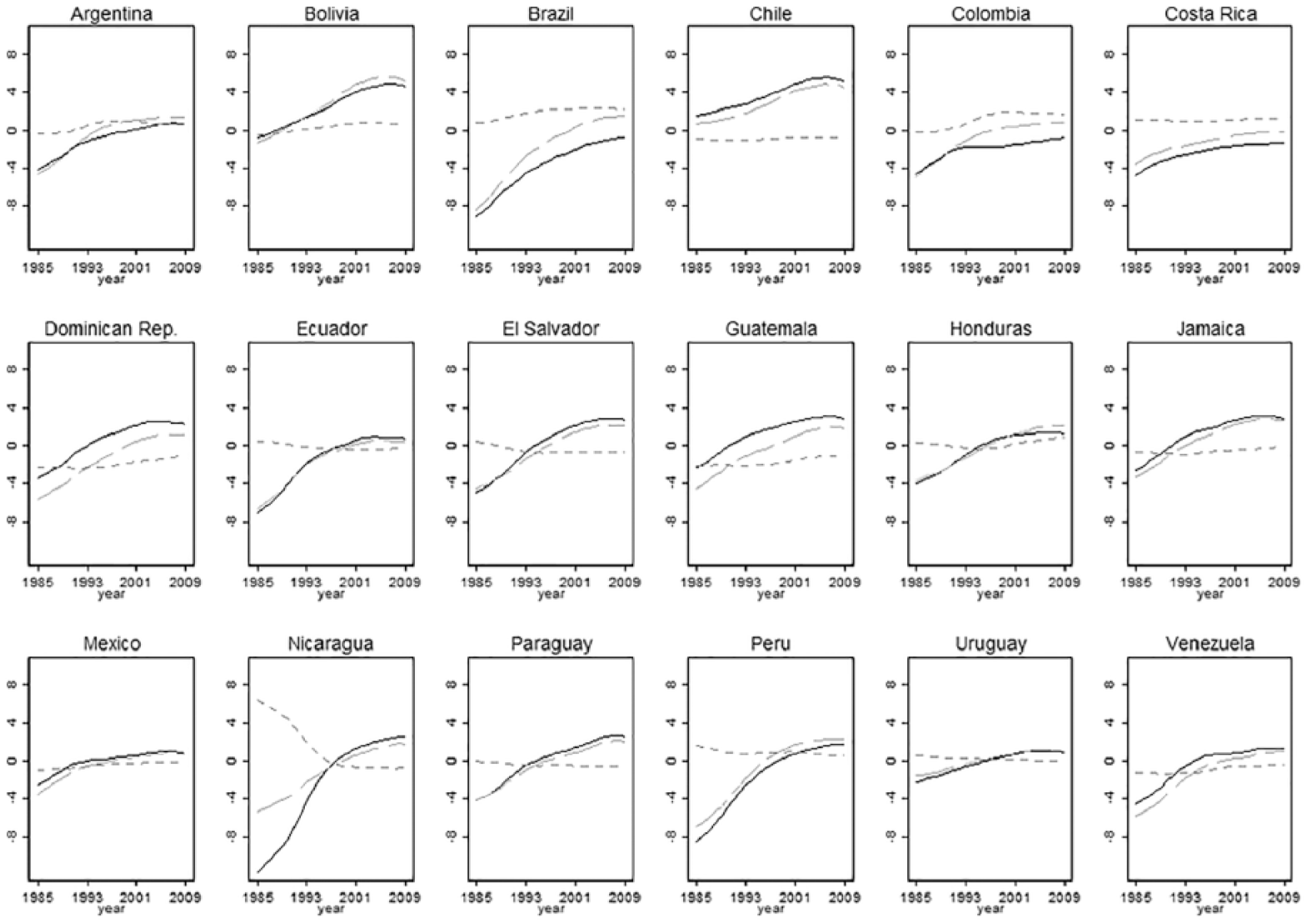
Economic policy regimes in 18 Latin American and Caribbean countries, 1985-2009.
To capture a more general orientation of economic policy, we subtract Statism from Neoliberalism to produce a single summary measure for the orientation of policy. The resulting series, which we label Policy Regime, appears as the dark solid lines in Figure 1. Policy Regime’s peaks and valleys are most obvious in emblematic cases such as Bolivia, Ecuador, Nicaragua, Peru, and Venezuela, where market-tilting reforms provoked instability and ushered in leaders who tempered them. Smoother liberalizing trajectories are found in Chile, Colombia, Costa Rica, Honduras, Mexico, and Uruguay. With these measures in hand, we now test the observable implications of our theory for responsibility attributions and for presidential approval.
Policy Regimes and Responsibility Attributions
We theorize that policy regimes condition accountability by altering the public’s ability to assign causal and role responsibility to incumbents for economic outcomes. Whereas interventionist policies clarify presidents’ role in stewarding the economy and their instrumental role in economic conditions, neoliberalism obscures these facets of responsibility. This, we argue, is the mechanism through which the orientation of economic policy shapes political accountability.
Is this proposition empirically defensible? Ideally, we would examine both role and causal responsibility attributions. However, such data do not exist, and even if they did, their observational manifestations would not differ. Therefore, we examine individual-level data on perceptions of policy responsibility, with the expectation that policy regime shapes how individuals assign blame for economic outcomes. We use data from the 2002 and 2003 Latinobarometer surveys. Respondents in 17 countries were asked, “Given the economic problems in [country], from the following list of institutions and actors, which do you think are responsible?” Respondents could choose up to nine actors on a closed list. Most frequently identified were “the government’s economic policy” (57% of respondents) and “the lack of entrepreneurial initiative” (24%). 3 These response options are handy proxies for, respectively, the state and market actors. Accordingly, we create an ordered trichotomous variable, Responsibility Attribution coded 1, if the respondent identifies the government’s economic policy as responsible, 2 if she blames lack of entrepreneurial initiative, and 3 if she blames either other actors or if she blames both government and business for the state of the economy. 4
We model Responsibility Attribution as a function of our Neoliberalism and Statism indices described above. Neoliberalism should be negatively related to blaming government policy but positively associated with blaming economic problems on a lack of entrepreneurial initiative. Statism should raise the likelihood of blaming government policies and lowering the likelihood of blaming business. At the macro level, the model includes a pair of controls: the natural log of GDP in real US dollars to capture effects of the size of the domestic economy, and central bank independence (Garriga, 2016) to address whether formal control over monetary policy matters. At the individual level, we control for ideological congruence, education, socioeconomic status, gender, and age (Alcañiz & Hellwig, 2011). 5 We estimate a generalized structural equation model with shared random effects and a multinomial link function. Intercepts are allowed to vary across country and include a dummy variable indicating whether the survey was administered in 2002 or 2003. This estimation strategy accommodates the multilevel nature of the data (individuals nested within country-years) and the unordered-choice nature of the dependent variable, respectively. 6
Table 1 reports the results, with “Government Economic Policy Responsible” and “Lack of Entrepreneurial Initiative Responsible” as the two reported response categories with all other actors as the baseline. Controls perform as expected: individuals who share the government’s ideology are less likely to blame government policy and more likely to cite entrepreneurs as responsible; the larger the economy, the more likely individuals will blame business. Variables of interest also comport with expectations. In the first column, Neoliberalism’s negative coefficient implies that, on average, individuals in market orthodox regimes are less likely to attribute responsibility for economic problems to the government’s economic policy relative to the baseline category. In the second column, Neoliberalism has the opposite effect; it raises perceptions that entrepreneurial initiative—or private sector business activity—is to blame for poor economic conditions. Statism’s negative and significant coefficient in the second column suggests policy regimes that interfere with the market reduce individuals’ tendencies to blame market actors. 7
Neoliberalism and Responsibility Attributions, 17 Latin American Countries, 2002-2003.
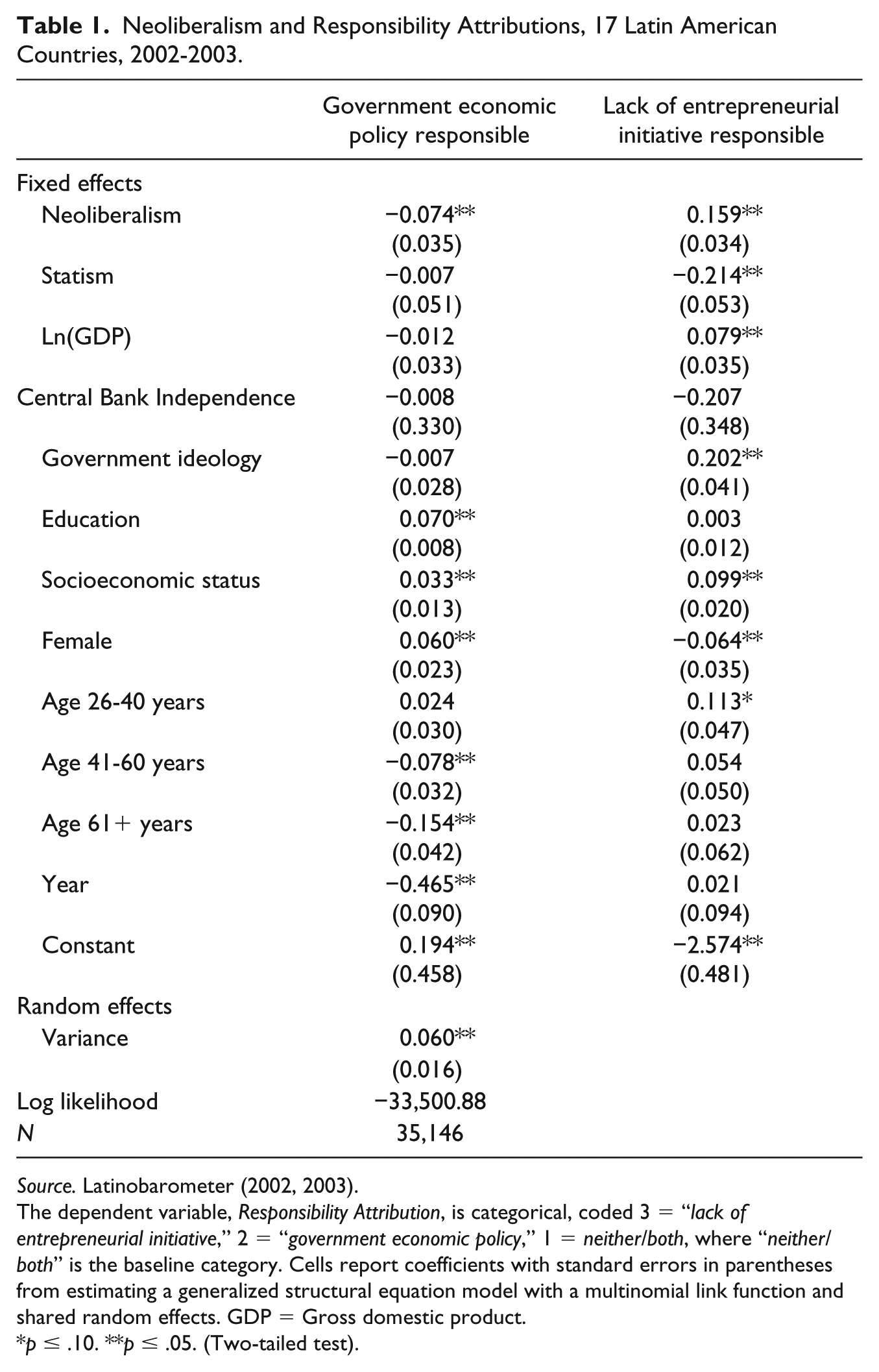
Source. Latinobarometer (2002, 2003).
The dependent variable, Responsibility Attribution, is categorical, coded 3 = “lack of entrepreneurial initiative,” 2 = “government economic policy,” 1 = neither/both, where “neither/both” is the baseline category. Cells report coefficients with standard errors in parentheses from estimating a generalized structural equation model with a multinomial link function and shared random effects. GDP = Gross domestic product.
p ≤ .10. **p ≤ .05. (Two-tailed test).
Table 2 illustrates the predicted probabilities of blaming the government in three counterfactual scenarios. The top row shows blame distribution in a case where both policy regime measures are set to their median in-sample values. In this scenario, the individual blames government policy with probability 0.42 and entrepreneurial activity with probability 0.20. The second row provides a contrasting example under an orthodox economic policy regime (Neoliberalism high, Statism low). Compared with the first scenario, here the average person is less likely to assign blame to the government than to businesses. The bottom row displays the inverse situation in which statist policies prevail. Consistent with expectations, we see a greater propensity to lay responsibility for economic conditions at the feet of government actors. While limits on the available survey data mean they should be taken as preliminary, these results are consistent with our basic proposition that neoliberal policy regimes reduce economic accountability by weakening mass perceptions of government responsibility for observed outcomes.
Probability of Responsibility Attribution, Counterfactual Scenarios.
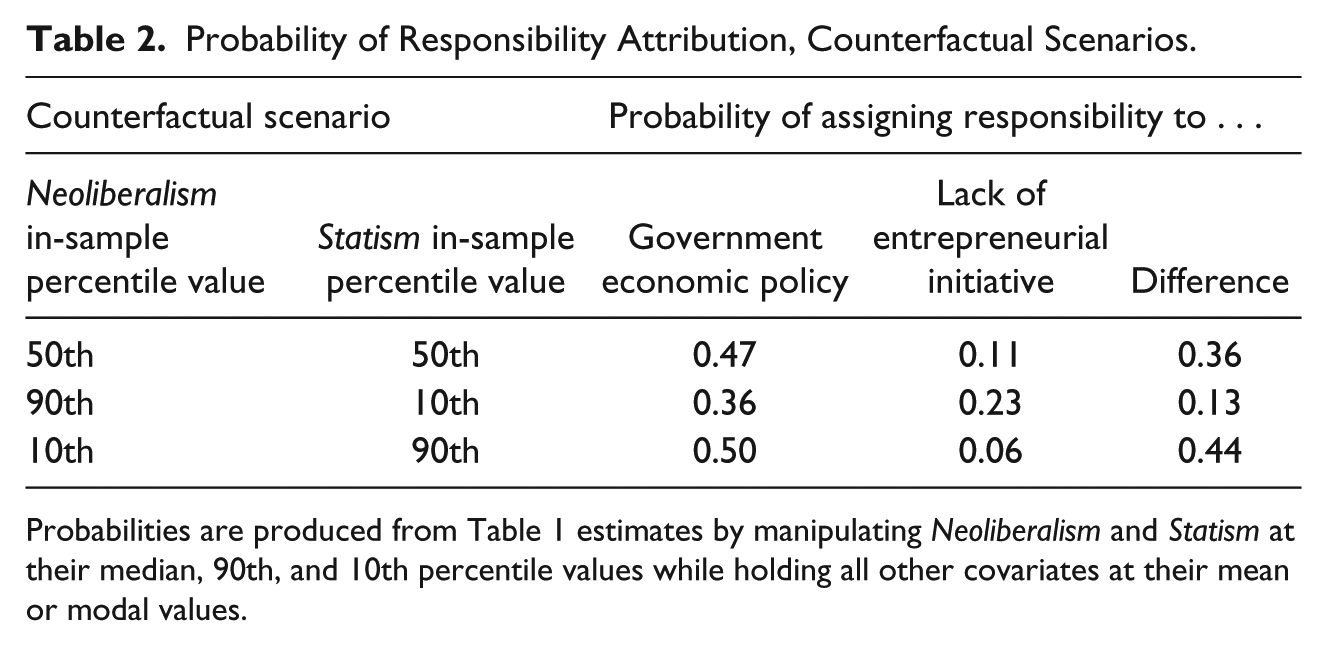
Probabilities are produced from Table 1 estimates by manipulating Neoliberalism and Statism at their median, 90th, and 10th percentile values while holding all other covariates at their mean or modal values.
Policy Regimes and Accountability
Policy regimes and economic responsibility attributions are related in ways consistent with the causal mechanism undergirding our theory. Now, we test our argument that policy regimes condition economic accountability using time-series cross-sectional models for 17 Latin America countries. Our dependent variable, presidential approval, derives from country-specific measurement models using Stimson’s (1991) dyad-ratios algorithm to combine multiple extant time series in the Executive Approval Database into single series (Carlin et al., 2016). This method is increasingly used in comparative studies of presidential approval in Latin America (e.g., Arnold, Doyle, & Wiesehomeier, 2017; Carlin et al., 2018; Carlin et al., 2015a, 2015b; Shair-Rosenfield & Stoyan, 2018; see Stimson, 2018, for a detailed description). Following Erikson, MacKuen, and Stimson (2002), we calculate approval as
Our primary explanatory variable gauges economic performance in terms of economic growth. Growth is the percent annual change in real GDP from the World Development Indicators, converted into quarterly frequencies. 9 Models also contain a pair of political controls. To account for elevated approval during presidential “honeymoons,” we include a series coded 1 for quarters following elections of new executives. In addition, we include a series of interventions for scandals involving the president from Pérez-Liñán (2007) and updated in Carlin et al. (2015a). Appendix Table A1 reports the countries, years, and quarters under analysis.
With these data, we test our claim that economic policy regimes influence economic accountability, that is, the electorate’s capacity to sanction incumbents for the economy. Here, we operationalize economic accountability as the impact of Growth on Approval and, pooling country time-series, estimate partial adjustment autoregressive distributed lag models. Lagged dependent variables account for potential time dependence within panels. Models include country fixed-effects to account for unobserved unit heterogeneity. 10 To account for differences in the persistence of error processes across countries, we include panel-specific auto-regressive terms (Williams & Whitten, 2011); this is especially appropriate for unbalanced panels. Unit-root tests for heterogeneous panels reveal no indication of non-stationarity (Im, Pesaran, & Shin, 2003) and thus suggest an autoregressive model is appropriate. Panel-corrected standard errors address any heteroskedasticity and any contemporaneously correlated disturbances the data’s panel structure might induce.
Our analytical strategy is to examine multiple policy regime measures to gauge robustness. Accordingly, Table 3 reports the results of six models. Model 1 is a baseline specification. Controls perform as expected: Presidents receive an average bump of almost 7% points during honeymoons whereas scandals cost them nearly 3%. Growth’s reliable effects indicate that, ceteris paribus, strong economic performance leads citizens to rate their presidents higher. Although non-controversial, this constitutes the most comprehensive evidence of its kind in Latin America and thus makes a unique empirical contribution. Adding our two policy regime indexes, Model 2 finds that, all else equal, popularity ratings are higher under more neoliberal policy regimes and lower in more statist settings. 11
Policy Reforms, the Economy, and Presidential Approval.
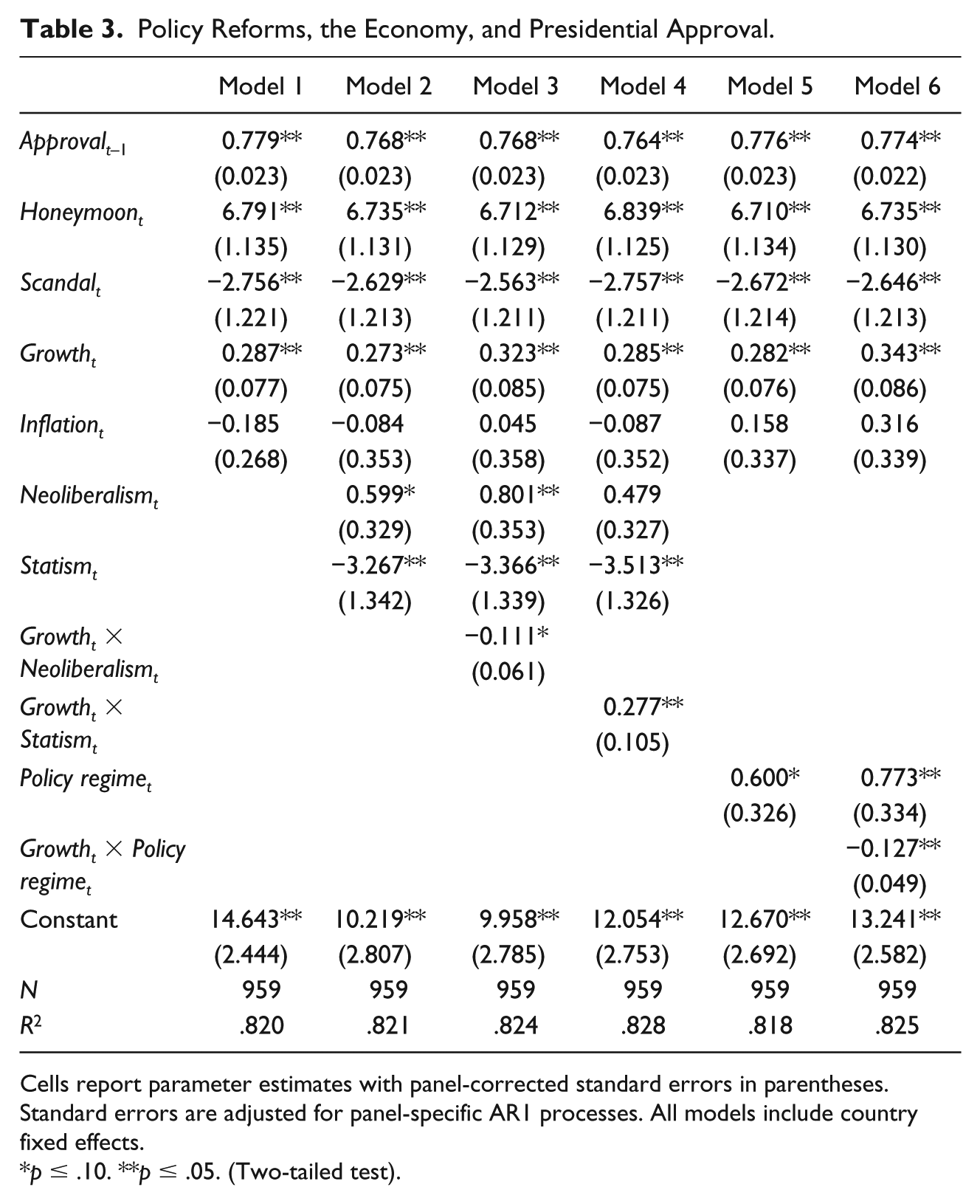
Cells report parameter estimates with panel-corrected standard errors in parentheses. Standard errors are adjusted for panel-specific AR1 processes. All models include country fixed effects.
p ≤ .10. **p ≤ .05. (Two-tailed test).
Remaining models test our priors regarding accountability under different economic policy regimes through interactive modeling. Model 3 specifies the effect of Growth on Approval to vary according to Neoliberalism. Per theoretical expectations, the orientation of the economic policy regime matters for economic accountability. The interaction coefficient, Growth × Neoliberalism, is negative and precisely estimated, implying that as the policy regime’s orientation shifts become more orthodox, the relationship between economic assessments and presidential approval weakens. In Model 4, we condition the effects of Growth by Statism, and the coefficient on the interaction term is now positive. Consistent with expectations, the economy has a stronger impact on the president’s standing in statist regimes than in neoliberal ones. The final two models replace these two indexes with the summary Policy Regime measure (see Figure 1). Here again, as expected, the coefficient on Growth × Policy Regime in Model 6 is signed positively.
Figure 2 displays predicted changes in the (short-term) effects of a unit increase in economic conditions on presidential approval across in-sample values of Neoliberalism, Statism, and Policy Regime. Figure 2A employs Model 3 estimates to examine the effects of economic growth as Neoliberalism varies. In the absence of neoliberal policies, we observe that an increased Growth boosts presidential job ratings, in line with conventional wisdom (Bellucci & Lewis-Beck, 2011). Yet, this effect diminishes as we move from left to right on the x-axis, and policy orientation becomes more liberal. Changes in growth rates no longer register a statistically discernible influence on approval ratings when Neoliberalism surpasses a value of 1.4, or roughly the policy orientation exhibited by Argentina in 2008 or Brazil in 2007. Figure 2B displays the opposite conditioning effect of Statism on Growth’s influence on Approval: as long as the policy regime is sufficiently statist, business cycles matter for executive popularity. Figure 2C uses Policy Regime to produce a result similar to that of Neoliberalism but slightly more pronounced. “Going neoliberal” hampers the public’s ability to hold leaders accountable for the economy.
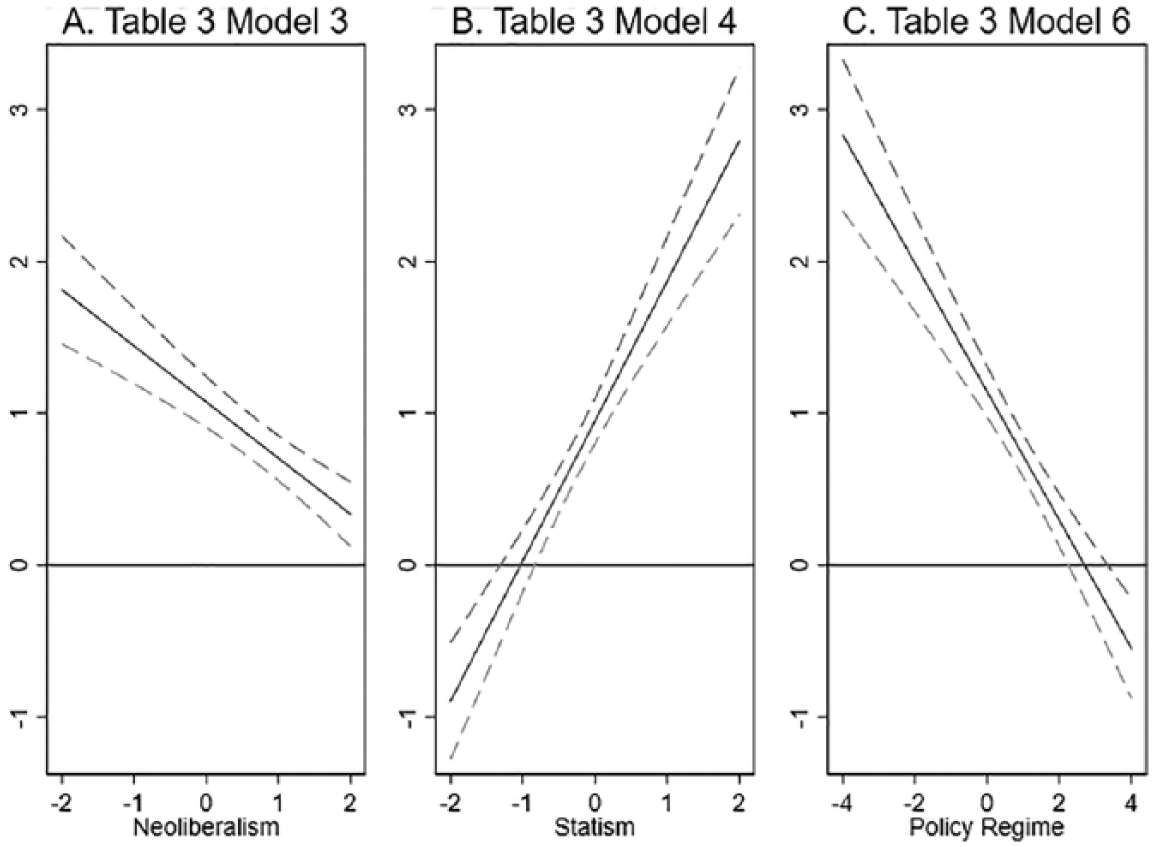
Conditional effects of the economy and economic policy regime orientations on presidential approval.
Of course, policy regimes are multifaceted, piecemeal, and inconstant. For example, liberalizing reforms, such as privatization, may coincide with new social protections without trade or tax reforms even on the table. Might distinct policy levers condition economic accountability to different degrees? To answer this question, we disaggregate our summary indices into their six components—the subindices of trade reform, financial reform, tax reform, privatization, worker welfare, and government consumption as a share of GDP—and re-estimate our interactive models. We report the conditional effects of interest in Figure 3, with parameter estimates reported in Table A7 in the appendix.
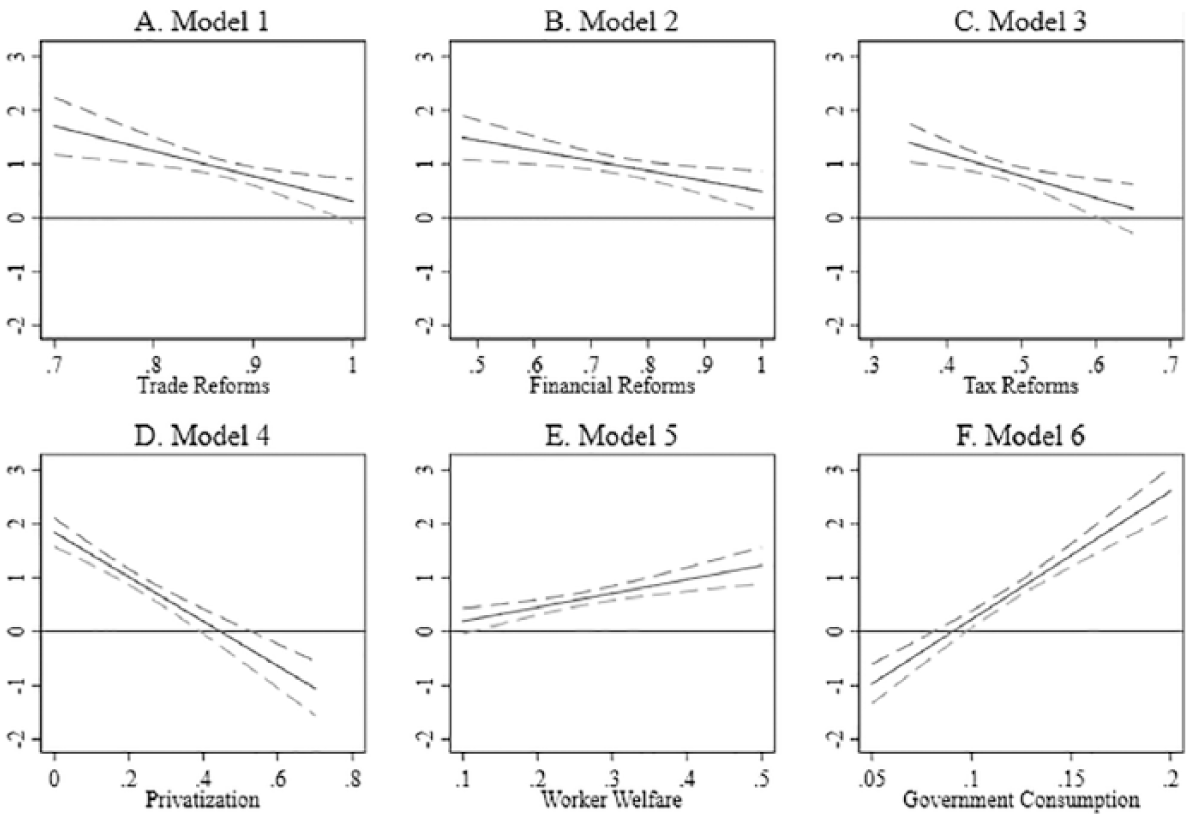
Conditional effects of the economy and disaggregated policy orientations on presidential approval.
Although slopes in Figure 3 are not as steep as those in Figure 2, remarkably, each of the six policy indicators registers a statistically significant slope in the anticipated direction. For the first four (trade reforms, financial reform, tax reform, privatization), the positive influence of economic growth on presidential popularity falls from significance once policies attain a degree of liberalization. Government consumption and pro-worker policies, by contrast, bolster the expected “economic voting” relationship. Results from these disaggregated analyses, thus, add further credence to our basic argument. Although the specific reforms’ effects clearly differ, their interrelationships underline the appropriateness of analyzing reforms in terms of the broad strategies described above. Furthermore, this finding is not limited to or driven by certain indicators; rather, neoliberal and statist policy regimes constitute separate syndromes that affect economic accountability in opposing ways. In sum, neoliberal reforms weaken the president’s accountability for the economy.
Finally, our dynamic model allows us to range beyond contemporaneous effects to examine long-term effects of policy reforms on economic accountability. After calculating the long-run multiplier, which depicts the full effect of a change in an exogenous variable through all subsequent quarters in the series, we use Table 3 Model 6 estimates to simulate the over-time effects of economic growth on the predicted levels of presidential approval. 12 Forecasts depict two states of the world: one in which policies are highly neoliberal, and another where they approximate a statist regime. 13 Presidential approval is set to 50% and values for Honeymoon and Scandal are set at zero, their modes. Figure 4 displays results.
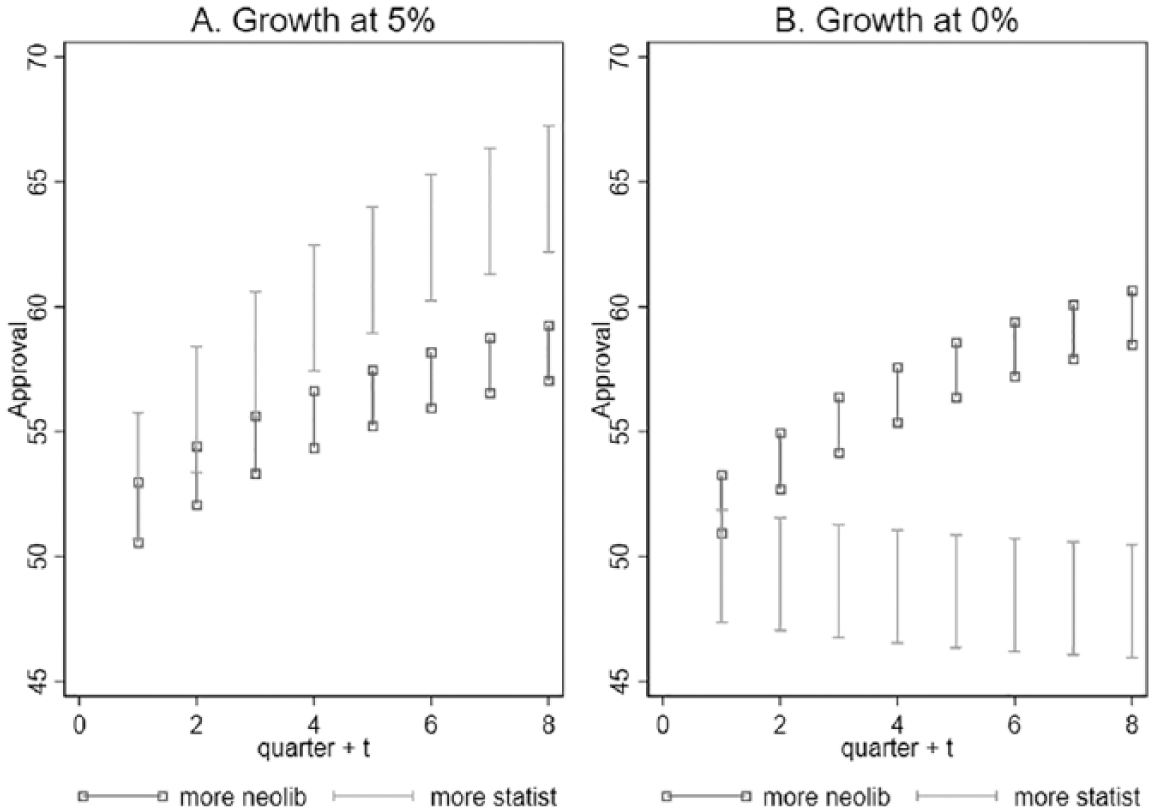
Forecasting the effects of the economy on presidential approval in two policy regimes.
The left-hand side of Figure 4 shows the effects of robust economic conditions on presidential approval ratings under distinct policy regimes. Our theory predicts the public will reward presidents less for economic performance as policy skews neoliberal. And that is what we observe. Under a more neoliberal policy regime (high values on Policy Regime), an economy experiencing 5% annual growth is predicted to yield an increase in approval ratings of about 5 points after 1 year (four quarters), all else equal. In contrast, in a strongly statist policy regime, a 4% growth rate would have twice the effect on Approval, boosting it around 10% points. Thus, freeing markets dampens the role of economic performance considerations in mass assessments of political leaders. Figure 4B reports the path of presidential approval when the growth rate is set to zero. In a neoliberal policy regime, the effects on Approval’s path are no different from the 5% growth scenario shown in Figure 4A. Neoliberal policies effectively remove economic performance as a basis of the president’s public standing. Only when policy regimes tilt statist does the president take a significant hit in popularity for overseeing stagnant conditions.
Alternative Mechanisms and Measures
The results of our time-series cross-section analyses suggest economic accountability depends on the structure of the policy regime. This finding is not limited to specific policy mixes but extends across a range of policy areas. To substantiate this conclusion, we perform a series of ancillary analyses. First, suppose policy matters for accountability but its effects are realized not through the regime but by the president’s own policy preferences. To assess this alternative account, we re-estimate our core model but consider two indicators of the president’s political leanings: (a) leftism (Wiesehomeier & Benoit, 2009; updated by Baker & Greene, 2011) and (b) “promise breakers,” that is, running as centrists (or leftists) but changing course once elected and governing as neoliberals (Johnson & Ryu, 2010). Results of these models, which appear in appendix Table A10, show that while policy preferences may directly affect approval, they do not condition the impact of the economy as policy regimes do. In short, our findings are not simply attributable to “pink-tide” or “promise-breaker” effects.
Second, we entertain an alternative argument: The statist-neoliberal nature of collective policy outputs may not condition presidential approval but, rather, the mass political consequences of economic performance are shaped by the president’s policy actions. If this were the case, then our findings would imply that presidents can strategically manipulate the direction of policy to shirk blame for a poor economy, or to claim credit for a good one. To test this alternative, we reconceive of our policy measures from levels policy orientation to changes in policy orientations. Namely, we gauge deviations in values of Neoliberalism, Statism, and Policy Regime from previous president’s administration. Results appear in appendix Table A10. They show that departures from previous administrations’ policies, per se, matter for approval ratings: more neoliberal policies increasing approval and more statist policies decreasing it, all else equal. But these shifts have no influence whatsoever on the economy–approval relationship at the heart of our theory.
Third, we consider an alternative indicator of economic conditions. Some argue that subjective economic evaluations perform better as an encompassing indicator for the economic signals received by the public than macroeconomic indicators, like the annual growth rates we employ above (cf. Erikson et al., 2002). By collapsing the disparate memories of different economic indicators into a single series, subjective measures also ameliorate issues with lag specification in time series models, allowing “the relevant objective macro-economic indicators in each country to be self-weighted according to voter attitudes” (Bellucci & Lewis-Beck, 2011, p. 196). To test our results’ robustness to a subjective indicator of the economy, we construct time series measures of Consumer Confidence; appendix Table A12 reports all data sources. We employ the dyads-ratio algorithm described above to combine multiple indices/series in Bolivia, Brazil, Chile, Peru, and Uruguay, and to impute (and smooth) values from an index measured at varying intervals in Costa Rica. We re-estimate Table 3 models using Consumer Confidence in place of Growth and report results in appendix Table A13 and Figure A2. Results confirm that, just as with economic growth, policy regimes condition the (positive) effect of aggregated subjective economic evaluations on presidential approval, and do so in ways that are qualitatively identical to what we reported above. This is the case despite the reduced sample size required when using a subjective measure of economic perceptions in place of the more widely available growth measure.
Conclusion
As the pendulum swung from ISI statism to neoliberal orthodoxy, stalled development led observers to dub the 1980s as Latin America’s “lost decade.” The democracy that accompanied economic liberalization in much of the region seemed incapable of responding to citizen demands. Many wondered if neoliberalism was antithetical to the democratic ideals of responsiveness and accountability. After famously advocating for social and political reforms to enhance government responsiveness and accountability in neoliberal economies, a dejected Atilio Borón (1996) wryly noted, “There are no terms in Spanish or Portuguese that correspond to either ‘responsiveness’ or ‘accountability’” (p. 13). Even after Latin American leaders backed away from orthodoxy and embraced some of these very reforms, Noam Chomsky (2010) declared, “The very design of neoliberal principles is a direct attack on democracy” (p. 47). Bold statements by influential voices grab our attention. Yet, as intriguing as they are, we have thus far lacked a full accounting of the implications of distinct economic regimes for mass politics and, especially, for democratic accountability.
Moving from commentary to theory, we posit economic policy regimes influence economic accountability in two interrelated steps. First, policies that concentrate economic management in the government’s hands should heighten the degree of responsibility the public assigns incumbent leaders for economic outcomes. Second, the extent to which the public evaluates political executives based on economic conditions should depend on how much the state intervenes in how the economy works. Because more statist policy strategies overtly intervene in the economy, leaders in such regimes should be subject to greater scrutiny with regard to economic performance than leaders in neoliberal regimes, which diffuse economic management away from the (direct) control of the state. To test these claims, this study combines existing data on individual-level responsibility attributions with novel macro-level measures of economic policy orientations, subjective economic evaluations, and presidential approval in Latin America. The micro- and macro-level evidence marshaled in the foregoing analyses is consistent with our theoretical framework.
Providing the most comprehensive demonstration to date of the uneasy coexistence between neoliberalism and accountability, our results advance the larger debates over Latin America’s dual transitions to markets and democracy. Statist models centralize economic decisions in the government’s hand and, in the public’s eye, put executives behind the wheel of the economy. Liberal, market-oriented models appear to diffuse decision-making among market actors and, in turn, convince the public that executives are merely along for the ride. As such, statism better facilitates economic accountability than neoliberal orthodoxy. In reality, of course, no Latin American political economy fits either ideal type. All are heterodox mixtures. And in terms of how democracy works in practice, that may be good news. If Latin American voters indeed prefer modest state intervention and the choices markets provide (Baker, 2009; Baker & Greene, 2011), then mixed economic strategies may optimize the democratic ideals of responsiveness and accountability.
As such, our findings can help explain the electoral strength and resilience of the New Left in Latin America. If votes for the New Left represent a “performance mandate” to improve how markets function, rather than to replace them wholesale (Baker & Greene, 2011), then policies that increase protection from the market’s negative externalities not only bolster government responsiveness but also infuse democratic politics in the region with greater economic accountability than witnessed during the neoliberal era. The fact that our results flow from cross-sectional and quarterly public opinion data suggests this accountability is not constrained to elections (Johnson & Schwindt-Bayer, 2009; Kelly, 2003). Rather, it is an ongoing feature of the political environment. Nevertheless, this study shows that leaders face different degrees of accountability depending on economic structure.
So what sorts of leaders might seek to implement neoliberalism or statism? Let us assume that presidents want to be popular because it increases their power (cf. Stimson, 1976). Indeed, Latin American presidents can leverage their popularity not only to succeed in the quotidian tasks of law-making (Calvo, 2007) and inter-branch bargaining (Martinez-Gallardo, 2012) but also to engage in less savory activities such as ruling by decree (Shair-Rosenfield & Stoyan, 2018), running roughshod over the checks and balances required for horizontal accountability (Ruth, 2018), and altering the rules governing reelection (Corrales, 2018). If, as we argue, neoliberal policy regimes remove politics from economics—at least in the public’s mind—it is a double-edged sword. Neoliberal reformers can more credibly shift blame for poor performance but cannot fully reap the rewards of economic booms. To the extent that “going neoliberal” decouples presidential approval from economic performance, it may well appeal to leaders with ambitions of major political reform seeking to hedge against economic volatility—a defining characteristic of Latin America’s dual transition to markets and democracy—while discounting the chances of sustained economic gains. In regimes which approximate statism, economics and politics are more tightly bound. Thus, “going statist” offers a better path for leaders seeking gains from a steady upward economic trajectory and discounting the chances of economic volatility. Insomuch as both pure statism and pure neoliberalism are unpalatable to citizens, our study points to why heterodoxy may become the dominant strategy. It allows leaders to hedge, to some degree, against economic busts and to credibly claim partial credit for economic booms. If moderately interventionist approaches prove more reliable paths to long-term development and equality (Huber & Stephens, 2012), then Latin American political economy may be on the verge of a new equilibrium.
Finally, this study contributes to a more general understanding of how accountability for the economy works beyond the Latin American experience. Reward-punishment models of economic voting assume voters observe current conditions, ascribe them to the government’s policy, and render judgment on their leaders. The threat of removal from office, the argument goes, provides even the most self-centered elites incentives to pursue welfare-enhancing policies and to grow the economy. Recent research, however, questions this assumption. Far from constant, the economy’s salience in the minds of the electorate varies according to circumstance (Singer, 2011), and a growing number of studies highlight how elites manipulate the messages about the economy or shift their policies to modify the role economics plays in elections (Hart, 2013; Williams, 2015). Building on these insights, our study suggests that the choice of policy regime for economic development influences how publics associate economic conditions with policymaker decisions and how they, in turn, assign reward and blame. Findings presented here should encourage scholars to examine how reform options, economic duress, and political ambition weigh on the behavior of current and aspiring politicians and the publics they must court.
Supplemental Material
Carlin-Hellwig_replication_link – Supplemental material for Policy Regimes and Economic Accountability in Latin America
Supplemental material, Carlin-Hellwig_replication_link for Policy Regimes and Economic Accountability in Latin America by Ryan E. Carlin and Timothy Hellwig in Comparative Political Studies
Supplemental Material
CarlinHellwig_CPS_RandR_app_final – Supplemental material for Policy Regimes and Economic Accountability in Latin America
Supplemental material, CarlinHellwig_CPS_RandR_app_final for Policy Regimes and Economic Accountability in Latin America by Ryan E. Carlin and Timothy Hellwig in Comparative Political Studies
Footnotes
Acknowledgements
The authors wish to thank Lee Alston, Moisés Arce, Andy Baker, Larry Bartels, Sarah Bauerle Danzman, Tracy Beck Fenwick, Rodrigo Castro Cornejo, Svitlana Chernyth, William Downs, John Gerring, Kenneth Greene, Nathan Jenson, Gregg Johnson, Gregory Love, Cecilia Martínez-Gallardo, Richard Price, Iñaki Sagarzazu, Matthew Singer, Christopher Wlezien, Nikolaos Zirogiannis, and audiences at SPSA, MPSA, Australian National University, University of Texas at Austin, and the Kellogg Institute of International Studies at University of Notre Dame.
Authors’ Note
Replication materials and supplemental analyses are available on the journal’s and authors’ webpages. Any remaining mistakes are the responsibility of the authors.
Declaration of Conflicting Interests
The authors declared no potential conflicts of interest with respect to the research, authorship, and/or publication of this article.
Funding
The authors disclosed receipt of the following financial support for the research, authorship, and/or publication of this article: Support for this research was provided by a Center for International Business Education and Research (CIBER) Research Grant from the Georgia State University J. Mack Robinson College of Business.
Supplemental Material

Notes
Author Biographies
References
Supplementary Material
Please find the following supplemental material available below.
For Open Access articles published under a Creative Commons License, all supplemental material carries the same license as the article it is associated with.
For non-Open Access articles published, all supplemental material carries a non-exclusive license, and permission requests for re-use of supplemental material or any part of supplemental material shall be sent directly to the copyright owner as specified in the copyright notice associated with the article.
