







Abstract
Canonical theories of bureaucracy demonstrate the need for enhanced monitoring in government hierarchies. I argue that intensive top-down monitoring may reduce the productivity of bureaucrats by frightening them away from the informal practices that they would otherwise rely on when completing daily tasks. Utilizing a unique dataset of sub-provincial inspections in China’s recent anti-corruption campaign, I identify this “chilling effect” by exploiting variation in the timing of inspections from 2012 to 2017. I show that these anti-corruption activities lower the area of land development projects proposed by bureaucrats. Causal mediation analyses with investigation data and original measures of corruption potential reveal that these effects are unlikely driven by reduction of actual corruption. Extension analyses suggest similar consequences on revenue collection and environmental regulation. Although scholars of state-building equate low corruption with effective bureaucracy, these findings present a paradox where intensive state-led efforts to lower corruption may further undermine bureaucrats’ productivity.
Introduction
What happens to a bureaucracy after intensive anti-corruption efforts? 1 Studies show that corruption directly impedes the ability of bureaucracy to perform basic yet critical tasks, such as resource allocation, revenue collection, and public goods provision (Gould & Amaro-Reyes, 1983; Rose-Ackerman and Palifka, 2016). Scholars of state-building generally equate low corruption with capable bureaucracy (Evans and Rauch, 1999; Kohli, 2004; Bäck & Hadenius, 2008). Canonical principal-agent theories of the bureaucracy also demonstrate the need for enhanced monitoring in government hierarchies (e.g., Hart & Holmstrm, 1986; Laffont & Martimort, 2009). We may thus have reasons to expect that bureaucrats work more effectively following initiatives to root out corruption.
However, this research contends that through a “chilling effect,” efforts to combat corruption may actually undermine the ability of bureaucrats to accomplish daily tasks. Working with huge caseloads, public administrators tend to sidestep formal procedures that are regarded as time-consuming or out of touch with reality. Proliferation of such informal practices leaves the bureaucracy vulnerable to anti-corruption activities that emphasize rigid adherence to formal rules. 2 Decline in the productivity of bureaucrats is a strategic reaction. To the extent that public administrators continue to view informal practices as the wherewithal to overcome bureaucratic pathologies, their productivity is likely to decline as anti-corruption inspection increases the cost of following such practices. This deliberate choice could also stem from the fact that some aspects of bureaucrats’ daily work feature heavy state-business interactions and therefore likely invite visits by anti-corruption inspectors, who will then learn of the bureaucrats’ past records of procedural violations. Reducing work activities thus decreases the probability of receiving attention in an anti-corruption probe.
Empirically, I draw on a diverse array of quantitative and qualitative evidence from China to test this theory. First, I compile an original dataset for sub-provincial anti-corruption inspections between 2012 and 2017 and match it with over 545,753 proprietary records of land auction initiated by local bureaucrats. The identification strategy exploits variation in the timing of the inspections, which comes from decision-making at the higher-level that is plausibly immune to lower-level political conditions. Results from a series of fixed-effect models show that anti-corruption efforts lead to a substantial decrease in the work activities of bureaucrats in local “Bureaus of Land and Resources” (BLR), measured via the total area (or the number) of land parcels that bureaucrats propose for auction on a monthly basis. These results are also robust to a multiple-period difference-in-differences (DiD) strategy that further reduces time-varying confounding by matching counties with identical histories of past inspections. Second, I conduct causal mediation analyses to rule out the possibility that the negative effect of anti-corruption on productivity identified here may conflate with a reduction of actual corruption. To this end, I employ individual level data for anti-corruption arrests in China, and also develop two original measures of each locality’s corruption potential over time using geo-coded transaction price of each land parcel. Third, my extension analyses in the Appendix show that the theory travels to other tasks of the Chinese bureaucracy, such as revenue collection and environmental regulation. These additional results help further address the concern that the negative effect of anti-corruption on bureaucrats’ productivity may be a result of economic slowdown or the shifting balance of power from the local governments to the strongman at the center. Furthermore, I complement the quantitative analyses with qualitative evidence for the mechanisms gathered from interviews with different bureaucrats, as well as press reports and political discourse of the Chinese Communist Party (CCP).
This research makes several theoretical contributions, first and foremost to the literature on anti-corruption strategies. Evaluation of specific anti-corruption techniques has been the preoccupation of this scholarship (see Gans-Morse et al., 2018 for a review). 3 I situate my study in the larger context of recent calls in political science for shifting scholarly attention from incremental techniques to “big bang” approaches (Rothstein, 2011; Persson, Rothstein and Teorell, 2013). The growing recognition that incremental techniques fail to resolve systemic corruption echoes arguments in earlier game-theoretic work on corruption. Formal models demonstrate that variation in the level of corruption reflects the existence of multiple equilibria, in which clean and corrupt bureaucracies are both steady states that self-perpetuate despite small, temporary deviations (Cadot, 1987; Andvig and Moene, 1990). These insights, shared by a wider community of scholars (e.g., Caiden & Caiden, 1977), highlight the inability of “short-run anti-corruption campaign” to reduce corruption (Tirole, 1996). However, the new research paradigm on the effect of systemic, as opposed to specific, solutions to the corruption trap faces acute empirical challenges. Its advocates acknowledge the difficulty to locate empirically viable cases as such strategies are only feasible in rare historical instances (Gans-Morse et al., 2018). For its unprecedented duration and reach, the still ongoing anti-corruption campaign in China offers one opportunity to investigate a “big-bang” approach in the real world (Manion, 2016), which is the subject of this research.
More specifically, whereas the anti-corruption literature chiefly focuses on assessing whether certain strategies prove successful in reducing corruption, my research examines the larger impact of fighting corruption on the performance of government bureaucracies. 4 This lacuna is important to address so long as improving bureaucratic performance remains a central motivation behind the anti-corruption scholarship. 5 The adverse effects of an anti-corruption “big-bang” on the bureaucracy challenge future research in anti-corruption evaluation to incorporate effects on organizational capacity as a key metric in policy assessment. In broader terms, my findings are related to prior works seeking to reveal a counter-intuitively positive role of corruption in economic growth (e.g., Leff, 1964; Huntington, 1968), but the focus on anti-corruption strategies away from corruption itself marks a clear departure from such works. The mechanism in this research, centered on informal practices within the bureaucracy, is also different from the bureaucrat-consumer interactions as often theorized in these works (e.g., Lui, 1985).
By documenting the unintended consequences of pursuing the Weberian ideal, this research also provides a cautionary note for a larger literature in political economy of development centered on state-building. Studies of state-building in Latin America (Geddes, 1994), post-Communist Europe (Grzymala-Busse, 2007), and East Asia (Kohli, 2004; Yang, 2004) tend to see low corruption as a pre-condition for effective bureaucracy. The present study does not dispute this relationship. But it suggests that because of the tendency for anti-corruption activities to reassert the dominance of formal rules and procedures, efforts to lower corruption may not improve, but rather undermine the bureaucracy.
Relatedly, the subnational findings in this study contribute to our knowledge about state capacity at the local level. Given global waves of administrative decentralization, quality of the local state deserves important scholarly attention. Existing research on the determinants of state capacity, however, is chiefly concerned with dynamics at the federal/national level. 6 Notable exceptions explore strategic interactions among local governments that invest in state-building (Acemoglu et al., 2015) and the effect of landholding inequality on local taxation (Pardelli, 2017). This research differs from the two studies by shifting our focus from politicians down to bureaucrats and highlighting the critical role of bureaucrats’ behaviors in development. It shows that lower-level state agents strategically respond to signals of anti-corruption initiated at the higher levels in ways that reduce their productivity.
Formal Rules, Bureaucratic Incentives, and the Chilling Effect of Anti-Corruption Activities
In advancing the claim that anti-corruption activities undermine the performance of government bureaucracies, this research integrates insights from various scholarly traditions in American politics and public administration that emphasize the rigidity of formal rules as obstacles to bureaucratic performance. Characterized by heavy workload and considerable case-by-case variability, bureaucrats’ daily job usually entails a high degree of flexibility and improvisation (Lipsky, 2010; March & Olsen, 1995). Scholars note the sharp trade-off between adaptability and the need to strictly adhere to formal procedures (Flinders, 2011; de Graaf & Paanakker, 2015). Perfect compliance with formal rules may hamper productivity for a variety of reasons. For one, higher-level rule makers have insufficient information about lower-level situations. 7 The complexity of ever-changing reality may render static formal procedures quickly obsolete (Zacka, 2017). More importantly, administrative design is often a direct function of partisan conflict and/or coalitional politics, the process of which sets aside concerns for efficiency (Wood & Bohte, 2004). In addition, due to the tendency for the volume of rules to rapidly grow within a bureaucracy (Crozier, 2009; Radaelli and Meuwese, 2009), complete procedural compliance could become excessively time-consuming for heavily tasked bureaucrats. 8 Bureaucratic pathologies emanating from dense procedural regulations manifest themselves in administrative meetings and paperwork, with the latter often cited as the most challenging career aspect by public servants (Chan, 1999; Howard, 2011).
With the need to be “liberated from the rules” (Osborne & Gaebler, 1992), bureaucrats intentionally or unintentionally sidestep certain formal procedures with a wide range of informal practices. 9 In fact, rule-breaking in bureaucratic organizations is “ubiquitous” and some of such practices may well be intended for the support of organizational goals (Martin et al., 2013, p. 551). For example, in cases where rules set in place clearly contradict one another, selective enforcement becomes the common practice (Lipsky, 2010). Public administrators may also opt to violate rules viewed as direct impediment to the larger organizational objective (Desmond, 2008). Another form of procedural violation concerns more specifically with onerous organizational routines, such as paperwork completion, some of which bureaucrats may deliberately skip. Similar practices may also be unintentional. Ensuring perfect accuracy in paperwork can be extremely time-consuming and cognitively taxing (Arnett et al., 2000; Weinberg, 2017).
By penalizing the informal practices of rule-breaking, anti-corruption activities have the unintended consequence of denying bureaucrats the chief wherewithal to accomplish daily tasks. This logic is closely akin to the “integrity/efficiency tradeoff” or the “accountability dilemma” long noted in public administration (Self, 1977). And it is especially powerful as the very formal rules re-emphasized in anti-corruption efforts are those originally aimed at enhancing accountability. 10 Flinders (2011) warns against efforts to “subject …every decision to forensic analysis” (p. 599), as excessive accountability requirements “suffocate the capacity and morale of any organization.” (p. 599) Importantly, because informal practices are not corruption per se as there is no private gain involved, anti-corruption effort not merely affects corrupt bureaucrats, but also has a chilling effect on the productivity of “clean” or “innocent” bureaucrats. The latter become afraid of doing their daily job through informal practices that would otherwise help overcome the pathology of formal procedures. Initiatives to root out corruption in Australia’s police force, for example, has led to “more paperwork” and “less discretion” experienced by public servants (Chan, 1999). Another underlying force for the chilling effect lies in the dense state-business interaction commonly featured in the work of bureaucrats. The nature of their work is prone to anti-corruption probe, a process during which bureaucrats’ past record of informal practices might be exposed and punished by inspectors. 11 They thus reduce the overall amount of work activities so as to reduce the probability of receiving attention in an anti-corruption probe. There is evidence that government employees in the shadow of anti-corruption campaigns understand that innocence does not protect them. 12
Scope Conditions
I want to be upfront about the several features of Chinese politics that may condition the generalizability of the argument: decentralization, authoritarianism, and personalist politics. Decentralization exacerbates principal-agent problems, and such problems, in turn, may explain the necessity of reliance on formal rules such as procedural regulations and administrative statutes. The proliferation of formal rules and procedures may simply dovetail with the discretion that principals delegate to local agents. As the theory of chilling effect operates through the link between informal practices and formal rules, it is plausible that the chilling effect might be more severe in more decentralized settings. China is likely among the more decentralized countries in the world. 13
One may also think of China as an empirical setting to demonstrate how the chilling effect works in authoritarian regimes but not democracies. It is easier to envision a nationwide monitoring campaign carried out in a setting without organized opposition, for example. Note, however, that the relatively unique nature of Chinese politics in this aspect does not limit the external validity of the chilling effect at a meso-level. Even though other polities may not be able to sustain nationwide campaigns like the CCP does, chilling effect could still occur in certain regions where the politicians do pursue inspections of bureaucrats, as cases in New York in the United States (Anechiarico & Jacobs, 1996) and New South Wales in Australia (Chan, 1999) suggest. More recently, Indonesian President Joko Widodo approved the controversial legislation that took away the power of the anti-corruption agency in Indonesia to wiretap bureaucrats at work. One reason given by the President’s Chief of Staff is that the anti-corruption agency had undermined investment. 14 Another aspect of Chinese politics, which may be commonplace across most authoritarian regimes, is the suppression of civil society and media which would otherwise play a powerful watchdog role in monitoring the bureaucracy. Without the assistance from forces external to the regime, autocrats must rely heavily on ex ante control of the bureaucracy through formal rules such as statutes and prescribing administrative procedures. Hence, another reason that the chilling effect is likely to be more severe in authoritarian regimes.
The personalist aspect of Xi Jinping’s rule could make the chilling effect more pronounced in China. Part of the formal activities required by Chinese bureaucrats is to read publications and attend regularly held seminars on “Xi Jinping Thought” (officially known as “Xi Jinping Thought on Socialism with Chinese Characteristics for a New Era”), and the enforcement of these activities receives a huge boost due to inspections. Thus, personalist politics in China’s authoritarian regime could manifest itself in more bureaucratic pathologies for the bureaucrats, and inspection reduces the bureaucrats’ ability to circumvent such pathologies via informal practices.
The presence of these features altogether admittedly makes it less likely for China to qualify as “the most difficult case.” 15 More generally, these features align to make China a case of excessive oversight that produces salient negative consequences. Nevertheless, as one or more of these characteristics are usually present to different extents in different countries as well, the foregoing discussion should help the reader better assess the severity of the negative impact of top-down monitoring efforts when they arise elsewhere. It should also encourage us to be more attuned to meso-level bureaucratic dynamics that are common across macro-level regime types.
Anti-Corruption Campaign and Bureaucratic Incentives in China: Qualitative Evidence
Corruption has been a long-standing challenge for China, both historically and under the CCP. 16 As the problem has grown more severe since the 1980s due to economic liberalization and administrative decentralization, the CCP has also intensified the fight against corruption (Wedeman, 2012). 17 The first broad category of methods in its toolkit is routine anti-corruption characterized by specialist agencies installed across all administrative divisions. Discipline Inspection Committees (DIC) at central and local levels are the main anti-corruption organizations in this regard (Manion, 2004; Yeo, 2016). Due to their institutional subordination to CCP leaders at the same administrative level, enforcement of routine anti-corruption is often a function of local CCP leaders’ political consideration and policy priorities (Manion, 2004; Zhu & Zhang, 2017). 18
To complement routine anti-corruption, the CCP also employs campaigns against corruption. The campaigns prior to the current CCP general secretary Xi Jinping were episodic outbursts of intensive anti-corruption activities over short periods of time at all levels of government (Manion, 2016). The still ongoing anti-corruption campaign, unleashed as Xi took office in late 2012, far exceeds its predecessors in intensity and scope (Manion, 2016). Prominently featured in this campaign is the heavy use of inspection teams from central DIC (CDIC) and provincial DICs (PDICs) to conduct probes at lower-level governments. Teams of inspectors sent down to the lower-level can conduct independent searches, or assist the DICs at the corresponding level in their routine work (Yeo, 2016). This section provides qualitative evidence for how the current anti-corruption campaign (hereafter “the campaign”) exerts a chilling effect on Chinese bureaucrats that negatively affect their performance.
Reliance on Informal Practices in the Chinese Bureaucracy
The Chinese bureaucracy is no different from other bureaucracies in its proliferation of informal practices. Given China’s legacy of totalitarianism and Soviet central planning, one reason often cited for the country’s economic success is precisely the ability of local bureaucrats to circumvent inefficient formal rules (Ang, 2016). A wide variety of informal practices go beyond the specific context of post-socialist transition, however. One such practice in violation of formal procedure is creative misuse of funding. Severely under-budgeted in light of manifold duties, local bureaucrats tend to rely on the temporary use of funding reserved for other projects to accomplish a project deemed more urgent. 19 Incentives for rule-breaking also grow out of the considerable mismatch between rigid and simplified higher-level directives and the complex reality rich in details that require ad-hoc solutions. 20 Daily bureaucratic pathologies consist of paperwork and work meetings, which entail substantial time commitment. 21 Chinese bureaucrats also observe the formalities of regularly attending meetings and seminars where manifestos and speeches of top CCP leaders are studied. Paperwork burden has further increased in the recent decade due to accountability reforms resulting in the creation of checklists and response forms that accompany project implementation concerning matters such as work safety, food safety and environmental protection. 22 The modus operandi shared by many bureaucrats is to set aside paperwork accuracy when fulfilling such requirements. 23 Regarding projects that require state-business collaboration, although attending expensive luncheon or dinner held by business representatives may violate formal discipline, bureaucrats understand that turning down invitation would incur the risk of signaling mistrust, which would undermine the potential for further collaboration. 24
Anti-Corruption under Xi Jinping and Bureaucrats’ Reactions
The campaign manifests itself in top-down inspections with expansive mandate that go beyond merely detecting corruption to ensuring that various formal rules are strictly followed. Xi made clear that “discipline” must “come before” the law and be “stricter” and “different” than the law. 25 Disciplines and rules “must be held in high regard,” “applied strictly,” and “implemented thoroughly.” 26 Contents of PDIC inspections released to the public confirm the observance of this guiding principle. For example, a PDIC team inspecting the Yongqiao county-level district emphasizes that the most primary objective of the inspection is to make sure that bureaucrats adhere to the Chinese Communist Party Charter and “other Party regulations.” 27 To achieve it, the first item on the agenda refers to maintaining “political discipline and political rules,” and ensuring that the speech and actions of bureaucrats comply with the CCP’s directives. The second item is about “integrity” (which is related to detecting corruption). The third item refers to “organizational discipline” and “organizational rules.” 28 In another example, a PDIC inspection of the Department of Water Resources in Gansu Province states that its chief mission is to combat rule violation concerning “political loyalty, integrity, organization, relations with the public, daily work, and everyday life.” 29 It is clear from this statement that detecting corruption is only part of the mission. 30
The campaign has reduced productivity of bureaucrats in two ways. First, with reassertion of rigid formal rules as part of the campaign, bureaucrats find the cost of pursuing informal practices dramatically increased. While violation of formal rules does not lead to criminal prosecution so long as such misconduct does not constitute corruption, disciplinary actions and administrative sanctions ranging from reprimand to removal from position could still be devastating to one’s career. 31 As a mechanism of ensuring performance incentives, provincial leaders link career promotion of PDIC inspectors to the number of cases they uncover against lower-level officials. This design further frightens bureaucrats as they understand that the other side is trying its best to make sure that “at least some kind of violations is found.” 32 The campaign has compelled certain bureaucrats to “add back procedures” (bu chengxu). 33 Performance declines as a result of drastically shrinking “flexibility space” (tanxing kongjian). 34 Second, bureaucrats may deliberately reduce their work activities simply to preempt anti-corruption probe. This strategic choice reflects their fear that inspectors could learn of their past records of procedural violations and impose career punishment (fan jiuzhang). 35 This reasoning is prevalent in works that feature heavy state-business interactions, which are by nature prone to anti-corruption probe. Reducing work activities serves to reduce the overall probability of receiving attention from inspectors. 36 Overall, bureaucrats share the understanding that the more responsibilities they take, the higher the probability of career danger will become in the shadow of the campaign. 37
That bureaucrats become “afraid of their work” (bugan zuoshi le) has been widely reported in the domestic Chinese press. Since the beginning of the campaign, media has expressed concerns that anti-corruption drive might undermine the economy by making officials afraid of initiating and proposing projects. The many phrases that the media and CCP leaders have adopted for this phenomenon include “administrative inaction” and “administrative slack” (lan zheng/dai zheng). One media report, when discussing administrative inaction, even quoted a widely used idiom in the Chinese bureaucracy: “Do less work, make fewer mistakes; do no work, make no mistakes”(shaozuo shaocuo, buzuo bucuo). 38 Administrative inaction related to the chilling effect has also entered Chinese pop culture via the highly popular, award-wining Chinese TV series In the Name of the People. 39
Concerns within the CCP over the Campaign’s Side Effects
Senior leaders in the CCP have become aware of the problem. In 2015, as a response to media speculations about administrative slack due to anti-corruption activities, Premier Li Keqiang said that “administrative slack is another form of corruption.” 40 Top Chinese leaders have taken strong public stances against administrative slack in various occasions since then. A recent example is President Xi Jinping’s speech delivered at the Conference on Party-building in Party and State Organs on July 9, 2019. He emphasized the need to “correctly handle the relationship between integrity and the courage to take responsibilities,” and vowed not to let CCP cadres “use anti-corruption as an excuse to commit inaction or avoid taking responsibilities.” 41 More notably, in the same speech, he also identified four wrong types of bureaucrats, “fatuous,” “lazy,” “inactive,” and “corrupt.” 42 The first three types are all related to productivity concerns while the corrupt type is now the last one to mention.
Since Premier Li’s remarks in 2015, local governments across China have been implementing mini-campaigns against administrative inaction. Contents of these mini-campaigns include organizing seminars to warn against the danger of administrative inaction to China’s governance, as well as small contests in which certain bureaucrats are rewarded for their work ethics. 43 According to the official summary of a seminar against administrative inaction in a BLR at Zhongmou county, bureaucrats who were “afraid of work” and “afraid of taking responsibilities” were criticized. 44 In Luoyang prefecture, secrete operational units were created to inform on bureaucrats’ administrative slack and “do-nothingism” (weiguan buwei). 45 In a related project, I provide a systematic analysis of the CCP’s efforts to combat administrative inaction using an original dataset covering mini-campaigns initiated by Chinese county governments in a total of 12 provinces.
Data and Identification Strategies
Having presented qualitative data in support of this theory, I now document quantitative evidence in the pages that follow. China’s highly decentralized administrative system offers substantial variation across time and space in governance outcomes. 46 Two administrative divisions below the central government are important in the context of this research. They are provinces (N = 31) and counties (N = 2, 698), by the descending order of jurisdictional hierarchy. 47 Specifically, I examine how the spatio-temporal variation in the intensity of the campaign, as a result of the inspections undertaken by provincial inspection teams at the county governments, affects county-level land development projects that local bureaucrats initiate.
Sub-Provincial Anti-Corruption Inspections
Since the beginning of the campaign, Xi Jinping has ordered provincial leaders to periodically launch anti-corruption inspections. These inspection teams consist of PDIC staff and other cadres working in province-level organs. They make largely unannounced visits to prefecture and county governments within the province. Upon arrival, inspectors may conduct independent investigations, investigate in collaboration with lower-level DICs, or provide assistance to the work of lower-level DICs. I compile an original, hand-coded dataset to map these inspections, using information collected from official websites of local DICs along with local Chinese newspapers.
48
My data records the target county or prefecture of each inspection tour as well as the arrival and departure dates of the inspection team. Between 2013 and 2017, provincial governments across China have made a total of 2905 sub-provincial inspections. The median duration for such visits lasts 39 days.
49
In my panel data analyses, a county in a given time period is coded as treated if part of this time period is covered by the duration of a visit.
50
Figure 1 displays the distribution of treatment across counties over time. The X-axis refers to the 2698 counties and Y-axis refers to the 72 months (from January 2012 to December 2017) in the panel data. Each cell is therefore a county-month (or “unit-time”) observation in the data. The gray cells are the county-months not under inspection, and the white cells are the county-months under inspection. X (Y)-axis refers to time periods (units) in the panel data. Each cell represents the treatment status in a unit-time observation. White (gray) cells represent a county-month that is treated (not treated).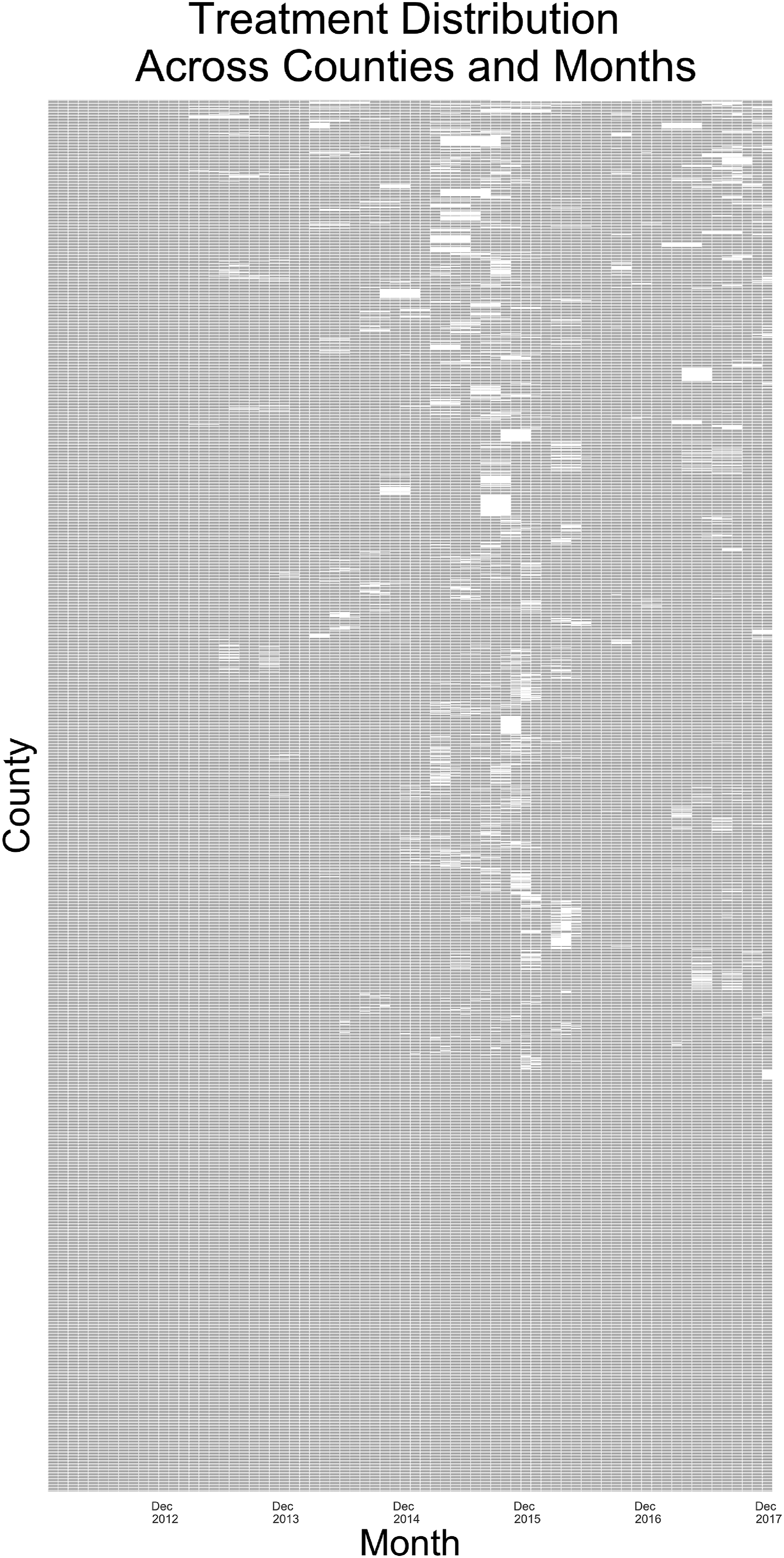
Recent studies of Xi’s anti-corruption campaign have largely focused on teams sent by the central government that inspect provincial governments (e.g., Chen & Kung, 2018). For the specific purpose of this study, data for provincially initiated anti-corruption inspections that target prefecture and county governments (hereafter “PDIC inspections”) have two unique advantages. First, provincial leaders and PDICs, compared to national CCP bosses and the CDIC, have better information about localities within their provinces. This makes the threat of anti-corruption efforts more credible for local bureaucrats. Section “Effectiveness of PDIC Inspections” in the Appendix shows that, empirically, PDIC inspections are much more effective than CDIC inspections in arresting corrupt local officials. 51 Second, as opposed to CDIC inspections whose timing only varies at the province level (the highest subnational administrative division in China), the new data for PDIC inspections allow me to tap into the rich variation in the timing of treatment across counties, a much lower-level of administration at which my dependent variable is measured.
Records of Land Development Projects Proposed for Auctions
The main dependent variable for our analysis is the (logged) total area of land development projects proposed by bureaucrats for auctions. I focus on auctions for two reasons. First, proposing land development projects is an important aspect of productivity by local bureaucrats. China’s economic model is largely one of “land-centered development” (Rithmire, 2017). Urban land transfers are crucial for the performance and functioning of Chinese local government (e.g., Rithmire, 2017; Cai et al., 2020). As local governments own the property rights of all urban land in China, project facilitating economic development normally occurs through the transfer of the use right of a land parcel from the state to a business entity through the decisions of BLR bureaucrats. Over the past years, auction has become the primary method for land transactions in China (Deng et al., 2014). This measure thus provides a micro-level indicator of bureaucrats’ productivity. In subsection “Validation of the Dependent Variable Measure” of the Appendix, I validate this variable choice as a meaningful measure of bureaucrats’ productivity. Specifically, I show that a decline in land auctions predicts an increase in the incidences of county-level mini-campaigns aimed at combating administrative slack. This result implies that county leaders themselves take land development projects seriously as an indicator of productivity. It is also consistent with my interviews of senior county officials, who appeared to pay close attention to land sales. 52
Second and more important, as auction method was introduced in China with the particular purpose of avoiding land-related corruption, using auction records helps mitigate the concern that my productivity measure might conflate with actual corruption. In fact, recent studies specifically use land parcels transacted via non-auction methods to proxy for local corruption (Li et al., 2016; Xu, 2019). Subsection “Alternative explanations” provides more rigorous evidence against the alternative explanation that reduction of actual corruption might be driving the results.
In 2003, local BLRs are required to post auction information on their official websites. Sofun.com is one of the commercial websites that centralize such information, whose land records I downloaded via a proprietary account for this research. 53 A key advantage of the new data, compared to land transaction data used in other studies (e.g., Chen et al., 2016), is that it includes all records of auctions ever proposed by bureaucrats, not just those auction proposals that led to successful transactions. The latter quantity would be a more indirect and conflated measure of bureaucrats’ own behavior because it is more subject to the level of local economic activities and commercial interests. 54 The data used in this research covers the near universe of land auction proposals in China from 2012 to 2017. Overall, there were 545,753 land parcels proposed by bureaucrats to be sold through auctions. The data contains information for the area and location of each land parcel, as well as the date on which it was put on the market. I compute the logged total area of all proposed land development projects for each county in each given month. 55
Identification Strategies
Quantitative analyses exploit variation in the timing of PDIC inspections across counties. This variation comes from two sources, across provinces and within province. In each year, the majority of provinces launch inspections. 56 As PDIC inspections remain an integral component of Xi Jinping’s anti-corruption campaign, the provincial-level decision over whether and when in a given year to send inspection teams down to lower-level governments may depend on provincial leaders’ bargaining power with the strongman at the center. It is unlikely that the unobserved characteristics of an individual county within a province could affect such power dynamics. 57 Within-province variation in the timing at which a county receives provincial inspections is largely due to logistical reasoning and hence also unlikely affected by the unobserved characteristics of a specific prefecture or county. One example of logistical consideration affecting the timing of inspection concerns the assignments of inspection team leaders. Even though the inspection staff mainly come from the PDICs that specialize in anti-corruption-related work, the leaders of these inspections tend to be officials from other offices, whose availabilities for the part-time jobs tend to vary. 58 For instance, the leader of an inspection group sent by Henan Province to monitor Wei Shi County of Kaifeng Prefecture in 2015 was a standing committee member of a different prefecture in the same province. 59 Two of the deputy group leaders came from provincial audit office and provincial development and reform commission, respectively. 60
Interviews reveal that bureaucrats are only noticed of inspection teams’ arrivals only a few days in advance.
61
If the prefecture or county leaders could manipulate the timing of treatment, then they would have given notice to lower-level bureaucrats earlier to the extent that bureaucratic productivity (my dependent variable) is of their concern. Figure 4 in a later section shows that when comparing counties that share identical patterns of past inspections, treated and untreated counties are indeed highly similar in terms of dependent variable trajectories. X-axis refers to 6 pre-treatment periods, from t − 6 to t − 1. The black lines are the trajectories representing the standardized mean difference between the dependent variable among the treated counties and that among the control counties for the 6 pre-treatment periods. The left column shows this trajectory for matched sets before Mahalanobis refinement. The center (right) column shows the trajectory after Mahalanobis refinement picking the top 50 (20) closest control units in each matched sets to receive equal weights.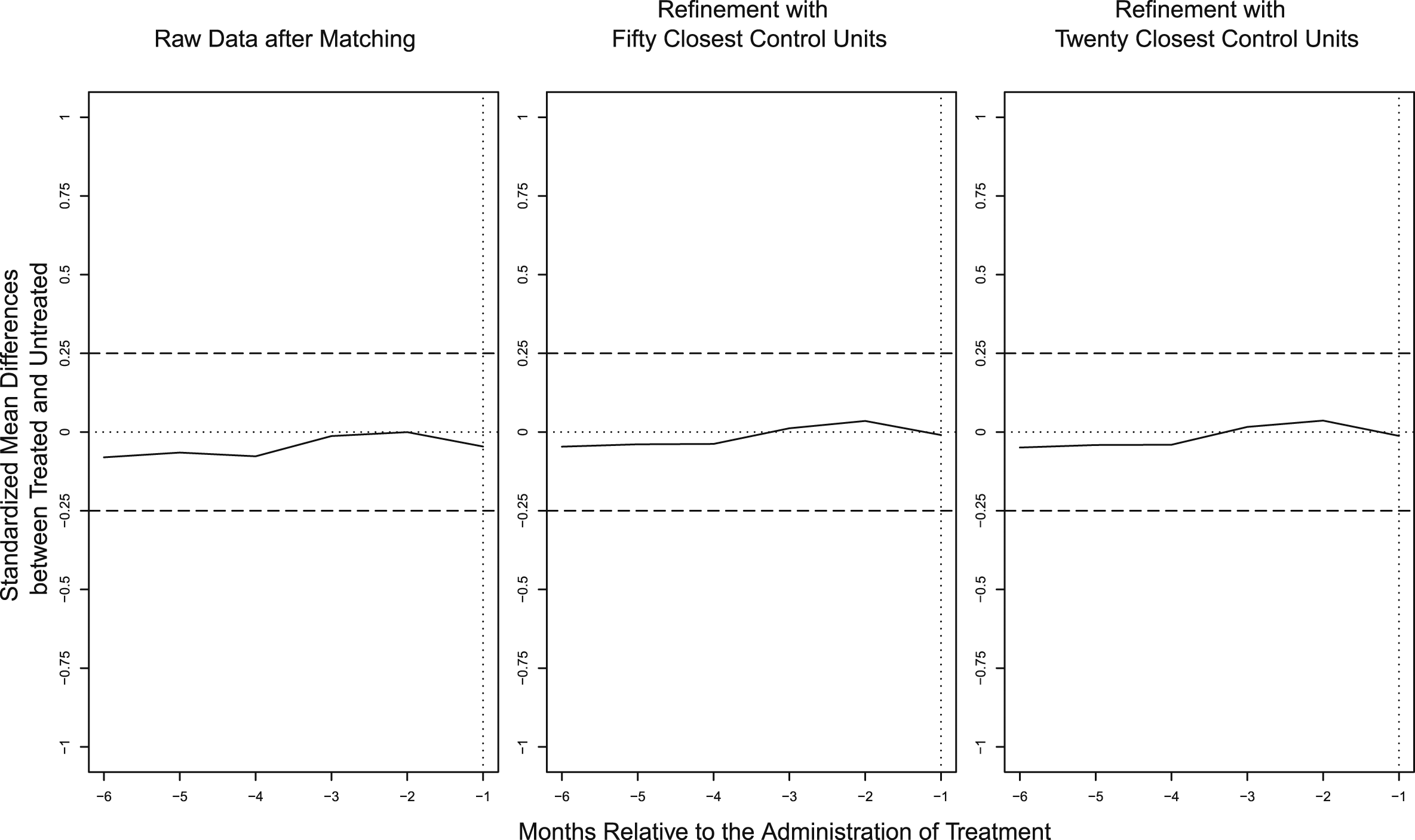
Fixed Effects Models
I employ two-way fixed effects models as the main specification for this county-month panel dataset. The specifications take the following form

I conduct a series of robustness checks based on fixed-effect specifications. First, utilizing the long T of the panel structure, I control for lagged outcomes in the past quarter by including outcomes at t − 1, t − 2, and t − 3 in the regression. 65 Including lagged dependent variables helps mitigate the influence of unit-specific time-varying confounders to the extent that such confounders are themselves correlated across time. 66 Second, I also show in subsection “Province-specific trends” of the Appendix that the results hold robust to the inclusion of interactions between province and year dummies. The purpose of this stringent test is to safeguard the results against province-specific year-varying unobservables. These unobservables might influence decisions made by provincial leaders every year over how inspections will roll out in different counties at different times of year. 67 Third, the results are similar when using the logged number of projects proposed as an alternative measure of bureaucrats’ productivity, shown in in subsection “Alternative dependent variable.” Fourth, I obtain similar results from a sub-sample that excludes the counties that never received inspections, as shown in subsection “Results excluding untreated units” of the Appendix. Finally, to ensure that my findings do not merely reflect underlying secular trends in the data, I subject the results to a placebo test that randomly permutes treatment status across units within each time period (see subsection “Placebo test” of the Appendix).
Matching-Augmented Difference-in-Differences
To further mitigate time-varying unobserved confounding, I also consider an alternative methodological framework proposed in Imai et al. (2021). This recently developed approach creates matched sets by matching each treated observation with untreated observations that share identical treatment history up to a pre-specified number of lags. Thus, when matching on L periods of treatment history, for each pair of consecutive time periods that feature a county switching from 0 at t − 1 to 1 at t in its treatment status (from “not under inspection” to “under inspection” in the context of my data), I consider this county at time t a treated observation. I go on to identify other counties that are untreated (“not under inspection”) for both t and t − 1, but nonetheless share identical treatment status for t − 2, t − 3 …t − L with the treated observation. These counties will form a matched set for the given treated observation. A matched set
The approach then refines the matched sets by adjusting for time-varying covariates as well as past outcomes using information within each matched set

Results
Main Results
Figure 2 presents results for the effects of PDIC inspections on the total logged area of land parcels proposed for auctions. The left (right) bar shows results not controlling (controlling) for lagged outcomes. Evidence from fixed effects models indicates that anti-corruption activities negatively affect proposed land auction sales. And the impact is substantively large. PDIC inspection in month t leads to around 15% decline in the area of proposed land auctions in the next month. The fact that effects are almost identical with or without lagged dependent variable adjustment further lends confidence to their robustness. Effects of PDIC inspection on logged area of land parcels proposed for auctions. Included in the regressions are unit and time fixed effects as well as time-varying controls specified in subsection “Identification Strategies.” 95% (90%) confidence intervals constructed using standard errors clustered by county are in black (gray) lines. Models for the right part of the graph also include lagged dependent variables in months t − 1, t − 2, and t − 3.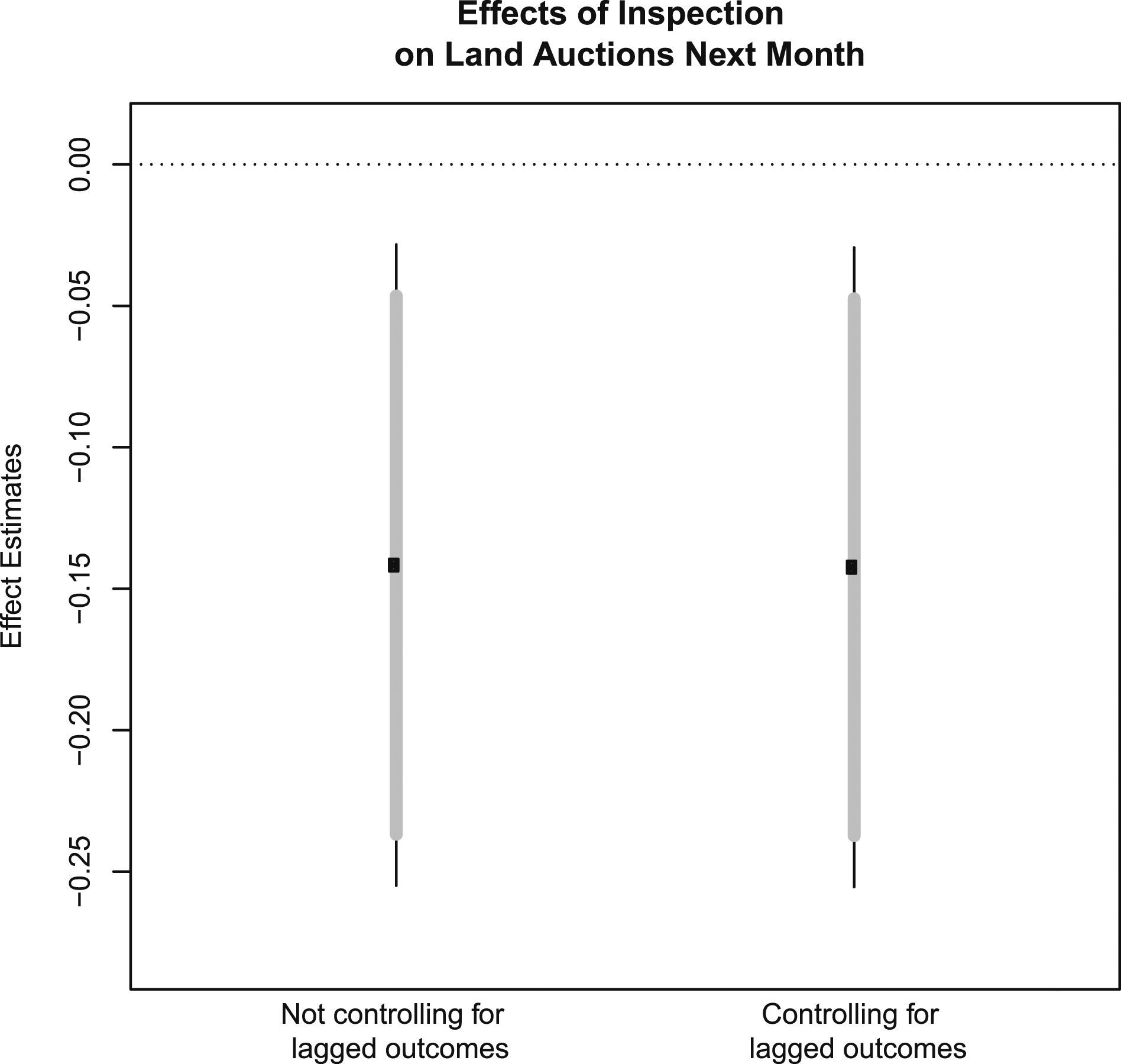
Results from Matching-Augmented DiD
This subsection reports results from the matching-augmented DiD developed in Imai et al. (2021). Estimation and inference rely on information from matched control counties in matched sets. The number of matched sets and their sizes are therefore important. The histogram in Figure 3 shows the distribution of the number of control counties in a matched set. The gray (transparent) bar represents the number of matched control counties that share the same treatment history with a treated observation for 4 months (6 months) prior to the treatment month. Understandably, the size of matched set gets smaller when using 6 as the number of lags because fewer control units could share such a long identical treatment history. But we see that across the choices of lags, most matched sets have more than 600 matched control counties and almost all matched sets have more than 400 matched control counties. This result suggests that we have sufficient information to make credible inferences applying this method to our county-level data. The gray (transparent) bar represents the number of matched control counties that share the same treatment history as a treated observation for 4 months (6 months) prior to the treatment month.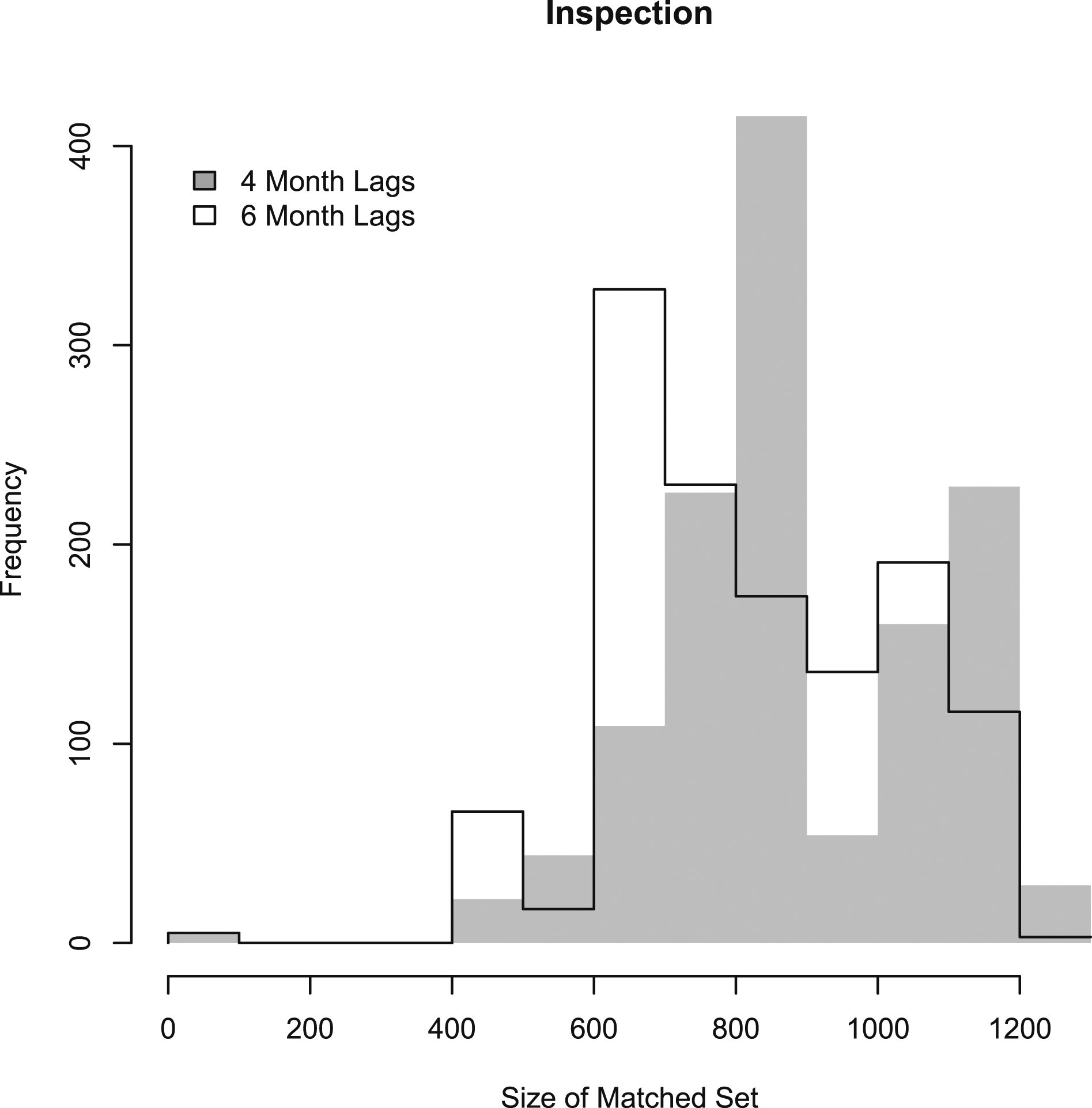
Using the matched sets based on past 6 months of identical treatment histories, Figure 4 presents the trajectories of the dependent variable before the introduction of treatment. Each plot presents the average difference between the dependent variable in the treated and control groups over the pre-treatment periods of 6 months. Specifically, for each matched set and for each pre-treatment time period, the algorithm first takes the difference between the outcome variable in the treated county and the “synthetic” outcome variable in the matched control counties. It then standardizes this difference by the standard deviation of the outcome variable across all treated counties in each pre-treatment time period in the data. This way, the difference from each matched set is measured in terms of standard deviations. The Y-axis has upward and downward limits of 1 standard deviation. Finally, the algorithm takes the mean of all the differences from these matched sets to produce the black lines in the figure. The left plot shows the pre-treatment trajectory in the raw data after matching. Here, the “synthetic” outcome in each matched set is produced by taking the average of the outcome across all matched control counties (for each pre-treatment time period). The middle (right) plot shows the pre-treatment trajectory after refinement using Mahalanobis distance metrics to pick the top 50 (20) closest matched control counties in each matched set. Here, the synthetic outcome for each matched set is produced by taking the average of the outcome in the 50 (20) matched control counties that are picked.
These descriptive data show that the matching technique enables us to focus estimation on treated and control counties that are highly similar. The causal inference literature generally recommends practitioners to use 0.25 standard deviation as a rule-of-thumb cutoff to assess balance (e.g., Rosenbaum & Rubin, 1985; Stuart & Rubin, 2008; Stuart, 2010). We see from the left column that the pre-treatment trajectory is well within this range and in fact close to zero. The parallel trend assumption in DiD analysis requires the difference between treated and control units to be stable over time without treatment. The relatively flat line in the left column gives us confidence that the assumption is likely to hold. Interestingly, raw data after matching already displays little tendency of pre-trending before the introduction of treatment in the left column. Refinement of past outcome and covariates does not seem to make much of a difference.
Figure 5 reports point estimates obtained using matching-augmented DiD described in Imai et al. (2021) with confidence intervals constructed using weighted block bootstrap (Otsu & Rai, 2016). The top (bottom) row presents results with the number of lags, L, set to 4 (6). The left (right) column refers to results with M = 20 (M = 50) as the number of most similar matched control units to pick from a matched set after refinement of lagged dependent variables and time-varying control variables. As each matched set contains information up to L time periods before the timing of treatment, the method allows us to check if the treatment affects the outcome even before it gets administered. None of the pre-treatment effects is statistically distinguishable from zero at the 10% level, suggesting that the DiD analysis is unlikely influenced by time-varying unobserved confounders. The white areas in the plots consistently show that across all combinations of L and M, there is a large negative impact of anti-corruption inspections on bureaucrats’ productivity. Although the specific effect at t + 2 period is small and imprecise, the results are overall substantial and even larger (about 25–40% decline in productivity) than those from the fixed effect models. Notably, the effects here tend to persist in the longer-term, as they remain consistently large in the third and fourth months. This difference from the fixed effects results suggests that scrutinizing counterfactuals via matching may help us better understand the dynamics of the impact. To sum up, both conventional and matching approaches to identification indicate a large negative effect of inspection on bureaucrats’ productivity measured through the total area of land development projects they propose for auctions.
68
Effects on logged area of proposed land auctions. The left (right) column refers to results from up to 20 (50) matches. The top (bottom) row refers to results with 4 (6) lags. X-axis refers to the number of time periods relative to the timing of treatment. 95% (90%) bias-corrected weighted block bootstrap confidence intervals are in black (gray) lines.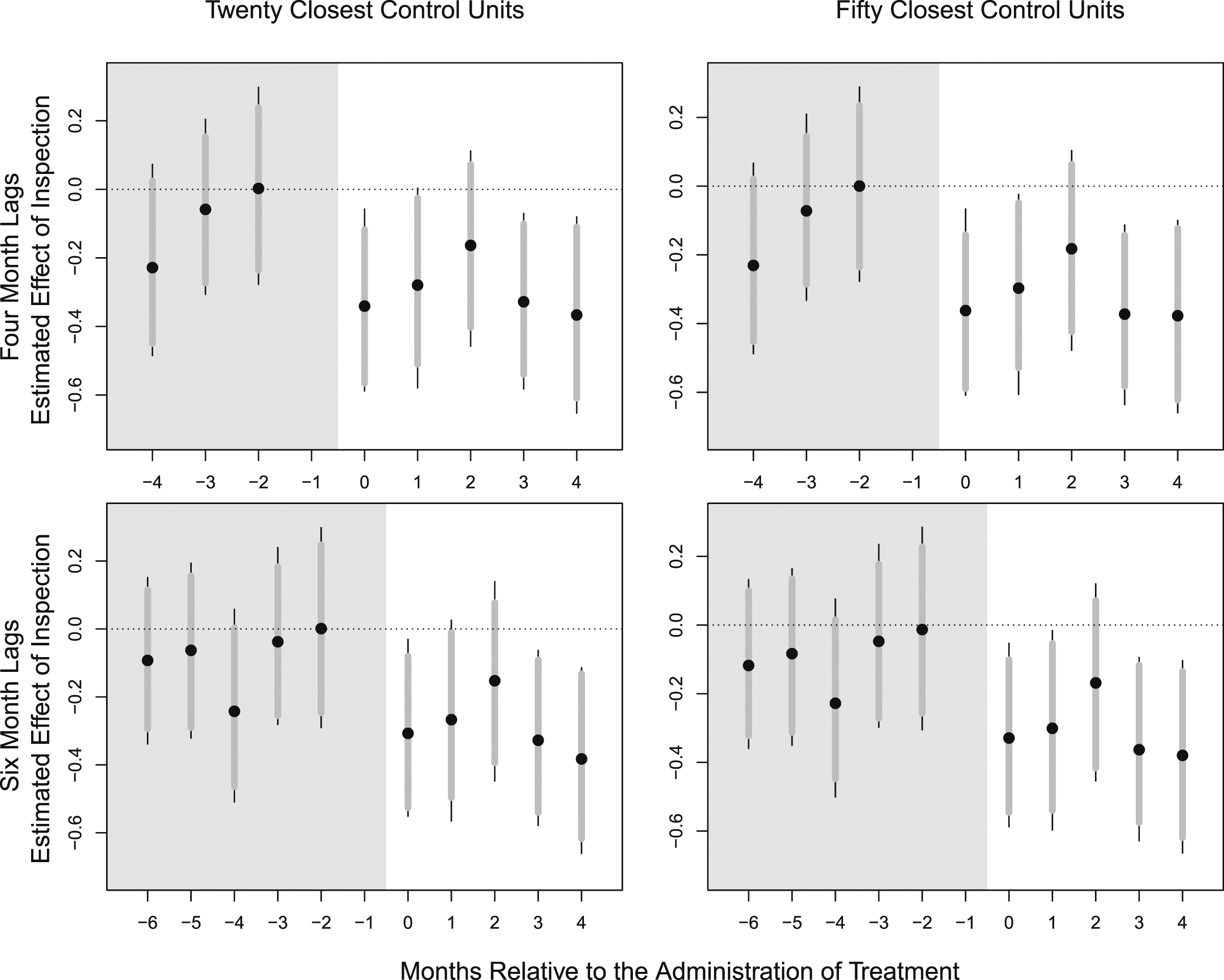
Alternative Explanations
One alternative explanation of the results would be that inspections themselves can be time-consuming for the bureaucrats, as they might cause disruption in their work. This different interpretation is inconsistent with the data. The median (average) duration of an inspection only lasts for 39 (48) days, but the effect in Figure 5 lasts beyond the 120 days after the inspection. In subsection “Longer-term Effects using Annual Data” of the Appendix, I consider the longer-term effect of inspection with OLS specifications by aggregating the treatment and dependent variables to yearly data. It shows that an additional month of inspection in the current year leads to decline in land development projects proposed in the next year. 69
Another different interpretation of the negative effects of anti-corruption inspection is that they may simply reflect a reduction of actual corruption. For example, one may argue that the method of land sales through auction, even though originally introduced as a way of preventing corruption, can still be gamed by officials. I conduct a series of causal mediation analyses (Imai et al., 2010) using PDIC inspections as the treatment and three different “mediators” to show that the negative effect of inspections on proposals of land development projects unlikely operates through the reduction of actual corruption.
The first mediator uses anti-corruption arrest data in Wang and Dickson (2021) to compute the number of arrests in each month for each county. The number of arrests proxies the extent to which corruption is reduced. 70 The second and third mediators are original measures of a locality’s corruption potential over time. Both measures exploit the idea that corruption could occur through either suspiciously high or suspiciously low transaction price and are therefore constructed by analyzing the transaction price of every land parcel relative to the prices of its spatially similar counterparts. Information for the precise address of each land parcel in my data allows me to scrape for each transaction’s geo-coordinates by algorithmically submitting the address to Baidu Maps (the equivalent of Google Maps in China). One measure residualizes the price difference between a land parcel and the average price of all other parcels within a 500-meter radius from it against multiple fixed effects and transaction-level covariates. The other measure employs spatial regression using the least absolute shrinkage and selection operator (LASSO), where the price of each land parcel is residualized against up to 9-way interactions of transaction-level covariates and multiple fixed effects. Both measures are aggregates of price residuals that reflect the part of a land parcel’s transaction price that is unrelated to its economic and geographic values. I provide a detailed discussion of mediator variable construction in “More information on the mediator measures” of the Appendix.
Causal mediation analyses with the mediators described above allow us to examine how much of the impact that inspection has on bureaucrats’ behavior is driven by reduction of actual corruption. The outcome for the analyses is the total area of land projects proposed for auction at t + 1. To facilitate interpretation, I standardize both the mediator variables and the treatment variable so that they have mean 0 and standard deviation 1. Figure 6 reports results for three quantities of interest: total effect of inspection, direct effect of inspection, and mediation effect of the respective mediator. “Total Effect of Inspection” in each panel is by construction equivalent to the effect identified in section “Main Results” without standardization. “Mediation Effect” measures how much of this total effect is driven by reduction of actual corruption. “Direct Effect of Inspection” is the amount of the total effect that still remains after taking out mediation effect and is thus directly relevant to the mechanism of chilling effect proposed in this research. Across all three mediators we find that the direct effect and total effect are substantively similar and statistically indistinguishable, whereas the mediation effect is extremely tiny. The analyses thus do not support the notion that the negative effect of inspection on bureaucrats’ productivity is due to reduction of actual corruption. However, as causal mediation analysis relies on the strong assumption of sequential ignorability, I urge caution when interpreting these suggestive results.
71
I complement these results with some additional qualitative evidence in subsection “Additional qualitative evidence on the mechanisms” of the Appendix. Results for causal mediation analyses. The dependent variable across the three panels is the logged total area of proposed land auctions. The mediation effects in the top rows refer to effects with number of arrests (left), price residuals within 500-meter radius (middle), and the absolute values of price residuals from spatial LASSO (right) as the mediators. All models include unit and time fixed effects and time-varying controls specified in subsection “Identification Strategies.” 95% (90%) confidence intervals constructed using standard errors clustered by unit are in black (gray) lines.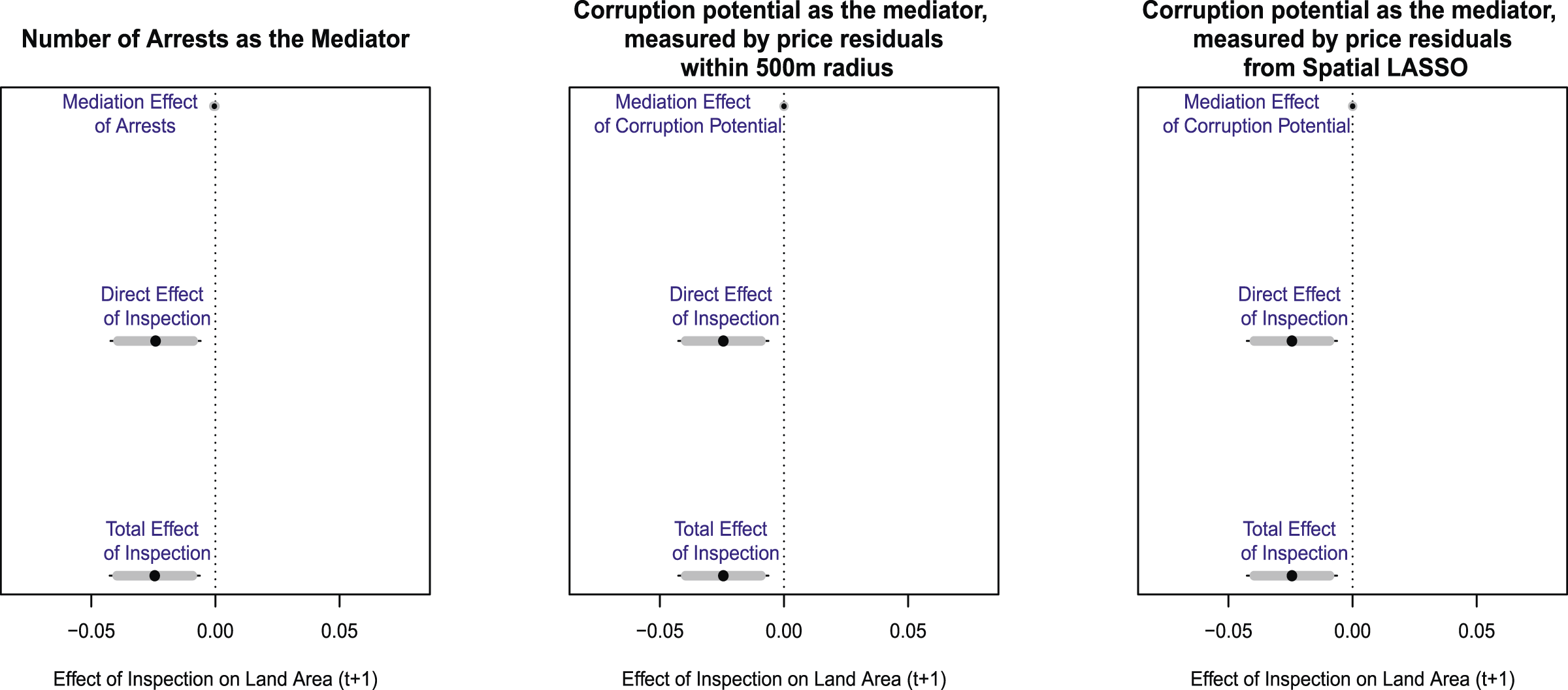
Discussion
This section provides a further discussion about the nature of the empirical results and the limitations of this research. Since my research design exploits a real-world setting, it is inevitably difficult to capture certain subject behaviors in the natural “laboratory.” Even though the timing of inspections at the county-level is hard to predict from the bureaucrats’ perspective, it is common knowledge that the entire country is under an unprecedented nationwide campaign. Bureaucrats might pre-adjust their behavior regardless of inspection in their own locality.
This limitation reflects the ultimate tradeoff between the gain in external validity from observational studies and the loss of internal validity from not having an actual lab experiment. Nevertheless, the plausibility of this issue likely means that the findings in this paper are potential underestimates of the real effect—as productivity in comparison groups without inspection also goes downward, it is harder to obtain the negative effect as I do. 72 A separate issue is whether the findings from land development projects travel to other areas of interest. In subsection “Extension analyses” of the Appendix, I show that inspections also negatively affect other tasks of the Chinese bureaucracy, such as revenue collection and environmental regulation.
In addition, these results naturally make us wonder: why would the campaign still persist given its negative impact? A fully fledged answer is beyond the scope of this paper, but I venture two perspectives for future research to consider. The first one concerns the political benefit of the campaign. To Xi himself, the anti-corruption drive has helped him consolidate power against potential opponents in elite politics. The continuation of this strategy against those in the top echelon of the political system (the “tigers”) certainly seems more justified when presented as part of a much wider campaign that reaches the lowest level of the bureaucracy (the “flies”). More importantly, the campaign is likely to have improved public support for the regime in China. Recent experimental evidence finds that Chinese citizens highly appreciate the moral commitment signaled by anti-corruption (Tsai, Trinh and Liu, Forthcoming). 73 The second perspective considers the difficulty for an authoritarian regime like China’s (and certainly for a leader on his way to power maximization) to back off on a trademark policy because of controversies. Doing so would send a signal of weakness. 74
Conclusion
This paper introduces a theoretical framework that links informal practices proliferated in government bureaucracies as ways of resolving bureaucratic pathologies to the unintended, negative consequences of anti-corruption efforts for bureaucratic performance. It then uses new data from China’s recent anti-corruption campaign to provide support for the argument. A variety of qualitative evidence indicates that the campaign has resulted in “administrative slack” by bureaucrats. Quantitative analyses that exploit variation in the timing of sub-provincial anti-corruption inspections provide systematic evidence for declines in bureaucratic productivity and performance measured in terms of proposals of land development projects through auctions. Additional analyses, using data for anti-corruption arrests as well as original measures of corruption potential, confirm that the results are not driven by reduction of actual corruption. The theory and findings offer us a way to rethink anti-corruption initiatives as efforts to enhance bureaucracy and state capacity. They also shed light on the critical importance of bureaucrats’ strategic response to understanding political economy of development as well as authoritarian politics.
This research, however, does not argue against the urgency to combat corruption in the developing world. Instead, it aims to provide policy recommendations that are theoretically and empirically grounded to practitioners. As mentioned earlier, internally driven anti-corruption efforts are largely products of politics and thus are likely to have expansive mandate that goes beyond just reducing actual corruption. Nevertheless, international anti-corruption organizations, to the extent that they can induce anti-corruption efforts external to the target country’s own politics, should make bureaucratic performance and organization capacity a main and immediate metric of evaluation in their initiatives. More specifically, they need to recognize that there are informal practices that bureaucrats adopt to fight bureaucratic pathologies and design initiatives that do not undercut their very wherewithal to accomplish daily tasks.
Footnotes
Acknowledgments
The author is grateful to Carles Boix, Rory Truex, and Kosuke Imai for guidance and support. The author would like to thank Ting Chen, Winston Chou, Brandon de la Cuesta, Greg Distelhorst, Naoki Egami, Ted Enamorado, Benjamin Fifield, Mary Gallagher, Jean Hong, Will Horne, June Hwang, Yue Hou, Xian Huang, Jay Kao, Yunkyu Kim, Horacio Larreguy, Reed Zhenhuan Lei, Tao Li, Adeline Lo, Zhaotian Luo, Asya Magazinnik, Eddy Malesky, Dan Mattingly, Melanie Manion, Gwyneth McClendon, Jen Pan, Albert Park, Grigore Pop-eleches, Molly Roberts, Tomoya Sasaki, Diana Stanescu, Yuriko Takashi, Jeremy Wallace, Yuhua Wang, Fangqi Wen, Yiqing Xu, Soichiro Yamauchi, Yang Yao, Yang-Yang Zhou, Jiangnan Zhu, members of the Imai Research Group, participants at the Asian Political Methodology Annual Meeting, participants at the Society of Political Methodology Annual Meeting, participants at the American Political Science Association Annual Meeting, Midwest Political Science Association Annual Meeting, and Southern Political Science Association Annual Meeting, and participants at conferences, workshops, and presentations at MIT, Vanderbilt, Columbia University, University of Wisconsin-Madison, Duke University, Princeton University, New York University, Waseda University, Peking University, Chinese University of Hong Kong, and Australian National University for helpful comments and feedback. This work received funding from the Paul and Marcia Wythes Center on Contemporary China, the Mamdouha Bobst Center for Peace and Justice, and the Princeton Program for Quantitative and Analytical Political Science (Q-APS). The author also acknowledges funding from the French National Research Agency (ANR) under the Investments for the Future program (Investissements d’Avenir, grant ANR-17-EURE-0010). The author is especially thankful to Yuhua Wang for generously sharing the data for investigations, and Lulu Li, Brian Leung, Zhizhen Lu, Tongan Lv, and Yuqing Jin for excellent research assistance. All errors belong to the author.
Declaration of Conflicting Interests
The author(s) declared no potential conflicts of interest with respect to the research, authorship, and/or publication of this article.
Funding
The author(s) disclosed receipt of the following financial support for the research, authorship, and/or publication of this article: This article was supported by French National Research Agency; Princeton Program for Quantitative and Analytical Political Science (Q-APS); Mamdouha Bobst Center for Peace and Justice; and Paul and Marcia Wythes Center on Contemporary China.
