







Abstract
How does the world of work in Latin America affect the way workers act to defend their interests? To what extent have “productionist” demands, those concerning jobs, work conditions, and wages, which are highly salient across the region, been “displaced” by consumptionist or political demands? While the literature has distinguished formal and informal work grosso modo, we explore individual traits of work, which cross-cut the formal-informal distinction. Analyzing survey data from four Latin American capital cities, we find, not surprisingly, that both work-based atomization and insecurity depress demand making in the work arena. But these traits of work also affect demand making on the state, albeit in somewhat different ways. Insecurity is associated with a shift from productionist to consumptionist and political demands, while atomization is associated with a more generalized demobilization across issues. These findings have implications for the representation of worker interests in light of current labor market restructuring and raise the question if labor can reclaim an important voice in that restructuring process.
Introduction
Economic crisis and market reforms in the 1980s and 90s produced turmoil in the lives of Latin American workers. Real wages declined, formal employment stagnated, and job dislocation escalated as markets were reconfigured through privatization and opening to international competition (Inter-American Development Bank, 2004, chap. 4; Rodrik, 2001, 13–15). As a result of these hardships, work issues were politically salient at the turn of the 21st century. In surveys from 1995 to 2007, citizens across the region overwhelming reported that the most important issues facing their countries were job-related—having to do especially with unemployment and low wages (Collier & Chambers-Ju, 2012, 574; Inter-American Development Bank, 2004, 12). The urgency of these issues has persisted; in region-wide surveys from the past few years, job-related issues continue to classify as among of the top three problems, surpassed only in some countries and years by insecurity or corruption (Gabriel, 2018; Latinobarómetro, 2018, 6).
Partly in response to these accumulating grievances and partly as a reflection of new organizing and civil society vibrancy that came with redemocratization, Latin America experienced a wave of redistributive policies. These policies were part of what more broadly has been conceptualized as “the new inclusion” (Kapiszewski, Levitsky, and Yashar 2021) and “the second incorporation” (Rossi & Silva, 2018), invoking an “older” or “initial” incorporation of the early-20th century (Collier & Collier, 1991). The vast majority of these policies, unlike the first incorporation, but in keeping with the approach from the 1980s and 1990s, were primarily consumptionist, in that they had to do with non-job-based income and benefits, especially social programs for the poor. What went neglected were productionist policies, that is, those that affected jobs per se—job creation or work conditions either in terms of employment relations or in terms of modified development models. 1 Indeed, in many countries, labor market flexibilization policies reversed pro-worker productionist policies (Cook, 2007; Etchemendy, 2011; Murillo, 2005). While some of these consumptionist programs began before the advent of Left government in the 2000s, this orientation was continued by Left-turn administrations, many of which were led by labor leaders such as Lula in Brazil and Morales in Bolivia. Why was even the Left timid in responding to productionist grievances with productionist policies?
Much attention has been paid to the influence of factors working against productionist intervention: globalization with its incentives for producing competitive exports and attracting foreign investment (Milner & Rudra, 2015); the power of capital in policy making (Fairfield, 2015); conditionality from multi-lateral institutions (Pop-Eleches, 2008, chap. 7); and the decline of labor-based political parties, which, when in power during the debt crisis, relented to these capital-friendly pressures (Levitsky, 2003; Roberts, 2015). Also, while the productionist policies under ISI were blamed for inflating public debt, consumptionist policies are cheap. The median cash transfer program in Latin America costs 0.24 percent of GDP (Holland & Schneider, 2017, 993). Further, the period corresponded with an international boom in civil society organizing that has been oriented toward consumptionist demand making, such as public services and social programs (Collier & Handlin, 2009b; Palmer-Rubin, 2019; Silva, 2009).
Rather than focus on opponents of productionist policies and the proponents of consumptionist policies, we draw attention to another component: the would-be proponents of productionist policies. We suggest that an important part of the explanation for the lack of job-promoting measures has to do with the weakness of demand making. Our analysis offers evidence that a lack of productionist demands may be related to the presence of certain work traits that demobilize worker collective action around shared productionist goals. These work traits push workers to instead make demands of consumption, asking the state to provide benefits to compensate for poor work condiitions.
Analysts have long pointed to the political weakness of the informal sector. In this analysis, however, we go beyond the typical formal and informal categories for three reasons. First, as many analysts have stated, informality is a multifaceted, inconsistent, fuzzy concept. (Indeed, the ILO has several times changed its definitions). 2 Definitions refer to a bundle of different traits; it is important to understand which of these may affect demand making. Second, many of these traits cross the formal-informal divide, belying any justification for employing the formal/informal dichotomy on the basis that these cohere into distinct “classes” or categories of work. As we demonstrate using survey data below, there is in fact very little statistical correlation between various work traits typically associated with informality. Third, with the introduction of platform labor and other recent modes of labor market restructuring, some of these particular traits may be on the rise. While the concept of the “informal sector” has primarily been analyzed in the Global South, a secondary labor market has grown over the past several decades in the world’s most advanced economies (see, for instance, Standing (2012); Kalleberg (2009)), and refocusing attention to more specific traits that is common to all these segmented labor markets usefully expands the scope of analysis. Understanding the effect of these traits on the political engagement of workers merits attention.
We interrogate two specific categories of work traits: (1) work-based resources for collective action, including the size of work-based social networks and the presence of a union and (2) work-based insecurity, including instability of income and of employment. We also consider workers’ individual resources for demand-making, including level of education and past union experience.
We ask the following questions. How do these work traits affect workers’ overall level of demand making? Are they associated with a shift in type of demands, from productionist to consumptionist issues? Finally, how does the effect of these work traits compare to that of individual traits of workers (i.e., human capital)?
We address these questions using data from an original survey carried out in 2002 and 2003 in four Latin American capital cities—Buenos Aires, Argentina; Santiago, Chile; Lima, Peru; and Caracas, Venezuela. These four countries exhibit variation in socioeconomic traits and party systems within the region. The focus on these four megacities—as opposed to nationally representative samples—provides a snapshot of the most notable sites of labor-market disruption in the neoliberal period and of new modes of urban associationalism. 3 The data used in this paper are limited to survey respondents who reported that they were working at the time of the interview (N = 2729).
The survey includes novel measures of our independent and dependent variables that are absent in other surveys of the region, such as LAPOP or Latinobarómetro. These other surveys lack measures of work traits (our independent variables), failing even to ask about labor union membership. In contrast, our survey contains a battery of questions that address work-based resources for collective action (coworker networks, unions) and employment security (wages and job stability), among other traits. On the demand-making (dependent variable) side, existing surveys ask about a series of modes of political participation (voting, protest, signing petitions, contacting politicians), but without linking these to the issues being addressed. In contrast, we asked respondents about different modes of demand-making—both at work and in the political arena—and then asked an open-ended question about the issue being addressed. We then coded these responses into three categories: productionist, consumptionist, and political.
The timing of the survey captures the landscape that leftist presidents confronted as they came to power in the early 2000s, when workers potentially faced a better opportunity to receive a positive policy response to productionist demands (Blofield, 2012; Rosaldo, 2016; Schipani, 2019). On the one hand, this is a period of accumulating grievances imposed by the ongoing hardship of the debt crisis and changing economic models, expressed in the political ascendancy of the Left. On the other hand, the new economic model intensified the potentially demobilizing work traits about which we hypothesize.
While the growth of a proletarian industrial labor force shaped popular-sector interest representation in the first half of the 20th century, the decades since gave rise to a segmented labor market and a more complex landscape of work. In Latin America, the growth of a so-called informal sector began in the 1950s and 60s. By all accounts, however, the lost decade of the 1980s produced the most rapid changes in the labor market, with high rates of formal-sector layoffs, declining real wages, informalization, and declining union density (Portes & Hoffman, 2003). While market reforms shook up labor markets worldwide, Latin American countries were hard hit with wage volatility roughly five times that of developed countries (Inter-American Development Bank, 2004, 121). In the 1990s—post-crisis, for most Latin American countries, but in the midst of structural reform—labor market disruptions persisted. According to the ILO, the size of the informal sector region-wide grew from 42.8 percent to 47.4 percent of the workforce from 1990 to 2003 and subsequently remained relatively stable, representing 47.2 of the workforce in 2017 (2006, 91–99, 2019, 66–67). 4 The proportion of workers with social protection coverage declined in six out of the region’s largest eight countries, from an average of 64.5 percent to an average of 59.8 percent. Meanwhile, by 2000, trade union density had declined by roughly half of its mid-century peak (from 31.9 percent to 16.1 percent) in Latin America’s “labor mobilizing” party systems (Roberts, 2015, 100). 5 Thus, compared with prior decades, at the turn of this century working conditions for the typical Latin American worker were more volatile and less protected.
In the two decades since our data were collected, the trend of labor flexibilization has continued. Platform-based independent contracting and gig work have constructed new labor markets, some of which are international (Collier et al., 2018). Data on the size of the gig economy in Latin America is lacking, but we do know that in-person platforms for transportation and delivery, like Uber, Rappi, and Didi, as well as digital web-based platforms for remote work, like Upwork, have become prominent sources for work in Latin America. The growth of this sector in Latin America has almost certainly exacerbated work-based atomization and insecurity, contributing to a global trend of increasingly flexible and precarious labor arrangements (Fine, 2006; Standing, 2012). Platform labor includes both relatively unskilled workers—primarily on in-person platforms—and highly skilled labor; over half of Latin American workers on web-based platforms have a university degree (Hilbert & Lu, 2020, 9). A recent joint report by the Economic Commission for Latin America and International Labour Organization on platform labor in Latin America (2021, 21) concludes that: “although these forms of work may offer new job opportunities, they tend to make the labour market more precarious. This not only results in worse quality employment but may also contribute to at least some segments of the population increasingly seeing precarious working conditions as the norm in Latin American labour markets.”
Our overall finding is that both work-based atomization and insecurity demobilize workers, especially in productionist demand making. As one might anticipate, the size of work-based networks is negatively associated with productionist demand making on the state and at work. Atomized work no doubt inhibits class formation and the identification of shared work-related grievances. More surprisingly, work-based atomization appears to demobilize workers in non-productionist demand-making as well. As work networks shrink, workers’ voices in politics weaken around all kinds of issues. In contrast, work traits associated with employment insecurity are associated not with change in the level of demand making, but with a shift in type of demands: from productionist to consumptionist and political demands on the state.
Work and Demand Making in Latin America
Conventional wisdom is that informal workers struggle to organize and thus have limited capacity to pursue their interests as workers in either electoral or contentious channels (Kurtz, 2004; Roberts, 2002; Schneider, 2013, chap. 5). Typically commanding attention only in occasional, albeit impressive, large-scale protest movements, as those in Brazil in 2013 (Vicino & Fahlberg., 2017), members of the informal sector are often described as politically marginal actors. What is missing in this account, however, is micro-level evidence demonstrating which specific conditions of informal work demobilize workers. Furthermore, while scholars have analyzed several surprising cases of informal‐sector organizing and productionist demand making in recent decades, our approach is to ask what extent specific work traits affect demand making and to see if these can systematically shed light on these “exceptions.”
We start, then, with the observation that the world of work is more complex than the formal-informal dichotomy suggests. Attempts to diagnose the effect of informality on political participation overlook specific traits of work and miss the opportunity to recognize that many formal and informal workers are, in many ways similarly situated. Within both of these categories, there is substantial variation in the relevant traits of work. For instance, while many informal workers are atomized, some have opportunities to work in close proximity and communicate with each other about common conditions of work, such as street vendors and trash collectors. At the same time, what is considered the formal sector has always been very diverse, in rich and developing countries alike. Certainly not all formal workers are unionized or even work in concentrations of any size. Many are self-employed and work alone, and since the 1980s, formal jobs have become increasingly flexible and precarious. New production structures such as those in transnational supply chains (Anner, 2011) and “fissured workplaces” (Weil 2014), blur the target of grievance and make collective action more difficult. The advent of labor platforms and, in some economies, just-in-time scheduling of work add enormous instability to hours and income and prevent the construction of coworker networks (Carre & Tilly, 2017; De Stefano, 2015). Thus, though certain traits of work may be more common among informal workers, a focus on the informal sector per se may not only misspecify and underspecify an explanation, but may also understate the representational difficulties of workers.
In looking at political outcomes, scholars have relied on the formal/informal dichotomy. Two approaches to this dichotomy have prevailed. In the first—which has generally become the consensus among labor scholars (Rosaldo et al., 2012)—“informal work” is defined as work that is not regulated in that workers do not enjoy state protections as afforded by labor law, lack contracts, and/or are not enrolled in social security (Baker & Velasco-Guachalla, 2018; Castells & Portes, 1989; Hussmans, 2004; Tardanico, 1997). In the second, scholars use the term “informal” to refer to the condition of marginality, precarity, and/or insecurity, (Rosaldo, 2021). Studies in this tradition do not focus on the nature of work per se, but variously emphasize poverty, labor market uncertainty, and powerlessness (Ruiz-Restrepo & Barnes, 2010; Swider, 2016).
A long tradition of research has analyzed the effect of informality on political participation. Formal sector “insiders” have traditionally been mobilized in labor-based parties and make demands through unions, while informal-sector “outsiders” are generally more demobilized politically. 6 Recent findings by Baker and Velasco-Guachalla (2018) suggest the alternative view that there is no difference in political engagement by formal and informal-sector workers. This finding is based on a sophisticated analysis of region-wide survey data using regulation-based measures of informality—whether a worker was enrolled in social security or had a contract. The authors explain this similarity in various measures of participation with reference to the idea that the formal and informal sectors are inter-temporally and interpersonally integrated. That is, workers rotate between formal and informal work and live in multi-sectoral households—with individuals who work in both.
Although we do not deny this integration, our view is that it misses the heterogeneity within the formal and informal sectors and thereby may also miss the most important relationships between conditions of work and political participation. Thus, we move beyond the binary approach, inquiring about the effects of specific traits of work on workers’ demand-making. Further, unlike Baker and Velasco-Guachalla and others (Blofield, 2011; Boulding & Holzner, 2020), we do not ask about general levels of participation (e.g., voting, protest, or contacting politicians), nor do we analyze the impact of these traits on party or electoral participation. Rather, we inquire into workers’ ability to make more specific demands, including those about highly salient productionist issues concerning jobs, work conditions, and wages.
We suggest that a focus on these more specific work traits may also help explain what have been viewed as exceptional cases of productionist demand making on behalf of informal or otherwise non-traditional segments of the workforce. Recent research in Latin America has documented successful campaigns on the part of coca growers (Anria & Cyr, 2017), street vendors (Hummel, 2017), domestic workers (Blofield, 2012), waste pickers (Rosaldo, 2016), the unemployed (Garay, 2007; Rossi, 2017; Schipani, 2008), and landless workers (Ondetti, 2008; Wolford 2010). To what extent does a more disaggregated approach to work traits help to explain the incidence of demand making by labor market outsiders and the types of demands that these workers make?
Traits of Work and Demand-Making Activity
In analyzing demand-making activity, we look at two sites: the work arena and the political arena. Demand making in the work arena includes instances where workers—either alone or collectively with co-workers—target private market actors who affect them as workers, such as employers, clients, and suppliers. The political arena is one of state-targeted demand making and includes such strategies as protest, signing petitions, taking legal action, or contacting state or party actors. In the political arena, we similarly asked whether respondents engaged in one of these strategies either acting alone or engaging in collective action as part of a group. By including individual action, we acknowledge the idea that workers, even atomized workers, can in principle undertake demand making activities individually in both arenas—not only targeted to the state, but also targeted to those who affect their conditions of work.
We distinguish three types of issues around which respondents make demands. Productionist demands relate to economic issues at both the macro-level, such as policies that affect real wages and unemployment levels, and the micro-level, such as wages, benefits, and working conditions. Consumptionist demands are directed at the state and concern social provision—such as health and education—income support, residential or neighborhood improvement, and local public goods. Like productionist demands, consumptionist demands are materialist. The final category is political demands. Though rights demands have been common and have received substantial analytical attention (Kapiszewski, Levitsky, and Yashar 2021), the most frequently noted in our survey are negative demands, frequently concerning public “bads.” These include such issues as problems with structures of representation (e.g., parties), corruption, or areas where the government is failing, as with insecurity or environmental degradation. Unlike productionist demand making, which we analyze in both the work and the political arenas, consumptionist and political demand making pertain only to the political arena.
Hypotheses
We consider three lines of explanations that have been theorized to afford resources for workers as they seek to advance their interests. First, we consider work-based resources, including work-based networks and labor unions. Social networks have widely been considered requisite for collective action (Sinclair, 2012; Verba, Schlozman, and Brady 1995). Studies of social movements in particular have emphasized the importance of networks for mass contentious mobilization (Klandermans & Oegema, 1987; McAdam et al., 1996; McCarthy & Zald, 1977). We do not limit demand-making activities to participation in collective contention; however, we hypothesize that networks may be important for a broad range of other activities as well.
Work-based networks are formed among those who work in the same location, have the same employer or clients, or otherwise communicate with each other because of employment-based commonalities. Such networks have long been recognized as a central basis for labor action and productionist demand making (Kerr et al., 1960), yet also may be activated outside the workplace. Work-based networks provide opportunities for the discussion and construction of common interests, identities, and grievances, and for mobilization, solidarity, and action. Thus, we expect that workers with larger networks have an easier time engaging in demand making around shared issues. Put differently, atomization at work is expected to demobilize workers. At the same time, as noted, we analyze individual action in the workplace, in recognition that action in atomized settings is possible.
Unions are the most important structures for workplace collective action and have historically coordinated worker action around productionist issues both at work and in the political arena. Unions have traditionally grown out of large concentrations of workers in the same workplace, as in manufacturing plants or mining operations (Kerr et al., 1960). In the last century, labor unions constructed identities based not only on the localized workplace, but corresponding as well to national and international working class movements (Katznelson & Zolberg, 1986; Wright 2000, chap. 10). Under corporatism in Latin America and Western Europe, unions were the central actors mobilizing the popular classes in labor policy primarily, but also ranging to macroeconomic issues of trade, industrial policy, and the welfare state (Collier & Collier, 1991; Lehmbruch & Schmitter, 1982).
The formation of networks may also be crucial for those who do not share an employer, such as own-account workers or those hired in very small workplaces or domestic workers in homes. Networks have proven important for similar workers who are geographically concentrated, such as street venders, recyclers, or domestic workers. Delivery workers may meet in places where they pick up goods or riders and those who share suppliers or clients may meet at marketplaces. To some extent online communication might substitute for face-to-face communication and “community” formation. However, so far this mechanism seems limited, as has been shown even in the case of Uber, where workers have the advantages of a common target of grievance, identical work conditions, and a number of on-line forums and channels of communication (Collier et al., 2018).
Our first hypothesis (H1) holds that work-based resources are positively associated with all types of demand making, but especially in the work arena and for productionist issues in the political arena.
The second category of traits that we consider is the insecurity of work, resulting from unstable or uncertain employment or pay. Scholars of the informal sector have noted insecurity as a distinct trait of informal work—a nearly constant condition of the “same job” but with daily or weekly fluctuations of hours and income (Castells & Portes, 1989). Insecurity is also a feature of many kinds of independent contracting arrangements, even when they are formal. Newer kinds of insecurity stem from flexibilization, such as just-in-time work, when employers call in workers on a weekly or even daily basis according to the fluctuating demand for work (as in some retailing), flexibilization of work sites, with a pattern of more frequent fluctuations in the size of the workforce. We consider two hypotheses for work insecurity.
First, we consider the effect of job and income-based insecurity on levels of demand making generally, in line with the common argument that insecure or “precarious” (Standing, 2012; Swider, 2016) work inhibits political participation, exacerbating underrepresentation and economic inequality. Contrary to Baker and Velasco-Guachalla (2018), much prior research argued that informal work produces lower levels of political engagement (Blofield, 2011; Castells & Portes, 1989; Kurtz, 2004; Roberts, 2002) and job and income insecurity may be an important mechanism in this relationship. More recent studies—both in Latin America (Braga, 2018; Iranzo and de Paula Leite 2006; Manky, 2018) and in advanced democracies (Kalleberg, 2009; Standing, 2012; Weil 2014)—have focused on labor flexibilization due to subcontracting, offshoring, and other business practices expanding in the neoliberal period. These studies suggest that such insecure work situations not only produce economic precariousness, but also hinder workers’ ability to organize and press for better working conditions.
We hypothesize that the mechanisms that connect these types of work to low levels of participation may have to do with insecurity produced by unstable incomes and jobs. Insecure workers may be reticent to engage in demand-making at work for fear of reprisals from people whom they may be dependent on or may be more risk averse as a result of unstable incomes. In addition, such workers may be inhibited from making demands on the state by time constraints and geographical transience that undermines the construction of common identities or interests or structures for collective action.
The insecurity demobilization hypothesis (H2) is that work-based insecurity is associated with less demand-making activity overall.
Second, we consider the effect of insecurity on the types of demand making that workers engage in. Perhaps insecure jobs do not demobilize citizens equally across all categories, but instead “push” them away from demand-making at work and “pull” them to address their economic grievances in other forms of demand making on the state. Such a finding would have resonance with research that has noted a robust degree of participation by the Latin American popular sectors today (Boulding & Holzner, 2020). In the last few decades, innovative structures for demand-making have tended to emerge from outside of the workplace and traditional union structures, on the part of neighborhood associations in urban areas (Dosh, 2009; Shefner, 2012) and the landless or the indigenous in the countryside (Wolford 2010; Yashar 2005). Given that they organize populations that do not share a common employment situation, such groups often focus on more broadly appealing consumptionist demands, related to state benefits, local public goods or services, or to the resolution of local grievances related to insecurity or pollution. In this vein, Agarwala (2007) documents well-organized associations of informal workers in India, which focus their demand making not on work-related issues, but rather on the state for welfare benefits. Similarly, Fine (2006) analyzes “worker centers” in the US, which primarily focus on immigrant services and advocacy. Closer to the present analysis, Carnes and Mares (2015) find that job and income insecurity in Latin American are associated with greater preferences for public social protection.
The insecurity displacement hypothesis (H3) holds that unstable work and income make workers less likely to engage in demand making in the work arena and pushes them instead toward consumptionist or political demands in the political arena.
The third class of explanation corresponds to resources of individual workers that are not generated from their current work traits, but rather are indicators of human capital or repertoires of action for demand making. Here we consider education and past union experience, that is, a measure of whether the respondent has ever belonged to a labor union. Past union experience provides a worker with a familiar repertoire of action and perhaps a sense of efficaciousness derived from having participated in collective work-based action in the past. Finally, we consider education as a general measure of human capital that can also represent skills in the labor market.
We hypothesize (H4) that both of these individual resources are positively associated with all modes of demand making, and, in the case of union experience, particularly with demand making in the work arena and in the political arena around productionist issues.
Taken together these hypotheses allow us to observe whether atomized and insecure work is associated with decrease in the overall level of demand making and/or a shift in type of demands (from productionist to consumptionist).
Data and Variables
The data we analyze were generated by the CIRELA 7 survey of individuals conducted between 2002 and 2003 in four Latin American metropolitan areas: Buenos Aires, Argentina; Caracas, Venezuela; Lima, Peru, and Santiago, Chile (Collier & Handlin, 2009a). Each of these countries was governed by a post-marketizing, reformist administration at the time of the survey (Duhalde in Argentina, Lagos in Chile, Toledo in Peru, and Chávez in Venezuela). They had quite distinct orientations to organized labor and economic policy. Duhalde (PJ) came from a traditional labor-based party that was in the midst of readjusting ties to its union base after a period of radical market liberalization and most recently of dire economic crisis (Etchemendy & Collier, 2007). In both Chile and Peru, longstanding partisan affiliations of the labor movements had been disrupted since the period of military rule (Burgess & Levitsky, 2003; Drake, 2003). Lagos (Concertación) was the first Socialist president of Chile following a long period of centrist rule in the post-Pinochet democratic period. In Peru, Toledo (Perú Posible) was elected as a moderate outsider in opposition to both APRA—the traditional labor-based party—and Fujimori, who had ruled as an authoritarian marketizing populist. Chávez, just beginning his first term, was the furthest left, yet had an openly antagonistic relationship to Venezuela’s major labor confederation (Silva, 2017, 107–11).
The CIRELA survey was designed to measure traits of work and a broad range of forms of political activity of the urban popular sectors. More recent surveys in the region, including LAPOP and Latinobarómetro, do not include questions about respondents’ traits of work other than their contract status and social security enrollment. Since our concern is with the activities of specifically workers, we use a subsample of those respondents who were working at the time of the survey. 8 The present concern is with “normal politics,” patterns that may be considered routinized—but not necessarily institutionalized—activities. That is, we include contentious forms of demand-making; indeed, a finding in Collier and Handlin (2009a) was that contention has generally become a quite a routine form of claim making. However, we exclude those contentious activities specifically related to unusual crises taking place in Argentina and Venezuela around the time of the survey, supporting cross-national comparability.
Demand-Making Activities: The Outcome
Frequency of Different Types of Demand Making by Country (Percent of Respondents Who Engaged in Activity at Least Once).
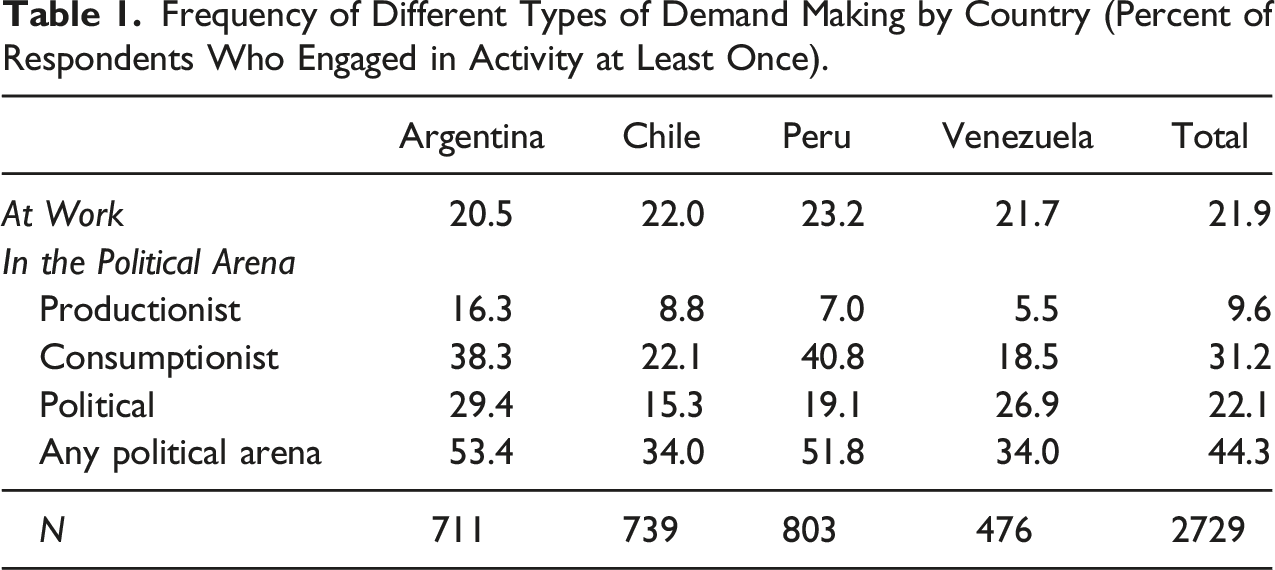
Demand making at work remains quite strong—21.9 percent of respondents, with similar levels across all four countries. This may be considered a type of productionist demand making, limited to “micro-level” issues, such as wages and working conditions. Not shown in the table, those making demands at work were primarily wage earners (henceforth “employees”), of whom 36.2 percent as opposed to 13.4 percent of other workers, engaged in such activity. For employees, most activities were claims targeted at employers. For non-employees, the most frequent target of claims in the work arena was providers of goods (though only about 3.9 percent of non-employees engaged in this type of demand making).
Demand making in the political arena (i.e., demands on the state) is about twice as prevalent as demand making at work, representing 44.3 percent of respondents. In this arena, we see a substantially greater share of consumptionist and political demand making than productionist. When targeted toward the state, productionist issues are primarily macroeconomic and affect real wages and employment levels, such as inflation, labor, trade, or industrial policy. Only 9.6 percent of respondents reported making this type of demand in the prior five years, although with significant variation across countries, ranging from 5.5 percent in Venezuela to 16.3 percent in Argentina. Demands on the state were much more commonly related to issues of consumption (31.2 percent of respondents) and political issues (22.1 percent of respondents). The former was most prevalent in Peru, where over 40 percent or respondents engaging in this type of demand making, while political demand making was the most common category in Venezuela.
Explanatory Factors: Traits of Work and Workers
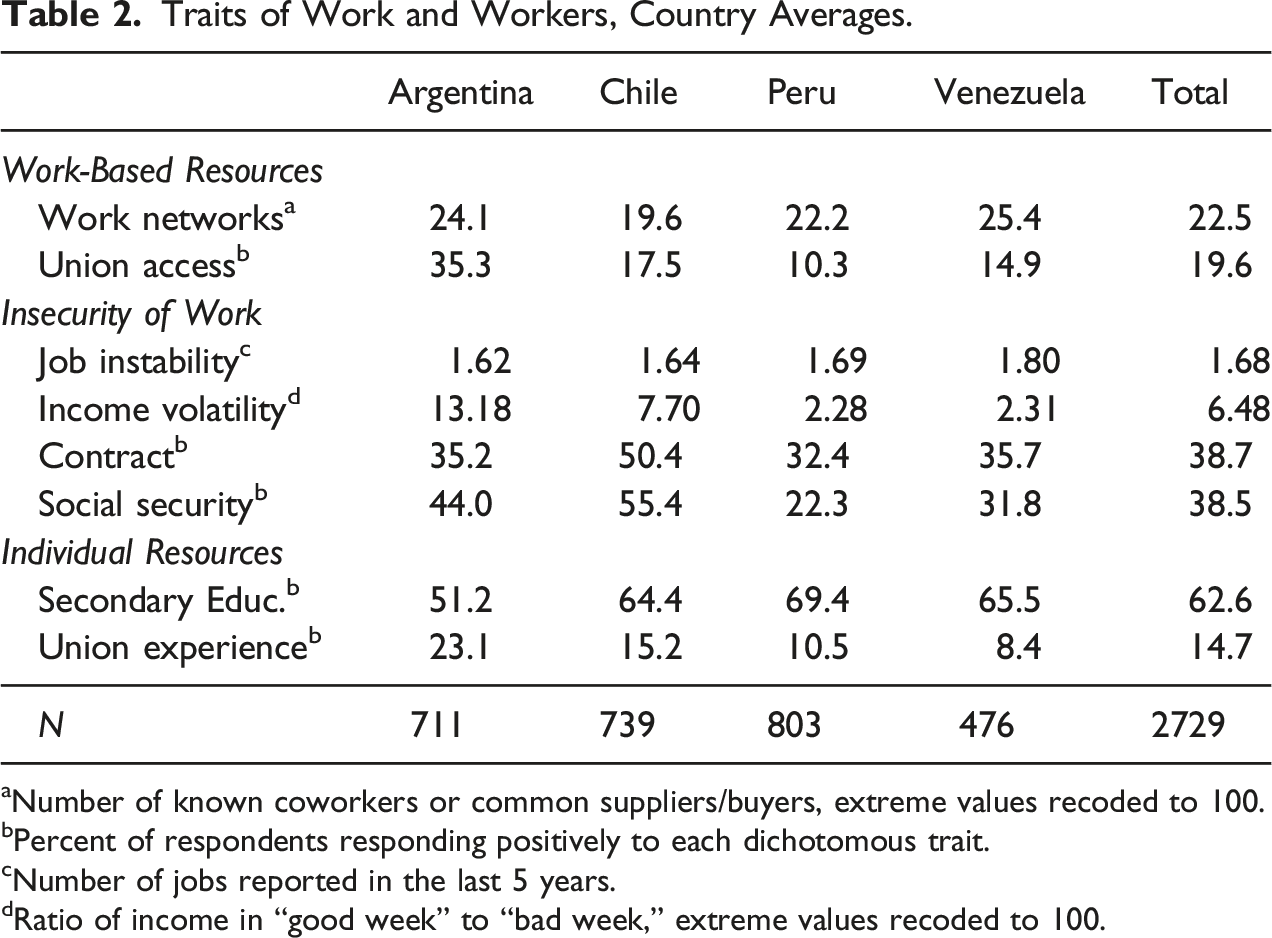
Traits of Work and Workers, Country Averages.
aNumber of known coworkers or common suppliers/buyers, extreme values recoded to 100.
bPercent of respondents responding positively to each dichotomous trait.
cNumber of jobs reported in the last 5 years.
dRatio of income in “good week” to “bad week,” extreme values recoded to 100.
Work-Based Resources
The first variables that we analyze have to do with work-based resources for collective action: worker networks and access to a union. Work-based networks are resources that allow workers to recognize others who share a common grievance and sometimes a common target of grievance. Long recognized as a resource for employees, these networks may also be relevant for non-employees. We constructed a variable based on the number of employees in the same workplace, or, for non-employees the number of people that the respondent knew who bought supplies from or sold goods or services to the same person or who sold in the same area. Less than one-fourth of non-employees belonged to more than one of these potential networks, and for those we used the largest network they reported, thus maximizing their measured level of connectedness. Across all four countries, the average worker had a workplace network of between 20 and 25. These averages disguise wide individual variation and a skewed distribution. Half of respondents reported a network of less than 10 coworkers, with 14 percent of respondents reporting no workplace network at all and two‐thirds reporting networks of less than 20. 10
Perhaps the most important work-based resources for collective action are labor unions. Respondents were asked whether there is a union in their current place of employment or for non-employees, “for people that do their same type of work” (union access). 11 Table 2 shows substantial variation in union access across countries. Most notably, over 35 percent of Argentine respondents have union access, while less than 20 percent have access to a union in each of the other three countries.
Insecurity of Work
We employ four variables to measure work insecurity, specifically insecurity related to income and to a job. Income volatility measures the extent to which a person’s income varies from one week to the next. This measure of income insecurity may occur with or without job instability, especially for those relying on commission, sales of goods or services, or tips. Income volatility was operationalized as a ratio of a respondent’s reported earnings in a “good week” to those in a “bad week.” Income volatility was substantially higher in Argentina at the time of the survey than in the other countries, due likely to the 2001–2002 economic crisis that had just taken place. In all countries about half of respondents reported having no income volatility. Over 23 percent of respondents reported income volatility ratios higher than 2.0 (the proportion of respondents reporting this level was closer to 30 percent in all but Chile). 12
Job instability is another aspect of work insecurity. Job instability was operationalized as the number of jobs respondents reported in the five years prior to the survey. Table 2 reveals surprisingly little cross-national variation and furthermore indicates that job instability is generally quite low: the majority of all respondents reported having only one job in the five‐year period in question, and about 80 percent of respondents in each country reported having had no more than two jobs. Of the four countries, Venezuela had somewhat greater job instability, with about 10 percent having four or more jobs in five years compared to less than 7 percent in the other countries.
We also analyze two work traits that reduce uncertainty in income and jobs, social security enrollment and contract status. (It might be noted that analysts commonly use these two variables to operationalize formal work.) Enrollment in social security reduces income insecurity by providing monetary or in-kind income, such as unemployment insurance, disability insurance, and health care, as well as pensions, which reduce the uncertainty of old age. The presence of a contract reduces job-based insecurity, typically by introducing legal obstacles against dismissal. 13 These traits vary widely by country. Chilean respondents reported the highest rates, with half having work contracts and being enrolled in social security. The rate of employment contracts is substantially lower in the other countries. The rate of social security contribution varies more widely, with a low of 22.3 percent in Peru and a high of 55.4 in Chile.
Individual Resources
Our final pair of variables includes measures of work-related individual resources that we hypothesize to increase human capital and repertoires of action for demand making: education and union experience. We understand education as a measure of skills that may position one somewhat differently in the job market. Given different educational systems across countries, we use a four-level ordinal variable: incomplete secondary, secondary, some post-secondary, and complete post-secondary. Figures in Table 2 display the percent of respondents from each country with at least complete secondary; the values range from 51.2 percent in Argentina to 69.4 percent in Peru. Finally, union experience is a measure of whether the respondent has belonged to a labor union at some point in the past. As with union access, this indicator varies considerably across the four countries. Close to one-fourth of Argentine respondents have union experience, compared with 15 percent or less of respondents from each of the other countries in the survey. We consider this a measure of a certain kind of “socialization” and acquisition of a repertoire of demand-making skills.
Do Work Traits Cohere into Formal/Informal Categories?
Correlation Matrix of Work Traits.

Note. Values in table are Pearson’s R. Values over 0.1 are in italics; over 0.2 are bold.
Analysis
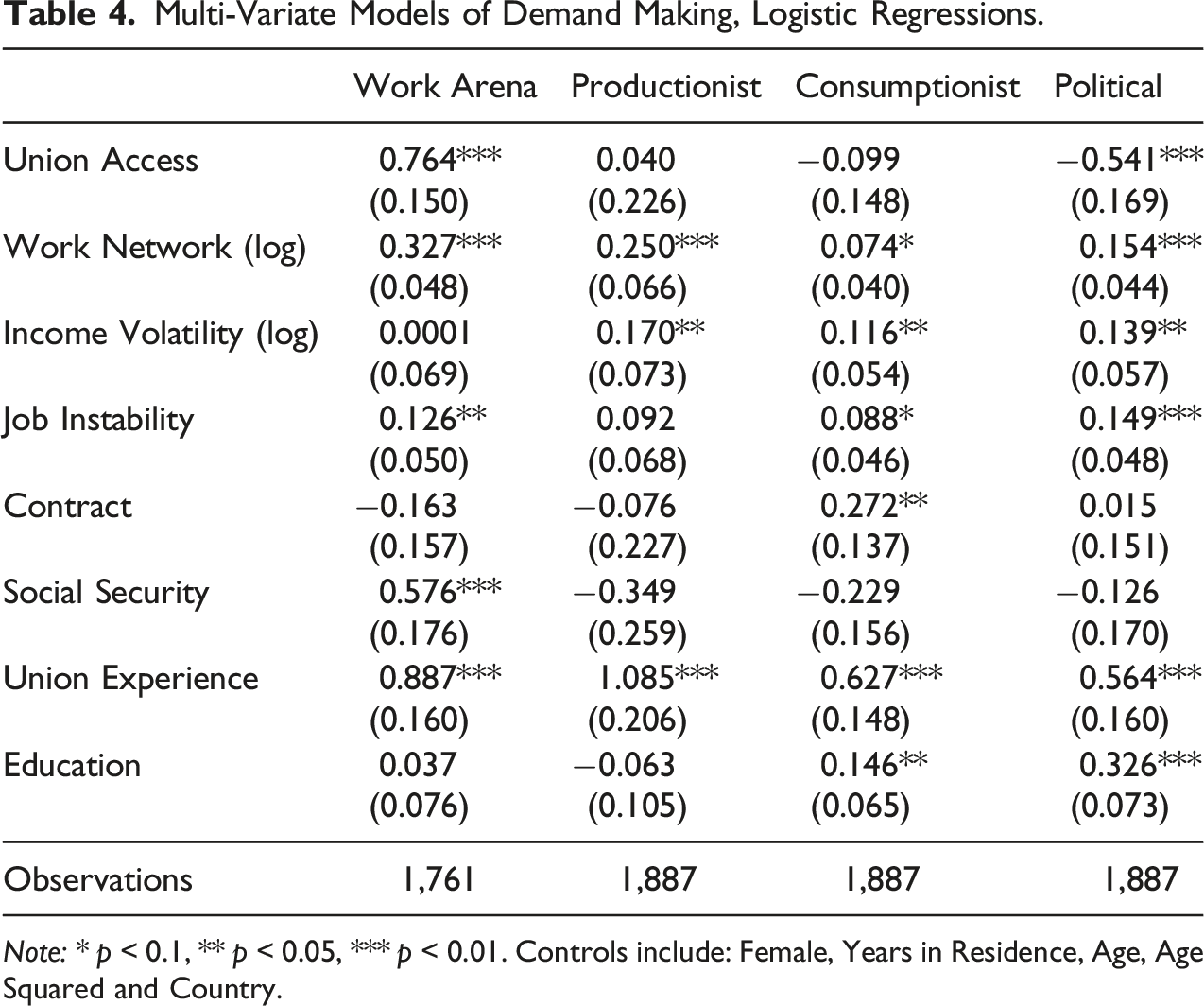
Multi-Variate Models of Demand Making, Logistic Regressions.
Note: * p < 0.1, ** p < 0.05, *** p < 0.01. Controls include: Female, Years in Residence, Age, Age Squared and Country.

Marginal effects of work resources, by country.
Marginal effects of income-based insecurity, by country.
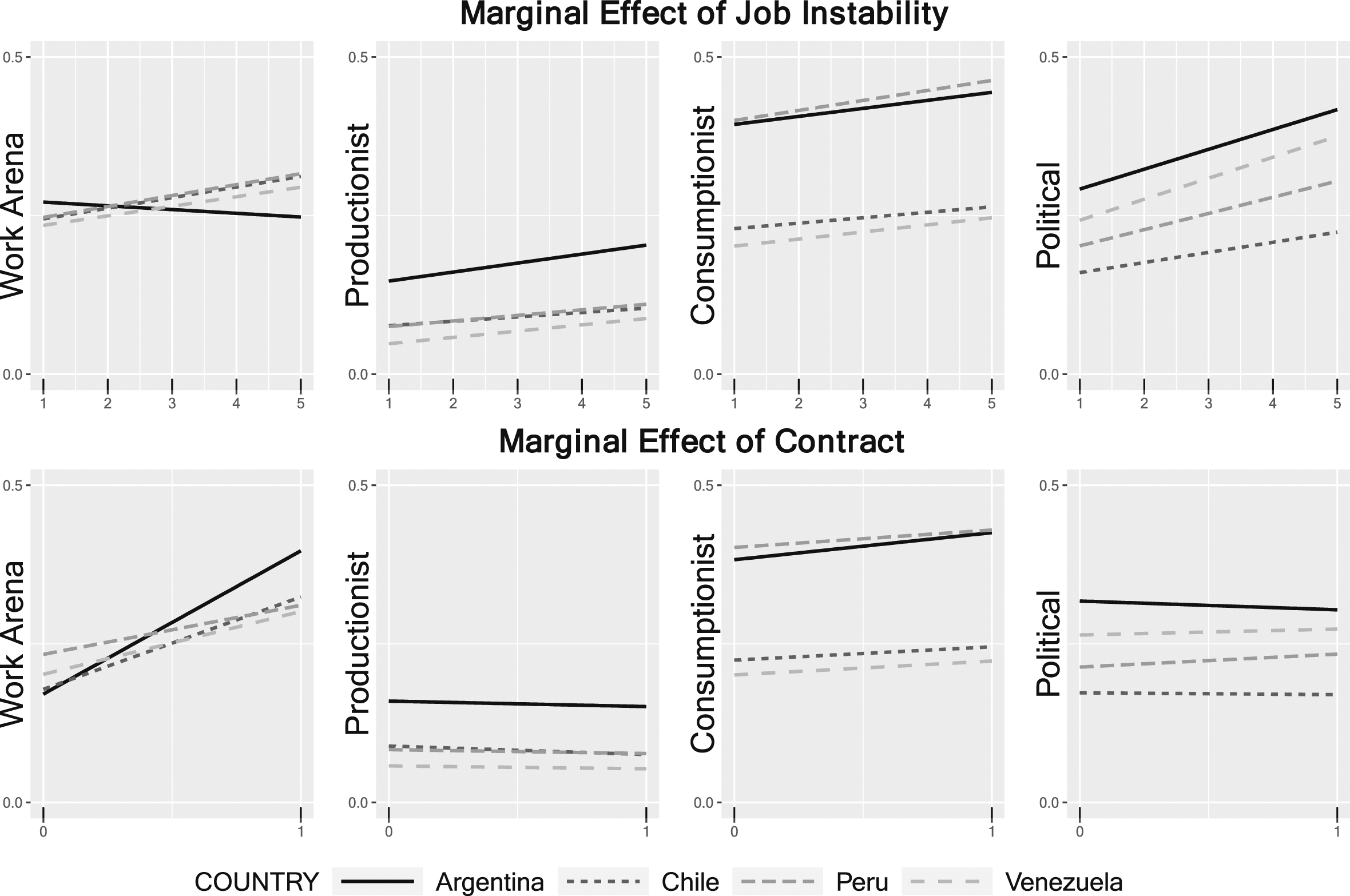
Marginal effects of job-based insecurity, by country.
As laid out above, we consider four hypotheses, oriented to address the relationship between work traits and demand making, with a particular emphasis on productionist issues. H1: Work-based resources promote activity in both arenas, and particularly for productionist demands. H2: Insecure work demobilizes workers across all forms of demand making. H3: Insecure work displaces demand making away from productionist issues at work and on the state and toward consumptionist and political demands on the state. H4: Individual resources of workers promote demand making in both arenas, and particularly for productionist demands.
To consider the effect of work-based resources we look at union access and work-based networks. In line with H1, these resources appear to augment several types of demand-making, particularly at work. Not surprisingly, union access is associated with roughly double the level of demand making at work in all four countries analyzed (Figure 1). However, having access to a union in one’s current place of work does not appear to promote demand making outside of work. This variable has a negative association with demand making around political issues. Perhaps, other than strikes, unions undertake such demand making through activities that do not involve action on the part of the individual worker. In this sense, then, unions may actually demobilize citizens acting individually in the political arena, as union leaders make political demands on behalf of their members, particularly when the governing party is a union ally.
Unlike union access, atomization appears to demobilize workers across all categories of demand making. The size of work-based networks is positively associated with all forms of demand-making, providing evidence that this resource for demand making at work is also useful outside of work. As shown in Figure 1, this association is strongest for demand making in the work arena, where it has a similar magnitude in all four countries analyzed. Moving from no work-based network at all to a network of 30 coworkers—while holding other variables at their means—is predicted to almost triple the level of work-based demand-making, from about 12 percent to about 35 percent of respondents. Also, in accordance with H1, work-based networks are strongly associated with productionist demand making in the political arena. This relationship appears both in cases with high levels of productionist demand making over all—particularly Argentina—as well as cases with lower incidence of productionist demand making, such as Venezuela.
We next address indicators of work-based insecurity, gauging whether it affects overall levels of demand making (H2) or causes workers to shift demand-making activity from productionist to non-productionist issues (H3). Here, we consider four variables: income volatility, social security enrollment, job instability, and contract status. The first two of these are indicators of income (in)security, while the latter two variables are indicators of job (in)security.
We find no evidence for the insecurity demobilization hypothesis (H2), but do find partial evidence in favor of the insecurity displacement hypothesis (H3). Income insecurity appears to push workers to make consumptionist demands on the state, presumably to compensate for economic precariousness. On the other hand, results are somewhat mixed for job insecurity, suggesting that more flexible working situations are not necessarily deleterious for demand making at work.
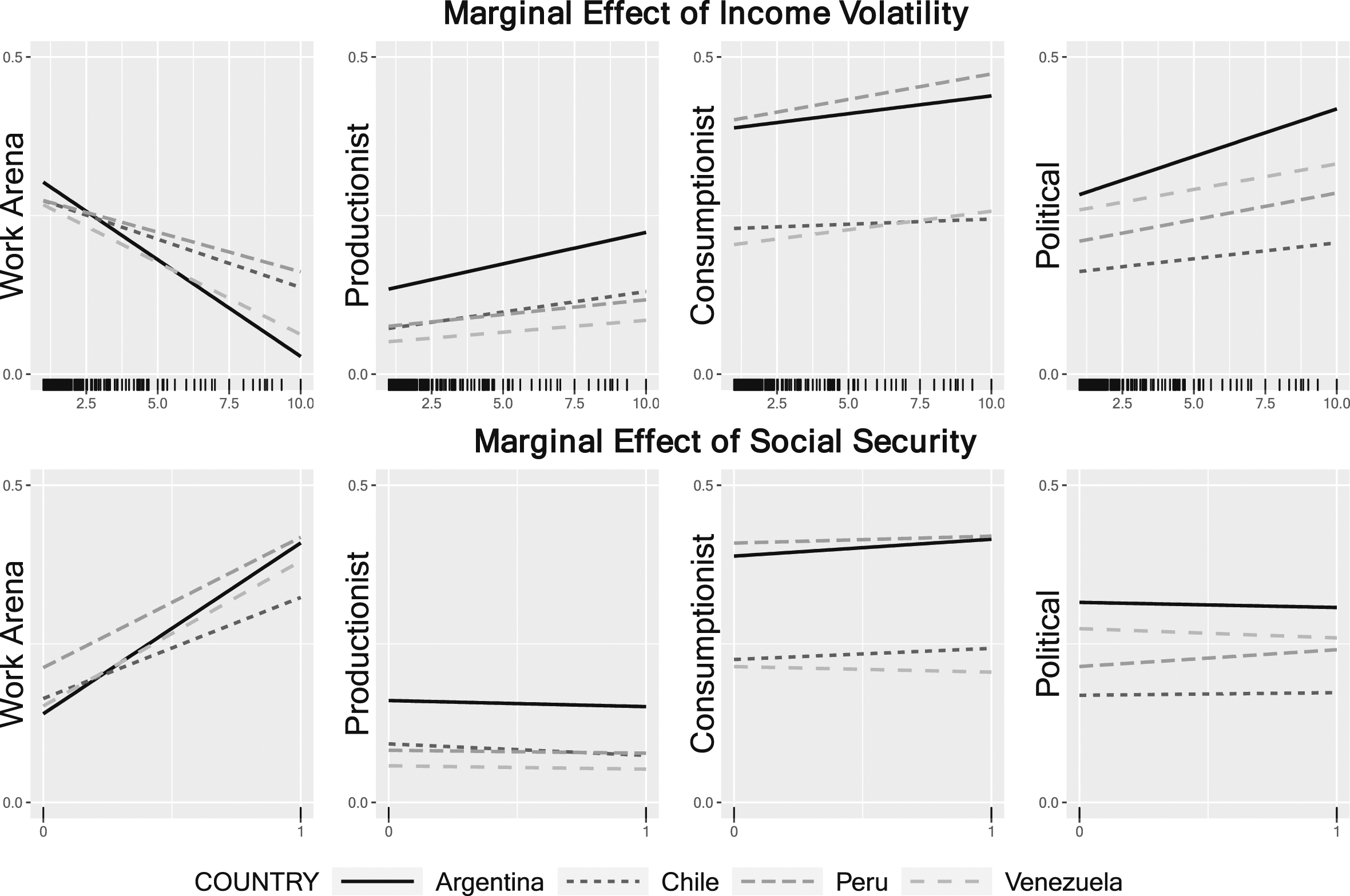
The two indicators of income insecurity are especially associated with a shift from productionist to consumptionist and political demands (Figure 2). The two measures, of course, have an opposite polarity: income volatility is a direct measure of income insecurity, while social security refers to important consumption benefits and thus is a measure of income security. Income volatility is positively associated with consumptionist and political demands in the political arena across all four countries. The lack of social security—a set of policies that smooth income over time and provide in-kind benefits like health care—is additionally associated with less demand-making at work. As shown in Figure 2, income volatility is associated with significantly less demand making at work in the Argentine case where the move from no income volatility to a (good week: bad week) income ratio of five is predicted to lower demand making at work by about one‐third (from 21 percent to 13 percent). This consumptionist orientation for those facing income insecurity fits into a pattern of adoption of income supports (usually CCTs) and health care for labor market outsiders across Latin America (Garay, 2016), a set of policies also preferred by the state.
The two measures of job insecurity do not operate the same way as income insecurity (Figure 3). Although contracts have a significant, positive relationship to demand making at work in the bivariate analysis (Supplementary Appendix 1), the association is not significant in the multivariate analysis. Job insecurity, like income insecurity, is associated with more consumptionist and political demand making (in line with H3), but also has a small positive association with demand making at work (contra H3). This relationship could be explained in several ways: those with more jobs (1) have more venues for demand making at work; (2) negotiate terms of employment at new jobs; (3) contest job termination; or (4) have been terminated as a consequence of engaging in demand making at work. Yet another possibility is that job instability signals a search for better work, which might also be compatible with its positive relationship with political demand making on the part of a more efficacious person who participates more broadly. This interpretation seems plausible given that mean job instability was actually quite low in our sample.
Third, we consider the individual resources of workers, namely union experience and education, finding strong support for H4. Our most consistent finding is that a respondent’s union experience is the most important correlate of demand making, in both the work and political arenas. That is, controlling for current access to a union, past union experience is a kind of socialization mechanism that increases one’s repertoire of action or propensity to act. This independent effect of personal experience in unions is associated with a 9 to 18 percentage-point increase in the predicted probability of demand making in both arenas and across the three types of issues. Union experience thus suggests the potential of demand-making action and produces an individual resource or sense of efficaciousness for resolving not only productionist issues in both arenas, but also quite different types of non-productionist issues, which are addressed through a quite diverse set of activities. This finding corresponds to the fact that some of the most dramatic popular-sector movements of both a productionist (e.g., Argentine piqueteros and Bolivian cocaleros) and consumptionist (e.g. Bolivian and Ecuadorian indigenous movements) orientation have often been led by figures with experience in traditional labor confederations (Anria, 2018; Rossi, 2017; Schipani, 2008; Yashar 2005).
We also consider education, a measure of skills and human capital. We find that education has a positive relationship with both consumptionist and political demand-making on the state, but not with demand making in the work arena or productionist demand-making in the political arena. This finding suggests that the individual resource of education does not effectively “substitute for” unions or other work-based resources because it does not support demand making in the work arena or productionist issues in the political arena.
Discussion
Since the Third Wave of democratization swept Latin America starting in the 1970s, elections have been held regularly, offering choices among competing parties to an unrestricted electorate. Further, a global wave of “new social movements” and of national and transnational organizing created new structures for aggregating and articulating societal interests. These developments intersected with an immiseration that attended the international debt crisis and a period when policy reforms introduced new economic models and labor market reform was high on the agenda.
In the post-austerity period, governments responded with consumptionist policies to address the circumstances of popular-sector constituencies. Even Left governments, which came to power in many countries in the new millennium, more consistently adopted consumptionist than productionist policies. The politics of consumptionist policies has been widely analyzed in terms of the constituencies opposed to pro-worker productionist policies as well as the popular demand for consumptionist benefits. To these, we offer a new explanation based on the nature of interest representation of the popular sectors: that is, in addition to explanations that emphasize the supply side of government policy preferences, there is a deficit of demand making for productionist policies.
On the one hand, our survey data reflect a fair amount of micro-level demand making at work. Not surprisingly, such work-based action was overwhelmingly more common among wage-earners and those that have access to a union. As for the key issues of macro-level productionist policy, those which pertain to the regulation of labor markets, real wages, benefits, and employment levels, and which capital influences heavily with instrumental and structural power, there is little demand making by workers. In exploring worker demand making, we move beyond the typical formal/informal-sector dichotomy to analyze how specific traits of work have an impact not only on productionist demand making, but also on demand-making activity around other issues, including consumptionist and political issues to which productionist issues might be “displaced” or “re-constructed.”
The analysis confirmed the role of unions as the most important vehicle for addressing productionist issues. Unsurprisingly, workers lacking access to unions were inhibited in making demands in the work arena. More surprising is the importance to an individual of having been a member of a union in the past. We find union experience to be a key personal resource for demand making of all sorts. It thus seems that past union membership affords a sense of efficacy and perhaps a repertoire of action that facilitates demand making. This trait to some extent “prolongs” the effect of unions from a current work resource to an ongoing personal resource. However, it too will be in shorter supply if unionization remains at low levels or continues to decline.
The fact that union experience bolsters not only productionist demand making, but also consumptionist and political issues underscores the importance of unions’ legacy for all modes of popular-sector interest representation today. While much has been made of the “new” associationalism as, in a sense, the post-union standard bearer for popular-sector interest representation, our findings here align with other scholars who have identified how unions and “outsider” associations are inter-reliant, as unions lend organizational structures and repertoires to neighborhood associations, indigenous movements, informal sector associations, the unemployed, and other expressions (Garay, 2007; Palmer-Rubin, 2021).
Beyond unions, work-based atomization and the insecurity of work have an independent relationship with demand making. Work-based atomization is associated not only with less demand making at work, but also in the political arena across the three types of issues analyzed. Atomization clearly makes any sort of coordination and collective activity less likely, prevents the identification of a common target of grievance or even a sense of common conditions. Work networks seem to be a resource that may even impart an awareness of political issues or sense of efficacy and hence promote participation across all issues and even in individual claim making.
Work-based insecurity operates differently from atomization. Insecurity of income—as measured by unstable income and lack of social security—prompts a shift from productionist demands to consumptionist and political demands. This finding accords with the “displacement” hypothesis: insecure income produces grievances for workers, while at the same time making it difficult for them to pursue those grievances at the workplace. To compensate, workers turn to demands on the state, and seek to address materialist issues through consumptionist benefits such as social programs rather than productionist issues, which might regulate earnings from work.
Some studies have analyzed the “exceptional” cases of successful mobilization by groups considered informal around productionist demands. Our findings shed some light on these exceptions. The Argentine piqueteros are widely regarded as a movement of the “unemployed,” a category that would seem to be one of the very hardest to engage in collective action. However, this movement started among recently laid off oil workers, who had been organized in a combative labor movement (Alcañiz & Scheier, 2007). It is thus an example of two of our work traits: networks and union experience. Similarly, Bolivia’s powerful cocalero mobilization capitalized on the past experience in mining union on the part of both leaders and members (Anria, 2013).
The successful mobilization of recyclers in Bogotá (Rosaldo, 2016) owes its success to the formation of networks that started and were centered in a subset of workers who met in dumps. Those in Buenos Aires met and formed networks in cartonero trains provided for recyclers, who overwhelmingly lived in geographically dispersed and peripheral neighborhoods, but could travel with their carts to collect in the city center. Successful street vendors are likely to be those with fixed stalls, who are geographically concentrated and can more easily form networks (Hummel, 2017). The analysts of these cases also point to other factors, such as the importance of outside actors (NGOs or transnational organizations), exceptional leadership, and government policy in providing a common grievance. However, the work traits analyzed here, such as atomization versus network formation and prior union experience, also helps to explain these rare successes.
Conclusion
The findings presented here have troubling implications for economic interest representation in a world of changing employment relations, which are in flux globally and are highly salient for both capital and labor. Labor relations have been regulated by laws, often nearly a century old, that were instituted for a pattern of labor relations—“employment”—that was growing, but may be now declining. In some countries, demands have arisen for new forms of labor regulation, such as broadening the definition of workers who are covered by the extant regulation or creating and regulating a new category of worker, for instance, dependent contractor or independent worker. But movement to update labor regulation is a political matter, and the role of workers in the political struggle is key.
We have examined traits of work that may affect the way workers participate in these politics. Traits of work that seem to be characteristic not only of much informal work but also of broader employment trends—temporary job arrangements, unstable incomes, atomization, lack of union protection, staffing agencies, and the growth of gig work on labor platforms—are associated with an inability to be a force in a new regulatory debate. That leaves Latin American labor markets and systems of interest representation in something of a vicious cycle. When workers are pushed away from arenas for making productionist demands, they wind up in spaces for consumptionist policies, especially for distributive social programs and subsidies. Undoubtedly, greater investment in these policy areas is warranted in many Latin American countries. However, they leave workers with weak voice in one of the most salient areas of public policy.
Productionist policy, in both its macro-and micro-economic dimensions, is one of the most fundamental concerns of the modern state. During the 1980s and 1990s in Latin America, productionist politics were dominated by capital interests and policies affected workers adversely. Even during the Left Turn in most countries—the period of reaction against the hardships of neoliberal reforms—government response to working class interests was mainly in terms of consumptionist rather than productionist policy. The reasons for this policy response are well studied and have to do with the strength of national and international capital interests, the reduced power of unions, and the structure of the political left which affects how attentive leftist presidents are to worker interests (Schipani, 2019). The present analysis has added nuance to the explanatory factor related to weak worker demand. Some important changes have occurred since the time when our data were collected, perhaps opening the possibility for more worker-friendly productionist policy. For instance, the commodity boom loosened a fiscal constraint, “easy” consumptionist policies may have already been accomplished (Holland & Schneider, 2017), and more recently, much economic thinking has been turning away from neoliberal prescriptions. These changes, however, leave open the question of the politics of productionist policy: who has a voice in the policy process and hence in shaping policy. In examining demand making by workers, we have argued that certain traits of work are inimical to productionist demand making: atomization, income insecurity, and lack of union protection. We have no reason to believe that there has been a substantial decline of the population experiencing these traits.
Footnotes
Declaration of Conflicting Interests
The author(s) declared no potential conflicts of interest with respect to the research, authorship, and/or publication of this article.
Funding
The author(s) received no financial support for the research, authorship, and/or publication of this article.
