







Abstract
As populist radical right parties muster increasing support in many democracies, an important question is how mainstream parties can recapture their voters. Focusing on Germany, we present original panel evidence that voters supporting the Alternative für Deutschland (AfD)—the country’s largest populist radical right party—resemble partisan loyalists with entrenched anti-establishment views, seemingly beyond recapture by mainstream parties. Yet this loyalty does not only reflect anti-establishment voting, but also gridlocked party-issue positioning. Despite descriptive evidence of strong party loyalty, experimental evidence reveals that many AfD voters change allegiances when mainstream parties accommodate their preferences. However, for most parties this repositioning is extremely costly. While mainstream parties can attract populist radical right voters via restrictive immigration policies, they alienate their own voters in doing so. Examining position shifts across issue dimensions, parties, and voter groups, our research demonstrates that, absent significant changes in issue preferences or salience, the status quo is an equilibrium.
Introduction
Populist radical right (PRR) parties have become a potent force in many democracies. As their vote shares have risen, so have fears about the spread of nationalism, nativism, and even democratic breakdown (Berman, 2019; Foa & Mounk, 2017). In light of these worries, a central question that has occupied public debate and scholars alike is whether and how mainstream parties can recapture voters who have cast their lot with the PRR (Carter, 2013; Meguid, 2008).
An answer requires, first and foremost, an assessment of the motivations of PRR voters: are they protest voters so dissatisfied with the political establishment that they are beyond recapture by the mainstream, or are they mainly driven by issue preferences, selecting the party that best represents their positions on salient issues (cf., Golder, 2016; van der Brug et al., 2000)? Yet equally important is an understanding of non-PRR voters. A key concern of mainstream parties is how their existing electorates will react to moves aimed at peeling away voters from the PRR.
If PRR voters remain loyal to their parties because they do not trust mainstream parties irrespective of party repositioning, the latter have little incentive to engage in potentially costly positional moves. Indeed, whereas early work on the PRR’s rise suggests frequent vote switching, recent research indicates that PRR voters are no more volatile than other voters (Voogd & Dassonneville, 2020), and some may indeed be quite loyal partisans (Bornschier, 2010; Marks et al., 2020). However, if a sizable share of voters would willingly desert the PRR for mainstream alternatives that adjust their platforms, the next critical question is whether mainstream party voters will greet such adjustments with defections of their own. If so, even a PRR electorate that consists mainly of floating issue voters may not prompt mainstream parties to change course.
An appraisal of the endurance of the PRR voter base thus requires studying the dynamic interactions of a range of voter groups and parties with differing issue preferences and positions across the political space. This paper undertakes such a study. To assess the linkage between party and issue preferences, we conducted a four-wave panel survey in which we observed the voting intentions and political preferences of German citizens over a 15-month period. We asked detailed questions about party choice, policy preferences, issue priorities, and party rankings on these issues. Second, and crucially, to test whether voters would actually desert the Alternative für Deutschland (AfD) if established parties co-opted its position on salient issues, these parties actually have to move, and voters need to be aware of these moves. However, established parties rarely make dramatic shifts away from the status quo (Dalton & McAllister, 2015; de Vries & Hobolt, 2020; Ferland & Dassonneville, 2019; Hooghe & Marks, 2018), and even when they accommodate radical right issue preferences, it is unclear whether voters monitor such moves closely (Adams et al., 2011). We therefore draw on the rich descriptive data that we gathered in waves 1 through 3 to construct counterfactual scenarios in wave 4, designed to gauge how voters make trade-offs across issues and parties. Our experiment varies parties’ positions on priority issues, as well as other theoretically-important attributes separating protest from issue voters. It examines directly whether established parties can recapture AfD voters and repel or retain their own voters by accommodating these voters’ issue preferences across policy dimensions.
Based on this multi-pronged design, we arrive at two main conclusions: First, although AfD voters are extremely dissatisfied with the political system and remarkably stable in their partisan support, many are better characterized as frustrated issue voters than as anti-establishment voters. Their support for the AfD remains stable because other parties fail to meet their preferences on their most prioritized issue—immigration—not because they mistrust the political system altogether. Once we introduce the important counterfactual scenario in which other parties do adopt more restrictive immigration positions, up to half of the AfD’s electorate leaves the party for more established alternatives. 1 These effects are substantively significant: for example, the far-left Die Linke could propel itself to the forefront of the opposition by capturing just 10% of AfD voters. Thus, much of what appears as radical right partisan loyalty is not caused by entrenched anti-establishment views, but is an illusion produced by stable party positioning on immigration.
Second, although we find that established parties that advocate more severe immigration restrictions can pull voters from the AfD, we also demonstrate that doing so is a losing strategy, for these gains are outweighed by defections from their more immigrant-friendly electorates. Our analysis thus explains why mainstream parties do not simply absorb PRR voters by accommodating their preferences: The partisan gridlock on immigration reflects an electoral equilibrium, in which mainstream voters bind their parties to more liberal immigration policies than AfD supporters prefer (cf. Arzheimer, 2013). Moreover, we find that mainstream parties do have more flexibility in accommodating the economic preferences of AfD voters, but that this strategy has somewhat uncertain payoffs, underscoring the salience of immigration for these voters and the stability of the ensuing equilibrium.
Our study advances existing research in several ways. Though a large body of work on which we build examines the motivations of PRR voters (see Section 2), a recent review concludes that the “study of the dynamic interaction between radical right and all other parties in postindustrial party systems is still at the beginning” (Kitschelt, 2018, p. 186). We conduct such an analysis, focusing on how voters respond to these positional interactions and the electoral payoffs that different parties can expect as a result. In so doing, we not only vary parties’ immigration-related positions, but also their stances on the economic dimension. This approach reveals that radical right and far left voters share some common ground (cf., Lefkofridi et al., 2014) and that accommodating right-wing immigration positions could lead to net gains for Die Linke. But our results also indicate that such moves are quite risky for Die Linke (and unattractive for other parties), which in turn points to the stability of the status quo. Our research thus provides further insights on the durability of electoral (re)alignments in postindustrial democracies characterized by two-dimensional competition. Existing work convincingly shows how shifting societal cleavages have paved the way for fragmented party systems (Bornschier, 2018; Häusermann & Kriesi, 2015; Hooghe & Marks, 2018). We demonstrate similar divisions but also foreground the importance of electoral strategy—and its limits—in translating societal cleavages into radical right success.
Furthermore, in jointly examining demand and supply in this way, we shed new light on the long-running question about whether radical right voters are issue voters who cast ballots based on policy preferences or protest voters disaffected from the political establishment. Theoretically, we observe that while these voter types have distinct microfoundations, they may be empirically inseparable when mainstream parties do not compete with PRR parties on the issues most salient to their voters. That is, when mainstream parties are not responsive to radical right voters’ core demands, issue voters can be observationally indistinguishable from anti-establishment voters. Our research design illuminates that in the absence of counterfactual policy environments this equivalence gives rise to an illusion of radical right partisan loyalty, which in turn can lead to potentially flawed inferences about these voters lacking allegiance to the existing democratic system. Our theoretical framework and empirical evidence allow us to demonstrate why this conclusion can be misleading when established parties are out of step with public opinion from constituencies that are not their own.
Voter Motivations and Party Choice
The central goal of this paper is to examine how parties’ positional moves affect the size and stability of the PRR vote. Our main focus relates to motives of PRR voters, building on literature that distinguishes between protest and issue voting. Given our interest in party interactions and electoral payoffs across the political spectrum, we also discuss non-PRR voters, highlighting research that investigates whether partisan attachments are sufficiently weak to cause such voters to fluidly seek out parties that best meet their issue preferences.
Populist Radical Right Voters
Following the literature (Golder, 2016; Mudde, 2010), we use the term “radical right” to describe a party family combining three ingredients. First, radical right parties are populist, calling for political power to be transferred from parties and politicians to “the people.” Second, they are nationalist, defining the people in terms of rigidly drawn national (and oftentimes ethnic) boundaries. Lastly, they are authoritarian, calling for the root-and-branch reform of the established political order around traditional morality, strong leaders, and society’s “natural” hierarchies.
A voluminous literature addresses the question of why voters support PRR parties. Much of this work has focused on the developments that have driven up “demand” for these parties, 2 ranging from rising immigration, to associated cultural and economic threats, to the pressures wrought by globalization (Europeanization) and austerity and accompanying shifts in groups’ social status and nationalist leanings (Dancygier, 2010; Gidron & Hall, 2017; Golder, 2016; Halikiopoulou et al., 2012; Hobolt & Tilley, 2016; Hooijer, forthcoming; Lancaster, 2020; Vasilopoulou, 2018).
Complementing these demand-oriented works, our study also examines the supply side, focusing on the choices of mainstream parties that either nourish or starve PRR parties of support (e.g., Art, 2011; Bustikova, 2014; Givens, 2005; Kitschelt, 2007). In particular, this paper addresses how vote-seeking parties should respond programmatically to the rise of the radical right, that is, the types of policy stances they should adopt, without necessarily modifying the rules of the game (Carter, 2013; Meguid, 2008). We outline two general views on this dilemma below.
Frustrated issue publics
Can established parties capture radical right voters by moving closer to their preferred issue positions? This strategy depends on the frustrated issue publics view, which assumes that radical right voters are predominantly pragmatic and issue-motivated—that is, their goal is to achieve key policy outcomes (van der Brug et al., 2000). Unlike prototypical issue voters, however, radical right voters are “frustrated” by their perception that established parties will not accommodate their issue preferences. This perception generates antipathy for the political establishment and feeds into the populist accusation that established parties are out of touch with and unaccountable to “the people” (Mudde, 2010).
This model yields several key predictions. First, radical right voters’ populist sentiments are secondary to their issue preferences; although they may appear resentful and mistrusting of the political establishment, they would readily defect to mainstream parties if the latter accommodated their issue preferences. Indeed, established parties should be even more attractive to radical right voters (as issue voters), since the former possess greater legislative capacity, experience, and probability of holding office (Carter, 2013; Meguid, 2008). Thus, in the frustrated issue publics view, the populist attitudes and partisan loyalties of radical right voters are fickle and “skin-deep”—once established parties change their issue positions, radical right voters should readily follow. Second, if PRR voters are issue-motivated, they should punish their party for taking more centrist positions on core issues (cf. Tavits, 2007), rather than “following the leader” by adopting its views (Lenz, 2013).
Anti-establishment voting
In the anti-establishment voting view, PRR voters are distinguished foremost by their overriding distrust of political institutions and established parties (Rooduijn et al., 2016). They are instead more likely to put their faith in “the people”—even to the point of labeling ordinary people as good and politicians as evil (e.g., Akkerman et al., 2014). Anti-establishment voters are thus cynical about the willingness and capacity of established parties to address their grievances. Consequentially, they are likely to view policy shifts by the latter as “cheap talk,” greatly undermining the effectiveness of issue competition (cf. Van Hauwaert & Van Kessel, 2018).
The anti-establishment voting view yields radically different predictions from the frustrated issue publics view. Most importantly, while mainstream parties can integrate frustrated issue publics by accommodating their preferences, anti-establishment voters are fundamentally averse to supporting established parties. The roots of this rigidity lie in factors that are inherently difficult for established parties to emulate or overcome, such as political cynicism and distrust (Foa & Mounk, 2017); the charismatic authority of radical right politicians (Lubbers et al., 2002); and blame for socio-economic developments, which have eroded the status of radical right voter bases (Gidron & Hall, 2017).
Lastly, anti-establishment voters also differ from issue voters in the relative weight they place on political experience. Given their political cynicism, these voters are more likely to cast pure protest ballots against incumbent parties (Van Hauwaert & Van Kessel, 2018). In contrast, issue publics do not share this intrinsic aversion to incumbency, and may value it to the extent that it enhances politicians’ ability to achieve desired outcomes.
We should point out that though we use the distinction between frustrated issue publics and anti-establishment voters to structure our theoretical framework, empirically we expect the PRR electorate to consist of a mixture of these two ideal types. Furthermore, it is conceivable that frustrated issue voters eventually turn into anti-establishment voters; disappointment with established parties’ failure to move closer to their issue preferences can undermine trust in the political system as a whole (cf. Voogd & Dassonneville, 2020). Although we are unable to test these (likely long-term) developments, we find no evidence that such a dynamic unfolded in the 15 months during which our panel was fielded. 3
By contrast, the fact that PRR parties have increasingly become part of the governing establishment may suggest that their supporters are largely issue-motivated. Empirically, populist party voters vary in their degree of anti-elite sentiment (Rooduijn, 2018), and voters of more established populist parties are less likely to hold these attitudes than are supporters of less established ones (Krause & Wagner, 2019). These findings are consistent with the results we present below: The AfD represents a rising party that is not part of the establishment, and the vast majority of its supporters express little trust in the political system and its leaders (see also Steiner & Landwehr, 2018). But, as we elaborate below, these sentiments do not allow us to conclude that anti-establishment views predominantly structure their vote choices. Rather, they prompt us to investigate whether these voters are nonetheless responsive to mainstream parties that align with their issue preferences.
Other Voters
In systems where radical right parties are relative newcomers, their voters have, by definition, broken with existing parties, and an important question underlying the above discussion is whether this shift presents a permanent realignment or a more temporary dealignment based on issue fit. In light of the increased party system fragmentation of recent decades, similar questions pertain to non-PRR voters. While our main interest lies in examining whether mainstream parties can recapture radical right voters by accommodating these voters’ issue preferences, a key strategic consideration these parties face is the electoral response of their own voters.
This concern is especially relevant as ties between voters and parties in postindustial democracies have loosened over time, and electoral volatility has risen as a result. Though voters generally stay within the same ideological bloc, party attachments to mainstream parties have become less durable as linkages between voters’ socio-demographic and class backgrounds and their party choices have shifted. There is debate about whether these changes amount to a transition to a new political cleavage structure or signal a continued process of less structured dealignment. 4 But for the purposes of our paper the relevant implication relates to the now widely shared assumption that voters are responsive to party positioning on issues that go beyond the left-right economic dimension—such as immigration and globalization. We therefore have also to examine what mainstream parties lose by changing their positions on these salient issues.
The Problem of Observational Equivalence
Our discussion thus far highlights the critical role of changes in party positioning in helping us understand the drivers of voters’ electoral choices. It is only when parties change their stance on salient issues that we can assess the extent to which issue fit determines partisan attachments. This presents scholars with a challenge: In the short term, parties rarely shift positions in significant ways (de Vries & Hobolt, 2020; Ferland & Dassonneville, 2019; Hooghe & Marks, 2018). When shifts do occur within an election cycle, they do not always represent the clear break that PRR voters are looking for or are even able to observe (cf., Kitschelt, 2018). To be sure, mainstream parties have over time accommodated aspects of the radical right’s program (Abou-Chadi & Krause, 2020; Meguid, 2008; Spoon & Klüver, 2020), and over the last five decades West European center-left and center-right parties have adopted more negative stances on immigration in particular (Dancygier & Margalit, 2020). Moreover, in rare cases, abrupt policy shifts do take place, as for example, when the Danish Social Democrats made a hard right turn on immigration in the late 2010s. 5 However, as with other issues (cf., Dalton & McAllister, 2015), positional changes on immigration tend to be gradual and voters update slowly (Kitschelt, 2018). Examining how party positioning affects voter behavior thus generally requires scholars to cover several election cycles in which a number of factors (e.g., the salience of issues “owned” by the PRR, positioning of other parties on a range of issue dimensions, party leaderships, political scandals, contextual factors, and so on) also vary, making it difficult to isolate the effect of party positioning on vote choice and the underlying nature of party attachments.
Accordingly, while studies that cover longer time periods can leverage positional shifts but face changing environments and associated measurement challenges, those focusing on the short-term evade time-varying confounding but often cannot exploit positional change. This lack of change in turn makes it difficult to accurately assess voter motivations. Concretely, in approaching the question of whether PRR voters are better described as frustrated issue publics or anti-establishment voters, we argue that, despite their different micro-foundations, these views may be observationally equivalent. For example, when frustrated issue voters perceive established parties to be unresponsive on core issues, they may well agree with anti-establishment statements like “Mainstream parties do not care about what the public thinks.” Conversely, anti-establishment voters might simply adopt the issue positions endorsed by leaders or parties that they already identify with (Lenz, 2013). Unfortunately, many kinds of data—in particular, cross-sectional data that do not contain perceptible shifts in party positioning—are unable to distinguish between these two causal sequences. When parties do not visibly change their positions on core issues, neither anti-establishment nor frustrated issue voters change their party preferences; the two models are observationally equivalent.
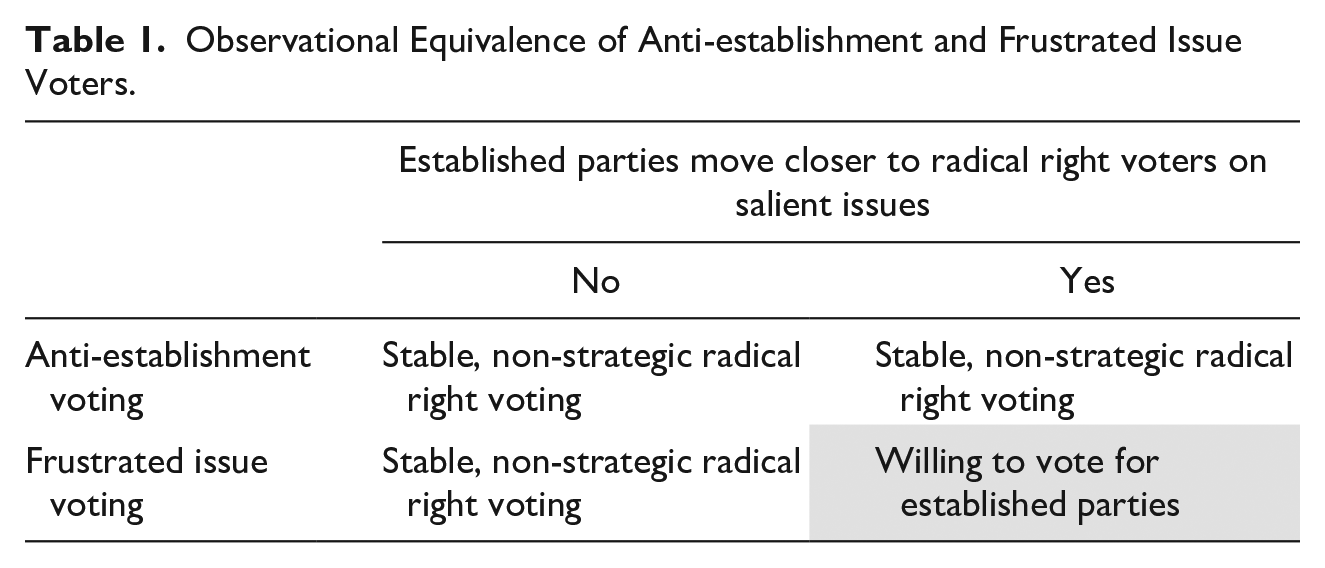
Instead, what distinguishes the two models empirically is the hypothesis that, if established parties do move closer to their preferred issue positions, frustrated issue voters will transfer their votes, whereas anti-establishment voters will continue to support a PRR party. This logic is summarized in Table 1. It is only under party repositioning that we are able to distinguish the two views (right column). When established parties adopt more accommodative stances, the empirical implications of the two models diverge, with frustrated issue voters moving back into the fold of established parties.
Observational Equivalence of Anti-establishment and Frustrated Issue Voters.
This empirical divergence frames our core research questions: By changing the positions taken by political parties on priority issues, can we also induce radical right voters to alter their party preference? And do established parties that accommodate PRR positions stand to lose more of their own voters than they gain? These questions not only speak to a longstanding debate about voter types and party attachments; they have also preoccupied centrist parties trying to formulate optimal electoral strategies against niche party challengers in Germany and beyond (Abou-Chadi & Krause, 2020; Bale, 2008; Cohen, 2018; de Vries & Hobolt, 2020; Meguid, 2008; Pardos-Prado, 2015; Spoon & Klüver, 2020).
Descriptive Evidence: Preferences and Vote Intentions
The Rise of the AfD and the German Case
We situate our analysis in Germany, a case that was once notable for the weakness of its postwar radical right politics, but which has recently become emblematic of the immigration controversies and populist, anti-establishment movements roiling Europe (Hager & Veit, 2019; Mader & Schoen, 2019). After a 4-year grand coalition between the center-right CDU/CSU and center-left SPD and a 12-year reign by Angela Merkel, voters in Germany expressed considerable dissatisfaction with the political dominance of the established parties, a development on which the AfD capitalized. 6 Furthermore, the inflow of refugees preceding the 2017 Bundestag elections propelled the topic to the forefront of the political agenda.
This setting reflects trends throughout Western Europe, where immigration levels are high and mainstream parties have been offering increasingly similar stances on this issue (Dancygier & Margalit, 2020), providing an opening for challenger parties. Moreover, though Merkel’s run as chancellor is particularly long, dissatisfaction with political elites runs high across Europe (Mudde, 2010). Learning about voter behavior in the German case could therefore shed light on developments elsewhere. At the same time, Germany does represent a somewhat unique case: Its shameful Nazi past is part of the reason why a nationally successful radical right party has only emerged in more recent years. However, the typical AfD voter in our sample also resembles radical right voters in other West European countries in that AfD voters are more likely to be male, to have low levels of education, and to perceive themselves as occupying a low rung on the social status hierarchy (Coffé, 2018; Gidron & Hall, 2017; Mayer, 2002; see Supplemental Appendix D for details). Additionally, as we show below, AfD voters do not shy away from supporting candidates endorsing violence against refugees, suggesting that Germany’s history does not place considerable constraints on the extremism of radical right voters in the 21st century. Indeed, a slight majority of all Germans (53%)—and 80% of AfD voters—think that it’s time that Germans put their history with national socialism behind them (“Schlussstrich ziehen”) (Staas, 2020). Finally, the German case is particularly relevant in addressing the “window of ownership opportunity” (Meguid, 2008)—the time when established parties still have the chance to co-opt the issue that a challenger party politicizes. Our study may consequently be less well suited to apply to settings where a radical right party has had a long and successful presence and is considered the “owner” of issues and sentiments that are salient among its voters.
Returning to the political situation in Germany in the months preceding the election, party-issue positioning was quite stable, giving rise to the problem of observational equivalence discussed earlier. To verify this stability, we used newspapers and party manifestos to document the positions of Germany’s leading political parties on prominent policy questions connected to immigration and whether there should be an upper limit (“Obergrenze”) on the number of refugees allowed annually into Germany. We recorded party positions from mid-2015 to early 2018, bracketing the endpoints of our survey and beginning just before the sharp uptick in refugee inflows. These positions are shown on a quarterly basis in Table 2. 7
Timeline of Party Positions on the Refugee Cap.
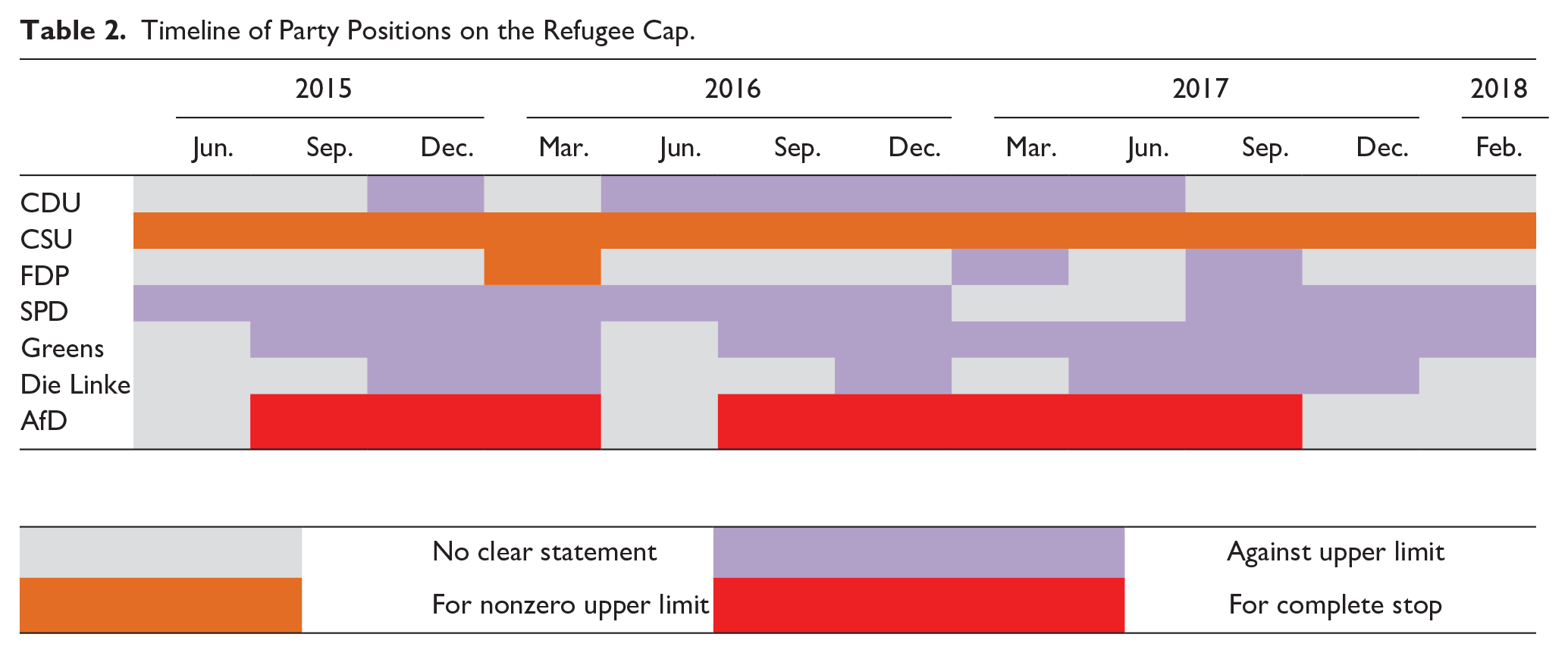

The question of an upper limit became increasingly salient in the lead up to the elections. Germany had received by far the most refugees of any European country, and while Merkel’s liberal stance was initially greeted with support, views soon hardened (Mader & Schoen, 2019). Though the government pursued measures that curbed the inflow (e.g., reclassifying sending countries as “safe”; an agreement with Turkey to host refugees) and in some instances sharpened its rhetoric (especially the CSU), established parties did not shift positions on the upper limit (as shown in Table 2; similar trends hold for deportations and family reunification, two other salient issues we analyzed). Internal party disagreements made it difficult to change course on the fundamental issue of the upper limit. Accordingly, AfD supporters in our panel gave these parties very low ratings on immigration throughout the survey period.
These circumstances provided an opening for the AfD. Founded in 2013 on a platform opposing the Eurozone, the party quickly pivoted to immigration, winning 12.6% in the 2017 elections. It became the largest opposition party and the only one to endorse a complete halt to new refugees.
Observational Evidence of AfD Voter Loyalty
To examine attitudes and vote intentions, we drew on our 15-month, four-wave online panel survey of German respondents, which we carried out from September 2016 to December 2017. The target sample size for each wave of our survey was approximately
However, we also note that our approach is not designed to illuminate long-term processes relating to structural changes in the economy and society (e.g., Bornschier, 2018), or to varying organizational or ideological features of radical right parties (Art, 2011; Kitschelt, 2007). Rather, we examine party support during a time of high immigration salience, established party convergence on this contentious issue, and mistrust of political elites.
We begin by assessing the individual-level stability of AfD support using self-reported vote intention. 8 We define AfD voters as all respondents who cast a party or a candidate ballot for the AfD during the 2017 Bundestag election (none of our results change significantly if we restrict the definitions to either party-ballots or candidate-ballots only). We then compute the percentage of AfD voters who reported an intention to vote for the AfD in each wave (for question wordings of this and other items, see Supplemental Appendix A.2). Figure 1 shows that 69% of eventual AfD voters expressed a vote intention for the AfD in at least three out of four waves. Notably, this is a much higher incidence of persistence than what we observe among other voters (CDU = 49%, SPD = 34%, Die Linke = 51%, Greens = 46%, and FDP = 34%), pointing to the relative volatility of non-PRR voters and perhaps hinting at their sensitivity to positional moves. A similarly high number of AfD voters (71%) stated that the AfD was the party they felt closest to in at least three waves. Again this value is higher than those for other established parties (CDU = 50%, SPD = 54%, Die Linke = 67%, Greens = 63%, and FDP = 33%).

Persistence of vote intention and issue preferences among AfD voters over time.
AfD voters also exhibit extremely stable issue priorities and preferences. The remaining panels of Figure 1 plot the proportion of respondents who prioritize immigration and prefer a reduced refugee intake. The vast majority of AfD supporters persistently state that immigration determines their vote choice and that Germany must accept fewer refugees.
Our survey also reveals that AfD voters hold extremely negative perceptions of mainstream parties and politicians. We examined three survey items asking respondents whether they think (1) that “the AfD is for those who no longer feel at home in the politically established parties”; (2) that politicians care not at all, very little, somewhat, quite a lot, or a lot “about what people like [them] think”; and (3) whether they have no, little, some, or complete “trust in political parties.” Figure 2 shows that AfD voters almost universally hold anti-establishment attitudes. Across items and waves, roughly 90% of AfD voters hold the anti-establishment position, relative to about a quarter to 60% of non-AfD voters. This gap persists even when comparing AfD voters to supporters of another non-centrist party, Die Linke. Its supporters do not hold above-average anti-establishment views. (Notably, among non-AfD voters we observe a reduction of anti-establishment views over time, perhaps a function of parties’ campaign efforts ahead of the election.) In Germany as elsewhere, radical right voters hold dismal views of the political establishment (Rooduijn et al., 2016; Van Hauwaert & Van Kessel, 2018).
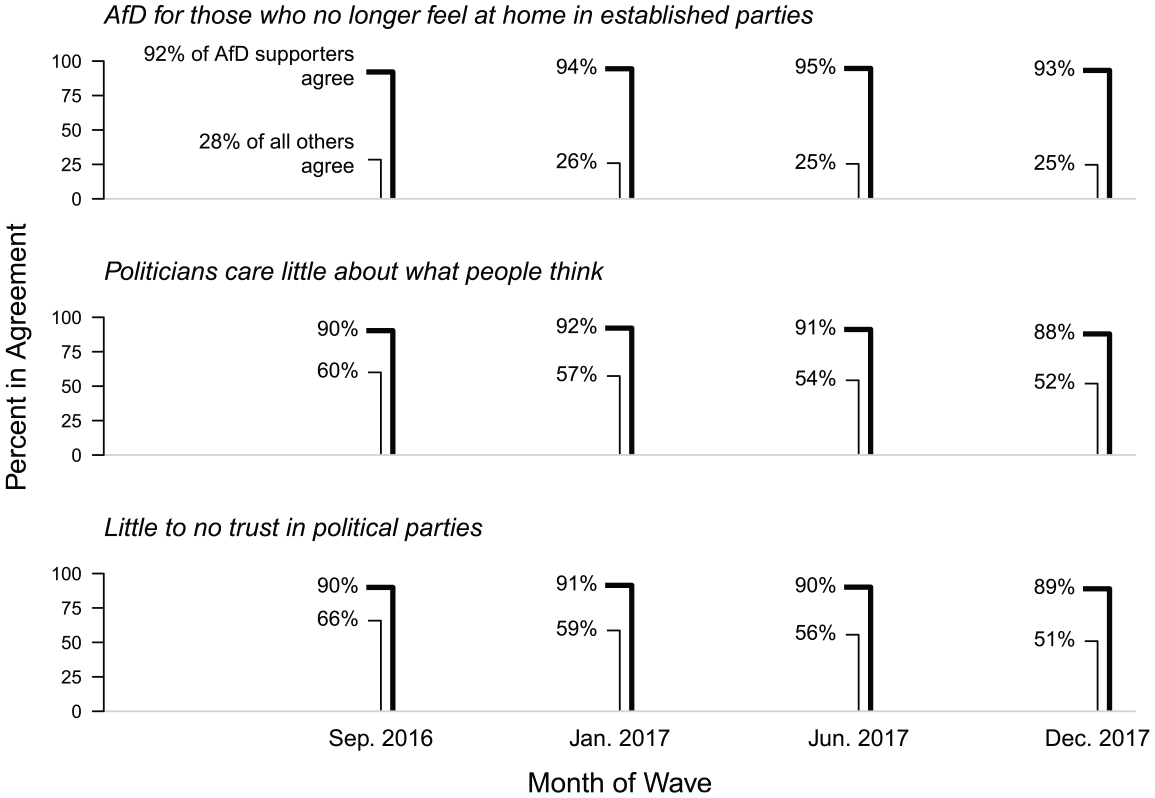
Prevalence of anti-establishment views among AfD supporters.
These pessimistic assessments could prompt voters to cast ballots for anti-establishment parties, even if their candidates do not have a chance of winning. A brief look at ticket-splitting supports this conclusion at first glance. In Germany’s mixed electoral system voters cast two votes, one for a candidate who is elected in single-member districts by plurality, and one for the party who is allocated seats according to proportional representation. Because voters have a stronger incentive to redirect their first vote to a less favored but more competitive candidate, the large centrist parties have historically captured a larger share of the first vote, while smaller parties have fared better in the second vote. However, when we examine 2017 vote shares at the district level, we find that the the AfD candidate vote share nearly perfectly predicts the AfD party vote share (r = 0.995), suggesting that even in districts where AfD candidates have little chance of winning, they receive support from voters who cast their party vote for the AfD. To avoid ecological bias, we also examine ticket splitting in our survey and find similar patterns. Conditional on giving her party vote to the AfD, the probability that a voter also votes for the AfD candidate is 80%. In contrast, Die Linke party voters only support the Linke candidate 66% of the time, and FDP/Green party voters support the FDP/Green candidate less than half of the time. AfD voters are thus most willing to “waste” their votes on noncompetitive candidates, a characteristic that has been used to describe expressive, anti-establishment PRR voters. The next section discusses why this inference may be misleading.
Experimental Evidence of Voter Disloyalty
We have shown that AfD voters have persistent vote intentions; that they hold dismal views of established political parties; and that they appear inattentive to strategic voting incentives. These attributes are consistent with the hypothesis that radical right supporters are anti-establishment voters. Yet, for reasons discussed in Section 3, they are also consistent with frustrated issue voting. To disentangle these views, we need to test whether AfD voters would alter their support for the party if other parties counterfactually adopted positions similar to those of the AfD.
Indeed, how to best respond to the rise of the AfD is a question that is dividing political parties in Germany. While there is a cross-party consensus that the AfD’s electoral appeal must be curbed, there is considerable disagreement about how to achieve this goal. Within the CDU, for instance, some strongly oppose a move to the right on immigration, “because for every voter that you win back with AfD-light-slogans, you lose two in the middle.” 9 Other CDU politicians argue instead that stricter refugee policies would bring AfD voters back into the fold without alienating core supporters. 10 The CSU bet on this scenario when it adopted harsh anti-immigrant rhetoric in the run-up to the 2018 Bavarian election, though its poor electoral performance suggests that this was not a winning formula. Similar debates are splitting Die Linke, with some in the party’s leadership blaming its liberal refugee stance for its weak showing in the eastern states, and others highlighting the need to more strongly emphasize economic inequality and redistribution. 11
To test whether established parties can capture radical right voters by changing their policy positions, we designed a conjoint experiment (Hainmueller et al., 2014), which presented our respondents with hypothetical candidate profiles. Our experiment is uniquely able to adjudicate the two main views because it allows us to observe the behavior of AfD voters in the counterfactual setting where mainstream parties shift issue positions. If AfD voters move, it provides some evidence that AfD voters are, at least in part, frustrated issue voters. If they don’t, it supports the notion that they are anti-establishment voters.
We leveraged conjoint analysis to combine policy positions and candidate characteristics that our panel indicated were important to AfD voters, allowing for richer candidate profiles and substantively meaningful choice tasks. Still, we acknowledge that some respondents might not have considered policy shifts that we assign to candidates as credible (cf., Fernandez-Vazquez, 2020). We therefore only select candidate-policy pairings that would be realistic given the current state of German politics (see below). 12 Moreover, we vary positions of candidates, not parties, as the stated policy preferences of German legislators can deviate from the party line (Zittel & Nyhuis, 2018).
Experimental Design and Methodology
Harnessing the panel structure of our study, we analyzed waves 1 to 3 to identify the issues most salient to voters. We presented respondents with a list of 14 issues (in randomized order) and asked them to select the three issues that would be most important in deciding their vote choice. While 80% of AfD voters prioritized immigration (along with linked issues of terrorism and crime [cf., Fitzgerald et al., 2012]), about 30% selected pensions—a proportion rivaling that among other voters—while about 20% selected social and income inequality (see Figure 3). 13
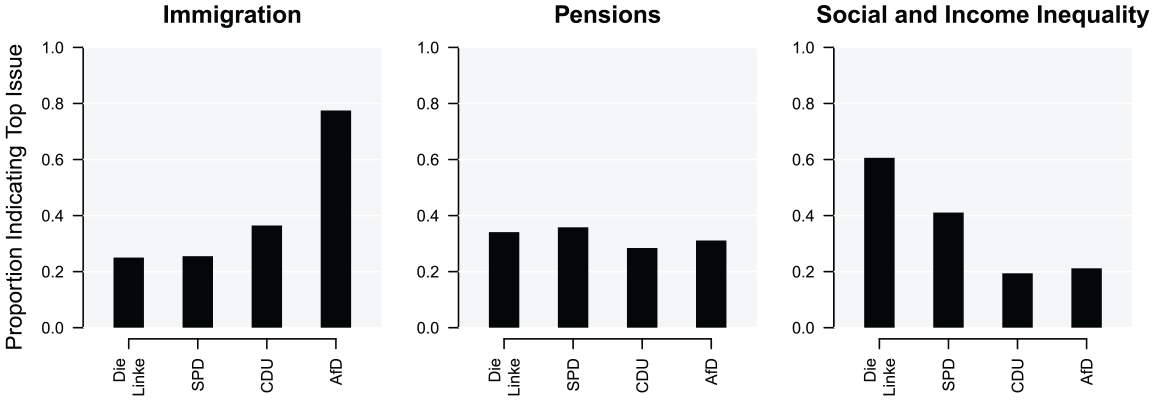
Issue priorities across voters.
Reflecting these three priorities, we composed profiles of candidates holding distinct positions on immigration, pensions, and taxation. Given its centrality to the AfD’s platform and salience among AfD supporters, our core attribute of interest is the proposed refugee policy. According to the frustrated issue voting view, AfD voters should be less likely to support the AfD if either the AfD adopts a less restrictive refugee policy or if another party proposes a more restrictive one. Alternatively, if AfD voters more closely resemble anti-establishment voters, variation in proposed refugee policies should have little effect. Turning to non-AfD voters, sizable shares also listed immigration as a top issue. This salience, combined with comparatively feeble partisan attachments, points to the electoral risks of these position shifts. Since the upper limit was among the most publicly discussed policy positions, we varied candidates’ stances on the number of refugees that should be allowed to enter Germany (no upper limit; 500,000; 200,000; or complete stop). 14
We also examine whether especially extreme proposals related to the treatment of refugees drive some voters away from the AfD. To do so, we varied whether candidates approved of border police being permitted to shoot refugees who entered Germany unlawfully. In January 2016, then AfD leader Frauke Petry advocated this radical policy in order to restore “law and order” at the border. 15
Lastly, respondents’ self-selected issue priorities underline that electoral competition revolves around at least two dimensions, comprising immigration and economic policies. Prior research has argued that mainstream party convergence on economic issues has provided a key entry point for PRR parties and that social democratic parties’ moves to the center caused vote losses to the PRR (cf., Arzheimer, 2013; Kitschelt, 2018). We therefore designed our survey to assess whether PRR parties can broaden their appeal—and non-PRR parties can gain PRR voters—by changing their positions on economic policies. Interestingly, many AfD voters either disagree with their party’s position on economic issues or view it as relatively incompetent; when asked how well the AfD represented their views on pensions, on average AfD voters rated it quite poorly (42 out of 100). To capture the causal impact of the pension issue, we varied whether a candidate had given “much” or “no thought” to the sustainability of pensions. We chose this neutral language because pension sustainability tends to be a valence issue, and it is a subject that the AfD had not focused on. The attribute is therefore meant to signal competence and attention rather than postulate a specific position. Additionally, since AfD voters gave the AfD low scores on the issue of social and income inequality (43 out of 100), we included an attribute indicating that a candidate would advocate raising, lowering, or maintaining the top tax rate.
To further differentiate the issue and anti-establishment voting views, we composed three additional attributes: incumbency status, the candidate’s stated reason for running, and his projected competitiveness. If the issue voting view is correct, incumbency would have a positive effect, since it would signal greater legislative capability and ability to implement policy (Meguid, 2008). Conversely, anti-establishment voters should punish incumbency, especially among non-AfD candidates. Along similar lines, issue voters should be more likely to reward candidates for trying to influence policy, while anti-establishment voters should be more likely to reward candidates who run for office to give “ordinary citizens” a voice.
Finally, we include the candidate’s electoral competitiveness. While our observational data suggest that competitiveness had little to no effect on the probability that an AfD supporter chose the AfD candidate in the 2017 election, if the issue voting view is correct, this effect should vary depending on whether other candidates also propose restrictive immigration policies. Conversely, anti-establishment voters should always vote for the AfD, regardless of the projected win probability. Thus, we are chiefly interested in the interaction of this variable with the proposed immigration policies.
Each respondent was asked to complete five choice tasks. For each choice task (i.e., selecting the preferred candidate and rating each candidate on a scale of 1–7), respondents were shown four experimentally-varied candidate profiles, from the following parties: Die Linke, SPD, CDU, and AfD (see Supplemental Appendix B for conjoint script and other details). We did not include the Greens or the FDP (or the option of non-voting), to avoid excessive complexity in the choice tasks that can undermine the quality of responses. Moreover, since AfD voters are too far removed ideologically from the Greens, switching support between these two parties is rather implausible. Finally, since male politicians significantly outnumber female politicians in the AfD and in Germany as a whole (Dancygier, 2020), we restrict the analysis to male candidates.
Evidence for Issue Voting
We begin by showing that support for the AfD is highly responsive to party-issue positioning. To estimate the average marginal component effects (AMCEs) of AfD candidate attributes (Hainmueller et al., 2014), we focus on respondents who indicated that they had voted for the AfD party or candidate in the 2017 election. The AMCE is a quantity of theoretical interest, as we are interested in the causal effects on the probabilities of choosing AfD candidates (Bansak et al., 2020).
16
The number of unique AfD voters in this conjoint analysis is

Causal effects of AfD candidate attributes on AfD vote choice among AfD voters.
Figure 4 shows that AfD voters are responsive to the AfD’s issue positioning. In particular, positions on the refugee issue predominantly and significantly shape support for the AfD. Among AfD voters, the causal effect of the AfD candidate adopting a moderately less restrictive stance on immigration is to reduce support for the hypothetical AfD candidate by more than 15% points. AfD voters are also sensitive to the severity of the proposed border security policy: they are about 5% points more likely to support the AfD candidate when he condones gun violence targeted at refugees. Violent extremism appears not to repel AfD voters; it solidifies their support.
Focusing on Experience and Reason for running, neither attribute reveals substantively or statistically meaningful effects. If anything, each provides evidence against the anti-establishment voting account. AfD voters do not intrinsically value newcomers who state they run for office because “politics too often ignores ordinary citizens” over candidates who focus on policymaking. At the same time, AfD voters do not seem to value a candidate’s competitiveness; the chance-of-winning attribute is insignificant. This result appears consistent with anti-establishment voting: frustration with established parties leads voters to “waste their votes” on losing candidates. Yet from the perspective of issue voters, there should be little reason to support competitive candidates if these candidates are far removed from the voter’s preferred policy position.
On its own, the chance-of-winning attribute is thus difficult to interpret, and we therefore investigate its effect in two scenarios: the status quo, in which no other party proposes a ban on refugees, and the counterfactual, in which at least one party does. 17 In Figure 5, we show the causal effects of AfD candidate attributes on AfD vote choice among AfD voters, subset by these two scenarios. In the status quo condition, AfD voters are indeed willing to support candidates with little chance of winning: the causal effect of the chance-of-winning attribute is insignificant and small. But in the counterfactual scenario in which another party does propose a ban, AfD voters are nearly 10% points less likely to support a noncompetitive AfD candidate. Outside the status quo, AfD voters divert their support to non-AfD candidates who will actually be in a position to implement their desired policies. By implication, absent counterfactual party positioning, observing that PRR voters “waste” their votes should not be interpreted as a sign of expressive, anti-establishment voting.
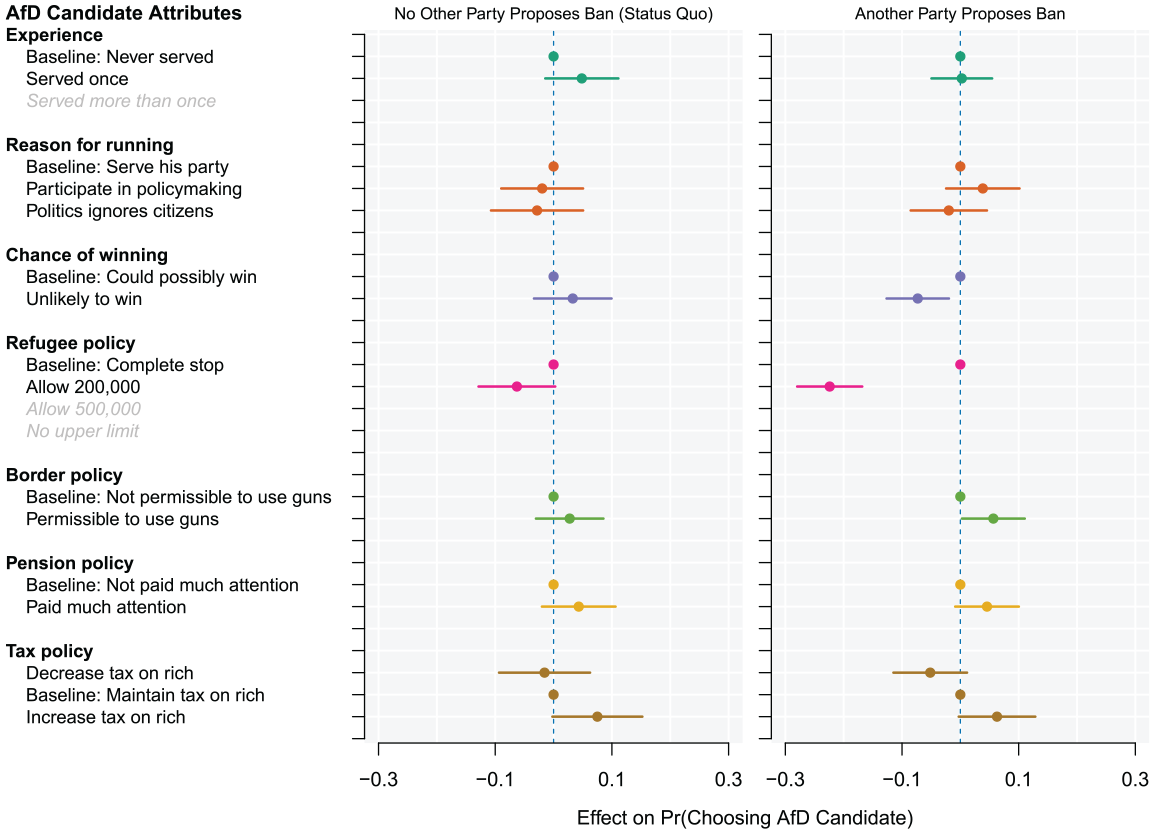
Causal effects of AfD candidate attributes on AfD vote choice among AfD voters, interacted with status quo.
Turning to other policy positions, we also find suggestive evidence that AfD voters are potentially swayed by the candidates’ proposed pension and tax policies. AfD voters are significantly more likely to prefer candidates who are attentive to pensions and who propose increasing taxes on the rich, reflecting a broader European trend whereby many radical right party supporters are in fact economic leftists (Harteveld, 2016). These findings confirm the logic of the AfD’s actual drift to the left on pensions, taxation, and social welfare.
The findings on the tax and border policies allow us to rule out an alternative explanation, which is that AfD voters withdraw support from AfD candidates who propose less restrictive refugee policies as punishment for deviating from the party program (rather than because of their issue preferences). If this mechanism were in effect, we should not find that AfD voters are sensitive to AfD candidates’ aggressive position on gun usage or liberal position on taxes, neither of which reflected the party line at the time.
Although the causal effects of the other policy dimensions are substantively meaningful, ranging from 5% to 10% points, positions on refugee policy clearly predominate. In particular, AfD voters heavily punish the AfD for adopting less restrictive immigration policies. The next crucial question is whether AfD voters respond to policy positions of other, established parties. Can AfD voters be persuaded to move to established parties when those parties accommodate their issue preferences on refugee policy? We answer this question in Figure 6, where we regress the same binary outcome variable, Vote for the hypothetical AfD candidate, on sets of indicator variables measuring positions on the upper limit adopted by hypothetical candidates from the established parties.
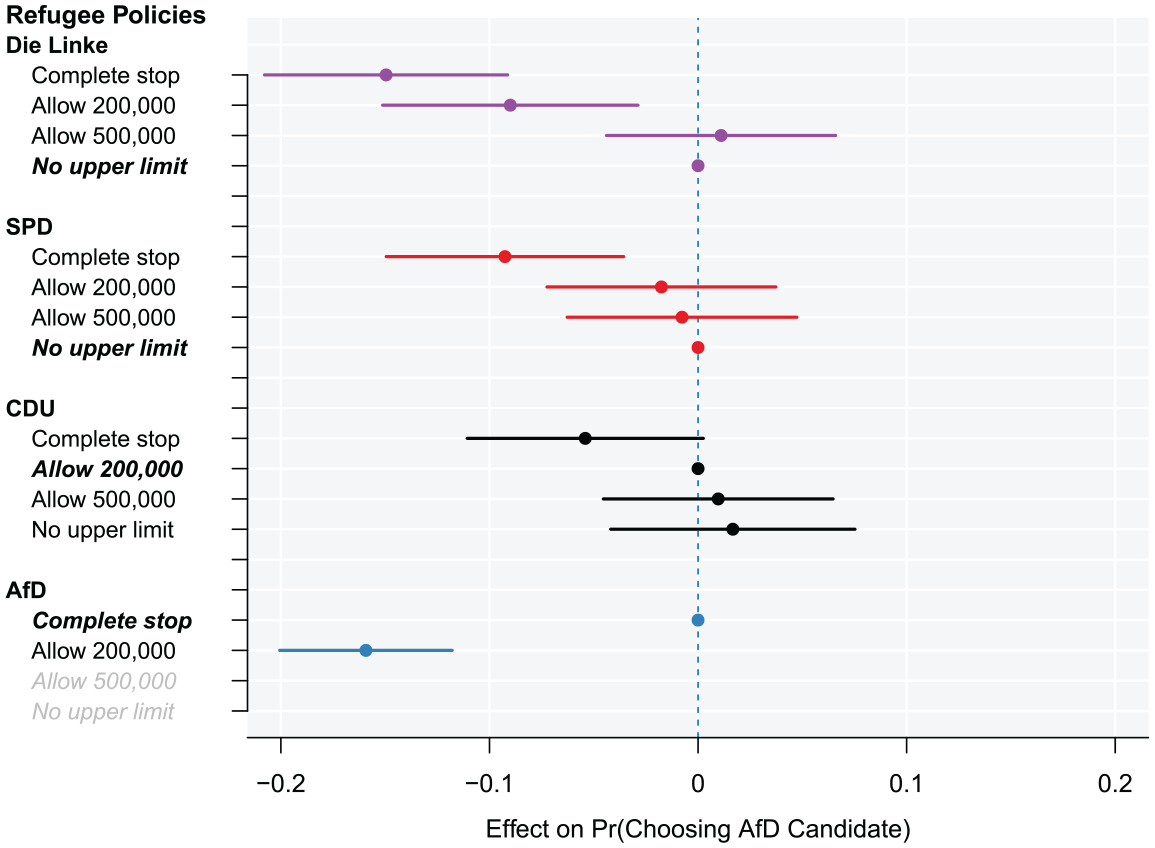
Causal effects of refugee issue positioning on AfD vote choice among AfD voters.
In Figure 6, we set the baseline for each party so that it approximates its real-world policy position. We also represent the causal effect of refugee policy positioning of the AfD as a reference. Figure 6 shows that the mainstream parties can dramatically reduce the AfD’s vote share by adopting more restrictive positions on immigration. Controlling for the AfD’s position on refugees, accommodative parties can reduce the share of AfD voters who support the AfD by between 5% and 15% points, with effects being largest for parties on the left. Importantly, the Linke candidate can capture AfD voters even when he does not advocate the most restrictive position.
Although the average impact of refugee policy positions is large, there might be important heterogeneity. In particular, effects could be moderated by voters’ trust in political parties. If voters are opposed to the establishment and genuinely distrustful of established parties rather than expressing dissatisfaction simply because those parties don’t meet their issue preferences, then they should not be swayed by changes in issue positions. Yet we found surprisingly little variation in the magnitude of the effects of refugee policy positions by political trust: in Supplemental Appendix C.3, we show that AfD voters who express no trust in parties are as willing to switch their vote to these parties when they appeal to them on the basis of issues. This evidence further casts doubt on the independent importance of anti-establishment views in explaining voting behavior. 18
Instead, underscoring the importance of adopting an interactive approach, we find that the effect of other parties’ refugee policies varies most strongly in interaction with the AfD’s own position on the refugee issue. As Figure 7, which displays support levels, 19 shows, when the AfD candidate proposes a less restrictive refugee policy—an upper limit of 200,000—he can lose more than half of his voters to a candidate that proposes a complete ban. To be clear, this configuration is not a realistic scenario, but we include it here to demonstrate that positioning on the refugee issue outweighs allegiance to the AfD among many AfD voters. By contrast, when the AfD remains at the most extreme position and another party proposes a ban, it loses about 30% of its voters. The dampening of this effect suggests that the AfD enjoys greater credibility in this domain—even during this early “window of ownership opportunity” —so long as it remains fixed at the most restrictive position (Kitschelt, 2007; Meguid, 2008). This finding highlights the need to replicate our analysis in future years: if established parties lose credibility over time by failing to meet PRR voters’ issue preferences, their ability to persuade these voters might also decline while party attachment to the PRR potentially intensifies (Golder, 2016).
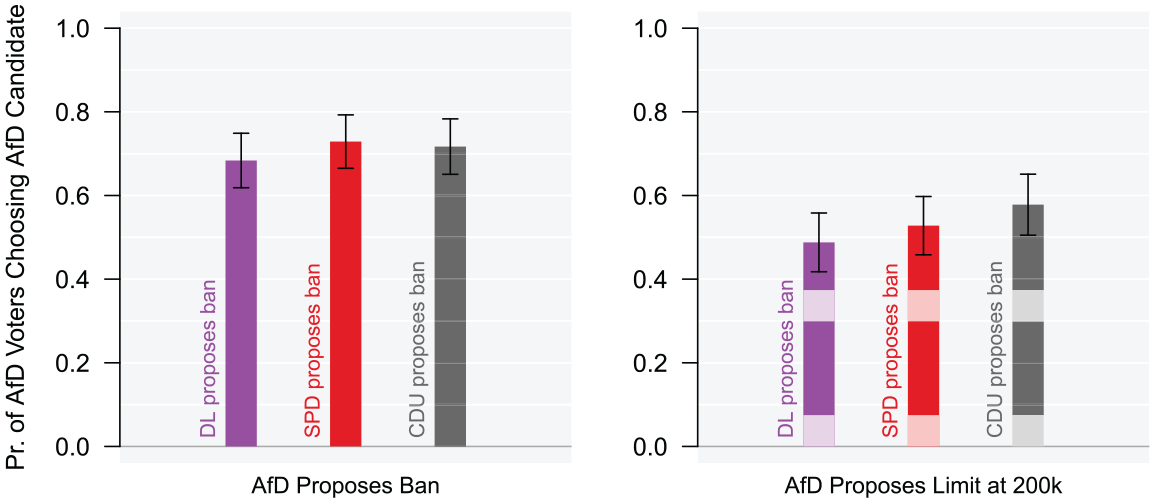
Interactions between proposed refugee policies.
Finally, though the AfD gains support by becoming more attentive to pensions and embracing higher tax rates, it is less clear whether other parties can reduce the AfD’s vote share by altering positions in these two domains. Figure 8 shows that the Linke may cut the share of AfD voters by about 4% when signaling increased competence on pensions, and the SPD could potentially bring about similar reductions by advocating taxes on the rich, but these effects are only weakly statistically significant. When the CDU candidate proposes decreased taxes, the AfD gains close to 5%. Interestingly, we also find that highlighting attention to pensions and proposing higher taxes raise support for established parties among their own supporters (see Supplemental Appendix E). 20 On the whole, then, moves on the economic dimension present an uncertain path toward recapturing AfD voters, at least during a time when immigration is highly salient. But leftward moves and signals of economic competence can be incentive-compatible for established parties. This finding stands in stark contrast to moves on immigration, as we show next.
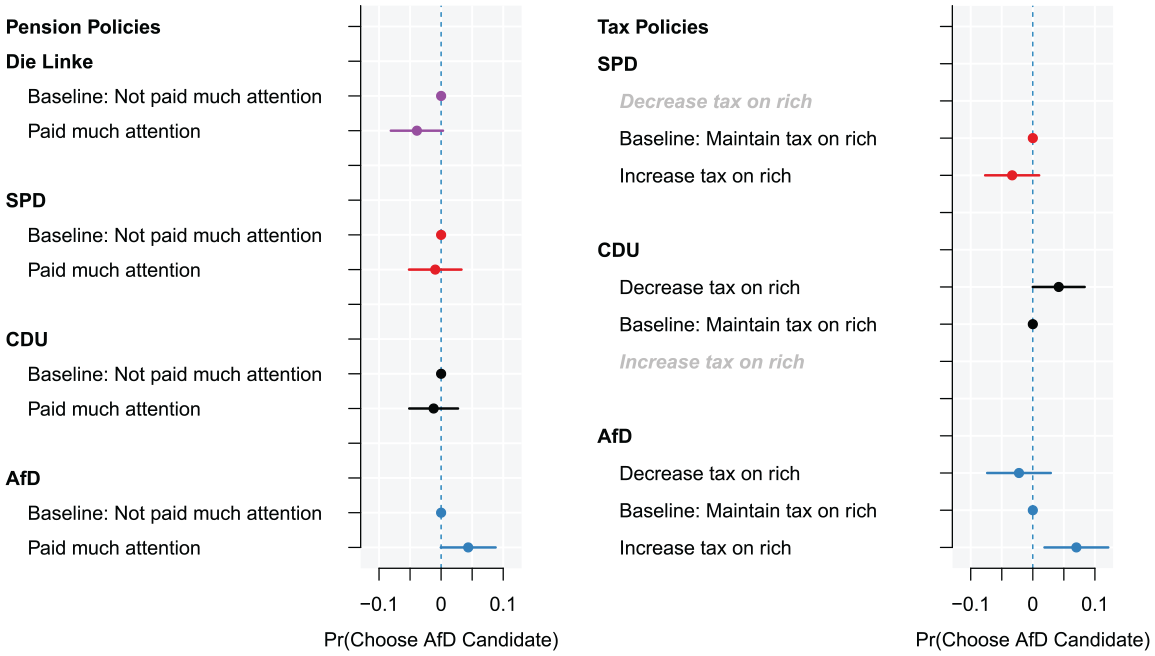
Causal effects of economic issue positioning on AfD vote choice among AfD voters.
Why Parties and Voters Remain Stable
Thus far, we have shown that a considerable share of AfD voters are sensitive to issue positioning on immigration and open to capture by mainstream parties. Why, then, do the latter not simply absorb the AfD’s constituency by co-opting its anti-immigrant platform?
We show here that, in fact, established parties have strong incentives not to accommodate AfD voters’ preferences, as they can lose their own supporters by proposing harsher refugee policies. In Figure 9, for each party, we estimate the effects of refugee policy positions on parties’ own supporters. In particular, we regress the binary outcome variable, Vote for the hypothetical candidate from Party X, on sets of indicator variables measuring the refugee policy positions of hypothetical candidates from Party X, where Party X is one of Die Linke, the SPD, or the CDU. 21
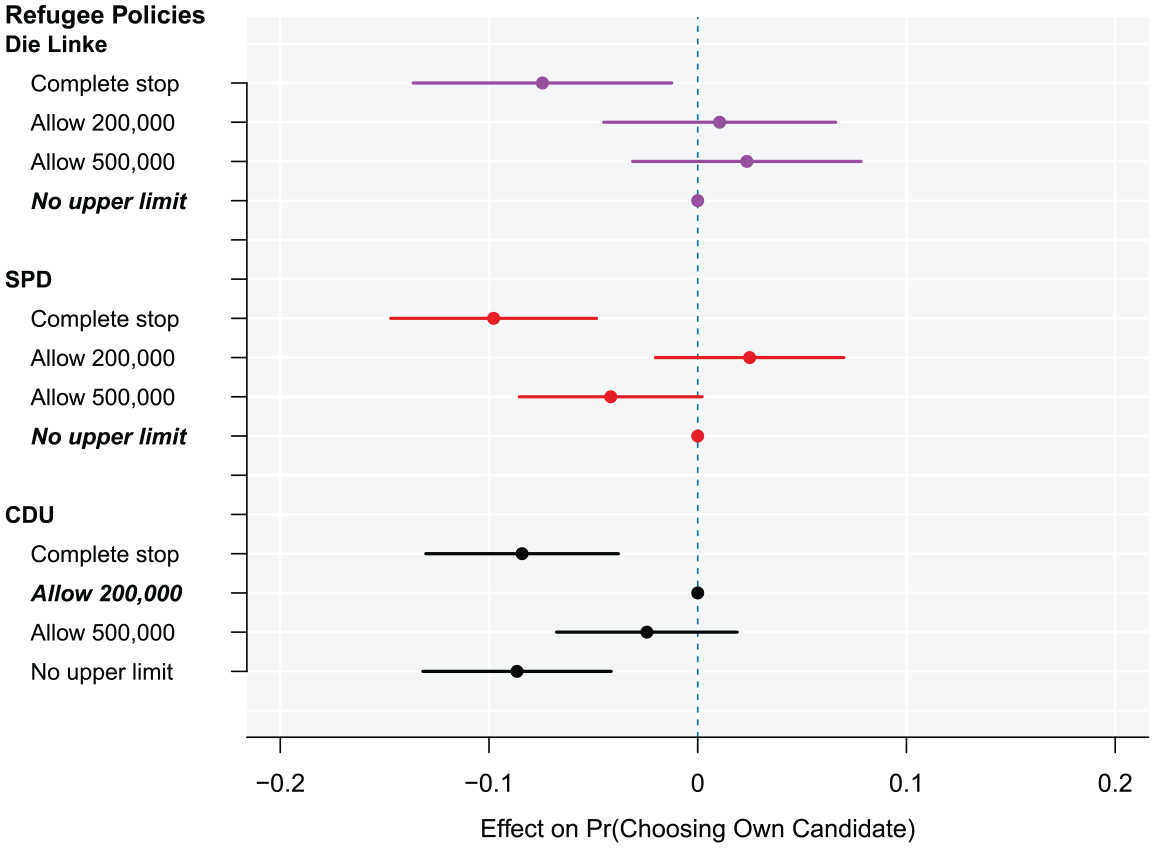
Causal effects of refugee issue positions on vote choice by own supporters.
Figure 9, which presents the estimated causal effects of the refugee policy positions for each of these regressions, shows that the three established parties each stand to lose a large proportion of their own voters by becoming more restrictive on immigration, which, in the case of the SPD and CDU, more than offsets their gains from AfD voters. On average, proposing a ban leads to a loss of around 10% of each party’s constituency. Post-multiplying this estimate by 2017 vote shares implies a loss of around 3%, 2.5%, and 0.8% of all voters for the CDU, SPD, and Die Linke, respectively, relative to absolute gains of around 1.3% from the AfD. 22 Proposing a ban is thus potentially incentive-compatible—if highly risky—only for Die Linke. Combined with our earlier results, our findings suggest that accommodation is most relevant to Die Linke, which has in fact begun to split internally over the refugee issue (Oltermann, 2018).
Discussion of Findings
To summarize, in Section 4, we showed that AfD voters have numerous characteristics that are consistent with anti-establishment voting. Not only is support for the AfD highly stable, AfD voters feel profoundly alienated from established parties and do not redirect their votes to them—even when strategically incentivized to do so. Our descriptive findings are consistent with the proposition that PRR voters would never vote for mainstream parties, even if the latter reconfigured their positions on salient issues.
Yet our experimental evidence reveals that a large fraction of AfD voters—in some scenarios, up to half—are willing to vote for established parties that accommodate their issue preferences. Furthermore, once AfD voters have the option of choosing between multiple parties that meet their preferences, they vote strategically, and are more likely to support stronger candidates.
To be sure, all experiments are subject to concerns of external validity. Conjoint experiments are especially susceptible, as they vary many attributes and present numerous counterfactual scenarios (Abramson et al., 2019; de la Cuesta et al., 2020). Encouragingly, we find strong alignment between our descriptive and experimental results. Consistent with our panel survey evidence, we find that AfD voters have intense directional preferences on refugees, which strongly determine their vote choice. Consistent with our analysis of vote returns, we experimentally recover a precise null effect of strategic voting incentives when other parties do not accommodate these preferences. Lastly, because we examine voters across the political spectrum, we can demonstrate experimentally that the status quo is an electoral equilibrium: no established party has a clear incentive to change position on immigration, while leftward shifts on the economic dimension have uncertain electoral returns. Though we cannot directly test the credibility of such moves nor the persistence of their electoral effects outside of the experimental setting, our results do explain why long-term policy stasis, itself a product of electoral dynamics, contributes to the success of the AfD.
Conclusion
A central question in the study of the populist radical right is whether its voters are forming loyal partisan identities, binding them to their parties irrespective of the choices of other parties, or whether mainstream parties can undercut the PRR by co-opting its issue positions.
Focusing on Germany, our findings suggest that the rise of the AfD—and the loyalty it appears to command—do not simply reflect a growing disenchantment with the political order, but instead emerge from an electoral equilibrium that prevents established parties from accommodating AfD voters’ issue preferences.
Our findings have nuanced implications for forecasting the stability of radical right support and the configuration of the political system as a whole. On the one hand, we show that support for the AfD rests precariously on party positioning on immigration: If an established party were incentivized to adopt more restrictive immigration policies, it could greatly undermine the AfD (Carter, 2013; Meguid, 2008). On the other hand, we also illuminate the electoral incentives that inhibit party repositioning on immigration. In this sense, the liberal preferences of more educated and cosmopolitan voters act as a powerful lever shaping radical right support (cf. Blinder et al., 2013), especially since our panel evidence shows—and our experiment backs up—that these voters are quite fickle in their partisan support. In all likelihood, views on immigration will continue to be polarized and structured by social divisions in status and education, making it difficult for mainstream parties to integrate radical right voters into their electoral coalitions. In the absence of shifting issue priorities or preferences, support for radical right parties could indeed be stable, even without strong partisan loyalties.
To further explore the role of partisan identities, our study should be replicated in countries where PRR parties have had a longer presence and appear to command loyal support (e.g., France). It is possible that, in these cases, voters stick with PRR parties because they have developed deeper partisan attachments than the AfD has been able to foster in its short life span (cf. Voogd & Dassonneville, 2020). While our findings caution against this inference absent additional evidence on voter preferences and party positioning, it is one that future work should address by leveraging variation in how established, centrist parties position themselves on salient issues.
Encouragingly, we find that AfD voters hold multidimensional preferences, making it possible to potentially undercut the AfD by lowering the salience of immigration (cf. Arzheimer, 2009) and accommodating their voters’ preferences on the economic dimension. Importantly, unlike positioning on immigration, these shifts are largely compatible with the electoral incentives faced by mainstream parties. At the same time, our results also suggest that if radical right parties continue to drift leftwards on economic issues and build competence in this area, this strategy may well lose its bite. Future research should thus delve more deeply into how changing the salience and positions of different types of economic policies and associated competencies can reshuffle voter support.
Finally, although many AfD voters change partisan allegiances based on issue fit, we also find that nearly half never do. Interestingly, anti-establishment attitudes do not explain this loyalty. Rather, being male and especially disapproving of refugees best predict this unwavering support (see Supplemental Appendix D). On the one hand, this finding might bode well for democratic stability. Indeed, most of our analyses demonstrate that opposition to the political order has little independent explanatory power. On the other hand, that anti-establishment views do not cause AfD support suggests that radical right parties won’t lose the backing of their core electorate when and if these parties become part of the political establishment, so long as they remain fiercely xenophobic. By implication, the erosion of democratic norms that can accompany the rise of radical right parties could reflect a troubling political bargain: even when xenophobic voters are not drawn in by the anti-democratic impulses of radical right parties, future research should examine whether they are willing to accept a weakening of democratic norms if they are promised closed borders in return.
Supplemental Material
sj-pdf-1-cps-10.1177_0010414021997166 – Supplemental material for Competing for Loyalists? How Party Positioning Affects Populist Radical Right Voting
Supplemental material, sj-pdf-1-cps-10.1177_0010414021997166 for Competing for Loyalists? How Party Positioning Affects Populist Radical Right Voting by Winston Chou, Rafaela Dancygier, Naoki Egami and Amaney A. Jamal in Comparative Political Studies
Footnotes
Acknowledgements
We thank Cung Truong Hoang and Ramona Rischke for valuable research assistance. For helpful comments we thank Verena Benoit, Tim Brackmann, Noam Gidron, Julia Gray, Anselm Hager, Will Horne, Alan Jacobs, Hans Lueders, Moritz Marbach, Sascha Riaz and seminar participants at the Annual Meeting of the American Political Science Association, Harvard University, the Immigration Policy Lab, Princeton University, the University of California, Berkeley, the University of Pennsylvania, and the University of Pittsburgh.
Authors’ Note

Declaration of Conflicting Interests
The authors declared no potential conflicts of interest with respect to the research, authorship, and/or publication of this article.
Funding
The authors disclosed receipt of the following financial support for the research, authorship, and/or publication of this article: For generous funding, we thank the University Center for Human Values at Princeton University.
Supplemental Material
Supplemental material for this article is available online.
Notes
Author Biographies
References
Supplementary Material
Please find the following supplemental material available below.
For Open Access articles published under a Creative Commons License, all supplemental material carries the same license as the article it is associated with.
For non-Open Access articles published, all supplemental material carries a non-exclusive license, and permission requests for re-use of supplemental material or any part of supplemental material shall be sent directly to the copyright owner as specified in the copyright notice associated with the article.
