







Abstract
Many socially conservative settings oppose pro-LGBT+ advocacy because of its perceived threat to “traditional values.” Can messaging on these issues from sources considered to have similar values be more effective than messaging from sources considered to have different values? This research uses the move towards legal protection of certain LGBT+ rights in Angola, Botswana, Mozambique, and South Africa to understand whether signals of changing social norms from African sources are better able to shift perspectives of those elsewhere on the continent than primes from Western sources. Using a survey experiment conducted in Uganda, I show that neither one-off messaging from African sources nor one-off messaging from Western sources shifts beliefs or behavior on LGBT+ issues. Rather, these messages produce backlash to both African and Western sources. This work highlights the challenges of attempting to rapidly change perspectives on LGBT+ issues in the most socially conservative settings.
In recent decades, the legal status of homosexuality has become politically salient in Sub-Saharan Africa (Grossman, 2015). During that period, the debate over sexual identity rights has taken a repressive turn in several countries in the region. The Ugandan Anti-Homosexuality Act of 2014 made same-sex activity in the country punishable by life imprisonment and the Nigerian Same-Sex Marriage Prohibition Act of 2014 made same-sex activity punishable by up to 14 years in prison. 1 Yet the status of LGB rights in the region is not uniformly moving in a repressive direction. 2 Several countries have put in place protections for LGB groups: South Africa legalized same-sex marriage in 2006; Mozambique made employment discrimination on the basis of sexual orientation illegal in 2007 and legalized same-sex relations in 2015; Angola made housing and employment discrimination on the basis of sexual orientation illegal in 2015 and legalized same-sex relations in 2019; and the High Court of Botswana ruled for the decriminalization of same-sex relations in 2019. Some observers of the region have expressed hopeful anticipation that these reforms may signal winds of change on the continent, with other countries soon to follow.
While attitudes towards LGB issues may seem difficult to move given their association with religious and moral convictions, research has demonstrated that—in certain contexts—these attitudes can be changed, even in socially conservative settings (Ayoub et al., 2021). However, the types of activism that have shown some success in shifting attitudes in North American or European settings, such as social contact (Lewis, 2011) or Pride events (Ayoub et al., 2021), are less feasible in contexts such as Nigeria or Uganda where public visibility carries considerable danger. Given the difficulty of public activism in environments that are dangerous for LGB people, under what other conditions might individuals change their outlook on LGB rights? One possible condition is the legal status of issues concerning sexual identity. Legal change—such as the decriminalization of same-sex activity or the legalization of same-sex marriage—might spur greater social acceptance of LGB rights by shifting individuals’ perceptions of prevailing social norms. 3 For instance, Ofosu et al. (2019) argue that the local legalization of same-sex marriage in the United States decreased anti-gay bias because legalization provided a signal of changing social norms. In this research, I investigate whether the recent examples of legal protections given to LGB individuals in countries such as Botswana and South Africa can be used to change perspectives elsewhere on the continent.
There are, of course, countries outside Africa that have guaranteed legal rights for their LGB populations. But there are reasons to believe that examples of non-African states might have little resonance in Africa. The debate around LGB rights in the region is framed by a narrative of the protection of African values against Western values: in this paper, I suggest that—for norms pertaining to LGB issues—other African countries may be perceived as in-group members and non-African countries as out-group members. Consequently, information about legal change in other African countries—but not information about legal change in Western countries—could provide a signal about relevant social norms and influence beliefs and behaviors towards LGB issues.
To investigate whether information about LGB rights in African countries can change perspectives, I conduct a survey experiment in Uganda that randomly exposes individuals to messages about LGB issues from both African and Western sources. This research provides the first empirical evidence to address the questions of (1) whether informational signals of LGB rights norms can shift attitudes and behavior in a socially conservative setting outside of Europe and North America and (2) whether signals from countries with values that are perceived to be similar are more effective than signals from countries with values that are perceived to be dissimilar.
This work makes three contributions: (1) it shows that one-off informational signals from international sources do not directly shift positions towards LGB issues in this setting; (2) it demonstrates that the source of the signal does not matter—one-off messages from African and Western sources are equally ineffective; and (3) it documents a backlash to the reputations of both African and Western countries when individuals are exposed to this messaging. In the pursuit of these findings, this research makes several secondary contributions: (1) a multidimensional descriptive understanding of individuals’ attitudes towards LGB rights in a context with minimal existing public opinion data on that topic and (2) suggestive evidence that some Ugandans’ negative attitudes towards LGB rights may be driven by social desirability bias.
This paper proceeds by contextualizing the status of LGB rights and attitudes in Sub-Saharan Africa; identifying theoretical priors of norm change; describing the survey experiment used to assess the effect of informational signals; and reporting results of the experiment. I then discuss the null effects of the messages on positions towards LGB issues, utilizing the framework proposed by Alrababa’h et al. (2022) to diagnose potential explanations for these results. I show that messages about LGB issues from African sources conveyed new information about the status of LGB rights in the region but that messages from Western sources did not contain new information due to a high degree of baseline knowledge. Rather, information about LGB rights protection in Western settings can be thought of as a priming treatment that makes this information salient at the time of the survey. The null results for both treatment arms are considered in light of two potential complications to the theoretical priors: (1) the role of sustained exposure to messaging about alternative norms and (2) the relevance of other African countries as a perceived in-group. I conclude with suggestions for future work that would build on these findings.
LGB Rights in Sub-Saharan Africa
As shown in Figure 1(a), same-sex activity is illegal in 26 of 45 countries in Sub-Saharan Africa.
4
Variation in the legal status of same-sex activity across the region can be partially attributed to the legacy of colonial institutions: the British and Portuguese imposed penal codes that included laws against sodomy or “acts against nature” while the Belgians and French never imposed such laws (Carroll & Mendos, 2017; Lennox & Waites, 2013). In many countries, statutes pertaining to sexual orientation have remained unchanged since the colonial era (Jjuuko, 2013). Same-sex laws and attitudes in Sub-Saharan Africa. (a) Legal Status and (b) Attitudes. Legal status of same-sex activity in Sub-Saharan Africa as of 2020 (at left) and the proportion of individuals who would be willing to have a “homosexual” neighbor from Round six of the Afrobarometer survey (at right). The Afrobarometer data is coded as a binary outcome where 0 = a strong or somewhat dislike of having a homosexual neighbor and 1 = indifference or a strong or somewhat like of having a homosexual neighbor. Countries colored in white in the right panel were not surveyed by Afrobarometer in Round 6.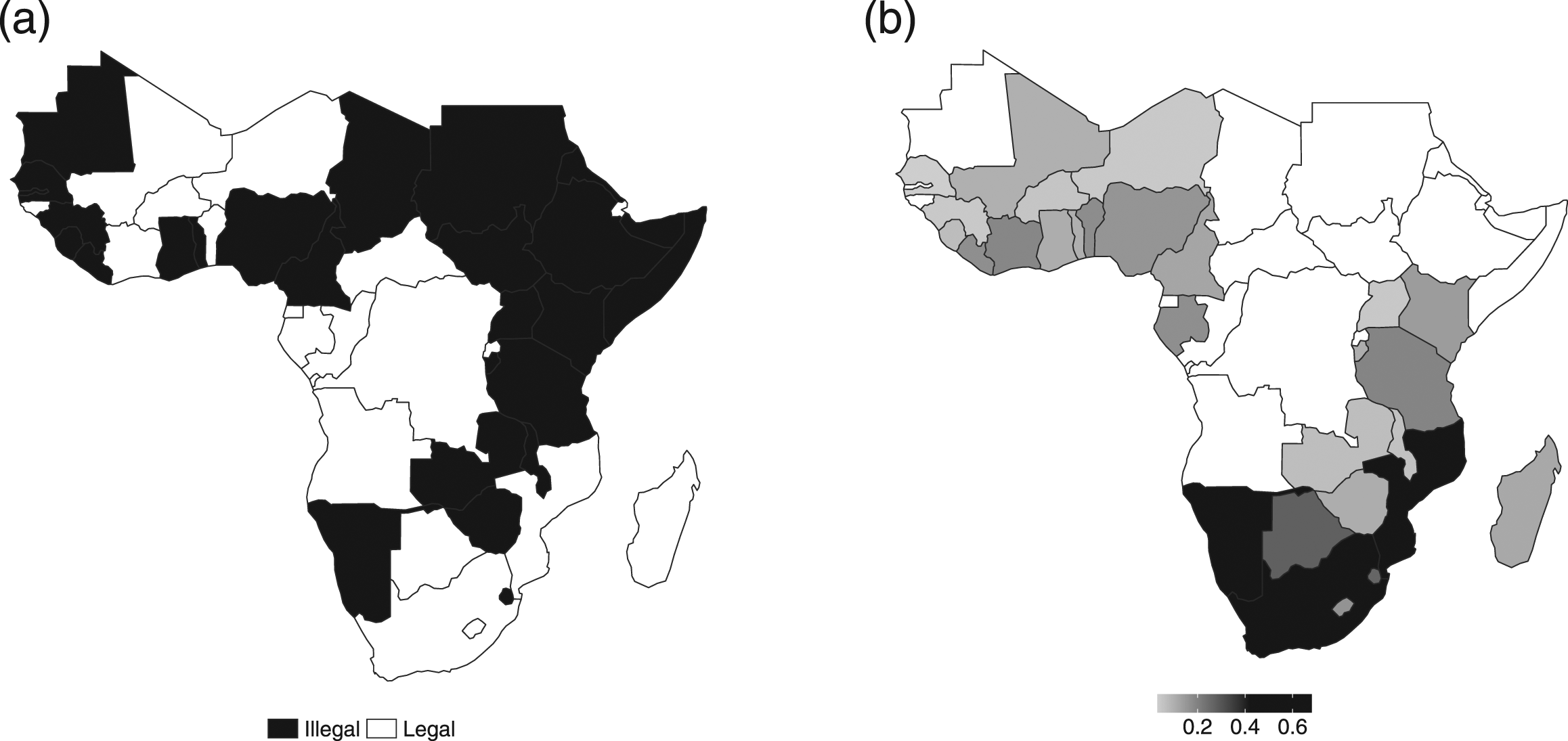
Some countries have changed the legal status of same-sex activity since becoming independent. Several former Belgian and French colonies have explicitly criminalized same-sex relations: Burundi (in 2009); Chad (in 2017); Guinea (in 1988); Mauritania (in 1983); and Senegal (in 1965) (Carroll & Mendos, 2017). Other countries have decriminalized same-sex activity. South Africa decriminalized same-sex relations in 1998 and legalized same-sex marriage in 2006. Guinea-Bissau (in 1993), Lesotho (in 2010), Mozambique (in 2015), Angola (in 2019), Botswana (in 2019), and Gabon (in 2020) have also decriminalized same-sex relations. Some LGB advocates view this recent wave of decriminalization as part of a broader winds of change on the continent, with legal change in one country signaling optimism for future change elsewhere. 5
However, future legal change may hinge upon an antecedent change in domestic public opinion. Elected officials are unlikely to lead the charge for LGB rights in contexts where their constituents overwhelmingly reject homosexuality. Figure 1(b) shows the proportion, by country, of respondents in round six of the Afrobarometer survey who would be willing to have a “homosexual neighbor.” The majority of respondents would dislike having a homosexual neighbor in all but three of the 26 countries—South Africa, Mozambique, and Namibia—that were surveyed. With slim prospects for legal change through legislative means, many LGB activists have turned to the courts (Jjuuko, 2013). Yet—as in other settings where court decisions are constrained by popular sentiment—courts in Sub-Saharan Africa may also weigh public opinion in their rulings. The 2019 Kenyan High Court ruling against the decriminalization of same-sex activity points to the role of public opinion in decisions about LGB rights: “while courts may not be dictated to by public opinion, they would still be loath to fly in the face of such opinion” (Kenya High Court, 2019, section 403).
A shift towards public acceptance of LGB rights may be an important driver of the legal adoption of those rights, as has been shown in other contexts (Lax & Phillips, 2009). Moreover, in settings—including much of Sub-Saharan Africa—where violence and social discrimination against members of the LGB community are common, a shift towards public acceptance of LGB rights may decrease the everyday risks faced by gays and lesbians. While the welfare implications of public opinion for LGB issues are clear, it is less clear which factors influence the public’s attitudes in Sub-Saharan Africa.
The dearth of available public opinion data on LGB issues in Sub-Saharan Africa has precluded extensive research on the predictors of support for LGB rights in the region. The studies that do exist draw on the Afrobarometer data cited in Figure 1(b), showing that attitudes are linked to media consumption (Winkler, 2021), the degree of religious diversity (Dreier et al., 2020), historical exposure to Christian missionaries (Ananyev & Poyker, 2021), and covariates including education, gender, religion, and urban-rural residence (Dulani et al., 2016). This research examines another potential driver of public opinion—information about the protection of LGB rights in other contexts—and examines its effect on a range of outcomes that go beyond what is available in the Afrobarometer data.
Theoretical Priors of Norm Change
Scholarship across the social sciences has long argued that social norms influence individuals’ beliefs and decisions (Greif, 1994; Tabellini, 2008). Driven by social pressure to conform to these norms, people condition their behaviors on their beliefs about the attitudes and actions of others (Bernheim, 1994). For example, the perceived appropriateness of discriminating against LGB people may depend on one’s expectations about whether other individuals would discriminate against them.
Previous research points towards a variety of interventions that have been successful at changing norms and reducing prejudiced beliefs and behaviors (Paluck et al., 2021). 6 One such intervention is the transmission of new information: informational messaging, especially from in-group peers, may be able to change attitudes and behavior by updating individuals’ perceptions of prevailing social norms (Bursztyn et al., 2020). In this section, I first discuss related work on informational interventions and the role of peer influence and then argue that “Western” and “African” countries are socially relevant groups for understanding social norms pertaining to LGB rights in Sub-Saharan Africa.
Informational Interventions and Peer Influence
Informational interventions seek to change individuals’ perceptions of social norms by updating their beliefs about what others do or by updating their beliefs about what others approve or disapprove of, or both. Changing perceptions of social norms would then translate into behavioral or attitudinal changes by altering the types of behaviors or attitudes that are considered socially acceptable. Informational interventions have played an important role in changing behavior across a wide variety of domains, such as the use of foot-binding (Mackie, 1996); men’s support of women working outside the home (Bursztyn et al., 2020); perspectives on race (Stangor et al., 2001); intention to vote (Gerber & Rogers, 2009); and global warning (Bolsen et al., 2014), among other substantive issues.
However, there are reasons to believe that the effect of informational messaging may be contingent upon the source of the message. Peers who are perceived in-group members may be especially influential sources of information about social norms. Because individuals tend to evaluate fellow in-group members positively and out-group members negatively (Abrams & Hogg, 1988; Stets & Burke, 2000), they will be more receptive to alternative norms that come from in-group members than they are to alternative norms that come from perceived out-group members (Gómez et al., 2018; Sechrist & Milford-Szafran, 2011). Experimental evidence shows that messaging from in-group members is more effective at inducing attitudinal or behavior change than messaging from out-group members (Sechrist & Milford-Szafran, 2011).
In-group membership has been used to explain processes of norm change and norm diffusion at both the national and individual level. At the individual level, group identity matters for attitude and behavior change across a wide range of domains, including support for LGBT rights (Harrison & Michelson, 2017; McClendon, 2014). At higher levels of group membership, perceptions of similarity may take on a geographic or regional dimension: countries may follow the example of their neighbors because they are the most visible references or because they have frequent cross-national interactions and common histories (Bonikowski, 2010). Among others, regional patterns of norm diffusion can be found in the expansion of women’s suffrage (Ramirez et al., 1997), women’s reproductive rights (McEneaney & Ramirez, 1997), and democratization (Starr, 1991).
Perceptions of similarity and in-group membership may be bound to only some domains—such as LGB rights—but not others (Strang & Meyer, 1993). If group membership matters for understanding norm change, it is important to know the contours of the in-group and out-group for that particular norm. I argue that “African” and “Western” identities may be relevant groupings that matter for understanding the acceptance of LGB norms in Sub-Saharan Africa.
African and Western Norms
Though the validity of anti-homosexuality as an African cultural norm is fiercely debated, 7 advocacy against LGB rights in the region has often followed a discourse of the protection of African culture against Western norms. For instance, Ugandan President Yoweri Museveni made it clear in a 2014 speech that external advocacy on LGB rights poses a threat to regional values: “There are even attempts to attack the core African values on the family in, for instance, the matter of homosexuals.” 8 Likewise, Dr. James Nsaba Buturo—former Ugandan Minister of State for Ethics and Integrity—highlighted the distinction between African and Western values by saying “In Uganda, we look at homosexuality as an abomination. It is not normal. You are talking about a clash of cultures. The question is: Which culture is superior, the African one or the Western one?” 9 Political, religious, and traditional authorities across the continent have presented similar sentiments focusing on the perceived affront of Western cultural imperialism against African values, drawing on the rhetoric of anti-colonialism to strengthen their appeals (Dreier, 2018). 10
This framing is also taken up by non-elites. Boyd (2013) documents public demonstrations in Kampala, Uganda calling for the protection of the “African family” against Western cultural influences. LGB issues and the politics of African values have increasingly featured in African media outlets, with coverage that is five times more likely to be negative than positive (Grossman, 2015). The popular narrative of Western cultural imperialism has gained such extensive traction in the region that some LGB advocates now argue that Western advocacy creates more harm than good and contributes to the everyday harassment of sexual minorities. 11
Appeals to regional values suggest one source of perceived in-group and out-group differentiation that matters for LGB rights: Africa and the West. If messaging from in-group members is more effective at changing norms than messaging from out-group members, then information that comes from African peers should be more effective than information from Western sources. In the research design presented below, I outline a strategy to experimentally test whether informational messages from African or Western sources can shift attitudes and behavior towards LGB issues in Uganda. This design also allows me to test whether messaging on LGB issues induces backlash to the sources of these messages (Ayoub & Garretson, 2017; Nuñez-Mietz & García Iommi, 2017). Ayoub (2014) argues that LGBT+ norms face fierce resistance when they are framed as external threats to domestic values. With Ugandan discourse about LGB rights highlighting not only the purported clash of African and Western values but also ideas of national identity, sovereignty, and neo-colonialism (Bompani & Valois, 2017), there is the potential for Ugandan citizens to express backlash to pro-LGB messaging from non-Ugandan sources.
It is important to note that the informational interventions described in the research design test only whether information can shift perspectives and not whether repeated exposure—which is highlighted in some conceptualizations of norm change (Bicchieri, 2016)—results in attitude and behavior change.
Research Design
To assess the effectiveness of an informational intervention on beliefs and behaviors towards LGB rights, I embedded a survey experiment in a representative survey of residents of Jinja District, Uganda. Uganda is an important setting to study the effects of informational interventions because it has been the target of social norms messaging on LGB issues, most prominently in statements made by former US President Obama. 12 Jinja District was chosen for this survey because it has sizeable urban and rural populations within the same district, allowing for analysis of how attitudes towards LGB rights differ by location. Moreover, existing Afrobarometer data suggests that aggregate LGB attitudes in Jinja District are similar to aggregate attitudes at the country level, making this setting an instructive test case: in Jinja District, 94% of Round 6 Afrobarometer respondents said they would dislike having a gay or lesbian neighbor, compared to 95% among all Ugandans.
Sample
The experimental sample used for this survey was drawn from residents of Jinja District, one of 134 districts in Uganda. To construct a representative sample of Jinja District residents, I first randomly sampled 30 of the 353 villages in the District using population as a sampling weight. 13 35 households were then randomly sampled from each village and one adult from each household was randomly selected to participate in the survey. The sampling design therefore projected a total sample size of 1050 respondents. In practice, some villages had fewer than 35 eligible or available respondents, resulting in a final sample of 1029 respondents across 30 villages. Summary statistics for a number of demographic attributes of participants can be found in Table A.1 of the Appendix.
Treatment Arms
The 1029 respondents were randomly assigned—at the individual level—to one of three conditions embedded in the survey. The treatment arms were designed to test the effectiveness of informational messaging from African and Western sources: one treatment arm exposed respondents to information about LGB rights in Western countries; a second treatment arm exposed respondents to information about LGB rights in African countries; and the third treatment arm was a placebo control condition. The messages on LGB rights convey information about what the source countries do and about what they think is right—the type of informational signal that should be most effective (Gómez et al., 2018).
These treatments were operationalized as short “News of the Day” audio clips. During the survey, respondents were instructed to listen to a two and a half minute audio message that emulated local radio broadcasts. Each audio clip contained three different messages. The first two messages—news about highway construction and a local taxi drivers’ strike—were constant across treatment conditions. The third message in the audio clip varied by treatment arm. The audio message for the African Message and Western Message treatment conditions was exactly the same except for the countries associated with the information. The content of the African Message and Western Message is shown below, in English.
14
The plain font shows the text common to both messages, the italicized font shows the text specific to the African Message condition, and the bracketed text shows the text specific to the Western Message condition. This text was translated, recorded, and played for respondents in Lusoga. Homosexuality is currently illegal in Uganda but countries in Africa [North America and Europe]—including Angola, Botswana, Mozambique, and South Africa [the United States, the United Kingdom, and France]—have passed legislation to protect the rights of homosexuals in the past decade. South Africa [The United States], for instance, has legalized same-sex marriage. Now, leaders in these countries have urged Uganda to guarantee the rights of gays and lesbians in their country. These African [Western] leaders say that, just like other citizens, Ugandan homosexuals deserve to have their rights protected.African and Western Messages
The placebo control included a third message entirely unrelated to LGB rights: news of the death of a prominent Ugandan businessman. 15 Respondents who received the placebo message serve as the control condition for this experiment. To engender engagement with the audio clip, respondents were asked to summarize the content of the audio in their own words after listening to it. If a respondent failed to mention key details in their summary, they were asked to listen to the recording a second time. Across the three treatment arms, respondents reported engagement with and interest in the topics discussed in the recording. Among survey participants, 79% in the Placebo control, 81% in the African Message condition, and 78% of participants in the Western Message condition “strongly agreed” that this news was important for Ugandans to listen to.
Simple random assignment to the three treatment arms took place within the survey platform, with 333 respondents receiving the Placebo message, 361 respondents receiving the African message, and 335 respondents receiving the Western message. This randomization procedure produced balance on observable respondent characteristics (see Table A2 in the Appendix).
Outcome Measures
Survey-based measures of beliefs and behaviors towards LGB issues face three distinct challenges: (1) the potential for social desirability bias; (2) the multidimensional nature of LGB issues; and (3) the potential instability of attitudinal measures. First, survey measures of sensitive items raise the challenge of social desirability bias (Lax et al., 2016). In the Ugandan context, survey respondents may feel pressure to conform to conservative social norms and falsely report negative opinions on LGB issues. Second, in understanding how a given intervention affects attitudes towards LGB issues, it is important to unpack potentially differential effects on both the moral and rights-based dimensions. Data from the 2015 South African Social Attitudes Survey indicate the value of separately understanding these two dimensions: 73% of respondents said it was wrong for two adults of the same sex to have sexual relations but only 20% felt the South African Constitution should remove protections against discrimination on the basis of sexual orientation. Third, public opinion surveys may capture attitudes made salient at the time of the survey rather than true underlying preferences (Zaller & Feldman, 1992). Behavioral outcomes—which require respondents to weigh real trade-offs—may evoke a deeper consideration of the issues at hand and hence may be more likely to reveal true preferences.
Outcome Measures.
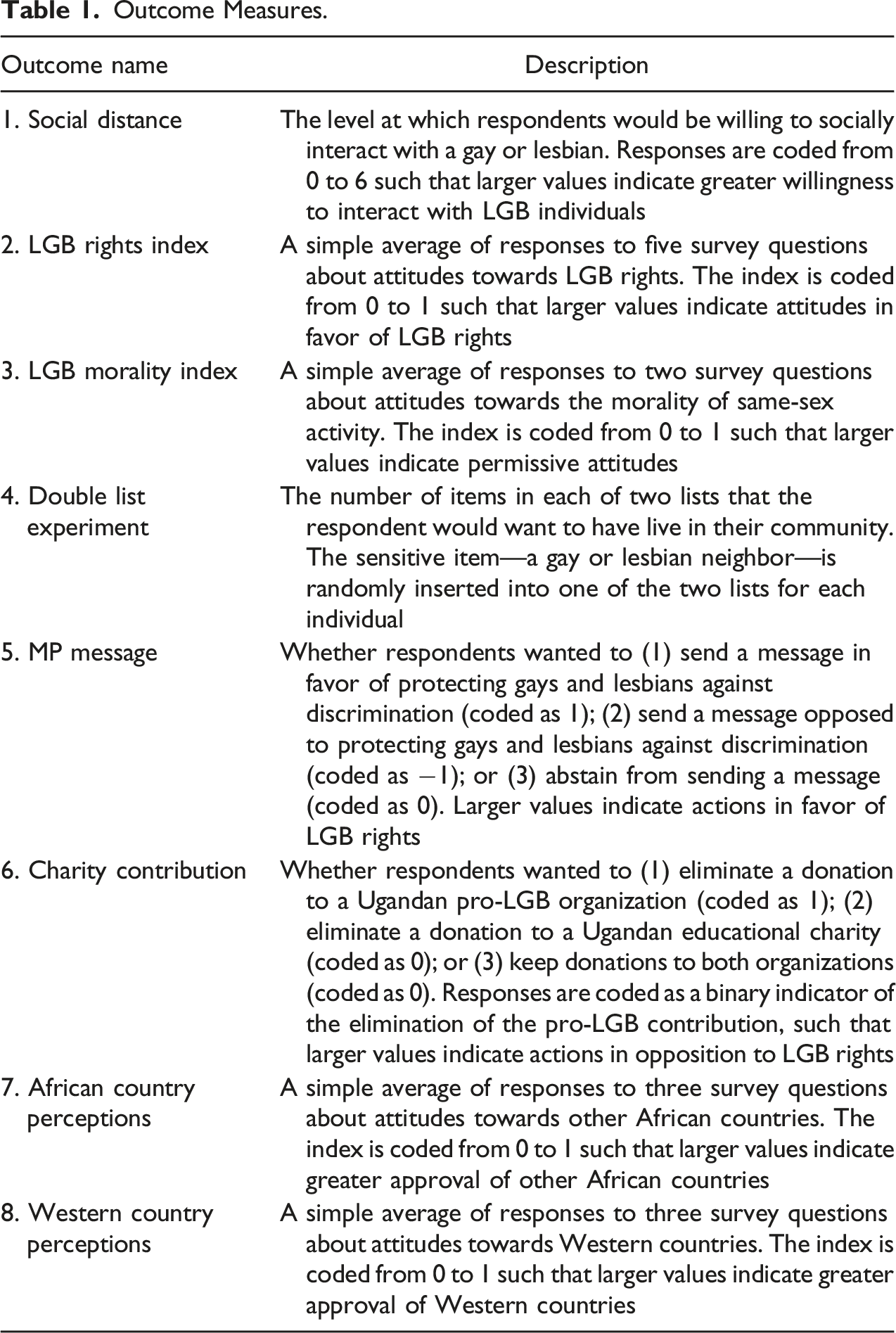
To protect against social desirability bias that may work against the measurement of accepting attitudes, I use a double list experiment. Like the standard list experiment (Corstange, 2009), the sensitive item under study is inserted into a list of control items for a random subset of study participants and respondents are asked a question to which the answer must be the number of items in the list. Comparing the average number among respondents who randomly received the sensitive item to the average number among respondents who randomly did not receive the sensitive item is one way of indirectly ascertaining a truthful response (Blair & Imai, 2012). To increase statistical power, I use the double list adaptation which involves each respondent randomly receiving the sensitive item in one of two lists (Glynn, 2013). In this study, each list contains different types of people who might live in the respondent’s community. The sensitive item—a hypothetical gay or lesbian neighbor—was randomly inserted into one of the two lists for each respondent. Participants were asked to answer each list with the number of different types of people they would be willing to have live in their community. 17 To address the cognitive load of keeping track of list items (Kramon & Weghorst, 2019), respondents were provided with small tokens and instructed to use them to keep track.
To foster deeper consideration of LGB issues, two behavioral outcomes were incorporated into the survey. The first behavioral outcome—the MP Message measure—gave respondents the opportunity to anonymously make their position on the issue of LGB rights known to their local Member of Parliament. Participants could choose from one of three options: (1) sending a message saying that Uganda should do more to protect gays and lesbians against discrimination; (2) sending a message saying that Uganda should not make efforts to protect gays and lesbians against discrimination; or (3) abstaining from sending a message. Although the MP Message measure is not individually costly to the respondent—sending the message anonymously imposes no cost—the decision to send a message in favor of LGB protections when one could easily choose to abstain demonstrates a willingness to proactively engage on this issue.
The second behavioral measure adapts the destruction game from Scacco and Warren (2018). Participants were faced with the decision of whether or not to eliminate charitable contributions to two different organizations: one organization that seeks to improve the quality of primary education in Jinja District and a second organization that works against LGB discrimination in Uganda. 18 Participants were told that 1000 Ugandan shillings would be donated to each of these organizations. 19 They could choose to eliminate one of the two donations, but that decision would come with a cost—the loss of 500 shillings towards the non-eliminated charity. The game therefore asked participants to choose one of three different options: send 1000 Ugandan shillings to both organizations; eliminate the donation to the pro-LGB organization and send only 500 shillings to the education organization; or eliminate the donation to the education organization and send only 500 shillings to the pro-LGB organization. Under the assumption that the education charity was considered by all respondents to be socially beneficial, the game forced a trade-off in which individuals must forgo something considered useful (investment in education) to discriminate against an LGB organization.
Lastly, to assess whether messaging from African or Western sources generates backlash, respondents were asked six questions about their attitudes towards other countries. Three questions were asked about Western countries to construct a Western Country Perceptions index and three were asked about other African countries to construct an African Country Perceptions index. The three questions asked for each set covered: (1) whether or not Uganda should follow the example of those countries; (2) whether leaders in those countries care about what is good for Uganda; and (3) whether Ugandan leaders should listen to the advice of those countries.
All outcomes and their coding for empirical analysis are summarized in Table 1. The complete wording of all survey measures is included in Section 5 of the Appendix.
Estimation
For all outcomes except the double list experiment, I estimate the average treatment effect of the two treatment arms relative to the placebo control in a simple regression model
For the double list experiment, I construct point estimates for each treatment arm by averaging the results from each of the two lists (Glynn, 2013) and calculate standard errors using the method found in Droitcour et al. (1991). Treatment effects are then estimated by taking the difference in means between the treatment arm point estimates.
Ethical Considerations
The issue of LGB rights is contentious in Uganda. A survey that focused singularly on these matters might make respondents uncomfortable, so questions about LGB rights were embedded in a survey that covered a range of social concerns. Participants were verbally informed about the content of the survey—including its focus, in part, on LGB issues—by enumerators before they agreed to participate. All aspects of the survey were conducted in Lusoga—the majority language in Jinja District—by local enumerators. Participants were informed that they could decline participation, stop the survey at any point, or refuse to answer particular questions without loss of the in-kind remuneration. No deception was involved in the survey: the informational treatments were modeled on real-world examples. Participant names and geolocations were never recorded as part of this study. Three institutional review boards—two located in Uganda—affirmed that the research protocol adhered to standards of cultural appropriateness and participant sensitivity and confidentiality. As is standard for survey participation in Uganda, respondents were compensated for their time with a non-cash token of appreciation valued at 3600 Ugandan Shillings. 21 Additional discussion of ethical and cultural considerations is included in Section 6 of the Appendix.
Results
The theoretical priors predict that individuals will be more responsive to messaging from African countries than they are to messaging from Western countries because other African countries are considered to have similar social values. Figure 2 shows that respondents in the sample do, in fact, believe other African countries to be more similar in their social values than Western countries. 58% of respondents reported that the social values of other African countries are at least “somewhat” similar to the social values of Ugandans while only 19% of respondents reported the same for Western countries.
22
When asked to explicitly choose between other African countries and Western countries on the basis of their social value similarity, 78% of respondents selected the former. These results support the conclusion that Ugandan respondents perceive other African countries to be more similar in terms of social values than Western countries.
23
According to the theoretical prediction that individuals will be more responsive to messaging from in-group peers, respondents should respond more favorably to the signals from African sources than to the signals from Western sources. Perceptions of social value similarity. Panel (a) “Value Similarity: African Countries. Panel (b) “Value Similarity: Western Countries. Panel (c) Value Similarity Comparison.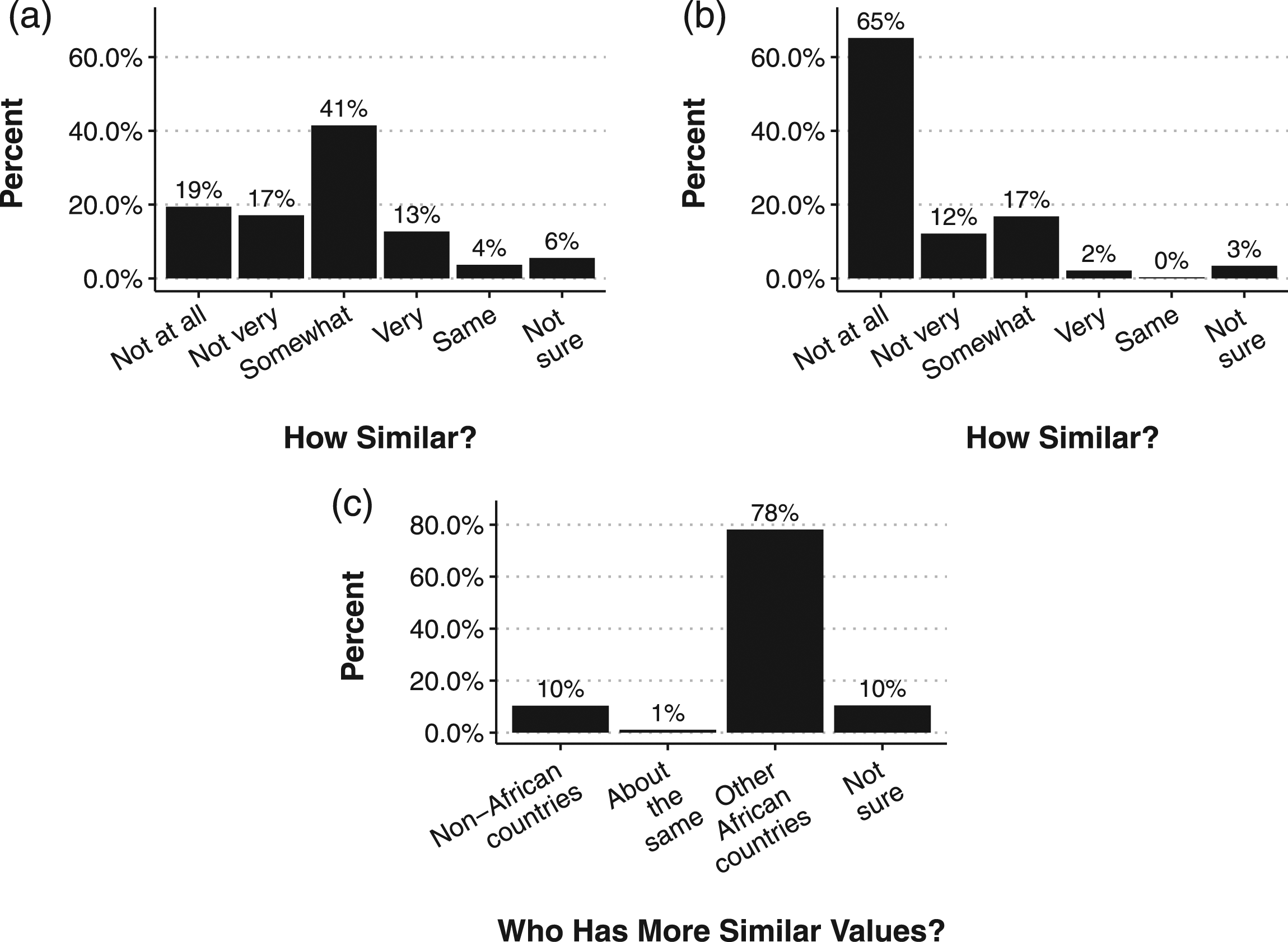
Manipulation Checks
Manipulation Checks.
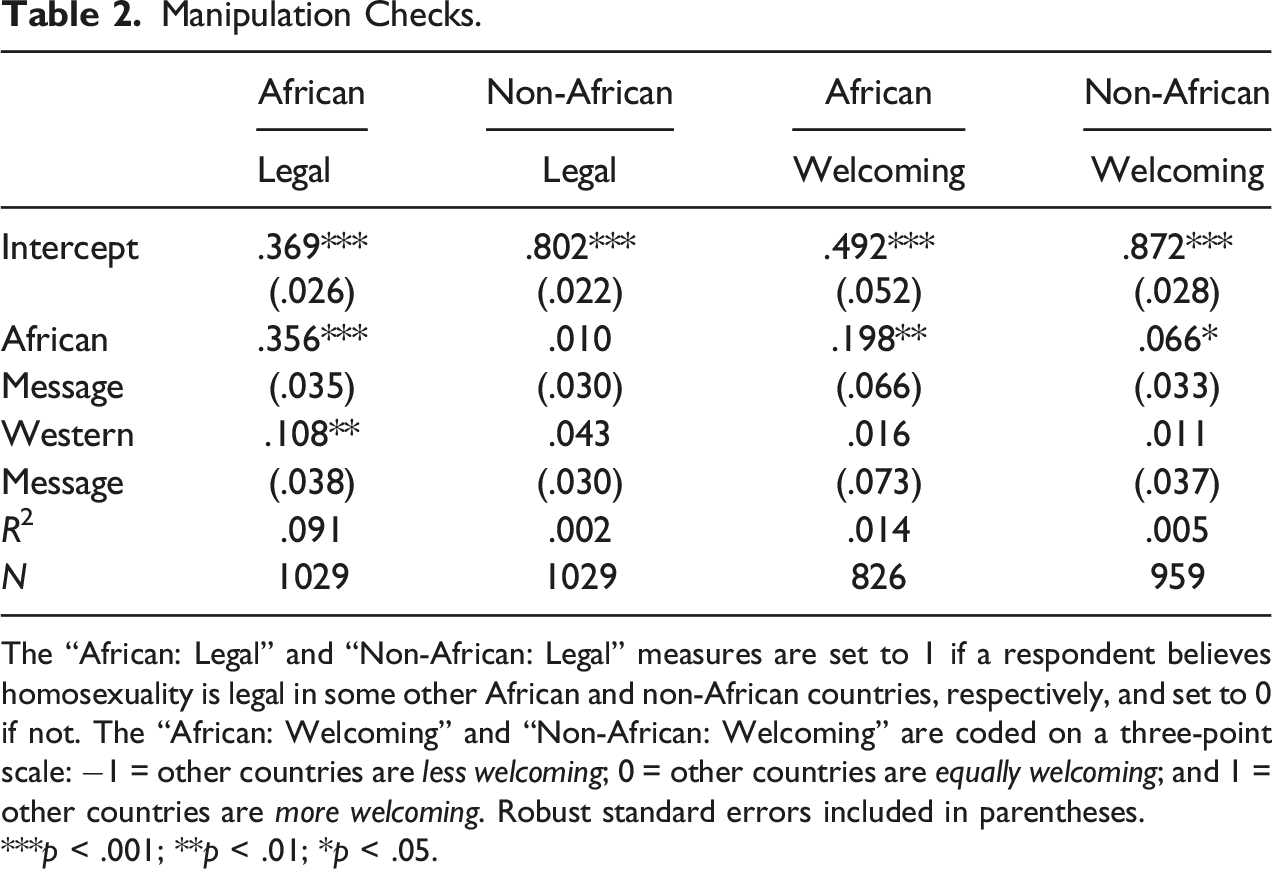
The “African: Legal” and “Non-African: Legal” measures are set to 1 if a respondent believes homosexuality is legal in some other African and non-African countries, respectively, and set to 0 if not. The “African: Welcoming” and “Non-African: Welcoming” are coded on a three-point scale: −1 = other countries are less welcoming; 0 = other countries are equally welcoming; and 1 = other countries are more welcoming. Robust standard errors included in parentheses.
***p < .001; **p < .01; *p < .05.
Table 2 also suggests that the African message and Western message may prime some respondents to think generally—without geographic attribution—that same-sex activity is legal in other countries and that other countries are more welcoming towards gays and lesbians than Uganda. Compared to the placebo group, respondents who heard the Western message are 11 percentage points more likely to say that same-sex activity is legal in some African countries and respondents who heard the African message report, on average, that non-African countries are more welcoming of gays and lesbians. However, the 25 percentage point difference (significant at
The manipulation checks indicate that the African message introduced new information to respondents but the Western message did not. If norm change happens through exposure to new information about the beliefs and practices of others—as the theoretical priors suggest—then the African message treatment should produce differences on the outcome measures. Though the Western message does not convey new information, it may have a priming effect because it makes previously known information about LGB rights in Western contexts salient at the time of the survey.
Treatment Effects on LGB Outcomes
Treatment Effects of Messaging.
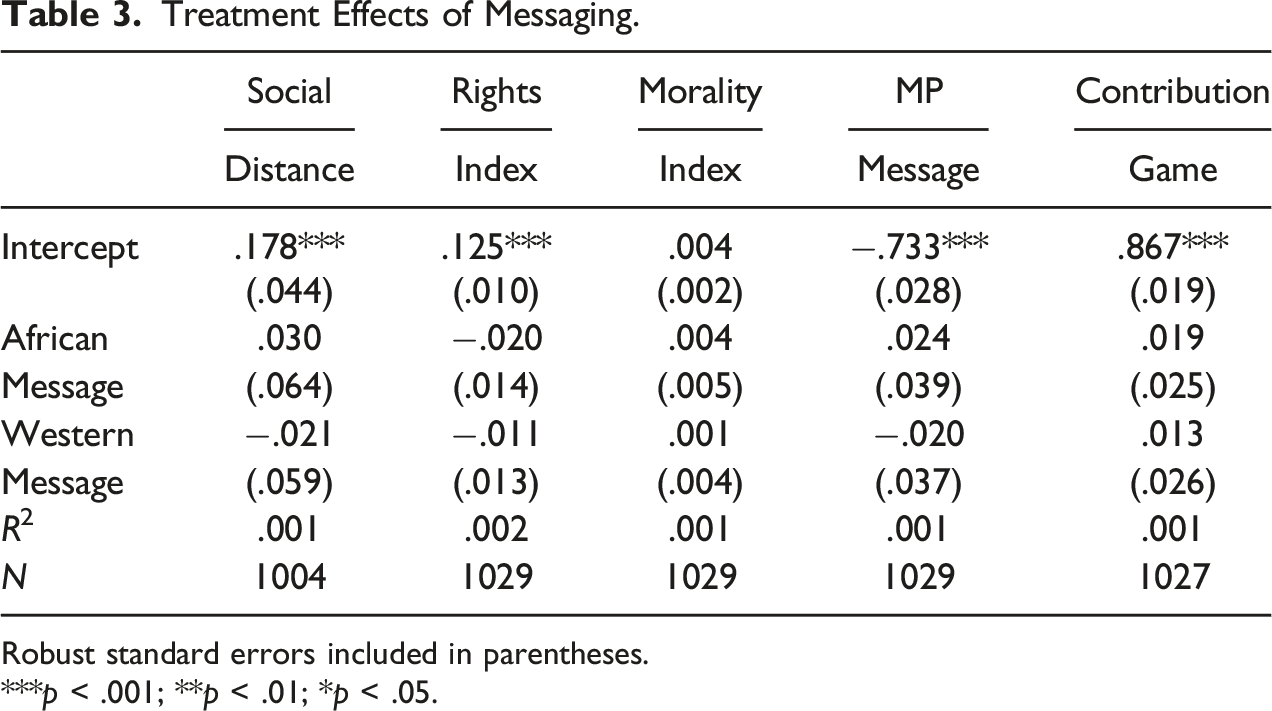
Robust standard errors included in parentheses.
***p < .001; **p < .01; *p < .05.
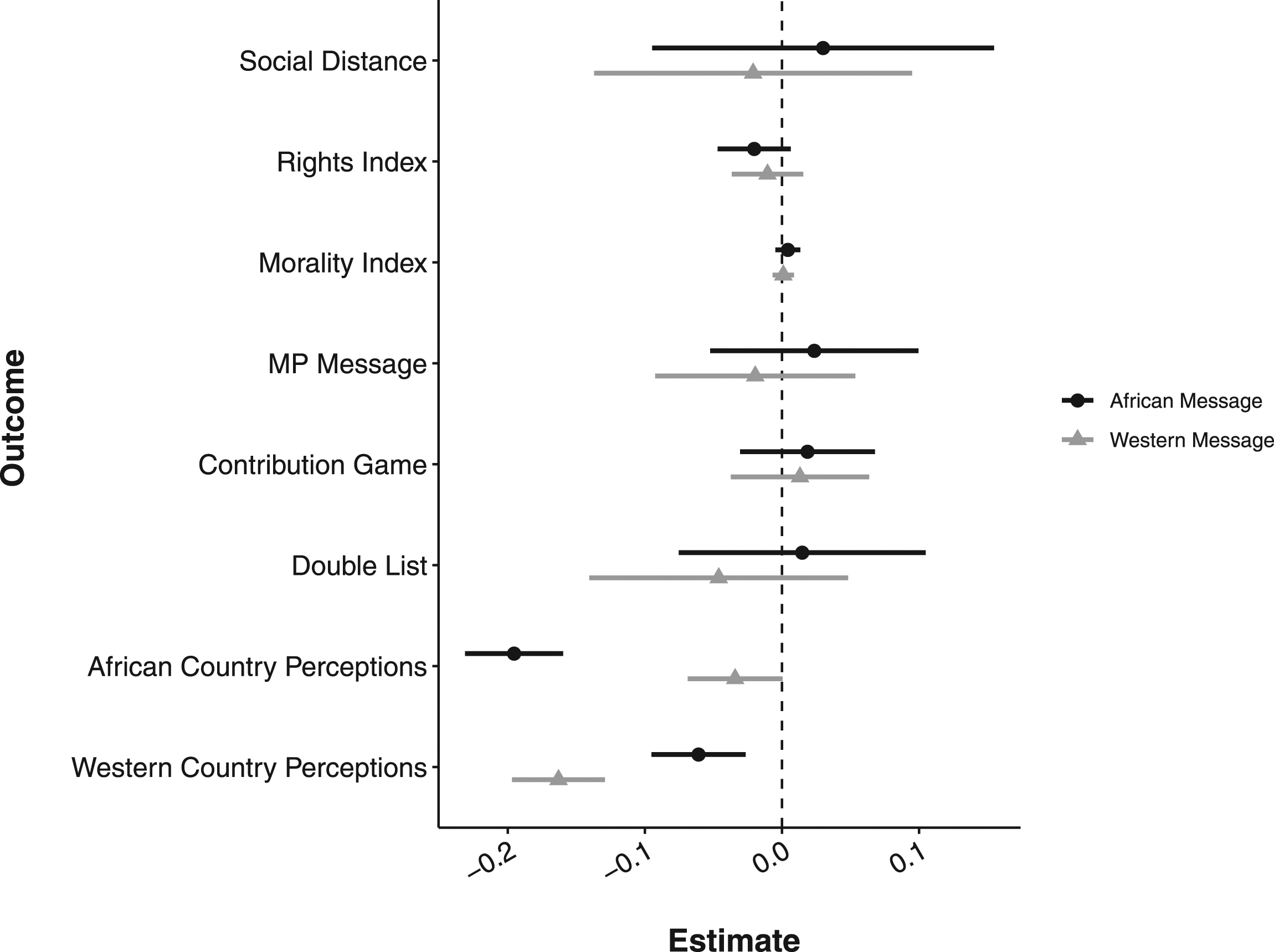
Treatment Effects. The treatment effects of the African Message (in black) and the Western Message (in gray) are shown for all outcomes. The point estimates—which indicate the differences between (1) the African Message and placebo control and (2) the Western Message and the placebo control—are shown using circles (African Message) and triangles (Western Message). 95% confidence intervals are included.
Double List Experiment.
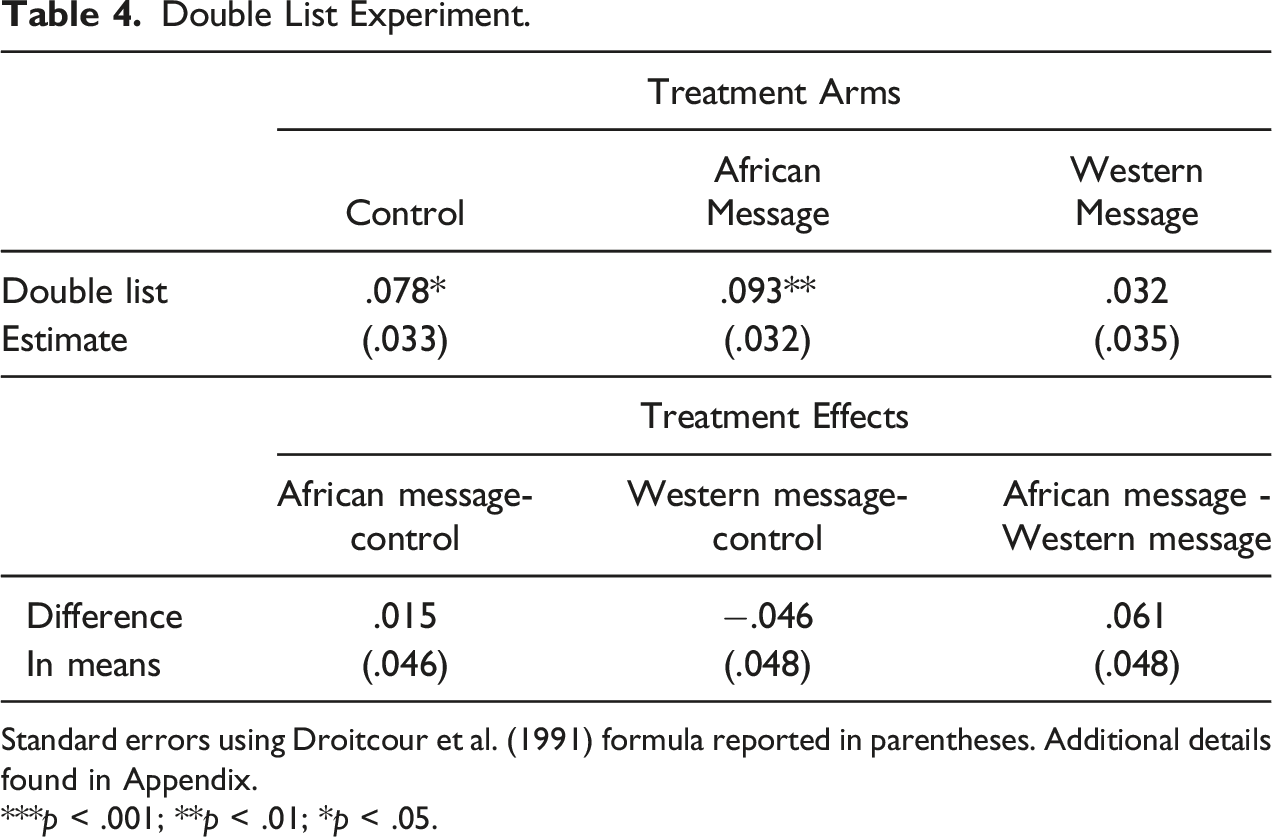
Standard errors using Droitcour et al. (1991) formula reported in parentheses. Additional details found in Appendix.
***p < .001; **p < .01; *p < .05.
The bottom panel of Table 4 shows the difference in means between treatment arms for the double list estimate. Again—as shown here and in Figure 3—there is no evidence for a treatment effect of either the African message or the Western message on individuals’ attitudes towards LGB issues. While the double list results do indicate there may be social desirability bias at play in public opinion towards these issues, the potential for bias does not drive the null effects of informational messaging.
Treatment Effects on Country Perceptions
Treatment Effects on Country Perceptions.
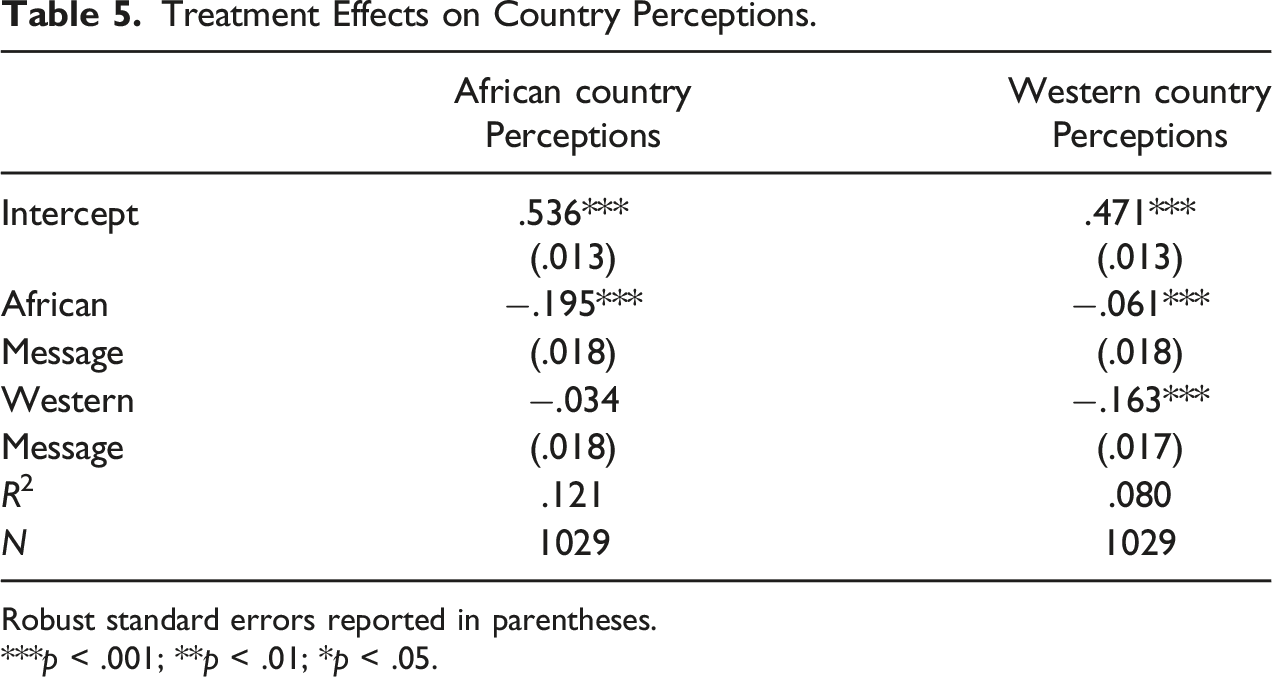
Robust standard errors reported in parentheses.
***p < .001; **p < .01; *p < .05.
Who Supports LGB Rights?
Aside from the African message and Western message under study in this research, which other factors might play a role in shaping attitudes towards LGB rights in Uganda? To better understand the correlates of individuals’ attitudes in this setting, I conduct a descriptive analysis of the LGB rights index using a host of demographic and attitudinal variables. Table A12 in the Appendix shows the results of this analysis. These results suggest that religious affiliation, frequency of news consumption, and attitudes towards other social issues are important predictors of attitudes towards LGB rights. Though there is some evidence that urban residents across Africa are generally more tolerant of homosexuality (Dulani et al., 2016), urban residents in this sample are no more accepting of LGB rights than respondents in rural areas. News consumption is negatively associated with the LGB rights index, possibly reflecting the salience of negative positions towards homosexuality in Ugandan media. Lastly, there is some support for individuals with permissive attitudes towards other social issues—abortion and marijuana legalization—having greater support for LGB rights, consistent with the argument that support for a broad range of social issues may go together (Inglehart, 1997).
Discussion: Diagnosing the Null Findings
The null effects of the African message and Western message on individuals’ perspectives towards LGB issues raise the question: are these findings driven by a genuine inability of the messages to induce change or are they instead the result of a threat to the internal validity of the study? To dissect the possible causes of this null finding, I turn to the framework for discussing null effects proposed by Alrababa’h et al. (2022). This framework proposes that the following set of factors be considered as potential causes for a null finding: “(a) statistical power, (b) measurement strategy, (c) implementation issues, (d) spillover and contamination, and (e) flaws in the theoretical priors” (Alrababa’h et al., 2022, p. 5).
This study had 80% power to detect a small effect size of .22 standard deviations between any two treatment arms. Consequently, it is unlikely that the null results are the consequence of an under-powered design. Though it is conceivable that messaging could induce minute changes smaller than .22 standard deviations, it would be difficult to detect such small effects using conventional survey methods. The second possible explanation is the use of faulty measurement strategies. As discussed in the Outcome Measures section and summarized in Table 1, a variety of attitudinal and behavioral measures were used to assess whether messaging affects some LGB issues but not others. Moreover, a list experiment was used to evaluate whether the results might be driven by social desirability bias. The null findings are consistent across all measures, suggesting that they cannot be attributed to the measurement strategy: it is unlikely that alternative measures would have produced different results. A null finding could also be the result of spillover between those who received the treatment messages and those who received the placebo control—for instance, if the African message or Western message were overheard by those who later received the placebo control. However, by design, the potential for spillover is likely to be small: whenever possible, surveys were conducted out of earshot and the audio clips were played using headphones to ensure that the messages would not be overheard. Moreover—in all but one of the 30 villages where the survey was fielded—all surveys within a sampled village were completed on the same day, limiting the ability for respondents in one treatment arm to convey the information they had received to other prospective survey participants. With little weight given to the possibility of the nulls being driven by issues of statistical power, measurement, or spillovers, it remains to adjudicate between implementation issues and the soundness of the theoretical priors as potential explanations.
Implementation Issues
If the messages failed to adequately convey information about LGB norms in other countries, then the experiment could suffer from a failure of internal validity. The manipulation checks in Table 2 are instructive about the potential for implementation issues. The African message had a substantively meaningful effect: recipients were much more likely than those in the placebo control to know that LGB rights are legally protected in some other African countries and were more likely than those in the placebo control to believe that other African countries are more welcoming of LGB individuals compared to Uganda. These manipulation checks support the conclusion that the African message conveyed new information and that recipients absorbed its message. However, the Western message proved much less effective at conveying new information: it did not meaningfully increase the proportion of respondents who knew about the legal status of LGB rights in non-African contexts and it did not make recipients more likely to believe that non-African contexts are more welcoming of LGB individuals compared to Uganda. As discussed in the Manipulation Checks section, the ineffectiveness of the Western message on the manipulation check outcomes is likely due to the high degree of baseline knowledge about LGB rights in Western contexts: overwhelmingly, control respondents knew about the protection of LGB rights in Western settings and held beliefs that these contexts were more welcoming of gays and lesbians than Uganda. The Western message did not introduce new information because the information was not actually new to the recipients.
Does the failure of the manipulation check for the Western message undermine the internal validity of this experiment? In this work, there have been three estimands of interest: (1) the effect of the African message relative to the placebo control; (2) the effect of the Western message relative to the placebo control; and (3) the effect of the African message relative to the Western message. The results from the manipulation checks should not cause concern for the interpretation of the results for the first estimand: those who received the African message did absorb new information relative to the placebo control, so—consistent with the theoretical framing—this treatment should be viewed as a one-off occurrence of an informational signal of legal change.
The manipulation check results do raise questions for the interpretation of the second and third estimands, however. Because recipients of the Western message did not absorb new information, the Western message should not be understood as a signal of changing norms. But this does not mean that the results are not informative: instead of viewing the Western message as a conveyance of new information, this treatment arm may instead be thought of as making previously known information salient at the time of the survey. Public pronouncements from Western governments may be a real-world analogue to this conceptualization of the treatment: they do not convey new information about norms in their countries (because those norms are already understood by most Ugandans) but they make the issue of LGB rights salient at a particular point in time. The substantive interpretation of the second and third estimands can be modified with this understanding in mind. The effect of the Western message relative to the placebo control provides information about the effect of priming knowledge about the protection of LGB rights in Western contexts; the effect of the African message relative to the Western message provides information about the effect of conveying new information about the protection of LGB rights in some African countries compared to priming knowledge about the protection of LGB rights in Western contexts. This discussion underscores the implications of the manipulation checks for the internal validity of the experimental results: the estimates produced for each of the three estimands are still internally valid—albeit with a slightly modified interpretation for the second and third estimands—for questions of substantive importance.
Complicating the Theoretical Priors
Finally, the null results could be consistent with complications to the theoretical priors introduced in the Theoretical Priors of Norm Change section. Here, I highlight two additional considerations that could be brought to bear on the theoretical priors in ways that might push against the stated expectations of change: (1) the role of sustained messaging and (2) the relevance of the proposed in-group. These two additional considerations are not exhaustive of the many different nuances that could be applied to the theoretical priors.
First, Gerschewski (2021) highlights the importance of considering the time horizon of change when analyzing its causes. Exogenous inputs—such as information about alternative social conventions—might induce either a sudden shock or a gradual process of change. Rather than prompting immediate change, messaging about LGB rights may gradually erode socially conservative outlooks over the longer term. Though there is evidence that one-off exposure can shift LGB attitudes in certain settings (Ayoub et al., 2021), in many contexts repeated exposure may be necessary for noticeable change (Bicchieri, 2016). If this is true in the Ugandan case, the one-off messages used in this research might not spur immediate change; they could, however, make listeners more receptive to future informational signals of the same variety.
Second, the theoretical priors proposed that African and Western countries are labels relevant for the distinction of social value in-group and out-group membership. Though much of the discourse used by Ugandan opponents of LGB rights stresses claims of homosexuality being “un-African” (Nyanzi, 2013), opposition to LGB rights has also been expressed in terms of safeguarding Uganda’s national sovereignty from foreign imposition (Nyanzi & Karamagi, 2015). Claims from abroad of LGB rights in Uganda being intolerable—a stance that expresses Puar’s (2018) account of homonationalism—may spark resistance framed in terms of a decolonial and anti-imperialist reassertion of Ugandan sovereignty (Rao, 2020). With LGB issues serving as a focal point in clashes of both (1) notions of African values against notions of Western values and (2) Ugandan sovereignty against Western hegemony, foreign proclamations of any origin—whether African or Western—might trigger backlash against perceived encroachment on Ugandan sovereignty. This is consistent with the backlash to the reputations of the sources of both the African message and the Western message, as discussed in the Treatment Effects on Country Perceptions section. This backlash and the context of LGB issues as partly a fight over national sovereignty suggests that domestic voices may be the most persuasive in shifting LGB attitudes: other Ugandans may be the most relevant in-group. Informational messages from prominent members of this in-group—such as religious or political elites—could be more persuasive than messages from abroad, though there are limited examples of Ugandan elites who have publicly supported LGB rights.
In this assessment of potential contributing factors for the null findings, I have highlighted implementation issues and complications with the theoretical priors that are pertinent for the interpretation of the results. I argue that the results are informative for questions of substantive importance: does new information about LGB rights in African contexts shift socially conservative attitudes elsewhere in the region? Though information about LGB rights in Western contexts is not new, does priming that information shift attitudes, or does it induce backlash? The null results suggest that neither a one-off dose of the African message nor a one-off dose of the Western message produces a shift in LGB outcomes. Rather, recipients of those messages exhibited a backlash to their foreign sources. These results are consistent with the complications to the theoretical priors that have been introduced in this section: sustained exposure to alternative norms may be necessary for viewpoints to be altered and foreign messaging may trigger defensive positions because of the national sovereignty framing of LGB issues. This work cannot speak to the efficacy of either sustained messaging or messaging that comes from domestic sources; both are directions that could be pursued in future research.
Conclusion
LGB issues are likely to become increasingly salient in Sub-Saharan Africa. Recent court cases in Botswana and Kenya speak to the debate that many countries in the region will be having about LGB rights in the coming decades. This research has addressed whether information about the initial African countries that have taken steps to protect LGB rights can directly shift public perceptions elsewhere in the region. It has shown that neither one-off messaging from African sources nor one-off messaging from Western sources results in an immediate shift in public opinion. Rather, the message sources lose credibility and suffer backlash. This suggests an important scope condition to other findings on pro-LGB interventions: while Ayoub et al. (2021) show that activism can shift perspectives in a socially conservative setting, their study location of Bosnia and Herzegovina—where 53% of survey respondents said they would dislike having a homosexual neighbor—is a very different starting point from Uganda, where 95% of Afrobarometer respondents said they would dislike having a homosexual neighbor. Pro-LGB informational interventions in socially conservative settings such as Malawi, Nigeria, Senegal, and Uganda—each among the nine countries surveyed by Afrobarometer where over 90% of respondents would dislike having a gay or lesbian neighbor—may be unlikely to shift public opinion on LGB issues until the number of supporters is closer to a tipping point (Centola et al., 2018). Finally, the complications to the theoretical priors suggest two additional areas for future research: (1) the efficacy of sustained LGB advocacy in socially conservative settings and (2) the role of domestic elites in shaping perspectives on LGB issues. Future research should also systematically assess whether pronouncements from abroad shape the choices made by political elites: though one-off messaging may not have an effect on the general public, it may shape the positions taken by domestic leaders (Rao, 2020).
Supplemental Material
Supplemental Material—Value Similarity and Norm Change: Null Effects and Backlash to Messaging on Same-Sex Rights in Uganda
Supplemental Material for Value Similarity and Norm Change: Null Effects and Backlash to Messaging on Same-Sex Rights in Uganda by Nicholas Lyon in Comparative Political Studies
Footnotes
Acknowledgements
I am grateful to Feyaad Allie, Ashley Fabrizio, David Laitin, Hans Lueders, Jeremy Weinstein, the anonymous reviewers, and participants of the Stanford Graduate Student Workshop in Comparative Politics for their helpful comments. Samuel Olweny and the team at Matrice360 Uganda provided excellent research assistance. A pre-analysis plan is filed with the EGAP registry at https://osf.io/jmp89. All errors are my own. Replication materials and code can be found at  .
.
Declaration of Conflicting Interests
The author declared no potential conflicts of interest with respect to the research, authorship, and/or publication of this article.
Funding
The author disclosed receipt of the following financial support for the research, authorship, and/or publication of this article: This work was supported by the Stanford Center for African Studies and Stanford King Center on Global Development.
Ethical Approval
This study has been approved by Stanford University IRB (protocol 52319), TASO (The AIDS Support Organization) IRB in Uganda (protocol TASOREC/076/19-UG-REC-009), and the Uganda National Council for Science and Technology (protocol SS 5117).
Supplemental Material
Supplemental material for this article is available online.
Notes
Author Biography
References
Supplementary Material
Please find the following supplemental material available below.
For Open Access articles published under a Creative Commons License, all supplemental material carries the same license as the article it is associated with.
For non-Open Access articles published, all supplemental material carries a non-exclusive license, and permission requests for re-use of supplemental material or any part of supplemental material shall be sent directly to the copyright owner as specified in the copyright notice associated with the article.
