







Abstract
Government services act as important sites of political socialization. Through interactions with the state individuals learn lessons about their value as citizens, form preferences over government services, and understand the value of political participation. What happens when the private sector replaces government provision of basic services? I explore this question in the context of a randomized private school voucher experiment in India. Based on an original household survey of 1200 households, and semi-structured interviews conducted 5 years after the voucher lottery, I find that voucher winning households hold stronger market-oriented beliefs. However, voucher winning households show little difference in political participation on most measures of political participation. I argue that these results are driven by a greater comfort with private providers as permanent economic actors. This suggests exposure to different economic actors, in the form of private schools, have the potential to change political preferences.
Keywords
Government services have been found to act as important sites of political socialization. Through interactions with institutions and functionaries of the state, individuals learn important lessons about their worth as citizens and the functioning of democracy, form preferences over government services, and understand the value of political participation. At the same time, private actors are providing a greater number of basic services across the developing world (Cammett & MacLean, 2011). What happens when governments no longer provide basic services and are replaced by private actors? Do private actors break the link to this political socialization process? And does exit from state-provided services shape political preferences in politically consequential ways? Scholars have feared that as states cease to provide services and private actors emerge to fill the vacuum, citizens will become politically ambivalent as they no longer require the state to provide services (Hirschman, 1970; Lerman, 2019).
I explore state exit in India, where citizens have increasingly turned to private organizations for basic services. This paper takes the case of education, where over 40% of households send their children to private schools (ASER, 2019), and asks what happens to political attitudes and behaviors when citizens exit state services for the private sector. I argue that state exit can have two types of effects on politics: on how citizens participate in politics as a result of different material and social positions, and on how citizens interpret politics as a result of different experiences (Pierson, 1993). Despite the importance of these questions, making conclusive causal claims is difficult as the growth of private services tends to be historically contingent and highly endogenous to political and economic variables. To overcome these problems, I leverage a randomized private school voucher program and provide causal evidence on the effects of private services on political socialization. I find that access to private services does not depoliticize citizens. Instead, they shape economic preferences by making citizens more comfortable with a greater role for the private sector in service provision.
Specifically, I leverage a randomized school voucher lottery to understand the political consequences of state exit. In 2008, households across five districts of Andhra Pradesh, a large state in South India, were offered the opportunity to enter a private school voucher lottery, and lottery winners could send their child to a private elementary school for 4 years. I returned to these households 5 years later and employed a mixed methods approach, including an original survey of 1202 households that entered the lottery, and 30 semi-structured interviews with program participants and education bureaucrats in the state to test the effects of private services on political outcomes. I find that households that sent their children to private schools become more comfortable with paying out of pocket for other services that are currently provided by the government, which I take as evidence of increasing comfort with the private sector. Political participation — measured either by voting, a number of more costly partisan actions such as canvassing for a political party, or non-partisan local participation — shows few differences between treatment and control groups on most measures. I argue that while exit from government services has an effect on mass publics, it is on economic preferences, and not political behavior.
I explore three potential mechanisms for what could be driving results: better objective or subjective quality of private schools, the breaking of ties between citizens who attend private schools and the Indian bureaucracy, and greater comfort with the private sector as a result of increasing ties to the private sector. Evidence suggests that the results are driven by greater comfort with the private sector, which I call “legibility”. Voucher winners report that they came to understand the functioning of the private sector through access to private schools, and that they had greater faith in the private sector continuing to operate in low-income communities. I find no evidence for private schools being of better quality than government schools or that moving children to private schools severed ties between citizens and the Indian bureaucracy. Private schools were of equivalent quality as government schools, and respondents in the treatment group reported similar levels of contact with government bureaucrats even after exiting to the private sector.
These findings are important not only for what they tell us about the Indian case, but what they reveal about service provision more generally. While social science has traditionally assumed that the state is the primary provider of basic services (Post et al., 2018), the private sector is increasingly an important service provider both in the U.S. (Morgan & Campbell., 2011), and in low- and middle-income countries (Cammett & MacLean, 2011). This paper adds to a growing body of work that suggests we should take the political effects of religious (Clark, 2004; Thachil, 2011, 2014b), non-governmental organizations (Boulding, 2014; Bratton, 1989), and private organizations seriously (Lerman, 2019). Much of this work has focused on the strategic use of service provision by political parties to win votes (Cammett & Issar, 2010; Clark, 2004; Thachil, 2014a, 2014b). Here I argue and show that even private organizations without explicit political goals have important political effects by changing a recipient’s perceptions of their social world (Lerman, 2019).
The case of education in low- and middle-income countries also merits special attention. I provide causal evidence of the effects of schools on mass publics. The literature on the effects of education in political science has largely been focused on the impact of increasing access on students political participation (Croke et al., 2016; Dee, 2004; Marshall, 2016, 2019; Mettler, 2005; Rose, 2018; Wantchekon et al., 2014). I show that schools impact not only the direct beneficiaries – students – but also a larger group of citizens that form opinions and take action on politics as a result of their interaction with schools. Education is a part of the larger welfare state and as such structures individual level beliefs about government beyond students (Kumlin, 2004). As a result of “Education For All” reforms, many low- and middle-income countries have greatly expanded access to education (Bold et al., 2015; Pritchett, 2013), yet private providers have thrived (Post et al., 2018). This has happened at the same time as state retrenchment in low- and middle-income countries have led to the rise of subsidiary service provision arrangements. Most of our evidence on these effects come out of high-income countries (Cook et al., 2020; DeAngelis & Wolf, 2019; Dill, 2009; Kingsbury, 2019). Given the increasing growth of charter and private schools in high-income countries this is not surprising but still represents an unfortunate omission as many low- and middle-income countries such as Liberia (Romero et al., 2020), India, and Kenya and Tanzania (Bold et al., 2015; Lucas and Mbiti, 2012) have seen a rapid growth of private schools.
Methodologically, I rely on a downstream or secondary experiment to uncover causal effects of interests to political scientists (Baldwin & Bhavnani, 2011). I take advantage of an existing voucher experiment implemented by a separate organization and return to respondents asking a different set of questions than the original implementers. With the increasing costs of data collection and fieldwork in comparative politics (Hsueh et al., 2014), and the causal revolution in the discipline (Humphreys & Scacco, 2020), this paper provides an example of a productive avenue for scholars to leverage already existing randomized control trials to ask questions that speak to questions in political science. Theoretically, I explore learning effects as a mechanism for institutional change through an exogenous shock and later endogenous feedback effects (Pierson, 2000). This provides an example of how to integrate literature on institutional change and stability, and experimental methods, two literatures that have largely remained separate (Steinmo, 2015).
Theoretical Expectations
How should we expect access to private services to change public opinion and behavior? The growth of private services could have an impact on behavior and opinions through selection or treatment. Hirschman (1970) suggested that citizens select into private services, and that those most likely to exit government service provision are also those most likely to exercise their “voice” to hold public sector providers accountable. Through exit, individuals discipline a service provider for a decline in quality by no longer using the service, while by using their “voice,” individuals express their displeasure directly to the service provider. The high levels of state exit in India might help partly explain that education has rarely been an important electoral issue in India (Ansell, 2010; Rudolph & Rudolph, 1972; Rudra, 2002; Weiner, 1990).
This idea has found empirical support in the United States and sub-Saharan Africa, where the use of private services has reduced the exercise of citizenship (Abernathy, 2005; Cook et al., 2020; MacLean, 2011), although findings are more indeterminate overall in the United States (DeAngelis & Wolf, 2019; Dill, 2009; Kingsbury, 2019). State retrenchment after market-oriented reforms in sub-Saharan Africa has meant that citizens have turned to private service providers for basic services such as health and education, leading to decreased political participation as citizens no longer needed to mobilize publicly for quality service provision (MacLean, 2011). Through a different mechanism, Bleck (2015) finds that sending children to government schools in Mali results in greater levels of political participation from parents. Families with students in government schools use these students as “linguistic brokers” to overcome linguistic barriers to greater political participation. In response to the declining quality of public services or continued access, citizens exercised voice and mobilized to demand better services from government officials through increased participation and ties to the state, while those that stop using public services exercised less voice.
In this paper, I focus on the treatment effects of private services. Education service provision provides an important test case for how public policy affects mass opinion as education service provision can directly change an individual’s capacity for political action as well as indirectly framing political problems in new ways, impacting how individuals exercise both exit and voice. I argue there are two potential mechanisms through which school privatization could impact political opinions and behaviors and therefore how exit and voice are used. “Resource effects” occur as, “[new policies] provide resources and incentives to individuals that profoundly influence crucial life choices: what kind of job to take, when to retire or take time off from the paid labor force, how to organize and divide household tasks such as child rearing,” (Pierson, 1993, p. 606). New policies also influence “the manner in which social actors make sense of their environment,” or what Pierson calls “interpretive effects” (Pierson, 1993, p. 610–1).
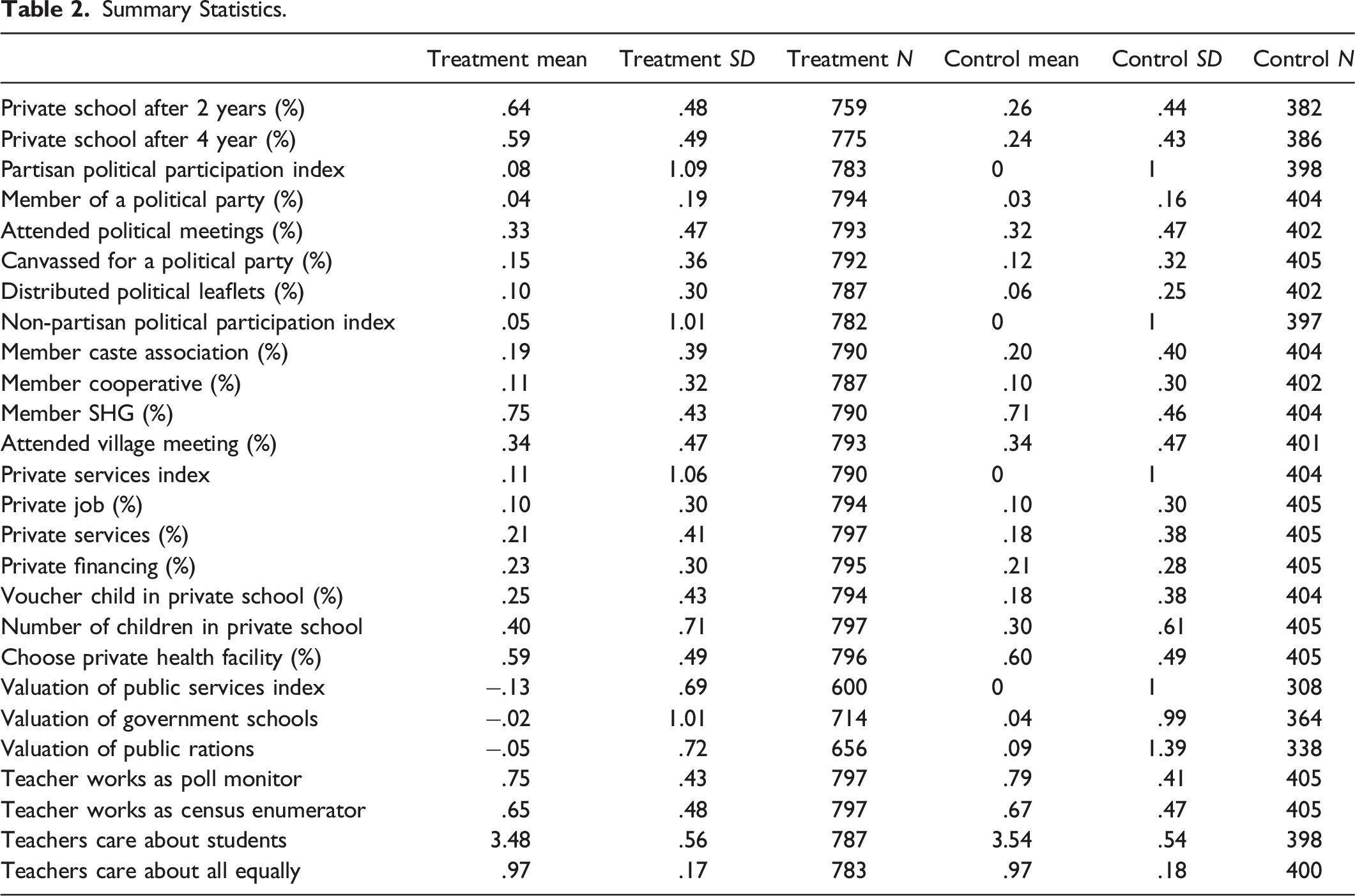
The material effects of policies have been found to have a broad range of effects on political behavior. The G.I. Bill in the United States encouraged returning soldiers to go to university and increased political participation (Mettler, 2005). Senior citizens became politically active to defend their existing material benefits (Campbell, 2003; Lynch, 2006). In India specifically, schools are often the first point of contact citizens have with the formal state (Corbridge et al., 2005), deliver the midday meal scheme (Drèze & Kingdon, 2001), and serve as voting locations (Neggers, 2018). Through legally mandated forums, known as School Management Committees (SMCs), parents are asked to be involved in the governance of government schools, including the spending of budgets and the hiring of teachers. Government teachers are also often the most educated members of their community, and engage in a number of non-teaching activities — such as election monitoring and conducting the decennial census — that make them highly visible in their communities (Béteille, 2015). Teachers unions are powerful political constituencies in their own right, and frequently lobby politicians and voters to act in their interests (Kingdon & Muzammil, 2009). My own data suggests that upwards of 85% of government teachers served as either election monitors or census enumerators in the past year in my sample villages (see Table 2).
In addition to the role that teachers and schools play in politics, there is frequent political interference from local politicians. Pressure is placed on District Education Officers (DEOs) to transfer particular teachers as punishment for poor performance, despite this being outside their responsibilities. 1 An interview with a parent suggested that parents would approach Members of the Legislative Assembly (MLA) and lower-level elected politicians if they had concerns in their children’s schools, instead of the education bureaucracy. 2 One survey respondent gave examples of how in the run-up to the 2014 legislative assembly election, the local MLA had begun to visit their village more frequently and had recently promised ₹100,000 (approximately US$1600 at the time of field work) to the village primary school to build a wall around the school and provide board games for the children at the school. 3
Finally, while many interactions between citizens and the state are mediated by intermediaries (Auerbach, 2016; Berenschot, 2010; Krishna, 2007), and the Indian state has also been described as “omnipresent but feeble” (Kohli, 1990, p. 6) – it is ever present in the lives of its citizens, especially the poor. The expansion of education over the last three decades has meant that, at the very least, citizens can expect a school to be present. The high levels of rural decentralization (Auerbach and Kruks-Wisner, 2020; Kruks-Wisner, 2018), and widespread social protection (Kapur & Nangia, 2013), has meant a greater presence in the social and economic lives of rural citizens.
Government schools act as a site of interaction between citizens and the Indian state. By providing opportunities and grievances over which to mobilize over the provision of club goods, bringing voters into contact with the state through the provision of services such as the midday meal, contact with teachers as front-line functionaries of the state, and contact with political parties and electoral politics through political interference, government schools provide a number of paths through which individuals can become involved in politics. By contrast, providing a way to exit these relationships through privatization and increasing contact with actors in the non-state sector can change the relationship between citizens, the Indian state, and partisan politics. This provides us with H1: • H1: Private school voucher lottery winners will be less likely to participate in political forums.
Interpretive effects provide a second channel through which exit from the state can impact politics. Political learning in the public sector provide individuals with greater knowledge “in the operation of complex systems [that lead] to higher returns from continuing use,” (Pierson, 2000, p. 254). Individuals learn about politics through policies and interactions with representatives of the state. These experiences provide citizens with examples of how the state views them and how they can better engage in repeated interactions with the state that then have spillovers to other domains (Pierson, 1993; Soss, 1999). Early experiences with representatives and institutions of the state shape knowledge and incentives and knowledge on how to later engage with the state and exhibit increasing returns from continued use.
Similarly, experiences with the private sector have the power to shape political attitudes and behaviors independent of any material change in the relationship between states, markets, and households. Experiences with private services that are new and then sustained should also exhibit increasing returns as formerly opaque and complex systems become more “legible”. 4 For example, access to financial markets have shifted political beliefs in the United Kingdom by increasing familiarity with markets (Margalit & Shayo, 2020). Even if individuals do not make money in the stock market, access to the stock market provide new and sustained experiences for participants that led to greater familiarity and decreasing distrust of financial markets. The privatization of state-owned enterprises in Czechia encouraged citizens to acquire information about how they operated and led to greater engagement with formerly state-owned private enterprises (Earle & Gehlbach, 2003). Markets in health care in India made health care recipients “energetic and entrepreneurial in shopping around,” (Jeffery and Jeffery, 2008, p. 133).
New experiences after market-oriented reforms introduce individuals to new market institutions and experiences that, with repetition, allow them to understand and use these institutions more effectively. In the case in this paper, citizens learn by understanding how the private sector, and one service in particular, works as these were new experiences for most households and provide a direct way through which to experience the functioning of the private sector. Two design features of the voucher encouraged this learning. First, households were only eligible to enter the program if they did not have any children in private schools already, and evidence from other states in India suggests that while households often rely on private tutors (ASER, 2019), 5 very few households from marginalized groups send their children to private schools (Romero & Singh, 2022). Most recipients in this voucher experiment lived in rural or peri-urban areas with little access to elite private schools.
A second design feature that encouraged learning and increasing returns is that the voucher was provided for 4 years, meaning that households had sustained experiences with private schools. While many voucher programs in the United States are administered by the state, the voucher program in this paper was implemented by the Azim Premji Foundation, a well known NGO in South India, and would have moved households away from government services, making this case analogous to that of Carlson et al. (2016). Field observations and administrative data suggest that most private schools in the area where the vouchers were offered were relatively new, with an average age of four to 8 years at the beginning of the voucher lottery. Private schools were often at the outskirts of villages and did not have dedicated school buildings, often renting space in existing houses. This was in contrast to government schools that were often in the center of villages or near major thoroughfares, with dedicated land and buildings for the schools. In this case, experiences with a new service provider can open the black box of the service, but depending on the program design, voucher and similar programs can highlight the importance of state regulation in the performance of schools (Fleming, 2014), or, if responsibility for provision is unclear, lead to greater confusion of who has ultimate responsibility for the benefits and failures of particular service providers (Carlson et al., 2016).
These effects are also independent of the quality of the service. For experiences such as education (here) or the stock market as in Margalit and Shayo (2020), quality is often only revealed in the long run. The understanding gained from repeated use, however, materializes quickly. An experience on the first day of school or selling your first share provides lessons for the second day of school or second sale.
Citizens in India experience many government policies through schools and have experiences that can structure their perception of the value of political participation that are no different from experiences in high-income welfare states (Kumlin, 2004). The high legibility case is analogous to the experiences that voucher winners underwent in the voucher lottery. This suggests that newfound access to private services introduce individuals and households to a new set of social actors, and makes certain parts of the private sector more legible to households. This legibility should make households more comfortable with market actors leading to H2: • H2 Private school voucher lottery winners should hold stronger market-oriented economic preferences.
Before turning to data collection and results, I explore the Indian context in the next section and introduce the field site in which I conducted fieldwork.
Private Services in India and the Andhra Pradesh School Choice Experiment
The private sector, including religious and non-profit organizations, have expanded rapidly across India (Kingdon, 2017). While exact data is hard to come across, it is estimated that approximately 50% of urban and 20% of rural primary schooled aged children attend private schools (Kingdon, 2017, p. 6). Acknowledging this reality, the Indian Government passed The Right to Education (RTE) Act in 2009 (Government of India, 2009). Section 12.1(c) of the Act specifies that private schools must accept 25% of their incoming class “belonging to weaker sections and disadvantaged group in the neighbourhood and provide free and compulsory elementary education till its completion,” (Government of India, 2009, p. 5–6). Some commentators have called the policy, “India’s civil rights moment,” as it would bring disadvantaged groups in contact with the country’s elites. 7 The policy effectively serves as a private school voucher as the state compensates schools for children admitted under this clause to attend private schools (Government of India, 2009, p. 6). Unlike other voucher systems where households receive vouchers, the state reimburses private schools directly, so students and parents do not receive a transfer from the state. At the same time, the policy has not been without controversy – it was challenged in courts by an association of private schools, 8 and concerns remain that private schools discriminate against the children accepted into their schools under this policy (Romero & Singh, 2022).
The Andhra Pradesh School Choice Experiment (from here on APSC), 6 which this paper follows-up from, sought to provide evidence of the effects of the RTE on educational outcomes (Muralidharan & Sundararaman, 2015, p. 1018–19). 9 The original design relied on a two-stage randomization process. In the first stage, villages were eligible if they had at least one private school as this would allow parents to choose a school for their children in their village. All villages were then informed that they would be entered into a private school voucher lottery run by the Azim Premji Foundation, a well known education NGO in South India. Villages were then randomized into treatment and control, creating a village-level counterfactual where some villages would be eligible to receive private school vouchers and others would serve as the control group. Next, households within treatment villages were then randomized in the second stage to receive vouchers, thereby creating a household-level counterfactual. Because of resource constraints, I only sampled from treatment villages, so I was only able to explore individual and not community level effects, fully aware that those questions are also of interest to researchers in political science. 10 In the larger experiment, 23% of all students originally in public schools in treatment villages accepted a voucher and moved to a private school, and 8% of students in private schools were voucher children (Muralidharan & Sundararaman, 2015, p. 1026). While the original experiment was administered by an NGO and not the government, the larger design mimics what then became national government policy.
The state of Andhra Pradesh represents an ideal location for this study as the state has tremendous amounts of cultural, linguistic, and religious diversity that reflects the larger diversity of the country. The state is the furthest North of the South Indian states (see Figure 1 for its location in India as well as the specific survey districts) and has a significant Islamic colonial legacy in its Northern districts and a strong British colonial legacy in the East and South. This history makes its Northern districts akin to states in India’s Northern Hindi belt, while its Southern and Eastern districts more similar to India’s Southern states. I conducted fieldwork in five different districts across its three major regional areas, Telangana, Rayaleseema, and Coastal Andhra. The three Southern districts in this study were part of Andhra State at independence prior to joining Hyderabad state after the States Reorganisation Act of 1956. This is not dismiss Andhra Pradesh’s unique policy making environment. Chief Ministers in Andhra Pradesh have led the way in attracting foreign capital (Rudolph & Rudolph, 2001), and in implementing technocratic forms of governance (Bussell, 2012), of which this policy experiment is another example. Survey districts in Andhra Pradesh. Notes: The state of Andhra Pradesh is shaded in light gray, while districts in which the intervention and subsequent survey were conducted are in dark gray.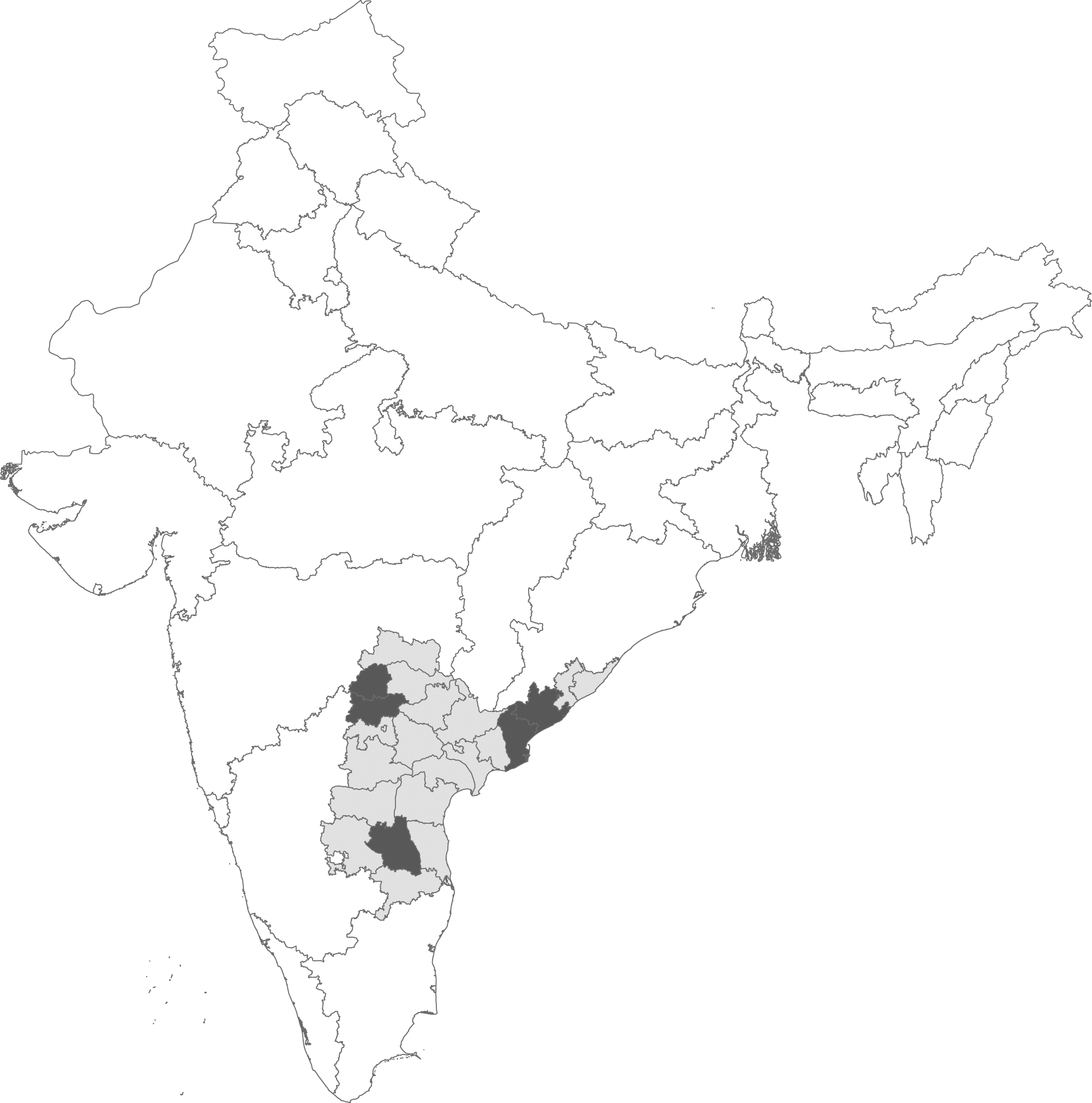
The state has also led attempts in understanding the impact of private schools on student learning outcomes. The survey I conducted followed a series of large scale experiments between the Government of Andhra Pradesh, the Azim Premji Foundation, and researchers from Harvard University, the World Bank, and the University of California, San Diego (see Muralidharan and Sundararaman (2011a, b, 2015)). The voucher experiment was explicitly designed to mimic Section 12.1(c) of the RTE Act. This provided a particularly conducive research environment in which to conduct research on the effects of the private sector. Using the original randomization list provided by Muralidharan and Sundararaman (2015), I returned to households 5 years after they entered a private school voucher lottery and 1 year after their children had completed primary school and the voucher lottery experiment and administered an entirely new survey instrument.
Data and Methods
To test the hypotheses laid out above I rely on an original household survey of 1202 households collected between September and December 2013 in five districts of Andhra Pradesh. The survey was conducted by a team of 11 surveyors administering an original in-person survey. I retained the same survey team as used in the original APSC experiment to maintain the trust of respondents given the different set of survey questions asked here. Between August and December 2013, I also conducted 33 semi-structured interviews with households that entered the lottery. 11 The survey sample was randomly drawn from the APSC Experiment. As the original experiment was stratified by district, this newer sample reflects this stratification. The voucher was provided for 4 years of primary education that covered Standard one through Standard four (equivalent to first through fourth Grade), and I surveyed households when their scholarship child had finished fifth Grade and was entering secondary school.
Operationalizing the Key Outcome Variables
This paper is interested in the effect of private schools on two broad outcomes of interests: 1. Political participation, and 2. Market-oriented beliefs. I operationalize these latent outcomes by grouping several observable variables into weighted indices. 12 In the following section, I describe the individual components of each index.
Political Behavior
Partisan Political Participation is an index composed of four variables: whether a household member is a member of a political party, whether they attended a political meeting over the past year, whether they canvassed for a political party over the past year, and whether they distributed leaflets for a political party over the past year.
Non-Partisan Political Participation is an index composed of four variables: whether a household member is a member of a caste association, whether a household member is a member of a cooperative or labor union, whether a household member is a member of a self-help group (SHG), and whether a household member attended a gram sabha (village government) meeting in the past 6 months.
Market-Oriented Beliefs
Turning to measures of market-oriented beliefs, I attempt to measure market-oriented beliefs through stated and revealed preferences for the private sector, and through a measure of how much money households would be willing to spend out of pocket to receive services through the market. I do this through two indices, Preference for Private Services and Valuation of Public Services.
Preference for Private Services is an index composed of six variables: whether respondents would prefer a job in the private sector or with the government, whether respondents would prefer the private financing of services like health and education, whether respondents would prefer the private provision of services like health and education, whether respondents continued to send their voucher child to a private school after the private school voucher lottery was finished, the number of children in the household in private schools excluding the voucher child, 13 and whether respondents go to a private health care provider if a household member falls sick.
Valuation of Public Services is an index composed of a respondent’s valuation of two government services currently provided in-kind: publicly provided education and food rations. I presented respondents with a hypothetical scenario in which households could either receive a cash transfer from the government of a certain value to purchase services on the private market or continue to receive the service from the government in-kind, attempting to reveal a respondent’s “valuation” of two important government services. For example, in the case of education I gave respondents the hypothetical option of either receiving a school voucher and being able to shop for a school for their children as they pleased or using the government school system. The value elicited provides the value at which respondent’s would be indifferent between receiving the value in-kind from the government or shopping for similar quality goods on the private market. I take this answer to represent the value respondent’s attached to government services — a higher response suggests it would take a higher value voucher to convince respondents to abandon government services for privately provided services.
For school vouchers [food rations], starting with the amount of ₹3000 per year [₹200 per month], surveyors asked respondents whether they would prefer to receive government provided education in-kind [their ration that month] or the specified amount in cash. The amount was increased in ₹500 [₹50] increments until either the respondent said they would rather receive that amount in cash or a maximum offer of ₹10,000 [₹1000] was reached. 14 If the respondent did not accept any offer below ₹10,000 [₹1000], the surveyor asked for the minimum amount the respondent would be willing to accept instead of government provided education directly [subsidized rations at government ration shops].
While uncommon in political science, this method of eliciting a person’s valuation of a good is more common in the development economics literature (Kremer et al., 2011). Kremer et al. (2011) caution against over interpreting the results from these hypothetical scenarios as valuations in hypothetical are often larger than through actual expenditures and revealed preferences. To validate these results, I include both the hypotheticals discussed here, as well as real preferences discussed in the preference for private services index.
I suggest that their valuation of public services through this measure represents a respondent’s relative preference for market services. I pick these two services as they are two services that have a potential “price” for their provision that a respondent could understand and calculate, as well as services for which there is policy debate as to the best way to provide them in India, with the use of vouchers so individuals can access the markets a realistic proposal (Kapur et al., 2008). The two services represent clear subsidies from the state to individuals and removing them would force households to bear expenses out of pocket. The choice I forced households to make is between having the respective service be subsidized by the state or shopping for that particular service on the open market.
Balance Tests Between Treatment and Control Groups.
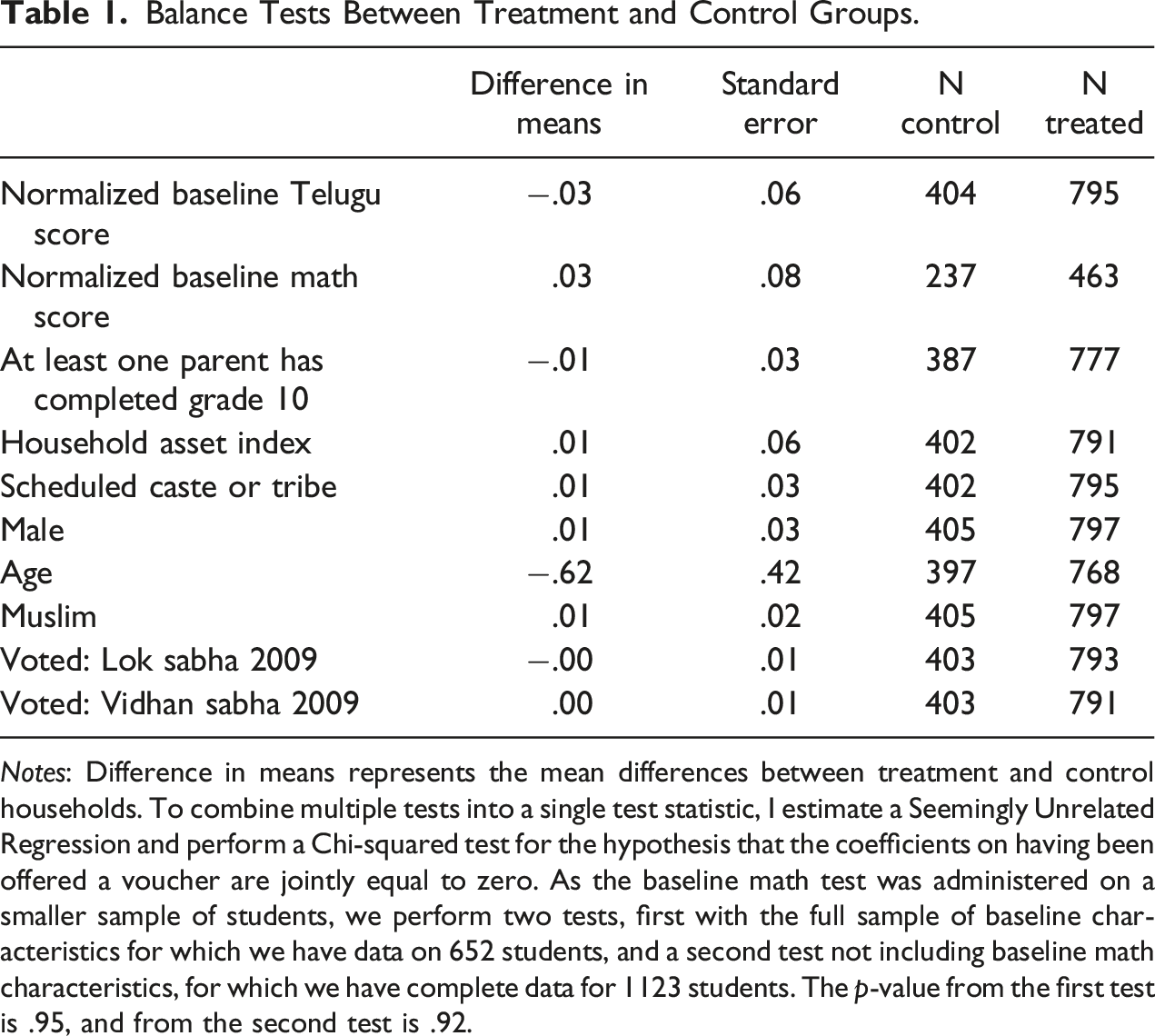
Notes: Difference in means represents the mean differences between treatment and control households. To combine multiple tests into a single test statistic, I estimate a Seemingly Unrelated Regression and perform a Chi-squared test for the hypothesis that the coefficients on having been offered a voucher are jointly equal to zero. As the baseline math test was administered on a smaller sample of students, we perform two tests, first with the full sample of baseline characteristics for which we have data on 652 students, and a second test not including baseline math characteristics, for which we have complete data for 1123 students. The p-value from the first test is .95, and from the second test is .92.
Summary Statistics.
There was also differential attrition between treatment and control groups in the downstream sample, with 7% more households reached in the treatment rather than control groups. 16
I rely on accepting the voucher offer as the estimator of choice, using a voucher offer as an instrument for accepting the voucher. This can be seen as one definition of the Treatment on the Treated (ToT) estimate. This is the estimator that most closely reflects the impact of having exposure to the private sector of which we are most interested. I estimate a two-stage least squares regression that uses the offer of a voucher to instrument for enrollment in a private school with district and surveyor fixed effects.
17
The estimating equation takes the form
Results
Political Behavior
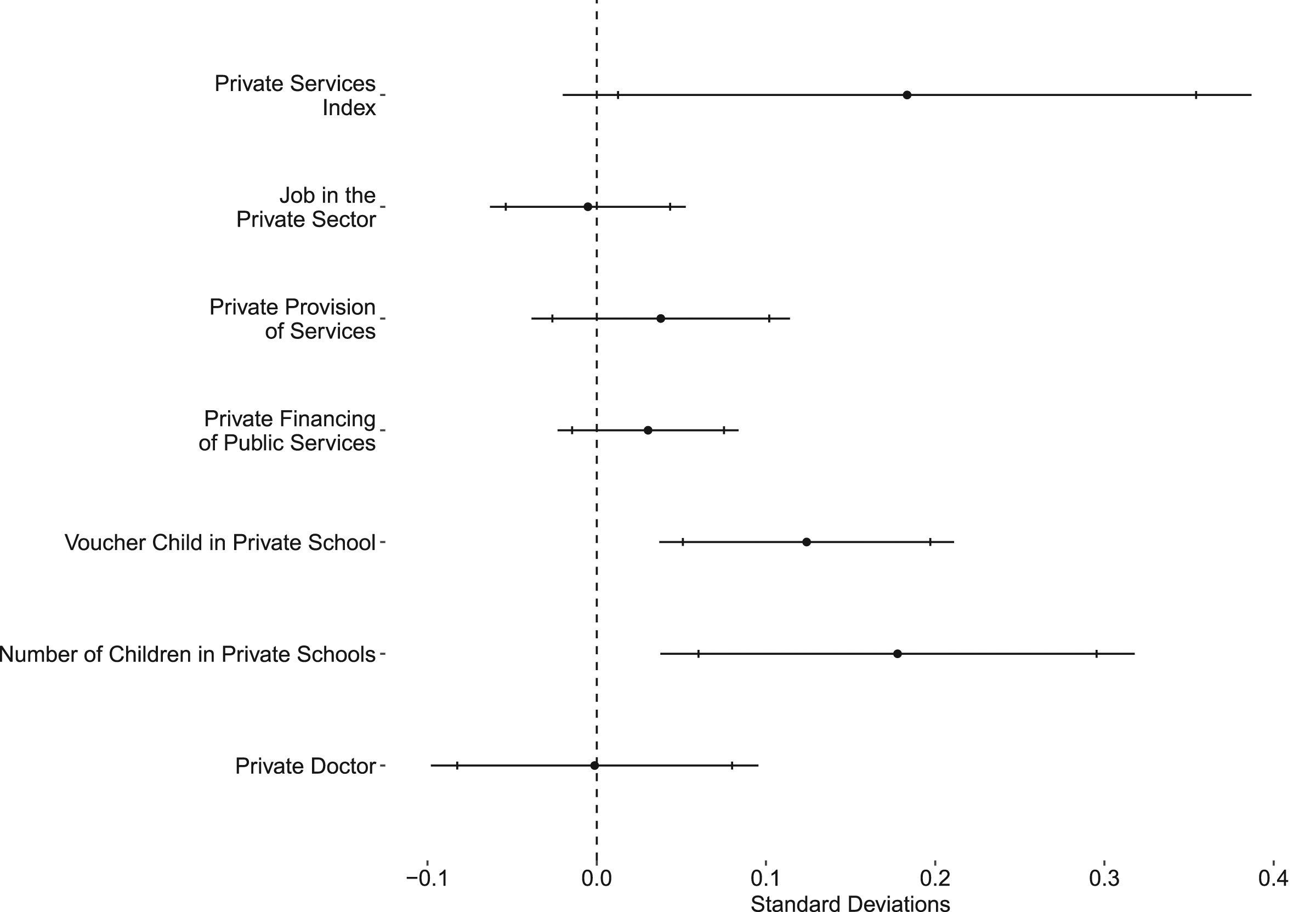
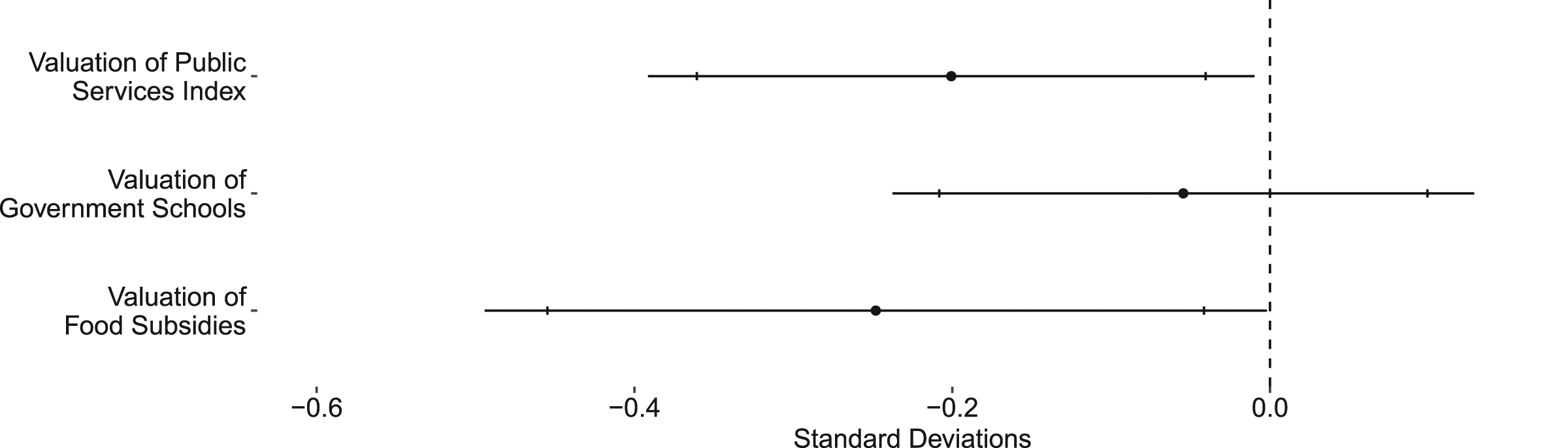
I present results in Figure 2 through 5. Figure 2 presents results for a series of partisan political activities. Although voucher winning households show higher levels of partisan political participation, the effects are both small and statistically insignificant except for the distribution of political leaflets that is positive at the 90% level. Rates of partisan political activity are generally low, ranging from about 3% of respondents that claim they are a member of a political party, to a high of 32% claiming that they attended a political meeting, and having access to private schools does not change this engagement substantially. Even though the survey was conducted during a highly politicized period, immediately following village elections and five to 8 months before highly salient state and national elections, rates of partisan political engagement remain low and similar between treatment and control. Voucher winning households are less than 10% of a SD more likely to engage in partisan political activities than non-voucher households, with this effect increasing with the costliness of the activity. These effects are also small substantively. Taking the case of reporting membership in a political party, receiving a private school voucher shifted the probability of reporting they were a member of a political party from 3% in the control group to 3.2 in the treatment group. Partisan political participation. Notes: Each plot presents results of a regression of the dependent variable on the left axis, on enrolling a child in a private school, instrumented by the original voucher offer. Solid lines represent 95% confidence intervals and tick marks represent 90% confidence intervals. Effect sizes are standardized to be comparable across specifications. All specifications include district fixed effects. Robust standard errors are clustered at the school at baseline. Tables B2 through B6 are the corresponding regression tables for these plots. Non-partisan political participation. Notes: Each plot presents results of a regression of the dependent variable on the left axis, on enrolling a child in a private school, instrumented by the original voucher offer. Solid lines represent 95% confidence intervals and tick marks represent 90% confidence intervals. Effect sizes are standardized to be comparable across specifications. All specifications include district fixed effects. Robust standard errors are clustered at the school at baseline. Tables B7 through B11 are the corresponding regression tables for these plots. Preference for private services. Notes: Each plot presents results of a regression of the dependent variable on the left axis, on enrolling a child in a private school, instrumented by the original voucher offer. Solid lines represent 95% confidence intervals and tick marks represent 90% confidence intervals. Effect sizes are standardized to be comparable across specifications. All specifications include district fixed effects. Robust standard errors are clustered at the school at baseline. Tables B12 through B18 are the corresponding regression tables for these plots. Valuation of government services. Notes: Each plot presents results of a regression of the dependent variable on the left axis, on enrolling a child in a private school, instrumented by the original voucher offer. Solid lines represent 95% confidence intervals and tick marks represent 90% confidence intervals. Effect sizes are standardized to be comparable across specifications. All specifications include district fixed effects. Robust standard errors are clustered at the school at baseline. Tables B19 through B20 are the corresponding regression tables for these plots.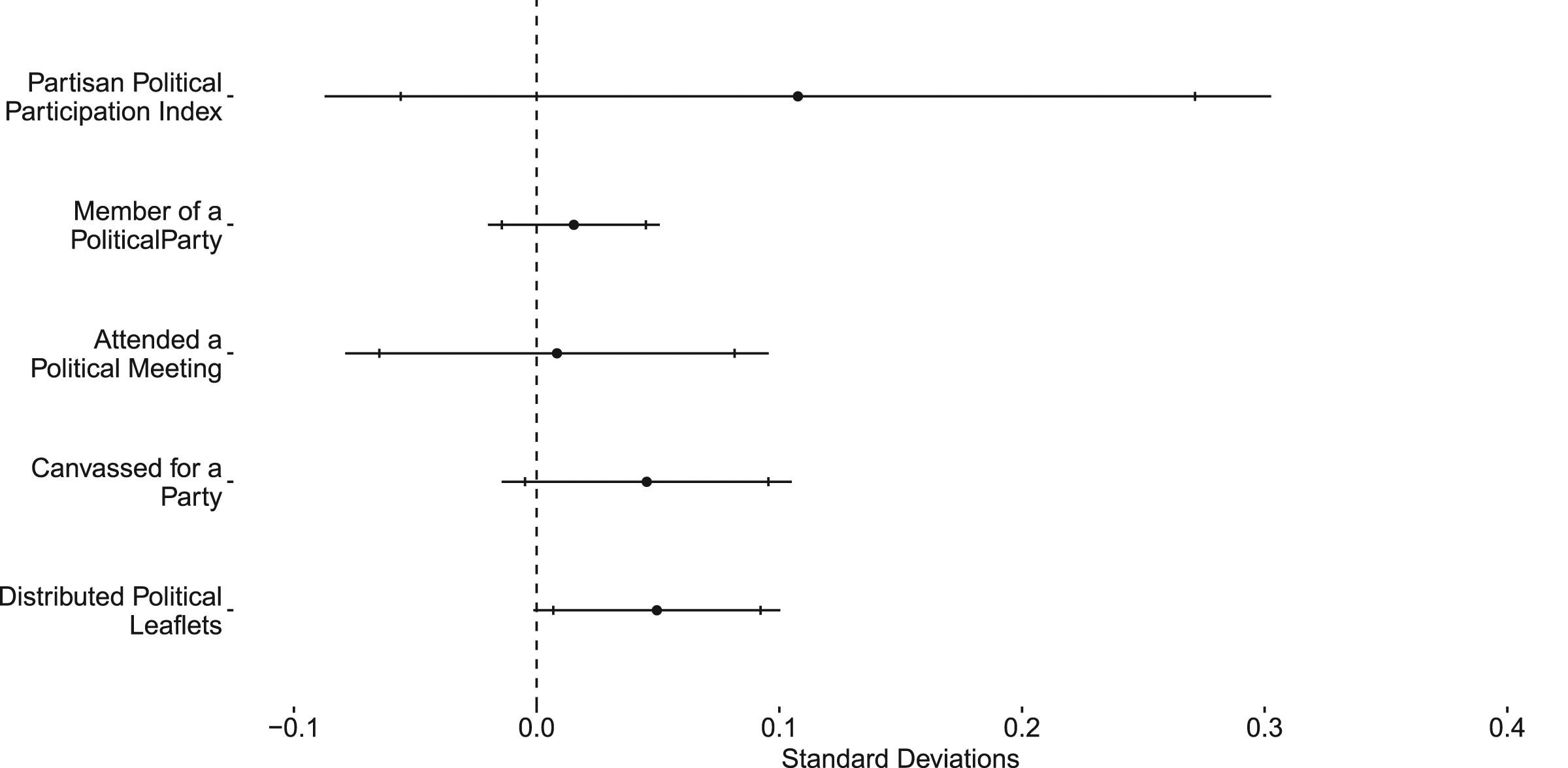
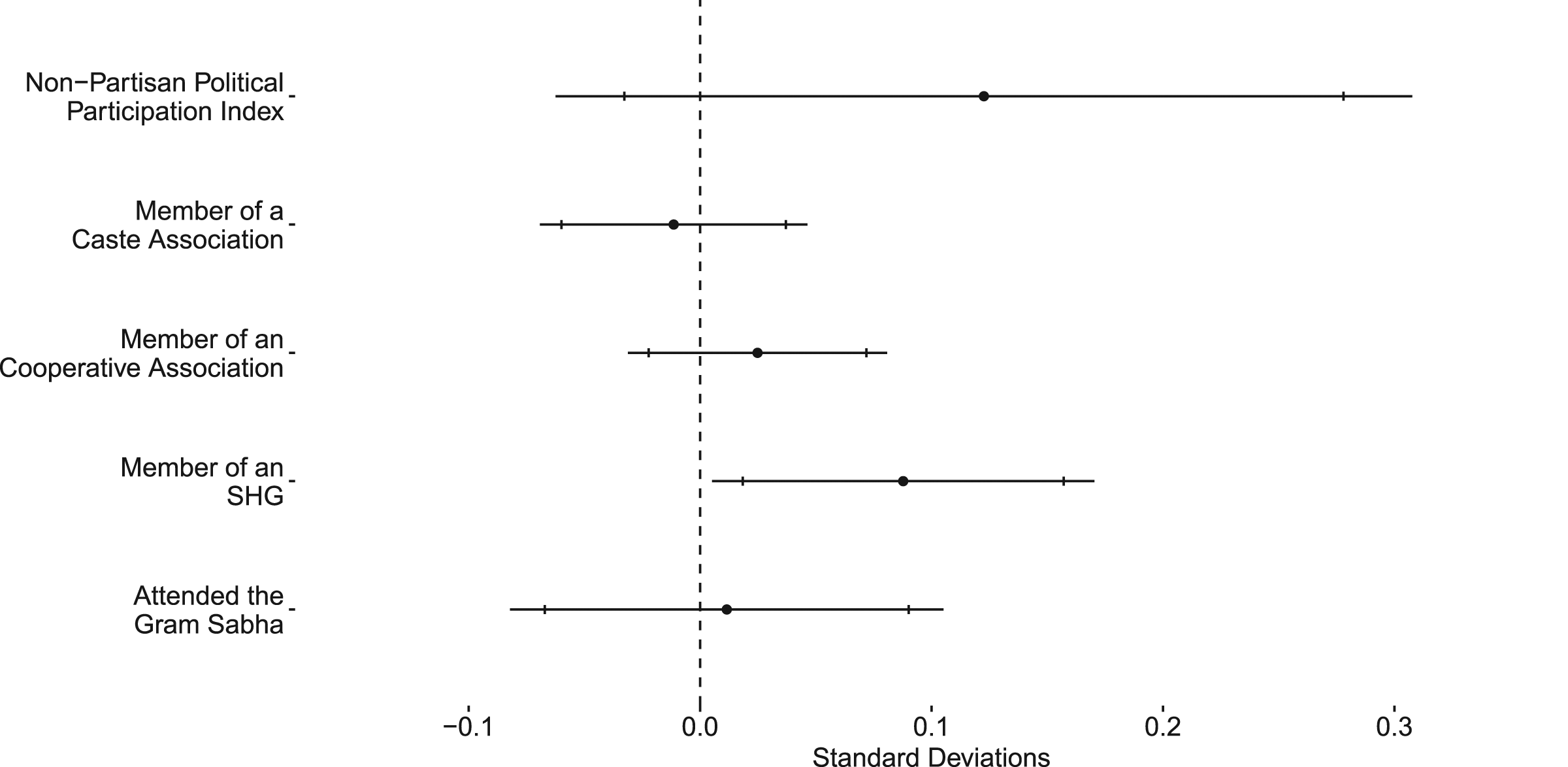
Turning to non-partisan forms of participation, Figure 3 shows that in an index of non-partisan forms of political and associational participation, as well as most of the individual components of the index, we see no differences between voucher winners and losers. Although political participation in India is consistently high, and higher among low-income households (Banerjee, 2011), there were few differences in political participation between treatment and control households. Receiving a private school voucher led to approximately 1% higher probability that a respondent was a member of a cooperative association. One result is of note: that of membership in self-help groups, largely women’s organizations designed to extend credit, share risk, and engage women in other activities in labor and private markets. Results on this measure are positive and significant, with a 5% higher probability that a household member was a member of an SHG in the treatment group. Work in other states of India have shown that these groups can mobilize women into politics by extending their social and political networks beyond the household (Prillaman, 2022).
Returning to my original hypothesis on political participation, I find little evidence that exit from public services decreases political participation. On almost all measures of political behavior, partisan political participation, and electoral participation, treated households show no difference in participation relative to control households. Households that exited to the private sector are just as likely to exercise their voice than households that remained in government schools. Indeed, for some measures of political participation, exiting the public sector might even increase political participation, an effect I return to later while discussing mechanisms and causal pathways. To preview that discussion, the effect on political participation might be on the networks households are exposed to, rather than partisan attitudes and behaviors. I now turn to economic preferences to understand if the content of political engagement does change, given that political participation was so high.
Economic Preferences
Returning to hypothesis 2, I argued that exposure to the private sector through private schools has increased voucher recipients’s comfort with the idea of the private sector. In the first part of the argument, I present evidence that access to private schools has resulted in a shift in market-oriented beliefs in an index and entire set of indicators in Figure 4 on preferences for private services. The index itself is positive, significant, and robust to different specifications. Having won a private school voucher increases both stated and revealed preferences for the private sector by between .1 and .25 standard deviations as shown in the first coefficient plotted in Figure 4. In other words, this suggests that having access to private school vouchers results in between a 4 to 10% increase in the number of respondents that say they would prefer the private sector providing services such as health and education. The second coefficient, which reports results on whether respondents would prefer a job in the private sector, presents the hardest test. Jobs with the Indian state often represent a salaried income, guaranteed employment, and solid pension, while jobs in the private sector are often precarious and ephemeral. In this test of preference for the private sector, there is no difference between treatment and control groups.
In the other components of the index, however, we see a much stronger relationship with receiving a private school voucher and preferences for private services. Questions on whether a respondent would prefer the private provision of services currently provided publicly, the private financing of services provided publicly, whether households continued to send their voucher child to private schools after the voucher had expired, the percentage of children in the household in private schools, and whether households would use private health services when household members are sick all show a positive relationship between receiving a private school voucher and preferences for private services. Aside from the hard test case of a job in the private sector, having access to private services results in both stronger stated and revealed preferences for private services.
To unpack another set of plausible preference changes, Figure 5 presents the results of the valuation of public services measures. Private school voucher winning households are more likely to express preferences for lower valuations of cash transfers and this result is both statistically significant and large in magnitude. Voucher winning households are willing to accept approximately ₹240 lower transfers for both school vouchers and food subsidies. For school vouchers, this represents a difference of about 6% from the control mean, 18 but for the food subsidy, this represents 25% of the accepted amount amongst control households. Most importantly, ₹200 is about 1% of a household’s monthly income, a significant difference in out of pocket expenditures for services they currently receive at a highly subsidized price from the government. Through access to private schools, voucher winning households are more likely to suggest that they would reduce the level of government subsidies on key public goods such as food subsidies and government private services and turn to the market for these services. This suggests a process of socialization and learning has occurred within voucher winning households, making them more comfortable with the idea of the private sector providing basic services.
Returning to Pierson’s differentiation between resource and interpretive effects, my finding that respondents developed stronger market-oriented beliefs suggest space for interpretive effects, but little evidence of resource effects. Within interpretive effects, I also find stronger results for private services that rural residents have less contact with: in the 2011–2012 round of the Indian Human Development Survey (IHDS-II), rural residents are most likely to use government schools, then the Public Distribution System (PDS), and finally private hospitals (89, 85, and 28% respectively). 19 The smaller shift in preferences for private hospitals relative to food and education is consistent with the larger theory that suggests these experiences need to be new to have an effect. In the next section I suggest that this effect is a result of changed experiences with service providers themselves, but not the larger political economy in which households were embedded. These differential experiences have little to do with the relative quality of private and government schools, but with the legibility of private providers.
Mechanisms: How do Preferences Change?
Here I present several pieces of evidence that are suggestive of why some preferences changed and others did not, as well as how preferences changed. Teachers – in addition to their role as classroom teachers – serve as census enumerators, poll booth monitors, and are responsible for organizing major public campaigns such as immunization drives, serving as the front-line functionaries of the Indian state in rural areas (Lipsky, 2010). Voucher winners did not reduce their contact with government school teachers in these core bureaucratic functions. There was also no difference in either objective or subjective quality: the children of vouchers winners did no better academically and voucher parents did not report better treatment by private schools. Instead, I argue that the primary mechanism driving changing in preferences over the relative importance of the private sector in the provision of services was that access to private schools increased voucher recipients’ confidence in the private sector as a permanent actor in their lives. Access to these formerly elite spaces made private schools, and by extension the private sector, more legible.
Evaluations of Front-Line Functionaries
The first mechanism I explore is the relationships households have with schoolteachers and principals. Earlier, I suggested that exit from government schools could break ties households have with teachers, and remove the discretion teachers have in the provision of public services. Teachers were present in the lives of households, irrespective of whether they were in the treatment or control groups. Table 2 shows that 67% of respondents across treatment and control reported experiences with government school teachers working as census enumerators, and 79% of respondents reported experience with government school teachers working as election monitors. This is also in a context where the last national census occurred 2 years before I fielded my survey and the last elections took place the month before I fielded the survey. Evidence from Bihar suggests that election monitors have influence on turnout and vote choice and have discretion in contexts where voters have low levels of education (Neggers, 2018).
To evaluate whether this relationship had changed as a result of having access to private schools, I repeat the analysis conducted in Figures 2–5 in Figure 6 for contact with the front-line functionaries of the Indian educational state. Despite exiting the state as a service provider, government teachers were still highly visible: voucher winners were just as likely to report an interaction with government school teachers as either a poll booth monitor or census enumerator, and recognize the teacher as both teacher and state representative. Non-teaching work of government school teachers. Notes: Each plot presents results of a regression of the dependent variable on the left axis, on enrolling a child in a private school, instrumented by the original voucher offer. Solid lines represent 95% confidence intervals and tick marks represent 90% confidence intervals. Effect sizes are standardized to be comparable across specifications. All specifications include district fixed effects. Robust standard errors are clustered at the school at baseline. Tables B22 to B23 are the corresponding regression tables for these plots.
Government school teachers in their non-teaching capacity were just as present in the lives of voucher winners, suggesting that exit from schools did not also lead to exit from these relationships. Individuals believed they derived direct material benefits from political participation. One respondent believed (incorrectly) that if they did not vote they would be struck off electoral rolls that were used to not only determine eligible voters, but also the beneficiaries of government programs. 20 Individuals vote because they expect to gain direct material benefits from being seen to have participated. In a context where actual and perceived political participation are important for receiving public and private benefits, households continued to participate politically, even after exiting one government service. Exploring these relationships more generally, households that send their children to private schools in the 2011–12 wave of the India Human Development Survey were 9% more likely to report knowing a government school teacher (Author’s own calculations using Desai & Vanneman, (2018)). Teachers and schools appear to play an important role in communities in addition to their roles inside of schools.
Comfort Rather Than Quality
Next, I turn to whether objective or subjective quality was different between students in government and private schools. If objective or subjective quality was higher in private schools, this could be driving the findings that voucher winners had a preference for private schools. With regards to objective quality, Muralidharan and Sundararaman (2015) find that voucher winning students performed no better after 2 or 4 years on tests of Telugu (the local language), or mathematics, and science and social studies after 4 years, although they had higher scores on tests of English after 2 and 4 years, and Hindi after 4 years. 21 However, private schools taught more subjects and spent less instructional time on these subjects, suggesting they were more efficient in achieving these scores. These results are replicated in part in a different context in India by Dixon et al. (2019) who find that a voucher program in Delhi also increased English test scores after 4 years.
I explore these results for the downstream sample in Online Appendix Section A.5 and find similar results to the larger student population. On objective but unobservable measures of quality, private schools did not achieve greater academic outcomes than government schools except on English scores, suggesting that more subjective experiences are driving differences in experience. For subjects such as Telugu and mathematics, students performed no better between treatment and control schools, and for English, students performed better.
Field observations across government and private schools suggest that the main difference in infrastructural quality between government and private schools was not that private schools had better infrastructure, but that the quality of infrastructure was more consistent between private schools. 22 While some government schools were clean and well kept, others were often in a state of disrepair. Private schools, however, were consistently of the same quality that was lower than the best government schools but better than the worst. Therefore, it was not necessarily true that private schools would be of better quality than government schools measured by infrastructure. 23
Although test scores and academic performance on tests were never cited as a reason for entering the voucher lottery, parents might still perceive quality using other markers such as how they or their children were treated in private schools. In Figure 7 I plot results of questions that ask respondents whether they thought government teachers cared about the well-being of their students and whether they also treated all students equally. I find no difference between voucher winning and losing households on how they believed teachers treated their children. These sets of results — that there were no differences in test scores, or objective quality, and treatment, or subjective quality — suggests it is not quality that is driving these results. Evaluation of school teachers. Notes: Each plot presents results of a regression of the dependent variable on the left axis, on enrolling a child in a private school, instrumented by the original voucher offer. Solid lines represent 95% confidence intervals and tick marks represent 90% confidence intervals. Effect sizes are standardized to be comparable across specifications. All specifications include district fixed effects. Robust standard errors are clustered at the school at baseline. Tables B24 through A14 are the corresponding regression tables for these plots.
A channel that was made abundantly clear during interviews was the idea of increased comfort with the private sector because of a perceived permanence and legibility of private schools. For voucher winners, the ability to send their children to private schools for 4 years, the access to private schools after the voucher period was over, and the continued interaction with private schools suggests that a strong mechanism through which respondents became more comfortable with the private sector was through the idea that private schools were a permanent economic actor.
One role of the vouchers was to make the functioning of the private sector more legible to voucher recipients. A voucher lottery loser, when asked if they would prefer to hold a government or private sector job, argued that government jobs were more stable because private companies were likely to leave if profits dried up. When asked about the value of private education, they expressed a similar fear that private schools were likely to abandon their village when they realized there were no profits to be made in low-income rural areas. 24 While a voucher winner also expressed a similar preference for government employment, they cited the benefits of government employment, not the uncertainty of private employment. 25 This suggests that comfort with private service providers and the permanence of a private actor in the lives of respondents has effects beyond merely the direct service provided, instilling confidence with the private sector as a permanent economic actor. Another voucher lottery loser who sent her three grandchildren to a local Islamic religious school, was concerned that private school fee structures were too complex for her to understand. On the other hand, the local Islamic religious school provided education to Muslim families for free so she did not have to worry about understanding or paying fees. 26
Vouchers also highlighted that private schools would now become permanent economic actors in the communities in which they opened. While government schools had a long history in the villages they operated, with some having been built prior to Indian independence in 1947, but most built around the time of independence, private schools on the whole were much newer, with few being more than 10 years old at the beginning of the voucher experiment. Private schools were perceived as ephemeral; one household believed that private schools would disappear when profits dried up as many had before. 27 A voucher recipient was surprised when she was able to keep her daughter in the private school for 4 years as the school managed to stay open for the entire period. 28 The responses from interview subjects was substantiated by the physical presence of school buildings. While government schools all had dedicated buildings and yards that were clearly demarcated and located in the center of most villages, private schools often operated out of houses and apartments that had been converted for the purpose of running a school, giving greater weight to the idea that they could pack up and leave at the first sign of trouble. While quality did not differ between treatment and control groups, experiences with private schools made them more legible to respondents, both through a better understanding of how they functioned as well as changed beliefs on their permanence as economic actors, allowing for a transfer of this belief to other private services and actors.
Discussion and Conclusion
Academic and policy debates around education in India since the early 2000s have focused on two closely related outcomes: increasing enrollment and retention (Banerji & Mukherjee, 2008) and improving test scores (ASER, 2017). The private sector has been seen as a solution to these twin problems as private provision is believed to help the understaffed and overstretched public sector and provide better quality education (Muralidharan & Sundararaman, 2015). India has recently introduced a nationwide program similar to the voucher program evaluated here (Government of India, 2009). Lost in this debate, however, are important questions on the appropriate role for states and markets in providing public services, and how these then come to affect the relationship between citizens and the state. The expansion of public schooling has been recognized as an important marker of increased state capacity (Mangla, 2015), while increased private provision is often seen as an indicator of low state-capacity.
Five years after households entered a private school voucher lottery, I find that households that had access to private schools after winning the lottery hold stronger market-oriented beliefs, particularly with regards to continuing engagement with private schools. I argue that private schools provided households with a qualitative different experience of the private sector. However, access to private schools had few effects on political participation as measured through partisan activities, voting, or associational membership suggesting that the role of exit is not to disengage households from the Indian state. The one notable exception is membership in self-help groups that can mobilize individuals into politics (Prillaman, 2022). Households report a greater preference for education services to be provided privately, with some spillovers to other services such as government food rations. This was expressed through revealed preferences by sending a greater number of children to private schools, even once the school voucher has expired, and report a greater willingness to receive cash transfers instead of in-kind transfers from the Indian government. The last set of results are particularly large, with households willing to forgo approximately 10% of their monthly income to receive a cash transfer instead of in-kind transfers from the government for education and food subsidies. Access to private services seems to create a class of citizens more comfortable with the idea of “shopping around” for education and other services (Jeffery & Jeffery, 2008) as respondents became more comfortable with private markets, similar to what Margalit and Shayo (2020) find with access to financial markets in the United Kingdom. These changes in economic preferences happen through a greater comfort with private schools. Semi-structured interviews revealed the idea of the permanence and legibility of private schools and the private sector. While control households revealed an uneasiness with the private sector as an ephemeral actor, voucher winning households had a greater comfort in the idea of private schools not closing or leaving their villages.
There are a couple of limitations that merit discussion. First, the population from which this study was drawn was self-selected. While the access to vouchers was randomized, the population that entered the initial voucher lottery was not. These are households that are, by revealed preference, more predisposed to using private services and potentially more likely to be able to take advantage of these services once granted access. If unobservable characteristics that made a more household more likely to enter a lottery for private school vouchers are also correlated with my dependent variables, this would likely make these effects stronger in this subsample relative to the general population. This would raise questions about the generalizability of the results for both policy and theory building. Additionally, only looking at education raises concerns that the effects found here might be a function of the particulars of the education sector and are not generalizable to other services. Indeed, the strongest results are precisely on continuing with education services. Interview evidence and results in Figure 5 suggest there are spillovers to comfort with the private sector at large, but we should be cautious in drawing too much from these results.
The policy itself is also unique. While the policy that this paper leverages was implemented by a well regarded NGO in partnership with academic economists, the larger policy has been implemented by the Government of India. This raises questions about how the effects I find here will translate to a policy implemented by a different entity, similar to questions about the expansion of policies from NGOs to governments (Banerjee et al., 2017). It is unclear whether this provides an upper or lower bound on more general effects. Non-compliance in the experiment was high, but no higher than non-compliance in other similar experiments, and the final rate of private school attendance in the control group of 24% is similar to the national average. The expansion of a similar policy to the entire country (Government of India, 2009), instead of five districts in one state would suggest that a greater number of households would be subject to similar experiences. These results provide credible interpretation of how the program could change political and economic preferences above and beyond their effects on student academic outcomes and should be considered when thinking about how to evaluate this larger role out.
Finally, as I was not involved in the original design and execution of the voucher experiment, I was unable to collect baseline data for the outcomes of interest in this study. This illustrates both the benefits and limitations of “downstream” experiments (Baldwin & Bhavnani, 2011). While I am able to provide clean causal identification of an important research and policy question at reduced cost to the researcher, the “downstream” researcher does not have full control of the data collection and implementation of the experiment. Nonetheless, I believe the benefits outweigh the costs in many cases and are a valuable avenue to pursue for researchers. With the increasing proliferation of randomized control trials in economics and other disciplines, political scientists should engage with the potential effects these supposedly non-political interventions have on mass politics (Humphreys & Scacco, 2020). This paper provides one such way to do so.
There are important lessons for countries after market-oriented reforms. Welfare arrangements that include a large number of non-state providers are becoming the norm in both the OECD (Gingrich, 2011), and the developing world (Cammett & MacLean, 2011; Thachil, 2009). In education specifically, Chile has a long history of using private school vouchers to encourage poor families to attend private schools (Hsieh & Urquiola, 2006). In Kenya, private schools attract the poor with better educational outcomes (Bold et al., 2015; Duflo et al., 2015). The growing number of schools run by religious organizations in countries such as diverse as India, Mali, and Pakistan can also be seen as a similar manifestation of state exit (Andrabi et al., 2006; Bleck, 2015; Thachil, 2011). If this form of service provision becomes increasingly prominent, it is important for political scientists to understand their effects on a broader range of outcomes. As a result, these results are also of interest to policy makers. This paper provides some ways to understand the value individuals place on private and public services, borrowing measures of “willingness to pay” for services from economics (Cohen & Dupas, 2010). More generally, it suggests we should explore both material and interpretive effects seriously. While the measures in this paper were context dependent and relied on the interplay between qualitative fieldwork to design close-ended quantitative survey questions relevant to the questions of interest (Thachil, 2017), we should look to better understand the effects of long-term processes on how individuals view their social world independent of material politics.
My results suggest we should take the non-material effects of new experiences more seriously when theorizing about political socialization and behavior. As China and India continue to integrate into the global economy, and households, particularly rural households, that had little experience with the market are given access to an institutionalized market, their expectations of these actors begins to change and have important implications for political attitudes and behaviors. Beyond private school vouchers, new and sustained experiences with these economic institutions will likely have experiences independent of any material effects they have in increasing or reducing material welfare. In a context such as rural India, where the economic lives of many households are precarious (Gupta, 2012; Krishna, 2010), these new, stable, experiences have the potential to shape attitudes in politically consequential ways. Institutional change, such as market-oriented reforms, create their own downstream behavioral and attitudinal effects. Here I find those effects to be greater comfort with markets in education specifically, and markets in service provision more generally. While actual political behavior might be unchanged, citizens opinions are changing by private service provision. Policy makers might find it difficult to roll back any reforms towards privatization enacted today as long as these reforms continue to build a mass public more comfortable with the idea of the private sector providing a large number of services. This is particularly important for India where the program evaluated here was designed to mimic actual government policy.
The mechanisms I propose suggest that one way that institutional learning occurs is through experiences with services (Pierson, 2000), even if those experiences are sometimes not positive. Here learning occurs through new experiences. This integrates two literature in political science that have been kept relatively separate: historical institutional and experimental methods (Steinmo, 2015). Although the intervention and experiment explored here are relatively short term, if the results hold over a longer period of time or even grow more pronounced, this would help explain how institutional change becomes habituated at an individual level.
This paper also improves on many existing studies of policy feedback as it is based on a randomly introduced policy experiment thereby providing clean causal estimates of the effect of the private sector. Reviews of policy feedback have often noted that a common problem plaguing studies of policy feedback have been their inability to make strong causal inferences as they were based on observational data or data at high levels of aggregation (Campbell, 2012). This study addresses both of the shortcomings of that literature. Here, I suggest that resource effects are perhaps overstated and potentially a result of selection, rather than policy feedback. I do find strong interpretive effects, suggesting a promising avenue for researchers to explore in greater depth, and propose a new mechanism for them: new experiences change individual’s orientations to their social world. I extend the policy feedback literature to the developing world and also to the idea of the private sector as a politically relevant actor. Given the rising prominence of non-state actors in service provision (Cammett & MacLean, 2011), it is important for political scientists to take non-state actors and the private sector seriously. My findings suggest that the private sector can have strong effects on the political attitudes of individuals.
Supplemental Material
Supplemental Material - The Lessons Private Schools Teach: Using a Field Experiment to Understand the Effects of Private Services on Political Behavior
Supplemental Material for The Lessons Private Schools Teach: Using a Field Experiment to Understand the Effects of Private Services on Political Behavior by Emmerich Davies in Comparative Political Studies
Footnotes
Acknowledgements
I would like to thank Alexandra Cirone, Aniruddha Jairam, Ashutosh Varshney, Bryce Millett Steinberg, Devesh Kapur, Guy Grossman, Milan Vaishnav, Nina Brooks, Tulia Falleti, Ujju Aggarwal, workshop participants at the University of Pennsylvania, New York University, University of Wisconsin-Madison, Harvard University, the Brown-Harvard-M.I.T. Joint Seminar on South Asian Politics and the 2014 American Political Science Annual Meeting, as well as three anonymous reviewers and the editors at Comparative Political Studies for insightful comments that have helped improved the paper immeasurably. I am forever indebted to M. Rajani and the field coordinators from the Azim Premji Foundation for help implementing and conducting the survey. This project could never have happened without the support and input of Karthik Muralidharan. I also thank the survey respondents for their infinite patience. Replication materials and code can be found at the Comparative Political Studies dataverse or the author’s personal github (Davies, 2022).
Declaration of Conflicting Interests
The author(s) declared no potential conflicts of interest with respect to the research, authorship, and/or publication of this article.
Funding
The author(s) disclosed receipt of the following financial support for the research, authorship, and/or publication of this article: Financial support for research and writing was provided by the University of Pennsylvania’s Penfield Dissertation Research Fellowship, the Browne Center’s Dissertation Research Grant, the American Institute for Indian Studies Junior Fellowship, and the National Academy for Education/Spencer Dissertation Fellowship.
Ethical Approval
The survey and interviews described in this paper were approved by the University of Pennsylvania’s Institutional Review Board, Protocol #818751.

Supplemental Material
Supplemental material for this article is available online.
Notes
Author Biography
References
Supplementary Material
Please find the following supplemental material available below.
For Open Access articles published under a Creative Commons License, all supplemental material carries the same license as the article it is associated with.
For non-Open Access articles published, all supplemental material carries a non-exclusive license, and permission requests for re-use of supplemental material or any part of supplemental material shall be sent directly to the copyright owner as specified in the copyright notice associated with the article.
