







Abstract
We investigate how dominant media networks can manipulate voters in young democracies. During the first presidential election after the democratic transition in Brazil, TV Globo, the largest and most-watched network in the country, unexpectedly manipulated the news coverage of the last debate 2 days before the decisive second round. In a video segment, Globo unfavorably depicted the left-wing candidate, Luiz Inácio Lula da Silva. Using the geographical distribution of broadcaster-specific TV signals and the timing of election events, we identify the effect of the manipulation net of the effect of the debate itself, showing that Globo’s misleading reporting caused Lula to lose millions of votes. Our results showcase how the media can reshape an election in a single stroke, especially where the media is concentrated and politically inexperienced voters have few other sources of information.
Introduction
Mass media plays a key role in democracies by gathering and transmitting political information to voters. When the media reports accurately, it improves political accountability and, eventually, policy and welfare (Strömberg, 2015). However, some media outlets can benefit from the victory of a particular party or candidate, encouraging them to present slanted news to their audience, and the dissemination of biased information, according to several studies, can effectively change voters’ political attitudes, 1 making voters choose a candidate they would not choose if they had received accurate information.
The size of the damage caused by the manipulation of news, however, depends on many factors. The reach and ramifications of untruthful news are proportional to its audience, which is substantively small in many of the documented cases (Prat, 2018). Media effects in the literature are primarily cases of openly partisan media outlets, whose ideological preferences are the same as those of their core audiences. In these contexts, independent voters and those on the opposite side of the ideological spectrum may not be exposed to the slanted content simply because they refuse to read or watch the partisan network (Zaller, 1992). In fact, most people do not consume news from partisan outlets (Guess, 2021). Even if they do, it is unlikely that they would be persuaded to switch their votes through the messaging alone (Kalla & Broockman, 2018; Le Pennec & Pons, 2019), especially if they have prior partisan preferences (Huber & Arceneaux, 2007). Moreover, voters often have other information that helps them decide and discount biased information, including the reputation record of parties and politicians, or news provided by other networks (Gerber & Green, 1999). Unsurprisingly, captured events of media effects are instances of continued exposure to biased content—long-term efforts to change political preferences. When all these conditions are factored in, most of the media effects in the literature may have had a modest impact on the electoral outcome, and single news events are unlikely to persuade voters.
This paper takes one notable case in a context where a single event of manipulation changed the votes of millions. In Brazil, 2 days before the first presidential election after 29 years of dictatorship, the Rede Globo TV network aired in its main newscast a video highlight of the last presidential debate that had taken place the day before. Globo’s directors purposefully distorted the events in the debate to picture the left-wing candidate, Luiz Inácio Lula da Silva, in an unflattering light. 2 Despite coming from second place in the first round of the elections, Lula had closed the distance to his opponent Fernando Collor, with opinion polls taken days preceding the debate placing the two candidates together within the margin of error. However, Lula ended up losing the election. Answering if Globo’s manipulation blocked Lula’s ascent and helped Collor win the election is the main empirical test of this article.
We know little about media effects in consolidating democracies. In these countries, the media market is often concentrated, and voters are largely non-partisan—conditions that should exacerbate media effects. In consolidated democracies, voters are familiar with campaigns and elections, have been following politicians’ accomplishments and limitations over time, and are knowledgeable about parties’ ideological positions. They often take sides, too, making them activists or strongly attached to a party. Their firm priors about candidates (and media biases), and clear policy preferences blunt the effect of political messaging (Greene, 2011). In many other countries, however, and especially during what O’Donnell and Schmitter call founding elections, voters cannot assess candidates’ track records, and party platforms are not informative (O’Donnell & Schmitter, 2013). They need to decide their votes using signals they receive during the campaign. Lacking reliable information from politicians themselves, the media, thus, becomes a pivotal source of information to voters (Lawson, 2002; Lawson & McCann, 2005). This central role of the media makes them powerful in terms of influencing voters (Gerber & Green, 1999; Prat, 2018). Since democratization often takes place when the media market is concentrated (Hughes & Lawson, 2005, 15), few or a single network will be able to reach and influence many voters. Such was the case in Brazil, where Globo seized this most-likely scenario to influence an election. It did so by offering its wide audience a distorted coverage of the debate, the paragon event of truthful electoral information.
The main empirical challenge in this paper is to identify the effect of Globo’s manipulated video on voters’ ballot choices net of the direct effect of the actual debate. Viewers who watch the news likely follow debates, too, and the performance of each candidate during the debate may play a role in voting behavior in and of itself (Lawson et al., 2010). Our empirical strategy exploits the fact that all major national broadcasters aired the debate at the time, not only Globo. Using precise municipality-level broadcaster-specific coverage data, we use a differences-in-differences design to compare municipalities that received Globo’s signal, where viewers could watch both the debate and its edited coverage, against those that had access to other channels but not Globo and could only watch the debate. 3 The key identification assumption is that the geographical distribution of Globo antennas, though not random, was uncorrelated with differences in voting trends between electoral rounds across municipalities.
Across different model specifications, estimates show that Globo’s slanted coverage of the debate markedly decreased Lula’s vote share and increased Collor’s. The results are robust to a number of falsification and sensitivity checks. They present a persuasion rate of 15.93%, which is relatively high but within the range of treatment effects of media exposure on vote share observed in the literature (DellaVigna & Gentzkow, 2010). 4 However, since Globo reached almost 90% of all municipalities in a universe of almost 70 million voters, it reached a striking number of voters. As we discuss in the penultimate section, under plausible assumptions the manipulation might have changed the electoral outcome.
We complement our analysis by focusing on municipalities for which we have opinion poll data regarding second-round voting intentions. The procedure allows us to estimate opinion changes in a 4-day interval instead of the 32 days separating electoral rounds. By using a smaller time window than the one used with ballot data, our estimated effect increases in magnitude. Although the results should be interpreted with caution, given that the control group is underpowered, we find that respondents in areas receiving Globo’s signal were 8.6% points less likely to report Lula as their preferred candidate.
We present two pieces of evidence that support the idea that manipulation persuades voters to change their preferences. First, we ran an online experiment that randomly assigned video clips from the actual debate or Globo’s edited highlights to Amazon’s MTurk participants. Results show that the manipulation affects the perception of individuals toward candidates. Second, using our survey data, we show that our estimates are mediated by the distorted perception of the debate performance of each candidate associated with Globo’s manipulation. We also discuss the likelihood of alternative explanations for our results and close by arguing that Globo’s manipulation did indeed change the electoral outcome of Brazil’s founding election.
Substantively, our analysis directly demonstrates how the concentration of media ownership can affect the quality of democracy. In Brazil, Globo’s process of market dominance started in the authoritarian regime and continued during the writing of the new democratic constitution (Motter, 2019). Outside Brazil, there are other documented cases of media concentration affecting democratic transitions, too (Enikolopov et al., 2011; Lawson & McCann, 2005). Many authoritarian legacies permeate democratic regimes (Albertus & Gay, 2017; Albertus & Menaldo, 2018; Loxton & Mainwaring, 2018; Riedl, 2014; Simpser et al., 2018), and the process of market concentration led by an outgoing dictatorship is one overlooked continuity that may limit popular representation in democratic regimes.
Our paper is related to several strands of the media literature. First, we communicate with the literature studying how media affect electoral choices. Mainly in the context of stable democracies, it has been documented that continuous exposure to biased media impacts voting (Barone et al., 2015; DellaVigna & Kaplan, 2007; Durante & Knight, 2012; Durante et al., 2019; Enikolopov et al., 2011; Martin & Yurukoglu, 2017). In this regard, our results might not be too surprising to students of media and politics. However, we contribute to this body of work along two dimensions. First, we show that a media organization with high media power can affect the vote shares of a presidential election by surprisingly increasing the slant of the coverage of a single piece of news: a presidential debate. Second, we document that media bias influences voting in the context of a young democracy, where reliable data is hard to find.
We also connect with the scholarship studying how advertisements affect political choices. This literature shows contrasting results, with some influential studies documenting economically meaningful effects of campaign advertisement on voting intentions (e.g., Gerber et al., 2011; Huber & Arceneaux, 2007), but the most encompassing experimental evidence suggests modest or null effects (Coppock et al., 2020; Kalla & Broockman, 2018). When looking at the evidence about the impact of television advertising on actual voting outcomes, the most credible and economically meaningful estimates imply modest persuasion rates (Spenkuch & Toniatti, 2018), contrasting with the extensive evidence demonstrating the high persuasive power of biased media (see DellaVigna & Gentzkow, 2010). We contribute to this discussion by showing that exposing voters to 6 minutes of edited debate highlights can be persuasive, suggesting that media organizations’ relatively high persuasive power depends more on their capacity to surprise voters than on their ability to expose them to slanted news continuously. Within the same literature, we dialogue with studies investigating the electoral consequences of media endorsements (Chiang & Knight, 2011; Ladd & Lenz, 2009), which have found that surprising newspaper endorsements are persuasive messages. Our findings confirm that the persuasion power of a short piece of information like a newspaper endorsement or the coverage of a single campaign event is high when it is unexpected.
Finally, we contribute to the literature investigating the role of political debates. In the context of African politics, where mass media is incipient, recent works have randomized political debate participation and showed that debates provide useful information about candidates’ quality and policy positions, improving accountability (Bidwell et al., 2020; Bowles & Larreguy, 2019; Brierley et al., 2020; Fujiwara & Wantchekon, 2013). In well-established democracies with developed mass media, cross-country evidence finds limited effects (Le Pennec & Pons, 2019) while experimental evidence (Fridkin et al., 2007; Gross et al., 2019) indicates significant short-run effects on the perceived candidates’ performance. Our contribution lies in determining the interrelated role of political debates and their media coverage in affecting electoral outcomes in a non-experimental setup. Together, our set of results bridges the debate and the media bias studies by showing how dominant media groups can distort the information generated by presidential debates through their subsequent news coverage, overturning the role of debates in informing voters and improving selection and accountability.
Institutional Background
Voters in young democracies struggle to identify who is their preferred candidate. To them, candidates’ party brands are seldom informative of policy intent. In fact, strong political parties in the developing world are a rarity (Levitsky et al., 2016; Mainwaring et al., 2018). Voters’ sophistication will be a barrier to choosing candidates, too. Illiteracy undermines proper representation (Fujiwara, 2015), and many voters in the countries that transitioned to democracies during the last decades of the 20th century are unable to read the news or even the options on their ballot. Also, without prior electoral experience, voters might not know how to vote strategically, missing the opportunity to undermine their less preferred candidate’s chances of winning (Tavits & Annus, 2006). Voters could potentially resort to other signals, such as the country’s economy (Duch & Stevenson, 2008). However, unless the extension of the franchise occurs when the country is prospering, which rarely occurs (Campello & Zucco, 2020; Haggard & Kaufman, 1997), and the outgoing authoritarian government fronts a viable candidate, retrospective voting will not be too useful. The incumbent party will not necessarily be running for the election, or if it is, it might not be competitive. 5
The first presidential election in Brazil after democratization presented all of these complicating attributes to voters. The Brazilian party system was unable to discipline political interests, and 22 parties fronted presidential candidates, many of whom were virtually unknown to the national electorate. Most parties lacked a programmatic identity from which voters could extract policy intentions or infer candidates’ types. Indeed, almost half of the voters had no particular preference for any party, and most had no party affiliation. 6 In addition, voters were inexperienced. It was the first opportunity for many who reached the legal age to vote during the military dictatorship, as well as 20 million illiterate citizens enfranchised by the 1988 Constitution.
In a context of democratic inexperience, uninformative party labels, illiterate voters, and limited partisanship, the media, and in special television, becomes a crucial source of information (Boas, 2005, 2013; Voltmer, 2013). Around 72% of Brazilian households had television sets in 1989, and 94% of the population regularly watched television (Boas, 2005; Porto, 2003). Over 86% of the population considered television their most important source of political information. The country also had one of the lowest rates of newspaper penetration in the world: 42 newspaper copies per 1000 inhabitants (Boas, 2005; Porto, 2003).
At the time, Globo unambiguously dominated the Brazilian media market and was positioned to influence elections. According to Kennedy and Prat (2019), media power is the “ability to induce voters to make electoral decisions they would not make if reporting were unbiased.” Globo’s signal reached 92% of all Brazilian municipalities, and the network was the sole TV broadcaster in nearly one-fourth of the country. Its national audience was consistently above 59% of all turned-on TVs, reaching up to 84% during prime time programming (Boas, 2005). Globo’s market power is second only to Mexico’s Televisa (Hughes & Lawson, 2005, 13–14). As a testament to its power, Globo’s large viewership enabled its entertainment content to influence the Brazilian social landscape, including women’s fertility (La Ferrara et al., 2012), divorce decisions (Chong & La Ferrara, 2009), and political preferences (Chong et al., 2019). With its flagship (and national audience leader) newscast—Jornal Nacional—the network also had the potential to directly influence elections through its news content.
Globo’s dominance is intertwined with the regulatory favors the network received during the military dictatorship (Herz (1987), Kucinski (2002, 44)). 7 From 1962 until 1988, the president alone could grant broadcasting licenses (Galperin, 2000), and during this period military presidents heavily favored Globo. During the transition to democracy, Globo promptly exercised the power it gained during the dictatorship, barring unfavorable regulation during the assembly that ratified Brazil’s new democratic constitution in 1988 (Hughes and Lawson (2005, 14), Porto (2003, 292-3)). The new Constitution stipulated that the morose Brazil’s Legislative would grant media licenses, which in effect cemented Globo’s dominance (Motter, 2019). The two strongest left-wing candidates in 1989 recognized Globo’s threat in influencing the media market and politics. Leonel Brizola of the Democratic Labour Party (PDT) and Lula of the Workers’ Party (PT) repeatedly promised to regulate the media sector during the campaign, often making direct attacks on Globo. 8 Hence, in the 1989 election it was clear that Globo’s interests were at stake.
The 1989 Elections and the Presidential Debate
Despite having many candidates, the 1989 elections presented a left-right divide. Collor, an outsider running with the recently created National Reconstruction Party and whose campaign attacked the incumbent’s inability to rein in inflation and overall public mismanagement, represented the center-right portion of the political spectrum. The left was divided between Lula and Brizola, but it was Lula who eventually battled Collor in the runoff election.
Debates became a primary source of information and a national event. 9 Collor and Lula debated twice during the runoff campaign. The first was held on December 3rd and the second on December 14th, when the opinion polls were indicating a technical tie and an increasing trend for Lula. After the last event, opinion polls and commentators declared Collor’s performance superior. 10 On December 15th, Globo aired a news segment from the final debate in its main newscast Jornal Nacional. The runoff took place on December 17th, just 2 days after the edited coverage aired by Globo, and Collor was elected president with 53% of valid votes versus 47% for Lula.
Opinion polls picture how support for the two candidates evolved during the second round campaign period, suggesting that the trajectory was reversed in the last few days. The dotted lines in Figure 1 represent the timing of the debate and Globo’s coverage, registering a positive variation for Lula and a negative variation for Collor.
11
While the last variations are within margins of error, they also characterize a break in the previous trend. Whether this break is the result of the debate itself or Globo’s distorted portrayal of candidates’ performance in the last debate. Voting intention trends during the second round.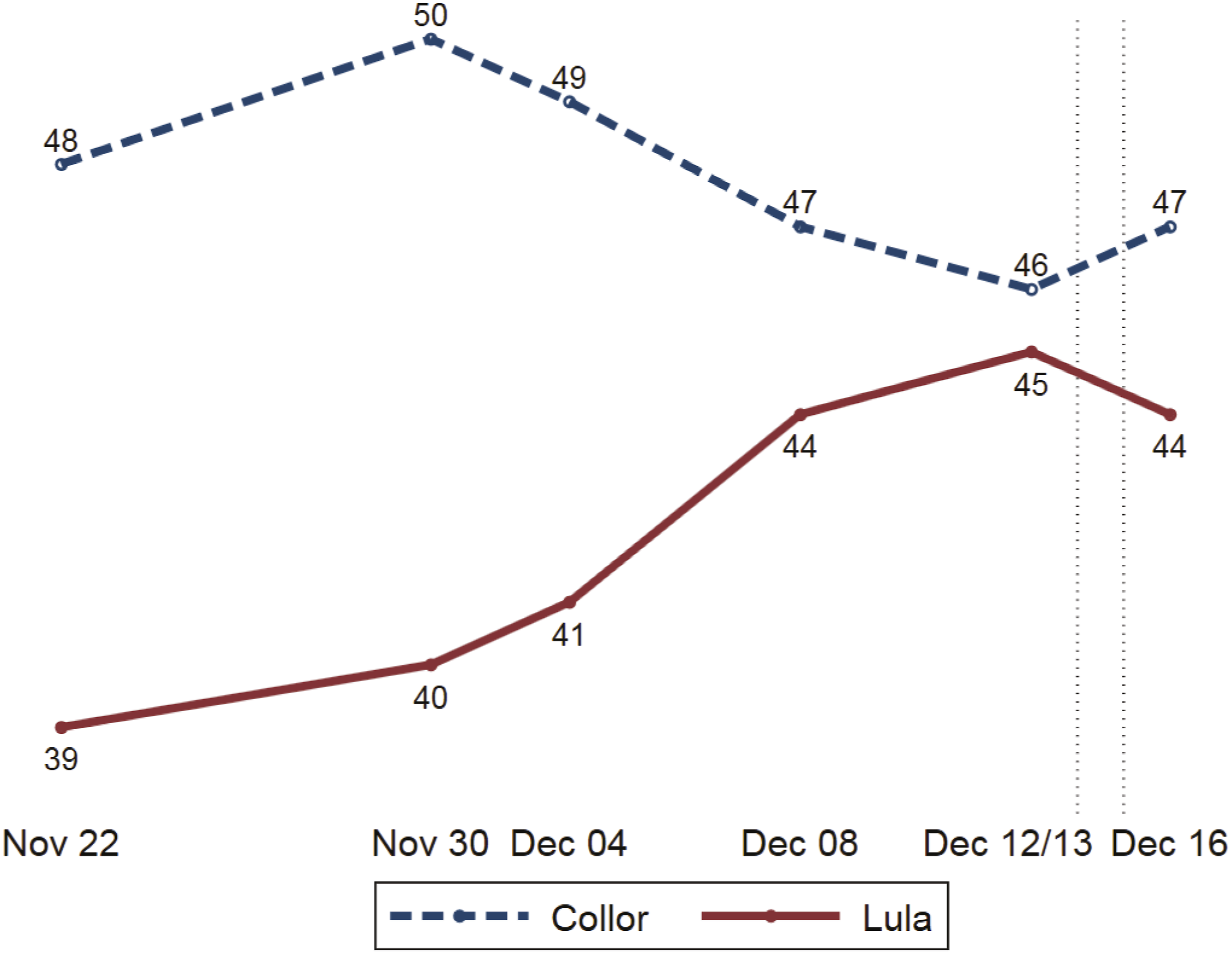
Globo’s Coverage of the Debate
Globo’s coverage of the last presidential debate ignited immediate controversy (Lins da Silva, 1993). According to observers at the time and news reports from other media, it was clear that the editors of Jornal Nacional had favored Collor. Some of Globo’s soap opera stars protested at the TV station’s headquarters the next day, and the PT petitioned the Electoral Court for additional air time in Globo’s programming. 12
Globo’s heavy-handed rendition of the debate is evident when watching the footage. While the debate’s format provided identical air time for both candidates, Globo’s highlights show Collor for 72 seconds longer. The content is intentionally unfavorable to Lula, according to oral history and Globo’s admission (Conti, 1999), and from viewing the excerpt today. 13 It accentuates Lula’s gaffes, insinuates that he tolerates corruption and that he considers some Northeastern Brazilians racially inferior. It shows Lula stammering and confused, while Collor appears confident and on the offensive.
We present experimental evidence that supports the conjecture that Globo’s edited highlights gave Collor an edge over Lula in Appendix A. We randomly assigned video clips from the actual debate or Globo’s coverage to MTurk participants. Results show that participants assigned to watch the highlights are more likely to vote for Lula and that he won the debate. Although we cannot interpret the experimental outcomes directly comparable to the actual debate due to the different historical contexts, the magnitude of the experiment effects indicates that the Jornal Nacional video favored Collor. In the following sections, we present a comprehensive empirical test of the effects of Globo’s debate coverage.
Municipality-Level Analysis of Globo’s Influence
In this section, we present our main approach to measuring how the exposure to Globo’s broadcast between the 1 st and 2 nd rounds affects electoral outcomes at the municipality level. We begin by defining our sample and outlining some descriptive statistics. Next, we describe the empirical strategy, present our main estimates, and discuss a series of robustness checks and heterogeneity analyses. For detailed information on data sources, we refer the reader to Appendix B.
Our sample includes all 4052 Brazilian municipalities that received TV signals from at least one broadcaster in 1989 (97% of the total). This approach uses actual election ballot data and takes full advantage of the rich cross-sectional variation across municipalities, allowing us to perform robustness checks and heterogeneity analyses that support the identification strategy.
We want to explore changes in candidates’ vote shares between rounds. However, individual candidates’ vote shares are not directly comparable across election rounds, as there are more than 20 candidates in the first round and only 2 in the runoff stage. 14 Voters who pick a candidate that fails to enter the runoffs will have to choose differently, but possibly the candidate ideologically closest to their first-round choice (Hinich and Munger, 1997). A potential challenge to identification arises as these vote transfers correlate with the location of Globo antennas. 15 It is key that we take into account the patterns of how votes transfer from one candidate to another across rounds (Da Silveira & De Mello, 2011).
To help account for this issue, we explore two different variations of our dependent variable as follows. One way to compare voting across rounds is by aggregating parties using a left–right scale as classified by Power and Zucco (2012). Another alternative is to use the top two candidates’ vote shares and condition the analysis on 1 st round voting on the remaining contenders. These procedures give us two operationalizations of the dependent variable, one in which we take the individual vote shares of the two main candidates and another using aggregate vote share for left-of-center and right-of-center parties.
We define the treatment group as the municipalities that received signals from Globo during the 1989 election and, therefore, could watch the last presidential debate and Globo’s manipulated coverage. To estimate heterogeneous effects, we split our treatment group between municipalities that received signals exclusively from Globo, where our treatment has a higher “dosage,” and those that received signals from Globo and at least one other major TV broadcaster. We expect effects to be larger in municipalities with Globo only. The control group is composed of municipalities that received signals (and the debate broadcast) from other national broadcasters only and, therefore, could have watched the debate but not Globo’s manipulated coverage. Figure B1 in Appendix B describes in detail how we define our treatment and control groups and the frequency of observations within each group. Of the 4052 municipalities in our sample, the treatment group includes 3922 and the control group, 130. Of the 3922 municipalities in the treatment group, 1054 (27%) only received Globo’s signal.
Summary Statistics: National Sample.
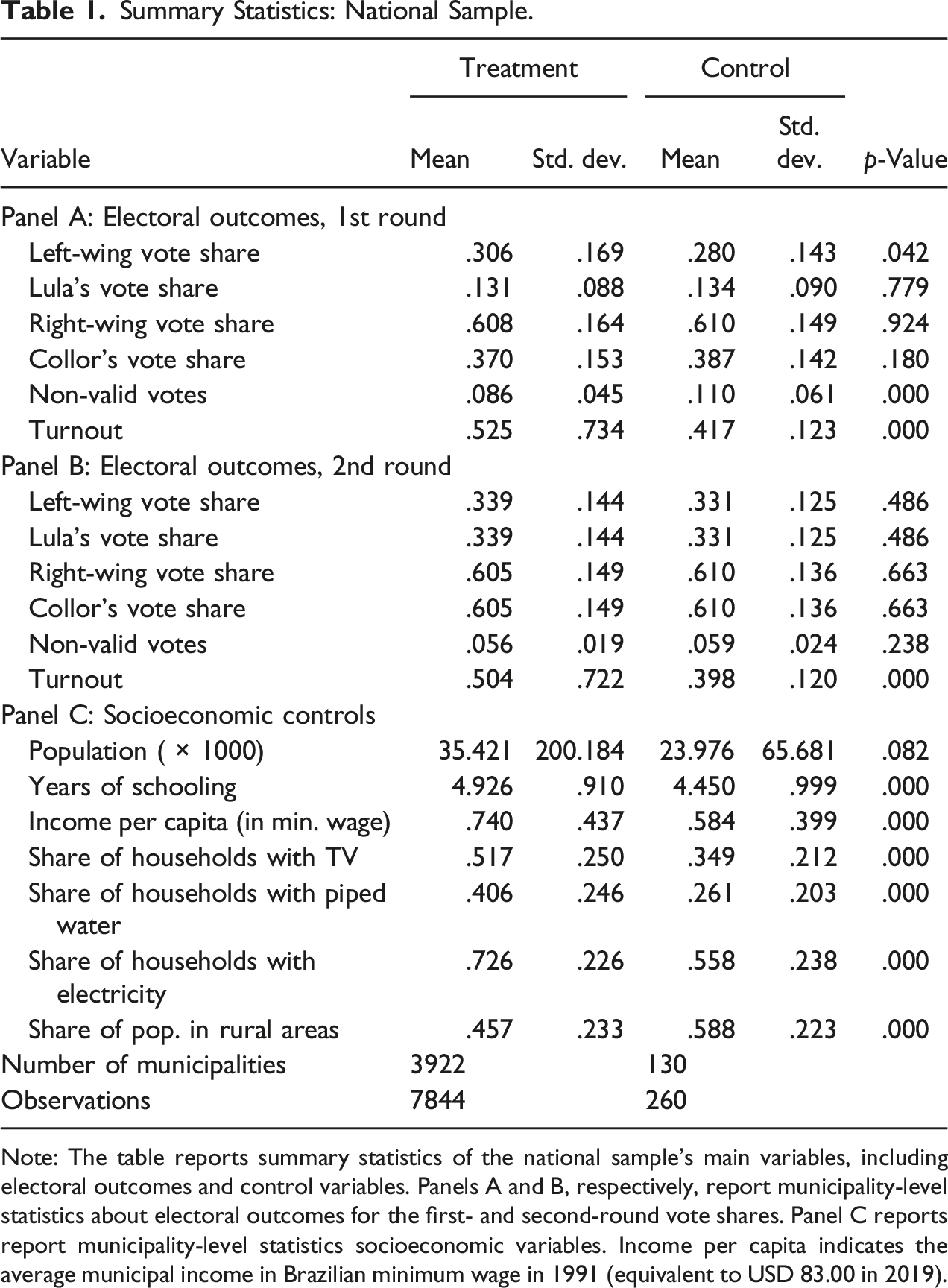
Note: The table reports summary statistics of the national sample’s main variables, including electoral outcomes and control variables. Panels A and B, respectively, report municipality-level statistics about electoral outcomes for the first- and second-round vote shares. Panel C reports report municipality-level statistics socioeconomic variables. Income per capita indicates the average municipal income in Brazilian minimum wage in 1991 (equivalent to USD 83.00 in 2019).
Empirical Strategy
In our differences-in-differences strategy, we specify the following regression model to trace out changes in vote share associated with Globo’s edited news coverage
The identifying assumption is that there are common trends in untreated potential outcomes between Globo (treated) and non-Globo (untreated) municipalities between the first and the second round of the election. Although the network’s signal availability is scattered across most states (Figure B2 in the Appendix), Globo followed a strategy to enter regions with higher TV ownership rates and higher consumption potential (Chong & La Ferrara, 2009). Figure B3(a), also in the Appendix, shows that Globo municipalities exhibit significant mean differences in (unconditional) pre-treatment characteristics. In particular, households without Globo are, on average, less educated, poorer, more rural, and less likely to have access to piped water, electricity, or a TV set. These differences suggest that our estimates may potentially be biased in case the effect of Globo’s coverage is heterogeneous across control and treated units.
In response to this imbalance, we take two complementary approaches to creating a more comparable control group.
17
First, we estimate models that produce the implicit control group using state-time fixed effects, which restrict comparisons of changes in vote shares in municipalities in the same state, and separate electoral round fixed effects interacted with dummies for deciles of income per capita, the share of households with TV, and the share of the urban population, which restricts comparisons to municipalities with similar income, TV ownership, and urban rates. It also accounts for state political dynamics, which are relevant given Brazil’s federalism (e.g., state leaders support different presidential candidates). The second model weights untreated municipalities in our regressions by
Figure B3 displays the significance and standardized difference between means of covariates across groups. 19 Both approaches (group-FE and p-score weighted) return differences in pre-treatment characteristics that are statistically insignificant and small in magnitude. In the next section, we report estimates based on these two approaches and a more straightforward (unconditional) DiD analysis without weights or group-fixed effects. Overall, our main estimates are qualitatively unchanged across all three, as discussed below.
Main Results
We begin our analysis by exploring results according to left–right ideology. By doing that, we assume that those voting on one side of the spectrum in the first round will continue to do so in the second or that at least losing candidates support runoff candidates in the same ideological spectrum as they are.
20
Figure 2(a) plots the average effect of Globo’s coverage on changes in vote share of left- and right-wing candidates according to the three approaches discussed above, namely, (i) standard unconditional DiD, (ii) group FE, and (iii) p-score reweighted.
21
Across all three approaches, Globo’s coverage is associated with a reduction of 1.2 − 1.8% points in the vote share of the left.
22
The corresponding point estimates are reported in column 1 of Tables B1 and B3 in the Appendix. Globo’s edited coverage and vote shares.
Figure 3 reports estimates that allow treatment effects to vary according to local media competition by splitting treatment status among municipalities that receive Globo and other TV broadcasters’ coverage as opposed to Globo only.
23
The estimated effect for Group FEs against the left-wing candidate when Globo is the only signal provider (−3.6 p.p.) is significantly larger than when other broadcasters are present (−1.0 p.p.). This is consistent with voters being more likely to have watched Globo’s coverage on the day following the debate and thus more likely to be affected by it in places where Globo is a monopolist. This difference indicates that where Globo had greater market power are also places where it was able to influence voters the most. Also, votes lost by the left transfer only partially to the right, with a stronger effect in municipalities covered only by Globo. The difference in coefficients is statistically significant in both cases. These results are in line with Enikolopov et al. (2011) who find that the persuasive effect of media on voting behavior is smaller for people who use alternative news sources. Globo’s edited coverage and local media competition.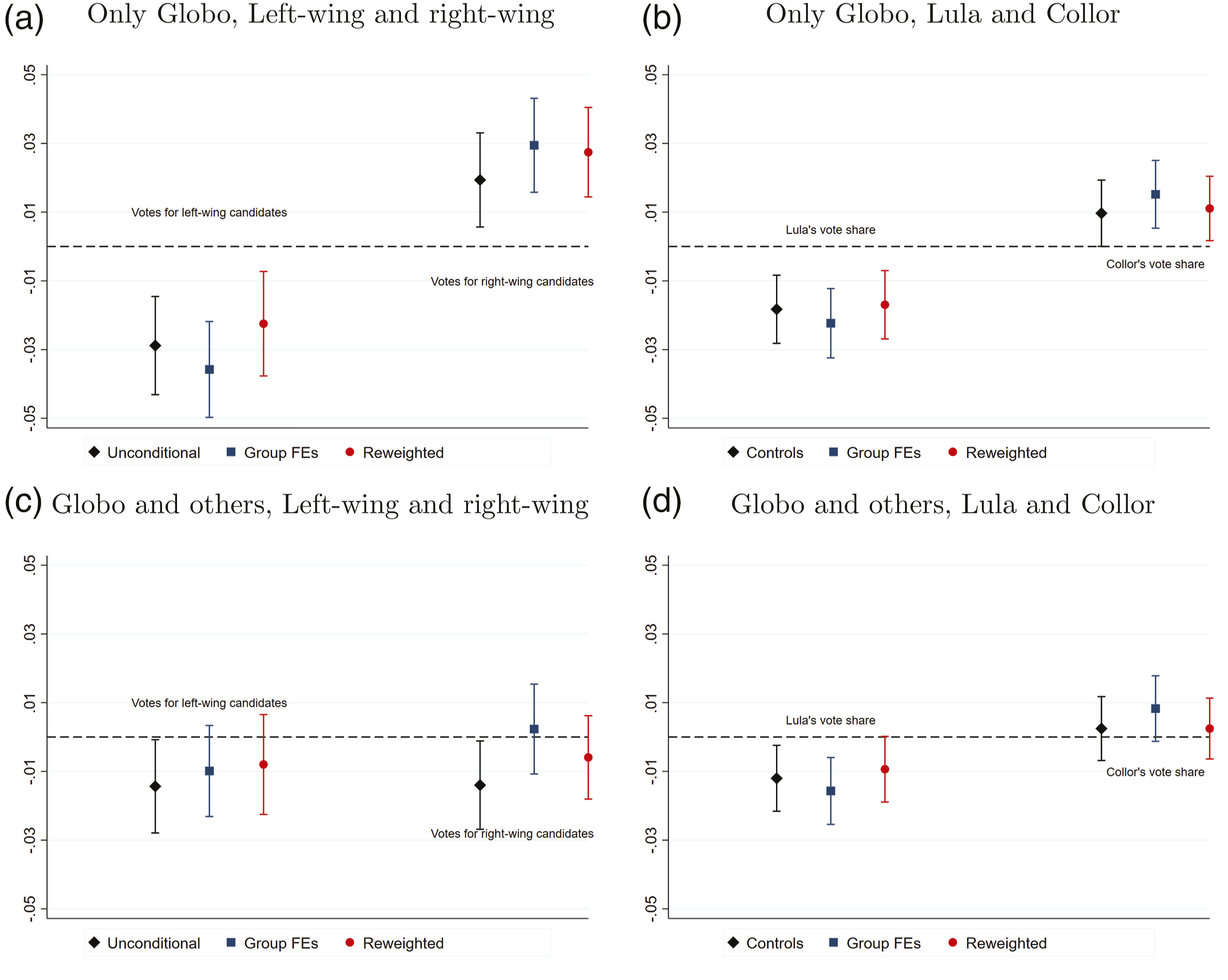
Next, we focus on individual vote shares of the two candidates that move on to the 2 nd round, Collor and Lula, as dependent variables. To address the identification challenges raised at the beginning of this section, we add controls for the 1 st -round vote shares of remaining candidates interacted with the time dummy as a way to explicitly allow for differential trends according to 1 st -round voting patterns in a flexible manner. 24 Since debate performance is not only determined by political platforms but also by individual traits of candidates (Lawson et al., 2010), using candidate’s outcomes is a more direct test of how voters perceived them after the debate and Globo’s coverage. Figure 2(b) and Tables B2-B3 in the Appendix show estimates of similar magnitudes, suggesting that left–right and candidate-specific outcomes are empirically equivalent, only now with more precisely estimated coefficients. Overall, both group-FE and reweighting guarantee balancing observables between treatment and control, but estimates remain substantively the same without the procedure.
Further Evidence
Other estimations using our municipality-level analysis show the robustness of our results and also uncover other nuances of Globo’s manipulation. We present some results regarding the heterogeneity of our estimations and the effect of Globo’s coverage on invalid votes and turnout. Then, we list a series of robustness checks and placebo analyses. Additionally, we discuss the persuasion rates associated with our setup, and how they compare to the scholarship of media effects. Finally, we outline alternative explanations for our estimates.
In analyzing the heterogeneous effects of exposure to Globo, we are able to learn more about who is most affected by the network’s coverage. Table B8 (in Appendix) reports estimates of treatment effects interacted with (demeaned) municipal characteristics. Across both fixed-effects and reweighted specifications, the effect is larger in less developed localities, where the share of households with access to piped water and electricity is lower. These results indicate that voter illiteracy, a common pattern in young democracies, is conducive to media effects. Lower sophistication also seems to play a role as they correlate with lower levels of education (Ceci, 1991). Years of schooling mitigate the estimated effect, consistent with the effects of media bias in Italy (Barone et al., 2015). Interestingly, the negative effects on Lula’s vote share increase where TV ownership is higher but decrease with radio ownership. 25 This is what we would expect in a scenario where information was manipulated on TV but not on the radio broadcast, and where there are competing sources of information.
The effects on turnout and invalid votes are less pronounced than those on vote shares, as Table B9 in the Appendix shows. 26 Column 1 indicates that being exposed to Globo increases the share of invalid votes by .7 p.p. in our fixed effects and in our re-weighted specification (panel B). This is almost exactly (up to rounding errors) the difference between the estimated coefficients on Lula’s and Collor’s vote share reported in columns 1 and 3 of Table B2. The effect on voter turnout is small and insignificant, as columns 3 and 4 report. Together, Tables B2 and B9 in the Appendix provide two lessons. First, approximately 25%–60% of the effect is explained by voters switching to Collor (1.1 p.p. out of 1.8, or .3 p.p. out of 1.2), and the remaining invalidate their votes. Second, our estimated effect is mainly explained by a switch in voters’ preferences towards the candidate favored by the slanted coverage among the voting population. This contrasts with most of the media persuasion literature that finds variation in electoral outcomes due to changes in who ends up going to vote Although our design is not aimed to explain this contrasting result, potential explanations include: (i) the difference in temporal nature of the treatments (one-time manipulation in our case vs long-run slanted coverage in DellaVigna and Kaplan (2007)), (ii) voters following the media coverage of important campaign events are more likely to go vote, or (iii) mandatory voting in Brazil. 27
A series of robustness checks validate our results. These are presented in Appendix Section B.4. There we show that our estimates are robust to (i) accounting for voting transfer patterns between candidates of similar ideology, (ii) restricting the group of treated observations to include only municipalities neighboring control units, and (iii) falsifying our results by testing if exposure to Globo affects the 1994 gubernatorial election, and (iv) testing whether our estimates are likely to arise by chance.
Finally, in Appendix C we calculate the persuasion rates associated with our setup, which estimates the percentage of receivers that change their behavior among those that receive a message and are not already persuaded. For our main sample, our calculations indicate a persuasion rate of 15.93%, which is relatively high but within the range of treatment effects of media exposure on vote share observed in the literature. (DellaVigna & Gentzkow, 2010). This is consistent with media persuasion being larger in young democracies.
Individual-Level Analysis
The municipality-level sample analysis presented above takes advantage of the full cross-sectional variation in the data, allowing us to perform robustness checks and heterogeneity analyses that support the identification strategy. However, a potential concern is that the 1 st and 2 nd rounds of the 1989 presidential election took place 32 days apart. Thus, the estimates capture the effect of all content broadcast by Globo in this period relative to the other networks, including other developments that took place between rounds and were relatively more (or less) emphasized by Globo.
In this section, we complement the municipality-level approach with additional analysis at the individual level using self-reported survey data. More specifically, we identified two surveys that were fielded between 12 th − 16 th December 1989, before and after the debate on the 14 th and Globo’s coverage, that aired on the night of the 15 th . They comprise data from the 350 municipalities in the metropolitan areas of the 27 state capitals, comprising nearly 40% of the national population at that time. The surveys also inform respondents’ age, gender, total years of schooling, place of residence, 2 nd round voting intention, and for the survey fielded after the debate, opinion regarding who won the debate, and whether individuals watched the debate. Our variation in exposure comes from the fact that interviewees from one metropolitan area, São Luís do Maranhão, did not receive Globo’s signal. As the signal from other broadcasters was available, locals were still able to watch the actual debate but not Globo’s coverage of the debate. Thus, we combine the timing of the debate coverage and the availability of Globo’s TV signal across metropolitan areas by comparing changes in 2 nd round voting intention—just before and after the debate and its coverage—using respondents in São Luís as a control for all other metropolitan areas.
Our individual-level analysis has the caveat that the only untreated respondents’ are in the São Luís area. However, while the data provides limited variation, the approach serves as a complement the municipality-level analysis in three important ways. First, it dramatically decreases the time interval between before and after treatment in our analysis, limiting the effect of other developments that took place between rounds and were potentially more (or less) emphasized by Globo. Second, it provides information on the individual level, as opposed to aggregate municipal data. Third, the survey questions allow us to directly test the mechanism behind the result as we have data on individuals’ opinions regarding who won the debate. Another limitation is that sampling was not fixed in predetermined areas, and the São Luís area was not included in surveys before the debate. This prevents us from analyzing pre-trends in the survey sample.
Summary Statistics: Survey Data in Metropolitan Areas Sample.
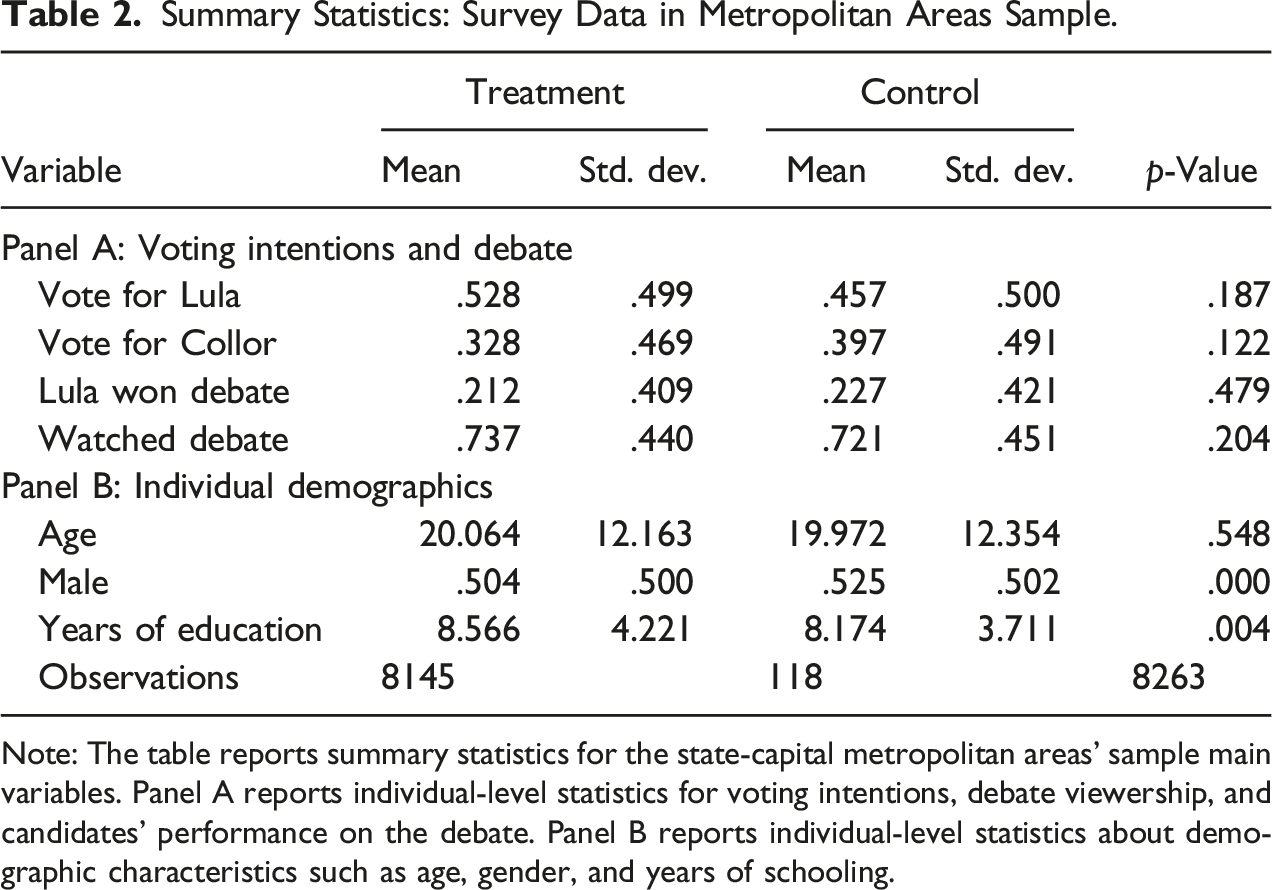
Note: The table reports summary statistics for the state-capital metropolitan areas’ sample main variables. Panel A reports individual-level statistics for voting intentions, debate viewership, and candidates’ performance on the debate. Panel B reports individual-level statistics about demographic characteristics such as age, gender, and years of schooling.
Given these features of the data, we modify our baseline regression to accommodate the individual nature of the individual-level data
Evidence From Metropolitan Areas.
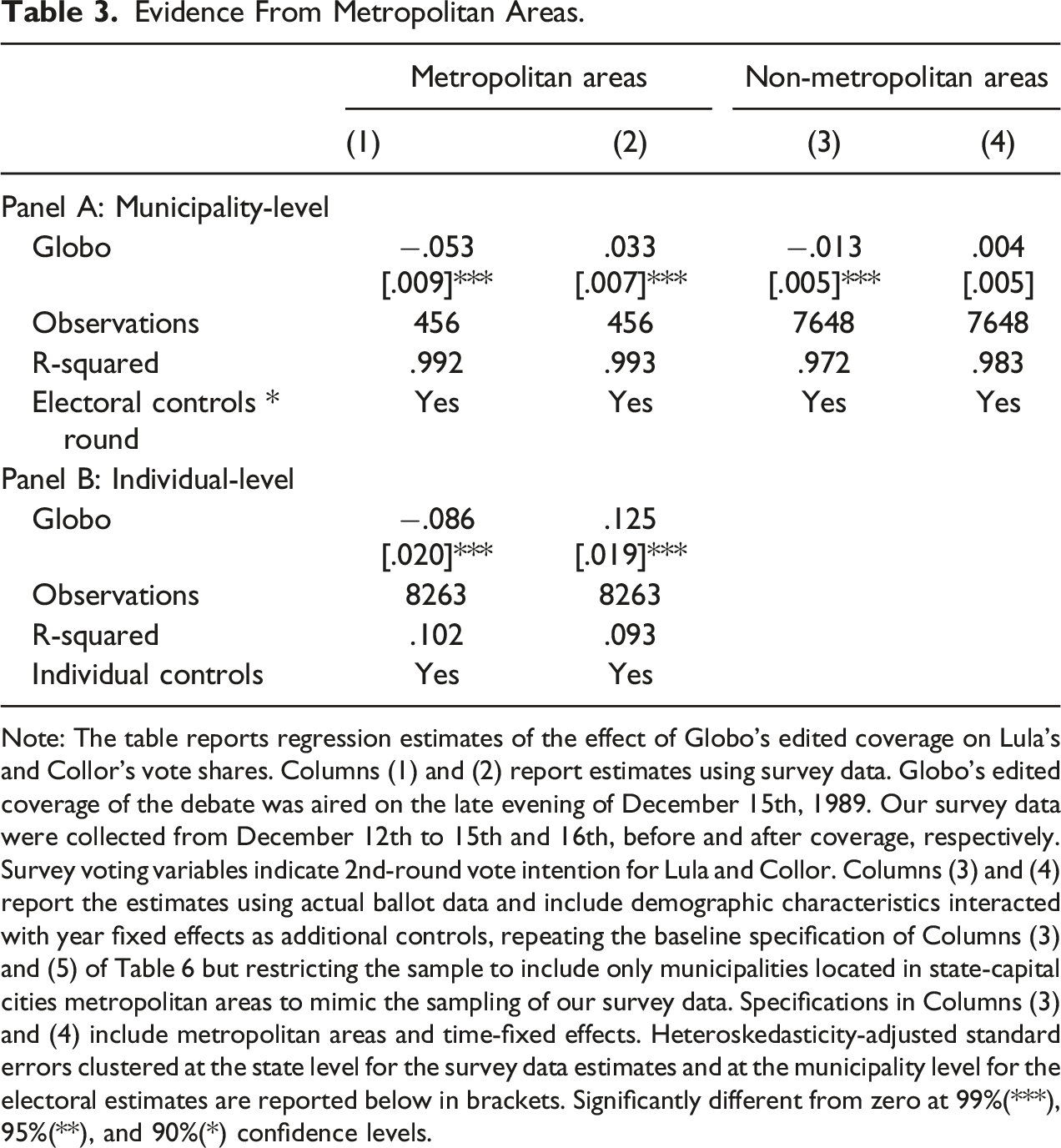
Note: The table reports regression estimates of the effect of Globo’s edited coverage on Lula’s and Collor’s vote shares. Columns (1) and (2) report estimates using survey data. Globo’s edited coverage of the debate was aired on the late evening of December 15th, 1989. Our survey data were collected from December 12th to 15th and 16th, before and after coverage, respectively. Survey voting variables indicate 2nd-round vote intention for Lula and Collor. Columns (3) and (4) report the estimates using actual ballot data and include demographic characteristics interacted with year fixed effects as additional controls, repeating the baseline specification of Columns (3) and (5) of Table 6 but restricting the sample to include only municipalities located in state-capital cities metropolitan areas to mimic the sampling of our survey data. Specifications in Columns (3) and (4) include metropolitan areas and time-fixed effects. Heteroskedasticity-adjusted standard errors clustered at the state level for the survey data estimates and at the municipality level for the electoral estimates are reported below in brackets. Significantly different from zero at 99%(***), 95%(**), and 90%(*) confidence levels.
Discussion
One key question is whether the manipulation persuaded voters to change their preferences. It is possible, instead, that it either dissuaded Lula’s voters from going to the polls. Two pieces of evidence suggest that persuasion, not mobilization, generated the effects, other than the fact that the vote was compulsory and the election had a massive turnout. First, we ran an online experiment that randomly assigned video clips with the same duration either from the actual debate or Globo’s edited highlights to MTurk participants. Results show that 33% of the participants assigned to watch Globo’s highlights would vote for Lula, while 22% answered that Lula won the debate. Of those who watched unedited footage of the debate, 56% chose Lula, while 53% said he had performed better. More details about the experiment and its results are in Appendix A. The results are consistent with recent evidence showing that candidates’ photos and videos convey information about their electoral performance (Benjamin & Shapiro, 2009; Casey, 2022; Todorov et al., 2005). Although we cannot interpret the experimental outcomes as compared to the actual debate due to the different historical contexts, external validity issues, and differences in what exposure to treatment was in 1989 and in the online experiment, the magnitude of the experiment effects indicates that the Jornal Nacional video favored Collor.
Debate Perceived Performance and Edited Coverage.
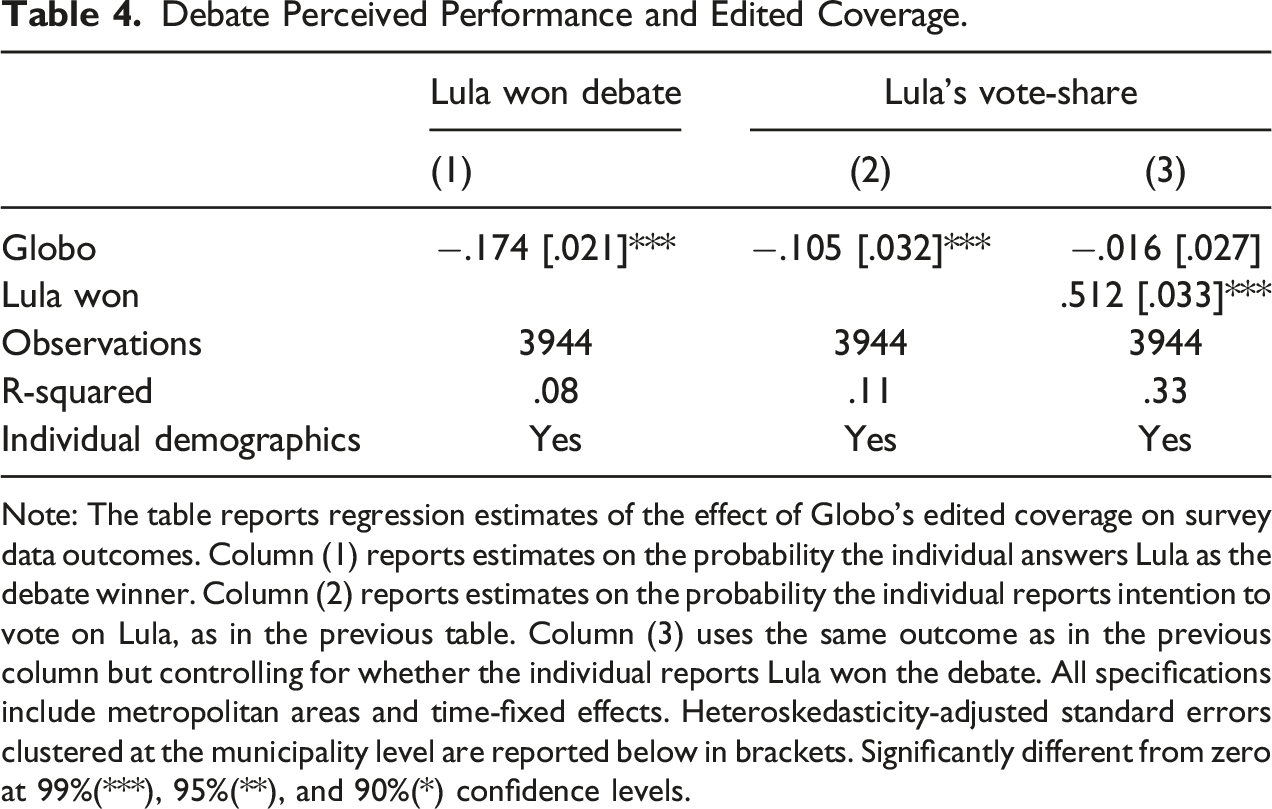
Note: The table reports regression estimates of the effect of Globo’s edited coverage on survey data outcomes. Column (1) reports estimates on the probability the individual answers Lula as the debate winner. Column (2) reports estimates on the probability the individual reports intention to vote on Lula, as in the previous table. Column (3) uses the same outcome as in the previous column but controlling for whether the individual reports Lula won the debate. All specifications include metropolitan areas and time-fixed effects. Heteroskedasticity-adjusted standard errors clustered at the municipality level are reported below in brackets. Significantly different from zero at 99%(***), 95%(**), and 90%(*) confidence levels.
How could the manipulation persuade millions of voters? Given that rational voters discount the bias from their news sources (DellaVigna & Kaplan, 2006; Gerber & Green, 1999), it should be surprising that a single exposure to 6 minutes of slanted coverage persuaded millions of voters to switch preferences. Two factors contributed to insufficient discounting of bias by voters. In an environment lacking competing sources of information, the manipulation surprised viewers with a spike in the degree of news slant near the election, not giving them enough time to discount the increase in bias before voting. Also, Globo’s journalism was well-regarded as a quality standard in TV journalism, employing some of the best Brazilian journalists and leading the national audience rankings (Mota Gomes, 2009). In this context, if the degree of slant from the manipulated coverage was more to the right than expected, the edited highlights could paint the persuasive message that Lula was inferior to Collor, an opinion they would not have without watching the Jornal Nacional that day.
Competing Explanations
There are other explanations that could have generated the results of the previous sections. We now outline mechanisms other than the persuasive effects of the manipulated coverage that could account for the negative and significant β treat in equation 1 and discuss why it is unlikely that they explain our results. The following discussion borrows arguments from the framework of DellaVigna and Kaplan (2006), which models the impact of media bias on voting.
If municipalities with Globo have higher audience rates for the final debate, the coefficient β treat may be estimating the effect of the final debate on Lula’s vote share instead of the effect of Globo’s edited coverage. 31 In this case, β treat would be negative even if Globo’s coverage did not affect Lula’s vote share. Such a mechanism is unlikely to explain our estimates for three reasons. First, audience rates are very similar across treatment and control municipalities in our metropolitan areas sample (as reported in Panel B of Table 2). Second, as shown in the national sample estimate in column 4 of Table B2, we estimate stronger effects on Lula’s vote shares in municipalities where Globo is the only broadcaster, where overall audience rates of the final debate are likely lower. 32 Third, even if the final debate had higher audience rates in municipalities with Globo, both our fixed-effects and reweighted specifications account for observed pre-existing differences across municipalities that are potentially related to audience rates, such as average income, schooling, and TV ownership levels.
Another competing hypothesis is that β treat may be explained by differences in the mean of priors about the relative quality of candidates instead of the effect of the manipulated coverage. All else being equal, if beliefs about Lula’s relative quality have a higher mean in municipalities with Globo, there will be a larger mass of Lula’s supporters to switch votes to Collor for any given realization of the information shock produced by the coverage of the final debate, which magnifies the effect of the information shock caused by the final debate. It is unlikely that such a mechanism explains our results for two reasons. First, Lula’s vote share in the first round is the same across treatment and control groups in our national sample, as shown in Table 1. Second, if anything, beliefs about Collor’s relative quality should have higher means in treatment municipalities because Globo’s slanted first-round coverage favored Collor and harmed his main competitors. 33
Finally, it could be that beliefs about Collor’s relative quality had lower precision in municipalities with Globo. In this case, the signal generated by the final debate is more heavily weighted when computing the posterior mean, and, consequently, a higher mass of voters believe that Collor has higher relative quality after the manipulated coverage, which magnifies the effect of the information shock caused by the final debate. This mechanism is unlikely to explain our results for two reasons. First, the share of individuals who self-report as undecided before the edited coverage in our election survey is lower in municipalities with Globo. Second, if anything, Globo’s slanted first-round coverage should increase the precision of Collor’s perceived relative quality. 34
Did the Manipulation Decide the Election?
Lula lost the election by 6.3% points (around 4 million votes), and our results with group-fixed effects lie in the 1.2–6.5% points range when summing both candidates’ coefficients. These estimations, however, measure the impact of watching the edited highlights on municipal vote shares, not the overall effect of the manipulation on the election outcome, which is impossible to appraise since there is only one observation to do so. The main reason why our estimates cannot directly answer the question is that the effect varies with voters’ demographics. Indeed, when restricting the analysis to metropolitan areas, where most of the population resided and where TV viewership was higher, estimations return an aggregate effect of 8.6% points (see Table 3). Moreover, our main estimates use first-round vote shares as a benchmark, but Lula’s support base grew considerably between rounds, as the opinion polls attest, implying that more individuals could be persuaded not to vote for Lula just before the manipulation. If we take the individual-level results as suggestive evidence of what an ideal estimation of municipality-level differences-in-differences with a shorter interval would appear, we should again expect a more sizable impact. Assuming that these factors present in our estimates attenuate the overall effect of the manipulation, it is plausible that Globo’s manipulation did indeed change the electoral outcome of Brazil’s founding election.
Conclusion
This paper shows that a powerful media group influenced an election by presenting a distorted coverage of a political debate. Although several studies identify media effects on political attitudes, ours brings new insights into the literature on media in two dimensions. First, the episode we study is not the result of exposure to partisan media in a consolidated democracy but comes from a non-openly partisan outlet during the first free presidential election after a regime change. Second, the network that edited the debate highlights was powerful enough to transmit the biased reporting to millions of voters, which under plausible assumptions, may have effectively changed the winner of a national election with a single event of manipulation.
The findings shed light on how politically persuasive an unexpected slant in the news can be. On the one hand, slanted content that matches the audience’s priors should not affect voters’ dispositions. Since voters update their beliefs after receiving each message, it is unlikely that repetitive slant from Globo could continue to change voters’ attitudes. More time between the message and the elections could also reduce its harm as voters would be exposed to competing stories. On the other hand, it is possible that reputed outlets, in either a “Nixon goes to China” position or by mistake, report news far out enough from their expected bias that it could change voters’ minds. 35
This threat of misleading news is higher when it reaches a larger audience with few sources to counter untruthful information. In developing countries, where voters are, on average, less able to read the news due to low educational attainment, misleading news should have an even stronger impact on voters’ choices. This threat is also amplified by market concentration, which may be a function of having experienced media market consolidation during an authoritarian regime. This pattern highlights a different type of authoritarian legacy that can later undermine democracy. In Brazil, Globo’s market power had grown in the period preceding the transition to democracy. But our analysis also points out the threat of market concentration not only during transitions to democracy but also on the reverse path of democratic backsliding, as it appears to have taken place in Turkey and Hungary (Coşkun, 2020; Szeidl & Szucs, 2021). It also exemplifies another reason why ultra-rich, politically motivated individuals that buy out the media as a political investment are a threat to democracy (Grossman et al., 2022).
Finally, our work showcases how the agency of a handful of individuals can supplant social structures and the economy in the making of a country’s trajectory. In our context, a left-wing candidate winning the election would have represented much more than just different public policies. The very first years of the democratic experience have persistent effects on the quality of representation (Boas, 2010; O’Donnell & Schmitter, 2013), and as Roberts (2014) shows, how incumbents fared electorally at that time could have determined how party competition would take place in the decades to come. Party systems disintegrated when incumbents from labor-based parties, such as Lula’s PT, failed to maintain voter support in subsequent elections. For Latin American presidents in that era, keeping approval rates up was daunting given the severe economic headwinds that made many attempts to stabilize inflation and debt unsuccessful (Campello & Zucco, 2020). Tellingly, an unpopular Collor, failing to control hyperinflation, vacated the presidential seat after Congress approved his impeachment over corruption charges. Had he won, Lula would have had a presidency plagued by the same exogenous shocks, likely suffering from a similar fate, making his and his party’s subsequent successful run in national politics less likely to take place.
Supplemental Material
Supplemental Material - Media Manipulation in Young Democracies: Evidence From the 1989 Brazilian Presidential Election
Supplemental Material for Media Manipulation in Young Democracies: Evidence From the 1989 Brazilian Presidential Election by Alexsandros Cavgias, Raphael Corbi, Luis Meloni, and Lucas M. Novaes in Comparative Political Studies.
Footnotes
Acknowledgements
An earlier version of this article circulated with the title “Edited Democracy: Media Manipulation and the News Coverage of Presidential Debates”. For useful comments, we are grateful to Leonardo Bursztyn, Filipe Campante, Katherine Casey, Francisco Costa, Ruben Durante, Anthony Fowler, Eliana La Ferrara, Claudio Ferraz, Mark Kayser, Hannes Mueller, Elias Papaioannou, Guido Tabellini, Diego Ubfal, David Yanagizawa-Drott and seminar participants at the EDGE Jamboree 2018, Winter Meeting of the Econometric Society 2018, Oxford Development Economics Workshop 2018, 4th Economics of Media Bias Workshop, RIDGE/LACEA, Bocconi University, Michigan State University, University of Chicago, PUC-Rio, and Stockholm School of Economics. We thank Alberto Chong and Eliana La Ferrara for kindly providing us with the TV signal data, and Tiago Ferraz and Danilo de Souza for excellent research assistance. Replication materials and code can be found at  .
.
Declaration of Conflicting Interests
The author(s) declared no potential conflicts of interest with respect to the research, authorship, and/or publication of this article.
Funding
The author(s) disclosed receipt of the following financial support for the research, authorship, and/or publication of this article: This work was supported by Fundação Instituto de Pesquisas Econômicas, Fundação de Amparo à Pesquisa do Estado de São Paulo, British Academy, Coordenação de Aperfeiçoamento de Pessoal de Nível Superior.
Supplemental Material
Supplemental material for this article is available online.
Notes
Author Biographies
References
Supplementary Material
Please find the following supplemental material available below.
For Open Access articles published under a Creative Commons License, all supplemental material carries the same license as the article it is associated with.
For non-Open Access articles published, all supplemental material carries a non-exclusive license, and permission requests for re-use of supplemental material or any part of supplemental material shall be sent directly to the copyright owner as specified in the copyright notice associated with the article.
