







Abstract
How does pre-war trauma impact battlefield behaviour? I study Irish troops in the American Civil War who experienced the Potato Famine over a decade prior. I use birth cohorts, sibling birth order, adult height, and the geography of last names in Ireland to measure famine exposure within the Irish group at the level of individual soldiers. Each strategy indicates that famine exposure increases desertion. Developing and testing observable implications from theory, I show that heightened risk aversion is the most plausible mechanism. Once soldiers are socialized into active combat through collective risk-sharing the famine effect dissipates. This research contributes to our understanding of the causes of contentious behaviour, how the behavioural legacies of atrocities play-out sans partisanship, and the importance of pre-migration experiences.
Why people participate in violence is a core question in understanding human behaviour (Kalyvas, 2006; Levi, 1997). Indeed, understanding the cohesion of soldiers in wartime has received extensive attention from social scientists due to its importance for wartime outcomes and the subsequent long-run development of societies at micro and macro levels (Besley & Persson, 2008; Lyall, 2020; Scheve & Stasavage, 2010; Shils & Janowitz, 1948). Explanations of soldiers’ behaviour, and the choice to fight on or desert, have paid attention to their proximate groups (Bearman, 1991; Costa & Kahn, 2010), the home front’s politics or geography (Kalmoe, 2020; McLauchlin, 2014), economic incentives (Berman et al., 2011; Humphreys & Weinstein, 2008), coercion (Gates, 2002), and the armed group’s socialization process (Cohen, 2013; Gates, 2017; Gilligan et al., 2023). I argue that individuals’ experiences before war also exerts effects on their performance during service. In particular, I propose that experiences suffered before a conflict’s onset have behavioural effects during war. Beyond the dynamics of groups, ideology, and identity, experiences in the pre-war lives of soldiers also play a role in determining behaviour.
I study how the potato famine impacted service among Irish-Americans in the US Civil War. I first measure famine through birth cohorts with the identifying assumption that experiencing famine at a younger age has relatively larger effects. I show that younger Irish soldiers, born just before famine, desert at higher rates. I develop this approach comparing siblings who served together and show that only for Irish troops birth order is a significant predictor of desertion. This within-family analysis reduces confounders across birth cohorts. I also leverage a measurement strategy exploiting how soldiers’ adult heights are only affected by malnutrition when they are at a certain stage of childhood. When height proxies malnutrition shorter soldiers desert more frequently in the Irish group. Lastly, I map soldiers to their potential origins in Ireland using the geographical spread of last names. I find that Irish soldiers whose names originate from areas with higher population loss and greater famine relief desert more.
Studying famine and wartime service in a setting where the conflict is divorced from the original trauma which allows for theory generation distinct from preferences or partisanship. From this theory I draw and test observable implications of two potential channels; risk-aversion and re-traumatization. Through supplementary empirical testing and a case-study of two New York regiments I find that additional Irish desertion is concentrated in the first weeks of service. Irish soldiers are akin to Germans once each group has been deployed and participated in active combat. When Irish soldiers are socialized on the battlefield through collective risk sharing the famine effect is no longer discernible and thus these empirical patterns are consistent with a risk-aversion stemming from famine. I test several alternative mechanisms such as economics, identity, discrimination, physical weakness and different roles in the military to rule out these pathways.
This research speaks to how traumatic events shape behaviour (Bauer et al., 2016; Blattman, 2009), the causes of wartime micro-level patterns (Ager et al., 2021), and how migrants’ new lives, and the societies they join, can be shaped by experiences before arrival (Dippel & Heblich, 2021). I add to our understanding of the American Civil War but also speak to a potentially broader literature of wars in the aftermath of famine and repression (Rozenas et al., 2022; Rozenas & Zhukov, 2019). Famine in the modern world typically co-occurs with violent conflict, so studying the relationship between these events enriches our understanding. A final contribution of this work is to disentangle traumatic events from preferences. I study victims of famine fighting in a war disconnected from the root cause of their prior suffering. In this way, I can probe mechanisms beyond the partisan preferences which would overwhelm other mechanisms if the war was against those responsible for governing the famine (Henn and Huff 2021; Narciso & Severgnini, 2023).
The Irish in the American Civil War
An initial, proximate cause of the food shortage was the infestation of the potato crop upon which Ireland depended (Mokyr, 2013). Over time, a weakened, malnourished population was assaulted by waves of fever which amplified the death toll against a backdrop of a distant landed elite class of land owners, restrictive relief policies and continued food exports during the hunger (Anbinder, 2001; Mokyr, 2013; Ravallion, 1987; Walker, 2007). The combined process of mass starvation and movement meant the island of Ireland today has fewer inhabitants than in 1840 before the famine. More than two million people left Ireland to seek refuge during the famine (Boyle & Grádo, 1986; Gráda, 2020). Emigration was the optimal way to survive due to the abysmal relief efforts deployed by the UK government and led to large chunks of the Irish populace re-locating to the United States (Grada & O’Rourke, 1997). The trans-Atlantic passage offered a ‘safety valve’ for Irish during the famine and then initiated chains of migration, often for young adults seeking employment in the post-famine landscape (Fitzpatrick, 1980).
Irish movement to the United States had begun long before the famine but the rate rose markedly from 1845 when the potato crop first failed, and during the 1840s Irish communities blossomed in the industrializing cities of New England and the Midwest (Anbinder & McCaffrey, 2015). Through the famine years, over 500,000 Irish settled in the US and this episode of migration, un-impinged by government restrictions on arrivals, was also typified by relatively poorer entrants vis-a-vis other groups and the earlier Irish (Collins & Zimran, 2019; Ferenczi & Willcox, 1929). Irish arrivals met hostility from the native population, facing discrimination in their daily interactions as well as an institutionalized backlash with the formation of the anti-Immigrant Know-Nothing Party (Alsan et al., 2020). Labour-market competition and a prejudicial characterization of the Irish as loyal to Rome by dint of their Catholicism fueled anti-Irish sentiment in the years between the famine and civil war’s onset. Nativist politicians sought to disenfranchise new arrivals, citing fears of their incapacity to remain loyal to the United States, and the heavily urbanized Irish newcomers remained clustered in ethnic neighborhoods throughout the country’s growing cities (Alsan et al., 2020). Antebellum Irish fled horrific famine and persecution by the British government yet were coldly received by their new adopted homeland.
Yet, a decade after the famine was alleviated, Irish-Americans contributed enormously to their new Republic’s deadliest war. Irish arrivals clustered in the industrial eastern cities largely fought for the Union side but tens of thousands also found themselves fighting on behalf of the Confederacy (Gleeson, 2013). The Union transitioned from a patchwork of state-run militias at its start to a federally administered force of millions by the war’s end. The primary unit of the Union Army were companies consisting of approximately one hundred soldiers which were typically recruited from a contiguous local area such as a county. For the Irish troops, given their urban slant, this typically meant serving in companies alongside many other Irish, immigrant groups, and poor city-dwellers.
The Irish contribution to the war effort was in large part proportional to their settlement patterns meaning the New York Irish contingent were the most numerous (Shiels, 2013). Within this New York contingent, several Irish-only brigades of soldiers were developed and garnered a reputation for courage during the most notable battles of the war (Craughwell, 2011). Irish-Americans who had fought in the Mexican-American War and the Young Irish uprising of 1848 commanded huge crowds in the cities of the Eastern seaboard and marshaled Irish-Americans to enlist and fight valiantly (Egan, 2016). These brigades played a role in raising Irish troops themselves but also in making the cause of the war salient to Irish-Americans on a broader scale by communicating through Irish-run newspapers and journals.
Nevertheless the Irish had split loyalties within and beyond these most vaunted regiments since participation in the Civil War had a complex, varying relation to affairs back in Ireland and identity (Ural & Bruce, 2006). In addition, Irish opposition to the war was piqued by the implementation of a draft process in the North leading to explosive rioting in New York City during the war (Bernstein, 1991). This context of Irish support for the war are related to two of the broad schools of explanation for civil war desertion: the home front and soldiers’ traits (Costa & Kahn, 2003; Kemp, 1990; Linderman, 1987). Against this backdrop of how desertion is shaped by events and groups away from the battlefield alongside individual characteristics I propose that pre-war famine can operate in a similar manner.
Theoretical Framework
Socializing soldiers into tight groups is central for armed groups to create an effective fighting force. A cohesive unit of troops is essential to prevent desertion and mutinies among rank and file soldiers (Gabriel & Savage, 1978). Fighting for and with those in your immediate network during service, and the subsequent identities tied to these units, is crucial to understanding patterns of performance in mass warfare (Kenny, 2011; Shils & Janowitz, 1948). Overall, scholars have often placed ‘emphasis on organization-level dynamics in state militaries [which] contrasts with the emphasis on individual-level motives often used to explain participation in nonstate groups’ (Blattman and Miguel 2010, p. 20). The American Civil War involved rapid mobilization and authorities invested in basic drill for new recruits to try and transform citizens into soldiers (Weitz, 1998). This training process was extensive and Weitz notes that this skill-based training, when combined with combat experience, underpinned the success of best-performing regiments (Weitz, 1998). Moreover, a company’s characteristics and homogeneity were important for its cohesion over the course of the war (Costa & Kahn, 2003). Nonetheless, this formalized state army had a relative endowment of material and basic training, as opposed to the inculcation and ideological approaches favoured by non-state actors (Gilligan et al., 2023). The American Civil War is a setting where ties to one’s peers on the battlefield were crucial to prevent disintegration (Costa & Kahn, 2003). However, these connections to one’s fellow soldiers were forged through action rather than ideas.
I outline individual-level behavioural consequences of famine which might interact with the meso-level process of building identities and socializing individuals into groups. In essence, soldiers may have particular characteristics which makes desertion more likely in a vacuum. These individual characteristics can also aid or infringe upon the generative process of becoming an effective fighting force over time. Also, the battlefield setting of the wartime experience could lead the import of these traits to wax or wane over time. A set of interactions between the trait imbued by famine and the process of socialization in the Civil War context can explain why desertion would be elevated by pre-migration experiences.
The famine can exert persistent effects within individuals who fled from it which influence wartime decision-making. Risk aversion and re-traumatization are the competing individual-level mechanisms I examine to connect famine with wartime desertion. I theorize about how individuals’ experience of famine could imprint changes to risk preferences or induce a distinctive reaction to wartime trauma. I explore how each pathway could stem from famine and also shape the revealed behaviours we observe. I then elaborate on how risk aversion and re-traumatization influence the group-building which is necessary to develop an effective force. In doing so, this connects the individual-level arguments about the persistence of famine with the established importance of group dynamics in mass warfare.
Risk Aversion
Experiencing the extreme scarcity of famine may increase risk-aversion across the life-course. Individuals, at least in part, develop their preferences for risk early in life (Fox, Levitt, and Nelson III 2010; Kim & Lee, 2014). Attitudes towards risk generally evolve slowly across adulthood but can be permanently shifted by an exogenous shock (Schildberg-Hörisch, 2018). Indeed, stated preferences for risk appear to translate consistently across different domains in life (Mata et al., 2018). Building from these basic findings about people’s risk appetites, I propose that risk aversion is increased by famine and this preference is then revealed through behaviour during the civil war.
Risk preferences are influenced by famine since individuals experience a shock to an essential product and witness the accompanying devastation. Famine and food insecurity influences behaviour relating to risk in other areas of individuals’ lives (Cavatorta & Pieroni, 2013; Pahontu et al., 2021). Direct evidence of famines as a shock inducing risk aversion has been most extensively studied in the Chinese context; families which experienced the Great Chinese Famine are less likely to adopt new agricultural technologies (Hu et al., 2022), CEOs with childhood exposure to the famine lead companies with less debt and less volatile returns (Zhang, 2017), and pursue more conservative, risk-averse accounting practices (Yao et al., 2020). Outside the Chinese context, Pahontu et al. find the Dutch Hunger Winter augments the demand for social insurance and in turn increases support for left-leaning parties (Pahontu et al., 2021). More generally, war and organized crime in early-life heightens subsequent risk-aversion in many contexts (Brown et al., 2019; Kim & Lee, 2014; Moya, 2018).
The clearest extant example of this mechanism potentially operating in the context of Irish Famine migrants comes from electoral politics. In his work on city machine politics, Golway focuses on how Irish famine migrants could be captured by Tammany Hall in New York (Golway, 2014). Golway emphasizes how the experience of famine and the traumatic journey to the United States imbued survivors with risk-aversion meaning they could be co-opted and their votes purchased relatively cheaply and easily by the machine (Golway, 2014). The population of interest in this study coincides with Golway’s since the restrictions to electoral suffrage and military service overlapped.
Risk aversion is a plausible antecedent of wartime behaviour and could explain how the famine impacted desertion. Beyond the broad implications across several decisions in finance and electoral politics, soldiering entails an immediate, tangible risk to livelihoods. It is important to make explicit the relative risk of fighting vis-à-vis deserting which is a necessary condition for this argument to hold. In the US Civil War, desertion was primarily discouraged with arrests and occasionally executions. The total Union soldiers executed for desertion was 147 (Long, 2012) and, with an approximately 10% desertion rate, this represented around a 0.06% chance of death conditional on deserting (Costa & Kahn, 2003; Service n.d). Compared to the average death rate from fighting (14.68%) this represents a far less risky choice on this dimension. Social castigation (Costa & Kahn, 2007) and punishments such as forced labour also stemmed from a decision to desert but the baseline risk of deserting was orders of magnitude lower than remaining in service.
Individuals’ preferences for risk are somewhat stable but experience changes the perceived risk of an action. In this account, the famine embeds a permanently elevated risk aversion in survivors and this trait impacts behaviour when they serve in the military. Navigating a battle influences how the risk of combat is perceived, causing soldiers to update. If a soldier survives battle then ceteris paribus the perceived risk is lower. This does not imply that individuals’ underlying risk appetites are shifted by the experience; instead, it reduces the relative importance of risk preferences in driving behaviour since the perceived risk is reduced. Thus, as soldiers enter active service and encounter repeated engagements, the perceived risk of staying is reduced and the relative effect of famine dissipates. If soldiering is perceived as less risky over time, desertion becomes less attractive.
Also, since socialization and group formation is primarily task-based, the bonds between a soldier and his immediate network is increased by active participation. Participating in a battle implies collective risk-sharing between individuals which builds trust. The effect of this risk-sharing on a risk averse soldier would be to reduce the salience of this trait in this context. Battles build networks between soldiers which would be particularly important for risk-averse soldiers, reducing the perceived risk of fighting on and increasing trust between them and their peers. Thus, as deployments progress, the relative importance of risk aversion in a decision to desert is reduced and the famine effect is lessened. Risk aversion recedes as their group identity and unit’s cohesion develop over the conflict.
Re-Traumatization
Second, soldiers who had more severe experiences of the famine could be re-traumatized by war and desert more often. While work has found a pro-social, activated, participatory response to traumatic events (see Bauer et al. (2016)), soldiering differs in that it involves additional trauma. Re-traumatization is when multiple, temporally distinct episodes of trauma compound (Duckworth & Follette, 2012). Most work in political science in this vogue centers on transitional justice processes evoking re-traumatization in East Africa (Brounéus, 2008, 2010; Cilliers et al., 2016). Nevertheless, from these multiple traumatic events may be homogeneous or heterogeneous in the sense of recurrence of the same event (Cloitre et al., 1997) or recurrent trauma from different sources (Duckworth & Follette, 2012). Observational evidence has suggested that Holocaust survivors had more severe psychological reactions to conflict in Israel and first responders to 9/11 had worse outcomes when Hurricane Sandy hit New York over a decade later (Bromet et al., 2017; Robinson et al., 1994). Repeated trauma shapes the behaviour of survivors and hence soldiers with a history of famine may be re traumatized during the war.
Experiencing the Potato Famine was a traumatic event for survivors. Witnessing widespread starvation and malnutrition in early life may correlate with worsened psychological outcomes. Particularly salient here is the early-life exposure and later degradation of mental health; babies in utero during the famine had higher rates of admission to asylums in 1865-70 during the period of high-risk adulthood (Kelly, 2019). Also, Irish emigrants to the UK had higher rates of admission to asylums in the decades post-famine (Cox et al., 2012). These facts suggest that early-life exposure triggered mental health problems later in life which travel with survivors. More granular measurement is possible among survivors of the Dutch Hunger Winter which finds deleterious mental health effects of in-utero and early childhood exposure (Roseboom et al., 2011). Undergoing a famine in early years is a highly traumatic event which can shape psychological responses across the life-course.
War is acutely stressful and traumatic (Summerfield, 2000) and deserting halts the traumatic experience. Deserting from service is a plausible option to leave service in the US Civil War when contracts were long, leave sparse and the fighting close to soldiers’ home communities. If Irish soldiers suffered from re-traumatization the this is an additional incentive for them to leave service compared to other troops. Soldiers with the same roles and battles may react differently if one has undergone significant traumatic experiences ex ante. Increasing the responsiveness of certain soldiers to trauma might induce the excess desertion. In a sense, soldiers’ experiences of hardship are increased by having undergone an earlier famine; after battles, Irish troops would be less able to cope with the additional new experience than their peers. While the proximate cause of the decision to desert is experiences on the battlefield, the magnitude of the response to this stimulus is affected by the prior experience of famine.
Re-traumatization may also operate through a more explicit mental-heath pathway. Soldiers can experience significant mental-health tolls from service and, despite the poor diagnosis in the period, acute stress in the Civil War service worsened mental health in veterans (Dean, 1997; Dean Jr 1991; Pizarro et al., 2006). The famine could inflate the likelihood of PTSD and broader mental health issues which could cause soldiers to flee. In this account, it is not simply that Irish soldiers feel new trauma more keenly than others and opt to desert, but instead that they are more susceptible to psychological disorders. These psychological issues could explain greater desertion as soldiers are rendered unaware and out of control of their actions. The trauma of war generates a relative difference in health outcomes in troops conditional on their experience of famine. These divergent health outcomes could shape behaviours in a way which is inconsistent with rational choices and decision-making. In this manner, mental health directly triggers soldiers to desert from the army at higher rates and the relative likelihood of extreme mental health events is augmented by prior famine.
Collective coping through trauma could help to offset its deleterious effects and this could be facilitated by the network of peers in a soldier’s unit. However, in the Civil War socialization process of activities building bonds between soldiers this process could be interrupted if the famine caused a more severe response to trauma. The battlefield is integral to constructing the deep ties between individuals to forestall desertion but this process would be disrupted for those soldiers by their psychological response. Over time, as fresh trauma accrues, Irish soldiers may be less likely to form the tight bonds with their fellow troops since they are experiencing mental health issues. This undermines the ties between soldiers which are essential to retain cohesion. Therefore, latent trauma from the famine undermines group formation and increases the desertion rate as the war progresses.
Data Sources
The primary data source is the Union Army Dataset, a 1.7% random sample drawn from the whole Union Army (Fogel et al., 2000). This project hand coded the records of over 39,341 troops which populated the military units of all Union states. In addition, it is particularly rich in its covariates which tracked soldiers after service; disease certificates and pension applications were also linked to the core enlistment and records of service for each soldier. I utilize the full dataset to conduct my initial investigations when I compare cohorts of Irish with different famine exposure to other groups of soldiers.
I supplement these data with three other sets of my own construction. 1 Firstly, I web-scraped approximately 900,000 entries from the National Archives of Ireland’s digital collection of the Griffith’s Valuation (Griffith, 1854). The Griffith’s Valuation was developed for taxation purposes by the UK Government in the years before and after the Famine in Ireland and is ta close approximation to a census for this period of Irish history. I use this data in an effort to geo-locate soldiers to their origins in Ireland. In addition, I employ data on soldiers’ donations in response to an 1863 food crisis in Ireland in order to validate this metric of famine intensity (Shiels, 2024).
Lastly, I collected autobiographical data from two ethnically-specific New York Regiments: the 52nd New York (German) and the 88th New York (Irish). I used ‘New York in the War of the Rebellion’ (Phisterer, 1890) and extracted the key details of all ‘ethnic’ regiments, units consisting of approximately 1000 men at any one time and known to be majority non-native. I then matched this set of regiments for similarities in service history and total losses and casualties. As a result, I selected the 52nd (German) and 88th (Irish) which had identical patterns of service, fighting in the same fourty-five engagements during the war, had total losses of 694 and 690 soldiers respectively, and were both raised in New York City. This effort to build a counterfactual to an Irish unit allows me to the explore in detail how the modalities of desertion varied between the two groups holding constant the ease of escape to a home community and battlefield factors. I then collect the biographical service records of individual soldiers in each regiment cataloged by the State Adjutant-General’s report to develop a typology and evaluate temporally how Irish and Germans facing homogeneous wartime conditions and resident in the same city differed in desertion.
Several selection processes are important to address since they influence generalizability and potentially identification. Firstly, there is a large selection effect into migration to the United States in the first instance. The famine emigrants typically heralded from a specific strata of society and thus their characteristics are not be representative of the broader Irish population (Collins & Zimran, 2019; Grada & O’Rourke, 1997) largely since only a middle stratum both needed to migrate and could afford trans-Atlantic travel. This induce bias if I did not compare within the Irish group; I estimate the effect of famine within the sub-population of Irish who travel to the United States. Since I study soldier behaviour, there is another selection into service. Intuitively, this group will be overwhelmingly male, within a certain age bracket, and willing, at least in principle, to potentially sacrifice their life. Thus, I estimate the effects of famine on behaviour conditional on participating in conflict, a sub population which is again not representative of the universe of Irish-Americans. This selection bias might understate the overall effects of the famine on risk aversion since those who enroll are likely more risk-tolerant than the population of Irish-Americans. Similarly, those who enroll might have lower latent trauma and post-traumatic stress from famine compared to the population. On both dimensions, these behavioural consequences of famine should be negatively selected for in the sample of soldiers compared to the local population. These selection pressures are important to acknowledge when considering the scope condition and generalizability of findings yet they might indicate a lower bound of famine’s effect given the direction of selection bias.
Empirical Strategy and Measurement
I generally rely on linear probability models to quantify how exposure to famine predicts desertion. Throughout the empirical analysis I rely on a functional definition of desertion drawn from the Union Army’s Carded Military Service Records (Fogel et al., 2000). In practical terms desertion here therefore implies leaving service with one’s company without permission and not returning of their own volition; the Union Army was sensitive to not overly judiciously brand deserters as such due to the social stigma and potential financial penalties with pensions. I specify these models firstly in a bi-variate manner and add company and enlistment-year fixed effects to certain specifications to soak up differing combat deployments and the home conditions of soldiers since companies were raised in geographically concentrated space. Home-community partisanship predicted American Civil War battlefield behaviour (Kalmoe, 2020), and geography offers deserters the chance to evade capture (McLauchlin, 2014). Company fixed effects allow us to tackle these factors in a parsimonious manner. I do not saturate the models with extra controls since exposure to famine is prior to variables which can be measured during the civil war and doing so may induce post-treatment bias. The model is as follows:

Cohorts and Families
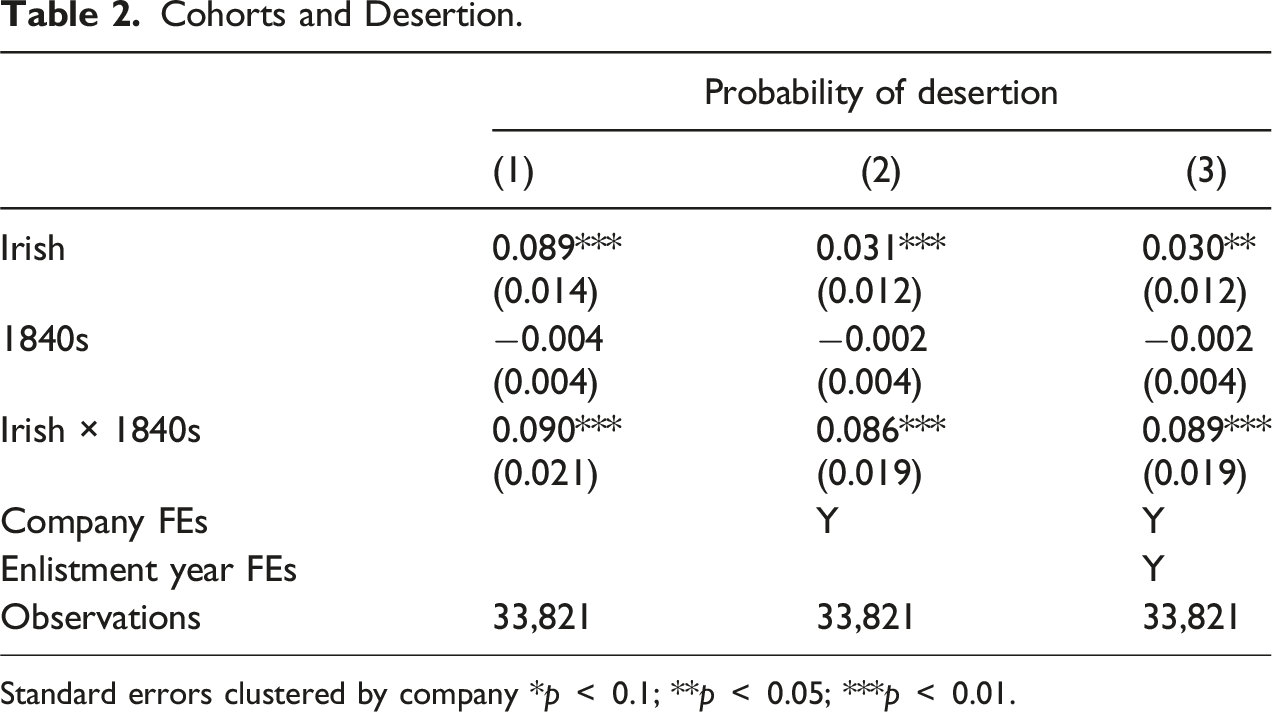
First, I argue that exposure to famine is more pronounced in its effects at a younger age. I follow existing literature that indicates youth socialization is important in the formation of political attitudes (Dinas, 2014; Jennings, 2007; Pop-Eleches & Tucker, 2014) and research which uses childhood exposure to events, such as war or famine, as a natural experiment (Kim & Lee, 2014; Meng & Qian, 2009). In essence, I contend that Irish emigrants to the United States who were younger during famine’s onset were more impacted by the event than their compatriots who were older during the famine. I argue that this generalized greater impact is salient irrespective of which mechanism is at play. For practical purposes I use 1840 as a cutoff for a younger cohort since it fulfills both being young in age during the famine’s onset (at most 6 years old) and also gives good power for interaction models since approximately half the sample is born in the 1840s. I show that the specific cutoff between cohorts which we use is not deterministic and results are unchanged by varying this year (Figure A1). This approach allows us to compare the extra effect of famine in one’s formative years controlling for the general behaviour of this birth cohort among other groups.
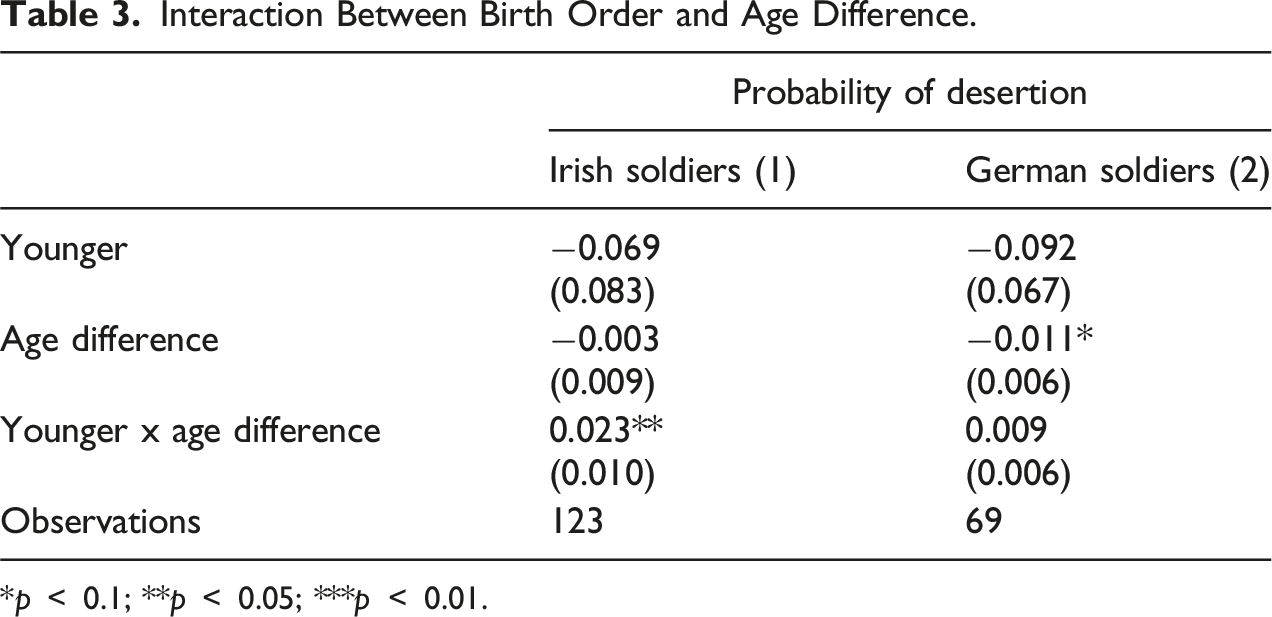
I supplement this age-at-exposure approach by comparing soldiers who are siblings. Older siblings serve as more appropriate counterfactuals to isolate the effects of age during the famine compared to simply older Irish-Americans since unmeasured differences in background are reduced. This also guards against unmeasured differences in the selection and composition of cohorts in this setting where age may be connected to immigration timing 3 . I compare within sibling sets to estimate how birth order affects the probability of desertion among Irish troops and interact birth order with age difference the logic being that brothers born far apart would have had more distinct experiences of famine. I deploy placebo models to estimate the effects of birth order on desertion for German and American brothers.
Height
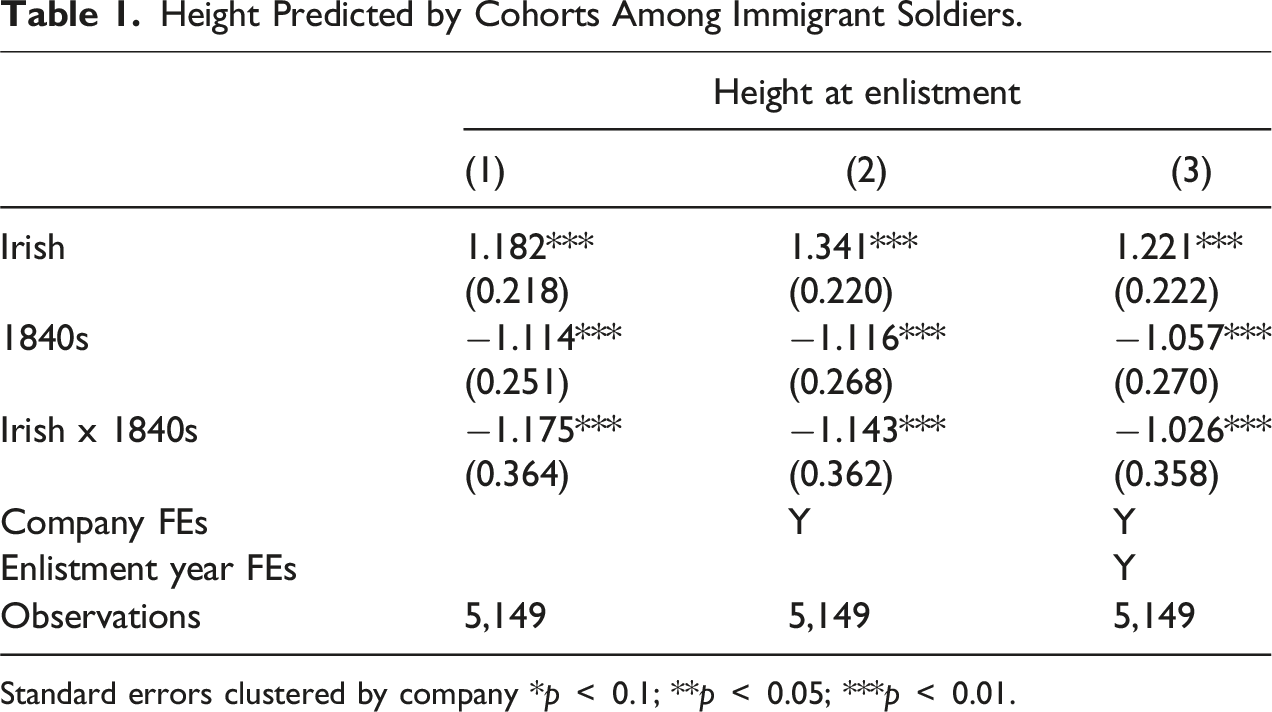
Height Predicted by Cohorts Among Immigrant Soldiers.
Standard errors clustered by company *p
Origins in Ireland
Thirdly, I construct a proxy of the intensity of famine by estimating the origins of troops within Ireland. I use the scraped Griffith’s valuation which contains the records of individuals’ names and place of residence in Ireland during the time period. The valuation was among tenants and smallholders to levy taxes, the same kind of mid-level farmers who emigrated to the United States (Grada & O’Rourke, 1997), and thus provides a useful distribution of names for a similar social strata as those who eventually fight in the Union Army. I create soundex codes from the last names of Irish soldiers to minimize confusion from inconsistent spelling and then filter the Griffith’s dataset to this set of soundex codes. I then group the Griffith’s data by each soundex code and calculate its spread across different baronies creating a matrix of shares for each soundex code-barony as a share of the total frequency of the soundex code. I merge this dataset with barony population change from 1840 to 1850 which is a raw estimate of the famine’s intensity in an area. I also use public works employment, a form of relief, as an additional measure of famine intensity in baronies. Public works and population change data comes from the Database of Irish Historical Statistics (Crawford et al., 1997) and Figure A7 in the Appendix shows the relationship between the two measures. I then multiply the soundex-barony coefficients by the indicator and sum these values to create a measure of each soundex code’s weighted-average famine exposure. 4
In Appendix Section S4 cross-validate this measure of origins using data from heights and donations to Irish food relief by troops (Shiels, 2024). I run regressions among Irish soldiers to show that the famine index constructed from public works and population change data is negatively correlated to height (Table A8). Intensity of the famine-exposure is positively correlated to donations to the food relief appeal (Figures A8 and A9). Soldiers with roots in places more affected by famine appear to have reduced heights and expressed their preferences by giving more to food relief in Ireland.
Cohorts and Families
Cohorts and Desertion.
Standard errors clustered by company *p
Figure 1 shows that Irish younger siblings desert more frequently than their older siblings. This result fits with the expectations that the effect of famine is greater when experienced at a younger age, leading younger Irish siblings to behave differently than their older brothers. Birth order matters within Irish families who enlist and serve together; the point estimate is 13 percentage points and is statistically significant at the 5% level with family fixed effects. The magnitude of these birth order effects is large and similar in magnitude to the cohort effects from Table 2. The birth-order effects of siblings dissipate outside the Irish group; placebo tests of German and American brothers serving together reveals null effects of birth order.
5
In this setting where we minimize confounding and selection by comparing inside families, the famine may be culpable for differential effects only found among Irish. The effect of being a younger sibling on desertion within families who served together.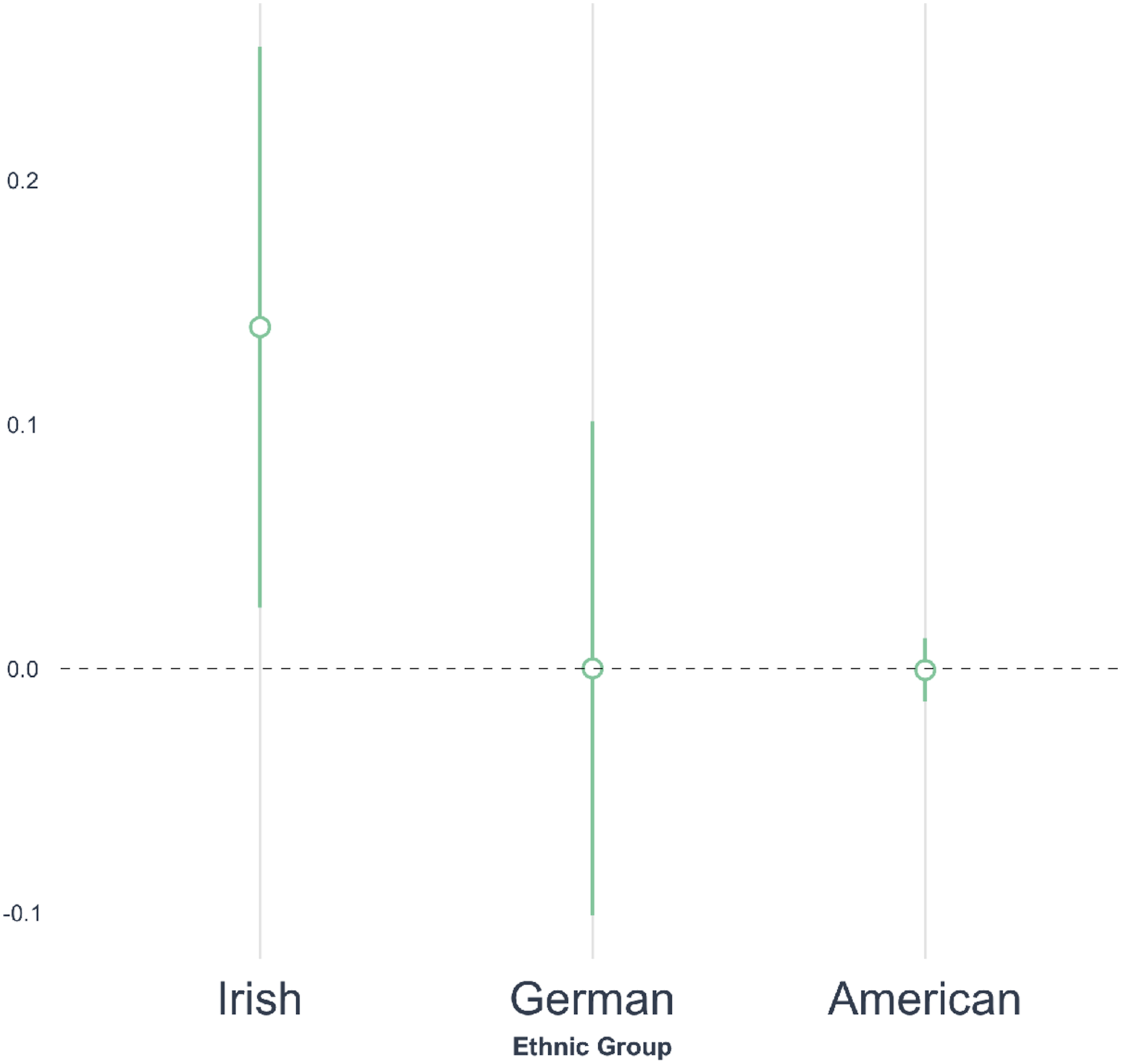
Interaction Between Birth Order and Age Difference.
*p
Height
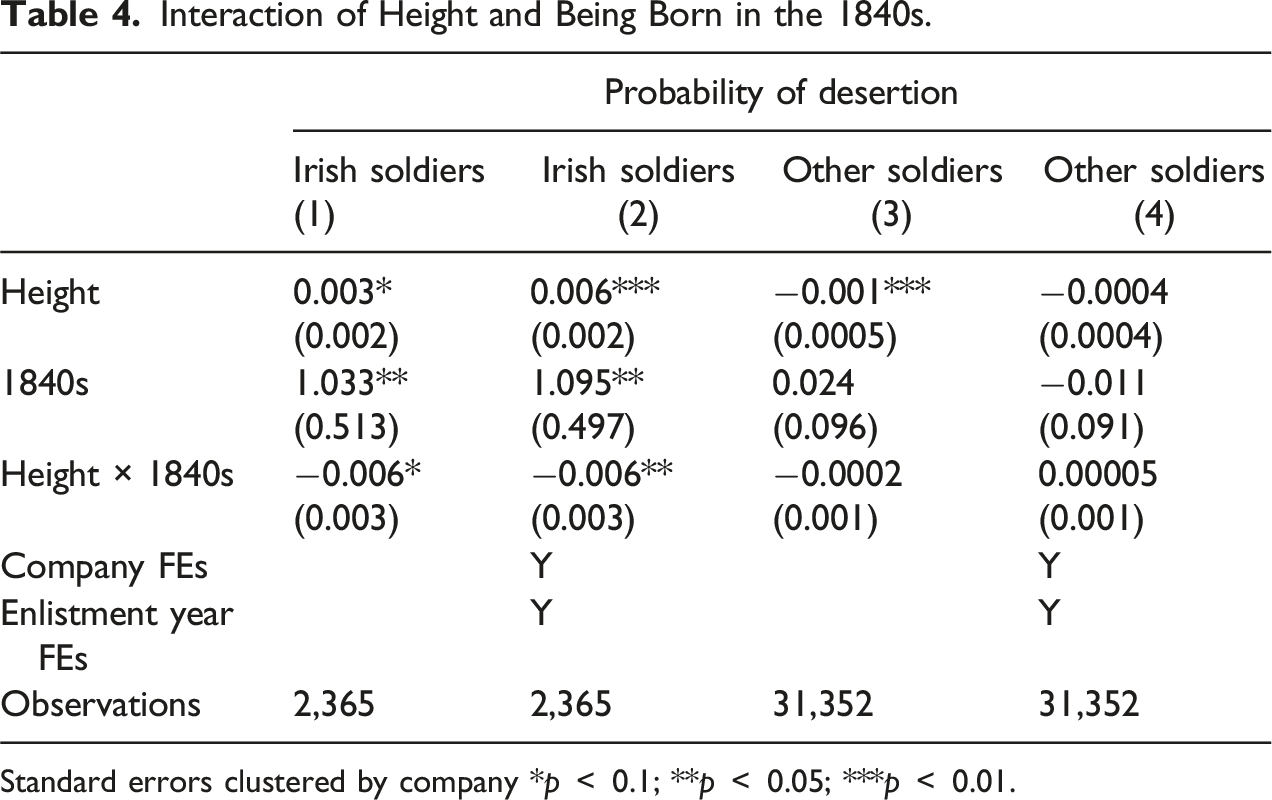
Adult height is reduced by famine specifically when it is experienced in utero and when under five years of age (Meng & Qian, 2009). Therefore, this can be used for measurement where identification hinges on this correlation of height and famine experience particularly within the Irish cohort born after 1840. I build from this by operationalizing height as a proxy for exposure to famine only within the youngest cohorts and construct interactions to test this.
Interaction of Height and Being Born in the 1840s.
Standard errors clustered by company *p
These findings depict how a subgroup where height is impacted by severe malnutrition from famine in youth sees divergent behaviour concentrated among its shorter members. Conceptualizing height as a proxy of famine, we are able to enhance the cohort and birth order estimation strategy. Genetic and other environmental factors clearly influence final adult height among soldiers. This strategy holds these constant by comparing multiple groups of soldiers and estimating how height is related to behaviour for different groups. Hence, we can infer that the physical toll of a childhood famine shapes behaviour on the battlefield; the relationship between height and desertion is changed when height is related to malnutrition.
The Communities They Left Behind
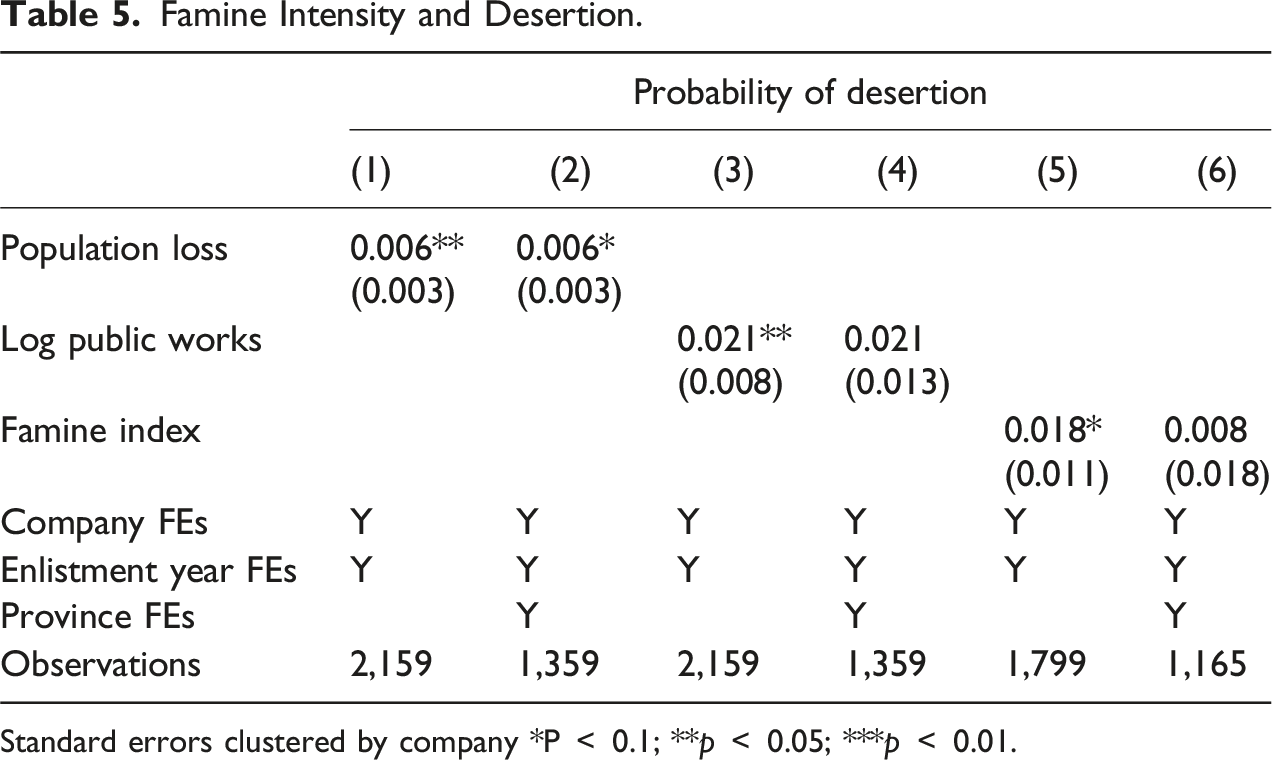
My third strategy involves linking soldiers to the range of possible communities of origin. I discuss the linking process in detail in the Empirical Strategy and the Appendix Section S4. I control for the soldiers’ year of birth and socioeconomic status to try and isolate a distinct metric of individualized famine effects and include province fixed effects for the region they likely had roots in before emigration to the US. The provincial fixed effect in particular also allows us to net out broader origin effects since there were considerable inter-province differences in un-observables before and during the famine.
Famine Intensity and Desertion.
Standard errors clustered by company *P
A strength of the public works approach is that it is a more direct proxy for intensity as population loss conflates death and migration but has its own limitations in temporal scope. I therefore also use a simple index of famine intensity by standardizing and combining the measures. The famine index is positively associated with desertion in both specifications but loses statistical significance with the inclusion of province fixed effects. I show in the Appendix Section S4 that as I increase the level of certainty for the province fixed effects this coefficient is positive and in some cases statistically significant.
Interpreting these findings theoretically is more complex than the previous two metrics of famine. Originating from a barony which has a relatively high rate of depopulation or public assistance during the famine has twofold implications. With greater population loss each individual could experience greater hardship 7 . A second interpretation may be that this famine-name exposure proxies for witnessing one’s family network and community collapse to varying degrees rather than individualized suffering. Unfortunately, assessing the relative import of these mechanisms is not possible but it is notable that, from the available evidence, famine exposure at a community level persists once an individual has emigrated.
Overall, this exposure measurement provides evidence for how localized experiences before migration influenced high-stakes decision making decades later in a foreign war. Survivorship bias might also play a role in this context since people non-randomly attritted during the famine as survival capacities were related to individual characteristics such as wealth and pre-famine health. Yet, the sample which I study is composed of individuals who successfully arrived in the United States and, given that it was relatively expensive to emigrate, were not from the same portion of society who largely perished in famine. Additionally, I control for age and a dummy for manual occupations to try and balance the sample and zero-in on this cross-sectional variation in geographic intensity. Since areas contained relatively different people, controlling for these individual characteristics attempts to isolate the famine’s additional effect.
Observable Implications
Drawing on the two competing mechanisms outlined in the theoretical argument I develop observable implications for this setting. I sketch the activation of each mechanism in terms of when it is most salient and how it interacts with socialization between troops. The context of the American Civil War implied task-based socialization between inexperienced troops as they served. This allows for a sharp prediction that risk aversion would increase desertion most at the start of service. Conversely, re-traumatization would lead to increasing desertion as new traumatic experiences accumulate over a campaign (Figure 2). Stylized observable implications of each mechanism.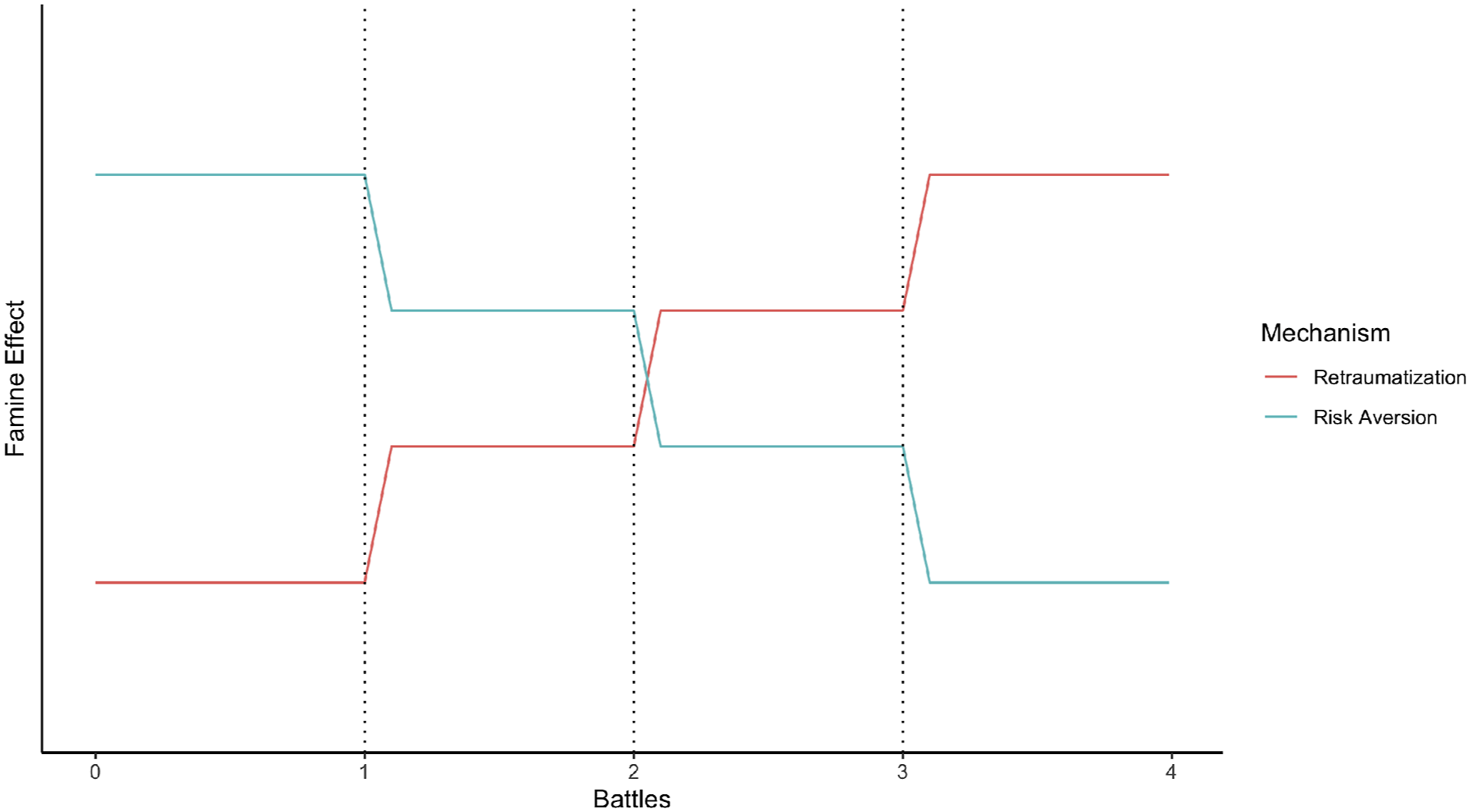
Risk aversion implies increased desertion since the relative risk of death outweighed the likelihood of a court martial passing a death sentence for desertion. However, as soldiers gain experience and successfully navigate front line duty, the perceived risk of fighting decreases. Simultaneously, soldiers build bonds and trust by engaging in collective risk-sharing during combat. This new-found trust also reduces the salience of risk-aversion in decision-making and makes desertion less likely over time.
Observable Implication I
If risk-aversion is the pathway from famine to desertion, the relationship will decrease in the number of battles.
Traumatic experiences on the battlefield can increase the attractiveness of desertion, either through a voluntary or involuntary response from the soldier. As a soldier serves, the increasing exposure to new traumatic events raises the likelihood of re-traumatization among famine-afflicted troops. Serving on campaign is central to forming networks between soldiers in a unit during the American Civil War. Novel trauma would interrupt this socialization process more if soldiers are undergoing a greater reaction to their battlefield experiences. This fresh trauma and interruption of group dynamics makes desertion more likely over time.
Observable Implication II
If re-traumatization is the pathway from famine to desertion, the relationship will increase in the number of battles.
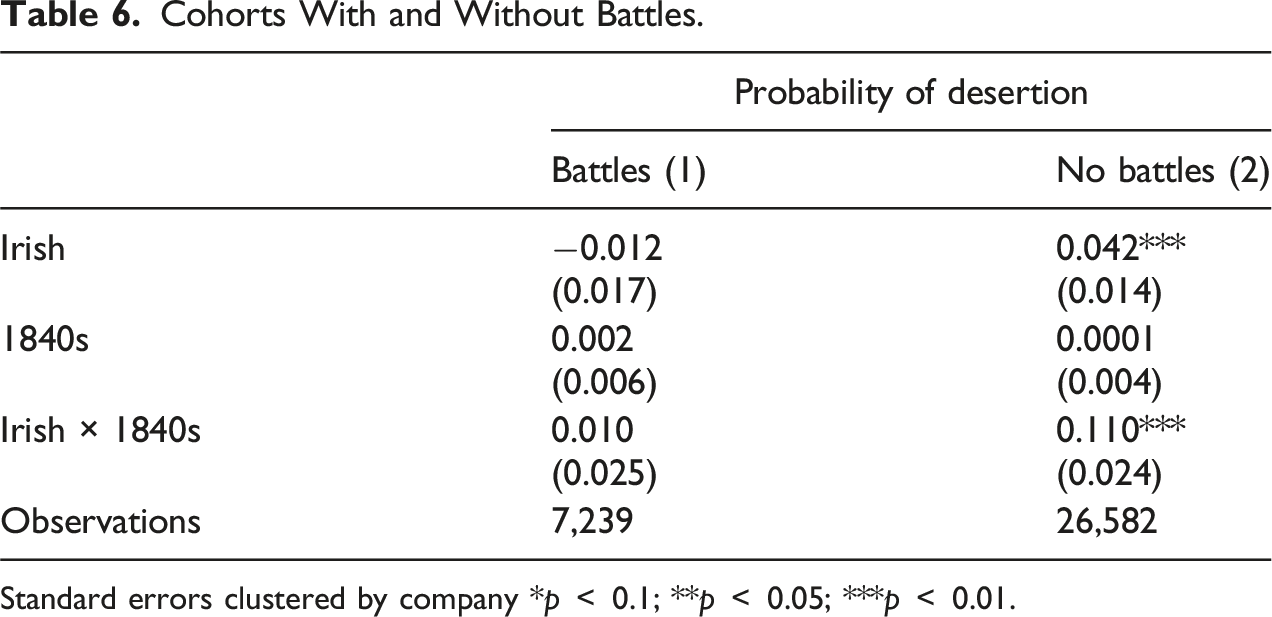
Cohorts With and Without Battles.
Standard errors clustered by company *p
Table 6 shows the famine cohort desert 11% more frequently than their older Irish counterparts in the sub-population that is without large scale engagements. While selection into ever facing engagements is evidently occurring in this sample splitting strategy, the notable finding is that, temporally, the Irish-American and famine-driven pattern of desertion is not taking place in the aftermath of fresh trauma from extreme violence during battle. Instead, it is concentrated among troops who do not enter large battles and is indicative that it is not a post-battle induced shock which would have been consistent with re-traumatization.
This finding is supplemented by evidence in Appendix Table A11 which plots the outcome of mental illness among veterans’ pension applications as a function of immigrant group. Although a rare outcome and poorly diagnosed at the time, insanity and a range of nervous diseases are sometimes cited in medical evaluations of veterans. The Irish troops were no more likely to exhibit mental illness in their pension applications than other nationalities of deserters or the native born. This metric is dependent on doctors’ evaluations and could be subject to bias, yet this proxy for re-traumatization is the opposite direction of what we would expect if it was active. Irish veterans, despite their higher desertion, do not exhibit more frequent mental health issues.
Dynamics of Desertion: a Case Study of New York Regiments
I further test observable implications from theory using a case study. I select the 52nd and 88th New York Regiments since each had a distinctive national character with the 52nd consisting of Germans and the 88th consisting of Irish. As noted, these two regiments were matched on deployment schedules, had nearly identical casualty levels, and were recruited from the same city 8 . Additionally, these regiments were the same size and, given we hold constant the sources of attrition from the regiment due to the matching strategy, we can compare the absolute level of desertion without transformations. I look within the sub-sample of deserters to elucidate how and when soldiers left duty. Overall, the 52nd (German) Regiment had 158 soldiers desert and the 88th (Irish) Regiment had 301 soldiers desert. Members of the 88th Irish were almost twice as likely to desert than their German counterparts which echoes with the army-wide results.
I coded the dates which soldiers deserted from the biographical details regimental rolls included for each soldier so I can map the temporal patterns for each regiment. Figure 3 plots the results of this stage of the analysis, where desertions are summed for each regiment-month of the war. Immediately obvious is the spike in desertion rates for the Irish regiment in the war’s initial months; in late 1861 dozens of soldiers desert from the 88th on a monthly basis before active combat began. By the middle of 1862 as the large pitched battles of the civil war intensified the two regiments’ desertion levels are similar. The frequency of desertion in the German and Irish Regiments exhibit a wave-like pattern from early 1862 but the peaks and troughs in frequency do not appear to coincide across the two regiments; the 52nd (German) saw the most significant wave of desertion in late 1863 whereas, within the time of active battles, but the 88th (Irish) increased in early 1864 and the final reaches of the war in 1865. The scale of desertion is similar across the two regiments from the start of 1862 until the war’s end and the pattern fits with the observable implications of risk aversion. Timeline of desertions for Irish and German regiments.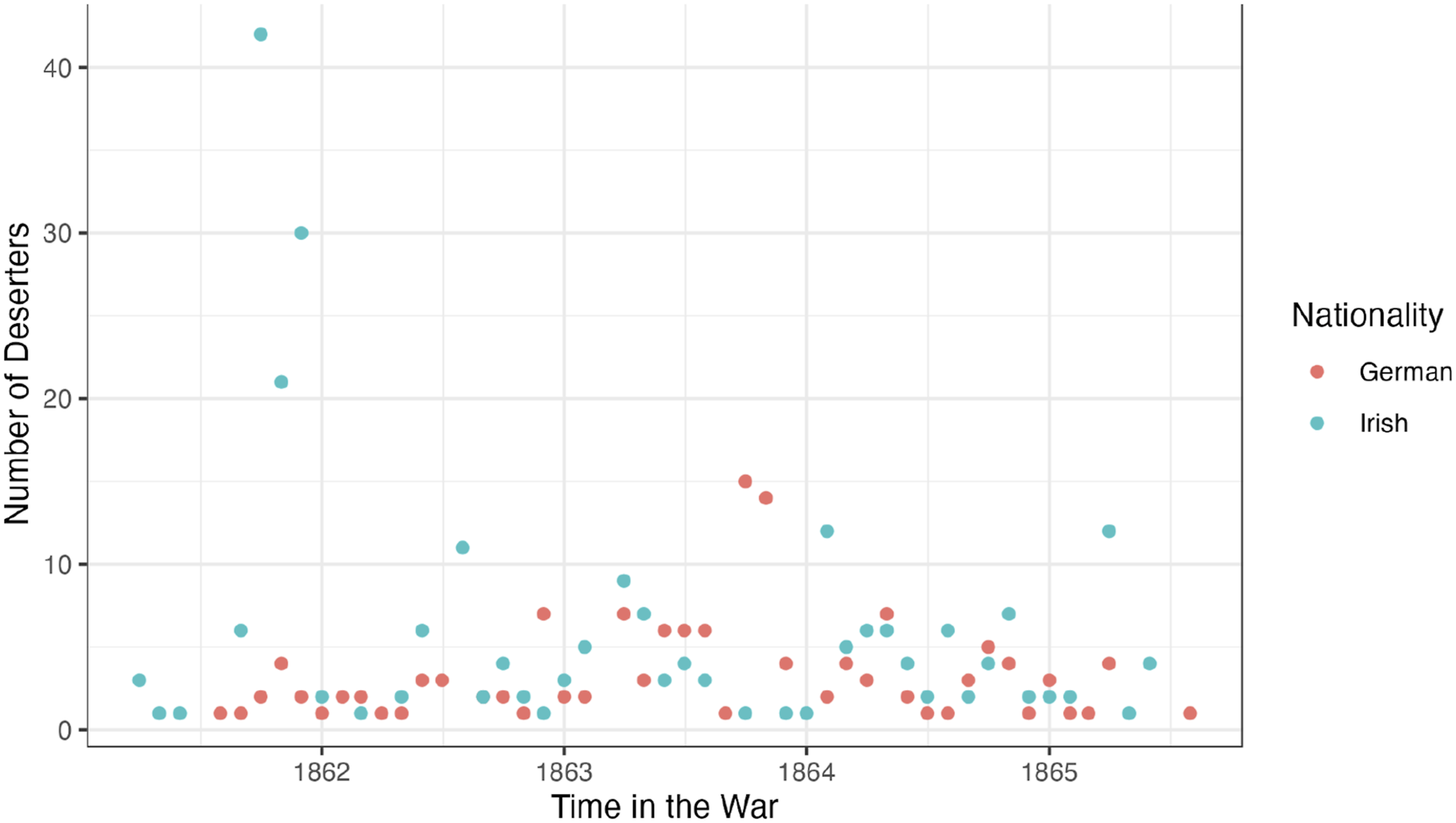
Moving beyond the temporal dimension I develop a typology of deserters outlined in Figure 4. The first type of desertion are troops who leave within the first weeks and this type of deserter is substantially over-represented in the Irish Regiment (Figure 4). Over 100 soldiers from the Irish Regiment deserted in this way while only 30 from the German Regiment exhibited this behaviour. In the war’s early months, monetary rewards for signing up to the army had not been introduced and so this is not symptomatic of collecting bounties for enrolling and then defecting. Across the war, the 88th Irish suffered from wide-scale desertion before troops were socialized in combat; a finding which manifests the observable implications of high risk aversion. Types of desertion in each regiment.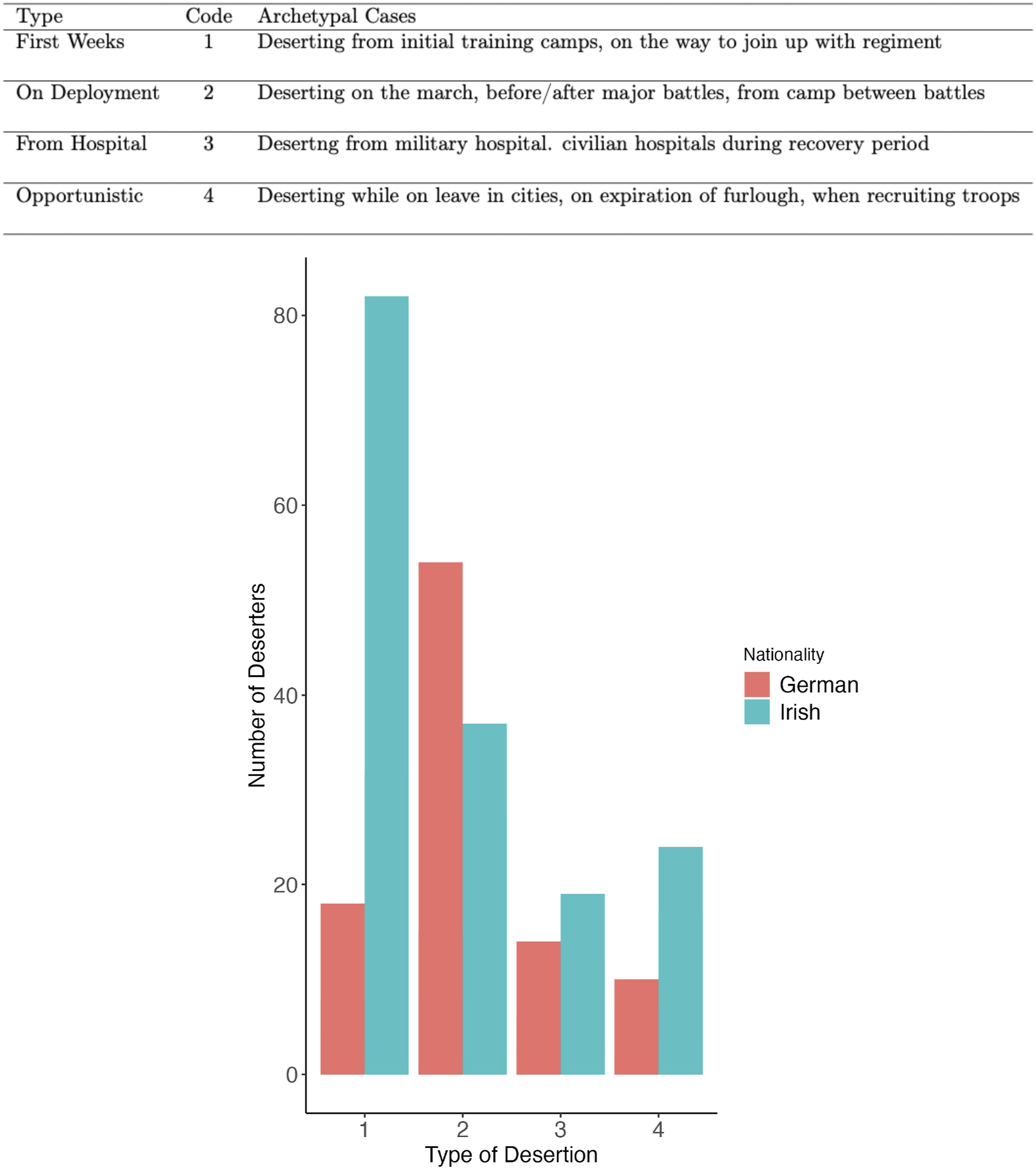
However, the German 52nd had more deserters during active campaigning in the war. Indeed, approximately half of the 52nd’s deserters left service through this means whereas for the Irish 88th fewer in absolute and relative terms chose this option. In general it fits with the broad finding that once socialized into active combat, Irish soldiers are no more likely to desert than others. Desertion on campaign, the kind which populates our imagination of wartime activity, is not driving the main results. Additionally, the fourth type of desertion, opportunism, was more than twice as frequent in the Irish 88th than the German 52nd. When dispatched from active duty to the cities of the East Coast, Irish troops were twice as likely to not return to their units. Although relatively small in absolute terms, the 45 Irish deserters who eloped by this means could provide some evidence for hostility to the war in their home community inspiring defection. As the war drew on, Irish communities became more suspicious of the war’s aims and the mass episode of desertion in late April 1865 while in New York City fits with this explanation.
This case-study underlines that the first weeks of service were the key difference between Irish and German aggregate outcomes; once socialized into the military via battlefield actions commencing in early 1862, Irish and German troops exhibit very similar behaviour. This case study also highlights civil war desertion as multifaceted with economic incentives, injury and trauma, and the preferences of home communities all playing a role (Kalmoe, 2020). Nevertheless, the net difference between Irish immigrants with famine pre-arrival and German immigrants is borne out in the first weeks of service. Two Immigrant groups living in New York City with identical deployments throughout the war have large differences in desertion until combat begins.
Alternative Explanations
Irish soldiers affected by famine before migration desert at elevated rates. The temporal dynamics of this process outline that this effect is concentrated in the early portion of a soldier’s service. The theoretical explanation for this relationship is that famine elevated risk aversion. Over service, as soldiers build tight bonds with their fellow troops, the perceived risk of remaining to fight declined. It is important to evaluate alternative explanations for these two empirical observations; that famine raised desertion and that this activity is clustered at the start of a soldier’s tenure.
I discuss two broad sets of explanations which might satisfy the criteria for explaining the patterns found in this paper. The first set explore how the famine could influence identity and discrimination against Irish soldiers. The second set of arguments tackle more prosaic factors such as soldier pay and selection into different roles in the army. Each of these arguments might fit with the empirics. If Irish soldiers joined and immediately faced prejudice, or realized the physical toll of soldiering was excessive, they may desert early in service. However, I show that none of these posited alternatives explain the findings of the paper.
Irish identity
Experiencing a famine induced by colonial incompetence (Grada & O’Rourke, 1997) may calcify group membership, augmenting Irishness, therefore reducing loyalty to the war’s cause and increasing desertion. In framing the famine as akin to government-instigated mass repression, greater exposure might augment in-group identification as in the Holodomor where greater intensity was associated with sharp anti-Russian preferences and soldier behaviour among Ukrainians (Kalyvas, 2006; Rozenas & Zhukov, 2019). Historians have argued that mobilization was initially tied to the prospect of preparing for a future war of independence in Ireland and thus a famine-induced Irish identity might have initially motivated troops to enlist (Ural & Bruce, 2006). Yet, as the war extended over several years and a domestic agenda such as the abolition of slavery more overtly motivated conflict, Irish troops may have increasingly deserted. I test this with company-level variables using the logic that if Irish identity is heightened by famine then serving alongside other Irish soldiers would have differential effects. In Figure 5, we see no interaction between company composition and desertion for different Irish birth cohorts. The elevated level of predicted desertion is clear for the 1840s famine cohort but the slopes are statistically indistinguishable. Desertion rates by Irish share in company for two Irish birth cohorts.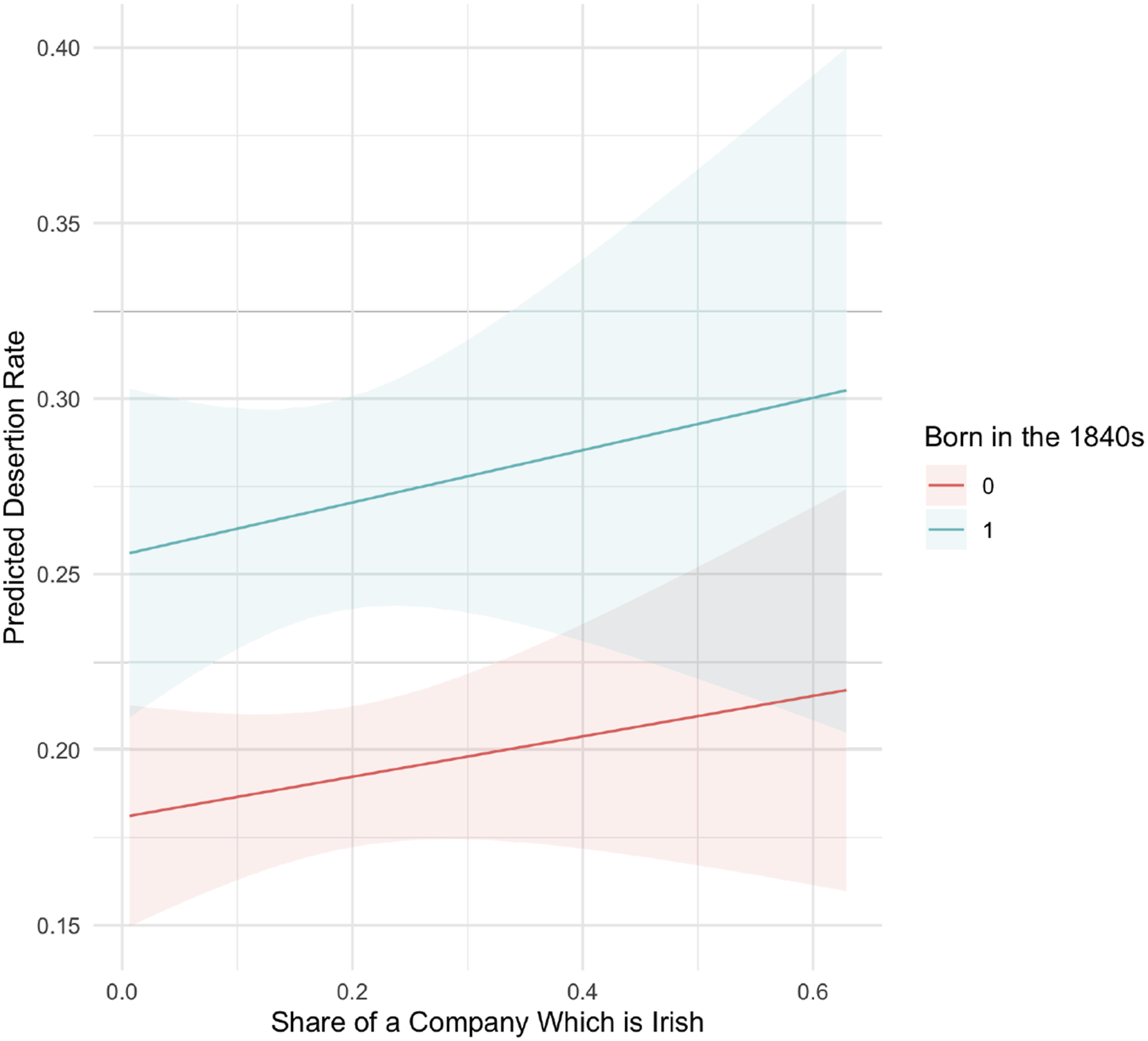
Prejudice and discrimination were frequent against the Irish in large part due to the anti-Catholic fervour which was commonplace at the time (Alsan et al., 2020). Although this discrimination hypothesis likely holds water for the Irish group en-masse, it fails to explain why the cohort of Irish born and raised during the famine would desert at higher rates. It is unlikely that they would face extensively higher discrimination than their counterparts just a few years older and the continuation of elevated desertion rates in Irish-majority units (Figure 5), which would often have Irish officers, is inconsistent with this explanation. Also, the 88th New York Regiment which was part of the case study was an explicitly Irish regiment. It served as part of the famed Irish Brigade and under Irish-born officers. We see the elevated desertion rates relative to the 52nd German Regiment despite this Irish leadership. While we cannot directly test for discrimination, the consistency of the relationship when soldiers are surrounded and commanded by other Irish men does not fit with a famine-induced discrimination argument.
Another related explanation could be that the famine cohort born in the 1840s arrived in the United States more recently which could drive the effects. I summarize the average year of arrival in Table A12. The 1840s birth cohort did arrive closer in time to the onset of war and the difference between cohort arrival times is slightly larger for Irish. Yet, the Irish arrived, on average, longer before the start of the war than German or English soldiers. This fact is in contrast to an explanation where Irish were newer arrivals, less motivated, and so deserted more often. I run a placebo regression using year of arrival among a subset of soldiers for which it is available and show the null results on desertion in Table A13. Soldiers who immigrated earlier and later desert at the indistinguishable rates within each immigrant ethnicity.
Pay and selection
The Role of Socioeconomic Status.
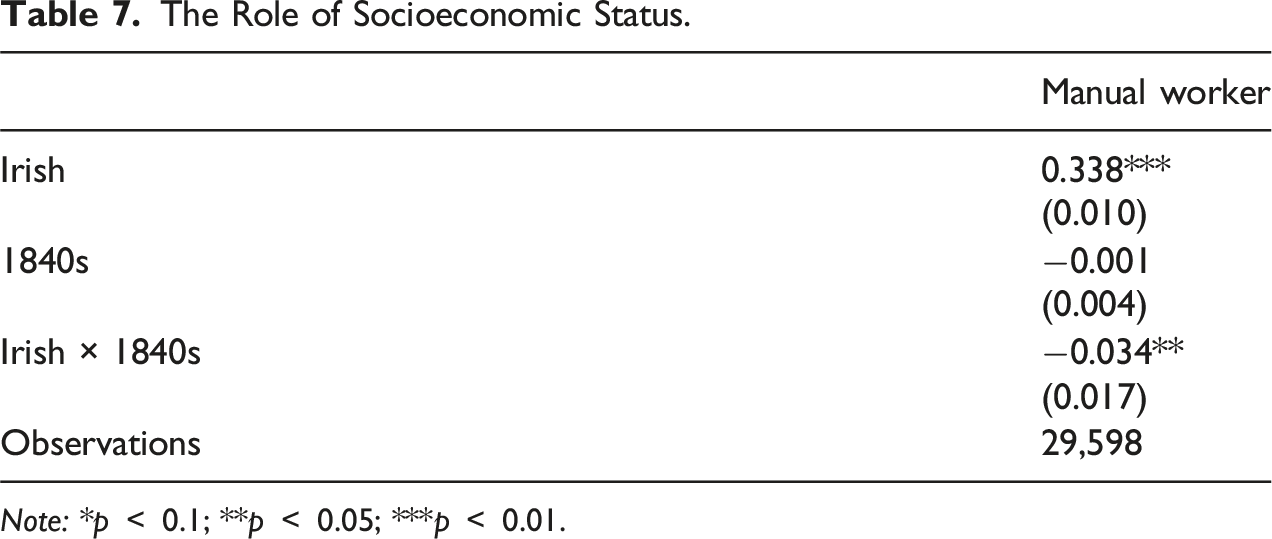
Note: *p
Furthermore, physical disadvantages from childhood famine could impact desertion. I consider this unlikely since there is a baseline of health which was necessary to be accepted for service. This floor effect would prevent soldiers more severely affected by famine from being either physically unable to perform military duties and thus deserting from service. Nonetheless, I check for this possibility using wounding and a logic that physical disadvantages would render soldiers more likely to be injured in service. Appendix Table 14 shows no effects of famine-induced malnutrition, measure by height and cohorts, on the probability of being wounded. Moreover, the increased desertion among Irish soldiers is concentrated among younger soldiers who experienced the famine in their youth (Table 2). We would expect that physical weakness would be positively correlated with age; despite facing malnutrition in youth, a 20 year old soldier would on average be more physically capable than a 40 year old. The lack of an effect on injury during battle and the greater desertion among younger soldiers runs contrary to the account of physical weakness.
Additionally, famine-afflicted soldiers might be assigned to systematically different roles and careers in the military which could be driving desertion rates. This selection process might be initiated by soldiers themselves or their officers. I rule out this alternate mechanism in Table A15 by showing that famine exposure does not predict whether or not soldiers participated in at least one large battle. Also, I seek to understand at a more granular level whether soldiers’ duties are an explanation. If soldiers affected by famine are systematically assigned to undesirable duties within the armed forces the this could spur desertion. I analyze the following roles; cook, medical staff, picket duties, teamsters, provost guards and pioneers. I find that the famine cohort was slightly more likely to be assigned to the teamsters which managed logistics with mules and wagons (Table A16). I probe this finding further with discussion of the selection processes which could cause this (Appendix Section S6). I illustrate that overall the teamsters were less likely to desert than other troops (Table A16) and therefore the relationship is in the incorrect direction to explain the results.
Discussion
The US Civil War marked the advent of modern industrialized warfare and pitted armies composed of a spectrum of nationalities against one another over the course of four arduous years. Irish-Americans, newly arrived in the country served, and this marked the start of the group claiming its space alongside the white American population (Samito, 2011). These Irish were the first wave of ‘poor and huddled masses’ which fled Europe during the Age of Mass Migration and settled across the United States to escape hunger and oppression in Europe. I argue that these Irish immigrants’ behaviour after arriving in the United States was shaped by what they experienced in the old world, namely that on the battlefield of the Civil War the echoes of famine which prompted their exodus were brought into sharp relief. In particular, I contend that to some degree soldiers’ decisions were rooted in Ireland over a decade before war’s onset.
This finding carries insights into how behaviour is altered by traumatic events and how these shocks continue to influence people even once they have emigrated away from the site of the incident. Previous research on how violence and trauma affect political behaviour are centered around contiguous geographical space which can pose a challenge to understanding the level at which these shocks persist over time; if they are nested at the community level, families, or within individuals (Charnysh & Peisakhin, 2022). This work contributes to underlining how individuals geographically and temporally removed from the context of trauma continue to exhibit traits associated with the experience.
In addition, this case offers an opportunity to study how traumatic shocks mold behaviour without partisan preferences playing an outsize role. Typically people who undergo this kind of trauma where blame can be clearly attributed will form partisan preferences against the instigators which will subsequently shape behaviour 10 . Here, I do not study how the Irish Famine experience generated anti-British preferences and how this may have contributed to the decision to take up arms against the British in the War of Independence (Henn and Huff 2021; Narciso & Severgnini, 2023). While partisan preferences overshadow other subtler behavioural changes, the veil of partisanship is lifted by studying the activity of emigrants in a war where neither side was associated with the onset of famine.
The mass mobilization of the American Civil War has served as a laboratory for historians and social scientists to understand behaviour. Soldiers’ behaviour has received examination as a function of soldiers’ principles (McPherson, 1994), home communities (Kemp, 1990), the social capital of soldiers in service (Costa & Kahn, 2003), and the experiences they acquired on the battlefield (Linderman, 1987). These findings have been replicated in other civil wars with extensive research aimed at understanding how soldiers’ origins influenced decisions (McLauchlin, 2020). This study offers a new but connected explanation for why some soldiers desert; a famine in their homeland. By analyzing the socialization process for soldiers and a pre-war trigger this finding draws from established theories that life away from and on the battlefield matter in the calculus of whether to desert. While this study does not repudiate existing research on the war or soldier behaviour more generally it highlights a new channel which interacts with known proximate causes of desertion. Thus, we gain a fuller understanding of what drives people’s actions during war.
I draw from literature concerned with a diverse set of famines to theorize behaviors which may result and nest my theoretical and empirical approaches within insights from the civil war literature writ large. The scope conditions of this work might mean that they do not travel to other contexts; the process of migration away from home communities might activate the behavioural responses to famine which I argue drive wartime behaviour. Future research should explore this co-occurrence of traumatic events to explore different behavioral outcomes and test how the relationship shifts across generations. Similarly, fertile ground to explore includes how the integration process of immigrants after wartime service may vary conditional on soldiers’ experiences before arrival. If famine influences the service history of Irish immigrants then it is plausible that repercussions could reach the post-war assimilation process (Mazumder, 2019; Samito, 2011). Lastly, further work on contemporary settings where mechanisms can observed in lab-in-th-field experiments would enrich this area of research.
Supplemental Material
Supplemental Material - Early-Life Origins of Wartime Behaviour: The Irish Potato Famine and Desertion in the American Civil War
Supplemental Material for Early-Life Origins of Wartime Behaviour: The Irish Potato Famine and Desertion in the American Civil War by Dylan Potts in Comparative Political Studies.
Footnotes
Acknowledgments
The author thanks Miriam Golden, Elias Dinas, Sergi Martinez, Manuel Sola Rodriguez, Vicente Valentim, Kasia Nalewajko, Antonella Bandiera, Cyrus Samii, and Jason Wittenburg for discussions and comments during the early stages of this project. I am especially indebted to all members of Miriam Golden’s lab at EUI on multiple occassions for their input. I am also thankful to comments from participants at The EUI-Oxford-Graduate Institute Geneva Conference 2021, EPSA 2022, and the Political Methods Seminar at NYU. I am very grateful for the suggestions from the three anonymous reviewers. Their careful readings of the paper substantially improved the manuscript.
Declaration of Conflicting Interests
The author(s) declared no potential conflicts of interest with respect to the research, authorship, and/or publication of this article.
Funding
The author(s) received no financial support for the research, authorship, and/or publication of this article.
Data Availability Statement
Data and code for replication is available at “Replication Data for: Early-life Origins of Wartime Behaviour: The Irish Potato Famine and Desertion in the American Civil War” (Potts, 2023) 
Supplemental Material
Supplemental material for this article is available online.
Notes
Author Biography
References
Supplementary Material
Please find the following supplemental material available below.
For Open Access articles published under a Creative Commons License, all supplemental material carries the same license as the article it is associated with.
For non-Open Access articles published, all supplemental material carries a non-exclusive license, and permission requests for re-use of supplemental material or any part of supplemental material shall be sent directly to the copyright owner as specified in the copyright notice associated with the article.
