







Abstract
This paper examines the global cleavages that structure world politics from the mid-19th century to the present. It develops the concept of cleavage applied at the global level and measures empirically how territorial divisions give way to the politicization of various types of inequality along functional lines cutting across world regions. Covering over 300,000 articles from The Economist between 1843 and 2020, the analysis applies semi-supervised computational text analysis based on word embeddings to capture the territoriality−functionality continuum in global discourse. This method allows testing the theoretical expectation that the territoriality in the politicization of global divisions has diminished historically. Results reveal a trend toward the de-territorialization since World War II, primarily for cleavages about social and economic inequality. Although spikes of territoriality re-appear during interstate wars throughout the entire period, surges of territoriality are temporary and do not reverse the historical trend towards prevailing cross-territorial divisions.
Keywords
Introduction: The Globalization of Politics?
Debates about the nature of global divisions abound both in academia and in the broader public sphere as current political rivalries, economic competition and war seem to reverse global integration. While many actors and scholars see global cleavages as dominated by territorial divisions between unequal world regions – West versus East, core versus periphery, democracies versus autocracies, North versus South or between civilizational areas – others point to the increasingly functional nature of global oppositions, such as transnational class inequalities in income and education, oppositions between people and elites or inter-generational conflicts about values and policies that cut across territory.
However, a theory of political cleavages at the global level and a long-term empirical analysis have so far been lacking. This paper theorizes the politicization of global inequalities by extending cleavage theory to the global level. It then measures the transformation of the global cleavages that structure the geographical and ideological space of world politics empirically, adopting a long-term perspective from the Industrial and National Revolutions of the 19th century to the present. Using an untapped source of data, it tests whether the nature of global cleavages mainly consist in territorial oppositions between world regions or in transnational oppositions that cut across the global geography.
Cleavage theory, as opposed to the mapping of inequality and IR conflict analysis, has never been applied to the global level. It has been limited to institutionally fully-formed nation-states with their clear territorial and membership boundaries achieved through the processes of state formation and nation-building (Bendix, 1964; Rokkan, 1970). As part of this structuring process, which runs parallel to the removal of internal boundaries through economic, political and cultural integration, territorial divisions yielded to non-territorial ones (Caramani, 2004; Chhibber & Kollman, 2004). The change from territorial to functional also took place in the incompletely formed European polity (Bartolini, 2005; Caramani, 2015). This paper goes a step further, extending cleavage theory to the global level, which is crucial not only for the present time but the whole era starting with industrialization, colonization and global trade in the 19th century (Caramani, 2024). Cleavage theory is thus enhanced by considering the connections between issues, actors and publics across polities and world regions. This departs from recent work on cleavages that remains confined to separate domestic settings. 1 Yet it incorporates the rich insights coming from contributions about spatial tensions and the territoriality of inequality at national level (Beramendi, 2012; Huijsmans & Rodden, 2024).
Global cleavages emerge from the politicization of unequal distributions of economic resources, political influence and socio-cultural status. Unequal distributions of these “rights” create territorial oppositions to different degrees and in various shapes over time. Insofar as cleavages are politicized inequalities – not simply unequal distributions as mapped by economic or sociological research – their framing in the global discourse is crucial. The theoretical expectation of a “globalization of politics,” which this paper analyses empirically, is that territoriality in the politicization of global inequalities fades and is progressively replaced by functionality, similarly to processes at the national and European levels (Caramani, 2004; 2015). The long-term perspective makes it possible also to address the intermittent reactivation of territoriality, namely during wars.
Multiple disciplines have analysed global territoriality. World-systems theory (since Wallerstein, 1974) and industrial and technological history identify core−periphery and North−South divisions, as well as colonial blocs (Landes, 1969). The macro-historical tradition (Braudel, 1993) and cultural and psychological approaches (Eisenstadt, 2006; Hofstede & Bond, 1988; Huntington, 1997; Inglehart & Welzel, 2005; Nisbett, 2004; Rokeach, 1973) identify “value maps,” “multiple modernities,” clashes of civilizations and contrasting East–West worldviews. Studies of global trade flows highlight divisions between creditor and debtor economies, and between rule makers and rule takers (Findlay & O’Rourke, 2007), whereas institutional studies and IR distinguish security blocs (Alker, 1964; Holloway, 1990) and democratic and autocratic regimes (Bartels, 2016; Gartzke, 2000, 2007). Territoriality also appears in “archipelago” shapes with local industrialization (Pomeranz, 2000) and global metropoles (Barber, 2014; Taylor, 2003).
World systems and dependency theories address a variety of distributive inequalities but they do not consider the ways in which they are politicized. Similarly, work on economic inequality (Bourguignon, 2015; Milanovic, 2016) focuses on factual inequality, therefore neglecting contestation and the way in which global inequalities are ideologically politicized into cleavages. Empirical evidence in this literature shows that inequality increases within countries but decreases across them. Yet while this literature contemplates class inequalities across regions, it does not analyse the politics of the de-territorialization of global divisions. Politicization is typically limited to territoriality “within” polities. This paper asks how actors and publics are opposed “between,” or create alliances “across,” borders worldwide.
Given its focus on the politicization of global inequality, the analysis relies on text data about the nature of global political oppositions. It applies semi-supervised automated text analysis in an innovative way on articles published in The Economist between 1843 and 2020, an English-speaking, global and continuous source of material on how cleavages are framed across historical phases and types of socio-economic, political and cultural inequality. Relying on a computational scaling technique (Latent Semantic Scaling), the analysis places articles on a territory−function dimension to show that, over the past 180 years, the territoriality of cleavages has been decreasing and gradually replaced by alignments that pit groups, rather than world regions, against one another. This method is established in the analysis of political oppositions and particularly suited for historical analysis, allowing to reach back in time.
The paper starts by theoretically extending cleavage theory to the international setting. The methodological section operationalizes the politicization of cleavages by applying semi-supervised automated text analysis to the territory−function continuum to explore a new source of data. The results section presents empirical evidence of de-territorialization in global politics since the mid-19th century and possible reversals toward new territorial divisions linked to international conflict. The conclusion addresses normatively the implications of global cleavage structures for global governance and points to future research.
Territorial Versus Functional Cleavages in World Politics
The analysis of global cleavages is concerned with contestation over inequalities that takes place increasingly between groups across polities and world regions. By extending cleavage theory to the global level, the approach in this paper challenges the notion that socio-economic, social and cultural structures should be analysed exclusively at the domestic level without looking at the connection between issues, actors and publics located in separate polities and world regions.
We define cleavages as oppositions between social groups about the distribution of resources or – at the most general level – “rights” (Caramani, 2024). Cleavages are structural oppositions between various types of groups with competing preferences about the allocation of socio-cultural, political and economic rights. Social classes and casts, genders and generations, ethnicities, denominations and groups defined by their members’ sexual orientation fight over the distribution of different resources, from economic benefits and educational opportunities, to marriage and adoption rights, and the rights to vote and protest. Preferences about the degree to which unequally distributed rights should be corrected to be distributed more equally constitute political dimensions. 2
Political cleavages are therefore not simply differences of identity and values (Huntington, 1997; Inglehart & Welzel, 2005), nor are they simply inequalities between groups (Milanovic, 2016; Wallerstein, 1974). While cleavages entail the structural element of the unequal distribution of some resource across groups, they become cleavages once they are politicized, that is when grievances about the distribution of such resources are voiced by actors with conflictual preferences. Groups’ differential access to rights transforms into a political cleavage when actors contest their distribution and voice groups’ demands that inequalities be corrected. An opposition, in the definition above, is therefore more than an inequality, and cleavages result from competing, opposing, discourses by actors that mobilize groups.
Cleavages arise “within” systems, that is, polities with delimited spatial and membership boundaries that achieved a certain level of closure. The concept covers conflicts between groups and regions under conditions of shared sovereignty and thus is broader than the definition of interstate conflict in IR. In the terms introduced by Hirschman (1970), these are situations where “exit options” are not available. In non-market conditions like the state, exit options are territorial (secession and migration) (Finer, 1974). Nation-states are the political units that have achieved the highest degree of territorial and membership closure through state formation (territorial boundaries) and nation-building (membership boundaries, or “loyalty”). Escaping state authority, for residents and members of such polities, is nearly impossible. 3 The transposition of Hirschman’s exit−voice model to the state (Rokkan, 1974a, 1974b) explains the rise of both voice institutions and actors channelling grievances when exit options are reduced. The internal emergence of cleavages, as well as the development of institutions that channel competing demands, is a consequence of external territorial and membership closure. The reduction of exit options leads to voice. Accordingly, it is in integrated systems that cleavages emerge.
With no integrated supra-national polity and no authoritative value allocation, the global level presents conditions for the emergence of cleavages that are radically different from national systems and even the forming European political system. 4 To what extent can we speak of political cleavages at the global level? On the one hand, the politicization of inequality faces the challenge of not having decision-making institutions that could be used to voice grievances. On the other hand, in a context of sovereign nation-states, the conditions of closure and exit reduction are at the minimum.
Yet it is plausible that the world’s supra-national political integration and economic interdependence, as well as its cultural homogenization and legal limitations on national sovereignty that combine with market constraints provide the conditions necessary for the emergence of global contestation over the unequal distribution of global resources (Viola, 2020; Voeten, 2021). In a world system, resources are distributed unequally and in a way that is conducive to conflict. While the world is not one political system, the distribution of resources is nonetheless unequal, creating the conditions for the emergence of cleavages. Processes of penetration into the “peripheries” of the globe create the conditions for the emergence of contestation. Through protracted economic and financial interdependence, political integration in international institutions and agencies, cultural homogenization, limitations on national sovereignty and regulatory convergence (Haggard and Kaufman, 1992), a global closure of some sort is achieved, favouring the emergence of global cleavages.
Diverse areas of unequally distributed rights and resources can be politicized by discourse around them, from the unequal right to marriage to access to water. Marshall’s (1964) typology of rights is useful to distinguish three broad areas of inequality whose politicization gives rise to cleavages: • Social and cultural inequality: cleavages over the extent to which personal rights and freedom of choice, such as expression of one’s own culture and sexuality, marital and educational choices, decisions over one’s own body, are unequally enjoyed. • Political inequality: cleavages over the extent to which power and influence (military and diplomatic), but also political rights and civil rights in the form of participatory and expressive resources, are unequally distributed. • Economic inequality: cleavages over the extent to which income, wealth, access to housing, health services, education and food, as well as exposure to economic (but also environmental and health) vulnerability are fairly distributed.
There are therefore parallels with cleavage theory at national level in phases of national centre–periphery tensions as well as for regional integration in Europe. As for the national and European level, closure and the formation global cleavages has to be understood as an evolution, a process of formation over time. 5 Furthermore, progressive global integration can be expected to transform cleavages from territorial to functional, that is, between membership groups cutting across nations and world regions. Not only does global integration set the conditions for the politicization of cleavages, but it also promotes their transformation from territorial to functional.
The distinction between territoriality and functionality as two poles of a continuum is well established in cleavage theory, and can be traced back to Rokkan’s grid (1970: 96−101) in which the territorial and membership axes are orthogonal. The grid is used to place cleavages according to their degree of territoriality. All cleavages take varying levels of territoriality depending on how groups distribute across space, and their degree of territoriality can vary over time. For example, at the national level the class cleavage used to be highly territorial (overlapping with urban−rural oppositions) but has become cross-local over time. Therefore, the analysis in this paper employs a continuum to measure global divisions over time. In the process of politicization, various forms of inequality can thus be framed more or less territorially or functionally. One can conceive of the unequal rights between men and women (in terms of pay or access to education) as a matter of more or less progressive world regions, or as a matter of women being discriminated against everywhere, which creates a transnational solidarity between women irrespective of location. Similarly, one may contrast workers’ rights in regions where laws guarantee their safety and protection, with regions where such laws do not exist, or alternatively contrast the parallel exploitation of workers by elites that takes place everywhere, which promotes global unity in the labour movement. On the other hand, specific forms of inequality tend by their very nature to be either more territorial (say, military or diplomatic resources) or functional (such as education).
The analysis in this paper is dynamic and measures the transformation over time of global divisions. Two perspectives can be used to conceptualize globalization of politics as the transformation from territoriality to functionality, that is a process of de-territorialization of global oppositions (Figure 1). The first perspective is “convergence.” This is a transformation of territorialized cleavages. These are configurations where certain world regions or polities have cleavages (say, group A vs. group -A) that are absent in other world regions or different (group B vs. group -B). Convergence means that cleavage structures across the world become similar. The second perspective is “linkage.” This is a transformation of territorial cleavages (rather than territorialized). These are configurations where regions that are not divided internally (or internal divisions are not politicized) are opposed (say, region 1 vs. region 2). Unlike a territorialized cleavage, in a territorial cleavage the same group is divided territorially (group A vs. group A between regions). Linkage means that they are replaced by cleavages between groups across regions.
6
But in this case, the transformation from territorial to functional means that similar groups in different regions “link,” that is collaborate and connect organizationally, offer financial support, emulate strategies and show solidarity. Linkage is more than similarity, although a functional similarity can evolve into linkage over time. The evolution of global cleavages.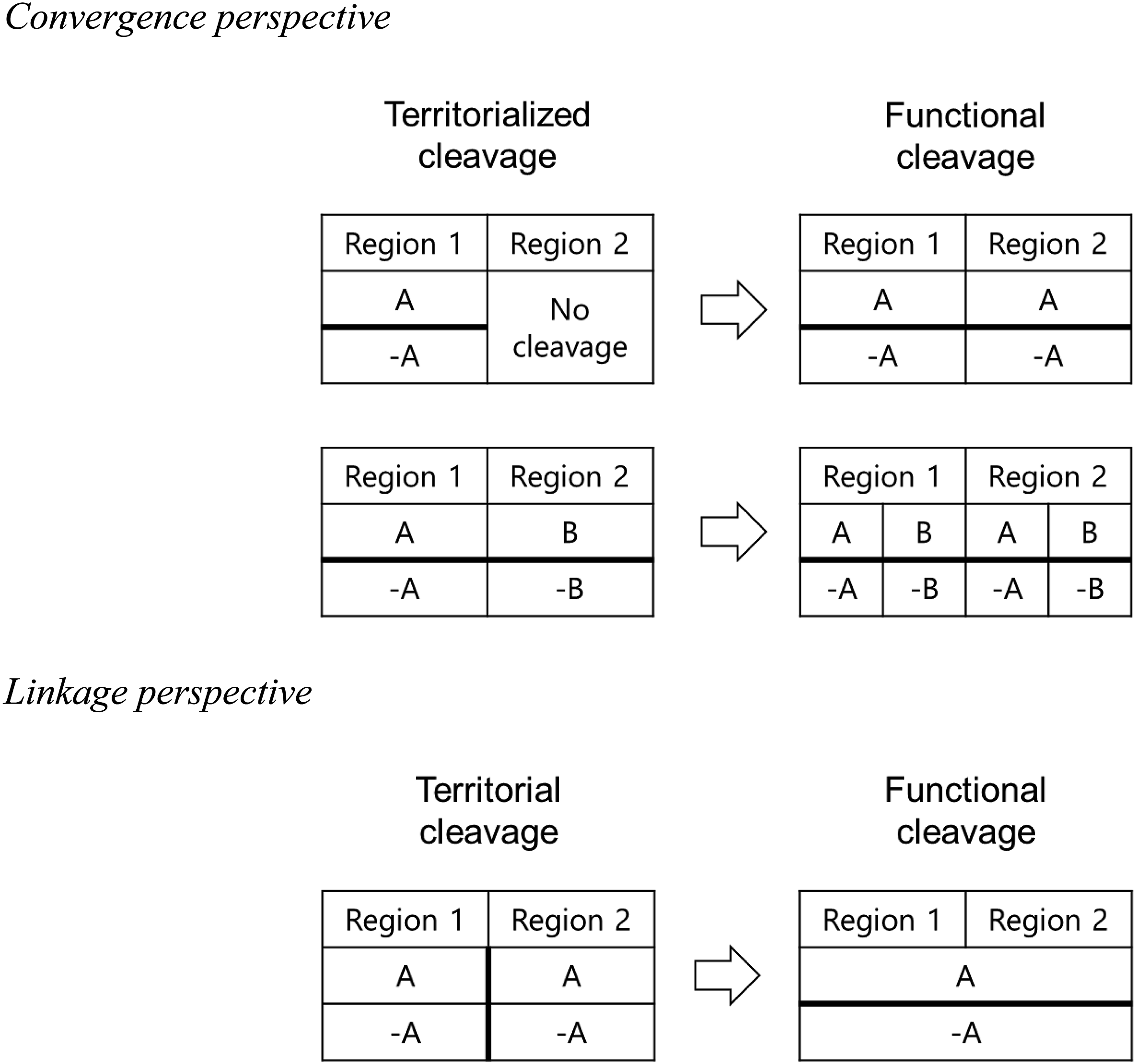
Territorialized, territorial and functional patterns are the result of different types of politicization, operated by actors and their ideologies, of unequally distributed rights and resources. Actors frame inequalities as unequally distributed resources either between territories or between groups across regions. Territorialized cleavages result from groups’ exclusive territorial claim when they politicize pre-modern cultural factors such as religion, language, history and civilization in ideologies like ethno-nationalism, fascism, but also “civilizational” or religious ideologies. Examples include Pan-Islamism, Zionism, Hindu nationalism, Kemalism and Make-America-Great-Again. Territorial cleavages are about the interests of a territory as a whole, a “realist” self-interest (as for colonialism and the control of national resources). One finds such politicization typically on topics like war, defence and military, and political influence and diplomacy. It opposes whole territories that are cohesive internally on a given right or resource. However, redistribution, too, can be framed in a territorial way as in developmentalism (the transfer of resources to other regions). Examples of actors, therefore, may include mercantilist ones but also aid organizations. 7
Functional cleavages politicize group oppositions that transcend territorial boundaries. Class, but also gender or generational groups, education and personal-orientation groups (sexual identities, subcultures) are mobilized and develop organizational linkages and solidarity bonds across regions. They are distributional between groups yet universally applicable. These are typically the grievances of left–right ideologies in actors such as social-democratic, liberal and conservative parties and transnational parties. Also inclusive ideologies that do not oppose groups or territories to one another, but favour values like nature and peace, as for environmentalist movements and pacifist NGOs, create winners and losers across borders. Accordingly, we expect the process of globalization of politics to be driven by social and economic topics dominating over military, political and cultural ones.
The process we call “globalization of politics” takes place when conflicts between world regions attenuate and give way to conflicts across world regions. It is the process whereby world politics moves from international to transnational. The following analysis measures the territoriality−functionality continuum of cleavages that results from this transformation. Rather than structural inequality itself, it measures the territoriality of the politics of inequality and the cleavages it generates. We analyse descriptively and empirically the theoretically-based expectation of a de-territorialization trend by measuring the strength of the territoriality of discourse on global cleavages and its cross-cutting nature since the closure-enhancing patterns of industrialization, colonization and world trade in the mid-19th century.
Text Data and Latent Semantic Scaling
The structural approaches based on trade and macro-economic indicators that economists and historians use do not capture the politicized nature of cleavages. Network analyses based on the dyadic relationships between countries (trade and aid, alliances and treaties, establishment of embassies, etc.) also fail to do so. 8 On the other hand, cultural analyses based on world “maps” of values and attitudinal traits (based on national aggregates) disregard transnational cleavages that cut across world regions (Inglehart & Welzel, 2005; Welzel, 2013). A cleavage-based approach that takes politicization into account and examines cross-regional cleavages may rely on roll-call data from global institutions or – if the goal is to go as far back in time as possible – text analysis. 9 The latter is the strategy adopted in this paper.
We use media discourse, more specifically, articles from The Economist published between 1843 and 2020, to operationalize the framing of world cleavages. We choose this specific source of text for several reasons. Our goal of identifying the nature of global cleavages over a long period of time in the broadest way possible leads us to focus on media, as opposed to texts from single actors. First, this source does not look directly at political actors’ discourse and can therefore be considered more objective. Media text is more likely to capture a fair balance of discourse by various actors. This media source is preferable to semi-official government outlets (such as Foreign Affairs) or outlets close to political parties for similar reasons. Second, it does not look directly at structural inequalities and can therefore be considered an indicator of politicization rather than structural inequalities. In this sense it fulfils the goal of capturing the either territorial or functional frame of political contestation.
Another advantage of this publication is that it provides global coverage and does so continuously for approximately 180 years. Its commentary and analysis of global events over nearly two centuries provide a unique lens to examine the evolution of global cleavages. The consistent quality and analytical rigour of The Economist’s editorials offer a stable and reliable dataset for examining shifts in global discourse. This “newspaper” (as the weekly defines itself) has existed throughout the period of interest to our research question, which covers the time of mass and class politics.
The Economist also provides a more analytical perspective than other media outlets. Since the goal of the analysis is to investigate cleavage structures, an analytical perspective is preferable to mere journalistic reports of events. Its focus on international affairs, economics and politics allows covering global issues. It is uniquely positioned to document global events, given its worldwide access to information, resources and influence. The Economist offers a broad view of global affairs and can thus capture the “zeitgeist” of different historical periods. The Economist distinguishes itself as a media outlet that has consistently reflected and analysed events in successive epochs. The fact that it is published on a weekly rather than daily basis also reduces the risk of biases from daily events.
Geographically and culturally, The Economist offers a Western, and more specifically, an Anglo-Saxon or British perspective. Historically, it is a newspaper from the imperial capital for the British and colonial elites. Up to the present day, it is considered an elitist publication. As a comprehensive textual source covering the extensive period from the 19th century to the present, its analytical character means that it is necessarily a product of elite discourse. This has the obvious advantage of providing a more analytical perspective and global coverage. In addition, The Economist has established itself as a global newspaper with a wide readership beyond Britain. As for its elitist character, this is a feature of most text data. The advantage of this particular outlet is that this feature has not changed much over the more than 180 years of its existence.
In terms of ideology, The Economist declares a free-market position on economic issues and liberal-democratic positions on social, cultural and political issues. Does this specific vantage point affect the phenomenon the analysis attempts to capture? While it may be a source of bias of the position on ideological dimensions such as left–right, a particular cultural or ideological perspective does not influence the polarity of the territorial–functional dimension. The free-market and liberal-democratic bias inherent to the choice of the media outlet is consistent over the entire period analysed. This consistency enables us to control for the ideological bias and focus on the identification of the shifts between a territorial and functional focus in the global discourse.
Overall, using The Economist as a source of data offers advantages that no other source can match. While we recognize and account for the biases inherent in our source, the longitudinal and analytical depth of The Economist provides an invaluable resource for tracing the contours of global cleavages through the lens of one of the most enduring and influential media outlets in the world. We do not claim that this method and source are able to capture world inequality but that it is suited to the goal of identifying the structure of global cleavages, that is, the way in which global divisions are politicized. The politicization of inequality in terms of cleavage is captured by an outlet that reports on political oppositions. Given our particular interest in tracking the evolution of cleavages, text analysis proves particularly fitting for a historical examination intending to trace back to the pivotal moments of the National and Industrial Revolutions in the mid-19th century, as it allows a continuous, uninterrupted indicator. As far as we can tell, this is an untapped source of text in comparative politics.
The articles from The Economist were downloaded from the Gale Digital Scholar Lab, a digital archive that contains a vast array of primary sources including all issues of The Economist from the beginning of its existence in 1843 to 2020. 10 In this archive, articles are tagged and can be selected by their “Section” and/or “Type.” The category “Section” allows users to select from multiple categories of topics: business, sports, news, opinions and editorials, people, preliminary matter, and advertisements. The option “Type” lists various types of material: both substantial material, such as articles, editorials, financial reports, letters, obituaries and reviews, and graphic material, such as front matter, cartoons, tables of content and advertisements.
Articles with the following categories have been downloaded: “News” and “Opinions and editorials” in the tag “Section,” and “Article” and “Editorial” in the tag “Type.” The rationale is that news articles and opinion leaders provide an interpretation of the world. Excluding items like advertisements, front matter and letters, and focussing on actual articles avoids introducing noise in the data. In addition to the articles’ text, we also downloaded the metadata associated with each item (title, date of publication, content type, publication type, identification number, etc.), which were then matched with the text items. The basic units of analysis are therefore articles. This process produced a dataset of 316,749 textual items read into the open-source software R. 11
Texts were digitalized using Optical Character Recognition (OCR). The Gale Digital Scholar Lab provides OCR precision scores for every article in its archive. This technique creates some data quality issues, which mainly affect earlier issues of The Economist.
12
We used the functions in the Quanteda package (Benoit et al., 2018) to pre-process our data, removing its punctuation, stop words, and words with very low or very high frequency.
13
We identified various patterns of errors in the textual data, such as missing letters and duplicates, and corrected them in the pre-processing phase. We dismissed articles with missing metadata and only considered articles longer than 150 words. Shorter articles were removed from the dataset because they typically include graphs or tables that introduce unnecessary noise into the analysis. These cleaning procedures reduced the total number of articles in the final dataset to 308,329. The average length of these articles is 961 words. Figure 2 provides information about the data, specifically how the type of articles has varied over time as well as the average article length. Overall, the number of articles remains fairly stable over time and there is no significant variation in the length of articles. Types of articles and average length (1843–2020).
The methodology must be able to measure the territoriality and functionality of global cleavages in media discourse, and trace how the dimension has evolved over time. Latent Semantic Scaling (LSS), a semi-supervised document scaling technique that allows users to locate text documents on user-defined dimensions using a small set of seed words (Watanabe, 2021), is the most appropriate method for this purpose. It can be applied to various dimensions and can be used to build a scale − in our case, a scale between territoriality and functionality. LSS relies on word embeddings, a method that turns words into numerical vectors by positioning them in a multi-dimensional space. Within this space, the distances between different words become indicative of their meaning. Words positioned closer to one another are thus identified as carrying a similar meaning, while words that are further apart as carrying a more dissimilar meaning.
The technique relies on seed words. The LSS algorithm uses the cosine distance to the seed words that researchers define to calculate a “polarity score” for each term in the corpus. Document polarity scores are then calculated by aggregating individual word scores and weighting them by their relative frequency within the document. This procedure produces document scores that make it possible to position articles on the scale we defined. We constructed a scale between the extremes of territoriality and functionality. An advantage of this method is that it does not depend on manually coded documents typical of other techniques, such as supervised machine learning. In addition, supervised machine learning techniques rely on algorithms that require intensive human coding to “train” the models. LSS assigns the documents polarity scores on a fixed scale over time, which makes the method suitable for historical analysis using longitudinal data (Watanabe, 2021). This feature of the method makes it more suitable for theory-driven analysis than non-supervised machine learning algorithms, which is exploratory-oriented and identifies latent dimensions ex post. The models were estimated using the LSX package in R (Watanabe & Zhou, 2022).
The choice of k for the number of dimensions used to reduce the term-document matrix through singular value decomposition (SVD) involves a trade-off – a value too low may lead to loss of important information, while a value too high may retain too much noise along with the relevant semantic information. We adhered to the default parameter of k = 300. This choice is supported by empirical evidence in the literature (Watanabe, 2021), demonstrating that this value effectively balances computational efficiency with the retention of meaningful semantic content. The semi-supervised nature of LSS makes the selection of seed words crucial for the validity of the model insofar as they directly link with the theoretical construct. Seed words should reflect the two poles of territoriality and functionality, and should ideally be characterized by strong polarity and low ambiguity (Watanabe, 2021).
Seed Words for the LSS Analysis.
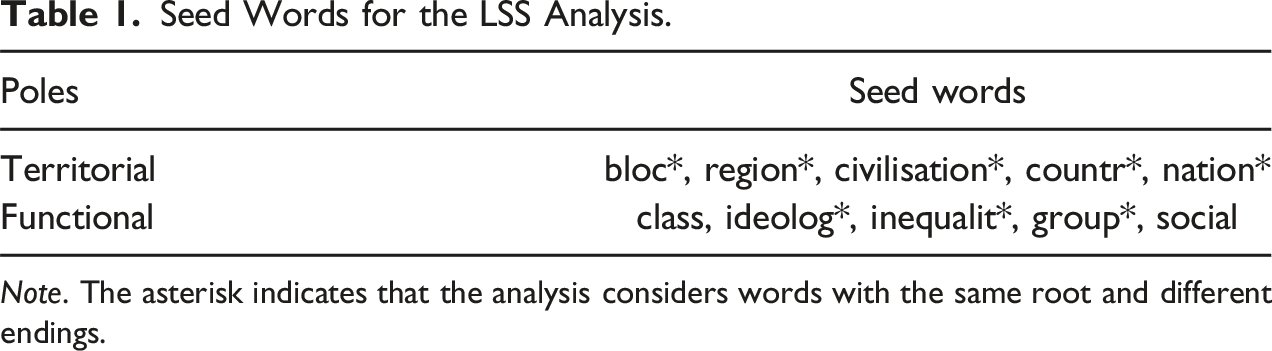
Note. The asterisk indicates that the analysis considers words with the same root and different endings.
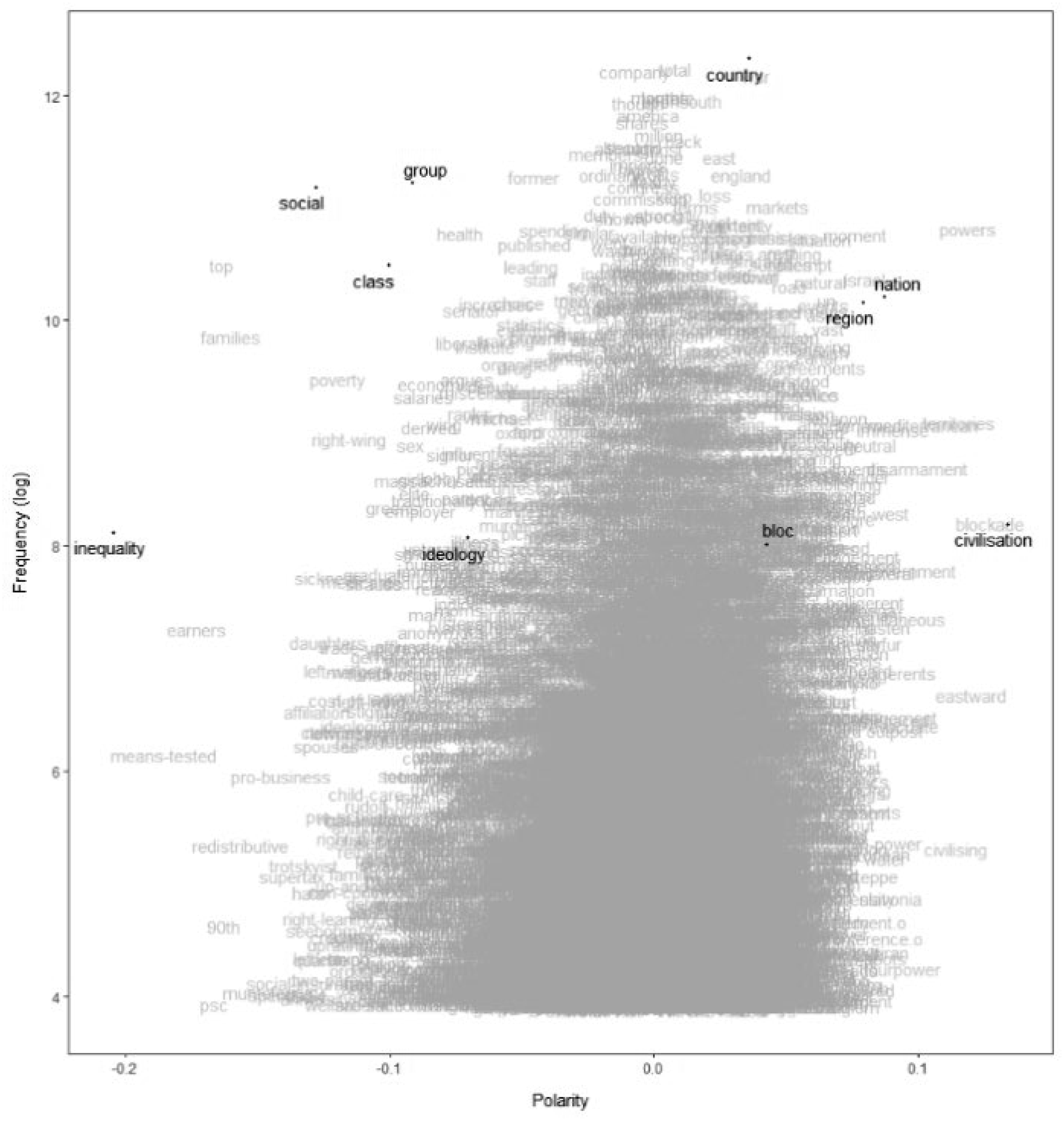
Seed words and polarity scores.
The scale takes values of territoriality through a positive sign and of functionality through a negative sign, with most of the variation limited to the range between +1 and −1. The analysis yields meaningful results and confirms the validity of the method. The words the algorithm associates with the scale align with our theoretical expectations. Appendix Table A1 in Appendix 1 lists the twenty words most frequently associated with each of the two sets of seed words. Together with Appendix Figure A1, this association clearly indicates that our model is valid as the most functional and territorial words reflect the concepts we intend to measure. In addition, we replicated the model by dropping each seed word consecutively.
Results from this robustness test are reported in Appendix 2 (Appendix Figure A2). The exercise illustrates that our results remain stable, even if we remove individual words. 14 This is also illustrated by the very high correlation of polarity scores between the original model and the model with omitted seed words, presented in Appendix Table A2. This exercise also points to the fact that the omission of none of the seed words is consequential in our results, nor that a word (such as “inequality,” a rather functional concept) may have a meaning relating to both poles.
Model Performance Statistics.
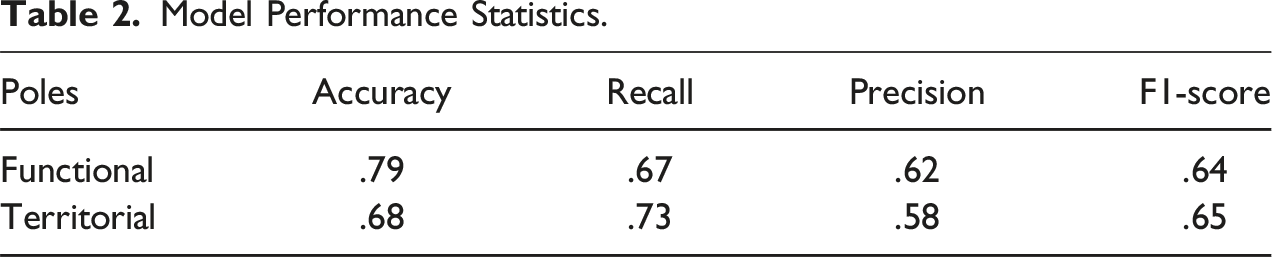
The results of the validation test in Table 2 show that our trained LSS model had a good performance – its accuracy was slightly higher than that of comparable analyses in Trubowitz and Watanabe (2021). As these authors point out, discrepancies between human and machine classifications are to be expected, especially with complex categories, such as territoriality and functionality in a historical context. While humans make use of their historical knowledge to classify news articles, machine learning models rely solely on the words that appear in the text. This means that compared to a machine learning model, humans have more information to form their judgements of any given news article. Despite these differences, the F1-score indicates that the model’s scores are accurate, which demonstrates that this method is a valid way of measuring cleavages over time.
For the topic-based analysis that we use to test which types of politicization drive the process of globalization, we organized the articles into six distinct categories. These categories encompass cultural, economic, military, political, social, and sports-related topics. To create subsets of articles within these categories, we employed specific dictionaries designed to detect and classify articles according to these topics. 17 The dictionary filters were only applied after running the LSS model on the entire corpus.
Trends in the Globalization of Politics
The Globalization of Politics After World War II
The main result of the analysis appears in Figure 4. The period between the middle of the 19th century and the present day is marked by a trend of de-territorialization in the framing of global cleavages present in the discourse of The Economist’s editorials and news articles. The interpolation curve clearly moves from the upper half of the graph, where territoriality is high, to its lower half, where territoriality is replaced by functionality.
18
This supports the hypothesis formulated in the theoretical section that we should expect the discourse on global cleavages to move from a predominantly territorial to a more functional framing over time. Overall, the trend does not reveal major reversals with the territorial frame being displaced by the functional one in a continuous way. The functional frame reaches its peak strength at the beginning of the 21st century and the corresponding levels of territoriality are lower than those observed at any other time during the entire period of 180 years considered by the analysis, even though the past decade (from 2010 onwards) has been characterized by a stabilization, if not a slight reactivation of territoriality. The process of globalization of politics.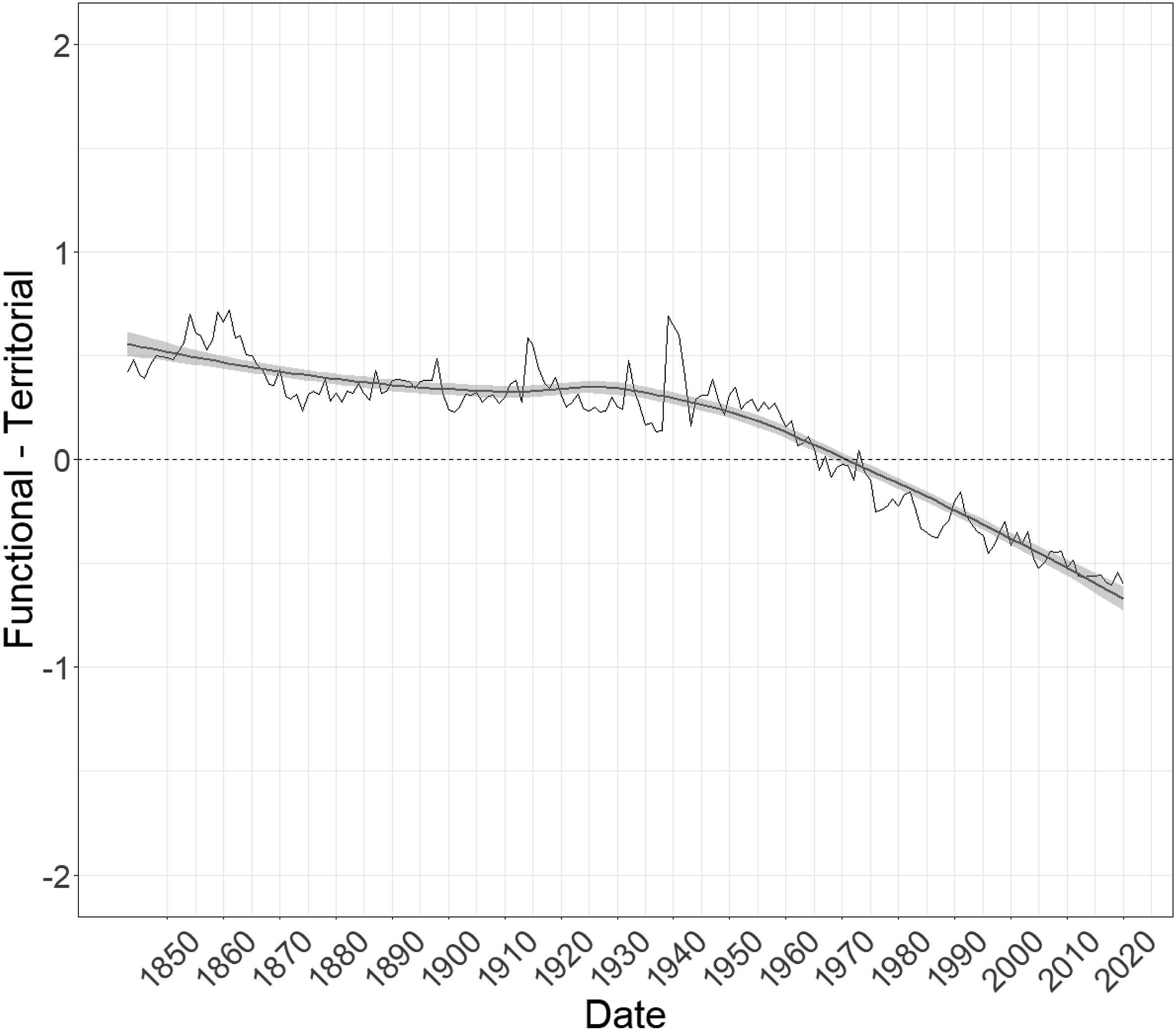
Beyond this broadly brushed result, more nuanced patterns reveal themselves. The dominance of the functional frame is a feature of the period since the 1970s. This is the decade in which the curve crosses the mid-point in the territorial−functional continuum. From that moment on, the functional frame has been progressively gaining prominence. However, the steep trend away from territoriality towards functionality first starts after World War II. It is from the second post-war period until the present that the de-territorialization of The Economist’s discourse takes place. In contrast, the period leading up to World War II is characterized by a stable territorial frame, even though the latter’s levels are slightly lower than those found in the middle of the 19th century. Territoriality only increases between World War I and World War II, the only reversal in this trend.
For a comparative reference point, the globalization of politics takes place later than what others have been shown to be similar processes of de-territorialization of cleavage structures at national level (Caramani, 2004; Chhibber & Kollman, 2004; Morgenstern, 2017; Schattschneider, 1960) and European level (Caramani, 2015). Both nationalization and Europeanization reach their highest levels of de-territorialization in the second half of the 19th century and the first two decades of the 20th century, in conjunction with the processes of state formation and nation-building as well as, most crucially, with the political mobilization and class politics carried out by mass parties during the period of Europe’s democratization and extension of the franchise (and the concomitant increase in party competition). The latter brought forward a cross-local left−right ideological dimension that cut across territorial units, be it regions at the national level or nation-states at the European level. The patterns in the globalization of politics displayed in Figure 4 indicate a later development, namely after World War II.
Democratization and mass political mobilization are, until the post-World War II period, processes that take place in the West – Western Europe and North America mainly. From a global perspective, this specificity reinforces the contrast between the West and other world regions, where mass democratization and industrialization took place later. Whatever type of territoriality characterizing the pre-World War II period (core−periphery, North−South, East−West or other), it persists until the post-World War II period. The trend of globalization of politics visualized by Figure 4 suggests that territoriality dissolves in conjunction with the international ideological confrontation between capitalism and communism of the Cold War that permeated processes of de-colonization and modernization beyond the West, and, after the end of the Cold War, in conjunction with global economic integration. This ideological element replaces the territorial one once it diffuses beyond the West. According to our indicator, furthermore, the dominance of this ideological continuum has not been reversed by “civilizational” fault lines. The fact that seed words (Table 1) refer to global (as opposed to domestic) territoriality, indicates that the trend towards functional politicization in Figure 4 captures global cleavages rather than domestic ones. 19
A More Fine-Grained Analysis of Temporal Patterns
The strong performance of the model enables us to delve into more detailed observations, exploring the fluctuations in territoriality and functionality levels over time. In particular, the solid curve in Figure 4 displays a number of distinct “peaks” in territoriality. Figure 5 zooms into the more fine-grained movements of the scale and indicates the major historical events associated with spikes in territoriality. The highlighted events have been selected by identifying the articles with the highest territoriality scores published during each period marked by a spike in the territorial framing and qualitatively assessing the subjects of these articles. The spikes in territoriality that the model produces correspond to events for which one would expect territoriality to peak. They constitute an additional validation, and the content of the articles with high territoriality scores further attests to the model’s validity.
20
Comparing the model estimates against historical events.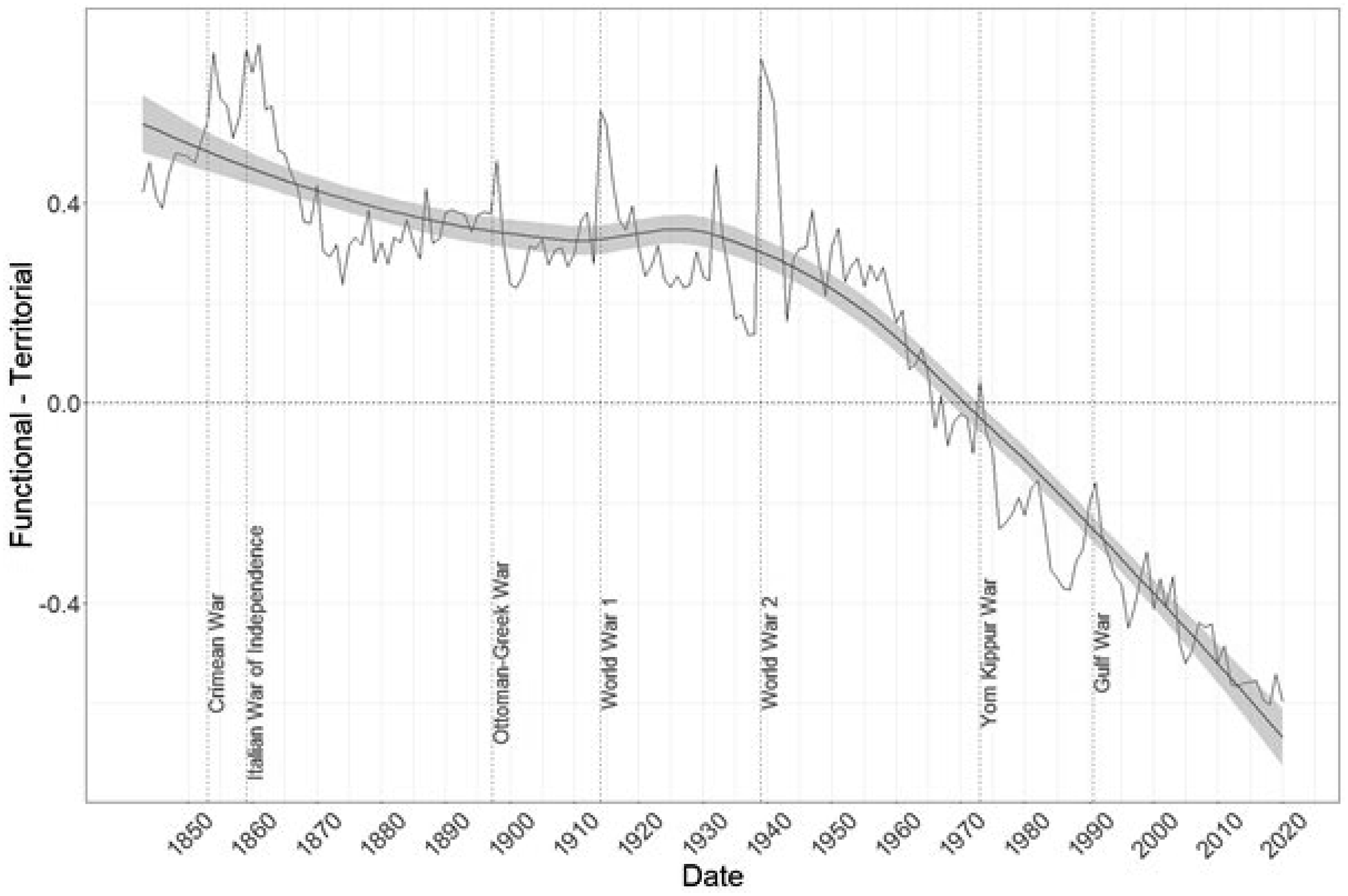
Most of the spikes produced by volatility come from war-like events, especially conventional wars between nation-states. Conventional wars are typically fought between polities. They are not confrontations that cut across territorial lines. It is therefore in line with the expectations formulated in the theoretical section that the scale moves toward more territoriality during the periods when such events took place. As we see later, the texts from The Economist that deal with military topics are the only articles for which there is no de-territorialization over time. This fact further confirms that the model is robust and that discourse around interstate wars is an instance of territorial politicization.
Theoretically, we also expect that a territorial discourse prevails during a period nationalist ideology. This is what we observe, as the increase in territoriality between the 1850s and the 1870s shows. The first set of peaks that the model detects is located during a historical period defined by nationalism in Europe but also colonization overseas. Processes of state formation and nation-building in Europe are associated with wars for independence and the ideology of national self-determination. The model accurately captures the territoriality inherent to these liberation movements, especially Italian unification, independence and democratization (the Risorgimento). The model picks up this event in particular, even though similar movements, such as the Polish and the Irish strives for self-determination, took place at the same time and with Belgium’s independence and Greece’s liberation from the Ottoman Empire. Zooming into the data and reading the articles with the most territorial framing confirms the prevalence of territorial framing during these events. However, the model also identifies the Crimean war from 1853 onwards and episodes concerning China and India among others, with The Economist’s discourse stressing the colonial nature of global relations, economies’ geographic specialization and Europe’s political dominance.
That wars between states lead to stronger territoriality in the frames of texts is further confirmed by the spikes around and between World War I and World War II. The spikes reflect the strongly territorial discourse surrounding wars between nations in Europe and beyond. On the one hand, these patterns largely account for the maintenance of stable territoriality in the inter-wars period that we mentioned in the discussion of the general results. On the other hand, the absence of such conflicts in the second half of the 20th century accounts for the inflection point after World War II – from then on, the functional discourse rises decidedly. In addition to the absence of inter-state confrontations, the ideological framing of the confrontation likely contributes to the decline of territoriality in The Economist’s texts. Both the Cold War and its manifestations in inter-state wars, such as the Vietnam War, appear to be predominantly portrayed as ideological confrontations between liberal democracy and market economy on the one hand, and communist planned economy on the other. This factor in the interpretation of the functional trend after World War II is reinforced by de-colonization, hinting at the ideological confrontation through the Marxist leadership in the struggle for independence. This is not the case with the 1990 Gulf War, which the articles present through a more territorial frame.
Given the importance of wars in IR theory, particular attention must be given to their changing nature after World War II (from international to intrastate and unconventional wars involving non-state actors), to avoid the risk of our measure being driven by this change. As discussed in the next subsection, when selecting articles that do not involve war, military alliances and diplomatic relations the pattern toward more functional divisions remains.
In contrast to the straightforward way in which the model is able to detect events responsible for increases in the levels of territoriality, no single event drives the functional politicization that we observe in the period since World War II. In line with our theoretical expectations, the examination of the articles that the model scores as the most functional, suggests that texts for this period provide discussions on a variety of topics related to broad processes of economic globalization, geographic mobility, the rise of inequality between social classes, ideological transformations, and the role of political parties, among others. This type of discourse is linked to macro socio-economic, political and cultural changes. While territoriality appears to be linked to specific events, functionality appears to take the more continuous shape of abstract – not directly observable – processes of social, cultural, political and economic transformation.
Trends in the Globalization of Politics by Topic
To explore the distinction between territorial and functional types of politicization more systematically, we break the pattern we observe down into different topics. As outlined in the theoretical section, we expect politicization around nationalism and state interests to produce high territoriality, whereas politicization around social and economic rights to transcend borders and produce functional cleavages that are more globalized. The politicization of some inequalities can be expected to be more or less susceptible to maintaining a high territoriality when they become politicized into cleavages. Accordingly, one should expect the model to reveal different trends in de-territorialization depending on each topic. Topics on oppositions about the unequal distribution of certain resources may be associated with lower territoriality (say, civil rights for homosexuals) than topics on oppositions about other resources (say, voting power in the United Nation General Assembly). Some articles connected to a given overarching topic may show persisting territorial divisions over time because the nature of the topic itself presupposes a territorial framing rather than a functional one. In contrast, articles on other topics may yield results similar to the results of the original model, which uses all articles. We expect that applying the original model to different subsets of articles would not always result in the same general trend of subsiding territoriality.
We probe our model on subsets of articles on specific topics by means of context words (Figure 6).
21
The purpose of the topic analysis is to show that the observed overarching trend, that is the transformation of global divisions from territorial to functional dynamics spanning nearly two centuries, is driven by articles on the politicization of specific resources and rights as discussed theoretically. Based on the distinction between rights that are more or less unequally distributed and politicized into cleavages, the analysis has been broken down into topics based on the theoretical section. Social and cultural topics have been further separated, as the former refer to the civil rights of gender and minorities, literacy and other development topics, such as health, while the latter encompass identity matters that relate to sexuality, language, ethnicity and religion. The subgroups of articles on our chosen topics were created using dictionaries as described in the methods section above. The decline of territoriality by topic.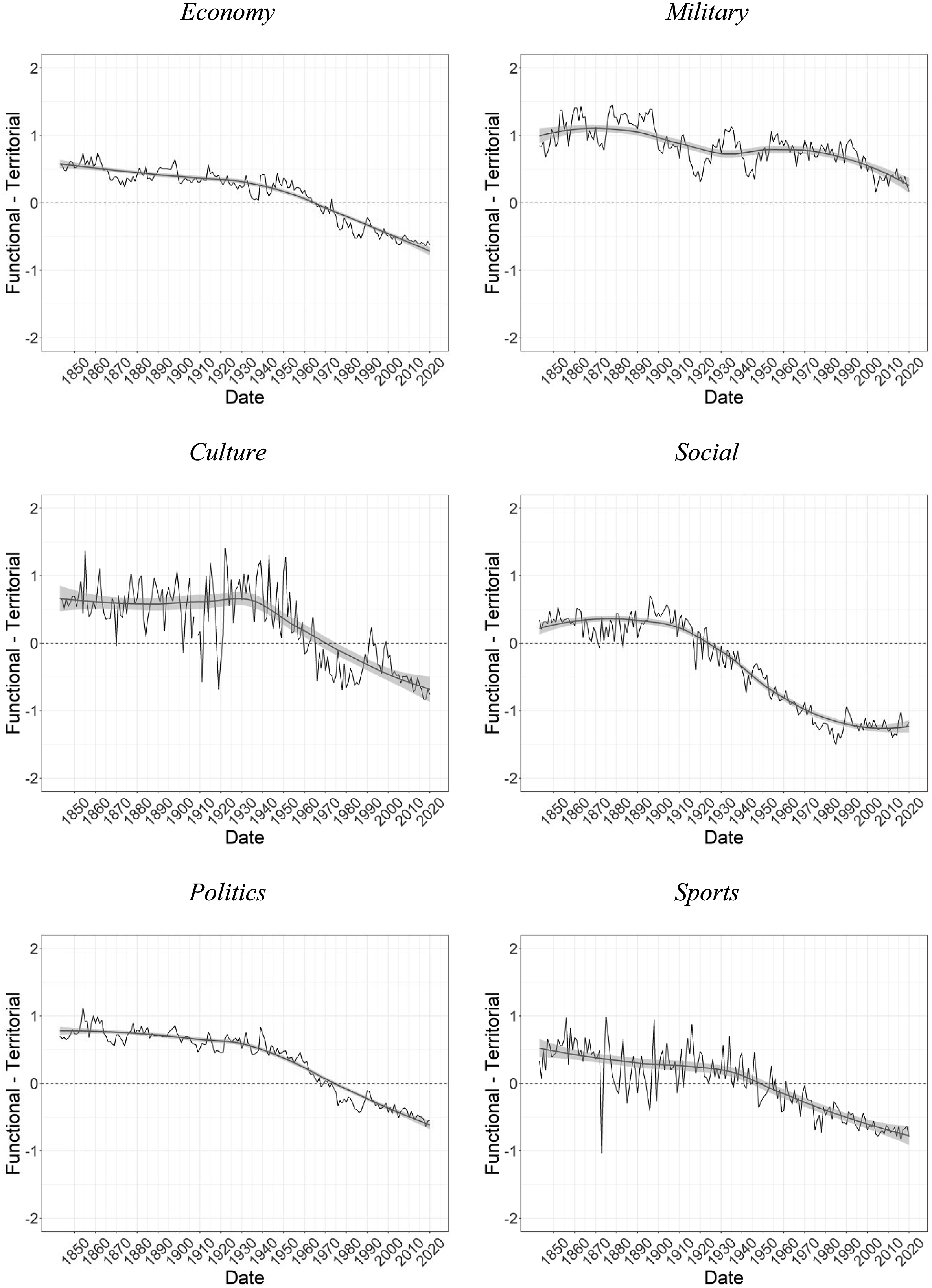
The subgroup on sports is used as a “check,” as one would expect it to reproduce the general pattern identified by our main analysis. This serves as another robustness check of our model’s accuracy and validity. For this “control” topic the model behaves as expected, namely following the general trend set by the reports’ global focus, which highlights the ideals of the world “coming together” and geographic barriers being abolished and stresses the transcendence of functional divisions in human rights and anti-racism campaigns, as well as women’s and transgender citizens’ participation on a fair footing.
Which frame prevails across the other topics? Most graphs reflect the overall trend of global cleavages becoming less territorial. With the exception of the graph for the military (a finding supported by the spikes in territoriality around inter-state wars seen above), all curves move from the upper to the lower halves of the graphs. However, there is a noticeable variation across topics.
First, trends in the levels of territoriality are similar to the overall picture in Figure 4 for the economy and culture, whereas for politics the levels of territoriality are higher until World War II. Social topics (which include articles on education, health, gender and migration) stand out as they reflect more functionality than any other topic. The levels of territoriality are low from the outset and drop to a much lower level than other topics in the second half of the 20th century. For the military topic, the model produces results that show a territorial politicization dominating throughout the period as expected. Military topics stand out both for reaching the highest levels of territoriality and their stability over time. The pattern of articles focussing on wars and alliances dispels the risk that the general pattern in Figure 4 reflects the declining importance of international wars and the increase of unconventional wars by non-state actors. One the one hand, in all other topics from which articles on the military are excluded, the pattern toward functionality holds. Thus, the consistent pattern toward functionality in other topics indicates that the graphs are not driven solely by the changing nature of wars. On the other hand, military topics are the ones for which the line does not drop and does not cross into the functional lower half of the graph. Were the changing nature of wars driving de-territorialization, we would first and foremost see this in the military panel.
Second, timing varies across topics. In terms of “inflection point,” for military topics there is no inflection point as the former remains stable and the latter displays a continuous declining trend of territoriality. For the economy and politics topics, the inflection point is around the 1940s (similarly, the inflection point for culture is around the 1930s). Again, social topics stand out with their earlier inflection point during the 1910s. Accordingly, the “cross-over” from the territorial to the functional half of the graphs occurs earlier in the coverage of social topics (around the 1920s) than in the coverage of economic events, politics and culture (around the 1960s).
Third, the volatility of the curves differs according to topics. This variation relates to the number of articles: when there are many articles on a particular topic, volatility is low. Based on this, the curves do not display high spikes of territoriality or functionality for the topics of economy and politics. The military and social topics are marked by mid-range volatility, but the trends and levels in both cases are so clearly delineated that volatility does not make their interpretation problematic, especially after World War II when volatility decreased for both. In contrast, the coverage of cultural topics is marked by high volatility (again, less so after World War II) that blurs the overall trend of stable levels of territoriality until World War II. There are spikes of both strong functionality and territoriality. The presence of spikes indicates that they are driven by a few articles (that weigh heavily in a smaller corpus of texts) on topics, such as culture, religion and ethnicity, as groups within countries or transnationally, but also in their unequal distribution across countries and world regions.
The military and social contexts display the highest and lowest levels of territoriality, respectively. Global cleavages in these areas represent the two extremes on the territorial−functional continuum. As seen in the theoretical section, discourse about military affairs is territorial almost by definition, as it relates to inter-state confrontations and alliances. While there can be a class-based discourse on the military personnel and spending for example, it is mostly territorial. Discussions about international politics, with their emphasis on diplomatic clue, cultural hegemony, economic dominance – “realist” power – share these characteristics with the military topic. However, this changes quite radically over time, in contrast to discourse about the military.
The graph for social topics clearly shows that the cleavages in this domain have always been weakly territorialized. The curve comes close to “zero” from the outset. It is true that inequalities in health and literacy vary dramatically across world regions. However, it seems that they are framed as class inequalities first and foremost. In addition, the topic also encompasses typical group inequalities that have little to do with location, such as gender equality and differences between generations, as well as diffusion factors, such as migration. The number of articles per topic affects the aggregation of these results as done in Figures 4 and 5. The topics of politics and economy dominate and display similar trends toward functionality. This reflects their growing relevance and the mirroring decline of topics, such as the military, especially after the end of the Cold War, but also before its end. Summing up, dissecting the corpus into different themes confirms that the transition to functional cleavages is driven by social and economic topics. De-territorialization is not driven by the established IR factors relating to the declining importance of international wars.
Conclusion: De-Territorialization and Global Governance
The broad scale findings presented in this paper show that global inequalities are increasingly politicized, as functional cleavages that cut across global territoriality progressively replace territorial cleavages opposing world regions. This result is based on empirical measures of the discourse on global affairs published in The Economist’s articles between 1843 and 2020, a continuous, analytical and so far untapped source of text on global affairs. De-territorialization is mainly a phenomenon of the second half of the 20th century, whereas the roughly 100 years from the mid-19th century to the mid-20th century maintain a rather stable level of territoriality. The timing of the globalization of politics points to the salience of social and economic inequalities, and their politicization through left–right ideologies, which apply globally and create both convergence between world regions and linkage between groups with similar grievances across borders. These functional oppositions replace highly territorial confrontations politicized by nationalist, religious and “civilizational” ideologies.
The pattern from territorial to functional challenges the view that the salience of cross-country differences in structuring conflict is larger at higher levels of governance. This is a core theoretical contribution that results from the extension of cleavage theory from the national and European levels to the global level. The novelty of this paper is that it does not limit the cleavage approach to the domestic level but instead applies it to the global level. The cleavage perspective based on different types of politicization differs from approaches that simply map regional inequalities in sociological and economic analysis as in dependence and world systems theories. It also extends such politicization to inequalities other than economic ones, to include social, cultural and political unequal distributions of resources. The paper thus introduces a political perspective and a cleavage approach to global inequality by considering the politicization measured in the framing by an encompassing sources of text over 180 years.
The normative implications of evidence attesting to cross-territorial world-wide cleavages are far reaching. While our territory–function scale does not measure patterns of differentiated economic and political integration in different regions, by measuring the territoriality and de-territorialization of cleavages our approach helps nonetheless illuminate processes of political integration insofar as we highlight the conditions that are conducive to integration. Integrated systems of governance are supported by shared alignments common to the different territorial units they are composed of. Such alignments enhance representation, in particular the “virtual representation” (Pitkin, 1967) of a communion of interests across localities. This does not mean absence of conflict but, rather, conflict lines that do not pitch territories against one another. The role of this cross-cuttingness has been recognized at the national and European arenas (Caramani, 2004; 2015). This paper extends it to the global arenas and considers their implications for a setup of global democratic institutions premised upon ideologies (Tallberg et al., 2014; Voeten, 2021). What this approach allows, therefore, is to conceptualize global integration in politicized – rather than de-politicized and technocratic – terms (Caramani, 2024).
The innovative method and data we employ allow us to measure these processes with a new territory–function scale derived through LSS, an established method to capture latent dimensions which is particularly suitable for historical analysis. Moreover, while our primary aim is to analyse specific trends and patterns within the globalization of politics, we also recognize the broader applicability of our findings. The methodologies and analytical frameworks we employ, although specific to our research, hold relevance for a wider scholarly audience. Researchers delving into the globalization of politics from a historical perspective or exploring similar comprehensive subjects might find the results and models developed in this paper useful for their own studies. This approach enhances the paper’s contribution, providing a valuable resource for further academic inquiry and interdisciplinary dialogue.
In this sense, the evidence presented in this paper is the starting point of a broader analysis. In particular, future research needs to extend to actors’ discourse to capture the different ideologies that politicize global inequalities. These should include transnational parties, international organizations, or global social movements among others (Noël & Thérien, 2008; Thérien, 1999). In addition, territoriality itself deserves more research. The inter-disciplinary literature on global territoriality suggests a sequence of territorial patterns throughout historical periods that can be measured by building new dimensions: core−periphery and colonial (North−South) structures, East−West and Cold War divisions during de-colonization, supported by a transnational ideological opposition that corresponds to the phases of clearest de-territorialization, civilizational and value-based world regionalism. Furthermore, the temporal pattern of “globalization of politics” itself varies over time. The conditions at the origin of such variation therefore require further analysis. Economic and cultural globalization have taken place during the period since World War II. Various indices based on data for trade, diplomatic connections and communication, cultural exchanges and geographical mobility point to these patterns in globalization. 22 The media discourse on global cleavages as increasingly framed in functional terms, together with the politicization of global cleavages as class inequalities rather than regional ones, thus seems to reflect a trend toward global integration. Future analysis should link more closely the long-term trend of the globalization of cleavages with economic, political and cultural globalization.
Finally, future reversals will need investigation. Current developments such as the opposition between East and West that stems from the economic and military rise of China and, most dramatically, from the war in Ukraine, may reverse patterns of de-territorialization. The fact that we did not find evidence of a civilizational re-territorialization taking place since the late 20th century does not exclude the possibility of future re-territorialization. The conditions for global actors’ coordination and global governance systems are changeable, as the current turbulence in international affairs demonstrates. This is possible even if our analysis shows that spikes of territoriality due to geo-political turbulences did not, in the past, reverse the long-term trend toward functionality.
Ultimately, our paper demonstrates that views of the world have changed over the past half century. To use a geological analogy, the discourse on global cleavages has moved away from seeing the world as fragmented into distinct world regions, divided by “fault lines” that separate them like tectonic plates, towards seeing it as more homogeneous, where levels of wealth and opportunity, access to cultural resources, the legitimacy of voice and the enjoyment of a range of rights are stratified from top to bottom in a similar way across the globe – like layers of sedimentation. Such a process replicates in the global arena what has been observed at the national and European levels. Nationalization (Caramani, 2004; Chhibber & Kollman, 2004; Morgenstern, 2017; Schattschneider, 1960) and Europeanization (Caramani, 2015) have taken place “earlier,” but similarly in conjunction with the closure of membership and territorial boundaries reducing exit options and internalizing voice. De-territorialization is a feature of cleavage structures in integrating systems. This applies to the global level beyond the national and regional levels. The analytical framework developed in this paper therefore serves also the goal of bridging comparative politics and IR and of linking the different levels into a common theoretical construct based on cleavage theory.
Supplemental Material
Supplemental Material - The Evolution of Global Cleavages: A Historical Analysis of Territorial and Functional World Alignments Based on Automated Text Analysis, 1843–2020
Supplemental Material for The Evolution of Global Cleavages: A Historical Analysis of Territorial and Functional World Alignments Based on Automated Text Analysis, 1843–2020 by Daniele Caramani, Siyana Gurova, and Tobias Widmann in Comparative Political Studies
Footnotes
Acknowledgements

Declaration of Conflicting Interests
The author(s) declared no potential conflicts of interest with respect to the research, authorship, and/or publication of this article.
Funding
The author(s) disclosed receipt of the following financial support for the research, authorship, and/or publication of this article: HORIZON EUROPE; ERC-2022-ADG 101097740.
Data Availability Statement
Articles from The Economist can be legally downloaded, mined and analysed without restriction through the Gale Digital Scholar Lab. The subscription was provided by the University of Zurich. Coding files are openly accessible (Caramani et al., 2024) but due to the Gale Digital Scholar Lab's policy, data cannot be made publicly available. CPS's account on Dataverse includes a detailed explanation on how researchers can obtain the data.
Supplemental Material
Supplemental material for this article is available online.
Notes
Appendix
Author Biographies
References
Supplementary Material
Please find the following supplemental material available below.
For Open Access articles published under a Creative Commons License, all supplemental material carries the same license as the article it is associated with.
For non-Open Access articles published, all supplemental material carries a non-exclusive license, and permission requests for re-use of supplemental material or any part of supplemental material shall be sent directly to the copyright owner as specified in the copyright notice associated with the article.
