







Abstract
Historically, extremist parties have engaged in a process of parliamentary disruption, violating the rules of interaction and slowing down the lawmaking process. How can democratic parties respond and counter parliamentary erosion? I propose a typology of the policies of parliamentary defense that includes targeting individual politicians and collective responses that change parliamentary or electoral rules. I explore the demand of political parties for different policies of parliamentary defense and the conditions under which legislative majorities in support of such policies come about. Empirically, the article examines the responses of mainstream democratic parties to parliamentary disruption in Weimar Germany (1918–1933) and Third Republic France (1919–1940).
Keywords
Introduction
Historically, decline in the legitimacy and effectiveness of parliaments is the first symptom of democratic erosion (Linz & Stepan, 1978). In interwar Europe, extremist parties on the left and right of the political spectrum played a key role in fueling perceptions of parliamentary illegitimacy and fostering parliamentary ineffectiveness. Disdainful of legislative representation, these parties participated in parliament with the goal of eroding legislative institutions. Beginning in 1919 the Communist International (or the Third International) advocated the use of parliamentary participation to undermine the functioning of legislative institutions. Communist parties like the German KPD and the French Communist Party (PCF) subscribed to this doctrine and entered parliament in their respective countries with the goal of undermining it. For example, the parliamentary strategy of the KPD, stated at its 1924 party congress, was to “engage in agitation in order to undermine the bourgeois state.” Parties on the far right also engaged in disruption. An entry in Joseph Goebbels’ diary on June 13, 1928, expresses disdain for parliamentarism: “The plenary session, a school of angry Jews. Parliamentarianism has long been ready for its downfall. We will sound the death knell for it. I have already had enough of this comedy” (Fröhlich 1997 [1]: 298).
The antiparliamentary strategies of extremist parties created political challenges for mainstream parties on the left and right. One strategy to combat these challenges was to draw on available tools to sanction the behavior of legislators violating parliamentary rules. But mainstream parties could also take a much more proactive role in sanctioning the disruptive behavior of extremist politicians. Additional strategies of parliamentary defense included changes in parliamentary procedures that introduced stronger sanctions against disruptive behavior, changes to electoral law, and the adoption of sanctions that weakened the protection of parliamentary immunity for extremist politicians. Given this broad range of choices, there is considerable variation in the strategies pursued by mainstream parties.
The French Socialist Party (SFIO) supported far-reaching reforms. Following the parliamentary entry of the Communist Party in 1924, French socialists abandoned their support of proportional representation and advocated a return to a majoritarian system. They also advocated for reforms that sought to limit disruption and legislative erosion in the parliamentary procedures of the National Assembly. In contrast, in Germany, the Social Democratic Party (SPD), which controlled the largest parliamentary fraction of the Reichstag, opposed changes in parliamentary procedures and the modification of the electoral law, while center-right parties, such as the Catholic Zentrum and the German Democratic Party (DDP), actively supported changes in parliamentary procedures and election law. This article seeks to understand the temporal and cross-national variation in the strategies pursued by different democratic parties to counter legislative erosion.
To begin, I document the menu of strategies available to mainstream parties to defend parliamentary institutions. My central analytic objective is to characterize the considerations of mainstream democratic parties when choosing among different strategies of parliamentary defense. Individual strategies may include calls to order (rappels a l'ordre or Ordnungsrufe) and restrictions on the parliamentary immunity enjoyed by individual politicians. Collective strategies involve changes in political rules that affect a large number of deputies, possibly even an entire party. These may include changes in electoral law that seek to limit the vote share of extremist parties or changes in the procedural rules of the chamber to minimize opportunities for disruption. I then examine the factors that contribute to the formation of political majorities around different interventions against parliamentary disruption. I distinguish between individual and collective strategies of defense of parliamentarism. In the former, mainstream parties sanction individual politicians who engage in parliamentary disruption, in the latter they adopted new rules that constrained the behaviour of extremist parties.
The election to parliament of extremist parties poses an important political dilemma to mainstream (centrist) parties. For mainstream parties that are ideologically proximate to the extremist party, the dilemma presents itself in two stages. First, ideologically proximate mainstream parties need to decide whether to pursue an electoral alliance with the extremist party or a strategy of electoral demarcation. This choice is affected by the ideological differences and disagreements between the mainstream and extremist parties and by the coalitional opportunities available to mainstream and other centrist democratic parties. A critical proposition of this study is that if the ideologically proximate mainstream party pursues a strategy of demarcation, it will favor collective strategies of parliamentary defense that impose stiff sanctions on extremist parties. Examples of collective strategies include changes in parliamentary procedures that impose either high-level sanctions on disruption or electoral reforms (Koos 2018). By contrast, ideologically proximate but non-demarcated parties are likely to favor less punitive strategies of parliamentary defense or even nonaction. These parties are inclined to prefer individualized strategies, such as calls for order or sanctions that weaken the parliamentary immunity of individual extremist politicians. Parties that are ideologically non-proximate are also likely to favor individualized over collective strategies of parliamentary defense. These parties face a lower electoral threat from extremists but are likely to reap some electoral benefits from the disruption that is targeted at their opponent.
Given this divergence in demand for different policies of parliamentary defense, one can identify different political configurations under which various policies of parliamentary defense are adopted. For example, when only one extremist party is present in a legislature, the parliament will adopt collective policies of parliamentary defense only when the proximate mainstream party pursues a strategy of electoral demarcation from the extremist party and has the majority necessary to enact this change. If such conditions are not met, parliaments will adopt individualized strategies of parliamentary defense or forgo the opportunity to respond to extremists. The situation is different in cases in which extreme parties from both ends of the ideological space are present in the parliament. In this context, if both center-left and center-right parties are demarcated from the extremist parties, they are likely to demand collective strategies of parliamentary defense and the parliament is likely to adopt them.
The theory I advance clarifies the trade-offs faced by mainstream parties when considering policies of parliamentary defense. This explanation accounts for commonalities as well as differences in the strategies of parliamentary defense pursued by mainstream parties in interwar Germany and France. In the early 1920s, both countries encountered a strong antiparliamentary threat from the left. The French Socialist Party (SFIO) pursued a strategy of demarcation from the French Communist Party (PCF) and became the pivotal actor in a coalition supporting electoral reform and the reintroduction of the majoritarian electoral system. By contrast, in Germany, the SPD was not demarcated from the Communist Party and rejected a collective strategy of parliamentary defense. Political majorities in support of other collective strategies of parliamentary defense, such as changes in parliamentary procedures, did not come about in either country. Consistent with the explanation presented in this article, in Germany and France, non-proximate and proximate (but not demarcated) parties favored individual over collective strategies of parliamentary defense. But when the situation elevated to a regime crisis, center-right parties in both countries changed their strategy and began to embrace collective strategies of parliamentary defense. This holds for the Reichstag elected in 1930 and the French Assemblée Nationale following the 1934 riots and after the German invasion of Poland and the onset of World War II.
My findings have implications for several literatures. First, this study contributes to the literature on democratic erosion. While historians and political scientists generally bundle together questions of parliamentary and regime breakdown (Bracher, 1984), these remain distinct political processes. This article presents the first comparative study of the choices made by mainstream parties to prevent parliamentary decline. Second, this work contributes to the literature on militant democracy (Capoccia, 2005). I build on and depart from existing studies by considering a broader range of policies of democratic defense. These include electoral reforms, changes to the immunity enjoyed by legislators and changes to the procedural rules of parliament. I also examine some of the trade-offs among these policies that presented themselves to actors in the interwar period. In contrast to existing studies, I consider democratic threats coming from both political extremes rather than from far-right parties alone. By exploring both individualized and collective strategies of parliamentary defense, I identify the conditions that lead to the formation of political majorities supporting each of these strategies.
Resisting Parliamentary Erosion: The Menu of Strategies
The interwar period saw the rise of numerous movements that explicitly questioned parliamentary representation. In France and Germany, the first extremist party to enter parliament was the Communist Party. In France, at the Tours Congress of 1920, a large group of party members denounced legislative deliberations as “parliamentary idiocy’ (le crétinisme parlementaire) and as the “comedy of the ballot box” (la comédie du bulletin de vote). Breaking away from the Socialist Party, these deputies founded the Communist Party (Defresne, 1990: 61). In Weimar Germany, the earliest attack on parliamentarism also came from the political left. In its 1918 Action Program, the Spartacus movement, a revolutionary socialist group, advocated for the “elimination of the Reichstag” and “the creation of a government of workers and soldiers’ councils” (Weber, 1963). And as noted above, the KPD embraced parliamentary representation with the goal subverting the legislative process. A communist publication in 1926 urged the party to “refrain from carrying out work in the parliament, but use the Reichstag to contribute to the disorganization of the bourgeois state” (KPD, 1926: 155). Parties on the right expressed similar hostility toward parliamentary institutions. The founding congress of the Deutsche Arbeiterpartei (DAP), the forerunner of the National Sozialistische Deutsche Arbeiterpartei (NSDAP), denounced parliament as a “Jewish invention.” The DAP used this antiparliamentary rhetoric to motivate a violent, revolutionary takeover of power. In Mein Kampf, Adolf Hitler outlined this strategy by considering that “the participation in parliament is only meaningful if it leads to its destruction, to the elimination of an institution in which we have seen one of the most serious degenerations of mankind.”
Strategies of Parliamentary Defense.
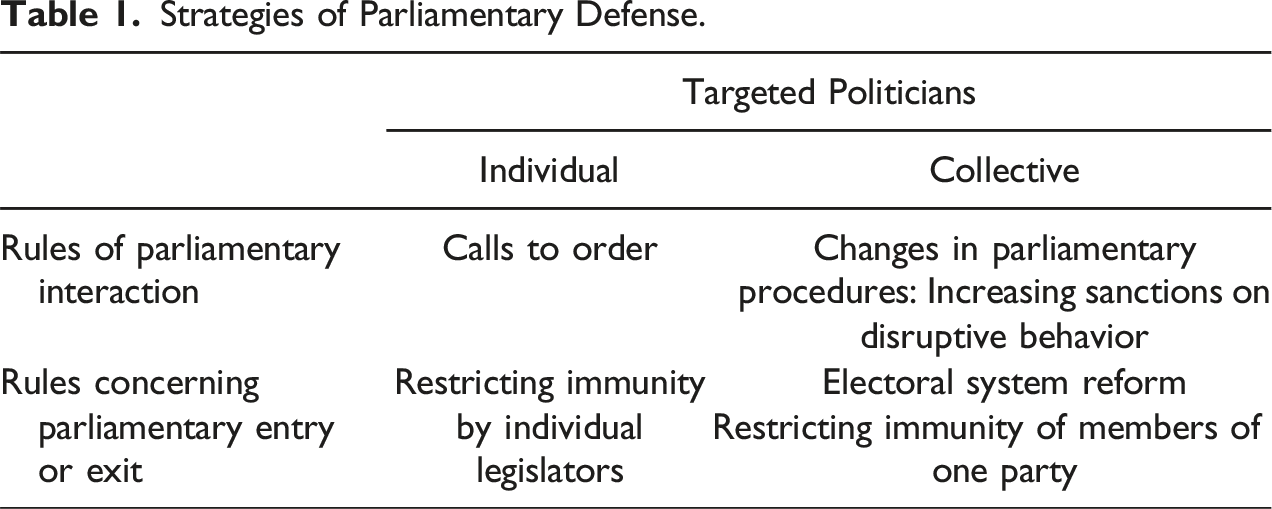
One strategy mainstream parties can use to address disruption by extremist deputies is to sanction the individual disruption perpetuated by an extremist politician during parliamentary deliberations. The parliamentary rules in both France and Germany gave the president of the chamber several tools to sanction such disruption, including calling a legislator to order, imposing fines, and excluding the politician from parliament for a limited duration.
A second strategy mainstream parties can deploy against extremist parties is to restrict the parliamentary immunity enjoyed by those politicians. To uphold the deliberative freedom of the parliament, immunity laws provide strong protection from legal prosecution to all deputies. Chambers also had strict procedures codifying the process by which elected politicians could be handed over to courts, which provides additional immunity protection. Mainstream parties can adopt two broad changes with respect to the immunity enjoyed by politicians—including those belonging to extremist parties. First, they can target individual politicians and weaken their immunity protection by allowing courts to continue legal proceedings even at times parliaments are in session. Mainstream parties can also strip the immunity of all members of a particular party. The latter is a collective strategy of parliamentary defense. As discussed in more detail below, this strategy was undertaken in France in 1940, when Édouard Daladier’s government stripped all communist legislators of their immunity. Such a collective use of immunity brings this policy instrument closer to a party ban—a policy instrument that has been studied by the literature on militant democracy.
A third strategy to combat parliamentary decline involves changes in the rules or procedures of the parliament. Examples of such changes include limitations on floor time, changes in the ability of legislators to submit amendments, and increases in the authority and power of the president of the chamber. Changing these rules could limit a variety of disruptive practices, which include parliamentary violence and the submission of frivolous amendments, among other obstructive methods. Leading politicians in the interwar period viewed changes in chamber rules as a key intervention to limit parliamentary decline. In France, Joseph Barthèlemy, the rapporteur of the rules committee of the Chamber of Deputies, asserted, “The crisis of parlamentarism is a crisis of method and a question about the chamber rules” (JORF 15 July 1926). In Germany, as late as November 1930, Heinrich Brüning, a leading Zentrum politician who was chancellor at the time, expressed his belief that “a change in the procedures of the Reichstag could give meaning to parliamentarism” [dem Parlamentarismus einen Sinn geben] (Vernekohl, 1968, p. 63).
A fourth strategy to combat parliamentary disruption is to change the electoral law. One diagnosis widely shared by many political actors during the interwar period was that electoral systems based on proportional representation were more permissive in the election of extremist parties than majoritarian systems. The logic for this relationship is as follows. Due to the larger district magnitude under proportional representation, voters are presented with long and often impenetrable lists of candidates. Extremist parties can take advantage of voters’ myopia and “smuggle” demagogic or extremist candidates to higher positions on these lists. Proponents of electoral reform suggested that majoritarian elections provided better safeguards against such demagogues—and hence, better protection of parliamentary deliberation—as compared to proportional representation. To limit political extremism, the flurry of proposals for electoral reform that were considered at the time either attempted to increase the candidate-centeredness of the current electoral system (by reducing the size of the district) or recommended a return to a majoritarian electoral system.
Mainstream Parties’ Strategies of Parliamentary Defense
Who demands strategies of parliamentary defense? Why are some parties supportive of these strategies while others seek to slow down their introduction or resist them? What are the advantages mainstream democratic parties derive from different strategies of parliamentary defense? In this section, I examine how mainstream parties that are ideologically either proximate or non-proximate to an extremist party evaluate the electoral advantages and drawbacks of the different strategies of parliamentary defense.
Consider first the preferences of mainstream parties that are ideologically proximate to the extremist parties regarding policies of parliamentary defense. The first choice faced by these parties is whether to demarcate from the extremist party or to form an electoral or parliamentary coalition with it. An example of a demarcation strategy includes pre-electoral or coalitional announcements, such as a cordon sanitaire, stating that cooperation between the extremist party and the mainstream party is off the table. In choosing whether to demarcate from an extremist party, mainstream parties weigh several considerations. The first is the ideological distance between it and the extremist party. Mainstream parties will demarcate if the extremist party competition is based on policies that are ideologically too far from their own. This was often the case in interwar Europe because the Soviet Union dictated the campaign strategies of the communist parties. The second is the coalitional opportunities with other ideologically proximate centrist parties. A mainstream party is likely to demarcate from an extremist party if it can forge parliamentary or governmental coalitions with other centrist parties. Thus, a crowded centrist political space (Kitschelt, 1994) creates stronger incentives for demarcation. Finally, the decision to demarcate involves also normative considerations whether the extremist party is a “legitimate” and “democratic” partner.
I conjecture that mainstream parties that draw a strong line of demarcation toward the proximate extremist are likely to favor collective strategies of parliamentary defense. These parties are inclined to favor changes in electoral law or changes in parliamentary rules that impose stronger sanctions on disruptive behavior. By contrast, mainstream parties that are ideologically proximate to the extremist party but that do not pursue a strategy of demarcation will reject collective strategies of parliamentary defense. In essence, ideologically proximate but insufficiently demarcated parties favor individualized strategies over collective strategies of parliamentary defense. Figure 1 illustrates the choice of different strategies of parliamentary defense. Partisan demand for policies of parliamentary defense.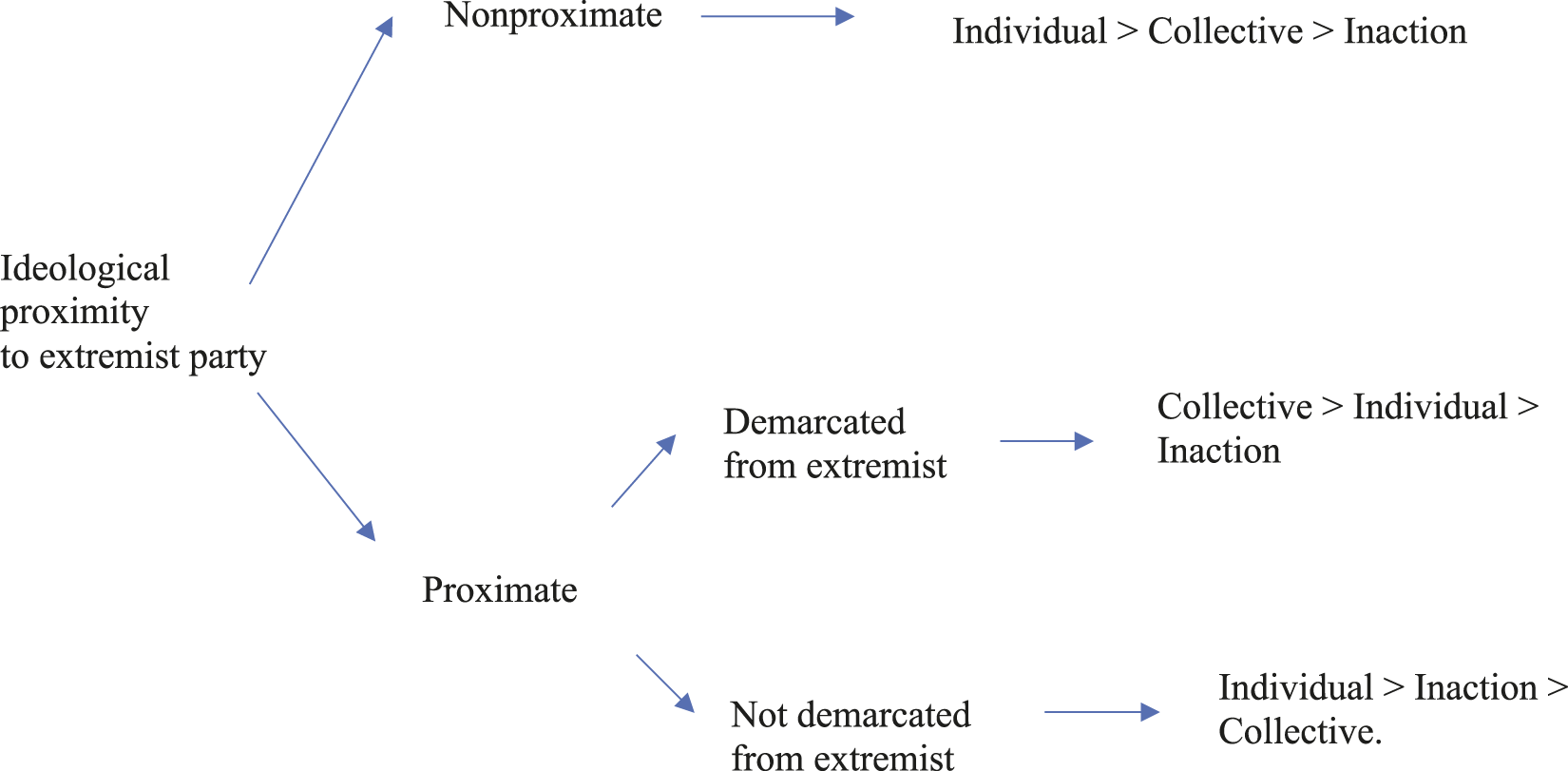
Here, I consider the calculations of non-proximate mainstream parties. Because these parties do not face direct competition from extremist parties, they have lower electoral incentives to reduce the entry of extremist parties. Electorally, these parties may indirectly benefit from the presence of extremist parties because such parties weaken their competitors. On the floor of parliament, therefore, these non-proximate parties may have incentives to tolerate some disruption from extremist parties because they themselves are not the target of such disruption. This suggests that non-proximate parties have electoral incentives to favor individualized over collective strategies of parliamentary defense. Deputies from these parties derive an additional advantage from individualized policies of parliamentary defense, which can be understood as an opportunity to signal to their voters the disapproval of non-proximate extremist politicians. A center right deputy may support a decision to sanction a communist deputy to establish their anticommunist credentials. Legislators from center-left parties may favor sanctions against politicians from far right parties to signal to their voters that they take a strong stance against fascism. If these signaling opportunities are electorally valuable, politicians from mainstream parties may favor individualized strategies of parliamentary defense over inaction.
Given these predictions about the distribution of preferences for collective relative to individualized strategies of defense against extremists, when do legislatures adopt the different policies of parliamentary defense? To address this question, it is important to distinguish two different scenarios. In the first, only one disruptive extremist party is present in parliament. In such situations, the choice of parliamentary defense strategy depends on the relative seat share of parties that are proximate and demarcated from the extremist, non-proximate party. Legislatures will adopt collective policies of parliamentary defense if a proximate party that is demarcated from the extremist commands a parliamentary majority. In other cases, the legislature will adopt individualized policies or take no action against extremist parties.
In the second scenario, disruptive parties on both extremes of the political spectrum threaten the parliamentary and democratic political order. Following Giovanni Sartori, I refer to such environments as contexts of “polarized pluralism” (Sartori, 1990). If both center right and center left parties pursue strategies of demarcation toward extremists, then the parliament will adopt collective strategies of parliamentary defense. The context of polarized pluralism is also conducive to the formation of a majority supporting collective policies of parliamentary defense even if one of the mainstream parties is not demarcated from the proximate extremist party. The presence of extremist parties at both ends of the political spectrum incentivizes embattled mainstream parties to suspend their disagreements and adopt collective strategies of parliamentary defense.
I rely on a variety of archival and secondary sources to test the predictions developed above about the strategies of parliamentary defense. I reconstruct party strategies using a combination of party congress reports, and the private archives of leading politicians. To reconstruct the policymaking process, I supplement these archives with the full corpus of plenary deliberations, archival records of the relevant parliamentary commissions, and transcripts of cabinet meetings.
Responses to Anti-parliamentarism During The Weimar Period
Strategies of Parliamentary Defense, 1920–1928: The Choice of Individualized Strategies
In Germany, the SPD split for the first time in 1914 during debates over war financing. Its offshoot, the Independent Social Democratic Party (USPD) split in 1919 over questions about strategy during the 1918 revolution. The communist party, the KPD, was established in December 1918, grouping together members of the USPD and the (Marxist) Spartacist League. From its origin, the KPD rejected parliamentarism and advocated for the “elimination of the Reichstag and all parliaments” (Weber, 1963, p. 39). Wilhelm Liebknecht’s guiding principles, one of the founding documents of the German communist movement, refers to parliamentary democracy as a falsified democracy that maintained class privileges despite its commitment to political equality (Liebknecht, 1974 [Volume 9]: 630). It follows that the goal of the party’s parliamentary participation was to “expose the fetish character of the bourgeois parliament” (KPD party congress 1924).
During the first decade of the Weimar Republic, the SPD pursued a strategy of incomplete demarcation from the KPD. Several factors explain this choice. The first is the history of repression experienced by left-wing forces during the imperial period (1871–1918). A second is the membership flow between different parties on the left due to the numerous splits. Three hundred seventy thousand members of the USPD joined the KPD in 1920. By 1922, 200,000 KPD members had returned to the SPD (Reschke et al., 2013, p. 57). Multiple coalitional agreements between these two left parties document that the demarcation between the SPD and KPD was incomplete. At the state level, the two parties coordinated in supporting coalition governments in Saxony, Braunschweig, and Thüringen (Riddell, 2011). Following the execution of Germany’s foreign minister Walther Rathenau in 1922, the SPD and KPD formed an alliance against extreme-right parties (Wilde, 2006). And between 1925 and 1926, the two parties coordinated during the debates on the expropriation of the princes.
In this period, the political composition of the Reichstag was extremely fragmented. While the SPD presided over the largest parliamentary fraction of the Reichstag between 1920 and 1928, the socialist share of deputies fluctuated between 24 and 38%. The share of communist deputies was 23% in the 1924 elections but declined to 14% in the election held in 1932. Democratic center-right parties (including Zentrum and the DDP) had a combined seat share that varied between 23% in 1920 and 15% in 1932. The representation of German far-right parties (National Socialist Freedom Party [NF] and NSDAP) in the Reichstag was very low in the first legislative periods of the Weimar Republic but increased over time. While in December 1924, far-right parties elected only fourteen deputies, in 1930, the seat share of the NSDAP had increased to 107.
The SPD leveraged its high seat share to decisively shape the strategies toward extremist parties in the Reichstag. As the party with the largest parliamentary delegation, it was able to elect the president of the Reichstag. Paul Löbe, an SPD legislator, held this position between 1920 and 1932, with a brief interruption between April and December 1924. The preferred strategy of the SPD was to rely on individualized punishments of politicians who transgressed parliamentary rules rather than on collective sanctions that involved changes in parliamentary procedures.
According to the Reichstag rules of procedures (Geschäftsordnung) [GO]), the president of the parliament had the right to call for order any speaker who violated the rules of parliament (GO, 1924; para. 89). The president could also deprive disruptive speakers of the floor and exclude them from meetings (GO, 1924; para. 91). The informal jurisprudence of the Reichstag, developed during the imperial period, defined the behaviors that violated parliamentary norms. Sanctionable offenses included the use of verbal violence against members of the government, antisemitic slurs, and incitation to disorder. To resist to the efforts of extremist parties to disrupt parliament, Löbe relied primarily on the call to order (Ordnungsruf). Between 1920 and 1932, Löbe used the call for order 1500 times. Politicians from other mainstream parties, such as the DDP, concurred with Löbe’s use of the call for order and widely praised him for his even-handedness in steering parliament during a very turbulent time. Otto Gessler, a politician of the DDP praised Löbe as follows: “If history was to bestow the epithet ‘the Great’ even on the rulers of parliamentary battlefields, this man was to receive it […]. He knew how to bring necessary discipline with freedom of mind and speech into the best possible harmony (Mergel, 2002, p. 435)”.
During the first decade of the Weimar period, German lawmakers rejected collective changes in the procedures of the parliament. The SPD, a fierce opponent of these measures, argued that changes in the rules of order sanctioning particular parties may restrict the parliamentary activity of opposition parties. In 1925, SPD legislators opposed changes to the parliamentary proceedings that allowed governments to pass legislation without consultation of minority parties (StBer DtRt August 10, 1925). This SPD opposition explains the absence of changes in the parliamentary procedures of the Reichstag during this period.
Another strategy with which mainstream parties could respond to the disruption of extremists was by limiting their parliamentary immunity. This could be achieved by allowing courts to continue to investigate politicians elected to the Reichstag even when the parliament was in session. Between 1920 and 1928, the Reichstag was extremely reluctant to use this tool of parliamentary defense; it considered 374 requests to suspend the immunity of politicians, but only 41 such requests were approved. During this period, the SPD systematically blocked any proposal to constrict the parliamentary immunity of communist deputies, invoking the biased nature of the German court system. SPD politicians considered interrupting legal proceedings against the immunity protections of communist deputies a necessary form of class justice to counter courts in reactionary states like Bavaria (StBer DT Rt, June 24, 1924).
During this period, the legislature responded to parliamentary disruption by taking up individualized policies of parliamentary defense. The preferred strategy involved using the call to order to sanction extremist politicians; lessening the political immunity of extremist deputies was used only scarcely. At the same time, deputies opposed more assertive policies to combat extremists that involved changes in the parliamentary procedures. The individualized strategies of parliamentary defense were favored by the SPD, the largest party in the Reichstag at the time. In addition, non-proximate democratic parties, such as Zentrum and the DDP, also had little appetite for collective policies of parliamentary defense. These preferences changed dramatically after the increased electoral success of far-right parties.
Parliamentary Defense in a Period of Polarized Pluralism, 1930–1932
Only a very small number of far-right deputies was elected to the Reichstag during the first decade of the Weimar Republic (1918–1928). The NF reached the necessary quorum of fifteen deputies to form a faction in 1924. In 1928, only twelve NSDAP deputies were elected to the Reichstag, but the number jumped to 107 in 1930. I develop two expectations about the consequences of the increase in electoral strength of far-right parties.
First, I expect that this political change will increase demand for collective policies of parliamentary defense by center-right parties (e.g., Zentrum and the DDP) that pursued strategies of demarcation from the extremist parties. At the same time, I hypothesize that this context of regime crisis is conducive to the formation of a parliamentary majority supporting collective strategies of parliamentary defense, as it was clear to all participants that democratic parties would no longer have a majority in a future parliament. The threat of regime breakdown is expected to increase demand for collective policies of parliamentary defense from all parties.
I find support for both hypotheses. Center-right parties responded to the increase in the parliamentary seat share of far-right parties by demanding collective changes in parliamentary procedures. In 1929, politicians from a small splinter party, the Bavarian People’s Party (BVP), advanced a proposal for reform of the procedures of the chamber. This proposal recommended increasing the power of the police to stop turbulent meetings and increasing the sanctions on disruptive legislators. The proposal of the BVP met with support from all democratic parties in the rules committee (Geschäftsordnungsausschuss) (RT Drucksache 1461/ 1928). This committee approved a modified version of the proposal. It recommended increasing the power of the president of the chamber to interrupt a speaker who engaged in disruptive behavior but rejected increasing police power. The committee also recommended stronger sanctions on politicians who engaged in disruption and a thirty-day interdiction of their participation in Reichstag sessions (StBer DtRt, 1928; Drucksache 1461).
The Reichstag approved these changes in a meeting on December 11, 1929 (StBer DtRt, 11 December 1929). In his intervention on behalf of the social democratic faction in the Reichstag, Löbe acknowledged the change in the position of the party on the question of procedural reform. He motivated this change by arguing that no additional possibility to ensure regular parliamentary debate existed and that the call to order was, by itself, insufficient to restore discipline. In Löbe’s words:
If there are deputies or groups of deputies who answer the call to order with jeers, who repeat the reprimanded remark, and who openly declare to the President that he can call them to order ten times, they do not care—what other means does the House have to secure its deliberations, than that to apply harsher measures of order? (StBer DtRt, 11 December 1929).
Delegations of the SPD, Zentrum, and the DDP unanimously voted to modify the rules of the Reichstag (modifying paragraphs 90, 91, and 95 of the Geschäftsordnung). The German National People’s Party (DNVP) abstained and the extremist parties (the KPD and the NF) opposed these changes by walking out of the meeting.
In February 1931, Weimar’s embattled democratic parties undertook the last changes to the parliamentary procedures of the Reichstag, (StBer DtRt, February 9, 1931) and the legislature adopted two modifications. First, to restrict the ability of individual legislators to disrupt deliberations during the budgetary process, the Reichstag adopted new rules requiring any amendment recommending either an increase or a decrease in fiscal expenditures to be specific about the resources needed to cover such expenditures (Geschäftsordnung, paragraph 48 a). A second modification restricted the ability of floor members to submit interpellations to government bills by increasing the number of required signatories for an interpellation from fifteen to thirty legislators (Geschäftsordnung, paragraphs 55 and 60). The new rules gave the president the right to reject interpellations that contained either “inadmissible phrases” or “judgement beyond the statement of facts.” But these changes were unable to stop frivolous motions of no confidence that were a common feature of Weimar’s parliamentary life. President of the Republic Paul von Hindenburg decided to dissolve the Reichstag in September 1932 because he anticipated a motion of no confidence that enjoyed the support of the two extremist parties, the KPD and the NSDAP.
Between 1928 and 1932, the Reichstag began taking increasingly harsh decisions to limit the parliamentary immunity of extremist legislators. It adopted changes that allowed for the temporary suspension of deputies when the parliament was not in session. These changes, which were initially advocated by politicians from Zentrum, were adopted by the Reichstag in 1928.
Prior to that period, in December 1927, Zentrum deputies began to endorse proposals asking for the suspension of parliamentary immunity for extremist legislators. For example, Johannes Bell, a Zentrum politician, supported a policy that would suspend the immunity of politicians when parliament was not in session, arguing that this position struck a balance between the requests of the courts to carry out justice and the interests of the parliament, which required the participation of all deputies (StBer DtRt, 1927; Anlage 3740, StBer DtRt, 9 December 1927). The Zentrum faction held this position in subsequent years.
In a critical vote taken on February 9, 1931, Zentrum and DDP politicians voted to support the demands of courts to continue the legal prosecution of deputies when the parliament was in session. On this occasion, the SPD voted in line with the center-right parties, shifting from its long-held position of unconditional defense of parliamentary immunity. Löbe justified his party’s decision by arguing that it was no longer possible to give deputies of extremist parties “the freedom to insult and swear and to discredit the parliament with impunity.” By this late date, SPD politicians recognized that restricting political immunity was a necessary step for the parliament to regain its legislative effectiveness. Endorsing this decision, Löbe argued that a harsher stance on immunity could lead to a defense of parliamentarism. A common practice of the NSDAP was to place extremely disruptive politicians high up on its ballots. Counting on future parliamentary immunity, these politicians exercised no restraint during their campaigns. Once elected, these deputies took their verbal violence to the floor of the Reichstag, disrupting legislative debate. Due to the increasing deterioration in the tone of the debates, SPD politicians considered constraints on immunity a necessary intervention that could counter the degradation of the parliamentary debates.
The alignment of the social democratic and center-right parties’ positions on questions of political immunity activated immunity as a mechanism of parliamentary defense. Between 1928 and 1932, the Reichstag allowed over sixty court cases against extremist politicians to go forwards, a development that stands in sharp contrast to the first decade of the Weimar period.
The increased parliamentary strength of far-right parties also led to demands for change in the electoral system. Consistent with my theoretical expectations, center-right parties that were demarcated from extremist parties expressed support for electoral reform. Beginning in 1928, center-right parties like Zentrum and the DDP advocated for change in the electoral system. They criticized the proportional representation system as contributing to the erosion of parliamentarism (BA R 45 III/13, Nr. 205), citing its permissiveness in the election of demagogues (StBer DtRt, 1924; Drucksache 5190). These center-right parties recommended several proposals to limit the presence of extremists in parliament. Some propositions recommended reducing the size of districts to increase electoral thresholds to lower party fragmentation (StBer DtRt, 1928; Drucksache 430); other reform initiatives advocated for the reintroduction of the majoritarian electoral system.
Also beginning in 1928, the DDP advocated for the introduction of majoritarian elements in the electoral system. At its party congress that year, the DDP championed the adoption of a hybrid electoral system that relied primarily on single-member districts but that also allowed for some redistribution in the allocation of seats (BA R 45 III/13, Nr. 205). Prominent Zentrum politicians joined the DDP and reiterated earlier demands for the adoption of electoral reforms. A few years earlier, in January 1926, Chancellor Hans Luther had announced that his government would propose an electoral reform that would seek to establish an “unmediated relationship between voters and their representatives in the parliament”—in other words a majoritarian electoral system (STBer 27 Jan 1926, StBer DtRt, 1927; Anlage 3667). Following that short-lived government, another Zentrum government, this one led by Chancellor Wilhelm Marx, continued discussions to reform the electoral system (Cabinet meetings, Marx, October 24, 1926), including a proposal recommending increasing the number of districts from 35 to 227. And in 1930, during meetings of Chancellor Heinrich Brüning’s cabinet, Joseph Wirth, the Zentrum minister of the interior, advocated for the introduction of majoritarian elections (Wirth, 1930).
In contrast to Zentrum and the DDP, the SPD obstinately defended the status quo and rejected proposals to change the electoral system. Throughout the Weimar period, the SPD was unwilling to subscribe to criticisms of the existing electoral law. Rejecting proposals to return to a candidate-centered electoral system, SPD politicians argued that “social democratic voters choose candidates not based on their individual characteristics but based on the loyalty to an idea (Treue zur Idee)”. Pushing back against the expectations raised by DDP legislators that the reintroduction of majoritarian elections could lead to a selection of “better” and less demagogic deputies, the SPD politicians argued that demagogues could be elected even in small districts under a majoritarian system if the party organization threw its weight behind a particular candidate. The social democrats also opposed proposals to reduce the size of the districts, questioning whether such reductions would result in closer connections between voters and candidates. They described such proposals as “experiments proposed by the decadent political parties of the bourgeoisie” and as “efforts to disintegrate electoral districts that had already acquired an organic unity” (StBer DtRt, 8 June 1929).
By leveraging its parliamentary influence, the SPD successfully blocked electoral reforms throughout the Weimar period 1 . The cabinet of Chancellor Marx, in which the SPD did not participate, was the only cabinet that approved electoral reform and advanced these recommendations to the Reichstag (BA R 43 1/999, Nr. 599) in this era. The SPD strongly opposed the electoral reforms proposed by Heinrich Brüning’s government (1930–1932), decrying them as “failed experiments” (Kluh, 1930). As late as 1931, the SPD opposed proposals to modify the electoral system that were advanced by Chancellor Franz von Papen’s government (June- November 1932). And in an open letter to President von Hindenburg in 1932, Löbe criticized proposals for electoral reforms as attempts to “dismantle people’s rights in Germany” (Löbe, 1932).
This account of political developments in Germany’s Weimar period lends support to the main hypotheses concerning the demand for policies of parliamentary defense advanced in this article. During the first three legislative periods of the Weimar era (1920–1924), demand for collective policies of parliamentary defense was low. The SPD did not pursue a strategy of demarcation from the Communist Party and preferred to rely on individualized strategies of parliamentary defense, including calls to order. The demand of legislators for policies of parliamentary defense changed after 1928. The entry of deputies of far-right parties in the Reichstag increased demands from center-right parties for collective strategies of parliamentary defense. Deputies of center-right parties, such as Zentrum or the BVP, advanced proposals to change rules of chamber, to impose stronger sanctions on disruptive politicians, and to change the electoral system. The SPD joined the legislative coalition supporting reforms of parliamentary procedure and changes in immunity 1930, in a moment of deep regime crisis when the democratic majority of a future parliament was uncertain. But the SPD refused to endorse changes in electoral rules and its opposition to electoral reforms prevented Weimar lawmakers from wielding an important policy tool of democratic defense, one that had been successfully used in neighboring France.
Response to Anti-Parliamentarism in Third Republic France
Collective Strategies following the Communist Entry: The Return to Majoritarian Elections
The French Communist Party (PCF) competed for the first time in France’s 1924 election (Tiersky, 1974). The socialists pursued a strategy of demarcation beginning with this election and refused any electoral alliance with the communists, but this strategy was insufficient in limiting communist electoral gains. In that election, the communists made significant inroads in areas with strong reservoirs of left-leaning votes, receiving 9.5% of the vote and electing twenty-six legislators to the chamber. This demarcation continued throughout the interwar period (with exception in 1936–38). And at the 1927 Socialist Party (SFIO) congress, the leadership adopted a resolution condemning the “cruel indifference or the insolent hostility” of Russian communist leaders and vowed to “jealously safeguard their independence” from the communists (SFIO, 1927: 505).
The SFIO followed up its strategy of demarcation from communists with demands for changes in electoral rules that could limit communist victories. Beginning in 1926, it began to advocate for the reintroduction of a majoritarian electoral system. This change in strategy was a departure from its historically held position, which was to advocate for a proportional electoral system. In a meeting of the National Council of the Socialist Party on June 26, 1927, a majority of legislators endorsed the return to a majoritarian electoral system (the scrutin d’arrondissement). French socialists used two arguments to motivate this shift in policy. First, the potential electoral losses associated with this reform were assessed as being relatively low, as socialists could count on their political strength in many departments (départements) and on electoral alliances with radicals. Second, socialists were confident that they could attract during runoffs the votes won by communist candidates during the first round. National party leaders urged elected socialist deputies to follow the strongest possible discipline and vote in a united manner on questions of electoral reform (SFIO Congress 1927).
This change in the SFIO’s position facilitated the formation of a new political majority on questions of electoral reform in the chamber’s Commission du Suffrage Universel (Archives Nationales, C14711). Following the socialist volte-face, the commission submitted to the chamber a draft bill recommending the adoption of a majoritarian system. This draft arrived on the floor of the chamber on July 1, 1927, and was discussed in a number of meetings the same month. Radicals also supported the reintroduction of majoritarian elections. For the radicals, this was not a new stance, but a long-held position on questions of electoral reform. Beginning at its party congress in 1906, the Radical Party voted in strong support of a majoritarian system, rejecting proposals to introduce proportional representation (Parti Radical, 1906). Due to its centrist position in the electoral system, the Radical Party could strike electoral coalitions with proximate parties on opposite sides of the political spectrum. As such, radicals preferred the coalitional flexibility of a majoritarian system. During its 1922 party congress, the radicals expressed their opposition to the “absurd” electoral formula adopted in 1919, which “lacked clarity” (Parti Radical, 1906, p. 235). Interestingly, while reaffirming its traditional support of majoritarian elections, the radicals were quick to denounce the shift in the socialists’ position. Camille Chautemps, a radical socialist from Indre-et-Loir, accused the socialists of embracing majoritarian elections with the goal of taking the highest number of seats from the radicals (JORF Deb, 1 July 1927).
In contrast to socialists and radicals, parties on the political right, such as the Républicains Progressistes, the Républicains de Gauche, and the Fédération Républicaine (FR), staunchly opposed a majoritarian system. La Nation, the main publication of the FR, referred to the reintroduction of the majoritarian electoral system as a “crime against the country” (La Nation, 19.2.1927, 16.7.1927). Eleven FR politicians withdrew from the deliberations of the Commission of Universal Suffrage following the socialists’ shift in position (Hoffmann, 2008, p. 457). Deputies on the right were unpersuaded by the argument that change in the electoral system could limit the communist vote. They expressed the worry that abstentions of other centrist parties during runoffs could lead to a victory for the communists. Representatives of FR regional associations expressed this concern in a 1927 letter to President Raymond Poincaré:
Given the local contacts between Communist and Socialist activists […] instituting a second round of voting is a crime against the fatherland, and it goes without saying that we will use every means—obstruction in parliament and agitation in the country—to prevent this odious attack on the nation (Archives Nationales 355, AP 1; Hoffmann, 2008, p. 457). Deputies on the right were quick to point out that the shift in the socialist position was a form of political opportunism.
The decisive vote on the reintroduction of majoritarian elections took place on July 11, 1927. On this occasion, socialists and radicals voted in support of reform, while over seventy percent of legislators from center-right parties opposed it. The pivotal actor in the electoral coalition supporting this reform was the French socialist party (SFIO), which shifted its long-held position in support of proportional representation. The reform passed and remained relatively effective in blocking a further increase in communist parliamentary representation. In 1928, communists won 1,063,943 votes, which represented an increase of 188,131 votes over the results from 1924. But the higher vote share did not translate to an increase in the number of parliamentary seats held by communists. Not one communist deputy won during the first round, and the party obtained only fourteen seats during runoffs, which reduced their parliamentary fraction by half relative compared to 1924. The collective strategy of parliamentary defense was, thus, effective in blocking electoral gains during the following electoral cycle.
The change in the socialists’ position on questions of electoral reform helped to bring about a different political majority in favor of a majoritarian electoral system in part because a significant number of deputies from other centrist parties, particularly the radicals, had always opposed proportional representation. But it was harder to create an encompassing majority on other questions of parliamentary reform due to the reluctance of center-right parties to endorse them. Following the parliamentary entry of communist deputies, socialists began to advocate for changes in the procedures of the chamber that could limit demagogy and disruption. The core idea of the socialist proposal, first advocated in 1925, was to limit speaking time. A proposal to restrict speaking time submitted by the socialist faction in 1926 sought to increase “order, discipline, and methods of deliberation” (JORF Chambre, 1926; Nr. 2550). At its 1927 congress, the Socialist Party adopted a resolution recommending limiting the time allotted to each speaker. The institutional innovation of the socialist proposal was to give the parties in the chamber more discretion in the allocation of speaking time.
The socialist proposals for a collective reform of parliament met opposition from center-right parties. In discussions in the Commission du Règlement, Louis Marin, a center-right politician, strongly opposed any measure restricting speaking time in the chamber (Koos 2018). The opposition of center-right parties contributed to the defeat of these proposals during the 13th and 14th legislative periods of the Third Republic.
During the 1920s, Third Republic politicians underutilized restrictions on parliamentary immunity as a mechanism to sanction extremist politicians (Guérin-Bargues, 2011). The most significant conflict over the use of immunity occurred between June 1927 and January 1928 and was triggered by the conviction of Marcel Cachin, a communist deputy. Deputies from right-leaning parties took advantage of Cachin’s conviction to forge an anticommunist electoral coalition. By contrast, center-left deputies criticized the politicization of immunity for electoral purposes. Countering the strategy of the right, Daladier, a radical politician, defended the “absolute inviolability” of elected legislators and argued that “no republican will be fooled, no one will allow himself to be embroiled in this new Holy Alliance which takes as its pretext the fight against communism, but which we know above all wants the fight against justice and the demands for social reform” (JORF Débats Chamber, June 10 1927).
Parliamentary Reforms Following The February 6 1934 Events
A political compromise among center-left and center-right parties on the reform of parliamentary procedures occurred in 1935. At the time, representatives of all major political parties agreed on two important changes in parliamentary procedure: a reform limiting speaking time and a reform of the amendment process. The critical event contributing to the formation of the encompassing parliamentary majority in support of those reforms was the Riot of February 6, 1934. The riot led to an assault on the Palais Bourbon, and the ensuing investigations brought the antiparliamentary and antidemocratic leagues of the far right to the center of French political life. At the same time, Gaston Doumergue, prime minister after the fall of the Daladier government in 1934, pushed for constitutional reforms that reduced the responsibilities of parliament while strengthening the executive. Faced with these dual pressures, a parliamentary majority in favor of reform formed in France.
In this transformed political environment, center right parties abandoned their opposition to parliamentary reform. At its 1935 party congress, the FR lamented the conditions of parliamentary life, which included “confusion of improvisation and overbidding” and abuses of the rights of amendments. The meeting concluded with a call for a reform to prevent the parliamentary crisis from becoming a regime crisis (Fédération Républicaine de France, 1935).
In 1935, the French parliament adopted two procedural (collective) reforms that attempted to limit disruption in the legislature. The first reform strengthened the role of political parties in controlling speaking time. The second changed the amendment submission process. Andre Bréton, a socialist legislator, was the architect of the reforms that enhanced the role of parliamentary groups in controlling speaking time (Archives Nationales C/15045, 22 December 1934). The modified article (article 43 bis) of the Règlement of the Chamber read as follows:
The conference of presidents may propose to the house to limit the duration of debates on a draft or a proposal. The Deputy Chairmen of the House and the group chairmen […] will divide the speaking time. They will then submit the names of the speakers to the chairmen, who will draw up the list in the order most conducive to the clarity of the discussion.
During a meeting on January 22, 1935, the chamber adopted this reform—an institutional innovation proposed by the socialists that strengthened role of political parties to control debate. The communists opposed the provision. Jean-Marie Clamamus, a communist legislator from Seine, rebuked it as a “dangerous” proposal reflecting the “evolution towards more dictatorial provisions” and leading to the “fascistization” of France.
The second collective reform adopted by the chamber involved changes in the submission of amendments. These reforms responded to concerns that frivolous amendments were the most important disruptive strategy used by extremist legislators. Léon Blum, a socialist politician and three-time prime minister of France, viewed the high number of amendments as the main source of the “nervous instability” of the assembly, which displayed “a mix of depression and excitation” (Blum, 1936: 165). Like the reform related to speaking time, proposals to reform the amendment process originated with socialist deputies (JORF, 1934; Nr. 4379). Proponents of this reform noted that the use of amendments was an important way to disrupt the debates. Together with “a faulty improvisation and rapid or diffused debate,” amendments “do not shed light on the issue, and often tend to confuse it” (JORF, 1934; Nr 4200). Deputies on the right, such as Ernest Lafont, argued that it was impossible to reduce the number of amendments because the discussion of bills created demand for further changes (Archives Nationales, C 141,910). The goals of these reforms were to “suppress the disorder and improvisation during the public meetings of the Chamber and to render the amendment more loyal and efficacious” (JORF, 1934; Nr 4379). In the end, the Règlement commission adopted the reforms in 1934 and the chamber adopted them at its January 15, 1935, meeting. The communists defended the status quo, which allowed individual legislators to submit amendments, because it provided better protection of political minorities.
The changes adopted in 1935 represent the first effort to regulate the right to submit amendments during the Third Republic. The 1935 decision introduced several changes to the Règlement of the Chamber. First, it introduced a deadline for amendments to be submitted before the opening of the debate in a session (article 85, para. 3, 1936 Règlement of the Chamber). Second, it clarified the rules on debate of amendments. Some of the provisions included restrictions on the number of speakers who could speak during an amendment discussion (only government officials, the committee chair, the rapporteur, one of the signatories to the amendment, and a speaker requesting the amendment rejected). Speakers were given 15 minutes, but the chair of the assembly had the right to call them back to the subject if the discussion strayed from the amendment itself. Third, it clarified the types of amendments that could be discussed (article 85 bis, 1936 Règlement of the Chamber). These included amendments that the committee or the government agreed to discuss, those reproducing text voted on by the senate, those tabled in the name of a committee, and those directly related to changes in the bills modified by the commission or the chamber during the discussion.
The French parliament adopted a final measure of parliamentary defense in 1940, a few months after Germany’s invasion of Poland. In January of that year, the government led by Prime Minister Édouard Daladier initiated a proposal to strip all communist deputies of their parliamentary immunity. This proposal followed other repressive measures against the Communist Party, including the dissolution of local organizations, the closing of newspapers, and the arrest of militants (JORF Débats Senate, March 19, 1940, Intervention of Albert Sarraut, Minister of Interior). The communist deputies in the chamber who had not repudiated the party reconstituted their parliamentary group as the Group of Workers and Pesants (Groupe Ouvrier et Paysan).
Effectively, Daladier’s proposal to strip all communists of their parliamentary immunity transformed questions of immunity that theretofore had been decided on a case-by-case basis into a collective strategy of parliamentary defense. I find strong party consensus in support of this change. Members of the assembly endorsed the proposal to strip communists of their immunity nearly unanimously, with 520 deputies voting in favor of the measure and only two abstaining (JORF Chamber, 16 January 1940). Georges Barthèlemy, a Socialist deputy and rapporteur of the law, exhorted his colleagues to give the government the “means to arrive at the total and final victory.” While underscoring that the decision represented a departure from existing constitutional provisions of the Third Republic, radicals like Camille Chautemps urged members of the chamber to take this leap “in order to kill treason from Moscow and Berlin” (JORF Chamber, 16 January 1940). Chautemps, who at the time was deputy prime minister argued, “The disenfranchisement of communist deputies is justified because these deputies betrayed working class at the expense of Adolf Hitler, the greatest enemy” (JORF Chamber, 16 January 1940). While socialists expressed fears that harsh repression of communists could martyrize the party, they went along with the majority of the chamber and supported the legislation (JORF Chamber, 16 January 1940).
Developments in France lend support to my main propositions about parties’ demand for collective and individualized policies of parliamentary defense. First, following the entry of communist deputies, proximate parties (in this case, the socialists and radicals) adopted a strong strategy of demarcation and followed up with demands for collective strategies of parliamentary defense, such as a change in the electoral system. Second, non-proximate parties, which included republican parties on the right (Républicains, FR, Gauche Républicaine), were reluctant to endorse collective strategies of parliamentary defense at a time when the main antiparliamentary party was on the extreme left. The rise of extremist parties at both ends of the ideological spectrum—which followed the antiparliamentary riots of February 1934—created a new window for parliamentary reform. In a context of polarized pluralism, parties on the right abandoned their opposition to collective reforms and consented to a change in the rules of the chamber. The reforms adopted in 1935 attempted to reduce parliamentary disruption by increasing control of the chamber president over speaking time and by limiting the ability of deputies to submit amendments. This cross-party consensus on parliamentary reforms weakened during the second half of the 1930s and was reestablished for the last time in 1940—a time of an intense national emergency following the outbreak of World War II. Upon the outbreak of the war, legislators from all the mainstream parties voted in favor of extreme sanctions against communist deputies.
Conclusion
During periods of democratic erosion, legislative institutions are sites of intense conflict between parties that seek to undermine their functioning and parties committed to parliamentarism. This article contributes to the literature on democratic erosion by placing legislative institutions at the center of the analysis and by examining conflicts over the protection of parliaments during periods of democratic decline.
This study lays out the toolkit of policies of parliamentary defense that are available to democratic parties and the trade-offs between these policies. In doing so, I broaden the menu of policies of democratic defense considered in the literature (Capoccia, 2005). While the literature on militant democracy focuses on party bans as the main instrument of democratic defense available to mainstream parties, I document that a range of additional instruments, such as changes to immunity protections and electoral reforms, have been considered and tried as possible responses to extremist parties. By drawing on the historical experience of two embattled democracies, Weimar German and Third Republic France, I bring to the discussion policies of parliamentary defense that have been insufficiently examined.
This study considers the antiparliamentarism of both communist and far-right parties and the political response of both proximate and non-proximate mainstream parties. This undertaking represents a departure from existing literature that focuses on proximate center-right parties as pivotal actors whose choices have momentous implications for the adoption of measures of militant democracy and for regime survival (Capoccia, 2005). I argue that to understand when and why countries adopt policies of parliamentary and democratic defense, it is equally important to understand the choices made by all political parties and not just center right parties alone. The variation in the strategies of parliamentary defense adopted in France and Germany can be attributed to the choices of center left parties. By pursuing an early strategy of demarcation from communist competitors, French Socialists also embraced more far-reaching collective strategies of parliamentary defense much earlier than German social democrats. In cases where center right parties prioritized individualized strategies of parliamentary defense, the coalitional possibilities for far-reaching policies of parliamentary defense were lower. As a result, the choice of these individualized strategies enhanced the parliamentary crisis of the interwar period.
Footnotes
Declaration of Conflicting Interests
The author(s) declared no potential conflicts of interest with respect to the research, authorship, and/or publication of this article.
Funding
The author(s) received no financial support for the research, authorship, and/or publication of this article.

Data Availability Statement
Data sharing not applicable to this article as no datasets were generated or analyzed during the current study.