






Abstract
The electoral ‘cost of governing’ is widely considered a law-like phenomenon. However, costs of governing are not limited to the electoral dimension. This paper highlights and documents an unappreciated nonelectoral cost of holding government office: diminished rhetorical simplicity. I argue that the functional demands of running government compel government members to speak less simply than is electorally optimal. I refer to this effect as 'the rhetorical cost of governing'. I test this theory using rich data on individual legislator careers and parliamentary speech in Denmark across three decades. Consistent with the theory, government membership reduces rhetorical simplicity. Additional analyses suggest the effect is transitory and is driven by constraints on issue emphasis. I then provide experimental evidence of downstream electoral consequences, showing that respondents prefer politicians using simple language. The results enrich our understanding of the costs of governing, the opposition advantage, and the mass grievances fueling populist political movements.
Keywords
Introduction
Governments lose votes over time. More precisely, on average, governments in electoral democracies lose voter support from the time they are elected to when they run as incumbents in subsequent elections. This ‘cost of governing’ is so consistently observed that it assumes a place in the pantheon of law-like phenomena in political science. (Some scholars use the term ‘cost of ruling’ to denote the same phenomenon. In the following, I use the slightly more commonly used label ‘cost of governing’). However, the set of challenges facing governments is not reducible to diminished electoral support. And whereas the electoral costs of holding government office are well-established, costs along non-electoral dimensions are less well-documented, much less understood.
This paper highlights and documents an as of yet unappreciated non-electoral cost of holding government office, in the form of diminished rhetorical simplicity. In short, I argue that while legislators aim to communicate policies in maximally simple terms, a property rewarded by voters, the functional demands of holding government office compel government legislators to speak with less simplicity than they otherwise would have. I call this effect the ‘rhetorical cost of governing’. The rhetorical cost of governing poses a challenge to government incumbents in that it limits their ability to craft effective political communication relative to their opposition competitors. The rhetorical cost of governing is also important in a broader democratic perspective insofar as it can reduce the quality of representation. This is the case because justification, i.e. how representatives explain their actions in public communications, is an important distinct dimension of political representation (Wolkenstein & Wratil, 2021). Legislators use justificatory communication to legitimize policy actions and connect them to broader societal aims and ideological values (Ebeling & Wolkenstein, 2018), a critical element of the ‘predisposition model’ of public opinion formation (Leeper & Slothuus, 2014). The rhetorical cost of governing can weaken representation by making justificatory communication less intelligible to citizens.
I provide evidence for the rhetorical cost of governing using parliamentary speech data from Denmark’s parliament, Folketinget, across three decades. Analyzing around 1.5 million paragraphs of speech, I measure rhetorical simplicity using standard and customized measures of text readability.
Consistent with the theoretical expectations, I find that legislators speak with diminished simplicity when serving in government. Moreover, consistent with the effect being driven by office-specific constraints, simplicity reverts back once legislators leave government. Additional analyses suggest that these constraints are not first and foremost government members’ formal speech obligations, but rather substantive constraints on which topics government members can choose to cover: legislators serving in government spend relatively more time on more intrinsically complex, technocratic issues and less on ‘easy’ issues (Carmines & Stimson, 1980) with a clear ideological dimension.
While important in its own right, the rhetorical cost of government can also have downstream effects on voters. If voters ceteris paribus prefer elected officials to speak simply, this may lead voters to evaluate government members more negatively. In a follow-up experiment, I provide evidence that voters indeed prefer politicians using simple language. This suggests that the rhetorical cost of governing can have adverse consequences on voter evaluations.
The paper contributes to the existing literature on multiple fronts. First and foremost, the paper identifies a novel cost of governing, adding to the set of known challenges and constraints faced by governments. In doing so, it adds to our understanding of the cyclical nature of government turnover. Though at a rhetorical disadvantage while in government, once legislators have left government office and returned to opposition they enjoy the ‘power of the loser’ (Seeberg, 2023) and can once again maximize simplicity. This in turn sets up a favorable contrast with the new government, now itself saddled with the rhetorical cost of government. This dynamic adds to our understanding of how once unpopular government parties can regain the upper hand after having assumed an opposition role.
Second, the paper advances a nascent literature examining how representational linkages are shaped by legislators’ parliamentary career stage. While a rich literature characterizes static differences in legislators’ representational style (e.g., Grimmer, 2013) and explains these with reference to their personal backgrounds (Zittel, Nyhuis, & Baumann, 2019), reelection incentives (Fouirnaies & Hall, 2022), or the composition of the electorate (Spirling, 2016), the literature has rarely contended with how representational linkages can change through the course of legislators’ careers (for exceptions, see Bailer & Ohmura, 2018; Bailer et al., 2022). In this paper, I bracket between-legislator differences by focusing on within-legislator movements in and out of government office. This in turn shifts attention from electoral and partisan differences to how legislators’ incentives, preferences, and constraints change across the career trajectory.
Third and finally, the theory and evidence presented in this paper help explain a phenomenon that has received little attention in the existing literature on the cost of governing, namely the electoral appeal of populist critiques of government. Because members of government are constrained in their ability to speak simply, populist challengers have fertile ground for claims that governing elites have ‘lost touch’ with regular voters. This sets up a structural asymmetry between mainstream parties in government and populist stripes of opposition ‘challenger parties’ (De Vries & Sara, 2020): the functional demands of running government commit its government office-holders to a base level of rhetorical complexity. This asymmetry helps explain the continued success of populist parties, even in the face of positional accommodation by mainstream parties (Meguid, 2005).
I proceed as follows. In the next section, I contextualize the argument by outlining existing accounts of electoral and non-electoral costs of governing. I then present the theory underpinning the rhetorical cost of governing. The remainder of the paper presents an empirical test of the theory, auxiliary analyses probing the mechanism, and the follow-up experiment testing voter preferences for rhetorical simplicity. The concluding section highlights relevant caveats and key implications.
Electoral and Non-Electoral Costs of Governing
There is no shortage of affirmations of the regularity of electoral costs of governing. Nannestad and Paldam (2002, p. 17) note that “few facts are so robust in political economy” as the cost of governing. Similarly, Cuzán (2015, p. 416) refers to it as “the law of shrinking support”. Most recently, Thesen et al. (2020, p. 555) note that the cost of governing is “one of the most well-established in political science”. While traditionally analyzed in the context of United States presidential politics (Green, 2017), the electoral costs of governing have recently been documented more broadly (Müller & Louwerse, 2020). In Online Appendix A I reproduce this finding in the context of contemporary European politics, estimating an average vote share loss of roughly five percentage points per election across government parties.
The extant literature identifies a host of disadvantages faced disproportionately by governments. However, while these costs are not in and of themselves electoral, they are generally seen as intermediate outcomes, invoked to explain downstream electoral costs. Generally speaking, we can organize these into three broad, diverse classes of explanations: One set of explanations highlights the consequences of government policy for the cost of governing (Downs, 1957; Mueller, 1970), with aggrieved constituencies gradually accumulating to a ‘coalition of minorities’ (Nannestad & Paldam, 2002) against the government. A second set of explanations highlights various consequences of post-election defections by governments: voters’ (possibly unrealistic) expectations for incoming governments lead to post-election disappointment (Mueller, 1970; Stimson, 1976). These disappointments may also be driven by ‘policy misrepresentation’, as governments campaign on centrist policies in order to win over the median voter, but drift toward their left- or right-wing policy ideal points after assuming office (Wlezien, 2017). Third and finally, negativity biases among voters (Nannestad & Paldam, 2002; Ashton & Munis, 2021) and in editorial standards (Thesen et al., 2020) can lead to an ‘accumulation of bad news’ for governments, which in turn drives down government support.
In contrast to these explanations which focus on mechanisms driving the electoral costs of governing, this paper adds to a relatively smaller literature identifying distinctly non-electoral costs of governing. Some highlight that the necessary compromises in coalition government compel government parties to deviate from their policy ideal point. This includes Klüver and Spoon (2020), who argue that this cost is higher for junior coalition partners, as their weak intra-coalition bargaining power renders them unable to deliver on policies promised before the election. More recently, Bøggild & Pedersen (2024) argue that governing increases the risk of legislator dissent, as reelection-minded legislators vote against the party line to distance themselves from the deteriorating brand of the incumbent party. The rhetorical cost of governing is a complement to, not a substitute for, these earlier accounts. As such, the rhetorical cost of governing enriches our understanding of the full set of challenges faced by governments vis-à-vis the opposition.
The theme of how rhetorical complexity intersects with government responsibility also features in the literature on so-called integrative complexity. Often studied in the context of political communication, ‘integrative complexity’ refers to an individual’s ability to cognitively combine differentiation and integration of competing perspectives (Suedfeld & Tetlock, 1977). Early studies find that revolutionary leaders who become government leaders express high integrative complexity (Suedfeld and Rank, 1976), and US presidents exhibit higher integrative complexity after assuming the presidency compared to during the election campaign (Tetlock, 1981). Pancer et al. (1992) find the same pattern in the Canadian House of Commons. However, this older literature rooted in cognitive psychology does not connect this finding to the political economy literature on the cost of governing. Moreover, due to the cost of measuring integrative complexity and data availability constraints at the time, these earlier studies are based on very limited samples relative to this study. As a consequence, they are not able to track how rhetorical complexity changes as individuals transition in and out of government. For reasons explained below, tracking changes within individuals is critical in order to avoid selection bias. In doing just that, this study meets Pancer et al.’s (1992) original call for “an examination of the way in which the complexity of rhetoric changes when a politician moves from government to an opposition role (and vice versa)” (p. 42).
The theory of the rhetorical cost of governing also helps explain a key aspect of party competition in contemporary European politics, namely populist challenges to mainstream government. To situate this contribution, recall that the widely cited characterization of populism as a ‘thin ideology’ (Stanley, Phelps, & Banaji, 2008) refers precisely to its lack of a firm anchoring in policy space. The common denominator of populist critiques of government is not based on their policy positions being too far either left or right. As a consequence, populism can cohabit with other, more comprehensive ideologies of either the left or right. Rather than being anchored in policy space, the common denominator of populist critiques of government is an elite/popular antagonism, specifically a contention that elites have ‘lost touch’ with the people (Canovan, 1999). Because of this populist contention, signaling a link to ordinary people through rhetorical simplicity is an important feature of populist communication (Decadri & Boussalis, 2020). As Bischof & Senninger (2025) argue, populists can use simple rhetoric and images to authenticate their contention that they represent ordinary people against out-of-touch elites.
The concept of the rhetorical cost of governing helps explain the appeal of populist communica- tion: rhetorical simplicity is politically advantageous for non-incumbents because incumbents are limited in their ability to match it. In fact, this to some extent substantiates the populist critique that governments have ‘lost touch’ with voters: due to governing responsibilities, government members fail to fully meet voters’ demands for rhetorical simplicity. Hence, the rhetorical cost of governing helps explain why elites generally do not respond to populists by matching their levels of rhetorical simplicity.
To be sure, this paper is not the first to connect the concept of cost of governing to populism per se. Most notably, Van Spanje (2011) demonstrates that anti-establishment parties incur a relatively higher cost of governing, plausibly because these parties are seen to compromise their anti-establishment brand by taking part in government. However, while thematically closely related to this study, Van Spanje (2011) seeks to explain variation in the cost of governing across party types, not why the cost of governing arises in the first place. In the next section, I elaborate on the theory behind the rhetorical cost of governing.
The Rhetorical Cost of Governing
The theory of the rhetorical cost of governing starts from the premise that voters have a preference for politicians to speak simply. This premise is not novel per se: for example, several studies find that populist parties and legislators placate voters’ demands for simple rhetoric (Bischof & Senninger, 2018; Decadri & Boussalis, 2020; Oliver & Rahn, 2016; Wang & Liu, 2018) (though for a comprehensive study finding conflicting evidence, see McDonnell and Ondelli (2022)). Preferences for simple language have also been found outside the political domain: for example, more readable academic journal articles win more awards (Sawyer et al., 2008) and are downloaded more often (Guerini et al., 2012). (For an extensive overview of the benefits of simple written language, see Hengel (2022)).
Given this voter preference, I expect that elected officials maximize rhetorical simplicity in order to appeal to voters. In the context of standard models of electoral competition, we can think of simplicity as a valence dimension, i.e. a nonpolicy attribute of candidates valued by voters (Serra, 2010). Prior evidence supports the notion that elected officials respond to voters’ demand for simplicity: Spirling (2016) finds that British parliamentarians simplified speeches in response to an 1832 extension of the franchise, and Lin and Osnabrügge (2018) find that present-day members of the German Bundestag use less complicated rhetoric when their constituents have relatively more limited linguistic skills.
However, while elected officials have some room to maneuver in defining their rhetoric, they do so while subject to constraints. That is especially the case with parliamentary speech. Generally speaking, parliamentary speech is subject to the institutional constraints governing legislators’ access to speaking time (Proksch & Slapin, 2012). In addition to this set of shared institutional constraints, legislators face a particular additional set of speech constraints if they are members of government. These constraints arise from the functional demands of holding government office, and are thus faced only by members of government. I refer to the total effect of these constraints on government members’ rhetorical simplicity as the rhetorical cost of governing.
The rhetorical cost of governing implies that members of government deviate from their preferred level of simplicity. Put differently, members of the opposition enjoy the ‘opposition advantage’ (Soubeyran and Pascal, 2008) of being able to maximize simplicity with minimal constraint. Conversely, government members, whose speech is subject to the functional demands of running government, are forced to settle for less simplicity. Based on this line of reasoning, I therefore predict that members of government speak with lower levels of simplicity compared to non-members. What is the nature of these functional demands of running government? To clarify the idea, we can distinguish between three important features of holding government office, each of which may pull government members’ rhetoric in the direction of more complexity. First of all, members of government have access to bureaucratic resources that opposition members do not. Most impor- tantly, members of government rely on legal and technical expertise to craft policy. This expertise is necessary for the development of policy, but also biases government members’ rhetoric toward ‘bureaucratese’ (Beatty, 1982), which prioritizes bureaucratic norms such as precision, nuance, and legal accuracy over simplicity. This bias arises in part out of ministers’ legal responsibilities: gov- ernments’ responsibility to enact concrete policy compels government members to debate with more nuance, hedges, and reservations than their opposition colleagues. Whereas opposition legislators can freely advocate for radically simple ideas, members of government need to take practical and legal considerations into account, which complicates the set of policies they can feasibly promote, and the ways in which they can do so.
Second, government members face formal role constraints by virtue of parliamentary speeches they are formally obliged to give. For example, members of government are sometimes tasked with introducing laws, which may involve reading aloud complex legal jargon. To be sure, citizens are not likely to infer that a government member has lost touch simply because they read aloud legislation in what is quite clearly a formality. Nevertheless, these formal constraints still represent an opportunity cost to members of government, who could have spent the floor time on more electorally advantageous communication.
Third and finally, members of government are subject to issue agenda constraints. Members of government are rhetorically constrained by virtue of their governing role to respond to issues that arise in the course of governing, e.g. externally imposed crises, which constrains topic selection. In contrast, opposition members can freely choose to emphasize only the most favorable issues (Green-Pedersen & Mortensen, 2010). Consistent with this line of reasoning, Greene (2016) finds that government parties cover a more diverse set of issues in election manifestos.
These three distinguishing features of government office—bureaucratic resources, formal role constraints, and issue agenda constraints—jointly produce the rhetorical cost of governing. That said, they may do so to varying degrees. After testing the main hypothesis below, I introduce auxiliary analyses testing observable implications of each of these mechanisms in order to probe their relative importance.
Methods and Data
To empirically assess the rhetorical cost of governing, I first collect a large corpus of rhetoric for legislators, some of whom enter and exit government over time. I then capture the rhetorical simplicity of each speech using two different measurement approaches. Lastly, I estimate the effect of government membership on rhetorical simplicity in a difference-in-differences framework. Here, I discuss each of these steps in turn. 1
Empirical Setting
The empirical setting is Denmark’s parliament, Folketinget, a useful setting for several reasons. First, Folketinget offers a rich data set on parliamentary speech. As shown below, the data used in this study covers the full set of parliamentary speeches across a quarter of a century. Second, there is an entrenched tradition in Danish politics for government members to be drawn from the legislature. As a consequence, nearly all government members in the data are also observable as legislators before and after serving in government. Lastly, there is a high level of turnover in Danish government, with legislators fairly frequently entering and exiting positions in government, yielding considerable variation on the independent variable.
Two distinguishing features of the Danish case have particular bearing on the generalizability of findings. First, Danish governments often rule by minority, relying on either stable or ad hoc support from other parties to pass legislation. This means that government parties need to appeal to parties outside government to pass legislation. Ceteris paribus this should make the Danish case a hard test of the theory, as the need for effective justificatory communication is greater compared to a majority government setting. Second, Denmark is a ‘merit bureaucracy’ (Christensen, 2004), where ministers are served nearly exclusively by career civil servants. This feature may on the other hand make the case a less demanding test of the theory, as career civil servants are less likely to prioritize clarity in communication.
Obtaining Data on Parliamentary Speech and Careers
I study political rhetoric by collecting comprehensive data on parliamentary speech. To be sure, parliamentary speech is far from the only form of political rhetoric. The rhetoric of elected officials also takes the form of campaign speeches, debate appearances, press releases, and social media posts, among others. However, parliamentary speech is widely used as a data source for studying political rhetoric (e.g., Giannetti & Pedrazzani, 2016; Lauderdale & Herzog, 2016; Proksch & Slapin, 2012). Moreover, crucially for this study, parliamentary speech offers a controlled setting where elected officials’ rhetoric can be directly compared across government and opposition members.
To obtain speeches, I begin with the data available in ParlSpeech V2 (Rauh & Schwalbach, 2020), a comparative data set on parliamentary speech covering nine countries, including Denmark. Since ParlSpeech only covers speeches beginning in 1997 until the end of 2018, I also retrieve XML transcripts directly from Folketinget and reformat them to extend the time series until early 2022. This extension includes the shift in government after the 2019 election, significantly expanding the number of cases of government membership. To make units of speech more comparable, I split very long speeches into snippets of 3–5 sentences each. The end result is a data set of 1,486,662 speech snippets, each assigned to a speaker and time.
I link each recorded speaker in the data to the Danish Legislators Database (Klint et al., 2023) to obtain covariates on speaker age, gender, and parliamentary seniority. Lastly, I obtain data on legislator spells in government. Existing databases on government composition (e.g., Nyrup & Bramwell, 2020), do not have the temporal granularity needed to link speeches at the day level. To obtain this, I scrape a list of historical Danish governments provided by the Prime Minister’s Office and use regular expressions to extract data on the composition of all governments since 1997. Using this data I can establish, for every speech in the data, whether the speaker was a member of government at the time of the speech.
Measuring Simplicity
To measure simplicity at the speech level I follow earlier approaches (e.g., Bischof & Senninger, 2018; Hengel, 2022) and apply a standard readability measure. English-language studies of simplicity in writing and speech typically use the Flesch reading ease (FRE) measure, but given that the speeches studied here are in Danish, it is unclear if FRE scores would accurately capture readability in this context. Instead, I apply a measure designed for Scandinavian languages. The läsbarhetsindeks (Swedish for readability index, abbreviated LIX), widely used to assess readability in Scandinavian languages, is calculated as follows:
where O is the number of word instances (i.e., types) in the text, P is the number of sentence breaks, and L is the number of long words, defined as words of six characters or more. Simply put, LIX is constructed as the sum of average sentence length and the percentage of long words. Texts composed of long sentences and a high percentage of long words will be assigned high LIX scores and thus low readability. Hence, in this context, simple speeches will have a low LIX score.
One significant shortcoming of LIX as a measure of readability or simplicity is that it does not take into account any other aspect of word choice than word length. Specifically, conditional on word length, LIX scores do not depend on whether words are common or rare. In the context of this study, this may miss an important dimension of variation in rhetoric, since running government is likely to require making use of specialized vocabulary. Consider for example a debate about monetary policy, where one legislator may refer to ‘LIBOR’, i.e. the benchmark interest rate for interbank loans, and another to ‘inflation’. The typical audience member would likely find ‘inflation’ a more familiar term than ‘LIBOR’, since ‘inflation’ is far more commonly used. But in fact, LIX would register ‘inflation’ as a long word, detracting from the readability score relative to ‘LIBOR’.
In order to account for word choice beyond word length, I therefore add an alternative measure of simplicity, based on how frequently the speaker uses uncommon words. To do so, I rely on a list of the 10,000 most common lemmas in Danish, compiled by The Society for Danish Language and Literature. 2 For each speech, I lemmatize all words and calculate the proportion of rare words defined as words whose corresponding lemma is not among the 10,000 most common.
Since these two measures plausibly capture different aspects of simplicity, I run all models below with each of them as the dependent variable. To ease interpretation, I reverse the measures so that higher values mean higher simplicity. I refer to them as the LIX measure and the rare words measure respectively. To ease comparability of regression coefficients, I rescale both measures to range from 0 to 100.
Benoit et al. (2019) (hereafter BMS) present a thorough discussion of how to measure complexity in political text. BMS discuss texts as varying in terms of ‘complexity’, but as the authors note, the terms ‘sophistication’, ‘difficulty’, and ‘complexity’ are used interchangeably, and for these purposes we can treat high complexity as fully equivalent to low simplicity, and vice versa. BMS critique the widespread use of pre-existing measures of readability—FRE scores in particular—as measures of textual complexity, on the grounds that these measures were developed for assessing educational materials rather than political communication. Instead, BMS advocate an approach based on first obtaining crowdsourced human pairwise comparisons of short extracts of the relevant text, and then fitting a Bradley-Terry model to comparisons to obtain estimates of complexity at the text level (see also Loewen et al., 2012).
In this paper, I rely on pre-defined measures of text simplicity rather than implement BMS’ proposed approach. I do so for three reasons. First, the BMS approach relies on obtaining human comparisons from online crowdsourcing platforms. While crowdsourced data is feasible to obtain in English, it is far more challenging in most non-English languages, and there are currently no platforms providing annotations of Danish-language text. Second, my use of an alternate measure of simplicity, the rare words measure, strongly mitigates the concern that the LIX measure is optimized for a slightly different target. Lastly, an important nuance to the BMS critique is that the authors find that results obtained using standard readability measures are in fact substantively nearly identical to results obtained using their preferred approach.
Figure 1 shows the distributions of the two measures of simplicity. To avoid results driven by high-leverage outliers, I omit speeches with extremely low levels of measured simplicity. These omitted observations account for less than 0.2 percent of the data. Distributions of measures of simplicity, based on the LIX readability index (panel a) and the proportion of rare words (panel b). Both variables are scaled so that higher values represent higher simplicity. Hence, the bar at the top end of the rare words measure represents speeches containing no rare words.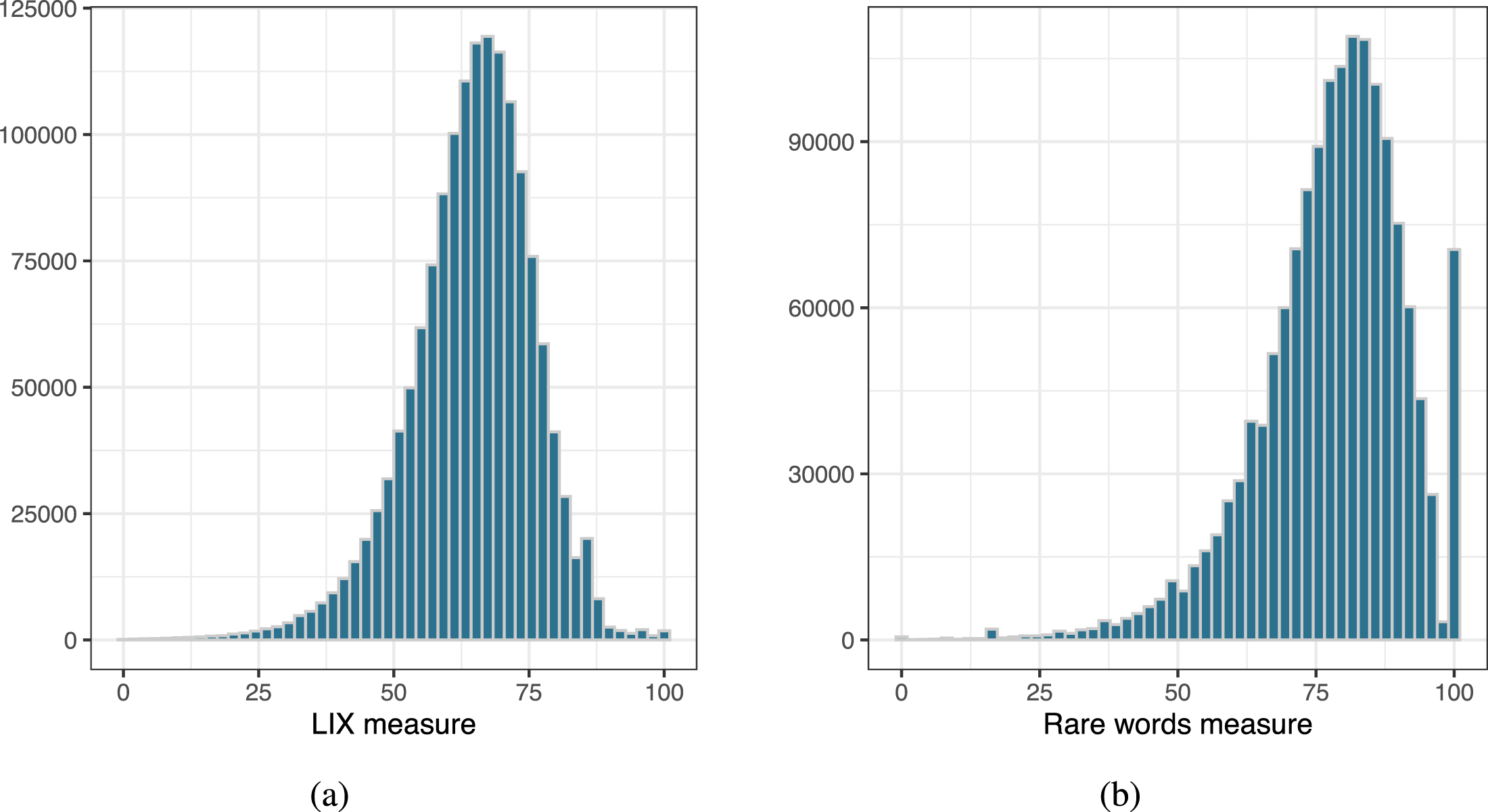
Appendix H presents time trends in average simplicity. As shown, average simplicity is roughly static over time, with perhaps a weak rising trend. In contrast to recent work showing strategic rhetorical responses to tv transmission of parliamentary debates (Gennaro & Ash, 2023), this indicates that the shared incentives faced by legislators have not changed substantially over the period studied.
Validation
Even so, the question of measurement validity remains. Do the LIX and rare words measures capture variation in simplicity? To assess validity, I field a question in a nationally representative survey (N = 516), where I present respondents with a set of pairwise comparison tasks to compare text simplicity across two short text snippets. Each respondent makes six pairwise comparisons, resulting in a total of 3096 comparisons.
In each pairwise comparison, I ask respondents to evaluate which of the two snippets shown is “easier to understand”. While the set of comparisons is insufficient to use as training data to predict simplicity in the full set of texts, we can assess whether the chosen measures of simplicity correspond to respondents’ assessments. Figure 2 shows results from logit models predicting respondents’ choices—i.e., selecting a given snippet as ‘easier to understand’—based on each of the two measures. Results from validation of simplicity measures against survey respondents’ pairwise comparisons of text snippets. Each plot shows the predicted association between text snippets’ measured simplicity and the probability of snippets being chosen as easier to read in a pairwise comparison. The associations are estimated using a logistic regression model. Coefficients are statistically significant (β = .04, p < .1 and β = .04, p < .001 respectively). Thin and thick error bands represent 90 and 95 percent confidence intervals. (a) LIX measure of simplicity versus probability of snippet being assessed as easier, (b) Rare words measure of simplicity versus probability of snippet being assessed as easier.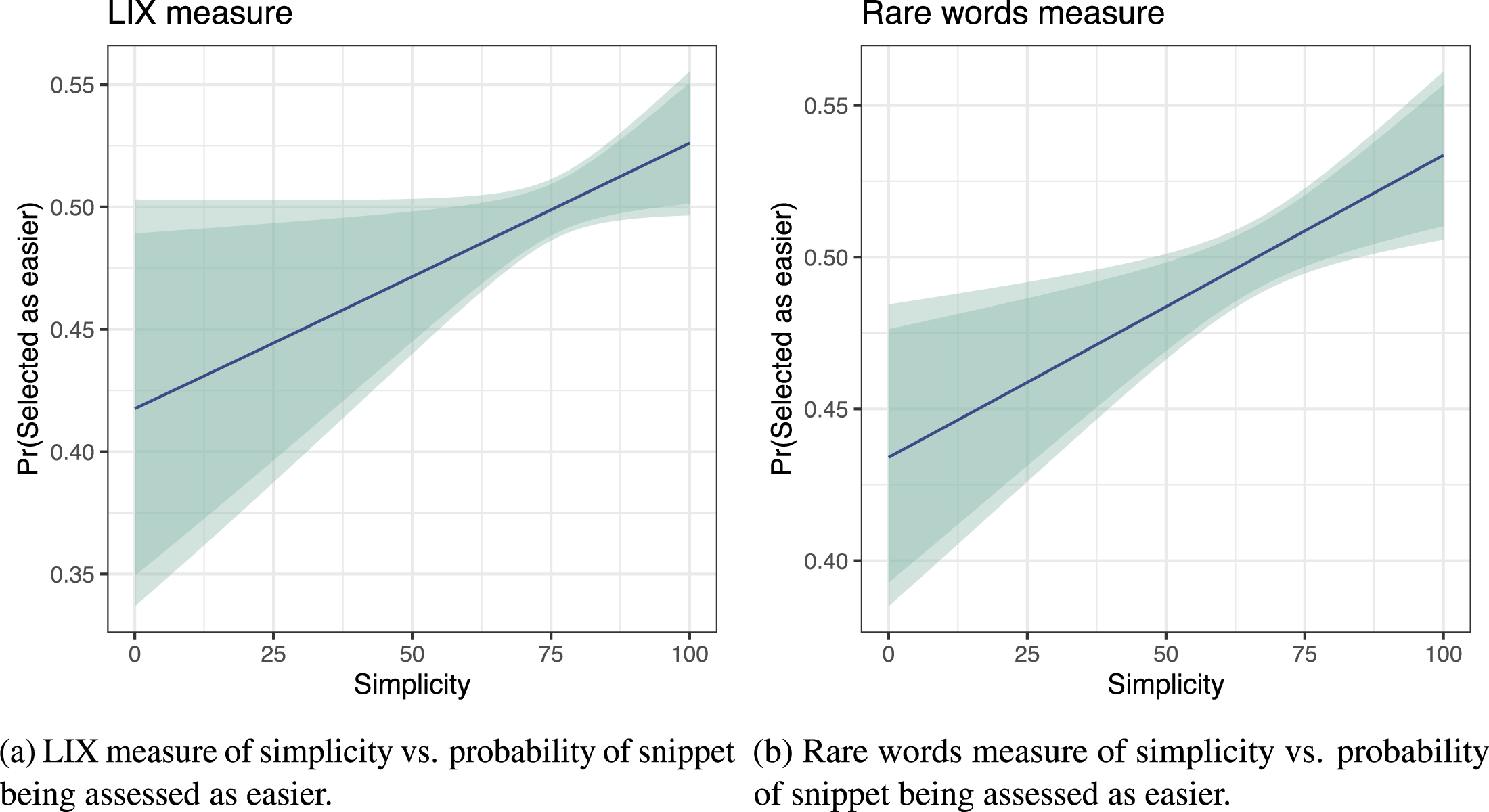
As shown, both measures of simplicity are positively associated with being assessed as easier to understand by respondents. That is, text snippets measured as having higher simplicity using either the LIX measure (left panel) or the rare words measure (right panel) are also deemed to be easier to read by respondents in pairwise comparison tasks. Both associations are statistically significant (β = .04, p < .1 and β = .04, p < .001 respectively.). Appendix I presents the results of this validation exercise in table form.
Model Specification
In order to estimate the effect of holding government office on rhetorical simplicity, simply regress- ing a measure of speech simplicity on an indicator for the speaker’s government status would not likely be informative. That is the case because legislator-level characteristics may affect rhetorical simplicity as well as likelihood of joining government. For example, legislators with government ambitions may employ more specialized language in order to signal expertise, and/or they may select into mainstream parties with higher chances of forming government. To avoid this type of selection bias, an appropriate statistical model should rely on variation in government status within legislators.
The timing of the treatment of interest is another complicating factor. In this context, the treatment of interest for each individual legislator is when they transition from a role as opposition MP to a role in government. This event is naturally staggered, i.e. it occurs at different points in time as governments form and dissolve and at varying stages in legislator careers. To compare effects of government office within legislators across these varying timelines, I construct a variable capturing the time relative to each legislator’s first time in government (if any). This allows me to estimate an event study, or dynamic difference-in-differences, model of the following form:
Recent work in econometrics has uncovered complications with two-way fixed effects models such as (1). Specifically, under staggered treatment rollout and given temporal heterogeneity in within-unit treatment effects, trends among early treated units may constitute a poor counterfactual for the trend among late treated units (Baker et al., 2022). In this context, this could be the case if for example legislators adopt a more complex rhetorical style only gradually while in government. To account for this potential bias, I use the estimator presented in Sun and Sarah (2021), which is robust to this type of treatment heterogeneity. In Online Appendix B, I also present results using a traditional two-way fixed effects OLS approach, which yields substantively similar results. These two-way fixed effects OLS specifications also have the advantage of including speeches during and after repeat spells in government, which are omitted in the main results and account for roughly 9 percent of the data.
Results
I now turn to the main results. Figure 3 presents the D
c,
jt
coefficients from equation (1) across c for each of the two measures of simplicity. Estimates by time to first year in government, calculated using Sun-Abraham estimator. Thick and thin error bars represent 90 and 95 pct. confidence intervals respectively. The x-axis is cropped at c = ↑10 for presentational purposes.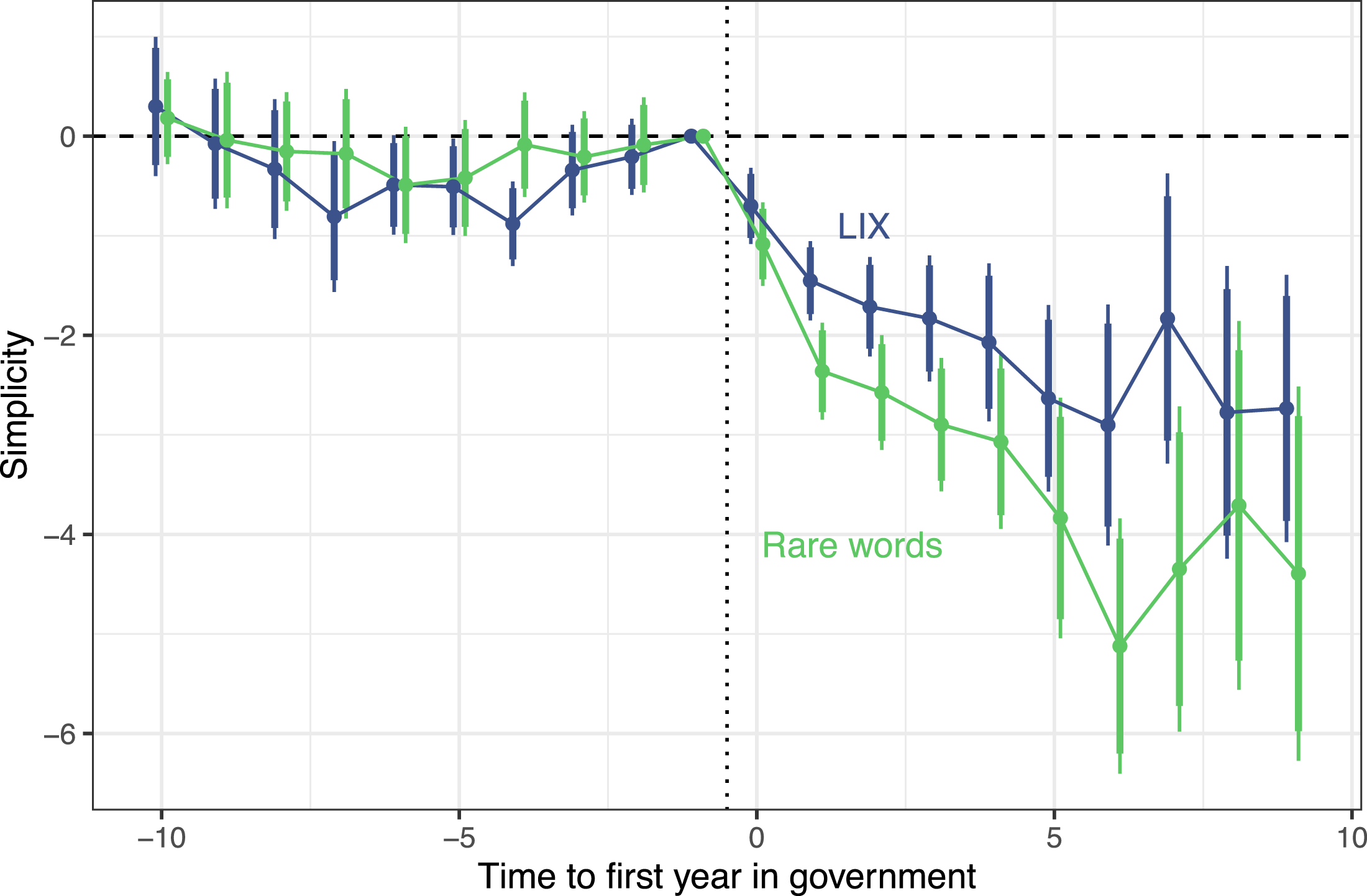
As shown, there is no linear trend in rhetorical simplicity before legislators enter government. Only one coefficient of the 20 pre-treatment coefficients is statistically significant, consistent with chance variation. In contrast, simplicity dips sharply in legislators’ first year in government (c = 0), and all post-treatment estimates are statistically significant. Substantively speaking, simplicity falls roughly linearly until around year six of serving in government, after which it stalls out at a consistently lower level compared to the pre-government baseline. Note that the vast majority of observations occur along this steep section of the line: 93 pct. of speeches by government members take place before or during year six. Hence, the main rhetorical cost of governing hypothesis is strongly supported.
ATTs for Event Study Models.

+p < .1, *p < .05, **p < .01, ***p < .001.
In absolute terms, the difference in simplicity between government members and non-members is fairly modest, at 1.6 scale points for the LIX measure and 2.6 scale points for the rare words measure. However, since both measures of simplicity are fairly concentrated, characterizing the effect in terms of standard deviations is more informative. Moving from non-government to government is associated with a change of .13 standard deviations for the LIX measure and a change of .2 standard deviations for the rare words measure. These changes are between the conventional standards for a ‘small’ effect size of .1 standard deviations and a ‘medium’ effect size of .3 standard deviations, corresponding to roughly the 30th and 50th percentile of observed effect sizes respectively (Gignac & Szodorai, 2016). Hence, while comparatively small, the observed effect sizes are well within the typically observed range.
Understanding the Mechanism
I now turn to a set of analyses examining heterogeneities in the main effect. The purpose of these analyses is to test whether effect heterogeneities are consistent with the theorized mechanism.
Reversal After Leaving Government
The three theorized mechanisms driving the rhetorical cost of government consists of a mix of role-specific resources and constraints. However, other mechanisms are compatible with the simple observed difference between members and non-members of government. Most plausibly, the difference could reflect a learning mechanism, whereby amassing experience in policy-making causes all legislators to adopt more technocratic and complex language over time. If changes in simplicity reflected learning, we should expect them to persist after legislators leave government. On the other hand, if the difference reflects office-specific bureaucratic resources, we should expect it to reverse after legislators leave government and no longer have access to these resources.
To assess the merits of these competing mechanisms, I partition the data to consider how simplicity changes as legislators enter and exit government. I omit all legislators who never join government, considering only legislators who at one point have held a government position. For these, I consider simplicity before entering government, during government, and after having held a government position, with the former as the reference category. For legislators who serve multiple spells in government I consider the start date of their first spell as the beginning and the end date of their last spell as the end, omitting intervening periods out of government. The results are shown in Figure 4. Simplicity across stages of government membership. The pre-government level serves as the reference category. Estimates are based only on legislators who at some point are members of government. The reference category consists of legislators who never serve in government and is represented by the dashed horizontal line. The dotted vertial line indicates that observations at 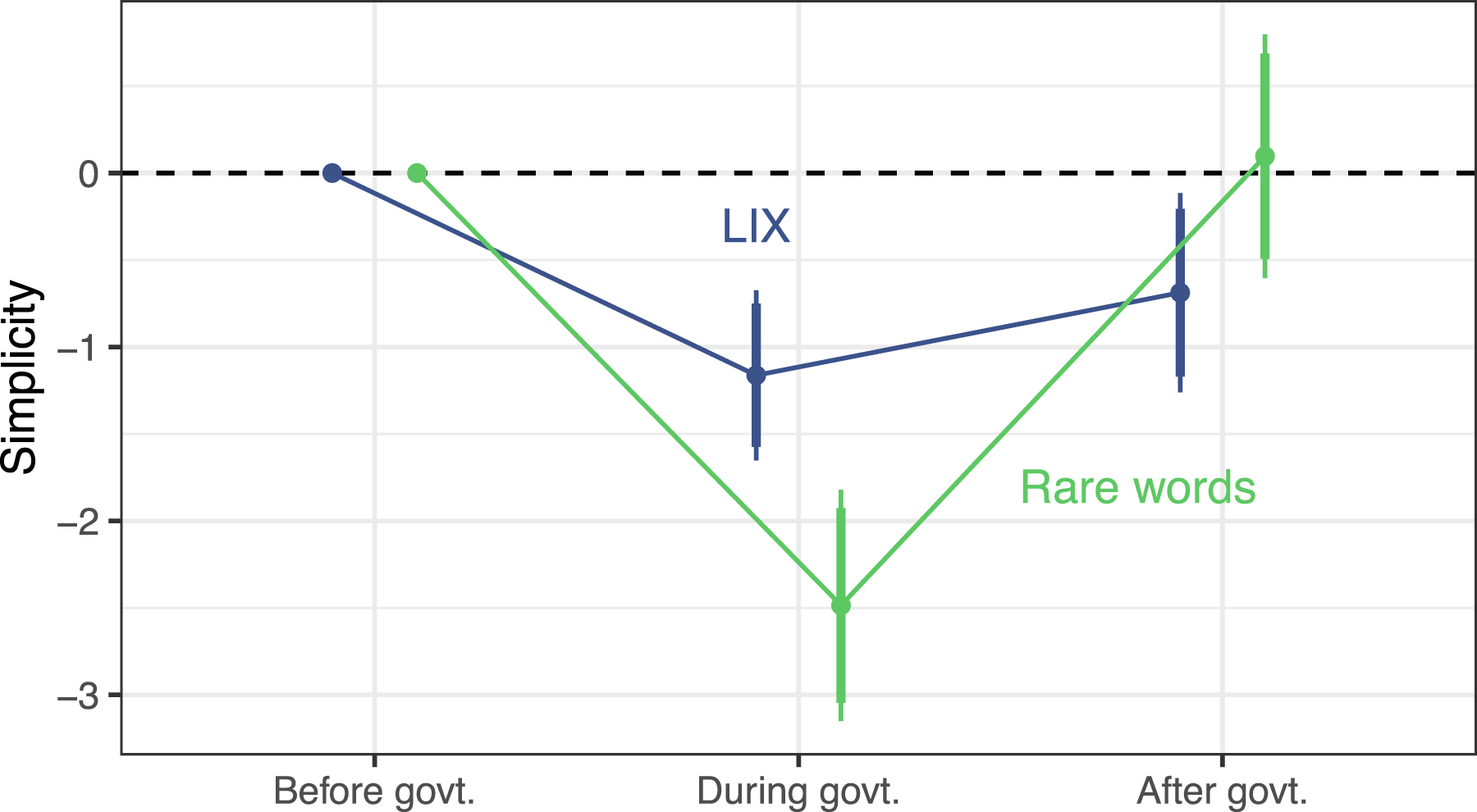
As shown in Figure 4, simplicity reverts back to the pre-government level once legislators leave government. For the LIX measure the estimated post-government level is slightly lower than the pre-government level, whereas for the rare words measure it is higher, but in both cases the difference compared to the pre-government level is not statistically significant. This pattern is not consistent with a learning mechanism. It is on the other hand consistent with role-specific resources and constraints, as posited by the theory.
Government Ministers Versus Government Party MPs
As an additional test of the role of bureaucratic resources, we can consider a more focused com- parison. The main results shown above reflects a comparison of government ministers to all other MPs, including government party MPs who are not ministers. At the theoretical level, the rhetorical cost of governing implies that the diminished simplicity of government members reflects features associated with holding government office. As a consequence, government party MPs who do not hold a ministerial position should not be subject to these constraints. The comparison in the main result does not allow for a direct test of this implication. Hence, to test this theoretical implication directly, I estimate separate models comparing (i) ministers to government party MPs and (ii) ministers to opposition MPs. The results are shown in Figure 5. Since the comparison group of government party MPs is relatively limited, I estimate these comparisons using the two-way fixed effects estimator, which makes use of all government spells and is therefore more precise. Effects of government participation comparing ministers to government party MPs (dark blue points) versus opposition party MPs (light green points). Results are from two-way fixed effects models. Thick and thin error bars represent 90 and 95 pct. confidence intervals respectively.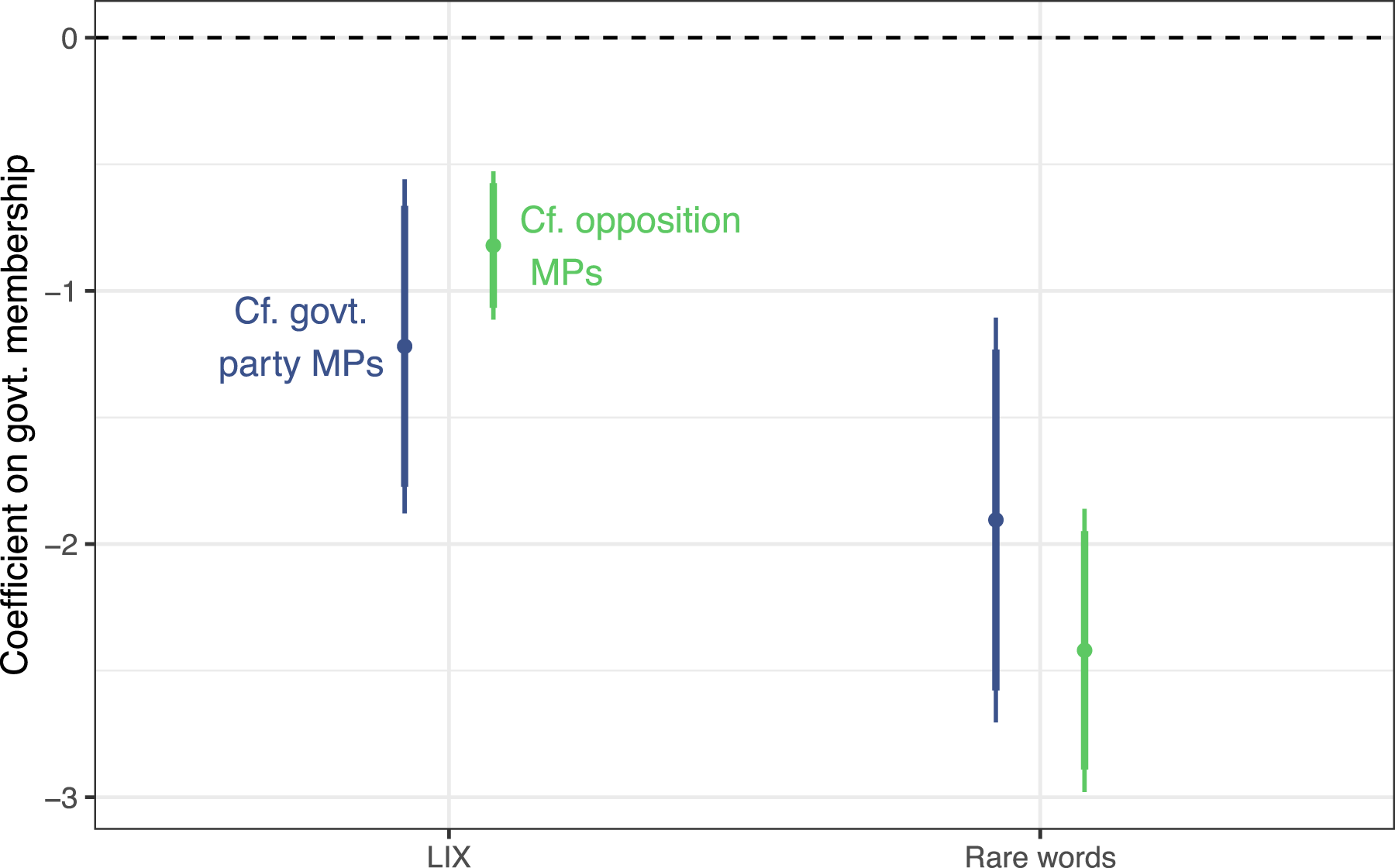
As shown in Figure 5, the estimated effect of government membership is similar in magnitude and significance when comparing ministers to government party MPs as when comparing ministers to opposition MPs. This is consistent with the theoretical notion that rhetorical costs of governing are specific to the experience of holding government office, rather than being a general feature of government party membership.
In sum, the additional results presented here are consistent with the rhetorical cost of governing being specific to the experience of holding government office in two ways: first, the effect of government membership is reversed after leaving government, and second, the effect is specific to ministers rather than government party MPs more generally. Still, this leaves open the question of the nature of these constraints. I now turn to a set of analyses of the nature of the role constraints, building on the distinction between formal versus substantive constraints on rhetoric introduced earlier.
Formal Constraints
Considering first formal constraints, the effect may be driven by formally mandated components of government members’ speeches, e.g. reading aloud legislative text when introducing legislation. To examine the role of formal constraints, we exploit a particular institutional feature of Denmark’s parliament: the beginning and end of each parliamentary year is marked by an ‘opening debate’ and a ‘closing debate’ respectively. These are marathon debate sessions, starting in the morning and often continuing past midnight (Hjorth, 2016).
The advantage of restricting the analysis to opening and closing debates is twofold. First and foremost, since opening and closing debates do not cover legislation, there are no formal constraints on speech. As a consequence, any observed effect of government membership within this subset will be driven by substantive constraints. Second, because of their ceremonial importance and relatively adversarial tone, opening and closing debates are by far the routine parliamentary events receiving the most mass media coverage. Hence, speeches in opening and closing debates are the most likely to reach a wide audience. In sum, these are what Osnabrügge et al. (2021) call “high-profile debates”, characterized by ideological exchange rather than parliamentary procedure.
To restrict the analysis, I identify the dates of every opening and closing debate covered by the data and create a subset of data drawn from these dates only. The resulting data set consists of roughly 61,000 speech snippets across 48 opening and closing debates. Though these dates account for less than 2 percent of all dates in the data, the speeches therein account for 4 percent of all speeches, reflecting the exceptional duration of opening and closing debates. I then compare the estimated effect of government membership on rhetorical simplicity in this subset as well as in the remaining set of speeches. As above, since the subset of speeches from high-profile debates is so limited, I use a two-way fixed effects estimator. Results from each subset for each of the two simplicity measures are shown in Figure 6. Effects of government participation when restricting the data to high-profile debates where no legislation is debated. Results are from two-way fixed effects models comparing non-government speeches with government speeches when restricting to high-profile debates (light green points) and across the remaining set of speeches (dark blue points). Thick and thin error bars represent 90 and 95 pct. confidence intervals respectively.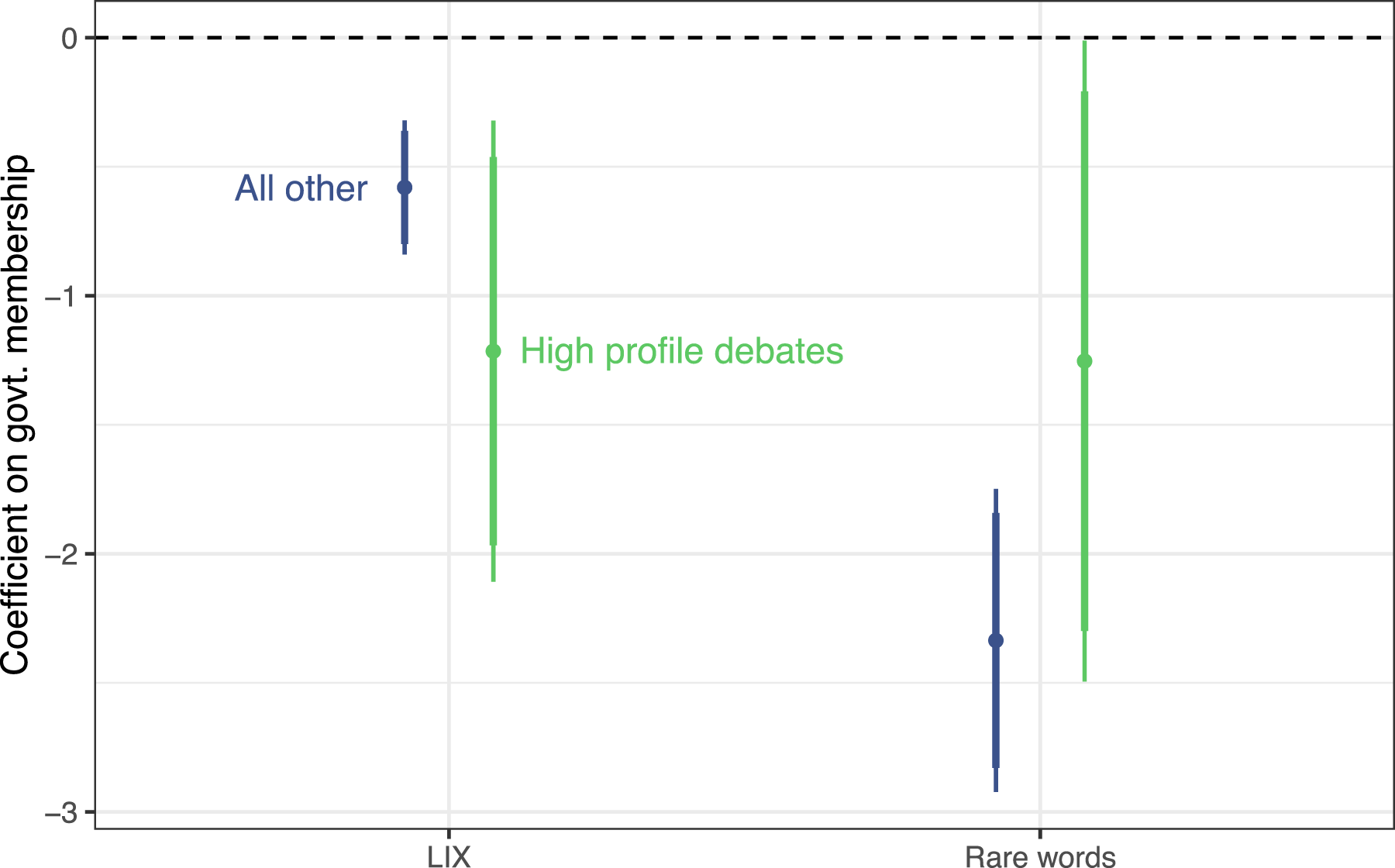
As shown in Figure 6, estimates based only on high-profile debates are similar in sign and magnitude to estimates based on the remaining set of speeches. They are less precise, as is to be expected given that they are based on a mere 4 percent of the data, and as a consequence the estimate for high-profile debates using the rare words measure is significant only at the .1 level (p = .06). But for both measures, the estimated effect of government membership is largely unchanged when considering opening and closing debates only. In Appendix C I show using interaction models that these estimates are not statistically significantly different. This lack of heterogeneity across debate types indicates that the observed effect of government membership is not predominantly driven by formal constraints. These models also show that rhetorical simplicity is significantly higher in high-profile debates on average, consistent with the argument in Osnabrügge et al. (2021) that legislators ‘play to the gallery’ in these debates by placating voter demands for rhetorical simplicity.
Issue Agenda Constraints
I now turn to the role of substantive constraints on government members’ rhetoric, focusing on the role of topic selection. Though topic selection is not the only conceivable type of substantive constraint on speech, it is the most tractable to examine, thanks to existing methods for estimating the topic distribution across texts conditional on text-level covariates. Specifically, I estimate a Structural Topic Model (STM) (Roberts et al., 2014) with government membership as a covariate, yielding estimates of how the prevalence of each topic in the full set of speeches changes conditional on government membership. Before fitting the STM, I implement standard preprocessing steps on the texts, including stemming words, removing stopwords, and removing extremely rare and extremely common words. (The threshold for rare words in this preprocessing step is far smaller than the threshold used in the simplicity measure, and applies to all speeches equally, so it does not introduce bias to the rare words measure). The parameter defining the number of topics to estimate K, is defined by the user. Based on model diagnostics across varying values of K, I set K = 30. Appendix D provides additional details on the STM, including keywords for each topic. Figure 7 shows how each topic is associated with government membership. Effects of government membership on topic prevalence across 30 topics estimated in a structural topics model. Topic labels are manually defined based on topic keywords (see Appendix D). Thick and thin error bars represent 90 and 95 pct. confidence intervals respectively.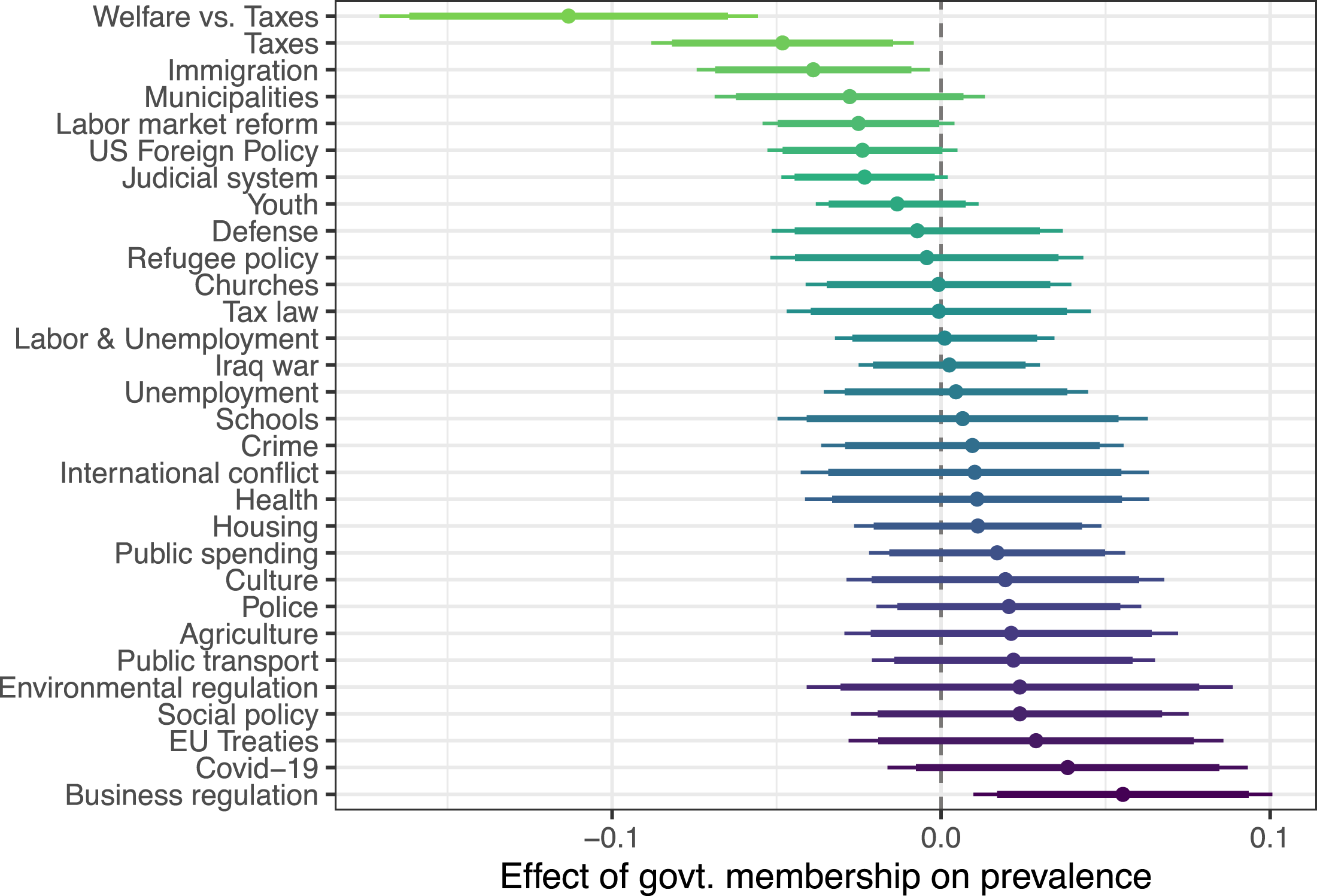
The topics most negatively associated with government membership, shown in the top end of Figure 7, ‘Welfare versus Taxes’, ‘Taxes’, and ‘Immigration’, all highly ideologically charged topics that align closely with first- and second-dimension lines of party political conflict. Conversely, the topics most positively associated with government membership, shown in the bottom end of Figure 7, are ‘EU Treaties’, ‘Covid-19’, and ‘Business regulation’ (though only the latter of the three is statistically significant).
The pattern is highly consistent with government members shifting away from ideologically charged topics over to topics associated with regulatory responsibilities and crisis management. This in turn suggests substantive constraints on speech play a key role in the rhetorical cost of governing: once legislators enter government, governing responsibilities compel them to dedicate speaking time to regulation and crisis management at the expense of ideologically charged topics that are plausibly easier to convey in simple terms.
To be sure Figure 7 shows only how each topic is used by members of government compared to non-members. While the topics most differentially prevalent in government speeches, ‘EU Treaties’, ‘Covid-19’, and ‘Business regulation’, are plausibly more intrinsically complex, that is not directly tested in this model. To test this association directly, I compare association with government membership and association with speech simplicity at the topic level. Specifically, I compare how strongly topic prevalence is associated with government membership with how prevalence for the same topic is associated with simplicity. The result is shown in Figure 8. Correlation between government membership (horizontal axis) and simplicity (vertical axis) at the topic level. The negative associations reflect that topics that are on average more common in government speeches are also on average lower in simplicity. Both correlations are negatively signed, though the association is only statistically significant for the rare words measure (p < .001). (a) Topic-level correlations for LIX measure. (b) Topic-level correlations for rare words measure.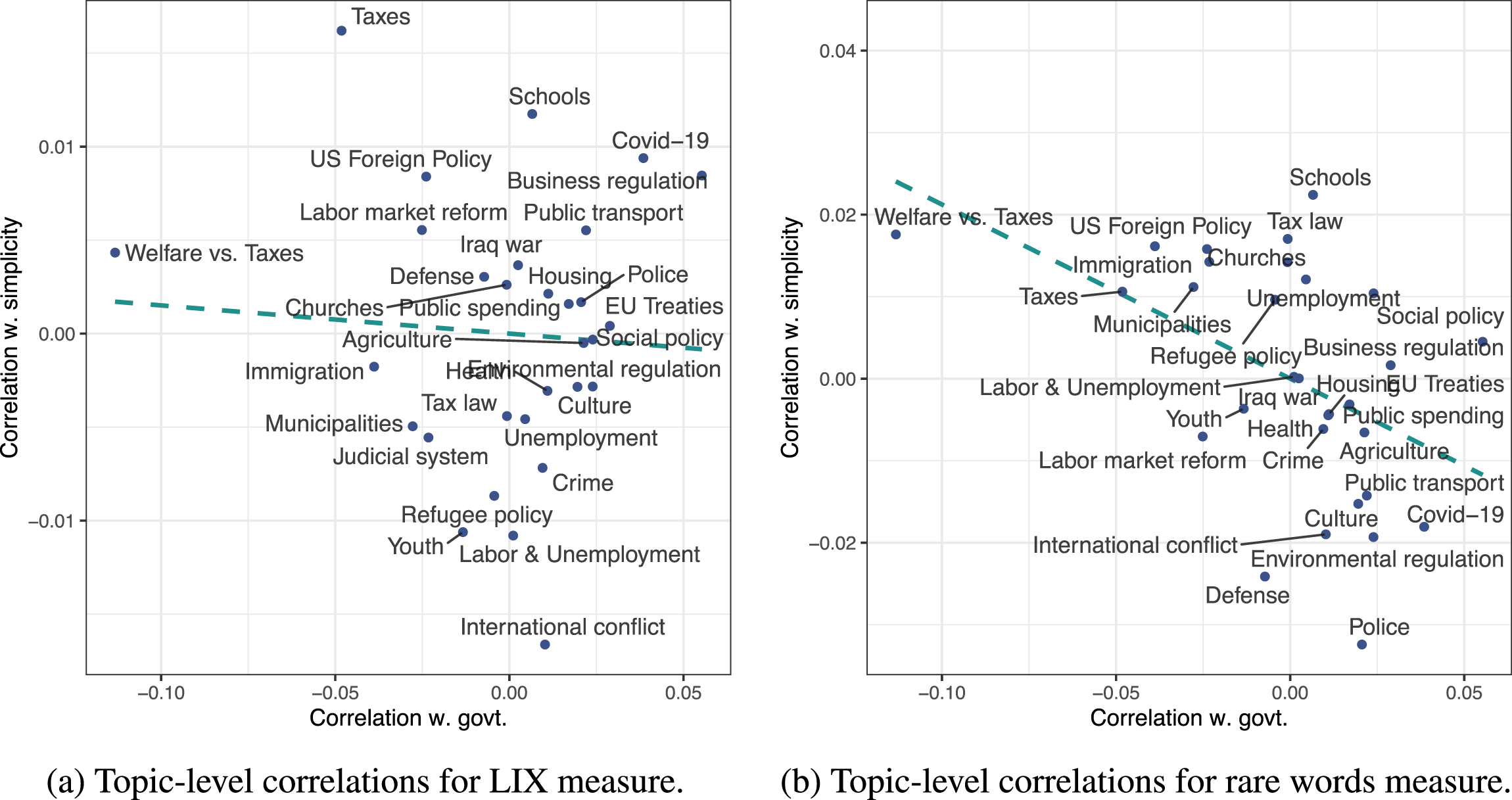
As shown in Figure 8, topics that are covered relatively more by members of government (higher values on the x-axis) tend to be lower in simplicity (lower values on the y-axis). In other words, topics that are more often covered by members of government tend to be covered using less simple speech. This lends support to the issue agenda constraints mechanism: the rhetorical cost of government stems in part from portions of the government’s issue agenda that are comparatively more difficult to convey in simple terms.
Heterogeneity Across Parties
Thus far, the analysis has compared government members versus non-members averaged across all parties. However, as in all party-centric systems, effects are likely to vary at the party level. Most pertinently, parties vary in their experience with government participation. For example, De Vries and Sara (2020) distinguish between ‘challenger’ and ‘dominant’ parties precisely based on prior experience in national government. To probe effect heterogeneity across parties, Figure 9 shows the estimated coefficient on government membership for each party. Effects of government membership by party. Thick and thin error bars represent 90 and 95 pct. confidence intervals respectively. The figure includes only parties with at least one instance of government membership.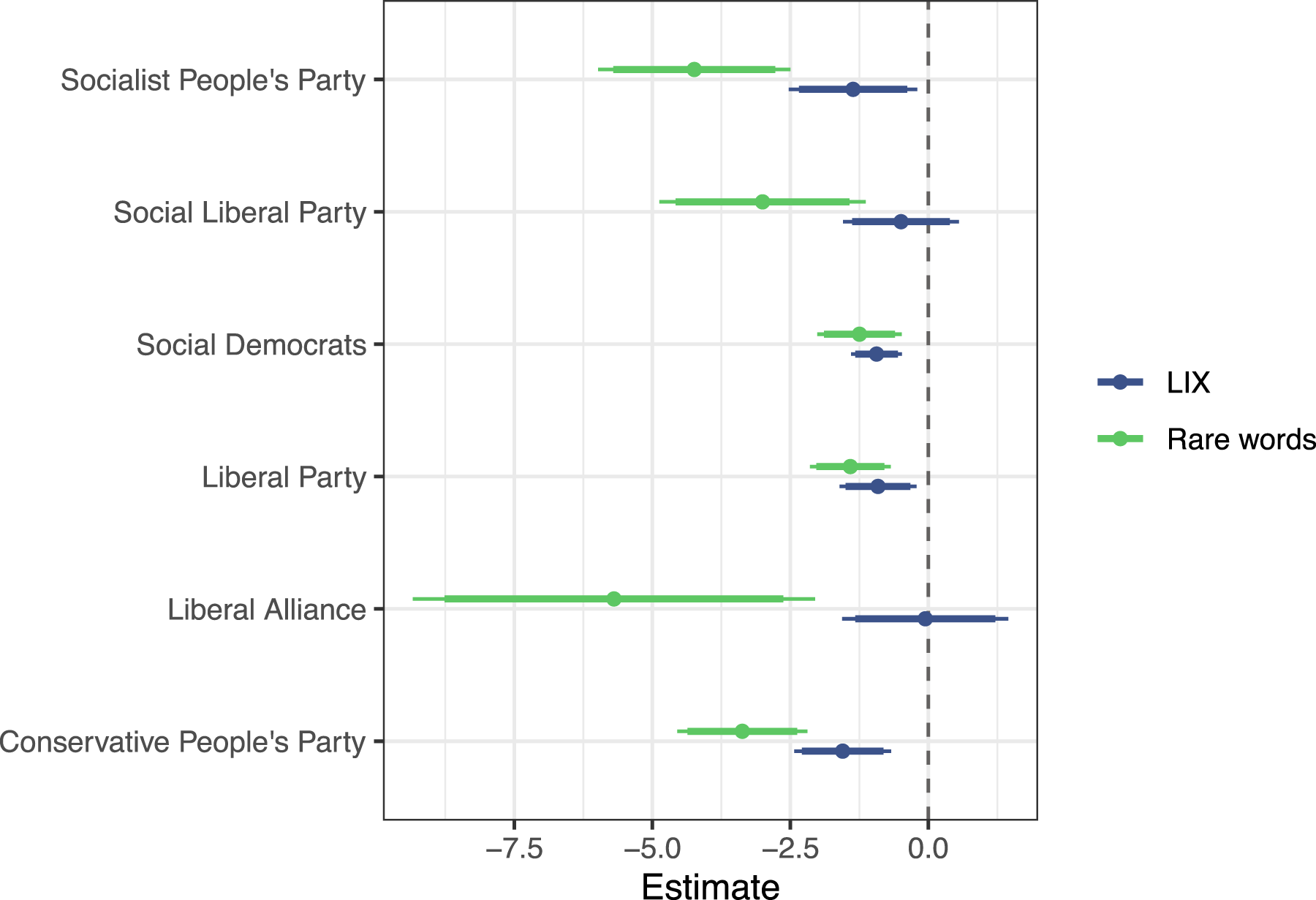
As shown in Figure 9, estimates are largely invariant across parties, indicating that the effect is not driven by any single party. However, it is notable that the estimates are the smallest in magnitude for Social Democrats and the Liberal Party, the parties with by far the most historical experience leading government. Conversely, the estimates are greater for smaller parties with historically fewer years in government: the largest coefficients are observed for the Socialist People’s Party and Liberal Alliance, both of which entered government for the first time in recent history in the 2010s. This heterogeneity indicates that the rhetorical cost of governing is greater for parties with less accumulated governing experience.
Additional Analyses and Robustness Checks
In addition to the appendices already mentioned, the appendix presents some additional analyses and robustness checks. Appendix E presents results from models that extend formula (1) by adding time-varying controls which are not absorbed by the legislator fixed effects. Specifically, I add a variable capturing the legislator’s parliamentary seniority at time t. Adding legislator seniority as a control accounts for the possibility that simplicity as well as the likelihood of joining government are both affected by legislators’ political experience. Lastly, I add measures of time-varying contextual factors in the form of unemployment and Covid-19 deaths. Both are associated with reduced simplicity, but their inclusion does not affect the main result.
Experimental Evidence on Voter Preferences for Simplicity
The theoretical argument underpinning the rhetorical cost of governing presumes that politicians maximize simplicity in order to placate voter preferences for simple communication. Conversely, the rhetorical cost of governing is consequential for electoral competition only if voters have a preference against rhetorical complexity to begin with. In order to test voter reactions to rhetorical simplicity, I implement a pre-registered experiment in a large online survey. 3 Conducted in May and June, 2022, the survey was fielded by the survey company Epinion, who recruited respondents from their large, online respondent panel. Like other online survey platforms, Epinion uses quota sampling to obtain a quasi-representative population sample. 4017 respondents participated in the survey in this period. The experiment is preregistered. 4
In the experiment, I show each respondent a paired set of policy proposals assigned to politicians ‘A’ and ‘B’. Each proposal is sampled from a set of three policy issues, with each proposal describing the policy in either simple or complex terms, yielding six proposals in total. All proposals are custom written in order to vary rhetorical complexity within issues while keeping policy content constant. The proposals shown to respondents are sampled freely from the set of proposals, with the constraint that respondents cannot see two proposals from the same issue. Within each comparison, I then ask respondents to express their relative preference between politicians ‘A’ and ‘B’ using a 0–10 continuous scale. Additional details about the experiment can be found in Appendix F. The appendix reproduces the original proposals as well as English translations.
After a pilot phase, one of the three policy issues (adding an extra teacher to elementary school classrooms) turned out to be so popular as to dominate all other effects. As a consequence, I omitted this issue from the remainder of the survey. Importantly, this stopping rule was not defined in the preregistration. Appendix G shows that the results are robust to keeping the responses for this issue in the data.
To estimate the effect of rhetorical simplicity on respondent preferences, I analyze responses at the response option level, regressing the rating of each fictional politician on the simplicity of the associated statement. All models include fixed effects for policy issue to capture issue-specific popularity. Figure 10 shows the predicted level of support for complex versus simple proposal styles. Preferences for fictional politicians across experimental conditions: complex (left) versus simple (right) proposal style. The model includes issue fixed effects. Thick and thin error bars represent 90 and 95 pct. confidence intervals respectively. The difference is statistically significant (p < .001). Standard errors are clustered at the respondent level.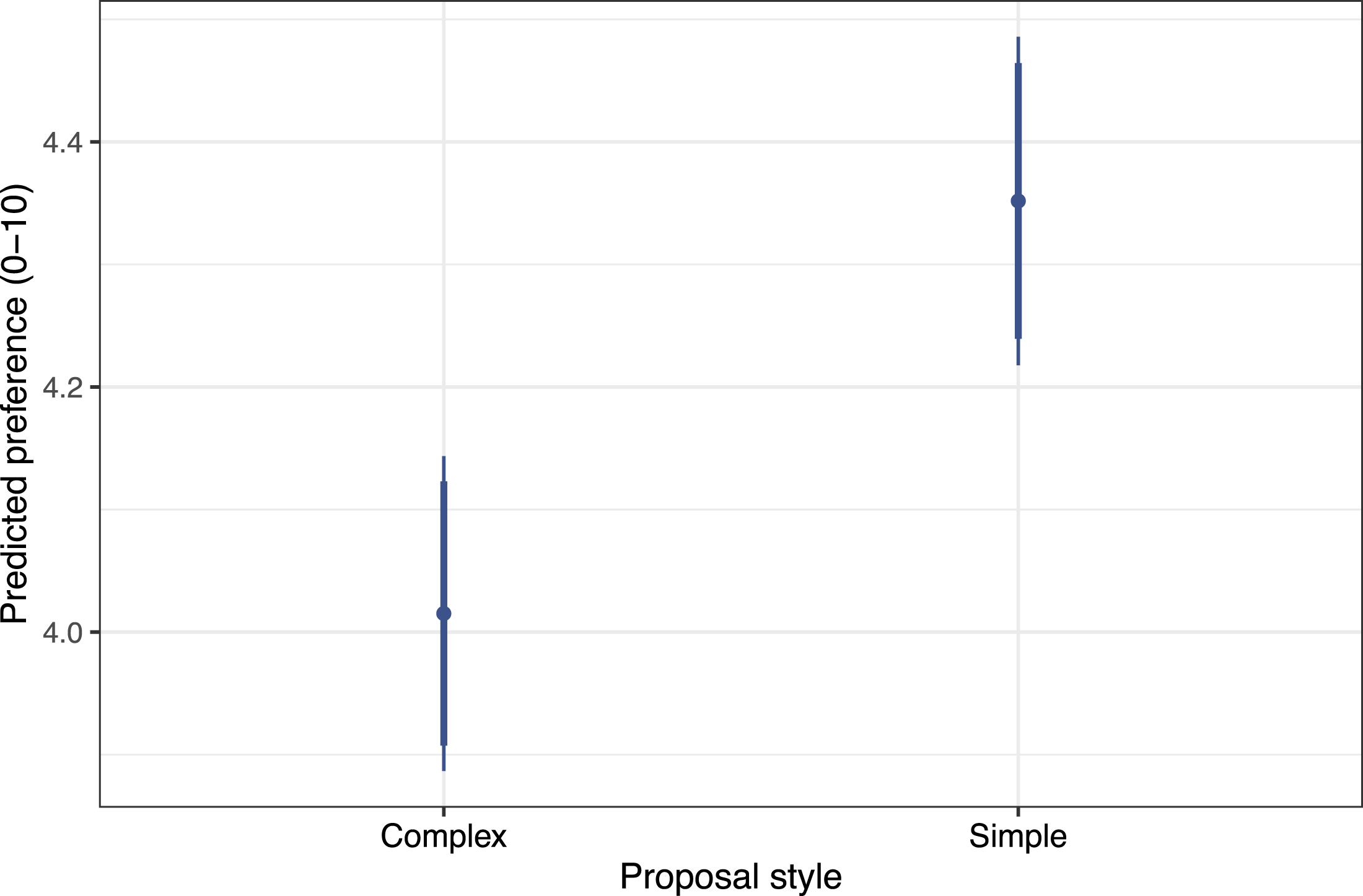
As shown in Figure 10, politicians using simple language receive significantly higher approval ratings from respondents compared to when using complex language. Because the model includes issue fixed effects, the estimates reflect only within-issue variation in rhetorical simplicity. Using simple rather than complex language increases support for a politician by .34 units, corresponding to roughly one-tenth of a standard deviation of politician approval. Hence, consistent with evidence from other domains, voters express a preference for politicians using simple language. To be sure, the experiment tests voter preferences for rhetorical simplicity, and not whether voters punish rhetorical complexity at the ballot box. An analysis incorporating media data, while beyond the scope of this paper, could shed light on the extent to which the rhetorical cost of governing is fully perceived by voters. However, the results are consistent with the theoretical premise that politicians face incentives to simplify their rhetoric in order to placate voter demands.
Conclusion and Discussion
Governments lose votes over time, a regularity so well-documented that the ‘cost of governing’ is widely considered a law-like phenomenon. However, our understanding of costs of governing outside the electoral domain is incomplete. This paper presents a novel perspective on this question, considering the cost of governing in the domain of rhetoric. I argue that legislators generally seek to satisfy voters’ demands for maximal rhetorical simplicity, but that the functional demands of running government compel legislators to speak less simply when serving in government. This structural condition provides the opposition with a rhetorical advantage vis-à-vis the government. I refer to this as the rhetorical cost of governing. I document this phenomenon with evidence from the Danish parliament, showing that across two measures of simplicity, legislators speak with reduced simplicity while serving in government. The association is robust to varying model specifications, including models considering only within-legislator changes in government membership. Auxiliary tests suggest the rhetorical cost of governing is driven by substantive rather than formal constraints on speech. Specifically, legislators serving in government dedicate more speaking time to intrinsically complex, technical issues and less to clearly ideologically laden issues, consistent with the rhetorical cost of governing being partly driven by constraints on government members’ issue emphasis. In a followup experiment, I show that, consistent with the theoretical premise, respondents exhibit a relative preference for politicians using simple language.
Some important limitations of this study deserve mention, some of which may help guide further research. For one, in the observational design employed here, entry into government is not randomly assigned, a challenge to causal inference across the cost of governing literature. For a stronger footing for causal inference about the effects of serving in governments, future research should identify cases that allow for more causally credible estimation of non-electoral costs of governing, similar to how regression discontinuity designs have been employed to recover the incumbency advantage in the US (Erikson & Titiunik, 2015) and Europe (Redmond & Regan, 2015). Second, an important caveat for the findings presented here is that the effect size, while not trivially small, is still modest. Depending on the measure, members of government speak with .13–.2 standard deviations lower levels of simplicity compared to non-members. On the other hand, this average difference is manifested in repeated instances of elite communication to which voters are continuously exposed. An important avenue for future research is to examine how the cumulative impact of repeated exposure to government communication affects citizens’ ‘running tally’ of government evaluations (Fiorina, 1981). Third, the theory presented here construes speech simplicity as in terms of constrained optimization—i.e., legislators always maximize simplicity, but under constraints that are more binding when in government. Hence, this framework does not consider strategically employed complexity, although earlier theoretical work has shown that strategic obfuscation can occur even when voters prefer simplicity (Dewan & Myatt, 2008). Future research could fruitfully explore strategically employed complexity, such as by considering within- government variation in incentives for obfuscation. Lastly, the evidence here comes from a single national context, naturally giving rise to concerns about generalizability. Notably, Schoonvelde et al. (2019) report diverging results with respect to complexity and government status, albeit with a more heterogeneous text sample and a less context-sensitive measure. This highlights the need to study how varying institutional contexts moderate the rhetorical cost of governing.
The caveats notwithstanding, the findings presented here have important implications for several ongoing research agendas in party politics and representation. I highlight three here. First of all, the findings indicate that the ‘opposition advantage’, i.e. the set of structural political advantages that accrue to election losers (Soubeyran and Pascal, 2008), is greater than previously assumed.
Existing research tends to conceptualize opposition advantage in terms of agenda-setting powers (Seeberg, 2023). The findings in this article highlight another dimension, namely the parliamentary opposition’s ability to freely employ rhetoric, including but not limited to using simple language. This in turn implies that independent of issue ownership and other agenda-setting advantages, opposition parties may have strategic incentives to emphasize issues where their advantage in terms of rhetorical simplification is especially stark.
Second, the rhetorical cost of governing sheds new light on the democratic value of profes- sionalized political communication. Scholars point to professionalization as a defining trend in contemporary political communication (Negrine & Lilleker, 2002), including increasing reliance on specialized communication consultants and speech writers (Plasser, 2008). The findings in this article imply that to the extent that professional staffers help government members craft simpler rhetoric, they help meet an important voter demand. In other words, professionalized political communication may contribute to solving an important representational problem, namely how to help voters make sense of complex aspects of government policy.
Third and finally, the rhetorical cost of governing may help explain the ongoing turnover among populist challenger parties. The rise of challenger parties, most of which populists of various stripes, is a defining trend in recent decades of European politics (De Vries & Sara, 2020), characterized among other things by a ‘fourth wave’ of far right parties in many cases assuming governing roles (Mudde, 2019). However, some of these parties have seen their electoral fortunes fade, instead replaced by new challenger parties. The rhetorical cost of governing may help explain the turnover of populist parties. Once populist parties enter the political mainstream, including assuming government power (Akkerman et al., 2016), they pay the rhetorical cost of governing, thus having to abandon their original crucial rhetorical advantage vis-à-vis incumbent governments. This in turn creates political space for new challengers to exploit the rhetorical constraints on government parties. The interplay between rhetorical style and government turnover, while outside the scope of this study, is an important topic for future research.
Supplemental Material
Supplemental Material - Losing Touch: The Rhetorical Cost of Governing
Supplemental Material for Losing Touch: The Rhetorical Cost of Governing by Frederik Hjorth in Comparative Political Studies
Footnotes
Declaration of Conflicting Interests
The author(s) declared no potential conflicts of interest with respect to the research, authorship, and/or publication of this article.
Funding
The author(s) received no financial support for the research, authorship, and/or publication of this article.
Data Availability Statement
Data and code to reproduce all results in this paper are available at the paper’s Dataverse repository (Hjorth, 2025):  .
.
Supplemental Material
Supplemental material for this article is available online.
Notes
Author Biography
References
Supplementary Material
Please find the following supplemental material available below.
For Open Access articles published under a Creative Commons License, all supplemental material carries the same license as the article it is associated with.
For non-Open Access articles published, all supplemental material carries a non-exclusive license, and permission requests for re-use of supplemental material or any part of supplemental material shall be sent directly to the copyright owner as specified in the copyright notice associated with the article.
