







Abstract
Why do autocratic regimes adopt reforms in one domain of gender policy while deferring them in another? Existing literature explains variation in state adoption of gender reforms through feminist mobilization, religious opposition, and policy type. I expand on the literature by developing a framework centered on the authoritarian logic of control and operationalized through carceral logic, which asserts state authority through punitive legal action, and moral domination, which governs through social discipline. I describe the Egyptian regime’s authoritarian logic of control as a macho mode of governance, in which control is performed through toughness and moral authority. Drawing on original interviews and legal analysis, I argue that the Egyptian regime reforms sexual violence laws, where punishment can be instrumentalized and moral discipline asserted, while avoiding family law reform, which requires confronting the patriarchal legal foundations of state power and disrupting alliances with religious authorities. The findings show how internal regime logics shape which feminist demands states act on.
Keywords
Introduction
Across regime types and regions, state adoption of gender reforms has often followed an uneven pattern. Chile, a democratic country with a strong feminist movement, criminalized femicide in 2010 and passed a comprehensive gender-based violence law in 2024, while family-law reforms have advanced more unevenly. India passed legislation against sexual harassment in the workplace in 2013, but efforts to reform personal laws, such as addressing marital rape or creating a uniform civil code, remain highly contested. In autocratic settings, the paradox is even starker. Regimes are more likely to introduce legislation on sexual violence while leaving personal status and family laws largely untouched. In Saudi Arabia, the monarchy criminalized sexual harassment in 2018, but despite recent legal reforms it maintains a guardianship system that restricts women’s autonomy in family matters. In Algeria, the regime criminalized domestic violence and expanded harassment laws in 2015 but left its patriarchal Family Code largely intact despite ongoing feminist advocacy. Similarly, over the past decade, the Egyptian regime has introduced a number of legal reforms targeting sexual violence, while personal status laws have remained largely untouched (Allam & Al Qaraghui, 2025). The article explores this paradox through the case of Egypt. It investigates why autocratic regimes adopt reforms in one domain of gender policy while obstructing or deferring them in another.
The literature on gender policy adoption argues that regimes are more likely to pass reforms addressing sexual violence than personal status laws due to key differences in the character of these policies. Sexual violence laws are typically non-doctrinal. They are more politically feasible because they address women’s status without fundamentally challenging religious or cultural authority (Weldon, 2002; Weldon & Htun, 2013). In contrast, personal status laws are doctrinal. They are deeply embedded in religious traditions and controlled by clerical or patriarchal institutions that resist reform to preserve their authority (Charrad, 2001; Htun, 2003; Htun & Weldon, 2015). Cross-national analyses further show that feminist activism, particularly by autonomous women’s movements, is the most significant factor driving policy change on violence against women across regime types (Weldon & Htun, 2013). In the Middle East and North Africa (MENA), the literature largely underscores that the autocratic regimes may often adopt women’s rights reforms for nondemocratic strategic motives (Bush & Zetterberg, 2024) or even to carry out “autocratic genderwashing” (Bjarnegård & Zetterberg, 2022). The literature, however, pays limited attention to how internal regime logics shape the prioritization of some gender reforms over others. Using the case of Egypt, I investigate what governance logics drive authoritarian regimes to instrumentalize reforms and respond to feminist activism in the area of sexual violence laws, but less so in family laws.
To explain the selective adoption of gender reform within an authoritarian regime, the article develops a framework centered on the authoritarian logic of control. The authoritarian logic of control is operationalized through two mechanisms: carceral logic and moral domination. Carceral logic refers to the regime’s reliance on punitive measures to perform responsiveness while reinforcing state authority. Moral domination describes how the regime reinforces its political and social dominance by patrolling the moral boundaries of the nation. The two mechanisms explain why the regime may adopt reform policies in areas like sexual violence, where legal punishment can be instrumentalized and moral discipline asserted, and avoids family law reform, which requires confronting the patriarchal legal foundations of state power and disrupting alliances with religious authorities.
To test this theory, the article leverages the case of Egypt. I describe the Egyptian regime’s authoritarian logic of control as a macho mode of governance, in which control is performed through manhood, toughness, and moral authority. Over the past decade, President Abdel Fattah al-Sisi has often dramatically emphasized the importance of women’s rights and gender equality in Egypt. He declared 2017 as the “Year of Women” and heralded it as a pivotal moment in the nation’s commitment to gender equality (Egyptian State Information Services, 2017). The head of National Council for Women, the national machinery responsible for overseeing the country’s agenda on women’s rights, frequently dub his rule as the “golden age for Egyptian women” (State Information, 2022). Reflecting on the landscape of gender politics in Egypt over the past decade, we can indeed locate strides in advancing women’s rights in certain areas but not others. Among the key areas that have witnessed legal advancements is addressing sexual violence in public spaces through a heavy-handed punitive approach that reflects the regime’s macho performance of authority. However, the regime notably neglected domestic violence in private settings, and the few family law reforms that have been enacted follow a carceral logic. Egyptian feminist organizations, legal activists, and public campaigns have mobilized around both sexual violence and family law reforms, yet state responses have varied markedly across these domains. Egypt thus offers a theoretically illuminating case for analyzing how the authoritarian logic of control shape policy outcomes. The Egyptian case allows for a within-case comparison of how a single regime adopts and resists gender reforms across domains.
The article contributes to the study of gender politics and authoritarian governance in three keyways. First, it puts forward a theoretical framework that explains why authoritarian regimes selectively adopt gender reforms. The theoretical framework introduces two mechanisms through which the authoritarian logic of control operates, carceral, where states rely on punishment to signal their authority, and moral domination, where the state governs through moral regulation and social discipline. While existing scholarship explains variation through institutional structures, religious influence or feminist mobilization, this article shows that internal regime logics also shape patterns of policy adoption. Second, it introduces the term macho governance to describe how authoritarian regimes like Egypt perform commitment to gender equality while reinforcing paternalistic and patriarchal forms of control. The concept adds analytical precision to debates on autocratic legitimation, gender instrumentalism, and state feminism. Third, the analysis advances empirical knowledge of gender politics in the MENA region through original fieldwork, discourse analysis of state rhetoric, and legal policy analysis in Egypt. It puts forward a dataset on reported sexual violence cases and legal outcomes and a systematic review of the Public Prosecution’s statements on high-profile cases of sexual violence.
The data for this study draw upon original fieldwork, legal and policy analysis, and discourse analysis. I conducted 32 semi-structured interviews with feminist activists, legal advocates, and NGO leaders working on women’s rights in Egypt between February 2022 and October 2024. To triangulate the information collected through interviews, I reviewed the official statements issued by the Egyptian Public Prosecution between 2020 and 2026, especially in high-profile cases involving sexual violence and online morality. I draw on an original dataset on reported cases of sexual violence and legal outcomes, compiled by Daftar Ahwal Data Research Institute, an independent research institute that documents gender-related legal and social data in Egypt. To provide background, context, and a commentary on the on-going legal and political discussions around the issues, I analyzed legal and constitutional texts, including the Penal Code, personal status laws, and reform proposals advanced by state institutions, religious authorities, and feminist legal organizations.
The article is divided into four parts. The first part engages with existing literature on gender policy adoption broadly and on authoritarian governance more specifically. I identify gaps related to the selective adoption of gender reform within a regime and develop the article’s inductive theoretical framework. The second part provides background on feminist activism and legal reforms in the areas of sexual violence and family law in Egypt. The third part delivers the crux of the analysis; I show how the Egyptian regime constructs different gender issues and why it selectively adopts certain reforms. The final section places the Egyptian case in broader comparative perspective and reflects on the implications of the argument for understanding gender politics under authoritarian rule.
Theoretical Framework: Variations in State Adoption of Gender Reforms
This section outlines the theoretical framework for analyzing why regimes selectively pursue gender reforms. To establish the conceptual foundation of the study, the section offers a brief survey of the relevant literature on variations in state adoption of gender reforms. Subsequently, I situate the case of Egypt’s selective reforms within the significant literature on the MENA region to show which governance logics drive authoritarian regimes to instrumentalize reforms in sexual violence laws while avoiding family law reforms. The section concludes by outlining the mechanisms through which regimes instrumentalize gender reforms selectively, with particular emphasis on the role of their carceral logic and moral domination in driving these processes.
Understanding Variation in State Adoption of Gender Reform Policies
In Sex and the State, Mala Htun first framed the puzzle of why gender reforms vary across states and issue areas. Her analysis of the mixed gender reforms in divorce, family law, and abortion enacted during Latin America’s democratic transitions in the 1980s and 1990s emphasizes that gender reform is issue-specific and institutionally mediated (Htun, 2003). Issues, she rightly explains, “differ in how they are processed politically, the groups that weigh in on policy debates, and the ideas at stake in change” (Htun, 2003, p. 4). Htun’s early work focused on how the configuration of elite issue networks and their institutional “fit” with state structures affect where and which reforms advance or stall.
To further explain variation in state adoption of women’s rights and reform policies, Mala Htun and S. Laurel Weldon have later proposed a framework combining typological distinctions with contextual factors (Htun & Weldon, 2010, 2018). Their framework is built around two central dimensions: the character of sex equality policies and the nature of interactions between actors and contexts.
Htun and Weldon’s first dimension demonstrates that sex equality policies are non-monolithic. They classify policies across two axes: gender-status vs. class-based policies and doctrinal vs. non-doctrinal policies. On one hand, gender-status policies address injustices targeting women as a group. Examples of gender-status policies include violence against women, reproductive rights, family laws, and gender quotas. These policies challenge practices and norms that subordinate women as a collective. On the other hand, class-based policies focus on alleviating gendered economic disparities among women. Examples include paid parental leave, state-funded childcare, and funding for contraception or abortion. Htun and Weldon’s second axis for classifying sex equality policies distinguishes doctrinal policies from non-doctrinal ones. Doctrinal policies challenge religious or cultural doctrines that uphold male dominance. By contrast, non-doctrinal policies are less directly tied to religious or cultural traditions. Doctrinal policies, such as family law reform or abortion legalization, often provoke significant resistance from religious or cultural authorities. In contrast, non-doctrinal policies, like workplace equality measures or sexual violence laws, typically face fewer ideological challenges.
The second dimension of Htun and Weldon’s framework emphasizes the interaction between actors and contextual factors in shaping policy adoption. Contextual factors include state capacity, historical policy legacies, international pressures, and levels of democracy. The strategies and effectiveness of actors advocating or resisting these changes, such as women’s movements, leftist parties, international organizations, and religious institutions, depend on these contextual factors.
According to Htun and Weldon’s framework, regimes are more likely to adopt reforms addressing sexual violence than personal status laws due to differences in the character of these policies. Given that sexual violence laws are non-doctrinal policies that address gender status issues without provoking opposition from religious or cultural authorities, they are thus more politically feasible (Weldon, 2002; Weldon & Htun, 2013). Furthermore, in explaining variations across countries in their adoption of sexual violence laws, Htun and Weldon’s cross-national analysis of 70 countries from 1975 to 2005 showed that feminist activism, particularly autonomous women’s movements, is the most significant factor driving policy change on violence against women (Weldon & Htun, 2013).
It is worth noting though that even within gender-based violence laws there is variation. One of the most contested and resistant areas of reform is the criminalization of marital rape. The United States only began to systematically reform its laws on marital rape in the late 20th century. Nebraska became the first state to fully criminalize marital rape in 1975, and it was not until 1993 that North Carolina became the last state to remove the explicit marital exemption from its rape statutes (McMahon-Howard et al., 2009).
In contrast to sexual violence laws, personal status laws are doctrinal policies that are deeply tied to institutionalized relations of power between the state and religious elites who resist reforms to maintain their authority over family law. In their global comparative study of seventy-one countries across four points in time—1975, 1985, 1995, and 2005, Htun and Weldon found that policy reforms are more difficult to adopt in personal status laws as such reforms threaten to shift control away from religious bodies and disrupt the status quo (Htun & Weldon, 2015).
Mala Htun’s earlier comparative work in Latin America has similarly underscored such dilemma (Htun, 2003). Analyzing reforms in divorce, family equality, and abortion in Argentina, Brazil, and Chile, Htun shows that the timing and content of reforms were shaped by institutional alignments and state–Church relations rather than by democratization alone. Military regimes transitioning to democracy facilitated certain family law reforms by delegating authority to technocratic commissions shielded from religious veto players, and divorce reform occurred only during moments of overt conflict between the Church and the state. Abortion reform, however, stalled as political elites avoided confronting religious authorities and failed to build broad coalitions.
The argument advanced in this article is not mutually exclusive with these existing explanations. While reforms addressing sexual violence may be comparatively easier to adopt because they are non-doctrinal, the article shows that authoritarian regimes also have affirmative incentives to pursue these reforms.
Instrumentalizing Sex Equality Policies in the Autocratic Regimes of the MENA Region
While it is easier to imagine the above factors as unfolding within democratic competition, the politics of gender reform are not confined to any single regime type. Autocratic regimes adopt gender reforms for a variety of internal and external reasons or as low-cost signals of modernization and advancement. For example, Donno & Kreft (2019) show that authoritarian regimes with electoral and legislative institutions are more likely to adopt women’s rights reforms because these institutions create incentives to signal international legitimacy without fundamentally threatening regime stability. Mala Htun (2003) also complicates the view that regime type determines reform outcomes. She shows that the “modernizing aspirations” of military rulers help explain why significant reforms to family law were adopted in Argentina and Brazil even in the absence of strong democratic and feminist pressure, while similar reforms were delayed in Chile.
In the context of the MENA region, scholars explain the adoption of sex equality policies by examining the interplay between state strategies, feminist activism, and domestic and international political currents. They show that autocratic leaders may instrumentalize women’s rights reforms to facilitate electoral manipulation (Blackman, 2024; Shalaby, 2024), suppress political opposition (Tripp, 2019), distract from human rights violations (Al-Rasheed, 2021; Arat, 2022; Forester, 2024; Noh, 2024; Tajali, 2022; Zaki, 2024), and burnish their international legitimacy (Bush, 2011).
Historical comparative analysis of gender politics in the Maghrib countries unpacks some of the dynamics of state adoption of gender equality policies in the region. Mounira Charrad suggests that the relationship between states and tribes influenced different approaches to family law in postcolonial Algeria, Morocco, and Tunisia (Charrad, 2001). Where central state elites were able to weaken or bypass tribal kin networks, as in Tunisia, they enacted reforms to family law and expanded women’s rights. By contrast, where state leaders depended on alliances with tribal structures for political consolidation, as in Morocco and Algeria, family law reform was more limited and preserved patriarchal authority within kinship systems.
Also examining Algeria, Morocco, and Tunisia, Aili Mari Tripp (2019) argues that particularly in Tunisia and Morocco but also in Algeria, the adoption of unified courts and legal systems after independence made family law reforms more procedurally accessible. Tripp attributes the variations in family law reforms and sexual violence legislations across countries in the MENA region to a combination of state-led reforms, presence of unified courts, and strength of transnational feminist advocacy. Her analysis shows that the leaders in the region have also strategically used women’s rights reforms to isolate Islamist oppositions thereby forcing political parties, including Islamist ones, to support gender reforms as a survival strategy. At the same time, feminist movements advanced these reforms through both domestic efforts and regional collaborations. Tripp highlights how activists in these countries worked together, particularly during times of national crisis, to pass similar legislation, such as laws against sexual harassment, around the same time.
Other scholars have further zoned in their analytical lens to examine the specific factors driving the adoption of reforms in violence against women laws and family laws within a particular MENA country. Vickie Langohr (2015) highlights how in the case of Egypt men’s participation in anti-sexual violence campaigns following the 2011 uprising have strengthened the movement and increased its success and pushed the state to adopt reforms addressing violence against women in public spaces. In Jordan, Summer Forester (2019) demonstrates that the 2008 Family Protection Law, a law addressing domestic violence, was tied to the regime’s militarized logic. The regime adopted reforms to enhance the state’s international image as a modern, democratic actor in the security arena while appeasing domestic audiences by reinforcing the state’s role as the ultimate protector of women. Similarly, in Morocco, Carolyn Barnett (2024) argues that reforms to the Mudawana, Morocco’s family law, were framed by the regime to position itself as the “savior” of women. This framing, she warns, paradoxically reinforced the misconception that public support for gender equality is weak and may undermine the enforcement of these laws by perpetuating the belief that they conflict with societal norms (Barnett, 2024).
Dynamics of Adoption
The literature thus largely underscores that in the MENA region regimes often instrumentalize gender reforms and selectively adopt sex equality policies. Scholars further explain within-country variations in the adoption of sexual violence laws versus family laws through institutionalized relations of power and cross-country variations in the adoption of sexual violence laws through the strength of feminist activism. Beyond these explanations, this article centers the internal governance dynamics of authoritarian rule. I show that the state is not necessarily conceding to feminist demands or religious veto players, rather I interrogate the effect of the regime’s governance logic in shaping its selective adoption of gender reforms. Specifically, what governance logics drive authoritarian regimes to instrumentalize reforms in the policy domain of sexual violence while avoiding family laws? Why would governments respond to feminist activism in the area of sexual violence reforms but less so in family laws? These questions are critical for understanding not only why authoritarian regimes adopt gender reforms but also how these reforms are tied to broader strategies of governance and control.
My framework addresses these questions by focusing on two mechanisms: carceral logic and moral domination. The two mechanisms illuminate the logic of authoritarian control and the macho style through which it is exercised (see Figure 1). Theoretical framework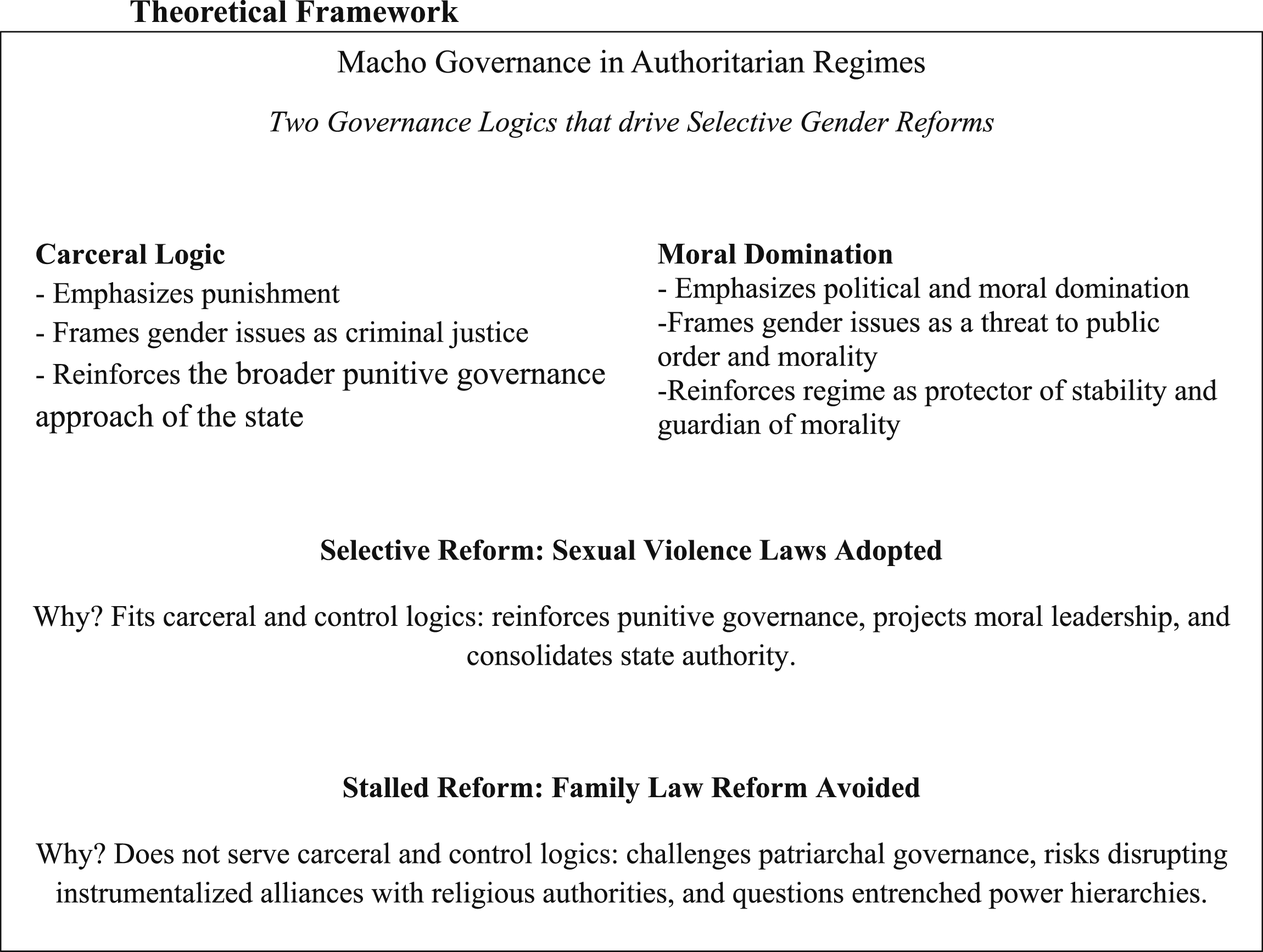
Macho governance refers to a masculinized performance of authority marked by toughness, moral regulation, and patriarchal sovereignty that varies in intensity across contexts and policy domains. The term macho governance serves here as a contextualized descriptor of how authoritarian control is enacted in Egypt. While elements of this governing style may appear in other regimes or policy areas, such as punitive migration governance or carceral politics in democratic contexts, the analytical focus of this article remains on how it operates within authoritarian settings to structure selective gender reforms. The primary contribution of the theoretical framework is identifying carceral logic and moral domination as the mechanisms driving selective adoption of gender reform.
By carceral logic, the reference here is to the way in which authoritarian regimes prioritize gender reforms that align with their reliance on punitive measures and coercive state apparatuses. For instance, a regime will often frame sexual violence primarily as a criminal justice issue, focusing on harsher penalties for offenders and increased policing rather than addressing systemic societal causes.
This framing and approach have three key implications. First, it reinforces and expands the broader punitive governance approach of the state. Scholarship on the politics of the carceral state has highlighted how even anti-sexual violence campaigns and movements have sometimes become intertwined with punitive criminal justice politics (Gottschalk, 2015). Second, these reforms are instrumentalized to portray the state as responsive and proactive, the regime leverages their visibility to marginalize advocacy groups and suppress independent feminist movements. For example, scholars have documented how regimes may use sexual violence accusations to target political opponents, as seen in cases such as Morocco (Human Rights Watch, 2024). Finally, framing sexual violence as a strictly criminal issue that requires increased punishment allows the regime to enhance its domestic and international legitimacy without conceding to broader rights demands.
By moral domination, I refer to how regimes are likely to adopt gender reforms that reinforce state authority over political and social order, particularly during periods of instability, contention, or autocratic consolidation. For example, sexual violence challenges the moral and political domination of authoritarian regimes on two fronts: (a) perpetrators undermine the state’s monopoly on the use of force by inflicting violence on victims, and (b) advocacy groups challenge the regime’s role as the sole arbiter of justice by occupying and policing public spaces to protect women from attacks. Regimes thus view reforms in the area of sexual violence as tools for restoring order and protecting public safety rather than advancing women’s bodily rights, they use them to consolidate authority while sidelining independent or oppositional voices.
This approach has several implications. First, addressing visible gender issues, such as sexual violence, enables the regime to signal its capacity to regulate public behavior and reclaim moral domination. The visibility of sexual violence allows public and widely circulated violations of moral order to be framed as threats requiring state intervention, providing the regime with opportunities to assert its authority and present itself as the guardian of social morality. Second, it enables the regime to assert its role as a moral guardian, shaping gendered morality narratives by deciding which women are “protected”—women loyal to the regime—and which women are excluded from state protection—socially and politically defiant women. Third, the regime uses these reforms to legitimize autocratic governance by presenting itself as indispensable to societal stability, thereby enhancing its legitimacy both domestically and internationally.
Using the case of Egypt, I show how carceral logic and moral domination structure the regime’s selective adoption of reforms in sexual violence while foreclosing reform in family law. Since 2014, Egypt has adopted a number of key reforms in sexual violence laws, meanwhile the regime did not address the domain of family laws notwithstanding activists' calls for reforms in both domains. What explains this variation? Why did the Egyptian regime adopt reforms in sexual violence and not family laws notwithstanding the activists’ contestation and advocacy work to reform both issues? Why does the regime prioritize and instrumentalize the issue of sexual violence but not family laws? I argue that the regime prioritizes the issue of sexual violence, but not family laws, because it aligns closer with its carceral logic and moral domination. I unpack these two mechanisms to illustrate how they shape the Egyptian regime’s selective and uneven adoption of gender reforms, despite sustained feminist advocacy efforts.
Context: Activism, Advancements and Pushbacks
Like its predecessors, the al-Sisi regime has adopted elements of state feminism and instrumentalized some of its policies (Allam, 2026). Over the past decade, the regime introduced some key legal reforms and policies on the agenda of women’s rights and gender equality. The overarching legal frameworks for these changes is the 2014 Constitution and its 2019 constitutional amendments. The 2014 Constitution dedicates Article 11 to women’s rights, it mandates the state to ensure gender equality in civil, political, economic, social, and cultural domains (2014). In practice, the regime, however, introduced reforms only on some issues but not others. The survey below provides a background and a context for understanding the underlying factors that shaped the regime’s selective policy choices.
Sexual Violence and Harassment
During and following the 2011 uprising that led to the ousting of Egypt’s former president Hosni Mubarak, sexual harassment and even mass sexual assaults took place under different regimes (Figure 2). In response to the increasing incidents of sexual assaults, women in Egypt organized protests to demand an end to gender-based violence. In addition to protests, several activist groups were formed in 2012, such as Tahrir Bodyguard and Operation Anti Sexual Harassment (OpAntiSH), to combat sexual harassment, assist survivors, and safeguard women’s political participation.
1
In the years following the election of al-Sisi in 2014, the regime, however, cracked down on independent feminists and closed many of these earlier anti-sexual harassment groups and initiatives, while simultaneously co-opting the issue of sexual violence for its own agenda (Allam, 2023). Summary of documented attacks on women protestors. Source: Keeping Women Out report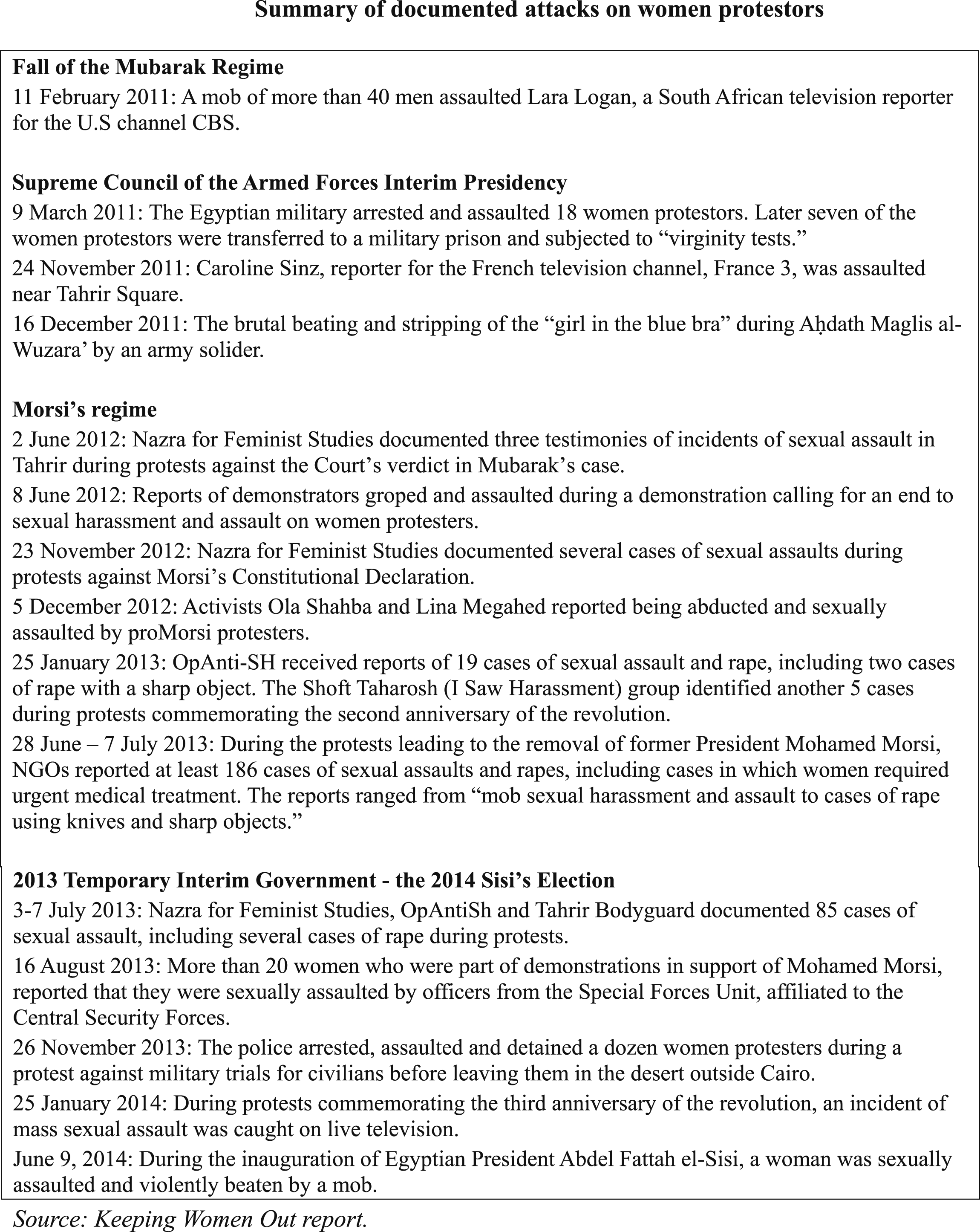
Following the uprising, Presidential Decree No. 11 amended a number of articles in the penal code related to rape, sexual assault, public indecency, and kidnapping (Law No. 11 of 2011, 2011). While significant, the amendments did not include explicit legislation on sexual harassment or incorporate the concept. The state criminalized sexual harassment for the first time in the history of Egypt in 2014. Presidential Decree No.141, issued by Interim President Adly Mansour under Law No. 50 of 2014, amended Article 306 bis (A) to increase penalties for sexual harassment and indecent conduct, and introduced Article 306 bis (B), defining sexual harassment and outlining more severe punishments when aggravating factors are present (Law No. 50 of 2014, 2014). Upon the adoption of the law, several anti-sexual-harassment units were established at various public institutions. The units were intended to handle reports of sexual harassment, provide support to survivors, and work towards preventing future incidents. In 2020, a new article was added to the Criminal Procedures Code to enhance the protection of the privacy and the security of survivors (Law No.177 of 2020, 2020). In addition to this procedural amendment, Articles 306 bis (A) and 306 bis (B) of the Penal Code were further amended, in the following year to significantly increase the penalties and prison sentences (Law No.141 of 2021, 2021). Besides sexual harassment, the penal code amendments in 2011 and 2016 expanded criminalization and penalties for various forms of sexual violence, including rape, sexual assault, indecency, kidnapping, and female genital mutilation (FGM).
Personal Status Matters and Laws
Personal status matters in Egypt are governed under Law No. 25 of 1920 and its subsequent amendments, Law No. 25 of 1929 and its amendments, Law No. 1 of 2000 on litigation procedures in personal status matters and its amendments, and Law No. 10 of 2004 on the establishment of family courts. Personal status laws are based primarily on Islamic Sharia, and non-Muslims communities—Christian and Jewish—apply their respective religious laws in personal status matters.
Feminists’ key concerns include unequal access to divorce, the practice of polygamy, child custody and guardianship laws, support, inheritance laws, and domestic violence. While men can easily initiate divorce without justification and exercise verbal divorce—the practice of men being able to verbally divorce their wives, women must navigate a far more complicated and burdensome process. Law No. 1 of 2000 granted women the right to seek divorce through khula, which is a form of divorce initiated by the wife in which she agrees to forgo financial rights, such as alimony or the return of the dowry, in exchange for dissolving the marriage (Law No. 1 of 2000, 2000). Polygamy, whereby men can marry multiple wives, also remains a significant concern as it creates unequal power dynamics within marriages. Child custody and guardianship laws present another layer of inequality. Although mothers are typically granted physical custody of young children after divorce—only under certain conditions such as remaining unmarried, the legal guardianship remains with the father. Inheritance laws also disadvantage women allocating them only half the share of their men relatives. The 2017 amendments to the Inheritance Law imposed stricter penalties on those who withhold inheritance, primarily benefiting women who have faced challenges from men family members in the past (Law No. 219 of 2017, 2017). A final significant issue is the lack of legal protections for women in cases of domestic violence and marital rape, neither of which are adequately addressed in Egyptian personal status laws or, as the above survey showed, in the penal code. The few amendments that took place under al-Sisi’s regime on family matters addressed procedural laws, especially alimony and child-support enforcement, where a carceral logic can be applied.
Despite their ongoing calls for reforms, feminists’ efforts to address these structural inequalities encountered fierce resistance. Meanwhile, proposals for reform put forward by state institutions, namely the 2019 draft presented by al-Azhar, the 2024 draft collectively put forward by the various Christian denominations, and the various proposals prepared by the cabinet—including the 2021 Personal Status Draft Law, and the 2025 draft personal status law have not offered concrete solutions and rather perpetuated and solidified gender inequalities.
For example, the 2021 draft personal status law became infamous for provisions that critics argued would further entrench male guardianship and significantly restrict women’s rights in matters of marriage, divorce, and child custody. In response to the 2021 Personal Status Draft Law, feminist groups mobilized substantial public resistance, notably through the Women and Memory Forum’s #GuardianshipIsMyRight campaign. The campaign condemned the law and called for equal guardianship rights for mothers alongside custody (The Women and Memory Forum, 2021). The National Council for Women (NCW) also criticized the proposal and prepared a set of determinants and requirements to guide discussions (El Sharif, 2022; The National Council for Women, 2022). The Center for Egyptian Women’s Legal Assistance (CEWLA) also presented alternative proposals (Center for Egyptian Women’s Legal Assistance, 2022). Among the most notable points addressed in CEWLA’s proposal is advocating court-managed divorces rather than unilateral decisions, structured division of marital assets, visitation rights for non-custodial parents, and equal custody rights for Christian mothers married to Muslim men (The National, 2022).
In response to the criticisms, the regime shelved the draft law presented by the cabinet, and in 2022, President al-Sisi appointed a judicial committee to produce a revised version (The National, 2022). In early 2025, the judicial committee introduced a revised draft. The draft included some modest improvements, especially with regards to requiring documentation of verbal divorce and prioritizing fathers in custody arrangements (Youm7, 2025). It, however, left patriarchal structures largely intact. Key issues such as male guardianship, unequal access to divorce, and the absence of protections against domestic violence remained untouched. In April 2026, the suicide of Bassant Soliman, a divorced mother of two, revived public debate over personal status law, especially custody and alimony.
Despite ongoing advocacy and activism on issues related to both sexual violence and personal status laws, the regime, however, has been selective in its willingness to introduce reforms. While legal reforms and policy adoption do not necessarily translate into full implementation or meaningful change on the ground, tracking and understanding policy adoption remains crucial. It serves as an indicator of shifting state priorities, evolving feminist advocacy strategies, and the broader dynamics of gender politics in Egypt.
Methods and Data
To investigate which governance logics motivate the Egyptian regime’s selective adoption of gender reforms, the study draws on original fieldwork, legal analysis, and discourse analysis. I focus on policy adoption rather than implementation in line with feminist scholarship on gender politics in autocratic settings. The literature views adoption not simply as a step toward enforcement, but as a political act of signaling. Adoption is not always the beginning of action; it is often the regime’s primary performance of action.
The data draw upon 32 semi-structured interviews with feminist activists, legal advocates, and NGO leaders working in the area of women’s rights in Egypt. I carried out the interviews between February 2022 and October 2024. I primarily conducted the interviews in Arabic and, where quoted, I provided the English translation. Semi-structured interviews were chosen to enable participants to reflect openly on the terrain of legal advocacy, gender reform, and regime repression. All interviewees were given the option to remain anonymous, and when individuals were quoted by name, this reflects their explicit and informed consent to be identified. At several points in the research process, I found myself torn between removing names to maximize protection and preserving attribution to honor participants’ agency. For many interviewees, including their names and affiliations was about challenging a regime that seeks to render reform efforts faceless and politically inert. My decision to retain names where consent was clearly given reflects a deliberate effort to balance protection with respect for participants’ political subjectivity and self-articulated goals.
The interview guide included questions on how legal reforms are initiated, framed, resisted, and co-opted by the regime; the role of state institutions in these processes; and the different ways in which feminist mobilization strategies have evolved in response to shifting political conditions. The interviews were analyzed using thematic coding. After a close reading of transcripts, I developed a set of initial codes and grouped participants’ insights into broader analytical themes to reflect (a) the regime’s carceral logic and (b) its moral domination.
In addition to interviews, I collected and reviewed official statements issued by the Egyptian Public Prosecution on high-profile cases of sexual violence between 2020 and 2026. The statements are not archived on the government website but disseminated via the office’s official Facebook page. I conducted detailed discourse analysis of statements related to the prosecution of the serial assailant Ahmed Bassam Zaki, as well as the prosecutions of women content creators—namely Haneen Hossam and Mawada al-Adham. I analyzed them with an eye to the Prosecution’s rhetorical framing, use of religious language, invocations of honor and morality, and appeals to national security, all of which speak to the regime’s effort to govern through punitive measures and moral discipline.
I also analyzed key legal texts, including Egypt’s 2014 Constitution (particularly Article 11), the Penal Code and its amendments related to sexual violence (Laws No. 50 of 2014, No. 141 of 2021, among others), and personal status laws and draft reform proposals on the issue. The draft reform proposals included Al-Azhar’s 2019 proposal, the 2024 unified proposal from churches, the 2021 Cabinet proposal, the 2025 draft personal status law as well as the proposals prepared by the Center for Egyptian Women’s Legal Assistance (CEWLA) in 2017 and 2021. I traced and analyzed the Women and Memory Forum’s #GuardianshipIsMyRight campaign on family laws reforms, and reviewed media reports, human rights documentation, and legal commentary from Egyptian and international sources.
Finally, I compiled data on reported sexual violence cases and legal outcomes—arrests, prosecutions, and convictions— from available NGO reports, data repositories, and international monitoring bodies. The dataset draws on the Daftar Ahwal Research Institute (DARDI) dataset on sexual violence in Egypt between 2011 and 2019. 2 I cross-checked DARDI dataset against reports from Nazra for Feminist Studies, the Egyptian Initiative for Personal Rights (EIPR), the United Nations Office on Drugs and Crime (UNODC), and extensive Arabic-language press coverage. The article’s multi-method approach to data collection and analysis allows me to trace how the regime discursively and legally constructs different categories of gender-related problems and distinct strategies of containment and control.
The Macho Egyptian Regime’s Logic of Control
To understand why the Egyptian regime selectively adopts gender reforms, this section traces two interlocking mechanisms that underpin its control governance model: its carceral logic and moral domination. The carceral logic reflects the regime’s reliance on expanded criminal codes, harsher sentences, and symbolic prosecutions to address gender issues in ways that reinforce state power. The moral domination reflects the regime’s broader effort to discipline social behavior and uphold moral order through legal, religious, and symbolic means. These mechanisms help explain how the regime promotes reforms that align with its security priorities and moral authority, while resisting others that would require challenging entrenched patriarchal hierarchies or redistributing power (see Figure 3). Regime decision logic on gender reform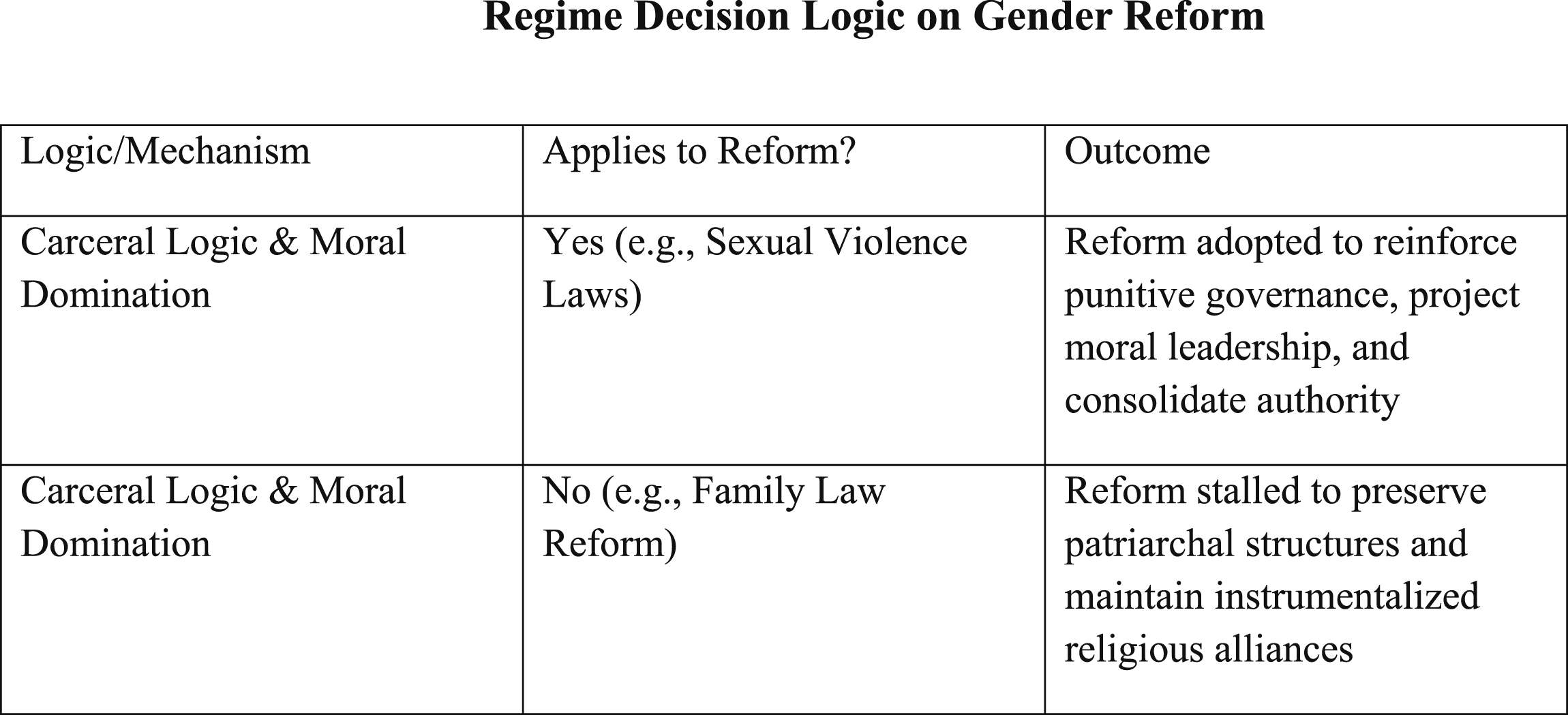
Carceral Logic
Since coming to power in 2014, the Egyptian regime has dramatically expanded its carceral approach and infrastructure. Its carceral apparatus became a central stage on which the regime performed, and continue to perform, a macho style of rule, one that demonstrates power through the capacity to incarcerate, punish, and impose order.
The regime invested heavily in prisons, punishment, as well as coercive capacity to project strength, toughness, and the ability to discipline society. The Arabic Network for Human Rights Information estimated that, by early March 2021, the total number of incarcerated individuals in Egypt had reached 120,000 prisoners, with roughly half detained on political grounds (The Arabic Network for Human Rights Information, 2021). Local activists estimated that by 2024 the number of political prisoners and detainees ranged between 10,000 and 20,000 (El-Hamalawy, 2024). Over the past decade, prison infrastructure has also expanded significantly. By 2021, the number of main prisons reached approximately 78 with the construction of 35 new facilities (The Arabic Network for Human Rights Information, 2021).
Parallel to the expansion of Egypt’s carceral infrastructure, the regime has sought to legitimize its punitive apparatus through a strategic rebranding of prisons and penal institutions. In 2021, the Ministry of Interior renamed the Prison Sector “the Community Protection Sector,” while prisons were rebranded as “reform and rehabilitation centers” (Al-Masry, 2021b). In the same year, President Abdel Fattah al-Sisi announced the construction of large prison complexes, the first of these complexes opened in Wadi al-Natron in October 2021 and was promoted as “the largest in the world” and a flagship achievement of the regime’s “New Republic” (Al-Masry, 2021a). In fact, individual prison construction projects have reportedly cost hundreds of millions of Egyptian pounds, with overall spending likely amounting to billions (El-Hamalawy, 2024).
The regime’s carceral logic extends to the domain of women’s rights and gender reforms. The regime of al-Sisi has relied on state punishment rather than tackling the root causes of sexual violence. The regime’s carceral approach toward sexual violence can be traced in the following legal measures adopted to address the issue. The legal measures have squarely focused on increasing prison sentences and fines. Under Law No. 50 of 2014, the revised article 306 (bis) (A) increased the punishment for anyone who subjects others to sexual or indecent conduct, suggestions, or insinuations, whether through gestures, spoken words, actions, or by any method, including wired, wireless, or electronic communication, in either a public or private setting (Law No. 50 of 2014, 2014). The penalty remained set at a minimum of six months, however, the fine increased to a minimum of 3,000 Egyptian pounds (approximately $97 USD) and a maximum of 5,000 Egyptian pounds (approximately $162 USD), up from 500 (approximately $15 USD) and 2,000 Egyptian pounds (approximately $65 USD). For repeated offences, the punishment escalated to a minimum of one year in prison and a fine ranging from a minimum of 5,000 Egyptian pounds (approximately $162 USD) to a maximum of 10,000 Egyptian pounds (approximately $324 USD), up from 1,000 (approximately $32 USD) and 5,000 Egyptian pounds (approximately $162 USD). If the offender repeats the crime multiple times, both the imprisonment duration and the fine was doubled at their minimum and maximum levels.
Furthermore, in 2014, Article 306 bis (B) was also added. The article defined sexual harassment for the first time in Egyptian law (Law No. 50 of 2014, 2014). The new article defined sexual harassment as a form of harassment in which the perpetrator seeks to obtain a sexual benefit from the harassed individual. The punishment included a minimum of one year in prison and a fine ranging from a minimum of 10,000 Egyptian pounds (approximately $322 USD) to a maximum of 20,000 Egyptian pounds (approximately $644 USD), or the application of one of these penalties. The punishment aggregated if the perpetrator had a position of authority—familial, educational, or work-related, used pressure to facilitate the harassment, committed the offense with two or more perpetrators, or if any of the perpetrators possesses a weapon. In these cases, the prison sentence increased to a minimum of two years and a maximum of five years, while the fine increased to a minimum of 20,000 Egyptian pounds (approximately $644 USD) and a maximum of 50,000 Egyptian pounds (approximately $1,610 USD).
An amendment that more intimately focused on survivors was the addition of a new article in 2020, the new article enhanced the protection of the privacy and the security of survivors (Law No.177 of 2020, 2020). It allowed prosecutors to withhold the survivor’s/plaintiff’s identity in cases of sexual harassment and sexual violence broadly from the main case files to protect survivors from privacy violations. In addition to this procedural amendment, Articles 306 bis (A) and 306 bis (B) of the Penal Code were further amended the following year (Law No.141 of 2021, 2021). The new amendments increased the penalty to a minimum of two years in prison—up from a minimum of six months, and/or a penalty of up to 200,000 Egyptian pounds (approximately $6,380 USD)—up from 5,000 Egyptian pounds (approximately $159 USD). The amended Article 306 bis (B) also increased the prison sentence for sexual harassment to a minimum of five years—up from one year, and in cases of power imbalances, the penalty is further tightened to a minimum of seven years in prison—up from two years. Similarly, laws governing FGM were revised in 2016 and 2021; the revisions upgraded the offense from a misdemeanor to a felony, with sentences reaching 15 years in prison if the procedure results in disability or death.
Unlike the topic of sexual violence, the carceral approach of the regime does not easily travel to family matters. Indeed, the few amendments that took place under al-Sisi’s regime on family matters addressed procedural laws where this carceral logic can be applied, the amendments intensified prison sentences and fines in cases of evading alimony and support enforcements. For instance, the amendments to Law No. 1 of 2000 and Law No. 10 of 2004 included stricter enforcement of alimony and child support obligations, introducing heightened fines and custodial sentences for those who fail to meet financial responsibilities. In 2026, the state announced suspending access to some government services and placing alimony defaulters on travel-ban and watch lists until court-ordered payments are made (Egyptian Public, 2026). These reforms, however, do not challenge the patriarchal foundations of the family law system itself; they reinforce state authority through punitive enforcement rather than substantively altering the gendered power dynamics enshrined in the law. Issues such as unequal divorce procedures, male guardianship, and domestic violence remain largely untouched. They remain untouched not because they are less central to women’s rights, but because they do not fit within the state’s security-based logic of governance.
Moral Domination
By moral domination, I refer to how the regime of al-Sisi adopts gender reforms that reinforce state authority over political and social order, particularly amid periods of instability, contention, and later autocratic consolidation. The Egyptian regime enacts these reforms through a macho performance of authority where it publicly displays toughness, manliness, and moral guardianship. The regime’s moral domination can be traced in how the regime frames and addresses the issue of sexual violence not as a matter of gender justice, but as a threat to public order and morality. Such framing is evident in the state’s prosecutorial discourse around high-profile cases of both sexual violence and perceived moral deviance. In analyzing both the defense of assault survivors, such as the case of Ahmed Bassam Zaki, and the prosecution of women, such as women influencers in TikTok cases, a pattern emerges. Rather than centering women’s rights and gender inequalities, the state frames these issues as problems of moral discipline that require and justify the state’s strict control.
For example, in the case of Ahmed Bassem Zaki, while his arrest and eventual eight-year sentence may appear to reflect state responsiveness to sexual violence, the Public Prosecution’s statement accompanying the case paint a more complicated picture (BBC News, 2020). Ahmed Bassam Zaki, a former student at the American University in Cairo (AUC), was accused in 2020 by dozens of women of sexual harassment, assault, blackmail, and attempted rape. Survivors came forward with screenshots, messages, and voice recordings showing Zaki threatening to expose their private photos and information unless they complied with his demands for sexual acts. The accusations, which initially circulated on social media web page Assault Police, prompted widespread public outrage and eventually led to Zaki’s arrest (Assault Police, 2020). 3
The Egyptian Public Prosecution’s official statements around Zaki’s case invoked a moralistic, almost religious discourse. In framing the assault, the statement did not include any mention of women’s rights, and it did not speak the language of bodily integrity, or justice for survivors. Instead, the Public Prosecution’s discourse was steeped in notions of honor, morality, and religious values. Originally published in Arabic and later translated into English, it stated that: The Egyptian Public Prosecution supports what has been affirmed by both Al-Azhar and Egypt’s Dar Al-Ifta in their official statement, that sexual harassment is against the values of the Revealed Religions and the principles of humanity (Egyptian Public, 2020a).
According to this logic, sexual violence is unacceptable not because it violates women’s rights, but because it defies religious values and disrupts the state’s moral order. The assault is thus framed as an affront to the moral fabric of the nation. For example, the statement further warned that “[r]especting and safeguarding sanctities is reciprocal. He who does not safeguard others’ honor, his honor will not be respected” (Egyptian Public, 2020a). The emphasis, once again, is not on survivors’ dignity, autonomy or legal redress, but on collective shame and retributive order.
In the same line, the Public Prosecution did not root gender-based violence in patriarchy or inequality. Instead, it framed the assaults as a consequence of familial negligence. For example, the statement urged families to instill moral and religious values in their youth: The Egyptian Public Prosecution, upon this incident, affirms the importance of parents taking the full responsibility of their children…Parents should teach their children the values and religious morals, upon which our time-honored Egyptian society is founded (Egyptian Public, 2020a).
By placing the onus on families and their monitoring—or lack thereof—of their children’s adherence to religious teachings, the statement diverts attention away from the need for comprehensive legal and structural changes, which are the natural prerogative of the Public Prosecution, and instead redirects it towards moral policing.
Indeed, rather than upholding the law in a neutral, rights-based manner, the Public Prosecution assumed the role of a patriarchal guardian, issuing not legal guidance but a sermon. It appealed directly to citizens and youth: Dear citizens, help the authorities of your country to fulfill their duties and protect your rights, honor, and dignity…To our dear youth we say, be aware that some of you have preoccupied themselves with useless acts…isolated themselves from their families… and thus fell prey to lusts (Egyptian Public, 2020a).
The language in the statement is thus not one of legal consequences or accountability. It is, rather, a paternalistic language in which the Public Prosecution, as an arm of the regime, assumes the role of a macho paternal authority who must guide the family’s—its citizens’—morality.
The paternalistic worldview of the Public Prosecution is further exemplified in the closing line of the statement. The statement theatrically closed with a final moral commandment: “He who is not preoccupied with good, will be preoccupied with evil.” The line, written in elevated, visually emphasized, and sermonic font, reinforces the regime’s claim to legitimacy not through rights-based governance, but through the guardianship of social values.
The same logic underlined the persecution of women content creators like Haneen Hossam and Mowada al-Adham. The state criminalized women who are perceived as violating the society’s traditional moral codes and framed its actions against them as necessary to protect the social fabric. For example, in 2020, Egyptian authorities launched a crackdown on female social media influencers active on TikTok, with accusations ranging from violating “family values” and “inciting debauchery” to “human trafficking” (Mada Masr, 2023). Among the most high-profile cases were Haneen Hossam and Mawada al-Adham, both were prosecuted for their content on online platforms deemed immoral by the state. Hossam was initially sentenced to ten years in prison on charges of human trafficking, later acquitted in January 2021, and accompanied by a fine of 300,000 Egyptian pounds (approximately $5,932 USD) (Mada Masr, 2023). Al-Adham faced similar charges and was sentenced to six years in prison and 200,000 Egyptian pounds (approximately $3,955 USD) (Mada Masr, 2023). 4 Human rights groups condemned the charges as vague and discriminatory, and emphasized that the women were being punished not for criminal conduct, but for expressing themselves online in ways that defied state gendered morality structures and norms.
In framing the accusations, the Public Prosecution again claimed the image of a moral authority and not just a legal one. For example, its statement against Mowada al-Adham opened with a verse from the Qur’an (Egyptian Public, 2020b). Opening with a verse from the Qur’an is not just for ritual or tradition, it positions the Public Prosecution as the defender of societal values, religious principles, and public morality. The Qur’anic opening also functions as part of a theatrical performance of state virtue. By invoking the Qur’an, the Public Prosecution aligned itself with religious values and Islamic traditions to appeal to a broad public base for whom religion is a central part of social life and legitimacy.
In addition to this theatrical performance of state virtue, one of the most telling sentences in the statement is framing the prosecution’s intervention as a security imperative to protect the “social national security,” and safeguard “social peace” and “general safety” (Egyptian Public, 2020b). The term “social national security” really stands out in this context as it actually has no precise legal meaning. Lobna Darwish rightly points out that invoking it, signals the state’s preoccupation with maintaining order not just through punitive governance and law enforcement, but through a broader ideological and behavioral disciplining of society. 5 Sexual violence is thus treated not as a violation of women’s rights, but as a disturbance of public order and morality. Through this discourse, the Public Prosecution does not merely enforce law, it disciplines the public in service of a conservative, state-defined morality in which dissent or difference is deviant and dangerous.
Indeed, the statement goes on to compare cyberspace to national borders which implies that the internet is a terrain the state must patrol and discipline. In its official statement, the Prosecution declared: “We are facing new cyber boundaries, centered around electronic platforms, which require full awareness and caution to protect them—just like any other borders.” By framing cyberspace as a vulnerable border zone, the statement legitimizes state intervention, surveillance, and punitive policing in digital life. It shifts the issue away from the language of rights, dignity, or privacy, and instead casts online expression, particularly by young women, as a security concern requiring policing and discipline. In doing so, the regime uses gendered and moral anxieties to justify broader state control.
The logic of moral domination does not travel as well to personal status laws because reforming personal status laws requires problematizing the philosophy behind the laws, as Hoda Elsadda, director of Women and Memory Forum, the organization behind the Guardianship is My Right campaign, rightly notes. 6 Unlike sexual violence, which the regime can criminalize through punitive and performative means that bolster its image as moral guardian, personal status law encodes deep-seated power relations within the family that sustain male authority and institutionalize female dependency. Reforming these laws would destabilize the regime’s own social contract, which hinges on controlling citizens through paternalistic as well as a patriarchal governance. Authority and governance are exercised through the regulation of gender relations, family structures, and women’s bodies. Problematizing personal status laws, then, would force a reckoning with the very structures, legal, political, and theological, that uphold the regime’s legitimacy.
Furthermore, while the regime is able to “own” the agenda of sexual violence and impose its own securitized, patriarchal logic in framing and addressing the issue, the terrain of family matters involves other influential actors beyond the regime, particularly religious establishments, which also uphold their own patriarchal visions. For example, the issue of verbal divorce has been a particularly contentious one between the regime and al-Azhar, the largest Islamic institution in Egypt and the Sunni world. In 2017, al-Sisi publicly clashed with Sheikh al-Azhar Ahmed El-Tayeb over a proposal to end verbal divorces as a way to reduce Egypt’s rising divorce rates. Al-Sisi suggested legislation requiring official documentation for divorces to take effect, Sheikh al-Azhar, however, opposed this change, citing Islamic traditions (Shams El-Din, 2017).
The disagreement over oral divorce is part of a series of legislative confrontations with al-Azhar that have unfolded over several years. Following the elections of the current president Abdel Fattah al-Sisi, the regime called for a “religious revolution” (Ford et al., 2015) to ostensibly modernize the religious discourse and reform al-Azhar. The call was part of the regime’s broader effort to reduce the influence of Islamist movements, particularly the Muslim Brotherhood, within Egypt’s religious institutions and public sphere following the movement’s short-lived rule after the 2011 uprising (Brown, 2016). In what some viewed as an attempt to sideline Al-Azhar, in 2017 the parliament unsuccessfully mobilized for legislation to impose a term limit on the Grand Imam’s tenure and to include non-religious experts on Al-Azhar’s Council of Senior Scholars (Feuer, 2020). The parliament pushed again in 2020 for a bill that ostensibly aimed to limit the power of al-Azhar while expanding the powers of Dar al-Iftaʾ. Dar al-Iftaʾ is an advisory, justiciary and governmental body responsible for Islamic legal research in Egypt, its head is selected by al-Azhar. Grand Imam of al-Azhar criticized the proposed bill describing it as “unconstitutional” and a “threat to the institution’s independence” (CNN Arabic, 2020), and the bill was shortly withdrawn from the parliament. The Ministry of Religious Endowments has also expanded licensing requirements for preachers, standardized Friday sermons, and closed thousands of small mosques and prayer rooms/corners that fall outside state supervision. Since the early 2020s, the state has further consolidated its authority over the religious sphere through expanded training programs for imams (Muslim prayer leaders) and increased oversight of religious education. While open legislative confrontations with al-Azhar have subsided in recent years, tensions between the institution and other state religious bodies, particularly the Ministry of Religious Endowments and Dar al-Iftaʾ, continue to reflect the regime’s broader effort to centralize and securitize the management of religious authority and moral domination in Egypt.
In the area of family law, the regime’s patriarchal vision may differ from that of the religious institutions. For the regime, personal status laws are seen as a means to extend state control over the family while shifting the responsibility for social security onto individuals. Religious establishments, on the other hand, aim to reinforce religious traditions and uphold the authority of religious leaders as gatekeepers. Notwithstanding these differences, the regime’s proposed reforms, or lack of meaningful reform, thereafter, have often aligned closely with the conservative religious institutions. For example, the 2019 al-Azhar draft (Sawt Al-Azhar, 2019) and the 2024 Christian denominations’ unified personal status law (Hani, 2024) both excluded women’s rights groups and retained deeply patriarchal provisions. Similarly, the 2021 cabinet draft which was anticipated to be the most concrete step towards reforming personal status laws proposed regressive measures (Personal Status Draft Law submitted by the Cabinet, 2021). The proposal included provisions that further restricted women’s rights and reinforced male guardianship in family matters. One of the most controversial provisions allowed fathers to annul their daughters’ marriages without their consent—even after adulthood—and granted them predominant guardianship over children—even in cases where mothers had custody. While the regime shelved the proposal in 2022, and appointed a judicial committee to revise it, the 2025 revised reforms by the committee left patriarchal guardianship structures largely intact and did not offer solutions for pressing issues such as alimony, domestic violence, and polygamy. It however again challenged the traditional practice of oral divorce that Al-Azhar has long rejected and required registration within 15 days of the verbal declaration.
The regime, thus, does not base its legal reforms on what will least upset conservative religious actors, nor does it respond to feminist demands out of concern for gender justice. Instead, it chooses when and how to reform, or not reform, based on what reinforces its own governance logics and imperatives. Personal status laws in Egypt, and in the MENA region broadly, are not just grounded in Islamic jurisprudence, but are also deeply tied to the state’s moral authority, religious legitimacy, and patriarchal social order. As Mounira Charrad (2001) shows in her analysis of the Maghreb, family law has historically served as a key arena through which states consolidate authority and manage relations with, not simply submit to, powerful social actors. Understanding the authoritarian control logic helps explain why states like Egypt resist reforming family law despite sustained advocacy. At the same time, it also helps us make sense of seemingly contradictory developments in religiously conservative countries like Saudi Arabia, where a number of gender-related reforms, including limited changes to marriage, custody, and guardianship laws, have been introduced in recent years. Scholars shows how these reforms reflect the regime’s strategic interest in restructuring the economy and reducing economic dependence on hydrocarbons (Tripp, 2026) and incorporating women into the workforce as part of its broader Vision 2030 agenda (Al-Rasheed, 2021; Allam, 2025; Bsheer, 2020; Noh, 2024).
States are thus not simply vulnerable to religious elites or feminist mobilization. They actively shape and manage religious and patriarchal norms in ways that serve their governance imperatives. Alliances with religious actors are preserved, reconfigured, or sidelined depending on their utility to the regime’s broader strategy of patriarchal control and legitimation.
In the case of Egypt, gender reforms did not unfold along a rights-based trajectory, but through a logic of control under al-Sisi’s regime. When reforms align with state’s control imperative, such as in cases of sexual violence framed as threats to public order, the regime adopts punitive measures that project moral authority. However, when reforms would require confronting entrenched patriarchal structures, as in personal status law, the state evades reform. What emerges is not a coherent gender justice agenda, but a selective strategy of governance. A strategy that punishes deviance, co-opts visibility, and sidelines feminist demands, all while reaffirming the regime’s role as moral guardian and ultimate arbiter of public and social order.
Implementation Issues and Unintended Consequences
Reported Sexual Harassment Cases and Annual Breakdown by Latest Procedural Action or Legal Outcome in Egypt (2014–2019)
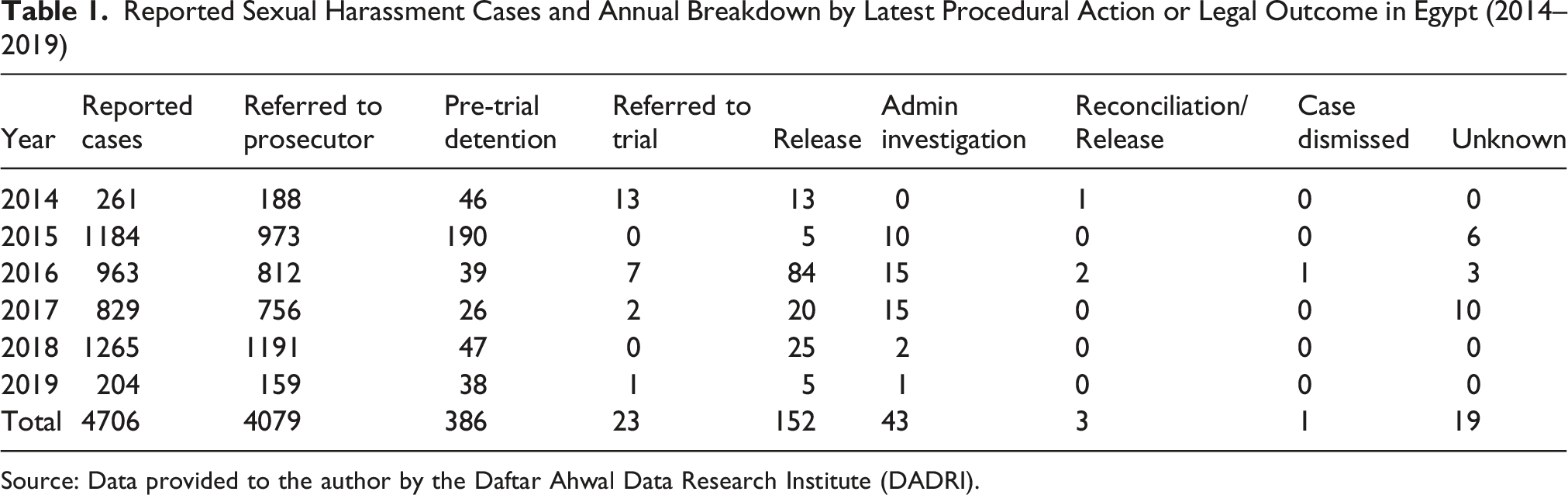
Source: Data provided to the author by the Daftar Ahwal Data Research Institute (DADRI).
This moment of heightened attention was, however, fleeting. In recent years, survivors reporting sexual violence have described being harassed or discredited by police officers, with some even facing accusations of filing false complaints. Furthermore, a director of a data tracking and analysis research institute in Egypt, observed that when disaggregating reported data by month over several years, one can detect patterns. Reporting increases during public holidays, but also closer to institutional audits. 8 During these periods, there is often a spike in reported cases which he believes is likely the result of intensified, time-bound policing efforts designed to bolster official performance metrics rather than provide sustained protection or accountability.
Feminists in Egypt, and beyond, thus debate the effectiveness of carceral measures and criticize the morality framework in addressing sexual violence. Carceral measures, while important, overlook the deeper structural problems of patriarchy, gender inequality, and absence of consent, that contribute to gender-based violence. When I asked interviewees to evaluate recent reforms, Lobna Darwish, director of women’s rights and gender programme at the Egyptian Initiative for Personal Rights (EIPR) explained how even when the state act upon high profile cases, their actions are rushed, sensationalized, and overly focused on severe punishments. They often lead to unintended consequences, such as fostering public sympathy for perpetrators, rather than effectively addressing the issue of justice for the victims. 9 For example, the case of Nayera Ashraf, the university student who was murdered in June 2022 by Mohamed Adel after she had reportedly rejected his advances, garnered widespread attention and mixed sentiments (Egypt Today, 2023). The execution of her killer sparked a controversial public sympathy narrative where he was labeled a “martyr” by some, despite the severity of the crime.
By reducing the issue to a strictly criminal one, the regime is also able to neglect grassroots feminist efforts and sideline feminists who demand addressing the root causes of violence. As feminist activism against sexual violence grew and expanded during and following the 2011 uprising, the regime moved to cracking down on independent feminist groups, closing off their organizations and offices, freezing their assets, and subjecting their leaders to travel ban. Feminist groups and leaders continue to face security harassment and bureaucratic mazes, especially related to funding, security clearance or registration.
Criticizing the state’s logic of control and its approach to reform is not to say that its measures are useless. However, in the absence of parallel societal conversations and independent feminist voices, these measures and framings contribute to consolidating the regime’s autocratic rules and produce limited, and even sometime mixed outcomes, for the agenda of sexual violence for several reasons. First, the overwhelming focus on lengthy prison terms and escalating financial penalties creates a legal framework that responds only after violence occurs and does little to address the broader social, cultural, and institutional structures that enable gender-based violence. Second, it also leaves significant gaps in areas like marital rape, domestic violence, and preventative education, that is, it reinforces a legal model in which punishment substitutes for protection. Third, such approach capitalizes on the visibility of such reforms to enhance the regime’s domestic and international legitimacy without conceding to broader rights demands. In fact, it justifies, reinforces, and expands the broader punitive governance approach of the state. Fourth, Egypt’s approach also reveals a reluctance to engage with independent feminists and to incorporate survivor-centered and restorative justice strategies. The selective nature of reform, then, is not a reflection of activist momentum alone, but of which issue lends itself better to securitized punitive governance, moral domination, and macho performance.
Conclusion
Why do authoritarian regimes adopt gender reforms in some areas while resisting them in others? I show that the answer lies not only in the character of demands, the strength of feminist mobilization or the intensity of religious opposition, but also in the internal governance logics of the regime itself. Through an in-depth case study of Egypt, the article introduced a theoretical framework centered on the authoritarian logic of control and theorized its two key mechanisms, carceral logic and moral domination. I describe the Egyptian regime’s authoritarian logic of control as a macho mode of governance, in which control is performed through manhood, toughness, and moral authority. This logic explains why over the past decade the regime introduced reforms addressing sexual violence but not family law despite sustained activism in both domains. Sexual violence lends itself to securitized and punitive governance and allows the regime to showcase moral leadership without threatening foundational patriarchal structures. By contrast, family law reform would require confronting the gender hierarchies on which state authority and its alliances with religious institutions rest.
While prior work on gender reform in authoritarian contexts has emphasized institutional constraints and/or women’s movements, the findings here suggest that we must also pay attention to the internal governance logics that determine not just whether gender reforms are adopted, but which ones, when, and why. The same regime may criminalize public harassment while leaving domestic violence unrecognized, not simply because of cultural constraints or religious veto players, but because some reforms bolster the regime’s disciplinary capacity and moral domination while others threaten the gendered foundations of its power.
By tracing within-regime variation in gender policy adoption, the article contributes to broader debates in comparative politics, gender politics, and authoritarian governance. While the Egyptian case is specific in its institutional and historical context, the analysis offers a framework for understanding how authoritarian regimes selectively adopt gender reforms that align with their broader agendas of political control, moral domination, and punitive governance. The analysis begins from the premise that feminist activism matters, but asks why do states respond to some feminist demands and not others? I show that autocratic regimes are not merely responding to external pressure or deferring to conservative religious institutions. They are patriarchal projects in their own right; they engage in contests over which vision of moral regulation and gendered control prevails. In some policy domains, such as sexual violence, the regime asserts its moral authority through punitive measures. In others, like family law, the regime stalls when reforms challenge the patriarchal foundations of its authoritarian rule and yields limited strategic benefit.
The article thus aims to reorient the study of gender policy reform from questions of “if” and “when” reform happens to “why here” and “why this.” It calls for further research into how governance logics shape the relationship between state power, feminist activism, and gender reform. Across the MENA region and beyond, autocratic regimes have selectively embraced gender reforms that reinforce state legitimacy or enhance coercive power, while stalling reforms that require redistributing authority or confronting entrenched hierarchies. Future work might explore whether similar governance logics are evident in states that criminalize gender-based violence yet preserve discriminatory family laws. More broadly, the article calls for a shift in how we study gender policy in autocracies. A shift away from questions of adoption as a monolithic category, and toward a more disaggregated inquiry into which reforms are pursued, which are avoided, and what this reveals about authoritarian governance. The analytical payoff lies in explaining variation in reform outcomes and understanding how gender becomes a site through which regimes perform moral authority, punish deviance, and reproduce gendered order.
Footnotes

Funding
The author received no financial support for the research, authorship, and/or publication of this article.
Declaration of Conflicting Interests
The author declared no potential conflicts of interest with respect to the research, authorship, and/or publication of this article.
Data Availability Statement
Replication data can be found at https://doi.org/10.7910/DVN/3XVVND. Allam, Nermin, 2026, “Replication Data for: Macho Governance and the Selective Adoption of Gender Reforms in Egypt”, (Allam, 2026).