






Abstract
In complex multiparty democracies, citizens face the challenge of interpreting elite behavior to locate parties on the policy spectrum. This paper investigates when and why voters use party cooperation as a heuristic for judging the distance between their own preferences and those of an out-party. Drawing on the theory of ecological rationality, I argue that cooperation becomes an efficient heuristic when it is cheap to access, simple to apply, and accurate enough to guide inferences about policy alignment. Using original surveys from Canada, Denmark, Germany, and the United Kingdom across fifteen policy domains, I show that perceived cooperation is consistently associated with reduced policy distance. The effect is strongest among knowledgeable partisans, on polarized issues, and when the out-party is perceived to be ideologically extreme. These findings reveal how ecological rationality conditions voter reasoning, highlighting cooperation as a dynamic elite cue that shapes mass perceptions and democratic representation.
Individuals’ political decision-making is rarely the product of full information and careful deliberation. As Tversky and Kahneman (1974) famously argued, people often rely on a limited set of heuristic principles that “reduce the complex tasks of assessing probabilities and predicting values to simple judgmental operations” (p. 29). This insight has shaped a large body of research in political science showing that heuristics, or mental shortcuts that simplify decision making, can help citizens form political judgments. These shortcuts are especially useful when individuals decide how to vote (Bartels, 2000; Campbell et al., 1960; Rahn, 1993), where to stand on policy issues (Cohen, 2003; Druckman et al., 2013; Levendusky, 2009; Slothuus & Bisgaard, 2021; Zaller, 1992), or how to evaluate governing coalitions (Bowler et al., 2022; Fortunato et al., 2021; Hjermitslev, 2023). All these works recognize that individuals face cognitive limitations, including restricted attention, incomplete information, and limited capacity to process complex data (Simon, 1955; Taylor, 1981). Heuristics help citizens manage these constraints, offering efficient and often effective tools for navigating complex political environments (Lau & Redlawsk, 2006; Lupia & McCubbins, 1999; Sniderman et al., 1991).
Most research in this tradition has focused on how voters use relatively stable party characteristics such as party labels, ideological orientation, or elite endorsements as cues.1 These characteristics help voters identify parties or candidates that broadly share their values and help them to adopt positions across different policy issues. While recent work had examined how institutional signals such as governing coalitions shape voters’ perceptions of parties (Adams, Bernardi, & Phillips, 2021; Fortunato & Stevenson, 2013), less attention has been paid to broader patterns of inter-party cooperation that voters observe in everyday political interactions. In multiparty systems where coalitions are common, alliances can shift, and cooperation is often necessary, voters may encounter a different kind of cue: one based not on what parties are, but on what they do. One especially relevant and observable form of such behavior is inter-party cooperation. 2 From a cue-taking perspective, visible cooperation can act as a signal that parties share common ground on at least some issues, prompting voters to update their perceptions accordingly (Harteveld et al., 2017; Rooduijn et al., 2016). Since policy proximity is central to how voters evaluate allies and opponents, shifts in perceived closeness can shape support for parties, their policies, and even the viability of future coalitions. Cooperation may therefore influence not just how voters see party relationships, but where they believe those parties stand on specific issues.
This leads to the central question of this paper: when do voters use inter-party cooperation as a heuristic for judging policy proximity? I argue that when individuals see their preferred party cooperating with another party, they may infer that the out-party is closer to their own position on a given policy than previously believed, even if the cooperation is unrelated to the policy in question. Since voters tend to align with their preferred party’s positions (Leeper & Slothuus, 2014), such cooperation can serve as an inferential shortcut for estimating how far away the out-party’s stance is on a given policy from their own position.
I develop the argument through the lens of ecological rationality, which evaluates heuristics not by their resemblance to full-information reasoning, but by their effectiveness given the structure of the environment (Gigerenzer, 2008; Gigerenzer & Gaissmaier, 2011). In complex, multiparty systems where coalitions are frequent, ideological boundaries are blurred, and political actors regularly shift alliances, judging patterns of cooperation between parties as a signal of policy proximity is not only cognitively efficient, but often adaptive. The key question, however, is under what conditions this heuristic is more likely to be used. As such, this paper will explore three conditions that make cooperation a more ecologically rational cue: cheapness, simplicity, and accuracy.
To test this, I field original surveys in 2019 in Canada, Denmark, Germany, and the United Kingdom. These four countries vary in their traditions of partisan cooperation, ranging from relatively adversarial systems to those with more consensual coalition politics. As such, they provide reasonable variation in political environments to test the theory above. In each survey, respondents were asked to judge the extent to which different pairs of parties cooperate with each other, and they were also asked to place themselves and several major parties in their country on 14–15 distinct policy issues, including immigration, redistribution, climate, cultural diversity, and others. This design allows me to examine how observed cooperation informs voters’ perceptions of policy proximity across a wide range of substantive domains, making the contribution of the paper arguably one of the most comprehensive issue-level designs used to study this question.
The findings demonstrate that voters tend to judge out-parties as closer to their own policy position when they report higher levels of cooperation between that party and their preferred party. Crucially, this pattern holds even after accounting for left-right distances between these parties and their joint cabinet membership. These results suggest that cooperative behavior is not just background political context. Instead, it also functions as a meaningful informational shortcut that shapes voters’ policy perceptions. Yet the value of this heuristic is not uniform across contexts or individuals. Following the logic of ecological rationality, the results show that voters are more likely to use cooperation as a cue when it is cheap (i.e., easy to access or recall), simple (i.e., cognitively easy to interpret), and accurate (i.e., informative about the out-party’s likely position). These conditions vary systematically: at the individual level, politically knowledgeable respondents are more likely to recognize and incorporate patterns of cooperation, making the heuristic cheaper; at the out-party level, ideological extremity simplifies inference because cooperation with a far-left or far-right party is more striking and less ambiguous; and at the policy level, cooperation is more accurate when it is statistically associated with convergence on highly polarized issues, whereas on less polarized issues the association is weaker. 3
Taken together, this paper makes three key contributions. First, it reconceptualizes elite cooperation as a policy heuristic, expanding the study of heuristics beyond stable party characteristics or formal roles in government to patterns of inter-party cooperation. Second, it advances a theoretical framework based on ecological rationality, offering clear and testable predictions about when such heuristics are used. Third, it provides empirical support across four democracies and a uniquely broad array of issue domains, showing that the relationship between perceived cooperation and policy proximity extends beyond broad ideological dimensions (Fortunato & Stevenson, 2013) or single-issue contexts (Adams, Bernardi, & Phillips, 2021). This offers one of the most comprehensive tests to date of how voters use elite behavior to infer policy proximity.
Inter-Party Cooperation as a Policy Heuristic
In multiparty systems, relationships between political parties are shaped not only by electoral competition but also by patterns of cooperation. A substantial body of research shows that voters perceive parties’ left–right positions to be closer together when those parties join formal governing coalitions (Adams et al., 2016; Fernandez-Vazquez, 2014; Fortunato & Adams, 2015; Fortunato & Stevenson, 2013; Spoon & Klüver, 2017). This effect grows stronger the longer coalitions last (Fortunato, 2012) and also appears when cooperation is informal, such as through legislative agreements or coordinated policy action (Adams, Weschle, & Wlezien, 2021; Falcó-Gimeno & Muñoz, 2017; Santoso, 2025a).
These patterns are consistent with the idea that voters use changes in partisan cooperation as a cue for policy change, perceiving parties that work closely together as holding more closely aligned preferences. While most of this work conceptualizes proximity in broad left–right terms, the same logic can apply at the level of specific policies, where signals of cooperation may be more immediately relevant to voters’ views on concrete issues such as immigration, redistribution, or climate change.
If partisans believe their party is moving closer to an out-party, partisan rationalization theory predicts that they will adjust their own views accordingly. Because many citizens take policy cues from their preferred party (Lenz, 2012; Zaller, 1992) and view that party as a core component of their social identity (Green et al., 2002; Huddy et al., 2015), they are motivated to remain aligned with it. When cooperation signals that the two parties are closer in policy terms, partisans may shift their own stance toward the out-party’s position to preserve loyalty and cognitive consistency, avoiding the discomfort of holding views at odds with their party (Goren et al., 2009; Taber & Lodge, 2006).
A recent study illustrates this mechanism. Santoso (2025b) finds that when identifiers of non-radical right parties (non-RRPs) perceive their party cooperating with a radical right party (RRP), they move their own positions, particularly on highly salient issues such as immigration and cultural diversity, closer to the RRP’s stance. Crucially, this occurs even without specific objective policy agreements between their supported party and the RRP, indicating that the cooperation itself is enough to trigger partisan rationalization.
The same logic, however, can be extended across the political spectrum. When any two parties cooperate, voters may interpret this as evidence of shared policy ground and, if they are partisans of one of the parties, adjust their own policy positions toward those of the out-party. In this way, inter-party cooperation functions as a policy heuristic: an observable, behavior-based cue that not only signals policy alignment but also activates identity-based and motivational processes that drive partisan rationalization across diverse political contexts and policy domains. By heuristic, I mean a rule that maps observable informational inputs (cues) and the weights placed on them onto a target inference or belief with less effort than more deliberative alternatives (Gigerenzer et al., 1999; Lau & Redlawsk, 2006; Shah & Oppenheimer, 2008). Here, perceived cooperation between parties is the cue and the voter’s inference about policy proximity to the out-party is the target.
Importantly, this mechanism does not require actual policy convergence. Since inter-party interactions are frequently documented by the media (Adams, Bernardi, & Phillips, 2021, Adams, Weschle, & Wlezien, 2021; Santoso et al., 2024), voters can observe and assess cooperation between specific party pairs. This visibility allows them to infer an out-party’s likely policy positions even in the absence of objective change. As a result, cooperation can shape mass opinion even when it reflects symbolic gestures rather than objective policy agreements. 4
Based on the explanation above, I hypothesize that:
Greater perceived cooperation between a partisan’s preferred party and an out-party will be associated with a smaller gap between the partisan’s own policy position and the out-party’s position on that issue.
While the expectation in H1 follows directly from the partisan rationalization mechanism, such cooperation will not always serve as an equally strong or reliable signal for reducing the perceived policy distance between the partisan’s own position and that of the other party. In some contexts, partisans may dismiss cooperation as a matter of convenience or parliamentary necessity. In others, they may view it as compelling evidence of shared policy ground. The case of cooperation with radical right parties discussed above illustrates this point: when the other party “owns” a salient issue such as nativism, even perceptions of cooperation in general can be politically meaningful and more likely to activate the partisan rationalization process.
This raises a broader question: when is inter-party cooperation most likely to operate as an effective heuristic for judging policy proximity? Partisan rationalization explains why cooperation works as a heuristic in the first place: to preserve consistency with their in-party, supporters interpret cooperation as evidence that the out-party must be closer to their own position. Yet rationalization alone does not tell us when this heuristic will be influential. Previous works on heuristics use suggest that the usefulness of a cue depends on the informational environment in which voters operate. Using an ecological rationality framework, Fortunato and Stevenson (2019) show that voters rely on heuristics to infer legislators’ behavior when partisan cues are sufficiently informative. Similarly, Fortunato et al. (2021) demonstrate that citizens attribute policy-making influence on parties using observable signals such as their roles in government and party size. These studies highlight that voters often rely on readily available political cues when direct information about party positions and policy influence is difficult to obtain. Using the same ecological rationality framework, I examine when patterns of inter-party cooperation function as cues for inferring policy proximity. While these works focus on cues derived from party labels or government roles, this paper considers a different type of cue — perceived interactions between one’s preferred party and an out-party—and when voters use these interactions to infer policy proximity across multiple issues.
Ecological Rationality: Conditions for Using Partisan Cooperation as a Policy Heuristic
As Gigerenzer (2008) and Gigerenzer and Gaissmaier (2011) argue, heuristics should be evaluated not by how closely they approximate full-information reasoning, but by how well they perform in the specific environments where decisions are made. In the context of inter-party cooperation, this perspective highlights three conditions that determine whether voters will use the cue: cheapness (the cue is easy to access or recall), simplicity (the cue is straightforward to interpret), and accuracy (the cue is informative about the proximity of out-party’s likely policy position). 5
First, a heuristic is “cheap” if the values of relevant cues are widely known or easy to obtain. In the case of inter-party cooperation (i.e., collaboration between an individual’s preferred party and an out-party), this means that voters can easily recall or observe patterns of collaboration between parties. Modern media environments, particularly in multiparty democracies, make this possible. Mainstream outlets routinely report on coalition negotiations, co-sponsored legislation, joint press conferences, and other visible signals of collaboration (Adams, Weschle, & Wlezien, 2021; Santoso et al., 2024). The rise of partisan media has amplified this accessibility: outlets sympathetic to a voter’s preferred party often frame cooperation as evidence of pragmatic problem-solving or strategic acumen, while hostile outlets may portray it as betrayal or ideological compromise (Jamieson & Cappella, 2008; Levendusky, 2013). Both frames make the cooperation salient, and repeated exposure embeds it more firmly in voters’ memories, lowering the cost of retrieving this information when forming judgments about policy.
The ease to which voters can access and recall information about cooperation, however, is not uniform. While contemporary media ecosystems, especially partisan outlets, can make instances of inter-party cooperation more visible, individuals still vary in their ability and motivation to take in and store this information. Politically knowledgeable individuals are more likely to follow news about parliamentary developments, recognize patterns of inter-party collaboration, and retain this information over time (Prior, 2018). Their interest in politics means that cues about cooperation slot easily into an existing mental schema, making retrieval almost effortless. In contrast, less knowledgeable voters may remain unaware of many cooperative episodes unless they are unusually prominent or repeatedly emphasized in the media. For them, the cue is less “cheap” because it must be noticed afresh each time rather than drawn from a well-established store of political knowledge. 6
Under these conditions, the cooperation cue is not only cheap but also more likely to be used in making policy proximity judgments. For politically knowledgeable individuals, the mental cost of recalling instances of cooperation is minimal, meaning the cue can be accessed quickly and deployed in low-effort reasoning about whether an out-party’s policies are close to their own. Accordingly, the association between perceived general cooperation and perceived policy proximity should be stronger among politically knowledgeable individuals, for whom the cooperation cue is especially easy to access and recall.
Second, a heuristic is simple if the mapping that applies the weight of a cue to generate an inference is cognitively relatively undemanding for the average person. 7 While cheapness is about the cost of accessing or recalling the cue, simplicity refers to the cost of processing it once it is in mind. In ecological rationality terms, simplicity refers to the minimal cognitive processing required to translate an observed cue into a belief or judgment (Shah & Oppenheimer, 2008). The simpler the cue–inference mapping, the less mental effort is required, and the more likely the heuristic will be used in practice (Gigerenzer & Brighton, 2009).
In the case of partisan cooperation, simplicity increases when voters can interpret the meaning of cooperation quickly and with reference to an existing, well-understood political framework. One such framework, which is deeply embedded in mass political cognition, is the left–right ideological spectrum. Across many democracies, the left–right scale functions as a “super-issue”, serving as a cognitive shortcut that summarizes a party’s general ideological orientation and, by extension, its likely position on a range of policy issues (Huber & Inglehart, 1995; Knutsen, 1997; Mair, 2009). Voters regularly use left–right placement as a shortcut to organize their own beliefs, assess other parties, and predict where those parties stand without consulting detailed policy platforms.
From this perspective, the ideological extremity of the out-party makes the cooperation cue simpler to interpret. When the out-party occupies a far-left or far-right position, its ideological identity is distinctive and highly diagnostic: voters already have a clear sense of what such a party stands for across many issue domains (Adams et al., 2006; Wagner & Meyer, 2017). 8 Observing cooperation with such a party therefore makes it straightforward to infer some level of policy proximity, since such cooperation is unlikely to be dismissed as mere procedural necessity or symbolic bipartisanship. The out-party’s extremity thus serves as an anchor — its positions are already sharply defined, making any visible cooperation stand out as a meaningful signal of common ground that voters can act on without needing to process detailed legislative records or issue-specific compromises.
In contrast, cooperation with a centrist or moderately positioned out-party is more ambiguous. Centrists often share partial policy overlaps with parties on both sides of the ideological divide, so their cooperation does not clearly signal genuine policy alignment. They also tend to have weaker valence attributes — lower perceived competence, integrity, or cohesion — which further dilutes the informational value of their cooperation (Zur, 2021a, 2021b). Voters may therefore interpret such cooperation as strategic flexibility or routine compromise rather than substantive agreement, making the cue noisier and less useful as a heuristic.
Thus, the ideological extremity of the out-party reduces the complexity of the inference process. Based on the discussion above, I expect cooperation with ideologically extreme out-parties to have a stronger effect on perceived policy closeness than cooperation with centrist ones.
Finally, a heuristic is considered accurate when the cue it relies on co-varies reliably with the outcome it is meant to signal. In the ecological rationality framework, individuals rely on cues that, over time, have proven statistically informative in their environment (Gigerenzer et al., 1999; Pohl et al., 2017). For example, a voter may use perceived inter-party cooperation as a shortcut to infer policy proximity between their preferred party and an out-party. 9 Put simply, a cue is accurate when it consistently co-varies with the outcome of interest. 10
Importantly, this does not imply issue-specific cooperation. In the empirical design that follows, I measure cooperation in general, while policy proximity is assessed across a wide range of issue domains. The heuristic is judged accurate to the extent that general perceptions of cooperation predict convergence on policy scales. This allows for meaningful variation: in some domains, cooperation cues may reliably indicate proximity; in others, they may not.
A central moderator of cue accuracy is issue-level polarization. On polarized issues, party elites tend to adopt internally coherent positions that sharply diverge from those of competing parties (Gidron et al., 2020; Levendusky, 2010; Mehlhaff, 2025). In such environments, any signal of cross-party agreement carries substantial political risks as partisans may react with backlash (Golder, 2006), and party leaders risk reputational harm among ideological allies (Martin & Vanberg, 2011). Because symbolic or merely procedural cooperation is politically costly, it is less likely to occur unless it reflects substantive alignment. As a result, when voters perceive cooperation and evaluate elite positions on polarized issues, those perceptions are more likely to reflect real convergence. In these cases, the cooperation cue is more diagnostic (i.e., more accurate).
By contrast, on issues with low polarization, elite positions are less distinct, and the political costs of cooperation are lower. Parties frequently coordinate for reasons unrelated to ideological alignment: passing routine legislation, resolving technical disputes, or engaging in strategic signaling. Voters may still perceive cooperation, but those perceptions are less informative of actual proximity. The heuristic, in these contexts, becomes noisier and less reliable.
This logic is reinforced by recent models of coalition governance. For example, De Marchi and Laver (2023) show that parties often construct governing agendas by tabling contentious issues and negotiating only in domains where agreement is feasible. Cooperation, in this view, does not imply alignment on all issues, instead, it reflects strategic issue selection under constraints. When voters perceive general cooperation, they may not know which issues are involved, but the underlying production of cooperation is not random. In polarized domains, agreement is rarer, more meaningful, and more likely to shape voter inferences. Thus, the same general cue can vary in diagnostic value across issues, not because voters know which issues are involved, but because the structure of elite competition makes some cues more likely to reflect real movement.
In sum, the accuracy of the cooperation heuristic depends on the political environment in which it is applied. When elite constraints filter out symbolic cooperation, especially on polarized issues, perceptions of cooperation become more accurate indicators of policy proximity. When those constraints are weak, the same cue is less informative. This theoretical framework yields a clear prediction: perceived cooperation should more strongly predict policy proximity on highly polarized issues. 11
Ecological Rationality Properties, Applications, and Hypotheses for Inter-Party Cooperation
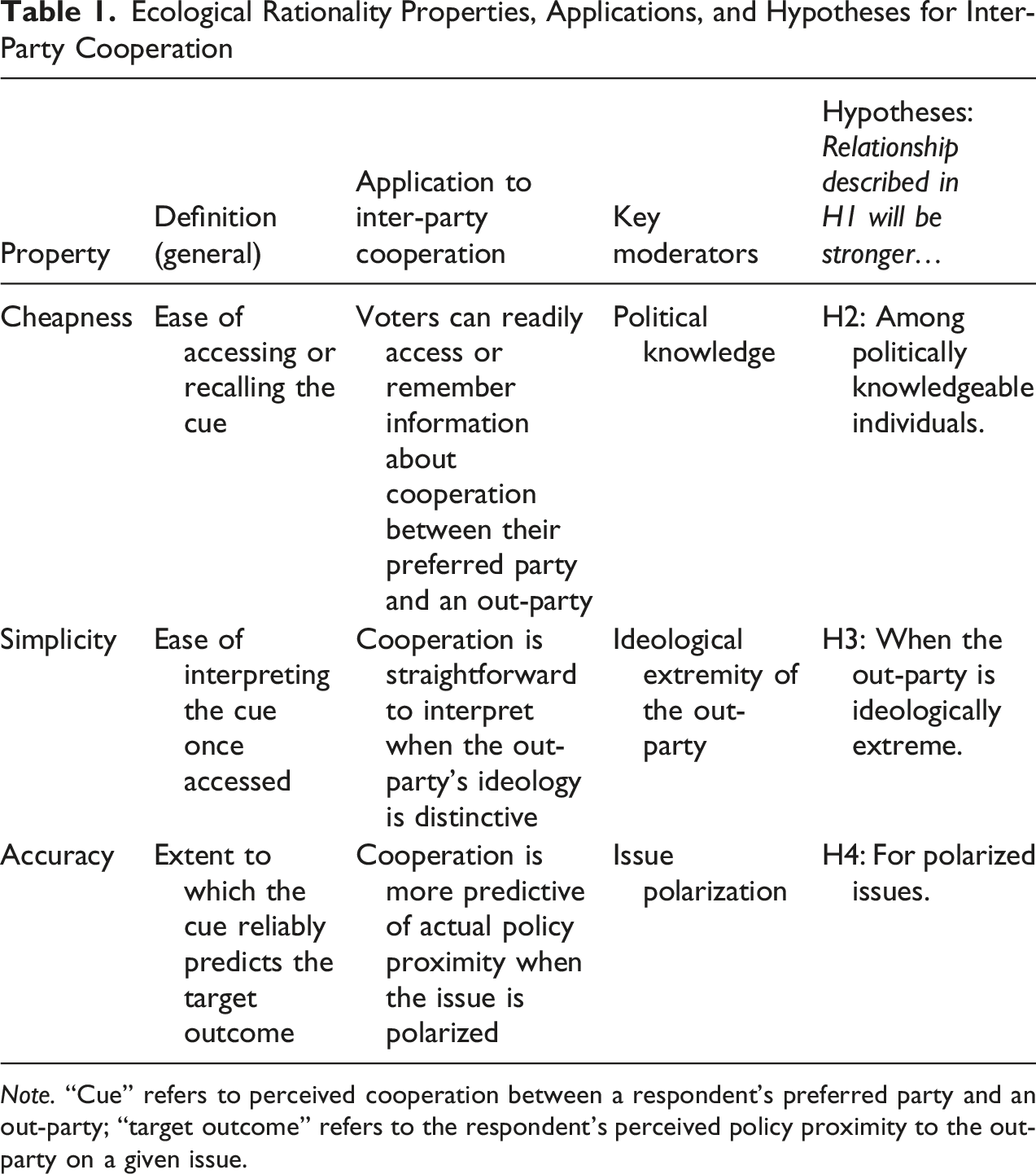
Note. “Cue” refers to perceived cooperation between a respondent’s preferred party and an out-party; “target outcome” refers to the respondent’s perceived policy proximity to the out-party on a given issue.
Research Design
To test the hypotheses above, I conducted original surveys in Canada (n = 1,000), Denmark (n = 1,278), Germany (n = 1,017), and the UK (n = 995) in 2019. 13 These four countries differ in party system and in their traditions of cooperation among parties, which allows for comparative assessments of how partisan cooperation shapes perceptions across distinct contexts. Because the meaning of cooperation between parties is conditioned by national experience, it is useful to situate each case within its respective tradition.
Canada’s political system is characterized by brokerage politics, where parties act as intermediaries between diverse social and regional interests (Carty & Cross, 2010;Cochrane, 2010). Rather than adhering to rigid ideological divides, parties frequently shift positions and engage in strategic cooperation to maximize electoral success (Johnston, 2010). Denmark, by contrast, operates within a multiparty system structured around stable “red” and “blue” blocs, where cooperation most often occurs within, rather than across, ideological camps (Green-pedersen & Thomsen, 2005). Governments are typically formed through coalitions of parties belonging to the same bloc, and cross-bloc cooperation, while possible, is less common and often politically costly. This tradition of bloc politics creates a context in which cooperation is expected and normalized within blocs but generates sharper signals when it occurs across them. Germany similarly has a long-standing tradition of coalition governance, including frequent grand coalitions between parties from different ideological camps such as the Christian Democrats and the Social Democrats (Debus et al., 2021). In this system, elite cooperation is frequent and institutionalized as a necessary feature of government formation. Finally, the UK represents a more adversarial case: a historically dominant two-party system where inter-party cooperation is rare and often perceived as a deviation from normal political competition. While coalition governments have occurred—most notably the Conservative–Liberal Democrat coalition from 2010 to 2015—they remain exceptional rather than routine (Barlow & Bale, 2021).
Thus, by spanning traditions that range from Canada’s brokerage politics to Denmark’s bloc competition, Germany’s institutionalized coalitions, and the UK’s adversarial two-party system, the study captures a wide spectrum of partisan cooperation. This variation ensures that the results are not artifacts of a single institutional or cultural setting. Instead, they provide evidence on how cooperation between a respondent’s preferred party and an out-party influences perceived policy proximity across contexts where cooperation between parties is routine, conditional, or unusual.
The next section describes how the key variables are measured. I begin with partisanship, since the analysis is limited to respondents who identify with a party — a restriction that follows directly from the theoretical framework. I then discuss the dependent variable (perceived policy distance across fifteen issues), the key independent variable (perceived cooperation between the respondent’s preferred party and an out-party), and the control variables. Descriptive statistics are provided in Appendix 2.
Partisanship
First, I identify whether a respondent is a partisan by asking whether he/she identifies with a party. In the British survey, respondents are asked: Regardless of which party you would vote for in any particular election, do you, generally speaking, identify with the Conservative Party, Labour Party, Liberal Democrats, or what?
They are then presented with a list of political parties, including an option to indicate that they do not identify with any party. A similar format is used in the surveys conducted in Canada, Denmark, and Germany. Further, those who identify with a party are asked about the strength of their identification. Using this question, I categorize these partisans as either very strong, fairly strong, or not very strong identifiers.
Following work by Theodoridis (2017), I also categorize “leaners” as partisans. Specifically, respondents who initially report that they do not identify with a party are asked a follow-up question about whether they feel closer to one party than the others. Those who indicate such closeness are coded as partisans and included in the analysis. 14 Only respondents who express no partisan identification, even when prompted, are excluded.
Policy Proximity
To measure the outcome variable of the paper, which is the proximity between partisan’s own policy position and the out-party’s position on that issue, I first need to identify which policies need to be included. The theory of ecologically rational heuristics suggests that cooperation cues are most likely to shape judgments on issues that are both salient in party competition and marked by partisan polarization. Guided by this logic, I include a broad set of specific policies: 15 in Germany and Denmark, and 14 in Canada and the UK. These policies were selected because they are central to contemporary political debates in each country and vary in their degree of partisan polarization.
While the specific content of elite discourse may evolve over time since political entrepreneurs often introduce new issues, reframe debates, or shift attention to different policy cleavages—the use of a “most-similar systems” design ensures a substantial degree of cross-national comparability in the relevancy of the policies. As such, the selected issues span a wide array of domains, including traditional economic policies, social and cultural issues, “new politics” topics, and country-specific policy issues.
In addition to the specific policy items, the survey includes a set of broader value-based questions designed to capture more abstract dimensions of political conflict that cut across policy domains. A long tradition of research suggests that enduring divides between parties often stem not only from disagreements over concrete policies, but also from deeper commitments to competing values—such as equality versus hierarchy or change versus tradition (Bobbio, 1996; Caprara & Vecchione, 2017; Jost, 2021). To reflect this dimension of political competition, the survey includes value-oriented items on income redistribution, cultural diversity, civil liberties, the role of government, and gender equality. Including both concrete policy stances and broader value commitments ensures that the dependent variable captures variation in both domain-specific preferences and underlying ideological orientations.
List of Issues Included in the Surveys, Scale Endpoints, and Countries
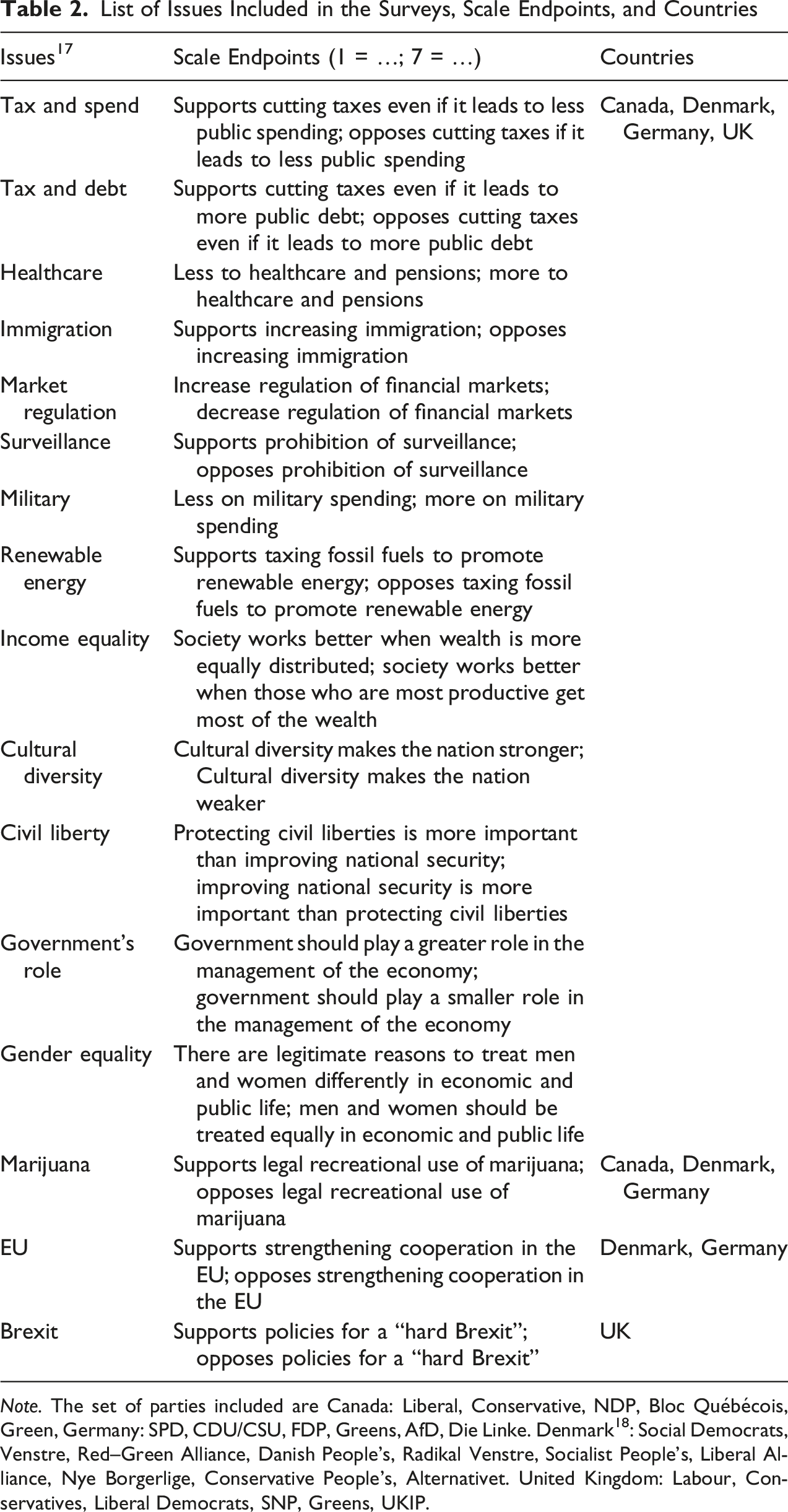
Note. The set of parties included are Canada: Liberal, Conservative, NDP, Bloc Québécois, Green, Germany: SPD, CDU/CSU, FDP, Greens, AfD, Die Linke. Denmark 18 : Social Democrats, Venstre, Red–Green Alliance, Danish People’s, Radikal Venstre, Socialist People’s, Liberal Alliance, Nye Borgerlige, Conservative People’s, Alternativet. United Kingdom: Labour, Conservatives, Liberal Democrats, SNP, Greens, UKIP.
Inter-Party Cooperations
To assess voters’ perceptions of the extent to which the party they support cooperates with an out-party, I used survey questions asking respondents about the perceived cooperation between specific pairs of parties in their country. The question was phrased as follows: How often do you think these two parties cooperate with each other in [your country’s] federal politics?
Each respondent was asked to evaluate all pairs of parties with seats in the legislature at the time of the survey, resulting in approximately 10 to 15 party-dyads per respondent across the four countries. While previous studies have relied on government coalitions (Adams et al., 2016) or media-based event data (Weschle, 2018) to measure cooperation, directly asking voters is more appropriate for this study. It captures individual-level perceptions, which are central to understanding how voters interpret partisan interactions, rather than relying on externally imposed measures.
Since the theoretical framework centers on how partisans interpret cooperation involving their own party, the analyses focus only on dyads in which one party is the respondent’s preferred party and the other is an out-party. 19 For example, among Conservative identifiers in the UK sample, only responses involving the Conservative Party are analyzed. Similarly, for CDU supporters in Germany, only dyads involving the CDU are included.
Political Knowledge
Building on the widely used approach developed by Price and Zaller (1993), I measure respondents’ political knowledge with a set of factual questions. The first three items concern major news stories that were prominently covered in the days immediately before the survey, capturing short-term awareness of current events. The other three items assess medium-term political knowledge, asking about facts such as the current inflation rate and the identities of individuals holding key elected offices. These questions generally require sustained exposure to political information over time. Combining both types of items provides a more comprehensive measure of political knowledge, distinguishing between those who may have missed recent news but are otherwise well informed and those with consistently lower levels of knowledge. Respondents are then grouped into three categories—low, medium, and high knowledge—based on the total number of correct answers across the six questions.
Out-Party’s Ideological Extremity
To measure how extreme the out-parties are, I use a question that asks respondents to place all the parties in their respective countries on a left–right scale (0 being the most left, and 10 being the most right). In the analyses below, this measure enters the models as a set of dummy variables for each scale point rather than as a continuous distance-from-center score, which would otherwise force symmetry between left- and right-wing extremity. This specification allows me to examine whether the impact of cooperation differs when the out-party is located at the far left or far right of the ideological spectrum.
Issue Polarization
To measure the extent to which parties are polarized on a given issue, I calculate the Cluster Polarization Coefficient (CPC), recently introduced by Mehlhaff (2024). The CPC captures the idea that partisan polarization requires both distinct positions across parties and relative homogeneity within them. This measure is particularly useful for my purpose because it can be calculated directly from the survey data, allowing me to generate a polarization score for every policy. Compared to previous measures (e.g., Ahler & Broockman, 2018; Dalton, 2008), the CPC offers several advantages: it applies naturally to multi-party systems and simultaneously accounts for both inter-group heterogeneity and intra-group homogeneity—both of which are necessary for polarization. Accordingly, a higher CPC score for a given policy indicates that respondents’ beliefs about party positions on the issue are both more distinct (parties are perceived to hold different positions) and more homogeneous (respondents converge in their perceptions of each party’s stance) compared to policies with lower CPC scores.
Other Control Variables
There are two crucial variables that could confound the relationship between partisan cooperation and policy proximity. The first is ideological distance between the in-party and the out-party. Parties that are ideologically closer are often observed to cooperate more frequently and are also perceived as more similar in their policy positions. By contrast, greater ideological separation tends to be associated with less cooperation and larger policy gaps. To measure this, I use both subjective and objective measures of ideological distance in the analysis. The subjective measure is the absolute difference in respondents’ perceptions of the parties’ left–right positions, while the objective measure is the absolute difference in the parties RILE scores from the Comparative Manifesto Project (CMP). Controlling these measures helps ensure that the observed association between cooperation and policy proximity is not merely a byproduct of baseline ideological similarity. 20
The second potential confounder is the broader pattern of cooperation among the out-parties with the in-party within governing coalitions. Parties that share cabinet responsibility in government may already be perceived as closer on policy. If these broader coalition dynamics are not considered, it becomes difficult to know whether the association between perceived cooperation and policy proximity reflects voters’ judgments about cooperation itself or simply the baseline closeness that comes from being governing partners. In the main analysis, I rely on a subjective measure, constructed as a dummy variable from survey responses in which individuals report the role of each party in their country’s government. In Table A3.3 of Appendix 3, I supplement this with an objective measure that codes a dummy variable indicating whether the out-party being evaluated co-governed with the respondent’s in-party at the time of the survey. For countries with no coalition government at the time of the survey, I include past instances of joint cabinet membership to capture the longer-term history of coalition ties (see Table A3.4 in Appendix 3).
Empirical Design
To test the four hypotheses, I estimate linear regression models separately for each country. The unit of analysis is the respondent– [in-party–out-party dyad]– issue. Each respondent first identifies their in-party, rates the extent of cooperation between that party and several out-parties, and then evaluates the out-parties’ positions across a set of policy issues. This design generates a crossed structure: each respondent is linked to multiple out-parties, and each out-party is evaluated across multiple issues. As a result, a single respondent contributes multiple observations, but the specific value of perceived proximity can vary both across out-parties and across issues.
All models also control for ideological distance between the two parties, using both perceived and manifesto-based measures, as well as a dummy variable capturing whether the dyad is perceived to share cabinet membership. I additionally include policy fixed effects to account for systematic differences across issues, for example, the possibility that some policies are more susceptible to partisan cues than others. Additional covariates are introduced when testing hypotheses 2 through 4.
Further, since each respondent evaluates multiple party-dyads and each party-dyad is evaluated by multiple respondents, the models include crossed random intercepts for respondents and party-dyads. This specification accounts for unobserved heterogeneity in how individuals rate parties and how certain party-pairs tend to be evaluated across the sample.
Results
Analyses of Policy Proximity
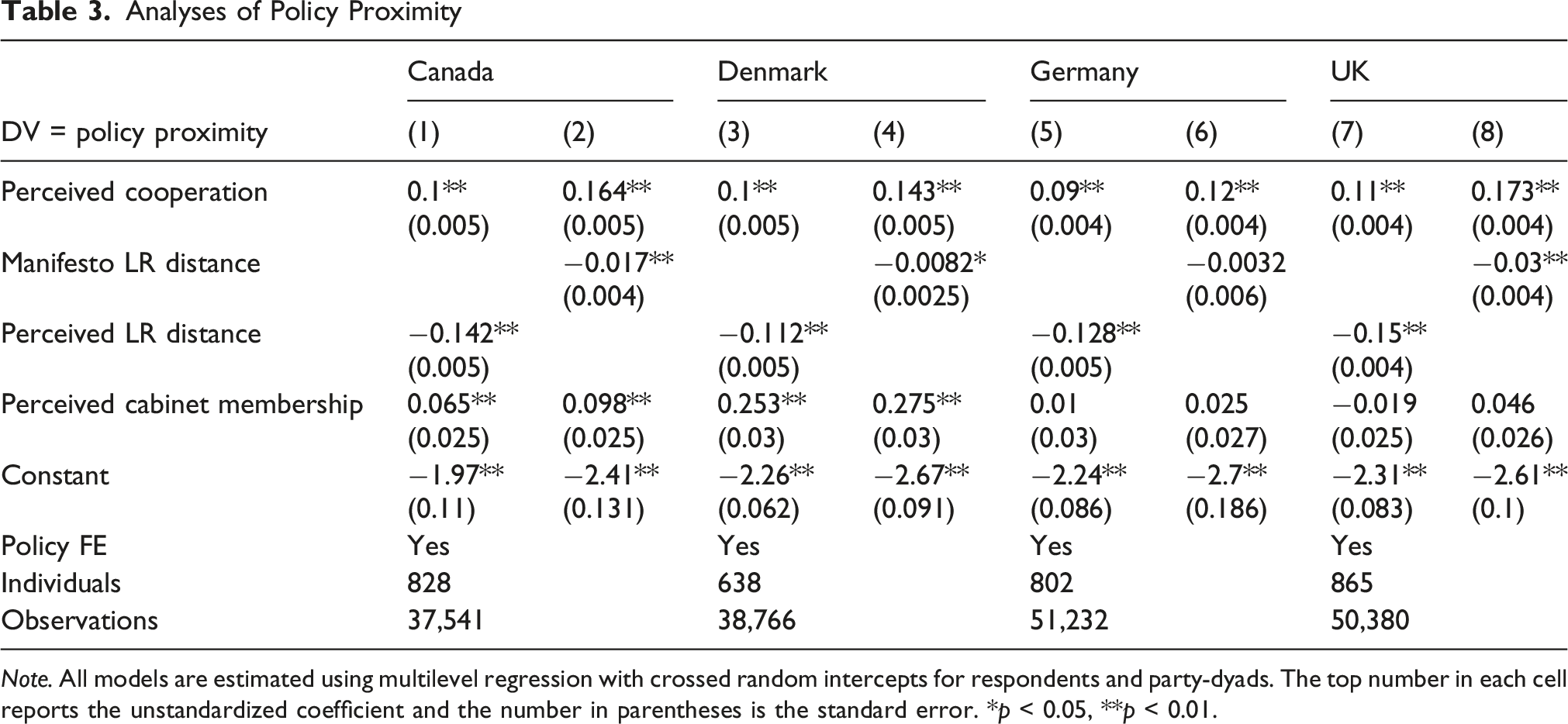
Note. All models are estimated using multilevel regression with crossed random intercepts for respondents and party-dyads. The top number in each cell reports the unstandardized coefficient and the number in parentheses is the standard error. *p < 0.05, **p < 0.01.
Regarding other variables, it is no surprise that perceived left–right distance between the in-party and the out-party is strongly associated with smaller policy proximity between the respondent and the out-party on a specific issue. The objective indicator from party manifestos also points in the same direction, reaching statistical significance in three of the four countries. Overall, this suggests that voters’ judgments of proximity tend to correspond more consistently with their own perceptions of ideological distance, while programmatic positions recorded in manifestos display a broadly comparable, though somewhat less uniform, association across contexts. A similar pattern emerges for cabinet membership: although the direction of the relationship is mostly positive, the relationship is only statistically meaningful in Canada and Denmark.
I also estimated several alternative models to assess the robustness of the findings. First, to account for the possibility that the association between perceived cooperation and policy proximity may vary depending on the strength of partisan attachment, I include a measure of respondents’ partisan strength. Second, I add a dummy variable indicating whether the out-party is a radical right party, given the possibility of radical right exceptionalism that may trigger distinct reactions (Gidron et al., 2023). Third, I replace perceived cabinet membership with an objective measure of whether the two parties are in government together. There are two variables capturing this objective measure: whether the two parties were in government together during the survey period (only applicable in Denmark and Germany), and whether they had record of joint governance in the last 10 years. 22 Furthermore, I substitute the subjective left–right distance between the respondent’s in-party and the out-party with the distance between the respondent’s self-placement and the out-party’s left–right position. This allows me to test whether the results depend on using a party-anchored measure of ideological distance or one that is anchored in respondents’ own self-placement. Finally, I address the possibility that missing responses to the party placement questions may bias the results. Because respondents could select a “Don’t Know” option, I re-estimate the models using stabilized inverse probability weighting (IPW) based on the predicted probability that respondents provide a substantive response (see Appendix 3.2 for details of the procedure).
All these alternative model specifications are presented in Appendix 3, and the substantive conclusion from Table 3 remains unchanged. Even after controlling for ideological distance between the in-party and out-party, their co-governance status, and policy fixed effects, the evidence continues to support H1: respondents perceive greater policy proximity to out-parties they see as cooperating with their in-party. This pattern is not just an artifact of issue selection. Even when holding constant all unobserved issue-level factors, respondents still see out-parties as closer to their own positions when they believe their in-party cooperates with them. To further assess this possibility, I conducted sensitivity analyses that sequentially exclude each issue from the analysis. Across the four countries, the estimated cooperation coefficient changes by no more than 2.6% to 4.9% when any single issue is removed. This stability suggests that the findings are not driven by any particular policy domain and remain robust across the set of issues examined (see Appendix 3.1).
Variations in the Associations Between Perceived Cooperation and Policy Proximity
While the results above suggest that respondents generally perceive greater proximity to cooperative out-parties, ecological rationality implies that this relationship should vary systematically depending on whether the cooperation cue is cheap, simple, or accurate. The next set of analyses therefore explores these conditional expectations by focusing on three moderators: respondents’ political knowledge (cheapness), the out-party’s ideological extremity (simplicity), and the degree of polarization surrounding the issue in question (accuracy).
First, to test the claim from H2 that the association between perceived cooperation and policy proximity is strongest among high-knowledge respondents, I re-estimated Models 2, 4, 6, and 8 from Table 3, this time interacting perceived cooperation with a set of political knowledge dummies. This is to allow the marginal effect of cooperation to vary across low-, medium-, and high-knowledge respondents. Figure 1 presents the marginal effects of cooperation across the three knowledge groups, showing that the estimated association is indeed most pronounced among respondents with higher levels of political knowledge.
23
The overall pattern is consistent across the four countries: in each case, the coefficient for perceived cooperation becomes more positive as knowledge increases. This suggests that as political knowledge increases, respondents are more likely to interpret cooperation as evidence that the out-party is closer to their own views.
24
Association between Perceived Cooperation and Policy Proximity by Levels of Political Knowledge. Note. The marginal effects are calculated based on the coefficients reported in Table A4.1 in Appendix 4. The distribution of political knowledge (PK) groups is 31%, 30%, and 39% for low, middle, and high PK in Canada; 25%, 39%, and 35% in Denmark; 18%, 36%, and 46% in Germany; and 26%, 35%, and 39% in the UK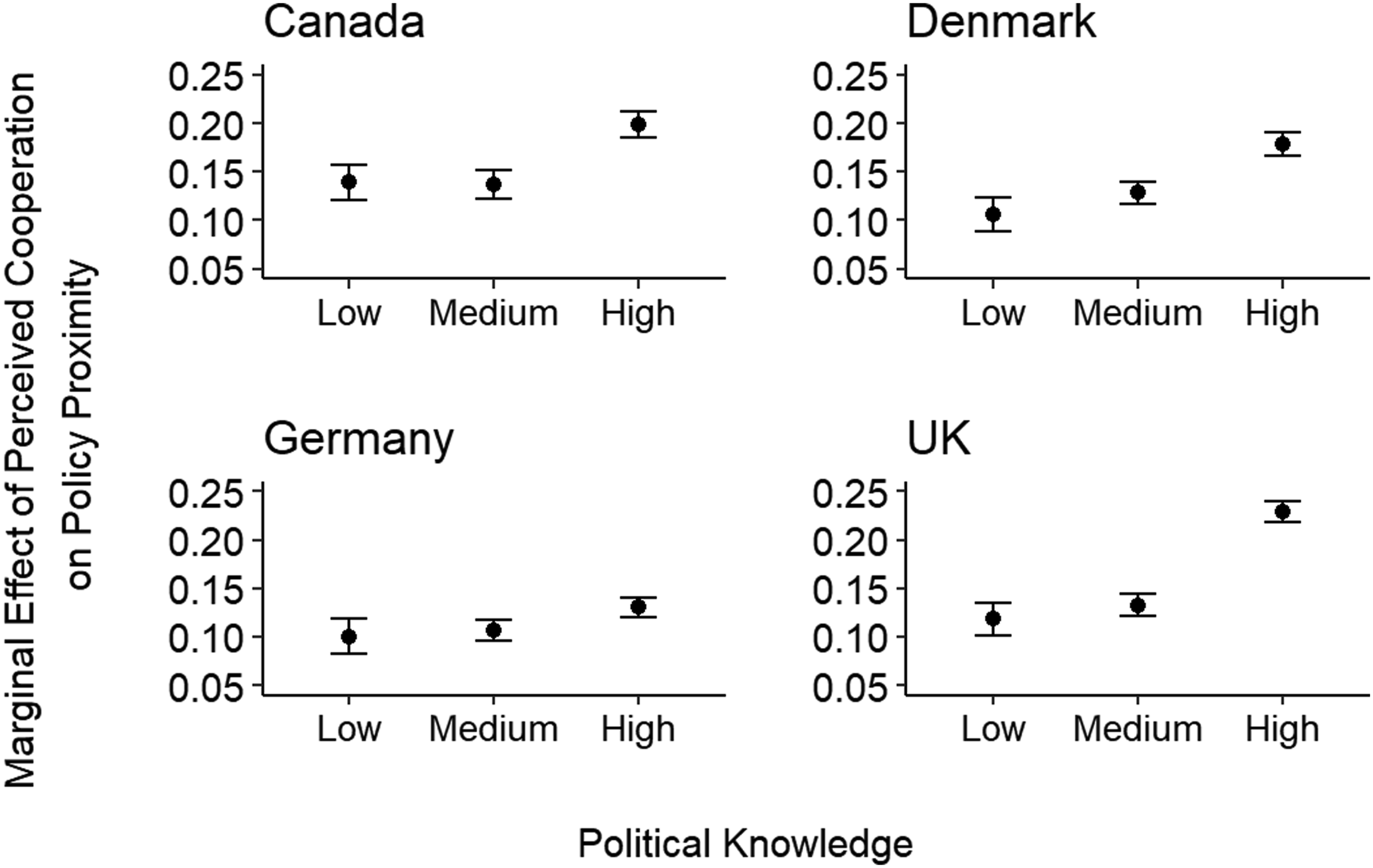
At the same time, there are notable country differences in magnitude. In Canada and the UK, the slope across knowledge groups is steepest, suggesting that political sophistication plays a particularly important role in conditioning how cooperation is used as a cue. In Germany, however, the same pattern is visible but much more modest, with not as stark difference between low- and high-knowledge respondents. The marginal effects for all three knowledge groups cluster fairly close together, suggesting that cooperation is interpreted in a relatively similar way regardless of how much political knowledge respondents possess. Unlike in Canada and the UK, German partisans of all knowledge levels appear to register cooperation as a cue to roughly the same degree. This does not mean that political knowledge is irrelevant in Germany, but rather that the conditional effect is weaker, and the heuristic operates more evenly across the electorate.
Nonetheless, the results point to a clear trend consistent with the cheapness condition of ecological rationality: across all four countries, the association between cooperation and perceived proximity tends to be stronger among politically knowledgeable respondents.
Next, to evaluate H3, which expects that the association between cooperation and perceived proximity will be stronger when the out-party is ideologically extreme, I examined how the relationship varies across the full left–right spectrum. From the perspective of ecological rationality, ideological extremity shapes the simplicity of the cue: cooperation with far-left or far-right parties is more distinctive and thus easier for voters to interpret than cooperation with centrist parties. To assess this, I re-estimated Models 2, 4, 6, and 8 from Table 3, this time including interaction terms between perceived cooperation and a set of dummy variables for the out-party’s perceived left–right position, ranging from 0 (most left) to 10 (most right). 25 By doing so, I can also evaluate whether the relationship between cooperation and perceived proximity is symmetric across the two ends of the ideological spectrum or whether cooperation with far-right or far-left parties, carries a stronger effect.
Figure 2 plots the relevant results. Across the four countries, I generally found that the association between cooperation and perceived proximity is indeed stronger when the out-party is ideologically extreme. In Canada, Denmark, and the UK, the marginal effects are most positive at the far ends of the spectrum, meaning that cooperation with far-left or far-right parties is more likely to be associated with greater perceived policy proximity than cooperation with the centrist parties. In several cases—particularly in Canada and the UK—the effect is slightly more pronounced on the far right than the far-left, suggesting that cooperation between their supported parties with right-wing out-parties carries especially strong implications for how voters judge their own proximity to these parties on a given issue. By contrast, for centrist parties located near the middle of the scale, the estimated effects are weaker, indicating that cooperation with such parties is interpreted less clearly as a sign of proximity. Association between Perceived Cooperation and Policy Proximity by the Ideological Positions of the Out-Parties. Note. The marginal effects are calculated based on the coefficients reported in Table A5.1 in Appendix 5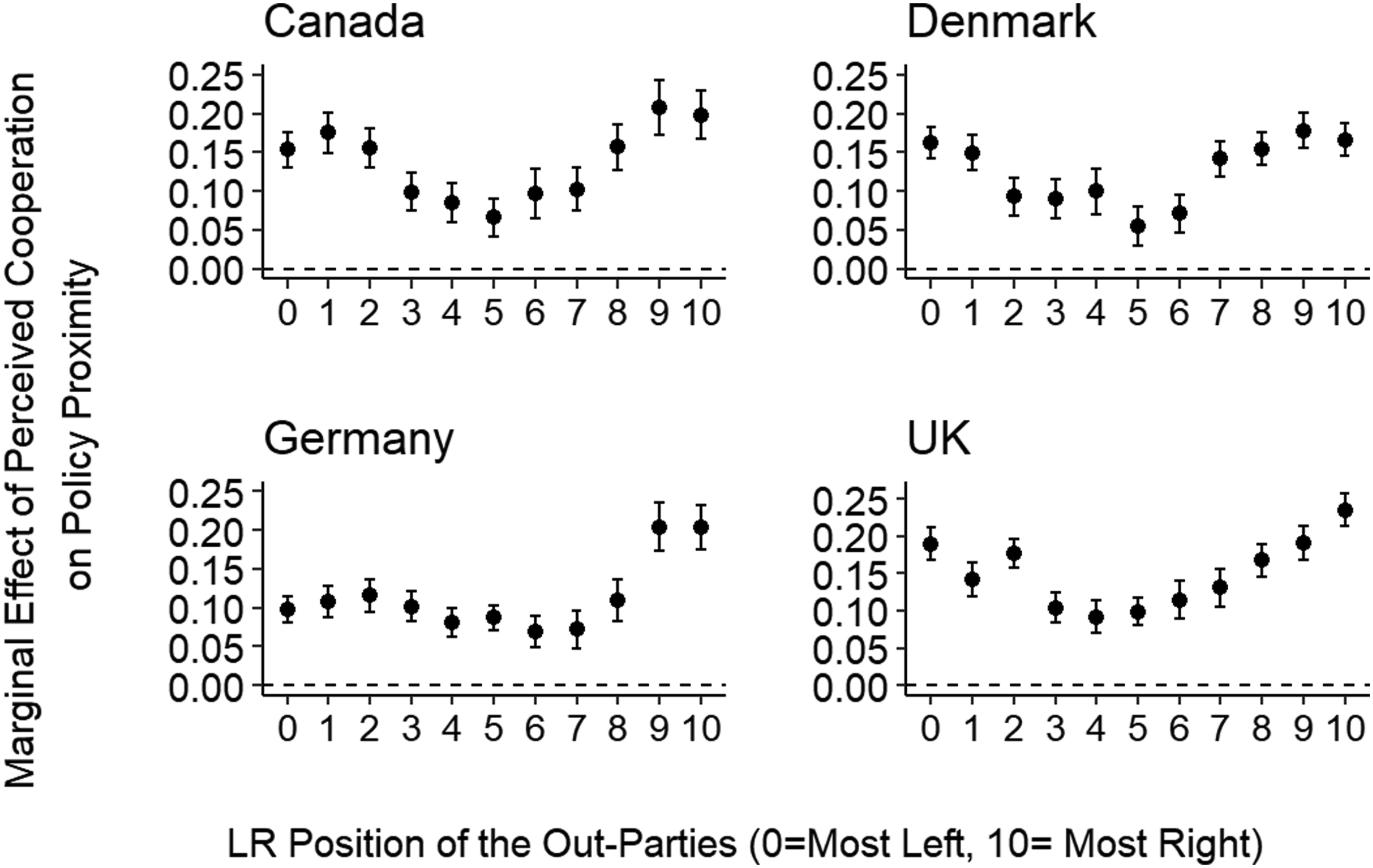
In Germany, the picture is different: the association is relatively flat across much of the spectrum and becomes pronounced only at the far right. This indicates that cooperation with a party like the AfD stands out as uniquely meaningful, whereas cooperation with far-left parties does not have the same effect. 26
In all, these findings provide support for H3 while also revealing important asymmetries. Consistent with the simplicity condition of ecological rationality, cooperation with ideologically extreme parties is easier to interpret and thus more influential as a heuristic. At the same time, the strength and balance of this effect differ across contexts: in some systems both extremes matter, while in others, most notably Germany, cooperating with the far right dominates the pattern.
Finally, to evaluate H4, which expects that the effect of cooperation will be stronger on more polarized issues, I examined how the association between perceived cooperation and policy proximity varies with the degree of polarization at the issue level. From the perspective of ecological rationality, polarization shapes the accuracy of the cue: when an issue is highly polarized, cooperation between parties is rarer and more politically costly, and thus more informative about genuine proximity. By contrast, on less polarized issues, cooperation is easier to explain as procedural or symbolic, and therefore less diagnostic.
To test this claim, I replicated the same set of models from Table 3 (i.e., Models 2, 4, 6, and 8) across the four countries, but instead of pooling all issues together in a single specification with fixed effects, I estimated the models separately by policy issues. In this set up, the association between cooperation and policy proximity is no longer estimated in the abstract “for an average issue.” Instead, it is defined for each specific policy domain, which can then be linked directly to its degree of polarization. Once I obtained the coefficients for cooperation across these policy domains in the four countries, I correlated them with the levels of polarization of these policies, using the CPC as a measure. 27
Figure 3 presents the relationship between the estimated effect of cooperation on policy proximity and the level of polarization of each issue, as measured by the CPC. Each point represents a specific policy domain, and the dashed line summarizes the slope of the association within each country. Across all four countries, the results show a clear positive correlation: the more polarized an issue is, the stronger (i.e., more positive) the estimated association between cooperation and perceived proximity between the respondent and the out-party on that issue. This means that as issue polarization increases, partisans who see their in-party as generally cooperative with an out-party perceive that out-party as closer to their own position on that issue. When polarization is low, this association weakens. Association between Perceived Cooperation and Policy Proximity across Different Levels of Issue Polarization. Note: The marginal effects are taken from Table A6.1 in Appendix 6. The CPC for a given issue is calculated based on how distinct and homogeneous respondents’ beliefs are about party positions on that policy. Higher CPC values indicate clearer differences between parties and greater agreement among respondents, reflecting higher levels of policy polarization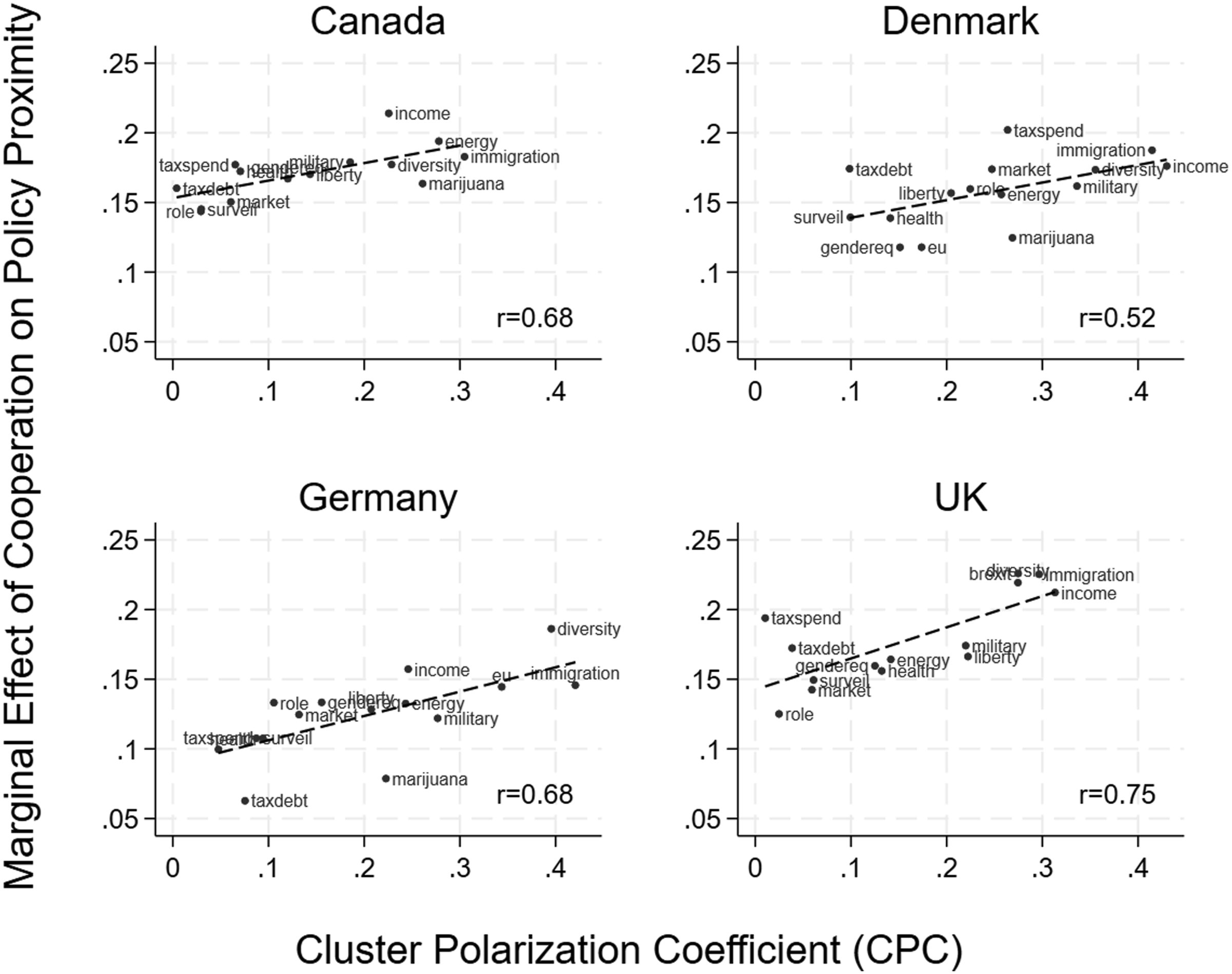
The pattern is visible in all four contexts, though with differences in magnitude. In Canada and Germany, the slopes are steep (r = 0.68 in both cases), suggesting that polarization is a strong moderator of how voters use cooperation as a heuristic. In the UK, the relationship is even stronger (r = 0.75), with immigration, diversity, and Brexit standing out as domains where cooperation sharply reduces perceived distance. In Denmark, by contrast, the slope is somewhat flatter (r = 0.52), indicating that although the trend holds, the conditioning role of polarization is weaker than elsewhere. 28
Beyond these cross-national differences, the issue-level estimates also confirm that the relationship between perceived cooperation and policy proximity is not driven by a small number of issues. Across all the issues, the estimated cooperation coefficients are consistently positive and statistically significant, suggesting that the heuristic operates broadly rather than being confined to a few high-salience policy areas (see Table A6.1 in Appendix 6). At the same time, the issue-level estimates reveal meaningful cross-national variation in which domains show the strongest associations. For example, immigration produces relatively large coefficients in Canada (0.183), Denmark (0.187), and the United Kingdom (0.225), while income equality shows strong associations in Canada (0.214) and the United Kingdom (0.212). In contrast, some issues produce smaller coefficients in particular contexts — for instance, the tax and debt issue in Germany (0.063). These patterns are broadly consistent with the theoretical argument: the effect of cooperation is stronger on more polarized issues but remains present across a wide range of policy domains.
Overall, these results lend support for the accuracy condition of ecological rationality. When an issue is polarized, cooperation between parties is rarer and more politically costly, making it a more accurate signal of genuine proximity. By contrast, cooperation on less polarized issues are easier to explain as pragmatic or symbolic and therefore carries less weight in shaping perceptions. Although the strength of the relationship varies across countries, the general pattern is consistent: polarization enhances the informational value of cooperation cues.
Taken together, the analyses of political knowledge, ideological extremity, and issue polarization demonstrate that the effect of cooperation on perceived proximity is not uniform but varies in predictable ways consistent with the framework of ecological rationality. Cooperation serves as a stronger heuristic when it is cheap (more easily accessed by knowledgeable respondents), simple (clearer to interpret when the out-party is ideologically extreme), and accurate (more informative when the issue at stake is highly polarized). While the magnitude and balance of these patterns differ somewhat across countries, the overall results underscore the broader claim: citizens do not rely on cooperation indiscriminately but instead appear responsive to the informational environment in which cooperation cues are embedded.
Conclusion
This paper investigates partisan cooperation as a heuristic for judging policy proximity across a wide number of issues, making it one of the most comprehensive studies of its kind. Using original surveys from four multiparty democracies, I show that voters perceive out-parties as closer to their own views when they believe those parties are cooperating with their preferred party. This relationship holds even after accounting for perceived and objective ideological distance, shared cabinet membership, issue fixed effects, and unobserved heterogeneity across respondents and party-dyads. Moreover, the effect is shaped by conditions of ecological rationality: cooperation is more likely to be used as a heuristic when it is cheap (easily recalled by knowledgeable voters), simple (especially when the out-party is ideologically extreme), and accurate (particularly on polarized issues).
While these findings contribute to our understanding of how voters use elite behavior to make inferences, they also depart in important ways from existing research on coalition heuristics. Prior studies have shown that formal governing arrangements influence perceptions of ideological closeness between parties (Adams et al., 2016; Fortunato & Stevenson, 2013), but they often rely on institutional indicators and do not theorize the informational conditions under which such cues are likely to matter. This paper shifts the focus to voters’ perceptions of cooperation in order to capture informal, symbolic, and non-institutional signals, and develops a structured framework rooted in ecological rationality to explain when and why voters use cooperation as a policy heuristic. In doing so, it builds on but moves beyond earlier work that treats coalition status as a static cue for ideological proximity. Rather than assuming that voters uniformly rely on formal governing arrangements, this paper shows that perceived cooperation between one’s preferred party and an out-party, whether or not it reflects institutional power-sharing, can shape how voters judge the out-party’s proximity to their own position on specific policy issues. It also uses the ecological rational framework to theorize the conditions under which cooperation between parties serves as a useful heuristic cue, showing how elite behavior provides voters with signals that shape perceptions in complex political environments.
At the same time, this study has several limitations that point the way toward future research. The most important concerns causality. Because the analysis relies on observational survey data, the results should be interpreted as identifying associations between perceived cooperation and perceived policy proximity rather than definitive causal effects. Nevertheless, the ecological rationality framework does not require strict causality for the heuristic to be meaningful, so long as the cue reliably correlates with outcomes in the environment. Voters can learn through repeated exposure that cooperation and proximity tend to co-occur, making cooperation a useful mental shortcut even if cooperation itself does not produce policy convergence.
That said, experimental designs would be particularly valuable in adjudicating between alternative theoretical interpretations of why cooperation matters and in identifying whether exposure to cooperation cues causally shapes voters’ perceptions of policy proximity. Beyond the ecological rationality offered here, voters may respond to cooperation for different reasons: it may signal new partisan norms of civility, redefine partisan identities and group boundaries, or be taken as evidence of pragmatic power-sharing rather than ideological proximity. The current design also does not disentangle different types of cooperation. Citizens may react differently when cooperation involves explicit policy compromises compared to when it reflects non-policy gestures such as symbolic endorsements, joint appearances, or procedural coordination. Future experiments that vary the framing and content of cooperative acts would allow scholars to test whether these different forms of cooperation carry distinct informational value for voters. In this way, experimental approaches could clarify which dimensions of cooperation matter most, and why.
Beyond clarifying mechanisms and establishing causality, future work might also assess whether the cooperation heuristic outperforms alternative shortcuts. It would be particularly valuable to identify the target inferences for which cooperation provides more accurate judgments than other available cues, as well as the conditions under which its relative performance improves or deteriorates, and for which types of voters it is most informative.
Supplemental Material
Supplemental Material - When Does Party Cooperation Inform Voters Judgments of Policy Proximity? A Cross-National Analysis of Heuristic Use in Multi-Party Democracies
Supplemental Material for When Does Party Cooperation Inform Voters Judgments of Policy Proximity? A Cross-National Analysis of Heuristic Use in Multi-Party Democracies by Lie Philip Santoso in Comparative Political Studies
Footnotes

Funding
The author disclosed receipt of the following financial support for the research, authorship, and/or publication of this article: This research is supported by Duke Kunshan University Summer Research Grant.
Declaration of Conflicting Interests
The author declared no potential conflicts of interest with respect to the research, authorship, and/or publication of this article.
Supplemental Material
Supplemental material for this article is available online.
Notes
Author Biography
References
Supplementary Material
Please find the following supplemental material available below.
For Open Access articles published under a Creative Commons License, all supplemental material carries the same license as the article it is associated with.
For non-Open Access articles published, all supplemental material carries a non-exclusive license, and permission requests for re-use of supplemental material or any part of supplemental material shall be sent directly to the copyright owner as specified in the copyright notice associated with the article.
