







Abstract
Despite the volume of research exploring the use of information and communication technologies (ICTs) for destructive purposes (terrorism, crime, war propaganda) on the one hand, and development (ICT4D) on the other hand, very little has been said about the role that traditional, and especially new social media, can play for the transformation and prevention of conflicts. This paper recognises ICTs as a tool, thus accepting their multi-level and multi-dimensional potential in the transformation as well as the intransigence and promotion of conflict. The paper seeks to explore: (a) whether ICTs can empower marginalised actors to transcend the peacebuilding and statebuilding processes, and lead to a more locally-owned, more representative transformation of the conflict; (b) whether ICTs can foster more hybrid forms of peace; and (c) whether they can be co-opted as a platform by donors to promote their agendas and impede resistance.
Introduction
Information and communication technologies (ICTs) have long been viewed as separate from the study of peace and conflict. Against this background and from a critical peacebuilding perspective, this article examines the role that ICTs can play in the promotion of peace, and the ways in which it may facilitate local and international actors to complement each other’s practices in their efforts to build peace. To date, there is a substantial literature that is being built on the role that ICTs can play for destructive purposes (terrorism, radicalisation, criminality), as well as a rather strong body of policy-relevant literature and web presence on the ways in which ICTs can be used in contexts of humanitarian relief (HICT) and mid-term development (ICT4D) (see International Federation of the Red Cross and Red Crescent Societies, 2002, 2005; Unwin, 2009). Although peacebuilding may often incorporate humanitarian and development dimensions, an examination of ICTs with regards to these is concerned correspondingly with improvements in emergency response (Vinck, 2013), and the improvement of socioeconomic conditions for local communities in developing and/or underdeveloped countries (Heeks, 2009). Yet, there is a significant lack of research, particularly in the field of Peace and Conflict Studies, of the role of ICTs towards inclusive, post-conflict peacebuilding and statebuilding. That is, not only the facilitation of information between actors (as in the case of HICT and ICT4D) but a contribution towards the transformation of conflict issues, contexts, structures and actors. On the other hand, most research that examines the use of ICTs in a context of conflict has revolved around crisis prevention and early warning systems (Leaning and Meier, 2009; Stauffacher et al., 2011), or around issues of democratisation (Akoh and Ahiabenu, 2012; CIPESA, 2012; Danitz and Strobel, 1999). In particular, there seems to be no study that examines the role of ICTs in ‘peace formation’ – the emergence of local, peaceful forms of subaltern power seeking non-violent, peaceful change, mitigating the exclusivity of agency presented (and deployed) by international and national actors (Richmond, 2013).
Our point of departure is the critique that liberal peacebuilding has been an imposition onto local populations affected by conflict, rather than a negotiated synergy between international, national and local actors (Bleiker, 2000; Clark, 2001; Duffield, 2001; Jabri, 2007; Kappler, 2011; Lederach, 1997; Mac Ginty, 2011; Newman et al., 2010; Paris, 2004; Pugh et al., 2008; Richmond, 2007, 2012). It must be noted here that it is not our intention to create and maintain an artificial divide between ‘good locals’ and ‘bad internationals’, as it is usually implied in the literature of hybrid peacebuilding. As shown elsewhere, there are many dilemmas surrounding the hybrid peace (Richmond, 2015), and the distinctions between subject and object are not entirely clear in hybrid frameworks of peacebuilding (Mac Ginty, 2011: 113). What is more, the relationship between the ‘local’ and the ‘international’ is as much co-constitutive as it is competitive (Hameiri, 2011; Sending, 2011). The article’s argument consists of both sets of critiques – that is, the critique that focuses on the limits of liberal peacebuilding and the latter’s imposition (rather than negotiated implementation), as well as the critique that exposes the limits of hybrid peacebuilding frameworks. This, in turn, helps guide our analysis on whether (and how) ICTs can be the tool through which hybrid frameworks of peace avoid the reproduction of liberal peace’s inclusion and exclusion logics (Nadarajah and Rampton, 2015), thus bridging the distance between local/everyday and international needs, demands and expectations (see Bratic, 2008; Hoffmann, 2014).
The article borrows Hamelink’s definition of ICTs, which defines them as ‘all those technologies that enable the handling of information and facilitate different forms of communication among human actors, between human beings and electronic systems, and among electronic systems’ (Hamelink, 1997: 3); this points to a departure from traditional/broadcast media, whereby communication was predominantly one-way and often susceptible to power controls, such as government censorship (Weidman, 2015). In contrast, new social media and mobile technologies facilitate a two-way communication which enhances access to information, increases the opportunities to engage in public speech, and raises the possibilities of collective action (Shirky, 2011).
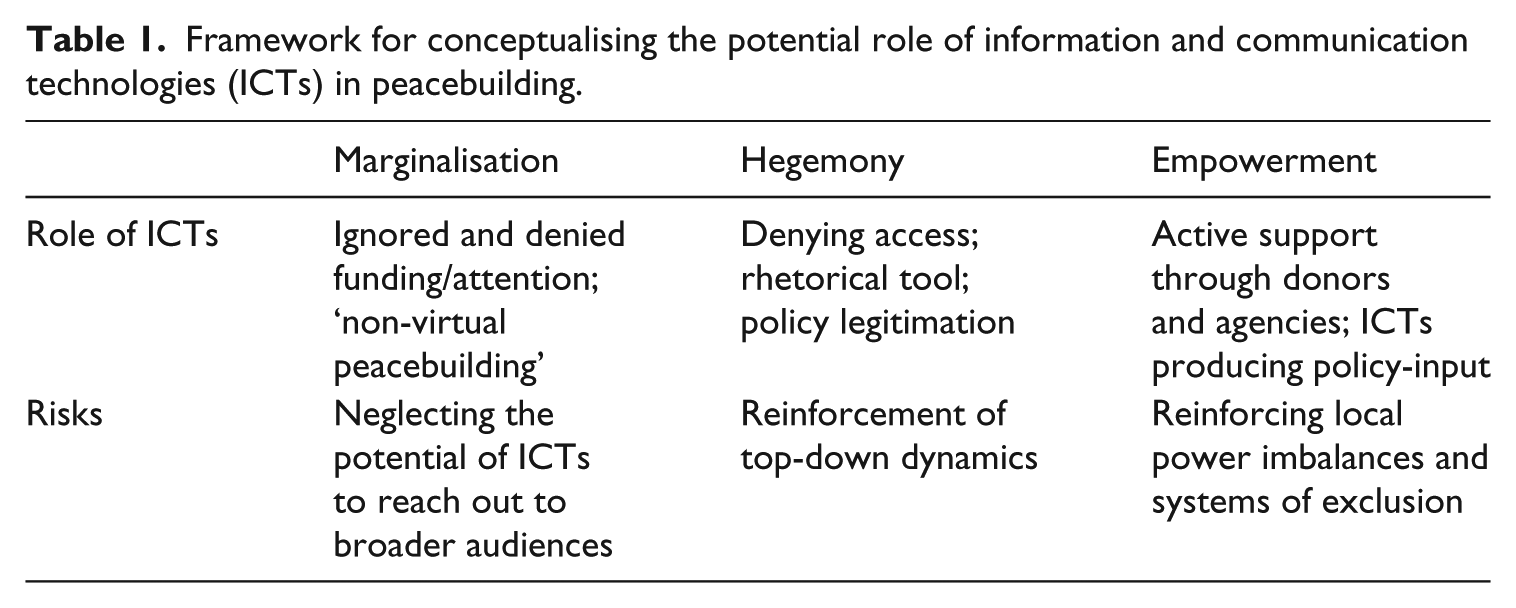
The article’s novelty lies not only in the lack of research that addresses the role of ICTs in peacebuilding processes, but also on the significance of the participatory elements offered by ICTs in such processes. We argue that socio-technical approaches to peace should conceptualise ICTs as a tool that can serve inclusionary frameworks of post-conflict co-existence, as much as it can be used to propagate conflict and cement divisions (ethnic, political, social or other). The article shows that a conceptualisation of ICTs as a tool points to three distinct scenarios, that is, the hegemonic use of ICTs, their marginalisation or, alternatively, their use as a representative, participatory tool. As we show, even when the third scenario prevails, local power imbalances may be perpetuated or reinforced, at the expense of marginalised actors. This implies that for every identified positive role that ICTs can play, there are corresponding risks that may spoil or stall peacebuilding efforts, or indeed reinforce or generate new power structures that render said efforts exclusionary. This is significant because similar risks have also manifested in traditional peacebuilding frameworks, thus highlighting the fact that ICTs should not be viewed as the panacea for peacebuilding’s maladies.
The following section functions as an empirical background of the use of ICTs in regions where conflict has manifested. This is then followed by a discussion of the conceptual variations of power with regards to ICTs, and their role in producing meaning and action. The final section analyses the role of the ICTs in post-conflict peacebuilding and the conditions that limit their use, and presents the article’s framework that conceptualises the potential and the risks for ICTs in the context of peacebuilding. Without claiming to be comprehensive or representative, this article aims to highlight the dynamics of power inherent in peacebuilding through ICTs.
ICTs in conflict: an empirical background
While the digital divide is indisputable, ICTs (and mobile technologies specifically) have an incredibly fast penetration of societies that are currently considered ‘developing’ (BBC News, 2011). As such, they may provide the potential for empowerment by opening up spaces for participation, and for local ownership of conflict transformation and peace formation. Yet development, peacebuilding and statebuilding policies have traditionally been administered by western actors and, despite their advocacy of inclusive democracy and human rights, their application has been unequal (Beckfield, 2003: 402; Richmond, 2009).
One must also bear in mind that not all post-conflict regions have the capacity to benefit from ICTs – due to a number of obstacles, such as lack of widespread use, often combined with technological illiteracy, and lack of electricity. 1 This tends to be associated with the ‘digital divide’, which has reinforced global inequalities in terms of who accesses which technologies, and who is excluded from cross-societal and cross-cultural discourses (Warschauer, 2003). This claim, however, points to the rarity with which the international community of donor states and organisations (with the exception of UNDP and USAID) has promoted the initiatives of local civil society organisations (CSOs) that have established ICT platforms which facilitate an agenda of peace and/or conflict transformation (Hoffmann, 2014).
Somewhat speculatively, such caution may be attributed to two factors: the diversity of ICTs; and the settings in which they are used, and the risk that said use may in fact increase, rather than decrease, violence. In the cases of Kenya and Kyrgyzstan, text messaging systems were implemented in anticipation of the outbreak of political violence ahead of and during elections. In Bosnia-Herzegovina and Cyprus, on the other hand, ICT-based efforts for collective action aiming at the transformation of conflict attitudes, behaviours and issues have rested mainly on the use of Facebook and Twitter as well as similar networks and associated online offers launched by diverse civil society initiatives (www.mreza-mira.net; www.foyacyprus.com). Yet, for every ‘benign’ use of these media, there is a corresponding opposite that seeks to exacerbate conflict, reinforce conflict dynamics and/or cement power that was generated as a result of the conflict itself. As it has been shown elsewhere, social media (Warren, 2015) and mobile phones (Bailard, 2015) may in fact generate substantial increases in collective violence, while ICTs often serve as tools of repression rather than liberation (Morozov, 2011; Rød and Weidman, 2015). Even when ICTs can empower individual or collective voices (such as female voices), there are no guarantees that these will influence government policies and actions (Cummings and O’Neill, 2015). This diversity of media usage in (post-) conflict settings points to the risk of romanticising ICTs as the contemporary panacea for conflict transformation obstacles.
To this end, the paper recognises that ICTs can be a tool both for the transformation as well as the intransigence and promotion of conflict, and seeks to investigate their multi-level and multi-dimensional potential. ICTs are generally recognised to be useful for the management of crises and conflict (Leaning and Meier, 2009), as well as for their monitoring and prevention (Mancini, 2013; Mancini and O’Reilly, 2013; Stauffacher et al., 2005) as the aforementioned cases of Kenya and Kyrgyzstan indicate. This implies and involves improved communication that increases transparency and trust-building, which in turn may facilitate negotiations by building pressure from the bottom-up, as became evident in Bosnia’s ‘baby-lution’. The failure of Bosnia’s politicians to fix a lapse in the law that prevented newborns from being given an identity number (and, by extension, travel papers and healthcare) resulted in the death of a newborn that needed surgery abroad (Gocmanac, 2013). This led to demonstrations in front of the parliament in Sarajevo and across all ethnic divides for the first time since the end of the war. The public outcry this provoked, not least through the use of social media, yet again reflects the potential that particularly social media, such as Facebook or Twitter, may have for impacting upon political discourses. This protest must indeed be read in the context of post-conflict dynamics, in that it cast light on dynamics of ethnic division on the one hand, but at the same time on the possibility of overcoming such divides through the use of social media, which seemed key in the mobilisation of the public to go out on the streets and protest. Armakolas and Maksimovic (2013: 10) highlight the role of the new media in generating a feeling of solidarity across the country, albeit to a larger extent in the Federation than in Republika Srpska; at the same time, those media seemed unable to sustain the momentum generated, resulting in disappointment on the part of the population who had hoped to kick-start a longer-term process of protest and resistance.
Understanding the ontological functionality of ICTs as a tool that can serve either end of the spectrum, leads to the observation that their empowerment potential is not inherent but instead depends on the dynamics of power as they are expressed in (and during) the politics of peacebuilding. ICTs may be seen to reinforce or generate power biases independently of the peacebuilding activities, mainly related to the identity and the socio-economic situation of its users (in the case of computer-based social media, said users tend to be wealthy, relatively young, urban, computer-literate males 2 ). In addition, we need to differentiate even further: as early as 2003 and researching the American context, Rice and Katz (2003) pointed out that media usage is contingent on a variety of social factors, such as education and income. This is even truer in a global context, where different technologies prevail in different countries, regions and localities. 3 Having said that, such distinction between mobile phone and computer use may no longer be easily discernible considering the increasing capabilities of mobile phones. Finally, there is also an ethical dimension of the paradox whereby technology is used for the promotion of peace, yet the metals necessary for the manufacturing of its core components are often sourced from regions where conflict, impoverishment and underdevelopment are not only prevalent, but also exacerbated by their extraction. 4
These observations help raise the following questions: (a) Can ICTs enable marginalised actors to transcend the peacebuilding and statebuilding politics played out between national and international actors, and lead to a more locally-owned, more representative transformation of the conflict?; (b) Can ICTs promote more hybrid manifestations of peace, reflecting both the diversity of local needs and interests as well as international agendas?; and (c) Can they be co-opted as a platform by donors to promote their agendas and impede resistance?
The following section discusses the conceptual variations of power with regards to ICTs in post-conflict peacebuilding settings, and looks at their potential in the production of meaning and action.
Whose power? What power?
Information and communication technologies are often viewed as a tool through which the grassroots levels of society can be empowered (Chapman and Slaymaker, 2002). The concept of ‘empowerment’ entails various conceptualisations of power. As identified by Rowlands (1997: 13), these are: ‘power over’; ‘power to’; ‘power with’; and ‘power within’. The first of these is Robert Dahl’s definition, which has become prevalent in International Relations and associated with dominance (‘A has power over B to the extent that he can get B to do something that B would not otherwise do’) (Dahl, 1957: 202–203). Contrary to this ‘zero-sum’ understanding, the latter three conceptualisations identified by Rowlands are better understood as processes, whereby a social group is: (a) empowered to implement action without seeking to dominate another group; (b) empowered along with other social groups, thus leading to the sharing of power; and (c) empowered within, through self-acceptance and self-respect, which extend to respecting and accepting others as equals.
This discussion is highly relevant when examining the role of ICTs in post-conflict peacebuilding because it helps unearth the current understandings and practices of the international community (consisting of states as well as governmental and non-governmental organisations (NGOs)) vis-à-vis marginalised, unrepresented communities in whose name ‘peace’ is being built. The tendency of the international community to keep imposing its liberal and neo-liberal values and ideals (leading invariably to Mac Ginty’s often-quoted IKEA analogy 5 ), manifests a ‘power over’ the local populations that are quite often perceived as backward, or even hostile to the ‘well-intentioned’ Western savants (Richmond, 2011).
Technology, however, is used by humans according to their realities – it is their use of it that ascribes meaning and importance to it (Orlikowski, 2000) – and that empowerment cannot be bestowed in the first place without hybrid interaction with the subjects – it must be claimed first and then facilitated. Thus, any advancement in technology may be futile unless the current understanding(s) of the internationals’ power over locals is transformed into the internationals’ power to allow locals to own, manage and direct peace efforts. Examples from Kenya’s preventive violence network (Jorgic, 2013), Uganda’s election monitoring (Hellström and Karefelt, 2012), Sudan’s low tech adaptations for community communications (Puig Larrauri, 2013b), Cyprus’ civil society empowerment (UNDP, 2008), and elsewhere prove that ICTs can be enablers for peace, not because they directly empower the local over the national and international, or the marginalised over the elites, but because they can be used for the mobilisation of grassroots actors, which may affect peacebuilding’s balances of power. This is important given that ICTs can act as mediators – that is, according to Latour (2007: 39), to serve as a medium or actor that distorts, changes and modifies the meaning of the elements it carries. In that respect, the mediator’s ‘input is never a good predictor of their output’ (Latour, 2007: 39). Framed as such, it becomes evident that ICTs hold the potential (although not necessarily, nor always, deploying it) to decentralise and re-circulate the input of liberal peacebuilding (hegemonic power, or tendencies towards) with a different output (mobilisation towards more inclusionary peace); the premise on which this rests, as Puig Larrauri (2013a) puts it, is the requirement of ‘letting go of control, giving in to the fact that we don’t know exactly how people will make use of information and communication tools’. This is the very point where empowerment lies – although not without its risks, including the promotion of division and hate.
The role of ICTs in post-conflict peacebuilding
The factors of information and communication have been prevalent in development studies through ICT4D and have only very recently been substantially expanded to cover conflict prevention research. Even then, however, most studies veer off towards the alleviation of suffering and protection from natural disasters – whether earthquakes, droughts or fires. Early-warning humanitarian platforms such as the Office for the Coordination of Humanitarian Affairs’ (OCHA) ReliefWeb and Integrated Regional Information Network (IRIN), and AlertNet are indicative of this. Their activities are restricted either to information dissemination or the enhancement of existing practices and activities regarding humanitarian issues. The reasons for the lack of a more holistic approach are twofold. First, ‘the humanitarian community is woefully unprepared to deal with this tidal wave of user-generated crisis information’ (Meier, 2013). Second, as it has been shown elsewhere (Kingston and Stam, 2013), even human rights NGOs are far less likely to capitalise on the ICTs’ ‘meta-power’ – their ability to foster interactions that change the identity of actors and their meanings of issues (Singh, 2013) – which is essential in allowing both post-conflict peacebuilding as well as prevention. However, it must be noted that prevention is problematic because of sovereignty, lack of political will and constraints of international diplomacy (Stauffacher et al., 2005: 18). As a result, the onus for prevention and social reconciliation falls on civil society initiatives – if and where one exists – without much support. This is what the UN refers to as ‘people-centred systems’ (United Nations Office for Disaster Risk Reduction, 2006), indirectly recognising the often tragic gap(s) between early warning indicators and executive decisions to alleviate, prevent and/or protect.
Possible ways of transforming conflict dynamics and enhancing post-conflict peacebuilding through ICTs can be found in the assembly of joint narratives of suffering (Bratic and Schirch, 2007: 22; Mannergren Selimovic, 2013), or the commonality of problems affecting everyday life, as in Israel’s and Palestine’s case of the Parents Circle Families Forum (www.theparentscircle.com) (Castelnuovo, 2013). Today, Facebook and Twitter can be far more catalytic for said initiatives, since ‘the power of citizen media lies in its grassroots, bottom-up authenticity and spontaneity’ (Hilmerfab and Chabalowski, 2008). Turkey’s ‘Gezi park protests’ in the early summer of 2013 are indicative of that empowerment, but even more indicative is the Turkish government’s decision to form a 6000-member social media team to promote the ruling party’s perspective, after months of trying to discredit and control Facebook and Twitter (Albayrak and Parkinson, 2013). Along those lines, the use of new media has also opened up possibilities of dealing with conflict in non-conventional ways. Strategies, such as digital storytelling (Burgess, 2006), the facilitation of grassroots participation and network building (Hattotuwa, 2004: 51) can indeed be said to open up new channels of participation for previously excluded actors, while at the same time not serving as a panacea against exclusion and discrimination due to limitations in accessibility as well as inherent power dynamics, as outlined above.
Moreover, the now decade-old critique that peacebuilding and statebuilding efforts are not sufficiently locally-focused obtains renewed and reinforced significance when examined through the prism of the role of ICTs. This is because
ICT interventions can have more impact when used for peacebuilding after a ceasefire or peace agreement, when the dynamics on the ground are more receptive on the need for sharing information, collaborating, appropriating technology and development mechanisms (both physical and virtual) for communities and peoples to deal with conflict creatively and non-violently. (Hattotuwa, 2004: 51)
The reason for this heightened impact is the change in discourse and narratives, that is, from the need to be at war to the need to be at peace. As it has been shown elsewhere, the formation of this new narrative is easier in ‘decentralized contexts than authoritative ones because they allow multiple actors to participate at levels and intensity unimaginable before’ (Singh, 2013). The failure of the international network of peacebuilding actors (states and organisations) to take full advantage of the potential of ICTs can be seen as linked to the former’s top-down modus operandi, its inequality (Beckfield, 2003: 402), and its self-perception of expertise despite the fact that 50% or more of the interventions undertaken have seen a reversion to conflict within five years (Barnett et al., 2007). Despite the correlation between protracted conflicts and the presence within those of a civil society with very little access to social media (Hussain and Howard, 2013), the international community’s concern with peace has often marginalised social media as one of a number of potentially participatory peacebuilding tools. This is not least the case because the construction of peacebuilding legitimacy has only become a concern in recent years (Roberts, 2013).
So far the priority of numerous governments and international agencies regarding the promotion of ICTs in post-conflict peacebuilding is to see them as promotional tools. There is of course a risk that if they try to promote pre-determined understandings of peace and are operated in a top-down manner, they will most likely fail, backfire or even become dangerous for the populations they attempt to support. One such example is the Haystack software used during Iran’s Green Revolution. The program, whose purpose was to circumvent the regime’s censorship tactics, received the uncritical backing of the US government. Yet when it was examined more closely, it was revealed that it actually did the exact opposite of what it was supposed to due to a lack of technical skills on the part of those examining and controlling the modus operandi of the program (Shirky, 2011).
It is also of upmost importance to note at this point that one must guard against the belief that ICTs are the panacea for the maladies of peacebuilding (and to a certain extent, statebuilding). Instead, the nature of peacebuilding through ICTs as well as the associated strategies, interests and infrastructures remain to be questioned and analysed in depth. Their tool-like ontology poses a number of problems that include their use for devious objectives, spoilers and the promotion of hidden agendas as the aforementioned example in Iran made evident. Moreover, the need for interpretation and contextualisation (Mancini and O’Reilly, 2013), as well as the degree of representativeness of the data generated, is still present and cannot (yet) be done automatically but, rather, relies on human agency and initiative. The data generated through the use of newer technologies indeed bear a strong risk of exclusion: social media are not used by all classes and generations alike, while information databases and collection services tend to be run and designed by expert organisations. The ‘Everyday Peace Indicators Project’, based at George Mason University (http://everydaypeaceindicators.org/) is just one example of where the use of mobile phones reflects the possibility to reach out to communities which had thus far been excluded from the design of peace processes. On the other hand, this and related projects still face factors of exclusion, such as the need to find local partners, constrained political environments and so forth.
Against this background, we propose the following approach to conceptualising the potential role of ICTs in peacebuilding (see Table 1):
Framework for conceptualising the potential role of information and communication technologies (ICTs) in peacebuilding.
Marginalisation: ICTs as an under-explored tool
Despite an emerging assumption that ICTs and social media will be crucial tools in international peacebuilding activities (Confidential source, personal interview, Sarajevo, 3 September 2013) peacebuilders’ interest in ICTs is relatively recent. In some cases, this may be because of a lack of knowledge in terms of how to use ICTs for peace-related purposes. This does not mean that ICTs are not used at all, but instead that they are used in a rather static and one-way form. For example, in Cyprus actors such as the UNDP are using Facebook, Twitter and YouTube to disseminate their activities. For the European Union (EU), the use of diverse media in Cyprus is part of its strategy of ‘Going Local’ and represents an attempt to break through the perceived distance between the grassroots and the institution (European Commission, 2013). A political analyst of the Commission’s Delegation in Nicosia emphasised the active role that the EU now plays on networks such as Facebook, Twitter and Flickr, not only to promote the EU’s work, but also to advertise a number of events and activities (Cyprus Community Media Centre, personal interviews with staff, Nicosia, 19 September 2012). This clearly reflects a belief in the fact that social media will help bigger institutions (particularly when they tend to be perceived as distant from the grassroots) to get deeper access to societies, and is most indicative of peacebuilding’s hybrid potential. Having said that, however, this access and connection entails the risk of being limited to a promotional use of social media instead of creating a two-way communication channel through which local populations’ voices are heard and implemented into the policies and strategies of peacebuilding actors.
In other instances, ICTs are not explored to their full potential because of fear that their impact cannot be controlled, or because of a belief that these media are not suitable to bring about political change, or indeed because ‘proof’ of their impact is difficult to measure (Shoemaker and Stremlau, 2014: 184). In the case of Bosnia-Herzegovina, a number of media outlets are reluctant to let political agendas take over too much. Besides the fact that ‘politics’ as such is considered as corrupt or a ‘dirty business’, there is also a risk of becoming (or being seen to become) co-opted by political agendas (Ajnadcic M, EFM Student Radio, personal interview, 7 March 2011). Moreover, the ambivalent character of ICTs means that intercommunal hostilities are often exacerbated in web portals and through social media, as in the case of both Bosnia (Voloder, 2013) and Cyprus (Larmou M, personal interview, Association for Historical Dialogue and Research, Nicosia, 21 September 2012) – indicative of the perils inherent in Larauri’s suggestion to ‘let go of control’.
ICTs as a tool for hegemony
Our framework reflects the ambivalent role that ICTs can play in peacebuilding practice. They can serve as a platform on which hegemony can be promoted and existing power imbalances be reinforced, shifting the balance towards powerful institutions if the latter are able to strategically use ICTs as legitimating tools. Post-conflict Sri Lanka is one such case where the state sought to impose a victor’s peace (Richmond and Tellidis, 2012) by controlling new social media, which the former President’s brother and Defence Secretary has branded ‘a threat to national security’ (The Republic Square, 2013b). Former President Rajapaksa referred to Facebook as a ‘disease’ (The Republic Square, 2013a), despite the fact that he himself has both a Facebook and a Twitter account. The imposition of the government’s victory narrative following the end of the war against LTTE includes support of nationalist extremist circles and their protection by the security forces (Groundviews, 2013), as well as the marginalisation of internationally promoted initiatives for reconciliation and reconstruction. Indicative of this is the management of the Lessons Learnt and Reconciliation Commission (LLRC – www.llrc.lk), set up with the objective of disseminating the Commission’s findings on humanitarian and development issues. Even though the Commission’s website is now defunct, finding its interim recommendations has always been impossible because the (government-allocated) websites were never updated to include these recommendations (Groundviews, 2012). Dissemination and distribution of LLRC’s findings was only made possible because of the efficiency of grassroots activists who copied and mirrored the documents on foreign websites.
Information and communication technologies may be used as a hegemonic tool even in cases where there is no explicit strategy to impose a victor’s peace. In South Africa, for example, the emergence of township journalism through blogging in informal settlements (Siyakhona, 2011) like Khayelitsha (near Cape Town) is a striking example that reflects the extent to which internet access can help circumvent censorship in the public sphere and give a voice to marginalised communities on the one hand. On the other hand, it must be noted that while Khayelitsha benefits from access to electricity, other townships nearby (such as Malawi Town) have been denied electricity and are thus unable to participate in the use of ICT-based communication. Thus, besides the fulfilment of basic human needs, political voice is also denied to certain groups and communities. This may as well represent a political strategy of keeping contestation and deviance under control. The marginalisation of ICTs in broader society is in this case not only a result of ‘not-knowing’ or a lack of technical skills, but equally a deliberate (hegemonic) strategy of keeping certain populations at bay and under control by denying them a platform of empowerment.
ICTs as a tool of hybrid peacebuilding
A third conceptualisation of ICTs is that of empowerment. The UNDP has increasingly been accepting ICTs as catalytic enablers both for e-governance (UNDP, 2013) as well as for the promotion of peace and development. To that effect, it is now seeking to exploit the potential of games and apps in building peace and fostering positive relations between communities and between communities and institutions (Kahl, 2014). This approach points to the recognition that the use of ICTs can considerably enhance hybrid forms of peace as conceptualised in recent literature (Mac Ginty, 2010; Richmond, 2011). They can do so by fomenting local access to formal peacebuilding practice(s) and thus challenge existing power biases of institutions. In that sense, ICTs can serve as platforms of resistance for actors that had previously been excluded from formal politics. This is evident in the case of Cyprus, where NGOs and the bi-communal peace formation movements have been quite isolated since the 1990s (Richmond, 2012: 23) from the general public (physically, ideologically, and in terms of their approaches to the transformation of the conflict). Initiatives such as the Cyprus Community Media Centre (CCMC, http://www.cypruscommunitymedia.org) have led to a rise in media coverage of civil society organisations on the island that are active in the promotion of bi-communal dialogue (Richmond, 2012). The CCMC has been providing training for other civil society organisations on the island to improve their communication channels with the wider public – which, amongst others, helps to deal with the perceived gap between civil society organisations and wider society on the island.
At the same time, movements like the ‘Occupy the buffer zone’ (OBZ, http://occupythebufferzone.wordpress.com/) and Mahallae (https://mahallae.org) have manifested the potential of ICTs for the emergence of grassroots activism and their outreach into both communities, leading to proactive civic engagement. With regards to the latter, Hands-on Famagusta is another interesting project initiated by architects, whose aim is to facilitate a participatory process for Cypriots to re-imagine and re-design a unified post-conflict Famagusta with shared and effective infrastructure and services (Stratis and Akbil, 2015). All these platforms and initiatives use new social media (blogs, Facebook, Twitter) to organise and disseminate their activities, and to mobilise people from both sides of the island through new social media.
In the case of OBZ, the movement successfully used social media to build a bi-communal movement intent on reclaiming the buffer zone as ‘their space’. On a couple of occasions their intentions landed them into trouble with local and international authorities. In 2012, and after several attempts by the European Union and the UNDP to remove a group pertaining to the movement from a building they were occupying, the Greek Cypriot police intervened with potentially fabricated stories of drug-trafficking and other criminal activities (Confidential source, personal interview, Nicosia, 19 September 2012; Confidential source, personal interview, Nicosia, 11 April 2014). On a separate and subsequent incident a few months later, OBZ’s initiative to stage a game of volleyball (i.e. non-violent protest) in order to ridicule the slow pace of the peace process incurred an angry and violent response from UN peacekeepers, with the UN spokesperson Michel Bonnardeaux claiming that ‘the area is not a public area, it’s narrow and meant to be a crossing point, not meant to be a place for an event. We’re happy to host events but they have to ask permission’ (OBZ, 2013). One would think that bottom-up, participatory and inclusive approaches to peace would be welcomed by an organisation such as the UN Peacekeeping Force in Cyprus (UNFICYP). Instead, this hegemonic insistence to obey the rules seems to contradict the organisation’s narrative for a locally-owned peace, as well as its concern at the unwillingness and non-commitment of the parties involved to resolve the conflict (UN, 2010). What is more, it may well be a missed opportunity as such local attempts of peacebuilding have shown the ability to include ICTs in ways that foment mobilisation and social activism for peace.
In South Africa too, as mentioned briefly above, ICTs are being used by university researchers, citizen initiatives and NGOs alike to formulate and promote policy alternatives. A project run by the University of Western Cape is using digital storytelling in order to frame experiences of traumatised individuals, whose voices are not heard in the politically-controlled or excessively market-oriented mainstream media (Confidential source, personal interview, Stellenbosch, 27 August 2012). The shack dwellers’ movement Abahlali baseMjondolo, (www.abahlali.org) is using ICTs in order to include youth and thus facilitate bottom-up approaches (Poni M, personal interview, Khayelitsha, 30 August 2012) in its fight for the right to housing and against the criminalisation of poverty by an increasingly politicised police force (OpenDemocracy, 2013). In a similar vein, the Human Rights Media Centre (www.hrmc.org.za) uses its media skills to fight for political and material rights of marginalised communities and, as the director suggested, managed to shift ‘boundaries of discrimination’ (Gunn S, personal interview, Human Rights Media Centre, Cape Town, 7 December 2012).
Signs of empowerment and resistance through civic media and citizen journalism are also evident in Sri Lanka, which is perhaps the case with the most stifling political environment. An early example was Infoshare (www.infoshare.lk), whose work focused in fostering democratic practices and good governance as pillars of positive social change. This was done by facilitating the strengthening of civic participation and citizen engagement in human rights issues, election and corruption monitoring (Hattotuwa, 2007). Following the demise of the ceasefire agreement, the onset of war and the change of government, Infoshare moved away from its peacebuilding orientation (Hattotuwa S, personal communication, 17 October 2013). Groundviews (www.groundviews.org) is another medium that seeks to transform ages-long attitudes, behaviours and narratives of the conflict through a number of initiatives. While serving primarily as a citizen journalism platform, uncovering state security forces’ abuses and discrimination tactics and policies, Groundviews also includes initiatives like ‘Mediated’ (Hattotuwa, 2012) – an art exhibition that sought to communicate constitutional matters, socioeconomic data and religious identity writing by challenging public apathy and engaging critical engagement – and ‘30 years ago’ (www.30yearsago.asia) – a group of film-makers, photographers, activists, theorists, and others that Groundviews brought together in order to highlight how the 1983 anti-Tamil pogrom has shaped Sri Lankan life, social mentality and perceptions, and even polity.
It is evident from the above that ICTs can represent a platform which is accessible to a broad range of groups and actors and can therefore empower a variety of grassroots actors. Given that access to ICTs requires not only the necessary infrastructure, but in some cases also technical skills, the support of such practice through peacebuilding actors and donors can boost the ways in which ICTs can represent channels through which otherwise disguised agendas can be made explicit.
However, it is crucial to remember that such usage of ICTs does not necessarily iron out power imbalances, but can instead further cement dividing lines in society, at grassroots level. This is particularly the case in situations where certain local actors have strategies to better access ICTs and international support in this context, while others remain at the sidelines of such practices, either through a reluctance to engage with ICTs, or alternatively a lack of infrastructure or funding. The implications of this are that ICTs should not per se be considered as agents of social change (Welch et al., 2015) in general, and peacebuilding in particular. Instead, as posited by our framework, ICTs have to be viewed in a continuous tension between disempowerment, marginalisation and empowerment, and activated in different ways by the agents controlling and using them.
Conclusion
The point of departure for this paper was the lack of research on the role of ICTs in post-conflict peacebuilding, especially when compared to related research on their role in terrorism, propaganda, but also development, democratisation and natural disasters. In many ways, the findings are similar to the findings in relation to the role of ICTs in development or democratisation, in that they allow for a participatory element in such processes, while not guaranteeing the latter as and in of themselves. However, we recognise a particularly complex angle in the relationship between ICTs and peace/conflict, in that ICTs can redefine social relationships, both for the promotion of hegemony and empowerment of local organisations alike. This perhaps suggests that ICTs have, in the field of peacebuilding, a lesser determining role than commonly expected – they represent but a tool which needs to be activated and used by those capable of and willing to use it.
The research presented in this article is not exhaustive of the nature of ICTs, nor indeed of all issues raised by their use. For one, many studies on the role of ICTs in peacebuilding (including this one) tend to underexplore methodological and epistemological obstacles. For instance, addressing the grassroots movements as one, coherent and uniform body throughout any geography is bound to lead to problematic findings. This is particularly evident in our attempt to browse through a number of different post-conflict contexts, all of which shape the functions and effects of ICTs in their own, very specific way, and where different (grassroots) actors have used ICTs in different forms. Similarly with legitimacy, which unlike a binary concept that one either has or has not, it is constantly evolving and contested (Newton, 2013). Finally, a more solid discussion of power relations with regards to use of ICTs in peacebuilding should uncover in a more nuanced manner the gender and generational imbalances that are simultaneously evident in peacebuilding praxis. Although we have not unpacked such questions in this article in detail, we want to encourage that future research focus not only on the mechanisms of potential inclusion that ICTs can bring, but also dynamics of exclusion and division.
In this context, we realise that for every identified role the ICTs can have, there are corresponding risks. A hegemonic, legitimation-seeking regime will attempt full control of ICTs, thus reinforcing top-down policies that will more likely reflect a victor’s peace (as in the cases of Sri Lanka and Turkey). A more neutral stance like the one usually exhibited by international actors in post-conflict environments, whereby ICTs are neglected at the expense of aggrieved groups and communities, runs the risk of being similarly exclusionary. Finally, even when the international community jumps on the virtual wagon and exhibits total support of virtual peacebuilding initiatives, the risk that local power imbalances will be perpetuated or reinforced remains, as evidenced in the case of South Africa.
This latter, however, is not much different from traditional, non-virtual peacebuilding approaches practised until now. This, as the literature that is critical of hybrid peacebuilding informs, may be because the risks identified above are inherent in the praxis of peacebuilding itself, transforming ICTs into a platform on which the politics of peace is played out. As a clearly political activity, peacebuilding includes and consists of power dynamics, and its objective is to transform power antagonisms into synergies. ICTs have the potential to serve as mediators, transforming hegemonic input into resistive practices, while at the same time also implying the risk of promoting hegemonic practices in new channels. In the context of peacebuilding, this seems to be particularly problematic, given that the authority to build peace is usually not democratically given, but tends to derive its legitimacy from global top-down structures.
The representation of resistance and the grassroots mobilisation towards more inclusionary peace frameworks, we believe, is where ICTs can play a significant role in altering liberal peacebuilding’s input and transforming it through a decentralisation of power, as is evident to a certain, albeit limited, extent in the Cypriot, Bosnian and Sri Lankan civic efforts. The transformation of conflict attitudes, behaviours and objectives to post-conflict sustainable, and self-sustained mentalities of acceptance and coexistence can only emerge by the everyday and the local that form part of the socioeconomic and socio-political fabric where these attitudes and behaviours are present. This is precisely the point where excluded actors can be empowered vis-à-vis an often dominant infrastructure of international peacebuilding, and also where the role of the international community should carefully throw its weight and focus, mindful of the risks associated with the wider social power structures inherent in the use of ICTs.
Footnotes
Acknowledgements
We are extremely grateful to Sanjana Hattotuwa, Julia Hoffmann, Francesco Mancini, Roger Mac Ginty, Helena Puig Larauri and Oliver Richmond for comments on earlier drafts, as well as those provided by three anonymous reviewers. Any errors are of course our own.
Funding
The author(s) received no financial support for the research, authorship, and/or publication of this article.