







Abstract
How do rising powers execute normative resistance to shape international order? Contrary to the existing literature, I argue that rising powers are productive agents of normative change and international order-making, through the use of rhetorical adaptation to contest pre-existing orders. Rhetorical adaptation is a strategy and set of tactics that simultaneously modifies norm content, while reducing critiques of obstructionism. To make this argument, this article traces China’s efforts as a ‘norm shaper’ regarding the responsibility to protect through the inception, institutionalization and implementation of the norm in the landmark 2011 Libya intervention. China layers traditional sovereignty norms under the responsibility to protect, focusing and narrowing the emerging norm by fortifying the primacy of the state. While I show how China resists co-option into an evolving ontological order that challenges traditional sovereignty, the article also addresses the unforeseen consequences of China’s normative efforts that ‘backfired’ to permit the use of the responsibility to protect to justify Libyan regime change. More broadly, this article speaks to rising powers as agents crafting international order, and the process of normative resistance that occurs throughout the norm life cycle. I draw from publicly available documents and semi-structured interviews with Chinese foreign policy and United Nations elites.
Keywords
Introduction
How do rising powers execute normative resistance to shape international order – the norms and institutions that reflect the interests of the dominant state in the system (Barma et al., 2009: 527)? Norms are the ‘collective expectations for the proper behavior of actors with a given identity’ (Katzenstein, 1996: 5), and matter for international relations as norms shape outcomes through regulative effects (specifying standards of appropriate behavior), constitutive effects (specifying actions and behavior commensurate with identity) and permissive effects (focusing or diverting attention from practices). Implicitly then, norms ‘help differentiate and hierarchically order actors,’ (Towns, 2012: 189) as it is great powers that set the normative agenda, so an international order is designed to benefit the dominant state and status quo powers (Diez, 2005; Jackson, 1975). By extension, to modify norms is to challenge the dimensions of an existing international order. While rising powers have a degree of influence, they are yet to be dominant. Although rising powers may accept they cannot dictate norms, they do not have to passively accept them either. Indeed, rising powers seek to achieve some degree of legitimacy as leading states by molding an international order. A growing literature recognizes that rising powers can at times use norm contestation as a cost-effective means to project power. 1 Rising powers, such as China and Brazil, ‘[vigorously] participate in the formulation of international norms…to safeguard our country’s sovereignty, security and development interests.’ (China Copyright and Media, 2014; on China, see Alden and Large, 2015; Foot, 2014; Foot and Inboden, 2014; Lindsay, 2014–2015; on Brazil, see Abdenur, 2014; Abdenur and Gama, 2015; Benner, 2013). In so doing, these states actively engage in resetting norms in line with their own preferences and interests, therefore asserting some type of control over international order.
Yet, much of the literature assumes that rising powers are problematic normative actors. Rising powers defy delegation of power from international institutions and counterbalance the existing Western liberal order (Patrick, 2010; Schweller, 2011; Terhalle, 2011). When engaging in international security management, these states are assumed to be ‘perennial spoilers’ (Thakur, 2016: 162), offering cheap talk with few policy commitments in practice (Focarelli, 2008; Job and Shesterinina, 2014; Stahn, 2007), producing alternate norms to resist responsibilities (Pu, 2012; Thakur, 2013). Rising powers with contending visions for an international humanitarian order will reject its core progressiveness (Murray and Hehir, 2012). These negative assessments reflect research on international order and normative change, which simply classifies states as exhibiting commitment, compliance or non-compliance (Checkel, 2005; Kelley, 2004; Risse et al., 1999; Simmons, 2009), at the cost of articulating norm resistance strategies (see Cardenas, 2006; Subotić, 2009; Wiener, 2004; exeptions include Bloomfield, 2016; Búzás, 2016; Sanders, 2016). With increasing capabilities and status aspirations, not only are rising powers difficult to socialize (Thies, 2013, 2015), but also are inappropriately dismissed as ‘autistic’ states in their ostensibly poor understanding of international social life and responsibilities. 2 In so doing, much of the existing scholarship at best unnecessarily overlooks and simplifies rising powers’ contributions to normative discourse and international order-making. Excavation of rising powers’ use of normative resistance will show that such a derogatory dismissal is shortsighted.
This article views rising powers as agents of productive normative change, and seeks to remedy academic oversight by using an in-depth case study of a rising China’s normative resistance regarding the emerging norm of the responsibility to protect. Sovereignty is not a static norm in international relations, with reinterpretations reflecting a long-rooted context-specific tension between rights and responsibilities (Glanville, 2014). The responsibility to protect joins this conversation by using a discursive frame of sovereignty as responsibility, as opposed to a right of states (Evans et al., 2013; International Commission on Intervention and State Sovereignty (ICISS), 2001). The responsibility to protect sees state sovereignty as no longer focused on undisputed territorial control, but that sovereignty is a conditional right moderated by a state’s minimum good behavior (ICISS, 2001: 8). It is not that the responsibility to protect is an explicit replacement for the traditional sovereignty norm, but rather, the new norm could change how states are constituted: as states adopt and internalize that sovereignty means a responsibility to protect citizenry from mass atrocities, state interests would be conceived of in ways that limit abuse of their citizens (Bellamy, 2013). If states are incapable of executing their responsibilities, then the international community has a responsibility to act.
The responsibility to protect concerns shifts in understandings of sovereignty and territoriality – components of an ontological order, which is fundamental to constituting states and their vital interests via relevant norms and institutions. The key norms here are those of sovereignty and territoriality co-produced by states’ drive to be legitimate state actors within the company of other legitimate states (Hurd, 1999). Without the norms of sovereignty and territoriality, the sovereign state itself does not exist. Therefore, ontological order has a key function in defining and naturalizing which actors are legitimate (i.e. sovereign states with territorial boundaries), normalizing the concept that states have control over their domestic affairs as a characteristic of sovereignty. States reproduce these norms amongst themselves, and at institutions like the United Nations (UN) and its subsidiary bodies, which require sovereignty as a minimum threshold for active participation. I specifically note ‘an’ international order and not ‘the’ international order as I do not assume there is only one order, but many orders for states to address (Foot and Walter, 2011; Hurrell, 2007; Schweller, 2001). As Johnston asserts, ‘there are likely to be different, even contradictory, “issue specific orders” operating at the same time, in the same geographical spaces, and involving the same states’ (Johnston, 2019: 9).
China is popularly viewed as one of the key proponents of a much more traditional interpretation of state sovereignty. While the literature acknowledges China’s nuanced application of traditional sovereignty specifically in regards to humanitarian intervention, peacekeeping and state-building, for example, there is agreement that China tolerates, but does not advocate, departures from traditional sovereignty, with its emphasis on territoriality and state control (Carlson, 2004, 2005; Fung, 2018, 2019; Wuthnow et al., 2012). It is unsurprising, then, that China once opposed the emerging responsibility to protect norm (Gill and Reilly, 2000). While China is identified as a ‘norm shaper’ engaging in the development and refinement of the responsibility to protect norm, existing research does not explain how China executes normative resistance (Foot, 2014; Job and Shesterinina, 2014; Liu, 2012; Teitt, 2008, 2009, 2011).
I argue here that China uses rhetorical adaptation to execute normative resistance, a process that occurs through the ‘life cycle’ of the norm, an example of a rising power as an agent of constructive normative change. Rhetorical adaptation contributes to iterative understandings of a norm, filling in the conceptual lacuna of one pathway for how iterative normative updating occurs (Sandholtz, 2008; Wiener, 2004). Defined as a strategy and set of tactics that simultaneously modifies norm content, while reducing and deflecting critiques of obstructionism (Dixon, 2017), rhetorical adaptation is in its nature an artefact of normative resistance, as it is not a wholesale adoption of a norm. To modify normative content is by implication an attempt to craft international order by reshaping normative structures, therefore moving China from passive acceptance to actively constructing norms, asserting China’s perch in a normative order. China has sustained commitment to addressing the emerging responsibility to protect norm, filling gaps with the norm’s intent to promote the state’s abilities to execute their protection responsibilities. China layers traditional sovereignty norms under the responsibility to protect and, in so doing, China’s rhetorical adaptations advance normative resistance, refocusing and limiting the norm from more expansive interpretation. Specifically, China emphasizes procedural reinterpretations (who gets to modify or apply the responsibility to protect norm) and substantive reinterpretations (under which conditions should the responsibility to protect norm be applied) (Welsh, 2014) through its normative innovations. China’s discursive efforts fill gaps in the normative framework that appeal to responsibility to protect sceptics – especially important at a time when the ‘enthusiasm for the norm is dead’ (interview, former special advisor to the UN Secretary-General for the responsibility to protect, New York, 3 March 2016). China’s efforts are especially crucial because non-consensual interventions that invoke the responsibility to protect are viewed as illegitimate following the fall-out of the 2011 Libya intervention and regime change (Ralph and Gallagher, 2014). In delineating the effects of China’s rhetorical adaptation, I highlight parallel pathways of normative advancement and the creation of international order: China’s use of rhetorical adaptation had its intended effects in focusing and narrowing the responsibility to protect by fortifying the primacy of the state, yet China’s efforts did not limit the use of the responsibility to protect in the key test case of Libyan intervention. Indeed, China’s efforts at rhetorical adaptation were successful in shaping how the international community collectively responded to the challenge of intervention against Gaddafi (i.e. by following normative standards introduced and reinforced by China), but China’s efforts did not ‘box in’ the responsibility to protect per se. Indeed, China’s normative standards were used to effectively remove Gaddafi under the charge of the responsibility to protect.
To develop my analysis, I build upon the largely disparate literatures concerning rising powers, international order and normative change, and view the latter as a dynamic, iterative, ongoing process through the responsibility to protect norm implementation phase. I take the position that even after what is regarded as the institutionalization of the responsibility to protect in 2005 (Welsh, 2014), the responsibility to protect was reinterpreted during norm implementation, when its application to various international crises meant that its content would be renegotiated and redesigned through its ‘meaning-in-use’ (Wiener, 2008). Next, I analyze how China engaged with the responsibility to protect against three critical junctures: during the crafting of the concept throughout 2001; when the norm was institutionalized at the 2005 World Summit; and during the norm’s implementation through to the seminal case of the 2011 Libya crisis, which is heralded as the benchmark case for the invocation of the responsibility to protect. 3 When UN Security Council Resolutions were used to justify Libyan regime change, much to the displeasure of China, responsibility to protect advocates noted that Libya was ‘a textbook case of the … norm working exactly as it was supposed to’ (Evans, 2011). Much of the existing literature emphasizes the dominance of Western states in engineering the UN Security Council’s response to the Libya crisis (Adler-Nissen and Pouliot, 2014; Dunne and Gifkins, 2011; Glanville, 2016; Vaughn and Dunne, 2015). I offer a contrasting view that emphasizes China’s contributions in shaping the path to UN Security Council outcomes, in part due to China’s use of rhetorical adaptation (see Fung, 2016a, 2019). The analysis then turns to separate the effects of China’s rhetorical adaptation, analyzing China’s unanticipated outcomes such that its traditional sovereignty normative advancements still paved the way for Libyan regime change. I explain how China is still productively engaged in normative redesign post-Libya. I conclude with the effects of rhetorical adaptation and the implications for rising powers and the international order debate. I use an evidence-based approach, including textual analysis of policy statements, supplemented by insights from semi-structured interviews with Chinese Foreign Ministry elites and UN officials in Beijing in January 2011 and December 2017, in New York in June 2012 and March 2016 and in Washington, DC, in March 2016.
Rising powers, normative resistance and rhetorical adaptation
This article makes two key contributions to the existing literatures. Firstly, I add specificity to the discussion about rising powers as agents crafting international order. The literatures on rising powers and global governance have been left separate for the most part (Florini, 2011). Rising power definitions emphasize material factors as identifiers – specifically the preponderance of global military capabilities (Geller and Singer, 1998; Modelski, 1974); changes in relative material capabilities and influence (Chestnut and Johnston, 2009; Hart and Jones, 2010); global rather than regional interests (Levy, 1983; Singer, 1988); or status recognition as a great power (Miller, 2016). Largely left out of this mainstream literature are definitions that link rising powers as agents of normative change. While recent works are correcting for this intellectual gap, these writings focus more on empirical rather than theoretical frameworks, using popular but intellectually fluid and ill-defined terms like ‘norm maker,’ ‘norm shaper’ or ‘norm taker’ (Alden and Large, 2015; Foot and Inboden, 2014).
Similarly, research on international order predominantly focuses on the hegemon at the expense of considering the efforts of other actors, such as rising powers, as productive sources of global governance norms. 4 For example, writings on international order emphasize how order structures choices made by actors: actors willingly accept restrictions in their freedom to maneuver to achieve stability via hierarchy (for example, Lake, 2011). These writings place emphasis on superordinate states, 5 however, and therefore are limited in insights on rising powers’ responses within hierarchies and order. Another variant of the international order literature focuses on how orders emerge and constitute states, and their contingent responses to an international order (Ayoob, 2002; Barnett, 2011; Dunne, 1998; Larson et al., 2014; Nexon and Neumann, 2018; Wendt and Friedheim, 1995; Zarakol, 2011). However, this literature addresses how order constitutes great powers, at the expense of explaining how rising powers respond and contest their positions within an international order. Yet another variant of the literature on international order sees that actors produce orders as a result of their social practices and, therefore, these actions themselves generate actors and the spaces in world politics in which they themselves act (Bially Mattern, 2001; Pouliot, 2010; Schatzki et al., 2001). However, this research agenda presupposes an activist, oppositional understanding of productivity – that is, that states attempt to outright dismantle normative orders that they face – which does not reflect the full set of strategies and behaviors of normative contestation. By using a detailed case of a rising China’s response to the responsibility to protect, I connect these two literatures on rising powers and normative change by showing how a rising power shapes international order using rhetorical adaptation.
Secondly, I speak to the process of normative resistance that occurs throughout the life cycle of the norm. The first wave of norm literature presents a linear story with norm entrepreneurs developing norms at the international level to be institutionalized by other states, promoting their socialization (Finnemore and Sikkink, 1998; Risse et al., 1999). The second wave of norm literature emphasizes the interaction between domestic and regional socio-legal structures to explain uneven institutionalization (Checkel, 1999; Cortell and Davis, 2000; Legro, 1997). The third wave of norm literature emphasizes how norms are reinterpreted by ‘receiving states’ at the local level, so that these internationally designed norms coexist with local normative orders during institutionalization (Acharya, 2004, 2011), and thereby disaggregates the over-simplified category of ‘norm taker,’ which reifies pre-existing power hierarchies and infantilizes norm resisters (Ralph, 2016).
Yet, these writings on normative change have two shortcomings. They place little consistent emphasis on the attempts by states to modify norms at the international level. The norm contestation literature identifies different resistance processes – contested compliance (Wiener, 2004, 2014), norm subsidiarity, norm localization and norm circulation (Acharya, 2001, 2004, 2013) – but these processes focus on how international norms vectored to the local level become congruent with local normative orders. Little is said about how states attempt to modify norms at the international level, and therefore project their normative power to shape orders beyond their specific neighborhood, as I will demonstrate in the case study. Moreover, these writings collectively emphasize the inflection point of institutionalization – when ‘norms emerge at the international level and become reflected in international law and organizations, and are signed, ratified, and adopted by particular states’ (Betts and Orchard, 2014: 6) – as birthing consensus on normative content and meaning, and therefore understandings of ‘good behavior’ and the associated costs of ‘bad behavior’ (i.e. non-compliance). What occurs in parallel to or after institutionalization, the actual practice of norm implementation – ‘the steps necessary to introduce the new international norm’s precepts into formal legal and policy mechanisms with a state or organization in order to routinize compliance’ (Betts and Orchard, 2014: 2) – is overlooked as a space where states continue to contest and resist norms. By tracing normative contestation through the implementation phase, we can see how the emerging responsibility to protect norm functions in application. Implementation is a new space in which the norm can be contested during its application, letting us observe two extreme outcomes: either the norm lingers and eventually collapses under contestation, or the implementation process strengthens the normative content through intersubjective understandings of what the norm means, leading to clearer observable implications of its existence and acceptance. Therefore, treating implementation as its own process permits clear analytical insights into how norms are shaped and vectored within states and institutions. As I will show, though, China was successful in layering its sovereignty first standards under the responsibility to protect through implementation, giving further credence to China’s acceptance of the emerging norm; the unintended consequence of China’s normative innovations was foreign-imposed regime change in Libya, kicking off a new round of debate about the applicability of the responsibility to protect vis-à-vis government accountability for mass crimes and the potential to unseat governments.
If one accepts ‘that meanings… are always in principle contested’ (Wiener, 2004: 200), then normative resistance is a useful deliberative process that promotes social buy-in as potential stakeholders have the opportunity to modify the norm and, therefore, promote its legitimacy and strength (Gould and Onuf, 2009; Hofmann, 2015; Lynch, 2002; Wiener, 2014). While new norms are embedded and recognized, the very same norms may be resisted and contested, precisely because norms are intersubjectively held beliefs that continue to be redesigned and contested with meanings situated in a broader social context, shaped by practice, and reflecting change in the international system. As Krook and True note, norms ‘tend to be vague, enabling their content to be filled in many ways and thereby appropriated for a variety of different purposes.’ (Krook and True, 2012: 104). This is not to say that contestation makes norms pointless; indeed, ‘norms are no less effective for being fluid and no less real for being negotiable.’ 6 Rhetorical adaptation builds upon the related concepts of ‘denials’ and ‘tactical concessions’ (Cohen, 2001; Risse et al., 1999, 2013), and delineates the space between norm compliance and norm rejection (Dixon, 2017), illustrating one means by which norm resistance occurs. Jennifer Dixon notes there are four tactics used in rhetorical adaptation, as shown in Table 1.
Definitions of rhetorical adaptation tactics (Dixon, 2017).
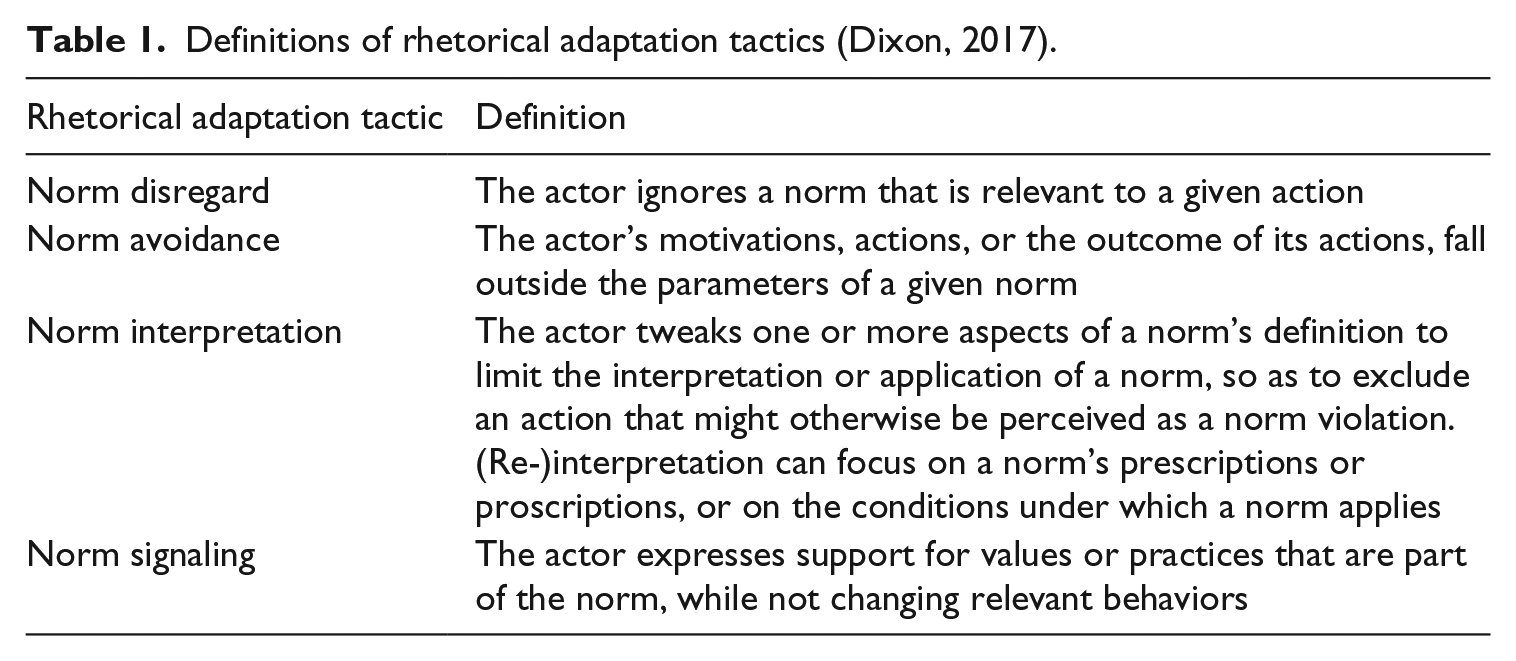
These tactics combined enable China to resist allegations of norm violation and reject pressures for normative compliance. The case study shows China cycled through different rhetorical tactics as the responsibility to protect norm gained legitimacy and strength.
Case study of China’s engagement with the responsibility to protect
2000–2005: China’s use of norm disregard and norm interpretation
The responsibility to protect was borne out of the failure of the international community’s response to genocide in Rwanda and Srebrenica, and ethnic cleansing in the former Yugoslavia. As then UN Secretary-General Kofi Annan asked, ‘if humanitarian intervention is, indeed, an unacceptable assault on sovereignty, how should we respond to a Rwanda, to a Srebrenica – to gross and systematic violations of human rights that offend … our common humanity?’ (UN General Assembly, 2000: 34). In response, the International Commission on Intervention and States Sovereignty (ICISS) served as a norm entrepreneur, introducing the responsibility to protect as a resynthesizing of state sovereignty: state sovereignty meant a responsibility to protect populations in their territory. If states failed to do, then the rights of sovereignty – that is, the state’s privileges of non-action – could be overturned by the international community assuming the responsibility to protect through prevention, rebuilding and reaction measures (ICISS, 2001: xi).
China initially used norm disregard to flat-out dismiss the responsibility to protect draft language: the ‘hardest line against intervention and in defense of sovereignty’ was touted in Beijing, ahead of all the skeptical audiences in Cairo, New Delhi and Moscow (Thakur, 2006: 268). China launched four critiques: that challenges to sovereignty, unless for the benefits of self-defense, had no role in the UN Charter; self-interest would lead to its abuse; tensions between individual human rights versus the rights of nations were unreconciled; and the responsibility to protect would only reintroduce Western views and double standards (ICISS, 2001: 392–394). China still determined that ‘[each] state shoulders the primary responsibility to protect its own population…,’ turning the emphasis back to traditional sovereignty. China echoed this position with President Hu Jintao’s speech to the World Summit, with direct references to the need for state-led sovereignty (Hu, 2005; Oertel, 2015: 175).
Recognizing the growing support for the responsibility to protect, China switched tactics to norm interpretation, as Chinese officials recognized that flat-out rejection of the norm could carry reputational and social costs (interview: Washington, DC, 1 March 2016). In the run up to the 2005 World Summit, China acknowledged that ‘when a massive humanitarian crisis occurs, it is the legitimate concern of the international community to ease and defuse the crisis’ (Permanent Mission of the People’s Republic of China to the UN, 2005). This comment opened the door for China to recognize the role of the international community in supporting a state’s responsibility to protect. However, China instead watered down the norm, making the case that states’ responsibilities were specified for only four specified crimes: genocide, war crimes, crimes against humanity and ethnic cleansing (UN General Assembly, 2005), all of which were already covered in international law. The World Summit Outcome Document charged the international community to act in a ‘timely and decisive manner,’ lifting the threshold for action only after states were found to be ‘manifestly failing’ rather than being ‘unable and unwilling’ to protect populations. Collective action by the international community included humanitarian, political and forceful means, and the international community was also to assist states in their capacity to protect, taking action before a crisis develops. The precondition of UN authorization remained, although the UN Security Council only had to consider action, with no requirement to act in the face of such cases. This change removed ambiguities about the agent for the norm. The UN General Assembly was to consider the further development of the responsibility to protect, within UN Charter principles and international law.
In the World Summit Outcome Document, the responsibility to protect was clarified as a political commitment, and as Kofi Annan noted, the aim was to strengthen the implementation of existing international humanitarian law (Jones, 2005). In this sense, the responsibility to protect emerged as a ‘soft law,’ emphasizing particular normative interpretations about state conduct to their population under existing international human rights and international humanitarian law. Despite claims that the language was a ‘historic breakthrough,’ (UN Meetings Coverage and Press Releases, 2005) and that ‘consensus seemed to have been reached on how to resolve one of the most difficult and divisive international relations of our, or any other, time,’ (Evans, 2008: 284), since the paragraphs were pinned in by qualifiers, China calculated that the responsibility to protect was so diluted it was rendered meaningless, and only a topic for future discussion (Teitt, 2009). In its 2005 World Summit Outcome Document form, the responsibility to protect still reified the state system and the UN Security Council’s position in determining the contours of global politics.
At this point, China had succeeded in limiting the responsibility to protect to be consistent with China’s views on the centrality of traditional sovereignty for international politics.
2005–2009: China’s use of norm avoidance
The World Summit Outcome Document language was quickly reaffirmed in a thematic resolution on the Protection of Civilians in Armed Conflict (UNSCR, 2006c, paragraph 4). A special advisor on the responsibility to protect was appointed in 2007 to develop an implementation strategy, which led, in part, to the UN General Assembly accepting the UN Secretary-General’s plan to build capacity to prevent and respond to mass atrocities. The responsibility to protect became a standard phrase in diplomatic discourse, with governments, non-governmental organizations (NGOs) and multilateral bodies all invoking the term in regards to violence in Darfur during 2004–2006 and post-election insecurity in Kenya in 2008 (Welsh, 2014: 133). China endorsed the responsibility to protect in various UN Security Council Resolutions when the language replicated the 2005 World Summit Outcome Document wording, and did so even while it could have used Russia for ‘veto cover’. 7 As one PRC Ministry of Foreign Affairs official reasoned, the norm was ‘not such a challenge to sovereignty as we had thought’ (interview: Washington, DC, 1 March 2016).
After the 2005 World Summit, China distanced itself from responsibility to protect rejectionists, who refused to fund the Office of the Special Advisor, permit use of the term or advance discussions of the responsibility to protect through various working groups. 8 Instead, China concentrated its efforts, refusing to ‘expand, wilfully… interpret or even abuse this concept’ (UN Security Council, 2006a), using norm avoidance to reduce critiques of China’s position when it opposed norm entrepreneurs that sought to expand the boundaries of the applicability of the responsibility to protect. When the responsibility to protect was applied beyond the immediate threshold of the four crimes, China reaffirmed that ‘the primary responsibility … [of] the United Nations Charter to the Security Council is to maintain world peace and security’ (UN Security Council, 2007a). Attempts to invoke the responsibility to protect in the internal affairs of Myanmar were rejected by China (Badescu and Weiss, 2010). While China pushed to concentrate authorization for intervention on the UN Security Council, it pushed for the UN General Assembly as the venue for discussions over the conditions in which the responsibility to protect applied, slowing change by requiring consensus amongst a much larger number of states.
2009–2011: China’s use of norm interpretation
The 2009 report on the status of the responsibility to protect posed the responsibility to protect as ‘an ally of sovereignty, not an adversary…By helping states meet their core protection responsibilities, the responsibility to protect seeks to strengthen sovereignty, not weaken it’ (UN General Assembly, 2009: 7). The report followed a strict interpretation of the 2005 Outcome Document, but clarified that the responsibility to protect rested upon three equal pillars of prevention, assistance and reaction, including coercive and consensual means.
Pillar one: states bear primary protection responsibilities.
Pillar two: the international community should assist states to meet their protection responsibilities.
Pillar three: when a state is manifestly failing to protect its population, the international community should be prepared for a timely and decisive response using economic, political and military tools.
The responsibility to protect was thus clarified as a ‘complex norm,’ with more than one prescription (Welsh, 2014: 133). If one component of the responsibility to protect fails (i.e. national governments do not protect their populations), then this implies triggering the use of another component (i.e. the international community taking on its role in protection). The reformulation of the responsibility to protect did not necessarily lead to any further clarification, however. Discussions continued as to whether certain pillars should have more importance, and again the threshold for determining when states have ‘manifestly failed,’ activating the international community.
China responded to the 2009 Report with the firm view that ‘[States] bear the primary responsibility for protecting their own citizens’ (UN Security Council, 2009a). China’s view was that the responsibility to protect operates in a hierarchy: state protection responsibilities are paramount, and these must be definitively shown to be exhausted first before permitting the international community to act. China began deploying norm interpretation, harnessing a prior norm – the privileging of traditional state sovereignty – to alter the content of the responsibility to protect. China sought to refocus the prescriptions of the norm: the responsibility to protect is still a ‘states first’ norm in reference to pillar one and that regional organizations are representatives of the international community in reference to pillar two. To this end, China advocates for greater say by regional organizations, state-based groups that are traditionally intervention hesitant, reinforcing China’s view that state-led sovereignty is prime in international politics (Bellamy and Williams, 2011).
China emerged with its interlocking strategy of advocacy for a greater say for regional organizations at the UN Security Council, early warning systems at the state and regional levels and a redefinition of ‘timely and decisive response’ (Teitt, 2008: 20). For example, at the 2009 protection of civilians debate, China focused efforts on the responsibility to prevent as a multi-stakeholder and multi-faceted project (UN Security Council, 2009b). China remained active in the August 2010 dialogue on early warning and the responsibility to protect, directing its time to what role the international community could play in supporting states acquiring effective early warning systems, recasting the meaning of ‘timely and decisive response’ as a long-term commitment to protect populations, and not just as a reaction to an immediate crisis. China views local-level early warning systems are consent-based opportunities to improve the state’s awareness and control over events in its territory. China initiated its first ever thematic debate at the UN Security Council on how regional organizations could best coordinate with the UN (Lin, 2010). In so doing, China reifies the norms of sovereignty by emphasizing state sovereignty as a means to achieve protection, through local/regional capacity building and conflict prevention.
China’s efforts reflect its long-term political relationships with authoritarian leaders. For example, President Omar al-Bashir deflected his responsibility for the Darfur crisis by claiming that Khartoum did not have an awareness, let alone control over all activities by the janjaweed militia groups, especially over such a large expanse of territory as Darfur, so far from Khartoum (Lippman, 2007). Partly because China maintains strong relations with Sudan, Chinese officials did not dismiss this comment out of hand. Chinese elites surmised that establishing Khartoum’s control through information awareness over Sudanese territory would mean assisting Sudan to execute its responsibility to protect, ‘so the government knows what’s going on where’ (interview: Beijing, 14 December 2017). Therefore, the international community should put its efforts into supporting the government’s information awareness and communications networks by building all weather road networks and deploying early warning systems, for example. China’s use of norm interpretation appeared to impact discussions regarding the importance of regional organizations for intervention (UN Security Council, 2015b), and reflects a similar logic proposed by the UN Secretariat in the use of drones and other new technologies for information awareness for peacekeeping and protection purposes (Charbonneau, 2015).
2011 and beyond: China’s use of norm avoidance and norm signaling
Anti-Gaddafi protests began in mid-February 2011 in Benghazi and were met by the indiscriminate use of force by the Libyan regime. The crisis was framed in the context of the responsibility to protect from the outset (Dunne and Gifkins, 2011), and UN officials noted that the violence could amount to crimes against humanity (UN News Centre, 2011; UN Office of the Special Adviser on the Prevention of Genocide, 2011). By the end of February 2011, diplomatic pressure continued to build on Libya, and the predominant view was that diplomatic measures alone would be insufficient to prevent a massive loss of life (UN General Assembly, 2011). Regional groups unanimously condemned Gaddafi’s use of force against civilians, paving the way for UN Security Council action (Fung, 2016a). China cast a yes votes for Resolution 1970, referring the Libya country case to the International Criminal Court (ICC) (UN Security Council, 2011b), which led to an indictment against Gaddafi. China explicitly noted that it took into account the positions of various regional groupings (UN Security Council, 2011a: 4).
China called for states to accommodate regional concerns, and shortly thereafter all the Middle East regional organizations seconded the no-fly zone request of the Interim Council of Benghazi (Leiby and Mansour, 2011). 9 The Obama administration further clarified that any military redress of Libya would require broad support and adherence to international law: UN Security Council authorization, political endorsement from regional players and the North Atlantic Treaty Organization (NATO) taking the implementation lead (Office of the Press Secretary of the White House, 2011), and therefore the USA joined France and Great Britain in advocating for no-fly zone enforcement. 10 Chinese officials saw that President Obama ‘had recognized China’ when invoking the need for UN Security Council authorization and regional player buy-in for action, indicative of the influence of China’s normative adaptations (interview: New York, 11 June 2013; similar views in interview: New York, 6 June 2016). On 17 March 2011, the UN Security Council authorized Resolution 1973, calling member states, acting nationally or through regional organizations, to take all necessary means, short of foreign occupation, to protect civilians under threat of attack in Libya (UN Security Council, 2011c).
Brazil, China, India, Germany and Russia all abstained, viewing that peaceful means were still viable and that armed intervention would only increase civilian casualties (UN Security Council, 2011b). China issued a comparatively short statement, again emphasizing the relevance of regional organizations for China’s abstention vote (Permanent Mission of the People’s Republic of China to the UN, 2011). After a short coalition-led campaign, NATO confirmed that it planned to implement the no-fly zone (Cameron et al., 2011), which eventually led to Gaddafi’s death in October 2011. Chinese analysts saw proof of regime change (Li, 2011; Liu, 2012), and Chinese officials called the no-fly zone enforcement an ‘abuse of force’ (Embassy of the People’s Republic of China in the United States, 2011).
Instead of tamping down the potential for intervention, each of China’s individual measures in its normative framework spurred action, including from China: early warning systems flagged Gaddafi’s trigger speeches; regional organizations endorsed intervention; and the UN Security Council vetted policy responses. Norm entrepreneurs, such as the United Kingdom and the United States, purposely used China’s normative adaptations to negotiate with China regarding Resolution 1973, reminding Chinese counterparts that it was China that had pushed for these additions under the responsibility to protect, and that this was the opportunity to support robust action based upon China’s own reading of the norm (interviews: New York, 11 June 2013). Although Chinese officials experienced dissonance with China’s self-proclaimed conservative pragmatism regarding mass human rights challenges, China acquiesced to the ICC referral and no-fly zone (Fung, 2016a).
Following the Libya crisis, a number of states reoriented the responsibility to protect debate, appropriating the term ‘responsible’ for different ends. 11 China briefly used norm signaling by developing a nascent, semi-official concept of ‘responsible protection.’ 12 China argued that responsibility for a target state carries on during and after an intervention, giving a much narrower interpretation for the use of military force, emphasizing a means–end trade-off (Garwood-Gowers, 2016). China emphasized a monitoring element for the use of military force, and responsibilities for post-intervention rebuilding – tasks that went beyond the cues for intervention. To only consider whether to intervene was irresponsible; states must calculate the costs of their intervention in economic, political and social terms as part of their responsibility to protect. Responsible protection reframed China’s multiple vetoes against intervention into Syria as fair and responsible by engaging in the normative discussion over pillar three – an aspect of the responsibility to protect that China had largely avoided since 2005.
Responsible protection was driven by the view that NATO had abused its mandate in Libya, citing questionable outcomes following Western-led interventions in Afghanistan, Iraq and Libya (Ruan, 2012), and was also in part a response to the blowback against China’s multiple vetoes scuppering action against the unfolding Syria crisis, which China rejected as a valid case of the responsibility to protect. Responsible protection enabled China to still express support for the norm and cast its vetoes as responsible action, given China’s concern for anticipating the longer term effects of action without Syrian consent. To be clear, China did not modify its relevant behavior: in this case, China continued to issue vetoes in 2014 and 2015 against the invocation of the responsibility to protect vis-à-vis Syria.
The responsibility to protect discussions at the UN Security Council now reflect a more cautious approach to the use of the norm since Libya, partly because of the heightened Chinese perception of the potential for the responsibility to protect to birth regime change (Fung, 2018). Textual analysis of the dozens of resolutions since 2011 invoking the responsibility to protect show a dominant trend in reiterating a state’s responsibility to protect, as opposed to invoking the responsibility to protect against state consent (Global Centre for the Responsibility to Protect, 2018). Even the lower threshold for consensus, through achieving agreement for non-legally binding UN Security Council presidential statements, reflects the same cautious approach to the responsibility to protect. The responsibility to protect is currently used to emphasize the primary responsibility of states to protect civilians, even in cases where the state itself is linked to committing atrocities, such as in Myanmar, South Sudan or Syria, for example (see UN Security Council, 2015a, 2016, 2017, for example).
Conclusion
I argue here that rising powers can be productive agents of normative change and by extension international order-making, as they contest their positions within pre-existing orders by rhetorical adaptation. Through the study of China’s approach to the responsibility to protect through the implementation phase of the norm, we can see how different tactics are emphasized throughout the norm life cycle, especially as China is cognizant of shifting acceptance for the responsibility to protect norm. China’s use of rhetorical adaptation tactics are exemplars of its normative leadership as a great power in simultaneously strengthening the norm, and limiting charges of abuse of the responsibility to protect by other norm sceptics, typically developing states. While bolstering its great power status and developing world status, China resists attempts of co-option into an evolving ontological order that challenges its preference for traditional sovereignty. Chinese officials are acutely aware of their position as a rising power in an international order, jostling against the dominant state. This intangible position guides China’s response to how it attempts to reshape facets of an ontological order. In so doing, China produces orders that make China appear less of a challenger and a threat to a shifting order that it itself is attempting to shape.
By separating China’s efforts vis-à-vis pillars two and three, we can see two separate, contemporaneous and parallel effects of rhetorical adaptation regarding international order-making. This complicates the unidirectional theorized pathway that ‘mere lip service’ (Price, 1998: 636) can lead to compliance and even socialization. The logic here is that a state’s own rhetoric can lead to its entrapment and perhaps socialization, even if that rhetoric was only initially of instrumental value (Keck and Sikkink, 1998; Risse, 2000; Risse et al., 1999). China’s rhetorical adaptations for pillar two have arguably strengthened the norm, especially as advocates saw the initial work on prevention as ‘brief, confused and unoriginal’ (Bellamy, 2009: 52; also see Liu, 2012). Other senior responsibility to protect specialists agree that China is ‘surprisingly becoming an advocate for the norm… and that is not a bad thing’ (interview: New York, 3 March 2016). In its conservative approach, China is not reversing the development trajectory of the responsibility to protect, but as one senior PRC Ministry of Foreign Affairs official noted, ‘doing something so at least [the responsibility to protect] has some meaning to non-Western states’ (interview: Beijing, 9 December 2017). There is little reason to doubt that China is pursuing normative additions for pillar two with sincerity, as all these discursive efforts follow a pattern for China’s normative leadership in complementary issue areas, where China again advocates for a ‘state-first’ solution to global governance (Alden and Large, 2015; Lindsay, 2014–2015).
However, in regards to pillar three, China’s rhetorical adaptations ‘backfired’ in the Libya case, leading to China’s self-entrapment (Schweller and Pu, 2011). This case highlights how rhetorical adaptation and narrative can affect foreign policy behavior in ways that the source of the rhetoric did not anticipate, which implies that much greater concessions can occur than anticipated when even intervention-hesitant states, like China, instigate what they anticipated to be conservative normative change. This echoes earlier research that highlights how rhetoric operates not as a pathway towards persuasion, but rather in the context of coercive outcomes (Krebs and Jackson, 2007). However, although it may still be too early to see the effects of rhetorical entrapment as a means to socialization, initial evidence implies that such an outcome remains unlikely. The use of Resolutions 1970 and 1973 to justify regime change has only strengthened China’s resoluteness to reduce attempts for pillar three actions as a ‘Trojan horse’ to produce these outcomes (Fung, 2018).
It would be an incomplete assessment to categorise China, as an asocial player intent on completely routing the US-led liberal international order. As a rising China is expected to provide for multialteral peace and security and has shown a willingness to do so at the United Nations (Fung, forthcoming), China does contest the emerging pro-intervention, pro-human-rights-first status quo, though not in ways portrayed in popular discourse about China’s apparent foreign policy ‘assertiveness.’ In China’s eyes, it is the United States and other Western states that seek radical revision to global governance structures in their willingness to blur the fine distinction between intervention and regime change (Lind, 2017). It is important to emphasize again that China is not attempting to render the responsibility to protect as completely ineffective. As the case study notes, Chinese diplomats are keenly aware of the social costs related to outright opposing the responsibility to protect. China instead uses rhetorical adaptation to recast norms and layer meanings under the responsibility to protect that China traditionally espouses. China is not offering a distinctly alternative view to the emerging responsibility to protect norm per se. Prevention is a key pillar to the norm, early warning systems are core components in helping states fulfil their responsibilities and regional organizations are increasingly calling upon global security providers. China instead seeks to limit change to normative structures via only minimal adjustments using updated versions of prior established norms. China’s efforts, however, are an attempt to return to an idealized version of a prior status quo, where traditional sovereignty and territorial integrity are respected cornerstones of international affairs.
Footnotes
Funding
The author(s) disclosed receipt of the following financial support for the research, authorship, and/or publication of this article: The author gratefully acknowledges support from the Research Grants Council of Hong Kong under the General Research Fund scheme, award #17612518.
