






Abstract
What do we speak of when we speak of ‘hybrid warfare’, a notion that has become prominent in discussions of European security? The article shows that this question is difficult to answer, as the hybrid warfare discourse is not only vague, but also consists of multiple, and at times contradictory, narratives. While talking and writing about supposedly the same thing, participants in the hybrid warfare debate often suggest markedly different ideas about the precise nature and target of the threat, offer different responses and draw upon different expertise. Grounding our argument in critical scholarship on narratives, security knowledge and hybrid warfare, we build a framework for studying security narratives around the four elements of threat, threatened value, response and underlying knowledge. This framework is utilised in a case study of Czechia, a country that has played a pioneering and outsized role in European hybrid warfare debates. We identify three narratives of hybrid warfare – defence, counterinfluence and education – which present markedly different understandings of ‘hybrid warfare’, and ways to defend against it. Our intervention hopes to contribute to disentangling the contradictions of the hybrid warfare discourse, itself a necessary precondition for both sound state policy and an informed public debate.
Since Russia’s aggression against Ukraine in 2014, ‘hybrid warfare’ (HW), a term most broadly understood as a combination of military and non-military means of conflict, has been elevated to one of the primary threats to European security (Fridman, 2018; Galeotti, 2019). While discussed and addressed by the North Atlantic Treaty Organization (NATO) and the European Union (EU), and resonating in particular in central and eastern Europe, the shape of the threat has often remained opaque. What is it exactly that Russians are supposed to threaten, and how? What is it precisely that governments should do in response? Various experts have provided explanations ranging from the particularities of Russian military thought, through changing conditions of war, to the rise of new technologies and proliferation of social media. Some of them also highlighted the extremely vague and undifferentiated ways that HW 1 is conceptualised and spoken about (Fridman, 2018; Johnson, 2018). In this article, we build upon and move beyond these studies by showing that the broader HW discourse in fact consists of multiple different and even contradictory narratives. While talking and writing about supposedly the same thing, participants in the HW debate often suggest markedly different ideas about the precise nature and target of the threat, offer different responses and draw upon different sources of expertise.
This variation poses a problem that deserves to be addressed for both analytical and normative purposes. If HW really is such a threat, as its adoption by NATO and EU, documented by the creation of a string of new institutions, strategies and action plans suggests (for overviews, see Bajarūnas, 2020; Rühle and Roberts, 2019), we should be interested in understanding its precise character to be able to craft well-tailored responses. However, as we will show, the HW label is pinned freely upon issues ranging from military challenges and functioning of democratic institutions, through covert subversion and social polarisation, all the way to critical thinking and media literacy. By identifying the key differences between the main threat constructions, we shed light on what issues are at stake when we talk about HW. Thereby, this article also makes a political intervention by denaturalising the often unreflected reading of HW as a singular problem. By disentangling the distinctive stories of causes and effects, we hope to re-problematise the coexistence of very different ideas under the same headline. It is often only the label of ‘hybrid war’ that temporarily holds these different narratives and knowledges together, as their assumptions may not be commensurable (see also Ördén, 2019; Rühle, 2019; Szostek, 2020). Therefore, the very label needs to be applied with extreme cautiousness as it hardly speaks about a coherent problem. Put bluntly, by facing HW without clearly specifying what it means exactly, we risk not only over-securitising the issue by applying security and war framing to issues such as social polarisation or media literacy, but also ending up tasking our security apparatuses with fighting everything and nothing at the same time.
While we are interested in the general issues of denaturalising HW, showing the variation within the discourse and pointing out the usually tacit discrepancies, we examine them through a study of one case: Czechia. The country is a good example for exploring how such a new threat is made sense of in the public sphere, as it is considered a pioneer in responding to HW (Jankowicz, 2020). The notion of HW made a significant impact on Czech security policies, as it has been included in key strategic documents and embedded in security and political institutions. Czechia has also played an outsized role in the European institutions, acting as a policy entrepreneur on several levels. Prague hosts the Stratcom Summit, a leading international forum for networking and discussing HW-related issues. As one of the very first countries, the Czech government contributed with two officials to the EU’s East StratCom Task Force, which runs the EUvsDisinfo website. The Czech Vice President of the European Commission, Věra Jourová, now oversees large parts of the EU’s ‘hybrid threats’ agenda, and Czech European Parliament members are highly visible in the matter, too. Czech discourse on HW is, thus, closely entangled with the broader European debate on the issue. This enables us to draw conclusions about the HW discourse and its variations relevant beyond our case, offering an important complement to the pioneering studies on the different articulations of ‘fake news’ discourse in Germany (Monsees, 2020) or the conceptualisations of the ‘information threat’ on the EU level (Ördén, 2019).
We read the HW discourse through a simple question: what exactly is the nature of the threat and how do we possibly respond to it? We answer it by identifying three narratives that interpret the nature of HW differently with respect to the threat, the threatened object or value, as well as what the response should be. First, the defence narrative is concerned with the possibility of a ‘real war’ resulting from great-power competition, which it wants to avert by building appropriate defence capabilities. Second, the counterinfluence narrative focuses on the societal and value threat in the form of Russian covert action practiced through disinformation and a network of local proxies, stressing the need to protect society against both foreign influence and its local allies. Finally, the education narrative zooms in on the individual ability to navigate and process information, calling for the development of media literacy and critical thinking skillsets.
This disentangling of the HW discourse into several cause–effect stories has important consequences, the analysis of which presents our first contribution to the critical literature on HW (Daniel and Eberle, 2018; Eberle and Daniel, 2019; Fridman, 2018; Galeotti, 2019; Mälksoo, 2018; Monsees, 2020; Ördén, 2019; Rychnovská and Kohút, 2018), as well as the broader field of Critical Security Studies. As mentioned earlier, we contribute to destabilising the story of a Russian malign meddling that manipulates the population and corrupts the elites (see Barša, 2020; Orenstein, 2019; Snyder, 2018) by showing that there are important discrepancies between various narratives. Further, we advance this scholarship by taking another step and shifting from the variations and contradictions on the level of narratives to their underlying knowledge and expertise upon which they rely. This takes us beyond the already analysed construction of the HW problem in particular controversies (Monsees, 2020) and formation of policies reacting to the HW in different institutions (Ördén, 2019; Szostek, 2020). Put simply, we do not look only at the narratives as such, but also at the knowledge that makes them possible and colours them in a certain way.
Second, in highlighting this broader perspective, our study contributes also to the literature on security knowledge and expertise (Aradau, 2017; Berling and Bueger, 2015; Leander and Wæver, 2019; Stampnitzky, 2014). As this work points out, security threats are often not readily connected to an already existing body of knowledge (Berling, 2019; Stampnitzky, 2014). Rather, their construction requires the interpretive intervention of experts who connect a threat with specific knowledge and create a narrative linking causes of the threat, its effects and needed courses of action (Edkins, 2019). Following this line of inquiry, we show how the central categories of HW (hybrid war, hybrid threat, etc.) function as discursive ‘nodal points’ (Diez, 2001; Laclau and Mouffe, 1985) that draw together very different issues and fields of knowledge – for example, military science, media studies or popular psychology. We add to this work by bringing a case study of HW as a prime security discourse of our time, as well as by showing how different HW narratives emerge through lenses provided by different forms of knowledge. Synthesising the existing approaches in narrative scholarship and security expertise, we develop a generally applicable heuristic framework that allows for the identification and comparison of security narratives and the knowledge that they are built on.
The article is structured as follows. First, we discuss the rise of the concept of HW in policy debates in the US, Europe and Czechia, as well as the academic literature that analyses it from a critical angle. Second, we embed our approach in International Relations (IR) literatures on narratives, security knowledge and expertise and outline our methodology. Third, we examine the three different narratives in the Czech HW discourse.
The rise of HW discourse
While HW has risen on the agenda after Russia’s aggression in 2014, the concept has a longer history (see Fridman, 2018). Developed by the military intellectual Frank Hoffman (2007, 2009), HW was first defined as a new way of waging war. Hoffman understood HW as a fusion of regular and irregular tactics pursued to attain military goals within an armed conflict. HW was thus a conceptual sibling of debates about counterinsurgency, compound wars, fourth-generation warfare and the like in the US, and was principally concerned with ‘problems that could be solved by the military’ (Fridman, 2018: 44). However, HW underwent a profound transformation when it was adopted by the broader Transatlantic community of security professionals around 2010. Leaving behind its narrow military roots, it now became a placeholder for ‘all possible combinations of military and non-military means’ (Fridman, 2018: 106). This occurred first in conceptual debates in NATO. While originally starting still with largely military security at heart (see NATO, 2010), the notion expanded to the extent that a ‘hybrid threat’ could be understood as broadly as ‘an umbrella term encompassing a wide variety of existing adverse circumstances and actions, such as terrorism, migration, piracy, corruption, ethnic conflict, and so forth’ (Aaronson et al., 2012).
It was in this broad sense that HW became popularised after 2014. The following years saw the gradual spread of the HW discourse (Fridman, 2018) and the emergence of ‘a “hybrid-industrial complex” of government agencies, think-tanks, non-governmental organisations (NGOs) and pundits’ who make their living as experts on the supposedly new danger (Galeotti, 2019: 11). Having started as a form of war, HW now stood also for hostile activities short of war, with particular focus on ‘non-military actions that undermine the political legitimacy of an adversary, rather than physically destroying it’ (Fridman, 2018: 118). This shift is most apparent in the EU, whose key document on the matter defined ‘hybrid threats’ as a broad range of hostile activities ‘below the threshold of formally declared warfare’ (European Commission and High Representative of the Union for Foreign Affairs and Security Policy, 2016: 2). The EU then also piloted the move towards information dimension, especially in focusing on strategic communication, debunking disinformation or working with digital platforms (Ördén, 2019). Therefore, what started as a military concept to describe a type of armed conflict became entangled with issues related to democratic institutions, social media platforms or changes in media consumption (Monsees, 2020; Wagnsson, 2020).
In Czechia, the formation of the HW discourse followed a very similar path. Prior to 2014, it was discussed only among military experts, mostly critically commenting on the NATO debate (Kubeša and Spišák, 2011; Zůna, 2010). This changed dramatically after Russia’s aggression and HW gradually diffused into public language, often with a very stretched understanding and linked, among others, to the strategic use of corruption, disinformation and other forms of covert influence (see Daniel and Eberle, 2018). References to HW, ‘hybrid campaign’ and ‘hybrid threats’, connected above all to Russia, gained a prominent place in key security documents (Ministry of Defence of the Czech Republic, 2017; Ministry of Foreign Affairs of the Czech Republic, 2015; Ministry of the Interior of the Czech Republic, 2016), as well in the public reports of intelligence agencies. New institutions were founded, most visibly the Centre against Terrorism and Hybrid Threats at the Ministry of Interior (in 2017) and the parliamentary Permanent Commission on Hybrid Threats (in 2020).
In the broader public sphere, a range of Czech non-governmental actors became involved in the debate (Daniel and Eberle, 2018; Jankowicz, 2020; Rychnovská and Kohút, 2018), which was increasingly mainstreamed also by the media. This can be documented in the dramatic increase of mentions of ‘hybrid war’ and ‘hybrid threat’, as gathered from the Anopress media database. The number of articles referencing these terms in national media rose from zero in 2012–2013 to just under 1400 returns in 2017 (see Figure 1). This was accompanied by a string of books on the topic (Alvarová, 2017; Gregor et al., 2018; Kundra, 2016; Nutil, 2018; Řehka, 2017; Táborský, 2019). Notably, even these books closely followed the broadening of the discussion on HW as only one of them took a military framing of the issue. The others discussed HW in connection with Russian intelligence operations, disinformation or with social media.
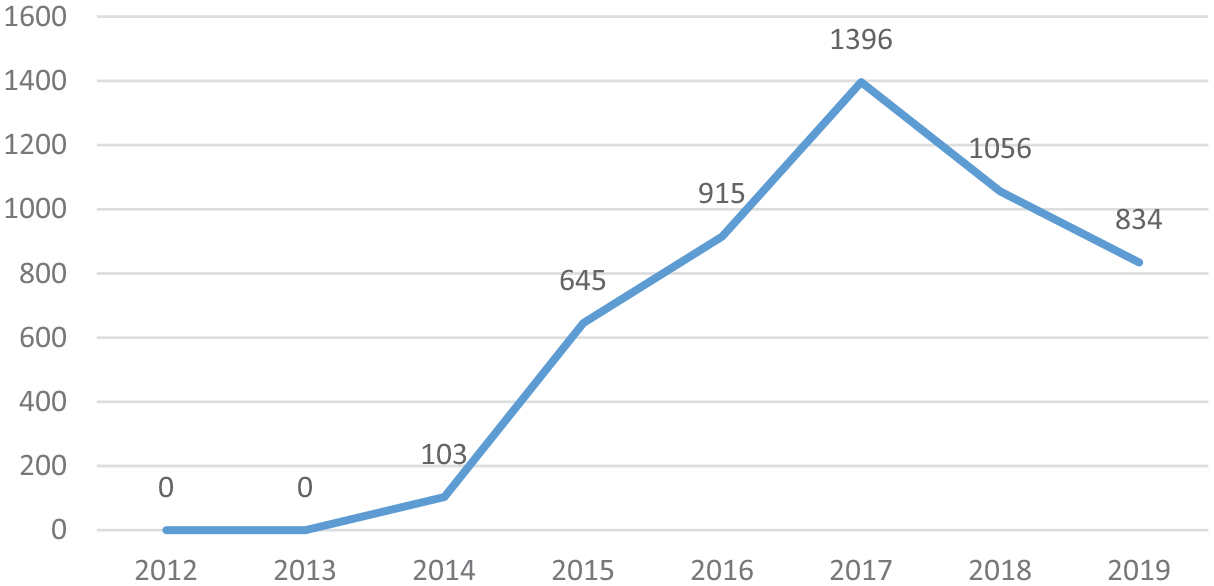
Search returns for ‘Hybrid War’ and ‘Hybrid Threat’ (Anopress database).
In parallel to practitioners, the debate on HW has been accelerating also among academics in IR and security studies. While often critical of the concepts, a wide range of studies focused on explaining and contextualising Russian actions in Ukraine and beyond (Almäng, 2019; Fridman, 2018; Galeotti, 2019; Jonsson, 2019; Lanoszka, 2016; Orenstein, 2019; Renz, 2016). Some authors specifically focused on disinformation as a tool of Russia’s foreign policy (La Cour, 2020; Lanoszka, 2019; Michelsen and Colley, 2019). In contrast, arguments exploring western countermeasures and understandings of HW have been less frequent. Some have focused on the composition of actors involved and highlighted the contingencies of construction of HW as a security and political issue (Daniel and Eberle, 2018; Monsees, 2020; Ördén, 2019; Szostek, 2020), while others explored systemic responses to disinformation (Bjola and Papadakis, 2020; Wagnsson, 2020). A growing number of studies also dig into the political dimension of HW discourse and its entanglement with identity (re)construction of international organisations or particular countries (Baumann, 2020; Eberle and Daniel, 2019; Mälksoo, 2018). Adopting a Critical Security Studies perspective, we side with works that problematise the understanding of the problem as a single and coherent story (Monsees, 2020; Ördén, 2019). Instead, we propose to understand the HW discourse as a broader assemblage of three distinct narratives based on different bodies of knowledge.
Knowing the threat: narratives and security knowledge
Narrative analysis has been widely employed in IR and security studies to explore how certain issues are understood and communicated or what political consequences of telling a particular narrative there may be (Bliesemann de Guevara, 2016; Krebs, 2015; Miskimmon et al., 2014, 2017; Neumann, 2002; Spencer, 2016). Employing diverse theoretical approaches, all these studies nevertheless concur that a well-crafted narrative represents a potent way of rendering unfamiliar phenomena understandable and presentable to a wider audience (White, 1990). Building on these insights as well as those of securitisation theory (Buzan et al., 1998; Ördén, 2019), we propose a generalisable heuristic framework for the study of security narratives in IR, together with their underlying knowledge, based around the four elements of threat, protected value, response and knowledge.
Narratives are stories told by people in order to make sense of their practices and the problems they face (Bueger, 2013; Selbin, 2010; Wagenaar, 2011). Although a given situation might not necessarily have a meaning and cohesiveness in itself, a narrative helps to craft a coherent interpretation – a story – that reduces any complexity and uncertainty that the situation might be posing and reconstructs the identity of the narrator (Homolar, 2011; Subotić, 2016; Wagenaar, 2011: 215). Thus, narratives assemble heterogenous elements (protagonists, practices, wider structures and conditions influencing behaviour) into a larger story, articulated along particularly defined causes and effects (Bueger and Gadinger, 2018: 74; Edkins, 2019; Homolar and Rodríguez-Merino, 2019). This also means that narratives can speak ostensibly about the same issue, yet establish very different links between the presented causes, effects and prospective actions, leading to stories with markedly different meanings (Stampnitzky, 2014: 6–7).
Narratives are articulated from the broader knowledge that is available to their producers, reflecting what is accepted and valued in their respective cultural and political contexts (Bueger, 2013; Jasanoff, 2007; Wagenaar, 2011). 2 The particular types of knowledge that are drawn upon serve as prisms through which a policy issue is constructed in a certain way and they also stabilise the narrative links between what are presented as the main problems and their causes (Stampnitzky, 2014: 6–7). For example, the story of the conflict in Afghanistan and policies proposed to ‘solve’ it are very different depending on whether they are weaved together from academic knowledge of Afghan tribal politics, or articulated from military counterinsurgency doctrines (Berling, 2019). While knowledge provides the basis for the construction of a narrative, its manifestation as expertise – socially recognised and authoritative proficiency in certain issues – plays an important role also for the legitimation of the narrative’s reading of a problem (Berling and Bueger, 2015: 7; Boswell, 2008). Therefore, we pay attention to what sorts of knowledge provide a basis for narrative constructions of HW and what types of expertise are articulated to give them credibility.
Building on previously outlined narrative characteristics, we propose a generalisable framework to reconstruct the different narratives in the Czech debate on HW on the basis of the main threat (its form and location), the main threatened value and the main action needed to counter the threat and protect the threatened value. In other words, as Stavrianakis (2020: 233) succinctly put it in her analysis of risk discourses, we explore how particular narratives explain ‘where potential harm comes from, to whom or what, and how?’ and ‘who has the ability to generate a constituency to act’. Together, these constitute a more or less coherent plot linking the security problem with its causes, potential negative consequences for those that need to be protected and a desirable reaction to avoid these consequences (Bueger and Gadinger, 2018: 74). In the final step, we also add a fourth element: the type of knowledge and expertise these narratives put forward.
Our archive comprises three types of texts. First, all main official documents of the Czech government concerning foreign and security policy (Security Strategy, Defence Strategy, National Security Audit), as well as annual reports of the Czech intelligence services, both for the timeframe of 2015–2019. Second, six Czech books on the issue of HW, which represent virtually all books published by Czech authors. These are decidedly popular and non-scholarly publications aimed at non-expert public written mostly by journalists, public speakers or other types of public intellectuals (Alvarová, 2017; Kundra, 2016; Nutil, 2018; Táborský, 2019), although in one case also by a high-ranking Czech Army officer (Řehka, 2017) and in another by a group of students and academics (Gregor et al., 2018). Third, a series of six published interviews conducted in 2018 and 2019 by the Czech Radio with some of the key figures of the Czech HW debate.
A single text does not necessarily correspond to only one of the three narratives. As testified by multiple documents from our archive, narratives freely coexist and one text can hold multiple narratives (e.g. Alvarová, 2017; Gregor et al., 2018; Ministry of the Interior of the Czech Republic, 2016). Therefore, we analysed each text according to the previously outlined narrative attributes and reconstructed the resulting narratives inductively. Not all texts contain the narratives in a fully developed form. In some of them, they appear rather in the form of ante-narratives – short stories and snippets, which, nevertheless, hint to full narratives (Bueger, 2013: 1817).
The defence narrative: protecting the state
The first narrative pictures HW as a problem for national defence. In this reading, which is closer to the original formulations of HW in US military thought (Bahenský, 2018; Fridman, 2018; Hoffman, 2007), ‘hybrid’ is above all a form of war, or at least an accompanying feature of conventional military confrontation. This leads to a narrative embedded in strategic studies and IR realism, where the threat comes from power politics backed up by military force and concerns, primarily, the state and its institutions. As such, the threat is to be minimised by building up and updating national and alliance institutions and defence capabilities. The key sources developing this narrative in the archive are the Security Strategy, the Defence Strategy and publications and interviews of Karel Řehka, a former Special Forces general and perhaps the most publicly visible military intellectual in Czechia.
Three narratives of hybrid warfare and their elements.

This narrative portrays HW as another type of war. It is animated by the broader Clausewitzian discourse about war as a phenomenon with unchanging ‘nature’, but constantly shifting ‘character’, where the latter is dependent upon the social and technological developments of a given age (Von Clausewitz, 1989). In Řehka’s words, wars have always been and always will be a part of human society. And as long as people have different interests and there are conflicts between them and there comes a situation, when they are ready to use violence, we have a war. (Řehka in Golis, 2018b)
What is different, though, is the social and technological environment, and especially the rise of the information domain as one of the battlefields (Řehka, 2017: 54).
The realist and military logic is apparent in the portrayal of the threat, which is understood as a combination of military and non-military means at the service of great-power politics. With an implicit yet clear allusion to Russia, Czech Security Strategy in this context talks about ‘states’ that are ready to pursue their power-seeking goals through hybrid warfare methods combining conventional and non-conventional military means with non-military tools (propaganda using traditional and new media, disinformation intelligence operations, cyber-attacks, political and economic pressures, and deployment of unmarked military personnel). (Ministry of Foreign Affairs of the Czech Republic, 2015: 13)
Therefore, the Kremlin and its HW approaches are a threat first and foremost because of Russia’s military power that backs up its assertive policies in eastern Europe (Ministry of Defence of the Czech Republic, 2017: 7). This does not mean that Czech security intellectuals are worried by a direct prospect of Russian tanks in Prague. However, official documents present national security as ‘indivisible’ from that of other NATO and EU members (Ministry of Foreign Affairs of the Czech Republic, 2015: 6). In this logic, Russia’s military threat to the Balts, Norwegians or Romanians is seen as a security issue also in Prague.
Of course, this does not concern only Russia’s conventional military operations, as ‘[t]hreats to the security of allies may be of the classical military nature or they may take the vague form of hybrid warfare’ (Ministry of Foreign Affairs of the Czech Republic, 2015: 10). While these ‘vague’, ‘hybrid’ measures can take a range of forms, most attention has been given to their informational dimension, or the ‘threats associated with information warfare and organised cyber-attacks’ (Ministry of Defence of the Czech Republic, 2017: 7). Relying on US and NATO conceptual documents, Řehka treats information warfare as a subset of HW, defined as ‘the conduct of war in the information environment’ (Řehka, 2017: 23, 62). While the means may be different, information war is clearly part and parcel of warfare. ‘Information war is always complemented by armed action, or backed up by armed force’ (Řehka in Golis, 2018b). This link to military force is arguably what distinguishes the comparatively less threatening ‘information operations’ that are the norm also in peacetime from the much more dangerous information war: ‘You can operate in an information and hybrid way as much as you like. You can try to polarize society and influence political decision making, but you must always be backed up by real military force’ (Řehka in Golis, 2018b). Therefore, the primary danger of information operations lies in the possibility that they may one day turn into a ‘real’ war (Řehka, 2017: 178).
In this military- and state-centred logic of the defence narrative, the threatened value concerns, above all, the continuing ability of the state– with emphasis on defence and security institutions – to properly perform its role and be prepared for effective defence. The official documents define this in the familiar terms of defending ‘sovereignty and territorial integrity’ (Ministry of Defence of the Czech Republic, 2017: 7; Ministry of Foreign Affairs of the Czech Republic, 2015: 6). Due to the above-mentioned principle of ‘indivisibility’ and Czechia’s emphasis on ‘collective defence’ (Ministry of Defence of the Czech Republic, 2017; Ministry of Foreign Affairs of the Czech Republic, 2015), the threatened value is extended also to the functionality of international institutions, of which Czechia is part, especially NATO and EU. Řehka’s work then outlines in detail how the functioning of institutions can be threatened by ‘hybrid’ operations, specifically by ‘manipulating information, information systems and [the] decision-making process’ in the case of information warfare, further listing a range of examples including ‘psychological operations, physical destruction, electronic combat, attacks against computer networks’ (Řehka, 2017: 140). All of these are aimed at disrupting key institutions and disarming the state, making it vulnerable to a possible conventional attack.
Consequently, the response is centred around reinforcing security and defence institutions. ‘The only thing that can effectively prevent the use of force by the Russian Federation, is resilience and preparedness of potential adversaries to face it, together with choosing the appropriate strategy’ (Řehka, 2017: 182). Therefore, the desirable answer of the state is ‘to strengthen its defence capacity and readiness, and to take its share of the responsibility in supporting those allies and partners who bear the greater share of the burden’ (Ministry of Defence of the Czech Republic, 2017: 7). At home, this means, above all, more money for the army, as the ‘response to the deteriorating security environment’ lies in that ‘the Czech government has begun to increase defence funding’ (Ministry of Defence of the Czech Republic, 2017: 7; Sobotka in Ministry of Foreign Affairs of the Czech Republic, 2015: 3). In the longer view, it also means a complex adaptation of the whole defence system to the new realities of warfare (Ministry of the Interior of the Czech Republic, 2016; Řehka, 2017). Abroad, the danger can be ‘eliminated’ through ‘the Czech Republic’s membership of NATO and the EU and its good relations with neighbouring countries’ (Ministry of Foreign Affairs of the Czech Republic, 2015: 10). Within NATO, this primarily means conventional defence and deterrence measures (Ministry of Defence of the Czech Republic, 2017: 7).
As far as the broader knowledge and expertise behind the defence narrative is concerned, the threat and responses to it are constructed and legitimised by military expertise and the authority of the state apparatus. While the official documents rarely elaborate on the sources of their claims in detail, even though they also occasionally mention NATO strategies, it is Řehka in particular who grounds his views on HW in reference to US and NATO official doctrines, manuals and think tank documents, as well as military classics such as Sun-Tzu, Clausewitz or Lidell Hart (Řehka in Golis, 2018b; Řehka, 2017: 32–45). Thus, Řehka analyses Russian behaviour through references to the supposedly timeless rules of geopolitics, anxiety about defensibility of Russian borders (Řehka in Golis, 2018b) and through Russia’s apparent concerns about its position in international order (Řehka, 2017: 177–178). He also frequently invokes past and present military conflicts to provide illustrations. In his assessment of the shift in Russian strategy following Crimea, Řehka argues with a historical lineage, suggesting that ‘we heard the statements, we had the signals, we saw changes in the Russian strategic documents, we saw cyber-attacks on Estonia, taking control of South Ossetia. Everyone ignored that and then we were shocked by the occupation of Crimea’ (Řehka in Golis, 2018b). Lastly, the narrative proves the legitimacy of its reading of the threat by references to other official strategic and governmental documents. In this respect, Řehka provides lengthy quotes from governmental documents and reports of intelligence services (Řehka, 2017: 178–182).
HW is thus made known through a broad body of academic and applied military knowledge, governmental statements and reports represented and created by those inside (or close to) the national and international security apparatuses. With its official, diplomatic and somewhat detached tone, the narrative paints a broad picture of the international situation, strategies of different states and alliances and threats the Czech Republic is facing in relation to HW. On the other hand, it leaves many parts of the threat veiled and reserved only for those ‘in the know’, who are responsible for matters of national security. Just as the specifics of the threat are hidden from the public eye, so are many of the responses, which are mostly entrusted to dedicated intelligence services, armed forces and the alphabet soup of specialised agencies.
The counterinfluence narrative: subversive agents within society
While for the defence narrative the threat lies outside the Czech Republic, the counterinfluence narrative moves its attention inside the country – to the alleged networks of Russian influence and a range of pro-Russian actors who are directly or indirectly linked with Kremlin. Thus, HW is about the promotion of the interest of states that do not share the same values as the Czech Republic (Vejvodová in Golis, 2019c) and it aims toward covert manipulation of the Czech society with the intention of turning it away from the liberal West and bringing it closer to the Russian orbit. If the previous narrative is concerned with HW as a tactic that seeks to weaken the defence before potential ‘real war’ and argues for strengthening preparedness, the counterinfluence narrative understands HW as a substitute for military action – something that can achieve the goals of warfare without resorting to arms at all, and something that is already happening right here, right now.
In this story, the Russians with their agents and local allies have already gained a foothold in the country (Alvarová, 2017; Vrábel in Golis, 2019a; Kundra, 2016). Thus, the threat lies not only in the possibility that a part of the population might be manipulated and the country might fall under Russian influence, but also that this process might remain undetected and not appropriately reacted to. As a leading proponent, Alexandra Alvarová, put it, ‘I am scared that my country will lose freedom and democracy before it even realizes that has come under attack’ (Alvarová, 2017: 11), or as claimed by the National Security Audit, ‘[t]he principal risk to which a subject attacked by a hybrid campaign is exposed lies in the fact that they will not be able to identify the hybrid campaign – in time, in its full scale, or at all’ (Ministry of the Interior of the Czech Republic, 2016: 129). In response, the public needs to be warned and Russian agents exposed and confronted. With its distinct alarmist and rallying style, the counterinfluence narrative is primarily disseminated in texts produced by journalists, think-tankers and activists, but its traces can also be found in some intelligence reports and governmental documents.
While the threat of Russian HW is at the core of this narrative, its shape and sources are interpreted in a different way than in the defence narrative. Russia is depicted not only as an assertive great power, but also as a radically different and aggressive ‘Eastern Other’ (Neumann, 1999) whose actions are based on ‘distinct civilisational modalities of thinking’ (Alvarová, 2017: 193). Thus, the narrative explains Russian policy as based on a culture that is fundamentally different, expansionist, opposed to the West and interested in spreading its influence in Europe. In this respect, there is little difference between the contemporary Putin’s regime, Tsarist Russia and the Soviet Union, as they are all driven by a ‘permanent urge to threaten others [. . .] [that] is a logical conclusion of its [Russia’s] history and geography’ (Kundra, 2016: 32). Just as present Russian attempts to gain local allies could be read as a ‘new reincarnation of the Comintern’ (Security Intelligence Service, 2015: 12), so the threat is also reminiscent of the historical experience with Soviet dominance over eastern Europe and incites fears of its potential return (see Eberle and Daniel, 2019). This raises the stakes and connects the narrative to wider anxieties about the development of Czech democracy – for example, with respect to the resurgence of anti-western, nationalist or authoritarian tendencies. Therefore, the narrative puts non-military and covert aspects of warfare to the forefront. It understands HW primarily as a networked security issue stemming as much from Russia as from its multiple allies and assets already present inside Czechia or other European countries. These could be intelligence agents stationed at the Russian embassy (Alvarová, 2017: 86; Kundra, 2016: 150–158). However, equally important are also the ‘dozens of people paid by Russia’ who, together with naïve local ‘useful idiots’, collectively spread Russian-made disinformation within the population or serve Russian interests in other ways (Vrábel in Golis, 2019a; Kalenský in Golis, 2019d).
Moving to the threatened values, these are pictured in distinctly cultural and normative terms: the persistence of democratic institutions, liberal values and a certain vision of civilisational belonging to the West. Russians and their local allies aim to ‘uproot local [Czech] still developing and fragile democracy, sow chaos, and weaken its integration in defence and political structures of the West’ (Kundra, 2016: 27). By corruption and manipulation of the Czech public and formal and informal alliances with like-minded local actors, Russia threatens the very foundations of the Czech democracy, self-determination and liberal western identity. In this vein, the narrative warns that HW, and especially disinformation campaigns as its indivisible part, threaten to also destroy the Czech public sphere and flood the population with multiple competing truth-claims (for such debate in other countries, see Bjola and Papadakis, 2020; Monsees, 2020; Wagnsson, 2020). Thus, HW seeks to ‘systematically undermine trust in authorities, relativize values and strengthen extreme opinions’ (Táborský, 2019: 92). Consequently, ‘the intended result of these activities is a mass of confused, suspicious and embittered voters’ (Táborský, 2019: 92). The ensuing resignation creates an environment where illiberal populists and pro-Russian figures can thrive and gradually open the doors to authoritarianism and Russian control (Alvarová in Golis, 2018a; Táborský, 2019: 92).
As far as the response is concerned, the narrative stresses that the gravity of the threat necessitates a resolute reaction of both the state and a range of non-governmental, civil society actors in defence of what is perceived as the core values of the society. ‘Until we all across the board realize that information war is our everyday reality and until we stop foolishly downplaying its manifestations, we don’t have a chance in this struggle’ (Táborský, 2019: 211). The authorities and others need to step up their game. ‘When one team shoots on the goal and the other does not, who will score more?’ (Kalenský in Golis, 2019d). As the football metaphor suggests, the key part of counter-reaction is to rally the public and politicians around liberal values and start pursuing more decisive policies to stop Russian and pro-Russian influence operations. Only in this way will the Czechs be able to ‘get out of Russian fog and start to be serious about defending liberty that we regained in 1989 and which the Kremlin and its secret services try to dismantle again’ (Kundra, 2016: 194–195).
The state institutions naturally play a key role as HW poses a threat for the constitutional order. Such tasks primarily fall to internal security agencies, such as the Centre against Terrorism and Hybrid Threats and the counterintelligence agency (Ministry of the Interior of the Czech Republic, 2016). But it is also politicians who should ban Russian state media (Kalenský in Golis, 2019d), take a decisive step against Russian spies and their influence networks (Kundra, 2016: 194) or convince the dissatisfied and, thus, vulnerable parts of society about the benefits of liberal democracy (Ministry of the Interior of the Czech Republic, 2016; Táborský, 2019). The liberal-leaning parts of the public then join the struggle ‘as an expression of their responsibility’ (Vrábel in Golis, 2019a). Beyond upholding liberal values and defending them in the public debate, their role also lies in exposing the pro-Russian voices or agents and, thus, publicly ‘naming and shaming’ them (Vrábel in Golis, 2019a; Kalenský in Golis, 2019d). The key goal of the countercampaign is then to uncover the tools of Russian influence, push them out of the public sphere and ‘immunise’ the public against further interference.
Finally, the counterinfluence narrative is based on an eclectic mixture of different knowledge and expertise. First and most importantly, it builds its credibility on the ability to unmask the strategies of Russian HW in the Czech Republic, thereby claiming to bring the hidden dangers to light. Grounding the claims in investigative skills or advanced computational methods, the narrative points to ‘pro-Russian’ disinformation circulating on the Internet and subsequently connects it with Russia’s supposed intentions, usually by pointing to a shared ideological worldview (Vrábel in Golis, 2019a, Kalenský in Golis, 2019d). Alternatively, the narrative highlights proficiency in journalistic investigation and the ability to uncover links between Russian intelligence services and local figures (Kundra, 2016), or its own experience in media manipulation (Alvarová, 2017; Táborský, 2019). Further, it also pieces together media reports on the Kremlin’s approach to information operations (Kalenský in Golis, 2019d; Kundra, 2016) with intelligence reports on the network of Russian agents in the Czech Republic (Vrábel in Golis, 2019a; Security Intelligence Service, 2016; Táborský, 2019). Popular and academic studies on Soviet and Russian history, politics and approaches to HW are often put in the mix to make sense of Russian behaviour (Alvarová, 2017; Kundra, 2016; Security Intelligence Service, 2018; Táborský, 2019). By combining all these sources, the narrative shows the supposed roots and nature of Russian HW, localises it in a certain reading of Russian ways of war and stresses its gravity by pointing to intelligence sources and its own investigation that proves the presence of Russian agents and pro-Russian disinformation in Czechia. Focusing primarily on the threat and making it widely known, the narrative, on the other hand, does not elaborate on how pro-Russian disinformation is received by its audiences.
The education narrative: fostering responsible individuals
The third narrative has a distinctly individualistic and liberal flavour, as it is based around the notion of personal skills and responsibilities that are to be fostered by education, especially in critical thinking and media literacy. The key threat is the combination of individual psychological predispositions and the dramatically altered information environment. For the education narrative, the problem is literally ‘in our head’ (Táborský, 2019: 9), as our natural limits are aggravated by the ‘flood’ of information that we have to deal with (Gregor et al., 2018: 106). This can be exploited by a range of actors for very different purposes, which may or may not be linked to security or politics. It can be Russia and domestic actors, which link the narrative explicitly to HW discourse (e.g. Ministry of the Interior of the Czech Republic, 2016: 52; Nutil, 2018), but also businesses trying to trick the public into buying their product or just anyone else using manipulative techniques for their own personal gain. In this sense, the narrative is notably focused on the receiver and their ability to deal with information chaos (see Monsees, 2020; Wagnsson, 2020). The threatened values are the individual skills and abilities to cope with this situation, where confusion hampers individual decision-making and, in consequence, also freedom and democracy. The response to this is primarily education of the individual. The narrative is most often articulated in the discourse of NGOs and journalists.
The threat is conceived as the interplay of a changing information environment with human psychological limits.
In our thinking and reactions, we are still cavepeople, who are driven rather by instincts and emotions than by rationality. And we are still learning how to deal with a world that is highly connected and complicated, cosmopolitan and growing ever smaller. (Nutil, 2018: 15)
Therefore, the root cause of the problem is not Russia’s overt power politics or covert influence campaigns, but rather the change in consumption of information and the way people struggle to cope with it. ‘Technology accelerates together with globalisation’ (Nutil, 2018: 54) and, consequently, ‘we are literally littered with information’ (Táborský, 2019: 10). This ‘information chaos’ (Valůch in Golis, 2019b) further amplifies our psychological limits. ‘Our brain is not equipped to process such big amount of information; its cognitive capacity is limited’ (Gregor et al., 2018: 78). Therefore, while manipulation and propaganda have been known since time eternal, as the key texts for the education narrative illustrate in extensive detail (Gregor et al., 2018; Nutil, 2018; Táborský, 2019), the recent information overload makes it particularly dangerous: We have the opportunity to read hundreds of media sources, even thousands and millions, if we count accounts across social networks. [. . .] But this great freedom is simultaneously the biggest threat. How to navigate in this immeasurable information flood, which source to trust and which not? (Gregor et al., 2018: 106)
This is certainly a problem as ‘we are programmed to generalise, simplify and create stereotypes’ (Gregor et al., 2018: 78). Such metaphors approximating human minds to computers are sometimes articulated in explicitly securitised terms. ‘Just like computers and computer programmes have their weak spots [. . .], weak spots are also in our head. We have different ‘backdoors’ in our brain, which anyone can use to get in our heads’ (Táborský, 2019: 151). However, rather than outright ‘brain-hacking’ that features in the counterinfluence narrative (e.g. Alvarová, 2017), the danger is typically seen as preventing individuals from making rational decisions, especially when emotions are involved. ‘Under the influence of emotions people are not able to think rationally enough [. . .] and they can be easily manipulated and oriented in a given direction. High emotions can literally shut down the brain’ (Nutil, 2018: 165).
The threatened value is thus defined as the capability to be an informed, critical and, therefore, responsible citizen. Consequently, and similarly to the counterinfluence narrative, this presents a danger to the liberal democratic order. However, the emphasis here is on the receiver side. It is the ‘ideals of humanism in the form of freedom, democracy, protection of human rights and human universalism that deserve to be defended from totalitarian, xenophobic or extremely nationalist tendencies’ (Nutil, 2018: 26), and it is precisely ‘our trust in democracy’ (Gregor et al., 2018: 98) that is being undermined by disinformation. Unlike in the counterinfluence narrative, the path towards their protection runs, above all, via skills and capabilities that help individuals remain/become responsible citizens who uphold these values. What needs to be secured or developed is ‘[o]penness, ability to question oneself, elementary media literacy and the use of critical thinking,’ since it is these skills that ‘can protect us from jumping into hatefulness’ (Nutil, 2018: 182).
Logically, the response is constructed around education and empowerment. In line with the liberal roots of this narrative, it is the individual citizen that is the main actor here. In contrast to the other two narratives, this individual is not merely a passive object of protection, but rather an active entrepreneur taking matters into their own hands. ‘Yes, my bet is in this respect on the individual. On the independent, individual intelligence of every one of us, which can freely examine even the biggest crap’ (Nutil, 2018: 92). The two key skillsets that individuals should acquire via (self-)education are critical thinking and media literacy. ‘Every day, we found ourselves in media overflow. [. . .] Fortunately, there is defence – media literacy and critical thinking’ (Gregor et al., 2018: 120). These should help people in their orientation in the complicated and confusing environment. While the state can, and certainly should, organise and promote educational programmes (rather than censoring information, which is seen as both undesirable and ineffective; see Gregor et al., 2018: 52; Nutil, 2018: 91), individual citizens should start actively educating themselves. To this end, some of the books are intended as self-help manuals (esp. Gregor et al., 2018; Nutil, 2018), providing ‘how to’ sections and encouraging and empowering the readers to take responsibility: ‘our advice is: use our brains and think critically’ (Gregor et al., 2018: 124). Others highlight the role of public and civil society institutions such as libraries and clubs for senior citizens, or the paramount role of personal encounters between members of different groups and generations (Valůch in Golis, 2019b).
The knowledge and expertise base of the education narrative relates, above all, to communication. On the one hand, it is based on research in the fields of psychology, sociology and media studies, focusing on the audience and its interaction with (dis)information, often gleaned by research on the recipients of disinformation (Valůch in Golis, 2019b). The key publications promoting this narrative employ quasi-academic citation practices and use scholarship on cognitive biases, the role of emotions in decision-making and the possibility of manipulating them, or the study of persuasion, referencing star scholars such as Philip Zimbardo or Antonio Damasio (Gregor et al., 2018; Nutil, 2018). Nevertheless, these are liberally mixed with popular texts, historical analogies, personal anecdotes and, as one author even admits, other ‘sources that would hardly meet the strict demands of scientific work: poets, song lyrics, movies, and others’ (Táborský, 2019: 9). Clearly, it is not the science-like presentation of arguments and evidence that is the source of expertise here, but often rather the personal claim of the narrators to be able to translate and authorise the knowledge provided to their lay audiences. All the three key books distance themselves from academic production, explicitly stating that what they offer might by informed by science but it is not a proper ‘scientific publication’ (Gregor et al., 2018: 5; Nutil, 2018: 11; Táborský, 2019: 9). Instead, they aim at broad comprehension, constructing their own personal authority and practical knowledge as grounded in their experience as fact-checkers and public speakers (Nutil, 2018: 11), journalists and public relations consultants (Táborský, 2019: 9), or political communication experts and workshop organisers (Gregor et al., 2018). Following the practical orientation, the books present a range of tips and tricks, often in bullet points (Nutil, 2018: 182), in which the complexity of the issue is reduced to simple guidelines on how to identify argumentative fouls or verify sources. Falling within the broader logic of the education narrative, it is then up to the individual reader to make use of this knowledge, become better at navigating the new media environment and not fall for malign disinformation.
Conclusion
This article analyses how the threat of HW is constructed in the Czech public debate. Connecting narrative analysis with attention to the role of knowledge and expertise in making authoritative claims on security issues, we argue that the broader HW discourse can be disentangled into three narratives that link the exact nature of the main threat, protected value and response in different ways. Furthermore, we show how different bodies of knowledge provide a basis for differing ways of narrating and justifying a specific understanding of HW. While the literature has already criticised the vagueness and broadness of the HW label, we highlight how this vagueness accommodates different readings of the main threat. We show that HW is a very different issue when interpreted through the lens of military science, popular literature on Russian history or cognitive psychology.
The disentangling of the HW discourse matters for both future analyses of HW and ‘real-life’ effects of the discourse. As nearly anything that has a vague reference to dangers in the information domain, challenges posed by illiberalism or great-power politics can be attached to the HW label; it is difficult to know what HW points to exactly, and where the threat is located precisely. This is unhelpful both for a sound risk analysis and for an informed and critical public debate. It also has profound political implications. An unproblematised reception of the HW discourse contributes to the creeping securitisation of issues that would have not necessarily been linked to security otherwise, such as media literacy or public diplomacy (Szostek, 2020). Proliferation of security framings of different issues in the name of HW can, furthermore, lead to mutually undermining and contradicting policy reactions. It makes a difference whether we treat the public as critically thinking citizens that can (with some assistance) make up their own minds, or if we understand them as a passive mass that needs to be protected from even being reached by hostile messaging or disinformation (see also Ördén, 2019). Each implies a markedly different view of the citizen – as active subject shaping their own life versus passive object in need of protection – and her relation to the government. Similarly, it matters whether we understand our adversaries as rational actors that can be deterred or accommodated, as the defence narrative does, or as malign and inherently irrational ‘others’ with whom we share no common rules or logics, as in the counterinfluence narrative (see Rühle, 2019).
While our case study concerns the Czech public debate, our findings have broader implications. The narratives circulating in the Czech Republic bear similarities to those articulated in different European countries and on the European level. In particular, the counterinfluence narrative is often shared by internationally published public intellectuals (Orenstein, 2019; Snyder, 2018), the defence narrative prominently features in NATO-related discourses (NATO, 2019; Rühle and Roberts, 2019), while the fears of information chaos and calls for enhanced media literacy have been heard in multiple European states (Monsees, 2020; Wagnsson, 2020). Similarly, the confusion over what the main issue connected to HW is and how it should be tackled are not limited to the Czech Republic and have been subject to controversies on the European level (Ördén, 2019; Rühle, 2019; Szostek, 2020). Our study contributes to the future analysis of these debates by providing a typology of three HW narratives that can be used as an analytical starting point, tested in different contexts and critically reinforced – or rejected. The analytical framework of threat, threatened value, response and knowledge then presents a more general contribution, as it can be employed to study security narratives beyond HW.
Footnotes
Acknowledgements
Above all, we are grateful to Natálie Jančíková for her diligent research assistance. We have also benefited from the critical yet generous comments from the two reviewers, as well as audiences at the Critical Studies Seminar and the Work in Progress seminar at the Institute of International Relations Prague, with particular thanks to Ondřej Ditrych, Jonáš Syrovátka and Atanaska Metodieva.
Funding
The authors disclosed receipt of the following financial support for the research, authorship, and/or publication of this article: This work was supported by the Czech Science Foundation (grant number 19-12081S: ‘Transforming security in the age of uncertainty: Understanding the rise of hybrid warfare in the Czech Republic’)
