







Abstract
The UN has been traditionally a prime component of small states’ foreign policy, but also a conspicuous space where norms are interpreted, bargained, and contested. Gauging the dynamics of remembrance and norms at international organizations, this article explores the purchase of norm legitimization through memory discourses. We argue that the transposition of memory at international level claims a new subjective order of legitimization, which actors then use to interpret or contest international legal norms in response to contemporary challenges. Linking our analysis to work on the centrality of interpretation for meaning-making in international law and the political processes that underpin these processes, we conceptualize the nexus between memory and international law. We articulate three mechanisms that link mnemonic invocations and norm legitimation: mnemonic co-presencing, mnemonic accountability claims, and countermemory and mnemonic critique. We also emphasize the entanglements between them on the one side, and between national and international memory discourses, on the other side. Empirically, this article examines discourses in the UN Security Council and the General Assembly in the context of Russia’s aggression in Ukraine. We conclude that by epitomizing both normative and memory spaces, international organizations reveal how mnemonic practices constitute the meaning and legitimacy of international law.
[T]he Human Rights Council should not and will not be tainted by the full—fledged membership of a State accused of perpetrating—and continuing to perpetrate—some of the most horrific war crimes seen in Europe since the end of the Second World War. (April 7, 2022; 11th Special Session of the UN General Assembly)
Introduction
Speaking on behalf of the delegations of Finland, Iceland, Norway, and Sweden, the Danish Ambassador to the UN, Martin Bille Hermann, recalled the Second World War and the atrocities and crimes associated with it to legitimize Russia’s exclusion from the UN Human Rights Council. Martin Bille Hermann expresses that violating international norms is fundamentally incompatible with membership in the UN Human Rights Council, bespeaking that UN institutions are tasked with fostering global cooperation and peace, justifying Russia’s removal from the UN organ and articulating support for the International Court of Justice’s investigations. Drawing on historical memory to underscore the gravity of the crisis and to rationalize the decision, the permanent delegate of Denmark, who currently holds a non-permanent seat in the UN Security Council, connected these chronicles to the norm of accountability.
Denmark’s UN Ambassador invocation of the past to legitimize norms in the present is just one example out of many references to history that are often being made in International Relations (IR). Broaching the dynamics of normative spaces at international organizations (IOs), this article explores the interplay of legitimizing norms through the enmeshing of national and international memory discourses. We argue that the transposition of memory onto the international level claims a new subjective order of legitimization. This transposition represents a mimetic and transcendental act of bringing national memory motifs into the realm of international discourse. Memories convey history and the past in the present (Zehfuss, 2006). Memory is displaced through the living remembrance of the past and history, serving the legitimization of a present norm. As this article sets out to demonstrate, memory discourses are entangled with legitimization—through processes of interpretation and contestation—of international law and legal norms. To illustrate this argument, this article analyzes discourses in the UN Security Council and the General Assembly in the context of Russian aggression in Ukraine.
The conceptual relationship between memory and IR is not new. In her book on collective memory and IR, Kathrin Bachleitner (2021) argues that collective memory in world politics manifests in four different forms: as a country’s political strategy, its public identity, the basis for its international state behavior, and as a source for its national values, empirically illustrating the case study of Germany and Austria. A small number of seminal works (Bachleitner, 2024; Bell, 2006; Budryte and Resende, 2014) contribute to better understanding the interaction between past and present in world politics. Other studies have examined the interconnections and liminality in processes of transformation (Hoppen, 2021; Mälksoo, 2010) or the connection between memory and norms (Baciu, 2022).
However, the dynamics through which norms—and particularly international legal norms and invocations of international law—are legitimized by interweaving national and international memory discourses have been insufficiently explored. Norm research has come into sharp focus in the face of challenges to the rule-based order at both national and international levels (Deitelhoff and Zimmermann, 2019; Niemann and Schillinger, 2017; Wiener, 2018; Zimmermann, 2017). Yet, the relationship between norms and mnemonic invocations in IOs has been relatively unexplored. We draw on emerging work on memory in IR, as well as scholarship on norm contestation and justification, to develop a theoretical framework for the use of memory discourses in IOs. In particular, we explore the place of these memory discourses in legitimizing and delegitimizing international legal rhetorics and related norms, linking our analysis to work on the centrality of interpretation for meaning-making in international law and the political processes that underpin these processes.
The novelty of our article consists in offering a conceptual framework for theorizing the nexus between mnemonic invocations and norm legitimation and international law. We articulate three mechanisms through which mnemonic acts influence norm interpretation: mnemonic co-presencing, mnemonic accountability claims, and countermemory and mnemonic critique. We also emphasize the entanglements between them on the one side, and between national and international memory discourses, on the other side.
Epistemologically, this study adopts a discourse-analytical perspective to examine speeches at the United Nations, both in the Security Council and the General Assembly, in the context of the Russian war in Ukraine from a memory-historical and normative-legitimatory standpoint. This perspective, with its interpretative approach, allows for a better understanding of the intertwine between national and international remembering and how norms can be legitimized or delegitimized as a result. In doing so, while this article is primarily focused on developing a conceptual framework of the use of international memory in IOs, we also hope to contribute to ongoing understandings of the role of the international community and international contestations in understanding the context of the Russian war in Ukraine.
This article begins with a discussion of the emerging literature on memory in IR, particularly scholarship examining the concept of international—compared to primarily national—memories and the relationship between them (Bachleitner, 2019, 2024); Following this, we draw on insights from norm contestation literature to develop a theoretical framework explaining how historical memories and memory discourses can shape normative processes in IOs. This framework is further explored and refined through an examination of memory and norms at the United Nations, using the example of speeches from February 24, 2022, to February 24, 2023. The final section explores the conceptual relationship between remembering and IR and how IOs serve as sites of memory, where national and international stories interlace, thus legitimizing or delegitimizing norms. Ultimately, this article aims to develop understandings of how mnemonic invocations are used in international politics and the effects of these claims on international arguments, justifications, and broader patterns of norm contestation and development.
Memory, norms, and international law
At their core, justifications are contesting acts. They aim to establish some condition of appropriateness in order to frame an action as right or necessary. In doing so, they seek to undermine, refute, or prevent possible counterclaims—both justifying the act and increasing the challenges faced by potential opposition actors. When crafting a justification, then, actors seek to employ the frames and rhetorics that offer the greatest support for their claim—both as a way to legitimize their act and to make it harder for opponents to counter them. The particulars of what make an effective frame or rhetoric are, of course, context- and actor-dependent. Certain types of language may be more appropriate—or, contrastingly, inappropriate—in different settings. The claim should be suitable within the “legitimacy terrain” facing the actor and the topic (Price, 2023: 5). The choice about what language to use, then, is crafting a justification that can appropriately serve the desired legitimizing function.
This article addresses these questions by considering the role of memory in justifications—particularly in contestation over legal and legal-adjacent norms. In doing so, we draw on work from memories studies and the role of international memories (Baciu, 2022; Assmann, 2011; Bachleitner, 2019, 2024; Klymenko, 2022), as well as scholarship on legal justifications and framing (Rapp, 2020, 2022; Kinsella and Mantilla, 2020; Lesch et al., 2024; Finnemore and Sikkink, 1998), and broader work on norm contestation (Brunnée and Toope, 2019; Hofmann, 2024; Wiener, 2004, 2014). We aim to explore the role of memory as a tool for justification—theorizing how it serves an interpretive function for international legal claims, in turn strengthening their role as a type of justification in international institutions. We do so by building on existing work on norm interpretation and contestation, situating these discussions alongside work on the politics of memory, to explore how memories are used to shape and support norm and legal contestations.
Norms and international law are often used interchangeably. The conceptual boundary between norms and international law is often difficult to delineate, and many studies have attempted to define the relationship between norms and international law (Rosert, 2024 Sen, 2006). Broadly, though, international law may be defined as the system of formalized rules that are understood as binding on all states, with a shared sense of accountability to each other and to the rule, due to their nature and which exist through some degree of states’ will (Finnemore, 1999; Sinclair, 2021). This may take the form of either treaty law or customary international law—law which is unwritten, although it may reflect rules that are also included in codified legal texts, and which agrees from a shared understanding of a rule emerging from a sense of legal obligation (opinio juris). Peremptory norms, including jus cogens rules like the prohibition of slavery, the prohibition of genocide, and the sovereign equality of states apply as law to all states, regardless of whether they are parties to treaties that codify these norms or not. At the same time, these rules may be reflected in written texts—for example, the prohibition of genocide is both a customary law prohibition and the subject of the Convention on the Prevention and Punishment of the Crime of Genocide. In these cases, actors may choose to appeal to either a particular codified legal norm or to the customary rule (Rapp, 2020).
Not all norms are legal norms, though. More broadly, norms may be understood as shared standards of appropriate behavior by actors with a similar identity in similar situations (Finnemore and Sikkink, 1998). These are often analogized to law—reflecting their role as shared rules seeking to regulate social behavior. In his famous tragedy “Circe,” Charles Davenant referred to norms as “unwritten law” three hundred years ago (Sen, 2006: 247). The different contractualistic form necessitates a differentiated form of recognition. While international law implies voluntary recognition through the signing of treaties, norms can come into conflict with each other (Ferguson, 2018; Bradely and Gulati, 2012; Klabbers and Piiparinen, 2013; Vranes, 2006). Norms can be morally contested, while the challenge to law must be addressed through procedural steps and decided and legitimized by decision-making bodies such as courts. Nevertheless, norms and international law are often discursively applied interchangeably.
We argue that, given this knotted relationship between law and norms, memory can serve a meaning-making purpose not only in the political, but also in the legal international realm. Memory claims can play a central role in structuring interpretations of international law—using appeals to constructed pasts to legitimate certain uses of the law and delegitimate others—in a way which is fundamental to the existence of the law itself (Hollis, 2015; Venzke, 2012). As with any type of normative system, international law requires interpretation to be made meaningful. Rules, written or unwritten, must be interpreted within a situation to be given meaning—the abstract rule understood in relation to an interpretation of current events. This features an actor offering an interpretation of what the law means and how it should be understood in relation to the identified event. An actor may argue that international law does or does not apply—framing the issue as one that should be understood in a legal framework—or they may argue that the law requires a particular behavior—identifying an implication from the frame.
These claims are open to contestation—at their core, they claim to understand what the rule requires and to set out what should be done in response to it, claims which other actors may challenge. Here, we draw on constructivist work on norm contestation to understand how and why actors may contest these interpretive claims (Deitelhoff and Zimmermann, 2019; Kinsella and Mantilla, 2020; Lantis and Wunderlich, 2018; Wiener, 2014). Given the fundamentally normative nature of legal rules and legal systems, contestations over the meaning of law follow patterns of broader norm contestation, which we elaborate here into a theory that emphasizes the unique role and value of claims of historical memory.
We expect that actors in IR use historical memory as a tool for analogical interpretation of international law and legal norms. By claiming and applying a shared understanding of a common past and applying it to the possible role of international law in a current situation, an actor may seek to accomplish several things. First, they seek to link the event being discussed to a historically conditioned claim of international law as a way to limit or otherwise shape the scope of the debate. Powerful shared memories may be challenging for opponents to dismiss and using them to link the current event to international law—or even a particular category of international law (e.g., human rights law instead of international humanitarian law)—helps an actor shape the grounds on which a debate may occur by setting out an analogy which may then be connected to either how the event is to be understood or by analogizing what area of law is relevant. Controlling this process may help an actor link the debate to an area where they have particular resources or leverage, where they perceive greater social support, or where their expertise is strongest, for example.
Second, the invocation seeks to shape the interpretation of the law. Once it is understood what body of law or what types of legal norms are relevant, the challenge is then on deciding how the law should be understood in the present. International law’s operation depends on its interpretation in the now moment, where the rule or norm—once identified—is applied to the particular facts of an event in order to offer a solution or set of solutions. This may include interpreting if a legal rule has been violated or upheld—and to what degree—as well as what reactions are appropriate given the nature of the violation. Invoking a shared past is one way for an actor to interpret the law and, in doing so, offers an answer to these questions. Invoking a shared past serves to identify and position a historical reference as being a similar case and, by extension, arguing that the current case should be understood similarly or in light of it, including similar calls to action. This is a rhetorically important move, shaping the scope of contestation that may occur and creating further challenges for opponents who may seek to offer a rival interpretation.
Third, such claims not only work to interpret and apply the law, but also provide an actor with the opportunity to “do” their history. They are able to advance their understanding of an international historical memory and to position it as one that is both correct and useful—the right understanding of history which also offers lessons for the future. In this way, using historical memories to analogize and interpret the law also offers an actor the opportunity to further strengthen their claim to the shared history and to advance their understanding of it. This reflects the nature of shared memories as narratives (Klymenko, 2020: 977), contextualized understandings of historical events that share a constitutive function (Klymenko, 2022: 3), not as absolute rules of discreet observations.
Given these conditions, we expect that actors will use mnemonic acts to frame their summoning of international law. While these actors could use any range of reasoning to frame their invocation of the law, or to justify their interpretation of it—for example, drawing on formal processes of legal interpretation, appealing to the appropriateness of law within the given forum, or appealing to the shared nature of the legal rule—we expect mnemonic co-presencing often in the form of historical analogies, mnemonic accountability claims and countermemory and mnemonic critique to be important rhetorical tools—perhaps especially so in IOs. Actors will seek to frame their justification with appeals to shared references—frames that other actors in the setting will find understandable and appropriate. Shared memories are useful frames as they may reflect an understanding or worldview shared by other elites (Bachleitner, 2019: 494–95).
Once the frame is established, the actor may then set for the relevant implication, the action which follows from their frame (Benford and Snow, 2000). Shared memories may offer a uniquely effective way of framing—the invocation of a shared memory speaking not only to the case under discussion and how it should be dealt with, but also appealing to the identity of the listener. Thus, we expect speakers to invoke international memories—those that explicitly claim a shared historical past—to situate the event and, by way of analogy, to present either a body of law, or a particular interpretation of one, as fitting to the situation.
At the same time, memory exists at the national level and not solely at the international level. Indeed, as discussed previously, much of the research on the use of memory in politics has focused on domestic memory—either within domestic political spaces or as a frame or tool of foreign policy (Klymenko and Siddi, 2022; Klymenko, 2022). Drawing on this work, we theorize that domestic political memories will be particularly important for actors to identify themselves in relation to the object of the debate and thus to posit a relevant legal interpretation. This is similar to how the international memory operates.
Furthermore, domestic memory may serve a second function—to position a speaker not strictly in relation to the topic of contestation but in relation to other actors involved in the debate. Experiences with colonialism, for example, may function first as domestic memories—with particular traits and characteristics related to the unique colonial experience of the speaker—but they do pose a shared international quality insofar as how other members of the international community have also experienced them (Bachleitner, 2024: 277).
Methodological considerations
To examine our theory, we study statements made at the UN General Assembly (UNGA) and Security Council (UNSC) in the period between 24 February 2022 to 24 February 2023, which discussed the Russian full-scale invasion of Ukraine. Statements were identified through keyword searches of the UN Official Document System (ODS), which catalogs minutes of UN meetings, including the topic of the meeting, the text of what was said, and information regarding speakers and their nationality.
In doing so, we build on literature that has identified the important role of UN bodies—particularly the UNGA with its universal membership and the UNSC with its focus on issues of peace and security—as forums for legitimation and contestation (Bachleitner, 2024; Binder and Heupel, 2015). When speaking at the UN, states and their representatives have the opportunity to engage in contestative and interpretive acts in a shared environment where their claims are shared with others. This provides an opportunity to engage in legitimation—of, for example, the appropriateness of a political-legal interpretation in response to a contemporary discussion—by providing the speaker with an appropriate audience who may receive and respond to the claim. These forums may also provide actors an opportunity to engage in order-making through contestation over shared norms and how they should be interpreted or applied (Hofmann, 2024), allowing them to advance memory-situated interpretations of legal norms as informing or determining what an order should be or how it should be understood.
Historical references are not uncommon in explanations in the UNGA or the Security Council. In the studied timeframe, there were 17 references to the Holocaust or the Second World War in the Security Council, and 26 references in the UNGA. In addition, references were made to the national history of a country. By referring to their own past and memory motifs, norms such as human rights, territorial integrity, sovereignty, punishment, peace, accountability, or humanitarian international law were invoked, interpreted, and applied. To analyze the identified references, we employ an interpretative hermeneutic approach (Baciu and Wivel, 2024: 8–9) based on a discourse-analytical perspective and qualitative inquiry.
Mechanisms of memory and norm intertwine at the United Nations
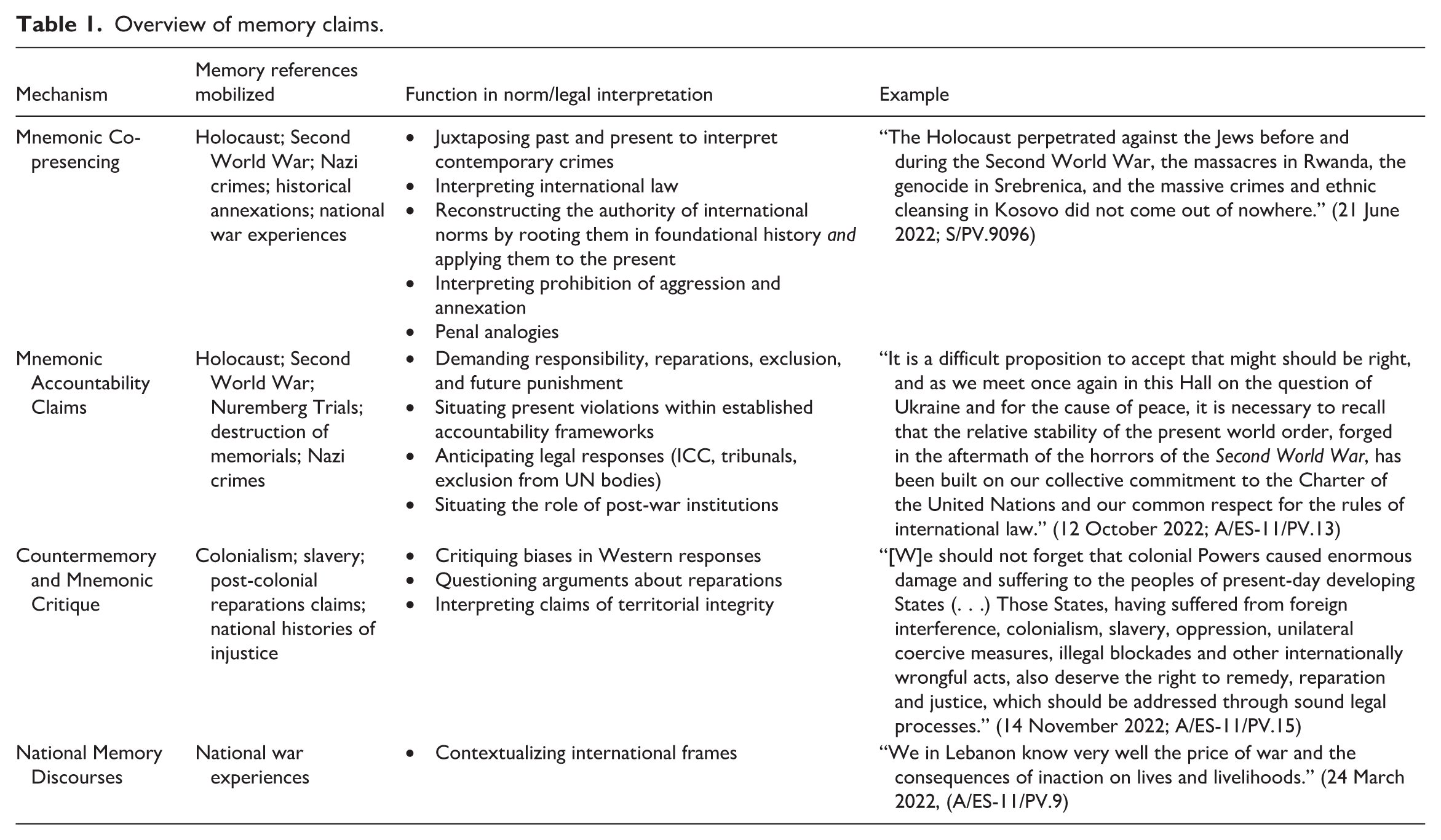
We illustrate three mechanisms describing the nexus between mnemonic invocations and norm legitimation: mnemonic co-presencing, mnemonic accountability claims, and countermemory and mnemonic critique. These mechanisms are often cross-cutting, and cannot be completely disentangled from each other, and we highlight this accordingly in our analysis. Across speakers, these speeches often invoked similar historical memories and references: the Holocaust, the Second World War, colonialism, and other national experiences. Our analysis, then, explores these themes, studying their use in situating and interpreting the legal norms. These mechanisms and the entanglements between national and international memories are highlighted in Table 1, including examples of their use and the legal norms they were connected to.
Overview of memory claims.
Mnemonic co-presencing
We define mnemonic co-presencing as the simultaneity of two or more memories, from different times and/or places. While this might seem to hold true for all remembering and memories in general, we delineate mnemonic co-presencing as a form of purposeful use of a memory of the past usually in relation to a situation in the present. Two or more memories are being presented together, in the sense that what happened a long time ago is presented as being in a specific relation of relevance to something that we experience in the now-time. Mnemonic co-presencing can take different forms, like analogy, mimesis, juxtaposition, or allegory.
Illustrating the mechanism of mnemonic co-presencing to link memory discourses with norms and international law, states drew on memories of the Second World War to delegitimize Russia’s actions in Ukraine, focusing on questions of aggressive war and annexation. Bob Rae, the Canadian UN Ambassador, condemned Putin’s land grab in Ukraine as the largest since World War II. The annexed territories encompass an area of 109 square kilometers. Rae recalled Russia’s annexation of the Baltic states during World War II: It is about the same size as the three Baltic countries illegally annexed by Stalin in 1940. We must remember that point because after the occupation of the three Baltic countries by the Soviet army, the rate of participation in the “elections” of the new constituent assemblies reached a staggering 99.6 per cent in 1940 following the invasion and annexation by Stalin’s Government. Ironically and oddly, that figure of over 99 per cent resembles the results of the so-called referendums held in the four illegally occupied regions of Ukraine that Russia has just attempted to annex. (Bob Rae; October 12, 2022; A/ES-11/PV.14)
By drawing a historical analogy between the behavior in World War II and the present, the Canadian ambassador emphasized Russia’s existing imperialistic intentions. Putin wants to rebuild a Russian empire, which he has publicly announced in his speeches. However, this is incompatible with the UN Charter, which sets out a fundamental norm—codified in international law and frequently invoked in global politics—which opposes territorial conquest. By comparing Russia’s past actions with those in the present, the ambassador highlighted the illegitimacy of current behavior.
By juxtaposing two aggressions and violations of international norms, one of which—the USSR’s claim to have annexed the Baltic states—has already been established as illegal, the second is mimetically portrayed as illegal, epitomizing a penal analogy (Baciu 2025). Rae subsequently quoted paragraphs from Article 2 of the UN Charter on territorial integrity and the obligation of states to peaceful dispute resolution, further linking the memory to the text of the law. By recalling past crimes and invoking the UN Charter and its recognition by almost all countries in the world, Russia’s present behavior in Ukraine is evaluated as illegal, and Putin’s claims of acting based on the UN Charter are step by step delegitimized. Even more specifically, drawing on the memory of the Baltic states further challenges Russian arguments centering on referendum and breakaway states, a more particular example that speaks specifically to aspects of Russian policy in eastern Ukraine. It sets out a clear historical analogy—the wrongness of referendums like these under conditions of occupation as well as their non-democratic nature—which then leads to the legal argument that the results of such a referendum must be understood as violations of territorial integrity. This serves a twofold purpose—legitimating one legal interpretation while simultaneously challenging another.
In another example of mnemonic co-presencing, the representative of Albania alliterated the Holocaust and a series of genocide events expressing their similarity to Russia’s aggression in Ukraine: The Holocaust perpetrated against the Jews before and during the Second World War, the massacres in Rwanda, the genocide in Srebrenica, and the massive crimes and ethnic cleansing in Kosovo did not come out of nowhere. (Arian Spasse; March 14, 2023; S/PV.9280)
The reference to the Holocaust precedes the mention of the UNSC briefing S/PV.9096 of 21 June 2022, which deals with incitement to violence and associated atrocities in the context of the Ukraine war. Thus, remembering the Holocaust serves as a signal for the escalation potential posed by Russia’s actions in Ukraine. This is achieved through the analogy with other genocide events that also began with aggressive rhetoric and incitement to violence against a people. International law’s role in atrocity prevention and human rights protection, then, is restated and interpreted in light of the ongoing conflict. The invocation of these memories provides the speakers with a call to action, urging the listener to understand Russia’s actions as behavior that may lead to similar atrocities in the present.
In an attempt to delegitimize Russia’s justification for the attack, the American representative at the United Nations condemned Putin’s attempt to manipulate the memory of the Holocaust and distort its history. The Holocaust reference came after a sentence in which Richard Mills mentioned norms such as human rights and fundamental freedoms, assuring that violations of these norms by Russia in contemporary times were taken very seriously: Russia has also sought to justify its war through cynical attempts to distort the history of the Holocaust. That disinformation detracts from serious, critically important worldwide efforts to combat anti-Semitism, including Holocaust distortion. (Richard M. Mills; January 17, 2023; S/PV.9245)
Mnemonic co-presencing of the Holocaust in this case and Russia’s attempt to justify the invasion reinforces the contested nature of memory claims in IOs. Different speakers may reference the same historical events to wildly different ends. Invocations of international memory discourses, then, may reflect an attempt to justify one’s interpretation of an event or the international legal norms surrounding it or they may serve to counter a rival claim, challenging the interpretation of the historical event in question. Even more likely is that it is both—this means, in countering the rival’s invocation of history, the speaker further outlines the acceptability and appropriateness of their interpretation.
The American representative proclaimed the universalized motto “never again” and invoked the globally shared memory of World War II to emphasize the primary source of collective security and the shared commitment to the UN Charter. Russia’s attack on Ukraine was considered an attack on the idea of the collective institution of the UN, founded after World War II with the goal of preventing such atrocities. In the sentence before, the second of the speech, Linda Thomas-Greenfield mentioned that there would be a vote on Resolution A/ES-11/L.5 on that day, which has ontological value not only for Ukraine and Europe, but also for the institution of the UN. Remembering the past and the undisputed commitment to “never again” serve as a basis for legitimizing the vote in favor of the resolution. The UN General Assembly Resolution A/ES11/L.5 addresses the territorial integrity of Ukraine during the illegal Russian invasion and was adopted with 143 votes in favor, 5 against, and 35 abstentions. It was a significant support that gave comprehensive legitimacy and recognition to norms such as state sovereignty and territorial integrity.
Another example of the mnemonic co-presencing mechanism to link norms and memory is the remembering of Nazi crimes conveyed by the Permanent Representative of Ukraine to the United Nations during an open briefing on the Ukraine war initiated by Russia: Let me recall that the Blitz was a German bombing campaign against the United Kingdom in 1940 and 1941. Casualties and losses included more than 40,000 civilians killed and thousands upon thousands injured. Two million houses were damaged or destroyed. It sounds almost like what Russia is doing today in Ukraine. Members might ask why I mention Church House. It is not because we are talking about religion today, but because the very first meeting of the Security Council (see S/PV.1) took place in Church House, Westminster, London. Were Russia to be a peaceful nation and not one bombing Ukraine today, as Nazi Germany bombed the United Kingdom then, it would be precisely today when they would be celebrating the seventh anniversary of the Security Council. (Sergiy Kyslytsya; January 17, 2023; S/PV.9245)
The remembrance of the Blitz attack on Church House in Westminster and the analogy to Russia’s actions in the present are further emphasized by a figure of speech using counterfactual conditional logic. Kyslytsya emphasized that if Russia had not attacked Ukraine, that day would probably have been remembered for the first UNSC meeting held in Church House in Westminster. The anniversary of the first UNSC meeting thus legitimizes the remembrance of the Blitz attack from 1940 to 1941. Kyslytsya continued his speech by mentioning norms such as religious freedom and human rights, quoting from past speeches in the Security Council condemning human rights violations. While this strengthened the legitimization of everyday international norms such as human rights, the Ukrainian representative also condemned Russia’s abuse of its UNSC seat.
In a further example of mnemonic co-presencing of past and present memories to associate remembrance to norms and international law, on 12 October 2022, during the 13th Plenary Meeting of the 11th Special Session of the General Assembly, the Ghanaian representation to the UN recalled the Second World War in connection with norms such as collective responsibility, institutions, and respect for international law. Although international law is not uncontested and is increasingly challenged, the reference had a legitimizing effect.
It is a difficult proposition to accept that might should be right, and as we meet once again in this Hall on the question of Ukraine and for the cause of peace, it is necessary to recall that the relative stability of the present world order, forged in the aftermath of the horrors of the Second World War, has been built on our collective commitment to the Charter of the United Nations and our common respect for the rules of international law. (Harold Adlai Agyeman; October 12, 2022; A/ES-11/PV.13)
This reference was made in the opening of the speech by Ghana’s representative, Harold Adlai Agyeman. He recalled the atrocities of World War II in his first sentence. In the same sentence, the collective commitment to the UN Charter and the shared respect for norms and international law are also emphasized, positing a clear link between the memory and the relevant legal rules. The commitment to international law and respect for international norms are reiterated in the following sentence. The remembrance of the past acts as a legitimization of norms and the UN institution, to whose Charter all member states have committed themselves. After the reference to the Second World War, there was a remark about the implications of the war for the UN as an institution and how the aggression weakens international law, with the representative emphasizing Ghana’s commitment to the norm of sovereignty and the territorial integrity of Ukraine.
National and international memories as mnemonic co-presencing
Intertwines between national and international memories are a distinct form of mnemonic co-presencing, juxtaposing a national and an international memory with the aim of coupling remembrance with norms and international law. National memory discourses are useful in normative and legal interpretation, as they help contextualize international frames. For example, national memory discourses were invoked by Pakistan. Ambassador Munir Akram, in the context of the developments in Ukraine, recalled the referendums in Jammu and Kashmir, mentioned in two UN resolutions from 1948 and 1951 but never conducted. Akram emphasized the right to self-determination while attempting to delegitimize India’s activities in Jammu and Kashmir. He referred to the territorial accession of Jammu and Kashmir to India as illegal occupation and a violation of international law, specifically the two UN resolutions stipulating a referendum. The dispute between India and Pakistan was one of the first international conflicts in the UN Security Council after the Middle East conflict. The conduct of a referendum (“plebiscite”) in the state of Jammu and Kashmir for the resolution of the conflict between India and Pakistan was ordered in UNSC Resolutions 47 of 21 April 1948, and 96 of 10 November 1951. The legal enforceability of these resolutions in the present is contested. While UN Secretary-General Kofi Annan referred to the resolutions as “advisory recommendations,” António Guterres in 2020 called for their implementation, conditional on the fulfillment of stipulated premises. Although the two referendum situations may not seem directly comparable, the remembrance of the referendum resolutions of 1948/1951 serves as a delegitimization of the current status of Jammu and Kashmir while also calling into question the conduct of referendums and the tensions surrounding border disputes and norms of territorial integrity. The Pakistani ambassador also sued the international community’s passivity toward the Indian “illegal annexation” of Kashmir despite the UN resolutions.
Another example of the interweaving of norms and mnemonic processes before the United Nations through co-presencing national and international memories is the speech by Lebanon’s representative, Amal Mudallali. He recalled World War II and the failure to stop the war in time, resulting in over 80 million casualties. This was complemented by a reminder of Lebanon’s national past: “We in Lebanon know very well the price of war and the consequences of inaction on lives and livelihoods” (A/ES-11/PV.9). The fuse of national and international memories highlighted the active shared responsibility in the present to stop the war. Lebanon suffered a violent civil war between 1975 and 1990 and fought three wars against Israel, preceded by ongoing disputes between Hezbollah and the Israeli army, which also led to Israeli attacks in Lebanon. In particular, the collective memory of the invasion of Lebanese territory by Israeli soldiers in response to Palestine Liberation Organization attacks in Israel, costing an estimated 1000–2000 lives in just 7 days, left a lasting impact. Invoking these memories, then, situates Lebanon as a state with a similar historical experience which is then drawn on to point to appropriate normative and legal reactions in the context of Russia’s invasion of Ukraine.
More broadly, these national memory discourses appeared to be used as a way for a speaker to contextualize the implication of an international frame. The quote from the representative of Lebanon, for example, employs a national memory of war—and its accompanying suffering—alongside an international memory (the Second World War). In doing so, the speaker frames their position as shaped by a domestic historical memory which, in turn, is helpful in understanding an international memory and which ultimately is linked back to the necessity of international action in this case. National memory discourses, then, may give speakers a way of further contextualizing their framing and interpretation of an international event and the accompanying international norms. These frames may serve a supporting function, then, being less internationally salient than other memory claims but giving the speaker an important tool for nuancing their claims and interpretations. These frames may also resonate with listeners who can analogize the domestic experience into their national memories, providing them with a further reason to agree with the speaker’s interpretation of the international norms.
To sum up, this subsection has shown that mnemonic co-presencing functions as a discursive mechanism through which past and present are deliberately juxtaposed to interpret and evaluate Russia’s invasion of Ukraine. By mobilizing memories of the Holocaust, World War II, historical annexations, and national experiences of war alongside contemporary events, speakers at the United Nations link remembrance to international norms and legal principles, particularly sovereignty, territorial integrity, human rights, and collective security under the UN Charter. These mnemonic invocations operate in a contested field, simultaneously legitimizing specific legal interpretations and delegitimizing rival claims. Through both international and national memory references, mnemonic co-presencing thus reinforces normative authority, contextualizes legal arguments, and strengthens calls for collective action in response to the Russo-Ukrainian war.
Mnemonic accountability claims
Mnemonic accountability claims refer to demands or assertions that agents should be held responsible for their actions in the present or based on how they remember, interpret, or publicly represent the past. Memory in this case is intertwined with moral, political, and legal responsibility. Mnemonic accountability claims can take the form of demands, accusations, or calls for action.
One example of mnemonic accountability claim comes from the Polish representative in the context of condemning the destruction of historical sites of memory, including historical buildings and Holocaust memorials, by Russian aggression in Ukraine. This mention was made in the context of advocating for a right to compensation as an international norm. In his speech on 14 November 2022, in the General Assembly in the context of the vote on Resolution A/ES-11/L.6 “Furtherance of remedy and reparation for aggression against Ukraine,” Szczerski condemned Russia’s violation of international norms and international law in Ukraine. Through Szczerski, the remembrance of the national past is linked to the attempt to legitimize an international norm of compensation while emphasizing the future of Ukraine and the importance of material factors: Moral gestures are welcome but never enough. It is material compensation that is needed to rebuild damages caused by wars. We need to create the registry because it is fundamental for the future of Ukraine. Poland knows only too well from its own history what it means when such actions are forsaken. [. . .] It should also not be forgotten, as Poland stressed in the Security Council in May, that apart from the human casualties, the Russian aggression keeps causing destruction to cultural sites in Ukraine. Religious sites, historic buildings, monuments, Holocaust memorials and other artefacts are still being damaged and looted on a daily basis. (Krzysztof Szczerski; November 14, 2022; A/ES-11/PV.15)
Szczerski emphasized the right to compensation and proposed the creation of an international register documenting the damage to Ukraine. By mentioning Holocaust memorials, not only the norm violation associated with the destruction of such monuments is emphasized, but also the materiality as a medium of remembrance, and form of accountability (Steele, 2013), while revealing the cross-cutting dimensions of mnemonic co-presencing and accountability claims. Whether in the form of statues, museums, or other physical artifacts, monuments serve as material spaces of remembrance that transpose history into the present. As a representative of the global crisis and the extent of destruction and uncertainty caused by Russia’s war in Ukraine, the Second World War is remembered. Furthermore, the speaker combines international and domestic memories and responses as part of this process. The international memory of the Holocaust and the accompanying importance of remembrance is intertwined with a set of domestic memories—of Poland as a state with a particular experience in the Holocaust and which has carried out a process of remembrance, linking the speaker to states who may have shared national experiences, a point which will be further explored in a following section. Here, though, invocations of the historical memory of the Holocaust—and the importance of preserving those memories—provide a way of interpreting and applying international legal norms of reparations and redress in the face of severe violations. Legal debates of the questions of a restitution registry, according to the speaker, should be understood in light of a shared understanding of the Holocaust and the necessity of institutionalizing and sustaining systems of memorialization.
In another example of the nexus between memory discourses and accountability, Ghana’s representative, Harold Agyeman used mnemonic references to delegitimize the justification for the war of aggression. He delegitimized Russia’s justification for the war, making it clear that the instrumentalization of memory and the past for justifying unacceptable behavior is prohibited: Indeed, that is why we cannot share the arguments that some have sought to make by referring to unacceptable past actions of other Member States in justifying the present unacceptable actions. Apart from the inappropriateness of using historical wrongdoing to justify present unacceptable actions. (Harold Adlai Agyeman; October 12, 2022; A/ES-11/PV.13)
This statement highlights the interactions between memory and processes of legitimation. Agyeman criticizes the instrumentalization of the past for self-serving purposes. Specifically, he condemns the remembering of past “unacceptable actions” of some states as an illegitimate source for justifying “present unacceptable actions.” In other words, just because an event happened in the past does not make it a legitimate source of justification to be repeated. This may also be seen as a contestation as to which memories are appropriate to use when interpreting this situation. The speaker sets out first their historical claims—the Second World War and the UN Charter system—and then turns to claims of others, highlighting the differences between them and situating the second as inappropriate. By delegitimizing the alternative memory claim, the speaker also calls into question the legal argument—an interpretation of state sovereignty—that the contesting speaker had set out to make.
Mnemonic accountability claims made frequent reference to the Second World War, alongside references to the Holocaust more broadly, situating statements on wartime violence and atrocity, accountability mechanisms, the simultaneous importance and fragility of post-war conflict resolution institutions, and questions of aggressive war and annexation.
During interventions in the Security Council, for example, the Ukrainian representatives twice referred to Nazi crimes during the Second World War. Serhii Dvornyk quoted from the Nuremberg Tribunal’s judgment against a Nazi propagandist, who was held accountable for his actions, to draw a comparison with Russian propaganda as a means of warfare and evoke anticipative accountability: The many similarities with the Russian course of action, including in the Security Council, make it clear that the Kremlin criminal regime should also find itself in the docks after its military defeat in Ukraine. It will be up to a future tribunal to establish the accountability of all those responsible for issuing criminal orders, for implementing those orders and for whitewashing them for internal and international audiences. (Serhii Dvornyk; March 12, 2023; S/PV.9280)
The remembrance of the Nuremberg Trials also serves to anticipatively legitimize future accountability and punishment for Russia’s crimes. This aligns with our expectation that international memory will serve an important role for analogizing the appropriate legal response. By drawing the comparison to the Nuremberg Trials—and revealing, once more, the cross-cutting dimension with mnemonic co-presencing—the speaker uses a shared memory to purposefully establish the appropriateness of international criminal accountability and to indicate what type of law is at stake here.
A further example of mnemonic accountability claim is illustrated by the Danish ambassador to the UN, speaking on behalf of the delegations of Finland, Iceland, Norway, and Sweden, recalling the Second World War and the atrocities and crimes associated with it to legitimize Russia’s exclusion from the UN Human Rights Council: We also welcome that the International Criminal Court has opened an investigation into the situation in Ukraine. Due process in the pursuit of accountability will be ensured. In the meantime, the Human Rights Council should not and will not be tainted by the full—fledged membership of a State accused of perpetrating—and continuing to perpetrate—some of the most horrific war crimes seen in Europe since the end of the Second World War. (Martin Bille Hermann; April 7, 2022; A/ES-11/PV.11)
The speech took place on 7 April 2022, during the 11th Plenary Meeting of the 11th Special Session of the General Assembly. Martin Bille Hermann emphasized the incompatibility of norm violation and membership in the UN Human Rights Council, as well as the mandate of UN institutions to support international cooperation and peace, making the use of these institutions as venues for disinformation and propaganda unacceptable. Hermann legitimized Russia’s exclusion from the UN organ as a form of accountability while welcoming the investigations of the International Court of Justice. He connected these investigations with the norm of accountability, employing the historical memory here to situate the severity of the crisis and justify the decision.
To sum up, this sub-section has shown that mnemonic accountability claims purposefully mobilize shared memories of past atrocities and norm violations to specifically demand accountability, responsibility, reparations, exclusion, or future punishment for present actions. Historical memories may serve to link not only to the criminality of the atrocities during the war, but also to the accountability which followed. Harkening to the post-Second World War accountability systems—as well as the UN’s place as an organization focused on preventing similar atrocities from happening again—speakers set out to position Russia’s accountability aligned with the historical goals of the organization. The role of the historical memory here is twofold. First, remembering plays a role in situating the egregious nature of the violation and the appropriateness of exclusion as a legal response. Second, it situates the role of the UN more broadly, as something borne out of a shared historical event and a commitment to prevent similar occurrences in the future.
Countermemory and mnemonic critique
Countermemory refers to alternative or oppositional memories that challenge dominant versions of the past. With critique being usually in tension with existing norms and aiming to challenge meta-narratives, mnemonic critique epitomizes a framework for highlighting how memories shape political and social realities, evoking the power dimensions of remembering. In most examples, memories of colonialism were invoked in different aspects of the discussion and to different ends. These references appeared particularly salient during discussions of remedy and reparations and the resolution UNGA/ES-11/5 “Furtherance of remedy and reparation for aggression against Ukraine.” Several states, including Syria, the Democratic Republic of Congo, Eritrea, Cuba, or Nicaragua, recalled the colonial past and condemned “Western double standards” when voting against the resolution. In their discourses, they attempted to delegitimize the resolution. These countries vocalized a perceived double standard of Western states and the lack of reparations, for example, in the case of colonial countries, even though they were demanded. For instance, the representative of Eritrea stated: [W]e should not forget that colonial Powers caused enormous damage and suffering to the peoples of present-day developing States. We also recall detrimental external interference in the internal affairs of sovereign States, including foreign interventions and invasions in Asia, Africa, Latin America and the Caribbean. Those States, having suffered from foreign interference, colonialism, slavery, oppression, unilateral coercive measures, illegal blockades and other internationally wrongful acts, also deserve the right to remedy, reparation and justice, which should be addressed through sound legal processes. (Sophia Tesfamariam; November 14, 2022; A/ES-11/PV.15)
Some countries, despite recalling the colonial past and condemning different normative standards, voted for the resolution, such as Kenya or the Caribbean countries, while others abstained, like Pakistan, South Africa, or Sierra Leone, or were absent from the vote, like Venezuela or the Democratic Republic of Congo. Some countries, like South Africa, attempted to legitimize their behavior toward the resolution through mnemonic processes: During the past seven decades, the Assembly has heard clarion calls for reparations for slavery, colonialism, apartheid and many other contemporary conflicts. Regrettably, in all those instances we have not been able to find agreement on reparations due to the opposition of many that are co-sponsoring today’s draft resolution. We are clearly sending a message of exceptionalism and that reparations matter in some cases and do not matter in others. The United Nations loses its credibility when it is seen to be partisan and exercising double standards in its work. As Member States, we should refrain from perpetuating such practices . . . For all these reasons, South Africa is unable to vote in favour of the draft resolution and will abstain. (Mathu Joyini; November 14, 2022; A/ES-11/PV.15)
In these cases, the remembrance of the past served a certain self-legitimization for positioning against this resolution. They also combined national memories of colonialism with the international memory, allowing speakers to identify themselves in relation both to each other and to the “wrongdoer.” This revolves around norms such as accountability or justice for the serious violation of international law, from which they themselves suffered without receiving the same attention as the war in Ukraine. Especially countries that were victims of the criminal behavior of Western states in the past found it challenging to support the resolution for reparations for Ukraine. This is because it not only neglects previous reparations claims of post-colonial countries to the UN, but could also create a perceived dangerous precedent by legitimizing “reparations” through an unclear process in the General Assembly, a concern which may be more clearly understood in the context of the accusations of hypocrisy and a mistrust of former colonial states who appeared to have had a sudden change of heart on a sensitive issue.
To conclude, this sub-section has shown that countermemory and mnemonic critique operate as tools for challenging the legitimacy of dominant normative claims by exposing perceived and power asymmetries. By invoking memories of colonialism and unaddressed reparations, several states contested the moral authority and legal coherence of the reparations framework advanced for Ukraine, framing it as an instance of Western exceptionalism and double standards. These mnemonic interventions functioned both as counter-legitimation—undermining the resolution’s credibility—and as self-legitimation, situating states’ voting behavior within unresolved historical injustices. Countermemory thus reveals how past unredressed harms continue to shape contemporary norm contestation, highlighting the fragility of consensus on accountability and justice in international law when historical inequalities remain institutionally unresolved.
The nexus between memory and international law
As theorized in this article, speakers make frequent use of historical memory to situate and interpret norms—particularly those associated with international law and legal rules—when speaking at the UN. We illustrated three mechanisms capturing the nexus between memory and international law: mnemonic co-presencing, mnemonic accountability claims and countermemory with mnemonic critique. Frequently, these mechanisms have cross-cutting functions, and can be entangled with each other. As the above analysis has explored, and as Table 1 highlights, mnemonic invocations in IOs function in a variety of ways. They analogize current moments in light of shared references, they situate legal questions into the historical context that led to their creation—in doing so arguing about how these legal rules are to be interpreted—and they question or critique memory uses by other speakers by offering different interpretations of the past and its relationship to the present. They also provide speakers with a way of linking international questions and events to domestic memories. Furthermore, as the statements discussed in this article have illustrated, historical memory is invoked throughout these debates and by a range of speakers.
Moreover, our analysis of memory discourses in the UNGA and UNSC after Russia’s full-scale invasion of Ukraine demonstrates the conceptual intertwine between national and international memory discourses and the function of remembering in (de-)legitimizing norms. This article has important implications for how we study and understand the role of memory and remembrance in IOs and particularly its role in relation to international law.
The remembrance of memories such as the Second World War, the Holocaust or genocides, often occurs relationally to signal the instability of the norm-based order or a certain normative normality, as well as to draw material-visual parallels or illustrate the dimension of the crisis, both for Europe and the world. Norms such as accountability, sovereignty, punishment, peace, international law, responsibility, or human rights are projected. References to the past are drawn both in a legitimizing and delegitimizing manner, constructing how institutions are to be understood or countering claims made by others.
References at international institutions are consciously selected and utilized, attempting to persuade or influence voting behavior through language. This is evidently stated in the speech by the Ghanaian representative: As the collective custodians of the peace of our world, we must take every necessary action to strengthen the present fragile order. That includes using these debates to send a clear, unified message of support for the Charter and international law, the bases for a stable international system. Not doing so would lead the world towards a historical path of division. (Harold Adlai Agyeman; October 12, 2022; A/ES-11/PV.13)
The question about why some memories are chosen and not others is likely a combination of two factors: first, the experience of the speaker and second, the experience of the target of the claim. For point one, a speaker may be more likely to invoke a memory when it is their memory. So European states, for example, may be more likely to draw on Second World War memories of invasion since these are their memory. Post-colonial states, likewise, are more likely than differently situated states to draw on memories of colonial reparations since they had the experiences. For point two, the experience of the target of the claim, an actor might be more likely to invoke a memory if they think the listener will also resonate with it. If “we” (I the speaker and you the listener) both share some experience of a memory then it may be a more meaningful or impactful memory to invoke. Of course, the question here may be who the relevant listener is—for example, are these statements being made to Russia or about Russia to other states.
Hence, what makes these particular memories especially significant for the legitimation process is linked to how the memory is connected to the speaker and the listener. Memories that are more widely shared—or that have more settled meanings—may be expected to be more effective legitimation tools. So if some of the Second World War memories are more clearly established than post-9/11 or Cold War analogies, they may “work” better in this case. Similarly, these earlier memories may be more shared, at least by speakers. Cold War memories may not resonate as clearly across global and European contexts, for example, and post-9/11 memories may be more diffused or substantively further removed (e.g., invasion vs terrorism) and so they end up being less effective.
Furthermore, countermemories, such as colonial past, show that unaddressed historical harms persist in shaping norm contestation, underscoring the instability of agreement on accountability and justice in international law.
In conclusion, this article has demonstrated that historical memory is not merely invoked at the United Nations but actively structures how international law and norms are interpreted, legitimized, and contested. Through mnemonic co-presencing, accountability claims, and countermemory, speakers strategically situate contemporary legal questions within shared or contested historical frames, linking past atrocities and foundational moments—most notably Second World War and the Holocaust—to norms of sovereignty, accountability, human rights, and collective security. Memory thus operates simultaneously as a source of legal authority and as an object of contestation, enabling both legitimation and delegitimation of claims. Which memories are mobilized, and how effectively they resonate, depends on their relational positioning between speaker and audience, as well as on the degree to which their meanings are shared and settled, and therefore part of affective investments. In this sense, remembrance functions as a (re-)constitutive element of legal argumentation in IOs, shaping not only how norms are justified, but also how the international legal order itself is understood and defended in moments of crisis.
Conclusion—International Organizations as places of remembrance
IOs function as spaces of memory where national and international histories intertwine, thereby legitimizing or delegitimizing norms—and particularly legal norms, as discussed in this article. As memory spaces, IOs provide actors with a forum to interpret and reinterpret norms through the invocation of different types of claims and references. In these international normative spaces, national and international memory discourses resonate within the framework of the agenda and may be linked to particular situations as well as to particular types of norms. As we have set out to consider, this takes on a unique form when considered in the context of international law and legal norms.
This article makes three theoretical contributions. First, we supplement the literature on norm legitimation and IOs (Rapp, 2020; Baciu, 2025; Finnemore and Sikkink, 1998; Lesch et al., 2024 Hofmann, 2024; Wiener, 2004) by exploring the role of memory as a tool of justification. This literature highlights the “reconstitutive role of normative agendas” (cf. Finnemore and Sikkink, 1998: 887), and we provide a theoretical distinction on the (re-)constitutive role of memory in normative spaces. We show that in IOs, this is often achieved—at least in part—through the conditioning of legal references with memory and historical claims. These claims give speakers a powerful rhetorical tool for situating their invocation of the legal norm, offering an interpretation of a rule that builds on a shared understanding of the past. Situating a legal invocation with a reference to the Second World War, for example, allows the speaker to make claims about the nature of the conflict, the role of law, and the steps that should be taken to uphold or fulfill an obligation. The shared nature of the memory, meanwhile, means that these claims are made with a mutually intelligible—and therefore, more resonant and perhaps socially appropriate—claim. Especially in IOs that function simultaneously as memory spaces and spaces for debating norms, the way memory discourses contribute new insights to the matter, constituting the international legal context, is particularly noteworthy.
Second, we consolidate and advance findings of previous works on memory (Assmann, 2003; Bachleitner, 2019; Bell, 2006; Budryte and Resende, 2014), showing that memories are not monoliths. They, like legal norms, are social creations subject to contestation. The resonance of a particular historical claim may be related to particular aspects of an actor’s shared identity—for example, historical memories of colonialism connect back to a state’s historical relationship with these processes—and may be used to speaker to certain audiences. In this article, we explored how these differences may be used to develop different interplays between legal norms and memory during the contestation processes in IOs. We advanced the conceptual discussion of the relationship between national and international memory discourses, showing that while in the national unfolding of memory “shift, deformation, distortion, revaluation,” or renewal can occur, and memory is “fundamentally reconstructive” (Assmann, 2003: 29), these claims also hold for memories in international settings. In international normative spaces, memory discourses can help interpreting international law and atrocity prevention as well as the prohibition of aggression and annexation, situate claims of reparation and memorialization, re-situate the role of post-war institutions, or contextualize international claims.
Third, the novelty of our study consists in offering a conceptual framework for theorizing the link between mnemonic invocations and norm legitimation and international law. We articulate three mechanisms through which mnemonic acts shape norm interpretation, mnemonic co-presencing, mnemonic accountability claims, and countermemory and mnemonic critique, highlighting the entanglements between them on the one side, and between national and international memory discourses, on the other side. Through the interweaving of national and international memory discourses, norms are legitimized or delegitimized in times of war. Memory discourses, then, shape which normative or legal claims are sensible and outline the appropriate interpretation of what behavior they call for. They serve, then, as powerful interpretive tools which give the law meaning in its use and the social resonance needed to make the claims politically useful. The course of one’s own national existence shapes how memories are tinged for the legitimization or delegitimization of norms before the United Nations. Memories, whether of the Holocaust, the Second World War, or the colonial past, play a role of atonement through the emergence of an imaginary. This imaginary takes the form of a metaphysical order of remembering history in the present. Through mimetic processes, analogies between history and the present can be established, simultaneously acting as legitimizing or delegitimizing factors. This happens through situating the norm that is being discussed or by situating the speaker as one who understands the norm in a meaningful way and can offer insights into its interpretation and implementation.
Hence, what we would miss without this study is the exploration of the particular role of memory discourses in legal and legal-adjacent norms, drawing on interdisciplinary scholarship from law and political science to consider the interpretive and justificatory role of mnemonic claims and what they might mean for the use and practice of international law in and through political speech.
In conclusion, processing the past as a historical norm is the beginning of a new understanding arising from the conception of history in the present. In the examined context, remembering is never an expression of the past without simultaneously being one of the barbarism of the present.
Footnotes
Acknowledgements
The authors are grateful to Kathrin Bachleitner, Hana Kubatova, Brent Steele, Stephanie Hoffman, Emmanuelle Blanc, Axel Heck, Eric Sangar, Falk Ostermann, Tyler Girard, Lucrecia Garcia Iommi, as well as the two anonymous reviewers for their valuable comments provided on previous iterations of this paper. We would also like to thank to the Cooperation and Conflict team for the editorial support. Earlier drafts of this article were presented at the “The legitimization of transnational norms through the interweaving of national and international memory discourses” Workshop at the Center for Military History and Social Sciences of the Bundeswehr, Potsdam, as well as the Workshop “Plural Perspectives on Political Contestation. Nothing Is Certain Anymore?” at Kiel University, the ISA Annual Conventions in San Francisco and Chicago, the IR Workshop on Trauma and Foreign Policy at the University of Salzburg, the CEEISA-ISA Joint Convention in Rijeka, and the German Political Science Association Annual Convention in Göttingen.

Funding
The authors received no financial support for the research, authorship, and/or publication of this article.
Declaration of conflicting interests
The authors declared no potential conflicts of interest with respect to the research, authorship, and/or publication of this article.